A White German Shepherd Puppy Was Returned Three Times for Crying at the Door Every Night—Then One Police Officer Finally Followed Him and Discovered Who He Was Trying to Find
PART3:
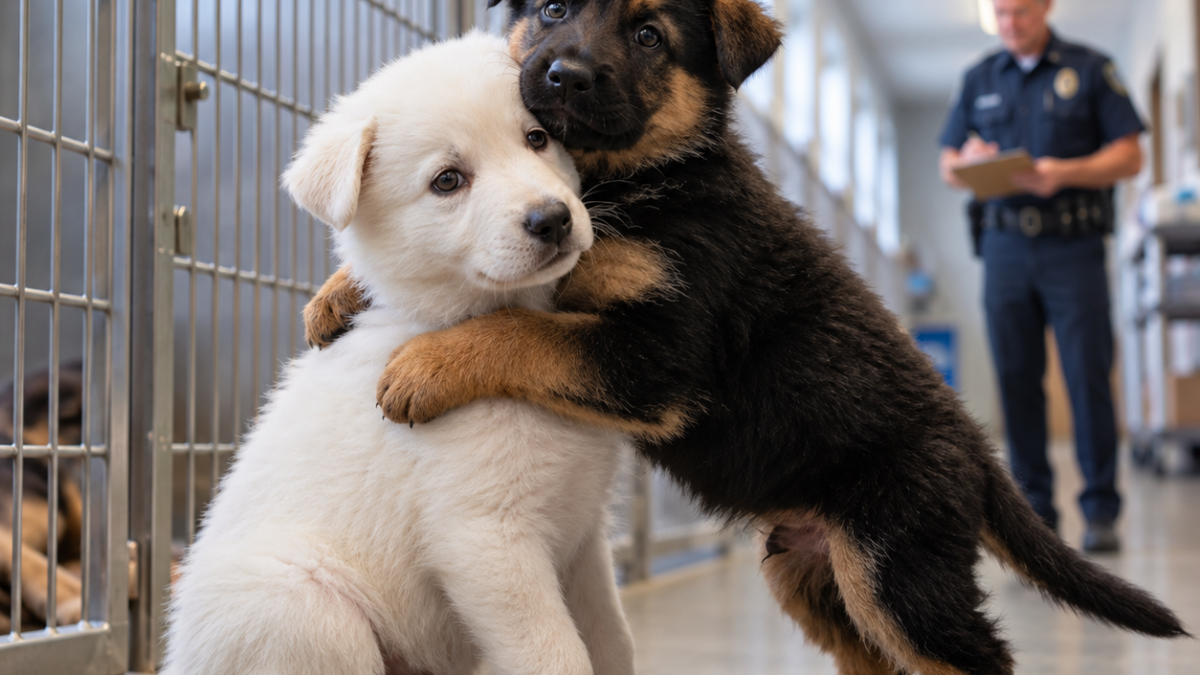
Benny rushed out so fast his paws slipped on the concrete. Frost wriggled from her arms, and she lowered him before he launched himself. The two puppies collided nose-first, sniffing frantically, tails whipping, bodies curling around each other in clumsy circles.
Then Benny did what he had done every time Frost left.
He rose awkwardly onto his hind legs, hooked both front paws over Frost’s shoulders, and pressed his little chest against him.
A hug.
That was what every volunteer called it. Benny’s goodbye hug.
Only this time, Frost was not leaving.
He leaned into Benny so hard they both nearly fell.
The woman in the beige jacket covered her mouth. “Oh.”
Leah looked at the puppies, and a feeling moved through her that was too small to name yet, but too sharp to ignore.
The first time Benny had done that, everyone had laughed softly and taken pictures.
The second time, a teenage volunteer had said, “He knows his brother is leaving.”
The third time, Leah had been too busy reassuring an excited family to think much about it.
Now Frost had been returned three times.
Three families. Three doorways. Three nights of crying.
Three times Benny had watched the white puppy disappear.
And three times, roughly forty-eight hours later, Frost had come back.
Leah crouched beside them.
“Benny,” she whispered.
The black and tan puppy did not look at her.
He was too busy pressing his face into Frost’s neck as if confirming something the rest of them had failed to understand.
The couple left after signing the return paperwork. They cried. Leah told them she understood. She meant it. They had tried. She could see that. But after they were gone and the lobby settled into silence, she stood in the corridor watching Frost and Benny curl together in one small bed while the identical empty bed beside them remained untouched.
A volunteer named Tessa passed with a laundry basket.
“Again?” she asked quietly.
Leah nodded.
Tessa looked at the puppies. “Poor Frost.”
Leah did not answer right away.
Frost slept with his white body curved around Benny’s shoulders.
Benny slept with his nose tucked under Frost’s chin.
Leah said, “Maybe we’ve been feeling sorry for the wrong puppy.”
By afternoon, the story of Frost’s third return had spread through the staff.
Not publicly. Leah did not believe in shaming adopters or turning animals into gossip. But shelters ran on patterns, and everyone had noticed this one now. Frost chosen. Benny left. Frost returned.
“Bonded pair?” Tessa asked during lunch, lowering her voice even though the puppies could not understand.
Leah rubbed her forehead. “They’re eight weeks old.”
“So?”
“Puppies bond quickly. They also adapt quickly. If we label every pair of puppies bonded, we’ll make adoptions harder than they already are.”
“But Frost isn’t adapting.”
Leah looked through the office window toward the puppy corridor.
“No,” she said softly. “He isn’t.”
The problem was not only emotional. It was practical.
One German Shepherd puppy was a commitment. Two were a life rearrangement. Twice the food. Twice the training. Twice the vet bills. Twice the muddy paw prints, chewed shoes, accidents on the floor, and adolescent chaos waiting a few months ahead. If Leah insisted Frost and Benny had to go together, she might doom them both to grow up in the shelter. If she separated them, Frost might keep breaking down in every home.
And Benny—
Leah thought of Benny’s small paws wrapped around Frost’s shoulders.
What happened to the puppy who never cried at the door because he never got far enough away from the shelter to try?
She did not have an answer.
Near closing time, when the light outside turned gold against the damp hills, a marked police vehicle pulled into the parking lot.
Leah recognized the man who stepped out.
Officer Evan Ridley.
Forty-two years old. Local. Quiet. The kind of officer who helped elderly residents carry groceries during snowstorms and once spent two hours catching a loose goat on County Road 12 because animal control was unavailable. Evan had lived in Lanesboro most of his life. He had a reputation for being calm in situations where other people got loud.
Leah also knew he had lost an old German Shepherd two years earlier.
Ranger.
Everyone in town had known Ranger. A massive sable dog with a gray muzzle and patient eyes. Not an official police K9, though children always assumed he was. Ranger had belonged to Evan before Evan wore a badge, had slept beside his boots through night shifts and divorces, through holidays Evan volunteered to work because going home alone was worse than staying useful.
When Ranger died at fourteen, Evan buried him on a hill behind his house and did not adopt another dog.
Until now, apparently.
Leah met him near the front desk.
“Officer Ridley,” she said. “You here on business?”
“Not today.” He removed his hat, looking almost uncomfortable. “I’ve been thinking about getting a dog.”
Leah smiled gently. “Thinking or deciding?”
He glanced toward the kennel corridor. “Somewhere in between.”
That was how Evan did everything. Carefully. Honestly. Without drama.
“What kind of dog are you looking for?” Leah asked.
He put his hat under one arm. “One that needs a home.”
Leah almost laughed. “That narrows it to every dog in the building.”
“I figured.”
“Puppy? Adult? Senior?”
He looked toward the hallway again, and for a moment Leah saw grief pass across his face like a shadow. “I had an adult dog for a long time. I’m not trying to replace him.”
“No one worth adopting from would think you were.”
Evan nodded once.
“I thought maybe a younger dog,” he said. “One that could grow into the house instead of coming in with memories I don’t understand.”
Leah thought about that later.
At the time, she only said, “Then there’s someone I should show you.”
They walked the corridor slowly. Evan stopped for every dog who came forward. That was something Leah noticed immediately. Most visitors scanned. They searched for a color, a size, a feeling. Evan gave each animal a moment of respect. He offered his hand low. He did not force contact. He did not make promises with his face.
Near the end of the puppy row, Frost stood.
His uneven ears lifted.
Benny stood a second later, but stayed behind Frost, close enough that their sides touched.
Evan crouched.
Frost came to the gate and sniffed his fingers. His white tail moved softly.
Benny watched from behind, head slightly lowered.
“That’s Frost,” Leah said. “And behind him is Benny.”
Evan looked from one to the other.
“Brothers?”
“We think so. They came in together.”
Frost sat directly in front of Evan.
Benny sat behind Frost.
Evan’s eyes settled on Frost first, the way everyone’s did.
Leah felt the old pattern begin again.
She made herself speak before hope could mislead anyone.
“Before you get too attached, you should know Frost has been adopted three times.”
Evan looked up.
“And returned three times,” she added.
His expression did not change much, but his eyes sharpened. “Why?”
“That’s the problem. Nobody can tell us anything during the day. He’s sweet. Healthy. Gentle. He bonds with people. Then at night he goes to the door and cries for hours.”
Evan looked back at Frost.
The puppy pressed his nose between the bars.
“Separation anxiety?” he asked.
“Maybe. But not exactly. He doesn’t panic when people leave the room during the day. He doesn’t destroy anything. He doesn’t hide. He just waits at the door once the house gets quiet.”
Benny lowered himself onto the floor behind Frost.
Evan noticed.
“What about Benny?”
Leah blinked.
Most people did not ask that so quickly.
“What about him?”
“Has he been adopted?”
“No.”
“Applications?”
“Not serious ones.”
Evan kept his hand near the gate. Frost licked one finger. Benny’s eyes followed the movement.
“Why not?”
Leah sighed. “Frost gets noticed first.”
Evan was quiet for a moment.
Then he said, “That happens.”
Leah did not know whether he meant with dogs or people.
Maybe both.
Evan did not adopt Frost that evening. Leah respected him for that. He asked questions. He met Frost in a small visiting room. He sat on the floor while Frost climbed into his lap, chewed his sleeve, lost interest, found his bootlace, and fell asleep with his head on Evan’s knee. Benny was not brought in at first. That was shelter procedure. One dog at a time.
But through the glass, Benny watched from his enclosure.
When Evan left, Frost woke and trotted to the gate.
Benny rose.
The two puppies pressed noses through the bars.
Evan paused at the lobby door.
Leah saw him looking back.
The next morning, he returned.
“I thought about what you said,” he told Leah.
“About Frost being returned?”
“Yes.”
“And?”
“I don’t think a puppy should be defined by the first three people who didn’t understand him.”
Leah liked him for that, but liking an adopter did not remove her responsibility.
“Evan, I need to be clear. He may cry. He may keep crying. He may need training, patience, maybe professional help.”
“I know.”
“Puppies aren’t rescue fantasies.”
“I know that too.”
“He could keep you up all night.”
“I work night shifts. I’ve met worse roommates.”
She smiled despite herself.
The paperwork took half an hour.
Frost waited at the front of the enclosure as if he knew his life was changing again. Benny stayed close behind him, quieter than usual.
When Leah opened the gate, Benny moved immediately.
Not toward the opening.
Toward Frost.
He rose on his hind legs and wrapped both front paws around Frost’s shoulders.
This time, Evan was close enough to see the tightness in the gesture. Not playful. Not casual. Benny pressed himself into Frost with a desperation too large for his small body.
No one spoke.
Frost leaned into him.
For a few seconds, the whole corridor seemed to hold its breath.
Then Evan lifted Frost gently.
Frost twisted backward in his arms.
Benny dropped to all fours and stood at the gate.
Leah swallowed.
She had seen dogs cry before. She had heard howls that rose from grief so deep it made humans step out of rooms. Benny did not howl. He did not bark. He did not throw himself against the gate.
He simply watched.
That was worse.
Evan carried Frost down the corridor. Frost kept looking back until the shelter door closed between them.
Benny remained standing long after they were gone.
Evan’s house sat on the edge of town, a modest one-story place with a wide porch, a fenced yard, and a hill behind it where the grass grew wild in summer. Ranger’s old collar still hung on a hook in the mudroom. Evan had meant to put it away years ago. He never had.
When he carried Frost inside, he did not set him down immediately.
He stood just inside the door and felt the strangeness of weight in his arms again.
A living weight.
Warm. Restless. Breathing.
For two years, the house had answered him with silence when he came home. At first, silence felt respectful, like grief needed room. Then it became habit. Then it became something colder. He had started turning on the television before taking off his boots just so the house would not feel like it was listening to him be alone.
Now Frost squirmed.
“All right,” Evan said. “Fair enough.”
He set him down.
Frost explored cautiously. He sniffed the rug, the kitchen table legs, the base of the couch, the hallway, the water bowl Evan had placed near the cabinets. He found a chew toy, ignored it, found a slipper, adored it, and dragged it three feet before tripping over his own paws.
Evan watched from the kitchen doorway.
A small smile appeared before he knew it.
“Well,” he said, “that slipper was never my favorite.”
During the day, Frost was everything the other families had described.
Sweet. Curious. Easy.
He followed Evan from room to room, never underfoot enough to be dangerous, but always close enough to keep track of him. When Evan sat at the kitchen table with coffee, Frost curled under the chair. When Evan stepped outside to check the fence, Frost bounced after him, discovered a leaf, and spent four intense minutes trying to defeat it. When Evan handled his paws, ears, collar, and mouth, Frost accepted it with mild confusion but no fear.
By evening, Evan wondered whether the other families had simply expected too much.
Eight weeks old was young. Too young to be brave alone in a strange house. Too young to understand why one place became another overnight. Maybe Frost only needed someone who did not panic at crying.
Then night came.
At 10:03, Evan turned off the living room lamp.
Frost lifted his head.
At 10:07, he walked to the front door.
At 10:09, the first whine came.
Soft.
Thin.
Persistent.
Evan sat on the couch and waited, because not every problem needed immediate interruption. Frost stayed at the door. His little white body faced the dark wood. His ears tilted forward. After a minute, he looked back at Evan.
Then he whined again.
Evan rose and crouched beside him.
“Need to go out?”
He clipped the leash and took Frost to the yard.
Frost sniffed, peed, wandered, and came back inside willingly.
Five minutes after Evan shut the door, Frost returned to it.
The whining began again.
Evan offered a toy. Frost played for three minutes, then went back.
Evan moved the bed closer to his own bedroom door. Frost lay down, rested his chin on the edge, then stood and returned to the front door.
At 11:30, Evan sat on the floor with his back against the wall.
Frost paced between him and the door.
“Leah said you did this,” Evan murmured.
Frost looked at him.
“You trying to tell me something?”
Frost whined.
Evan had been a police officer long enough to know there was a difference between noise and communication. People lied with words and told the truth with patterns. A frightened person looked toward exits. A guilty person answered questions not asked. A lost child repeated the same detail because it was the only one that mattered. Dogs had patterns too. Ranger had once refused to leave Evan’s truck until Evan noticed a lost toddler’s mitten near a drainage ditch.
Frost did not look terrified of Evan.
He did not hide.
He did not avoid the house.
He simply returned to the door again and again, as though the door was not an exit but an answer.
Evan stayed with him until after midnight.
Frost finally fell asleep near his boot.
The second day was normal again.
Frost ate breakfast, tried to climb into the dishwasher, chased sunlight across the floor, and slept under the kitchen table while Evan completed reports on his laptop. He showed no interest in the door until evening.
At 10:01, the routine repeated.
Door.
Whine.
Look back.
Door.
Whine.
Look back.
This time, Evan watched more carefully.
Frost was not begging to be released into the yard. He did not paw at the handle. He did not scratch. He did not panic when Evan touched him. He waited, cried, and looked back.
Take me.
That was what it felt like.
Not let me out.
Take me.
By the third morning, Evan had slept maybe four hours total.
He was in the kitchen making coffee strong enough to qualify as a medical intervention when he heard something dragging across the floor.
Frost appeared in the doorway.
He had his leash in his mouth.
The leash was nearly longer than he was. He stepped on it twice, stumbled, recovered with great dignity, and dragged it across the kitchen until it lay at Evan’s feet.
Then he ran to the front door.
Evan stared.
Frost looked at the leash.
Then the door.
Then Evan.
Something inside Evan clicked into place.
“Oh,” he said softly.
Frost’s tail moved.
“You’re not trying to leave me.”
Frost whined once.
Evan picked up the leash.
“You’re trying to get me to go with you.”
The drive back to the shelter took eleven minutes.
Frost stood alert in the secured carrier on the passenger seat, nose lifted, ears forward. He did not whine once. The closer they came to the rescue, the more certain his body became. By the time Evan turned into the gravel lot, Frost was trembling with purpose.
Leah looked up from the front desk when he walked in carrying the puppy.
For one painful second, disappointment crossed her face.
Evan spoke before she could.
“I’m not returning him.”
Leah froze.
“He brought me his leash,” Evan said. “I think he wants to show me something.”
Leah stared at Frost.
Frost stared toward the kennel hall.
“Open the door,” Evan said gently.
Leah did.
Frost nearly launched from Evan’s arms, and Evan quickly set him down.
The puppy ran.
He passed the first kennel. The second. A beagle barked. A hound lifted his head. Frost ignored all of them.
At the far end, Benny was already standing.
For one silent second, the two puppies looked at each other through the bars.
Then Frost made a sound Evan had not heard before.
Not the night whine. Not fear.
Relief.
Benny pressed himself to the gate so hard it rattled.
Frost turned and barked once at Evan.
Leah covered her mouth.
Evan crouched and opened the gate.
Benny came out like his heart had been tied to Frost with a string someone finally loosened. He rushed forward, rose onto his hind legs, wrapped both paws around Frost, and held on.
Frost leaned into him.
This time, Evan understood the hug.
At the adoption goodbye, it had meant, Please don’t disappear.
Now it meant, You came back.
Leah’s eyes filled.
“Oh my God,” she whispered.
Frost and Benny dropped back onto all fours but stayed pressed side by side, shoulder to shoulder, as if space itself was now suspicious.
Evan sat back on his heels.
“There’s your answer,” Leah said.
Evan looked at her.
Then at Frost.
Then at Benny.
He should have felt relieved. Mystery solved. Return the puppy? No. Adopt the pair? Maybe. Make a rational plan? Certainly.
Instead, he felt a weight he had not expected.
Because Frost had not been the broken one.
Not alone.
Frost had been chosen three times and lost Benny three times.
Benny had been left behind three times and waited without anyone asking what it did to him.
Leah wiped her cheek quickly. “We should have seen it.”
Evan shook his head. “You see a hundred things a day here.”
“That’s not an excuse.”
“No,” he said. “But it’s a reason.”
She looked at the puppies.
“Two German Shepherd puppies is a lot.”
“I know.”
“I can approve a foster trial. Fourteen days. Both together. We monitor. We see what happens.”
Evan watched Benny settle slightly behind Frost, still touching him.
Fourteen days.
He had walked into the shelter wanting one dog.
Now two pairs of puppy eyes looked up at him, one bold and white, one cautious and dark, and somehow the house in his mind no longer had space for only one set of pawprints.
“All right,” Evan said. “Fourteen days.”
Leah exhaled.
“But I need all the intake paperwork,” he added.
She blinked. “Why?”
“Because bonded this strongly at eight weeks doesn’t always start in a shelter.”
Leah looked toward her office.
Evan stood. “I want to know what happened before they got here.”
That afternoon, Evan left the shelter with two puppies.
The difference began before he reached home.
Frost lay calmly beside Benny in the back crate, no whining, no restless shifting. Benny, who had been cautious in the shelter, kept his body pressed to Frost’s but watched Evan in the rearview mirror with serious eyes.
At the house, Frost led the way as if he had lived there for years and had invited Benny for a tour.
Water bowl. Kitchen. Slipper. Rug. Interesting chair leg. Suspicious laundry basket. Yard.
Benny followed one step behind at first, then two steps beside him, then, when Frost pounced at a leaf, Benny pounced too.
Evan stood on the porch watching them tumble through the grass.
For the first time in two years, the yard sounded alive.
That night, Evan placed two small beds side by side near his bedroom.
Frost sniffed the first and climbed in.
Benny sniffed the second, considered it, and climbed into Frost’s.
The bed was too small. Benny’s back leg hung over the edge. Frost’s chin rested on Benny’s shoulder. Both looked perfectly content.
Evan lifted Benny and placed him in the empty bed.
“Two beds,” he said. “Modern concept. Very useful.”
Benny blinked.
Evan went to brush his teeth.
When he returned, both puppies were squeezed into the first bed again.
The second sat untouched.
Evan looked at Ranger’s old collar hanging on the hook across the room.
“Don’t laugh,” he muttered to the absent dog.
Then he turned off the light.
Frost slept through the night.
No whining.
No pacing.
No door.
At 2:00 a.m., Evan woke automatically, expecting sound. The house was quiet, but not empty. In the hallway, two puppies breathed softly in the same too-small bed.
Evan stood there for a long moment.
Then he went back to sleep.
Over the next few days, Frost changed so dramatically that Evan almost could not believe this was the puppy three families had returned. He became lighter. Playful. Confident. He explored without anxiety and checked in with Evan often. He approached new rooms as though the world was interesting again instead of incomplete.
Benny’s change was quieter.
At first, Evan almost missed it.
Benny stayed near Frost. He followed him from room to room. When Evan called both puppies, Frost usually arrived first. Benny approached after, sometimes stopping behind Frost as if waiting to see whether there was still room.
There was always room.
But Benny did not seem to know that.
One afternoon, Evan’s neighbor Marlene Greer came by with a covered dish because she had heard, in the miraculous way small towns hear everything, that Evan Ridley had gone to adopt a dog and somehow come home with two.
Marlene was sixty-six, retired from the public library, and incapable of entering a house without feeding someone.
Frost bounded to her first.
“Oh, aren’t you beautiful?” she said, bending down. “Look at that coat.”
Benny started forward, then stopped.
He watched Frost receive her attention, then moved back beside the armchair.
Evan saw it.
Marlene noticed a moment later. “And who is this sweetheart?”
She crouched and held out her hand. Benny sniffed politely but did not push closer.
After she left, Evan sat on the floor with both puppies.
Frost climbed into his lap as if ownership had already been legally transferred.
Benny sat just outside reach.
Evan did not call him. Did not coax. Did not lean forward.
He waited.
After nearly five minutes, Benny stood, took two steps, and lay down with his head on Evan’s boot.
Evan rested his hand on the floor beside him, not touching yet.
“You got used to being second,” he said softly.
Benny’s eyes lifted.
“That ends here.”
The investigation into their past began with shelter records.
Leah found the intake form buried beneath vaccination notes and transfer paperwork. Frost and Benny had been brought in by a man named Carl Decker, who said he was “temporarily caring” for the puppies after their owner fell ill. The owner’s name appeared once, almost as an afterthought.
Stanley Barlow.
Seventy-one years old.
Address outside Lanesboro.
Current location: rehabilitation center.
Leah frowned when she read it over the phone. “I remember Carl. He seemed overwhelmed. He told us the owner couldn’t take them back.”
“Did he say they had to stay together?”
There was a pause.
“He said they were close.”
“That’s not the same thing.”
“No,” Leah said quietly. “It isn’t.”
The next day, Evan drove out to the address listed in the file. He brought the puppies, not because he expected them to solve the case like trained tracking dogs, but because sometimes recognition lived in the body before the mind could explain it.
The property sat along a quiet rural road bordered by fields not yet green. The house was small, white, with blue trim and a sagging porch. No car in the driveway. Curtains closed. A weathered feeding dish sat near the steps. Two low hooks were mounted by the porch rail, the kind someone might use to clip puppy leads while working outside.
Benny stood first in the back crate.
His nose worked fast.
Frost rose a second later.
Evan parked by the road and leashed them both.
He let Benny choose.
For once, Benny moved ahead of Frost.
Not boldly. Not fast. But with certainty.
He led them to the porch steps and stopped.
Frost came beside him. Both puppies sniffed the bottom step, the dish, the edge of the porch. Neither barked. Neither panicked. They simply stood there, as if listening for a life that used to be louder.
A curtain shifted in the house next door.
An older woman stepped out onto her porch wearing a cardigan and slippers.
“You looking for Stanley?” she called.
Evan lifted a hand. “Yes, ma’am.”
“He’s not there. Stroke took him in March.”
Evan walked closer but stayed near the road. “I’m Officer Ridley. I’m trying to understand what happened to these puppies.”
The woman’s face changed when she saw Frost and Benny.
“Oh,” she said. “Those two.”
“You know them?”
“Everybody on this stretch knew them. Stanley carried them around like they were made of gold.”
“What happened?”
She came down one step, arms folded against the cold.
“Stanley had a stroke. His nephew Carl came up from Rochester, said he’d take care of things. Stanley kept asking about the puppies. Carl said they were fine.”
“Were they?”
The woman’s mouth tightened. “They were in that yard alone half the time. I fed them twice when I saw their bowls empty. I told Carl they needed more than someone dropping food and leaving.”
Evan kept his face still. “Did Stanley want them surrendered?”
“I don’t know. But I know this. He never would have wanted them split.”
Frost bumped Benny’s shoulder.
Benny leaned into him.
The rehabilitation center sat on the quiet side of town, surrounded by bare trees and a walking path where patients moved slowly with therapists when weather allowed. Evan arrived without the puppies first. He did not want to surprise a recovering man with more emotion than his body could handle.
Stanley Barlow sat near a window in a wheelchair, a plaid blanket over his knees. His left hand rested curled against his lap, weaker than the right. His face had the slight unevenness of stroke recovery, but his eyes were sharp.
When Evan introduced himself, Stanley looked wary.
“Is this about my house?”
“No, sir. It’s about Frost and Benny.”
The names changed him.
His right hand tightened around the blanket.
“They’re alive?” he asked.
The question hit Evan harder than he expected.
“Yes.”
Stanley closed his eyes.
For several seconds, he said nothing.
Then he whispered, “Together?”
Evan pulled a chair closer.
“They are now.”
Stanley opened his eyes.
And Evan told him the truth.
Not cruelly. Not all at once. But truth deserved enough light to be seen. He told Stanley the puppies had been surrendered to the rescue. That Frost had been adopted three times and returned three times. That Benny had not been chosen. That Frost cried at night until Evan brought him back and discovered what everyone had missed.
Stanley’s mouth trembled.
“What about Benny?” he asked again, as if the answer still mattered more than anything.
“He waited,” Evan said.
Stanley looked down at his lap.
“That little dog,” he whispered.
“You knew?”
“That people would see Frost first?” Stanley gave a sad smile. “Everybody did. White shepherd pup? People acted like he was something out of a movie. Benny never pushed. But Frost…” He looked toward the window. “Frost needed him more than people knew.”
Evan leaned forward.
“How so?”
Stanley breathed slowly, choosing words around the lingering difficulty in his speech.
“Frost was brave when Benny was there. New room, new person, loud sound—Frost went first. But if Benny wasn’t close, he’d look around like the floor moved under him. Benny didn’t lead much. But he steadied him.”
That word stayed with Evan.
Steadied.
The puppy no one chose first had been the one keeping the chosen puppy whole.
Stanley told him the rest.
He had taken in the puppies from a neighbor whose shepherd had an accidental litter. He had not planned to keep both, but after three days he stopped pretending there was a choice. They slept together, ate together, explored together. Frost was mischief. Benny was balance. Stanley had intended to train them slowly, find help if needed, maybe keep them through the rest of his old age.
Then came the stroke.
He fell in the kitchen.
He remembered the puppies barking.
He remembered Frost licking his face.
He remembered Benny lying against his side until the ambulance came.
After that, memory became hospital ceilings, bright lights, and people telling him he could not go home yet.
“My nephew said he’d handle them,” Stanley said.
His voice held no anger, which made the grief worse.
“I kept asking. He said they were okay. Then he said they went to a good place. I thought…” He swallowed. “I thought he meant together.”
Evan’s jaw tightened.
“Did you give permission for them to be adopted separately?”
Stanley looked startled. “No.”
“Did you sign surrender paperwork?”
“My nephew brought papers after the hospital. Said it was temporary care authorization.” He closed his eyes briefly. “My hand wasn’t working right. I trusted him.”
Evan had been a police officer long enough to know betrayal rarely looked dramatic from the outside. Sometimes it looked like a rushed signature from a frightened old man in a hospital bed. Sometimes it sounded like, Don’t worry, I’ll handle it. Sometimes no law could fully repair it.
“Would you like to see them?” Evan asked.
Stanley’s face crumpled.
“Yes,” he said. “Please.”
That afternoon, Evan brought Frost and Benny to the rehabilitation center.
The staff cleared a small visiting room.
Stanley waited in his wheelchair with a blanket over his knees and both hands trembling.
The moment Frost entered, he recognized him.
The white puppy surged forward, tail whipping so hard his whole body curved. Evan let the leash loosen. Frost reached Stanley’s chair and pressed against his legs, whining, licking his hand, pushing his head beneath the old man’s palm.
Stanley bent over him.
“There he is,” he whispered. “There’s my Frosty boy.”
Benny stopped near the doorway.
He watched Frost first.
Always Frost first.
Stanley lifted his head.
His eyes found Benny.
He did not call loudly. He seemed to understand that Benny needed something quieter.
“Benny,” he said.
The black and tan puppy’s ears shifted.
Stanley held out his hand.
Benny took one step. Then another. He looked at Frost. Frost moved slightly aside.
That small movement broke Evan’s heart.
Frost made room.
Benny approached until his nose touched Stanley’s fingers.
The old man lowered his hand to the puppy’s head.
Benny froze.
Then slowly, almost painfully, he leaned into Stanley’s leg.
Stanley began to cry.
Not loud. Not dramatic.
Just tears slipping down a face that had already survived too much.
“I’m sorry,” he whispered. “I didn’t know.”
Frost pressed against one side of him.
Benny pressed against the other.
Evan stood by the door and looked away.
Some reunions were too sacred to watch directly.
Before Evan left, Stanley asked a nurse to bring a small bag from his room. Inside were two puppy collars, old and too small now. One pale. One dark. He held them for a long moment before placing them in Evan’s hands.
“I can’t take them back,” Stanley said.
Evan did not interrupt.
“I want to. Every part of me wants to. But wanting isn’t enough.” He looked at the puppies. “They’ll be big. Strong. They need walks and training and someone who won’t fall trying to keep up with them.”
His voice broke.
“I love them too much to pretend I can be that now.”
Evan held the collars.
Stanley looked him directly in the eyes.
“Don’t let them be separated again.”
Evan nodded.
“I won’t.”
The promise settled into the room like a vow.
But promises cost something once you leave the emotional moment behind.
Evan learned that quickly.
Two German Shepherd puppies were not twice as hard as one.
They were closer to five times harder, because every idea became a committee meeting conducted with teeth.
If Frost found a sock, Benny helped kill it. If Benny discovered mud, Frost spread the research indoors. If Evan bought two identical toys, both puppies wanted the same one. If he placed two bowls down, they switched halfway through for reasons known only to them. If he trained “sit,” Frost sat dramatically and Benny sat thoughtfully three seconds later, as if signing a legal document.
There were accidents.
There was barking.
There was one tragic morning involving a bag of flour.
There was a shoe Evan had worn for six years and mourned for six minutes before admitting it had died in a noble cause.
There were vet bills. Vaccines. Food costs. Puppy classes. Crate training. Leash manners. Nights when Evan came home from a long shift and found chaos where silence used to be and wondered whether silence had been underrated.
But every time he imagined returning one, the thought collapsed under its own cruelty.
Returning Frost would repeat the wound.
Returning Benny would confirm the lesson he had already learned too many times: the world chooses the brighter thing first and leaves the quiet heart behind.
So Evan adjusted.
He woke earlier.
He trained separately and together.
He took Benny on short solo walks so he could learn the world did not end when Frost stayed home.
The first time Evan clipped the leash to Benny’s harness and not Frost’s, both puppies looked offended.
Frost stood at the door, tail wagging, ready.
Evan walked past him and crouched in front of Benny.
Benny did not move.
He looked at Frost.
Then Evan.
Then Frost.
Evan waited.
Finally, Benny took one cautious step forward.
Outside, he stayed close to Evan’s leg at first. Then he sniffed the mailbox. Then the edge of the driveway. Then a clump of grass with such seriousness that Evan wondered if Benny had discovered evidence of a felony.
By the end of the walk, Benny’s tail was up.
Not high.
But up.
When they returned, Frost greeted Benny like he had crossed an ocean. They tumbled together on the rug until Evan had to rescue a lamp.
But Benny did not look terrified.
He had left.
He had returned.
The world had held.
Evan began doing small things no one else would notice.
He fed Benny first sometimes.
He greeted Benny first when he came home if Frost barreled ahead.
He praised Frost’s courage and Benny’s steadiness with equal weight.
He taught visitors to acknowledge both puppies.
“Frost is beautiful,” people would say.
“Yes,” Evan would answer. “And Benny is thoughtful.”
At first they laughed, assuming it was a joke.
It was not.
One Saturday, Leah visited to check on the foster placement.
Frost met her at the door with wild joy. Benny came forward a few seconds later, then stopped beside Evan instead of retreating.
Leah noticed.
“He looks different,” she said.
“He’s learning he won’t be overlooked.”
Her eyes softened.
“And Frost?”
At that moment, Frost attempted to climb into Leah’s lap despite having grown significantly in two weeks.
“He’s learning the same thing from the other side,” Evan said.
“What thing?”
“That love doesn’t have to disappear when somebody else gets attention.”
Leah looked at him for a long moment.
“You’re good with them.”
“I’m tired with them.”
“That too.”
The fourteen-day foster period ended on a rainy morning.
Evan loaded both puppies into the patrol vehicle, though he was off duty. Frost watched the windshield wipers with fascination. Benny rested his chin over Frost’s back.
At the shelter, Leah had two adoption folders waiting on her desk.
Frost’s folder was on top.
The order meant nothing.
And also, somehow, everything.
Evan looked at it.
Leah followed his gaze.
Without a word, Evan picked up Benny’s folder and placed it on top.
Leah’s eyes filled, but she smiled.
“You sure?” she asked.
“No,” Evan said honestly.
She blinked.
“I’m sure they belong together,” he added. “I’m sure they belong with me. I’m not sure I’ll ever own matching socks again.”
Leah laughed through tears.
Evan signed Benny’s paperwork first.
Then Frost’s.
The puppies lay under the desk, chewing opposite ends of the same rope toy, completely unaware that one of the most important decisions of their lives had just been made in ink.
Benny did not know he had finally been chosen first.
But Evan knew.
Leah knew.
And sometimes humans need to make meaning on behalf of creatures who only know whether they are safe.
News of the adoption spread.
Most people were happy.
Some were not.
A man who had applied for Frost after seeing his photo online complained publicly that the shelter had “withheld” a desirable puppy by forcing a pair adoption. Another commenter suggested Evan got special treatment because he was a police officer. Someone else wrote that Benny looked “ordinary” and should not have prevented Frost from finding a “better” home.
Leah cried in the shelter office after reading that one.
Evan found out when Tessa showed him the post.
He did not argue online. That was rarely useful.
Instead, he asked Leah for permission to make one statement through the rescue page.
She agreed.
The photo they posted showed Frost and Benny asleep in the same bed at Evan’s house, bodies tangled, Frost’s white chin resting across Benny’s back.
The caption was written by Evan.
Frost was not returned three times because he was difficult. He was returned because none of us understood who he was missing. Benny was not unwanted because he lacked value. He was overlooked because he was quiet. These two puppies are not a prize and a bonus. They are a pair. Sometimes the heart standing in the background is the one holding everything together.
The post was shared thousands of times.
Applications for bonded pairs at the shelter tripled over the next month.
Not every bonded pair could be placed together. Leah knew that. Rescue work was never simple enough for slogans. But people began asking better questions.
Who does this dog look for?
Who makes this cat brave?
Who shuts down when the other leaves?
Who is standing quietly in the background?
Months passed.
Frost and Benny grew at a ridiculous speed.
Their paws became enormous. Their ears finally stood up, though Frost’s left ear still tilted when he was tired. Benny’s coat deepened into rich black and tan, and his body filled out with quiet strength. Frost remained more striking at first glance, white and bright and expressive. Benny became the dog people noticed second and remembered longer.
Training changed them.
Frost learned impulse control, though he considered it an unreasonable human hobby. Benny learned confidence, slowly but beautifully. He began reaching Evan first sometimes. He carried toys away and kept them instead of surrendering everything to Frost’s enthusiasm. He chose resting spots not directly against his brother, though at night they still often ended up touching paws.
Stanley received updates.
Evan visited the rehabilitation center every few weeks at first, then brought the dogs to Stanley’s small assisted living apartment when he transitioned there. Frost always greeted him like a parade. Benny approached more calmly, then leaned against Stanley’s leg with the solemn tenderness of a creature who understood old grief.
Stanley kept the photo of the adoption day beside his bed.
One day, he told Evan, “You know what people get wrong?”
“What?”
“They think Frost was the loyal one because he kept trying to get back.”
Evan waited.
Stanley looked at Benny asleep near his chair.
“Benny was loyal too. He just didn’t have anywhere to go.”
That sentence stayed with Evan.
It changed the way he saw the world.
On calls, he noticed the quiet people more. The child behind the louder sibling. The elderly man who said he was fine while standing in a house too cold for anyone fine. The woman who insisted her boyfriend “just got upset sometimes” while her hands shook around a mug. The teenager who shrugged through questions while his eyes kept moving toward the door.
Not every hurt announced itself.
Some pain barked.
Some waited.
That winter, nearly a year after Frost’s first failed adoption, Evan responded to a call at the shelter.
A pipe had burst overnight during a hard freeze, flooding part of the older kennel wing. No animals were seriously harmed, but staff needed help moving dogs, crates, supplies, and soaked bedding. Evan arrived off duty with Frost and Benny in the back of his personal truck because the dogs had just finished a training session nearby.
Leah met him outside, wet to the knees and exhausted.
“You didn’t have to come.”
“I know.”
Inside, chaos reigned. Volunteers carried towels. Dogs barked from temporary crates. The concrete floor shone with water. Frost stepped in confidently, alert but steady. Benny came beside him.
Several volunteers stopped.
Most had not seen them since adoption.
“My God,” Tessa said. “They’re huge.”
Frost wagged proudly as if size were a personal accomplishment.
Benny stood calmly at Evan’s side.
An older couple arrived during the cleanup. They had come to meet a dog they had seen online, but the appointment was clearly impossible in the mess. Leah apologized, explaining the emergency.
The woman’s eyes drifted to Frost.
“What a gorgeous dog,” she said.
Frost wagged.
Then her husband noticed Benny.
“And this one?”
Evan rested a hand on Benny’s shoulder.
“This is Benny.”
The man crouched, slower than Evan had. He did not reach immediately. He waited.
Benny stepped forward on his own.
The man smiled.
“He has kind eyes.”
Evan looked at Leah.
She looked back.
Something full and quiet passed between them.
Frost had been noticed first again.
But this time, Benny was not invisible.
Later that day, after the burst pipe was controlled and the dogs were settled safely, Leah walked Evan to the door.
“I changed the adoption questionnaire,” she said.
“How?”
“We ask now if the animal has a companion they seek out. We ask staff to document who sleeps near whom, who watches when another leaves, who changes behavior after separation.”
Evan nodded.
“That came from them,” Leah added.
Frost was sniffing a mop bucket.
Benny was watching him, but not anxiously. Just aware.
“They did something good,” Evan said.
“So did you.”
He shook his head. “I listened after three other people walked away.”
“That matters.”
Outside, snow had begun falling lightly over the parking lot.
Evan loaded Frost and Benny into the truck.
Before closing the door, he looked back at the shelter entrance.
He could still see it in his mind: Frost twisting in his arms, Benny standing behind the gate, Leah watching with that look of worry she could not hide.
A goodbye that had almost become permanent.
He closed the truck door gently.
“Not again,” he said.
Spring returned.
Frost and Benny turned one year old.
Evan took them to Stanley’s apartment with two ridiculous birthday bandanas Leah had bought. Frost tried to eat his. Benny tolerated his with quiet dignity. Stanley laughed harder than Evan had ever heard him laugh.
On the way home, Evan stopped at the hill behind his house where Ranger was buried.
He had not brought the puppies there before.
The grass was new and soft. A simple stone marked the place beneath an oak tree. Ranger’s old collar, weathered now, rested in a small sealed box Evan had placed there years ago.
Frost bounded ahead, then slowed as Evan’s mood shifted.
Benny stayed close.
Evan stood at the grave for a long time.
“I waited a while,” he said quietly.
The dogs moved in the grass.
“I thought bringing someone home meant replacing you.”
Frost sniffed the stone.
Benny sat beside Evan.
“But I think maybe love doesn’t work like that.”
The wind moved through the oak branches.
“Maybe a house can hold more than one kind of missing.”
Frost leaned against his leg.
Benny leaned against the other.
Evan looked down at them and smiled.
“Yeah,” he said. “You two would have annoyed him.”
Frost sneezed.
Benny blinked.
The house was never quiet the same way again.
There were still hard days. Days when Frost forgot his size and knocked over a chair. Days when Benny startled at sudden separation and needed reassurance. Days when Evan came home exhausted and found shredded paper across the living room like indoor snow. Days when training felt slow and bills felt high.
But there were also mornings when Frost’s white head appeared first in the front window and Benny’s dark one appeared beside it. Evenings when the three of them walked beneath pink skies along the river. Nights when both dogs slept near Evan’s bedroom door, no longer because they feared being left, but because they had chosen the place closest to him.
And there was one afternoon, ordinary in every visible way, that Evan understood healing had truly begun.
He had a vet appointment for Frost.
Routine. Vaccines. Nothing serious.
He clipped the leash to Frost’s harness while Benny watched from the hallway.
For a second, Benny’s body changed.
Old memory returned.
He hurried forward, rose onto his hind legs, and placed both paws around Frost’s shoulders.
The goodbye hug.
Evan froze.
Frost leaned into him.
Benny held on.
One second.
Two.
Three.
Then Benny let go.
On his own.
He stepped back.
Frost looked at him, then at Evan, tail wagging.
Evan opened the door.
Frost walked out.
The door closed.
Inside, Benny stood facing it for a moment.
Then he turned away, walked to the living room, and lay down in the patch of sunlight near Evan’s chair.
No crying.
No pacing.
No panic.
He knew Frost would come back.
Three hours later, Frost did.
Benny ran to greet him, and the reunion was joyful but not desperate. They sniffed, bumped shoulders, wrestled clumsily, and nearly knocked over the same lamp they had endangered months before.
Evan stood in the doorway laughing.
The old wound had not vanished.
But it no longer ruled them.
That night, after both dogs were asleep, Evan found the two small puppy collars Stanley had given him. They sat on the shelf near Ranger’s old framed photo, too small now for the powerful young dogs snoring on the rug.
One pale collar.
One dark.
For a long time, Evan held them.
He thought about Frost, the puppy everyone wanted until his grief became inconvenient.
He thought about Benny, the puppy nobody rejected outright, because rejection would have required seeing him clearly first.
He thought about Stanley, loving them enough to let go.
Leah, humble enough to change the shelter’s process.
The three families who had failed Frost but accidentally revealed the truth.
And himself, a man who had walked into a shelter asking for one dog because one felt manageable, one felt safe, one felt like enough sound to soften an empty house without turning his whole life upside down.
He had been wrong.
Sometimes love did not arrive in the amount you planned for.
Sometimes it came doubled, tangled together in one too-small bed, asking for more patience than you thought you had.
Sometimes the thing that looked like a problem was really a message.
And sometimes the one everyone noticed first was not the whole story.
Frost had been returned three times.
That was the sentence people began with.
But Evan no longer thought it was the most important sentence.
The most important sentence was this:
Benny was still waiting.
Waiting behind the gate.
Waiting while Frost was chosen.
Waiting while families misunderstood.
Waiting while the world admired the white puppy and overlooked the quiet black and tan one standing one step behind him.
And Frost, in the only way he knew how, had refused to let that be the ending.
He cried at doors.
He carried a leash.
He made one patient officer follow the ache back to its source.
By the time Frost and Benny were grown, people in Lanesboro no longer told the story as “the white shepherd returned three times.”
They told it differently.
They said there were two puppies who had lost their first home, then nearly lost each other because people kept seeing one and missing the other.
They said a police officer figured out that the puppy everyone wanted could not be happy without the puppy nobody chose.
They said the shelter changed because of them.
They said the quiet one learned to step forward.
They said the bold one learned he did not have to cry at doors anymore.
And if you drove past Evan Ridley’s house on a cold evening, you might see two German Shepherds in the front window.
A white one, bright as snow.
A black and tan one beside him, steady and watchful.
Sometimes Frost appeared first.
Sometimes Benny did.
But when Evan’s truck turned into the driveway, both heads lifted.
Both tails moved.
Both dogs ran to the door.
And for the rest of their lives, no one in that house ever had to wonder who would be chosen.
Because the answer was always the same.
Both.
Always both.








