A Waitress Walked 20 Miles Every Day to Feed Homeless Veterans—Then a Navy SEAL Followed Her and His K9 Found the Man Who Saved His Life
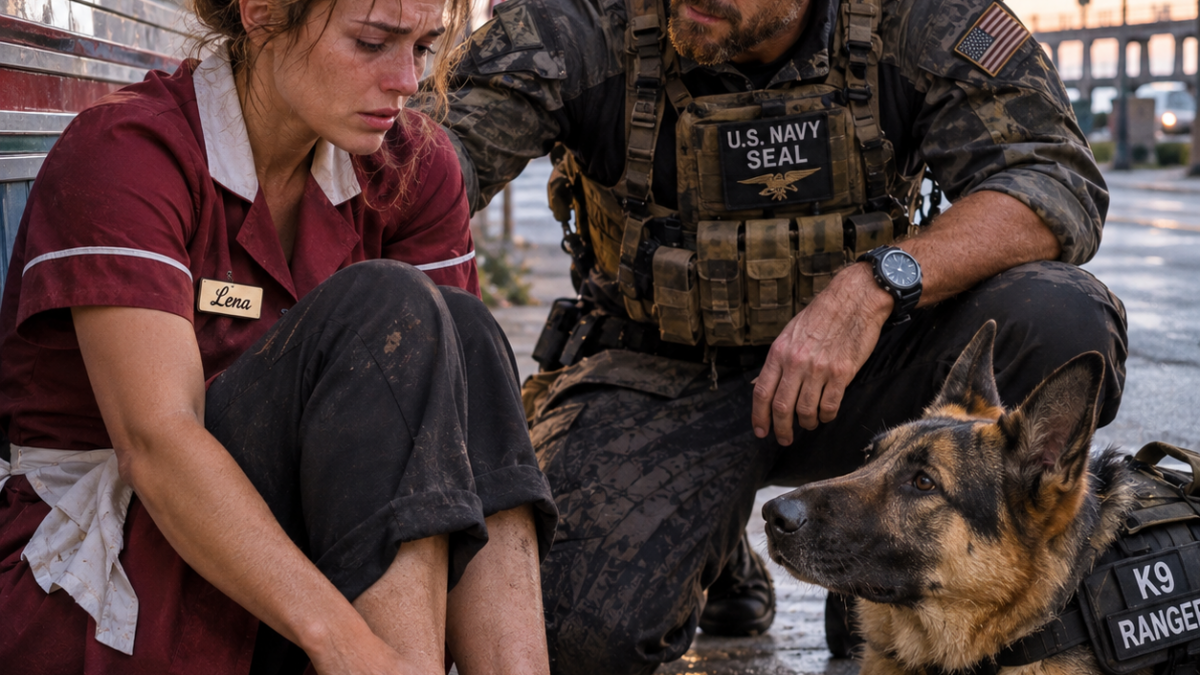
A Waitress Walked 20 Miles Every Day to Feed Homeless Veterans—Then a Navy SEAL Followed Her and His K9 Found the Man Who Saved His Life
For nearly two years, Lena Hayes walked twenty miles a day on bleeding feet, spent her bus money buying meals from the diner where she worked, and disappeared beneath an inlet bridge every night while the wealthy charity owner who employed her told donors he was feeding two hundred homeless veterans across Virginia Beach.
Senior Chief Cole Brennan followed her one evening with his retired K9 Ranger expecting to uncover a secret—and instead watched the dog tear free of his leash, sprint toward a ragged homeless man, and drop at the boots of Navy corpsman Theo “Doc” James, the medic Cole had believed was gone from his life forever.
But Lena’s handwritten notebook of thirty-seven names, Ray’s hidden shipping slips, and the words of one broken combat medic were about to expose something even bigger: Gordon Pierce had been selling donated coats and blankets out the back door while using forgotten veterans as scenery for a $1.2 million fundraising gala.
At 5:11 every morning, Lena Hayes tied her shoes beneath the yellow light of her grandmother’s kitchen.
By 5:18, she was walking.
The first mile was residential.
The second cut behind a gas station and a grocery distribution lot.
By the fifth, the sidewalks narrowed.
By the eighth, they disappeared in places.
By mile ten, she could hear the ocean when the wind came from the east.
Twenty miles total in a day.
Ten out.
Ten back.
Sometimes more if she went beneath the inlet bridge after her shift.
She had been doing it long enough that most people no longer asked why.
The regulars at Pierce’s Harbor Diner simply knew the young waitress with dark hair and a quiet smile always arrived before six, no matter the weather.
Rain.
Heat.
Cold.
Wind.
One morning in February, sleet coated the shoulder of Shore Drive and Lena still walked through the kitchen door at 5:56.
Ray Dorsey, the diner’s night cook, looked at the clock.
Then at her.
“You’re insane.”
Lena pulled off wet gloves.
“Morning, Ray.”
“Every morning.”
“Coffee?”
“You need a car.”
“I need coffee.”
“You need both.”
Ray was sixty-one and had worked inside that kitchen for twenty-two years.
He had the permanent expression of a man disappointed by every generation after his own, but Lena had learned not to take it seriously.
He poured her a cup.
Then looked down.
Her right shoe had a red spot near the heel.
“Your foot again.”
“It’s fine.”
“Fine doesn’t leak through canvas.”
She looked.
Then shrugged.
“They do that.”
“Feet are not supposed to do that.”
“Mine didn’t read the manual.”
PART2:
Ray muttered something under his breath.
Lena tied on her apron.
At 6:03 the bell over the diner door rang.
Senior Chief Cole Brennan came in with Ranger.
Cole was forty-eight.
Tall.
Quiet.
Hair clipped short even though retirement was only two weeks away.
He had spent most of his adult life in Naval Special Warfare and had developed the habit of scanning a room without appearing to look at anything.
Ranger entered beside him.
Large Belgian Malinois.
Retired military working dog.
Dark face.
Alert ears.
Gray just beginning around the muzzle.
Ranger did not wander.
Did not beg.
Did not care about strangers.
He knew exactly where Cole’s booth was and walked there without being told.
Lena picked up a coffee pot.
“Morning, Senior Chief.”
“Morning, Lena.”
“Ranger.”
The dog looked at her.
She put one hand against her chest.
“Still hate me?”
PART3:
Cole opened the menu without reading it.
“He doesn’t hate you.”
“He stares at me like I owe him money.”
“He stares at everyone like that.”
Lena reached into her apron pocket.
A tiny piece of bacon.
Cole looked up.
“Don’t.”
“I’m not.”
“You are.”
“I’m testing a theory.”
“He doesn’t take food from strangers.”
Lena crouched.
Held out the bacon.
Ranger stared.
One second.
Two.
Then took it gently.
Cole stopped moving.
Lena smiled.
“Strangers, huh?”
Ranger chewed.
Cole looked at the dog.
“He’s never done that.”
“Maybe he likes breakfast.”
“He’s had breakfast.”
“Maybe he likes me.”
Ranger continued staring at Lena.
Something in his posture changed.
Not affection exactly.
Recognition of some sort Cole could not identify.
Lena stood.
“What’ll it be?”
“Eggs.”
“Toast?”
“Yeah.”
“Ranger?”
“Nothing.”
She looked at the dog.
“Your father is very controlling.”
Cole almost smiled.
The diner filled.
Construction crews.
Nurses getting off overnight shifts.
Retired Navy men.
A group from the shipyard.
Lena moved quickly between tables.
Coffee.
Checks.
Orders.
By seven, Cole noticed she had stopped favoring her right foot and started favoring the left.
That meant both hurt.
When she brought his check, he looked down.
“You’re bleeding.”
Lena followed his gaze.
“Again?”
“Your feet.”
“They do that.”
“That’s not an answer.”
“I’m going to change socks.”
“How far did you walk?”
“Here?”
“Yes.”
“Ten miles.”
Cole assumed he had heard wrong.
“How far?”
“Ten.”
“You walked ten miles to work.”
“Yes.”
“You’re walking ten back?”
“Probably.”
“Probably?”
“Unless I get lazy and sleep in the walk-in.”
Ray shouted from the kitchen:
“Don’t give her ideas.”
Cole looked at Lena.
“My truck’s outside.”
“I noticed.”
“I’ll drive you home tonight.”
“Thank you, Senior Chief.”
“Good.”
“But I like the walk.”
He stared.
“That sentence doesn’t make sense.”
“Most of my sentences don’t before coffee.”
She moved away.
Cole looked at Ranger.
The dog watched her go.
That afternoon, Cole mentioned it at base.
Master Chief Walter Brennan—no relation despite the surname, though everyone had joked about it for fifteen years—was helping coordinate Cole’s retirement ceremony.
“Twenty miles?”
“Every day.”
Walter leaned back.
“Maybe she doesn’t own a car.”
“She used to.”
“How do you know?”
“Used to see it.”
“Ask.”
“I did.”
“And?”
“She likes the walk.”
Walter laughed.
“No one likes twenty miles after waiting tables.”
Cole knew.
That was why he returned the next evening.
Lena’s shift ended at 4:30.
She did not go directly home.
Cole sat in his truck across the street with Ranger in the back.
He felt ridiculous.
“You know this is stalking.”
Ranger panted.
“Don’t look at me like that.”
Lena emerged carrying two canvas bags.
Heavy.
She crossed the road.
Turned east.
Not west toward her grandmother’s neighborhood.
Cole frowned.
“That’s not the way home.”
He waited.
Then drove slowly.
Kept distance.
Ranger stood.
Nose against rear window.
Lena stopped at a convenience store.
Came out with bottled water.
Then kept walking.
Three miles later, she turned beneath the Inlet Bridge.
Cole pulled onto the shoulder.
“What is she doing?”
Ranger whined.
Cole opened the door.
“Easy.”
The dog jumped down.
Cole clipped the leash.
They followed.
The concrete columns beneath the bridge formed long gray rooms between shadow and late-afternoon light.
Blankets.
Shopping carts.
Cardboard.
Small tents.
Men and women.
Older mostly.
Some clearly veterans.
Cole recognized posture before clothing.
The way a person sits with their back protected.
The way eyes track exits.
The way people arrange sleeping spaces in rows without discussing it.
Lena walked straight toward them.
“Evening, Miss Lena.”
“Evening, Sergeant.”
A gray-haired man smiled.
“You late.”
“By four minutes.”
“Unacceptable.”
“Eat first, talk later.”
She opened the canvas bags.
Foam containers.
Meals from the diner.
Twelve.
Cole counted.
Chicken.
Mashed potatoes.
Green beans.
Bread.
Lena handed them out by name.
“Frank.”
“Thank you.”
“Mills.”
“Ma’am.”
“Carter.”
“Bless you, girl.”
“Don’t make it weird.”
Then Ranger stopped.
His body became rigid.
Cole felt the leash tighten.
“Easy.”
Ranger stared into the darkness beneath the far side of the bridge.
A man sat alone near a column.
Thin.
Untrimmed beard.
Old field jacket.
Baseball cap pulled low.
He had not moved toward the food.
Lena looked up.
“Senior Chief?”
Cole was still watching Ranger.
“Did you follow me?”
“Twenty miles a day, Lena.”
“That isn’t an answer.”
“I had to know why.”
She looked around.
“Now you know.”
Then Ranger pulled.
Hard.
“Ranger. Heel.”
The dog ignored him.
That never happened.
“Ranger!”
The Malinois surged hard enough that Cole nearly lost the leash.
The homeless man raised his head.
Ranger made a sound Cole had heard only twice in seven years.
A high, broken whine.
Then the leash slipped from Cole’s grip.
Ranger ran.
Straight across the concrete.
People shouted.
Cole followed.
“Ranger!”
The dog reached the man.
Stopped so suddenly his claws scraped.
Then lowered himself.
Not attack.
Not alert.
Submission.
Front legs down.
Head low.
Tail shaking.
The man stared.
His face went white beneath the beard.
“Hey, boy.”
Cole stopped ten feet away.
That voice.
Years disappeared.
Dust.
Helicopter wash.
Radio chatter.
Blood.
A medic shouting for pressure.
Cole whispered:
“Theo?”
The man’s eyes closed.
Lena looked between them.
“Senior Chief, you know him?”
Cole could not answer immediately.
Ranger crawled forward on his belly.
Pressed his head against the man’s knee.
The man’s hand trembled.
Then settled between Ranger’s ears.
“He never forgot me.”
Cole’s throat tightened.
“Neither did I.”
The man looked up.
His name was Theo James.
Hospital Corpsman First Class Theodore James.
Doc.
Attached to Cole’s team in Afghanistan.
Kandahar Province.
Cole had watched Theo carry wounded men through gunfire.
Had seen him work on Rangers, Marines, Afghan commandos, civilians.
Had seen him perform medicine in dust so thick that blood turned brown on gloves.
During one firefight, Cole had been hit badly.
Not enough to kill him immediately.
Enough that leaving him seemed impossible.
Theo carried him almost two miles to extraction despite a bullet wound through his own leg.
Cole remembered waking during the movement.
Seeing Theo’s face above him.
Sweat.
Blood.
Dust.
“You drop me, Doc?”
Theo had answered:
“Medics eat last.”
Then kept moving.
Cole had never forgotten.
When Theo left the Navy years later, he disappeared.
Stopped answering calls.
Changed numbers.
Cole assumed he wanted distance.
By Christmas 2019, nobody knew where he was.
Eventually people stopped looking because there is a cruel line between respecting somebody’s silence and abandoning them inside it.
Cole had wondered for years which side of that line he had chosen.
Now Theo sat beneath a bridge twenty minutes from base.
Twenty minutes.
Cole crouched.
“Doc.”
Theo’s hand remained on Ranger.
“Don’t call me that.”
Cole looked at him.
“Theo.”
“That’s worse.”
“Where have you been?”
Theo gave a dry laugh.
“Apparently under a bridge.”
Lena quietly set down a meal beside him.
Theo pushed it toward an older man nearby.
“Give it to Jimmy.”
Lena pushed it back.
“You haven’t eaten.”
“Jimmy’s younger.”
“Younger people can eat too.”
“Medics eat last.”
Cole looked at him.
Same words.
Different world.
Lena pointed.
“Eat first. Talk later.”
Theo almost smiled.
“That your order?”
“Yes.”
“You Navy?”
“No.”
“Then you can’t order me.”
“Try me.”
Ranger rested his chin on Theo’s knee.
Theo looked down.
His eyes filled.
“Ranger was mine first.”
Cole nodded.
“I know.”
Lena looked surprised.
Theo rubbed the dog’s ears.
“I trained him.”
Cole said:
“When you got out, they reassigned him to me.”
“That’s why he ran.”
Ranger pressed closer.
Theo whispered:
“Traitor.”
The dog licked his hand.
Cole sat on the concrete.
For once, he did not care about the dirt on his uniform trousers.
He had a thousand questions.
Theo wanted none.
So Cole asked one.
“You safe?”
Theo looked around.
“For tonight.”
Cole hated the answer.
Lena finished handing out meals.
Thirty-seven people lived beneath or near the bridge according to her notebook.
Not twelve.
The other meals came from sandwiches, canned food, leftovers she bought, donations from a church kitchen, whatever she could afford.
Cole watched her.
“You pay for those diner meals?”
“Yes.”
“You could just take leftovers.”
Lena’s jaw tightened.
“Then Mr. Pierce calls it stealing.”
“He throws food away.”
“I know.”
“So why pay?”
“Because if I don’t, he owns the story.”
That sentence caught Cole.
“Explain.”
“Gordon Pierce owns the diner.”
“I know.”
“He also runs Harbor Heroes.”
Cole knew that too.
Everyone did.
Gordon Pierce had built himself into one of Virginia Beach’s most visible veteran philanthropists.
Expensive suit.
American flag pin.
Photos with admirals.
Photos with politicians.
Photos serving meals beneath bridges.
His foundation’s slogan appeared on local television:
NO VETERAN IN VIRGINIA BEACH GOES TO BED HUNGRY.
The charity claimed two hundred hot meals every night.
Winter coats.
Blankets.
Emergency shelter.
Job support.
Saturday’s Navy gala would honor Pierce.
Donors had pledged more than $1.2 million.
Lena looked toward the thirty-seven people under the bridge.
“You see Harbor Heroes trucks?”
Cole thought.
“No.”
“They came twice this winter.”
“Twice?”
“When cameras were here.”
Theo laughed quietly.
“Good lighting.”
Lena continued.
“The day after filming, nothing.”
Cole looked around.
“Where do the donations go?”
“That’s what I want to know.”
“Why don’t these people go to the foundation?”
“They tried.”
One veteran called from behind them:
“Three-month wait for intake.”
Another:
“They told me bridge outreach comes nightly.”
Lena nodded.
“It doesn’t.”
Cole stared toward the water.
Then at her shoes.
“Why walk?”
She looked down.
“I sold my car in March.”
“Why?”
“The gas money feeds three more people every week.”
“And the bus?”
“Six dollars a day.”
“That’s nothing.”
“That’s two meals.”
Cole stared.
She shrugged.
“My math works.”
“Your feet don’t.”
“They’re dramatic.”
He stood.
“My truck is three miles back.”
“Then you better start walking.”
He looked at her.
“You’re walking home?”
“Yes.”
“I’m walking with you.”
“You don’t have to.”
“I know.”
Theo looked up.
“Don’t make her your mission, Cole.”
Cole turned.
Theo’s face was guarded again.
“I’m not.”
“You always need one.”
Cole held his stare.
“You were never a mission.”
Theo looked away.
That night, Lena’s grandmother opened the front door and saw three figures under the porch light.
Lena.
Cole.
Ranger.
The old woman looked at Lena’s feet first.
Then Cole.
“So you’re the Navy man who drives my grandbaby home?”
“Senior Chief Cole Brennan, ma’am.”
“Tonight we walked.”
She nodded.
“Good.”
Then looked at Ranger.
“And who is this?”
“Ranger.”
The dog stared.
Cole said:
“He doesn’t take food from strangers.”
Grandma Hayes disappeared inside.
Returned with a piece of roast chicken.
She held it out.
Ranger took it immediately.
Cole sighed.
She laughed.
“Then I better not be a stranger.”
Inside, she put food on the table.
“Sit.”
Cole started:
“Ma’am, I—”
“Eat first. Talk later.”
He looked at Lena.
Lena grinned.
“So that’s where you got it.”
Grandma Hayes sat.
“My son used to say it.”
“Your son?”
“Marcus Hayes.”
Lena’s father.
Corporal Marcus Hayes.
Marine.
Iraq.
He came home wounded.
Not only physically.
Grandma Hayes described a man who rarely slept and sometimes sat on the floor beside the kitchen door until sunrise because bedrooms felt unsafe.
Every Tuesday, volunteers connected to the VA brought soup.
No press.
No camera.
Just soup.
“They didn’t fix him,” she said.
“They showed up.”
Marcus eventually died years later from complications of injuries and illness.
Lena had been young.
But she remembered Tuesdays.
Her grandmother looked at Cole.
“She never forgot.”
Then toward Lena.
“Now she walks twenty miles to be somebody’s Tuesday.”
Cole did not sleep well that night.
The next morning he went straight to Master Chief Walter Brennan.
“Doc’s alive.”
Walter went still.
“Say that again.”
“Theo James.”
Walter stood.
“Where?”
“Under the Inlet Bridge.”
“How long?”
“Three months that Lena knows.”
“Twenty minutes from base.”
“I know.”
Walter looked furious.
At himself.
At Cole.
At everybody.
“He got out in nineteen.”
“I know.”
“Stopped answering.”
“I know.”
“We figured he didn’t want finding.”
“He still doesn’t.”
Walter sat.
Cole rubbed both hands over his face.
“My retirement ceremony’s in two weeks.”
“Admiral Hail confirmed.”
“I’m not standing up there without him.”
Walter looked at Cole.
“Then go get your medic.”
“He’s not a package.”
“I know.”
“He has to choose.”
“Then give him something worth choosing.”
Cole nodded.
Walter added:
“And look into Harbor Heroes.”
Cole looked up.
“Why?”
“Pierce shows up at every Navy event with a camera.”
“I know.”
“If what that girl says is true…”
Walter did not finish.
He did not need to.
Cole spent the next days doing something he was good at.
Not investigating formally.
Observing.
He was careful.
He did not misuse military access.
Did not call law enforcement friends for favors.
Did not pull government databases.
He asked questions any citizen could ask.
Public charity filings.
Foundation claims.
Event schedules.
Donor materials.
Harbor Heroes advertised:
Two hundred meals every night.
Thousands of coats annually.
Hundreds of blankets.
Emergency outreach trucks.
But Lena’s notebook showed thirty-seven recurring people beneath one of the city’s most visible veteran encampments.
Meals documented nightly.
No charity truck most nights.
Then Ray quietly approached Cole at the diner.
“You asking about Pierce?”
Cole looked at him.
“Maybe.”
Ray wiped his hands.
“Come with me.”
Behind the diner stood a large storage building.
Locked.
Gordon used it for Harbor Heroes donations.
Ray knew the code because kitchen staff occasionally moved canned goods there.
Inside were boxes.
Coats.
Blankets.
Canned food.
Hygiene kits.
Some marked with donor organizations.
Some tagged for winter veteran outreach.
Ray pointed toward a stack.
“These came in last month.”
“Delivered?”
“No.”
“Why?”
Ray looked toward the back loading door.
“Because they leave the other way.”
He showed Cole discarded shipping labels.
Cash-buyer invoices.
Warehouse transfers.
Not enough by themselves to prove a crime.
Enough to ask more.
Ray said:
“Coats go Friday.”
“Where?”
“Cash buyer.”
“Blankets?”
“Same.”
“And the bridge?”
“Gets a truck Saturday if the cameras are there.”
Cole stared at him.
“How long have you known?”
Ray looked ashamed.
“Long enough.”
“Why stay quiet?”
“Twenty-two years in that kitchen.”
“Pierce owns your job.”
“My rent too.”
Gordon Pierce owned several low-cost rental properties used by staff.
That was how control worked.
Wages.
Housing.
Schedule.
Reference.
Ray said:
“I kept slips.”
Cole looked at him.
“What slips?”
“Everything he told me to burn.”
That changed things.
Before they could decide what to do with it, Gordon discovered Lena’s meals.
He called her into the diner office.
Not privately.
He wanted witnesses.
Ray stood near grill.
Cole and Ranger were in their usual booth.
Gordon came through kitchen holding register records.
He was fifty-six.
Silver hair.
Tailored jacket.
Flag pin.
The kind of face local television trusted immediately.
“Miss Hayes.”
Lena stopped.
“Yes?”
“Twelve meals a night leave this kitchen.”
“Yes.”
“Twelve.”
“Yes.”
“You want to explain?”
“I pay for them.”
She pulled receipts from apron.
“Ray rings them.”
Ray stepped forward.
“That’s true, Gordon. I ring her up myself.”
Gordon looked at him.
“Stay in your kitchen, Ray, or go find another one.”
Ray stopped.
Gordon turned to Lena.
“You feed people under my donor bridge with food from my restaurant.”
“I buy food from the diner.”
“You make Harbor Heroes look like liars.”
Lena looked at him.
“You don’t need my help for that.”
The diner went silent.
Gordon’s face changed.
“Excuse me?”
“You tell people you feed two hundred veterans a night.”
“You have no idea what my foundation does.”
“I know thirty-seven names.”
“Names?”
“People.”
“Those people refuse services.”
“Some.”
“Many are addicts.”
“Some.”
“Some are dangerous.”
“Some.”
“You’re not qualified to help them.”
“I feed them.”
Gordon laughed.
“That’s not helping.”
Lena looked him in the eye.
“They seem less hungry afterward.”
Cole almost smiled.
Gordon did not.
“Apron.”
Lena stared.
“You’re fired.”
Ray stepped out.
“Gordon—”
“Apron.”
Lena slowly untied it.
Ranger stood.
Not growling.
Alert.
Gordon looked at the dog.
“Get that animal out of my diner.”
Cole rose.
“Ranger hasn’t moved.”
“And who are you?”
“A customer.”
Gordon looked at Cole’s posture.
Then Ranger.
Perhaps recognized him vaguely.
Perhaps not.
Lena folded the apron.
Placed it on counter.
Then picked it back up.
“Keep the apron, Mr. Pierce.”
She walked out.
Gordon shouted after her:
“You’ll regret embarrassing me.”
She did not turn.
Cole left money on table.
Followed.
Outside, Lena was already walking.
Cole caught up.
“You got fired.”
“Yes.”
“Because you fed them.”
“Apparently.”
He looked down road.
“You’re walking?”
“Yes.”
“Then I’ll walk with you.”
She stopped.
“Don’t do this.”
“Do what?”
“Make me your mission.”
“That’s the second time someone said that this week.”
“I’m serious.”
“So am I.”
“I’m nobody’s mission.”
Cole looked at her.
“You never were.”
She continued walking.
Ranger beside them.
Three miles later they reached bridge.
Theo was gone.
So were several others.
Cardboard spaces empty.
Lena’s face changed.
“Where are they?”
An older veteran named Darling looked up.
“Doc left before sunrise.”
“Why?”
“He said you’d lost enough because of us.”
Lena closed her eyes.
Darling handed her an old Navy cap.
Theo’s.
“He left this.”
Cole took it.
Theo never removed that cap.
Not ever.
Cole looked at Ranger.
“Find Doc.”
Ranger smelled the cap.
Then the ground.
Pulled west.
Theo was found hours later near an abandoned service road.
Sitting on a concrete barrier.
He looked at Cole.
“You really sent the dog?”
“He volunteered.”
Theo looked at Lena.
“You lost your job.”
“Yes.”
“Because of us.”
“No.”
“Twenty miles a day.”
“Still my feet.”
“I made it worse.”
Lena stared at him.
“You didn’t make it worse.”
Then:
“You made it seen.”
Theo looked away.
“That’s why Pierce is scared.”
Cole sat beside him.
“Saturday.”
“What?”
“Harbor Heroes gala.”
“No.”
“Admiral Hail will be there.”
Theo stood.
“No.”
“Press.”
“No.”
“Donors.”
“Cole.”
“Pierce gets microphone at nine.”
Theo’s voice sharpened.
“I said no.”
Cole held out the Navy cap.
“Ranger remembered you.”
Theo looked at it.
“He remembers everybody.”
“No.”
Cole shook his head.
“He doesn’t.”
Theo took cap.
Cole continued.
“Afghanistan, 2012.”
“Don’t.”
“You carried me two miles.”
“Stop.”
“With a bullet in your leg.”
“Stop.”
“You saved six men in that valley.”
Theo turned.
“And Danny?”
Cole was silent.
Theo’s eyes filled with rage.
“There it is.”
“Theo.”
“I had Danny in my hands.”
“You had seven casualties.”
“I had Danny.”
“You were shot.”
“He died.”
“You saved six.”
“A medic who can’t save his own guy—what is he good for?”
Ranger moved between them.
Pressed against Theo.
Cole’s voice softened.
“Seven years.”
“What?”
“He still sleeps by the door.”
Theo looked down at Ranger.
“He never forgot you.”
Cole swallowed.
“Neither did I.”
Theo’s shoulders dropped.
“You were never supposed to find me.”
“Maybe.”
“Then why now?”
Cole looked toward Lena.
“She walks twenty miles.”
Theo almost laughed.
“That your answer?”
“She shows up.”
Silence.
“She doesn’t fix everybody.”
“She shows up.”
Theo stared at the cap.
Cole continued.
“Saturday, Pierce is going to tell the whole city he feeds two hundred veterans.”
Theo looked toward bridge.
Cole said:
“Thirty-seven people know different.”
“Who believes thirty-seven homeless vets over Gordon Pierce?”
“Everyone who sees evidence.”
“You have evidence?”
“Not enough yet.”
Theo put cap on.
“Then get enough.”
That night Gordon Pierce appeared at Lena’s grandmother’s door.
Suit.
Flag pin.
Envelope.
Grandma Hayes opened it.
Gordon smiled.
“No hard feelings.”
She did not invite him in.
“I came to speak with Lena.”
“You can speak from there.”
Lena stepped into hallway.
Gordon held out envelope.
“Simple deal.”
“What?”
“Stop feeding the encampment.”
“Why?”
“Because it interferes with organized outreach.”
“You don’t have organized outreach.”
He ignored that.
“You get your job back.”
Lena said nothing.
“Plus a raise.”
“No.”
“Everybody has a price.”
Grandma Hayes stepped forward.
“Not everybody.”
Gordon looked at her.
She pointed to flag pin.
“My son died for that flag on your jacket.”
His smile disappeared.
“You don’t get to wear it in my doorway while talking to my granddaughter like that.”
Gordon lowered envelope.
Then looked at Lena.
“Come Saturday, those people won’t be under that bridge anyway.”
Lena’s face tightened.
“What does that mean?”
“Good night.”
He left.
That sentence accelerated everything.
Cole called Walter.
Walter called no one illegally.
He simply said:
“If Pierce is moving vulnerable veterans before a public gala, we need lawful eyes on it.”
A local veterans outreach attorney was contacted.
Then city outreach personnel.
Then law enforcement through proper channels after Ray produced records indicating donated property may have been sold.
Nobody wanted Saturday to become a stunt without evidence.
Lena went home exhausted.
She sat at her grandmother’s kitchen table.
“I’m done.”
Grandma Hayes looked up.
“I lost my job.”
“Mhm.”
“I can’t buy meals.”
“Mhm.”
“I can’t keep walking.”
Her grandmother closed the notebook in front of her.
“Who feeds them?”
Lena stared.
“Grandma.”
“You don’t walk twenty miles for people who can pay you back.”
She pushed the notebook toward Cole, who sat across the table.
He opened it.
Dates.
Names.
Meals.
Needs.
Notes.
FRANK — no onions.
MILLS — extra bread.
CARTER — diabetic, no sweet tea.
DOC — refuses first plate.
Two years.
Every night.
Every person.
Thirty-seven names.
Cole turned page.
Then another.
Lena said:
“Grandma, that’s private.”
Grandma Hayes shook her head.
“Every meal. Every date. Every name.”
Cole looked at Lena.
“This is better than any intel I’ve had all month.”
Lena frowned.
“Don’t call it intel.”
“I’m sorry.”
Ray arrived later carrying an old grocery bag.
Inside:
Shipping slips.
Cash receipts.
Warehouse manifests.
Instructions Gordon told him to destroy.
Same donated coats.
Same serial pallet numbers.
Outgoing through back dock.
Cash buyers.
Ray’s hands shook.
“Twenty-two years.”
Lena looked at him.
“You kept these?”
“He told me burn them.”
“Why didn’t you?”
Ray looked at her notebook.
“Same reason you wrote names.”
Saturday came.
The Harbor Heroes gala filled a waterfront ballroom.
Navy uniforms.
Evening dresses.
Donors.
Local press.
Admiral Hail attended.
Retired officers.
Business owners.
Politicians.
A giant screen displayed footage of Gordon Pierce beneath the bridge handing food to veterans.
Those shots had been filmed on the two nights the charity trucks actually came.
A banner read:
200 HOT MEALS. EVERY NIGHT. NO VETERAN FORGOTTEN.
Gordon stood backstage rehearsing.
“Two hundred veterans every single week.”
An assistant corrected:
“Every night, sir.”
“Right.”
The irony would have been funny if thirty-seven people were not hungry.
Cole waited outside with Lena.
She wore a simple navy-blue dress borrowed from her grandmother.
Her shoes were new.
Walter had bought them and refused to discuss it.
Theo stood near the wall.
Clean shaven.
Hair trimmed.
Wearing a dark suit that did not fit perfectly.
He carried his old Navy cap in one hand.
Ranger sat at his feet.
Theo looked ready to run.
Cole said:
“You can leave.”
Theo looked at him.
“What?”
“If you’re here because I pressured you, leave.”
“You need me.”
“I want you.”
“Different?”
“Yes.”
Theo looked toward ballroom.
“My mama always wanted to see me walk into a room like this.”
Cole nodded.
Walter approached.
“Theo James.”
Theo stiffened.
Master Chief looked at him.
“Thought we lost you.”
“You did.”
“For a while.”
Theo looked down.
“I don’t deserve any of this.”
Walter shook his head.
“That uniform never asked if you deserved it, Doc.”
“I’m not wearing one.”
“No.”
Walter smiled.
“But it asks the same question anyway.”
Theo waited.
“Will you show up?”
At nine, Gordon took the stage.
Applause.
Big.
Warm.
He was good.
That mattered.
Fraud does not always look nervous.
Sometimes it looks polished.
“This year, Harbor Heroes fed two hundred veterans every single night because that’s what heroes deserve.”
Applause.
Lena whispered:
“Thirty-seven.”
A microphone nearby picked it up.
Gordon stopped.
“I’m sorry?”
Lena stood.
“Thirty-seven.”
People turned.
Gordon recognized her.
His face hardened.
She walked toward the aisle holding notebook.
“There are thirty-seven veterans under the Inlet Bridge.”
Gordon laughed.
“I apologize, folks.”
Then into microphone:
“That’s a former waitress I dismissed last week for stealing food from my kitchen.”
Murmurs.
Ray stood.
“No.”
Gordon turned.
Ray walked forward with receipts.
“She paid for every plate.”
Gordon’s expression changed.
Ray continued.
“I rang her up myself.”
Gordon pointed.
“Security.”
No one moved immediately.
Then Gordon saw Cole.
Ranger.
Theo.
He laughed again.
“And who is this?”
He pointed at Theo.
“Her bodyguard? Some drifter in Army surplus with a dog?”
Admiral Hail stood.
“That is Senior Chief Cole Brennan.”
The room changed.
Cole spoke calmly.
“With respect, Admiral, I’m not here for me.”
He looked at Ranger.
“Go.”
Ranger crossed the ballroom.
Straight to Theo.
Sat at his feet.
Then leaned against his leg.
Cole said:
“This is Hospital Corpsman Theo James.”
Theo’s eyes lowered.
“Ranger’s first handler.”
People listened.
“Afghanistan.”
“Kandahar.”
“He carried six men out of a firefight.”
Theo interrupted:
“Cole.”
Cole stopped.
Theo took microphone himself.
“I lived under that bridge.”
The room went silent.
“For three months.”
He looked at Gordon.
“Harbor Heroes did not feed us every night.”
Gordon shook his head.
“These people refuse services.”
Theo continued.
“A waitress did.”
Gordon stepped toward him.
“This is a stunt.”
Lena opened notebook.
“Frank Delaney.”
A man near back stood.
“Mills Carter.”
Another.
“Eddie Shaw.”
Another.
She continued.
Name after name.
Some veterans had been brought safely to the gala through outreach workers after agreeing to come.
Thirty-seven names.
Not all present.
Enough.
Lena knew each.
“Tuesday chili. No onions.”
Frank laughed through tears.
“Extra bread.”
Mills raised a hand.
Gordon’s confidence cracked.
Then Ray stepped forward with shipping slips.
“Donated coats went out your back door.”
Gordon’s lawyer began moving.
Ray continued.
“Blankets too.”
“Cash buyers.”
“Same pallet numbers the foundation reported as distributed.”
Gordon snapped:
“You kept confidential company records?”
“I kept slips you told me to burn.”
The room erupted.
Admiral Hail raised his voice.
“Let him finish.”
Ray handed copies to investigators already present pursuant to the inquiry that had begun before the gala.
Gordon looked toward exits.
Then Lena.
“You told me nobody walks twenty miles for charity.”
He said nothing.
She continued:
“Everybody’s selling something.”
Still nothing.
“So what were you selling, Mr. Pierce?”
That was the line cameras caught.
It became the line people remembered.
But the arrest did not occur because Lena delivered a good sentence.
It came because investigators had already reviewed enough documentation to establish probable cause relating to donated goods and charity finances.
The gala was not a theatrical trap.
It was where Gordon finally lost control of the story.
An investigator approached.
“Gordon Pierce.”
He turned.
“You’re under arrest pursuant to the warrant.”
The charges involved charity fraud allegations and theft or unlawful disposition of donated property subject to the investigation.
Gordon looked toward Admiral.
Then donors.
Then cameras.
“Everybody has a price.”
Lena stood still.
“No.”
She shook her head.
“Not everybody.”
The applause began somewhere behind her.
She hated it at first.
It felt wrong.
Then one of the veterans stood.
Then another.
Not for Gordon.
For her.
Lena began crying.
Cole looked at Theo.
Theo looked at Ranger.
The dog sat between them.
Exactly where he belonged.
The aftermath was less dramatic.
Investigations took time.
Accounts.
Donor records.
Inventory.
Warehouse transfers.
Sales.
Advertising claims.
Some money was frozen.
Some goods recovered.
Not every missing coat could be traced.
Not every fundraising statement became a criminal count.
The foundation entered independent oversight while legal proceedings continued.
Donors demanded answers.
The Navy gala committee reviewed its relationship with Harbor Heroes.
The $1.2 million in pledged donations did not simply disappear into the same structure that night.
That mattered.
Cole insisted nobody confuse scandal with service.
Veterans still needed food.
Blankets.
Housing.
Treatment.
The failure of one charity did not eliminate the need that charity had been exploiting.
Lena’s notebook became unexpectedly useful.
Not as evidence of Gordon’s financial crimes by itself.
As a map of people who had fallen between systems.
Thirty-seven names.
Outreach teams began contacting them individually.
Not all accepted help.
Theo did not immediately.
That frustrated Cole.
“Come home.”
“No.”
“Stay with me.”
“No.”
“VA apartment.”
“No.”
“Hotel.”
“No.”
Theo sat under the bridge.
Ranger beside him.
Cole looked exhausted.
“Then what do you want?”
Theo thought.
“A room with a lock.”
“I can get that.”
“No cameras.”
“Okay.”
“No ceremony.”
Cole looked away.
“My retirement is in nine days.”
“I said no ceremony.”
“You don’t have to stand on stage.”
“No.”
“You can sit in back.”
Theo shook his head.
Cole’s voice broke slightly.
“I don’t want to do it without you.”
Theo looked at him.
“Why?”
“Because when people tell my career story, they’re going to say I survived Afghanistan.”
He swallowed.
“They won’t say who carried me out.”
Theo looked down.
Ranger placed a paw on his boot.
“Manipulative dog.”
Cole almost smiled.
Theo eventually agreed to attend.
Back row.
No speech.
That was the agreement.
It lasted fourteen minutes.
At Cole’s retirement ceremony, Admiral Hail recognized Theo from the stage.
Not by surprise.
Cole had asked permission first.
“The man sitting beside Ranger helped bring Senior Chief Brennan home once.”
Theo froze.
Everyone looked.
Cole stepped toward microphone.
“No.”
Admiral paused.
Cole walked off stage.
Went to Theo.
Held out one hand.
“You can stay seated.”
Theo stared.
Then stood.
Slowly.
No uniform.
Simple suit.
Old cap.
Ranger between them.
The room rose.
Theo whispered:
“I hate you.”
Cole said:
“I know.”
Then:
“Eat first. Talk later.”
Theo laughed.
Real laughter.
Maybe the first Cole had heard from him in years.
Lena did not return to Pierce’s diner.
Ray eventually left too.
Twenty-two years was long enough.
A group of local businesses, veterans, and donors created a new meal program under independent oversight.
No one person controlled the money.
Distribution records were public.
Warehouse inventory counted.
Food went where reports claimed it went.
Lena was offered a paid coordinator position.
She refused at first.
“I’m a waitress.”
Grandma Hayes looked at her.
“You were.”
“I don’t know how to run a nonprofit.”
“Good.”
“How is that good?”
“Means you know enough to ask somebody who does.”
She accepted only after experienced administrators were hired.
She kept serving meals.
Not because a viral story made her saint.
Because she liked knowing names.
That remained her rule.
No one became a number.
Frank still hated onions.
Mills still wanted extra bread.
Carter pretended not to like soup and always ate two bowls.
Theo started volunteering one night a week.
Then two.
At first he stood in the back.
Then he began checking feet.
Blisters.
Infections.
Blood pressure.
Medication reminders.
Old instincts returning carefully.
One evening, Lena found him kneeling beside a young veteran cleaning a cut.
“You know you’re doing medic stuff.”
Theo did not look up.
“Don’t call me that.”
“Doc?”
He glared.
She smiled.
“Eat first, talk later.”
He rolled his eyes.
But kept working.
Ranger divided his time between Cole and Theo.
Officially, he remained Cole’s dog.
Emotionally, no one bothered making rules.
Some nights Ranger slept by Cole’s door.
Some nights at Theo’s small apartment.
Cole called it joint custody.
Theo called it theft.
The dog ignored both.
Lena kept walking for months.
Even after people offered rides.
Cole finally cornered her one morning.
“You have a job now.”
“Yes.”
“A salary.”
“Yes.”
“Bus pass?”
“Yes.”
“Then why are you walking?”
She looked at him.
“I like the walk.”
He stared.
She laughed.
“This time I actually do.”
Her feet had healed.
Good shoes.
No blood.
Some mornings Cole walked part of it with her.
Ranger too.
Not ten miles.
Cole had limits.
Lena teased him.
“Thought SEALs were tough.”
“SEALs have trucks.”
The twenty-mile story spread farther than Lena wanted.
Reporters asked:
“Why?”
She always gave the same answer.
“Somebody had to show up.”
They wanted more.
A quote about sacrifice.
Heroism.
Faith.
America.
She refused.
“I walked because bus fare bought food.”
Simple.
That was the truth.
People complicated kindness because simple kindness exposes uncomfortable choices.
Six dollars.
Two meals.
A car sold.
Three more people fed.
Twenty miles.
The arithmetic embarrassed everyone who had more money and fewer excuses.
But Lena never wanted guilt to be the engine.
“Guilt burns out,” she told volunteers.
“Know somebody’s name instead.”
That lasted longer.
Gordon Pierce’s legal case moved through proper proceedings.
Lena testified only about what she personally knew.
Meals.
Employment.
Threats.
Offer to rehire.
His statements.
Nothing more.
Ray testified about warehouse records and instructions.
Investigators handled finances.
Theo testified regarding services beneath the bridge.
Cole’s role was limited.
He had never wanted military rank to become leverage in a civilian criminal case.
That mattered.
The scandal had started with image.
Gordon wore patriotism like branding.
Cole refused to weaponize the real thing in response.
At one hearing, Gordon’s attorney implied Lena had targeted him for publicity.
She answered:
“I walked in the dark for almost two years.”
The attorney paused.
“What does that mean?”
“It means there weren’t cameras.”
That answer traveled.
Not because Lena planned it.
Because truth is sometimes concise.
Harbor Heroes’ old warehouse was eventually emptied under supervision.
Usable donated goods redistributed through legitimate organizations when legally permitted.
Coats finally went to people who needed coats.
Blankets became blankets again instead of inventory for resale.
That mattered to Lena.
Objects had been trapped inside a lie.
Now they returned to their purpose.
Ray cried the first time he watched a Harbor Heroes coat go onto Frank’s shoulders.
He tried hiding it.
Lena noticed.
“You okay?”
“Onions.”
“There are no onions.”
“Shut up.”
Grandma Hayes became famous against her will.
People wanted interviews.
She refused almost all.
One reporter convinced her to answer one question:
“What did you teach Lena?”
Grandma Hayes frowned.
“Teach her?”
“About service.”
“She watched.”
“That’s it?”
“My son came home from Iraq and people brought soup.”
She shrugged.
“We remembered.”
That became another quote people printed.
Grandma hated seeing it on mugs.
“Who makes money off that?”
Lena laughed.
“Probably someone.”
“See? Everybody’s selling something.”
“Not everybody.”
Grandma smiled.
“Good girl.”
Theo improved unevenly.
That part was important.
There was no single gala-night miracle.
No applause curing PTSD.
No K9 recognition erasing guilt.
Some mornings he could not leave the apartment.
Some nights he slept on the floor beside the door.
He missed appointments.
Then hated himself for missing them.
Cole learned not to turn recovery into another mission.
That was hard.
He had spent decades solving operational problems.
Theo was not an operational problem.
One night Cole arrived with groceries.
Theo did not answer.
Cole almost forced the issue.
Then remembered.
He left the bags outside.
Texted:
Food’s here. No need to talk.
Two hours later:
Thanks.
That was progress.
Ranger helped.
Not magically.
Dogs do not cure combat trauma.
But Ranger gave Theo something uncomplicated to care for.
Walk.
Water.
Food.
Brush.
The dog did not ask Theo to explain Kandahar.
Did not ask why he disappeared.
Did not tell him he should be grateful to be alive.
He simply recognized him.
That recognition broke through something human words could not.
Seven years.
Same scent somewhere beneath age, rain, bridge smoke, and grief.
Ranger knew.
Theo once told Lena:
“He was the first thing that looked at me like I was still myself.”
She wrote nothing down.
Some things did not belong in notebook.
Cole retired.
Not completely, according to everybody who knew him.
He still woke at 4:50.
Still folded shirts like inspections existed.
Still called people by rank accidentally.
But he learned how to have mornings without orders.
Sometimes he met Lena for first mile.
Sometimes Theo.
Sometimes both.
Ranger always came.
One Tuesday they carried soup beneath the bridge.
Not because cameras were there.
No cameras.
Lena handed Theo a container.
“Tuesday soup, chef.”
Theo looked.
“Extra bread?”
“Always.”
A young veteran nearby said quietly:
“I don’t have any money.”
Theo handed him the meal.
“Didn’t ask.”
The young man hesitated.
Theo nodded toward seat.
“Eat first.”
Lena smiled.
“Talk later.”
Theo looked at her.
“Don’t steal my line.”
“You stole it from Grandma.”
“Your family steals everything.”
Ranger rested his head on the young veteran’s knee.
The veteran looked startled.
Cole said:
“He doesn’t take food from strangers.”
Lena laughed.
“Apparently nobody here is a stranger.”
That was how the story should have ended.
Not with handcuffs.
Not applause.
A full room.
Soup.
Names.
Ranger asleep under a table.
Theo working again.
Lena still walking because now she chose to.
But there was one more thing.
Two years after the gala, the new veterans meal center opened a permanent location.
Small.
Not glamorous.
A commercial kitchen.
Medical outreach room.
Showers.
Laundry.
Mailboxes for people without addresses.
Lockers.
A quiet room.
No donor wall in the lobby.
Lena insisted.
“If somebody gives because their name needs marble, they can buy a building somewhere else.”
The board compromised.
Donors listed online in annual reports.
Grandma approved.
On opening night, every chair was occupied.
Thirty-seven original names were invited.
Not all survived the two years.
That hurt.
Some had moved.
Some found housing.
Some reconciled with family.
Some disappeared.
A few died.
Lena kept every name in the old notebook.
Not as statistics.
People.
Theo stood near kitchen doorway.
Cole beside him.
Ranger older now.
Gray around his muzzle.
Moving slower.
A young volunteer carried a tray past.
Theo stopped him.
“Where are you going?”
“Table seven.”
“Who?”
The volunteer looked at ticket.
“Robert.”
“Robert what?”
“I don’t know.”
Theo pointed toward Lena.
“She’ll make you learn.”
Lena shouted from kitchen:
“I heard that.”
Theo smiled.
The volunteer laughed.
“Why does it matter?”
Theo looked around the room.
“Because nobody ends up forgotten all at once.”
The young man waited.
Theo continued.
“It happens one name at a time.”
Cole looked at him.
That sounded like Doc again.
Not the wounded man beneath bridge.
Not entirely.
But enough.
Grandma Hayes sat at the center table.
Ranger wandered over.
She held out a piece of chicken.
Cole said automatically:
“He doesn’t take food from strangers.”
Ranger ate it.
Grandma laughed.
“Told you.”
Then looked around.
“Every seat full.”
Lena sat beside her.
“Not one stranger in the room.”
Outside, the sidewalk stretched into the distance.
Ten miles home.
Cole had parked his truck by the curb.
At the end of the night, he jingled the keys.
“Get in.”
Lena shook her head.
“I like the walk.”
Theo groaned.
“Not this again.”
Cole looked at Ranger.
Then at Lena.
“Fine.”
He pocketed the keys.
“Then I’ll walk with you.”
Theo stood.
“Twenty miles?”
“Ten.”
“Still stupid.”
Lena opened the door.
“Coming?”
Theo looked down at Ranger.
The dog was already beside her.
“Traitor.”
They stepped outside together.
No cameras.
No gala.
No applause.
Just streetlights.
Shoes against pavement.
One old K9 moving between three people who had all carried someone farther than they thought they could.
Lena had walked twenty miles a day because six dollars bought two meals.
Cole had followed because he could not understand why.
Ranger followed because somewhere under that bridge was a scent he had never forgotten.
And Theo, the medic who once believed a man who could not save everyone was good for nothing, walked beside them carrying a bag of leftover bread for tomorrow.
Kindness had never been soft.
Grandma Hayes had been right.
It was the hardest walk there was.
And sometimes the only reason anybody made it home was because somebody else decided to walk it with them.








