A Waitress Threw Herself Over a Little Boy as a Glass Cart Crashed Behind Him—Then His Father Asked How She Knew His Name, and Her Answer Left Him Frozen
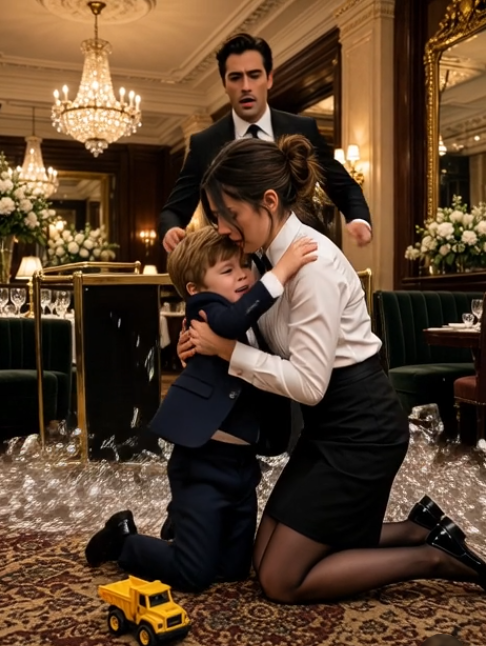
A Waitress Threw Herself Over a Little Boy as a Glass Cart Crashed Behind Him—Then His Father Asked How She Knew His Name, and Her Answer Left Him Frozen.
Emma threw herself over the little boy before the crystal glasses shattered, taking the pain meant for a child who did not know she existed.
She had spent five years believing she would never touch her son again, never hear his laugh, never say the name she had chosen for him in the hospital room where everything was stolen.
Then the boy’s father looked at her through the broken glass, heard her whisper “Leo,” and realized the woman bleeding on the restaurant floor was not a stranger at all.
Emma dropped her tray before she had time to think.
One second, she was standing beside the private booth with a silver serving tray balanced against her hip, refilling water glasses for a table of men who wore watches worth more than her yearly rent. The next, the crystal tower on the service cart beside her trembled.
A careless elbow had struck the cart.
A dozen wineglasses shifted at once.
Emma saw the whole thing happening before anyone else did.
The top row tilted.
The metal wheels caught against the edge of the rug.
The cart lurched toward the booth.
And on the carpet beside it, a little boy sat cross-legged, pushing a red toy car in lazy circles, completely unaware that a glittering wall of glass was about to come down on him.
There were three feet between Emma and the child.
Maybe less.
A man shouted.
Someone reached too late.
Emma ran.
By the time the first wineglass fell, she had already thrown herself over him.
Glass burst against the floor behind her in a violent, musical crash. Something sharp tore across her back. Pain flashed white and hot through her spine, but she kept both arms locked around the child, one hand covering his dark hair, the other wrapped across his small shoulders.
He smelled like clean cotton, expensive soap, and the faint sweetness of chocolate milk.
For one impossible second, Emma forgot where she was.
She forgot the restaurant.
The broken glass.
The customers screaming.
The blood spreading warm under her blouse.
All she knew was the small body beneath her, shaking, alive, breathing against her chest.
And the name slipped out before she could stop it.
“Leo,” she whispered, voice breaking. “Look at me. You’re safe.”
The boy blinked up at her, confused.
His eyes were gray-green.
Exactly the same shade they had been in every dream Emma had tried to survive for five years.
A man in a dark suit came fast from the far side of the room.
He moved through the chaos like someone used to danger obeying him. Tall, broad-shouldered, black hair cut short, jaw shadowed with stubble, his suit tailored perfectly but unable to hide the tattoos climbing from beneath his collar and disappearing under the cuffs at his wrists.
He dropped to one knee beside them and pulled the child into his arms with the reflex of someone who had already imagined losing too much.
“Leo,” he breathed.
The boy clutched him tightly, small fingers digging into the black fabric of his jacket.
“Dad.”
The man looked at Emma then.
His eyes moved from her face to the blood on her blouse, then to the jagged pieces of crystal scattered across the carpet behind her.
“Don’t move,” he said.
It sounded like an order, but there was fear under it.
Emma tried to push herself up.
Pain ripped across her back so sharply that the room tilted.
“I’m fine,” she said automatically.
She had said those words through worse.
Through a hospital bed.
Through stitches.
Through social workers.
Through the first night she had gone home without the baby she had carried for eight months.
The little boy turned in his father’s arms and pointed at her.
“She saved me, Dad.”
The man’s face changed.
The terror softened into gratitude.
Then something colder moved in behind his eyes.
He looked at Emma as if trying to place a half-remembered voice in the dark.
“How do you know his name?”
Emma froze.
Her back throbbed.
Her hands trembled.
The restaurant seemed to narrow around that question.
She looked at the boy’s face, at the small dimple in his left cheek, at the dark curls falling over his forehead, at the familiar gray-green eyes she had once searched for in every crowd, every stroller, every playground she passed and punished herself by looking into.
Tears slipped down before she could wipe them away.
She pushed herself up on one elbow.
“Because…” Her voice broke. “I named him.”
The father’s hand tightened around the child.
For one second, the room went completely silent.
Not actually silent. People were still shouting. A hostess was crying near the bar. The restaurant manager was barking instructions into a phone. Somewhere, water kept dripping from the overturned cart.
But around Emma, around the man, around the child named Leo, the world stopped.
The man stared at her.
His face lost all color.
Then he said her name like it had been buried for years.
“Emma?”
She closed her eyes.
No one had said it that way since him.
Not her coworkers.
Not the landlord who taped late notices to her door.
Not the hospital clerk who called her Miss Hartwell without ever looking up.
Only one person had ever said her name like it was both a question and a wound.
“Dante,” she whispered.
Dante Moretti did not move.
The name traveled through him visibly. His shoulders tensed, then locked. The boy in his arms shifted, sensing the change in his father’s body.
“Dad?” Leo said.
PART2:
Dante looked down at him, and the hardness in his expression shattered for half a second.
“You’re okay,” he said, pressing one hand to the back of the boy’s head. “You’re okay, little lion.”
Little lion.
Emma made a sound she could not stop.
Dante’s eyes flew back to her.
Only three people had ever known that nickname.
Emma.
Dante.
And the newborn baby Emma had held against her chest for less than nine minutes before the nurse took him away and never brought him back.
The restaurant manager rushed over, pale and sweating.
“Mr. Moretti, I am so sorry. We’ve called an ambulance. Security is clearing the area. I don’t know how this happened, the cart was checked, we—”
Dante did not look at him.
“Get my son away from the glass.”
“Yes, sir.”
“No,” Leo said immediately, twisting in Dante’s arms to look back at Emma. “She’s hurt.”
Emma forced herself to smile at him.
It hurt worse than the glass.
“I’m okay.”
Leo frowned.
“You’re bleeding.”
“I know.”
“My dad can fix things.”
Dante’s jaw flexed.
“He can try.”
Two men in dark jackets appeared near the booth. Emma had noticed them earlier because they did not sit like ordinary customers. They stood near exits, eyes scanning the room. Security. Bodyguards. Men who belonged to Dante’s world.
One reached toward Leo.
Dante looked down at the boy.
“Go with Enzo for one minute.”
Leo shook his head.
“No.”
“Leo.”
The boy tightened both arms around his father’s neck.
“No. She saved me.”
The words landed like a verdict.
Dante looked at Emma again, and this time the suspicion was tangled with something much worse.
Hope.
He did not want it.
She could see that immediately.
Hope had teeth when it returned after being buried alive.
“Emma Hartwell died five years ago,” he said quietly.
The words struck harder than the glass.
Emma stared at him.
“What?”
His voice lowered.
“I buried you.”
She shook her head once.
No.
Not possible.
“I didn’t die.”
His face darkened.
“I stood in a hospital chapel while my mother told me your body had already been transferred. I signed papers I was too sedated to read because I had been pulled out of a wreck. They told me you were gone.”
Emma’s breath caught.
“No. No, they told me you left.”
Dante went still.
Behind him, one of the bodyguards muttered something in Italian under his breath.
Emma barely heard it.
Her heartbeat had become too loud.
Dante leaned closer.
“Who told you that?”
She could not answer.
Not because she did not know.
Because the name had lived in her mouth like poison for five years, and speaking it in front of him felt like opening a grave.
“Your mother,” she said.
The last bit of color left Dante’s face.
Emma remembered every detail of Celia Moretti.
Pearls at her throat.
White silk blouse.
Sharp perfume.
Hair pinned perfectly even in a hospital waiting room at three in the morning.
A woman who looked like grief would not dare touch her without permission.
Dante turned his head slightly toward his men.
“Call Dr. Vale,” he said.
One of them stepped away immediately.
“And my mother.”
Emma’s stomach clenched.
“No.”
Dante looked back at her.
“You’re bleeding.”
“I don’t want her near me.”
Something in her voice stopped him.
Not fear.
Not anger.
Old terror.
Dante heard it. She saw that he heard it. His eyes changed again, and beneath the shock, beneath the confusion, beneath five years of being lied to, something protective rose so violently that the air around him seemed to sharpen.
“She won’t touch you,” he said.
The paramedics arrived through the side entrance five minutes later.
By then, the restaurant had been cleared except for staff, security, and the stunned guests in Dante’s private party. Emma lay on her side because the glass in her back made any other position impossible. Leo sat several feet away on a leather bench with Enzo beside him, clutching the red toy car in both hands and refusing to take his eyes off her.
Dante stayed on one knee beside Emma.
He did not touch her.
Maybe he was afraid she would disappear.
Maybe he thought he had lost the right.
Maybe both.
A paramedic crouched beside her.
“Ma’am, can you tell me your name?”
Emma opened her mouth.
For five years, the name Emma Hartwell had been a burden she carried in cheap apartments, late shifts, and court offices that never called back. But hearing Dante say he had buried her made it feel suddenly stolen from her too.
“Emma,” she said. “Emma Hartwell.”
Dante closed his eyes briefly.
The paramedic cut away the back of her blouse.
Cool air hit her skin.
Then the medic inhaled sharply.
“It’s a long laceration, possible embedded glass. We need transport.”
“I can walk,” Emma said.
“No, ma’am, you can’t.”
“I said I’m fine.”
Dante’s voice came low beside her.
“You were never good at lying when you were hurt.”
Emma laughed once.
It came out broken.
“You were never good at knowing when I was telling the truth.”
His face flinched.
She regretted it immediately.
Not because it was false.
Because it was too early.
Too much blood.
Too many people.
Too many years.
The paramedics lifted her carefully onto the stretcher. Pain tore through her so fiercely that the ceiling lights blurred.
“Emma!” Leo cried.
Her head turned instinctively.
“I’m okay, baby.”
The word came out before she could stop it.
Baby.
Leo’s face softened in confusion.
Dante heard it too.
His jaw clenched, but this time not in anger.
In agony.
At the ambulance doors, Leo pulled away from Enzo and ran to Dante.
“Dad, can we go with her?”
Dante looked at Emma.
For a second, they were back in another room, another life.
Emma barefoot in his kitchen, eight months pregnant, laughing because Dante had assembled the crib backward and refused to admit defeat.
Dante kneeling to tie her shoes because she could no longer see her feet.
Dante pressing his hand against her stomach as the baby kicked, whispering, “Little lion.”
Emma saying, “Leo. That’s his name. Strong enough to survive your family.”
Dante laughing then.
Not knowing how prophetic that sentence would become.
Now he stood in a restaurant doorway with their son clinging to him and five years of lies between them.
He looked at the paramedic.
“We’re following.”
The ambulance ride was bright, loud, and unreal.
A paramedic asked Emma questions while another worked on controlling the bleeding. She answered automatically.
Allergies.
No.
Medications.
No.
Loss of consciousness.
No.
Pregnant.
The question struck so unexpectedly that her face twisted.
“No.”
The paramedic noticed, softened, and moved on.
Emma turned her head slightly toward the rear window, where she could see headlights behind them.
Dante’s convoy.
Of course Dante had a convoy now.
Five years ago, he had been dangerous only by association. The youngest son of a powerful family, trying to drag the Moretti name out of old shadows and into legitimate business. He owned restaurants, construction contracts, private security firms, warehouses, real estate. He had enemies because his father had made them, and because Dante had spent years dismantling the kind of operations other people profited from keeping alive.
Emma had met him before any of that became public.
She had been twenty-four and working double shifts at a hotel bar downtown. Dante had walked in with blood on his knuckles, ordered black coffee, and tipped her one hundred dollars for asking no questions.
She had asked one anyway.
“Should I call somebody?”
He looked at her then, really looked, as if people rarely asked him questions that were not calculated.
“No.”
“Should I call an ambulance?”
“No.”
“Should I call whoever did that to your hand and tell them they missed your face?”
He laughed.
That laugh changed her life.
For eight months, Dante Moretti came back to the bar every Thursday night.
At first for coffee.
Then for her.
He never drank alcohol around her because he said men in his family had done enough damage with whiskey and rage. He never lied about being complicated. He told her there were parts of his life he was trying to clean up and parts that might stain him forever. He told her his mother hated weakness, his older brother loved power, and his father had taught both of them the wrong lessons before dying with enemies at every church pew.
Emma should have run.
Instead, she fell in love with the one man in the room who looked relieved when she told him no.
When she became pregnant, Dante did not hesitate.
He bought the crib the same day she told him.
He proposed the next week.
Emma said yes in sweatpants while eating pickles straight from the jar.
For a while, happiness came so suddenly that she did not trust it.
Then Dante’s mother invited her to lunch.
Celia Moretti did not raise her voice. Women like Celia did not need to. She sat across from Emma at a private table in a club where even the flowers looked expensive and explained, very calmly, that the Moretti family was not a place for girls like her.
Girls like her.
Poor girls.
Service girls.
Girls with no family name, no protection, no understanding of what it cost to stand beside a man like Dante.
“You love him,” Celia had said, stirring tea she never drank. “That makes you dangerous.”
Emma had placed one hand over her stomach.
“My child is not dangerous.”
“Every child is leverage.”
Emma left before dessert.
That night, Dante promised her his mother would never control them.
Three weeks later, his car was hit by a truck that ran a red light.
Dante survived.
Barely.
Emma went into early labor from the shock.
After that, memory came in fragments.
Hospital lights.
Pain.
A nurse telling her to breathe.
A cry.
Tiny.
Angry.
Perfect.
A warm body placed against her chest.
Dark hair.
Gray-green eyes barely open.
Dante’s eyes.
“He’s Leo,” Emma whispered.
Then Celia’s voice near the door.
Then medication burning through the IV.
Then sleep.
When Emma woke, the baby was gone.
A doctor she did not know told her there had been complications.
A social worker told her Dante had authorized a transfer.
Celia told her Dante had chosen his family.
And then, two days later, a lawyer placed papers beside her bed and explained that if she tried to challenge the Morettis, she would lose everything she had left.
“But my son,” Emma had whispered.
The lawyer’s face remained professionally sad.
“You signed consent.”
“I didn’t.”
“You did.”
“I was medicated.”
“That would be very difficult to prove.”
Celia visited once more before Emma was discharged.
She wore black.
Not mourning black.
Power black.
“Dante is gone,” she said. “The child will be raised properly. If you love either of them, disappear.”
Emma slapped her.
It was the only time in her life she had ever struck another person.
Celia’s face turned slowly back toward her, a red mark blooming across one elegant cheek.
“You will regret that more than anything you have ever done.”
Emma already did.
Not the slap.
The weakness that came after it.
Because Celia was right about one thing.
Emma had no money.
No family.
No lawyer willing to take on the Morettis.
No access to the baby.
No proof that she had been drugged into signing away the only person she would have died to keep.
So she disappeared.
Not because she wanted to.
Because every door closed.
Because every call went unanswered.
Because the hospital record changed twice.
Because the nurse who had whispered, “I’m sorry,” outside her room suddenly no longer worked there.
Because the court clerk looked at Emma with pity and said, “Miss Hartwell, there is no record of you filing maternal objection.”
Because grief, when mixed with powerlessness, can make survival look like surrender.
But she had never stopped looking.
Not really.
She searched newspapers for photos of Dante.
Watched charity gala coverage online with the sound off.
Looked for any mention of a Moretti child.
Nothing.
No son.
No baby.
No Leo.
For five years, Emma lived with the belief that Dante had hidden him from her completely.
Now, in the back of an ambulance, she had learned Dante believed she had died.
The lie was bigger than either of them.
And it had a name.
Celia Moretti.
At St. Vincent’s Medical Center, Emma was rushed into an exam room. Doctors removed three pieces of glass from her back. The largest had missed anything vital by less than an inch.
“You were lucky,” the surgeon said.
Emma stared at the ceiling.
Lucky had never felt like the correct word for surviving things.
Dante stood outside her room for the entire procedure.
She learned this from a nurse who came in later with antibiotics and an expression she was trying very hard to keep neutral.
“There’s a man in the hall,” the nurse said. “Very intense. Very expensive. Very polite in a way that’s terrifying.”
Emma turned her head.
“Dante.”
“He says he won’t come in unless you agree.”
That hurt.
Kindness, from him, hurt.
“Where’s Leo?”
“With him. Asleep in a chair, apparently. He refused to leave.”
Emma closed her eyes.
“He should go home.”
“Probably. But I’m not telling that man what to do.”
Despite everything, Emma smiled faintly.
The nurse checked her IV.
“Do you want him inside?”
Emma did not answer immediately.
She wanted five years back.
She wanted to slap Dante and hold him and scream until every lie shook loose from the walls.
She wanted to run from the room before seeing Leo again could make losing him a second time impossible.
Instead, she said, “Yes.”
Dante entered alone.
He had removed his suit jacket. His white shirt sleeves were rolled to his forearms, revealing old tattoos and one fresh scratch near his wrist where flying glass must have caught him. His hair looked as if he had dragged both hands through it repeatedly.
For a second, they only stared at each other.
Five years had changed him.
There were harder lines around his eyes. More control in his posture. Less boyish arrogance. More danger, but also more exhaustion.
Emma wondered what five years had done to her.
She knew, of course.
She saw it every morning.
A thinner face.
Tired eyes.
The kind of sadness people mistook for maturity.
Dante stepped inside slowly.
“You’re really alive.”
Emma laughed softly.
It hurt her stitches.
“You keep saying that like I had a choice.”
His face tightened.
“I saw a death certificate.”
The room chilled.
Emma looked at him.
“What?”
His voice was rough.
“My mother gave it to me while I was recovering. Your name. Your date of birth. Complications from childbirth and trauma after the accident. I was told your family claimed your remains.”
“My parents died when I was nineteen.”
“I know that now.”
She closed her eyes.
The lie had not merely separated them.
It had buried her.
Dante moved closer, then stopped beside the foot of the bed.
“She told me the baby lived. She said you didn’t. She said your final request was that I raise him away from the violence around my family.”
Emma’s throat tightened.
“I would never ask you to raise him without me.”
“I know.”
“You didn’t know then.”
His silence answered.
She turned her face toward the window.
There was nothing to see but darkness and the reflection of hospital lights.
Dante’s voice broke the quiet.
“She also told me you named him Leo.”
Emma looked back.
He swallowed.
“I kept it.”
Her face crumpled before she could stop it.
He looked down, shame twisting through his expression.
“I thought it was the last piece of you I had.”
Emma pressed one hand over her mouth.
For five years, she had hated him on the nights grief needed a target. She had imagined him handing their son to his mother. Imagined him choosing legacy, money, safety, all the things Celia said mattered. She had cursed his name in cheap apartments and whispered it on Leo’s birthdays because love and rage were not cleanly separate things.
Now she had to fit a new truth into old wounds.
Dante had loved a dead woman.
Emma had hated a grieving man.
And their child had been raised between them by the woman who had buried the truth.
“Does he know about me?” Emma asked.
Dante’s eyes glistened.
“He knows his mother died when he was born.”
Emma turned away again.
The words opened something inside her that no doctor could stitch.
Dante stepped closer.
“Emma.”
“Don’t.”
“I didn’t know.”
“I know.”
“No, you don’t.” His voice sharpened, not at her, but at the years. “You don’t know what she built around me. The doctors. The documents. The funeral. The hospital chaplain. My brother telling me not to torture myself. Everyone confirming the same story until grief became fact.”
Emma looked at him then.
“Your brother?”
Dante stilled.
The air changed.
“My brother what?”
“Who told you not to torture yourself?”
“Vince.”
Emma’s fingers tightened around the hospital blanket.
Vincent Moretti.
Dante’s older brother.
Celia’s favorite.
A man who smiled like a blade sliding from silk.
Emma had only met him twice. The second time, he had stood behind Celia in the hospital hallway while the lawyer told Emma she had no case. He said nothing. He simply watched.
Dante saw her face.
“What?”
“He was there.”
“When?”
“In the hospital. After Leo was taken.”
Dante’s expression emptied.
“Vince was in Milan.”
“No.” Emma’s voice shook. “He stood beside your mother while a lawyer told me I had signed my rights away.”
Dante did not speak.
Then he turned and walked to the door.
Emma tried to sit up too quickly.
Pain stabbed through her back.
“Dante.”
He stopped but did not look back.
“Don’t do something stupid.”
His laugh was low and humorless.
“I’m trying to decide which stupid thing comes first.”
“Look at me.”
For a moment, she did not think he would.
Then he turned.
Whatever she saw in his face frightened her more than anger.
Because Dante Moretti was not out of control.
He was very much in control.
And that was worse.
“Your son is asleep outside this room,” Emma said. “He already almost got hurt tonight. Whatever you do next, do it as his father first.”
The words landed.
His jaw flexed.
Then he nodded once.
“As his father,” he said. “And as your husband.”
Emma stared at him.
“We weren’t married.”
His mouth twisted.
“No. But I signed the license application two days before the accident. It’s still in my desk.”
“You kept it?”
“I kept everything.”
That undid her more than she wanted him to see.
Before either of them could speak again, the door opened slightly.
A small face appeared in the gap.
Leo.
His hair was messy from sleep. His red toy car was clutched against his chest.
“Dad?”
Dante’s entire body softened.
“Hey, little lion.”
“I woke up.”
“I see that.”
Leo looked past him at Emma.
“Does your back hurt?”
Emma smiled through tears.
“A little.”
“Are you going to die?”
The question struck both adults.
Dante crouched immediately.
“No. She’s not going to die.”
Leo looked at Emma, needing confirmation from the person in the bed.
“I’m not,” she said. “Promise.”
He walked in slowly, still holding the toy car.
Dante watched him with the careful attention of a father trying not to control every step.
Leo stopped beside the bed.
“You knew my name.”
Emma’s throat closed.
“I did.”
“Dad said you were someone important.”
Dante looked at her.
Emma did not know what to say.
Leo placed the red toy car on the edge of her blanket.
“You can hold this if you’re scared.”
For five years, Emma had imagined reunion in impossible ways.
Courtrooms.
Doorsteps.
Schoolyards.
Dramatic confrontations where she would know exactly what to say.
She had never imagined her son offering her a toy car in a hospital room because he thought she might be afraid.
She reached for it with trembling fingers.
“Thank you.”
Leo studied her face with unsettling seriousness.
“Why are you crying?”
Emma looked at Dante.
He gave her nothing but the truth in his eyes.
No pressure.
No script.
No Celia.
No lies.
“Because I’m happy you’re okay,” Emma said.
Leo nodded, accepting that.
Then he climbed carefully onto the chair beside the bed.
Dante moved to stop him, but Emma shook her head.
“Let him.”
Leo leaned close and whispered, “You can call me Leo. Only my dad and grandma call me Leonardo when I’m in trouble.”
Emma’s heart twisted.
Grandma.
Celia had been in his life.
Of course she had.
Emma tried to keep her voice even.
“Do you get in trouble a lot?”
“No. But sometimes I put frogs in places.”
Dante sighed.
“Once. He did that once.”
“Three frogs,” Leo corrected.
“That is still one incident.”
Emma laughed.
It hurt so badly she gasped.
Leo looked alarmed.
“Don’t make me laugh yet,” she said.
“Okay.” He leaned back, then whispered, “But it was funny.”
Emma smiled.
“Yes. It sounds funny.”
Dante stood watching them, one hand against his mouth, eyes shining.
For a moment, the hospital room held something fragile and impossible.
Not healing.
Not yet.
But the first breath after drowning.
The next morning, Dante’s lawyers arrived.
Not the polished vultures Emma remembered from five years earlier, but a woman named Nora Vale with silver hair, sharp eyes, and a reputation, Dante told Emma, for making powerful men regret learning her name.
Emma was still in the hospital, sitting upright with pillows behind her back. Leo was downstairs with Enzo getting pancakes because he had decided hospital toast was “for prisoners.” Dante stood near the window, phone in hand, speaking in a low voice to someone who sounded afraid of him.
Nora Vale placed a folder on Emma’s bedside table.
“I need to ask you difficult questions.”
Emma looked at Dante.
He ended his call.
“I’ll leave if you want.”
“No.” She surprised herself with the answer. “You should hear it.”
The lawyer asked about the hospital.
The medication.
The forms.
The nurse who disappeared.
The lawyer who threatened her.
Celia’s visits.
Vincent’s presence.
The dates.
The names.
The discharge paperwork.
The court office.
Every door that had closed.
Emma answered as carefully as she could.
Sometimes her voice broke. Sometimes anger steadied it. Sometimes Dante turned away because listening hurt him too visibly, but he never left.
When Emma described waking without Leo, Dante gripped the windowsill so hard his knuckles whitened.
When she repeated Celia’s words—If you love either of them, disappear—Dante lowered his head.
Nora Vale did not comfort either of them.
She wrote.
Asked.
Clarified.
Built the bones of war.
When Emma finished, the room was quiet.
Nora closed her pen.
“Ms. Hartwell, do you still have anything from that time? Records, discharge summaries, copies?”
Emma laughed bitterly.
“I had nothing.”
Dante looked up.
“That’s not true.”
Emma turned.
“What?”
He reached into the inside pocket of his jacket and removed a folded envelope. It was old, worn at the edges, carried more than stored.
“My mother said this was found among your personal effects after you died.”
Emma stared at it.
Her name was written across the front in Dante’s handwriting.
Not Celia’s.
Not a lawyer’s.
Dante’s.
“I wrote it while you were in labor,” he said. “I wasn’t fully conscious after the accident, but I remember asking a nurse to give it to you. My mother said you never read it.”
Emma took the envelope with shaking hands.
Inside was a letter.
Emma,
If I am not there when he comes, I need you to know I tried to be.
If you are scared, remember what you told me the night you first felt him kick—that this baby already has the heart of a fighter because he chose you as his mother.
Name him Leo if you still want to.
If anything happens to me, do not let my family make you feel small. You and our son are my family now.
I love you more than my name, more than my blood, more than any empire I was born into.
Dante
Emma covered her mouth.
A sound tore out of her that was almost a sob and almost a scream.
Dante crossed the room before thinking, then stopped himself.
“Can I?”
She reached for him.
He held her carefully, avoiding her injured back, but when his arms closed around her, the years between them collapsed so violently that neither could breathe.
“I thought you left,” she whispered against him.
“I thought you died.”
“They stole everything.”
His voice hardened.
“Not everything.”
She pulled back enough to look at him.
His eyes were wet.
“They didn’t steal him,” Dante said. “He is here. You are here. That means they failed.”
Emma wanted to believe him.
But five years could not be undone by a sentence.
“Does Celia know?”
Dante’s face changed.
“She will soon.”
Celia Moretti arrived at the hospital at 2:13 p.m.
Emma knew because the air changed before the door opened.
People like Celia brought atmosphere with them.
She entered in a cream suit, pearls at her throat, hair perfect, lipstick the color of old money and fresh blood. She looked five years older but no less terrifying. Behind her stood Vincent Moretti, taller than Dante, with cold eyes and the same polished cruelty Emma remembered.
Celia stopped when she saw Emma sitting up in bed.
For one fraction of a second, shock broke through her face.
Then it vanished beneath elegance.
“Well,” Celia said. “This is unexpected.”
Dante stood between her and the bed.
“Don’t take another step.”
Celia looked at her son, eyebrows lifting.
“In a hospital? Really, Dante?”
Vincent glanced at Emma.
“Emma. Alive after all.”
Emma’s hands turned cold.
Dante turned his head slightly toward his brother.
“You knew.”
Vincent smiled faintly.
“About what?”
Dante moved so fast Emma barely saw it. One second he was beside the bed; the next, Vincent was slammed against the wall with Dante’s forearm across his throat.
Celia inhaled sharply.
“Dante!”
Security rushed in, then froze when Dante lifted one hand without looking.
Vincent’s smile disappeared.
Dante spoke softly.
“That is the last time you pretend in front of me.”
Vincent’s face darkened.
“You don’t want to do this here.”
“You were in the hospital.”
Vincent said nothing.
“You stood beside our mother while Emma was threatened.”
Still nothing.
Dante leaned closer.
“I loved you.”
For the first time, Vincent’s expression flickered.
Not guilt.
Annoyance.
“You were weak,” Vincent said. “You were going to hand everything to a bar waitress and her bastard child.”
The room went silent.
Emma felt the words enter her body, but they did not hurt the way Celia’s words once had.
Maybe because she was no longer alone.
Maybe because Dante’s reaction was immediate and unmistakable.
He did not shout.
He did not strike him.
He simply stepped back as if Vincent had become something dead.
“Get him out,” Dante said.
Two guards took Vincent by the arms.
Celia’s composure cracked.
“You cannot remove your brother like hired help.”
Dante looked at her.
“I can remove him like a threat.”
“He protected this family.”
“He stole my son’s mother.”
Celia’s eyes flashed.
“I protected Leo.”
Emma’s voice came before fear could stop it.
“From me?”
Celia looked at her then.
Really looked.
The old disdain returned.
“You were a liability.”
Dante turned slowly.
Celia continued, and perhaps she could not stop herself now. Arrogance, cornered, often became confession.
“You were young, poor, emotional, and entirely unprepared for what it meant to raise a Moretti heir.”
“He was my baby,” Emma said.
“He was Dante’s son.”
“He was ours.”
Celia’s mouth tightened.
“You would have taken him away from everything he deserved.”
Dante stared at her.
“So you told me she died.”
Celia lifted her chin.
“You were recovering from a traumatic brain injury. You were unstable.”
“You forged a death certificate.”
“I arranged what needed arranging.”
Nora Vale stepped into the doorway with her phone held loosely in one hand.
“That was very clear, Mrs. Moretti.”
Celia turned.
The lawyer smiled politely.
“Thank you.”
For once, Celia had no words.
The investigation that followed did not move like drama.
It moved like law.
Slow.
Documented.
Unforgiving.
Nora Vale filed emergency petitions first. Emma’s parental rights were challenged on grounds of fraud, coercion, medical incapacitation, and falsified records. Dante signed affidavits confirming he had never authorized Emma’s removal from Leo’s life and had been told she died. The hospital was served. Former staff were located. A retired nurse named Angela Ruiz cried through her deposition and admitted she had suspected Emma was being overmedicated but was threatened into silence after questioning the paperwork.
The death certificate was fake.
The transfer forms were altered.
Emma’s signature had been forged on two documents and obtained under sedation on one.
The lawyer who had threatened her had vanished years earlier after taking a position overseas, but bank records connected him to Vincent.
Celia’s fingerprints were not on everything.
Women like Celia did not leave fingerprints when they could leave instructions.
But Vincent did.
And Vincent, under pressure, became exactly what Dante always feared he was: selfish enough to betray, cowardly enough to talk.
The court hearings were brutal.
Not because the truth was uncertain.
Because truth, spoken officially, often hurt more than memory.
Emma sat in a family court chamber while strangers reviewed the worst day of her life in legal language.
Petitioner alleges unlawful separation from minor child.
Fraudulent consent.
Suppression of maternal identity.
Intentional emotional harm.
Maternal identity.
As if motherhood were a category.
As if Leo had not once fit beneath her ribs.
Dante sat beside her at every hearing. Not across the aisle. Not behind lawyers. Beside her.
The first time Celia entered the courtroom, Leo was not present. Dante had insisted the child be protected from proceedings as much as possible. Celia looked at Emma with the same cold appraisal she had used five years earlier.
This time, Emma did not look away.
During the third hearing, Celia’s attorney attempted to suggest that Emma had made no serious effort to find her child.
Emma’s hands folded in her lap.
Dante went still beside her.
Nora Vale rose slowly.
“Your Honor, we have submitted records of Ms. Hartwell’s attempts to obtain hospital files, court intervention, birth documentation, and legal aid. We have also submitted evidence that she was misdirected, denied access, and threatened repeatedly by representatives connected to the Moretti family.”
The opposing attorney pressed.
“Yet she did not approach Mr. Moretti directly.”
Emma closed her eyes.
Nora’s voice sharpened.
“She was told Mr. Moretti had abandoned her and that any attempt to contact him would result in financial retaliation and permanent termination of any future custody claim. She was twenty-four, recovering from childbirth, medically compromised, and deliberately isolated.”
The judge looked at the attorney over her glasses.
“Move on, counsel.”
But Emma heard the question under the question.
Why didn’t you fight harder?
It was a question victims heard in many forms.
Why didn’t you leave?
Why didn’t you scream?
Why didn’t you call?
Why didn’t you know the door was locked until you tried to open it?
That night, Emma sat on the edge of Dante’s guest room bed and stared at her hands.
After the hospital, Dante had asked where she lived. She told him. He visited the apartment once, looked at the broken heater, the stained ceiling, the lock that barely held, and said nothing. By that evening, Emma was in a secured guest suite in his home while recovering from the glass injury.
She had argued.
He had listened.
Then Leo had appeared in the doorway holding a stuffed lion and asked if she could please stay because he had bad dreams about the falling glasses.
Emma stayed.
Dante did not enter her room without knocking. He did not assume forgiveness. He did not ask for affection she was not ready to give.
But every morning, coffee appeared outside her door exactly the way she used to take it.
Two sugars.
Too much cream.
On the seventh night, he found her sitting with the court documents spread across the bed.
“You should sleep,” he said from the doorway.
“I keep reading it.”
“Why?”
She looked up.
“Because I’m looking for the part where I should have done something different.”
Dante’s face changed.
He entered slowly.
“There isn’t one.”
“There’s always something.”
“No.”
“You don’t know that.”
His voice broke.
“Yes, I do.”
She looked at him.
Dante sat in the chair near the window, elbows on knees.
“I spent five years doing the same thing,” he said. “Reading medical records. Accident reports. Your death certificate. The funeral home receipt. I looked for the place where I should have known. The mistake. The clue. The one moment where a better man would have seen the lie.”
Emma’s anger softened despite herself.
“And?”
“And all I found was grief. Grief makes you trust people you shouldn’t because you don’t have strength left to question the hand holding you up.”
Emma’s eyes burned.
“I should have found you.”
“I should have found you too.”
For a long time, neither spoke.
Then Emma whispered, “He doesn’t know what I am.”
Dante’s brow furrowed.
“Leo?”
She nodded.
“He likes me because I saved him. Because I’m staying here. Because everyone is being careful. But he doesn’t know I’m his mother.”
“He will.”
“What if he doesn’t want me?”
The question came out small.
Dante crossed the room, then stopped in front of her, letting her choose.
After a moment, she reached for his hand.
He held it like something breakable.
“Emma,” he said, “Leo spent five years loving a ghost because I told him his mother was in heaven. He drew pictures for you. He asked if you could see them. On his fourth birthday, he refused to blow out candles until we lit one for you too.”
Emma covered her mouth.
“He already loves you,” Dante said. “He just doesn’t know love is about to have a face.”
They told Leo on a Sunday afternoon in the garden.
Emma chose the garden because it was open, and Leo liked the koi pond, and no child should learn the foundation of his life had been cracked in a dark room.
Dante sat on one side of him.
Emma on the other.
Leo held his red toy car, the same one he had given Emma in the hospital.
He looked between them suspiciously.
“Am I in trouble?”
Dante’s eyes softened.
“No, buddy.”
“Because Enzo said nobody is mad about the frogs anymore.”
Emma blinked.
Dante sighed.
“We were done discussing the frogs.”
Leo looked relieved, then nervous again.
Emma’s hands trembled. She folded them in her lap.
Dante began.
“You know how I told you your mom died when you were born?”
Leo nodded slowly.
Emma’s heart clenched.
“I told you that because I believed it was true.”
Leo looked at Emma.
“But it wasn’t?”
Dante swallowed.
“No. It wasn’t.”
The boy’s face tightened with confusion.
“Then where was she?”
Emma’s voice shook.
“She was looking for you.”
Leo stared at her.
“For me?”
“Yes.”
“But…” He turned to Dante. “You said she was with angels.”
Dante closed his eyes briefly.
“I know. I was wrong because someone lied to me.”
“Who?”
Emma looked at Dante. He gave a slight shake of his head. Not yet.
“That part is grown-up complicated,” Emma said gently. “But the important part is that I didn’t leave you because I wanted to.”
Leo’s eyes moved across her face.
Children know when adults are telling a truth too large for them.
Sometimes they accept it more easily than adults do because they have not yet learned to protect the lie.
“Are you my mom?” he asked.
Emma stopped breathing.
Dante’s hand closed around hers.
“Yes,” she whispered. “I am.”
Leo looked down at the toy car.
For one terrible second, Emma thought he would pull away.
Instead, he asked, “Did you name me Leo?”
A sob broke out of her.
“Yes.”
“Why?”
“Because when you were in my belly, you kicked every time your dad talked. And I said you were already brave. Like a little lion.”
Leo looked at Dante.
“You call me that.”
Dante’s voice was rough.
“Because she did first.”
Leo was quiet for a long time.
Then he slid off the bench and stood in front of Emma.
“You saved me twice?”
Emma frowned through tears.
“What?”
“In the restaurant. And when I was a baby, you wanted to keep me safe?”
Her chest broke open.
“Yes.”
Leo nodded seriously.
Then he climbed into her lap.
She froze because he had never done that before, because she still had stitches, because she was afraid if she held him too tightly someone would take him away again.
Dante saw the fear.
“He’s here,” he whispered.
Emma wrapped her arms around Leo carefully.
Her son rested his head against her chest.
“You smell like the hospital,” he said.
Emma laughed and cried at the same time.
“I’m a waitress. That’s not a compliment.”
“I like it.”
Dante turned away, one hand covering his face.
In court, Celia Moretti did not cry.
Even when the judge restored Emma’s parental status.
Even when Dante was granted emergency sole authority to keep Celia and Vincent away from Leo pending criminal proceedings.
Even when the prosecutor’s office confirmed charges for conspiracy, fraud, falsification of records, and custodial interference.
Celia sat perfectly still.
She wore navy.
Pearls.
A face that had once convinced rooms to bend.
But power changes when people stop believing it is permanent.
At the final family court hearing, the judge addressed Emma directly.
“Ms. Hartwell, this court recognizes that you were deprived of your relationship with your child through deliberate fraud and coercion. No ruling can restore the five years taken from you. What this court can do is ensure that no person in this matter continues to benefit from that harm.”
Emma gripped Dante’s hand beneath the table.
The judge continued.
“Reunification will proceed with therapeutic support. Mr. Moretti has already affirmed Ms. Hartwell’s role and agreed to co-parenting integration. The child’s emotional safety will remain the priority.”
Leo was not in the room.
Thank God.
Emma did not want her first official victory as his mother to be something he had to witness from a wooden bench.
Afterward, in the hallway, Celia approached.
Security stepped forward.
Dante did too.
Emma surprised everyone by lifting a hand.
“Let her speak.”
Dante looked at her.
“Emma.”
“I want to hear what she has left.”
Celia stopped three feet away.
Up close, she looked older than Emma remembered. Still elegant. Still sharp. But something under the skin had loosened. Control had been her beauty, and losing it had aged her more than time.
“You think you’ve won,” Celia said.
Emma looked at her.
“No.”
That seemed to annoy her.
“You have no idea what it takes to protect a family like ours.”
“I know exactly what it costs when you confuse protection with ownership.”
Celia’s eyes narrowed.
“You were nobody.”
Emma felt Dante stiffen.
She did not.
Not this time.
“I was his mother.”
“You were a mistake.”
Emma stepped closer.
“No. The mistake was thinking a poor woman wouldn’t matter if you erased her on paper.” Her voice remained calm. “But mothers are not paperwork. We are not signatures. We are not something you can bury because we make your family tree look less polished.”
Celia’s mouth tightened.
Emma looked her directly in the eye.
“You raised Leo for five years around a lie. And somehow, he is still kind. That is not because of you. That is because Dante loved him well enough to leave room for the mother he thought was dead.”
For the first time, Celia flinched.
Emma leaned closer.
“You didn’t protect your family. You broke it. And now we’re going to spend the rest of our lives becoming something you can never control.”
She turned away before Celia could answer.
That was the first time Emma walked away from Celia Moretti without shaking.
Healing did not arrive like a sunrise.
It came awkwardly.
In therapy rooms with boxes of tissues.
In Leo asking questions at bedtime that sliced through Emma’s heart.
“Did you hold me when I was born?”
“Yes.”
“For how long?”
“Not long enough.”
“Did I cry?”
“Very loudly.”
“Did Dad hear me?”
Emma would look toward Dante, who sat in the doorway some nights because Leo wanted both of them there.
“No,” she said softly. “But he wanted to.”
Dante would lower his head.
Leo would think about this, then ask if he had been a cute baby.
Emma would say, “The cutest.”
Dante would say, “You looked like an angry potato.”
Leo would laugh so hard the sadness broke apart before it could swallow the room.
There were hard days.
Days Leo pulled away from Emma because love confused him.
Days Dante overcorrected and hovered until Emma snapped at him.
Days Emma woke from nightmares convinced the guest room door was locked from the outside.
Days the press found them.
Days old Moretti associates tried to turn the scandal into a war for control.
Days Emma wondered whether she could survive being given back exactly what grief had taught her not to hope for.
But there were good days too.
The first time Leo called her Mom was accidental.
He was building a cardboard castle in the living room while Emma helped tape the walls together. Dante was on the phone nearby, arguing with someone about legal strategy in a voice that made grown men reconsider their choices.
Leo held up two markers.
“Mom, should the dragon be green or red?”
Emma froze.
The tape stuck to her finger.
Dante stopped speaking mid-sentence.
Leo looked up.
“What?”
Emma tried to answer.
No sound came out.
Dante lowered the phone slowly.
The person on the other end kept talking.
He ended the call without looking.
Leo frowned.
“Is green bad?”
Emma laughed, then cried, then pulled him into her arms.
“Green is perfect.”
Leo hugged her back, still confused but pleased.
Dante walked into the kitchen and stayed there for several minutes.
When Emma found him, he was gripping the counter, head bowed.
“He called you Mom,” he said.
“I know.”
“I was afraid I’d never hear that.”
“So was I.”
He looked at her then, and the old love between them stood in the room like someone who had waited patiently for both of them to stop bleeding.
They did not rush.
Love after betrayal, even betrayal by others, was not simple. It had to be rebuilt from truth, not memory. Dante had to learn that protecting Emma did not mean deciding for her. Emma had to learn that needing help did not mean surrendering power. They both had to learn who they were without Celia’s lies standing between them like a wall.
Months passed.
Emma stopped waitressing at the restaurant after the owner offered her a private settlement for the injury and Dante threatened to buy the building just to fire him for negligence. Emma told Dante he would not buy her workplace as a coping mechanism.
He said, “It would be a strategic acquisition.”
She said, “It would be dramatic revenge in a suit.”
Leo said, “Can we still eat there?”
They both said, “No.”
Eventually, Emma went back to school part time, finishing the childhood development degree she had abandoned when she became pregnant. She wanted to work with children who had been separated from parents by crisis, poverty, violence, or systems that used polite words while breaking families apart.
Dante funded a legal clinic in Emma’s name without telling her.
She found out from Nora Vale.
Emma confronted him in his office.
“You named it after me?”
Dante stood behind his desk like a man prepared for impact.
“It helps mothers challenge fraudulent custody actions and hospital coercion.”
“That’s not the point.”
“It also helps fathers.”
“Dante.”
“And grandparents when appropriate.”
“Dante.”
He stopped.
Emma crossed her arms.
“You don’t get to put my name on things without asking.”
He lowered his eyes.
“You’re right.”
She blinked.
She had been ready for an argument.
He looked up.
“I’m sorry. I wanted something good to come from it.”
Her anger softened.
“I do too.”
“I’ll change the name.”
Emma looked at the paperwork on his desk.
The Hartwell Family Justice Fund.
For mothers erased.
For fathers lied to.
For children caught between power and truth.
She hated that she liked it.
She hated more that he knew.
“You should have asked.”
“I should have.”
She sighed.
“But the name can stay.”
His shoulders relaxed.
“Thank you.”
“And I’m on the board.”
“Already planned.”
“And your name isn’t on it anywhere.”
He smiled faintly.
“Also already planned.”
She narrowed her eyes.
“You’re becoming suspiciously good at being corrected.”
“I have excellent motivation.”
That night, they took Leo for pizza, and he lost his first tooth biting into the crust. He panicked because he thought the tooth fairy might not find him at Dante’s house if he slept at Emma’s apartment. Emma and Dante exchanged one look across the table.
By morning, both homes had letters from the tooth fairy explaining jurisdiction.
Leo found this perfectly reasonable.
A year after the restaurant accident, the criminal trial began.
Celia took a plea before the jury was selected.
Not because she was sorry.
Because she was strategic to the end.
Vincent did not.
He believed charm could become innocence if delivered confidently enough.
It did not.
Angela Ruiz testified. Nora Vale testified. Hospital administrators testified with the stiff discomfort of people whose institutions had allowed powerful donors to bend records and silence staff. Emma testified for three hours.
She wore a blue dress.
Simple.
No jewelry except a small gold necklace Dante had given her after Leo called her Mom. It held a tiny lion charm.
During cross-examination, Vincent’s attorney suggested that Emma was motivated by money.
Emma looked at the jury.
“I lived without money for five years. What I couldn’t live without was my son.”
No one moved.
The attorney tried again.
“You are aware Mr. Moretti is extremely wealthy?”
Emma looked at Dante, then back.
“I was aware of that when I met him. I was also aware he was bleeding into a bar napkin and pretending he wasn’t in pain. Wealth was not the interesting part.”
A juror smiled before hiding it.
Vincent was convicted on multiple counts.
Celia received house arrest, probation, fines, and a permanent restraining order barring contact with Leo. Emma struggled with that outcome at first. Part of her wanted prison walls. Part of her wanted Celia to feel one night of what Emma had felt leaving the hospital without her baby.
But Nora Vale said something Emma carried afterward.
“Consequences are not always equal to pain. Sometimes the consequence is losing access to the thing you stole.”
Celia lost Leo.
She lost Dante.
She lost the family image she had murdered truth to preserve.
For a woman like Celia Moretti, that was its own prison.
Two years after the crystal shattered, Emma stood in the garden behind Dante’s house while guests filled rows of white chairs.
Not a grand society wedding.
Not the spectacle Celia would have staged.
Something smaller.
Leo wore a little navy suit and carried the rings with the seriousness of a Supreme Court justice. He had insisted on walking Emma down the aisle because, as he explained, “I’m the reason everybody is here.”
Dante said this was arrogant.
Emma said it was accurate.
Enzo cried before the music even started and denied it violently.
Evelyn from the hospital, who had somehow become Emma’s friend after the trial because women who survive hard things recognize each other, handed out tissues with military efficiency.
Nora Vale officiated because Leo said she was the scariest person he trusted, and everyone agreed this made her perfect.
When Emma reached Dante, he looked at her the way he had in the early days.
Before the wreck.
Before Celia.
Before death certificates and courtrooms and five stolen years.
But not exactly the same.
Better, maybe.
Because this love knew what it had survived.
Dante took her hands.
His voice shook during the vows.
“I once thought the worst thing that could happen was losing you,” he said. “Then I learned there is something worse. Living in a lie built from that loss. You came back to me through broken glass and blood because that is who you are. You protect before you think. You love even when it costs you. You named our son before I ever heard him cry, and somehow that name held us together until truth found us again.”
Emma cried openly.
She no longer cared who saw.
Dante continued.
“I cannot return the years. But I can spend every year we have left making sure no one stands between you and the life that was always yours.”
When it was Emma’s turn, she looked at Leo first.
Their son smiled, missing one front tooth.
Then she looked at Dante.
“For five years, I thought love had made me weak because losing you both nearly destroyed me,” she said. “But love was the only part of me that never died. It kept me searching. It made me run toward Leo when the glass fell, before my mind knew what my heart had already recognized. It brought me back to the name I whispered in a hospital room when the whole world tried to take him away.”
Dante’s eyes filled.
Emma squeezed his hands.
“I choose you now with the truth between us. No lies. No ghosts. No one else deciding what our family means.”
Leo sniffed loudly.
“I’m not crying,” he announced.
Nora Vale looked at him.
“That is clearly false.”
The guests laughed through tears.
After the ceremony, Leo insisted on a family dance. He stood on Emma’s shoes for half of it and Dante’s for the other half, claiming this was fair custody.
As music played under string lights and the garden filled with warmth, Emma looked across the lawn and saw, for one strange second, the path that had brought them here.
A falling cart.
A red toy car.
A child on the carpet.
Glass in her back.
A name she could not keep buried.
She used to think the moment she lost Leo had defined her life.
But maybe life was not defined only by what was taken.
Maybe it was also defined by the instant you moved before fear could speak.
The instant you threw yourself over love, even before you knew it was yours.
Late that night, after the guests had gone and Leo had fallen asleep on a couch with frosting on his sleeve, Emma stood alone in the garden.
Dante found her near the koi pond.
“You okay?”
She smiled faintly.
“People keep asking me that.”
“Annoying, isn’t it?”
“Yes.”
He stood beside her.
For a while, they watched the water move in the moonlight.
Then Emma said, “When the glasses fell, I didn’t know it was him.”
Dante looked at her.
“Not consciously,” she added. “I just saw a child in danger.”
“That’s who you are.”
She shook her head.
“I keep wondering if some part of me knew.”
Dante reached for her hand.
“Maybe.”
“You think so?”
“I think a mother’s heart recognized what the world tried to hide.”
Emma leaned against him carefully.
The scar on her back had healed into a long pale line. Leo called it her superhero scratch. Emma told him superheroes probably had better insurance.
Sometimes the scar ached when it rained.
Sometimes her grief did too.
But pain was no longer the only proof that the past had happened.
There were other proofs now.
Leo’s laugh from the hallway.
Dante’s coffee beside her books.
The lion charm against her chest.
A framed copy of Leo’s birth certificate, corrected at last, listing Emma Hartwell as his mother.
Truth in ink.
Truth in law.
Truth in a little boy who now ran into her arms without hesitation.
Dante kissed the top of her head.
“What are you thinking?”
Emma looked toward the house, where their son slept safe beneath the same roof.
“I’m thinking,” she said softly, “that I named him Leo because I wanted him to be brave.”
Dante smiled.
“He is.”
Emma squeezed his hand.
“Yes. But I think he saved the bravest part of the name for us.”
Years earlier, Emma had whispered that name in a hospital bed and watched the world steal it from her arms.
Then, five years later, in a room full of shattered crystal, pain, and terrified screams, the name had come back.
Not as a memory.
As a child.
Alive.
Breathing.
Looking at her with Dante’s eyes.
And this time, when Emma said his name, no one took him away.
The Waitress Saved a Powerful Man’s Son From Shattered Glass—Then Whispered the Name Only His Mother Should Know
Emma dropped her tray before she had time to think.
One second, she was standing beside the private booth with a silver serving tray balanced against her hip, refilling water glasses for a table of men who wore watches worth more than her yearly rent. The next, the crystal tower on the service cart beside her trembled.
A careless elbow had struck the cart.
A dozen wineglasses shifted at once.
The top row tilted.
The metal wheels caught against the edge of the rug.
The cart lurched toward the booth.
And on the carpet beside it, a little boy sat cross-legged, pushing a red toy car in lazy circles, completely unaware that a glittering wall of glass was about to come down on him.
There were three feet between Emma and the child.
Maybe less.
A man shouted.
Someone reached too late.
Emma ran.
By the time the first wineglass fell, she had already thrown herself over him.
Glass burst against the floor behind her in a violent, musical crash. Something sharp tore across her back. Pain flashed white and hot through her spine, but she kept both arms locked around the child, one hand covering his dark hair, the other wrapped across his small shoulders.
He smelled like clean cotton, expensive soap, and the faint sweetness of chocolate milk.
For one impossible second, Emma forgot where she was.
She forgot the restaurant.
The broken glass.
The customers screaming.
The blood spreading warm under her blouse.
All she knew was the small body beneath her, shaking, alive, breathing against her chest.
And the name slipped out before she could stop it.
“Leo,” she whispered, voice breaking. “Look at me. You’re safe.”
The boy blinked up at her, confused.
His eyes were gray-green.
Exactly the same shade they had been in every dream Emma had tried to survive for five years.
A man in a dark suit came fast from the far side of the room.
He moved through the chaos like someone used to danger obeying him. Tall, broad-shouldered, black hair cut short, jaw shadowed with stubble, his suit tailored perfectly but unable to hide the tattoos climbing from beneath his collar and disappearing under the cuffs at his wrists.
He dropped to one knee beside them and pulled the child into his arms with the reflex of someone who had already imagined losing too much.
“Leo,” he breathed.
The boy clutched him tightly, small fingers digging into the black fabric of his jacket.
“Dad.”
The man looked at Emma then.
His eyes moved from her face to the blood on her blouse, then to the jagged pieces of crystal scattered across the carpet behind her.
“Don’t move,” he said.
It sounded like an order, but there was fear under it.
Emma tried to push herself up.
Pain ripped across her back so sharply that the room tilted.
“I’m fine,” she said automatically.
She had said those words through worse.
Through a hospital bed.
Through stitches.
Through social workers.
Through the first night she had gone home without the baby she had carried for eight months.
The little boy turned in his father’s arms and pointed at her.
“She saved me, Dad.”
The man’s face changed.
The terror softened into gratitude.
Then something colder moved in behind his eyes.
He looked at Emma as if trying to place a half-remembered voice in the dark.
“How do you know his name?”
Emma froze.
Her back throbbed.
Her hands trembled.
The restaurant seemed to narrow around that question.
She looked at the boy’s face, at the small dimple in his left cheek, at the dark curls falling over his forehead, at the familiar gray-green eyes she had once searched for in every crowd, every stroller, every playground she passed and punished herself by looking into.
Tears slipped down before she could wipe them away.
She pushed herself up on one elbow.
“Because…” Her voice broke. “I named him.”
The father’s hand tightened around the child.
For one second, the room went completely silent.
Not actually silent. People were still shouting. A hostess was crying near the bar. The restaurant manager was barking instructions into a phone. Somewhere, water kept dripping from the overturned cart.
But around Emma, around the man, around the child named Leo, the world stopped.
The man stared at her.
His face lost all color.
Then he said her name like it had been buried for years.
“Emma?”
She closed her eyes.
No one had said it that way since him.
Not her coworkers.
Not the landlord who taped late notices to her door.
Not the hospital clerk who called her Miss Hartwell without ever looking up.
Only one person had ever said her name like it was both a question and a wound.
“Dante,” she whispered.
Dante Moretti did not move.
The name traveled through him visibly. His shoulders tensed, then locked. The boy in his arms shifted, sensing the change in his father’s body.
“Dad?” Leo said.
Dante looked down at him, and the hardness in his expression shattered for half a second.
“You’re okay,” he said, pressing one hand to the back of the boy’s head. “You’re okay, little lion.”
Little lion.
Emma made a sound she could not stop.
Dante’s eyes flew back to her.
Only three people had ever known that nickname.
Emma.
Dante.
And the newborn baby Emma had held against her chest for less than nine minutes before the nurse took him away and never brought him back.
The restaurant manager rushed over, pale and sweating.
“Mr. Moretti, I am so sorry. We’ve called an ambulance. Security is clearing the area. I don’t know how this happened, the cart was checked, we—”
Dante did not look at him.
“Get my son away from the glass.”
“Yes, sir.”
“No,” Leo said immediately, twisting in Dante’s arms to look back at Emma. “She’s hurt.”
Emma forced herself to smile at him.
It hurt worse than the glass.
“I’m okay.”
Leo frowned.
“You’re bleeding.”
“I know.”
“My dad can fix things.”
Dante’s jaw flexed.
“He can try.”
Two men in dark jackets appeared near the booth. Emma had noticed them earlier because they did not sit like ordinary customers. They stood near exits, eyes scanning the room. Security. Bodyguards. Men who belonged to Dante’s world.
One reached toward Leo.
Dante looked down at the boy.
“Go with Enzo for one minute.”
Leo shook his head.
“No.”
“Leo.”
The boy tightened both arms around his father’s neck.
“No. She saved me.”
The words landed like a verdict.
Dante looked at Emma again, and this time the suspicion was tangled with something much worse.
Hope.
He did not want it.
She could see that immediately.
Hope had teeth when it returned after being buried alive.
“Emma Hartwell died five years ago,” he said quietly.
The words struck harder than the glass.
Emma stared at him.
“What?”
His voice lowered.
“I buried you.”
She shook her head once.
No.
Not possible.
“I didn’t die.”
His face darkened.
“I stood in a hospital chapel while my mother told me your body had already been transferred. I signed papers I was too sedated to read because I had been pulled out of a wreck. They told me you were gone.”
Emma’s breath caught.
“No. No, they told me you left.”
Dante went still.
Behind him, one of the bodyguards muttered something in Italian under his breath.
Emma barely heard it.
Her heartbeat had become too loud.
Dante leaned closer.
“Who told you that?”
She could not answer.
Not because she did not know.
Because the name had lived in her mouth like poison for five years, and speaking it in front of him felt like opening a grave.
“Your mother,” she said.
The last bit of color left Dante’s face.
Emma remembered every detail of Celia Moretti.
Pearls at her throat.
White silk blouse.
Sharp perfume.
Hair pinned perfectly even in a hospital waiting room at three in the morning.
A woman who looked like grief would








