A Waitress Gave a Homeless Old Man Her Own Dinner—Then Her Manager Fired Her on the Spot, and One Phone Call Revealed Who He Really Was
PART2:
Not dramatic storm rain with thunder and lightning, just steady gray sheets sliding down windows, making the streetlights glow blurry and the pavement shine like black glass. Customers hated rain because it ruined hair and delayed Ubers. Servers hated rain because wet floors meant slipping, coats piled over chairs, umbrellas dripping onto menus, and customers staying too long because they did not want to go back outside.
I had been scheduled for lunch.
Then Melissa called in sick.
Then Devon’s childcare fell through.
Then Victor Hale, our floor manager, appeared beside the server station at three-thirty with his clipboard and that thin smile he used when he wanted you to feel grateful for being trapped.
“Emily, I need you to stay through dinner.”
I was cutting lemon wedges with hands already stiff from six hours on the floor.
“I opened.”
“I know.”
“I was supposed to leave at four.”
“I also know that.”
“My feet are numb.”
He glanced down at my shoes as if numbness were a personal failure.
“I’d stay myself if I could serve tables.”
I did not answer because Victor had not served a table in seven years and considered carrying a water pitcher beneath his dignity.
He lowered his voice.
“Corporate is sending a guest evaluator this week. Maybe tonight. Maybe tomorrow. I need my strongest servers on.”
That was what he said when he needed something.
Strongest.
Reliable.
Professional.
Words that sound like praise until you realize they mean easiest to exploit.
“I need the hours on my check,” he added, as if reminding me poverty should be grateful for opportunity.
I wiped my hands on a towel.
“Fine.”
“Good girl.”
I looked at him.
He smiled wider.
Victor Hale was forty-two, handsome in the way men become when they spend more time looking authoritative than being useful. Dark suit, silver tie clip, polished shoes, hair so carefully styled it seemed terrified of movement. He had a name tag too, though his said VICTOR H., FLOOR MANAGER, as if the extra title might keep him warm at night.
He believed rules were sacred when they protected him and flexible when they inconvenienced him.
He also believed kindness was something employees did on their own time.
By seven, the restaurant was packed.
By eight, I had spilled iced tea on my apron, burned two fingers on a plate, been snapped at by a man who insisted his wife’s salad had “too much green in it,” and watched Victor comp a dessert for a customer who had called me “sweetheart” six times and left exactly three dollars on a ninety-eight-dollar bill.
By nine-fifteen, I was running on coffee, muscle memory, and the knowledge that my employee meal was waiting in the kitchen.
That meal was small compensation for a long shift: one burger, fries, fountain drink. Nothing fancy. Staff food came from the least expensive ingredients and the most available excuses. But by then, I was hungry enough that the smell of the grill made my hands shake.
“Ross,” Manny, the line cook, called as he slid the tray toward me. “Your dinner before Hale sees it and decides breathing counts as a break.”
I smiled because Manny was one of the few people in that building who still remembered staff were human.
“Thank you.”
He leaned closer.
“You look like death with eyeliner.”
“Then I look expensive.”
He snorted.
I took the tray through the service hallway toward the back corner where staff were allowed to eat if no one important needed the space.
That was when I saw him.
At first, he was only a shape through the front window.
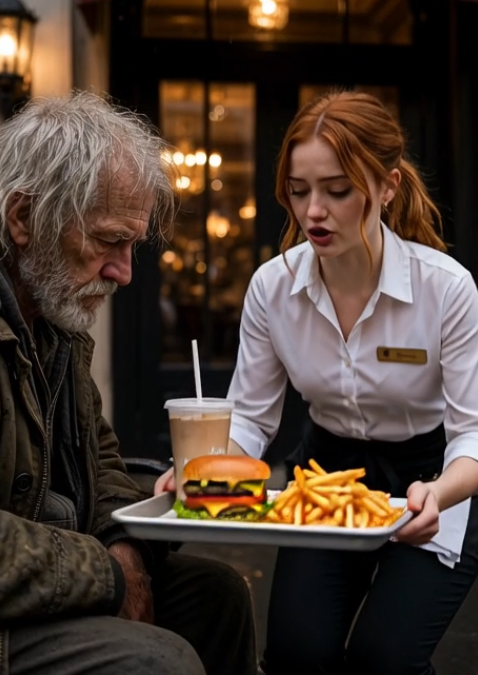
An old man sitting on the bench beneath the awning, shoulders hunched, rain dripping from the edge of the canvas behind him. The bench was technically part of the restaurant’s outdoor waiting area, though no one waited outside in weather like that. He sat with both hands tucked between his knees, head bowed, coat dark with rain.
People passed him without slowing.
A woman in a red coat stepped around his shoes.
A couple leaving the restaurant glanced at him, then away.
He did not hold a sign.
Did not ask anyone for money.
Did not even look up.
He simply sat there in the cold, as if he had forgotten where else a body could go.
I stopped.
Behind me, Manny called, “Emily?”
I looked down at my tray.
Burger.
Fries.
Cola sweating against the paper cup.
My stomach tightened with hunger.
Then the old man coughed.
A small, painful cough that shook his shoulders.
I thought of my mother.
That was the truth.
I thought of the last winter she was alive, how she pretended she was not hungry because medicine made food taste metallic, and how sometimes I knew she was lying because she watched my plate too long. I thought of her telling me, “Emily, never let the world teach you to step over somebody.”
I had nodded then, annoyed because I was young and tired and wanted advice less than I wanted one day without fear.
Now I heard her voice as clearly as if she stood behind me.
Never step over somebody.
I pushed through the front door with the tray balanced in both hands.
The rain slapped cold air against my face.
The old man did not lift his head until I crouched beside him.
“Sir?”
He turned slowly.
His beard was gray and uneven. His hair hung in damp strings around his face. His coat had once been expensive, maybe, but now it was ripped near the cuff and soaked through. His shoes were good leather ruined by weather. His eyes were tired, but clear.
Not vacant.
Not confused.
Just exhausted in a way that made me think he had been carrying something heavier than hunger.
I held out the tray.
“Take this, sir. This was my dinner.”
He blinked.
For a second, he looked more shocked than grateful.
“What about you?”
I gave him the smile I used for frightened children, grieving widows, angry customers, and lonely regulars who only came in to speak to someone.
“I’m not hungry.”
That was a lie.
My hands were still shaking from the double shift, and my stomach cramped at the smell of fries.
The old man looked at me for a long moment.
“You shouldn’t lie to an old man,” he said softly.
I almost laughed.
“I work in customer service, sir. Lying is half my job.”
Something in his eyes warmed, but only for a second.
Then he looked down at the food.
“I can’t pay you.”
“I didn’t ask you to.”
“I’ve had people offer things before. Usually there’s a sermon attached.”
“No sermon.”
“Or a camera.”
“No camera.”
“Or pity.”
I looked at him.
“No pity either.”
He studied my face as if testing that.
Then he took the burger with both hands.
Carefully.
Like it was made of glass.
He unwrapped it slowly, and I looked away because some dignities matter even when a person is eating on a bench in the rain.
He had barely taken one bite when the restaurant door flew open behind me.
“Emily Ross!”
Victor’s voice cracked through the rain like a whip.
I stood so quickly the tray rattled.
Victor stormed out beneath the awning, his expression twisted with outrage and something else—panic, maybe, though I did not understand why then.
Behind him, several customers near the front windows turned to watch. A hostess froze by the podium. One of the busboys paused with a stack of plates. The old man stopped chewing.
“We don’t feed people outside,” Victor snapped.
I felt heat rush to my face.
“That’s my dinner. I did nothing wrong.”
“You took restaurant property.”
“It was my employee meal.”
“That meal is for staff consumption inside designated areas.”
“Are you serious?”
His eyes flashed.
“You do not get to decide what our brand looks like from the sidewalk.”
The old man lowered the burger.
“I can leave,” he said quietly.
Victor turned on him.
“Yes. You can.”
Something in me rose.
“No, he can finish eating.”
Victor stared at me as if I had slapped him.
“Excuse me?”
“You heard me.”
The rain kept falling behind us.
Inside, the restaurant had gone very still.
Victor stepped closer.
I smelled his cologne, sharp and expensive.
“You are embarrassing this establishment.”
“I’m embarrassed for it.”
His face darkened.
“Do you know who I had at table twelve tonight?”
“No.”
“Investors.”
I almost laughed.
Of course.
It was always investors, evaluators, influencers, owners, someone invisible and important whose comfort mattered more than the visible suffering of anyone poor enough to be inconvenient.
Victor reached toward my chest.
I stepped back.
“What are you doing?”
He grabbed my name tag from my blouse and tore it off so hard the pin scratched my skin.
The little plastic rectangle flashed in his hand.
EMILY.
He held it up like evidence.
“You’re fired.”
The old man stopped chewing completely.
His whole face tightened with pain.
“You don’t have to do this for me,” he said softly. “I don’t deserve it.”
That sentence hurt more than Victor’s words.
I turned to him.
“Yes, you do.”
He shook his head.
“You don’t know me.”
“I know you’re hungry.”
Victor laughed once, cold and ugly.
“She has always had a weakness for strays.”
I looked back at him.
The rain ran down the ends of my hair and into my collar. My blouse stuck to my back. My feet hurt. My skin burned where the name tag had scratched me. My dinner sat half-eaten in a stranger’s hands. My job was gone.
And still, for the first time all night, I felt completely awake.
“I’d do it again,” I said.
Victor’s mouth tightened.
“You will regret that sentence.”
For one strange second, the old man changed.
Not physically, exactly.
His shoulders straightened.
His eyes sharpened.
The shrinking, guilty figure on the bench vanished so completely that I wondered how much of him had been hidden there all along.
He reached into the inside pocket of his ruined coat and pulled out a black smartphone.
Victor went still.
The old man pressed one number.
No searching.
No hesitation.
One number.
Then he lifted the phone to his ear and spoke in a voice so cold and steady it seemed to change the weather.
“This is Walter Madden. I need to change the will.”
Everything stopped.
Even Victor looked as if someone had cut the strings holding him upright.
From the doorway behind him, another man whispered, “Dad?”
I turned.
Standing just inside the restaurant entrance was Richard Madden, owner of Maple & Main Grill.
Everyone knew him.
Not well, but enough.
His framed photo hung in the hallway by the office: Richard Madden, CEO of Madden Hospitality Group, smiling beside a charity banner and a ribbon-cutting. He rarely came in except during inspections, investor dinners, and holiday promotions. He was in his late forties, tall, silver at the temples, with the polished look of a man who knew exactly which rooms would make way for him.
Now he stood in the doorway staring at the old man on the bench like he had seen a ghost.
The old man did not lower the phone.
“Yes,” he said into it. “Tonight. No, I’m of sound mind. My daughter-in-law tried that argument last year and failed. Send the papers to the Harrington office. And Evelyn?”
A pause.
His eyes moved to me.
“Find out the legal process for transferring controlling interest in the restaurant division to an employee trust.”
Victor made a strangled sound.
Richard stepped into the rain.
“Dad, please.”
Walter Madden ended the call.
For several seconds, the only sound was rain hitting the awning.
I looked from Walter to Richard to Victor and felt my brain trying to reject what my eyes were telling me.
Walter Madden.
Madden.
As in Madden Hospitality Group.
As in the company name on my paycheck.
As in the man whose portrait used to hang in the upstairs conference room before Victor had it removed because he said it made the brand feel “dated.”
Richard took another step.
“Dad, come inside.”
Walter looked at him.
“I was outside for twenty-seven minutes.”
Richard flinched.
“I didn’t know.”
“No. You didn’t.”
His voice had no anger in it.
That somehow made it worse.
“You built a restaurant with windows tall enough for everyone inside to see me clearly, and not one person came out until she did.”
Richard’s eyes flicked toward me.
Victor swallowed.
“Mr. Madden, I can explain—”
Walter turned his head slowly toward him.
“Can you?”
Victor straightened, trying to recover authority.
“This employee violated food policy, guest-facing standards, and public presentation rules during an investor service window. I acted to preserve the restaurant’s reputation.”
Walter looked at the half-eaten burger in his hand.
“By firing a hungry woman for feeding a hungry man.”
Victor’s face tightened.
“She is not hungry.”
Walter’s gaze returned to me.
“Were you?”
I opened my mouth.
Every server instinct screamed at me to minimize, smooth, protect my last shred of employability.
Then I remembered I was already fired.
“Yes,” I said.
Walter nodded once, as if that answered more than the question.
Richard rubbed both hands down his face.
“Dad, we need to talk privately.”
“No.”
“Please.”
“No, Richard. We have been talking privately for ten years. It appears public truth is the only language left.”
Inside the restaurant, customers were standing now. Phones were out despite the hostess’s frantic attempts to discourage recording. Staff lined the bar and service station, frozen between terror and fascination. Manny stood visible through the kitchen window, holding a spatula like a weapon.
Walter placed the burger carefully back on the tray and stood.
He was taller than I expected.
Older, yes.
Wet, tired, unshaven, but not weak.
Richard moved as if to help him.
Walter stepped away.
That one movement changed Richard’s face more than any words had.
“Emily,” Walter said.
I startled.
“Yes?”
“May I come inside with you?”
With me.
Not with his son.
Not with Victor.
With me.
I glanced at Richard.
Then at Victor.
Then back at Walter.
“Yes, sir.”
I picked up the tray because I did not know what else to do with my hands.
Walter walked beside me through the restaurant door.
Every conversation died.
The warmth inside hit my wet clothes, and suddenly I realized how cold I was. My blouse clung to my arms. My shoes squeaked on the polished floor. I was still wearing my black apron, but without the name tag I felt strangely exposed, as if Victor had not just fired me but erased me.
Walter stopped in the center of the dining room.
He looked around slowly.
At the brass lamps.
At the flowers.
At the marble host stand.
At the diners holding wine glasses midair.
At the servers with tired faces.
At the open kitchen.
At the manager who had just fired me.
Then he looked at Richard.
“Bring me a chair.”
Richard stiffened.
“Dad—”
“A chair, Richard.”
No one moved faster than Manny.
He came out from the kitchen with a chair before Richard could blink, set it behind Walter, and stepped back.
Walter lowered himself carefully.
“Thank you,” he said.
Manny nodded.
“Yes, sir.”
Walter pointed to the chair beside him.
“Emily, sit.”
Victor made a faint noise.
I sat.
Because at that point, life had become so impossible that obedience to the old man felt easier than guessing what would happen next.
Walter looked at the customers.
“I apologize for interrupting your dinners.”
No one answered.
“Since many of you have phones out, I assume what happens next will travel farther than this dining room. Good. It should.”
Richard closed his eyes.
Walter turned to Victor.
“Did you fire this woman?”
Victor’s jaw worked.
“Yes.”
“For feeding me.”
“For violating policy.”
“What policy?”
Victor blinked.
“What?”
“Name the policy.”
Victor looked toward Richard.
Richard said nothing.
Walter waited.
“The employee meal policy requires staff meals to be consumed—”
“No. The policy that says hungry people may not be fed outside.”
Victor flushed.
“It’s not written that way.”
“How is it written?”
Victor said nothing.
Walter looked at Richard.
“Do you know?”
Richard’s face had gone gray.
“Dad, policies are handled by regional operations.”
“I asked if you know.”
“No.”
Walter nodded slowly.
“There it is.”
He looked around the room again.
“My wife, Margaret, and I opened the first Madden diner forty-three years ago with six tables, three employees, and a rule written on a cardboard sign above the kitchen door. Feed people well. Treat people better.”
His voice did not rise.
It did not need to.
“We were not rich. We were not polished. I washed dishes. Margaret kept books at the counter with our baby asleep in a flour sack beneath the register because we could not afford childcare. If someone came in hungry and short on money, she fed them. If a server worked twelve hours, she sent them home with food. If a man sat outside in the rain, she would have dragged me by the ear until I brought him in.”
A few people laughed softly.
Walter did not.
“Somewhere along the way, my name stayed on the company, but my rule disappeared.”
Richard stared at the floor.
Walter’s eyes moved to Victor.
“And men like you mistook that disappearance for permission.”
Victor’s face hardened.
“I run this floor according to standards your son approved.”
Richard looked up sharply.
Victor realized too late what he had done.
Walter leaned back.
“Do you?”
Richard’s mouth opened.
Closed.
The silence answered.
Then a woman from table twelve stood.
She wore a cream blazer, diamond earrings, and the expression of someone used to being heard. I recognized her as one of Victor’s “investors.”
“My name is Caroline Bishop,” she said. “I represent Northbridge Capital. We were here tonight to discuss expansion funding.”
Victor looked relieved for half a second, perhaps thinking she would defend the polished image he had tried to protect.
She did not.
She looked at Walter.
“Mr. Madden, I want you to know our table witnessed the termination. Miss Ross behaved with dignity. Your manager did not.”
Victor’s mouth fell open.
Caroline continued, “And if this is how employees are treated when no one important is supposed to be watching, our firm will require significant review before proceeding with any investment.”
Walter nodded.
“That sounds wise.”
Richard looked like a man watching money catch fire.
I should have felt satisfied.
Instead, I felt suddenly exhausted.
My body had realized the shift was over, the fight had happened, and my future remained uncertain no matter how dramatic the room had become.
Walter seemed to notice.
“Emily,” he said quietly, “when did you last eat?”
I looked down.
“Before lunch.”
“What time?”
I hesitated.
“Ten-thirty.”
His expression changed.
Not pity.
Anger on my behalf.
He turned toward the kitchen.
“Manny, is there food?”
Manny did not wait for Richard, Victor, or anyone else.
“Yes, sir.”
“Bring two meals. One for her. One for me. Something hot.”
Manny smiled for the first time all night.
“Yes, sir.”
Victor snapped, “You can’t just—”
Walter looked at him.
“I can.”
Victor shut his mouth.
We ate at table six.
That was the strangest part.
After everything, after the rain, the firing, the phone call, the public unraveling of power, Walter Madden insisted I sit at a proper table and eat a proper meal.
Manny brought steak, potatoes, grilled vegetables, bread, and soup “because you both look like the weather beat you with a stick.” He set everything down with more ceremony than any VIP service I had ever seen.
I was too shaken to eat.
Walter picked up his fork.
“Eat anyway.”
“I don’t think I can.”
“You gave away your dinner.”
“I didn’t expect it to turn into all this.”
“No decent act ever knows what it will cost beforehand.”
I looked at him.
His face was lined, rain still caught in his beard, coat ruined, but his eyes were alert and terribly sad.
“Are you really Walter Madden?”
“I’m afraid so.”
“Why were you outside dressed like that?”
His fork paused.
Richard stood near the bar, pretending not to listen. Victor had disappeared into the office with two security staff after Walter instructed someone to “make sure he doesn’t delete anything.” Customers remained, though many had stopped eating, too invested in the unfolding disaster to leave.
Walter lowered his voice.
“Because I wanted to know what my restaurants had become when no one recognized me.”
“You disguised yourself?”
He smiled faintly.
“That sounds more theatrical than it felt. I’ve been ill. I’ve been away from operations. My son controls most public-facing matters now. Reports came to me. Employee complaints. Wage disputes. Guests being prioritized over staff safety. Managers turning away people in need. Richard told me it was exaggeration from disgruntled workers.”
“And you believed him?”
His face tightened.
“I wanted to.”
That was honest enough to hurt.
“My late wife used to say money builds walls first inside the heart,” he said. “By the time you see them around the house, it’s already late.”
I thought of Richard whispering Dad in the doorway.
“He didn’t know you were coming?”
“No.”
“Victor didn’t know you?”
“He was hired after I stepped back. My portrait has apparently been removed from every location but corporate headquarters.”
Despite everything, I almost smiled.
“That seems like an oversight tonight.”
Walter’s mouth twitched.
“It does.”
I took one bite of steak because he was watching me like a grandfather prepared to win by patience. The food tasted so good my eyes stung.
Walter pretended not to notice.
That kindness undid me more than open sympathy would have.
Richard finally approached the table.
“Dad, please. Can we talk?”
Walter kept eating.
“We are talking.”
“Not like this.”
“Why not?”
“Because people are watching.”
Walter looked around.
“Yes. That appears to be the first useful thing that has happened in some time.”
Richard’s face tightened.
“I made mistakes.”
“You built systems.”
“I was trying to scale the company.”
“You were trying to impress investors who stood up tonight because a waitress had more integrity than your leadership team.”
Richard flinched.
I stared at my plate.
Being discussed like an example while chewing steak was deeply uncomfortable.
“Dad,” Richard said, voice lower. “I have spent ten years keeping this company alive.”
Walter set down his fork.
“Alive is not the same as decent.”
“You think decency pays rent?”
I looked up.
Richard’s mask had cracked.
There he was.
Not the polished CEO.
A son angry at a father who had built something he could never fully own while the father lived.
Walter looked tired.
“No,” he said. “But cruelty sends the bill eventually.”
Richard leaned closer.
“You always did this.”
Walter’s expression shifted.
“Did what?”
“Made morality sound simple because Mom handled everything messy. You got to be the generous one. She balanced the books. She said yes after figuring out how to afford it. You fed the stranger. She worked until two in the morning to make sure payroll cleared.”
Walter went still.
The room changed.
For the first time, Richard sounded not like a villain, but like a wounded child who had mistaken an old grief for permission to become hard.
Walter’s voice softened.
“You are right.”
Richard blinked.
“I am?”
“Your mother did carry more than people knew. Including me.”
For a second, Richard looked lost.
Then Walter continued.
“But she never balanced books by humiliating hungry women. Do not use her labor as an excuse for your cowardice.”
Richard’s face closed again.
There are doors people only open a little.
Sometimes truth still cannot fit through.
The investigation began that night.
Not police at first.
Corporate.
Legal.
Then police.
Walter’s lawyer, Evelyn Grant, arrived within an hour wearing a navy coat, sharp glasses, and the calm expression of someone who had received many impossible phone calls but considered this one especially rude to her evening plans. She brought another attorney, a forensic accountant, and a tablet full of documents that made Richard look sicker with each passing minute.
Victor was suspended immediately.
By midnight, he was fired.
By morning, he was being investigated for wage theft, tip manipulation, retaliation, and falsifying disciplinary reports.
He had been shaving hours off employee timecards.
Changing tip pool distributions.
Punishing staff who complained by cutting shifts.
Using “brand presentation” rules to target employees who gave food away, spoke up, or refused unpaid cleaning after clock-out.
There were records.
There were emails.
There were texts.
There were witnesses who had been too afraid before but suddenly found courage when Walter Madden himself asked to hear them.
I stayed at the restaurant until two in the morning.
Not because anyone forced me.
Because staff kept coming to me.
Servers.
Hosts.
Dishwashers.
Line cooks.
People I had worked beside for years and somehow never fully known because exhaustion keeps everyone private.
Manny showed Walter photos of burns he had treated himself because Victor discouraged injury reports.
Nora from the bar pulled out copies of schedules changed after she refused to flirt with VIP guests.
A dishwasher named Abel admitted he had been paying for staff meals from his own tips when younger employees could not afford food before shifts.
Walter listened to every word.
Richard listened too, but differently.
Walter absorbed.
Richard defended, minimized, looked for legal angles, then fell silent when Evelyn began asking questions that clearly had answers already attached.
At 2:17 a.m., Walter stood in the empty dining room.
The chairs had been turned upside down on tables. Rain had stopped. The windows reflected a tired group of people who looked like survivors of a small, private war.
Walter looked at us.
“All employees scheduled tonight will be paid through closing, plus overtime. Any improper deductions discovered in review will be repaid with interest.”
No one spoke.
“Effective immediately, this location’s management structure is suspended pending investigation.”
Manny folded his arms.
“Does that mean we’re closed?”
Walter looked toward the kitchen.
“For forty-eight hours. Paid.”
A sound moved through the staff.
Shock.
Relief.
Disbelief.
Then Walter looked at me.
“Miss Ross.”
My body tensed.
“Yes?”
“I owe you a dinner.”
A laugh went through the staff, soft and exhausted.
“You already gave me one,” I said.
“No. You gave me yours. Then Manny gave us both one. I still owe you.”
“You don’t owe me anything.”
His eyes warmed sadly.
“That is where you and I disagree.”
The video went viral by morning.
Of course it did.
Someone from table twelve had recorded Victor tearing off my name tag. Someone else had caught Walter’s phone call. The clip spread with captions that became more dramatic every hour.
WAITRESS FIRED FOR FEEDING HOMELESS MAN—HE WAS THE OWNER’S FATHER.
OLD MAN CHANGES WILL AFTER RESTAURANT MANAGER HUMILIATES SERVER.
BILLIONAIRE TESTS SON’S RESTAURANT—SERVER’S KINDNESS EXPOSES EVERYTHING.
I hated every headline.
Not because they were wrong exactly.
Because they made it sound clean.
A neat story.
Poor waitress kind.
Rich old man secret.
Cruel manager punished.
Everyone claps.
But life after a viral moment is not clean.
Reporters found my apartment building. Strangers sent messages calling me an angel, which made me uncomfortable, and others calling me manipulative, which made me furious. People dug up old photos. Someone found my mother’s obituary. Someone else posted that I had probably known who Walter was. Another claimed Victor was the real victim of “woke hospitality culture,” whatever that meant.
I turned off my phone for six hours and still came back to 312 messages.
Walter called me the next afternoon.
From a number Evelyn had texted first so I would know it was safe.
“Emily,” he said, “are you all right?”
I looked around my apartment.
Laundry unfolded.
Dishes in the sink.
Work shoes by the door.
My blouse from the night before hanging over a chair, name tag scratch still visible near the fabric tear.
“No.”
Walter was quiet.
Then he said, “Good. People who say they are all right too quickly usually aren’t.”
I sat on the floor because the chair held laundry and because my legs were tired.
“What happens now?”
“With the restaurant?”
“With me.”
“That depends on what you want.”
I laughed once.
“I want rent paid.”
“A reasonable beginning.”
“I want my job back, but not if everyone thinks I’m some mascot for corporate redemption.”
“Also reasonable.”
“I want Victor to never touch another employee’s schedule again.”
“Already handled.”
“I want Richard to stop looking at me like I ruined his life.”
Walter sighed.
“That may take longer.”
“Why does he hate you?”
The question slipped out before I could polish it.
Walter did not seem offended.
“He doesn’t hate me,” he said. “He hates failing me. It expresses itself poorly.”
“That sounds generous.”
“My wife accused me of the same.”
“What happened between you?”
Silence.
Then he said, “I loved the business. Margaret loved the people. When she died, I mistook growth for honoring her. Richard mistook profit for proving himself. Between us, we built something she would have scolded us both for.”
That was the first time I heard Walter Madden sound truly old.
“Come to the Harrington office tomorrow,” he said. “Ten o’clock. Evelyn will be there. So will staff representatives. I want you in the room.”
“Why me?”
“Because when the company forgot its rule, you remembered it.”
I pressed my eyes closed.
“I’m just a waitress.”
“No,” Walter said. “You are the person who fed a stranger when everyone paid to serve food pretended not to see him.”
The Harrington office was on the twenty-third floor of a glass building downtown. I owned nothing appropriate for a twenty-third-floor meeting, so I wore my cleanest black pants, a white blouse, and the coat I usually saved for funerals and job interviews. Technically, this was both.
Evelyn Grant met me in the lobby.
In daylight, she looked even sharper.
“Miss Ross.”
“Emily.”
“Evelyn.”
She scanned my face with lawyerly precision.
“Media bothering you?”
“Yes.”
“Do not answer unknown numbers. Do not post. Do not sign anything. If anyone offers money for interviews, send it to me.”
“Are you always this comforting?”
“No. This is my warm version.”
I liked her immediately.
The meeting room had a long table, city views, bottled water, and the kind of silence rich people use before saying things poor people cannot afford to ignore. Walter sat at the head, now clean-shaven, dressed in a charcoal sweater and jacket. He still looked tired, but less like a man abandoned in rain and more like the person rain had failed to wash away.
Richard sat to his right.
He did not look at me.
Manny was there, along with Nora from the bar, Abel from dish, Denise from payroll, two corporate HR representatives who looked terrified, and three lawyers.
Walter began without ceremony.
“Yesterday, I changed my will.”
Richard’s jaw tightened.
“I also signed documents placing my controlling shares in Madden Hospitality into a temporary trust while a full ethics and financial review proceeds.”
One HR woman actually blinked too many times.
Walter continued.
“My son will step down from executive control during the review.”
Richard looked up sharply.
“That is not what we discussed.”
“No,” Walter said. “It is what I decided after we discussed.”
“Dad.”
Walter’s eyes moved to him.
“I am not removing you from the family. I am removing you from authority you abused or neglected. There is a difference. Whether you understand that difference will determine what happens later.”
Richard’s face reddened.
“You humiliated me publicly.”
“You humiliated yourself privately for years. The public part merely arrived.”
No one moved.
Evelyn adjusted her glasses, which I suspected was her way of enjoying herself professionally.
Walter turned to the rest of us.
“I am establishing an employee council with access to payroll records, scheduling practices, safety reports, and meal policies across all Madden restaurants. Staff meals will be guaranteed for shifts over six hours. Leftover food donation partnerships will be reinstated. No employee will be disciplined for providing an approved meal to a person in need under the new community service policy.”
Manny raised a hand.
“Approved by who?”
“By the council and store leadership.”
Manny’s expression darkened.
Walter added, “Store leadership that includes staff representation.”
Manny lowered his hand.
“Better.”
Then Walter looked at me.
“I would like you to help build it.”
My stomach dropped.
“I don’t know how to build councils.”
“Good. Neither do the people who built the system that failed.”
One lawyer coughed, possibly from pain.
Walter continued.
“There will be training. Paid time. Support. You may decline. Your job remains available either way, if you want it.”
I looked at Richard.
He looked at me then.
For the first time, really looked.
There was anger there still. Shame. Exhaustion. Something that might one day become apology if it survived pride.
“I want to serve tables,” I said slowly. “And I want the right to speak without being punished for it.”
Walter nodded.
“Then that is where we begin.”
The next months were ugly.
Change always sounds inspiring until it has to enter payroll software.
Victor fought his termination, then disappeared after the wage theft complaint became criminal. He had taken more than money. He had taken time. He had taken tips from single mothers, students, cooks, hosts, men who sent money home, women paying medical bills, teenagers saving for community college. The final number made me sick.
Richard did not go to prison.
That disappointed some people online who wanted a villain cleanly punished. But he was removed as CEO, required to repay improper bonuses tied to manipulated labor cost reports, and entered what Walter called “mandatory humility,” which included working six months without executive title inside the company’s lowest-performing locations.
Not as a stunt.
Not filmed.
Not announced publicly.
At least, not by the company.
The first time Richard came back to Maple & Main after the review, he wore no suit.
Just black pants, a plain shirt, and an apron.
Manny stared at him from the pass.
“You lost?”
Richard swallowed.
“No.”
“You know where the mop is?”
Richard looked toward me.
I did not rescue him.
“Storage closet,” I said.
He nodded.
That night, he mopped badly.
Manny made him redo it.
Richard did not argue.
That was the beginning.
Not redemption.
Beginnings should not be confused with endings.
He apologized to me three weeks later.
Not in front of cameras.
Not in a meeting.
I was polishing silverware before lunch when he came to the server station.
“Emily.”
I kept polishing.
“Yes?”
“I blamed you.”
“I noticed.”
“For my father seeing what I didn’t want him to see.”
I set down a fork.
Richard looked older than he had that night. Less polished. More human, though not necessarily better yet.
“I am sorry,” he said.
I waited.
He did not add excuses.
That helped.
“I don’t know what to do with that,” I admitted.
“You don’t have to do anything.”
“Good.”
He nodded.
Then he turned to leave.
“Richard.”
He stopped.
“Your father waited outside twenty-seven minutes.”
His shoulders stiffened.
“I know.”
“No, you know the number. I’m not sure you know the time.”
He turned back.
I continued.
“Twenty-seven minutes is long enough to decide nobody is coming. Whatever you fix, don’t forget that.”
His face changed.
“I won’t.”
Maybe he meant it.
Maybe he only wanted to.
Sometimes that is where people start.
Walter came every Thursday after that.
Not as a disguise.
As himself.
He sat at table six, ordered soup and coffee, and asked staff questions that made executives nervous.
“Were you paid correctly?”
“Did you eat today?”
“Who made the schedule?”
“Any equipment broken?”
“Does anyone need a ride home after closing?”
At first, people straightened when he entered.
Eventually, they relaxed.
Manny began sending him experimental soups and demanding honest opinions. Nora from the bar taught him how to make espresso because he called every coffee drink “fancy milk.” Abel once told him the dishwasher needed replacing, and the next week a new one arrived with Walter watching installation like a proud grandfather.
He also kept calling me Miss Ross until I threatened to stop refilling his coffee.
After that, he called me Emily.
One Thursday in spring, he came in carrying a small wooden frame.
He handed it to Manny, who called everyone over.
Inside the frame was a cardboard sign, old and stained, the lettering faded but legible.
FEED PEOPLE WELL. TREAT PEOPLE BETTER.
“My wife wrote that,” Walter said.
His voice softened.
“First diner. 1981.”
No one spoke.
He looked at the wall near the kitchen entrance, where staff came and went all day.
“I thought it belonged where people work, not where customers pose for pictures.”
Manny hung it himself.
Afterward, Walter stood beneath it for a long time.
I stood beside him.
“She would be angry,” he said.
“At what?”
“At how long it took me to put it back.”
I looked at the sign.
“She’d probably be glad it’s back anyway.”
He nodded.
“My Margaret was annoyingly generous like that.”
The year turned.
The viral video became old news.
People moved on to other outrages, other miracles, other villains and heroes. Maple & Main stayed open. Staff meals got better. Schedules became fairer. Tips were tracked transparently. The employee council expanded across the company. I learned more about policy than I ever wanted to know and discovered that meetings are somehow more exhausting than double shifts.
I kept serving tables.
I also trained new hires.
Not in the fake corporate way Victor used to do, with scripts and threats disguised as standards. I told them practical things.
Never carry soup over a child’s head.
Write down allergies twice.
If a customer touches you, step back and get a manager.
Eat before you shake.
Good service is not servitude.
And if someone is hungry, find a way to tell the truth about it.
One rainy evening almost a year after the night everything changed, I stood near the front window watching water shine on the sidewalk.
A man sat on the bench beneath the awning.
For one sharp second, my body remembered.
Then he looked up.
Walter.
Clean coat this time.
Good shoes.
Same bench.
I pushed through the door.
“Absolutely not,” I said.
He smiled up at me.
“I wondered how long it would take.”
“You are not doing a sequel.”
“I’m waiting for my ride.”
“Inside.”
“I like the rain.”
“Inside.”
He laughed and let me help him stand, though I knew he did not need help as much as he enjoyed irritating me.
When we reached the door, he paused.
The bench gleamed behind us.
“You know,” he said, “that night I was ready to give up on the whole company.”
I looked at him.
“Really?”
“Yes.”
“What changed your mind?”
He opened the door and held it for me like an old gentleman who had once sat hungry in the rain and never forgotten who fed him.
“You did.”
Inside, the restaurant was warm.
Manny was yelling about missing tongs.
Nora was laughing behind the bar.
Richard was at table twelve speaking quietly with a dishwasher about transportation reimbursements.
The cardboard sign hung near the kitchen door.
Feed people well.
Treat people better.
Walter went to table six.
I brought him soup without asking.
Before I walked away, he caught my hand briefly.
Not like a boss.
Not like a billionaire.
Like an old man grateful for a second chance he knew he had not earned alone.
“Emily,” he said, “you once told me you weren’t hungry.”
I smiled.
“You told me not to lie to old men.”
“And now?”
I looked around the restaurant.
At the staff eating before rush.
At the leftover meals packed for the shelter van.
At Richard carrying plates because Manny had shouted that leadership should learn balance.
At the bench outside empty in the rain.
“I’m hungry,” I said.
Walter’s eyes warmed.
“Good.”
“For the soup,” I added.
He laughed.
But that was not all I meant.
I was hungry for a world where kindness did not cost someone their job.
Hungry for workplaces that did not run on fear.
Hungry for managers who understood that rules without mercy become weapons.
Hungry for daughters who did not have to lose their mothers to learn compassion.
Hungry for old men to be seen before they had to reveal they were powerful.
Hungry for every person outside the window to matter before someone inside discovered their name.
That night, when my shift ended, I sat at table six with my own dinner.
A burger.
Fries.
A cola.
Manny placed the tray in front of me and said, “Staff meal. For staff consumption inside designated areas.”
I raised an eyebrow.
He grinned.
“Unless you see somebody hungry.”
I looked toward the window.
Rain softened the glass.
The bench outside was empty.
For once, nobody had been left there waiting.
I took a bite of my burger and thought of my mother, of Walter, of the name tag Victor had torn from my blouse, of the woman I had been before the rain and the woman I was still becoming after it.
I lost my job that night for giving away my dinner.
Then I got my voice back.
And somewhere between those two things, an old rule came home.
Feed people well.
Treat people better.
It should never have taken a viral video, a ruined coat, a torn name tag, and a billionaire changing his will for us to remember that.
But sometimes the truth enters through the front door.
Sometimes it sits on a bench in the rain.
And sometimes it waits for one tired waitress to carry out a tray and say, “Take this, sir. This was my dinner.”








