A Vet Was 5 Minutes From Euthanizing a Cat Nobody Wanted—Then One Black Paw Reached Through the Cage and Refused to Let Go of His Hand
PART3:
No behavioral reason.
No bite history.
No aggression.
Nothing except time.
Mara said quietly, “I checked adoptions again.”
Gabriel looked at her.
“Anything?”
She shook her head.
“No applications.”
“Rescues?”
“Nothing listed.”
“Fosters?”
“No.”
Gabriel exhaled.
“Okay.”
Neither moved.
Finally Mara said, “He’s the last one.”
“I know.”
“At least after him we’re done.”
Gabriel looked at her.
Mara immediately regretted saying it.
“I didn’t mean—”
“I know what you meant.”
She stared at the floor.
The phrase after him sounded ugly once spoken aloud.
After him.
As though 418 were simply the last task between two exhausted people and a weekend.
Gabriel picked up the chart.
The shelter had named the cat Shadow when he arrived.
Most staff still called him 418 because the intake number remained clipped to his kennel door.
He had been surrendered on June 16 by a family whose form said they were relocating to Texas.
REASON FOR SURRENDER: MOVING / PETS NOT ALLOWED.
OWNER COMMENTS: FRIENDLY. INDOOR. LIKES PEOPLE. QUIET.
No handwritten letter.
No dramatic story.
No expensive medical condition.
No aggression.
No reason anyone could post online and say, This explains why nobody wanted him.
Sometimes ordinary abandonment was harder.
Gabriel walked into the cat wing.
The overhead fluorescent lights had been dimmed slightly for evening cleaning.
Cats watched him from stacked kennels.
Some slept.
Some meowed.
Some turned away.
The smell was disinfectant, litter, canned food, and the faint metallic odor every shelter employee eventually stopped noticing.
Kennel 418 was near the center.
Shadow was sitting at the front.
Black coat.
Small white patch beneath his chin.
Yellow eyes.
Ten years old, though he carried his age well.
He saw Gabriel and stood.
“Hey, buddy.”
Shadow walked closer.
His tail rose.
That made Gabriel’s stomach hurt.
He would have preferred fear.
He knew that was selfish.
Animals that fought or hid were harder to handle, but emotionally easier in certain moments.
Trust complicated everything.
Shadow rubbed his face against the bars.
Gabriel crouched.
“You have terrible timing.”
Shadow purred.
Gabriel looked at the kennel card.
120 DAYS.
A volunteer had drawn a small heart beside FRIENDLY.
Someone else had added LOVES CHIN SCRATCHES.
Another note read LAP CAT.
Four months of evidence.
None of it had been enough.
Mara came behind him carrying a folded blue towel.
She whispered, “I can take him.”
Gabriel shook his head.
“I’ll do it.”
“You don’t have to.”
“Yes, I do.”
There were parts of shelter medicine Gabriel refused to delegate simply because they hurt.
If he signed the list, he carried the animal.
If he made the final call, he wanted the weight in his own arms.
He unlocked the kennel.
Shadow leaned forward.
Gabriel slipped his right hand through the opening.
And then the cat grabbed him.
Not violently.
Not fast.
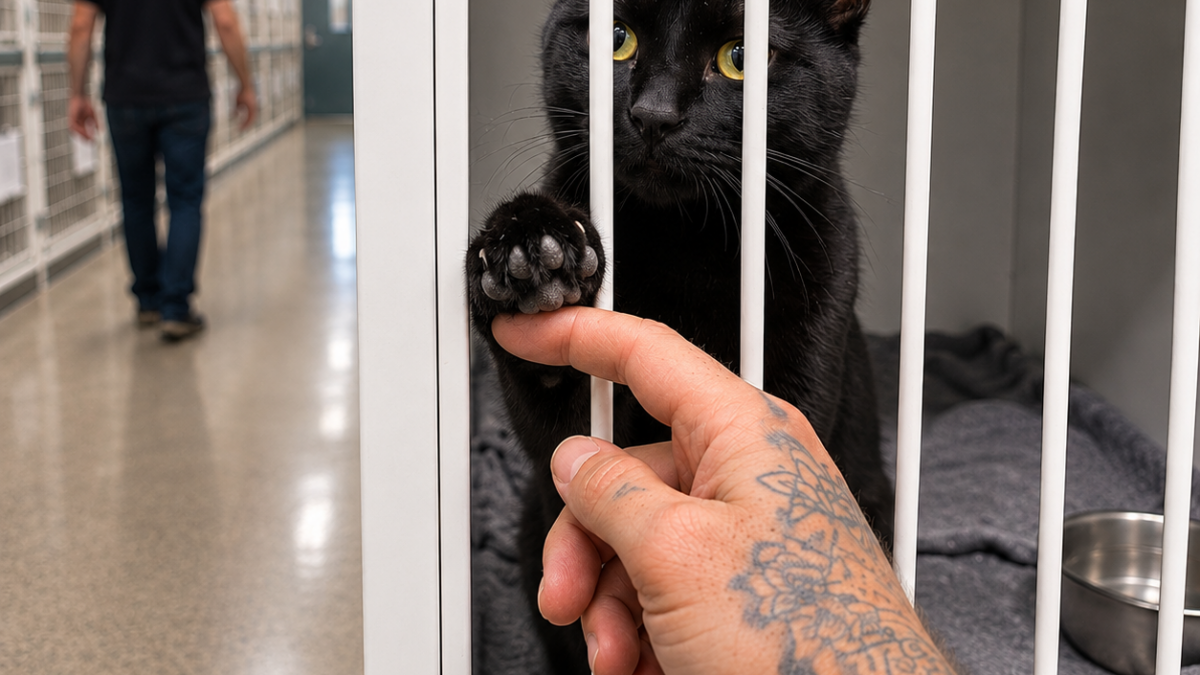
One paw came through the gap.
Wrapped around Gabriel’s index finger.
Claws extended just enough to hold.
Gabriel froze.
Shadow looked directly at him.
There was no hiss.
No flattened ears.
No panic.
Just pressure.
One paw.
One finger.
Gabriel had handled thousands of frightened animals.
Dogs had bitten through gloves.
Cats had attached themselves to his forearms.
He had been urinated on, scratched, kicked, sprayed, clawed, and once knocked unconscious by a sedated Great Dane that woke at exactly the wrong moment.
He knew defensive behavior.
This was not defensive.
Shadow was holding him.
Mara stopped behind him.
“Oh.”
Gabriel did not answer.
The cat tightened his paw slightly.
Gabriel looked down.
Then back at the cat’s eyes.
His throat closed.
“Buddy.”
Shadow purred.
Gabriel swallowed.
“Don’t do that.”
The paw remained.
Mara whispered, “Gabriel.”
He closed his eyes.
For eight years, Gabriel had performed shelter euthanasia.
He hated when people called it killing.
Not because the word was inaccurate.
Because it erased context.
He had euthanized dogs dying from parvovirus because their intestines were sloughing apart.
Cats hit by cars with injuries no surgeon could repair.
Animals with uncontrolled seizures.
Dogs so neurologically unstable they had seriously injured people without warning.
Old pets surrendered because owners could not afford humane end-of-life care.
And yes, healthy animals when space ran out.
That was the part outsiders wanted divided into heroes and monsters.
It was never that clean.
Gabriel had watched shelter workers spend their own money on formula.
Volunteers sleep beside terrified dogs during thunderstorms.
Kennel attendants cry in bathrooms.
People who accused shelters of cruelty rarely saw the two hundred animals arriving after a hurricane or the seventeen kittens found behind one abandoned house.
But understanding the system did not make Shadow’s paw easier to bear.
Gabriel whispered, “You don’t know what you’re asking.”
The cat held tighter.
Mara’s eyes filled.
Gabriel tried to gently withdraw his hand.
Shadow’s paw followed.
No scratching.
Just refusal.
Gabriel stopped.
The clock above the hall door read 3:55.
Five minutes.
He would remember that time exactly.
3:55.
Not because of the scheduled procedure.
Because that was the moment something inside him refused to continue pretending the decision had already been made.
Gabriel placed his free hand against the kennel door.
He looked at Shadow.
“I’m sorry.”
Then he carefully uncurled the cat’s toes from his finger.
He closed the kennel.
Shadow immediately pushed the paw back through the bars.
Gabriel stood.
Mara looked at him.
“What are you doing?”
“I don’t know.”
He walked away.
“Gabriel?”
He kept going.
Past treatment.
Past laundry.
Past the break room.
Into his small office.
He shut the door.
Sat behind his desk.
Stared at the telephone.
Then called his wife.
Sofia answered on the third ring.
“Hey. You leaving?”
“No.”
Silence.
Sofia knew his voice.
“What happened?”
Gabriel rubbed his face.
“I’m bringing one home.”
Another silence.
Then:
“Dog or cat?”
“Cat.”
“We have a cat now?”
“Apparently.”
“Gabriel.”
“I know.”
“We have three children.”
“I know.”
“We have Cooper.”
“I know.”
“Cooper thinks squirrels are a personal insult.”
“He’s good with cats.”
“We’ve never had a cat.”
“He’s good with Mrs. Talley’s cat.”
“He ate Mrs. Talley’s cat food.”
“That’s not the same thing.”
Sofia sighed.
“What cat?”
Gabriel looked toward his office window.
“The one that grabbed my hand.”
There was a pause.
“What does that mean?”
“I’ll explain when I get home.”
“Are you crying?”
“No.”
“You sound like you’re crying.”
“I’m not.”
“Gabriel.”
“I’m at work.”
“That has never stopped you before.”
He laughed once.
Then his voice broke.
Sofia became quiet.
Finally she said, “Bring him home.”
Gabriel closed his eyes.
“Just like that?”
“You called me instead of finishing whatever you were supposed to do.”
“Yes.”
“So I’m assuming this is not a normal Friday.”
“No.”
“Bring him home.”
“What if Cooper hates him?”
“Then Cooper learns disappointment.”
Gabriel smiled.
“I love you.”
“I know.”
“You’re supposed to say it back.”
“Bring cat food.”
The call ended.
Gabriel sat there another minute.
Then someone knocked.
He assumed Mara.
It was shelter director Nolan Pierce.
Gabriel’s stomach tightened.
Nolan stepped inside without waiting.
Fifty-one.
Large frame.
White dress shirt with the sleeves rolled halfway up.
Former operations manager at a private veterinary chain.
He had been hired by the county ten months earlier.
Nolan closed the door.
“What happened?”
Gabriel looked at him.
“With?”
“The list.”
“Mara told you?”
“Mara said you stopped.”
“I’m adopting 418.”
Nolan stared.
“Today?”
“Yes.”
“Gabriel.”
“I know.”
“His disposition has been authorized.”
“Then unauthorize it.”
“That isn’t how this works.”
“It is exactly how adoption works.”
Nolan folded his arms.
“You’re the attending veterinarian.”
“And?”
“You approved him medically.”
“Yes.”
“You participated in the disposition review.”
“Yes.”
“And now five minutes before procedure you’re reversing the decision because you got emotional.”
Gabriel stood slowly.
“I’m taking him home.”
“You cannot create exceptions every time something gets hard.”
“I’m not creating an exception.”
“You are staff.”
“Staff members can adopt.”
“Not after final disposition review without administrative approval.”
“Then approve it.”
Nolan looked at him.
“No.”
Gabriel actually laughed.
Not because it was funny.
Because the word seemed absurd.
“No?”
“No.”
“I’m offering him a home.”
“You’re responding under emotional distress.”
“I’m not purchasing a motorcycle.”
“Don’t be flippant.”
“Then don’t tell me I’m too emotional to adopt a cat I was qualified to euthanize five minutes ago.”
Nolan’s jaw tightened.
“This is exactly what I mean.”
“What?”
“Boundary failure.”
Gabriel stared.
Nolan continued.
“You have been increasingly resistant on capacity cases.”
“Because we’ve increased capacity euthanasia.”
“We’ve increased intake.”
“Then say that.”
“I have.”
“No. You say flow, disposition, turnover, population management.”
“Because I run a county facility.”
“And animals live in it.”
Nolan stepped closer.
“Do you think I enjoy these lists?”
“I don’t know.”
“That’s insulting.”
“Then answer.”
“No, Gabriel. I do not enjoy euthanasia.”
“Good.”
“But this building cannot function if every employee decides a painful moment exempts them from procedure.”
Gabriel’s voice lowered.
“Nothing about this exempts me from procedure. I am asking to adopt an available animal.”
“He is not currently available.”
“He was available at three forty-nine.”
“He was designated.”
“He is alive.”
Nolan said nothing.
Gabriel pointed toward the cat wing.
“He is healthy. Friendly. No behavioral restriction. No legal hold. I have a home. I have the adoption fee. What exactly are you protecting?”
Nolan’s face hardened.
“The integrity of the process.”
Gabriel stared at him for several seconds.
Then he removed his county badge from the clip on his waistband.
Placed it on his desk.
“What are you doing?”
“You said staff status is the problem.”
“Don’t be dramatic.”
“I’m not.”
Gabriel picked up his wallet.
“My name is Gabriel Ramos. I’m a resident of Hinds County. I’d like to adopt cat 418.”
Nolan’s eyes narrowed.
“You walk out in the middle of your shift, and we are going to have a different conversation Monday.”
“My shift ended at four.”
He looked at the clock.
3:59.
“Apparently I have one minute.”
Nolan stepped aside.
“You’re making a mistake.”
Gabriel stopped at the door.
“Maybe.”
He looked back.
“But it won’t be his last one.”
At 4:07, Gabriel completed an adoption form at the front desk.
The receptionist, June Carter, kept looking between Gabriel and Nolan.
Nobody spoke.
Mara stood near the hallway holding a cardboard carrier.
The adoption fee was forty dollars.
Gabriel paid with his debit card.
Nolan signed the release only after June quietly said county policy required management to process a valid adoption unless an animal had a legal or medical restriction.
Nolan looked at her.
June looked back.
She was sixty-eight and had worked for the county since before Nolan had learned the phrase operational efficiency.
He signed.
Mara brought Shadow out.
The cat walked into the carrier reluctantly.
Gabriel crouched.
“You just ruined my weekend.”
Shadow sat down.
Mara whispered, “You need a name.”
“He has one.”
“Shadow?”
Gabriel looked at the clock above reception.
4:13 Friday afternoon.
“No.”
“What then?”
He looked at the cat.
“Friday.”
Mara smiled.
“That’s terrible.”
“I know.”
“It’s staying?”
“Yes.”
“Then it’s perfect.”
Nobody knew Mara had taken a photograph.
At 3:55, when Shadow held Gabriel’s finger, she had instinctively pulled her phone from her scrub pocket.
She captured one frame.
Gabriel’s back.
Open kennel.
Black paw reaching through the bars.
His finger caught gently between two small toes.
She did not show him that day.
She thought the moment belonged to him.
Gabriel drove home with Friday’s carrier buckled into the passenger seat.
Rain had started.
Thin October rain spreading headlights across the pavement.
The cat made no sound.
At a red light, Gabriel looked over.
“You okay?”
Friday stared through the carrier door.
“You have no idea what happened.”
Nothing.
“I’m not sure I do either.”
The light changed.
Gabriel drove.
His home was in a quiet subdivision fifteen minutes outside Jackson.
Brick ranch house.
Two oak trees.
Basketball hoop leaning slightly left because his oldest son had hit it with the mower.
When Gabriel pulled into the driveway, the front door opened before he had turned off the engine.
His nine-year-old daughter, Lucia, ran outside.
Sofia came behind her.
“Slow down,” Sofia called.
Lucia reached the car.
“Where is he?”
“Inside.”
“What’s his name?”
“Friday.”
Lucia looked horrified.
“That’s his name?”
“It is now.”
“That is not a cat name.”
“It’s the day I got him.”
“You got me on a Tuesday.”
“I didn’t name you Tuesday.”
“Exactly.”
Sofia laughed.
Gabriel lifted the carrier.
Their boys, Mateo, thirteen, and Eli, six, appeared in the doorway.
Cooper, their golden retriever, pushed between them.
Friday saw Cooper.
Friday hissed.
Cooper stopped.
His entire body seemed to reconsider life.
Eli whispered, “The cat hates him.”
Gabriel said, “The cat just met him.”
Cooper leaned forward.
Friday hissed again.
Cooper retreated behind Sofia.
Mateo laughed.
“Great. He’s scared of a ten-pound cat.”
“Smart dog,” Gabriel said.
They put Friday in the laundry room with food, water, litter, blankets, and the carrier door open.
Friday came out once.
Saw four humans and a golden retriever staring at him.
Then disappeared behind the dryer.
For two days, he remained there.
Lucia sat cross-legged on the floor and read him chapters from Charlotte’s Web.
Eli pushed toy cars beneath the dryer until Friday swatted one back.
Mateo pretended not to care.
Then Gabriel caught him lying on his stomach at midnight offering pieces of chicken.
Sofia watched Gabriel more than the cat.
On Saturday night, after the children were asleep, she found him sitting on the kitchen floor outside the laundry room.
“You okay?”
“Yeah.”
“You’ve said twelve words since dinner.”
“Long week.”
She sat beside him.
“Tell me.”
Gabriel looked at the dark opening behind the dryer.
“His paw.”
“The grabbing?”
“Yes.”
“What about it?”
“I don’t know.”
“You’re a very unsatisfying storyteller.”
He smiled faintly.
Then shook his head.
“I’ve euthanized hundreds of animals.”
Sofia put a hand over his.
“You’ve euthanized sick animals.”
“Not all.”
She knew that.
He rarely discussed the healthy ones.
“Gabe.”
“The first year at the shelter, I thought I wouldn’t make it.”
“I remember.”
“Then I learned how to compartmentalize.”
“That’s not a bad thing.”
“No.”
He paused.
“But you start wondering when compartmentalizing becomes something else.”
“Numbness?”
“Permission.”
Sofia looked at him.
Gabriel continued.
“You tell yourself the list was approved. The hold expired. The kennels are full. No rescue responded. No adopter came. And all of that can be true.”
He swallowed.
“But sometimes truth becomes a wall you hide behind.”
Sofia squeezed his hand.
“Were you supposed to take him home?”
“I don’t know.”
“Then why did you?”
Gabriel stared toward the dryer.
“Because he held on.”
Sofia smiled sadly.
“So did you.”
On the third evening, Friday appeared in the kitchen while the family ate spaghetti.
Nobody reacted.
Gabriel had warned them.
Do not stare.
Do not rush him.
Do not make a big deal out of it.
Eli stared so hard he almost crossed his eyes.
Friday sat near the refrigerator.
Lucia whispered, “He came out.”
Gabriel whispered back, “I have eyes.”
Friday remained five minutes.
Then returned to the laundry room.
The fourth day, he jumped onto the couch.
The fifth night, Lucia woke with him curled against her legs.
She screamed.
Friday launched off the bed.
Everybody ran into her room.
Lucia sat upright crying.
Gabriel’s heart stopped.
“What happened?”
“He slept with me.”
Gabriel blinked.
“Why are you crying?”
“Because he picked me.”
Sofia leaned against the doorframe.
Mateo muttered, “That was a lot of screaming for happiness.”
Friday watched them from beneath the dresser.
Eli dropped to his knees.
“Friday, you almost killed Dad at work and now Lucia.”
Gabriel looked at Sofia.
“We should work on his vocabulary.”
Monday morning came too quickly.
Gabriel stood in the shelter parking lot at 7:14.
He had barely slept.
Friday had wandered the hallway at three.
Cooper had decided every feline movement required supervision.
Lucia had appeared in Gabriel’s bedroom at four to report that Friday was “thinking about coming back to my room.”
Sofia told Gabriel the shelter might be quieter.
He was not sure.
He entered through the employee door.
Mara looked up from treatment.
“How is he?”
“Alive.”
“Strong start.”
“He hid behind the dryer for two days.”
“Expected.”
“Slept in Lucia’s bed last night.”
Mara smiled.
“That fast?”
“Apparently I’m just transportation.”
She laughed.
Then Gabriel looked toward the cat wing.
His stomach tightened.
He walked to kennel 418.
The kennel was not empty.
A young orange cat sat inside.
Fresh intake card.
A-5279.
Stray.
Approximately two years.
The new cat pressed his face against the door.
Gabriel stood there.
Something about seeing another animal in the same space hit harder than bringing Friday home had.
The kennel had not been saved.
The population problem had not disappeared.
One life had left.
Another filled the rectangle.
Mara came behind him.
“I know.”
Gabriel kept looking.
“I thought it would feel different.”
“What?”
“Empty.”
“It was empty for about nine hours.”
Gabriel laughed without humor.
“There it is.”
“What?”
“The whole problem.”
Mara said nothing.
A kennel was not a victory.
It was capacity.
The building would keep filling.
That afternoon, Nolan called Gabriel into his office.
A woman from county HR joined by speakerphone.
Nolan had prepared documentation.
“Dr. Ramos,” the HR representative began, “this meeting concerns conduct during the October fourteenth euthanasia schedule.”
Gabriel leaned back.
“Okay.”
“You refused to complete an assigned procedure.”
“I adopted the animal.”
“That is not in dispute.”
“Good.”
“You also removed your employee badge and represented yourself as a member of the public during working hours.”
“My shift was ending.”
“The timeline shows you initiated adoption before four.”
“By approximately one minute.”
Nolan slid a paper across the desk.
Written warning.
UNPROFESSIONAL CONDUCT / FAILURE TO FOLLOW DISPOSITION PROTOCOL.
Gabriel read it.
“You’re disciplining me for preventing euthanasia through legal adoption.”
Nolan said, “We are disciplining you for bypassing procedure.”
“I asked permission.”
“You challenged direct management decisions in front of staff.”
“Because your decision made no sense.”
“This is exactly the issue.”
“What issue?”
“You continue framing policy disagreement as moral failure.”
Gabriel looked at him.
“Did I say you were immoral?”
“You implied it.”
“Maybe you heard something I didn’t say.”
Nolan’s face tightened.
The HR voice interrupted.
“Dr. Ramos, you have the right to submit a written response.”
“I will.”
Gabriel placed the warning on the desk.
Then asked, “Why was 418 on the list?”
Nolan stared.
“We discussed this Friday.”
“No adoption applications. No rescue inquiries. One hundred twenty days. Population pressure.”
“Correct.”
“Who checked rescue inquiries?”
“Adoption staff.”
“Who specifically?”
“Gabriel.”
“I’m asking.”
Nolan sighed.
“June reviews public inquiries. Kayla handles rescue email.”
Gabriel nodded.
“Okay.”
Nolan looked suspicious.
“Why?”
“No reason.”
There was a reason.
Something bothered him.
Not the decision alone.
The certainty.
No inquiries.
No rescue interest.
No one.
One hundred twenty days.
Gabriel had worked at Cedar—no, we need keep Jackson County Animal Services. He knew cats like Friday were harder to place.
Older.
Black.
Adult.
Not flashy.
But 120 days without one inquiry felt strange after seeing Friday at home.
This was not a cat who merely tolerated people.
He attached.
Quickly.
He had slept with a child on his fifth night.
Gabriel began asking questions.
Nothing official.
At lunch, he sat beside June Carter.
“Did anyone ever ask about 418?”
June looked over her glasses.
“The black one you stole?”
“I adopted him.”
“Same thing, depending who you ask.”
“Seriously.”
She thought.
“Not that I remember.”
“Any phone calls?”
“We get fifty calls a day.”
“Emails?”
“Kayla handles most.”
“Did anyone visit him?”
June shook her head.
“He wasn’t up front much.”
Gabriel paused.
“What do you mean?”
“He got moved.”
“From where?”
“Main adoption room to overflow.”
“When?”
“August, maybe.”
“Why?”
“Upper respiratory outbreak. Then kitten season.”
“How long was he in overflow?”
June frowned.
“Couple weeks?”
Gabriel knew the answer was longer.
He went to the kennel logs.
Friday had entered June 16.
Main adoption: twenty-two days.
Medical isolation: six days after mild sneezing.
Cleared.
Overflow C: thirty-nine days.
Returned to adoption.
Then moved to Back Cat Room B during renovations.
Thirty-one days.
Only twenty-two of his 120 days had been spent in the public-facing adoption room.
Gabriel stared at the record.
“No wonder.”
Mara was beside him.
“What?”
“He wasn’t visible.”
“He was technically adoptable.”
“That is not the same thing.”
“No.”
Gabriel looked at her.
“Did you know?”
“I knew he moved around.”
“Did Nolan?”
“Probably.”
The story could have ended there.
A crowded shelter.
A cat lost in overflow.
No villain.
No conspiracy.
Just limited space and bad luck.
Gabriel almost accepted that.
Then Kayla found him Wednesday afternoon.
She was the rescue coordinator.
Twenty-six.
Always wearing bright sneakers.
She closed the treatment room door behind her.
“You asked about 418?”
Gabriel looked up from a dog’s radiographs.
“Yes.”
“Why?”
“Curious.”
Kayla did not move.
Gabriel noticed her expression.
“What?”
“There was an inquiry.”
He set the film down.
“What kind?”
“Rescue.”
“When?”
“August.”
Gabriel stared at her.
“About him specifically?”
“Yes.”
“Which rescue?”
“Magnolia Cat Project.”
“What happened?”
“I sent it upstairs.”
“To Nolan?”
“Yes.”
“And?”
“No response.”
“What do you mean no response?”
“I needed approval because they wanted us to hold him until weekend transport.”
“How long?”
“Three days.”
“And?”
“Nolan declined.”
Gabriel felt something cold move through his chest.
“Why is it not in the file?”
Kayla looked toward the door.
“That’s why I’m here.”
“What happened to the email?”
“It was archived.”
“By you?”
“No.”
“Who?”
“I don’t know.”
“Kayla.”
“I’m telling you I don’t know.”
“Do you still have it?”
She hesitated.
“In my sent folder.”
“Show me.”
She pulled out her phone.
The rescue email was simple.
We can take A418 black senior male if medically cleared. Transport Sunday. Please confirm hold through weekend.
Kayla’s forwarded message to Nolan:
Magnolia has placement for 418. Request three-day hold through Sunday transport. Okay to confirm?
Nolan’s reply:
Do not extend long-stay holds into next reporting cycle unless transport is guaranteed onsite. Maintain current disposition eligibility.
Gabriel read it twice.
“Next reporting cycle?”
Kayla nodded.
“What does that mean?”
“Monthly census.”
“Friday was August thirty-first.”
“Yes.”
Gabriel understood.
The shelter reported average length of stay and population count at month-end.
Keeping Friday three more days would carry him into the next month.
“Did Magnolia know we declined?”
“I told them we couldn’t hold.”
“Did they offer another arrangement?”
“They asked if they could pick up Saturday morning.”
“And?”
“Nolan said staffing was limited.”
“What time?”
“Ten.”
“The shelter is staffed at ten.”
“I know.”
Gabriel looked at her.
“Why didn’t you tell me Friday?”
“I forgot.”
“No.”
She looked ashamed.
“I stopped thinking about it.”
That answer was worse.
Not because Kayla was cruel.
Because she was normal.
Too many animals.
Too many messages.
Too many declines.
One cat disappeared into the machinery.
Gabriel whispered, “He had a rescue.”
“Two months ago.”
“He had a rescue.”
“Yes.”
“And his file says none.”
Kayla’s eyes filled.
“I’m sorry.”
Gabriel walked straight to Nolan’s office.
Mara saw his face and followed.
“Gabe.”
He kept walking.
“Gabriel.”
He knocked once and entered.
Nolan looked up.
“I’m in the middle of—”
“You declined a rescue placement for 418.”
Nolan’s expression did not change quickly enough.
That told Gabriel everything.
“Close the door.”
“No.”
“Gabriel.”
“Kayla sent you Magnolia’s request.”
Nolan looked past him at Mara.
“This is a personnel discussion.”
Mara said, “Then I’ll leave.”
Gabriel stopped her.
“No. Stay.”
Nolan stood.
“This is my office.”
“And Friday was my patient.”
“Not anymore.”
“He almost died because the file said nobody wanted him.”
“No. He was selected because of population pressure and length of stay.”
“A rescue wanted him.”
“Two months earlier.”
“You denied them.”
“They could not take possession within the required window.”
“They offered Saturday.”
“We had staffing constraints.”
“Saturday at ten?”
Nolan’s jaw tightened.
“Your understanding is incomplete.”
“Complete it.”
“The county required reduced population entering September.”
Gabriel stared.
There it was.
“Say that again.”
“Do not distort what I said.”
“You declined rescue because you wanted the census lower.”
“No. I declined an unconfirmed delayed transfer during a capacity emergency.”
“They confirmed.”
“They requested we hold him.”
“For three days.”
“We cannot warehouse animals indefinitely.”
“Three days is not indefinitely.”
Nolan’s voice rose.
“You think every decision exists in isolation because you touch the animal at the end. I manage the building.”
Gabriel stepped closer.
“And that means what?”
“It means I have to think about labor. Food. kennel space. disease spread. intake projections. overtime. state reporting. public complaints.”
“And a cat.”
“Yes, a cat.”
“You forgot that part.”
“I did not.”
“You did when you wrote maintain disposition eligibility instead of yes.”
Nolan slammed his palm onto the desk.
“You want the truth?”
“Yes.”
“If Magnolia had cared that much, they could have come Friday.”
Mara flinched.
Gabriel stared at him.
“That is your defense?”
“It is reality.”
“No.”
Gabriel’s voice became quiet.
“You made their delay his death sentence.”
“He did not die.”
“Because he grabbed my hand.”
Nolan gave a humorless laugh.
“And there it is again.”
“What?”
“Emotion.”
Gabriel looked at him for a long moment.
“Do you know what bothers you about that word?”
Nolan said nothing.
“You use emotion like it’s the opposite of judgment.”
“It can be.”
“So can efficiency.”
Silence.
Gabriel turned to leave.
Nolan called after him.
“If you start turning internal emails into a crusade, you will create problems for people who are already drowning.”
Gabriel stopped.
“That sounded like a threat.”
“It was advice.”
Gabriel looked back.
“Then put it in writing.”
Nolan did not.
That evening Gabriel told Sofia everything.
Friday sat on the kitchen counter despite repeated orders to get down.
“You’re saying someone wanted him in August?” Sofia asked.
“Yes.”
“And the director said no?”
“Yes.”
“Why?”
“Metrics.”
Sofia stared.
“Explain that without making me hate somebody.”
“I’m trying.”
“Try harder.”
Gabriel rubbed his face.
“The shelter was over capacity. Nolan was under pressure. Rescue pickup was delayed. He wanted population down before monthly reporting.”
“So he picked the easiest answer.”
Gabriel looked at Friday.
“Yes.”
Sofia shook her head.
“That’s not an explanation.”
“It is.”
“No. It’s a sequence of words.”
Gabriel smiled faintly.
“You’d be a terrible bureaucrat.”
“Thank you.”
Friday walked across the counter.
Sofia pointed.
“Get down.”
Friday ignored her.
Gabriel picked him up.
The cat immediately placed one paw against his wrist.
Sofia noticed.
“Same paw?”
Gabriel looked.
Right paw.
“Yes.”
She touched Friday’s head.
“Maybe he knew.”
“Knew what?”
“You were leaving.”
Gabriel shook his head.
“Cats don’t understand euthanasia schedules.”
“I didn’t say that.”
“Then what?”
“Maybe he just knew you were about to stop touching him.”
Gabriel looked at her.
Sofia shrugged.
“Sometimes the smaller explanation is sadder.”
Six months later, Mara posted the photograph.
But before that happened, Friday’s story almost cost Gabriel his job.
Gabriel submitted a written response to his warning.
He included the Magnolia email.
He requested correction of Friday’s shelter record.
He asked whether any other animals had rescue offers declined for reporting reasons.
Two days later, Nolan called him into another meeting.
This time county animal services administrator Cynthia Bell was there.
So was HR.
Cynthia was fifty-eight, composed, and known for saying almost nothing until she knew exactly what she wanted to say.
She placed Gabriel’s written response on the table.
“You have made several allegations.”
“I asked questions.”
“You used the phrase ‘potential manipulation of live-release opportunities.’”
“That’s accurate.”
Nolan sat stiffly.
Cynthia looked at him.
“Nolan says Magnolia’s offer was not viable.”
Gabriel slid printed emails across the table.
“They offered Sunday. Then Saturday.”
Cynthia read.
“Nolan?”
“Transport was not confirmed.”
Gabriel pointed.
“Read the second message.”
Cynthia did.
Magnolia’s director had written:
We can have volunteer driver there Saturday at 10 AM. Please confirm.
Cynthia looked at Nolan.
“Why was this declined?”
Nolan’s answer came quickly.
“Operational capacity.”
“That does not answer the question.”
“We were short two staff.”
“At ten Saturday?”
“Yes.”
Gabriel said, “Five staff were scheduled.”
Nolan turned.
“You accessed scheduling records?”
“I worked that Saturday.”
Cynthia looked between them.
“What happened to 418 after the declined transfer?”
Gabriel answered.
“He remained alive another six weeks.”
That silenced the room.
Not because the fact proved wrongdoing.
Because it destroyed the staffing argument.
If the shelter could house Friday six more weeks, it could have held him twelve additional hours for rescue transport.
Cynthia sat back.
“Anything else?”
Gabriel hesitated.
Then nodded.
“His adoption exposure.”
“What about it?”
“Of 120 days, fewer than thirty were in the main public room.”
Nolan said, “Housing rotation is standard.”
“I know. But his file later treated lack of adoption interest as evidence he had no placement potential.”
Cynthia took notes.
Gabriel continued.
“You can’t hide an animal in overflow and then call the public’s failure to choose him proof that nobody wanted him.”
Nolan said, “Nobody hid him.”
“Intentional or not, the result was the same.”
“That is rhetoric.”
“No. That is kennel location.”
Cynthia raised a hand.
“Enough.”
The county opened an internal review.
Nolan was furious.
He stopped speaking to Gabriel except when required.
Schedules changed.
Gabriel lost two Saturday clinic shifts he preferred.
His request for continuing education reimbursement was suddenly “under reconsideration.”
A memo appeared reminding veterinarians that “personal adoption decisions must not compromise professional objectivity.”
Gabriel knew retaliation when he saw it.
He also knew not every slight was retaliation.
So he documented everything.
Dates.
Emails.
Schedules.
He remained polite.
He came to work.
Treated animals.
Performed surgeries.
Signed medical records.
And yes, he continued euthanasia when necessary.
That surprised some coworkers.
One technician asked, “How can you still do it after Friday?”
Gabriel answered, “Because Friday did not make suffering disappear.”
The technician looked confused.
Gabriel explained.
“A dying animal still deserves a peaceful death. A dangerous animal can still be dangerous. A shelter can still run out of space.”
“So what changed?”
“I stopped accepting avoidable as inevitable.”
At home, Friday transformed.
By the end of the first month, he owned the house.
Cooper became his reluctant bodyguard.
Lucia slept with one hand outside her blanket because Friday placed his paw over her fingers.
Mateo began doing homework with the cat across his notebook.
Eli told his kindergarten class his father “saved a panther from execution,” resulting in a phone call from the teacher.
Sofia bought Friday a cat tree.
He slept in the cardboard box it came in.
Gabriel complained.
Sofia said, “You spent forty dollars adopting a cat who sleeps in trash.”
“Technically cardboard is recycling.”
Friday gained one pound.
His coat became shinier.
He began sitting in Gabriel’s lap every evening.
Always the same routine.
Gabriel sat after dinner.
Friday climbed up.
Turned around twice.
Settled.
Then placed his right paw against Gabriel’s wrist or shirt.
Kneaded once.
Twice.
Three times.
The same paw.
Gabriel noticed every time.
Three months after the adoption, Cynthia Bell called Gabriel into her office.
The county review was complete.
She closed the door.
“I’m going to tell you what we found before the report goes out.”
Gabriel sat.
“Okay.”
“There was no formal quota requiring euthanasia before month-end reporting.”
“I didn’t say there was.”
“I know.”
“Did Nolan?”
“We found repeated internal communication emphasizing reduction of average length of stay and month-end census.”
Gabriel waited.
“Several rescue holds were denied.”
“How many?”
“Twelve animals over nine months.”
His stomach tightened.
“Did they die?”
Cynthia paused.
“Seven were later euthanized.”
Gabriel looked down.
Seven.
“Were the rescue offers legitimate?”
“Five clearly were. Two were ambiguous.”
“Why denied?”
“Various reasons were documented. Staffing. transport delays. disease-control concerns.”
“Were those reasons valid?”
“In several cases, no.”
Gabriel said nothing.
Cynthia continued.
“We also found an informal practice under Nolan of excluding long-stay animals from certain promotional events if staff believed they were unlikely to convert quickly.”
Gabriel looked up.
“Convert.”
“That was the language.”
He laughed bitterly.
“Of course.”
“He did not violate animal cruelty statutes.”
“I didn’t accuse him of that.”
“No.”
“But?”
“He exercised poor judgment, failed to accurately document available live-release options, and created incentives that prioritized reporting metrics over individual placement opportunities.”
Gabriel leaned back.
“What happens?”
“Nolan is being removed from operational authority pending disciplinary action.”
“Fired?”
“I cannot discuss personnel outcomes before final notice.”
“Of course.”
“Your written warning will be rescinded.”
Gabriel looked at her.
“And the shift changes?”
“Restored.”
“My education reimbursement?”
“Approved.”
He nodded.
Cynthia watched him.
“You don’t look happy.”
“Seven animals.”
“Yes.”
“Do we know their names?”
She hesitated.
“Numbers.”
Gabriel’s face changed.
Cynthia understood.
“I’ll get the names.”
“Please.”
A week later, the county announced Nolan Pierce had resigned.
His statement blamed “political pressure and social media-driven management.”
There had been no social media story yet.
Only internal review.
Gabriel found that interesting.
Nolan sent him one email before leaving.
You got what you wanted.
Gabriel stared at it.
Then replied:
No. Friday got what he should have received in August. Seven others did not.
Nolan never answered.
The shelter changed policy.
Rescue offers had to be documented directly in the animal’s primary record.
A confirmed live-release option could not be declined solely because pickup crossed a reporting period.
Long-stay animals received mandatory promotional review after thirty, sixty, and ninety days.
Every animal scheduled for nonmedical euthanasia required a second-person verification that no active rescue, foster, or adoption inquiry existed.
It was not revolutionary.
That bothered Gabriel too.
The fixes were obvious.
Sometimes the most painful reforms were simply rules requiring people to do what everyone assumed they were already doing.
Mara kept the photograph to herself throughout the investigation.
Then six months after Friday came home, she asked Gabriel to lunch.
They sat in the shelter break room.
She opened her phone.
“I have something.”
Gabriel looked.
The photograph.
His back.
Kennel door.
Friday’s paw around his finger.
Gabriel stopped eating.
“When did you take that?”
“That afternoon.”
“Why didn’t you show me?”
“I didn’t know if you’d want it.”
He stared.
The image was not perfect.
Slightly blurry.
Fluorescent light.
His scrub shirt wrinkled.
The kennel label visible on one side.
But the paw was clear.
So was the grip.
He whispered, “Send it to me.”
Mara did.
That evening, Sofia found Gabriel staring at it on the couch.
“That’s it?”
“Yes.”
She sat beside him.
“That’s the moment?”
“Yes.”
“He really did grab you.”
“I told you.”
“I thought you were dramatizing.”
“I’m offended.”
“You’re Hispanic and a veterinarian. Both groups enjoy storytelling.”
Gabriel laughed.
Then Sofia studied the photograph.
“You should post it.”
“No.”
“Why?”
“I don’t want people turning it into shelter hate.”
“Then explain it.”
“Social media does not enjoy nuance.”
“That has never stopped anyone.”
“No.”
Two weeks passed.
Mara asked permission to post it on her own page.
Gabriel agreed under one condition.
“No attacking the shelter.”
“What should I write?”
“The truth.”
Mara posted:
This cat was scheduled to be euthanized at 4 PM on a Friday.
At 3:55, he reached through the cage and grabbed the vet’s hand.
The vet took him home.
That was all.
The first hour brought twelve shares.
By morning, 800.
By noon, 14,000.
Three days later, more than 300,000.
People filled the comments with their own interpretations.
He begged for his life.
He chose the doctor.
That cat knew.
That was God.
Animals understand more than we do.
Some comments attacked the shelter.
Some attacked Gabriel.
One person wrote:
If the vet really cared, why had he been willing to euthanize the cat in the first place?
Gabriel stared at that one longer than he should have.
Sofia took his phone.
“Stop.”
“They’re right about part of it.”
“No.”
“I was going to do it.”
“You were doing your job under information you believed was complete.”
“I should have asked more.”
“You cannot personally audit every file.”
“Maybe we should.”
Sofia sighed.
“This is what you do.”
“What?”
“You turn every failure near you into evidence you should have been more perfect.”
Gabriel looked away.
She softened.
“Friday needed someone to stop.”
“Yes.”
“You stopped.”
“Five minutes before.”
“Still stopped.”
Gabriel did not answer.
The viral attention brought reporters.
He declined television interviews.
He accepted one newspaper interview after the journalist agreed to discuss shelter capacity and rescue systems, not just the “miracle paw.”
The reporter asked:
“Do you believe Friday knew he was about to die?”
Gabriel answered honestly.
“No.”
That disappointed her.
“You don’t?”
“I don’t think a cat understands a four o’clock euthanasia schedule.”
“Then why did he grab you?”
“He was social. I opened his kennel. He wanted contact.”
“That sounds less dramatic.”
“It is.”
“Does that make the moment less meaningful?”
Gabriel thought.
“No.”
“Why?”
“Because meaning doesn’t require magic.”
The reporter leaned forward.
“What does it require?”
Gabriel looked down at his hands.
“Attention.”
The article ran Sunday.
Its headline was not about a miracle.
It was about a cat who had nearly died after a rescue offer was missed.
That reopened everything.
Magnolia Cat Project released its emails publicly.
The county published the review findings.
Nolan gave one interview defending himself.
He said shelters were being asked to perform impossible work under relentless public scrutiny.
On that point, Gabriel agreed with him.
Nolan also said decisions were being “retroactively judged through emotional storytelling.”
On that point, Gabriel did not.
A county board meeting was scheduled.
The room overflowed.
Animal advocates came.
Shelter staff came.
People who had never visited the shelter came because of the photograph.
Some wanted Nolan prosecuted.
There was nothing to prosecute.
Some demanded zero euthanasia immediately.
The shelter had no infrastructure to guarantee that.
Some accused every worker of cruelty.
Mara cried in the bathroom.
Gabriel grew angry.
When public comment opened, he had not intended to speak.
Then a woman walked to the microphone.
She introduced herself as Denise Holloway.
“I surrendered my cat here last year.”
Gabriel recognized the name.
Not the woman.
The surrender record.
A fourteen-year-old calico named Rose.
Denise gripped the podium.
“My mother died.”
The room became quiet.
“Rose belonged to her.”
She swallowed.
“My apartment did not allow pets. I begged the manager. I paid for two weeks at a boarding kennel while I tried to move.”
Her voice shook.
“I ran out of money.”
Someone behind Gabriel whispered.
Denise continued.
“I brought Rose here because I thought a shelter was safer than putting her outside.”
Tears ran down her face.
“She was euthanized nine days later.”
A board member lowered his eyes.
Denise said, “I hated this shelter for a year.”
Gabriel felt his chest tighten.
“Then I read about Friday.”
She looked toward the employees.
“And I realized some of the people I blamed are the same people crying over these animals.”
She wiped her face.
“I’m still angry.”
The room remained silent.
“But I’m angry at a county that built fewer kennels than it needs. At landlords who make people choose between housing and pets. At rescues that are full. At owners who dump animals. At myself because I couldn’t find another apartment fast enough.”
She looked at the board.
“So please don’t make this meeting about finding one evil person.”
Gabriel looked at Cynthia Bell.
Denise continued.
“But don’t use a broken system to excuse bad decisions either.”
That sentence landed.
Gabriel stood.
Sofia, seated beside him, looked up.
“You’re speaking?”
“Yes.”
“You hate speaking.”
“I hate this more.”
He joined the line.
When his turn came, cameras lifted.
He hated that.
“My name is Dr. Gabriel Ramos. I’m a veterinarian at Jackson County Animal Services.”
Someone clapped.
He shook his head.
“Please don’t.”
The room quieted.
“I am not a hero.”
He looked around.
“I need to start there because I’ve seen that word more times this week than I’m comfortable with.”
He took a breath.
“Friday was on my euthanasia list.”
Silence.
“I signed the medical review.”
His voice remained steady.
“I walked to his kennel intending to carry out that procedure.”
He paused.
“If he had not reached through those bars, I do not know whether I would have stopped.”
A woman in the audience began crying.
Gabriel continued.
“That is difficult for me to admit.”
He looked toward shelter staff.
“But if we are going to use his story, we should use the whole story.”
He described the overcrowding.
The rescue email.
The reporting pressure.
The hidden overflow rooms.
The staff working double shifts.
The seven animals whose rescue opportunities were lost.
Then he said, “The danger is not that shelter employees stop caring.”
He looked toward Mara.
“Most never do.”
“The danger is that caring becomes so painful and so constant that systems teach people to replace judgment with procedure.”
Nobody moved.
“A box gets checked.”
He raised one finger.
“Hold expired.”
Another.
“No application recorded.”
Another.
“Over capacity.”
Another.
“Long stay.”
He lowered his hand.
“And eventually the boxes sound like a complete explanation.”
He paused.
“They are not.”
Gabriel looked toward the county board.
“Friday was healthy.”
“He was social.”
“A rescue offered placement.”
“He spent much of his stay outside the main adoption room.”
“And then his lack of adoption interest was used to justify his death.”
His voice hardened.
“That is not bad luck.”
“That is a process failure.”
Applause began.
Gabriel waited.
When it stopped, he continued.
“But there is another truth.”
He looked toward the public.
“This shelter cannot solve everything alone.”
A few people shifted.
“If you want fewer capacity euthanasias, foster.”
“Adopt adults.”
“Spay and neuter your animals.”
“Support pet-friendly housing.”
“Donate to transport.”
“Volunteer.”
“Stop dumping litters in boxes outside our gate.”
His voice cracked slightly.
“Do not call people murderers on Facebook and then disappear when we ask for help on Monday morning.”
The room became completely still.
Gabriel breathed.
“That photograph shows a cat holding one finger.”
He looked at the projected image someone had placed on a screen behind the board.
Friday’s paw.
His hand.
“But the point is not that one cat saved himself.”
Gabriel turned back.
“The point is that we had almost built a process where his only remaining chance was an accident.”
Nobody applauded immediately.
That was how Gabriel knew they had heard him.
Then Denise Holloway stood.
Others followed.
The applause rose slowly.
Not celebratory.
Heavy.
Gabriel returned to his seat.
Sofia grabbed his hand.
“You hate public speaking?”
“Yes.”
“You were unfortunately good at that.”
“Don’t tell anyone.”
The viral attention changed more than policy.
Donations increased.
A local foundation funded a foster coordinator for two years.
A church network created temporary pet housing for hospitalized owners.
Two apartment complexes dropped breed and age restrictions for certain adopted animals after public pressure.
Magnolia Cat Project began weekly transport instead of twice monthly.
A retired bus driver donated a van.
None of these things eliminated euthanasia.
But the numbers changed.
A year later, nonmedical feline euthanasia at the shelter had dropped by forty-one percent.
Two years later, fifty-eight.
Not zero.
Gabriel insisted people understand that.
Progress was not purity.
Friday meanwhile became spectacularly uninterested in his own significance.
He hated cameras.
He stole butter.
He sat directly on Sofia’s clean laundry.
He once knocked Gabriel’s county service award off a shelf and slept in the empty space.
Lucia declared this “political commentary.”
Mateo said she did not know what political commentary meant.
Eli insisted Friday was a panther until age nine.
Cooper and Friday developed a relationship based on mutual blackmail.
Friday stole Cooper’s bed.
Cooper ate Friday’s food.
At night, they sometimes slept back to back.
Gabriel never photographed that because he feared the internet might collapse.
Two years passed.
Then three.
Friday developed arthritis in his hips.
At twelve, he began hesitating before jumping onto Gabriel’s lap.
Gabriel bought stairs.
Friday refused them.
At thirteen, he finally used the stairs when nobody was watching.
At fourteen, bloodwork showed early kidney disease.
Gabriel knew what that meant.
He also knew it did not mean tomorrow.
They changed food.
Added fluids.
Monitored weight.
Friday remained himself.
Every evening.
Lap.
Turn twice.
Right paw.
Knead.
Gabriel sometimes took the paw gently in his hand.
“Still bossing me around.”
Friday purred.
One evening Lucia, now a teenager, sat beside him.
“Dad.”
“Hmm?”
“Do you ever think about what would have happened?”
Gabriel did not need to ask.
“Yes.”
“All the time?”
“Not all the time.”
“Sometimes?”
“Yes.”
“If he hadn’t grabbed you?”
Gabriel looked at Friday.
“Yes.”
Lucia’s eyes filled.
“Would you have done it?”
He could have lied.
Parents are tempted to lie when truth hurts their children.
Gabriel did not.
“Probably.”
Lucia looked down.
“That’s horrible.”
“Yes.”
“Doesn’t that make you feel guilty?”
“Yes.”
“Still?”
“Yes.”
She waited.
Gabriel continued.
“But guilt can become selfish.”
Lucia frowned.
“What do you mean?”
“If I spend the rest of Friday’s life thinking about the five minutes before I adopted him, I miss the years after.”
She looked at the cat.
Friday stretched one paw over Gabriel’s wrist.
Gabriel smiled.
“I owe him my attention now.”
Lucia leaned against her father.
“That sounds like something you say at work.”
“It probably is.”
“You’re getting old.”
“That is definitely something I hear at work.”
When Friday was fifteen, Mara found another old record.
She had become shelter operations manager by then.
Nolan’s office had been converted into a foster and rescue coordination room.
Mara came into Gabriel’s treatment room holding a scanned form.
“You need to see this.”
“What?”
“Friday’s original owner file.”
Gabriel looked up sharply.
“What about it?”
“The surrender family.”
He read.
The intake form listed Michael and Dana Wallace.
Moved to Texas.
Gabriel remembered.
Mara placed another document beside it.
A returned voicemail transcription from four months after surrender.
The shelter had migrated old phone logs during a software upgrade.
Someone had flagged an entry.
CALLER: EMILY WALLACE. ASKING ABOUT BLACK CAT “MIDNIGHT.” STATES PARENTS SURRENDERED WITHOUT HER KNOWLEDGE. WANTS TO ADOPT WHEN TURNS 18 / REQUEST INFO.
Gabriel stared.
“What happened?”
“Nothing.”
“What do you mean nothing?”
“No callback documented.”
“How old was she?”
“Seventeen.”
“Where was Friday?”
“At the shelter.”
His throat tightened.
“She called while he was there.”
“Yes.”
“When?”
September third.”
Friday had been euthanasia-eligible later that month.
Gabriel read the note again.
Midnight.
That had been his name.
Not Shadow.
Not Friday.
Midnight.
“What happened to Emily?”
Mara had already searched public records.
She found an address in Tennessee.
Gabriel did not contact her immediately.
He was unsure he should.
Friday was his cat now.
Legally.
Emotionally.
For years.
But someone had called once.
A seventeen-year-old girl.
Asking.
No response.
He told Sofia.
She said, “Call her.”
“What if she wants him?”
“Then you talk.”
“What if—”
“Gabriel.”
He stopped.
“You spent years arguing that unanswered inquiries matter.”
He closed his eyes.
“Yes.”
“You don’t get to dislike the principle when the inquiry reaches your house.”
He laughed softly.
“I married a monster.”
“You married consistency.”
Gabriel called.
A woman answered.
“Hello?”
“Is this Emily Wallace?”
“Yes.”
“My name is Dr. Gabriel Ramos. I’m a veterinarian in Jackson.”
Silence.
“I’m calling about a cat you may have known as Midnight.”
The sound on the other end changed.
Not words.
Breath.
“Oh my God.”
Gabriel closed his eyes.
“You remember him?”
“Is he alive?”
“Yes.”
She began crying immediately.
Gabriel waited.
Emily was twenty-four now.
She lived near Nashville.
She worked as an elementary school art teacher.
Seven years earlier, when she was seventeen, she had spent a summer with her grandmother while her parents prepared to move.
They surrendered Midnight without telling her.
They said he had “gone to a family friend.”
Emily found the paperwork in a kitchen drawer months later.
She called the shelter.
She left two messages.
No one returned them.
Her parents moved.
She did not have a driver’s license yet.
She had no money.
She begged her older cousin to take her to Jackson.
By the time he agreed, her father told her the shelter had said Midnight was already adopted.
That was a lie.
Gabriel sat very still.
“I’m sorry.”
Emily sniffed.
“Why are you calling now?”
“We found your message in an old database.”
“Seven years later?”
“Yes.”
She laughed through tears.
“That sounds about right.”
Gabriel looked at Friday sleeping on the windowsill.
“He was almost euthanized.”
Emily became silent.
“When?”
“Four months after you called.”
Nothing.
“But he wasn’t.”
“No.”
“What happened?”
Gabriel told her.
The hand.
The adoption.
The photograph.
Emily interrupted.
“Wait.”
“What?”
“That cat?”
Gabriel paused.
“What do you mean?”
“The Friday cat?”
“You saw the photo?”
“Everybody saw that photo.”
She began laughing and crying at once.
“That was Midnight?”
“Yes.”
“Oh my God.”
Gabriel let her process it.
Finally Emily whispered, “He always held hands.”
Gabriel stopped breathing for a second.
“What?”
“When I was little.”
Her voice softened.
“He slept by my pillow. If I put my hand under the blanket, he would put his paw on it.”
Gabriel looked down at his own hand.
Same paw.
“Did he use his right paw?”
Emily laughed.
“Mostly.”
Gabriel covered his eyes.
All these years, people had called the moment instinct.
Magic.
Coincidence.
Begging.
Maybe it was simpler.
Friday had learned a language long before entering kennel 418.
A girl had taught him that hands stayed.
Then her family disappeared.
The shelter passed him around rooms.
People came and went.
And at 3:55 on a Friday afternoon, a hand entered his cage.
He did the one thing that had once meant someone was his.
He held on.
Emily visited two weeks later.
Gabriel was terrified.
Not of losing Friday legally.
There was no ownership question after seven years.
He was terrified emotionally.
He wondered whether Friday would remember her.
Whether Emily would expect some cinematic recognition.
Whether nothing would happen and everyone would be hurt.
Sofia told him, “Stop directing the scene before it happens.”
Emily arrived carrying no carrier.
Gabriel noticed that first.
Good.
She was twenty-four, curly brown hair, nervous smile.
She stood in the foyer gripping her purse.
“I feel weird.”
“So do I.”
“Is he—”
“In the kitchen.”
She laughed nervously.
“Of course.”
Gabriel led her in.
Friday was sitting on a chair.
Older.
Gray around his muzzle.
Thin from kidney disease.
But alert.
Emily stopped.
Her face collapsed.
“Midnight.”
Friday looked at her.
No dramatic sprint.
No cry.
No immediate recognition.
He simply stared.
Emily knelt.
“It’s me.”
Friday watched.
Gabriel’s heart hurt.
Then Emily extended her hand.
Palm up.
Friday jumped down.
Walked toward her.
Sniffed her fingers.
Paused.
Then lifted his right paw.
Placed it in her hand.
Emily broke.
She bent over him, crying so hard Gabriel almost stepped forward.
Sofia grabbed his wrist.
“Let them.”
Emily whispered into Friday’s fur.
“I’m sorry.”
Friday purred.
“I tried.”
His paw remained in her hand.
“I swear I tried.”
Gabriel turned away.
Not because he wanted privacy.
Because he was crying too.
Later Emily sat with Gabriel on the porch.
Friday slept inside with Lucia.
“I used to hate my parents,” Emily said.
“For surrendering him?”
“Yes.”
“Do you still?”
She thought.
“My mom apologized.”
“Your dad?”
“No.”
“What happened?”
“They divorced.”
“That seems unrelated.”
“It probably was.”
She smiled faintly.
Then her expression changed.
“I was angry at the shelter too.”
“You had reason.”
“You weren’t there then?”
“I was.”
Emily looked at him.
Gabriel nodded.
“I didn’t know about your call.”
“I know.”
“But I was there.”
She stared toward the yard.
“Do you ever feel responsible for things you didn’t know?”
“Yes.”
“All the time?”
“Yes.”
She smiled sadly.
“Maybe that’s our problem.”
“What?”
“We both think if we had loved him correctly enough, nobody could have failed him.”
Gabriel looked at her.
That sentence stayed.
Emily visited twice more that year.
She did not ask to take Friday.
Gabriel finally asked why.
She looked surprised.
“He’s home.”
“You were his person first.”
“I was one of them.”
“That matters.”
“So does this.”
She gestured toward the house.
“Lucia. Cooper. Your couch he destroyed.”
“He did not destroy the couch.”
Emily raised an eyebrow.
“He absolutely did.”
Gabriel smiled.
Emily touched his arm.
“I wanted to know he lived.”
She looked through the window at Friday sleeping in sunlight.
“Now I know.”
Friday died at seventeen.
Almost seven years after Gabriel opened kennel 418 intending to end his life.
It happened at home.
Kidney failure eventually became something treatment could no longer soften.
Gabriel knew before anyone else.
That was the curse of being the veterinarian in the family.
He saw the appetite changes.
The posture.
The breathing.
The distance between discomfort and suffering narrowing.
Sofia asked one night, “Is it time?”
Gabriel said, “Soon.”
Lucia, sixteen now, cried.
Eli refused to speak to him for an hour.
Mateo drove home from college.
Emily came from Nashville.
Mara came too.
Nobody planned a gathering.
It simply happened.
Friday spent his last afternoon in Gabriel’s lap.
Cooper had died two years earlier.
The house was quieter now.
Sunlight fell through the living room window.
Gabriel held Friday’s right paw.
Emily sat on the floor.
Lucia beside her.
The veterinarian who came to the house was one of Gabriel’s former interns.
He offered to let Gabriel perform the procedure himself.
Gabriel shook his head.
“No.”
For once, he wanted only to be Friday’s person.
Not doctor.
Not employee.
Not decision-maker.
Just the man whose hand the cat had grabbed.
Before sedation, Gabriel leaned down.
“You were supposed to die at four o’clock.”
Friday blinked slowly.
“Terrible scheduling on your part.”
Lucia laughed through tears.
Gabriel’s voice broke.
“You gave me seven years of trouble.”
Friday’s paw flexed weakly around his finger.
Same grip.
Almost.
Gabriel closed his eyes.
There it was.
The beginning returning at the end.
But different.
No bars.
No fluorescent shelter hallway.
No list.
No clock deciding anything.
A living room.
Family.
Hands everywhere.
Gabriel whispered, “You can let go now.”
Friday’s paw relaxed.
He died peacefully in Gabriel’s arms.
For weeks afterward, Gabriel could not look at the viral photograph.
People sent messages.
Mara reposted it with a final update.
Friday passed away today at approximately seventeen years old, surrounded by the family he chose at 3:55 on a Friday afternoon seven years ago.
Gabriel asked her to change one sentence.
He did not choose us.
Mara called him.
“What should I say?”
Gabriel looked at the empty place on the couch.
After a moment he answered.
“We chose each other.”
The final post read:
Friday passed away today at approximately seventeen years old, surrounded by the family he found after one small moment changed everything.
At 3:55 PM seven years ago, he put his paw around a veterinarian’s finger.
They chose each other.
Gabriel returned to work four days later.
He walked through the cat room.
Kennels.
Cards.
Meows.
Same fluorescent light.
A young black cat occupied kennel 418.
Not Friday.
Never Friday.
The cat watched Gabriel pass.
Gabriel stopped.
Crouched.
The cat approached.
Gabriel slipped one finger through the bars.
The cat sniffed it.
Nothing dramatic happened.
No paw.
No miracle.
Just a cat smelling a hand.
Gabriel smiled.
“That’s okay.”
He stood.
Then looked at the kennel card.
Thirty-six days.
Friendly.
No applications.
Gabriel took out his phone.
Photographed the cat.
Sent it to rescue coordination.
Adult black male in 418. Can we feature him today?
Three minutes later Mara replied:
Already moving him to front adoption room.
Gabriel smiled.
That was the difference now.
Not every cat would grab a hand at the right moment.
They should not have to.
That was the lesson Friday had left behind.
For years people had asked Gabriel what the photograph meant.
Did Friday know he was dying?
Was he begging?
Did animals sense death?
Did fate intervene?
Gabriel never learned the answer.
He stopped needing one.
He knew only what happened.
At 3:55, he was about to follow a procedure.
A black cat reached through a cage.
A paw closed around one finger.
And for several seconds, a man who had spent years learning how to let go was forced to feel what it meant for another living thing to hold on.
That pause saved Friday.
Then Friday’s survival uncovered a rescue inquiry.
That inquiry exposed a broken practice.
That practice changed policy.
The policy saved animals Gabriel would never meet.
And seven years of ordinary life followed.
Seven birthdays.
Seven Christmas mornings.
Thousands of dinners.
A child growing into a teenager.
A dog becoming a friend.
A girl from Friday’s first life finding him again.
Kidney medication.
Ruined furniture.
Sunlight.
Lap naps.
One paw resting against a hand.
Those were the things hidden inside the five minutes between 3:55 and 4:00.
That was what Gabriel eventually understood about euthanasia lists.
A line on paper could measure how long an animal had already lived.
It could not measure the life still waiting ahead.
Friday’s card had said:
10 YEARS.
120 DAYS.
NO INTEREST.
Those facts had sounded final.
They were not.
Because no interest had not meant no one could love him.
It had meant his rescue email was ignored.
His kennel was moved.
His former girl was never called back.
His opportunities disappeared into systems that described failure as absence.
Nobody came.
Nobody asked.
Nobody wanted him.
Except people had.
Emily had.
Magnolia had.
Gabriel eventually did.
Sometimes an animal was not unwanted.
Sometimes the yes simply never reached the cage.
Years after Friday died, the original photograph was enlarged and placed in the shelter’s staff corridor.
Gabriel resisted at first.
He did not want a shrine.
Mara convinced him.
The photograph had no inspirational quote.
No dramatic caption.
Only a small line beneath it:
3:55 PM.
That was enough.
New employees sometimes asked what it meant.
Older staff told the story.
Not the legend.
The real version.
The crowded shelter.
The missed rescue.
The warning Gabriel received.
The investigation.
The policy changes.
The girl who called and was forgotten.
The seven unexpected years.
And always the paw.
One afternoon, long after Gabriel’s hair had turned mostly gray, a veterinary student shadowing him stopped in front of the photograph.
“Dr. Ramos?”
“Yes?”
“Is that Friday?”
“Yes.”
“The cat that grabbed you?”
“Yes.”
The student studied it.
“Did that really change your whole career?”
Gabriel thought.
“No.”
The student looked surprised.
“No?”
“My career was already changing me.”
He looked at the photograph.
“Friday changed the direction.”
The student nodded.
Then asked, “What if he hadn’t reached out?”
Gabriel was quiet.
That was the question beneath every version of the story.
What if Friday had sat still?
What if he had hidden?
What if he had been afraid?
What if he had hissed?
What if he had done nothing remarkable at all?
Gabriel looked at the student.
“Then we would have failed him.”
The student swallowed.
Gabriel continued.
“And that’s why the lesson cannot be that animals need to earn rescue with one perfect moment.”
He pointed toward the photograph.
“Friday was lucky enough to do something I couldn’t ignore.”
Then he looked down the hallway toward the kennels.
“The others deserve us to notice before they have to.”
The student said nothing.
Gabriel walked on.
Behind him, the photograph remained.
A man’s back.
An open kennel.
One black paw.
One finger.
Five minutes before an ending that never happened.
And that was how Gabriel preferred to remember Friday.
Not as the cat who almost died.
Not even as the cat who saved himself.
But as the cat who held on long enough for one human being to stop calling the end inevitable—and start looking for the door.








