A Vet Gave This 18-Year-Old Shelter Cat Just One Week to Live—But After I Took Him Home, Ollie Began a Journey Neither of Us Was Ready to Understand
PART3:
It sat behind a feed store on the edge of town, a low white building with a green roof and a hand-painted sign showing a dog, a cat, and a rabbit sitting together as though they had all agreed to be civil for the sake of marketing.
I had donated there before.
Blankets. Towels. Cleaning supplies. Once, a box of canned food after my neighbor’s cat passed away and she could not bear to keep it in the pantry.
I was going to drop off the blankets, say hello, and leave.
That was the whole plan.
Plans are adorable.
The front room smelled like disinfectant, litter, and old coffee. A volunteer at the desk looked up and smiled.
“Donation?”
“Blankets,” I said, lifting the bags.
“You are now our favorite person.”
“I thought that was whoever brings kitten food.”
“That person is our favorite rich person. You’re our favorite blanket person.”
Her name tag said Beth.
She came around the desk and helped me unload the bags. As she carried them into the back, a long orange cat in a lobby enclosure began yelling at me with the righteous fury of an unpaid landlord.
“Is he always like that?” I asked.
Beth looked back.
“Cornbread? Yes. He believes volume is a constitutional right.”
I laughed.
It felt good.
A little rusty.
Beth disappeared through a swinging door, and I stood alone near the front desk, listening to the strange orchestra of the rescue. Dogs barking in the distance. A phone ringing. Someone laughing in the back. The steady hum of a dryer. A cat making biscuits against a fleece bed with serious concentration.
I should have left then.
Instead, I wandered into the cat room.
That was where I saw him.
Not immediately.
That is important.
The younger cats made sure of that.
Two tuxedo kittens launched themselves at the front of their enclosure like furry salesmen. A ginger adolescent rolled upside down and grabbed the bars with all four paws. A long-haired calico sat in a hammock looking regal and annoyed, which, in my experience, is often the same expression.
Then I reached the bottom row at the back.
The kennel card read:
OLLIE
Male, 18 years old
Senior hospice / comfort adoption
Gentle
Quiet home preferred
Eighteen.
I bent down.
At first, all I saw was a gray-and-white bundle in the back corner. He was curled so tightly that his body looked smaller than it was. His fur stuck out in every direction, thin and uneven, like he had tried to groom himself but lost interest halfway through. His face was narrow. Too narrow. His cheeks hollow. One ear had a tiny tear at the edge. His paws looked enormous only because the rest of him was so frail.
He did not come forward.
He did not meow.
He did not perform.
He only opened his eyes.
They were cloudy blue-green, tired but alert.
I crouched lower.
“Hello, Ollie.”
He watched me for a long moment.
Then closed his eyes again.
I do not know why that broke my heart.
Maybe because everyone else in the room was asking to be chosen, and he looked as if he had already accepted that no one would choose him.
A shelter worker came in carrying a stack of bowls.
“That’s our old man,” she said.
“How long has he been here?”
She hesitated.
That pause told me more than the answer.
“Almost three months.”
Three months.
For an eighteen-year-old cat, three months is a lot of life to spend waiting under fluorescent lights.
“Has anyone asked about him?”
The worker’s face softened with apology.
“No.”
That was it.
That was the sentence.
No.
Not one person.
No applications.
No meet-and-greets.
No family saying, “Maybe him.”
No one kneeling long enough to see whether the ancient gray-and-white cat in the bottom kennel might still have something to give.
For some reason, that answer cracked something open in me.
I crouched beside his door and held out one finger.
Nothing happened at first.
I almost pulled my hand back.
Then Ollie moved.
Slowly.
Painfully.
As if every joint had to submit a request before movement could be approved.
He uncurled himself, placed one paw forward, then the other, and walked toward me with the fragile dignity of a very old man crossing a church aisle.
When he reached the front, he lowered his head.
And pressed his forehead against my finger.
That was all it took.
Not because it was dramatic.
Because it was trusting.
Because he had every reason to conserve his energy, every reason not to bother, every reason to let the world keep passing by.
But he came forward anyway.
The worker watched me through the kennel glass.
“He likes you.”
“He doesn’t know me.”
“Sometimes they know enough.”
I asked to meet him.
They brought me into a small room with two chairs, a cat tree, and a blanket on the floor. The worker carried Ollie in carefully, both hands supporting him. He felt almost weightless even from across the room.
When she placed him on the blanket, he stood for a second, then sat down as though standing had used most of his budget.
I sat on the floor.
My knees objected.
I ignored them.
Ollie looked at me.
I placed one hand on the floor, palm down, a few inches away.
He sniffed weakly.
Then, after a pause, he stepped forward and placed one paw on the back of my hand.
His paw was bony.
Warm.
Real.
I started crying before I knew it.
The worker pretended to check the adoption folder.
That was kind of her.
“I’m not looking for a cat,” I said.
It sounded ridiculous, given the tears.
The worker nodded as if people cried on the floor beside cats they were not looking for all the time.
Which, at a rescue, they probably do.
“His adoption is considered hospice,” she said gently. “We want to be honest. He has significant age-related issues. Dental disease. Weight loss. He needs a vet exam. We don’t know how much time he has.”
I looked at Ollie.
He was still standing with one paw on my hand, as if he had claimed me before I understood the paperwork.
“How long?”
“We don’t know.”
That answer should have frightened me away.
Instead, it clarified something.
I had spent months surrounded by rooms with too much time in them.
Empty evenings.
Long weekends.
A house waiting for nothing.
Here was a cat who might not have much time at all.
And somehow, that made every minute feel urgent in a way my own life had stopped feeling.
“I want to take him home,” I said.
The worker’s eyes widened.
“Today?”
“If I can.”
She blinked quickly.
“Let me get the coordinator.”
Paperwork takes longer when your heart has already left with the animal.
I filled out forms.
Answered questions.
Listened to instructions.
Soft food. Senior bloodwork recommended. Dental pain likely. Keep him warm. Monitor appetite. Watch for hiding, breathing changes, pain signs. Hospice adoption means comfort-focused care. Call if concerned. Call even if not concerned. We want updates. We always want updates.
They sent him home with medication, a small bag of the food he tolerated, his medical notes, and a fleece blanket he had been using in the kennel.
The shelter waived most of the adoption fee because of his hospice status. I insisted on donating anyway.
The coordinator, a woman named Beth—the same one who had taken my blankets—walked me to the car.
“He may hide at first,” she said.
“That’s okay.”
“He may not eat much.”
“I understand.”
“He may only have days.”
I looked at the carrier in my back seat.
Through the mesh, Ollie’s face was barely visible.
“Then they’ll be good days.”
Beth’s expression changed.
She nodded.
“That’s the whole point.”
I stopped at the pet store on the way home and bought everything.
Too much of everything.
Soft beds.
Senior food.
Shallow bowls.
A heated pad.
Litter with low dust.
A ramp for the couch, because apparently I believed an eighteen-year-old cat who could barely stand needed immediate furniture access.
The young cashier scanned item after item, then looked at me.
“New kitten?”
“Old cat.”
“Oh.”
Her voice softened.
“That’s nice.”
“Yes,” I said.
It was.
It was also terrifying.
At home, I set Ollie up in Claire’s old room.
I had not planned that.
The room still held the twin bed, a bookcase, a faded rug, and the curtains Claire had picked out at fourteen and later denied liking because teenagers are unreliable witnesses to their own taste.
I placed Ollie’s bed near the radiator, food and water nearby, litter box against the opposite wall, and the carrier on the floor with the door open.
Then I sat on the bed and waited.
Ollie did not come out for twenty minutes.
When he finally did, he moved like a little ghost.
Slow.
Thin.
Careful.
He sniffed the air, took three steps, stopped, then looked at me.
“Hi,” I whispered.
He walked toward the bed.
That was ambitious.
Too ambitious.
He placed one paw against the frame, tested it, and immediately decided no. Then he sat on the rug and looked offended by gravity.
I laughed.
The sound startled both of us.
“Sorry.”
He blinked.
I lowered myself onto the floor beside the bed.
Ollie came to me.
Not quickly.
But directly.
He pressed his head against my knee, then leaned his whole fragile body into my leg.
I had known him for less than four hours.
And already, my house sounded different.
That night, I expected him to sleep in the warm bed.
Instead, around midnight, I heard scratching at my bedroom door.
A weak, determined sound.
I opened it.
Ollie stood in the hallway, looking up at me with the solemnity of a creature who had crossed a desert.
“How did you even get here?”
He did not answer.
He walked past me into my bedroom.
Then looked at the bed.
“No,” I said. “Absolutely not. You cannot get up there.”
He placed one paw on the bed frame.
“Ollie.”
He tried to jump.
It was less of a jump and more of a vertical misunderstanding.
He did not even clear the first inch.
I scooped him up carefully, feeling every rib beneath my hands, and placed him on the bed.
He stood there for a moment, swaying.
Then he walked across my chest, turned around three times, and curled up directly over my heart.
Then he started purring.
His purr was not strong.
It rattled a little.
A thin, uneven sound.
But it was real.
I lay there in the dark, afraid to move.
I remember thinking, He doesn’t even know he’s dying.
Looking back, I realize I was the one who did not understand.
The next morning, I took him to the veterinarian.
Dr. Palmer had cared for my previous pets years earlier, when Claire was small and we had a cranky terrier named Biscuit who hated men in hats and once bit the UPS driver’s shoelace with surgical precision.
Dr. Palmer was older now. So was I. His hair had gone fully gray. Mine was getting there. He examined Ollie with the gentle hands people develop after decades of touching animals who cannot understand why they hurt.
Ollie sat on the table, bundled in his fleece, and purred.
He purred while Dr. Palmer listened to his heart.
Purred while his mouth was examined.
Purred while the scale confirmed what my hands already knew.
He weighed almost nothing.
Dr. Palmer’s face remained kind.
That was how I knew the news was not.
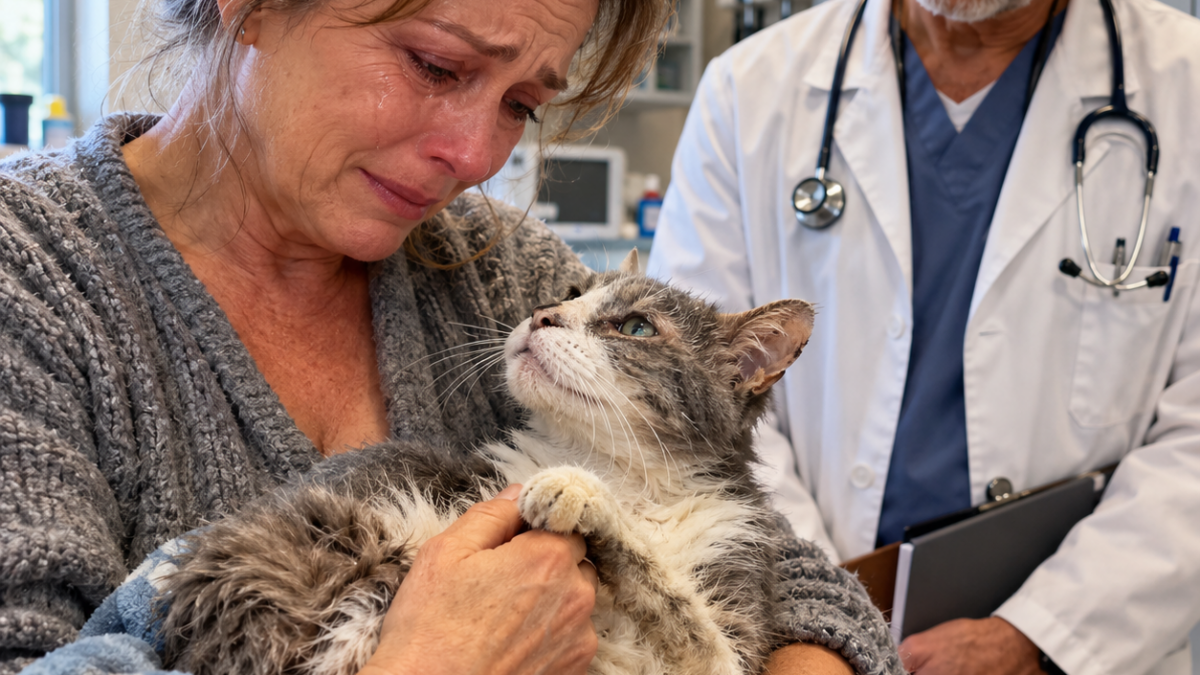
“He has severe dental disease,” he said. “Likely very painful. A heart murmur. Significant muscle wasting. Extreme weight loss. His body is very tired.”
I nodded.
Words came to me slowly.
“Can we fix the teeth?”
“At his age and condition, anesthesia would be risky. Very risky. We can manage pain. We can make eating easier. We can treat infection if present. We can focus on comfort.”
Comfort.
There it was.
The hospice word again.
“How long do you think?”
Dr. Palmer sat back slightly.
“I don’t want to pretend I can predict exactly. Cats surprise us. But based on what I’m seeing, I think you should prepare yourself. It may be a week. Maybe two.”
A week.
Maybe two.
Ollie looked up at me and purred louder.
I pressed my lips together.
Dr. Palmer continued gently.
“That doesn’t mean he’s suffering right this moment. He seems comfortable with you. But he’s very fragile. The kindest thing may be to give him good food, warmth, pain control, and love. Watch him closely. When his bad days outnumber the good, call me.”
I nodded because nodding was easier than speaking.
We made a plan.
Medication.
Soft food.
A warming pad.
Small meals.
Pain management.
A follow-up call in forty-eight hours.
I paid the bill, carried Ollie to the car, placed the carrier on the passenger seat, and sat behind the wheel.
Then I cried so hard I could not start the engine.
It was ridiculous.
I had known him for less than twenty-four hours.
I had adopted him as hospice.
The shelter had warned me.
The vet had not said anything cruel.
But grief does not check the length of acquaintance before entering.
There is something uniquely unfair about falling in love with an animal after you have already been told goodbye is waiting nearby.
I covered my face with both hands.
“I’m sorry,” I whispered. “I’m so sorry.”
From the carrier came a soft sound.
Then one skinny paw reached through the little opening.
I stared.
Ollie’s paw searched the air.
I placed my finger against it.
He held on.
Not tightly.
He did not have the strength.
But he kept his paw there all the way home.
That was when I made the promise.
Not out loud.
Not dramatically.
Just in the quiet between red lights, with an old cat’s paw resting against my finger.
You will not die alone.
Whatever happens, however long we have, you will not leave this world wondering whether anyone is there.
The first week became a series of small negotiations.
Medication hidden in food?
Rejected.
Medication crushed in gravy?
Suspicious.
Medication mixed with tuna water?
Accepted once, then never again.
Pill pocket?
Insulting.
Direct dosing?
Necessary and morally complicated.
Ollie objected to medication with a silent dignity that made me feel like a war criminal.
He also had very strong preferences about food.
The shelter food he had eaten before? Suddenly unacceptable.
The expensive senior pâté I bought in bulk? Apparently poison.
Warm chicken baby food? Interesting.
Tuna mousse? Acceptable if served on a saucer, not a bowl.
Prescription recovery food? Only if I sat beside him and pretended not to watch.
I became obsessed with calories.
There is no graceful way to say this.
I, a grown woman who had balanced budgets, raised a child, buried parents, and refinanced a house, began celebrating half-teaspoons of cat food like Olympic victories.
“Good job,” I told Ollie one morning as he licked three bites from a spoon.
He looked at me with tired eyes.
“You’re very brave.”
He took one more bite.
I nearly applauded.
Claire called that night.
“How is the hospice cat?”
“His name is Ollie.”
“I know. I’m trying to emotionally prepare you by using descriptive distance.”
“That is not helpful.”
“How is Ollie?”
“He ate almost two tablespoons today.”
“That’s good, right?”
“That’s incredible.”
She softened.
“Mom.”
“What?”
“You sound… different.”
“Different how?”
“I don’t know. Busy.”
I looked at Ollie, who was asleep on a heated pad with one paw stretched out as if he owned the room.
“I guess I am.”
“Good,” she said quietly.
A week passed.
Ollie was still there.
Not thriving.
Not yet.
But there.
He slept a lot. Ate little. Needed help onto the bed. Needed medicine twice a day. Needed his face wiped gently after meals because dental pain made him messy. Needed warmth. Needed patience. Needed someone to notice small changes.
I noticed everything.
Too much, probably.
A slower walk made my stomach drop.
A better appetite made me float.
A missed meal convinced me the end had arrived.
A purr restored my faith in medicine, God, and chicken baby food.
Two weeks passed.
Still there.
I called Dr. Palmer.
“He’s eating a little more,” I said.
“That’s good.”
“He follows me to the kitchen.”
“That’s very good.”
“He yelled at me yesterday.”
Dr. Palmer paused.
“Yelled?”
“More of a cracked squeak. But judgmental.”
I could hear the smile in his voice.
“That may be the best update yet.”
At three weeks, Ollie developed a morning routine.
I would shuffle into the kitchen at 6:30, still half asleep, and find him sitting in front of the refrigerator, staring at me as if I had failed him professionally.
“You cannot possibly be starving,” I told him.
He stared.
“I fed you at midnight.”
Stare.
“You are eighteen years old. You should be more patient.”
Stare.
I opened the refrigerator.
He made the cracked squeak.
I warmed his food in the microwave for exactly seven seconds because eight made it too hot and six apparently failed to release the correct aroma.
Then I sat beside him on the kitchen floor while he ate.
This became our morning.
I stopped resenting the early hour.
That surprised me.
Before Ollie, mornings had been the loneliest part of the day. The house held all its silence at once. Coffee brewed for one. No footsteps upstairs. No school lunches to pack. No daughter yelling, “Have you seen my other shoe?” as if I had personally hidden it for sport.
Now there was Ollie.
Tiny, frail, demanding Ollie.
A cat who might have had a week.
Maybe two.
A cat who, on day twenty-four, scolded me because breakfast was late by four minutes.
By the end of the first month, he jumped onto the couch.
Or rather, he climbed, scrambled, panicked halfway, committed out of spite, and arrived on the cushion with the expression of a mountain climber who had conquered Everest.
I screamed.
Not loudly, but enough that Ollie startled and nearly fell off.
I grabbed him.
He looked offended.
Claire called two minutes later.
“Are you okay? You called and didn’t say anything.”
“You’re not going to believe what happened.”
“What?”
“Ollie jumped on the couch.”
There was a long pause.
Then Claire laughed.
“Mom… you called me because your cat got on the couch?”
“Yes.”
“And this required emergency contact?”
“Yes.”
She laughed harder.
I did too.
Then I started crying.
Claire stopped laughing.
“Mom?”
“He wasn’t supposed to make it this long.”
“I know.”
“He got on the couch by himself.”
“I know.”
“He wanted to sit by me.”
Claire was quiet for a moment.
Then she said, “That is a big deal.”
“Yes.”
“And I’m proud of him.”
“Thank you.”
“And also, you need more friends.”
“I have Ollie.”
“That is not a rebuttal.”
But she was smiling.
I could hear it.
Every little thing felt enormous.
He started grooming himself again.
Not well, but enough.
A few careful licks across his chest. One paw dragged over one ear. Then he would stop, exhausted, as if personal hygiene were a major construction project.
I brushed him with a soft brush, slowly, in short sessions. At first, he tolerated it. Then he liked it. Then he expected it. By the second month, if I stopped too soon, he would tap my wrist with one paw.
That tap became his language.
Tap for more brushing.
Tap for lap access.
Tap for food.
Tap for “you have been reading too long and should attend to me.”
He gained three ounces.
Three ounces.
I announced it to three people.
Rachel from next door, who had brought soup after Claire moved.
Claire, of course.
Dr. Palmer’s receptionist, who was kind enough to sound impressed.
By month three, Ollie discovered the warm patch of sunlight beside the front window.
I had lived in that house for twenty-two years and never appreciated that patch properly. Every morning around ten, sunlight slipped through the maple tree and landed in a soft rectangle on the rug. Ollie found it, lowered himself into it, and stretched out with his old bones soaking up warmth.
He looked ancient.
He looked peaceful.
He looked like the reason sunlight had been invented.
I began moving my reading chair closer so I could sit near him.
At first, I told myself I was supervising.
Then I admitted I simply liked being where he was.
One afternoon, while Ollie slept in the sun and I read beside him, the house felt quiet again.
But not empty.
There is a difference.
Quiet with someone else breathing nearby is peace.
Quiet alone is weather.
Ollie changed the weather.
By month four, he discovered my desk.
I worked part-time from home doing bookkeeping for a local dental practice. Before Ollie, I worked in efficient silence. After Ollie, I worked under supervision.
He would sit on the corner of the desk, bony body tucked awkwardly beside the lamp, and stare at my pen.
The first time he knocked it off, I assumed it was an accident.
I picked it up.
He watched carefully.
Then knocked it off again.
I looked at him.
“Ollie.”
He stared.
I picked it up.
He knocked it off.
A game was born.
A stupid game.
A perfect game.
Every day, he knocked a pen off my desk. Every day, I picked it up. Sometimes I pretended to scold him. Sometimes I tried moving the pen farther away. He adapted. His old body could not do many things quickly, but his commitment to minor office disruption was inspiring.
Claire visited in December.
She arrived late on a Friday, carrying too many bags and wearing the exhausted happiness of someone who had driven eight hours to come home.
I hugged her in the doorway longer than necessary.
She let me.
Then she pulled back.
“Where is the old man?”
“Probably in the sunroom.”
Claire dropped her bags and followed me.
Ollie was asleep on the heated bed.
He opened one eye.
Claire crouched.
“Hi, Ollie. I’m Claire.”
Ollie closed the eye.
She looked at me.
“He seems thrilled.”
“He’s conserving energy.”
“He’s ignoring me.”
“He ignores everyone with nuance.”
Over the weekend, Ollie mostly avoided her. He accepted her presence but not her touch. Claire tried not to be offended and failed a little.
“I thought I was charming,” she said.
“You are. He’s elderly and discerning.”
On Sunday afternoon, while Claire packed to drive back, Ollie shuffled into the guest room.
He had never done that before.
Claire’s suitcase lay open on the bed.
Ollie stared at it.
“No,” Claire said. “You cannot come to Denver.”
Ollie placed both front paws on the side of the suitcase.
“Oh no.”
I stood in the doorway.
“This is new.”
With great effort, Ollie climbed into the suitcase. It took him almost a full minute. Claire and I watched, neither of us breathing. When he finally made it in, he turned around twice and lay down on her sweaters.
Claire’s face crumpled.
“Oh, Mom.”
“I know.”
“He likes me.”
“He likes your knitwear.”
“Don’t ruin this.”
She sat on the bed beside the suitcase and touched his back gently.
Ollie purred.
Claire cried.
I pretended not to because mothers sometimes give their daughters privacy even while standing three feet away.
After she left, Ollie slept on the sweater she had forgotten to pack for three days.
I mailed it back covered in cat hair.
Claire called when it arrived.
“Was this necessary?”
“He blessed it.”
“I’m allergic to blessings now.”
“You’re welcome.”
Spring came.
Then summer.
Then a year.
Ollie turned nineteen.
We celebrated because I had become the sort of woman who celebrated a cat’s birthday with a candle in a dish of tuna mousse.
Rachel came over.
Claire video-called.
Ollie sniffed the tuna, ate two bites, and walked away.
Typical.
I took photographs anyway.
Dr. Palmer looked genuinely surprised at his annual exam.
“Well,” he said, listening to Ollie’s heart. “Hello, miracle man.”
Ollie purred.
“He’s still very fragile,” Dr. Palmer reminded me.
“I know.”
“His dental disease is still significant.”
“I know.”
“His heart murmur is unchanged, which is better than worse.”
“I will take unchanged.”
“You should.”
He weighed more than he had at intake.
Not much.
Enough.
When we got to the car, I cried again, but differently this time.
Not because the end was near.
Because the end was not the only thing anymore.
That is what Ollie gave me first.
Not forever.
Never forever.
He gave me a shift in attention.
At the beginning, I watched him for signs of dying.
After a while, I began watching him for signs of living.
There is a world of difference between the two.
Signs of dying made me afraid.
Signs of living made me present.
He taught me to notice warmth, appetite, irritation, curiosity, routine, small pleasures, persistence, sun patches, the sacred importance of a pen falling off a desk.
The second year was not perfect.
No year with an ancient cat is.
There were bad days.
Days he would not eat.
Days his mouth hurt despite medication.
Days he hid under the table and looked at me with tired eyes.
Days I called Dr. Palmer convinced it was time.
Sometimes Dr. Palmer said, “Bring him in.”
Sometimes he said, “Try warming the food more.”
Sometimes he said, “Maren, tell me about the last three days, not just this hour.”
That became one of the most useful things anyone had ever said to me.
Not just this hour.
Grief and fear narrow time.
They make a bad hour feel like a final diagnosis.
So I began tracking Ollie’s days on a calendar.
Good appetite.
Lap time.
Sun patch.
Pen game.
Vomited breakfast.
Ate dinner.
Slept with me.
Groomed.
Quiet day.
Bright evening.
The pattern mattered.
When the bad hours came, I looked at the week.
Ollie taught me that too.
A hard moment is not always the whole truth.
At twenty, he became louder.
Not strong-lunged loud.
Old-man loud.
A cracked, demanding sound that appeared anytime I failed to meet expectations he had not communicated.
Standing by the refrigerator: squeak.
Standing by the closed bathroom door: squeak.
Standing beside the bed at 3:12 a.m. because he had decided he wanted help up but not badly enough to use the ramp: squeak.
I bought three ramps.
Bedroom.
Couch.
Window chair.
He used none of them consistently.
He preferred to stand beside furniture and summon staff.
I was staff.
By then, I had stopped pretending otherwise.
When Claire visited that summer, she found me cutting Ollie’s food into tiny manageable portions and arranging them on a saucer.
“You know he has trained you,” she said.
“He is elderly.”
“He is a dictator.”
“He has needs.”
“He has a staff member.”
“Ollie has standards.”
Ollie squeaked from the kitchen.
Claire pointed.
“See?”
I went.
Of course I went.
At twenty-one, Ollie developed rules.
The warm spot by the front window belonged to him.
My side of the bed was negotiable.
The bathroom rug was community property.
No one was permitted to close a door between him and me.
Visitors could be tolerated if they spoke respectfully and did not smell like dogs.
Chicken was preferred over turkey.
Salmon was acceptable only on Tuesdays, for reasons neither of us understood.
Medication remained an ongoing betrayal.
Brushing was mandatory.
Lap access was immediate.
Evenings became our sacred time.
I would sit in the blue chair by the window, the same one that used to face the television, and Ollie would make his slow way across the room. Sometimes I lifted him. Sometimes he insisted on doing it himself. He would climb onto my lap, turn around with great ceremony, and settle in.
His bones softened under warmth.
His purr started.
I read books.
He slept.
Outside, the neighborhood moved through seasons. Children rode bikes. Snow fell. Lawns grew and browned. The maple tree dropped leaves. Delivery trucks came and went. Life kept being life.
Inside, Ollie and I grew older together.
There is a tenderness in caring for an old animal that is hard to explain without making it sound only sad.
It is sad sometimes.
Of course it is.
You count pills.
You monitor weight.
You watch stairs.
You learn the difference between sleeping deeply and sleeping wrong.
You know the ending is closer than the beginning.
But there is also extraordinary peace.
An old animal does not waste love.
They do not need adventure.
They do not ask you to become more interesting than you are.
They want the bowl in the same place.
The blanket warm.
The hand gentle.
The lap available.
They teach you that ordinary devotion is not small.
It is the whole thing.
My life changed around Ollie in ways I did not expect.
I spoke to more neighbors because they asked about the old cat in the window.
Rachel began stopping by on Wednesdays with soup, claiming she was “checking on Ollie,” though she always stayed for tea.
Claire called more often.
At first, to ask about him.
Then to ask about me.
Sometimes we talked about Ollie’s latest outrage for twenty minutes. Sometimes we talked about her work, my garden, a recipe, the strange loneliness of adulthood, the way both of us were learning that love changes shape but does not have to disappear.
Ollie became a bridge.
Not because he did anything dramatic.
Because shared love gives people a place to meet.
At twenty-two, he scared me badly.
It was February, bitter cold, the kind of week when the windows iced at the corners. Ollie stopped eating one morning.
Then lunch.
Then dinner.
He drank a little water but turned away from every food I offered. Tuna. Chicken. Baby food. Warm broth. Recovery formula. Nothing.
His body felt smaller in my hands.
At the emergency clinic, a young vet reviewed his chart and looked at me with the careful expression I recognized.
“He’s very old.”
“I know.”
“You’ve had a remarkable amount of time.”
“I know.”
“We can run bloodwork, provide fluids, nausea medication, pain control. But we also need to talk about quality of life.”
The phrase did not offend me.
It never should.
Quality of life is love translated into responsibility.
Still, hearing it made my chest hurt.
Ollie lay in a blanket on the exam table, tired and quiet.
Not purring.
That was what frightened me most.
I called Claire from the parking lot after they admitted him for supportive care.
She answered immediately.
“Mom?”
“I don’t know if this is it.”
Silence.
Then: “Do you want me to come?”
I almost said no.
The mother reflex.
Do not disrupt her life.
Do not make your pain her emergency.
Then I thought of Ollie’s paw through the carrier opening that first day.
The promise.
No one alone.
“Yes,” I said.
Claire drove through snow that night.
By the time she arrived, Ollie had received fluids and medication but still had not eaten. The clinic allowed us into a quiet room with him. We sat on either side of the table while he lay between us.
Claire touched his back.
“Hey, old man.”
His ear moved.
I cried.
Claire looked up at me.
“What?”
“He heard you.”
She wiped her face.
“You’re both ridiculous.”
“I know.”
For two hours, we sat with him.
Talking softly.
Remembering the first couch jump, the suitcase, the pen game, the year he developed strong opinions about salmon.
Near midnight, Claire opened the small container I had brought from home.
Warm chicken baby food.
Ollie’s nose twitched.
Barely.
Claire held a bit on her finger.
“Come on,” she whispered. “You have to keep bossing Mom around. She’s hopeless without supervision.”
Ollie lifted his head.
Licked once.
Then again.
Not much.
Enough.
Barely counts.
The next morning, Dr. Palmer called.
He had spoken with the emergency clinic and reviewed everything.
“He may recover from this episode,” he said. “Or he may be giving us warning.”
“I know.”
“How does he seem to you?”
That was why I trusted him.
He did not ask only for numbers.
He asked for Ollie.
“Tired,” I said. “But still interested. He ate for Claire.”
“That tells me something.”
“What?”
“That he is not done today.”
Not done today became our prayer.
Not forever.
Not promised.
Not painless.
Just not done today.
Ollie came home the next evening.
Claire stayed three more days.
For once, she worked remotely from my kitchen, laptop open, Ollie sleeping beside her notebook. He interrupted two meetings by squeaking at the exact moment her boss was speaking.
Claire muted herself and whispered, “Professional sabotage.”
Ollie looked pleased.
After she left, the house felt quiet again, but not empty.
Never empty now.
At twenty-three, Ollie became impossibly old.
Not in a sad way.
In an astonishing way.
Every time someone asked his age, I enjoyed saying it.
“Twenty-three.”
People reacted like I had said he was one hundred and twelve and still doing taxes.
Which, in cat terms, he basically was.
Dr. Palmer shook his head at every visit.
“If he starts giving lectures on the stock market, I’m retiring.”
Ollie purred.
His body was very frail by then. His back legs wobbled. His face had become sharper. His fur needed help. His hearing was not as good. His appetite came and went. We adjusted medication, food, routines, expectations.
But he remained Ollie.
Still demanding.
Still affectionate.
Still deeply committed to the pen game despite reduced accuracy.
Sometimes he knocked nothing off the desk and looked proud anyway.
I applauded.
At twenty-three, I bought him a tiny birthday treat.
A ridiculous little senior cat mousse shaped like a cupcake from a boutique pet bakery Claire had found online.
“It’s absurd,” I told her on video.
“Buy it.”
“It costs more than my lunch.”
“He’s twenty-three.”
“That is emotional manipulation.”
“Yes.”
I bought it.
On his birthday, Rachel came over. Claire joined by video. I placed the tiny treat on a saucer in front of Ollie.
He sniffed it once.
Looked at me.
Walked away.
Typical Ollie.
Rachel laughed so hard she had to sit down.
Claire shouted through the phone, “I love him so much!”
I ate a slice of human cake in his honor.
That evening, after the birthday betrayal, Ollie climbed onto my chest and settled in the exact same place he had chosen on his first night.
Over my heart.
He was lighter now.
Older.
His purr thinner.
But the shape of him against me was the same.
I looked down at his old gray face and thought about that first vet visit.
A week.
Maybe two.
Five years had passed.
Five years of mornings, routines, laughter, worry, warm afternoons, quiet evenings, and someone waiting for me when I came home.
Five years of soft food and medicine and sun patches.
Five years of Claire calling to ask, “How’s my elderly brother?”
Five years of Rachel bringing soup “for Ollie.”
Five years of learning that a life does not have to be young to be full.
I had adopted Ollie because I could not bear the thought of an elderly cat spending his final days unwanted.
I thought I was giving him a peaceful ending.
I never imagined he would give me another chapter.
The end came in May.
I wish I could skip this part.
I cannot.
Love stories with old animals do not become less beautiful because they end. But they do ask honesty of us.
Ollie had a good morning.
That is what I remember.
He ate a little chicken. Sat in the sun patch. Knocked a pen off my desk with such weak determination that I left it on the floor for him to admire. Then he slept on my lap through most of the afternoon.
By evening, something changed.
Not dramatically.
A shift.
His breathing became shallower. His body felt different in my hands. He looked toward me, and I knew.
Anyone who has loved an old animal knows the look.
Not pain, necessarily.
Not panic.
A kind of distance.
As if they are already listening to a room you cannot hear.
I called Dr. Palmer.
He answered after hours because saints sometimes carry veterinary licenses.
“I think it’s time,” I said.
My voice broke on time.
“I’ll meet you at the clinic,” he said.
I called Claire.
She was already crying when she answered.
“I’m leaving now.”
“You can’t get here in time.”
“I’m leaving anyway.”
“Claire.”
“Put me on speaker when you’re there.”
So I did.
I wrapped Ollie in the blue fleece blanket that had once belonged to Claire. The same one I had almost donated the day I met him. I had kept it after all. I think some part of me knew.
At the clinic, Dr. Palmer had prepared a quiet room with soft lighting and a blanket on the table. No cold metal. No rush. No strangers moving in and out.
Ollie lay in my lap, not on the table.
Claire’s voice came through the phone.
“Hi, Ollie.”
His ear moved.
Even then.
The smallest gift.
Rachel came too. She stood near the door with one hand over her mouth, then sat beside me and touched my shoulder.
Dr. Palmer examined him gently.
Then he looked at me.
“I agree,” he said softly.
Those two words hurt.
They also helped.
There is mercy in not being made to decide alone.
I held Ollie the whole time.
I told him every true thing I could fit into the minutes we had.
That he was loved.
That he had been wanted.
That he was a good boy.
That he had saved me.
That Claire loved him.
That Rachel loved him.
That the sun patch would always be his.
That I was right there.
That he was not alone.
His purr began one last time.
So faint I almost missed it.
I felt it more than heard it, against my wrist.
Then it faded.
And Ollie, who had arrived with a week left and stayed five years, left this world exactly as I had promised.
Not alone.
Never alone.
For a while afterward, the house became quiet again.
This time, I did not pretend it didn’t hurt.
I let it hurt.
I left his bowls out for a week.
Then two.
Claire came home the weekend after. We cried in the kitchen. Rachel brought soup and said nothing wise, which was the wisest thing she could have done.
Dr. Palmer sent a card.
Inside, he wrote:
Some patients teach us not to count time only by length.
I kept that card on my desk.
Beside the pen Ollie had knocked down so many times that the cap no longer stayed on.
Grief after Ollie was different from the loneliness before him.
Before Ollie, the quiet had been empty.
After Ollie, the quiet was full of evidence that love had lived there.
The sun patch.
The ramp he rarely used.
The blanket.
The desk corner.
The tiny scratches on the floor near the refrigerator.
The way I still woke at 6:30 expecting judgment.
For weeks, I thought I heard his squeak.
Sometimes I did not even mind.
Claire worried about me.
“Are you okay?” she asked one night.
“No.”
She was quiet.
Then I added, “But I’m not alone in the same way.”
“What does that mean?”
I looked at the blue chair by the window.
“It means he changed the house. Even without being here.”
Six months later, I returned to Willow Creek Animal Rescue.
Not to adopt.
Not yet.
Maybe not ever.
I brought blankets.
Better ones this time.
New ones.
Beth was still at the front desk.
When she saw me, her eyes softened.
“Maren.”
“Hi.”
She came around the desk and hugged me.
Not too long.
Exactly long enough.
“How are you?”
“I miss him.”
“I know.”
“He made it five years.”
“We still talk about him.”
That surprised me.
“You do?”
“Are you kidding? Hospice Ollie? The cat who rejected the birthday cupcake? Legend.”
I laughed.
It hurt.
But it was real.
Beth took the blankets.
Then hesitated.
“We have a senior room now.”
“A what?”
“We converted the old storage office. Quieter space for older cats. Better beds. Heated pads. Softer lighting.”
“That’s wonderful.”
“We call one of the beds Ollie’s Spot.”
My throat closed.
“Beth.”
“We got a donation after his story went out in the newsletter. People liked hearing that hospice adoption could mean years. Or days. But meaningful either way.”
I followed her down the hall.
The senior room was small and warm. Three old cats slept in various states of collapse. A twelve-year-old tortie opened one eye, judged me, and went back to sleep. A white cat with one ear missing snored loudly. A thin black cat sat on a heated pad and blinked.
Above one bed was a small sign.
OLLIE’S SPOT
For the old souls who still have love to give.
I cried.
Obviously.
Beth handed me a tissue from a box that looked heavily used.
“Everyone cries in here.”
“I’m fine.”
“No one is fine in the senior room.”
That was true.
I sat in the chair by the window while the black cat watched me.
After a few minutes, he came over and sniffed my shoe.
My heart jumped in panic.
Not because I did not want another cat.
Because I did.
And because wanting felt like betrayal for half a second.
The black cat turned and walked away.
Apparently unimpressed.
I laughed through tears.
“Fair enough.”
I did not adopt that day.
But I began volunteering in the senior room on Saturdays.
At first, I told myself it was to honor Ollie.
That was only partly true.
The rest was simpler.
I missed being useful to old animals.
I missed the quiet company of creatures who did not need me to be cheerful, only present.
I brushed cats.
Cleaned bowls.
Sat with the ones who wanted laps.
Read to the ones who did not.
I learned again that love does not run out when it has somewhere to go.
One afternoon, a woman about my age came into the senior room holding herself the way I had held myself the day I first saw Ollie.
Lonely but trying not to be obvious.
She stopped in front of a seventeen-year-old tabby named Agnes.
“How long has she been here?” the woman asked.
“Two months,” Beth said.
“Has anyone asked about her?”
Beth glanced at me.
I smiled sadly.
“Not yet.”
The woman crouched.
Agnes opened one eye.
Then, with ancient effort, she stood and shuffled forward.
She pressed her forehead against the woman’s finger.
The woman began to cry.
I handed her a tissue.
She looked embarrassed.
“I’m sorry. I wasn’t looking for a cat.”
I sat beside her on the floor.
“Neither was I.”
Agnes leaned harder into her hand.
The woman whispered, “She’s so old.”
“Yes.”
“What if there isn’t much time?”
I thought of Ollie.
The first night.
The vet’s warning.
The paw through the carrier.
The couch jump.
The suitcase.
The pen game.
The five birthdays.
The final purr.
“Then don’t waste it,” I said softly.
The woman looked at me.
I touched the edge of Ollie’s Spot sign.
“Sometimes the ones with the least time teach us the most about how to spend it.”
Agnes went home with her two days later.
I cried in the laundry room.
Beth found me.
“Allergies?” she asked.
“Very aggressive.”
She laughed.
Years have passed now.
I am older than I was when I met Ollie, though in my mind I am still fifty-seven and crouched in front of a bottom-row kennel, holding out one finger to a cat nobody had asked about.
Claire moved closer eventually.
Not because of me, she insisted.
Because of a better job.
I let her keep the dignity of that lie.
She now lives forty minutes away and still refers to Ollie as “my elderly brother.” On the anniversary of his adoption, she brings me coffee and we sit by the front window. Sometimes we talk about him. Sometimes we just sit in the light.
I still volunteer in the senior room.
I have adopted again, too.
A twelve-year-old tortie named Maude who bites visitors she dislikes and adores Claire with insulting enthusiasm. Maude is not Ollie. That matters. No animal should be asked to become the ghost of another.
She is herself.
Loud.
Bossy.
Very much alive.
And sometimes, when she sleeps in the sun patch, I feel Ollie’s life not as absence, but as foundation.
He taught the house how to welcome again.
That is what love does when it is allowed to finish its work.
People still hesitate to adopt older animals because they are afraid there will not be enough time.
Maybe they are right.
Maybe there will not be.
Maybe it will be a week.
Maybe two.
Maybe five years.
No one can promise you length.
But length is not the only measure.
There are lives that stretch for years and never wake the heart.
There are moments that last seconds and change the weather of a house forever.
Ollie taught me that love does not become less meaningful because you know it may end.
All love ends in some form here.
We know that.
We marry anyway.
Raise children anyway.
Plant gardens anyway.
Bring home old cats anyway.
Not because we are foolish.
Because love was never valuable only when it could be guaranteed.
I thought I was saving Ollie from being alone.
I thought I was giving him a soft place to spend his final days.
I thought the story would be short and sad and merciful.
Instead, he gave me five years of mornings.
Five years of routine.
Five years of laughter.
Five years of worry.
Five years of warm afternoons and quiet evenings.
Five years of a small, stubborn heartbeat against mine.
And when the end finally came, it did not erase any of that.
It completed the promise.
The vet had looked at him and said a week.
Maybe two.
Ollie heard that, purred, and apparently decided the medical profession had underestimated his schedule.
I am grateful every day that he did.
Because sometimes the animal you bring home to comfort at the end does not just teach you how to say goodbye.
Sometimes he teaches you how to live again before goodbye ever arrives.
And if you are very lucky, if you are paying attention, if you let your heart be broken open instead of shut, one old cat with bad teeth and a rattly purr can take a quiet house and fill it with time that matters.
Not endless time.
Not easy time.
Sacred time.
The kind you do not count by weeks.
The kind you count by every morning someone is waiting for you by the refrigerator, staring like breakfast is late and life, somehow, is still asking to be lived.