A U.S. Marine Watched an 80-Year-Old Veteran Pawn His Bronze Star to Pay for His Wife’s Oxygen—Then His K9 Noticed the Leak That Exposed a Much Bigger Betrayal
PART3:
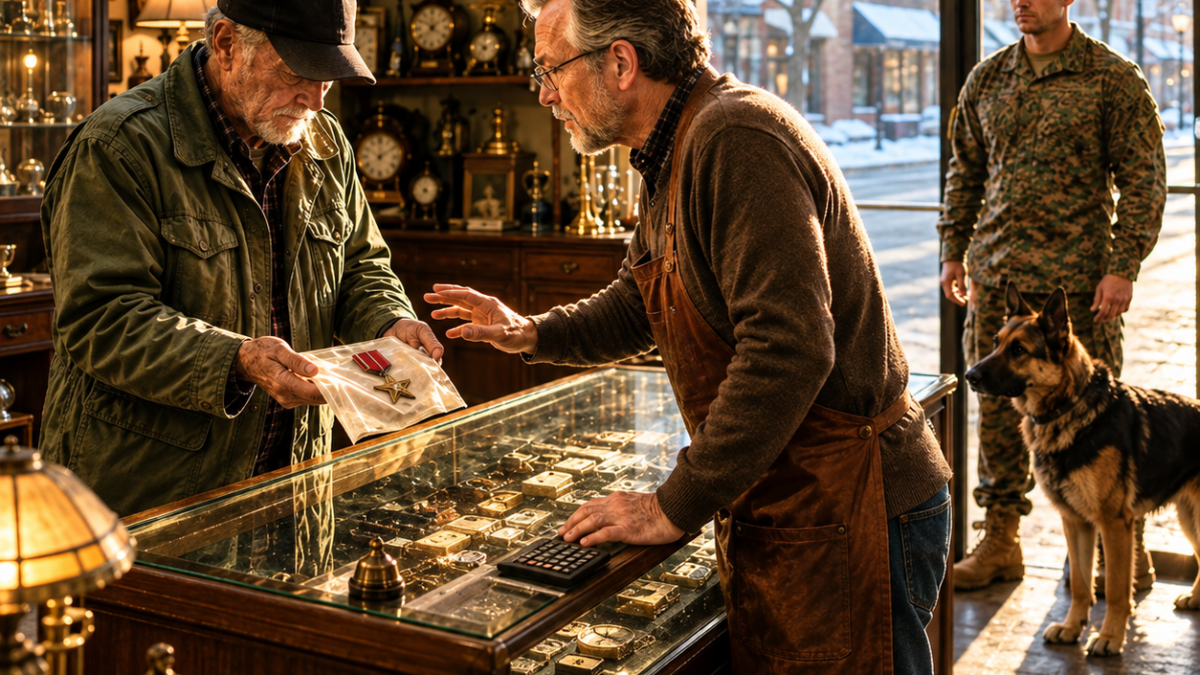
Checked markings.
Asked a few questions.
Then counted money into a small envelope.
The old man accepted it.
Did not count it.
That bothered Caleb more than desperation would have.
People who desperately needed money usually counted every bill.
The old veteran already knew the amount was not really what mattered.
He folded the empty handkerchief.
Placed it inside his coat.
Turned toward the door.
Valor still had not moved.
Caleb quietly touched the dog’s shoulder.
“Come on.”
Valor’s ears shifted.
Not toward the medal.
Toward the oxygen cylinder.
Caleb heard it then.
A soft hiss.
Rhythmic.
Almost hidden beneath the ticking clocks and low radio music inside the pawnshop.
Valor tilted his head.
Caleb crouched.
The regulator on the old cylinder looked scratched and worn.
Aging tubing.
Old fittings.
Not immediately catastrophic.
But not right.
The veteran left.
Valor watched him through the window.
“Partner.”
Nothing.
Caleb had seen the dog ignore explosions in training.
He had seen Valor lie calmly beside injured Marines while chaos moved around them.
When that animal became still, Caleb had learned not to argue.
He set the dog food beside the counter.
“Frank, mind if I leave that here two minutes?”
Frank looked toward the departing veteran.
“No problem.”
Caleb followed.
He kept his distance.
Not because he was hiding.
Because dignity had space requirements.
The old veteran moved slowly along Main Street.
His oxygen tank rattled across patches of salt and ice.
He stopped once beside a bench.
One hand braced against the cylinder handle.
He took several controlled breaths.
Then two teenagers walked past.
The man immediately straightened.
Caleb recognized the instinct.
He had seen Marines hide injuries from one another because they could not stand being the reason someone slowed down.
Pride could keep a person alive.
It could also keep help far away.
The veteran continued.
Two blocks later, he entered a storefront with a faded blue sign.
MOUNTAIN HOME RESPIRATORY CARE
Caleb stopped outside.
Valor looked through the frosted lower window.
Caleb could see enough.
The old man approached the counter.
Removed the pawnshop envelope.
Slid it forward.
A young employee counted the money.
Her expression shifted.
She checked the computer.
Counted again.
Then spoke.
Caleb could not hear every word through the glass.
He heard the number.
“Sixty-three.”
The veteran lowered his head.
The employee looked genuinely sorry.
Caleb stepped closer.
“Without the remaining sixty-three dollars, Mr. Whitmore, we can’t renew the rental after tomorrow.”
Mr. Whitmore.
Now Caleb had a name.
Samuel Whitmore.
Samuel did not complain.
No anger.
No begging.
No speech about being a veteran.
No demand that anyone bend rules for him.
He simply gathered the money back into the envelope.
“Thank you for checking.”
Then he turned around.
Caleb felt something hard form inside his chest.
The man had pawned a Bronze Star.
And it still was not enough.
Samuel stepped outside.
Valor moved before Caleb did.
The German Shepherd crossed the sidewalk and sat beside the oxygen cylinder.
Samuel stopped.
Looked down.
Valor lowered his head slightly.
The dog’s eyes stayed on Samuel.
The old veteran’s composure fractured.
Only for a moment.
He put one gloved hand on Valor’s neck.
“I promised her I’d bring air home today.”
Caleb heard it.
The sentence was soft.
Almost private.
It hit harder than the medal.
Caleb approached.
“Mr. Whitmore?”
Samuel looked up sharply.
Caleb stopped several feet away.
“My name is Caleb Thornton.”
Samuel looked at his jacket.
Then toward the pickup parked farther down the street.
“I saw the Marine Corps sticker.”
Caleb nodded.
Samuel studied him.
“You followed me.”
“I did.”
“Why?”
Caleb looked at Valor.
“He did first.”
Samuel almost smiled.
Caleb continued.
“I’m not trying to interfere.”
“Then don’t.”
Fair.
Caleb nodded.
Samuel took the cylinder handle.
Valor remained sitting.
Samuel looked down.
“Your dog appears to disagree.”
“He does that.”
“Bad habit.”
“Terrible.”
Samuel waited.
Caleb said:
“I’d like to drive you home.”
“No.”
“I expected that.”
“I’ve walked farther.”
“I believe you.”
“Then we understand each other.”
“We do.”
Caleb looked at the cylinder.
“But every minute that valve leaks is oxygen your wife isn’t getting later.”
Samuel’s eyes sharpened.
Caleb knew immediately he had guessed correctly.
The oxygen was not for Samuel.
Samuel’s hand tightened on the cylinder handle.
“My wife’s name is Evelyn.”
Caleb nodded.
Samuel looked away.
“She doesn’t know about the medal.”
“She won’t hear it from me.”
Another pause.
“I’m not taking charity.”
Caleb understood the line now.
Not stubbornness.
Fear.
Samuel had already surrendered something deeply personal.
He could not surrender dignity too.
Caleb said:
“I’m not offering charity.”
Samuel looked at him.
“I’m offering respect.”
The old man studied Caleb’s face.
Years seemed to pass inside that silence.
Finally:
“It would save oxygen.”
Caleb nodded.
“That was my thought.”
The drive north passed mostly in silence.
Samuel checked the cylinder gauge every few minutes.
Valor lay behind the passenger seat.
Snow-covered pasture spread beyond the road.
The Bridger Mountains were nearly hidden by gray cloud.
Samuel occasionally pointed out a ranch name or an old road.
He did not volunteer much about himself.
Caleb did not push.
They turned onto a narrow county lane bordered by pine.
At the end stood a small wooden cabin.
Weathered.
Clean.
Firewood stacked precisely.
Walkway shoveled.
Windows sealed with careful strips against winter drafts.
Nothing was luxurious.
Everything was maintained.
Samuel turned toward Caleb before opening the door.
“My wife thinks I went to arrange the next oxygen payment.”
“You did.”
“She doesn’t know how.”
“She still won’t.”
Samuel gave him a grateful look.
Inside, warmth carried the smell of cedar and dried mint.
A woman sat near the window beneath a blue knitted blanket.
Evelyn Whitmore.
Seventy-nine.
Thin.
Oxygen tubing under her nose.
Silver hair.
Gentle blue eyes.
Her body looked fragile.
Her smile did not.
“Samuel.”
Then she noticed Caleb.
“And you brought company.”
Samuel introduced them.
Valor entered last.
He went straight to Evelyn.
Stopped beside her chair.
Waited.
She smiled.
“Oh.”
Her hand moved slowly toward the dog.
Valor lowered himself beside her.
Evelyn touched his head.
“Now this is a handsome visitor.”
Samuel looked offended.
“You didn’t say that to me.”
“You’ve heard it enough.”
Caleb looked away to hide a smile.
Samuel went into the kitchen.
Returned with mugs of hot water and dried mint.
“Out of coffee.”
Caleb accepted one.
“I’ve survived worse.”
They talked.
Weather.
Road conditions.
The cabin.
Fishing.
The strange number of tourists who came to Montana unprepared for winter.
Evelyn teased Samuel about his obsession with stacking firewood evenly.
Samuel accused her of alphabetizing canned food.
For twenty minutes, Caleb saw what illness had not taken.
Marriage.
Humor.
Familiarity.
The small choreography of two people who had spent most of their lives together.
He also saw the oxygen cylinder.
Old.
Scratched.
Regulator worn.
Tubing patched once near a connector.
Caleb did not mention it immediately.
Then something else caught his attention.
A stack of medical papers beside the telephone.
Organized by date.
Paper-clipped.
One page had slipped sideways.
A blue Medicare logo was visible.
Caleb looked away.
Then saw a printed line.
EQUIPMENT DELIVERY COMPLETED.
He looked back.
“Samuel?”
“Yes?”
“When did they deliver the new concentrator?”
Samuel frowned.
“What new concentrator?”
Caleb pointed.
Samuel put on reading glasses.
Took the statement.
Read it.
Then again.
Evelyn watched him.
“What is it?”
Samuel did not answer.
Caleb asked:
“You were supposed to receive a replacement?”
Samuel shook his head.
“They said they were waiting on inventory.”
Evelyn looked toward the old machine near her chair.
“That’s what they told us.”
Caleb picked up another document with Samuel’s permission.
Same provider.
Mountain Home Respiratory Care.
Different date.
Replacement approved.
Delivery recorded.
Service visit completed.
Caleb checked another.
And another.
Samuel looked increasingly confused.
“I paid everything they sent me.”
“Did you ever compare the claims to what actually arrived?”
Samuel shook his head.
Then laughed without humor.
“Paperwork got harder after Michael.”
Caleb looked up.
“Our son.”
Evelyn’s voice softened.
“He was killed in Iraq.”
Caleb became still.
“I’m sorry.”
Samuel removed his glasses.
“He was thirty-one.”
Silence filled the room.
Evelyn rested her hand over Samuel’s.
“After that, bills arrived.”
“Samuel paid them.”
“Statements arrived.”
“He filed them.”
“Anything that looked official, we trusted.”
Samuel stared at the paperwork.
“They told me a new machine was delayed.”
Caleb looked at the old oxygen unit.
According to the paperwork, it had already been replaced.
Three weeks earlier.
Another claim listed a maintenance visit.
Nobody had come.
One form contained a digital signature.
Samuel’s name.
Caleb looked at it.
“Is this yours?”
Samuel studied the signature.
“No.”
“You’re sure?”
“I’ve signed my name for seventy years.”
His voice hardened.
“That isn’t it.”
Valor lifted his head.
Outside, tires crunched across snow.
A dark pickup moved slowly past the cabin.
No company logo.
No reason to stop.
It disappeared around the bend.
Samuel looked after it.
“I’ve seen that truck.”
“How often?”
“Three times this week.”
Caleb’s attention returned to the documents.
Maybe the truck was nothing.
Maybe not.
He refused to build conclusions faster than evidence.
That discipline had kept him alive more than once.
He asked Samuel:
“Would you let me make copies of these?”
“Why?”
“Because I think you paid for something you never received.”
Samuel looked embarrassed.
Caleb continued.
“And if someone forged your signature, this may not be only about you.”
The next morning Caleb walked into the Gallatin County Sheriff’s Office carrying a weatherproof folder.
Valor beside him.
Detective Naomi Sinclair met him upstairs.
Thirty-eight.
Athletic.
Chestnut hair tied back.
Green eyes that moved over details without making a performance of noticing them.
She had worked financial crimes involving elderly victims long enough to know that theft rarely looked dramatic from the outside.
Sometimes it looked like an automatic payment.
A forged signature.
A frightened pensioner too embarrassed to admit something felt wrong.
Caleb explained everything.
Pawnshop.
Oxygen provider.
Statements.
Forged signature.
Naomi did not interrupt.
When he finished, she compared the signature on the oxygen claim with Samuel’s signature on pension paperwork.
She frowned.
“That’s bad.”
“Bad as in suspicious?”
“Bad as in whoever forged this didn’t care very much.”
She accessed the secure claim system.
Samuel’s file appeared.
Replacement oxygen concentrator.
Delivered twenty-three days earlier.
Activated.
Maintenance completed.
Naomi stared.
“According to this, the equipment is already in the Whitmore home.”
“It isn’t.”
She opened the delivery confirmation.
Same false signature.
She leaned back.
“If this is deliberate, Samuel is probably not the only one.”
Naomi began searching.
Same provider.
Same equipment category.
Same region.
Six months.
Names filled the screen.
Most over seventy.
Many veterans.
Widows.
Retired ranchers.
People on fixed incomes.
A pattern emerged slowly.
Twelve patients.
All approved for replacement oxygen systems.
All recorded as successfully delivered.
Many still paying rentals on old cylinders or outdated units.
Naomi said quietly:
“This isn’t random.”
Caleb nodded.
“What happens now?”
“I call them.”
Caleb looked at Valor.
“I’ll come.”
Naomi raised an eyebrow.
“You know I’m the detective.”
“I know.”
“So why come?”
Caleb looked at the list.
“Half those names have military notes.”
Naomi understood.
“Some might talk to another veteran before they talk to a badge.”
Exactly.
Their first stop was a small trailer outside Belgrade.
Arthur Collins.
Eighty-one.
Korean War veteran.
Arthritis curled his fingers.
Old oxygen cylinder beside his recliner.
Naomi explained why they were there.
Arthur listened.
Then shook his head.
“I don’t want trouble.”
“You’re not in trouble.”
“I know how this works.”
Naomi leaned forward.
“Tell me.”
“You start investigating.”
“They get angry.”
“They take the equipment.”
“You argue over paperwork for three months.”
“I stop breathing during month one.”
Naomi’s face softened.
“They cannot legally remove medically necessary equipment because you cooperate with an investigation.”
Arthur gave her a tired smile.
“Legal doesn’t always mean quick.”
Caleb felt that.
Fear, not ignorance, had kept these people silent.
The next house produced the same answer.
Then another.
Everyone suspected something.
Nobody wanted to risk the oxygen they still had.
Valor became useful in a way no detective manual could teach.
At each house, the dog settled near the most anxious person.
No commands.
No tricks.
He simply stayed.
Arthur talked while rubbing the dog’s neck.
A widow named Rose finally showed Naomi three invoices after Valor rested his head against her knee.
Another veteran retrieved old delivery notices from a drawer he had been afraid to question.
By evening, Naomi had enough statements to begin formal expansion of the investigation.
Then her phone rang.
Unknown caller.
She answered.
A male voice.
“I heard you’re asking about oxygen deliveries.”
Naomi started recording.
“Who is this?”
“I drove for Mountain Home until last month.”
“Name?”
Silence.
“I’m not giving that yet.”
“Why call?”
Another pause.
“I kept quiet because I needed the job.”
“What changed?”
The man breathed out.
“Mr. Collins.”
Naomi glanced at Caleb.
“I delivered to him twice.”
“Delivered what?”
“Old cylinders.”
“Did you ever deliver his replacement concentrator?”
“No.”
“But the system says someone did.”
“I know.”
Naomi’s voice sharpened.
“Who approved that?”
The caller hesitated.
Then said:
“Curtis Voss.”
“Branch manager?”
“Yes.”
“Was he working alone?”
The line went quiet.
Then:
“No.”
The call disconnected.
Naomi looked at Caleb.
Now they had a name.
The investigation moved quickly after that.
Subpoenas.
Claim records.
Internal billing histories.
Driver schedules.
Inventory logs.
The same serial numbers appearing in records without matching delivery routes.
Naomi built the case carefully.
Caleb stayed mostly outside it.
He was not law enforcement.
He knew the difference.
He visited Samuel and Evelyn instead.
The old couple’s oxygen situation had become immediate.
Naomi helped connect them with a patient advocate and another authorized supplier while the investigation proceeded.
A temporary replacement unit arrived.
New regulator.
New tubing.
Proper documentation.
For the first time in months, Samuel stopped checking the pressure gauge every few minutes.
Evelyn noticed.
“You’re sleeping.”
Samuel grunted.
“I always sleep.”
“You patrol the house at two in the morning.”
“I check the stove.”
“We have electric heat.”
Samuel looked at Caleb.
“She exaggerates.”
Evelyn smiled.
“Thirty-eight years married.”
“Forty-two.”
She looked pleased.
“You remembered.”
“I learned after year thirty.”
They laughed.
Caleb did too.
Then one afternoon, Evelyn asked about the Bronze Star.
Samuel froze.
Caleb looked down.
The room changed.
Evelyn studied her husband.
“Samuel.”
He tried to redirect.
She did not let him.
“Where is it?”
Samuel sat slowly.
“I pawned it.”
Her eyes filled immediately.
Not anger.
Pain.
“You told me it was being cleaned.”
“I’m sorry.”
“For oxygen?”
He nodded.
Evelyn closed her eyes.
Samuel reached for her hand.
“I couldn’t let them take the equipment.”
“You could have told me.”
“And what would you have done?”
“Been your wife.”
Samuel looked away.
Evelyn’s voice remained gentle.
“You keep trying to protect me by carrying everything alone.”
“I promised Michael I would.”
That name silenced them.
Evelyn looked at the framed photograph of their son.
Marine uniform.
Smiling.
Young.
Alive forever inside the frame.
“Michael did not ask you to become lonely.”
Samuel’s face tightened.
“He told me before his last deployment to take care of you.”
“And you did.”
“I’m still doing it.”
“No.”
She squeezed his hand.
“We’re doing it.”
Samuel’s eyes filled.
Caleb looked toward the window.
Some moments did not need witnesses.
Valor remained beside Evelyn.
Two days later, Naomi obtained a search warrant.
Mountain Home Respiratory Care operated a regional warehouse at the edge of an industrial park.
Caleb accompanied investigators only as a civilian witness.
He stayed behind the law-enforcement team.
Valor beside him.
Curtis Voss met them inside.
Early fifties.
Expensive charcoal overcoat.
Dark hair.
Clean-shaven.
Polished.
The kind of man who looked comfortable in meetings where everyone else checked whether they had worn the correct tie.
“This is unnecessary.”
Naomi handed him the warrant.
“Then we’ll be out quickly.”
Curtis smiled.
“Everything is in our system.”
“Excellent.”
She smiled back.
“We’re comparing the system to the warehouse.”
His smile weakened.
Deputies began documenting stock.
At first everything appeared ordinary.
Sealed cartons.
Replacement tubing.
Portable cylinders.
Respiratory equipment.
Shipping labels.
Valor slowed.
Caleb felt the leash change.
The German Shepherd turned toward the back of the warehouse.
A locked steel door.
Valor stopped.
Curtis spoke immediately.
“That’s overflow.”
Naomi looked at him.
Nobody had asked.
“What’s inside?”
“Old stock.”
Valor sat.
Caleb looked toward Naomi.
“He’s interested.”
Curtis took a step forward.
“I’d prefer my warehouse supervisor present before—”
Naomi turned toward Deputy Ethan Brooks.
“Open it.”
Curtis stopped smiling.
The lock clicked.
The heavy door opened.
Cool stale air moved out.
Shrink-wrapped pallets filled the room.
Dust coated several.
Naomi opened the first carton.
Brand-new oxygen concentrator.
Serial number.
Sealed packaging.
Another.
Another.
Evidence technicians began comparing inventory numbers with claimed deliveries.
Within minutes the first match appeared.
A machine listed as delivered to Arthur Collins was sitting six feet from Naomi.
Still sealed.
Another belonged to Rose.
Another to Samuel Whitmore.
Caleb stared at the serial number.
The new machine Samuel and Evelyn were supposedly using had never left the warehouse.
Naomi’s voice became flat.
“Photograph everything.”
A filing cabinet contained signed delivery confirmations.
Dozens.
The signatures looked different enough to fool a quick scan.
Similar enough to fail close examination.
Another locked cabinet contained inspection stickers.
Equipment certification forms.
Patient identification copies.
Then they found the old machines.
Dozens of aging concentrators cleaned cosmetically and reissued.
Panels replaced.
Inspection stickers renewed.
Internal components years older than paperwork claimed.
Caleb felt anger rise.
Not explosive.
Cold.
Controlled.
Curtis said:
“I can explain.”
Naomi looked at him.
“I’m counting on it.”
Ethan stepped beside Curtis.
Read him his rights.
Curtis’s posture collapsed more quickly than Caleb expected.
For months, perhaps years, elderly patients had feared that speaking up would leave them without oxygen.
The man who profited from that fear looked suddenly very ordinary when handcuffs closed.
But the case did not end with Curtis.
Financial records led upward.
Payments.
Shell vendors.
False inventory transfers.
Regional billing approvals.
Several employees had known pieces.
Few had understood the whole operation.
Some cooperated.
Others were charged.
More patients came forward.
Twenty-one.
Then thirty-four.
Different conditions.
Same scheme.
Replacement equipment billed but withheld.
Old devices kept in circulation.
Forged signatures.
Patients charged rentals for machines that should have been retired.
Many of the victims were veterans or widows simply because the company’s local contracts covered a large number of military retirees.
Samuel gave his statement at the sheriff’s office.
He wore his Vietnam cap.
Field jacket.
No medal.
Yet Caleb thought he looked more decorated that morning than he had in the pawnshop.
Naomi placed the statement in front of him.
Samuel signed.
Steady.
When he finished, he looked at the signature.
Then said:
“That one’s mine.”
Naomi smiled.
“Yes, sir.”
Samuel sat back.
“I should have noticed sooner.”
Caleb answered from the doorway.
“No.”
Samuel looked at him.
“You should have received the equipment you were promised.”
“That’s the beginning and end of your responsibility.”
Samuel shook his head.
“I spent years telling young soldiers to check their gear.”
“Samuel.”
“I should have checked the paperwork.”
Caleb walked in.
“Do you blame every Marine who got hit because he didn’t see the thing that hit him?”
Samuel’s expression hardened.
“That’s different.”
“It always is when we’re judging ourselves.”
Samuel looked away.
Caleb sat across from him.
“You were taking care of your wife.”
“Someone used that.”
“That shame belongs to them.”
Not Samuel.
The old man said nothing.
But he stopped arguing.
A week later, Caleb returned to Frank Delaney’s pawnshop.
Valor came too.
Frank looked up.
“Knew you’d come back.”
“You still have it?”
Frank bent beneath the register.
Opened a lower drawer.
Removed a folded white handkerchief.
Same one.
He opened it carefully.
The Bronze Star rested inside.
Untouched.
Caleb felt something loosen in his chest.
“You never put it out?”
Frank shook his head.
“Couldn’t.”
“I run a business.”
“But I’m not stupid.”
Caleb placed an envelope on the counter.
“Full amount.”
Frank did not take it.
“Frank.”
“No.”
“You gave Samuel the money.”
“I did.”
“This repays it.”
Frank looked at the medal.
“I’ve sold wedding rings.”
“Military watches.”
“Old Bibles.”
“Family guns.”
“Anything people bring.”
He closed the handkerchief.
“But I never believed that medal belonged to me.”
“You still lent the money.”
Frank pushed the envelope back.
“Then consider the loan repaid.”
“By who?”
“The old man.”
Caleb frowned.
Frank explained:
“He walked into the sheriff’s office and told the truth.”
“That was worth more than the bills I gave him.”
Caleb looked at the shopkeeper for a long moment.
“You know accounting doesn’t work that way.”
Frank smiled.
“That’s why I own a pawnshop and you don’t.”
Caleb accepted the medal.
Outside, snow fell lightly.
Valor sat beside him.
The dog watched the folded cloth.
Caleb looked down.
“You started all this.”
Valor blinked.
“Don’t act innocent.”
They did not go directly to Samuel.
Caleb stopped first at Mountain Home’s replacement contractor.
A delivery van stood outside.
Two technicians carefully unloaded a new oxygen concentrator.
They checked serial numbers.
Confirmed paperwork.
Photographed the unit.
Then loaded another for a different patient.
This time the machines were going where the paperwork said.
Caleb stood watching.
That mattered.
Justice could become abstract.
Arrests.
Charges.
Headlines.
Court dates.
For Evelyn Whitmore, justice sounded like a quiet oxygen concentrator humming beside her chair.
For Arthur Collins, it was knowing he could answer investigators without fearing someone would take away his ability to breathe.
For Rose, it was seeing a real technician at her door.
For Samuel, Caleb hoped it would become something else.
The Bronze Star did not return privately.
Caleb considered doing it at the cabin.
Then he thought about why Samuel had pawned it.
Not for himself.
Never for himself.
The Gallatin County Veterans Association met two weeks later.
No large ceremony.
No media.
No politicians.
Folding chairs.
Coffee.
Donuts.
Veterans from Korea, Vietnam, Iraq, Afghanistan.
Spouses.
Widows.
Children.
People who understood without explanation why some men entered a room and automatically chose a chair facing the door.
Samuel and Evelyn arrived together.
Evelyn used a portable oxygen system connected to her new equipment.
Her color had improved.
She walked slowly but steadily.
Samuel helped her from the car.
Caleb waited inside.
Valor beside him.
The Bronze Star rested inside a small wooden box.
At the front of the hall stood an American flag and framed photographs of local service members who had died.
Michael Whitmore’s photograph was among them.
When Samuel entered, he noticed it.
Stopped.
Evelyn touched his arm.
They continued.
The chapter commander eventually called Caleb forward.
He hated ceremonies.
Valor walked beside him.
Samuel looked confused.
Caleb spoke simply.
“There’s something here that never belonged anywhere else.”
He opened the wooden box.
Unfolded the white handkerchief.
Silence fell across the room.
Samuel saw the Bronze Star.
His face collapsed.
Not dramatically.
His chin trembled.
His eyes filled.
He did not move.
Caleb held out the cloth.
Samuel whispered:
“How?”
“Frank kept it.”
Samuel closed his eyes.
Caleb continued:
“He wouldn’t take repayment.”
“That’s not right.”
“Take it up with him.”
A few people laughed softly.
Samuel approached.
His hands trembled when he accepted the medal.
He held it for several seconds.
Then looked at Caleb.
“I sold this.”
“You pawned it.”
“I handed it over for money.”
“To keep your wife breathing.”
Samuel shook his head.
“It feels different when you say it.”
“That’s because context matters.”
Samuel looked toward Evelyn.
She was crying.
Smiling.
Samuel carefully pinned the Bronze Star onto his field jacket.
Nobody applauded.
Not at first.
Something about the moment resisted noise.
Samuel touched the medal.
Then walked toward his son’s photograph.
He stood before Michael.
One aging veteran.
One young Marine frozen forever inside a frame.
Samuel placed his hand against the edge.
For a long time, he said nothing.
Then:
“We both came home with honor.”
Evelyn covered her mouth.
Caleb looked away.
Valor sat perfectly still.
Samuel returned to his chair.
A boy approached later.
Maybe ten.
Sandy blond hair.
Too much curiosity to remain quiet during adult conversations.
His grandfather was a Vietnam veteran.
The boy stopped before Samuel.
“Mr. Whitmore?”
Samuel smiled.
“Yes?”
“What does that medal mean?”
Several adults started to redirect him.
Samuel raised a hand.
“It’s okay.”
He removed the Bronze Star.
Placed it gently in the boy’s palms.
The child stared.
“It’s heavy.”
Samuel smiled faintly.
“Not really.”
The boy looked confused.
Samuel pointed toward his chest.
“The heavy part is here.”
“What did you get it for?”
Samuel became quiet.
Then answered:
“It reminds me of people I was responsible for.”
“Did you win?”
Samuel smiled.
“Wars don’t work that cleanly.”
The boy frowned.
Samuel continued.
“A medal isn’t proof that you’re better than somebody.”
“It’s proof that something happened that you’re supposed to remember.”
The boy looked down at it.
Samuel glanced toward Michael’s photograph.
Then Evelyn.
Then Caleb.
Then Valor.
“It reminds you who you were fighting for.”
The boy returned it.
Samuel pinned it back over his heart.
The investigation eventually became larger than Gallatin County.
State authorities joined.
Federal healthcare-fraud investigators reviewed billing.
Additional patients were identified in neighboring regions.
Some executives claimed they had never known how local branches operated.
Investigators sorted truth from convenience.
Curtis Voss pleaded guilty to multiple fraud-related charges and cooperated against others.
Several employees avoided prosecution after proving they had unknowingly processed false records.
Others did not.
The legal consequences took time.
They usually do.
But equipment replacement happened faster.
That mattered more to Caleb.
Because investigations could afford patience.
People with lung disease could not.
Mountain Home Respiratory Care lost key contracts.
A replacement provider opened a temporary patient-support office in Bozeman.
Naomi pushed for a hotline.
Calls arrived immediately.
Some patients had billing questions.
Some had suspected fraud.
Many simply wanted someone to explain their paperwork without making them feel foolish.
Samuel volunteered there two afternoons a week.
The first time Caleb heard that, he laughed.
“You hate paperwork.”
Samuel looked offended.
“I hate my paperwork.”
“Apparently other people’s is different.”
Samuel helped elderly veterans organize statements.
He never offered legal advice.
Never pretended to understand every code.
He simply sat beside them.
“Show me what you received.”
“Now show me what they say you received.”
Those two questions uncovered mistakes before they became crises.
Evelyn teased him.
“You became exactly what you complained about.”
“What?”
“A paperwork man.”
Samuel grunted.
“I’m temporary.”
Six months later, he was still there.
Valor became popular at the office.
Caleb sometimes brought him when schedules allowed.
Patients trusted the dog first.
Then people.
Naomi noticed the pattern.
“You realize he’s more effective than half our outreach materials.”
Caleb scratched Valor’s ears.
“He’s cheaper than printing.”
Valor looked at him.
Naomi smiled.
“You sure?”
“Good point.”
The Whitmore cabin changed too.
Not dramatically.
A volunteer veterans group repaired two porch steps.
A neighbor improved the handrail.
Someone installed brighter exterior lights.
Samuel complained throughout.
Evelyn accepted everything.
“You’ve spent eighty-two years helping everyone else.”
She told him.
“You can survive six men repairing a porch.”
“They installed the rail wrong.”
“It has passed your inspection three times.”
“I’m monitoring it.”
“Of course.”
Caleb visited often.
Sometimes they talked.
Sometimes they did not.
One night he arrived to find Samuel sitting alone on the porch.
Bronze Star pinned to neither jacket nor display.
It rested inside the open handkerchief on a small table.
Caleb sat.
“Everything okay?”
Samuel nodded.
“Evelyn’s sleeping.”
They watched snow begin across the yard.
After a while Samuel said:
“I still feel ashamed sometimes.”
Caleb looked at him.
“For the medal?”
“Yes.”
“Why?”
Samuel struggled.
“I spent years telling Michael never to give away anything that represented who he was.”
Caleb said nothing.
Samuel continued.
“His dress blues are upstairs.”
“His ribbons.”
“Letters.”
“Dog tags.”
“Everything.”
“I preserved all of it.”
“Then I walked into a pawnshop with mine.”
Caleb leaned back.
“You think the medal represents who you are?”
Samuel looked at him.
“Part of it.”
“What part?”
Samuel frowned.
“Service.”
“Sacrifice.”
“Duty.”
Caleb nodded.
“Did you stop serving when you pawned it?”
Samuel was quiet.
“Did you stop sacrificing?”
No answer.
“Did you abandon duty?”
Samuel looked toward the bedroom window where Evelyn slept.
“No.”
Caleb smiled faintly.
“Then the medal did its job.”
Samuel looked confused.
“It reminded you what those words meant.”
Caleb pointed toward the house.
“You didn’t sell your honor.”
“You used everything you had trying to protect someone you loved.”
Samuel looked at the Bronze Star.
“So Frank was right.”
“About what?”
“You Marines are annoyingly philosophical when nobody asks.”
Caleb laughed.
Samuel smiled.
Then became serious again.
“Michael would have liked you.”
Caleb looked toward the snow.
“I wish I could’ve met him.”
“So do I.”
Valor emerged from the cabin behind them.
Evelyn had apparently opened the door.
The shepherd walked toward Samuel.
Sat beside him.
Samuel rested one hand on the dog’s neck.
“You know,” Samuel said, “if he hadn’t noticed that cylinder…”
Caleb looked at Valor.
“I know.”
“How did he?”
“Sound.”
“The leak?”
“Probably.”
Samuel shook his head.
“One small hiss.”
“One stubborn dog.”
“One nosy Marine.”
Caleb raised an eyebrow.
Samuel smiled.
“And suddenly half the county gets investigated.”
“Accurate summary.”
Valor leaned against Samuel.
The following winter, the Veterans Association created a small emergency medical-support fund.
Not charity, Samuel insisted.
Everyone learned quickly that arguing terminology with Samuel Whitmore could consume entire afternoons.
So they called it a bridge fund.
Temporary oxygen rentals.
Transportation.
Prescription gaps.
Heating bills during emergency medical treatment.
Small problems that became life-threatening when someone had no margin left.
Frank Delaney donated first.
Anonymous.
Samuel immediately discovered him.
“You run a pawnshop.”
Samuel confronted him.
“How did you think I wouldn’t know?”
Frank shrugged.
“I thought you were bad at paperwork.”
“Used to be.”
Naomi contributed.
So did sheriff’s deputies.
Nurses.
Retired military families.
People who had never worn a uniform.
Caleb refused any position on the committee.
They made him an adviser anyway.
He never attended most meetings.
Valor attended more than he did.
One afternoon, almost a year after the pawnshop encounter, Caleb walked down Main Street with Valor.
Same route.
Different winter.
They passed Frank’s shop.
The antique lantern remained in the window.
Caleb stopped.
“I forgot about that.”
Valor kept walking.
“Fine.”
Caleb followed.
Near the frozen river, Valor slowed.
An elderly man sat alone on a bench.
No oxygen cylinder.
No medal.
Just a man in a heavy coat looking toward the water.
Valor stopped.
Caleb sighed.
“Again?”
The dog turned toward the bench.
Caleb looked at the man.
Could have been lonely.
Could have been fine.
Could simply have wanted quiet.
Caleb had learned something important.
Helping did not mean assuming tragedy.
It meant noticing.
Then asking.
Giving another person room to say yes.
Or no.
He walked over.
Valor beside him.
“Cold day.”
The stranger looked up.
“Montana.”
“That’s fair.”
The man smiled.
Valor sat.
The stranger noticed.
“Beautiful dog.”
“He knows.”
Another smile.
Caleb looked toward the river.
“Mind if we sit?”
The man shifted slightly.
“Plenty of bench.”
Caleb sat.
No rescue.
No investigation.
No miracle.
They talked about fishing for fifteen minutes.
Then Caleb left.
That mattered too.
Not every person sitting alone needed to be saved.
Sometimes they simply needed to be seen.
Two years after Samuel pawned his Bronze Star, Evelyn’s illness worsened.
There was no fraud now.
No missing equipment.
No unanswered billing question.
Just disease doing what disease sometimes does despite everyone doing everything correctly.
She entered hospice at home.
Samuel rarely left her side.
Caleb visited.
Valor settled near her chair.
Evelyn’s hand had become thin enough that when she touched the dog’s head, her fingers disappeared into his fur.
“Still handsome.”
She whispered.
Samuel sat beside her.
“You never say that to me.”
Evelyn smiled.
“You’re still jealous of a dog.”
“Yes.”
“Good.”
Her breathing was shallow.
But peaceful.
Later that evening, she asked Caleb to come closer.
He did.
“Take care of him.”
Samuel immediately objected.
“I’m sitting right here.”
Evelyn ignored him.
Caleb looked at Samuel.
Then back to her.
“He’ll hate that sentence.”
“I know.”
She smiled faintly.
“That’s why I said it.”
Samuel wiped his eyes.
Evelyn looked toward Valor.
“And him too.”
Caleb nodded.
“I will.”
She died three days later.
At home.
Samuel holding one hand.
A photograph of Michael beside the bed.
Valor asleep near the chair.
Caleb arrived twenty minutes afterward.
He did not say:
She’s at peace.
Did not say:
Everything happens for a reason.
Did not say:
She’s in a better place.
He sat beside Samuel.
That was all.
At Evelyn’s memorial, Samuel wore the Bronze Star.
Not because he wanted attention.
Because she had asked him to.
“She told me medals should come out of drawers occasionally.”
He explained.
Frank stood near the back.
Naomi beside him.
Arthur Collins came with portable oxygen.
Rose came.
Veterans.
Neighbors.
Respiratory therapists.
People whose lives had crossed because one old man had walked into a pawnshop.
Samuel looked around.
Then said something Caleb never forgot.
“Evelyn spent her last two years breathing air that came through machines.”
“But none of those machines kept her alive as much as people did.”
He looked toward Valor.
“Sometimes the person who notices first isn’t even a person.”
Soft laughter moved through the room.
Samuel touched the Bronze Star.
“I almost lost this medal trying to keep my wife alive.”
He shook his head.
“That’s how I thought of it then.”
“Almost lost.”
He paused.
“I was wrong.”
“The medal was never the important thing being saved.”
He looked toward Caleb.
“Neither was my pride.”
“What was saved was our ability to trust somebody again.”
The room became quiet.
Samuel continued.
“Fraud teaches people the world is dangerous.”
“Kindness teaches them danger is not the whole world.”
Caleb lowered his eyes.
Samuel stepped away from the podium.
No applause at first.
Then one veteran stood.
Then another.
Samuel frowned.
He had not wanted applause.
Evelyn would have enjoyed that immensely.
Years passed.
Samuel aged.
Valor grayed.
Caleb eventually retired fully from the Marine Corps.
He kept the cabin.
Kept restoring old objects.
Never did buy the lantern.
Frank finally gave it to him after retiring from the pawnshop.
“You stared at the thing for four years.”
Frank said.
“I was waiting for the price to drop.”
“You’re cheap.”
“I’m disciplined.”
“You’re cheap.”
The lantern sat above Caleb’s fireplace.
Samuel’s Bronze Star did not sit behind glass.
He wore it once a year.
Veterans Day.
And one other day.
Evelyn’s birthday.
When Samuel turned eighty-six, a ten-year-old boy named Owen—the same boy who once held the Bronze Star at the veterans hall—visited for a school project.
He was fourteen now.
Still asking questions.
“Do you regret pawning it?”
Samuel looked at the medal.
Thought carefully.
“No.”
Owen looked surprised.
“Really?”
“I regret needing to.”
“That’s different.”
Samuel leaned back.
“I regret the people who put us in that position.”
“I regret hiding it from Evelyn.”
“I regret thinking asking for help would make me smaller.”
He smiled.
“But pawning it?”
“No.”
“Why?”
Samuel pointed toward Valor, now sleeping near the fireplace.
“Because that decision led a stubborn dog to notice me.”
Caleb, standing in the kitchen, called out:
“I was there too.”
Samuel raised his voice.
“Yes, eventually.”
Owen laughed.
Samuel continued.
“That medal taught me something I should’ve learned in uniform.”
“What?”
“Honor is not an object.”
He touched the Bronze Star.
“This can be lost.”
“Stolen.”
“Sold.”
“Pawned.”
“Burned.”
“Buried.”
He tapped his chest.
“But what it represents only disappears when you stop living by it.”
Owen wrote that down.
Samuel smiled.
“Spell my name correctly.”
“I know how.”
“You kids type everything.”
“I’m writing.”
“Suspiciously.”
Caleb came into the room.
“Leave him alone.”
Samuel looked at him.
“You’re in my house.”
“Yes.”
“Taking my side is mandatory.”
“No.”
Valor opened one eye.
Samuel pointed.
“Even the dog agrees.”
Caleb laughed.
On the fourth anniversary of the investigation, the bridge fund paid for emergency oxygen for its one-hundredth family.
Samuel was there.
So was Naomi.
Frank.
Arthur.
Rose.
Respiratory workers from the new provider.
Caleb.
Valor.
A small framed plaque hung on the wall.
Samuel hated plaques.
This one said:
NO ONE SHOULD HAVE TO CHOOSE BETWEEN DIGNITY AND BREATHING.
Samuel stared at it.
“Too sentimental.”
Naomi smiled.
“You wrote it.”
“I was emotional.”
Caleb looked at him.
“Frame looks permanent.”
Samuel sighed.
Valor walked to the center of the room.
An elderly woman sat alone near the back.
New oxygen tubing.
Nervous.
She watched everyone like she was unsure whether she belonged.
Valor approached.
Sat beside her.
Placed his head against her knee.
The woman’s eyes widened.
Her hand slowly lowered to his fur.
Caleb watched.
Four years earlier, that same simple movement had begun everything.
A pawnshop.
A Bronze Star.
A leaking regulator.
An unpaid sixty-three dollars.
A forged signature.
A locked warehouse.
Thirty-four frightened patients.
One arrest that became several.
A medal returned.
A community rebuilt.
But as Caleb watched the woman touch Valor’s head, he understood something.
The dog had never cared about the fraud case.
He did not understand insurance codes.
Did not understand medals.
Rank.
Bills.
Courtrooms.
Honor.
Valor understood people.
Breathing.
Fear.
Tension.
Loneliness.
He noticed.
That was his gift.
Maybe, Caleb thought, humans made compassion too complicated.
We waited for proof.
For explanations.
For tragedy large enough to justify involvement.
Dogs did not.
They noticed somebody hurting.
Then stayed.
Samuel approached Caleb.
“You’re staring.”
“Thinking.”
“Dangerous.”
Caleb nodded toward Valor.
“Remember the pawnshop?”
Samuel laughed.
“I remember selling my Bronze Star.”
“You pawned it.”
“You sound like Evelyn.”
“Compliment.”
“Yes.”
They stood together.
The elderly woman was now talking to Naomi.
Valor remained beside her.
Samuel touched the Bronze Star pinned to his jacket.
“You know what Evelyn said the last time I wore this?”
Caleb shook his head.
“She said it looked better after the pawnshop.”
Caleb smiled.
“Why?”
Samuel looked down at it.
“She said before, it reminded her what I did when I was young.”
“And afterward?”
Samuel’s eyes softened.
“It reminded her who I was when I got old.”
Caleb let that settle.
Outside, snow began falling across Bozeman.
The same kind of quiet Montana snow that had covered Main Street the morning Valor stopped beside a stranger.
Samuel watched it through the window.
“I spent weeks ashamed that I’d put a price on my medal.”
Caleb said nothing.
Samuel continued.
“Then I realized I hadn’t.”
“The pawnshop put a price on the bronze.”
“The company put a price on oxygen.”
He looked toward Valor.
“But the things that mattered most?”
“My wife.”
“My son.”
“My word.”
“My service.”
“The people who helped us.”
“My honor.”
Samuel smiled.
“None of those were ever for sale.”
Valor lifted his head.
For a moment, his amber eyes met Caleb’s.
Then he returned his attention to the woman beside him.
Caleb smiled.
“All right, partner.”
Because in the end, the most extraordinary thing Valor did was not uncover a crime.
He did not arrest anyone.
He did not understand a Bronze Star.
He did not know why sixty-three dollars mattered.
He simply heard something wrong.
Saw a man struggling.
And refused to walk away.
Sometimes that is where every act of courage begins.
Not with a uniform.
Not with a medal.
Not with a command.
With noticing.
With staying.
With deciding that another person’s suffering is worth interrupting your own day.
Samuel Whitmore once believed he had surrendered his greatest honor across the glass counter of a pawnshop.
Years later, he understood the truth.
The medal came home.
His honor had never left.








