A Truck Driver Spotted a Tiny Movement Beside the Highway—Then He Found a Cat Duct-Taped to a Fence Post With Her Mouth Sealed Shut.
PART3:
Then the driver’s-side mirror.
There.
Getting smaller behind me.
And the shape moved.
Not much.
A twitch.
Maybe a shift.
But it moved.
I remember saying:
“What the hell was that?”
No answer, obviously.
I drove another hundred yards.
My hands stayed on the wheel.
There was no safe place to turn a tractor-trailer immediately.
Part of my brain started doing what human brains do when inconvenience is involved.
Probably trash.
Maybe fabric.
Maybe an animal carcass shifting in the wind.
Keep going.
You have a schedule.
Then I pictured the movement again.
Wind does not move like that.
I slowed.
Found a farm entrance wide enough to make the turn.
Checked both directions.
Swung the truck around.
By the time I headed back, my stomach had already started tightening.
I pulled onto the shoulder about fifty yards from the post.
Hazards on.
Parking brake.
I grabbed my reflective vest and climbed down.
The morning air was cold.
Not freezing.
But cold enough that I could see a little of my breath.
Cars were rare that early, but the few that passed moved fast.
Every one pushed a wave of air across the grass.
I started walking.
Thirty yards.
Twenty.
Then I understood what I was looking at.
I stopped.
There are images your brain refuses to identify immediately because the correct answer feels impossible.
This was one of them.
A cat.
Small.
Gray and white.
Pressed against the wooden fence post.
Not caught accidentally.
Not tangled.
Taped.
Someone had wrapped silver duct tape around her body and the post repeatedly.
Her front legs were pinned against the wood.
Her back legs too.
A thick strip crossed her muzzle.
Completely.
From one side of her face to the other.
Her eyes were open.
That is what I remember most.
She looked straight at me.
I said:
“Oh, God.”
She moved her head slightly.
That was the movement I had seen from the truck.
She was suspended about three feet off the ground.
Her body had slipped downward inside the tape.
Several inches, probably.
I could see places where she had twisted.
Struggled.
Tried to get free.
The adhesive had pulled fur tight against her body.
Her front paws looked swollen.
She was breathing through her nose.
Fast.
Tiny breaths.
I walked closer.
“Hey.”
Her eyes widened.
I stopped.
“Easy.”
I did not know whether she understood anything.
Probably not.
But when something is terrified, you talk anyway.
“It’s okay.”
I looked around.
No houses close.
No people.
No vehicle.
Just road.
Field.
Fence.
And this cat.
I drive with a utility knife clipped inside my work vest.
Box cutter.
Use it every day for shrink wrap and cardboard.
I took it out.
Then hesitated.
The tape was tight against her skin.
One wrong cut and I could slice her.
So I started with the easiest section.
Her rear legs.
I slipped two fingers between the tape and the post where I could.
Cut outward.
One layer.
Then another.
The cat flinched.
“Easy.”
Another strip.
Her back legs came loose first.
They hung weakly.
She did not kick.
That scared me.
Healthy frightened cats fight.
This one had nothing left.
I moved to her front legs.
The tape there was tighter.
Her paws were swollen enough that I could see the fur puffed around them.
I cut slowly.
Traffic passed behind me.
One pickup.
Then a sedan.
Nobody stopped.
I remember thinking:
How many people had already driven by?
Maybe nobody saw.
Maybe everyone saw exactly what I had seen.
Just a shape.
The tape around her chest came next.
As soon as I loosened it, her body sagged.
I caught her against my arm.
She weighed almost nothing.
I supported her while cutting the remaining bands.
Only one piece remained.
The strip around her mouth.
I looked at it.
The tape had pressed her whiskers flat.
One edge was stuck into the fur beneath her eye.
I put the knife away.
No blade near her face.
I used my fingers.
Found a loose corner.
Peeling duct tape from fur hurts.
There was no way around that.
I tried to go slowly.
Her eyes squeezed shut.
“Sorry.”
I pulled another inch.
Fur came with it.
“Almost there.”
Another.
Then the tape released.
The cat opened her mouth.
Wide.
I expected a scream.
Nothing.
She inhaled.
One enormous breath.
Then another.
The sound was soft.
Almost nothing.
But standing beside that fence post in the half-light, it sounded louder to me than the trucks passing on the highway.
She was breathing through her mouth now.
Not crying.
Not hissing.
Just pulling air.
When the final piece dropped into the gravel, her entire body collapsed against my chest.
I caught her.
“Got you.”
She did not fight.
No claws.
No biting.
Nothing.
She simply lay against me.
Exhausted.
I could feel her heart hammering.
I looked at the fence post.
Strips of duct tape remained wrapped around it.
Gray adhesive.
Tufts of fur.
And I felt something inside me become very cold.
This had not happened accidentally.
Nobody wraps a cat’s four legs to a post by accident.
Nobody seals an animal’s mouth by mistake.
Someone had stood exactly where I was standing.
Held her.
Wrapped the tape.
Again.
Again.
Again.
Then walked away.
I had thoughts about that person.
None useful.
So I focused on the cat.
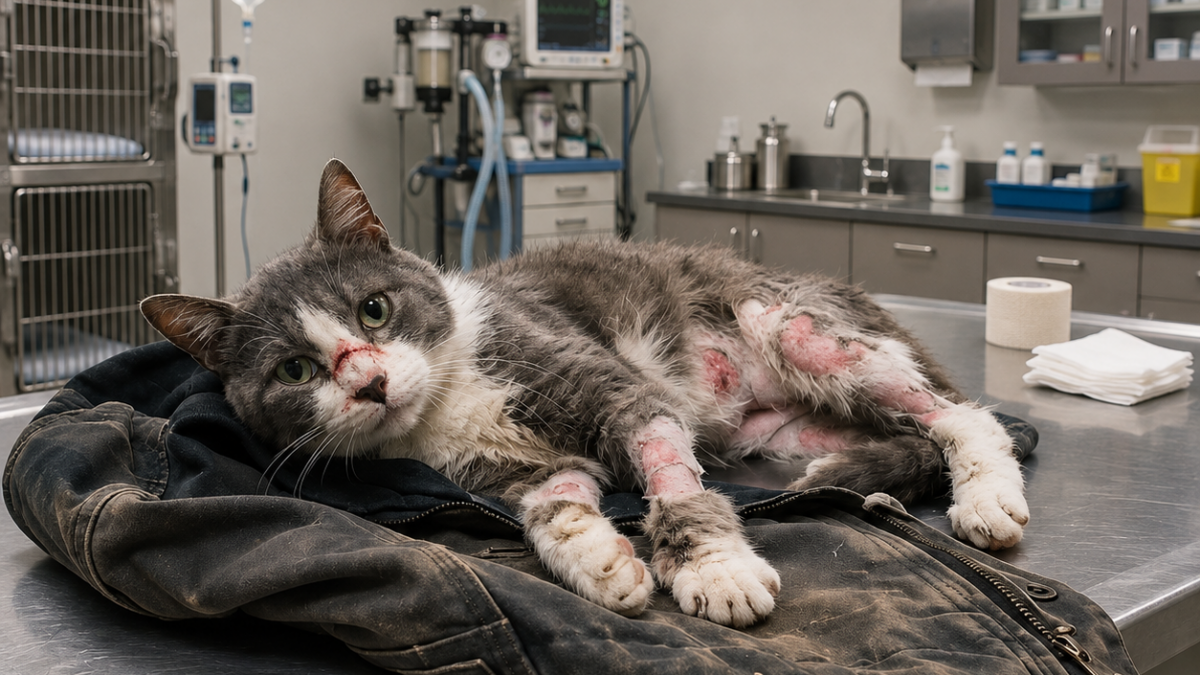
Her skin looked irritated where the adhesive had pulled fur away.
Along one side, several patches were nearly bare.
There was a red line across her muzzle.
Her front paws were swollen from compression.
But I did not see blood.
No obvious broken bones.
She was alive.
That was enough for the moment.
I took off my work jacket.
Wrapped her inside.
She disappeared almost completely.
Only her head remained visible.
I carried her toward the truck.
Halfway there, a car passed.
The cat flinched violently inside my arms.
I tightened the jacket around her.
“You’re okay.”
I realized how stupid that sounded.
She had no reason to believe me.
Still, I kept saying it.
At the truck, I climbed carefully into the cab.
Placed her on the passenger seat.
She tried to stand once.
Her front legs gave out.
I caught her.
“No.”
I folded the jacket into a nest.
She sank into it.
Then I called dispatch.
My dispatcher was named Mike.
We had worked together nearly eight years.
He answered:
“Mercer?”
“Yeah.”
“You’re early.”
“Not anymore.”
Silence.
“What happened?”
“I need to go off route.”
“How far?”
“I don’t know.”
“Mechanical?”
“No.”
“Medical?”
I looked at the cat.
“Yes.”
Pause.
“You okay?”
“Not me.”
Another pause.
“Daniel, what happened?”
I said:
“I found a cat taped to a fence post.”
Silence.
Mike thought he had heard me wrong.
“What?”
“Somebody duct-taped a cat to a fence post.”
Another silence.
Longer.
Then:
“Is it alive?”
“Yes.”
“Go.”
That was all.
No argument.
No freight question.
No schedule.
Just:
Go.
I pulled up the nearest veterinary clinic.
Twenty-three miles.
Closed until seven.
I drove there anyway.
The cat barely moved.
Every few minutes, I looked toward the passenger seat.
Her eyes were partly closed.
Once I thought she had stopped breathing.
I reached over at a red light.
Touched her side.
Movement.
“Good.”
When I reached the clinic, it was 6:18.
Dark building.
Empty parking lot.
I parked near the door.
Turned the truck off.
Then moved into the passenger seat.
I placed the wrapped cat on my lap.
Forty-two minutes.
That is how long we waited.
I know because I watched the clock constantly.
6:21.
6:29.
6:37.
6:44.
Every few minutes, she shifted.
Her head rested against my forearm.
At 6:51, she made her first sound.
Not a meow.
A tiny rough squeak.
I looked down.
“Hey.”
She opened her eyes.
“You still with me?”
Another tiny sound.
I found an unopened bottle of water in the cab.
Poured some into the plastic lid.
Held it near her.
She sniffed.
Licked once.
Then again.
I didn’t let her drink much.
I had no idea whether too much too quickly would hurt.
I just wet my finger and touched it near her mouth.
She licked the water from my skin.
Seven o’clock felt like it took three hours.
At 6:58, a sedan pulled into the lot.
Woman in blue scrubs.
I was already outside before she reached the front door.
“Excuse me.”
She looked at me.
Then at the bundle in my arms.
“What happened?”
“Cat.”
She came closer.
Then saw the missing fur.
“Oh my God.”
“Somebody taped her to a fence post.”
The woman unlocked the clinic immediately.
“Come inside.”
We did not wait for reception paperwork.
A veterinary technician took the cat.
For the first time since finding her, I had to let go.
She clung to my jacket.
Not me exactly.
The fabric.
Her claws caught lightly.
The tech said:
“Can we take the jacket?”
“Yes.”
“Are you sure?”
“Yes.”
So they carried her away wrapped in it.
I stood in the exam room wearing only my work shirt.
Hands shaking.
That surprised me.
I drive an eighty-thousand-pound vehicle through mountain storms.
I had seen wrecks.
Helped at accidents.
Watched people die before ambulances arrived.
But my hands were shaking because of a seven-pound cat.
The veterinarian arrived fifteen minutes later.
Dr. Hannah Pierce.
She explained everything carefully.
Female.
Approximately three years old.
Dehydrated.
Significant skin irritation from adhesive.
Swelling in both front paws caused by restricted circulation.
Minor abrasions.
Stress.
But no fractures.
No obvious internal injury.
Her breathing sounded clear.
Body temperature low but improving.
“She’s lucky.”
I hated that sentence.
“Lucky?”
Dr. Pierce understood immediately.
“I mean medically.”
I looked toward the treatment room.
“How long?”
“Attached?”
“Yes.”
“Hard to know precisely.”
She thought.
“Based on dehydration, swelling, and exposure?”
“Possibly eight to twelve hours.”
“All night?”
“Potentially.”
I sat down.
All night.
Cars passing.
Cold air.
No way to move.
No way to call.
Dr. Pierce said:
“She could breathe through her nose.”
I looked at her.
“Barely.”
“Yes.”
“Why tape her mouth?”
She did not answer.
Because there was no medical answer.
The question belonged somewhere darker.
A technician came in with a scanner.
No microchip.
No collar.
No tattoo besides the standard spay mark.
Dr. Pierce estimated she had probably been a stray or abandoned pet.
She was too comfortable with humans to be truly feral.
Even frightened and exhausted, she allowed examination.
At one point, the tech touched her sore paw.
The cat flinched.
But did not bite.
“She’s incredibly gentle,” the technician said.
That almost made me angrier.
Not because a difficult cat would deserve less rescue.
But because somebody had done this to an animal who was still willing to trust hands.
The receptionist brought paperwork.
Estimated treatment cost:
$285.
Exam.
Fluids.
Medication.
Skin cleaning.
Pain relief.
Follow-up.
She said:
“If animal control takes custody, they may cover—”
“I’ll pay it.”
“You don’t have to.”
“I know.”
She looked at me.
“You sure?”
“Yes.”
I paid.
Then called the county sheriff.
A deputy met me at the clinic.
I gave him the exact location.
Showed him photographs I had taken after freeing her.
Fence post.
Tape.
Fur.
He asked if I had seen any vehicles nearby.
No.
People?
No.
Houses?
Not close.
“Any camera on your truck?”
“Dash camera.”
That mattered.
The camera did not capture whoever tied her there.
But it captured the location as I passed.
Time stamp.
5:34 a.m.
It showed the shape on the post.
Then my truck returning several minutes later.
The deputy copied the footage.
Animal control documented the injuries.
I wish I could tell you they found the person.
They didn’t.
Not then.
Maybe never.
Rural road.
No nearby security cameras.
No witness.
No identifying information.
Cruelty often happens in places chosen precisely because nobody is watching.
But somebody was watching that morning.
Not intentionally.
Just passing.
The clinic contacted a rescue called Blue Ridge Safe Paws.
By early afternoon, a foster volunteer named Melissa arrived.
She looked at the cat on the treatment table.
Then at me.
“Does she have a name?”
I realized nobody had named her.
The paperwork said:
FOUND FEMALE — ROUTE 17.
I looked at the little gray-and-white face.
The red mark still crossed her muzzle.
“Echo.”
Melissa smiled.
“Why?”
“I don’t know.”
That wasn’t completely true.
Maybe because the only reason she was alive was that one tiny movement had echoed in my mirror strongly enough to make me turn around.
Echo.
It stayed.
Before Melissa took her, one of the technicians asked if she could photograph us.
“I don’t need a picture.”
“Not for social media.”
She pointed toward Echo.
“For her file.”
So I stood beside the table.
Echo lay wrapped in my jacket.
Her eyes looked exhausted.
One front paw extended from the fabric.
The areas where adhesive removed fur were visible along her side.
I hated the photograph.
Still do.
Because she looks defeated.
But she was not.
She had survived.
Melissa lifted the carrier.
Echo was still on my jacket.
I said:
“You can keep that.”
Melissa laughed softly.
“The jacket?”
“She likes it.”
“You sure?”
“It’s twenty years old.”
“Looks it.”
“Thanks.”
Echo left.
I returned to the truck.
The passenger seat was empty.
That hit me harder than expected.
For less than three hours, there had been a cat there.
Now nothing.
I called Mike.
“How is she?”
“Alive.”
“Good.”
“I’ll be four hours late.”
“Already rerouted part of it.”
“Thanks.”
Then Mike said:
“Daniel?”
“Yeah?”
“You okay?”
I looked through the windshield.
“No.”
“Good.”
“What?”
“If you were okay after finding that, I’d worry.”
Fair.
I finished the route.
All day, I smelled the adhesive on my hands.
Maybe imagination.
Maybe not.
That evening Melissa sent me a photo.
Echo standing.
Unsteady.
Eating wet food.
Message:
She ate almost half the bowl.
The next morning:
She slept through the night.
Two days later:
Swelling going down.
Five days:
Skin healing.
Ten days:
She purred today.
I replied:
Really?
Melissa sent a video.
Echo sat on a blanket while Melissa gently scratched beneath her chin.
At first, nothing.
Then a faint rumble.
Purring.
I watched that video at a truck stop in North Carolina.
Three times.
A grown man sitting alone in an eighteen-wheeler crying over a cat he had known for fifteen minutes on a roadside.
Trucking does strange things to you.
Two weeks after the rescue, Melissa asked if I wanted to visit.
I almost said no.
Why?
I’m still not sure.
Maybe I was afraid Echo would be scared of me.
Maybe I would remind her of the road.
Maybe I did not want to see the injuries again.
But I went.
Melissa lived outside Richmond.
Small house.
Fenced yard.
Three foster cats inside.
Echo was in the living room.
When I entered, she disappeared beneath a chair.
That made sense.
I sat on the floor.
Did not call her.
Did not reach.
Melissa brought coffee.
“She does that with everyone.”
“Good.”
“Good?”
“Means she learned something.”
Melissa understood.
We talked.
Twenty minutes.
Then Echo’s head appeared.
Gray ears.
White nose.
She watched me.
I looked away.
Ten minutes later she came out.
Walked around the sofa.
Stopped.
Sniffed my boot.
Then froze.
I held still.
Echo stepped closer.
Sniffed my jeans.
Then rubbed her cheek against my knee.
Once.
I swallowed.
Melissa smiled.
“She remembers you.”
“Maybe.”
I did not want to pretend I knew.
Maybe she remembered scent.
Maybe the jacket.
Maybe nothing.
But she stayed.
That was enough.
Her fur had started growing back.
The red mark on her muzzle had faded to pink.
Her paws looked normal.
She had gained weight.
I asked:
“Still have my jacket?”
Melissa pointed toward a chair.
There it was.
Folded.
Covered in cat hair.
“Apparently I’m not getting it back.”
“No chance.”
Echo slept on it every night.
Weeks passed.
The rescue posted her story.
Not every detail.
Enough.
Applications came in.
Lots.
Some from people emotionally overwhelmed by what happened to her.
That worried Melissa.
She wanted someone who wanted Echo.
Not simply someone who wanted to be the person who rescued the famous abused cat.
There is a difference.
Echo needed quiet.
Patience.
Routine.
She startled at tearing sounds.
Tape dispensers terrified her.
The first time Melissa opened a cardboard shipping box and pulled packing tape, Echo ran so hard she hit a wall.
They stopped using tape around her.
She hated fence posts too.
Nobody knew whether that connection was real, but during her first weeks, she froze near upright wooden posts in the yard.
Trauma is strange.
Bodies remember things the mind cannot explain.
Then an application came from a woman named Grace Holloway.
Fifty-eight.
School librarian.
Widowed.
One older cat had died the year before.
No children at home.
Quiet house.
Grace did not write:
I want to save Echo.
She wrote:
I have a quiet home and I’m willing to let her decide how much contact she wants.
Melissa called me.
“I think we found her person.”
I asked:
“Does she own duct tape?”
Melissa told me I was not funny.
Grace visited three times.
First visit, Echo stayed under the sofa.
Grace sat and read a book.
Second visit, Echo came out.
Grace did not touch her.
Third visit, Echo jumped onto the other end of the couch.
That decided it.
Adoption day arrived seven weeks after I found her.
I wanted to attend.
Grace invited me.
Echo went into her carrier without much trouble.
My jacket went with her.
I protested.
Not seriously.
Grace said:
“You can visit the jacket.”
“Thank you.”
She smiled.
Before leaving, she walked over.
“Daniel.”
“Yes?”
“I want you to know something.”
“What?”
“I’m not adopting her because of what happened.”
I looked at her.
“I’m adopting her because of who she is now.”
Exactly.
That was what I hoped.
Echo went home.
Grace sent updates.
First week:
Under the guest bed.
Second:
Window sill.
Third:
Sleeping beside Grace’s feet.
Two months:
Couch.
Three months:
Bed.
Five months:
Echo began waiting by the kitchen every afternoon because she had learned that Grace ate yogurt at four and occasionally dropped some.
Normal cat things.
That made me happier than dramatic milestones.
Normal was the victory.
A year after I found Echo, Grace invited me over.
Echo was sitting in a window.
Full coat restored.
Healthy weight.
Bright eyes.
If you did not know her history, you would never guess.
The only visible reminder was a faint line across the bridge of her nose where fur grew slightly differently.
I sat.
Echo walked over.
No hesitation this time.
She climbed onto the couch.
Then onto my lap.
I froze.
Grace laughed.
“You can breathe.”
“Not risking it.”
Echo turned twice.
Settled.
Her body warm against me.
I touched her head carefully.
One stroke.
Then another.
She began purring.
I looked at Grace.
“This is unfair.”
“What?”
“I did the dramatic rescue and you get the cuddly cat.”
“Correct.”
I laughed.
Echo stayed on my lap nearly twenty minutes.
When she left, my legs had gone numb.
Worth it.
The cruelty investigation remained open for a while.
No suspect.
No useful lead.
People online kept asking:
Who did it?
I wanted to know too.
Of course.
But over time, the question started mattering less.
Not because the crime mattered less.
Because Echo’s life became larger than the worst thing someone had done to her.
That distinction matters.
We often tell rescue stories as if the injury is the animal’s identity.
The taped cat.
The burned dog.
The abandoned kitten.
The one-eyed stray.
But Echo did not spend her days thinking of herself as the cat from the fence post.
She thought about food.
Sunlight.
Warm laundry.
Birds outside the window.
Grace’s bed.
My old jacket.
Whatever cat thoughts exist.
The fence post was something that happened to her.
It was not who she was.
I learned that gradually.
For months, every time someone asked about Echo, I told them how I found her.
Eventually Grace started telling me different things.
“She stole chicken off my plate.”
“She knocked a plant over.”
“She woke me at three because the food bowl was apparently eighty percent empty.”
“She hates the mailman.”
“She loves the dryer.”
Normal.
Echo became wonderfully, beautifully ordinary.
Two years later, Grace sent me a photograph.
Echo was stretched across my old jacket in a patch of sunlight.
Caption:
Your jacket is officially beyond recovery.
I replied:
Keep it.
Grace:
Echo planned to.
I still drive that highway twice a week.
Same route.
Same farmland.
Same fence.
The first time I passed the post again, I almost missed it.
Wood.
Weathered.
Nothing unusual.
Then I saw a gray patch.
Adhesive residue.
My hands tightened around the wheel.
For several months, I slowed whenever I approached that stretch.
Checked the post.
Checked the ditch.
Checked the fence line.
Mirror.
Always mirror.
Other drivers probably thought I was strange.
Maybe I was.
Eventually rain and sun removed most of the adhesive.
Grass grew.
The field changed.
One winter storm damaged the fence.
The owner replaced several posts.
Echo’s post disappeared.
I expected that to bother me.
Instead, it felt right.
The road did not need a monument to cruelty.
Echo was alive.
That was enough.
But I still look.
Every time.
Not because I expect another cat.
Because once you see how easily a living thing can disappear into the background at highway speed, you stop trusting the first glance.
That morning, hundreds of things entered and left my vision.
Signs.
Trees.
Mailboxes.
Fence posts.
Plastic.
Shadows.
One of them moved.
Barely.
That movement changed everything.
People sometimes call me a hero.
I hate that.
I stopped a truck.
I carried a utility knife.
I made a U-turn.
That is not heroism.
It is attention.
Maybe attention matters more than we admit.
Most suffering does not happen with a spotlight on it.
Sometimes it is on the side of a road before sunrise.
Sometimes it is quiet because somebody literally made sure it could not make noise.
Sometimes the only evidence is one small movement in a mirror.
A few months after Echo’s adoption, I spoke to a group of new drivers at our company.
Mike had told the story.
Someone asked:
“How did you even see her?”
“I almost didn’t.”
That surprised them.
One driver said:
“Seriously?”
“Seriously.”
“If you hadn’t looked back?”
I knew the answer.
I did not say it.
Then another asked:
“What made you turn around?”
That question stayed with me.
What made me?
Nothing dramatic.
The shape moved.
That was it.
Maybe curiosity.
Maybe instinct.
Maybe the fact that I had enough doubt that continuing felt wrong.
I told them:
“If something doesn’t look right, give yourself permission to check.”
Not every strange shape is a trapped animal.
Usually it is trash.
Checking might waste five minutes.
That morning, it did not.
Three years after I found Echo, Grace called.
“Are you driving?”
“Parked.”
“Good.”
My stomach tightened.
“What happened?”
“Nothing bad.”
I relaxed slightly.
“Echo has something to show you.”
Cats famously do not communicate over phones, so I waited.
Grace sent a photograph.
Echo sitting beside a small orange kitten.
“What is this?”
“Foster.”
“You’re fostering?”
“Temporarily.”
“That word has killed many good intentions.”
Grace laughed.
“The rescue asked for help.”
The kitten had been found alone near a warehouse.
Too young for adoption.
Needed socialization.
Grace agreed.
Echo hated him for approximately one day.
Day two, tolerated.
Day three, groomed him.
By week two, he slept beside her.
Grace sent a video of Echo licking the kitten’s forehead.
I watched it from a truck stop.
The same cat whose mouth had once been taped shut now grooming a kitten who would not stop screaming.
Life has a strange sense of symmetry.
Grace eventually adopted the kitten too.
Named him Milo.
Echo became the patient older sister.
Mostly.
She occasionally smacked him when he deserved it.
Five years have passed now.
Echo is around eight.
Healthy.
A little heavier than Dr. Pierce would prefer.
Grace blames Milo.
Milo denies involvement.
I still visit once or twice a year.
Echo still comes to me.
Not immediately anymore.
She has her own life.
That makes me happy.
Last Christmas, Grace handed me a wrapped box.
Inside was a new work jacket.
Same brand as the one Echo kept.
I laughed.
“Is this an apology?”
“No.”
“Replacement?”
“Absolutely.”
“Where’s the old one?”
Grace pointed.
Echo was asleep on it beside the fireplace.
Gray fur against faded black fabric.
I looked at her.
Then at the jacket.
The original one was torn.
Covered in fur.
Probably smelled permanently like cat.
I realized I did not want it back.
It had done its job.
The new jacket fits better anyway.
There is still one thing I have never told Grace.
I kept a piece of the tape.
Tiny.
Maybe two inches.
It stuck to my glove while I was cutting Echo down.
I found it later inside my truck.
For a long time, I kept it in the center console.
Not because I wanted a souvenir.
I hated it.
But throwing it away felt too easy.
Eventually I placed it inside a small plastic evidence bag.
It sits in a drawer at home.
I rarely look at it.
When I do, I remember two things at once.
What one person was capable of doing.
And what another person can decide to do afterward.
We do not control which kind of person appears first.
Sometimes cruel people get there first.
They hurt.
Abandon.
Tie.
Tape.
Leave.
But they do not necessarily get the last decision.
Someone else can stop.
A veterinarian can treat.
A foster can stay up at night.
A stranger can pay the bill.
A woman with a quiet house can open her door.
A frightened cat can learn that hands also bring food, warmth, and gentle scratches beneath the chin.
That does not erase what happened.
Nothing erases it.
Healing is not editing.
The past remains true.
It simply stops being the only true thing.
Echo was taped to a fence post.
True.
Echo survived.
Also true.
Echo was terrified of human hands.
True.
Echo later chose to sleep in them.
Also true.
Somebody left her beside a highway.
True.
Other people spent years making sure she never had to wonder whether she belonged again.
Also true.
I think about that whenever people ask how I can still drive the same road.
I drive it because the road did not hurt her.
The post did not hurt her.
The darkness did not hurt her.
A person did.
Then other people helped.
Places do not have to belong forever to the worst thing that happened there.
The fence is different now.
The adhesive is gone.
The post itself is gone.
Cars pass.
Sun rises.
Fields change.
And somewhere miles away, Echo is probably asleep on a jacket I once thought I needed.
Sometimes I wonder what would have happened if I had been looking at the radio.
Or drinking coffee.
Or checking a gauge.
If I had not glanced into that mirror at exactly the right second.
I cannot stay inside that question long.
There is no useful answer.
I saw her.
I turned around.
That is the version we got.
So every Tuesday and Friday morning, when my route takes me past that stretch of road, I do the same thing.
I look toward the fence.
Then I pass.
And a few seconds later, even though I know there is nothing there anymore, I check my mirror.
Every time.
Because once, at sixty miles an hour, something moved.
One tiny movement.
One glance backward.
One U-turn.
And a little gray-and-white cat who had survived an entire night unable to cry for help finally got to breathe again.








