A Truck Driver Saw One Tiny Movement on a Fence Post at 60 MPH—When He Turned Back, He Found a Cat Taped There With Her Mouth Sealed Shut
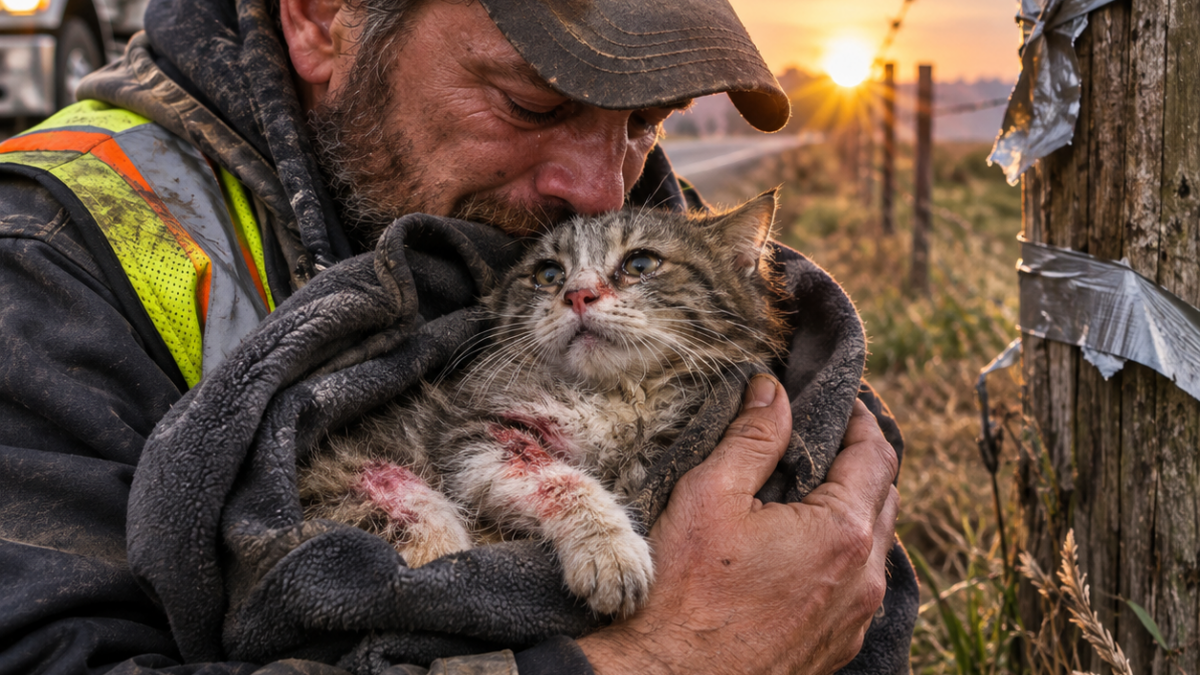
A Truck Driver Saw One Tiny Movement on a Fence Post at 60 MPH—When He Turned Back, He Found a Cat Taped There With Her Mouth Sealed Shut
At 5:43 on a freezing Pennsylvania morning, truck driver Daniel Mercer almost dismissed the tiny movement beside a rural highway as nothing more than a plastic bag caught on a fence—until something inside him made him look into his mirror one more time.
What he found a quarter mile behind him was a gray-and-white cat taped upright to a wooden post, every leg bound and her muzzle sealed so tightly she could not cry, while the only proof she was still alive was the frantic rise and fall of her chest.
But when Daniel cut her free and paid for the emergency care himself, he had no idea that the faint strip of adhesive left on that fence would lead investigators to a nearby farm, expose the person responsible, and eventually force him to make a decision about the terrified little cat that changed both of their lives.
Daniel Mercer had driven that road hundreds of times.
Route 219 cut through miles of farmland, low wooded hills, empty fields, and towns small enough that the gas stations closed before midnight.
At forty-eight, Daniel had been driving freight for nearly twenty-two years.
He knew which curves iced first in winter.
Which diner opened at four.
Which state troopers usually sat behind the abandoned grain warehouse.
Where deer crossed near mile marker sixty-three.
He knew every place the highway widened enough for a tractor-trailer to stop safely.
And he knew how darkness could trick the eyes.
Plastic grocery bags became animals.
Mailboxes became people.
Fence posts became deer.
Tree branches became hazards that disappeared when headlights moved.
So when something shifted beside a fence just before sunrise that Tuesday morning, Daniel almost ignored it.
He was hauling auto parts from Erie toward a distribution center outside Harrisburg.
His coffee was too hot.
The cab smelled faintly of diesel, peppermint gum, and the leather cleaner his daughter had given him for Christmas.
A country station played quietly through the speakers.
The dashboard clock read 5:43.
He was doing sixty miles per hour.
On his right:
Field.
Fence.
Tree line.
Then movement.
Daniel’s eyes flicked toward it.
Something gray.
Small.
Pressed against a wooden post.
He passed before his brain could understand.
“Probably trash.”
He said it aloud.
PART2:
Truck drivers talk to themselves.
Hours alone make silence strange.
He kept moving.
One hundred yards.
Two hundred.
Then his eyes moved toward the passenger-side mirror.
The post had vanished behind darkness.
Daniel’s hands tightened slightly around the steering wheel.
Something bothered him.
Not what he had seen.
What he had not seen.
Trash flapped.
This had moved once.
Then stopped.
He checked the mirror again.
Nothing.
“Damn it.”
He eased off the accelerator.
A quarter mile ahead, the shoulder widened.
He activated his hazard lights.
The truck rolled onto gravel.
Air brakes hissed.
Daniel sat for three seconds.
He had a schedule.
Delivery window.
Electronic log.
Dispatch tracked delays.
Maybe he had seen nothing.
PART3:
He could walk back half a mile in cold air to investigate a feed sack somebody nailed to a fence.
He looked toward the darkness behind him.
Then thought of something his father used to say.
If your brain keeps asking you to look twice, look twice.
Daniel put on his reflective safety vest.
Grabbed his flashlight.
Climbed down.
The cold hit immediately.
Thirty-four degrees.
Wind from the west.
He zipped his jacket.
The truck’s hazards flashed red behind him.
Daniel started walking along the shoulder.
Gravel cracked beneath his boots.
No other traffic.
For the first hundred yards he felt foolish.
By the second hundred, he could see the fence.
By the third, the flashlight beam reached the post.
Daniel stopped.
His entire body went cold in a way that had nothing to do with weather.
“No.”
He walked faster.
Then ran.
The cat was taped upright against the fence.
Gray back.
White chest.
Small body.
Silver duct tape crossed her ribs.
Again around the lower abdomen.
Her front legs were pressed together and bound.
Hind legs secured separately lower down.
Another strip went around the post itself, pinning her body to the wood.
But what Daniel saw first was her face.
A wide strip of duct tape stretched across her muzzle.
Wrapped around the back of her head.
Her mouth could not open.
Her eyes could.
Huge.
Yellow-green.
Terrified.
Daniel dropped to his knees.
“Oh God.”
The cat did not fight.
That frightened him more.
A healthy terrified cat should scratch.
Twist.
Bite.
Try to escape.
This one barely moved.
Her chest rose rapidly.
Fell.
Rose.
Fell.
She was breathing entirely through her nose.
“Hey.”
Daniel’s voice changed automatically.
Soft.
The same voice he had used with his daughter when she was small and woke from nightmares.
“Hey, sweetheart.”
The cat stared.
“I’m not gonna hurt you.”
Her ears were flattened.
One twitched.
That was probably the movement he had seen.
One ear.
Maybe a tiny head turn.
At sixty miles per hour.
Daniel looked down the road.
Nothing.
Then back at the cat.
His hands began shaking.
He wanted to rip the tape off.
He stopped himself.
Duct tape against fur and skin.
Pulling fast could tear tissue.
The tape around the legs looked tight.
Paws swollen below it.
Circulation compromised.
He needed something sharp.
Daniel always carried a folding knife and box cutter in his safety vest.
Shipping straps.
Plastic wrap.
Cardboard.
He pulled out the box cutter.
Extended only a small section of blade.
“Okay.”
He leaned closer.
The cat’s breathing accelerated.
“I know.”
“I know.”
He started with the tape around her body.
The blade needed to slide between adhesive and fence without touching skin.
Daniel worked slowly.
One inch.
Stop.
Another.
His fingers became sticky.
The adhesive resisted in the cold.
He cut through the first layer.
Then second.
The cat sagged slightly.
Daniel supported her body with one forearm.
“Got you.”
He cut the hind-leg binding.
The moment pressure released, one paw twitched.
Swollen.
Raw-looking around the ankle.
Then the front legs.
He slipped one finger beneath the tape.
Barely enough space.
Cut outward.
Never toward her.
The last piece remained across the muzzle.
Daniel hesitated.
This frightened him most.
The adhesive had caught whiskers.
Fur.
Possibly skin.
He could not simply cut across the face.
He used the knife to split the tape at one side.
Then slowly peeled.
The cat jerked.
Daniel stopped.
“Sorry.”
Her eyes squeezed shut.
He began again.
Millimeter by millimeter.
Fur came away with adhesive.
A thin red line appeared across the bridge of her nose.
Daniel’s jaw clenched.
Whoever had done this had wrapped the tape more than once.
He worked around the back of her head.
Finally the last piece came loose.
The cat opened her mouth.
No meow.
Just one deep, ragged gasp.
Air.
Then another.
Her whole body seemed to deflate.
She collapsed forward.
Daniel caught her.
“Easy.”
The cat lay in his hands.
Too light.
Maybe seven pounds.
Maybe less.
Trembling so hard her ribs vibrated against his palms.
He removed his jacket.
Wrapped her inside.
The cat did not resist.
Her head rested against his chest.
Daniel looked at the fence post.
Pieces of silver tape hung from it.
Long strips.
Fur stuck to some.
His stomach turned.
This was deliberate.
Nobody accidentally taped an animal’s legs.
Nobody accidentally sealed a mouth.
Nobody accidentally attached a living cat upright to a fence twenty yards from a highway where darkness and distance made her almost invisible.
Somebody had taken time.
Enough time to wrap her.
Enough time to listen—or deliberately prevent themselves from listening—to whatever sounds she made.
Then walked away.
Daniel took out his phone.
Photographed the post.
The tape.
Ground.
Area around it.
Not because he thought like an investigator.
Because he knew someone would eventually ask.
Then he called dispatch.
His dispatcher, Marcus Turner, answered.
“Mercer, you’re stopped.”
“Yeah.”
“You got equipment trouble?”
“No.”
“Medical?”
“Not me.”
Pause.
“What happened?”
Daniel looked down.
The cat’s head barely protruded from his jacket.
“I found a cat.”
Marcus waited.
“A cat.”
“Taped to a fence.”
Silence.
“What?”
“Somebody duct-taped a cat to a fence post.”
Another silence.
Longer.
Daniel heard a chair move.
“You serious?”
“Yeah.”
“Alive?”
“Barely.”
“Where are you?”
Daniel gave the mile marker.
“I need a vet.”
Marcus’s voice changed.
No jokes.
No dispatch tone.
“I’ll find one.”
“I’m going off route.”
“Go.”
“Delivery—”
“Forget delivery.”
Daniel looked down at the cat.
Marcus repeated:
“Go.”
Daniel carried her back toward the truck.
Every step made the cat tremble.
He climbed into the cab carefully.
Placed her on the passenger seat.
Then changed his mind.
Too exposed.
He sat her against his right side while calling the number Marcus sent.
No answer.
Clinic opened at seven.
He called another.
Closed.
Emergency hospital thirty-eight miles away.
Open.
Too far?
No.
He started driving.
Not fast.
Carefully.
The cat remained inside his jacket, partly against his abdomen.
Daniel kept one hand resting near her whenever road conditions allowed.
“Stay with me.”
No response.
“What are we calling you?”
The cat’s eyes opened.
“Fence Post is a terrible name.”
One ear twitched.
“That was a joke.”
Nothing.
“Okay.”
He drove through dark farmland while sunrise slowly turned the horizon gray.
At one intersection, he looked down.
The cat was watching him.
“Good.”
“Keep doing that.”
The emergency veterinary hospital sat outside a town Daniel barely knew.
He reached it at 6:24.
The receptionist looked toward his jacket.
“What’s happening?”
“Cat.”
“Hit by car?”
“No.”
Daniel opened the jacket.
The receptionist’s face changed.
“Oh my God.”
Within seconds, two technicians appeared.
One took the cat.
She panicked.
For the first time, she struggled.
Her claws caught Daniel’s shirt.
“Wait.”
He touched her head.
“It’s okay.”
The cat looked at him.
Then let the technician lift her.
Daniel noticed the red marks more clearly beneath fluorescent lights.
Skin exposed along her sides.
Fur pulled away.
Swollen paws.
Raw front legs.
Muzzle irritated.
He felt anger rise.
A dangerous kind.
The technician carried her through swinging doors.
Daniel stayed in the lobby.
His shirt had one small streak of blood where her claw caught him.
He stared at it.
The receptionist handed him forms.
“Owner?”
“No.”
“Finder?”
“Yes.”
“Location?”
He wrote.
“Would you like us to contact animal control?”
“Yes.”
“Police?”
“Yes.”
The receptionist looked at him.
“You took pictures?”
“Yes.”
“Good.”
Daniel sat.
At 6:51, Marcus called.
“How is she?”
“Inside.”
“Alive?”
“Yes.”
“Company knows.”
“What’d they say?”
“That you made the correct decision.”
Daniel laughed once.
“That’s generous.”
“Delivery got reassigned.”
“Thank you.”
“Mercer.”
“Yeah?”
There was a pause.
“Who does something like that?”
Daniel looked through the closed doors.
“I don’t know.”
He meant it.
He had seen ugly things.
Road accidents.
Abandoned dogs.
Dead deer.
People behaving badly in truck stops.
But this felt different.
An animal immobilized deliberately.
Silenced.
Displayed where nobody would likely notice until it was too late.
The veterinarian came out at 7:18.
Dr. Elena Ramirez.
Late thirties.
Dark hair tied back.
Purple scrubs.
Serious face.
“Mr. Mercer?”
“Yes.”
“She is stable.”
Daniel exhaled.
He had not realized he was holding his breath.
“Good.”
“She is dehydrated.”
“Her paws are swollen from restricted circulation, especially the left front and right rear.”
“Is that permanent?”
“We don’t know yet.”
“Any fractures?”
“None that I can feel.”
“X-rays will confirm.”
“Internal injuries?”
“No obvious signs.”
“We’re running bloodwork.”
“The adhesive damaged skin and removed fur, but the worst areas look superficial rather than full-thickness.”
“What about her breathing?”
“Better.”
She paused.
“The tape across the muzzle was dangerous.”
Daniel’s jaw tightened.
“How long?”
“Hard to know.”
“Based on dehydration, body temperature, and the tissue swelling, I’d guess several hours.”
“Eight?”
“Possibly.”
“Twelve?”
“Possible.”
“Overnight?”
“Very likely.”
Daniel looked toward the window.
It had been near freezing overnight.
“She would’ve died?”
Dr. Ramirez chose words carefully.
“If you had not seen her?”
She looked at him.
“Yes.”
Daniel rubbed his face.
He did not feel heroic.
He felt sick.
“What happens now?”
“Animal control is sending an officer.”
“We’ll treat her.”
“Pain medication.”
“Fluids.”
“Clean the adhesive residue.”
“Monitor circulation.”
“Vaccination status unknown.”
“No microchip detected.”
“Any collar?”
“No.”
“Pregnant?”
“No obvious signs.”
“Approximate age?”
“Three.”
Daniel stared.
Young.
“Can I see her?”
“In a little while.”
Then the veterinarian asked the question.
“Who is financially responsible for treatment?”
Daniel answered before thinking.
“I am.”
She paused.
“You understand she isn’t legally your animal.”
“I found her.”
“That doesn’t automatically make—”
“I know.”
“Initial estimate is around two hundred eighty-five dollars.”
“Do it.”
“There could be additional charges if complications appear.”
“Do it.”
Dr. Ramirez studied him.
Then nodded.
“Okay.”
Animal-control officer Rebecca Shaw arrived twenty minutes later.
She photographed the wounds.
Interviewed Daniel.
Collected the tape he had brought in a plastic grocery bag.
“Good that you saved this.”
“I almost left it.”
“Anything you saw?”
“No.”
“Cars?”
“No.”
“Buildings?”
“Farm about half a mile east.”
“Another property maybe farther west.”
“Camera on your truck?”
Daniel looked up.
Dash camera.
Of course.
“Front-facing.”
“Would it show the post?”
“Maybe.”
“Would it show another vehicle?”
“If one passed.”
Officer Shaw wrote quickly.
“Don’t overwrite that footage.”
Daniel called his company.
They preserved the video.
At 8:05, Daniel finally saw the cat again.
She was lying on a white towel.
IV catheter in one front leg.
The swelling remained.
Her fur looked worse after cleaning.
Several bald patches showed angry pink skin.
But her eyes were open.
She saw Daniel.
Her head lifted.
The technician smiled.
“She knows you.”
Daniel stepped closer.
“Hey.”
The cat made a sound.
Tiny.
Raspy.
Her first actual meow.
Daniel swallowed.
“Yeah.”
“I know.”
He touched one finger to her forehead.
She leaned against it.
That nearly broke him.
“Do you have a name?”
The technician asked.
“No.”
“Shelter will probably give one.”
Daniel looked at the cat.
“She needs something better than Fence Post.”
The technician laughed softly.
“What road?”
“Route 219.”
“Two-nineteen?”
“Terrible.”
“Tuesday?”
“Also terrible.”
Daniel looked toward the window.
Sunrise had finally cleared the horizon.
Light spread across the parking lot.
“Dawn.”
The cat blinked.
The technician smiled.
“Dawn?”
Daniel nodded.
“Found her before sunrise.”
“Dawn it is.”
By noon, X-rays confirmed no fractures.
Bloodwork showed dehydration and stress but no organ failure.
Circulation returned gradually to all four paws.
Dawn could stand.
Barely.
Then sit.
Then walk several steps.
She ate a tablespoon of wet food.
Daniel watched a video the technician sent him after he resumed his route.
She ate.
That should not have felt monumental.
It did.
The local rescue, Pine Valley Animal Aid, agreed to take custody after the veterinary hold.
A foster named Susan Patel volunteered.
Quiet home.
No children.
One older cat isolated initially.
Experience with traumatized animals.
Daniel should have returned to ordinary life.
He tried.
He delivered freight.
Slept.
Drove.
Checked the rescue page more often than he checked weather.
Every update:
Dawn ate breakfast.
Dawn allowed wound cleaning without sedation.
Swelling improving.
First purr today.
Then:
Dawn moved to foster care.
The first foster photograph showed her beneath a couch.
Only two eyes visible.
Caption:
No pressure. She gets to decide when the world is safe again.
Daniel saved the photo.
He did not know why.
His daughter, Emma, noticed when she visited that weekend.
Emma was twenty-two.
Nursing student.
She opened his refrigerator.
“Dad.”
“What?”
“You have four things.”
“I eat on the road.”
“You have mustard, eggs, cheese, and something that expired during the previous administration.”
“Probably fine.”
She threw it away.
Then saw his phone.
“Who’s the cat?”
Daniel explained.
Emma stared.
“Somebody taped her to a fence?”
“Yes.”
“Why?”
“No idea.”
“You paid the vet?”
“Yes.”
She looked at him.
“What?”
“Nothing.”
“No, that’s the face your mother used to make.”
“You rescued a cat.”
“I stopped.”
“You turned an eighteen-wheeler around for a cat.”
“Quarter mile.”
Emma smiled.
“Are you adopting her?”
“No.”
“Okay.”
He pointed.
“Same face.”
“What face?”
“The one where you don’t believe me.”
“I believe you.”
She absolutely did not.
Meanwhile, Officer Shaw kept investigating.
The dash-camera footage proved useful.
At 4:58 a.m., thirty-five minutes before Daniel passed the fence, a dark pickup appeared traveling in the opposite direction.
Nothing unusual.
At 5:12, the same truck appeared again.
Slow.
Then stopped briefly near the fence beyond camera range.
License plate unreadable.
But one detail showed clearly.
A white toolbox across the bed.
Large dent in passenger-side rear quarter panel.
Shaw canvassed nearby properties.
One farm owner remembered a pickup matching that description belonging to a tenant named Cody Harlan who rented a trailer three miles away.
Cody denied involvement.
No cat.
No reason.
Then an investigator noticed silver duct tape on a workbench inside an open detached shed during a consensual conversation.
Common item.
Not enough.
But Cody had a history.
Animal-control complaint two years earlier.
Neighbors reported he had threatened stray cats entering his property.
No charges.
Officer Shaw requested additional evidence.
A nearby gas station had surveillance footage.
At 4:41 that morning, Cody’s truck appeared.
He bought coffee.
A roll of duct tape.
Cash.
Still circumstantial.
Then came the breakthrough.
The clinic posted Dawn’s photograph.
Not her injuries in graphic detail.
Just her face.
A woman named Kayla called.
“That cat belongs to my neighbor.”
Officer Shaw asked:
“Which neighbor?”
“Cody Harlan.”
Dawn had apparently appeared around Cody’s trailer about five months earlier.
Stray, maybe.
Kayla fed her occasionally.
Cody complained.
Then, according to Kayla, Dawn had kittens beneath his porch.
Three months before Daniel found her.
The kittens disappeared.
Kayla assumed rescue took them.
Cody later claimed the mother cat was gone too.
Then Dawn returned.
“She was friendly.”
Kayla said.
“Very friendly.”
“Cody hated her.”
“Did you ever see him hurt her?”
“No.”
“But he kept saying he’d ‘take care of the problem.’”
Search warrant followed.
Investigators recovered:
Matching duct tape.
Cat food containers.
Photographs on Cody’s phone of Dawn near his trailer.
Most damaging:
A deleted video recovered from the device.
Twenty-seven seconds.
Dawn already taped to the fence.
Cody laughing behind the camera.
No ambiguity.
Daniel learned of the arrest from Officer Shaw.
He had just parked outside a truck stop.
“You got him?”
“Yes.”
“Confessed?”
“No.”
“Doesn’t matter?”
“We have strong evidence.”
Daniel sat behind the wheel.
His first reaction was satisfaction.
Then anger.
“What about the kittens?”
“Unknown.”
“Could he have—”
“We’re investigating.”
Daniel closed his eyes.
He hated imagining.
“What happens to him?”
“Court.”
“Animal cruelty charges.”
“Potential felony depending on prosecutor.”
Daniel looked across the parking lot.
“Good.”
Officer Shaw paused.
“You okay?”
“No.”
Honest answer.
“I keep thinking if she hadn’t moved.”
“I know.”
“If I had been looking at the radio.”
“I know.”
“If a car was beside me.”
“Daniel.”
He stopped.
“You saw her.”
“That part happened.”
“Try not to build your life around the versions where it didn’t.”
He remembered that sentence.
Dawn’s recovery was not linear.
Fiction likes abused animals to understand immediately that rescue means safety.
Real animals carry nervous systems.
Three weeks after rescue, Susan reached for a roll of packing tape while opening a delivery box.
Dawn heard the ripping sound.
She disappeared.
Behind the washing machine.
Would not emerge for seven hours.
Susan called Daniel because the rescue had added him to the update list.
“She’s okay?”
“She will be.”
He drove seventy miles after finishing work.
Susan met him at the door.
“You didn’t need to come.”
“I was nearby.”
“You were not.”
Fair.
Dawn remained behind the appliance.
Daniel sat on the floor six feet away.
“Hey.”
Nothing.
He talked.
Not coaxing.
Just voice.
Truck routes.
Emma.
Bad coffee.
Weather.
After twenty minutes, one gray paw appeared.
Then a face.
Dawn saw him.
Stopped.
Daniel stayed still.
She walked out.
Low to the floor.
Then directly toward him.
Pressed her forehead against his knee.
Susan looked at him.
Daniel said:
“No.”
“I didn’t say anything.”
“You were going to.”
“I was going to say she remembers you.”
“That’s different.”
Susan smiled.
“Is it?”
Dawn climbed partly into Daniel’s lap.
First time.
He did not move for forty minutes.
After that, Daniel visited weekly.
Officially because he wanted to “check progress.”
Susan stopped pretending to believe him.
Dawn’s fur returned slowly.
The raw bands around her legs faded.
Muzzle healed.
A small permanent patch remained where fur grew thinner.
She learned to play.
Feather wand first.
Then cloth mouse.
She hated cardboard tape.
Loved paper bags.
Slept in sunlight.
Discovered Susan’s heated blanket.
Started sleeping near her foster brother, Milo, though never touching.
The rescue began accepting adoption applications.
Daniel hated that.
He did not say it.
The first applicant was a family with two toddlers.
Too loud.
Second had unrestricted outdoor cats.
No.
Third was an older couple.
Excellent home.
Quiet.
Experienced.
Daniel read their application because Susan accidentally left it on the kitchen table during a visit.
He felt physically sick.
“They sound good.”
Susan watched him.
“They do.”
“House?”
“Yes.”
“Indoor?”
“Yes.”
“No kids?”
“Grandchildren occasionally.”
“Vet reference?”
“Excellent.”
He looked at Dawn.
She was sleeping on his jacket.
“Good.”
Susan waited.
Daniel scratched behind Dawn’s ear.
“Good.”
The couple visited.
Dawn hid initially.
Then emerged.
Allowed petting.
Sat near the woman.
Daniel was not there.
Susan told him afterward.
“They liked her.”
“Did she like them?”
“I think she could.”
Daniel nodded.
“Okay.”
That night, Emma called.
“You sound weird.”
“Dawn may get adopted.”
Pause.
“Oh.”
“She needs a permanent home.”
“Yes.”
“That’s the point.”
“Yes.”
“Good family.”
“Dad.”
“What?”
“You want her.”
“No.”
“Yes.”
“I drive freight.”
“So?”
“I’m gone.”
“How long?”
“Sometimes two nights.”
“Then don’t adopt her.”
“Exactly.”
Emma waited.
Daniel became irritated.
“Why aren’t you agreeing?”
“I did.”
“No, you’re doing the thing.”
“What thing?”
“The silent daughter thing.”
“I’m asking whether the problem is that you can’t provide a home or that you’re afraid you’ll fail at one.”
He went quiet.
Emma had become annoyingly perceptive in adulthood.
Daniel divorced when Emma was fourteen.
Not ugly.
Not peaceful either.
His wife, Sarah, eventually remarried.
Emma lived mostly with her mother.
Daniel spent more time driving because driving was simpler than sitting alone in a townhouse meant for people who came home.
He had told himself he liked the road.
Mostly true.
He had not owned a pet since childhood.
Responsibility.
Schedule.
Travel.
Excuses.
Dawn complicated the story.
“What if I’m gone overnight?”
Emma said:
“Cat sitter.”
“What if I get rerouted?”
“Cat sitter.”
“What if something happens to me?”
“I’m your daughter.”
“You’d take her?”
Emma laughed.
“You’ve been pretending I wasn’t going to steal her since week one.”
Daniel smiled despite himself.
Then became serious.
“She’s been through enough.”
“Yes.”
“She needs stability.”
“Yes.”
“I don’t know if I’m that.”
Emma’s voice softened.
“She already runs to you.”
That sentence stayed.
The next morning Daniel called Susan.
“Did the couple file the application?”
“Yes.”
“Approved?”
“Pending.”
“Can you hold it?”
Silence.
“For what?”
Daniel closed his eyes.
“Twenty-four hours.”
Susan smiled through the phone.
He could hear it.
“You have twelve.”
“Why?”
“Because you’ve been wasting three weeks.”
Daniel drove directly to the rescue office after his route.
Beth? Need keep new names. Rescue director Melissa Grant sat across from him.
“Let’s discuss lifestyle.”
“I drive.”
“We know.”
“Sometimes overnights.”
“Plan?”
“Emma.”
“Backup?”
“Neighbor, retired teacher.”
“Veterinarian?”
“Dr. Ramirez if she’ll take new clients.”
“She will.”
“Indoor-only?”
“Yes.”
“Financial?”
Daniel looked offended.
“I paid a stranger cat’s bill before breakfast.”
Melissa smiled.
“Fair.”
“Do you understand adoption after trauma can include setbacks?”
“Yes.”
“Do you expect gratitude?”
“No.”
“Do you understand she might bond differently at home?”
“Yes.”
“Why her?”
Daniel looked through the glass.
Dawn sat in Susan’s carrier.
Watching him.
“I don’t know.”
Melissa waited.
Daniel tried again.
“I keep seeing that post.”
“The fence?”
“Yes.”
“I pass it every week.”
“And?”
“I don’t want that to be the place her story points back to.”
Melissa’s expression softened.
“That’s about you.”
“I know.”
“Why her?”
Daniel looked at Dawn.
“She trusts me.”
“That isn’t enough.”
“No.”
He thought.
Then finally understood.
“Because when I’m driving home now, there’s somebody I want to get home to.”
Melissa said nothing.
Daniel continued.
“I’ve spent twenty years thinking home is where I park between routes.”
“I think I’m tired of that.”
Dawn went home with him the next day.
No dramatic ceremony.
Carrier.
Medical records.
Medication ointment.
Favorite blanket.
A bag of food.
Susan cried.
Daniel did too.
Dawn screamed for fourteen minutes in the truck.
Then fell asleep.
His townhouse confused her.
Stairs.
Echo.
Heating vents.
She hid beneath the couch for the first night.
Daniel slept on the floor nearby.
At 3:17 a.m., he woke with Dawn sitting on his chest.
Seven pounds of suspicion.
He opened one eye.
“Hi.”
She meowed.
Then curled against his shoulder.
Daniel smiled into the dark.
“Okay.”
Life adjusted.
Daniel changed routes.
Not entirely.
He requested more regional day runs.
Slight pay reduction.
He did not care.
Emma became official backup cat staff.
She bought Dawn an expensive tower.
Dawn preferred the cardboard box.
Predictable.
The neighbor, Mrs. Caldwell, checked her on overnight trips.
Dawn began waiting near the door around Daniel’s usual return time.
When his key turned, she ran.
Every time.
For the first six months, duct-tape sounds remained a problem.
Daniel removed every roll from visible drawers.
Used paper tape when possible.
Opened packages outside.
Then one evening he forgot.
He pulled duct tape from a drawer to repair a cracked storage bin.
RIIIIIP.
Dawn froze.
Daniel froze.
Her pupils widened.
She did not run.
Instead she looked at him.
Daniel put the tape down.
“Sorry.”
Dawn watched.
Then slowly walked toward him.
Sniffed the roll.
Backed away.
Daniel did not push.
A minute later, she returned.
Sniffed again.
Then rubbed her cheek against his hand.
He cried afterward.
Not because she had forgotten.
Because she had learned a new association without losing the old fear entirely.
Healing did not erase memory.
It gave memory competition.
Cody Harlan’s case went to court eight months after Dawn’s rescue.
Daniel attended.
He did not want to.
Officer Shaw asked because his testimony about the discovery mattered.
The courtroom was smaller than he expected.
Cody looked ordinary.
That bothered Daniel.
Thirty-two.
Clean shirt.
Hair combed.
No visible sign explaining how a person could tape an animal to a fence and leave.
Cody’s attorney argued intoxication.
Anger.
Poor judgment.
Mental-health stress.
Daniel listened.
None of those explanations felt large enough.
Then Kayla testified.
She described Dawn appearing near the trailer.
The kittens.
Cody’s complaints.
Threats.
The recovered video played only for the judge and attorneys, not publicly.
Daniel did not watch.
He had seen enough.
Cody eventually pleaded guilty to aggravated animal cruelty and related charges.
Jail.
Probation.
Ban on animal ownership.
Mandatory psychological evaluation.
Financial restitution for treatment.
The sentence felt both significant and insufficient.
Daniel told Officer Shaw afterward:
“I thought I’d feel better.”
She nodded.
“You wanted punishment to unsee the fence.”
He looked at her.
“Yeah.”
“It doesn’t.”
“No.”
“What helps?”
Daniel thought of Dawn sleeping on his jacket.
“Going home.”
He did.
Dawn met him at the door.
He sat on the floor.
She climbed into his lap.
Daniel rested his face against her fur.
For several minutes, nothing else mattered.
The restitution check arrived months later.
Two hundred eighty-five dollars plus later expenses.
Daniel stared.
He did not need it.
He donated the entire amount to Pine Valley Animal Aid.
Then added another five hundred.
The rescue created a small emergency medical fund.
No grand naming.
Daniel refused.
“Use it for whatever cat needs somebody to stop.”
They did.
Years passed.
The fence post remained.
Daniel continued driving Route 219.
The first few months, he could not pass without slowing.
His eyes always found it.
Wood weathered.
Tape residue fading.
Eventually county workers replaced part of the fence.
The original post disappeared.
Daniel thought he would feel relieved.
Instead he pulled over.
Walked to the spot.
Nothing.
Just grass.
New wood.
Traffic.
He stood there remembering.
Emma called while he was parked.
“Where are you?”
“Route.”
“You sound weird.”
“They replaced the post.”
She understood immediately.
“Oh.”
“I thought I wanted it gone.”
“And?”
“I don’t know.”
“Dad.”
“Yeah?”
“The post didn’t save her.”
He looked toward the highway.
“You did.”
Daniel shook his head though she could not see.
“She saved herself by moving.”
Emma paused.
“Fair.”
“One ear.”
“What?”
“I think that’s what I saw.”
“One ear move.”
Daniel looked at the new fence.
“If she hadn’t done that…”
“Dad.”
He stopped.
Officer Shaw’s sentence returned.
Do not build your life around the versions where it didn’t happen.
Daniel exhaled.
“I’m coming home.”
“Good.”
Dawn was waiting.
By age eight, she had become confident.
Bossy.
Slightly overweight.
Dr. Ramirez used the word “chunky.”
Daniel objected.
Dawn lost half a pound.
Everyone celebrated.
She learned to sleep in the passenger seat of Daniel’s personal pickup but never rode in the semi because company rules prohibited animals.
Daniel kept a photo taped near the dash.
Dawn in sunlight.
Every new dispatcher eventually heard the story.
Marcus never let him forget.
“You owe me.”
“For what?”
“I authorized the route deviation.”
“You said ‘go.’”
“Exactly.”
“Very managerial.”
“Heroic leadership.”
Daniel sent him a cat-hair-covered Christmas card every year.
When Dawn was ten, Emma got married.
The wedding venue allowed pets for photographs.
Emma insisted.
Daniel refused initially.
“She hates crowds.”
“Then pictures before.”
Dawn wore a tiny green bow.
No tape.
No costume.
Just bow.
In the family photo, she sat in Daniel’s arms while Emma stood beside him in her wedding dress.
Daniel looked at the picture later.
His daughter.
His cat.
Family.
He thought about the morning he believed he was merely stopping because something looked wrong beside a fence.
Sometimes decisions expand long after you make them.
At twelve, Dawn developed kidney disease.
Early.
Manageable.
Special food.
More water.
Medication later.
Daniel adjusted again.
Fewer overnight routes.
Then none.
He took a dispatcher-training position three days a week and drove local runs on the others.
Marcus teased him.
“You’ve gone soft.”
Daniel looked toward the office photo of Dawn.
“Apparently.”
He did not mind.
At thirteen, arthritis.
Steps beside couch.
At fourteen, hearing declined.
She no longer met him at the door because she did not hear the key.
So Daniel flicked the hallway light twice.
Dawn learned.
Light.
Then door.
Then Daniel.
She still ran.
Slower.
But ran.
One winter morning, almost eleven years after the fence, Daniel woke before sunrise.
Dawn lay beside him.
Breathing differently.
Shallow.
He knew.
People who live with old animals eventually learn.
He called Emma.
Then Dr. Ramirez.
Same veterinarian.
Older now.
Gray appearing in her hair.
She came to the house.
Dawn’s kidneys had declined rapidly.
Treatment might buy days.
Maybe weeks.
Not good weeks.
Daniel sat on his living-room floor.
Dawn wrapped in the same style of work jacket he had worn the morning he found her.
Not the original.
That one had been destroyed years earlier.
But similar.
Reflective strip.
Heavy canvas.
Emma arrived.
Pregnant with Daniel’s first grandchild.
She sat beside him.
“Dad.”
“I know.”
Dawn rested her chin on Daniel’s wrist.
Dr. Ramirez explained.
No pressure.
Time.
Daniel looked toward Dawn.
“You know what I keep thinking?”
Emma asked:
“What?”
“That first breath.”
He closed his eyes.
“When I pulled the tape off.”
“She couldn’t meow.”
“Just breathed.”
Dawn’s chest rose.
Fell.
Daniel stroked her head.
“I spent all these years being grateful for every one after that.”
Emma cried.
Daniel did not immediately.
Then he looked at Dawn’s muzzle.
The scar was almost invisible.
Only if you knew.
“Okay.”
He kissed her forehead.
“You don’t have to fight anything anymore.”
Dawn died peacefully in his arms.
No fence.
No tape.
No darkness.
No stranger driving past.
Just Daniel.
Emma.
Warm room.
Morning beginning outside.
Afterward, Daniel sat for almost an hour.
Dr. Ramirez never rushed him.
Eventually Emma asked:
“What are you going to do with her collar?”
Dawn had worn a simple blue collar.
Daniel looked at it.
“Keep it.”
He did.
Months later, Pine Valley Animal Aid asked to use Dawn’s story in a campaign about reporting animal cruelty.
Daniel agreed with conditions.
No graphic images.
No video from Cody’s phone.
No sensational photographs of Dawn taped to the post.
Instead they used the clinic image.
Dawn lying on Daniel’s work jacket.
Fur missing.
Muzzle red.
Eyes open.
Caption:
SHE WAS SEEN BECAUSE SOMEONE LOOKED TWICE.
The campaign funded security-camera grants for rural dumping areas.
Emergency veterinary support.
Public education.
Cruelty-reporting hotlines.
Daniel spoke once.
Only once.
He stood before about a hundred people at a fundraising dinner.
He hated public speaking.
Emma sat in front.
Officer Shaw.
Dr. Ramirez.
Susan.
Marcus.
People who had become connected through one animal.
Daniel said:
“People keep telling me I saved Dawn.”
He looked down.
“I stopped a truck.”
“I walked back.”
“I used a box cutter.”
“Other people did the rest.”
He named them.
Veterinarian.
Officer.
Rescue.
Foster.
Neighbors.
His daughter.
“Saving anything is rarely one moment.”
He paused.
“But noticing can be.”
The room became quiet.
“I almost drove past.”
Nobody moved.
“I want that understood.”
“I almost decided it was trash.”
“I almost told myself I’d imagined the movement.”
“I almost kept my schedule.”
He looked toward the photograph of Dawn.
“If there’s anything useful in her story, it isn’t that I was special.”
“It’s that ordinary people get seconds where they can choose to pay attention.”
“That morning I got one.”
“I happened to use it.”
Afterward, an older woman approached.
“My husband always says I worry too much when I stop for animals.”
Daniel smiled.
“Sometimes you will stop for nothing.”
“That’s okay.”
A teenager asked:
“Did you hate the man who did it?”
Daniel thought.
“Yes.”
“Still?”
He considered.
“No.”
The answer surprised even him.
“Why?”
Daniel looked toward Dawn’s picture.
“Because hate kept him at the center of her story.”
The teenager waited.
“He doesn’t belong there.”
That became the final thing Daniel learned.
For years, when people heard Dawn’s story, they asked:
Who did that?
Why?
What happened to him?
Reasonable questions.
Daniel once asked them too.
Eventually he became more interested in different ones.
Who stopped?
Who treated her?
Who fostered her?
Who investigated?
Who donated?
Who changed their route?
Who changed their life?
Cruelty had occupied perhaps eight or twelve hours of Dawn’s existence.
Terrible hours.
Important.
But not the whole life.
Dawn lived almost eleven years afterward.
Thousands of mornings.
Thousands of meals.
Windows.
Sun.
Toys.
Emma.
Daniel.
Vet visits.
Christmas cards.
Warm floors.
A ridiculous green wedding bow.
Kidney medication she hated.
A light flicked twice when she could no longer hear the door.
Those years mattered more than the fence.
Daniel still drove Route 219 occasionally after retiring.
Not freight.
Just his pickup.
Sometimes to visit friends.
Sometimes because old roads become part of people.
He always knew the place.
Even without the original post.
Mile marker.
Curve.
Field.
He still glanced into the mirror.
Habit.
Memory.
Once his granddaughter, Lily, was riding beside him.
Seven years old.
She had heard about Dawn.
Of course.
Family stories become mythology.
She pointed.
“Is that where you found her?”
“Yes.”
“Which post?”
“Not there anymore.”
“Why?”
“Old fence.”
Lily looked out the window.
“Was she scared?”
“Yes.”
“Did she bite you?”
“No.”
“I would’ve.”
Daniel laughed.
“Probably.”
“Why did somebody do it?”
The hardest question.
He had never found an answer that satisfied adults.
Children did not need complicated speculation.
“Because sometimes people do cruel things.”
Lily frowned.
“That’s stupid.”
“Yes.”
“Were you scared?”
Daniel thought.
“Yes.”
“Of the cat?”
“No.”
“What?”
“That I was too late.”
She became quiet.
Then asked:
“But you weren’t.”
“No.”
They drove another mile.
Lily looked toward him.
“Grandpa?”
“Yeah?”
“What if you didn’t see her?”
Daniel’s hands tightened briefly.
Old question.
Old alternate life.
Then he remembered.
Not building around versions that did not happen.
“I did.”
“But what if—”
“I did.”
He smiled at her.
“That’s the story.”
Lily accepted that.
Children sometimes know when an answer is enough.
Years after Dawn was gone, Daniel kept one photograph inside his truck.
Not the clinic photograph.
Not the rescue picture.
Not the famous image used by newspapers.
It showed Dawn at home.
No scars obvious.
No special context.
She was lying on her back in a patch of sunlight, one paw curled against her chest, looking completely ridiculous.
Daniel loved that photograph most.
Because nobody looking at it would know.
They would see a cat.
Safe.
Ordinary.
Maybe ordinary was the greatest ending.
The fence had made Dawn extraordinary to strangers.
Her life afterward made her ordinary again.
Loved animals should be allowed that.
Not symbols.
Not trauma stories.
Just animals.
Hungry at breakfast.
Annoying at night.
Hair on furniture.
Vet bills.
Warm bodies taking up the exact center of beds.
Daniel did not save Dawn so she could become inspirational.
He saved her because she was alive.
Everything else came later.
And sometimes, driving before sunrise, he still remembered that first movement.
So small.
An ear.
Maybe her head.
He would never know exactly.
At sixty miles per hour, it barely existed.
A fraction of a second.
Enough to catch the eye of a tired truck driver who had every reason to keep going.
Schedule.
Darkness.
Cold.
Uncertainty.
He could have said:
Nothing.
He could have trusted the first explanation.
Trash.
Shadow.
Fence post.
Instead he looked again.
Then stopped.
That was all the beginning required.
Not certainty.
Not courage large enough for headlines.
Just doubt.
Just one human being allowing the possibility that what he almost ignored might matter.
A truck pulled onto a shoulder.
A man walked back.
A box cutter opened.
Tape fell.
A cat breathed.
And for the next eleven years, every ordinary morning Dawn received was built on that tiny sequence of choices.
Daniel eventually stopped calling that luck.
Luck was seeing the movement.
What happened afterward was attention.
And attention, he learned, is one of the simplest forms of mercy.
Sometimes the world does not announce what needs saving.
Sometimes it cannot.
Sometimes its mouth has literally been sealed shut.
Sometimes all it can do is move once in the darkness and hope somebody is looking.
Dawn moved.
Daniel looked.
And this time, that was enough.








