A Tiny Stray Kitten Brought Me “Gifts” Every Night—Then I Realized He Was the Only One Still Reminding Me I Was Needed
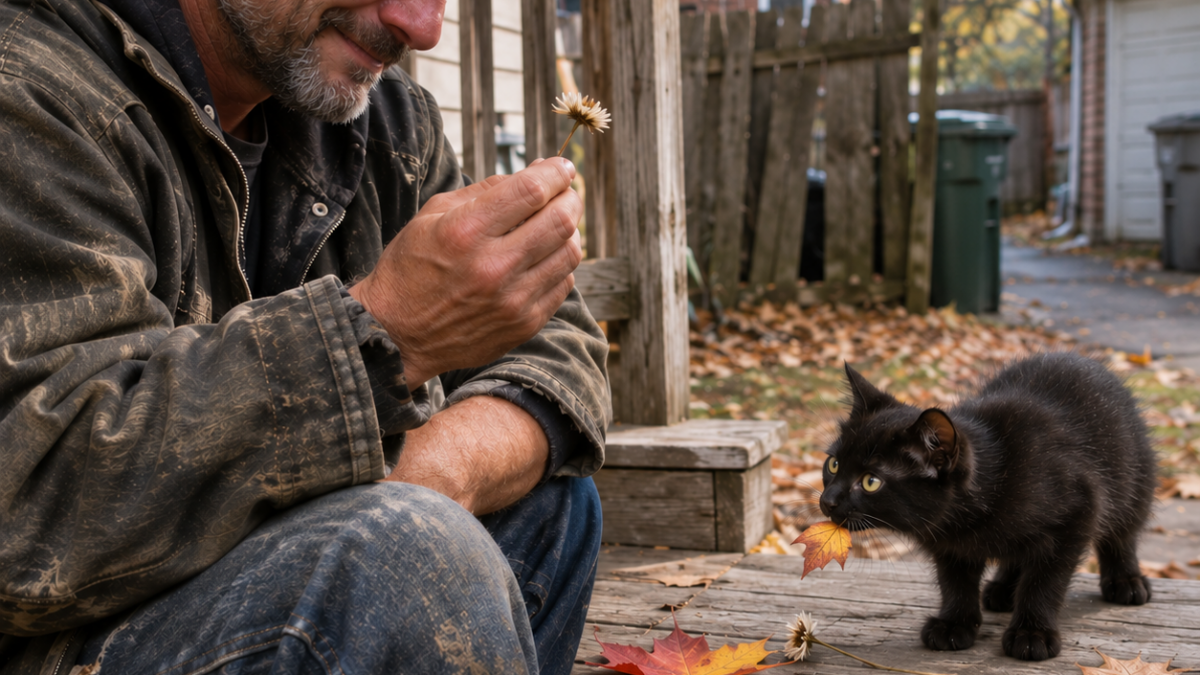
A Tiny Stray Kitten Brought Me “Gifts” Every Night—Then I Realized He Was the Only One Still Reminding Me I Was Needed.
After fifteen years of loyalty, my company shut its doors, blamed people like me for its failure, and left me sitting on a Pittsburgh back porch wondering whether forty-six was too old to start over.
Then a starving black kitten began appearing every evening with bottle caps, leaves, scraps of string, and other worthless little treasures—as if I were still important enough for somebody to bring something home to.
But when one of those gifts helped expose what my former boss had really done before the factory closed, the tiny stray everyone ignored became the reason dozens of discarded workers finally got justice—and the reason I remembered that losing my job had never meant losing my worth.
The first thing he ever gave me was a blue plastic bottle cap.
I still have it.
It sits in a glass jar above my kitchen sink beside a yellow maple leaf that has long since turned brown, a rusted metal washer, a piece of frayed green string, a silver pull tab, a smooth gray stone, and enough other pieces of alleyway junk to make any reasonable person wonder why a grown man keeps garbage displayed like family heirlooms.
But I know what each piece means.
I know because the first one arrived on the evening I had seriously begun to believe nobody would notice if I stopped getting up in the morning.
My name is Daniel Mercer.
I was forty-six that fall, living alone in a narrow brick duplex in Pittsburgh, Pennsylvania, and for almost three weeks I had been moving through the same four rooms like a man temporarily occupying somebody else’s life.
Kitchen.
Living room.
Back porch.
Bedroom.
Then back again.
I had worked for Keystone Precision Components for fourteen years and nine months.
Everybody rounded it up to fifteen.
So did I.
We made small machined parts for industrial pumps, rail equipment, and specialty construction machinery.
Not glamorous work.
Most people in Pittsburgh never knew our building existed even if they drove past it twice a week.
It sat between a tire warehouse and an old brick distribution building near the river, with one fading blue sign over the employee entrance and a loading dock that always smelled like oil, wet cardboard, and hot metal.
I loved that place.
Maybe love is too strong.
But I understood it.
There is comfort in understanding where you fit.
I knew which press had to be restarted twice on cold January mornings.
I knew that the coffee machine outside shipping ate dollar bills.
I knew Luis Ortega would complain about overtime every Saturday and then volunteer for it before anyone else.
I knew Donna Briggs kept peppermint candy in the second drawer of her desk.
I knew which vendors exaggerated lead times and which truck drivers would help move a pallet if you asked instead of pretending company policy prevented their hands from working.
I started on the floor.
Worked shipping.
Moved into inventory.
Eventually became materials coordinator.
No impressive title.
No corner office.
But if a batch of stainless fittings disappeared between receiving and production, people came to me.
If a supplier insisted we had ordered eight hundred pieces and I knew we had ordered five hundred, I found the paperwork.
If production needed a component by Thursday, I knew whether Thursday meant Thursday morning or Thursday at 4:57 p.m.
I mattered there.
That sentence embarrassed me after the company closed.
It shouldn’t have.
But it did.
Because when you tie enough of your identity to being useful somewhere, the place disappearing can make you feel as though you disappeared with it.
PART2:
The closure came on a Monday.
At 7:15 in the morning, there were security guards at the employee entrance.
That was the first sign.
The second was the parking lot.
Managers’ cars were missing.
Not all of them.
Enough.
The third was a white sheet of paper taped crookedly inside the glass door.
MANDATORY ALL-STAFF MEETING — 8:00 A.M.
Nobody worked between 7:15 and 8:00.
We stood around pretending to.
Luis found me near shipping.
“You know something?”
“No.”
“You always know something.”
“Not today.”
He looked toward the offices.
“You think layoffs?”
I wanted to say no.
Instead I said, “I don’t know.”
That frightened him more.
PART3:
At eight, seventy-three of us were packed into the break area and the aisle outside it.
Our owner, Richard Halpern, stood in front with plant manager Wade Collins and a lawyer I had never seen.
Richard was fifty-eight, always tan, always polished, the kind of man who wore a fleece vest over expensive shirts so people would think he was casual.
For years he had called us “the Keystone family.”
I would learn to hate that phrase.
He cleared his throat.
Nobody spoke.
“Effective immediately,” he said, “Keystone Precision Components is suspending operations.”
For a second, nobody reacted.
Suspending.
Corporate words can delay understanding.
Then Donna said from behind me, “What does that mean?”
Richard looked toward the lawyer.
The lawyer didn’t help him.
“It means the facility is closing.”
Someone swore.
Someone else said, “For how long?”
Richard’s face tightened.
“Indefinitely.”
That was how seventy-three people learned they had lost their jobs.
No warning.
No transition.
No final week.
No chance to empty lockers before security began escorting us through the building in groups.
Some people cried.
Some shouted.
Luis kicked a trash can.
Donna stood completely still.
I remember that because stillness frightened me more than anger.
I asked about accrued vacation.
The lawyer said claims would be handled through the restructuring process.
I asked about our final payroll.
He said payroll was being processed.
I asked about retirement deductions from the previous two pay periods because one employee had mentioned his contribution had not appeared online.
Richard looked directly at me.
“Daniel, this isn’t the time.”
That bothered me immediately.
Because questions about money are exactly for times when somebody tells seventy-three people their income just vanished.
“What happened to the deductions?” I asked.
Wade stepped forward.
“Daniel.”
“I’m asking.”
“They’re processing.”
“Through where?”
Richard’s expression changed.
He had smiled at my mother during the company Christmas dinner two years earlier.
He had shaken my hand when my father died.
He had once told me, “Men like you are the backbone of this place.”
That morning he looked at me like I was a malfunctioning piece of equipment.
“Your attitude is not helping anybody.”
My face burned.
In front of everyone.
I remember Luis turning toward me.
I remember Donna staring at Richard.
I remember thinking I should stop.
So I did.
That decision haunted me later.
At noon, I carried a cardboard box through the employee exit.
Inside were two coffee mugs, a framed photograph of my father, a Steelers magnet, three pens, an old calculator I owned personally, and the blue employee badge I had worn for fourteen years.
I sat in my truck for twenty minutes before starting it.
By the end of the week, Richard Halpern had given a statement to a local business publication.
Market pressures.
Supply-chain instability.
Rising labor costs.
Declining productivity.
That last one spread through our former employee group chat like gasoline.
Declining productivity.
Luis called me.
“You see this?”
“Yes.”
“He’s blaming us.”
“He didn’t say us specifically.”
“What the hell else does labor costs and productivity mean?”
I had no answer.
Two days later, Wade Collins sent letters to several employees offering “neutral employment verification” but warning that company references would not discuss performance because “production metrics declined materially during the final operating period.”
It was clever.
Nobody accused us directly.
They didn’t have to.
A forty-six-year-old manufacturing worker applying for another job does not need a former employer quietly suggesting the plant closed because its workforce stopped performing.
I sent out applications anyway.
Seven the first week.
Eleven the second.
One interview.
The interviewer was twenty-eight at most.
Nice kid.
He looked at my résumé and said, “You’ve been at one place a long time.”
“Fourteen years, nine months.”
“Wow.”
He said wow the way people say it when they discover a refrigerator is older than they are.
He asked whether I was “comfortable taking direction from younger leadership.”
I said yes.
He asked whether I would struggle with “modern inventory systems.”
I explained that I had helped migrate Keystone from paper inventory to cloud-based tracking.
He nodded.
Then hired someone else.
The rejection email arrived at 6:07 the next morning.
By week three, I stopped checking email before coffee.
Then I stopped making coffee right away.
Then I stopped getting dressed before noon.
That is how it happens.
Not dramatically.
Nobody wakes up one morning and announces, Today I will become a smaller version of myself.
You just stop doing one thing.
Then another.
My yard went first.
The grass grew uneven.
The flower bed my mother had helped me plant became weeds.
Coffee mugs accumulated.
Laundry sat unfolded.
I ignored texts because I didn’t want people asking how the job search was going.
I declined dinner with Luis.
Ignored Donna’s voicemail.
Stopped attending Sunday breakfast with my sister and her husband because every conversation eventually reached the question:
Any leads?
People meant well.
That almost made it worse.
Hope can feel like pressure when you have none to return.
The evening the kitten arrived, I was sitting on my back porch wearing the same gray sweatshirt I had slept in.
My coffee had gone cold.
One boot rested on the lower step.
The other foot was still in a sock because I had started putting shoes on that morning and apparently lost interest halfway through.
That detail should tell you enough about where my head was.
Something moved beneath the fence.
The back of my property bordered a narrow service alley running behind our row of duplexes.
Trash bins.
Old garages.
Broken concrete.
Telephone poles.
A vacant property two doors down with plywood across one window.
The fence between my yard and the alley had begun leaning after a storm the previous spring, leaving a gap near the bottom.
At first I thought a squirrel had come through.
Then a tiny black face appeared.
He couldn’t have been more than ten or eleven weeks old.
Solid black except for three white hairs under his chin.
Too thin.
Long legs he hadn’t grown into.
Huge ears.
His eyes were yellow-green and impossibly serious.
He stopped about six feet from me.
We stared at each other.
“Hey.”
His ears moved.
He didn’t run.
He also didn’t come closer.
He lowered his head.
I thought he was sniffing something.
Then I realized something was in his mouth.
He walked toward the steps with the exaggerated caution of an animal that had learned every foot mattered.
Three feet.
Two.
Then he dropped a blue plastic bottle cap at the bottom step.
The cap bounced once.
He jumped backward.
I stared at it.
Then at him.
“You bring me that?”
He stared.
I leaned down.
The kitten flinched but held his ground.
I picked up the cap.
And I laughed.
Not a polite little chuckle.
A real laugh.
It came out of me unexpectedly enough that I nearly scared myself.
The kitten twitched one ear.
Then turned, shot through the fence, and vanished into the alley.
I sat there holding that ridiculous bottle cap for fifteen minutes.
The next evening, I went outside earlier.
I told myself I wanted air.
That was a lie.
At 5:41, the fence moved.
He appeared carrying a yellow leaf.
Not even a particularly interesting leaf.
But he walked straight to the bottom step and set it down closer than the cap.
Then retreated.
“Seriously?”
He sat.
I picked up the leaf.
He left.
On the third evening, a dried flower.
Fourth, a metal washer.
Fifth, a short piece of string.
I began feeding him.
At first, I put food at the bottom step and went inside.
Then I learned that if I sat three steps above him and looked away, he would eat while I remained outside.
He always drank first.
Then ate quickly.
Not greedily.
Urgently.
As though somebody might revoke permission.
I bought kitten food.
Then pretended I had accidentally bought kitten food.
That distinction mattered to my pride for about two days.
My neighbor Marissa caught me on day six.
She lived on the other side of the fence.
Fifty-one.
Emergency-room nurse.
Divorced.
Two grown sons.
She had the unnerving habit of noticing exactly what people hoped she wouldn’t.
She leaned over the fence while I crouched near the steps.
“What are you doing?”
“Nothing.”
“That is clearly a cat.”
“Yes.”
“You have a cat?”
“No.”
“You’re feeding a cat.”
“That doesn’t make him my cat.”
The kitten emerged.
He carried something small and white.
A piece of plastic.
He placed it near my step.
Then looked at me.
Marissa went quiet.
I picked it up.
She said, “He brought you that.”
“Apparently.”
“That’s weird.”
“Thank you.”
“No, I mean it’s adorable weird.”
The kitten left.
Marissa watched the fence.
Then looked at me.
“You know he doesn’t do that with anybody else.”
I frowned.
“What?”
“I’ve seen him around for maybe two weeks.”
“You have?”
“He runs from everybody.”
“He runs from me too.”
“He comes back to you.”
That sentence bothered me for the rest of the night.
Not in a bad way.
In the way certain truths hurt when they arrive somewhere tender.
He comes back to you.
I opened a kitchen drawer.
Placed the bottle cap inside.
Then the leaf.
Flower.
Washer.
String.
Plastic scrap.
Why?
I couldn’t have explained it.
Maybe because throwing them away felt rude.
Maybe because I had spent three weeks receiving nothing except rejection emails and suddenly something alive had decided I was worth bringing things to.
Two nights later, Rook—though I hadn’t named him yet—didn’t appear.
At 5:30 I told myself that was normal.
At six, I checked the fence.
At 6:15, I set out food.
At 6:30, I walked into the yard.
By seven, I was carrying a flashlight into the alley.
That was when I realized how attached I had become.
The temperature had dropped.
Wind moved between buildings.
Trash-bin lids clanged.
Loose paper scraped along pavement.
I found him near an abandoned garage about forty yards away, squeezed behind a stack of wooden pallets.
He wasn’t trapped.
That was obvious.
He could have left.
But every time a metal lid slammed in the wind, his body flattened.
Fear had become its own cage.
I sat on the asphalt several feet away.
My knees protested immediately.
“Yeah,” I said. “I don’t really feel like coming out either.”
His eyes stayed on me.
Wind pushed harder.
A lid slammed.
He flinched.
I sat.
Ten minutes.
Fifteen.
Twenty.
Eventually he stopped flattening after every sound.
I didn’t reach.
Didn’t move closer.
I just stayed until the wind eased.
Then I walked home.
Five minutes later, I heard something behind me.
He was at the fence.
I opened the gate and went inside.
He followed through his usual gap.
That evening he brought nothing.
He simply ate.
For some reason, that felt more important.
The next morning, my phone rang.
A warehouse on the other side of Pittsburgh.
They had received my résumé.
Inventory and loading.
Early shift.
Less money than Keystone.
More physical work.
The manager asked whether I could interview the following Monday.
“Yes.”
I answered immediately.
After we hung up, I stared out the kitchen window.
My first thought should have been:
Finally.
Instead it was:
I won’t be home at five-thirty.
I felt ridiculous.
A stray kitten had known me for barely a week.
I needed income.
Health insurance.
Routine.
Purpose.
Yet the thought of him appearing to an empty porch bothered me.
That afternoon, Marissa delivered worse news.
She was pulling weeds beside the fence.
“Did you hear about the duplex?”
“What duplex?”
“The vacant one.”
I looked toward the alley.
“Sold.”
“Good.”
“Maybe.”
“What?”
“They’re clearing everything next week.”
My stomach tightened.
“What does everything mean?”
“Garage. Junk. Overgrowth. Pallets. Old sheds.”
The kitten’s world.
The places he vanished into.
The route he used.
“When?”
“Wednesday, I think.”
I looked at the fence.
Marissa followed my gaze.
“Oh.”
“Yeah.”
“You need to catch him.”
“I know.”
“I have a carrier.”
“He won’t let me touch him.”
“We don’t need to touch him.”
The next afternoon she brought over a faded carrier and an old towel.
We placed food inside.
Set it near the porch.
Then waited.
The kitten appeared at 5:38.
He saw the carrier.
Stopped.
I saw the change instantly.
His body lowered.
His eyes widened.
He looked at me.
Carrier.
Me.
Then slowly backed away.
“Buddy.”
Marissa whispered, “Don’t move.”
He kept backing up.
Then disappeared.
That night he returned after dark.
He left a curled brown leaf halfway across the yard.
Farther from me than any previous gift.
Then vanished.
The message wasn’t really a message.
I knew that.
He was a kitten.
But it felt like one.
You changed the rules.
The following evening, he left a bottle tab at the same distance.
Wouldn’t approach the food.
I moved the carrier inside.
Then sat alone at my kitchen table feeling worse than any forty-six-year-old man should feel over losing the trust of a four-pound animal.
And that was when I understood why.
After Keystone closed, everybody had a plan for me.
Update your résumé.
Apply here.
Call this guy.
Take anything.
Move if you have to.
Sell the house.
Use LinkedIn.
Learn this software.
Try that certification.
Reasonable things.
Useful things.
But when you’re already ashamed and frightened, even good advice can sound like:
Please become functional again quickly because your uncertainty is making everyone uncomfortable.
And I had just done the same thing to the kitten.
His alley was disappearing.
So I decided his fear needed to disappear faster too.
I opened the drawer of gifts.
Spread them across the table.
Cap.
Leaf.
Flower.
Washer.
String.
Plastic.
Bottle tab.
I stared at them.
“You’ve got terrible taste,” I said.
The kitchen was silent.
Then I started crying.
I hadn’t cried when Keystone closed.
Not in the parking lot.
Not when I packed the box.
Not when the rejection emails came.
Not when my checking account dipped below the number that let me pretend everything was fine.
But there I was crying over trash.
Because all those useless little things meant one thing.
He had noticed me.
The next morning, I woke before six.
For several minutes, I stayed in bed.
The familiar heaviness was there.
Then I forced myself up.
Walked into the kitchen.
Opened the back door.
And stopped.
Five objects sat on the porch boards.
Arranged.
Not scattered.
A red leaf.
A silver can tab.
A white flower petal.
A smooth stone.
A short strand of pale string.
There were several inches between each.
I looked toward the fence.
Nothing.
Then at the objects again.
I sat down.
Maybe the kitten had simply dropped them while wandering.
Maybe my human brain was turning random behavior into meaning because I needed meaning.
I didn’t care.
I picked up the stone.
Held it in my palm.
And for the first time since losing my job, I thought:
Something expects me to be here tomorrow.
That thought changed the entire morning.
I called the warehouse.
Asked whether the interview could be moved two hours later.
The manager paused.
“Everything okay?”
“Yes.”
That was almost true.
“I have something I need to handle.”
“Ten-thirty?”
“Perfect.”
I moved the carrier completely out of sight.
Then headed into the alley.
I found the kitten near the old garage.
He watched from beneath the pallets.
I sat.
No carrier.
No trap.
No food held like leverage.
Just me.
“Wednesday they’re tearing this place apart.”
He stared.
“I know you don’t understand that.”
One ear moved.
“I barely understand anything lately either.”
I looked at my hands.
“Company closes, everyone tells you to move on, and somehow nobody explains where you’re supposed to move to.”
The kitten blinked.
I laughed softly.
“I sound insane.”
We sat together.
After half an hour, he came within six feet.
That was enough.
I went to the interview.
The warehouse was enormous.
Fluorescent.
Concrete.
Forklifts beeping.
The manager’s name was Helen Park.
Fifty-eight.
Short silver hair.
Direct eyes.
She looked through my résumé.
“You were a materials coordinator.”
“Yes.”
“This job starts on loading.”
“I understand.”
“You’d report to a supervisor who’s thirty-one.”
“Okay.”
“Pay is six dollars an hour less than your previous average.”
“I know.”
“Why do you want it?”
I almost gave her the correct interview answer.
Fresh start.
Opportunity.
Hands-on environment.
Instead I said:
“Because I need work.”
Helen looked up.
I continued.
“And because I’m tired of acting like taking a job below my old title means I’ve become less of a person.”
Silence.
I regretted it immediately.
Then she leaned back.
“That’s the first honest answer I’ve heard this week.”
She asked about inventory systems.
Shipping discrepancies.
Cycle counts.
Safety.
At the end, she said, “I have two more interviews.”
I nodded.
“Fair.”
“We’ll call.”
That phrase had become my least favorite phrase in English.
I drove home.
The kitten was not there.
Tuesday passed.
Then Wednesday arrived with trucks.
Men.
Noise.
The alley changed before nine.
Chainsaws.
Metal dragged across concrete.
Boards thrown into dumpsters.
The old garage door was pulled down.
I had already explained the kitten to the crew supervisor.
He had nodded sympathetically.
“We’ll watch.”
Watch.
A ten-week-old black kitten in an alley full of dark gaps.
Not reassuring.
At 10:20, I saw him.
Two yellow-green eyes behind a stack of boards near the garage wall.
Workers were approaching from the opposite side.
I raised my hand.
“Hold up!”
One worker stopped.
“What?”
“Cat.”
They backed away.
I crouched.
The kitten was frozen.
Completely.
I could have reached eventually.
Maybe.
But one wrong grab and he might bolt beneath machinery.
I sat in the dirt.
A worker looked at me like I was crazy.
I ignored him.
Then I remembered the gifts.
I had placed them in my jacket pocket that morning.
No idea why.
I pulled out the bottle cap.
Placed it on the ground.
Then the yellow leaf.
The dried flower.
Washer.
String.
Stone.
One by one.
A tiny line of proof between us.
The worker behind me whispered, “What are you doing?”
“No idea.”
The kitten’s nose appeared.
Then one paw.
I didn’t move.
“I know what it feels like,” I whispered.
His second paw appeared.
“When everything gets moved and everyone acts like you should be fine.”
He stepped out.
Body low.
“I’m here.”
Another step.
“I’m not leaving first.”
He approached the bottle cap.
Sniffed it.
Then the washer.
The string.
Finally he reached my hand.
I held one finger out.
He smelled it.
And pressed his forehead against my knuckle.
One second.
That was all.
I nearly stopped breathing.
Then I slowly moved the towel behind him.
Marissa was waiting ten feet away with the carrier.
We didn’t chase.
Didn’t grab.
We used food.
Space.
Time.
Forty minutes later, the kitten entered the carrier himself.
Marissa closed the door.
He panicked for exactly twelve seconds.
Then crouched.
I put my hand against the plastic.
“I know.”
His eyes stayed on me.
The clearing crew applauded.
That embarrassed me.
I laughed anyway.
The veterinarian found no microchip.
Male.
Approximately eleven weeks.
Underweight.
Fleas.
Mild respiratory infection.
Otherwise healthy.
“What’s his name?” the receptionist asked.
I looked through the carrier.
He stared back.
“Rook.”
“Like the chess piece?”
“Kind of.”
“Why?”
I thought about the black color.
The way he watched.
The deliberate gifts.
“Because he’s always thinking three moves ahead.”
She typed it in.
Rook Mercer.
Seeing my last name beside his hit me strangely.
I paid the bill.
Drove home.
Set him up in the kitchen.
For three days, he lived between the space under the wooden chair, the table, and the wall vent.
He did not become cuddly.
Did not transform magically.
He ate while I sat nearby.
He watched me constantly.
At night, he explored.
The first time the ice maker dropped a cube, he nearly climbed the wall.
The first time I sneezed, he disappeared for forty minutes.
But every morning, something was moved.
A pen.
A receipt.
A sock.
Once, one of his toy mice appeared beside my boot.
“Still doing deliveries?”
He watched me.
Three days later, Helen Park called.
“We’d like you to start Monday.”
I sat down.
“Really?”
“Really.”
“Thank you.”
“You still okay with loading?”
“Yes.”
“Six a.m.”
“I’ll be there.”
I looked toward Rook.
He sat beneath the chair.
“You hear that?”
One ear moved.
“I have a job.”
For the first time since Keystone closed, I smiled without needing to make myself.
The warehouse work hurt.
That first week reminded me I was forty-six.
My back complained.
My hands stiffened.
I came home exhausted.
But exhaustion from being useful felt different from exhaustion caused by doing nothing.
Every morning I got up at 4:45.
Coffee.
Boots.
Lunch.
Rook learned the routine quickly.
By the second week, he appeared beside the door while I tied my shoes.
Then one morning a folded receipt lay beside my boot.
The next, a bottle cap.
Then a piece of cardboard.
He had relocated his delivery service indoors.
I put everything in the jar.
Life began moving again.
Not upward exactly.
Forward.
That was enough.
Then Luis called.
I was eating dinner.
Rook sat beneath the opposite chair.
“Danny.”
“What?”
“You still have any Keystone inventory reports?”
“Why?”
“You remember those retirement deductions?”
My fork stopped.
“What about them?”
“Mine never showed up.”
“Which ones?”
“Last three checks.”
I put the fork down.
“Did you call the plan administrator?”
“Yeah.”
“And?”
“They said Keystone never transmitted them.”
My stomach tightened.
“How much?”
“Almost nine hundred.”
“Employer match too?”
“Nothing.”
He lowered his voice.
“Donna checked hers. Same thing.”
“That could be processing.”
“It’s been seven weeks.”
I looked toward Rook.
He was grooming one paw.
“What are you thinking?”
Luis said, “I think Halpern stole from us.”
“Don’t say that.”
“Why?”
“Because not transmitting something yet and stealing are different.”
“Listen to you.”
“What?”
“You sound like you still work there.”
That landed.
I rubbed my forehead.
“What do you want me to do?”
“You handled reconciliation reports.”
“I handled inventory.”
“You also had access to purchasing and receiving.”
“So?”
“You remember those machines that disappeared in August?”
I did.
Three CNC machines had been moved from our floor.
Wade told us they were going for refurbishment.
A fourth followed two weeks later.
Then two forklifts.
Then specialty tooling.
I had entered transfer paperwork.
The receiving location had been listed as HPR Industrial Storage.
“What about them?”
Luis said, “There’s no HPR storage.”
“How do you know?”
“My cousin does commercial trucking. Address on the paperwork belongs to another machine shop.”
“So?”
“Guess who owns it.”
I already knew from his tone.
“Who?”
“Halpern’s brother-in-law.”
My kitchen seemed suddenly quieter.
“Luis—”
“Look it up.”
I did.
HPR Industrial Solutions LLC.
Registered six months before Keystone closed.
Managing member: Marcus Reeve.
Richard Halpern’s brother-in-law.
I felt cold.
That night, I dug through old files.
Most company material had been on company servers.
But I had worked remotely occasionally.
Some reports remained in my email.
Monthly inventory reconciliation.
Transfer authorizations.
Purchase summaries.
I found the equipment transfer forms.
Authorized by Wade Collins.
Approved by Richard Halpern.
Book value far below replacement value.
Transferred to HPR for “temporary service and storage.”
No return records.
Then I found something else.
A spreadsheet attachment from three weeks before closure.
Richard had asked me to reconcile discrepancies between physical inventory and accounting.
There were huge shortages.
Not finished parts.
Raw materials.
Specialty metals.
Tooling.
I had sent an email:
These shortages appear consistent with unrecorded transfers rather than production consumption. Please advise whether additional transfer documentation exists.
Richard replied:
Please stop overcomplicating the year-end reconciliation. Wade will provide final numbers.
At the time, I had been irritated.
Now my hands started shaking.
I called Luis.
“I found something.”
Within a week, twelve former employees were involved.
Then twenty.
Not everyone had missing retirement contributions.
Several had unpaid overtime from their final period.
Others were owed vacation under company policy.
Donna had discovered that her health insurance had terminated four days before employees were told the plant was closing.
Her husband had undergone a procedure during those four days.
The insurer rejected the claim.
Twenty-three thousand dollars.
She had received the bill that morning.
Donna cried when she told us.
Not quietly.
Angrily.
“I worked there nineteen years.”
I remembered her standing still during the closure meeting.
Now I understood.
Luis wanted to call the news.
Donna wanted a lawyer.
Others wanted to forget the company existed.
I wanted to hide.
That embarrassed me.
But it was true.
I had just begun rebuilding something.
Warehouse.
Routine.
Rook.
The idea of walking back into a fight with Richard Halpern made my chest tighten.
He had money.
Lawyers.
Connections.
I had a black kitten and sore shoulders.
Then an envelope arrived.
From Keystone’s restructuring attorney.
It stated that former employees should direct wage and benefit claims through bankruptcy proceedings.
Attached was a summary of company assets.
I read it twice.
The transferred machines were not listed.
Neither were the forklifts.
Neither was the specialty tooling.
I called a labor attorney named Michelle Greene.
Her name came from Donna’s union-organizer cousin.
We met at her office downtown.
Six former employees squeezed around a conference table.
Michelle reviewed the records.
She asked questions for ninety minutes.
Then said:
“You potentially have three different problems.”
Luis said, “Only three?”
She ignored him.
“Unpaid wages and benefits. Potential improper handling of employee retirement contributions. And potentially fraudulent transfers of company assets before insolvency.”
Nobody spoke.
I asked, “Fraudulent?”
“Potentially.”
Richard’s name flashed in my mind.
Declining productivity.
Labor costs.
I felt something old and hot rise in my chest.
Michelle looked at me.
“You have the transfer records?”
“Some.”
“Original emails?”
“Yes.”
“Do not alter anything.”
“I won’t.”
“Do not post anything.”
Luis groaned.
“Seriously?”
“Seriously.”
She looked around the table.
“If you want justice, stop trying to win Facebook.”
That became our rule.
Facts first.
Anger second.
The investigation grew.
The bankruptcy trustee requested records.
The Department of Labor became involved over retirement deductions.
A state agency reviewed wage claims.
Richard’s lawyers denied wrongdoing.
They said HPR had legitimately purchased equipment before Keystone became insolvent.
But the payments were strange.
Too low.
Delayed.
Some apparently never completed.
Wade Collins claimed he had only followed instructions.
Then something happened I didn’t expect.
He called me.
I was at work.
I stepped outside during lunch.
“Daniel?”
I knew his voice immediately.
“What do you want?”
“I heard you’ve been talking to investigators.”
“I’m not discussing that.”
Pause.
“You always were dramatic.”
I laughed.
He sounded surprised.
“What’s funny?”
“You stood in front of seventy-three people while our jobs disappeared and told me to stop asking about our own money.”
“That wasn’t my decision.”
“You signed the transfers.”
Silence.
Then:
“You don’t understand what was happening.”
“Then explain it.”
He lowered his voice.
“Richard told us investors were coming in.”
“So?”
“We moved equipment to keep it outside a lender review.”
I went still.
“What?”
Nothing.
“Wade.”
“I didn’t say that.”
“Yes, you did.”
“No, I said—”
“Why are you calling?”
He breathed hard.
Then said:
“You need to stop.”
There it was.
“Why?”
“Because you have another job now.”
My hand tightened around the phone.
“Is that a threat?”
“It’s advice.”
“You know what’s funny, Wade?”
“What?”
“Three months ago that might’ve worked.”
I hung up.
My legs were shaking.
I sat on the curb behind the warehouse.
For a few minutes, I felt forty-six and unemployed again.
Small.
Disposable.
Then something buzzed.
A security camera notification from home.
I had installed a cheap indoor camera to check on Rook.
I opened the app.
There he was.
Dragging one of my socks across the kitchen.
I laughed.
Right there behind the warehouse.
The fear didn’t vanish.
It simply stopped being the only thing in me.
That night, I told Marissa about Wade’s call.
She listened over the fence while Rook stalked a moth.
“You recording calls now?”
“No.”
“You should.”
“Michelle said document everything.”
“Then document.”
She looked toward Rook.
“He’s gotten big.”
“A little.”
“He still bringing you garbage?”
“Every day.”
“Smart cat.”
“He brought me a sponge yesterday.”
“Useful.”
“He stole it from my sink.”
“Still counts.”
I smiled.
Then Marissa became serious.
“You know what your problem is?”
“I assume you’re going to tell me.”
“You think being needed means being employed.”
I looked at her.
“That’s not fair.”
“It’s exactly fair.”
She pointed toward my house.
“That cat needs you.”
“He’d survive.”
“Maybe.”
“People survived before me at Keystone too.”
“Not the point.”
“What is?”
“You think usefulness only counts if somebody signs a paycheck.”
I had no answer.
She pulled another weed.
“You spent fifteen years making yourself valuable to a company and three weeks believing that company had the authority to decide whether you were valuable at all.”
She tossed the weed into a bucket.
“That’s stupid.”
“Thank you, Marissa.”
“You’re welcome.”
The legal process dragged through winter.
That was the hardest part.
Justice in stories arrives quickly.
Justice in real life sends emails saying the next conference has been moved to February.
People got tired.
Luis wanted to quit.
Donna’s medical bill went to collections.
One former coworker signed an individual settlement with Keystone’s insurer and withdrew from the group claim.
Others blamed him.
I didn’t.
People do desperate things when bills are real.
At the warehouse, Helen noticed I had become distracted.
One afternoon she called me into her office.
“You’re making mistakes.”
My stomach dropped.
“What mistakes?”
“You logged a pallet in B-17 instead of B-71.”
“I fixed that.”
“You also missed a damaged-carton note.”
“I’m sorry.”
She studied me.
“You’re not twenty.”
“I’m aware.”
“That means you don’t get to destroy yourself proving you can work like someone who is.”
I stared.
She continued.
“Something going on?”
I hesitated.
Then told her.
Not everything.
Enough.
When I finished, she said:
“Take Friday.”
“I can’t.”
“You can.”
“I need the hours.”
“Paid.”
I looked at her.
“Why?”
“Because I hired you to work here for more than three months.”
That sentence hit harder than she knew.
For more than three months.
A future.
Small.
Practical.
Real.
The bankruptcy hearing happened that Friday.
Richard Halpern appeared in a dark suit.
I hadn’t seen him since the closure.
He looked exactly the same.
That angered me irrationally.
I wanted betrayal to leave marks.
He sat with two lawyers.
Former employees filled three rows.
Donna beside me.
Luis on my other side.
Richard’s attorney argued that market collapse had forced the closure and that equipment transfers were legitimate pre-insolvency business decisions.
Then the trustee’s counsel displayed the transfer timeline.
Machine one.
Machine two.
Machine three.
Forklifts.
Tooling.
Raw material.
All moved to HPR.
HPR had paid less than one-third of estimated fair-market value.
Much of that money had never reached Keystone before bankruptcy.
Then came my email.
Projected on a screen.
These shortages appear consistent with unrecorded transfers rather than production consumption.
Richard’s reply.
Please stop overcomplicating the year-end reconciliation.
The attorney asked me to testify.
My mouth went dry.
I walked to the witness seat.
Swore to tell the truth.
Answered questions.
How long did you work at Keystone?
What was your role?
Did you prepare these reports?
Did anyone instruct you to change inventory figures?
I remembered something.
Two days after my email, Wade had brought me a revised spreadsheet.
He told me to use those quantities.
I had refused to overwrite the physical count without supporting transfers.
That was why my original report still existed.
Richard’s attorney stood for cross-examination.
He smiled.
“Mr. Mercer, you were terminated when Keystone closed.”
“Yes.”
“You were upset.”
“Yes.”
“Embarrassed?”
I paused.
“Yes.”
“Angry with Mr. Halpern?”
“Yes.”
Luis shifted beside the gallery.
The attorney continued.
“You have struggled to find comparable employment since the closure.”
“I have employment.”
“Comparable?”
“No.”
“So your income decreased.”
“Yes.”
“Your status decreased.”
That sentence hit exactly where he intended.
I looked at him.
“My paycheck decreased.”
A pause.
He continued.
“You believe Mr. Halpern is responsible for your personal hardship.”
“I believe he’s responsible for decisions he made.”
“Do you want him punished?”
“I want the records to be true.”
He smiled slightly.
“That wasn’t my question.”
“No.”
“What?”
“No, I don’t wake up wanting Richard punished.”
The room became quiet.
“What do you want?”
I looked toward Donna.
Luis.
The other workers.
“I want Donna’s medical coverage accounted for.”
The attorney frowned.
“I asked about you.”
“I want Luis’s retirement deductions where they belong.”
“Mr. Mercer—”
“I want people who worked there fifteen and twenty years to stop being told declining productivity is why the doors closed if equipment was being moved out before we even knew there was a problem.”
The attorney’s smile disappeared.
I continued.
“And I want whatever happened written down accurately so none of us spend the next ten years wondering whether we failed a company that had already decided to leave us behind.”
The judge told me to answer only the question asked.
I apologized.
But something in me had changed.
For months, I had thought justice meant proving Richard had hurt us.
Sitting there, I understood something else.
Justice also meant refusing to carry the shame he handed us.
The trustee eventually proved that several transfers had been made for less than reasonable value to an entity controlled by Richard’s relative.
The bankruptcy court ordered assets and proceeds returned to the estate.
The Department of Labor found that employee retirement contributions had been improperly delayed and required restoration with additional amounts.
Wage claims were settled.
Donna’s insurance issue took longer, but the company’s benefits administrator ultimately covered the disputed medical period after documentation showed the termination date had been mishandled.
Richard faced civil penalties.
Later, prosecutors charged him and another executive with offenses related to falsified financial records and asset transfers.
Wade cooperated.
People online wanted dramatic revenge.
Prison.
Handcuffs.
A ruined mansion.
I stopped caring about spectacle.
I cared about Donna calling me and crying because the hospital balance was finally zero.
I cared about Luis sending a screenshot showing his retirement account corrected.
I cared about a check arriving for accrued vacation I had assumed was gone forever.
Most of all, I cared about a letter from the trustee stating that operational productivity had not been identified as a material cause of Keystone’s insolvency.
I read that line five times.
Then took the letter into the kitchen.
Rook was sitting on the windowsill.
He had grown into a sleek black cat with a narrow face and ridiculous ears.
“Look.”
He stared outside.
“They officially say it wasn’t us.”
Nothing.
“I thought you’d be more impressed.”
His tail moved.
I laughed.
Then I cried.
I hadn’t realized how badly I needed those words.
Not because a legal document could restore fifteen years.
Because shame had been living in me quietly.
I had been carrying Richard’s explanation like a verdict.
Declining productivity.
Labor costs.
Failure.
Not ours.
His.
The warehouse changed too.
Six months after I started, Helen moved me into inventory control.
Not because she felt sorry for me.
Because I had caught repeated shipping errors costing the company thousands.
When she offered the position, I said:
“I thought I was too old for modern inventory systems.”
She frowned.
“Who told you that?”
“Long story.”
“You’re forty-seven, Daniel.”
“I know.”
“That isn’t old.”
“My knees disagree.”
“Your knees aren’t doing inventory.”
The new role paid almost what I had made at Keystone.
A year later, slightly more.
I did not celebrate the raise the way I would once have.
Money mattered.
Of course it did.
But it no longer felt like proof that I had returned to being somebody.
I had learned something before the raise arrived.
Rook taught me.
Not intentionally.
Cats rarely deliver philosophy on purpose.
They simply live and let humans steal meaning.
He never stopped bringing gifts.
Once he was indoors full-time, the selection changed.
Paper clips.
Receipts.
Socks.
Foam earplugs.
A shoelace.
A pen cap.
One terrifying morning, a house centipede.
That gift was rejected.
“Boundaries,” I told him.
He looked offended.
The jar on the windowsill filled.
Marissa gave me a larger one for Christmas.
The card said:
FOR YOUR IMPORTANT BUSINESS DOCUMENTS.
I called her an idiot.
She laughed for a full minute.
Rook gradually became affectionate.
Gradually is important.
He didn’t become a lap cat overnight.
For months, touch happened on his terms.
Forehead against fingers.
One shoulder against my leg.
Eventually he slept near my feet.
Then beside my hip.
The first time he climbed onto my chest, I was watching television.
He stood there.
Four paws digging into me.
Staring directly into my face.
“This is aggressive intimacy.”
He purred.
That sound nearly broke me.
By spring, I began helping Marissa with neighborhood strays.
She had already been quietly getting cats spayed and neutered through a local rescue.
I had never known.
“Why didn’t you tell me?”
“You were busy being miserable.”
“Fair.”
We trapped two adults near the alley.
Then a pregnant female.
Then three kittens behind a garage.
I became the guy with carriers in his basement.
The guy neighbors called when a cat appeared under a porch.
The guy who knew which clinic had reduced-cost vaccinations on Thursdays.
None of it was planned.
A year earlier I had sat on my porch believing nobody needed me.
Now people were texting:
Daniel, there’s a kitten behind the laundromat.
Daniel, can you check this cat for a collar?
Daniel, do you still have that humane trap?
It became almost funny.
My sister noticed first.
“You seem different.”
We were eating Sunday breakfast.
“I have a cat.”
“That’s not what I mean.”
“I have responsibilities.”
“You had responsibilities before.”
I looked at my coffee.
“Maybe now I understand they’re mine.”
She reached across the table.
“You scared me that fall.”
I looked up.
She rarely said things like that.
“I’m sorry.”
“I didn’t know how bad it was.”
“I didn’t either.”
“You stopped answering.”
“I know.”
“I thought you were angry with us.”
“I wasn’t.”
“What were you?”
The answer took a while.
“Ashamed.”
Her eyes filled.
“Of losing a job?”
“Of not knowing what came next.”
She squeezed my hand.
“You know you were still my brother, right?”
I laughed softly.
“I do now.”
That was the painful truth.
Rook had not made me needed.
I had already been needed.
By my sister.
Friends.
Coworkers.
People who loved me.
The kitten simply reached me in a language I could hear when I couldn’t hear theirs.
Show up.
Sit down.
Feed something.
Wait.
Come back tomorrow.
Small instructions.
No five-year plan.
No interview strategy.
No motivational speech.
Just tomorrow.
That was enough to get me through.
Two years after Keystone closed, the old plant was sold.
Most of the equipment was gone.
The blue sign came down.
A logistics company bought the building.
Luis called and asked whether I wanted to drive past.
“No.”
“You sure?”
“Yeah.”
“Why?”
I looked around my kitchen.
Rook was attacking a paper grocery bag.
The jar sat above the sink.
“Because I know what it looks like.”
Luis was quiet.
Then said, “You know Richard got sentenced?”
“I heard.”
The criminal case had ended with a sentence involving incarceration, restitution obligations, and financial penalties.
Some former employees celebrated.
Someone posted the courtroom photograph in our group chat.
Richard looked older.
Gray.
Tired.
I stared at the picture for maybe ten seconds.
Then closed it.
Luis said, “I thought you’d care more.”
“I did care.”
“What changed?”
“Nothing.”
I watched Rook disappear inside the grocery bag.
“I just don’t need him ruined for me to be okay.”
Luis let out a breath.
“That’s annoyingly healthy.”
“I’ve become unbearable.”
“You have a cat, don’t you?”
“Yes.”
“That explains it.”
We laughed.
That autumn, on the second anniversary of Rook’s arrival, I sat on the back porch.
Same porch.
Same steps.
The fence had been replaced.
The vacant duplex had been renovated.
The alley was cleaner now.
Less hiding space.
Safer, probably.
Different.
Rook sat inside the screen door.
He was an indoor cat by then.
He had no interest in returning to street life.
He watched moths.
I held the original bottle cap.
Blue.
Scratched.
Worthless.
Marissa appeared over the fence.
“You being sentimental?”
“No.”
“You’re holding trash.”
“It’s historically significant.”
“To absolutely nobody.”
“To me.”
She came through the gate carrying two beers.
Handed me one.
We sat.
After a while she said:
“You ever think about what would’ve happened if he hadn’t shown up?”
I did.
Sometimes.
But I didn’t like dramatizing it.
“I would’ve found a job eventually.”
“That’s not what I asked.”
I looked at the yard.
“No.”
She waited.
I said:
“I think I would’ve gotten smaller for a while.”
She nodded.
“Me too.”
“What?”
“After my divorce.”
I turned.
“You never told me that.”
“You never asked.”
“Fair.”
She looked toward Rook.
“People think loneliness is being alone.”
“It isn’t.”
“No.”
She took a drink.
“Loneliness is feeling unnecessary.”
That sentence stayed with me.
Necessary.
Needed.
For years I had thought being needed meant solving problems.
Having answers.
Earning.
Providing.
Producing.
Keystone needed my inventory counts.
My family needed me to show up.
Rook needed food.
But that still wasn’t the whole thing.
Being needed is not the same as being useful.
Useful things get replaced.
Machines.
Software.
Employees.
A person can be useful and unloved.
Loved and temporarily useless.
Rook didn’t come to me because I was the best cat rescuer in Pittsburgh.
I had never rescued a cat.
He didn’t know my résumé.
Salary.
Age.
Title.
He just kept returning.
And because he returned, eventually I did too.
Returned phone calls.
Returned to work.
Returned to breakfast with my sister.
Returned to my own yard.
Returned to being curious about tomorrow.
Years later, people occasionally hear the story and make it prettier than it was.
They say:
“That cat saved you.”
Maybe.
But not in the dramatic way people mean.
He didn’t pull me from a burning building.
He didn’t sense some medical emergency.
He didn’t perform a miracle.
He brought me trash.
Then came back.
Again.
Again.
Again.
Until repetition became responsibility.
Responsibility became routine.
Routine became connection.
Connection made room for hope.
That was the rescue.
One morning, several years after he first appeared, I woke to find Rook sitting beside my work boots.
He was older.
Still sleek.
A little gray beginning under his chin.
Between the boots lay a tiny metal washer.
Nearly identical to the one he had brought me as a kitten.
I picked it up.
He looked at me.
“You’re kidding.”
He chirped.
I carried it to the kitchen.
Opened the glass jar.
There was barely room.
I dropped the washer inside.
It landed against the original one with a soft metallic click.
Then I noticed something behind the jar.
My old Keystone employee badge.
I had forgotten I kept it.
Years earlier, after the plant closed, I had shoved it into the back of a drawer.
At some point during a kitchen renovation, it must have ended up behind the jar.
I pulled it out.
DANIEL MERCER.
MATERIALS COORDINATOR.
EMPLOYEE 0447.
My photograph looked younger.
Hair darker.
Expression serious.
For a long moment, I waited for the old pain.
It didn’t come.
Rook jumped onto the counter.
Technically forbidden.
I had lost that argument years earlier.
He sniffed the badge.
Then knocked it onto the floor.
I laughed.
“That’s about right.”
I picked it up.
For years, that badge had represented who I thought I was.
Then who I thought I had lost.
Now it was just plastic.
I placed it in a kitchen drawer.
Not the gift jar.
That distinction mattered.
The gifts stayed visible.
The badge didn’t need to.
I put on my boots.
Rook followed me to the door.
Outside, morning light came through the kitchen window.
My phone buzzed.
A text from Marissa.
CAT UNDER PORCH ON SENECA. YOU FREE AFTER WORK?
I typed:
Yep.
Another message arrived from Luis.
BREAKFAST SUNDAY?
Yep.
Helen had already emailed about a shipment problem waiting at the warehouse.
My sister had asked me to help move furniture Saturday.
Rook sat by his bowl looking as if starvation were imminent despite having eaten twenty minutes earlier.
I looked around and laughed.
For a man who once believed nobody needed him, my schedule had become extremely inconvenient.
I bent down.
Rook touched his forehead to my fingers.
That gesture never lost its power.
Not because it reminded me that I had rescued him from an alley.
Because it reminded me of the day beside those broken pallets when neither of us was willing to move first.
Two frightened creatures.
One had lost a hiding place.
The other had lost a job and mistaken it for a life.
Neither could fix the other.
We just stayed.
Sometimes that is enough.
I still keep every ridiculous gift.
People ask why.
I could tell them about the factory.
Richard.
The investigation.
The court.
The warehouse.
The alley.
I could explain how a starving kitten accidentally helped me notice financial records that eventually mattered to dozens of workers.
All of that is true.
But it isn’t the real reason.
The real reason is simpler.
Those scraps arrived during a season when I believed my value had disappeared because an employer stopped paying me.
A bottle cap said otherwise.
Then a leaf.
Then a flower.
Then a washer.
Then string.
Worthless objects delivered with complete seriousness by a tiny animal who did not know the difference between treasure and trash.
Maybe that was exactly what I needed.
Because at the time, neither did I.
I thought a job title was treasure.
A paycheck was proof.
A company badge was identity.
And an unemployed forty-six-year-old man sitting alone on a neglected porch was something close to trash.
Rook had no interest in any of those categories.
He simply looked at me and decided:
That one.
That is where I bring things.
That is where food appears.
That is where I go when the alley gets loud.
That is where I return.
And slowly, without ever understanding what he was doing, he reminded me of something I should never have allowed another person or company to make me forget.
Being discarded by one place does not make you disposable.
Being unemployed does not make you useless.
Being lost does not mean nobody is looking for you.
And sometimes purpose does not return carrying a promotion, a paycheck, an apology, or a grand second chance.
Sometimes it slips through a broken fence on skinny black legs.
Sometimes it drops a bottle cap at your feet.
Sometimes it backs away and waits to see what you will do.
And sometimes, if you are very lucky, it keeps bringing you tiny gifts until you finally remember that you were never unnecessary at all.








