A Tiny Mother Cat Took 47 Porcupine Quills to Protect Her Four Kittens—Not One of Her Babies Had a Single Scratch.
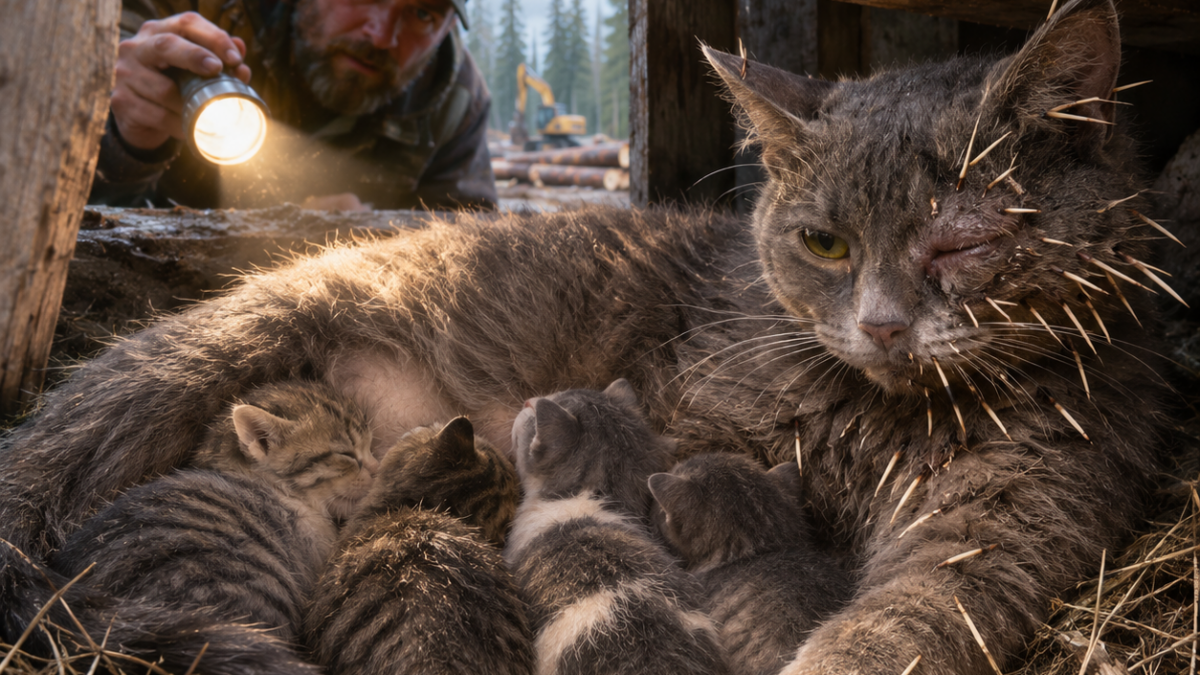
A Tiny Mother Cat Took 47 Porcupine Quills to Protect Her Four Kittens—Not One of Her Babies Had a Single Scratch.
The little gray mother cat had forty-seven porcupine quills buried in her face, chest, and front legs, yet for two agonizing days she refused to crawl away from the four kittens sleeping safely beneath her body.
Not one of her babies had been touched, which meant whatever happened beneath that remote logging shed, their seven-pound mother had somehow put herself between them and something several times her size.
But when I finally carried her out of the dirt and discovered what she had been hiding beneath one injured paw, I realized the most painful part of her story had begun long before the porcupine ever arrived.
The smell was what made me stop.
Not the kind of smell you notice and immediately understand.
It was faint at first.
Something sour.
Wet.
Organic.
The kind of smell that does not belong around diesel, sawdust, hydraulic fluid, fresh-cut cedar, and cold September mud.
I had been walking past the old equipment shed at the edge of Timber Block 17 when it caught me.
I stopped.
Took two steps backward.
Smelled it again.
“Damn.”
The morning had started like most mornings on remote timber property in northern British Columbia.
Cold enough to make your fingers stiff but not cold enough for snow.
Fog hanging low between black spruce and lodgepole pine.
Machines starting one by one in the half-light.
Chains clattering.
Radios cracking.
Men speaking louder than necessary because thirty years around heavy equipment teaches you to assume everybody is half deaf.
My name is Daniel Fraser.
I was fifty-eight years old that September, and I had been logging since I was twenty-one.
I had seen black bears climb into haul trucks.
I had watched a moose chase a foreman through a muddy landing.
I once found a wolverine sleeping beneath a tarp covering three thousand dollars’ worth of chainsaw equipment.
So when I smelled something beneath the shed, I assumed what any practical man would assume.
Something had crawled under there and died.
The shed sat six inches off the ground on old timber blocks.
It had not been used properly in years.
The roof leaked.
One wall leaned.
PART2:
Nobody cared because all we kept inside were fuel cans, cable, grease, broken chokers, and things management insisted we might need someday even though everybody knew we wouldn’t.
I grabbed a flashlight from my pickup.
Then I crouched beside the gap beneath the wall.
The smell was stronger there.
I turned on the light.
At first, I saw only dirt.
Old leaves.
Wood chips.
A crushed paper coffee cup.
Then two yellow eyes appeared in the beam.
I jerked backward so hard I nearly sat in the mud.
Something moved.
A small shape.
Gray-blue fur.
Then I heard it.
A kitten.
Not a proper meow.
A thin squeak.
I lowered myself again.
“Easy.”
The flashlight beam moved slowly across the darkness beneath the shed.
And that was when I saw her clearly.
A tiny mother cat was curled around four kittens.
PART3:
She was so small I thought at first she might still be a kitten herself.
Her coat was blue-gray, almost silver where the flashlight touched it.
One front paw was tucked against her chest.
The other rested across two of the babies.
And her face—
I stopped breathing.
Long pale quills stuck from her cheek.
Her muzzle.
Her ear.
Her chest.
Her legs.
Dozens.
Some looked five or six inches long.
Others had snapped.
One crossed beside her swollen left eye.
Three had gone straight through the pad of her front paw.
For several seconds, I did nothing.
I had spent more than thirty years in wilderness country.
I knew what porcupine quills looked like.
I had removed them from a dog once when I was twenty-six and stupid enough to believe pliers and confidence were a substitute for a veterinarian.
I knew the backward-facing barbs.
I knew how movement could drive them deeper.
I knew how badly they hurt.
The cat looked at me.
She didn’t hiss.
That frightened me.
A healthy feral cat trapped beneath a shed with kittens should have come after my face.
This one barely lifted her head.
Then one of the kittens crawled toward the opening.
The mother moved instantly.
Despite every quill.
Despite the swollen eye.
Despite whatever infection was already burning through her body.
She pulled herself forward and blocked the kitten with her chest.
A quill shifted as she moved.
Her body flinched.
But she did not stop.
The kitten disappeared beneath her again.
I whispered, “Jesus.”
Behind me, boots came through the mud.
My coworker Mike Talbot stopped beside me.
“What are you doing?”
“Get down here.”
“I’m too old to crawl around in—”
“Mike.”
Something in my voice changed his mind.
He crouched.
I moved the flashlight.
He swore softly.
“Oh, God.”
The mother cat watched us.
Mike had been logging almost as long as I had.
He was sixty-two, built like a fence post, and considered emotional expression something people should keep private.
He stared under that shed for maybe twenty seconds.
Then he took off his gloves.
“How many?”
“I don’t know.”
“Thirty?”
“More.”
One kitten shifted.
Cream-colored.
Tiny dark ears.
Another was gray like the mother.
One black.
One tabby.
All four looked astonishingly healthy.
Round bellies.
Clean fur.
Eyes open.
Maybe four weeks old.
Mike looked at them.
Then at their mother.
“They don’t have any.”
I knew exactly what he meant.
No quills.
Not one.
That realization changed the whole scene.
A porcupine does not fire quills like arrows.
The animal has to make contact.
A dog or predator lunges.
The porcupine turns its back or swings its tail.
Quills release into whatever touches them.
For that mother cat to have forty or fifty embedded while four kittens remained untouched—
She had been the one who made contact.
Maybe again.
Maybe repeatedly.
Mike looked toward the woods.
“Think the porky got under there?”
“Maybe.”
“And she went at it?”
I looked at the four kittens.
“She went between it and them.”
Neither of us spoke after that.
The radio on my belt crackled.
“Fraser, you copy?”
Our site supervisor.
Brent Holloway.
I ignored it.
“Fraser, need you on Landing Three. Processor’s down.”
I reached for the radio.
“Give me ten.”
“Need you now.”
“I found injured animals.”
There was a pause.
“Wildlife?”
“Cat and kittens.”
Another pause.
Longer.
Then, “You called me off production for a cat?”
I looked beneath the shed.
The mother was trying to lick the gray kitten.
A quill in her lower lip stopped her.
My jaw tightened.
“I said give me ten.”
“Daniel—”
I turned the radio off.
Mike looked at me.
“That’s going to go well.”
“He can fire me after lunch.”
“You planning on eating lunch?”
“No.”
“Figured.”
We needed to get them out.
That was the problem.
The gap beneath the shed was too narrow for either of us to crawl through properly.
And reaching blindly toward an injured mother with kittens was a good way to get bitten.
I went to my truck and brought back a piece of cooked chicken from my lunch.
The moment I put it near the opening, one of the kittens smelled it.
The mother did too.
But she did not move.
I tore off a tiny piece and slid it closer.
She stared at it.
Then looked at the kittens.
Again.
Always the kittens first.
I suddenly wondered how long she had been there.
The smell.
Not decay.
Infection.
Urine.
Wet bedding.
Maybe she had not left to relieve herself.
Maybe she had not left for water.
I looked at Mike.
“We need the floor.”
He understood immediately.
The shed had old plank flooring.
We went inside.
Two minutes later I was pulling warped boards with a pry bar.
Mike worked beside me.
Brent arrived before the third board came up.
He stood in the doorway.
“What the hell are you doing?”
“Cat’s underneath.”
“You’re tearing apart company property.”
“This building is worth less than the pry bar.”
“That isn’t the point.”
Mike muttered, “Usually means he doesn’t know the point.”
Brent ignored him.
“Processor’s still down.”
“Then call Dean.”
“Dean’s twenty miles away.”
“So?”
Brent stared at me.
I had known men like him my entire career.
Not necessarily cruel.
That would have been simpler.
Brent was the kind of man who measured the world by whether something created or delayed production.
A broken hydraulic line mattered.
A sick worker mattered until paperwork became inconvenient.
A cat did not appear on any spreadsheet.
“Daniel, it’s a feral cat.”
I stopped pulling the board.
“So?”
“So call animal control.”
“We’re ninety minutes from the nearest clinic.”
“Exactly. What do you plan to do?”
“Get her out.”
“And shut down half the morning?”
I stood.
Mike stopped working too.
That was useful because Mike was six foot four and looked like someone who had once eaten a chainsaw.
I said, “There are forty-some porcupine quills in her.”
Brent exhaled through his nose.
“That’s nature.”
Something about that sentence hit me wrong.
Maybe because the mother cat heard him.
Obviously she didn’t understand the words.
But she raised her head at the sound of his voice.
And I could see her eye.
The left one was almost swollen shut.
“This isn’t nature anymore,” I said.
“What does that mean?”
“It means I found her.”
Brent laughed once.
“You gonna adopt every animal you find in the forest now?”
“No.”
I looked back through the opening in the floor.
“Just this one.”
I did not know yet how true that would become.
We removed six boards.
The entire nest appeared beneath us.
It was not much of a nest.
Pine needles.
Old insulation.
A scrap of plastic.
And something blue tucked beneath the mother.
She tried to rise when light entered.
Couldn’t.
Her legs shook.
I crouched.
“All right, sweetheart.”
I hadn’t called anything sweetheart since my wife died seven years earlier.
The word surprised me.
Apparently grief leaves language stored in strange places.
The cat’s good eye stayed on me.
Mike brought a cardboard box.
I told him no.
Too hard.
Too small.
We found an old canvas equipment bag and lined it with my jacket.
I put on leather gloves.
Then I reached slowly.
The mother’s lips pulled back.
Finally.
Good.
Anger meant there was still something in her.
“I know.”
She hissed.
Barely audible.
“You don’t know me.”
I placed one hand near her.
Didn’t touch.
Let her smell.
She tried to move over the kittens.
A quill in her chest pressed deeper.
She cried out.
It was the smallest sound.
I had heard men scream under falling timber.
I had heard injured animals make noises that still came back in dreams.
But that tiny sound went through me harder than most.
“Stop.”
I don’t know why I whispered it.
“Please stop fighting.”
The cat stared at me.
Then something strange happened.
One of the kittens crawled from beneath her belly and climbed onto my glove.
A little tabby.
No fear.
The mother watched.
The kitten smelled my fingers.
Then sat directly on my hand.
Mike said behind me, “Well.”
I lifted the kitten.
The mother tensed.
I placed it in the canvas bag.
Another kitten followed.
Then another.
I moved slowly.
Every time, I showed the mother where the kitten went.
When all four were inside the bag, she tried to stand.
Not to escape.
To follow them.
Her front leg collapsed.
That was when I saw the blue object that had been beneath her.
A faded cloth collar.
Not hers.
Much too small.
Kitten-sized.
A tiny silver bell remained attached.
No tag.
The fabric was dirty and stiff.
Someone had put a collar on one of those kittens at some point.
Or on another kitten.
That detail bothered me.
These animals might not be feral.
I put the collar in my pocket.
Then I lifted the mother.
She weighed almost nothing.
Maybe seven pounds.
Probably less.
My hand supported her chest.
Another under her hindquarters.
She trembled against me.
I could feel every rib.
I carried her out of the shed.
The moment the kittens cried from the bag, she twisted toward them.
One of the quills caught against my jacket.
She jerked.
I nearly dropped her.
“Easy.”
I set her beside them.
She crawled inside the bag.
Immediately.
Then curled around the kittens again.
Mike looked at me.
“Two days.”
“What?”
“The rain.”
I understood.
It had rained hard Sunday night.
The dirt beneath the shed was dry where she had been lying.
Outside the nest, the soil showed dried splash marks from that storm.
The porcupine encounter had happened before the rain.
Today was Tuesday.
If Mike was right, she had been injured for close to two days.
Forty-seven quills, though we didn’t know that number yet.
Two days of nursing.
Two days of kittens climbing over wounds in her chest and legs.
Two days without enough food.
Maybe no water.
And she stayed.
Brent stood near the door.
For the first time, he looked uncomfortable.
“You taking them in your truck?”
“Yes.”
“You’re on company time.”
I turned.
Mike said, “Brent.”
“No, I’m asking.”
I took out my keys.
“You can mark me off.”
“You leave site without authorization, I have to document it.”
“Document it.”
“Daniel.”
“Document every damn minute.”
I picked up the bag.
The mother cat’s head appeared over the edge.
One swollen eye.
One good eye.
Still watching.
“If you want to explain in writing why I left production to transport an injured animal with four nursing kittens, spell my last name correctly.”
Brent said nothing.
Mike picked up my lunchbox.
“I’m driving.”
“You don’t need to.”
“You’re holding the bag.”
“I can put it down.”
“And then I’d have to listen to you complain about my driving.”
“You drive like a drunk moose.”
“Exactly.”
We left.
The nearest veterinary clinic was in a town called Pine Crossing.
Normally seventy-five minutes.
That morning it took an hour and twenty.
Every pothole made the mother tense.
I held the canvas bag against my lap.
She kept one front leg stretched across the kittens.
There were three quills passing through the paw pad.
I could see the skin pulling around them whenever the truck vibrated.
I wanted to remove them.
Every instinct said remove the thing causing pain.
Experience said don’t.
Porcupine quills have microscopic backward-facing barbs.
Pull wrong.
Break one.
Leave a fragment.
Turn a terrible problem into a worse one.
The kitten with the tabby markings climbed onto her shoulder.
A quill blocked it.
The mother shifted so the kitten could settle against her neck without touching the sharp end.
Mike noticed.
“Look at that.”
“I see it.”
“She knows.”
“Yeah.”
“What are you gonna call her?”
“I’m not.”
He looked at me.
“What?”
“I’m not naming a cat.”
“You called her sweetheart.”
“That is not a name.”
“Sounded intimate.”
“Drive.”
He smiled.
Ten minutes later he said, “Quill.”
“No.”
“Good name.”
“No.”
“Because she’s got—”
“I understand the joke.”
“It isn’t a joke.”
“It’s terrible.”
“Quill.”
The mother looked up at the sound.
Mike slapped the steering wheel.
“She likes it.”
“She moved her head.”
“Quill.”
The cat looked again.
“That proves nothing.”
“You’re outvoted.”
“There are two people in this truck.”
“Four kittens.”
“They don’t vote.”
“Typical management.”
Despite myself, I smiled.
By the time we reached Pine Crossing Veterinary Centre, the name had stuck.
Dr. Hannah Mercer met us at the side entrance.
She was younger than I expected.
Maybe thirty-eight.
Dark hair in a loose braid.
Blue scrubs.
No wasted motion.
I respected her immediately.
She looked inside the bag.
Her entire face changed.
“How long?”
“Maybe two days.”
“Good Lord.”
She touched Quill’s gum.
Checked hydration.
Heart rate.
Temperature.
Then she looked closely at the face.
“We need sedation.”
“Will it affect nursing?”
“We’ll use the safest protocol we can. But these need to come out now.”
“How many?”
She glanced across Quill’s body.
“At least forty.”
I swallowed.
Hannah moved a hand toward one quill.
Quill tried to stand.
Hissed.
Then reached toward the kittens.
Hannah stopped.
“She’s still guarding them.”
“Has been the whole time.”
“Any injured?”
“Not that I saw.”
Hannah inspected each kitten.
One by one.
Ears.
Eyes.
Paws.
Mouths.
Bellies.
When she finished, she looked up.
“Nothing.”
“Nothing?”
“Not even a scratch.”
Mike stood beside the door.
“So she took all of it.”
Hannah looked at Quill.
“We can’t know exactly what happened.”
“But?”
“But porcupines don’t chase cats.”
“Right.”
“The kittens are too young to get away quickly.”
“Right.”
“And she has quills concentrated in the face, chest, forelimbs…”
Hannah touched one lightly.
“Exactly where I’d expect if she went forward.”
The room became quiet.
Mike whispered, “She attacked it.”
“No,” Hannah said.
We looked at her.
She shook her head.
“I wouldn’t call it attacking.”
She looked at the four kittens pressed together in the carrier.
“I’d call it stopping it.”
They prepared the procedure.
I assumed that meant our part was over.
I had delivered the animals.
Professionals had them.
I could return to work.
That was the reasonable thing.
Then Hannah said, “You can leave your number at reception.”
I looked at Quill.
She was already becoming sleepy.
One eye remained fixed on the carrier.
“Can the kittens stay with her?”
“Nearby. Not during the actual removal, obviously.”
“She’ll wake up with them?”
“Yes.”
I nodded.
“Good.”
Mike watched me.
We went to the waiting room.
I sat.
He sat beside me.
After a minute, he said, “Thought we were leaving.”
“We are.”
“When?”
“When they finish.”
“That could be hours.”
“I know.”
“You’re getting attached.”
“No.”
“Sure.”
I looked around the clinic.
Photos of golden retrievers.
Cats in Halloween costumes.
A poster explaining dental disease.
A fish tank containing one fish that seemed as unhappy about captivity as I felt.
“I’m making sure she makes it.”
Mike nodded.
“Attached.”
The procedure lasted two hours and sixteen minutes.
I know because I watched the clock.
At one point, Brent called.
I didn’t answer.
Then he texted:
Need ETA.
I wrote:
Unknown.
His reply came immediately.
This is becoming a problem.
I stared at the words.
Mike leaned over.
“What’s he say?”
“Production.”
“Delete him.”
“I can’t delete my supervisor.”
“I’ve deleted three.”
“From your phone.”
“Still counts.”
I locked the screen.
Hannah finally came through the swinging door just after two.
She looked tired.
There was a small dark spot on one sleeve.
Blood.
I stood.
“How is she?”
“Alive.”
Not the answer I wanted.
My face must have shown it.
Hannah continued quickly.
“She did well. Better than I expected.”
“How many?”
“Forty-seven.”
Mike swore under his breath.
I repeated, “Forty-seven.”
Hannah nodded.
“Eleven from the face and head. Nine around the left shoulder and upper chest. Twenty-four across the front legs and lower chest.”
“That’s forty-four.”
She looked at me.
“The last three passed through the pad of her left paw.”
I already knew.
Hearing it counted made it worse.
“Eye?”
“She keeps it.”
I exhaled.
“We had to remove two quills extremely close to the orbit, but the globe itself wasn’t penetrated.”
“Infection?”
“Yes. Significant.”
“How bad?”
“Bad enough that another day or two could have changed this conversation.”
I looked at the floor.
Hannah’s voice softened.
“She’s lucky you found her.”
I thought of the tiny body beneath the shed.
“No.”
Hannah waited.
“The kittens were lucky she was there.”
She understood.
“Yes.”
Then she told us something that changed the next six weeks.
“She has milk, but not enough.”
“What does that mean?”
“She’s badly dehydrated and underweight. Her body has been feeding four kittens while fighting pain and infection.”
“Can they eat?”
“They’re around four to five weeks. We can supplement.”
“Can she stay here?”
“For tonight.”
“And after?”
Hannah studied me.
“Do you have a rescue in mind?”
“No.”
“Foster?”
“No.”
She smiled faintly.
“You?”
“No.”
Mike coughed.
It sounded suspiciously like laughter.
I glared at him.
“I’ve never owned a cat.”
“Everybody starts somewhere,” Hannah said.
“I work twelve-hour days.”
“You have coworkers.”
“No.”
“Warm building?”
“Yes.”
“Quiet room?”
“Yes.”
“Can you follow medication directions?”
“I rebuild hydraulic systems.”
“That wasn’t the question.”
“Yes.”
“Can you bottle-feed or supervise supplemental feeding every few hours?”
“No.”
“You can learn.”
I stared at her.
She stared back.
Veterinarians, I discovered, are dangerous negotiators.
An hour later I had a printed medication schedule, kitten formula, five small feeding dishes, antibiotics, eye drops, a soft recovery collar, and enough instructions to run a neonatal ward.
Mike carried everything to the truck.
“You know what happened here.”
“Shut up.”
“You got a cat.”
“I’m fostering.”
“You got five cats.”
“Temporary.”
“Five.”
“Drive.”
We returned to the timber site to collect my personal truck.
Brent was waiting.
So was our operations manager, Russell Pike.
Russell came up from Prince George maybe once a month.
The fact that he was there told me Brent had made phone calls.
Quill and the kittens remained at the clinic overnight.
That was fortunate.
I was angry enough without holding them.
Russell stood beside the office trailer.
“Daniel.”
“Russell.”
“I hear there was an incident.”
“There was an injured cat.”
“You dismantled part of an equipment shed.”
“Six boards.”
“You left site for more than four hours.”
“Yes.”
“Without authorization.”
“Yes.”
Brent stood beside him.
He looked uncomfortable now.
I understood.
He had expected a reprimand.
Not a confrontation.
Russell folded his arms.
“You understand we have policies.”
“I do.”
“And responsibilities.”
“Yes.”
“What would you have done if every operator left production whenever an animal was injured?”
I looked around.
At the forest.
At the machines.
At land where animals lived before we arrived with chainsaws and steel.
“I’d probably ask what animal.”
Russell sighed.
“This isn’t funny.”
“I agree.”
“Brent says you became confrontational.”
Mike made a sound behind me.
Russell looked at him.
“Something to add?”
Mike said, “Forty-seven.”
“What?”
“Quills.”
Russell frowned.
Mike stepped forward.
“The cat had forty-seven porcupine quills in her body. She was nursing four kittens. Daniel took her to a vet.”
Russell looked at me.
“You couldn’t call conservation?”
“An hour and a half away.”
“Animal control?”
“Same.”
“Wait until shift change?”
“She had infection around the eye and chest.”
Russell rubbed his forehead.
“You’re one of our most experienced operators.”
“Then you should trust my judgment.”
Brent said, “This isn’t about judgment.”
I looked at him.
“What’s it about?”
“Following process.”
“There wasn’t a process for this.”
“There’s always a process.”
That sentence made Mike laugh openly.
Russell shot him a look.
I took my hard hat off.
“If you need to write me up, write me up.”
“Daniel—”
“If you need to dock the hours, dock them.”
“That isn’t what we want.”
“Then what?”
Russell hesitated.
That told me the answer.
They wanted an apology.
Not because I had done something morally wrong.
Because organizations like submission more than correctness.
I put the hard hat on the hood of my truck.
“I’m not apologizing for taking her.”
Brent said, “Nobody asked you to.”
“You were about to.”
His face reddened.
Russell stepped in.
“Go home, Daniel.”
I nodded.
“Fine.”
“We’ll discuss this tomorrow.”
“Fine.”
Mike followed me.
At the truck he said, “You gonna retire?”
“No.”
“Shame. I was hoping to steal your chainsaw.”
I looked at him.
“You already stole my wedges.”
“Borrowed.”
That evening, my house felt unusually empty.
I lived outside Pine Crossing in a small place that had belonged to my parents.
Two bedrooms.
Wood stove.
Mudroom.
Workshop.
My wife, Elaine, had died there after pancreatic cancer took everything slowly and then suddenly.
We had no children.
That had not been by choice.
After she died, I removed almost nothing.
Her coffee mug remained in the cabinet.
Her gardening gloves stayed in the mudroom for five years before I finally moved them into a drawer.
Grief, I had learned, is partly the process of deciding which objects are allowed to become objects again.
I prepared the spare bedroom for Quill.
Old towels.
A shallow litter box.
Cardboard nesting box.
Heat pad under half the bedding.
I drove to the general store and bought cat food.
The cashier, Janet, knew me.
Everybody knew everybody.
She looked at the cart.
“You getting a cat?”
“No.”
She looked at the kitten formula.
“Having a baby?”
“Apparently.”
By the time I reached home, Mike had told three people.
By morning, half the camp knew.
Someone had taped a drawing of a cat onto my locker with the words CRAZY CAT LADY underneath.
I knew exactly who did it.
Mike’s handwriting had not improved in forty years.
I left it there.
At ten, Hannah called.
“Quill ate.”
The relief that went through me was disproportionate.
“All right.”
“She also tried to climb out of her kennel because she could hear the kittens.”
“Where were they?”
“Six feet away.”
I smiled.
“She’s difficult.”
“Sounds familiar.”
“I don’t like the direction of this conversation.”
“She can go home this afternoon.”
Home.
The word stayed.
I picked them up at four.
Quill wore a soft protective collar.
Without the porcupine quills, her face looked smaller.
Too small.
Shaved spots showed tiny punctures and incisions.
Her left eye was open a narrow slit.
Red.
Swollen.
But there.
The kittens were furious about the carrier.
All four screamed as though being transported to prison.
Quill immediately became agitated.
Hannah said, “Talk to her.”
“What?”
“You’re familiar.”
“I’ve known her one day.”
“Long enough.”
I crouched.
“Hey.”
Quill looked at me.
The kittens continued screaming.
“You’re okay.”
She moved toward the carrier door.
“Everybody’s coming.”
I had no idea why I said everybody.
Like we were a family.
The word frightened me more than I admitted.
Quill settled.
Hannah noticed.
I pretended she didn’t.
At home, Quill inspected the spare bedroom slowly.
She limped.
The paw bothered her most.
When one of the kittens climbed toward the door, she moved to block it.
I sat on the floor.
“You can’t keep doing everything.”
She looked at me.
“Trust me. Doesn’t work.”
Elaine had told me something similar.
Not about kittens.
About life.
I had spent our marriage fixing.
Roof.
Car.
Fence.
Money.
Appointments.
Anything practical.
When she got sick, I approached cancer like an equipment failure.
Schedules.
Medication charts.
Research.
Second opinions.
I kept looking for the tool that would solve it.
Elaine finally took my hand one night and said, Danny, I don’t need you to fix dying. I need you to sit here while I’m scared.
I did.
But not enough.
There is never enough when somebody dies.
Quill lay down.
The kittens climbed over her.
I stayed on the floor.
For nearly an hour.
That first week was chaos.
The kittens developed personalities quickly.
The gray female, almost identical to Quill, was the boldest.
I named her Ash.
The cream-colored male became Birch.
The black kitten became Coal.
The tabby—the one that had climbed onto my glove beneath the shed—became Timber.
Mike claimed all four names proved I had spent too long in forestry.
I told him to mind his business.
Quill took her medication reluctantly.
Eye drops required diplomacy.
Antibiotics required bribery.
She hated the soft collar.
She loved cooked chicken.
Every night at exactly 2:15, Timber decided sleep was oppression and climbed onto his siblings.
By the third night, I moved a mattress into the spare room.
Not because I was attached.
Because administering medication at six in the morning was easier if I was already there.
That explanation satisfied nobody.
I went back to work.
Russell gave me a written warning.
I signed it.
Brent avoided discussing the cat.
Then something unexpected happened.
People started leaving things beside my locker.
A bag of kitten litter.
A scratching toy.
Canned food.
A small fleece blanket.
Nobody signed anything.
Loggers are sentimental in the same way bears are polite.
Only when nobody is watching.
One afternoon, I found Brent putting a bag of expensive kitten food beside my truck.
We looked at each other.
He froze.
“That yours?”
“No.”
“Interesting.”
“It was donated.”
“By who?”
“No idea.”
I walked away before he had to answer.
Two weeks after the rescue, Quill’s face began healing.
Her eye opened fully.
Hannah declared the vision intact.
The puncture wounds closed.
Her paw remained sore, but she was using it.
Then we discovered something else.
Quill was terrified of brooms.
Not mildly startled.
Terrified.
I entered the room carrying a broom one Saturday morning.
She saw the handle.
Her entire body flattened.
She shoved the kittens behind the bed.
Then hissed at me so violently saliva flew from her mouth.
I stopped.
Dropped the broom.
Quill lunged between me and the kittens.
Not attacking.
Defending.
Again.
Always defending.
I backed out.
For twenty minutes, she would not come from beneath the bed.
That bothered me.
A cat that had lived wild might fear tools.
But the reaction looked specific.
The blue kitten collar from beneath the shed was still on my dresser.
I had cleaned it.
Faded blue fabric.
Tiny silver bell.
No name.
I took it to Hannah at the next appointment.
“Found this under her.”
Hannah turned it over.
“Looks domestic.”
“That’s what I thought.”
“Could belong to one of the kittens.”
“Too big.”
She agreed.
“Maybe Quill wore it when she was younger?”
“Too small for her now.”
“Possible.”
“Can we trace anything?”
“No tag. No chip in the collar.”
Quill herself had no microchip.
Neither did the kittens.
But Hannah pointed out a faint line around Quill’s neck.
Collar wear.
Old.
Mostly grown out.
“She belonged to somebody,” I said.
“At some point.”
“Then why was she under a logging shed?”
Hannah looked at me.
“That’s a different question.”
I posted her photograph online.
I hated social media.
Had an account only because Elaine created one for me years ago.
I wrote:
Found near Timber Block 17 north of Pine Crossing. Small blue-gray female cat with four kittens. Please contact Pine Crossing Veterinary Centre with proof of ownership.
I did not mention the porcupine attack.
Within six hours, the post had been shared hundreds of times because Mike posted the photograph of Quill after surgery.
Then a local rescue group shared it.
Then a newspaper.
By the next morning, strangers were calling her “the porcupine mom.”
I disliked that immediately.
She had a name.
Quill.
Three people claimed ownership.
All three were lying.
One could not describe her markings.
One thought she was male.
The third claimed all four kittens were white.
Then a woman named Sarah Donnelly called.
She sounded eighty.
Maybe older.
“I don’t think she’s mine,” she said.
That got my attention.
“Then why call?”
“Because I’ve seen her.”
“Where?”
“There was a trailer about seven miles from your timber site.”
My grip tightened.
“Whose?”
“A man named Craig Larkin.”
I knew the name.
Everyone around Pine Crossing did.
Seasonal laborer.
Odd jobs.
Hunting guide when people hired him.
Trouble when they didn’t.
Sarah continued.
“He had a gray cat last spring.”
“Quill?”
“I don’t know what he called her. I heard his girlfriend call her Misty once.”
“Pregnant?”
“Later.”
“Blue collar?”
Silence.
“Yes.”
My stomach tightened.
“Did she wear one?”
“Yes. Little blue thing with a bell.”
I sat down.
“Why isn’t she there now?”
Sarah’s voice changed.
“I don’t know.”
That meant she did.
“Mrs. Donnelly.”
“I don’t like accusing people.”
“Neither do I.”
That was not entirely true.
“If you know something, tell me.”
She took a long breath.
“Craig’s girlfriend left him in July. The cat was hers.”
“What happened?”
“He was angry.”
“How angry?”
“I saw him throw her food dishes into the yard.”
My jaw tightened.
“The cat’s?”
“Yes.”
“Anything else?”
“About a week later, the trailer was empty.”
“Craig moved?”
“Yes.”
“The cat?”
“No.”
I closed my eyes.
Sarah continued quietly.
“She was sitting on the porch.”
Pregnant.
Abandoned.
“How far from Timber Block 17?”
“Seven miles by road.”
“Through forest?”
“Less.”
Quill had been somebody’s pet.
Then somebody’s unwanted reminder of a relationship.
Left behind pregnant.
No food.
No home.
She survived.
Gave birth.
Moved her babies beneath our shed.
And then, when a porcupine entered that hiding place, she stood between it and them.
The anger was immediate.
Hot.
Simple.
I called the conservation office.
They referred me to local animal welfare.
I spoke with Deputy McKenzie because abandonment of domestic animals could constitute an offense depending on evidence.
He listened.
“Do you have proof?”
“Witness.”
“Of the cat being there, maybe. Not necessarily abandonment.”
“Trailer owner left.”
“Could’ve believed someone else took her.”
“He threw out her dishes.”
“Daniel.”
“What?”
“You want me to arrest him because you hate the story.”
That stopped me.
McKenzie was right.
I wanted justice to be easy.
It rarely is.
“What can you do?”
“Interview him.”
“Do it.”
“I will.”
Craig Larkin denied owning Quill.
Said she belonged to his ex-girlfriend.
Said he assumed she took the cat.
His ex-girlfriend, Melissa Warren, lived in Alberta.
When contacted, she told investigators something different.
She had tried to take Quill.
Craig refused.
He said the cat was his because he had paid for veterinary care once.
Melissa eventually left after a violent argument and planned to return with her brother.
When she came back two days later, Quill was gone.
Craig told her he had “handled it.”
That phrase haunted me.
Handled it.
People use clean words for ugly things.
Disposed.
Relocated.
Handled.
Melissa cried on the phone when Hannah let me speak with her.
“Is she alive?”
“Yes.”
“And the babies?”
“All four.”
“Oh God.”
She sounded genuinely relieved.
Then she said, “I didn’t know she was pregnant when I left.”
“She was.”
“I would never have abandoned her.”
“I believe you.”
“Can I see her?”
That was harder.
Quill was recovering.
The kittens were attached to me.
I had already begun thinking of the spare room as theirs.
But Quill was not mine simply because I rescued her.
So Melissa drove six hours the following weekend.
When she arrived, she stood on my porch holding a bag.
Late twenties.
Dark hair.
Tired eyes.
She looked nervous.
“I brought her blanket.”
I stepped aside.
“Come in.”
Quill was near the stove.
The moment Melissa entered, she froze.
Her entire body changed.
I watched carefully.
Recognition.
Definitely.
Melissa knelt.
“Misty.”
Quill stared.
Melissa began crying.
“Baby.”
She held out one hand.
Quill did not approach.
That surprised us both.
Melissa whispered, “It’s okay.”
Quill backed away.
Not terrified.
Cautious.
She moved toward me.
Then sat against my boot.
Melissa saw it.
Something painful crossed her face.
“I deserve that.”
“No.”
“Yes.”
She wiped her cheeks.
“I left her with him.”
“You thought you were coming back.”
“I should’ve taken her the first time.”
“Maybe.”
I didn’t offer false absolution.
People often do that because another person’s guilt makes them uncomfortable.
Melissa sat on the floor.
She did not reach again.
After several minutes, Quill approached.
Slowly.
Smelled her hand.
Then the bag.
Melissa opened it.
Inside was a faded fleece blanket covered in cartoon fish.
Quill climbed onto it immediately.
Recognition.
Home.
Melissa began sobbing.
I looked away.
She stayed three hours.
By the end, Quill allowed her to touch her head.
Then Melissa asked the question I had been dreading.
“Are you keeping her?”
I looked at Quill.
Then at the kittens.
“I don’t know.”
Melissa nodded.
“I can’t take her.”
I hadn’t expected that.
“You came all this way.”
“To know she was alive.”
She touched the fish blanket.
“My apartment doesn’t allow animals. My job keeps me away ten hours some days. And she…”
Melissa looked toward Quill beside my chair.
“She’s safe here.”
“That isn’t the same as belonging here.”
“It might be.”
I said nothing.
Melissa smiled through tears.
“She never liked men much.”
“That’s insulting.”
“She hated Craig from the first week.”
“Smart cat.”
That got a laugh.
Then Melissa handed me a folder.
Veterinary records.
Quill’s actual previous name had been Misty.
She was two years and three months old.
Spayed?
No.
Vaccinations partially current.
No microchip.
She had been adopted as a kitten from a farm litter.
Melissa said, “You can keep calling her Quill.”
I looked surprised.
“She responds to it.”
“She responds to food.”
“She looks at you differently.”
I felt myself becoming defensive.
“She’s a cat.”
“Exactly.”
I did not know what that meant.
But apparently Melissa did.
Before leaving, she sat beside Quill one last time.
“I’m sorry.”
Quill sniffed her fingers.
Melissa whispered, “You found a better person than I did.”
I wanted to object.
I wasn’t better.
I was a widower who spent too many years believing solitude made me uncomplicated.
But Quill climbed onto my boot.
And stayed.
Craig Larkin’s story unraveled over the following month.
A neighbor had security footage from a trail camera facing the access road.
The camera existed because bears had been getting into garbage.
Instead, it captured Craig’s truck driving toward Timber Block 17 on July 29.
The passenger door opened near the edge of the frame.
A small gray cat appeared on the roadside.
Then the truck drove away.
Quill chased it.
For almost thirty yards.
The video ended before she stopped.
I watched it once.
Only once.
It made me angrier than the quills.
She had trusted him enough to run after the truck.
Craig later admitted leaving her there.
His excuse was that he believed cats “could survive outside.”
She had been visibly pregnant.
He received charges under provincial animal protection law and was prohibited from owning animals for a period after the investigation.
Some people thought the consequences were too small.
So did I.
But Hannah told me something important.
“You cannot build Quill’s recovery around Craig’s punishment.”
I looked at her.
“That sounds like something Elaine would have said.”
“I’ll take that as a compliment.”
“It was.”
Justice mattered.
But Quill did not know about court.
She didn’t know Craig had been interviewed.
Didn’t know strangers online were furious.
Didn’t care.
Her world was smaller.
Food.
Warmth.
Kittens.
Pain fading.
Hands she trusted.
A window where sunlight reached the floor.
For her, healing had nothing to do with whether Craig suffered enough.
Healing was learning that a broom could cross a room without touching her.
That took three weeks.
I started by leaving the broom in the hallway.
Then against the opposite wall.
Then closer.
Every time Quill saw it and remained calm, she got chicken.
Mike called this bribery.
Hannah called it desensitization.
I called it expensive because Quill developed sophisticated opinions about chicken quality.
Eventually I could sweep.
She watched.
Tense.
But stayed.
The first time she remained on the couch while I swept the living room, I felt absurdly proud.
“You see that?” I asked Timber.
The kitten was attacking my shoelace.
Nobody respected the moment.
By October, the kittens were old enough for adoption.
That was the plan.
Hannah found excellent homes.
A teacher wanted Birch.
A retired couple wanted Ash.
A firefighter and his wife wanted Coal.
Mike wanted Timber.
That surprised me.
“You?”
“What?”
“You don’t even like cats.”
“I don’t.”
“You have one sitting in your jacket.”
Timber’s head was sticking out of Mike’s partially zipped coat.
“He got cold.”
“It’s sixty degrees.”
“Wind chill.”
“Inside the clinic?”
“Mind your business.”
So Timber was going to Mike.
That left Quill.
Hannah asked, “Have you decided?”
“About what?”
She stared.
I hated that look.
“You know exactly what.”
“Quill can stay until she’s fully recovered.”
“She is fully recovered.”
“Her paw still—”
“Fine.”
“Eye?”
“Fine.”
“Antibiotics?”
“Finished.”
“Scars?”
“Scars don’t require hospitalization.”
I looked through the examination-room window.
Quill was sitting on the reception counter despite being explicitly forbidden from doing so.
One small scar crossed her cheek.
Tiny marks remained on the ear.
Her coat had grown over most of the chest wounds.
Hannah said, “She needs a home.”
“She has one.”
The words left before I thought.
Hannah smiled.
I sighed.
“Don’t.”
“I didn’t say anything.”
“You’re smiling.”
“I’m allowed.”
I looked at Quill.
“She stays.”
There.
Two words.
Life changed.
The kittens left over the next two weeks.
Birch first.
Quill searched the room that evening.
That hurt.
She called softly.
Walked from the spare bedroom to the kitchen.
Then back.
I almost called the teacher and demanded the kitten back.
Hannah warned me this would happen.
“It’s normal.”
“I don’t like it.”
“That isn’t the standard.”
Ash left next.
Coal after that.
Quill adjusted.
The kittens returned for visits.
Every time, she smelled them carefully and seemed satisfied they were alive.
Timber was the last.
Mike came to collect him carrying a brand-new carrier that cost more than the boots he wore.
I looked at it.
“You’re ridiculous.”
“It was on sale.”
“No, it wasn’t.”
“How would you know?”
“I bought the same one.”
He stared.
“For what?”
I looked at Quill.
He laughed so hard he had to sit down.
When Mike finally left, Timber screamed for the first ten minutes in the truck.
Quill stood at the window watching.
Then silence settled over the house.
I expected relief.
Instead, the rooms seemed too large.
Quill walked to the spare bedroom.
Empty.
She smelled the blankets.
Then came into the kitchen.
I was standing beside Elaine’s old coffee mug.
I had taken it down without noticing.
Blue ceramic.
Small chip near the handle.
Quill jumped onto the chair.
Then onto the table.
“No.”
She sat.
“Down.”
She blinked.
“You’re not supposed to be up here.”
Another blink.
I laughed.
And suddenly I was crying.
No warning.
No heroic reason.
Just tears.
Quill stepped toward me.
I sat.
She climbed into my lap.
That was the first time.
She had slept near me.
Against my boot.
Beside my chair.
Never on me.
She circled once.
Then settled.
Seven pounds.
Warm.
Purring.
The sound vibrated against my stomach.
I put one hand on her back.
“I miss her.”
Quill purred.
“You don’t know who I’m talking about.”
Her eyes closed.
“I suppose that’s convenient.”
For seven years, people had told me I needed to move forward.
I hated that phrase.
Forward where?
Grief was not a road.
Elaine was not an obstacle I had to pass.
Quill taught me something different.
You do not move on from love.
You make room beside it.
Elaine remained.
Her mug.
Photographs.
The chair she bought even though I said it was ugly.
The memory of her telling me not to use the good towels in the workshop.
Quill did not replace any of that.
She simply occupied a place that had been empty.
Sometimes that is enough.
The story went farther than I expected.
A regional newspaper interviewed me.
Then a television station from Vancouver called.
I said no.
Mike said yes on my behalf.
I threatened to fire him from a job I did not control.
Eventually I agreed to one interview because Hannah said attention might help the rescue clinic raise funds.
The reporter arrived at my house.
Young woman named Claire.
Camera operator.
Microphones.
Quill disappeared under the couch.
I respected her judgment.
Claire asked, “What went through your mind when you realized the kittens had no injuries?”
I thought about the shed.
The dirt.
The mother moving despite every quill.
“I understood where the quills went.”
Claire waited.
I continued.
“She took the contact.”
“You believe she deliberately protected them?”
“I believe four kittens were clean and their mother had forty-seven quills in the front half of her body.”
“That sounds deliberate.”
“It sounds like a mother.”
Claire asked whether I considered myself Quill’s rescuer.
“No.”
She looked surprised.
“You drove her ninety minutes to a clinic.”
“That’s transportation.”
“You paid for treatment.”
“So?”
“You adopted her.”
“That came later.”
“Then who rescued her?”
I looked toward the couch.
A gray face watched from underneath.
“She kept herself alive long enough for somebody to notice.”
Claire lowered the microphone slightly.
“And the kittens?”
“She rescued them.”
That clip spread online.
Millions of views.
I found out because strangers began mailing things to Pine Crossing Veterinary Centre.
Cat toys.
Blankets.
Letters.
Donations.
One child in Ohio sent five dollars and a handwritten note:
Please buy Quill chicken because brave moms need snacks.
I kept that letter.
Hannah framed it for the clinic.
The donations eventually funded an emergency animal-treatment program for remote rescues.
They called it the Quill Fund.
I objected.
Nobody cared.
Over the next year, it paid veterinary bills for dogs injured on rural properties, barn cats, a fox caught in fencing, and one extremely angry goose.
Quill became accidentally famous.
She remained unimpressed.
Her priorities were simpler.
At six every morning, she demanded breakfast.
At six-oh-five, she complained breakfast had not been served recently enough.
At night, she slept in a wooden crate I converted into a bed.
Elaine had used the crate for gardening tools.
I sanded it.
Lined it with fleece.
Added a cushion.
Mike built a little wooden plaque that said QUILL.
He claimed he found it.
I saw the sawdust in his truck.
Quill slept there sometimes.
More often she slept on my bed.
The kittens kept coming back.
Ash’s family visited at Christmas.
Birch’s teacher sent photographs.
Coal became enormous.
And Timber—
Timber belonged to Mike in the legal sense.
In reality, Timber ran Mike’s house.
He slept on his pillow.
Followed him to the bathroom.
Waited beside the door when Mike worked.
Mike once left a shift early because Timber “seemed emotionally off.”
This from a man who worked three days with a cracked rib because he did not want to fill out an incident report.
One February afternoon, Mike brought Timber over.
The grown kittens had not seen all their siblings together in months.
We arranged it.
All four came.
At first, chaos.
Smelling.
Hissing.
Running.
Then Quill entered.
Everything changed.
All four adult kittens approached.
Not tiny anymore.
Nearly her size.
Coal larger.
Quill smelled each one.
Ash.
Birch.
Coal.
Timber.
Then she lay in front of the woodstove.
One by one, they settled around her.
Exactly as they had beneath the shed.
Older.
Healthy.
Safe.
I sat in Elaine’s old chair watching them.
Mike stood beside me.
“Would you look at that.”
“Yeah.”
He was quiet.
Then asked, “Think she remembers?”
“The porcupine?”
“The whole thing.”
I considered.
“I hope not.”
Mike nodded.
After a moment he said, “Maybe remembering isn’t always bad.”
I looked at him.
He gestured toward the cats.
“She’d remember this part too.”
That stayed with me.
I had spent seven years treating memory like a trap.
The hospital.
Elaine’s last weeks.
Her weight disappearing.
The moment she stopped breathing.
Those memories became so loud that they drowned everything else.
Then one night, after the cats went home, I took out an old box of photographs.
I found Elaine at twenty-seven standing beside my first pickup.
Elaine at thirty-two holding a trout and laughing.
Elaine asleep on a ferry.
Elaine wearing my logging helmet backward.
Elaine on our wedding day.
Elaine furious because I had accidentally cut down a lilac bush she loved.
I laughed at that one.
Actually laughed.
Quill jumped onto the table.
She walked across the photographs.
“Careful.”
She sat directly on our wedding picture.
“Very respectful.”
She started washing a paw.
I realized Mike was right.
Memory contained the porcupine.
But it also contained the kittens sleeping safely afterward.
Both were true.
Years passed.
Quill remained small.
Six and a half pounds after she filled out.
She always looked younger than she was.
The scars softened but never vanished completely.
One ear carried a small notch where the cartilage had been damaged.
A pale line remained near her left eye.
Her paw healed, though she lifted it slightly during very cold weather.
The first snow each year changed her.
She would sit at the window.
Watch.
Sometimes for an hour.
I wondered whether she remembered the shed.
The hunger.
The cold.
The animal in the dark.
I never knew.
But when the kittens visited, Quill remained the same mother.
She groomed them.
Corrected them.
Let them crowd her bed.
Even when Coal became twice her size, one look from Quill could make him sit down.
Motherhood apparently does not recognize body weight.
I retired at sixty-three.
Not because of the cat.
Mostly.
My knees were bad.
My hearing worse.
The company changed owners twice.
Brent left before I did.
Interestingly, he adopted a shelter dog.
A three-legged mutt named Rosie.
He never acknowledged the irony.
Russell retired to Alberta.
Mike retired six months after me because he claimed logging without someone sensible around was too dangerous.
I told him he had never listened to me when we worked together.
He said that was different because then he was being paid.
Life became quieter.
But not empty.
That distinction mattered.
I volunteered two mornings a week helping transport animals to the clinic.
The first time Hannah handed me an injured stray and called me “our senior rescue driver,” I threatened to quit.
She ignored me.
On one transport, I picked up a frightened mother cat and three kittens from an abandoned barn.
No porcupine quills.
No dramatic rescue.
Just hungry animals.
The mother hissed at me.
I smiled.
“That’s okay.”
Healthy enough to complain.
Good.
I knew how to respect that now.
When I brought them to Hannah, she looked at me.
“You’re getting soft.”
“No.”
“You have kitten formula in your truck permanently.”
“Preparedness.”
“Three carriers.”
“Logistics.”
“A heated cat bed.”
“That belongs to Quill.”
“In the passenger seat?”
“She likes the truck.”
Hannah laughed.
Quill did like the truck.
Eventually.
The same animal who had once chased a vehicle after being abandoned learned that a truck door could mean something different.
Sometimes I took her to the timber road where I found her.
Not beneath the old shed.
The shed was demolished years later.
But near the clearing.
She sat in the cab.
Never tried to leave.
I wondered whether animals understand places the way we do.
For me, that road had become sacred.
Not because something good happened there.
Because something terrible ended there.
People confuse those things.
A rescue does not erase what came before it.
Quill still endured forty-seven wounds.
She still spent two days in pain.
She still had been abandoned while pregnant.
Nothing I did changed those facts.
But the story did not end beneath the shed.
That was what mattered.
On the tenth anniversary of Elaine’s death, I drove there with Quill.
It was autumn.
Gold leaves.
Cold air.
No snow yet.
I carried Elaine’s old blue mug in a box.
For years, I had protected it.
Never used it.
Never allowed anyone to touch it.
That morning, I poured coffee into it.
Sat on the porch.
Drank.
The world did not end.
The mug became a mug again.
And somehow Elaine did not become less important.
That realization was one of the gentlest gifts age gave me.
Quill sat beside me.
I scratched behind her damaged ear.
“You know, she would’ve liked you.”
Quill purred.
“She’d have pretended not to.”
Purr.
“She liked dogs.”
Quill stopped purring.
I laughed.
“Fair.”
Years after the rescue, people still wrote occasionally.
Teachers used Quill’s story in classrooms.
A veterinary student once emailed me asking whether I believed animals experienced “maternal altruism.”
I had to look up the phrase.
I wrote back:
I don’t know the scientific term. I know four kittens were untouched and their mother had forty-seven reasons to leave but didn’t.
The student replied:
That might be better.
I kept that email too.
There is one part of Quill’s story people always focus on.
The number.
Forty-seven.
It is dramatic.
Specific.
Easy to remember.
Forty-seven porcupine quills.
Forty-seven wounds.
Forty-seven pieces of pain.
But after living with her, I came to believe that number was not the most important one.
Four was.
Four kittens.
Four small bodies beneath her.
Four reasons she stayed.
Four lives untouched because she put herself closer to danger.
People ask whether she understood what she was doing.
Of course she did.
Maybe not in the philosophical way humans need to explain sacrifice.
She did not think, I am demonstrating maternal courage.
She did not understand heroism.
She knew those sounds belonged to her kittens.
She knew danger was near.
She knew where to place her own body.
Sometimes love is much simpler than language makes it.
Toward the end of her life, Quill slowed.
She developed arthritis.
Then kidney disease.
Hannah had retired by then but still came to my house because rules apparently did not apply when it involved Quill.
Ash died first.
Cancer.
Birch went two years later.
Coal remained with his family until almost sixteen.
Timber lived with Mike longer than either of us expected.
When Timber died, Mike called me at midnight.
He did not speak for nearly a minute.
Then said, “House sounds wrong.”
I understood immediately.
“Yes.”
He came over the next morning.
Quill was sleeping in her crate.
Mike sat beside her.
When she woke, she smelled his hand for a long time.
Then put one paw on his wrist.
Mike cried.
I pretended not to see until he was ready.
By then, Quill was nearly eighteen.
Ancient for the tiny mother cat I had once carried from beneath an equipment shed.
Her blue-gray coat had faded.
Her face was narrow.
The scars were barely visible unless sunlight hit them.
One September morning, exactly fifteen years after I found her, Quill stopped eating.
I knew.
You spend enough time loving animals and eventually you learn the difference between sickness and leaving.
Hannah came.
Older.
Silver hair now.
Still impatient.
She examined Quill on my bed.
“She’s tired.”
I nodded.
“Pain?”
“Some discomfort. We can manage it.”
“How long?”
Hannah looked at me.
I hated that look.
Always had.
“Maybe days.”
I sat beside Quill.
She was so light.
Almost the same weight as when I found her.
“Can she stay here?”
“Yes.”
Of course.
That afternoon, the four families who had adopted her kittens came.
Not all the kittens were alive anymore.
But the people came.
Ash’s teacher.
Birch’s retired couple.
Coal’s family.
Mike.
They brought photographs.
Thousands of them, it seemed.
Four kittens became four adult cats who had filled homes.
Children grew up with them.
One helped a teenager through depression.
One slept beside an elderly man after his wife died.
Timber spent sixteen years bossing Mike around.
Quill had protected more than four lives beneath that shed.
She could never know how far the consequences traveled.
That night, I placed her wooden crate beside my bed.
Soft fleece.
Same way she liked it.
She refused it.
Instead, she climbed onto my chest.
Slowly.
Painfully.
Exactly where she had settled the first time I cried for Elaine.
I put one hand over her back.
She purred.
Very faint.
“You stubborn little thing.”
Purr.
“You know you ruined retirement.”
Purr.
“I had plans.”
The purring grew weaker.
I looked toward the photograph of Elaine beside the bed.
“You two can compare notes.”
Quill lifted her head.
Then lowered it again.
Before dawn, she stopped purring.
I called Hannah.
She came at six.
We sat together.
Quill did not appear frightened.
That helped.
Hannah prepared the medication.
I held the little cat who had once stood against a porcupine.
The cat who had been thrown from somebody’s life.
Who had given birth under trees and machinery.
Who had turned her body into a wall.
Who had refused to leave four helpless animals even while forty-seven barbed quills moved beneath her skin every time she breathed.
And who later learned that not every hand reaching toward her meant pain.
I touched the scar near her eye.
“You did enough.”
Quill blinked.
“You did way more than enough.”
Hannah gave the first medication.
Quill relaxed.
I whispered, “The babies are safe.”
That sentence mattered.
Even though most of those babies had lived entire lives by then.
Some part of me needed her to hear it.
“The babies were always safe.”
Her paw rested against my wrist.
Then the second medication went in.
Her breathing slowed.
One breath.
Another.
Then none.
She was eighteen years old.
I buried Quill beside Elaine’s lilac bush.
Yes.
The same variety I accidentally destroyed years earlier.
I replanted one after Elaine died.
It had grown enormous.
In spring, purple flowers covered it.
Mike made the marker.
He did not ask.
Gray stone.
Simple letters.
QUILL
SHE STAYED.
I stood there for a long time.
Then I added something beneath it myself.
FOUR LIVES BENEATH HER.
COUNTLESS AFTER.
People still tell Quill’s story as the story of a tiny mother cat with forty-seven porcupine quills.
That is true.
But it is incomplete.
Her story is also about the logger who nearly kept walking because he thought the smell beneath a shed belonged to something already dead.
It is about a veterinarian who spent more than two hours removing one piece of pain at a time.
It is about hardened men leaving kitten food beside a locker because they did not know how to say they cared.
It is about a woman who made a terrible relationship choice, came back, admitted what she regretted, and loved the cat enough not to claim her when another home had become safer.
It is about four kittens who grew up never knowing what their mother absorbed for them.
And maybe that is how love works more often than we realize.
The protected rarely understand the full cost of the protection.
Children do not know how many nights their parents stayed awake.
Animals do not understand veterinary bills.
People we save may never see the things we quietly stood between them and.
Quill never needed her kittens to understand.
She just stayed.
That is the part I think about most.
She could have run.
A seven-pound cat against a porcupine had no reasonable chance.
Instinct should have told her to escape.
Pain should have driven her away afterward.
Hunger should have forced her to leave the nest.
Instead, she remained beneath that lonely equipment shed for what we believe was two days.
Nursing.
Cleaning.
Covering.
Guarding.
Every time a kitten moved against her chest, quills shifted.
Every time she stood, three barbs pulled inside her paw.
Every time she lowered her head to groom them, the quills around her mouth and eye must have hurt.
Still, she stayed.
For years I believed strength meant enduring pain without asking anything from anyone.
Quill changed my definition.
Strength was not the forty-seven quills.
Strength was what she was protecting beneath them.
And love was not that she never suffered.
Love was that suffering never convinced her the lives beside her mattered less.
Sometimes the smallest creatures carry the largest truths.
A mother does not need to be big enough to defeat the danger.
Sometimes she only needs to be brave enough to stand in front of it.
And beneath an old equipment shed in the northern British Columbia wilderness, one tiny gray cat did exactly that.
Four kittens slept safely behind her.
Forty-seven quills told us what it cost.
The rest of her life told us it was not the end of her story.








