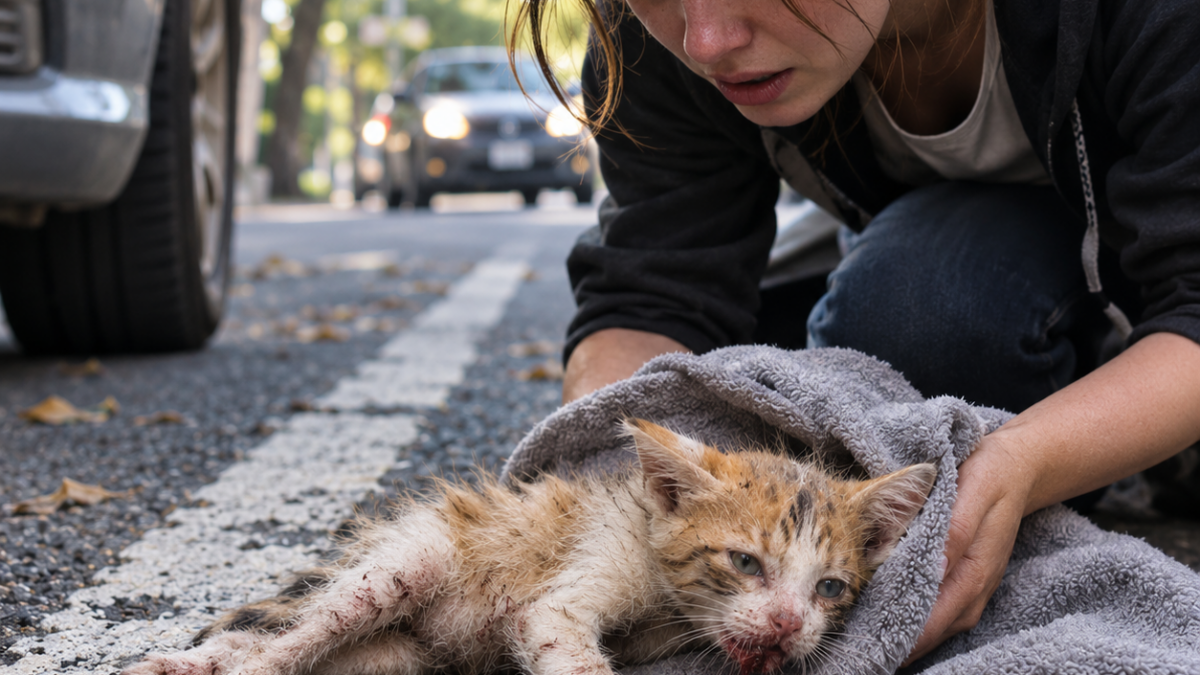
A Tiny Kitten Lay Bleeding in the Road After Being Hit by a Car—Then He Reached Out One Paw to the Person Who Stopped.
PART3:
We placed him on the jacket.
Carried him to my vehicle.
Someone shouted that the driver had left.
I did not even turn around.
At that moment I did not care who had caused the accident.
I cared whether the kitten would still be breathing when we reached the hospital.
The nearest animal clinic was twelve minutes away.
It felt like an hour.
I drove with the hazard lights on.
The woman who helped me sat in the passenger seat holding the jacket steady across her lap.
The kitten’s front paws moved occasionally.
His rear legs did not.
“Is he breathing?”
“Yes.”
Thirty seconds later:
“Still breathing?”
“Yes.”
Again.
Again.
I kept asking.
Because if she kept saying yes, then the next minute still existed.
At the hospital, the staff met us at the door.
“What happened?”
“Car.”
“When?”
“Maybe fifteen minutes.”
“Conscious?”
“Yes.”
“Movement?”
“Front legs only.”
They took him immediately.
The jacket went with him.
I stood in reception covered in road dust and blood that was not mine.
The woman who helped me left after giving her number.
I never saw her again.
I wish I had gotten her name.
People often say one person saved an animal.
That is rarely true.
Usually it is a chain.
One person stops.
Another person carries.
Someone drives.
Someone opens the clinic door.
Somebody stays late.
Somebody donates.
Somebody cleans.
Life continues because enough people choose not to break the chain.
That day, I happened to be the first link.
A technician came out.
“He’s stable enough for X-rays.”
“Is he going to live?”
“We don’t know yet.”
“Can he feel his back legs?”
“The doctor will talk to you.”
That answer frightened me.
If it had been good, she would have said good.
The veterinarian came twenty minutes later.
Dr. Hassan.
He sat beside me rather than across the desk.
That frightened me more.
“There is a spinal fracture.”
My hands went cold.
“How bad?”
He brought up the X-ray.
Even without medical training, I could see something wrong.
One section of the spine did not line up.
The bones looked shifted.
“The thoracic spine is fractured,” he said. “There is displacement here.”
He pointed.
“Pressure on the spinal cord?”
“Yes.”
“Can you fix it?”
“Maybe.”
That word.
Maybe.
“What does that mean?”
“It means right now we need to separate survival from function.”
I stared at him.
“Explain.”
“First, we stabilize him. Pain control. Shock. Hydration. Monitor breathing. Make sure there aren’t internal injuries we’re missing.”
“And his legs?”
“We evaluate neurologic function repeatedly.”
“Will he walk?”
Dr. Hassan paused.
“I cannot promise that.”
“Ever?”
“No.”
The room became very quiet.
He continued.
“There appears to be significant spinal cord trauma.”
I looked through the window toward the treatment area.
The kitten lay under a blanket.
Tiny.
Surrounded by equipment.
“How old?”
“Probably a few months.”
“Does he have a chance?”
“Yes.”
“How much?”
“Of walking?”
“Of recovering.”
He gave me the estimate carefully.
“Maybe twenty to thirty percent for meaningful neurologic improvement, based on what we see now. But those numbers are not guarantees.”
Twenty to thirty.
People hear thirty percent and think hope.
I heard seventy percent.
He might never walk.
Might never use the bathroom normally.
Might need help for everything.
I asked the question I was ashamed to ask.
“Is keeping him alive cruel?”
Dr. Hassan did not look shocked.
That helped.
“No.”
“You’re sure?”
“If he were suffering in a way we could not control, I would tell you.”
“He’s in pain.”
“We can treat pain.”
“But if he’s paralyzed—”
“Paralysis is a disability.”
He looked directly at me.
“Not automatically a death sentence.”
That sentence became important later.
At the time, I barely heard it.
I looked at the kitten again.
“He needs a name.”
The technician smiled.
“Already?”
“I can’t keep calling him ‘the kitten.’”
“What do you want to call him?”
I had no idea.
The name Bonnie came out almost accidentally.
Maybe because it sounded soft.
Maybe because I once knew a childhood cat with a similar face.
I said it.
“Bonnie.”
The technician looked toward the cage.
“Bonnie.”
His ear moved.
We all froze.
She said it again.
“Bonnie?”
His eyes opened.
Turned slightly.
My throat closed.
“That’s his name.”
The first night, Bonnie went into intensive care.
I went home.
I hated leaving.
The clinic had twenty-four-hour staff.
He was safer there than with me.
Still, leaving felt wrong.
My house was too quiet.
I washed the blood from my hands.
Then found a small smear on my sleeve.
I sat on the bathroom floor and stared at it.
Had I moved him wrong?
Had I made the spinal injury worse?
Should I have waited for professionals?
Would he have died if I had waited?
Every possibility accused me.
At 1:13 a.m., I called the hospital.
The night technician answered.
“He’s stable.”
“Stable meaning?”
“Breathing well. Temperature better. Pain controlled.”
“Legs?”
“No change.”
“Eating?”
“Not yet.”
“Can I call again?”
She laughed softly.
“Yes.”
I called at four.
Then six.
At eight, Dr. Hassan called me.
“He made it through the night.”
I cried.
Not because everything was fine.
Nothing was fine.
Because he had reached morning.
That became our standard.
Morning.
Then afternoon.
Then another night.
The first forty-eight hours were about keeping Bonnie from getting worse.
Fluids.
Medication.
Neurologic checks.
Bladder monitoring.
Cleaning.
Pain control.
He could not stand.
He could not support the rear half of his body.
When technicians lifted him, they supported his spine carefully.
His front legs remained active.
His eyes followed movement.
He responded to his name.
That became the thing I clung to.
“Bonnie.”
Eyes toward me.
“Hey, boy.”
Blink.
“Still here?”
Blink.
I was asking myself as much as him.
After three days, Dr. Hassan recommended consultation at a larger specialty hospital.
“We need better neurologic assessment.”
“Does that mean surgery?”
“Maybe.”
There was that word again.
I arranged transport.
The specialty hospital was farther.
Bigger.
More machines.
More doctors.
More terrifying.
They repeated imaging.
Neurologic exam.
Pain response.
Reflexes.
Bladder function.
The specialist, Dr. Chen, showed me the findings.
“The injury is severe.”
I nodded.
I already knew.
“There’s significant nerve damage affecting the hind limbs.”
“Deep pain?”
“Very limited.”
“Meaning?”
“Prognosis for normal walking is guarded to poor.”
I stared at the image.
“What about his bladder?”
“That may be affected too.”
It was.
Bonnie could not empty it properly.
The first time someone explained catheterization to me, I felt overwhelmed.
Not because the procedure itself was impossible.
Because it made the future real.
This was not a broken leg that would heal in six weeks and disappear from our lives.
If Bonnie survived, care might become permanent.
Medication.
Bladder help.
Cleaning.
Skin care.
Checkups.
Monitoring for infections.
Mobility support.
Maybe carts later.
Maybe acupuncture.
Maybe nothing changed.
I sat beside his hospital enclosure after the specialist left.
Bonnie was awake.
His head looked too big for his body.
I opened the door.
Slowly.
Touched his forehead.
“Hi.”
His eyes half closed.
“You’re expensive.”
No response.
“Extremely.”
He blinked.
“I hope you appreciate that.”
I stroked between his ears.
Bonnie stretched one front paw.
Not far.
Just a few inches.
Then placed it against my wrist.
I stopped breathing.
His paw was warm.
Tiny.
He did not grip.
Did not pull.
Simply rested it there.
I had spent the entire morning listening to percentages.
Nerve damage.
Poor prognosis.
Catheters.
Potential permanent paralysis.
Then Bonnie put one paw on me.
Numbers disappeared.
He was still there.
Still responding.
Still reaching.
I lowered my forehead toward the edge of the enclosure.
“Okay.”
My voice broke.
“Okay, I’m not done either.”
Food became the next battle.
Bonnie had little appetite initially.
Medication made some things worse.
Stress made everything worse.
Then one afternoon he surprised us.
A technician brought a bowl.
Bonnie smelled it.
Then ate.
Not a polite bite.
He attacked it.
The technician laughed.
“Whoa.”
I laughed too.
He paused.
Looked up.
Then continued.
I had never been happier to watch an animal make a mess.
From then on, meals became one of the easiest parts.
I mixed his medication into food when permitted.
Added nutritional support.
Watched him finish.
“Slow down.”
He ignored me.
“Bonnie.”
Nothing.
“You’re going to make yourself sick.”
Still eating.
That was the beginning of his personality returning.
Pain had flattened him.
Safety revealed him.
He was stubborn.
Food motivated.
Nosy.
Very interested in objects he was not supposed to touch.
And surprisingly affectionate with people he recognized.
The hospital staff noticed.
When one specific technician entered, Bonnie lifted his head.
When I arrived, he watched the door.
Sometimes he reached a paw.
Sometimes he simply relaxed.
Those were the moments that kept us going.
Then the bills came.
Emergency stabilization.
X-rays.
Imaging.
Specialist consultation.
ICU.
Catheterization.
Medication.
Hospitalization.
I could not cover everything alone.
I hated asking.
I posted Bonnie’s story anyway.
One photograph.
Not the worst one.
I did not want suffering to become spectacle.
I wrote what happened.
Kitten hit by car.
Spinal injury.
Hospitalized.
Unknown prognosis.
Needs continued treatment.
The response stunned me.
Ten dollars.
Twenty.
Five.
One hundred.
People I did not know.
A woman wrote:
“I can’t give much, but I once had a paralyzed cat. Please use this for Bonnie.”
Another:
“For his next meal.”
Someone donated the cost of one full day in hospital.
A schoolteacher sent the equivalent of fifteen dollars and wrote:
“My class saw his photo. They want him to get stronger.”
Bonnie had no idea.
He ate.
Slept.
Allowed technicians to care for him.
While strangers quietly bought him time.
That is what donations really are in emergency rescue.
Time.
Another day of treatment.
Another test.
Another bag of food.
Another chance to see what the body will do before a decision has to be made.
Bonnie used that time.
He gained strength in the front half.
His appetite improved.
His eyes brightened.
His bloodwork stabilized.
The catheter remained.
The back legs did not improve much.
That hurt.
Every morning I looked for movement.
Toe.
Tail.
Hip.
Anything.
Sometimes I thought I saw something.
The doctor would test.
“No meaningful change yet.”
Yet.
I lived inside that word.
Weeks passed.
Then came the day the hospital said Bonnie could go home.
I should have been thrilled.
Instead, I panicked.
“Home?”
“Yes.”
“He can’t walk.”
“He doesn’t need hospitalization just because he cannot walk.”
“What if I do something wrong?”
“We teach you.”
“What about his bladder?”
“We teach you.”
“Cleaning?”
“We teach you.”
“Medication?”
“Schedule.”
“What if he gets worse?”
“You call.”
Dr. Chen smiled.
“Hospital is for acute care. Life happens somewhere else.”
I looked at Bonnie.
He was licking one front paw.
Completely unconcerned with my crisis.
I bought more supplies than necessary.
Soft washable bedding.
Waterproof pads.
Low-sided litter setup.
Wipes.
Medication organizers.
Towels.
Food.
Protective coverings.
Two beds.
Three blankets.
A small playpen.
Bonnie ignored half of it.
The first day home, I put him carefully on a padded mat.
He looked around.
New smells.
New walls.
No hospital sounds.
He pulled forward.
Front paws.
Then hips.
Back legs dragging behind.
I followed him like a nervous bodyguard.
“Slow.”
Bonnie continued.
“Don’t go there.”
Continued.
“Bonnie.”
He reached the trash can.
Smelled it.
Tried to investigate behind it.
I stared.
“You nearly died and this is what you wanted to do?”
He put one paw against the trash can.
It tipped slightly.
I caught it.
That was home life with Bonnie.
Medication.
Cleaning.
Bladder care.
Follow-up appointments.
And preventing him from climbing into garbage using only two fully functional legs and an unreasonable amount of determination.
The first week exhausted me.
Bonnie’s daily care had rhythm.
Check bedding.
Clean him.
Medication.
Food.
Bladder management according to veterinary instructions.
Skin check.
Move.
Rest.
Repeat.
If his rear legs dragged too much, friction could injure the skin.
If he stayed wet, irritation could develop.
If bladder function was not managed properly, infection could become dangerous.
Everything mattered.
I became obsessed.
One evening, I noticed his urine smelled different.
I called the hospital immediately.
They tested.
No infection.
I apologized for overreacting.
The vet said:
“Keep overreacting.”
So I did.
Bonnie did not care about my anxiety.
He had discovered the house.
The kitchen interested him first.
Of course.
Food.
Then the hallway.
Then a sunny patch near the window.
He developed an unusual method of moving.
Strong front paws.
Pull.
Slide.
Reset.
Pull.
Faster than I expected.
At first the dragging broke my heart.
Then I realized Bonnie did not seem ashamed of it.
Animals are better than humans at that.
They do not compare themselves to the version they were supposed to become.
They adapt to the body they have.
Bonnie wanted to get from the living room to the kitchen.
So he did.
Not elegantly.
Still did it.
One afternoon I was working at my desk.
I heard scratching.
Looked down.
Bonnie had followed me.
He sat beside the chair.
Rear legs behind him.
Head lifted.
“What?”
He stared.
I returned to work.
Two minutes later, one paw touched my ankle.
I looked again.
“You followed me all the way in here?”
Blink.
I lifted him onto the padded bed beside my desk.
He curled up.
That became routine.
I worked.
Bonnie stayed nearby.
If I moved rooms, eventually I heard:
Scratch.
Pull.
Scratch.
Pull.
He followed.
I began calling him my shadow.
A badly engineered shadow.
But loyal.
When I left the house, Bonnie often stayed near the doorway.
When I came back, he was there.
The first time, I thought coincidence.
The second, maybe.
The fifth?
No.
He waited.
I would open the door.
Bonnie’s head came up.
Front paws started working.
He pulled himself toward me.
Every time, I remembered the road.
A kitten nobody had stopped for.
Now waiting because he knew someone came back.
That difference mattered more than walking.
His playfulness emerged slowly.
He discovered paper.
Any paper.
Receipts.
Mail.
A grocery list.
All enemies.
He attacked them with his front paws.
He loved crinkly toys.
Hated one bell ball.
No explanation.
He groomed himself constantly.
That impressed me.
Even with limited mobility, Bonnie worked hard to clean his chest, front paws, face, and whatever parts of his body he could reach.
Sometimes I helped with the rest.
He disliked that.
Strongly.
The first time I shaved fur around the tail area for hygiene, Bonnie looked at me for ten minutes as though our relationship had ended.
“Necessary.”
He stared.
“You’ll forgive me.”
Stare.
“I feed you.”
That got his attention.
His weight increased.
His shoulders strengthened.
The front half of his body became almost athletic.
He learned how to pivot.
How to pull himself over low obstacles.
How to climb onto a cushion using his front legs.
I would find him somewhere and think:
How did you get there?
Bonnie offered no explanation.
At the two-month checkup, I carried him into the hospital with hope I did not want to admit.
The veterinarian performed the neurologic exam.
Reflexes.
Pain response.
Positioning.
Movement.
Bonnie complained about being handled.
Good.
Complaining meant energy.
But the result was not what I wanted.
No meaningful ability to stand on the hind legs.
No functional walking.
I looked at the doctor.
“So nothing changed?”
“Some general strength improved.”
“Neurologically?”
“Not enough to call recovery.”
I looked at Bonnie.
He was trying to bite the edge of the exam-table paper.
“Could it still happen?”
“Possibly.”
There was that word.
“What do we do?”
“Continue supportive care.”
“Massage?”
“Gentle, yes.”
“Physical therapy?”
“Yes.”
“Acupuncture?”
“Reasonable adjunct to discuss.”
“Will it work?”
“No promises.”
I nodded.
I had become good at hearing that.
No promises.
We continued.
Every evening, gentle massage.
Range-of-motion exercises exactly as demonstrated.
No forcing.
No twisting.
I talked to Bonnie while I did it.
“Left leg.”
He looked bored.
“Right leg.”
More bored.
“You could at least pretend to participate.”
He groomed one paw.
Some days I convinced myself his toes moved.
Some days I knew they did not.
Hope is complicated when caring for a disabled animal.
Too little, and you stop trying things that might help.
Too much, and you begin treating the animal in front of you like an unfinished version of somebody else.
I did not want Bonnie to spend his life feeling like I was waiting for him to become a walking cat.
So I changed the way I thought.
We would try rehabilitation.
We would hope.
But Bonnie’s life did not begin later.
It was happening now.
That realization freed both of us.
I stopped measuring every good day by his legs.
I started measuring it by Bonnie.
Did he eat?
Yes.
Did he play?
Yes.
Did he explore?
Absolutely.
Did he seek affection?
Constantly.
Did he have pain we could not control?
No.
Was he interested in life?
Very much.
Then his life was not on hold.
One morning, I woke to noise in the kitchen.
Not a crash.
A suspicious scraping sound.
I walked in.
Bonnie had somehow opened the lower cabinet under the sink.
Half his body was inside.
Only the back legs and tail visible.
“Bonnie.”
Movement stopped.
“Come out.”
Nothing.
“Now.”
His head appeared.
Eyes innocent.
I started laughing.
He crawled out.
I picked him up.
“You are paralyzed.”
He licked one paw.
“You are supposed to make my life emotionally meaningful.”
No response.
“Not rob cabinets.”
He leaned against my chest.
I forgave him.
Of course.
People online continued asking for updates.
Some messages were beautiful.
Others annoyed me.
“Has he walked yet?”
“Any miracle?”
“When will his legs heal?”
I understood.
People wanted the ending.
They wanted a before and after.
Broken kitten.
Then walking kitten.
That makes sense in a short video.
Life is less obedient.
Sometimes the beautiful ending is not restoration.
Sometimes it is adaptation.
Bonnie may never walk normally.
That does not mean his story failed.
I began sharing different updates.
Bonnie eating.
Bonnie waiting at the door.
Bonnie attacking a paper bag.
Bonnie grooming.
Bonnie sleeping beside my laptop.
Bonnie stealing a piece of chicken.
Bonnie dragging himself after a toy so quickly the camera struggled to follow.
One comment said:
“I forgot he was disabled until halfway through the video.”
That made me smile.
Not because disability should be invisible.
Because Bonnie had become larger than it.
The accident was something that happened to him.
Not everything he was.
Months later, we tried acupuncture.
Bonnie hated the drive.
Loved the treats afterward.
I watched every session for movement.
Tiny reflex.
Muscle twitch.
Anything.
There were occasional small responses.
Nothing dramatic.
No sudden standing.
No miracle montage.
We continued because the veterinary team felt it was reasonable and Bonnie tolerated it.
But I refused to build his happiness around results.
One night, I sat on the floor beside him.
He had finished dinner.
His belly looked comfortably round.
I was tired.
The kind of tired that comes from doing the same care tasks every day and knowing tomorrow they return.
Bonnie crawled onto my leg.
Front half first.
I lifted the back gently.
He settled.
Purred.
I looked down at him.
“Do you know you’re a lot of work?”
Purr.
“Very expensive too.”
More purring.
“Possibly the worst investment I’ve ever made.”
He put one paw on my chest.
Same gesture from the hospital.
I stopped joking.
That paw brought everything back.
ICU.
Cold metal enclosure.
Percentage estimates.
The first moment he reached toward me.
I touched his paw.
“You were worth it.”
He closed his eyes.
That was the truth.
Not inspirational truth.
Not the kind where caring becomes effortless because love exists.
Care was still work.
There were messy mornings.
Accidents.
Medication schedules.
Extra laundry.
Vet bills.
Fear of urinary infections.
Skin problems.
Adjustments.
Sometimes frustration.
Sometimes exhaustion.
Love does not erase labor.
It makes you decide the labor matters.
Bonnie grew.
The tiny injured kitten became a young cat.
Broad chest.
Strong front legs.
Bright eyes.
His personality became impossible to miss.
He was curious.
Clingy.
Food obsessed.
Possessive about one blue blanket.
Suspicious of vacuum cleaners.
Fascinated by trash cans.
Terrified of nothing except the carrier, despite the carrier being the one object designed to keep him safe.
He learned my routine.
Alarm.
Breakfast.
Medication.
Work.
Lunch.
Afternoon nap.
Evening care.
At 5:30 every day, Bonnie began positioning himself near the kitchen.
Dinner was at six.
He believed preparation required thirty minutes of supervision.
If I was late, he followed me.
Dragging.
Pulling.
Staring.
One evening I said:
“You know you can’t herd me.”
He followed faster.
Apparently he could.
He also learned people.
My sister visited.
Bonnie watched from across the room.
Did not approach.
Second visit.
Closer.
Third.
He allowed one touch.
Fourth.
Sat beside her.
Trust remained selective.
I respected that.
One friend once picked him up without asking.
Bonnie twisted.
Panicked.
I took him back.
My friend looked offended.
“He lets you.”
“Yes.”
“He’s just a cat.”
“No.”
I said it more sharply than intended.
Then softened.
“He has a spinal injury. He needs support. And he chooses contact differently.”
My friend apologized.
Bonnie did not care.
He stayed against me until calm.
That moment reminded me of the road again.
How helpless he had been.
Once you care for an animal who cannot simply run away from uncomfortable handling, consent becomes something you think about differently.
Bonnie depended on people.
That did not mean people were entitled to him.
I always supported his body.
Always warned before lifting.
Always gave him space when possible.
Medical care sometimes required things he disliked.
That was unavoidable.
But ordinary affection?
Choice.
Over time, Bonnie became more confident because he learned that his no mattered too.
Then came our first real scare after hospitalization.
He stopped eating.
Bonnie.
The cat who treated food like religion.
He sniffed breakfast.
Turned away.
My stomach dropped.
By noon, still nothing.
At the hospital, urine test.
Bloodwork.
Imaging.
Early urinary infection.
Caught quickly.
Antibiotics.
Fluids.
He recovered.
But that day changed me.
I understood how fragile his routine could become.
A paralyzed cat with bladder dysfunction has risks healthy cats do not.
We could manage them.
Not eliminate them.
The veterinarian told me:
“You’re doing everything right.”
I laughed.
“That feels suspicious.”
“Why?”
“Because something still went wrong.”
She looked at me.
“Doing everything right does not mean nothing ever goes wrong.”
Another sentence I kept.
Caring is not control.
You reduce risk.
You watch.
You respond.
You do not get guarantees.
Bonnie taught me that repeatedly.
By his first anniversary with me, I stopped calling the house mine.
It was ours.
His modifications had spread everywhere.
Ramps.
Low beds.
Washable surfaces.
Protected corners.
Food station positioned for easy access.
I had become someone who evaluated furniture based on whether a paralyzed cat could navigate around it.
A sofa was no longer a sofa.
It was a mobility challenge.
A rug was traction equipment.
A low basket was either storage or an obstacle depending on Bonnie’s mood.
I loved it.
One year after the accident, I took Bonnie back to the stretch of road where I found him.
Not onto the asphalt.
Never.
I parked nearby.
Carried him in a secure carrier.
We sat on a bench.
I opened the top enough for him to smell the air.
He looked around.
No recognition that I could see.
Why would there be?
Cats do not need symbolic closure.
Humans do.
I looked at the road.
Cars passing.
People walking.
Normal afternoon.
I tried to find the exact place where he had lain.
Couldn’t.
Traffic had washed everything away.
That was strangely comforting.
The road did not remember.
But I did.
I touched Bonnie’s head.
“You almost died here.”
He looked at a bird.
“Very emotional.”
Bird.
“I’m trying to have a moment.”
Still bird.
I laughed.
Then realized something.
For months, I had thought of Bonnie as the kitten who survived being hit.
But Bonnie did not live in that story.
I did.
To him, life was now.
Bird.
Food.
Home.
My footsteps.
A warm bed.
A cabinet he was not allowed to enter.
That was healing too.
Not forgetting.
Living somewhere larger than the worst moment.
Years passed.
Bonnie never regained normal use of his back legs.
There were slight movements.
Reflexes.
Occasional responses.
But no functional walking.
For a while that sentence hurt me.
Eventually it became simply information.
Bonnie cannot walk on his hind legs.
Bonnie loves chicken.
Bonnie hates carriers.
Bonnie sleeps against my left side.
Bonnie waits at the door.
All facts.
None cancels the others.
Mobility aids helped in certain situations.
We experimented carefully.
Some he tolerated.
Some he hated.
I learned not every disabled animal needs to perform mobility in the way humans find most satisfying.
Bonnie moved well around the home in his own way.
That mattered.
When people met him for the first time, they sometimes made a sad face.
“Oh, poor thing.”
I hated that.
Bonnie usually hated them too, so we agreed.
Yes, what happened to him was terrible.
No, his entire existence was not terrible.
There is a difference.
Bonnie had good food.
Medical care.
Sunlight.
Toys.
Warmth.
People.
Curiosity.
Annoyance.
Preferences.
Love.
Pain belonged to his story.
It did not own the story.
One afternoon, several years after the accident, I was working in the same room where Bonnie had first begun following me.
Laptop open.
Deadline.
Phone ringing.
I noticed it had become quiet.
Too quiet.
Any cat owner understands that sentence.
I stood.
“Bonnie?”
Nothing.
Kitchen.
No.
Hall.
No.
Bedroom.
No.
Then I saw the bathroom cabinet door open.
I crouched.
Two bright eyes stared back.
“You’re too old for this.”
Bonnie came out slowly.
He was heavier now.
Movement not as fast.
Still guilty.
I laughed.
“You really never changed.”
He crawled toward me.
I picked him up.
Supported the back.
He settled against my shoulder.
Purring.
For a moment I saw both versions at once.
The kitten bleeding on asphalt.
The adult cat in my arms.
Same eyes.
Different world.
People often told me:
“You saved him.”
I never liked that sentence.
It made everything sound finished.
Heroic.
One action.
I picked him up from the road.
Yes.
But Bonnie’s life was built from thousands of smaller things afterward.
Doctors stabilized him.
Technicians cleaned him.
Strangers paid bills.
Specialists evaluated nerves.
People taught me bladder care.
Others shared advice about disabled cats.
Bonnie ate.
Bonnie adapted.
Bonnie trusted.
I kept showing up.
He kept showing up too.
Maybe that is what rescue really is.
Not one person saving another.
Two lives agreeing, day after day, not to abandon the work.
Bonnie never became the cat people expected when they first watched his story.
There was no dramatic footage of him suddenly standing.
No moment where everyone screamed because he took his first normal steps.
For years, some people waited for that clip.
It never came.
Something else did.
A video of Bonnie dragging himself to the door because he heard my key.
A photograph of him asleep on my paperwork.
A clip of him stealing food.
A morning when I woke with his paw on my face.
A thousand ordinary moments that would never go viral.
Those became the miracle.
Not walking.
Belonging.
If I could go back to the hospital and speak to myself on that first night, I would tell that frightened woman something she desperately needed to hear.
Stop asking only whether he will walk.
Ask whether he can live.
Ask whether pain can be controlled.
Ask whether he wants food.
Ask whether he looks for you.
Ask whether curiosity remains.
Ask whether his world can be made comfortable.
Ask whether care is possible.
Those answers matter too.
Maybe more.
I would tell her that hope has more than one shape.
Sometimes hope is a spinal cord healing.
Sometimes hope is a kitten learning to move differently.
Sometimes it is a catheter being removed.
Sometimes it is accepting that one will still be needed.
Sometimes it is standing.
Sometimes it is dragging yourself toward the front door because the person you love just came home.
Bonnie taught me not to confuse recovery with becoming exactly what you were before.
Some injuries change the body permanently.
Life does not end at the point where restoration becomes impossible.
It changes.
And then, if we are lucky, it grows around the damage.
The last photograph from Bonnie’s first hospital stay still exists on my phone.
He is lying on a white pad.
Thin.
Tired.
Rear legs stretched behind him.
One front paw reaching toward the edge of the frame.
I know what was outside that frame.
My hand.
That photo used to make me cry because I saw everything he had lost.
Now it makes me cry for a different reason.
He was reaching.
He had been hit.
Bleeding.
Terrified.
Unable to stand.
Surrounded by strangers.
And somehow, some part of him still moved toward someone.
That tiny paw was not proof he would walk again.
It was proof he had not withdrawn from life.
Years later, when Bonnie waited at the door for me, I sometimes remembered that paw.
Same instinct.
Toward me.
Toward home.
Toward whatever came next.
I never found the driver.
For a long time, that bothered me.
I imagined confronting them.
Asking why they left.
Maybe they panicked.
Maybe they never knew Bonnie survived.
Maybe they knew and did not care.
Eventually I stopped needing an answer.
The person who nearly ended Bonnie’s life became less important with every year Bonnie continued living it.
That is the strange mathematics of survival.
One terrible minute becomes smaller when enough good days accumulate afterward.
The accident never disappears.
But it stops being the biggest thing.
Bonnie became bigger.
His life became bigger.
And that was all I wanted.
One evening, long after I had stopped expecting neurological miracles, I came home later than usual.
The house was dark.
I opened the door.
There he was.
Exactly where he always waited.
Front paws planted.
Head high.
Back legs behind him.
I dropped my bag.
“Bonnie.”
He started toward me.
Pull.
Slide.
Pull.
Slide.
Still fast.
Still determined.
I crouched.
He reached me.
Climbed partly onto my shoe.
I lifted him carefully.
He put both front paws against my chest.
Purring.
The same cat who once could not lift himself from the road.
I held him.
And I realized I no longer saw the missing movement first.
I saw Bonnie.
That was the ending I never knew to hope for.
Not that he would become the kitten he had been before the car.
But that one day, neither of us would need him to.
The road took something from him.
It did not take his appetite.
His curiosity.
His stubbornness.
His affection.
His ridiculous interest in trash cans.
His ability to trust.
His desire to follow me from room to room.
It did not take his life.
And in the end, that life was not defined by the two legs that could no longer carry him.
It was defined by everything he kept moving toward anyway.








