A Tiny Kitten Appeared Freezing on Their Porch—Then Their Adult Cat Did Something No One Expected
A Tiny Kitten Appeared Freezing on Their Porch—Then Their Adult Cat Did Something No One Expected
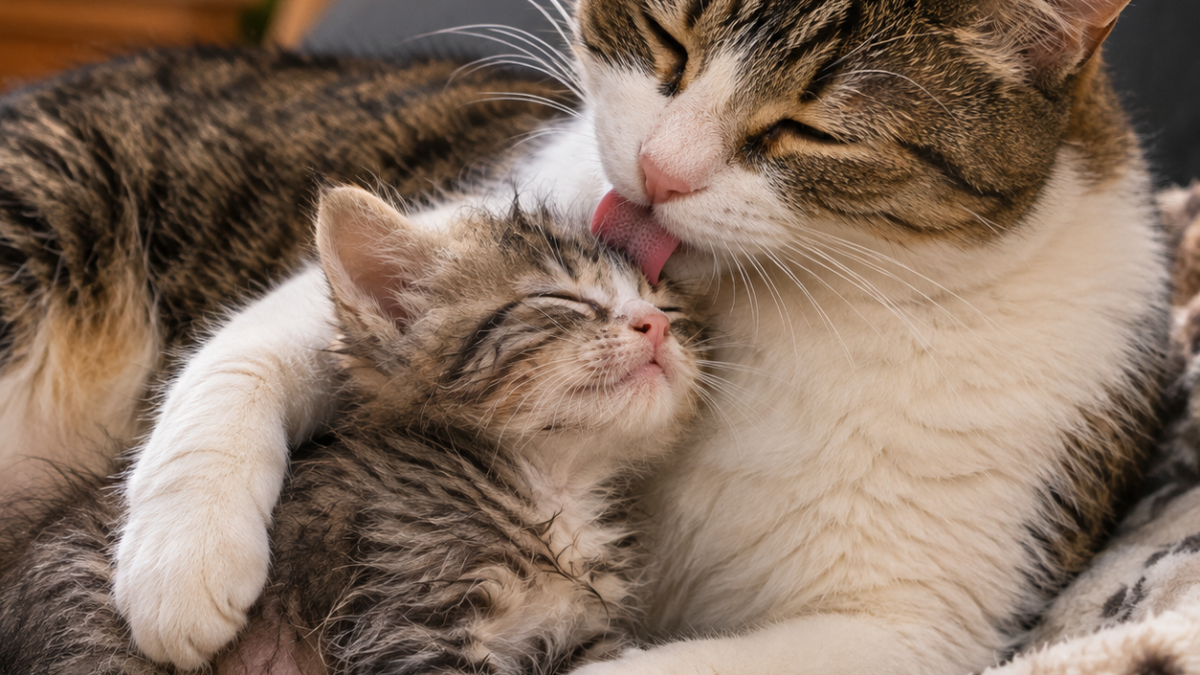
The kitten was so cold and weak that the family who found her outside their front door feared she might not survive the night, but the biggest surprise came when their adult cat—who had never raised kittens and usually avoided strangers—walked straight toward the trembling baby instead of hissing or running away.
Within minutes, the older cat was grooming the orphan’s wet fur, curling her body around the tiny stranger, and refusing to leave even when the family tried to separate them for a veterinary check.
What began as a simple rescue soon revealed something nobody in the house understood at first: the frightened kitten had not just found shelter from the cold—she had somehow found the one cat willing to become the mother she had lost.
The sound at the front door was so faint that Megan Walsh almost ignored it.
Not a knock.
Not scratching.
More like something brushing once against the bottom of the storm door.
Then silence.
Megan was standing in the kitchen rinsing a coffee mug when she heard it again.
A tiny scrape.
Pause.
Then what sounded like a weak squeak.
She turned off the faucet.
“Ethan?”
Her husband was in the living room trying to assemble a bookshelf that had already defeated him twice.
“What?”
“Did you hear that?”
“Hear what?”
“There’s something outside.”
Ethan looked toward the front window.
Rain had been falling since late afternoon.
Not heavy.
Steady.
Cold November rain that darkened the sidewalks, stripped the last brown leaves from the maple trees, and made their quiet neighborhood outside Columbus feel several weeks closer to winter than the calendar claimed.
“Probably branches.”
“There aren’t branches against the door.”
Another sound.
This time both of them heard it.
A tiny, broken meow.
Megan froze.
PART2:
Ethan put down the screwdriver.
Their eleven-year-old daughter, Sophie, appeared from the hallway.
“Was that a cat?”
“No.”
Megan answered too quickly.
Sophie was already moving toward the door.
“Mom.”
“Wait.”
“Why?”
“Because if there’s an animal outside, we don’t know if it’s sick.”
That was not the real reason.
The real reason was currently asleep on the back of the sofa.
Hazel.
Their six-year-old tortoiseshell cat.
Hazel did not like change.
Hazel did not like visitors.
Hazel did not like Ethan’s brother.
Hazel did not particularly like the mail carrier.
She tolerated dogs only if they remained on television.
Once, when Megan’s sister brought over a kitten for less than an hour, Hazel spent the entire visit upstairs beneath the bed and refused to come down until midnight.
PART3:
Introducing another cat had never been part of the family plan.
Especially not without warning.
Sophie pressed her face toward the glass beside the door.
“I don’t see anything.”
Ethan joined her.
“Porch light.”
Megan switched it on.
Yellow light spread across the wet steps.
At first, there was nothing.
Then Sophie gasped.
“Mom.”
Near the corner of the porch, partly hidden behind a ceramic planter, sat a kitten.
Tiny.
Maybe six weeks old.
Maybe younger.
Gray-and-white.
Wet fur plastered flat.
One paw tucked awkwardly beneath her.
She was so small that the planter had hidden almost all of her.
Her eyes looked enormous.
Dark.
Exhausted.
And she was staring directly at the door.
“Oh my God.”
Megan opened it.
Cold air rushed inside.
The kitten did not run.
That frightened her.
Healthy stray kittens usually fled from adults.
This one simply remained sitting.
Shivering.
Sophie knelt inside the doorway.
“Hi, baby.”
The kitten meowed.
Barely.
A sound so weak it seemed to use the last energy she had.
Megan stepped onto the porch.
“Don’t touch her yet.”
“Mom.”
“I know.”
She grabbed a hand towel from the kitchen.
Then crouched.
The kitten watched.
No hiss.
No growl.
No retreat.
Megan held one hand low.
The kitten sniffed.
Then collapsed forward.
Not dramatically.
Her front legs simply stopped holding her.
Megan caught her.
“She’s freezing.”
Ethan’s face changed.
“Bring her in.”
Megan wrapped the towel around the kitten.
The body inside felt frighteningly light.
Bones beneath fur.
The little animal trembled so hard Megan could feel it through the towel.
Sophie started crying immediately.
“Is she dying?”
“No.”
Megan did not know that.
“She’s cold.”
“We’re going to warm her.”
Hazel had awakened.
She stood on the sofa.
Watching.
Every adult in the room noticed at once.
Ethan whispered:
“Hazel.”
Megan looked over.
Hazel’s tail was not puffed.
No flattened ears.
No growling.
Just intense focus.
Sophie carried the kitten’s towel toward the laundry room while Megan found a cardboard box.
“We should keep them separate.”
Ethan nodded.
“Bathroom?”
“Too cold.”
“Laundry room.”
Hazel jumped from the sofa.
She walked toward them.
Megan stepped sideways.
“No, Hazel.”
The tortoiseshell stopped.
Then continued.
“Hazel.”
Still coming.
Sophie looked worried.
“Is she going to hurt her?”
“I don’t know.”
Megan placed the kitten inside the towel-lined box.
Hazel reached the edge.
Everyone froze.
Hazel leaned forward.
Sniffed once.
Then again.
The kitten lifted her head.
For a moment, the two cats stared at one another.
Megan prepared to grab Hazel.
Instead, Hazel did something none of them expected.
She stepped into the box.
Carefully.
Turned.
Lowered herself beside the kitten.
Then began licking the top of her head.
Sophie covered her mouth.
“Oh my gosh.”
Ethan stared.
Hazel licked again.
The kitten did not resist.
Her eyes closed.
Hazel moved down the wet fur around one ear.
Then the neck.
Slow.
Deliberate.
The same way a mother cat cleans a baby.
Megan whispered:
“She’s never had kittens.”
They knew.
Hazel had been spayed at six months.
They had adopted her from a rescue when she was nearly one.
No litter history.
No maternal experience.
Yet she pulled the kitten closer with one front leg.
The tiny body disappeared against Hazel’s belly.
The shaking did not stop immediately.
But within minutes it became less violent.
Sophie sat on the floor.
“She thinks it’s her baby.”
Megan did not answer.
She did not know what Hazel thought.
People attach human meanings to animals too easily.
But what Hazel was doing was undeniable.
She was grooming.
Warming.
Staying.
Ethan reached toward the box.
Hazel looked up sharply.
He stopped.
“Okay.”
Megan almost laughed.
“Apparently she has jurisdiction.”
The kitten needed medical care.
That part could not wait.
Megan called their veterinarian.
Closed.
Emergency clinic twenty minutes away.
They packed the kitten into Hazel’s soft carrier.
Hazel immediately objected.
Not violently.
She stood at the carrier door.
Meowed.
Followed them from room to room.
Sophie said:
“She wants to go.”
“We can’t bring Hazel into an emergency clinic for no reason.”
“She’s the reason the kitten calmed down.”
“She’ll be okay here.”
Hazel disagreed.
She tried to climb into the carrier before Ethan closed it.
“Hazel.”
He gently removed her.
She returned.
Megan looked at Ethan.
He looked at Sophie.
Sophie crossed her arms.
“I vote Hazel comes.”
“This is not a democracy.”
Megan said.
Two minutes later, Hazel was in the car.
Apparently it was.
The veterinary clinic admitted the kitten immediately.
Hazel remained in the waiting room with Ethan and Sophie while Megan spoke to the veterinarian.
Dr. Lauren Patel examined the kitten.
Approximate age:
Seven weeks.
Female.
Weight:
Just under one and a half pounds.
Underweight.
Dehydrated.
Mild upper respiratory infection.
Fleas.
Small abrasion on one paw.
No obvious fractures.
No major trauma.
Body temperature low but improving.
“Was she outdoors long?”
“No idea.”
“Any mother nearby?”
“We looked.”
“Other kittens?”
“No.”
“Microchip?”
Dr. Patel smiled gently.
“Not at this age.”
Megan felt foolish.
“Right.”
“That’s okay.”
The kitten accepted warmed fluids.
A little food.
Then more food.
Too quickly.
The technician removed the bowl.
“Slow.”
The kitten stared at it as though betrayal had occurred.
Sophie laughed for the first time since finding her.
“What happens now?”
Dr. Patel asked.
Megan looked at Ethan.
They had not discussed that.
“Temporary.”
Ethan said.
Megan nodded immediately.
“Definitely temporary.”
Sophie said nothing.
Dr. Patel smiled in the way veterinary professionals smile when adults use the word temporary.
Megan saw it.
“I’m serious.”
“Of course.”
Hazel began meowing from the waiting room.
The kitten’s ears lifted.
She answered.
A tiny squeak.
Hazel meowed again.
Sophie said:
“She knows she’s here.”
Dr. Patel looked interested.
“You brought your resident cat?”
“Yes.”
“Because apparently we have lost authority in our own home.”
Ethan said.
Dr. Patel laughed.
“Can I see something?”
They brought Hazel into the exam room.
Both cats were held safely.
The moment Hazel saw the kitten, she leaned forward.
The kitten moved toward her.
Dr. Patel watched.
“Interesting.”
“What?”
“Nothing dangerous.”
“Just interesting.”
Hazel groomed the kitten’s face.
The kitten relaxed almost immediately.
Dr. Patel smiled.
“Some adult cats have very strong social or nurturing responses to young kittens.”
“Even if they’ve never had kittens?”
“Absolutely.”
“Does she think she’s the mother?”
Dr. Patel shrugged.
“We can’t know that.”
“But she seems comfortable providing some of the behaviors a mother would.”
Sophie whispered:
“So she adopted her.”
The doctor smiled.
“Maybe she did.”
They returned home shortly before midnight.
The kitten was supposed to remain in a separate room until they had parasite treatment completed and were confident there was no contagious illness.
Hazel hated that plan.
She slept outside the laundry-room door.
Not near it.
Against it.
When the kitten cried, Hazel answered.
At 2:13 in the morning, Megan opened her eyes.
Meow.
Pause.
Meow.
Hazel answered from the hallway.
Then scratching.
Megan sat up.
Ethan groaned.
“Do not open that door.”
“I didn’t say anything.”
“You’re thinking it.”
“The baby is crying.”
“She is a cat.”
“A baby cat.”
“Same category.”
Megan got up.
Hazel sat in front of the laundry-room door.
The moment Megan appeared, she looked up.
“Don’t manipulate me.”
Hazel meowed.
Megan entered carefully.
The kitten was awake.
Sitting in her box.
She looked toward the doorway.
“Hi.”
Megan sat on the floor.
The kitten climbed awkwardly over the edge.
Walked toward her.
Then past her.
Straight to the door.
Hazel’s paw appeared beneath the gap.
The kitten touched it.
Megan’s heart broke a little.
“Fine.”
She opened the door two inches.
Hazel squeezed through before Megan could change her mind.
“Traitor.”
Hazel walked to the box.
Climbed in.
The kitten followed.
Five minutes later, both were asleep.
Megan lay on the floor beside them until morning.
At 6:30, Ethan found her.
“You know we own beds.”
Megan opened one eye.
“Quiet.”
He looked into the box.
Hazel was curled around the kitten.
The baby slept with her nose tucked beneath Hazel’s chin.
Ethan’s face softened.
“Oh.”
Megan sat up.
“Exactly.”
They named the kitten Minnie.
Sophie chose it.
Megan objected because naming made temporary animals less temporary.
Sophie said:
“We can’t call her The Kitten.”
Ethan suggested Porch.
Nobody supported him.
Minnie won.
The first week revolved around feeding.
Medication.
Cleaning.
Flea treatment.
Warmth.
Rest.
And Hazel.
Always Hazel.
When Minnie ate, Hazel watched.
When Minnie used the litter box, Hazel inspected afterward.
When Minnie became frightened by the vacuum, Hazel appeared from nowhere and positioned herself between Minnie and the machine.
When Sophie carried Minnie too long, Hazel followed.
When Ethan accidentally closed a door between them, Hazel sat outside until somebody opened it.
She was not aggressive.
Not possessive in a dangerous way.
Just present.
Constantly.
The most surprising behavior came during naps.
Minnie refused the heated cat bed they bought.
She wanted Hazel.
Hazel would lie on her side.
Minnie pressed into her belly.
Sometimes kneaded against her fur.
Once, Megan saw Minnie attempting to nurse.
Hazel simply looked mildly offended.
Then licked her head.
“I don’t think that’s going to work.”
Megan whispered.
Hazel ignored her.
As Minnie gained strength, personality emerged.
She was not timid.
That disappeared quickly.
By week two, Minnie climbed curtains.
Attacked shoelaces.
Stole food.
Knocked a picture frame from the windowsill.
Tried to leap from the sofa and badly miscalculated.
Hazel followed her like exhausted security.
Once Minnie launched herself into a laundry basket and disappeared beneath clothing.
Hazel stood beside it.
Looked at Megan.
Meowed.
“She’s fine.”
Meow.
Megan removed a towel.
Minnie emerged.
Hazel groomed her as though she had personally rescued the child from a collapsed building.
Sophie laughed.
“She is such a helicopter mom.”
Hazel glared.
“See?”
The family posted a photograph online.
Nothing dramatic.
Hazel asleep on the couch.
Minnie curled against her chest.
Caption:
Found this little one freezing on our porch last week. Our cat apparently decided she belongs to her now.
Friends shared it.
Then friends of friends.
People asked questions.
Where did Minnie come from?
Was there a mother?
Had anyone searched for littermates?
Megan realized they had done only a limited search that first night.
The weather had been terrible.
They had checked around the porch and yard.
Nothing more.
The question bothered her.
The next morning, she walked the neighborhood.
Called shelters.
Posted in local groups.
Asked neighbors.
No missing-kitten reports.
No known litters.
Then Mrs. Patterson, who lived three houses away, said:
“I saw a cat carrying something last week.”
“What?”
“Could’ve been a kitten.”
“Where?”
“Toward the abandoned house behind the creek.”
That changed everything.
The abandoned property sat half a mile away.
Old single-story house.
Owner deceased.
Family dispute over sale.
Overgrown yard.
Detached garage.
Megan called a local rescue before going.
A volunteer named Rachel came with traps, gloves, flashlights, and enough experience to stop Megan from doing something stupid.
They searched.
Inside the garage:
Cat footprints.
Empty food cans.
Old blanket.
Then a faint sound.
Megan froze.
“You hear that?”
Rachel raised one hand.
Again.
Tiny cry.
Behind stacked lumber.
They found two kittens.
Alive.
Smaller than Minnie.
One black.
One gray.
Cold.
Hungry.
No mother.
Megan’s stomach dropped.
“Are there more?”
They searched for hours.
No others.
A camera trap was set.
Food placed.
The mother appeared that night.
Thin black-and-white cat.
Feral.
She approached cautiously.
A rescue trap caught her the next morning.
The veterinarian estimated she was Minnie’s mother.
Milk production.
Age.
Physical condition.
Likely.
Megan stared at the mother inside the covered trap.
“So Minnie wasn’t abandoned.”
Rachel shook her head.
“Probably separated.”
“How?”
“Storm.”
“Predator.”
“Someone moved her.”
“Kitten wandered.”
“We may never know.”
Megan felt strangely guilty.
“She has a mother.”
“Yes.”
“Should we bring Minnie back?”
Rachel paused.
“Let’s ask the vet.”
The answer was complicated.
The mother was highly fearful of humans.
The litter needed medical evaluation.
Reintroduction might be possible under controlled conditions.
They tried.
Minnie was placed near the mother safely.
The mother sniffed.
Minnie cried.
There was recognition of some kind.
Maybe scent.
Maybe not.
The mother tolerated her.
But she remained stressed.
The rescue decided to foster the mother and three kittens together temporarily while evaluating.
That meant Minnie leaving Hazel.
The first separation lasted six hours.
It went badly.
Hazel searched the house.
Room to room.
Called.
Ignored food.
Sat at the front door.
Sophie cried.
Megan felt ridiculous and miserable.
Meanwhile Minnie cried more than the other kittens.
She ate.
Interacted.
But repeatedly climbed toward the carrier door whenever people entered.
Rachel called.
“She’s okay.”
“But?”
“She’s bonded to your home.”
“And Hazel?”
“Probably.”
“Does that mean she shouldn’t be with her mother?”
“No.”
“Then what?”
“It means biology is not the only relationship cats form.”
The rescue kept the litter together for a week.
The mother cat relaxed slightly.
Her kittens nursed.
Minnie tried.
She was older, stronger, already weaning.
She interacted with her siblings.
Played.
Slept in the pile.
But every time Megan visited, Minnie ran toward her.
When Hazel’s blanket was placed nearby, Minnie slept on it.
Dr. Patel reviewed everything.
“There isn’t a moral test here.”
Megan looked at her.
“It feels like one.”
“Why?”
“Because I don’t want to take a kitten away from her mother.”
“You’re not.”
“The mother is caring for her current kittens.”
“Minnie is already weaning.”
“She has another secure social attachment.”
Dr. Patel paused.
“What matters is welfare.”
“What environment is she thriving in?”
Megan knew the answer.
Home.
With Hazel.
The mother’s two remaining kittens stayed with her until fully weaned.
The rescue later spayed her and placed her in a barn-cat program on a protected rural property where she had shelter, food, veterinary care, and minimal forced human contact.
The two siblings were adopted together.
Minnie came home.
Hazel heard the carrier before it reached the living room.
She ran.
Megan set it down.
Opened the door.
Minnie burst out.
Hazel immediately began grooming her.
Fast.
Almost frantic.
Minnie climbed over her.
Under her.
Around her.
Purring.
Sophie cried openly.
Ethan tried not to.
Megan failed completely.
Hazel finally pinned Minnie gently with one foreleg and washed her face.
Sophie whispered:
“She came back to her mom.”
Megan did not correct her.
Not that day.
Minnie was officially adopted three weeks later.
Megan signed the paperwork.
Ethan stood beside her.
Sophie held Minnie.
Hazel stayed home because bringing a cat to sign another cat’s adoption paperwork was perhaps too much even for them.
Rachel smiled.
“I thought this was temporary.”
Megan glared.
“Don’t.”
“Just checking.”
“You rescue people are smug.”
“We have data.”
Life settled.
Minnie grew.
Fast.
Her legs became too long.
Her ears briefly looked enormous.
Her gray-and-white coat became soft and thick.
She remained half Hazel’s size for months.
Then nearly caught up.
The relationship changed as Minnie matured.
Hazel stopped following every movement.
Minnie needed less reassurance.
But they remained inseparable in small ways.
Morning:
They ate side by side.
Afternoon:
Shared the living-room window.
Evening:
Chased each other through the hallway.
Night:
Often slept together.
Not always.
Family is not constant physical contact.
Sometimes it is simply knowing where the other one is.
Minnie learned Hazel’s routines.
At 6:00 a.m., Hazel expected breakfast.
Minnie joined.
At 8:00 p.m., Hazel sat beside Ethan during television.
Minnie copied.
When Hazel jumped onto Sophie’s bed at night, Minnie followed.
They developed a strange habit of touching paws while sleeping.
Not every time.
Often enough that Megan photographed it constantly.
One year passed.
Then another.
The story might have remained simple.
Kitten found.
Adult cat adopts kitten.
Happy home.
But life rarely leaves relationships untouched.
When Minnie was nearly three, Hazel became ill.
It started with weight loss.
Subtle.
Megan noticed because Hazel had always been solid.
Then increased thirst.
Bloodwork.
Kidney values abnormal.
Early chronic kidney disease.
Manageable.
Diet.
Monitoring.
Medication eventually.
Minnie noticed too.
She began grooming Hazel more.
The reversal was gradual.
Hazel had spent Minnie’s kittenhood cleaning her.
Now Minnie washed Hazel’s forehead.
Ears.
Face.
When Hazel became tired, Minnie stayed closer.
Dr. Patel smiled during one appointment.
“They’ve switched jobs.”
Megan looked at them.
Hazel rested inside the carrier.
Minnie sat beside it.
“Maybe.”
The kidney disease progressed slowly.
Years.
Not months.
Hazel lived normally for a long time.
But by age eleven, she moved more carefully.
Stairs became harder.
Megan placed steps near the sofa.
Minnie initially treated them like a toy.
Hazel used them seriously.
When Hazel started receiving subcutaneous fluids at home, she hated the procedure.
Megan administered them.
Ethan held treats.
Sophie, now a teenager, helped.
Minnie watched.
The first time Hazel cried during the needle placement, Minnie climbed onto the table.
Pressed her face against Hazel’s cheek.
Hazel stopped moving.
Megan nearly lost control of the needle because she was crying.
“Not now.”
Ethan whispered:
“Focus.”
“I am.”
“You’re crying.”
“I can multitask.”
After fluids, Minnie groomed the damp patch in Hazel’s fur.
Every time.
Without anyone teaching her.
Sophie said:
“She remembers.”
“Remembers what?”
“When Hazel took care of her.”
Megan looked at the cats.
Maybe.
Or maybe this was simply what bonded animals did.
Either interpretation felt beautiful enough.
At twelve, Hazel’s kidneys worsened.
Then stabilized.
Then worsened again.
Food became difficult.
Minnie sometimes refused to eat until Hazel began.
Megan recognized the behavior.
Nurturing had come full circle.
She moved Minnie’s bowl beside Hazel’s.
If Hazel took a bite, Minnie ate.
If Hazel walked away, Minnie followed.
One afternoon, Hazel stumbled.
Minnie ran beneath her.
Not literally holding her up.
But close enough that Hazel leaned briefly against her side.
Megan was standing in the kitchen.
She dropped a spoon.
Sophie looked over.
“What?”
Megan pointed.
Hazel had settled.
Minnie lay beside her.
“Nothing.”
But it was not nothing.
The frightened porch kitten had become the protector.
That night, Megan went through old photographs.
First night.
Minnie wet.
Tiny.
Wrapped in a towel.
Hazel inside the cardboard box.
Week one.
Minnie nursing against a cat who had no milk.
Month two.
Both in sunlight.
Year one.
Paws touching.
Year three.
Minnie grooming Hazel.
She had hundreds.
Maybe thousands.
Ethan found her at midnight.
“You okay?”
“No.”
He sat beside her.
“We knew Hazel would get older.”
“I know.”
“That’s the deal.”
“I hate the deal.”
“Me too.”
Megan wiped her face.
“She saved Minnie.”
Ethan looked at the photograph.
“She helped.”
“No.”
Megan shook her head.
“She changed everything.”
“Maybe.”
“What happens to Minnie when Hazel dies?”
Ethan did not answer.
Because that was the question.
The end came quietly two years later.
Hazel was fourteen.
Much older in her body.
Dr. Patel had managed the kidney disease as long as possible.
Then Hazel stopped eating.
Not one meal.
Several.
Fluids no longer helped enough.
She lost weight quickly.
Nausea.
Weakness.
Megan brought her to the clinic.
Bloodwork confirmed what they already feared.
Kidney failure.
Advanced.
Hospitalization might buy time.
Not quality.
Megan stared at Hazel.
The tortoiseshell who once walked toward a freezing stranger without hesitation.
Who had slept against the laundry-room door.
Who had washed Minnie’s face until the kitten stopped shaking.
“Can we take her home?”
Dr. Patel nodded.
“Yes.”
They scheduled home euthanasia for the next afternoon.
Sophie came home from college.
She was twenty now.
Cried from the moment she entered the house.
Hazel lifted her head.
Sophie lay on the floor.
“Hi, Mama.”
That had become Hazel’s nickname years earlier.
Mama Hazel.
Minnie stayed beside her.
Did not play.
Did not leave.
That final night, Hazel slept in the living room.
Everyone stayed there.
Blankets.
Pillows.
No television.
Minnie curled against Hazel’s back.
Around three in the morning, Megan woke.
Hazel was grooming Minnie’s forehead.
Slow.
Weak.
Three strokes.
Rest.
Two more.
Minnie closed her eyes.
Megan covered her mouth.
Fourteen years old.
Dying.
Still doing the first thing she had ever done for the kitten.
Taking care.
The next afternoon, Dr. Patel arrived.
Hazel lay on her favorite blanket.
Minnie beside her.
They had discussed whether Minnie should remain.
The veterinarian recommended allowing her the choice.
No forced contact.
No removing her unless distressed.
Sedative first.
Hazel relaxed.
Minnie sniffed her face.
Then lay down.
Megan held Hazel’s head.
Ethan rested one hand along her back.
Sophie held her paw.
When the final medication was given, Hazel died peacefully.
Minnie remained still.
For several minutes, she did nothing.
Then stood.
Sniffed Hazel’s nose.
Her ears.
Her side.
She nudged her once.
Waited.
Nudged again.
Then sat.
Sophie began sobbing.
Megan felt physically broken.
Minnie did not cry immediately.
That came after Hazel was removed.
She walked through the house.
Kitchen.
Bedroom.
Hallway.
Laundry room.
The same laundry room.
The place where Hazel first curled around her.
Minnie sat inside.
Meowed.
One long call.
Megan went in.
Sat on the floor.
Minnie looked at her.
Then toward the doorway.
“She’s not coming.”
The cat did not understand the sentence.
Probably.
But Megan needed to say it.
“I’m sorry.”
Minnie walked into her lap.
For the first time in years, she seemed small again.
The weeks after Hazel’s death were difficult.
Minnie ate less.
Not dangerously.
Enough to worry them.
She stopped sleeping on the couch.
Instead, she slept on Hazel’s old blanket.
At night, she searched rooms.
Behavior gradually improved.
Grief did not vanish.
Routine changed around it.
Megan played more.
Sophie video-called.
Ethan created new routines.
Breakfast.
Window time.
Evening brush.
Minnie adapted.
That word can sound cold.
It isn’t.
Adaptation is what living creatures do when love leaves a shape behind.
Months passed.
Minnie began sleeping on Megan’s bed.
Then Ethan’s chair.
Then, eventually, the couch again.
One afternoon, Megan found her in the laundry room.
Sunlight came through the small window.
Minnie was asleep inside an old cardboard box.
Not the same box from years earlier.
But close enough.
Megan smiled through tears.
“You remember this place?”
Minnie opened one eye.
Then slept.
Two years later, another animal arrived at their door.
Not quite literally.
Sophie was volunteering at a shelter during college.
A six-week-old black kitten had been surrendered after being found beneath a porch.
Bottle-raised.
Healthy.
Very social.
No mother.
Sophie called.
“No.”
Megan answered before she finished.
“You don’t know what I’m asking.”
“Yes, I do.”
“Minnie is alone.”
“Minnie is peaceful.”
“She might like—”
“No.”
Ethan listened from the kitchen.
“Absolutely not.”
Two days later, Sophie came home for the weekend.
Without kitten.
Megan felt relieved.
Then Sophie showed them a video.
Tiny black kitten.
Big eyes.
Climbing a towel.
Minnie heard the sound through the phone.
Her ears lifted.
She approached.
The kitten meowed.
Minnie stared at the screen.
Sophie said nothing.
Megan looked at her daughter.
“No.”
Sophie smiled.
“We can foster.”
“No.”
“Temporary.”
“Don’t use that word in this family.”
Ethan laughed.
They did not bring the kitten home immediately.
They did it properly.
Veterinary check.
Slow introduction.
Separate room.
Scent exchange.
Minnie was nine years old then.
Mature.
Calmer.
Nobody knew whether she would accept another cat.
The kitten arrived.
Name:
Bean.
Because Sophie had apparently lost all interest in dignified animal names.
Minnie approached the closed door.
Bean meowed.
Minnie froze.
Then sat.
For twenty minutes.
The next day, visual introduction through a gate.
Bean bounced.
Minnie stared.
No hiss.
Third day:
Closer.
Fourth:
Same room.
Supervised.
Bean walked directly toward Minnie.
Megan held her breath.
The tiny kitten sniffed Minnie’s face.
Minnie stepped back.
Bean followed.
Minnie looked at Megan.
As though accusing her of arranging this.
Then Bean sat.
Minnie sniffed her head.
Once.
Walked away.
“That’s it?”
Sophie whispered.
“That’s good.”
Days passed.
Minnie tolerated.
Then interacted.
Then one evening, Megan walked into the living room.
Stopped.
Bean was asleep beside Minnie.
Not touching.
Two inches apart.
Megan took a picture.
The next morning, one inch.
Two days later:
Bean’s head against Minnie’s side.
Then, finally, the moment none of them expected.
Minnie began grooming her.
Forehead.
Ear.
Slow strokes.
Megan sat down.
Hard.
Ethan entered.
“What?”
She pointed.
His face changed.
“Oh.”
Sophie cried when they sent the video.
History was not repeating exactly.
Minnie was not Hazel.
Bean was not Minnie.
Relationships are not replacements.
But something had traveled forward.
Care.
Minnie had learned safety in the body of another cat.
Years later, she offered it.
The family kept Bean.
Of course.
Temporary lasted twelve days.
Minnie never became as intensely maternal as Hazel had been.
She played differently.
Set boundaries.
Occasionally hissed when Bean attacked her tail.
But Bean followed her.
Copied her.
Slept near her.
And whenever thunder came, Bean hid beside Minnie.
Minnie stayed.
That was enough.
Megan sometimes wondered about that first November night.
Why their porch?
There were thirty houses on the street.
Why climb those steps?
Did Minnie smell Hazel through the door?
Food?
Warm air?
Did she simply stop at the first place she reached?
No answer.
They never learned exactly how she became separated from the litter.
The mother cat had survived.
Her siblings had survived.
Minnie had somehow crossed half a mile in cold rain.
A seven-week-old kitten.
Tiny.
Hungry.
Alone.
Then stopped at one door.
The family used to tell the story as coincidence.
Later, Sophie called it luck.
Ethan called it “cat GPS.”
Megan stopped naming it.
Some events become meaningful without needing explanation.
A kitten arrived.
A family opened a door.
An adult cat walked over.
That was enough.
Years after Hazel died, Megan still kept one photograph on the refrigerator.
Not the cutest.
Not professionally printed.
Slightly blurry.
Taken on a phone during that first night.
Cardboard box.
Towel.
Tiny wet kitten.
Hazel curled around her.
The picture showed something Megan did not appreciate until much later.
Hazel was awake.
Minnie was asleep.
Hazel’s front leg rested across the kitten’s back.
Protective.
Her head raised.
Eyes looking toward the camera.
As though keeping watch.
Sophie once asked:
“Do you think Hazel knew Minnie needed a mom?”
Megan thought about it.
“I don’t know.”
“You always say that.”
“Because I don’t.”
“But what do you think?”
Megan looked at the photograph.
“I think she knew Minnie needed somebody.”
Sophie smiled.
“That’s basically the same thing.”
Maybe.
The story spread online again years later after Sophie posted the old photograph beside a newer one.
First:
Hazel wrapped around kitten Minnie.
Second:
Adult Minnie grooming Bean.
Caption:
She learned kindness before she was old enough to understand it. Years later, she gave it back.
People shared it.
Thousands of comments.
Some said animals were better than people.
Megan disliked that.
People had rescued Minnie too.
Rachel trapped the litter.
Dr. Patel treated them.
The family opened their home.
Sophie cared.
Ethan paid vet bills.
Hazel did something uniquely feline inside that network of care.
Kindness had not belonged to one species.
It had moved through everyone.
That became the lesson Megan preferred.
Rescue did not begin with grand heroics.
It began with noticing a sound.
Opening a door.
Offering a towel.
Making a phone call.
Allowing an animal time.
Getting proper veterinary care.
Searching for the mother.
Accepting that doing the right thing could be complicated.
Then staying.
Staying was always the harder part.
People love the rescue moment.
Wet kitten.
Warm blanket.
Before-and-after photograph.
The real work came afterward.
Medication at 6:00 a.m.
Cleaning diarrhea from carpet.
Vaccinations.
Spaying.
Introducing cats slowly.
Emergency vet visits.
Kidney disease years later.
Fluids.
Grief.
Euthanasia.
Another kitten.
Another responsibility.
Love is less cinematic after the first night.
That does not make it smaller.
It makes it real.
Minnie lived to sixteen.
Long enough for Sophie to graduate college.
Long enough for Ethan’s hair to turn mostly gray.
Long enough for Megan to stop referring to herself as middle-aged without laughing.
Bean grew into an enormous black cat who outweighed Minnie by five pounds and still behaved as though Minnie had personally invented safety.
When Minnie’s own final year arrived, the pattern changed again.
Arthritis.
Thyroid medication.
Then heart disease.
Nothing catastrophic at first.
Just age accumulating.
Bean became quieter around her.
He stopped ambushing her from behind furniture.
Waited near the steps.
Slept beside her.
One evening, Megan watched Bean groom Minnie’s forehead.
She started crying before she understood why.
Ethan looked over.
“What?”
“The chain.”
“What chain?”
Megan pointed.
Hazel had groomed Minnie.
Minnie groomed Bean.
Now Bean.
He understood.
“Oh.”
They watched without speaking.
Minnie died at home during spring.
Not sudden.
Planned.
Comfort first.
Bean beside her.
Sophie came home.
Everyone knew what the moment meant.
Megan placed Hazel’s old blanket beneath Minnie.
It had survived all those years.
Faded.
Washed countless times.
The edges worn.
Minnie rested on it.
Bean pressed against her side.
Dr. Patel had retired by then.
A younger veterinarian came.
Kind.
Patient.
When it was over, Bean remained.
Sniffed.
Waited.
Then lay down on the blanket.
Megan remembered the porch.
The weak meow.
Hazel walking toward a stranger.
All the years between felt impossible.
After Minnie died, Sophie took the old refrigerator photograph.
Had it enlarged.
Framed.
On the back she wrote:
Family began here.
Megan corrected her.
“No.”
Sophie looked offended.
“What?”
“Family didn’t begin there.”
“What do you mean?”
Megan touched the picture.
“Hazel was already family.”
“Minnie joined it.”
Sophie thought.
Then added another line beneath the first.
And kept growing.
That was better.
Because family had not been created through replacement.
Not:
Minnie needed a mother, so Hazel became one.
Not:
Hazel died, so Bean replaced her.
It was addition.
Each relationship changed the next one.
Hazel’s care shaped Minnie.
Minnie’s security shaped Bean.
The humans changed too.
Megan became the person neighbors called when they found kittens.
Ethan learned how to administer fluids despite once insisting he “couldn’t do medical stuff.”
Sophie eventually became a veterinary technician.
She blamed Hazel.
Megan did too.
Bean grew old in a house filled with photographs of cats he never understood were part of the reason he lived there.
One winter evening, years after Minnie was gone, Megan heard scratching at the front door.
She froze.
Ethan looked up.
“No.”
Megan laughed.
“We haven’t even looked.”
“No.”
The scratching came again.
Sophie no longer lived at home.
No daughter to overrule them.
Megan walked toward the door.
Ethan followed.
“Do not say temporary.”
“I haven’t said anything.”
“You’re thinking it.”
Megan turned on the porch light.
A raccoon stared back.
They both burst out laughing.
Ethan opened the curtain slightly.
“Good.”
“Why?”
“Not our jurisdiction.”
The raccoon left.
They returned to the sofa.
Bean slept between them.
Megan looked toward the framed photograph.
“Do you ever think about what would’ve happened if we didn’t hear her?”
“No.”
The answer surprised her.
“Why not?”
Ethan shrugged.
“Because we did.”
That was something Daniel? Can’t mix. Ethan was right.
People sometimes torture themselves with alternate lives.
What if the sound had been quieter?
What if they had gone out to dinner?
What if Hazel had hated kittens?
What if they had closed the door?
None of those lives happened.
The one that happened was enough.
A tiny cat reached a porch.
A woman heard her.
A door opened.
Warmth.
Food.
Medicine.
Another cat.
Years.
Love.
Loss.
Care passed forward.
That was the story.
Not fate.
Not miracle.
Not proof that animals possess mysterious knowledge humans cannot understand.
Just a series of compassionate responses.
And maybe that was more powerful than magic.
Because compassion can be chosen.
Anyone can hear a small sound.
Anyone can decide to look.
Anyone can make room.
Anyone can say:
You don’t have to face this alone.
Hazel had never raised kittens.
Nobody taught her what to do.
She simply walked toward Minnie.
Sniffed.
Then stayed.
Years later, when people asked Sophie why she had chosen veterinary medicine, she would show them the first photograph.
“Because of this.”
They would see a tortoiseshell cat curled around a wet gray-and-white kitten.
“That’s it?”
Sophie would smile.
“No.”
“That was just the beginning.”
She knew the rest.
The vet visits.
The searches.
The mother’s rescue.
The siblings.
The return home.
Hazel aging.
Minnie becoming caregiver.
Hazel dying.
Bean arriving.
Minnie becoming what Hazel once had been for her.
The story was not one moment.
It was what one moment created.
Kindness does not always come back to the person who first gives it.
Sometimes it travels.
Hazel gave it to Minnie.
Minnie gave it to Bean.
Sophie gave it to patients she treated years later.
Megan gave it to neighbors who called about strays.
Ethan gave it to every reluctant foster he pretended he did not want.
And somewhere in all that ordinary life, the frightened kitten who once sat shaking beside a planter became part of something much larger than survival.
She became evidence.
Not that every stray will find the right door.
Not that every adult cat will accept a kitten.
Not that love automatically fixes trauma.
But that family can begin before anyone has language for it.
A body moving closer.
A warm place beside another.
A gentle lick across wet fur.
A decision not to leave.
On Minnie’s final day, Megan whispered something into her ear that she had once said on the first night without realizing it would become true.
“You’re safe.”
Sixteen years earlier, the kitten had been too cold and exhausted to understand.
By then, she had spent a lifetime learning what the words meant.
Safe was Hazel’s body curled around her.
Safe was Sophie’s hands.
Safe was Ethan’s ridiculous cardboard boxes.
Safe was Megan waking at two in the morning when she cried.
Safe was veterinary care.
Food.
Windows.
Sunlight.
Bean sleeping nearby.
Safe was not the absence of loss.
Hazel died.
Minnie eventually died.
Everyone loses somebody.
Safe was knowing loss would not send you back into the cold alone.
That was what the family had given Minnie.
And what Hazel had given first.
The porch remained unchanged for years.
Same steps.
Same planter, eventually replaced.
Same storm door.
Most visitors never knew anything important had happened there.
That was fitting.
The most important doors rarely look important from the outside.
One cold November night, a kitten stopped at theirs.
She was hungry.
Wet.
Frightened.
Alone.
She made one tiny sound.
Someone heard.
Someone opened the door.
And before the humans in the house had even decided what they were going to do, an adult cat who had never been a mother walked toward the frightened stranger, curled her body around her, and quietly made the decision for all of them.
The kitten was not alone anymore.








