A Stray Tabby Gave Birth to Two Albino Kittens—Then a Stranger Offered Me $8,000 to Split Her Family
PART2:
“I have exactly one plant, and it is barely surviving.”
Her tail curled around one paw.
“You cannot possibly think I am qualified for this.”
She looked at my car.
Then at me.
Then she walked forward and sat directly beside my front tire.
I actually laughed.
A tired, disbelieving sound.
“Seriously?”
She stayed.
I noticed then how carefully she moved.
Not limping.
Protecting herself.
Every step placed as though the ground might punish her.
I lowered my bag.
“You pregnant?”
Her belly answered for her.
I crouched without reaching.
“Okay.”
She flinched.
Not from my voice.
From the click of my car unlocking.
The sound was small.
Her reaction was not.
Her shoulders jerked.
Her body flattened.
PART3:
Ears disappeared backward.
For one second she looked less like an animal preparing to run than an animal preparing to be hit.
That changed something in me.
There are expressions you recognize from working emergency registration.
People waiting for police after domestic assaults.
Children watching adults argue in triage.
Women who answer simple questions while staring at the door.
Fear does not always look dramatic.
Sometimes fear looks like making yourself smaller before anything has happened.
I lowered my voice.
“Hey.”
The cat watched.
“I’m not touching you.”
Nothing.
“You decide.”
I stayed there.
Hospital machinery hummed behind us.
A dumpster lid slammed somewhere near dietary services.
She flinched again.
Then my phone vibrated.
I pulled it out.
The screen illuminated the parking lot.
For half a second, something pale moved behind the shrubs near the concrete wall.
White.
Cat-sized.
Gone.
I stood.
The tabby immediately lowered herself.
“Sorry.”
I looked toward the bushes.
Nothing.
I used the edge of my shoe to move one branch.
Pressed grass.
Leaves.
No cat.
“Friend of yours?”
The tabby said nothing.
Obviously.
I looked at my car.
Looked at her belly.
Looked at the apartment key in my hand.
Then heard my mother’s voice from twenty years earlier.
We can’t save everything, Tess.
She had been right.
She was still right.
That sentence had become one of the most useful truths of my adult life.
It was also occasionally the coward’s favorite excuse.
When I was eight, my mother and I had found a kitten behind a grocery store.
It was hiding beneath a pallet near the loading dock.
I begged.
My mother had three children, two jobs, and exactly enough money to make rent.
She said no.
We left a can of tuna.
We drove away.
For years I remembered the kitten’s face more vividly than the store.
Not because my mother had done something wrong.
She had made the only decision she could.
But I had learned something that day.
Walking away gets easier once you have already done it once.
I looked at the tabby.
“Don’t make me regret this.”
I opened the passenger door.
She did not move.
I removed my sweatshirt.
Bunched it into a nest on the seat.
Still nothing.
I stepped back.
Five minutes passed.
She sniffed the door frame.
Stopped.
Looked at me.
“You decide.”
One paw.
Then another.
She climbed onto the sweatshirt.
Immediately crouched low.
I closed the door slowly.
The drive to my apartment took seventeen minutes.
Every bump made her tense.
At one red light, she turned in a slow circle as if she could not find a safe direction.
“Almost there.”
She looked at me.
“I have no idea what I’m doing either.”
At home, I cleared out the utility closet beside my washer.
It was the quietest enclosed space I had.
I moved detergent.
Laundry basket.
Vacuum.
Put a cardboard box on its side.
Blanket.
Water.
Small bowl with tuna because that was all I had.
She entered the closet.
Stopped.
Listened.
Then crawled into the box.
I sat in the hallway.
For twenty minutes.
Then thirty.
She did not eat.
She watched me.
I put my phone down.
“Okay.”
I leaned my head against the wall.
“You won.”
Her eyes stayed open.
“You can stay tonight.”
That was the first bargain.
One night.
The dangerous thing about temporary decisions is how often they survive until morning.
I slept maybe two hours.
At 7:15, I called a veterinary clinic.
At 8:40, I was sitting in their waiting room with the cat inside a borrowed carrier from my neighbor, Marcy.
Marcy had opened her apartment door wearing pajama pants printed with avocados.
“You got a cat?”
“No.”
She looked at the carrier.
“That is an aggressively cat-shaped no.”
“Pregnant stray.”
“Oh.”
She handed over the carrier.
“Congratulations.”
“Do not say that.”
The veterinarian confirmed what I already suspected.
Pregnant.
Close.
Possibly days.
Maybe less.
Underweight.
Fleas.
No microchip.
Probably young.
Two, maybe three years old.
The vet, Dr. Elena Ruiz, ran careful hands along her body.
The cat trembled but never struck.
“No obvious injuries.”
“Good.”
“She’s definitely had a rough time.”
“How can you tell?”
“Condition. Reaction to handling. She’s also missing a little fur around the neck.”
Dr. Ruiz showed me.
A faint ring beneath the tabby fur.
Not raw.
Not recent.
“Collar?”
“Possibly.”
“So she belonged to somebody.”
“Maybe.”
That bothered me.
Not because I wanted her.
I still insisted I did not.
But because the idea of someone losing a pregnant cat felt different from someone abandoning one.
“What happens now?”
Dr. Ruiz said, “We can contact a shelter partner for stray intake.”
The receptionist added, “That would probably be easiest.”
Easiest.
My favorite dangerous word.
I looked through the carrier.
The tabby had stopped shaking.
She stared at me.
Not pleading.
Not performing.
Waiting.
I heard myself say, “I’ll foster her.”
The receptionist looked up.
“Through us?”
“Whatever paperwork.”
“You understand there may be kittens very soon.”
“Yes.”
“Delivery complications.”
“Yes.”
“Neonatal care if she rejects them.”
“Yes.”
“Expense.”
I swallowed.
“Yes.”
“And foster placement doesn’t mean legal ownership.”
“I understand.”
I did not understand.
Not really.
I understood words.
I did not understand how quickly those words would become important.
I signed.
Temporary foster.
I drove her home.
On the way, I named her nothing.
That felt safer.
If I did not name her, maybe I remained helpful stranger instead of emotionally compromised idiot.
At 11 that night, she went into labor.
I knew something had changed because she began breathing differently.
I had been sitting on the hallway floor with a bowl of reheated soup.
She stood.
Turned twice.
Entered the box.
Came out.
Looked at me.
Went back inside.
“Now?”
Of course now.
I called the emergency number the clinic gave me.
A technician talked me through warning signs.
Do not interfere unless necessary.
Keep it quiet.
Watch.
Mother knows what to do.
That sounded reassuring until you were alone in a one-bedroom apartment at midnight watching a frightened stray produce living creatures.
The first kitten arrived at 1:09.
Dark tabby.
Wet.
Tiny.
The mother immediately cleaned him.
My entire body relaxed.
Then tightened again because there were more.
The second arrived twenty-three minutes later.
Another tabby.
Slightly lighter.
The mother gathered both.
She looked at me once.
Not alarmed.
Checking.
“I’m here.”
The third kitten arrived at 2:02.
I leaned forward.
Stopped breathing.
White.
Not cream.
Not pale gray.
White.
Entirely.
Tiny pink nose.
Pink ears almost translucent beneath wet fur.
I whispered, “What the hell?”
The mother pulled the kitten toward her.
Then the fourth arrived.
Also white.
I stared.
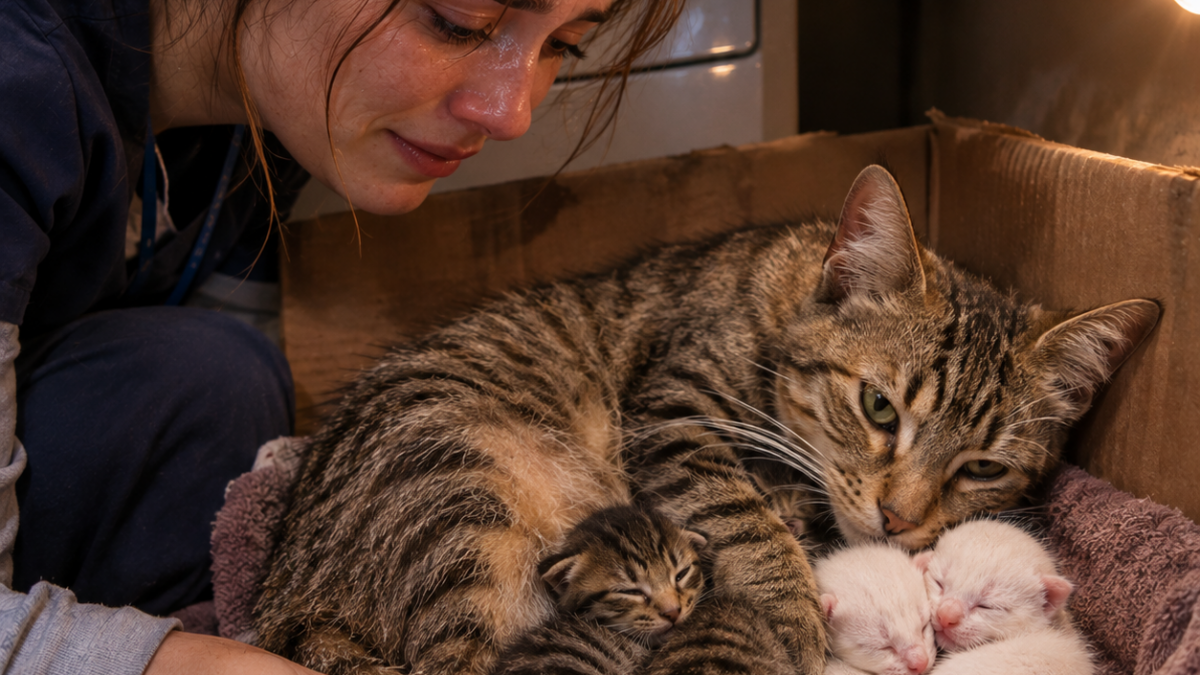
The mother immediately curled herself around all four.
Two dark babies.
Two white.
Her ordinary brown body surrounding them.
I took out my phone to use the light.
The white kittens went still.
I immediately turned the screen away.
“Sorry.”
I draped part of the blanket to soften the glow.
The mother watched every movement.
At 2:44, the apartment became quiet.
Four kittens nursing.
One exhausted tabby breathing hard.
And me sitting on cold tile with tears on my face for reasons I could not explain.
“You need a name.”
She lifted her head.
I thought of moonlight.
Of the white shape behind the hospital bushes.
Of the way she had appeared beneath fluorescent light like she had come looking for a witness.
“Selene.”
Her ears flicked.
“Yeah.”
I smiled.
“Selene.”
The kittens remained unnamed.
That seemed wise.
It lasted three days.
I called the clinic the next morning.
Dr. Ruiz asked me to describe them.
When I said two were pure white with pink noses and very pale skin, she became interested.
“Bring them in when everyone’s stable.”
“Are they albino?”
“Could be. True albinism is uncommon. White coat alone doesn’t prove it.”
“What would?”
“Pigmentation assessment, eye development when they open, genetics if someone really wants certainty.”
I looked at Selene.
She was nursing.
“Does it matter?”
“Medically, potentially. Light sensitivity. Vision issues. Skin protection. It can affect care.”
That mattered.
The rarity did not.
At least not to me.
I wish I could say the same for everyone else.
At the clinic three days later, the front-desk employee heard us talking.
Her name was Beth.
I had met her twice.
Friendly.
Efficient.
The moment Dr. Ruiz said “possible albinism,” Beth leaned closer.
“Two?”
“Yes.”
“In the same litter?”
“Apparently.”
“Wow.”
She smiled.
“Those are going to disappear fast.”
The phrase bothered me.
“What does that mean?”
“Adopters love unusual coloring.”
“They’re three days old.”
“I mean later.”
Dr. Ruiz looked at her.
Beth raised both hands.
“I’m just saying.”
Then:
“We have a rescue partner with a specialty placement list. Rare-color cats, special-needs kittens, that kind of thing.”
I looked down at the carrier.
Selene’s body covered all four babies.
“What happens if they go into that?”
“Once weaned, foster transfer. They get photographed, profiled, matched.”
“All four?”
Beth hesitated.
“The albino kittens would probably be placed through specialty.”
“What about the others?”
“Standard adoption.”
“And Selene?”
“Adult-cat program.”
There it was.
Five animals.
Three pathways.
I felt cold.
“They’re a family.”
Beth smiled gently.
“Of course. But kittens separate from mothers all the time once they’re old enough.”
I knew that.
Intellectually.
I was not proposing a permanent commune of cats living in one pile forever.
But the speed of her answer unsettled me.
She had already divided them in her mind before their eyes were open.
Dr. Ruiz interrupted.
“Nothing is happening now.”
Beth nodded.
“Absolutely.”
Then she looked at me.
“But if you’re interested in that program, space is limited. We’d want an early decision.”
An early decision.
About animals not yet a week old.
On the drive home, I kept hearing it.
Space is limited.
Rare-color placement.
Specialty program.
I told myself I was being irrational.
Systems existed for reasons.
Rescues had experience.
Resources.
Waiting adopters.
I worked nights.
I had no backyard.
No spare room beyond a utility closet.
No money tree.
Giving them to professionals later might genuinely be the best thing.
Then I got home.
I opened the carrier.
Selene moved immediately toward her kittens.
She counted them.
I swear she did.
One nose.
Second.
Third.
Fourth.
Then she lay over them.
Her body relaxed.
Mine did too.
That evening, Beth emailed.
I had never given her my personal email directly.
It was on the foster paperwork.
The message was polite.
Hi Tessa,
Just following up about the two possible albino kittens. Our specialty partner has expressed preliminary interest. If you’d like to reserve placement, we’d need confirmation within approximately one week so we can plan foster capacity.
No pressure, of course. We just don’t want you to miss the opportunity.
Opportunity.
I stared at that word.
For whom?
I closed the email.
At work that night, I registered forty-three patients.
Chest pain.
Broken wrist.
Fever.
Pregnancy complication.
An eighteen-year-old boy punched through a window after an argument.
A homeless man came in with an infected foot.
People placed names, dates, insurance cards, and signatures in front of me.
One form.
One click.
One bed.
One direction.
At 4:30 a.m., during a lull, I opened the email again.
Then closed it.
My coworker Dana noticed.
“You’re doing the face.”
“What face?”
“Decision face.”
“I don’t have one.”
“You absolutely do.”
Dana was an ER nurse in her thirties who ate peanut butter crackers like they were a food group.
“What happened?”
I told her.
Pregnant stray.
Four kittens.
Two white.
Possible albinos.
Specialty rescue.
Her eyes widened.
“Pictures.”
“No.”
“Tessa.”
“They look like wet mice.”
“Pictures.”
I showed her one.
Dana covered her mouth.
“Oh my God.”
“See? This is the problem.”
“What problem?”
“Everyone reacts like that to the white ones.”
She looked again.
Then swiped.
The next picture showed all four nursing.
“Oh.”
Her expression changed.
“They’re tiny.”
“Exactly.”
“Okay.”
She handed back the phone.
“What do you want?”
“I don’t know.”
“That’s a lie.”
I looked at her.
She shrugged.
“You want them left alone long enough to become cats instead of content.”
That was it.
I hated how accurately she said it.
A week passed.
The kittens gained weight.
Selene began eating like someone had informed her calories were now a competitive sport.
I bought better food.
Heating pad.
Digital scale.
Playpen.
My apartment slowly transformed into a low-budget neonatal ward.
I named the dark kittens Jasper and Rowan.
Then the white kittens needed names because calling them “White One” and “Other White One” felt unethical.
I chose Lumi and Alba.
Lumi had a slightly rounder head.
Alba screamed louder when weighed.
Their eyes had not opened.
They were still just warm bodies and squeaks.
The internet did not know they existed.
I preferred it that way.
Then Beth called.
“Tessa, have you decided?”
“About the program?”
“Yes.”
“No.”
A pause.
“No, you haven’t decided?”
“No, I’m not transferring them early.”
Her voice changed slightly.
“I think there may be a misunderstanding.”
“About what?”
“Our rescue partner isn’t taking newborns today.”
“I know.”
“They’re just reserving future placement.”
“I’m not reserving them.”
“All right.”
She sounded surprised.
“They may be harder to place together.”
“I didn’t say they all have to remain together forever.”
“Then what’s the concern?”
“The concern is they’re ten days old and people are already sorting them by rarity.”
Silence.
Then Beth said, “That’s not fair.”
“Maybe.”
“These organizations place hundreds of animals.”
“I know.”
“They have experience you don’t.”
“I know.”
“So I’m not sure why you’re treating professional placement like exploitation.”
I went still.
“I didn’t use that word.”
“You implied it.”
I breathed.
“Beth, I’m keeping the foster arrangement exactly as it is.”
“You understand foster custody remains with the rescue network.”
There it was.
Not a threat.
Not yet.
A reminder.
“Yes.”
“Okay.”
She hung up.
I sat on the kitchen floor for ten minutes.
Selene came out of the closet.
Walked toward me.
Stopped two feet away.
She had begun doing that.
Approaching without permission.
I held out one hand.
She sniffed.
Then pressed her forehead against my knuckles.
First time.
I almost cried.
“Great.”
I whispered.
“Now I’m emotionally compromised.”
Selene rubbed again.
“Fantastic.”
The next day, the first message arrived from a stranger.
Not through the rescue.
Through social media.
Hi, I heard you have albino Siamese mixes available in Austin?
I stared.
Nothing about that sentence was correct.
Selene was a tabby.
The kittens were not available.
Nobody knew breed.
Nobody outside the clinic and my coworkers should have known.
I replied:
They are not available.
The person responded:
Would you consider private placement when they’re old enough?
No.
I blocked the account.
An hour later:
Second message.
Different profile.
I collect rare-color cats and have experience with albinos. Happy to pay well.
Blocked.
Third.
Would $1,500 each change your mind?
My stomach turned.
I called Beth.
“Who did you tell?”
“What?”
“People are messaging me about the kittens.”
“I didn’t give anyone your information.”
“Did you tell the specialty rescue?”
“Yes, as part of our consultation.”
“Did you send photos?”
“One clinic image.”
“Did it have my name?”
“No.”
“Address?”
“Absolutely not.”
“How do strangers know?”
“I don’t know.”
I believed her.
Mostly.
That did not make me feel better.
I changed my social settings.
No public workplace tag.
No location posts.
I asked Dana not to mention them.
She looked horrified.
“I told one person.”
“Who?”
“My sister.”
“Does she collect albino cats?”
“Tessa.”
“Sorry.”
Then something worse happened.
I found a paper bowl of cat food outside my apartment door.
At first I thought Marcy had left it.
I knocked.
She frowned.
“Not me.”
The food was dry kibble.
Cheap.
A handful.
No note.
My skin crawled.
“Do people here feed strays?”
Marcy looked down the hallway.
“Not inside the building.”
I threw it away.
That night, another message.
You’re being selfish. Those kittens deserve experienced homes.
Blocked.
Next morning:
I can offer $8,000 for the pair. No questions asked.
I read it three times.
Eight thousand dollars.
For two kittens.
My rent was $1,480 a month.
My car needed tires.
I had credit-card debt.
Eight thousand dollars was not abstract.
It was breathing room.
That made the message uglier.
Because for one awful second, my brain calculated.
Then I looked into the playpen.
Lumi was sleeping across Jasper’s back.
Alba was upside down against Selene’s stomach.
Rowan’s tiny tail twitched.
Eight thousand dollars suddenly felt obscene.
I wrote:
Do not contact me again.
The reply came before I blocked it.
You don’t own them.
That one stayed with me.
Because technically, the rescue did.
I called the foster coordinator directly.
Not Beth.
Her name was Rachel Brenner.
I had spoken to her only during intake.
I explained everything.
Messages.
Money offers.
Food outside my door.
The phrase You don’t own them.
Rachel went quiet.
“Screenshot everything.”
“I did.”
“Do not engage.”
“I won’t.”
“Do you feel physically unsafe?”
“I don’t know.”
“That means yes enough to document it.”
She asked me to send everything.
Then she said, “We need to move the foster location.”
My entire body tightened.
“No.”
“Tessa.”
“No.”
“If your address is compromised—”
“Move all five together?”
Silence.
“Tessa—”
“All five.”
“We don’t currently have another foster cleared for a nursing mother plus four neonates.”
“Then they stay.”
“That may not be your decision.”
My stomach dropped.
“Excuse me?”
“You are a foster.”
“I know.”
“And if safety becomes a concern, the organization can reclaim animals.”
I stood.
“So because somebody is harassing me for rare kittens, you can take the entire family?”
“That is not what I said.”
“It’s exactly what you said.”
“I said safety decisions may require transfer.”
“To where?”
“We’d find placement.”
“Together?”
“I can’t promise.”
There it was.
The word that terrified me.
Promise.
“I’m not agreeing.”
“You don’t legally have veto authority.”
My face went hot.
“Then what exactly do you want me to do?”
“Let us investigate.”
“And meanwhile?”
“Lock your doors.”
I almost laughed.
Not because it was funny.
Because helplessness often sounds ridiculous when spoken aloud.
That night, I did not sleep.
I moved the playpen farther from the window.
Closed the blinds.
Checked the hallway peephole every time I heard footsteps.
At 3:10 a.m., Selene woke suddenly.
She stood.
Ears forward.
Stared toward the front door.
I froze.
A sound.
Soft scrape.
Something moved outside.
I called apartment security.
By the time they arrived, nobody was there.
But another bowl of food sat beside the door.
This one had a folded paper beneath it.
$10,000. CASH. NO PAPERWORK. YOU KEEP MOM + OTHER TWO.
I stared.
My hands went numb.
You keep mom + other two.
As if the tabby kittens were consolation prizes.
As if Selene were furniture.
As if the family could be divided according to resale value.
I called the police.
The responding officer took a report.
Photographed the note.
Bagged it.
Asked whether I had enemies.
I almost laughed again.
“I work hospital registration.”
“That doesn’t answer the question.”
“Fair.”
My building had security cameras.
The footage showed someone in a baseball cap and mask entering behind another resident.
Male.
Medium build.
Leaving the food.
Plate in parking lot unreadable.
Not enough.
But real.
Rachel called me the next morning.
“We have to move them.”
“No.”
“Tessa, someone entered your building.”
“I’ll stay with a friend.”
“You work nights.”
“I’ll take leave.”
“You can’t reorganize your whole life around this.”
“Watch me.”
She sighed.
“You’re attached.”
“Yes.”
It was the first time I said it without defending myself.
“I’m attached.”
“That doesn’t automatically make your judgment correct.”
“No.”
I breathed.
“But neither does being less attached.”
Silence.
Rachel said, “Come to the office this afternoon.”
The rescue operated from a converted house in South Austin.
No kennels there.
Administrative offices.
Storage.
Meeting room.
Rachel sat across from me.
Beth was there.
So was the rescue director, Gregory Shaw.
Gregory was forty-six.
Clean shirt.
Perfectly trimmed beard.
A man who looked comfortable asking for donations.
He had a folder.
“Tessa, nobody questions that you care about these animals.”
I immediately disliked the sentence.
“Okay.”
“But foster placements depend on cooperation.”
“I’ve cooperated.”
“You declined recommended specialty placement.”
“For newborn kittens.”
“You refused relocation after a safety incident.”
“Because you couldn’t guarantee they would remain together.”
Gregory folded his hands.
“At some point, attachment becomes obstruction.”
There it was.
I felt my pulse rise.
“I’m following veterinary care.”
“Yes.”
“Weight checks.”
“Yes.”
“Medical appointments.”
“Yes.”
“No kitten has lost weight.”
“Correct.”
“Selene is stable.”
“Yes.”
“So what exactly have I obstructed?”
“Placement planning.”
“They’re not weaned.”
“Planning happens early.”
“Why?”
“So resources are ready.”
“For Lumi and Alba.”
“For all of them.”
“No.”
Gregory paused.
“No?”
“The urgency started after the word albino.”
Beth shifted.
Gregory’s voice cooled.
“Rarity changes demand.”
“That’s my point.”
“It should also make placement easier.”
“At whose expense?”
He looked irritated.
“Tessa, foster care is not ownership.”
“I know.”
“Then you need to understand that final placement decisions belong to the organization.”
I leaned forward.
“And if your decision is to split two rare kittens into specialty homes while the other two wait in standard adoption and the mother goes somewhere else?”
“That may be appropriate at weaning.”
“Based on what?”
“Individual needs.”
“They are three weeks old.”
“We are planning.”
I looked at Rachel.
She looked uncomfortable.
Then Gregory said, “There is another issue.”
Of course.
“We’ve received concerns about your ability to remain objective.”
“From who?”
“Potential adopters who say you were hostile.”
I stared.
“People trying to buy kittens from me privately?”
“They describe you as accusatory.”
“They offered cash.”
“That doesn’t necessarily make them illegitimate adopters.”
One sentence.
That was the moment I stopped trusting him.
“Who gave them my contact information?”
Silence.
Gregory’s expression changed.
Tiny.
Enough.
“Did you?”
“No.”
“Did someone here?”
“We are reviewing that.”
“Beth?”
Her eyes widened.
“No.”
I believed her immediately.
Not because I knew her.
Because fear looks different from guilt.
Gregory closed the folder.
“We’re going to transfer the kittens next week.”
My chest went cold.
“All four?”
“The two white kittens to specialty foster.”
“No.”
“The other two can remain with Selene temporarily.”
“No.”
“Tessa.”
“No.”
“You cannot refuse.”
“I just did.”
Rachel whispered, “Tessa.”
Gregory’s face hardened.
“If you interfere with an authorized transfer, your foster status will be terminated.”
My throat tightened.
“And Selene?”
“If necessary, all animals will be removed.”
There it was.
The threat.
Not subtle anymore.
I stood.
“Then put that in writing.”
Gregory blinked.
“What?”
“Put the transfer plan in writing. Include that Dr. Ruiz recommended early separation.”
“I never said she did.”
“Exactly.”
Beth looked at him.
Rachel looked down.
I continued.
“Include the behavioral or medical reason the albino kittens need to leave their mother before the others.”
“They would not leave before appropriate weaning.”
“Fine. Put the reason they need a separate specialty foster at all.”
Gregory’s jaw tightened.
“This meeting is over.”
“Send me the policy.”
“Leave.”
I did.
My knees shook all the way to the parking lot.
I sat in my car.
Cried.
Then called Dr. Ruiz.
She listened.
When I finished, she said, “I never recommended separate placement.”
“I know.”
“I also don’t think rarity alone is a medical reason for a specialty transfer.”
“Can you write that?”
“Yes.”
That was the beginning of the fight.
I did not go online.
I did not make a viral post.
I did not accuse anyone publicly.
I documented.
Every text.
Every email.
The notes.
The food.
The police report.
The foster agreement.
Dr. Ruiz’s statement.
Then I reread the foster contract.
Line by line.
It allowed transfer for medical need, foster incapacity, safety, or organizational placement decisions.
Broad.
But it also required placement actions to reflect “best welfare interests of the animal.”
That phrase became important.
Animal.
Not donor.
Not waitlist.
Not market value.
Animal.
I called an attorney.
Not some dramatic animal-rights crusader.
A woman named Monica Lee who handled nonprofit and civil contract disputes.
She listened.
Then said, “You probably do not own these cats.”
“I know.”
“But you may have leverage if records show the organization is prioritizing financial value over welfare while exposing your private information.”
“Can I stop the transfer?”
“Maybe temporarily.”
“That’s enough.”
She sent a letter.
Preserve communications.
Do not disclose foster address.
Clarify basis for transfer.
Suspend movement pending review of harassment incident.
Gregory responded within three hours.
He was furious.
Professional language.
Polite threats.
Accusations that I was interfering with rescue operations.
Then something unexpected happened.
Beth called me from her personal number.
“I know who leaked the photos.”
I sat down.
“Who?”
“Gregory.”
My stomach dropped.
“What?”
“He sent them to a private donor group.”
“When?”
“The day after your clinic visit.”
“Why?”
“He wanted pledges.”
I went still.
“Pledges for what?”
“Our rare-animal medical fund.”
“Were the kittens sick?”
“No.”
“So he fundraised off them.”
“Sort of.”
“What does sort of mean?”
Beth’s voice shook.
“He posted the photo and said we had ‘two rare albino neonates requiring specialized placement and long-term medical support.’”
I stared at the wall.
“Long-term support?”
“We didn’t know that.”
“No.”
“And then one donor asked if adoption sponsorship could include priority placement.”
My hands went cold.
“Who?”
“I shouldn’t say.”
“Was it the man offering me money?”
“I think so.”
“Beth.”
“His name is Calvin Rourke.”
I wrote it down.
“Who is he?”
“Owns exotic-pet boutiques.”
Every instinct in me sharpened.
“Retail?”
“He says education and specialty placement.”
“That isn’t an answer.”
“I know.”
Beth began crying.
“I should’ve said something earlier.”
“Why didn’t you?”
“Gregory signs my paycheck.”
There it was again.
Fear hiding behind practicality.
“What else?”
“He told the donor group you were ‘difficult but temporary.’”
My face burned.
“What does that mean?”
“I don’t know.”
“Yes, you do.”
Silence.
“He thought we’d remove the kittens from your foster once they were old enough.”
I closed my eyes.
“And Selene?”
“Nobody talked about Selene.”
Of course not.
The rare kittens had become the story.
Their mother became packaging.
“Do you have screenshots?”
“Yes.”
“Send them to the board.”
Not to me.
“Why?”
“Because if you send confidential internal messages to me, Gregory makes you the problem.”
Beth sniffed.
“Then what?”
“Board chair. Compliance contact. Whatever your whistleblower policy says.”
“We don’t have compliance.”
“Then board chair.”
“I could get fired.”
“Yes.”
I hated saying it.
“But you might.”
Silence.
“I have two kids.”
“I know.”
“You don’t know.”
“No.”
I softened.
“I don’t.”
I looked toward the playpen.
Selene was cleaning Lumi.
“But I know what it feels like when someone with authority makes fear do their work for them.”
Beth was quiet.
Then she said, “I’ll send it.”
The next forty-eight hours changed everything.
The board chair was a retired veterinarian named Dr. Patricia Ames.
She called Beth.
Then Rachel.
Then Dr. Ruiz.
Then me.
Gregory was placed on administrative leave pending investigation.
The transfer was suspended.
The kittens stayed.
I should have felt victorious.
I felt nauseated.
Because suddenly the entire situation had become public inside the organization.
Staff knew.
Donors knew something was wrong.
Gregory’s supporters blamed me.
One anonymous email called me “an unstable foster mom playing savior.”
Another said:
You’re hurting the rescue because you want attention.
That one hurt.
Not because it was true.
Because part of me feared it could become true.
I looked at myself.
Had I made the family into my crusade?
Was I refusing any future separation because I needed to feel indispensable?
That question mattered.
I called Dr. Ruiz.
“If Selene is ready when they’re weaned, is separating them wrong?”
“No.”
“Even the albinos?”
“If they’re healthy, well-socialized, and placed appropriately, no.”
“So I’m not protecting them by insisting they stay all five forever.”
“No.”
I felt embarrassed.
“I knew that.”
“Emotionally?”
“No.”
She laughed softly.
“Different thing.”
“What should I do?”
“Watch the cats.”
Not the donors.
Not the rescue politics.
Not my fear.
The cats.
That became my reset.
Over the next weeks, I documented them.
Selene began leaving the playpen for longer periods.
At first five minutes.
Then fifteen.
Then she would sleep on my couch while the kittens wrestled.
Jasper and Rowan were fearless.
They attacked shoelaces.
Climbed blankets.
Fought cardboard.
Lumi and Alba were more cautious in bright light.
Dr. Ruiz confirmed very low pigmentation and significant light sensitivity.
Their eyes developed pale blue-gray.
They needed sun protection.
Indoor-only homes.
Window management.
Possibly ophthalmology checks.
Special needs.
Real ones.
Not marketing language.
But they were also kittens.
They chased.
Bit.
Climbed.
Screamed for food.
Alba once attacked my ponytail for six minutes.
Rare did not make them porcelain.
That mattered.
I began talking to potential adopters.
Quietly.
People I knew.
Dana from the ER loved Jasper and Rowan.
But she lived alone and worked twelve-hour shifts like me.
Not ideal for two young cats without backup.
A respiratory therapist named Miguel and his husband, Aaron, had recently lost a senior cat.
They visited.
Sat on the floor.
Did not reach.
Jasper climbed into Miguel’s lap.
Rowan attacked Aaron’s shoelace.
Both men laughed.
Good.
My coworker Priya had a quiet home with shaded windows and experience with visually sensitive cats because her previous white cat had chronic eye issues.
She was interested in Lumi.
That scared me.
One albino kitten alone.
Would Alba suffer?
Would Lumi?
I watched.
Lumi and Alba slept together sometimes.
But Alba slept with Rowan just as often.
Lumi followed Jasper more than Alba.
The grouping I had created in my head—rare pair, tabby pair—was mine.
Not theirs.
That realization humbled me.
I had been furious at strangers sorting them by appearance.
I had accidentally done a version of the same thing.
So I stopped.
I observed relationships.
Jasper and Lumi were nearly inseparable.
They slept tangled.
Played together.
If Jasper entered another room, Lumi followed.
Rowan preferred Selene but functioned independently.
Alba was socially flexible.
She liked everyone.
The best placement pairing was not white with white.
It was Jasper with Lumi.
A tabby and an albino.
Reality did not care about the neat story.
I loved that.
Priya actually fell for Alba.
Not because she was rare.
Because Alba climbed onto her shoulder and fell asleep inside her hair.
Miguel and Aaron bonded with Jasper and Lumi.
That left Rowan.
I watched Selene.
At eight weeks, she still allowed nursing occasionally but was increasingly irritated by it.
At ten, she hissed when Rowan tried.
Normal.
She was letting go.
So was I.
Then the board investigation found something larger.
Gregory had not stolen money.
That would have been simpler.
He had bent ethics around fundraising.
When unusual animals arrived, he marketed them aggressively to private donor circles before they were even eligible for placement.
He used phrases like exclusive sponsorship opportunity and priority meet-and-greet.
Not technically sale.
Not officially auction.
But enough money opened doors earlier than it should.
Calvin Rourke was one of those donors.
He had donated more than fifty thousand dollars over four years.
He also owned three boutique pet stores.
His businesses claimed they did not sell rescue animals.
Instead, they hosted “rare rescue showcases.”
Adopters paid large suggested donations.
The rescue benefited.
His stores gained traffic.
Everyone could tell themselves it was charity.
The animals became marketing.
That was how my photograph spread.
Calvin saw Lumi and Alba.
He wanted them paired for a “white wonders” promotional campaign.
He had offered me cash privately because he wanted to bypass the foster process and secure them.
When I refused, he had someone find my address through a donor database that improperly contained foster contact information.
The man leaving food outside my apartment was not Calvin.
It was one of his employees.
Calvin claimed he had only asked the employee to “make contact.”
The employee admitted he left the cash note.
Police had enough for trespass-related charges and harassment investigation.
Not a dramatic felony.
Enough.
The rescue board permanently banned Calvin from adoption or foster access.
Ended the business partnership.
Reported the privacy breach.
Gregory resigned before the board voted on termination.
His statement said:
I regret that my passion for increasing lifesaving outcomes was misinterpreted.
That sentence made me angrier than an apology would have.
Not because he was evil.
Because he still thought results excused methods.
Dr. Ames called me personally.
“We failed you.”
I sat on the couch.
Selene beside me.
“You failed the cats.”
“Yes.”
The fact that she did not defend the organization made me trust her.
“We are changing the placement process.”
“Good.”
“And I want to be clear about something else.”
“What?”
“You were also correct to question whether your attachment was affecting your judgment.”
I blinked.
That was not where I expected the call to go.
She continued.
“You should keep questioning that.”
I felt defensive.
Then understood.
“That’s fair.”
“Being right about Gregory doesn’t make every instinct you have automatically right.”
“I know.”
“Good rescuers need enough heart to notice and enough humility to verify.”
I smiled.
“I’m putting that on a mug.”
“I’ll buy one.”
The rescue changed.
Foster addresses were removed from donor-accessible systems.
Potential adopters could not receive foster contact information without consent.
Donations no longer influenced meet-and-greet order.
Specialty placement decisions required documented welfare reasons.
Marketing could not label neonates “rare” before veterinary assessment.
Every behavioral or medical recommendation had to be retained in the record.
And large donors were subject to the same application process as everyone else.
Simple rules.
Amazing how expensive it had been to learn them.
Meanwhile, Selene changed my apartment.
She stopped sleeping in the closet.
First she slept beside it.
Then hallway.
Then couch.
One morning, after my shift, I collapsed without changing clothes.
I woke at noon.
Selene was pressed against my thigh.
Not kittens.
Me.
I barely moved.
She opened one eye.
I whispered, “You know you’re allowed to leave now.”
She closed the eye.
“Great.”
I smiled.
“I’ve been adopted.”
At twelve weeks, placement decisions became real.
Miguel and Aaron were approved for Jasper and Lumi.
Their home had UV-filtering window film because Aaron worked from home and had installed it after learning about Lumi’s sensitivity.
They bought two cat trees.
Not because I demanded it.
Because they had already decided the kittens deserved vertical territory.
Miguel asked, “Do we need to keep Lumi away from windows completely?”
“No.”
“What does he like?”
“Sunlight, unfortunately.”
He laughed.
“So we protect him without turning the house into a cave.”
Exactly.
That mattered.
Priya adopted Alba.
She brought blackout curtains to her bedroom but left filtered daylight in the living room.
She never once mentioned how unusual Alba looked during the adoption conversation.
She asked about food.
Eye checks.
Whether Alba liked being held.
Which toys she preferred.
That was how I knew.
Rowan became complicated.
Three people applied.
One wanted him because “the normal one will be easier.”
Rejected.
One family had three young children and an energetic husky.
Possible someday.
Not ideal then.
Then Marcy—the avocado-pajama neighbor—knocked on my door.
“You still have the striped boy?”
“Rowan?”
“The one who bites your laundry.”
“Yes.”
“I’ve been thinking.”
“That’s dangerous.”
She ignored me.
“My cat died two years ago.”
I knew that.
She still had his scratching post near her window.
“I didn’t want another.”
“Okay.”
“But Rowan comes to my door when I visit.”
“He also runs into walls.”
“I relate.”
I laughed.
“You’re serious?”
She nodded.
“Only if you think it’s right.”
That sentence helped.
Not Can I have him?
Is it right?
We did the application.
Home check was easy.
She lived fifteen feet away.
Rowan moved next door.
I could hear him occasionally running across her floor.
That first night, it made me smile instead of cry.
Then there was Selene.
The rescue listed her.
Brown tabby.
Adult female.
Former stray.
Quiet home preferred.
Her page received eighteen views the first day.
Lumi and Alba’s old medical update had received thousands.
I stared at the number.
There it was again.
Rare gets attention.
Ordinary waits.
The difference was that now I knew Selene did not need the same future as her kittens.
She needed the right future.
She had started following me through the apartment.
Sleeping on my bed.
Waiting beside the door when I returned from work.
When I showered, she sat on the bathmat like a small security guard.
Dr. Ruiz asked me during the final postpartum check:
“You adopting her?”
“I’m fostering.”
Dr. Ruiz looked at Selene.
Selene looked at me.
“Right.”
“I work nights.”
“Cats are famously unionized against night shifts.”
“My apartment is small.”
“She currently lives there.”
“I travel sometimes.”
“Pet sitter.”
“I’m tired.”
“She sleeps eighteen hours a day.”
I sighed.
“Everyone is against me.”
Dr. Ruiz smiled.
“No. Everyone is watching you lose an argument you started weeks ago.”
I applied.
Foster-to-adopt.
Then permanent.
Selene Morgan.
The first night after the paperwork finalized, nothing dramatic happened.
She ate dinner.
Groomed.
Sat on the windowsill.
Then jumped beside me on the couch.
I scratched beneath her chin.
“You realize you engineered this.”
Purr.
“You followed the correct exhausted hospital employee.”
Purr.
“I respect the strategy.”
She pressed her forehead into my hand.
I cried.
Quietly.
Not because she was mine.
Because she had chosen to trust.
There is no document for that.
The white cat in the photograph still bothered me.
I had nearly forgotten until the kittens were placed.
One night, I opened the first picture again.
Hospital parking lot.
Selene near my tire.
Bushes.
White shape.
Now that I had spent months staring at Lumi and Alba, the resemblance felt impossible to ignore.
Adult white cat.
Pinkish ears in the flash.
Could he be their father?
Genetics are more complicated than coat color.
I knew that.
Still, curiosity won.
I returned to the hospital loading area on my next night off.
I brought food.
Sat near the bushes.
Nothing.
Second night.
Nothing.
Third.
At 3:07 a.m., a white cat appeared.
Same bushes.
Adult male.
Thin.
Cautious.
One ear tipped.
I stopped breathing.
He looked at me.
Then at the food.
I stayed still.
He ate only after I backed twenty feet away.
The next week, I borrowed a humane trap through a TNR group.
It took three nights.
We caught him.
At the clinic, the microchip scanner beeped.
I stared.
“He’s chipped?”
The technician nodded.
Registered owner information came back.
Not Calvin.
Not Gregory.
A woman named Evelyn Hart.
Address twelve minutes from the hospital.
We called.
Disconnected.
Property records showed the house had been sold seven months earlier.
I drove by.
Renovation dumpster.
New owner.
He remembered the previous tenant.
Older woman.
Died suddenly.
Her daughter cleared the property.
“There were cats,” he said.
“How many?”
“Several.”
“What happened to them?”
“Daughter said rescue picked them up.”
“Do you know which rescue?”
“No.”
The white cat’s name on the microchip record was Ghost.
I contacted county records.
Evelyn Hart had registered six cats over several years.
One of them matched Selene.
Female brown tabby.
Name: Pepper.
I stared at the screen.
Selene had a name before me.
Pepper.
She had belonged to someone.
Not abused.
Not necessarily abandoned deliberately.
Her owner died.
The house emptied.
Somewhere in the transition, at least two cats disappeared from the system.
Ghost.
Pepper.
I felt ashamed.
For months, I had imagined someone had taught Selene fear through cruelty.
Maybe someone had.
But maybe grief had.
Strangers entering her home.
Furniture disappearing.
Owner gone.
Carriers.
Doors.
Street.
Then pregnancy.
Then hospital parking lot.
Fear does not require a villain.
Sometimes life itself is violent enough.
The daughter, Melissa Hart, eventually returned my call.
She cried when I said Pepper.
“Oh my God.”
She had believed every cat went to rescue.
She lived in Colorado.
After her mother died, she hired a local pet-placement service recommended by an estate cleaner.
The company claimed all six had been transferred.
Records showed only four arrived.
Pepper and Ghost did not.
“What happened?”
“We don’t know.”
Melissa’s voice broke.
“I thought they were safe.”
I looked at Selene.
“She is now.”
“Can I see her?”
We video called.
When Melissa saw Selene, she covered her mouth.
“That’s Pepper.”
I almost corrected her.
Selene.
Then stopped.
Both names belonged to her.
Melissa showed me photographs.
Pepper sleeping on Evelyn’s lap.
Pepper as a young cat.
Ghost beside her.
And one photograph that made me cry.
Pepper curled against Ghost on a sunlit couch.
They knew each other.
They had been family.
That was the white silhouette.
Ghost had been following her.
Or staying near.
Maybe he was the father.
Maybe not.
But he was not random.
He had been watching the night she chose me.
Suddenly the story changed again.
Selene had not arrived alone.
She had lost a human.
A home.
Four other cats.
And somehow Ghost had remained near enough to find her behind the hospital.
The TNR group fostered Ghost temporarily.
Melissa wanted to take him to Colorado.
She had one cat already and a quiet house.
We arranged the paperwork.
But before that happened, I brought Ghost to my apartment for a controlled visit.
I did not know what to expect.
Selene smelled him through the carrier.
Her entire body froze.
Ghost made a low chirping sound.
Not a meow.
Selene stepped forward.
Sniffed.
Then made the same sound.
My throat closed.
I opened the carrier under supervision.
Ghost stepped out.
Selene walked toward him.
No dramatic sprint.
No cinematic reunion.
Nose touch.
Pause.
Then Selene rubbed the side of her face against his.
Ghost leaned back.
They stood together for maybe ten seconds.
That was enough.
I sat on the floor crying like an idiot.
Marcy watched from my doorway.
“Are we sure you work in emergency medicine?”
“Registration.”
“Still.”
“Shut up.”
Ghost stayed two nights.
Selene slept near him.
Not tangled.
Not inseparable.
They had both changed.
Then Melissa flew in.
When Ghost met her, he hid.
She did not force him.
Good.
She sat on the floor for an hour.
Eventually he sniffed her hand.
He went home with her the next day.
Selene watched the carrier leave.
I worried.
She walked to the window.
Sat.
Then came back to me.
That mattered too.
Love does not always mean refusing every separation.
Sometimes love means becoming secure enough to survive one.
Melissa and I stayed in touch.
Ghost eventually slept on her bed.
She sent photographs.
Selene never seemed distressed after he left.
She had seen him.
Maybe that was enough.
Maybe I needed it more than she did.
A year after the kittens were born, we held an informal reunion.
Not all in one room.
That would have been chaos.
Miguel and Aaron sent photos of Jasper and Lumi.
Lumi wore no special costume.
No “rare albino” content.
He was simply a cat asleep across a laptop keyboard while Jasper sat on his head.
Priya sent a video of Alba chasing an ice cube across the kitchen.
Marcy opened her apartment door and Rowan walked straight into mine as if he still owned both units.
Selene hissed at him once.
Motherhood had ended.
Boundaries were healthy.
We laughed.
The kittens had not remained together as one permanent family.
That had once been my greatest fear.
Now I understood I had been protecting the wrong thing.
The goal was never to freeze them in the safest moment I could create.
The goal was to keep them safe long enough to become capable of change.
That is different.
The mother needs kittens.
Then she needs rest.
Kittens need siblings.
Then homes.
Some pairs remain bonded.
Some do not.
Some love expands with distance.
Some requires proximity.
You cannot decide based on which story makes you feel noble.
You have to watch the animal.
That lesson changed how I handled people too.
At work, I became better at recognizing the difference between helping and controlling.
A patient’s daughter once apologized for crying while filling out forms.
I said, “You don’t have to make this easier for me.”
The sentence surprised both of us.
I think Selene taught me that.
Gregory’s investigation ended with more consequences than resignation.
The rescue discovered several donor-related privacy violations.
State regulators reviewed fundraising materials.
The organization paid a civil penalty for improperly representing restricted donations.
Nobody went to prison.
There were no handcuffs.
Some people online complained the outcome was too mild.
I disagreed.
The rescue changed.
Calvin lost access.
Foster privacy improved.
Donor influence decreased.
Staff could report concerns directly to the board.
The next rare-looking kitten who arrived would not have its photograph sent to wealthy collectors before its medical chart was complete.
That mattered.
Beth kept her job.
For a while she seemed ashamed whenever she saw me.
I finally said, “You told the truth.”
“Late.”
“Still told it.”
“I almost didn’t.”
“Most people almost don’t.”
She looked at me.
“Are we okay?”
“We’re not friends.”
She laughed.
“Fair.”
“But we’re okay.”
Fear makes people slow.
Truth sometimes arrives late.
Late is better than never.
Dr. Ames eventually asked whether I wanted to join the foster advisory committee.
I said no.
Then yes.
Because apparently I enjoy unpaid meetings.
We rewrote policy around specialty animals.
Not just albino cats.
Tripods.
Unusual breeds.
Animals with viral stories.
Any animal likely to attract attention for the wrong reason.
The policy was simple:
Medical and behavioral suitability first.
Publicity second.
Donations never determine adopter priority.
No private foster information.
No pre-placement bidding disguised as sponsorship.
And my favorite:
Animals will not be described as “rare,” “exclusive,” or “collector quality” in adoption marketing.
They are not watches.
They are not sneakers.
They are not limited-edition merchandise.
They are animals.
That policy passed unanimously.
I framed the email.
Not because I was dramatic.
Because I was extremely dramatic.
Two years later, I moved.
Not because of the harassment.
Because my lease increased by three hundred dollars and even compassion has a budget.
Selene moved with me.
Obviously.
The new apartment had a bigger window.
I installed UV film partly from habit after raising Lumi and Alba.
Selene loved the window.
Every morning after my night shift, she sat there while I made coffee.
Sometimes I looked at her brown striped back and tried to imagine the path.
Evelyn’s house.
Owner gone.
Unknown transfer.
Street.
Pregnant.
Ghost following somewhere behind.
Hospital.
Parking lot.
My tire.
Four babies.
Harassment.
Board investigation.
New homes.
A whole chain of events that had begun because she refused to let me drive away.
People often describe rescued animals as lucky.
Maybe.
But I think that language can make humans feel too important.
Selene did most of the hard work.
She survived loss.
Found shelter.
Gave birth.
Fed four kittens while underweight.
Learned my apartment.
Learned my hands.
Learned that doors opening did not always mean danger.
Learned her kittens could leave without vanishing.
Learned Ghost could leave and still be safe.
I provided food.
Walls.
Vet appointments.
Paperwork.
A legal fight.
She did the healing.
Years later, Lumi developed mild chronic eye irritation.
Nothing catastrophic.
Miguel and Aaron managed it.
They sent me updates.
Jasper remained his shadow.
Not because Lumi was helpless.
Because they genuinely bonded.
Alba became the ruler of Priya’s home.
She slept in filtered afternoon light and screamed when dinner was late.
Rowan got fat.
I say that with love.
Marcy denied it.
The veterinarian did not.
Ghost lived in Colorado with Melissa for four years before kidney disease caught up with him.
When Melissa called me after he died, we both cried.
Selene was asleep on my couch.
I looked at her.
I wondered whether animals remember loss the way we do.
Probably not in stories.
Not in dates.
Maybe in absence.
Maybe in smells.
Maybe in the way a hallway feels when someone who used to walk through it no longer does.
I told Selene, “Ghost is gone.”
She looked at me.
Then stretched.
Then pressed her head against my hand.
I cried harder.
That is another thing animals teach you.
The world can end in one place and continue in another at exactly the same time.
Grief does not stop breakfast.
Love does not prevent death.
Safety does not guarantee forever.
Still worth it.
Every part.
Selene is older now.
The narrow street body is gone.
She has a soft middle.
Excellent appetite.
Strong opinions about tuna.
The missing fur around her neck grew back years ago.
She still flinches at certain metallic clicks.
Carrier latches.
Some cabinet noises.
I stopped trying to eliminate every reaction.
Trauma is not a stain you scrub until the animal becomes the version you think they should have been.
She is safe.
That is enough.
Sometimes she startles.
Then looks around.
Realizes where she is.
Continues.
That is healing too.
I still have the first photograph.
Hospital lot.
Selene beside the tire.
Bushes behind her.
Ghost barely visible as a pale blur.
The photo is terrible.
Grainy.
Bad lighting.
No composition.
I almost deleted it once.
Now it is one of the most important pictures I own.
Not because it proves some supernatural story.
Because it reminds me how incomplete our first understanding usually is.
I thought I found one pregnant stray.
There were two displaced cats.
I thought the white kittens were the mystery.
The real mystery was how Selene had survived long enough to ask me for help.
I thought keeping the family intact meant preventing separation.
Eventually I learned keeping a family intact can also mean respecting the relationships enough not to let outsiders assign value based on appearance.
Jasper mattered as much as Lumi.
Rowan mattered as much as Alba.
Selene mattered before any of them existed.
Ghost mattered although nobody was trying to pay ten thousand dollars for him.
That sounds obvious.
It was apparently not obvious enough.
Rarity has a dangerous effect on people.
We see unusual and immediately create value.
Financial.
Social.
Emotional.
Something becomes special because fewer people have seen it.
But the most important thing about Lumi was never that he lacked pigment.
It was that he would not sleep unless one paw touched Jasper’s back.
The most important thing about Alba was not her white coat.
It was that she climbed onto Priya’s shoulder the first day and refused to get down.
The most important thing about Rowan was that he came running every time Marcy opened her apartment door.
The most important thing about Jasper was that he followed Lumi into every dark corner first as if testing whether the world was safe.
And the most important thing about Selene was not that an ordinary tabby somehow produced two extraordinary-looking kittens.
It was that after losing almost everything familiar, she still walked toward a stranger.
That is courage.
Not the loud kind.
No dramatic leap.
She followed me across gravel.
Sat beside a tire.
Waited.
I think about that when people ask why I refused the early transfer.
I used to answer:
Because I didn’t want them split.
That was true.
But incomplete.
The real answer is that everyone else had started deciding what the white kittens were worth before they had even opened their eyes.
I wanted somebody to wait long enough to find out who they were.
That was the risk.
Not simply keeping them together.
Keeping the world from turning them into a story before they became themselves.
One evening, years after all of it, I came home from the hospital exhausted.
Bad shift.
A child had died after a car accident.
I was not clinical staff.
I did not touch the medicine.
But registration is close enough to grief that it sometimes follows you home.
I sat on the floor without taking off my shoes.
Selene came from the bedroom.
Stopped.
Looked at me.
She had learned me too.
She walked over.
No crying.
No performance.
Just presence.
She sat beside my leg.
I put one hand on her back.
Warm.
Solid.
Alive.
For several minutes, neither of us moved.
I thought about the first night.
Same posture.
Me on the floor.
Her watching.
Except then I had believed I was the person offering safety.
Now I knew better.
Sometimes safety moves both ways.
That is what Selene changed in me.
I had spent most of my life believing usefulness was love.
Solve things.
Help.
Carry.
Fix.
Take the shift.
Complete the form.
Drive the patient’s family to the right desk.
Bring home the cat.
Protect the kittens.
Fight the policy.
I was good at giving.
Terrible at letting anyone stay beside me without earning it.
Selene never earned her place.
Neither did I.
She simply stayed.
So did I.
Maybe that was the promise from the beginning.
Not forever.
Not never separate.
Not I will protect you from every bad thing.
Just:
I see you.
I’m still here.
We will decide the next part when we get there.
The first night, I said those words beside a hospital parking lot without realizing they would become the shape of the next several years.
I see you.
That was enough to get Selene into my car.
I’m still here.
That was enough to get her through labor.
We will decide the next part when we get there.
That was enough to keep me from handing newborn kittens into a system simply because other people were excited by how unusual they looked.
And eventually, that was enough to let them go when letting go became the right thing.
That may be the hardest part of rescue nobody tells you.
Sometimes protecting something means holding on.
Sometimes protecting it means refusing money.
Refusing pressure.
Refusing a powerful person who thinks your fear will make you obedient.
And sometimes protecting it means opening your hands when the time comes.
Jasper left.
Lumi left.
Alba left.
Rowan moved next door.
Ghost went to Colorado.
Selene stayed.
Not because I won.
Because that was where each life fit.
The apartment became quiet again after the kittens left.
The first night, I expected Selene to search.
She did.
She walked to the empty playpen.
Sniffed.
Checked beneath the couch.
Then came to me.
Jumped up.
Circled once.
Settled against my thigh.
I pulled out that first grainy photograph.
The bushes.
The white blur.
Her small body beneath the security light.
For months I thought the picture represented an unanswered question.
Eventually it became something else.
Proof that stories can begin before we know we have entered them.
There had been a whole life behind Selene before she found me.
There would be whole lives for the kittens after they left.
I was not the beginning.
I was not the ending.
I was one safe place in the middle.
That was enough.
And when I remember the two albino kittens now, I do not picture the offers.
I do not picture the ten-thousand-dollar note.
I do not picture Gregory telling me I did not own them.
I do not picture board meetings, police reports, or strangers calling me selfish.
I picture the first night.
Four newborn bodies beneath a tired brown tabby.
Two dark.
Two white.
No idea that humans would ever assign different value to them.
Selene pulled all four closer with the same paws.
Covered all four with the same body.
Cleaned all four with the same patience.
To her, there were no rare kittens.
No ordinary kittens.
No specialty placements.
No donor opportunities.
Only hers.
That simplicity exposed every complicated excuse the adults created afterward.
And that is why I refused to let anyone split them for the wrong reason.
Not because families can never separate.
Not because every sibling must remain together forever.
Not because I believed love means holding on until nothing changes.
I refused because there is a difference between separation that follows growth and separation driven by greed.
One respects the animal.
The other assigns a price.
Selene knew that before I did.
She had spent weeks gathering four kittens beneath her body without caring what color they were.
By the time the rest of us finally learned the same lesson, the kittens were old enough to walk into their own lives.
And the ordinary brown tabby everyone had nearly overlooked was still beside me.
Exactly where she had decided to be the night she sat beside my tire and waited to see whether I meant what I said.
I did.
I saw her.
And once I had, I could never pretend she—or any of her babies—was something that could simply be priced, sorted, and carried away.








