A Stray Mother Dog Dragged Herself Into a Restaurant Begging for Food—But When She Suddenly Ran Away With the Chicken, Everyone Followed and Discovered Who Was Waiting for Her
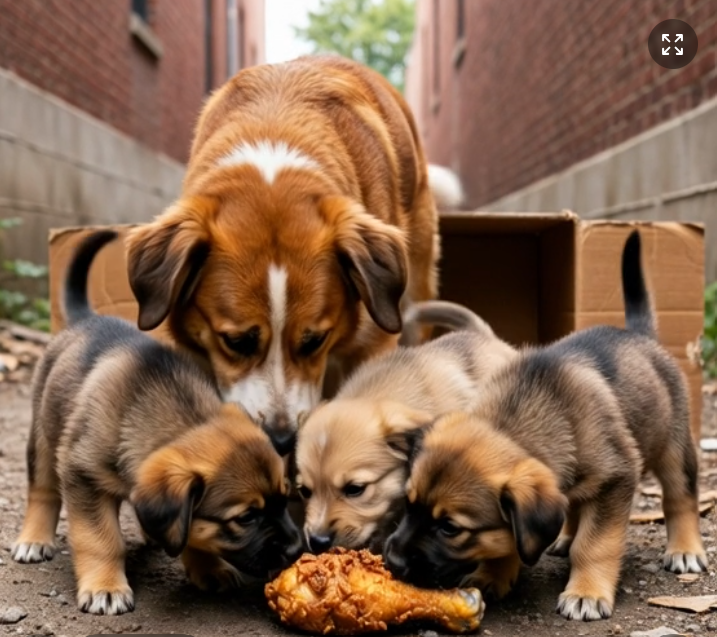
A Stray Mother Dog Dragged Herself Into a Restaurant Begging for Food—But When She Suddenly Ran Away With the Chicken, Everyone Followed and Discovered Who Was Waiting for Her.
The first time I saw her, I thought her back legs were useless.
She dragged herself across the sidewalk outside my restaurant like every inch of concrete hurt, while customers stared, whispered, and looked away.
Then I gave her one piece of chicken, and the moment she took it in her mouth, that “crippled” stray stood up and ran.
My name is Lucas Bennett, and I own a small fried chicken restaurant on the corner of Maple and 6th in a working-class neighborhood just outside Cleveland, Ohio.
It is not a fancy place. We do not have polished floors, linen napkins, or the kind of menu where people need to ask what half the words mean. We have red vinyl booths that squeak when you slide in, old brick walls, a counter with a bell that sticks in humid weather, and a fryer that has been with me so long I sometimes think it understands English.
People come to my place because they know what they are getting.
Hot chicken.
Crispy fries.
Cold lemonade.
Big portions.
Fair prices.
A place where construction workers, nurses, truck drivers, college kids, grandparents, and tired parents can sit down for twenty minutes and feel like the world is not completely against them.
That was all I ever wanted Harbor Chicken to be.
My father opened the restaurant thirty-one years before I took it over. Back then, the sign out front still had his name on it: Bennett’s Chicken & Fries. He built the place with a loan, a secondhand fryer, my mother’s seasoning recipe, and more stubbornness than business knowledge. When he died, I was thirty-two, divorced, exhausted, and absolutely certain I could not keep it running.
But grief has a strange way of giving people jobs.
I did not want the restaurant to vanish right after him.
So I stayed.
By the time the dog came, I had been running Harbor Chicken for almost nine years.
I knew most of my regulars by name. I knew Mr. Dalton liked extra salt but pretended his doctor had not warned him. I knew the three mechanics from the shop down the street would say they were “just grabbing something quick” and then sit outside for forty minutes arguing about baseball. I knew Mrs. Alvarez always bought two meals on Fridays even though she lived alone, because one meal was for the neighbor upstairs who had trouble walking after his stroke.
I also knew hunger when I saw it.
You do not run a restaurant for nine years in a neighborhood like mine without learning the difference between appetite and hunger.
Appetite is loud. It jokes. It complains. It asks whether the chicken is fresh even while staring at steam rising from the tray.
Hunger is quiet.
Hunger counts coins under the table.
Hunger asks for water first.
Hunger says, “I’ll just take fries,” while looking at the chicken.
Hunger looks away when someone else’s plate passes by.
That Thursday afternoon, hunger came dragging itself along the sidewalk on four paws.
It was late summer, but the kind of late summer that already feels tired. The air was heavy. The sky had been threatening rain since morning without committing to it. A warm wind pushed paper napkins along the curb and carried the smell of fryer oil, car exhaust, and damp brick down the block.
The lunch rush had mostly passed. Inside, only three tables were occupied. Outside, on the small patio, two men in work shirts were sharing a family platter even though both had sworn they were “not that hungry.” A young couple sat near the front window. At the counter, my cook, Marcus, was boxing an order for pickup while I wiped down the soda station.
That was when I heard the first murmur.
Not a scream.
Not a laugh.
Just that low ripple people make when they notice something sad and are not sure whether looking too long makes them kind or rude.
I turned toward the front window.
A dog was coming down the sidewalk.
At first, I thought she had been hit by a car.
Her front legs worked, but her back half dragged behind her. Her hind paws scraped across the concrete. Her hips twisted slightly with every pull. Her fur was dirty brown and white, matted along the belly, dusty around the tail. Her ribs showed beneath her coat, not sharply enough to mean she was dying, but clearly enough to say she had not eaten properly in a while.
She was medium-sized, maybe forty pounds when healthy, though she looked lighter now. Her ears drooped. Her head hung low. Her mouth was open, tongue hanging, but not in a happy way.
She looked exhausted.
PART2:
One of the men outside lowered his chicken.
“Man,” he said softly. “Look at that poor thing.”
His friend turned. “Is she hurt?”
The dog stopped near the patio railing.
She looked at the table.
Not at the men.
At the food.
I had seen stray dogs before. There were always a few moving through the alleys behind restaurants. Most kept distance. Some were bold enough to sniff trash bags. A few learned which employees were soft and came around at closing time.
But this dog did not behave like the others.
She did not bark.
She did not wag.
She did not beg in the energetic, hopeful way dogs sometimes do when they still believe people might be good.
She just lowered herself beside the patio and stared at the food with a kind of quiet desperation that made the entire sidewalk feel guilty.
I walked outside.
The two men looked at me.
“You see her legs?” one asked.
“I see.”
The dog’s eyes moved to me.
She froze.
I stopped several feet away and crouched, palms open.
“Hey, girl,” I said softly. “What happened to you?”
She did not come closer.
She did not run either.
PART3:
That was when I noticed the strangest thing.
Her back legs were positioned badly, yes, but not like they were completely dead. There was tension in them. Control. She held them just wrong enough to look broken. Too wrong, maybe.
But I did not think much of it then.
I was busy feeling sorry for her.
“Lucas,” Marcus called from inside, “don’t get bit.”
“I’m not planning to.”
“That’s what everybody says before getting bit.”
The dog’s eyes flicked toward Marcus’s voice, then back to the table.
The man in the blue work shirt picked up a piece of chicken.
“Can I give her some?”
Before I could answer, his friend said, “Chicken bones are bad for dogs.”
“No bones,” I said. “Just meat.”
I went inside, pulled a fresh piece from the warmer, stripped off the crunchy skin, and took a chunk of white meat in my hand. It was still warm. I brought it outside and crouched again.
The dog’s nostrils flared.
Her whole body leaned toward the smell, but she did not move.
“It’s okay,” I said. “Come on.”
She pulled herself forward.
Front paws.
Drag.
Front paws.
Drag.
Every movement looked painful.
The customers went silent.
Even Marcus stopped pretending not to watch.
She reached me slowly, head low, eyes moving between my hand and my face.
I held the chicken flat on my palm.
She took it gently.
Not snapping.
Not greedy.
Gently.
Then she turned.
And ran.
Not dragged.
Not crawled.
Ran.
Her back legs came under her body like they had been waiting for permission. She twisted around the patio chair, leapt off the curb, and sprinted down the side alley with that piece of chicken clamped in her mouth.
For one full second, nobody moved.
The man in the blue shirt stood up so fast his chair scraped backward.
“What the hell?”
His friend blinked. “Did that dog just scam us?”
Marcus stepped out behind me, wiping his hands on a towel.
“I told you,” he said. “City dogs are evolving.”
I should have laughed.
Everyone else did, at least a little. Not cruelly. More from shock than anything else.
But I was still crouched on the sidewalk, staring down the alley where she had disappeared.
Because something about the way she ran did not feel like a trick.
It felt like urgency.
Not escape.
Purpose.
“She wasn’t faking for herself,” I said.
Marcus looked at me. “What?”
I stood.
“That dog didn’t eat the chicken.”
The man outside frowned. “She took it.”
“She didn’t swallow it.”
I stepped toward the alley.
Marcus groaned. “Lucas.”
“I’ll be right back.”
“You don’t chase strange dogs into alleys. That’s how people end up in local news.”
The man in the blue shirt stood too. “I’ll come with you.”
His friend wiped his hands. “Same.”
I looked back at the restaurant. “Marcus, watch the counter.”
Marcus pointed the towel at me. “If you get rabies, I’m not covering dinner rush alone.”
“She didn’t bite me.”
“Yet.”
The three of us followed the alley.
The dog was already gone from sight, but not from evidence. The alley behind the restaurant ran between brick buildings, past dumpsters, delivery doors, broken pallets, and the old loading entrance of a hardware store that had closed years earlier. Puddles sat in uneven concrete. A few pigeons scattered from a trash bin when we rounded the corner.
“There,” the blue-shirted man said.
A smear of grease marked the ground near the dumpster.
Then another.
Tiny drops, not blood. Chicken juice.
We followed them past the back of the restaurant, past the narrow gap behind the old laundromat, toward a row of abandoned storage spaces beneath a crumbling brick overhang.
That part of the block had been half-forgotten for years. The city said redevelopment was coming. The property owner said paperwork was complicated. Everyone else just learned not to park too close because the bricks sometimes dropped chips onto windshields.
At the far end, under the shadow of a boarded service entrance, the dog stood near a torn cardboard box.
She was no longer pretending.
She stood squarely on all four legs, though her posture sagged with exhaustion. The chicken was in her mouth. She looked back at us.
For the first time, she growled.
Low.
Warning.
Not because she wanted to attack.
Because behind her, inside the box, something moved.
A small sound came out of the dark.
Then another.
Whimpering.
The man beside me whispered, “Oh no.”
The dog backed toward the box, never taking her eyes off us.
Then five tiny heads appeared over the edge of the cardboard.
Puppies.
They were so small that for a moment my mind refused to accept them as real.
Five puppies, maybe four weeks old. Brown, black, white, spotted, dirty, beautiful. Their bellies looked hollow. Their eyes were barely focused. They climbed over one another weakly, noses lifted toward their mother and the smell of food.
The mother dog dropped the chicken into the box.
She did not eat any of it.
Not one bite.
The puppies swarmed it with desperate little sounds, chewing, licking, nudging each other, too hungry to understand sharing.
The mother stood over them like a shield.
Her ribs moved with every breath.
She watched us as if we were both threat and hope, and she had not decided which one would win.
Nobody spoke.
The alley seemed to go quiet around us.
No traffic.
No fryer hum.
No customers.
Just five hungry puppies and one mother who had dragged herself across a sidewalk, performed helplessness in front of strangers, and carried the first food she received straight back to them.
My throat tightened so hard it hurt.
The man in the blue shirt took off his cap.
“God,” he whispered. “She was acting.”
His friend shook his head slowly. “Not acting. Working.”
That was exactly what it was.
Work.
Strategy.
Survival.
Motherhood stripped down to its most desperate form.
She had learned that if she approached as a healthy stray, people might chase her away. They might yell. They might call animal control. They might think she was dangerous.
But if she looked injured, people stopped.
People softened.
People fed her.
So she became what the world would pity long enough to save her children.
I had seen people do versions of that too.
Pretend not to need much.
Pretend to be fine.
Pretend pain was smaller than it was because the people depending on them needed food, rent, medicine, school shoes, electricity, one more day.
But seeing it in that dog broke something open in me.
“Stay here,” I said.
The men looked at me.
“I’ll be back.”
I jogged toward the restaurant.
Marcus saw my face before I said a word.
“What happened?”
“She has puppies.”
His towel lowered. “What?”
“Five of them. Maybe more. Behind the old hardware loading space.”
Marcus looked toward the alley.
Then toward the fryer.
Then back at me.
“How hungry?”
I swallowed.
“Bad.”
He did not joke this time.
He turned to the kitchen window and shouted, “Rey! Drop another tray of chicken, no seasoning on half. And start fries.”
Rey, who helped during afternoons, looked through the pass. “For an order?”
“For puppies.”
Rey blinked.
Marcus pointed. “Move.”
Within seconds, the whole restaurant changed.
Customers who had been eating quietly looked up as the story traveled from table to table.
“She was feeding puppies.”
“She faked being hurt.”
“She ran with the chicken.”
“Five babies.”
“No, six maybe.”
“Behind the old hardware place.”
Mrs. Alvarez stood from her booth. “I have blankets in my car.”
A college student near the soda fountain pulled out her phone. “There’s an emergency vet on West 14th.”
One of the mechanics said, “I’ve got a crate in my truck.”
His friend said, “You have everything in that truck.”
“Not the point.”
The blue-shirted man had followed me back and was already pulling cash from his wallet.
“Whatever food costs, put it on me.”
I shook my head. “No.”
“Lucas.”
“No. Not this.”
He looked like he wanted to argue.
Then Mrs. Alvarez slapped a twenty on the counter.
“Then put mine toward dog food.”
The college student added ten.
Someone else added five.
Then another twenty.
In less than two minutes, there was a pile of cash beside the register, customers standing with takeout trays, blankets, water bottles, and the kind of urgent kindness people sometimes reveal when life gives them something clear to do.
I called animal rescue first.
The woman on the phone said they could send someone, but it might take forty minutes.
“Make it twenty,” I said.
“We’re volunteer-run, sir.”
“I know. I’m not mad. There are five puppies in an alley and the mother is starving.”
A pause.
“We’ll come as fast as we can.”
I hung up and loaded two trays.
Plain chicken.
Rice Marcus had started from the staff meal pot.
Warm water in a shallow container.
No bones.
No seasoning.
No onions.
No things dogs should not have.
The mother was still there when we returned.
She had not fled.
That told me how hungry they were.
A truly healthy stray with puppies would have moved them if humans found the nest. But she stayed because there was nowhere safer to go, and because the food had changed the equation.
She stepped in front of the cardboard box as we approached.
Her ears lowered.
Her body was thin enough that fear and courage looked almost the same on her.
I stopped ten feet away and crouched.
“Hey, mama,” I said. “We brought more.”
Her eyes moved to the tray.
Her nose worked.
Behind her, the puppies squeaked.
I placed the tray down slowly and pushed it forward.
She did not move until I backed away.
Then she crept toward it.
No dragging now.
She walked like a tired dog, not an injured one.
She sniffed the chicken.
Looked at me.
Looked at the men behind me.
Then picked up a piece and carried it to the box.
One puppy grabbed it. Another climbed on his sibling’s head. A third cried because he could smell food but could not get to it fast enough.
The mother went back.
This time, she took a bite herself.
Just one.
Then another.
Then she carried more to the puppies.
Mrs. Alvarez arrived with blankets. The mechanic came with a plastic crate and an old towel. The college student, whose name turned out to be Natalie, crouched behind me and whispered updates from the rescue volunteer on her phone.
“They’re eight minutes out.”
The mother dog kept watching us.
But she kept eating too.
Trust and hunger were fighting inside her.
Hunger was winning by inches.
“She needs a name,” Mrs. Alvarez whispered.
Marcus had come out carrying another tray, his apron dusted with flour.
“No naming,” he said. “That’s how you end up with six dogs.”
Mrs. Alvarez looked at him. “Her name is Grace.”
Marcus sighed. “Of course it is.”
I looked at the mother dog.
Grace.
It fit in a way that hurt.
Because grace is not always soft.
Sometimes grace crawls across concrete pretending to be broken because babies are hungry.
Sometimes grace has dirty fur, tired eyes, and ribs showing beneath her coat.
The rescue van arrived seventeen minutes after my call.
Two women stepped out with slip leads, medical kits, and the calm expressions of people who had seen enough animal emergencies to know panic wasted time.
The older volunteer introduced herself as Marsha. The younger one was Elise.
They approached slowly.
Grace stood in front of the box and growled.
Not loudly.
Enough.
Marsha stopped immediately.
“Good mama,” she said. “You’re allowed to be scared.”
That sentence nearly undid me.
You’re allowed to be scared.
Nobody had said that to Grace before, I was sure of it.
Maybe nobody had said it to half the people standing in that alley.
Marsha asked what we had fed her. I told her. She nodded.
“Good. No bones?”
“No.”
“Any vomiting? Limping? Bleeding?”
“She pretended she couldn’t use her back legs,” the blue-shirted man said.
Marsha’s eyebrows lifted.
“She what?”
I explained.
Marsha looked at Grace with something like respect.
“Well,” she said softly. “Aren’t you something?”
Elise peered carefully into the box.
“Five puppies. Dehydrated. Thin. No obvious injuries from here.”
Grace growled again when Elise moved too close.
Elise leaned back. “Understood.”
It took nearly an hour to get them all safely secured.
Not because anyone was careless.
Because Grace had survived too much to surrender quickly.
Marsha did not force her.
She sat on the ground several feet away with pieces of chicken in her palm and waited. Every few minutes, Grace came closer. Then retreated. Then came closer again.
The puppies were easier.
One by one, Elise lifted them gently into a warm crate lined with Mrs. Alvarez’s blanket. They cried at first, then huddled together and quieted under the warmth.
Grace watched every movement.
When the fourth puppy was placed in the crate, she rushed forward.
Everyone froze.
But she did not attack.
She shoved her nose into the crate, sniffed each puppy frantically, counted them in the only way she knew how, then looked back toward the box.
“One more,” I said softly. “We’ve got one more.”
The fifth puppy was the smallest.
A little brown female with a white chin and barely enough strength to lift her head.
When Elise placed her beside the others, Grace pressed her nose to the tiny body and let out a sound I cannot describe except as grief turning into relief.
Then Marsha slipped the lead gently over Grace’s head.
The dog stiffened.
I held my breath.
Marsha did nothing else.
No pulling.
No command.
No pressure.
Just waited.
Grace looked at the crate.
Then at the alley.
Then at the tray of food.
Then at me.
For one strange second, it felt as if she recognized me as the man she had fooled.
Not with shame.
With explanation.
I did what I had to do.
I nodded.
“I know.”
Grace stepped toward the van.
The entire group of customers, employees, and strangers moved back to give her space.
She climbed in after the crate with her puppies.
No dragging.
No acting.
Just a tired mother finally allowed to stop performing.
The rescue took them to West 14th Veterinary Hospital.
I closed the restaurant for two hours and followed.
Marcus said this was terrible business practice.
Then he locked the front door and came too.
At the hospital, Grace was examined first while the puppies were warmed, weighed, and given fluids. She trembled when separated from them, so the vet techs placed the puppy crate where she could see it through the open exam room door.
Dr. Caroline Meyers was the veterinarian on duty. She had silver-streaked hair tied back, tired eyes, and the gentle efficiency of someone who had learned to move quickly without seeming rushed.
“She’s malnourished,” Dr. Meyers said after the exam. “Dehydrated. Paw pads worn. Some old scarring along the hind legs, but no paralysis. No fresh fractures.”
“So she really was pretending,” Marcus said.
Dr. Meyers looked through the glass at Grace.
“Or she learned a behavior that got her food.”
“That’s pretending.”
“It’s surviving.”
Nobody argued with that.
The puppies were about four weeks old. Too young to be away from her. Thin but responsive. Covered in fleas. Wormy. Dehydrated. But alive.
All five.
Dr. Meyers said if they had gone another few days without proper food and shelter, especially if rain came hard, the smallest one might not have made it.
Mrs. Alvarez crossed herself.
The blue-shirted man, whose name was Troy, turned away and wiped his face.
Marcus stood with his arms folded so tightly I thought he might crack a rib.
“Can we pay?” he asked.
Dr. Meyers looked up. “For what?”
“All of it.”
I looked at him.
He shrugged. “What? I’m not heartless.”
The clinic had a rescue fund. The customers had already given money. Harbor Chicken covered the rest.
By evening, Grace and the puppies were settled in a foster room at the rescue center.
Clean blankets.
Warm lights.
Food.
Water.
A low bed where Grace could lie down and still touch the crate if she wanted.
She did want.
The first photo Marsha sent me came at 9:43 that night.
Grace lay on her side, eyes half-closed, while five puppies nursed against her belly. Her face still looked tired beyond measure, but her body had softened. The smallest puppy was tucked between her front legs.
The caption said:
She finally slept.
I sat alone in the restaurant office looking at that photo for a long time.
Outside, the dinner rush had ended. Marcus was cleaning the fryer. Chairs scraped as Rey stacked them upside down on tables. The register receipt printer clicked softly from the counter.
I thought about my father.
That surprised me.
I had not expected a stray dog with five puppies to lead me back to him, but grief does not follow logical roads.
When my father was dying, he kept pretending he was fine.
He would sit at the end booth by the window, the one with cracked vinyl, and say he was just tired. He would wave me away when I asked if he needed help carrying boxes. He would laugh off pain. He would hide hospital papers beneath supplier invoices because he did not want me to worry.
He had dragged himself through his final months the way Grace dragged herself across that sidewalk.
Not because he was weak.
Because he was trying to protect someone.
Me.
I was angry at him for years for not telling me sooner.
That night, looking at Grace asleep beside her puppies, I understood something I had not wanted to understand before.
Sometimes love lies.
Not to betray.
To carry the burden alone a little longer.
I cried in the office with the door half-closed and the smell of fryer oil in the walls.
Marcus knocked once, opened it anyway, saw my face, and immediately looked uncomfortable.
“You okay?”
“No.”
He nodded. “Reasonable.”
He stepped inside and placed a plate on the desk.
Chicken.
Fries.
A biscuit.
“Eat.”
“I’m not hungry.”
“Yeah, well, neither was the dog, apparently. Mothers lie. Owners lie. Men in offices lie. Food remains useful.”
I laughed through my nose.
He nodded toward my phone. “She okay?”
I showed him the picture.
Marcus stared.
His face changed.
“Small one looks like a potato.”
“That’s your emotional response?”
“A brave potato.”
I smiled.
He tapped the edge of the phone gently.
“She did good.”
“Yeah.”
“So did you.”
I shook my head. “I gave her one piece of chicken.”
“And followed.”
That stayed with me.
And followed.
A lot of kindness stops at the first piece of chicken.
It feels good. It photographs well. It lets us say we helped.
But sometimes the real truth is down the alley, behind the old building, inside the cardboard box no one sees unless someone follows.
The next morning, the story had already spread.
Natalie posted a video of the rescue with permission from Marsha, leaving out the exact location so people would not disturb the alley. Someone else had filmed Grace outside the restaurant, dragging her legs. Then the second clip showed her running away with the chicken.
By noon, half the neighborhood had seen it.
People came into Harbor Chicken asking about “the mama dog.”
Some brought blankets.
Some brought puppy food.
Some brought cash.
One man brought a bag of dog toys and looked embarrassed.
“My wife bought too many,” he said.
The bag still had the receipt inside from that morning.
We set up a donation bin near the counter.
Marcus wrote on a cardboard sign:
FOR GRACE AND HER POTATOES
Mrs. Alvarez crossed out “potatoes” and wrote “puppies.”
Marcus crossed out her correction when she left.
By the end of the week, the rescue had received enough donations to cover Grace’s medical care, vaccinations, food, flea treatment, deworming, and foster supplies for all five puppies.
But the story did not end there.
Stories about animals rarely do, if you keep paying attention.
Grace improved quickly in some ways and slowly in others.
Her body recovered first.
Good food changed her coat. Her ribs softened beneath healthy weight. Her eyes cleared. Her paws healed. After two weeks, the puppies were round-bellied, loud, and fearless in the way only puppies with no memory of disaster can be.
They were named by the rescue staff because apparently “potato one through five” was not acceptable.
The smallest brown female became Penny.
The black male with white paws became Scout.
The spotted female became Mabel.
The fluffy tan male became Biscuit, which Marcus claimed as a personal victory.
The last one, a serious-looking brown and white boy who always tried to climb out first, became Captain.
Grace watched every naming with tired suspicion.
But her spirit took longer.
She still performed.
That was the heartbreaking part.
The first time I visited the rescue, she saw me through the kennel gate and dropped her back legs.
Just like that.
One second standing.
The next, dragging herself toward me.
Marsha saw my face.
“She does it when new people come,” she said softly.
“She still thinks she has to?”
“Sometimes.”
Grace pulled herself to the gate, eyes fixed on the treat bag in my hand.
I crouched.
“Grace,” I whispered. “You don’t have to do that anymore.”
She pressed her nose through the bars.
I opened the treat bag with shaking fingers.
Marsha touched my shoulder.
“Don’t reward the crawl immediately.”
I looked at her.
“I know that sounds cruel,” she said. “But she needs to learn she gets food when she’s herself too.”
So I waited.
Grace stared at the treat.
Her hind legs remained limp behind her.
I placed the treat in my closed fist and rested my hand near the gate.
“Stand up, mama,” I said softly. “You can stand.”
Her ears twitched.
“Come on.”
For almost a minute, nothing happened.
Then slowly, cautiously, Grace brought one back paw beneath her.
Then the other.
She stood.
I gave her the treat.
Her tail moved once.
Not much.
Enough.
The next time I visited, she crawled for twenty seconds before standing.
The time after that, five.
Eventually, she stopped pretending with me.
But she still did it for strangers sometimes.
That was how deeply survival had trained her.
The puppies grew.
At seven weeks, they became chaos with paws.
At eight weeks, applications opened.
The rescue received dozens because the video had gone viral in the local community. Marsha screened every applicant as if she were assigning children to royal guardianship. She turned down three people who only wan








