A Stray Kitten Had Nowhere to Go—Then a Golden Retriever Gave Him His Bed, His Warmth, and a Family
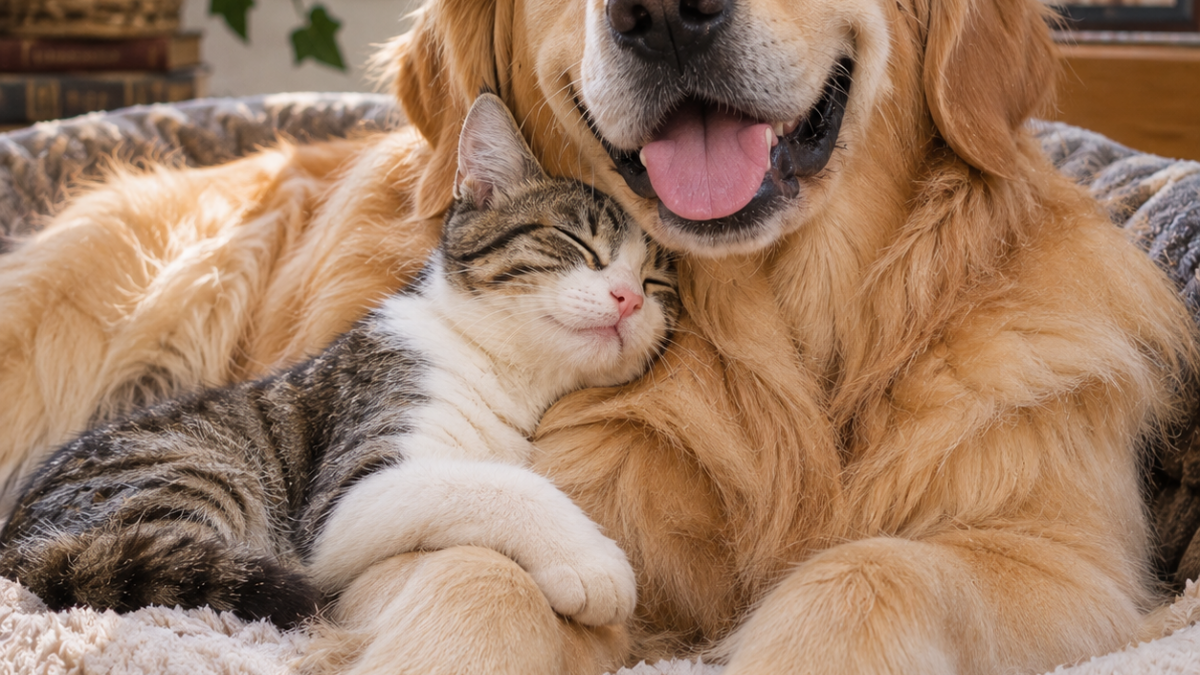
A Stray Kitten Had Nowhere to Go—Then a Golden Retriever Gave Him His Bed, His Warmth, and a Family
The tiny stray kitten had spent weeks hiding beneath a family’s porch, running from every human who came near him—until their enormous golden retriever walked outside one rainy morning, lowered himself onto the wet grass, and quietly waited for the frightened little animal to decide whether he was safe.
Within months, the kitten was sleeping against the dog’s chest, eating beside him, following him from room to room, and treating the gentle retriever less like another pet than the first family member who had ever made the world feel safe.
Then, three years later, the dog’s bed became suddenly empty—and when the family found the grown cat curled beside his old stuffed toy night after night, they realized the little stray had never forgotten who had first given him a home.
In the spring of 2021, the Benson family first noticed the kitten because their golden retriever would not stop staring through the kitchen window.
Cooper had always been a watcher.
At nine years old, the large golden retriever had reached the stage of life where urgency rarely interested him.
Doorbell?
Maybe he would lift his head.
Mail carrier?
Not worth getting off the rug.
Squirrel on the bird feeder?
He had given up that argument years earlier.
But that morning, Cooper stood completely still beside the sliding glass door, nose almost touching the window.
Emily Benson noticed while pouring coffee.
“What are you looking at?”
Cooper’s tail moved once.
Emily followed his gaze.
At first she saw nothing.
Their backyard outside Portland, Maine, was still damp from overnight rain. Water clung to the grass. The hydrangeas along the fence had only begun showing green after a long winter, and a thin layer of fog rested between the houses.
Then something moved beneath the old wooden bench near the shed.
Small.
Gray.
Too small to be one of the neighborhood cats.
Emily stepped closer.
A kitten stared back at her.
He could not have been more than eight or nine weeks old.
His fur was dark gray with faint stripes along his sides.
One ear appeared slightly larger than the other.
His face was narrow from hunger.
His eyes looked enormous.
The second Emily touched the door handle, the kitten disappeared beneath the shed.
“Oh.”
Cooper turned toward her.
“You scared him.”
Cooper looked offended.
Emily smiled.
“Okay. I scared him.”
She poured a little cat food onto a saucer.
PART2:
They did not own a cat, but Emily’s sister had left several cans after visiting with her own senior tabby.
Emily carried the food outside.
Cooper followed.
“Stay.”
The dog stopped near the door.
Emily placed the saucer beside the bench and backed away.
Nothing happened.
She returned inside.
Twenty minutes later, the food was gone.
That should have been the entire story.
A hungry stray passes through.
Someone feeds him.
He moves on.
But the kitten returned the following morning.
And the morning after that.
Sometimes he appeared at dawn.
Sometimes just before sunset.
He never approached the house.
Never meowed for attention.
Never rubbed against anyone’s legs like a socialized neighborhood cat.
He simply appeared.
Waited.
Ate if food was available.
Then vanished.
PART3:
Emily mentioned him to her husband, Mark, who worked as an electrician and possessed what Emily jokingly called “the emotional range of a parking meter” when it came to pretending he did not care about animals.
“We are not getting a cat.”
“I didn’t say we were.”
“You have the face.”
“What face?”
“The rescue face.”
Emily laughed.
“There is no rescue face.”
“There absolutely is.”
Their daughter Lily, fourteen, immediately became involved.
By dinner she had named the kitten Shadow.
“You cannot name an animal that doesn’t belong to us,” Mark said.
“Too late.”
“It is literally living under someone else’s shed half the time.”
“His name is Shadow.”
Their son Noah, ten, preferred Rocket.
Emily refused both.
“We don’t know if it’s male or female.”
Lily shrugged.
“Shadow works for both.”
Mark pointed his fork at her.
“Still not our cat.”
Cooper slept beneath the table.
Nobody asked his opinion.
Over the next two weeks, the kitten continued visiting.
Emily contacted neighbors.
Nobody claimed him.
She posted a photograph in two local community groups.
Nothing.
She called the nearby shelter and checked missing-cat reports.
No match.
The kitten had no collar.
No obvious injuries.
Just hunger and fear.
Emily began placing food beneath the porch rather than beside the shed because she wanted to move him gradually closer to the house.
It worked.
Four feet the first few days.
Then two.
Then directly beside the steps.
The kitten tolerated Emily watching from behind the kitchen window.
If she opened the door, he ran.
If Mark appeared, he ran faster.
If the children stepped outside, he disappeared instantly.
But Cooper was different.
The first real encounter happened during a cold rain in early May.
Emily woke to the sound of water striking the bedroom window.
By six-thirty, the backyard had turned dark and glossy.
Cooper stood beside the sliding door.
Again.
Emily came downstairs wearing slippers and one of Mark’s old sweatshirts.
“Is he there?”
Cooper looked outside.
The kitten was beneath the patio table.
Soaked.
His fur clung tightly to his tiny body.
He looked even smaller wet.
Emily’s heart tightened.
“Oh, baby.”
She opened the door.
The kitten immediately backed away.
Cooper stepped forward.
Emily caught his collar.
“No.”
Cooper looked at her.
The kitten froze.
Emily hesitated.
Cooper had lived with cats before.
Years earlier, when Lily was little, Emily’s mother had stayed with them for several months and brought an elderly orange tabby named Henry.
Cooper had spent the entire visit allowing Henry to sleep on him.
He was gentle.
Almost absurdly gentle.
Still, the kitten was tiny.
Emily whispered:
“Easy.”
She released Cooper.
The dog walked onto the patio.
Slowly.
The kitten crouched.
Emily expected him to run.
He did not.
Cooper stopped six feet away.
Then something strange happened.
The large golden retriever lowered himself onto the wet grass.
Not play bow.
Not stalking.
He simply lay down.
Head between his front paws.
Eyes soft.
The kitten stared.
Rain darkened Cooper’s fur.
Emily stood in the doorway getting wet herself because she did not dare move.
For almost a minute, neither animal moved.
Then the kitten took one step.
Stopped.
Another.
Cooper remained perfectly still.
The distance became three feet.
Two.
The kitten stretched his neck forward.
Sniffed.
Cooper’s tail moved once against the grass.
The kitten jumped backward.
Cooper did nothing.
Then the kitten approached again.
This time he reached Cooper’s front paw.
Sniffed it.
Then his nose.
Cooper exhaled.
The kitten flinched.
But did not run.
Emily covered her mouth.
Behind her, Lily whispered:
“Oh my God.”
Emily had not heard her come downstairs.
“Don’t move.”
“I’m not.”
The kitten moved beside Cooper’s face.
Cooper turned his head slightly.
Then licked the top of the kitten’s head.
One enormous golden tongue.
The kitten froze.
Lily nearly laughed.
The kitten looked deeply offended.
Cooper licked him again.
And somehow, instead of fleeing, the kitten sat down.
Right beside him.
Rain continued falling.
The dog and kitten remained there together.
Emily eventually put a towel near the door and stepped back.
Cooper stood.
Walked inside.
The kitten watched him.
For a moment, Emily thought that was it.
Then Cooper turned around.
Looked at the kitten.
Walked back two steps.
The kitten followed him onto the patio.
Emily stopped breathing.
Cooper walked inside.
The kitten placed one paw across the threshold.
Then another.
Mark came downstairs at exactly the wrong moment.
He stopped halfway into the kitchen.
“No.”
Emily whispered:
“Do not ruin this.”
“I said we were not getting a cat.”
“We are not.”
Mark pointed toward the kitten standing inside their kitchen.
“There is currently a cat in our house.”
“He came in himself.”
“That does not make him legally responsible for the lease.”
Lily started laughing.
The kitten startled and ran.
Not outside.
Under the kitchen table.
Cooper immediately lay beside the table.
The kitten pressed himself against Cooper’s side.
Everyone went quiet.
Mark looked at Emily.
Emily said nothing.
Mark sighed.
“This is how it happens, isn’t it?”
“Yes.”
“I hate all of you.”
Noah appeared in the hallway.
“Do we have a cat?”
“No.”
“Yes,” Lily said simultaneously.
The kitten stayed inside for eleven minutes.
Then ran back outside when Noah moved too quickly.
Emily did not try to stop him.
The next day he came in again.
Fifteen minutes.
Then thirty.
By the end of the week, he would enter whenever Cooper was near the door.
Humans remained suspicious.
Cooper had apparently been approved.
The kitten began following him.
If Cooper went outside, the kitten appeared from beneath the porch.
If Cooper lay in the grass, the kitten sat nearby.
If Cooper walked toward the back gate, a little gray shadow followed six feet behind.
That was when the name Shadow became permanent.
Mark objected for approximately two more days.
Then Emily caught him one evening sitting on the porch with a bowl of food beside his boot.
Shadow was eating from it.
Mark looked up.
“Don’t.”
Emily smiled.
“I didn’t say anything.”
“You’re thinking loudly.”
A week later, they trapped Shadow gently using food and took him to the veterinarian.
He weighed three pounds.
Male.
Approximately ten weeks old.
No microchip.
No major illness.
Fleas.
Mild ear mites.
Underweight.
Otherwise healthy.
The veterinarian asked whether they planned to keep him.
Mark answered first.
“No.”
Shadow was sitting inside the carrier pressed against Cooper’s nose through the door.
The veterinarian looked at them.
Then back at Mark.
“Okay.”
Mark sighed.
“Why does everyone say it like that?”
The family officially adopted Shadow three days later.
The first month inside the house was not easy.
Shadow trusted Cooper.
That did not mean he trusted people.
Lily wanted desperately to hold him.
Shadow disagreed.
Noah moved too quickly.
Shadow hid.
Mark sneezed once while Shadow was eating and did not see the kitten again for three hours.
Emily learned to sit on the floor and pretend he did not exist.
No reaching.
No grabbing.
No staring.
Eventually Shadow came closer.
He sniffed her hand.
One afternoon, while Emily read on the couch, Shadow jumped onto the cushion beside Cooper.
Cooper was asleep.
Shadow crawled across his back.
Settled between the dog’s shoulder and Emily’s leg.
Emily did not move for forty minutes because she was afraid to ruin it.
The next day Shadow touched her hand with his nose.
Three days later he accepted one finger beneath his chin.
The first time he purred for her, Emily cried.
Mark found this ridiculous.
Until Shadow purred for him.
Then Mark sat motionless in his recliner for nearly an hour while the kitten slept against his stomach.
When Emily walked through, Mark whispered:
“Don’t tell the kids.”
“You know they’re going to see you.”
“I have a reputation.”
“With whom?”
“Myself.”
Shadow’s world expanded slowly.
Kitchen.
Living room.
Hallway.
Stairs.
Bedrooms.
He remained nervous around unfamiliar visitors.
Doorbell meant immediate disappearance.
Vacuum cleaner meant apocalypse.
But Cooper remained his constant point of safety.
If something frightened Shadow, he looked for Cooper.
Thunder?
Cooper.
Visitors?
Cooper.
A dropped pan?
Cooper.
The first time Mark’s brother arrived wearing a motorcycle helmet, Shadow vanished behind the couch.
Cooper walked over.
Lay down.
Within five minutes, a gray head appeared beside his belly.
Emily began noticing smaller rituals.
Every morning Cooper waited beside the kitchen counter while Mark prepared coffee.
Shadow began waiting too.
Cooper received one piece of banana.
Shadow sniffed it once, decided bananas were offensive, but continued attending the ceremony.
At five in the evening, Cooper sat near the pantry because dinner happened at five-thirty.
Shadow joined him.
At night, Cooper slept on a large orthopedic dog bed beside the fireplace.
Shadow had his own expensive cat bed near the window.
He ignored it.
For the first few weeks, he slept beneath the couch.
Then one evening Emily came downstairs after midnight and found him curled against Cooper’s stomach.
The golden retriever had one front leg draped loosely around the kitten.
Emily took a photograph.
The next night, same thing.
Then again.
Eventually Cooper’s bed became theirs.
Shadow grew.
By fall, he was no longer tiny.
His gray coat became thick and soft.
The faint kitten stripes remained along his tail.
His eyes changed from blue-gray to pale green.
He developed an absurdly fluffy chest.
He also developed confidence.
Too much sometimes.
He learned that Cooper would not defend his toys.
So Shadow stole them.
A tennis ball bigger than his head.
Cooper’s rope.
A stuffed duck.
Most importantly, a faded stuffed moose Cooper had owned since puppyhood.
The moose was missing one antler and had been repaired so many times nobody remembered its original color.
Cooper carried it to bed almost every night.
One afternoon, Emily found Shadow dragging the moose across the hallway by one leg.
Cooper followed.
Not retrieving.
Just following.
“Shadow.”
The cat continued.
“That’s Cooper’s.”
Shadow reached the dog bed.
Dropped the moose.
Climbed onto it.
Cooper lay beside him.
Emily shook her head.
“Fine.”
After that, the stuffed moose belonged to both of them.
Winter came.
Maine winters are difficult even when you have a roof.
For a kitten that had once lived outside, the first snow produced fascination.
Shadow sat at the sliding door watching flakes fall.
Cooper came beside him.
The dog wanted outside.
Shadow apparently did too.
Emily opened the door.
Cooper walked into six inches of snow.
Shadow followed.
His first paw disappeared.
He launched backward.
Straight into the kitchen.
The family laughed for several minutes.
Shadow spent the rest of the winter observing snow safely through glass.
Cooper came inside carrying it on his fur.
Shadow waited at the door and attacked the melting snowballs attached to his legs.
The two animals became a neighborhood curiosity.
People walking past often saw them together in the front window.
Large golden dog.
Gray cat beside him.
Sometimes Shadow sat between Cooper’s front paws.
Sometimes on his back.
Once on his head.
Mark took a picture.
“That cat has no respect.”
Lily replied:
“Cooper loves him.”
“He tolerates him.”
Cooper turned and licked Shadow’s face.
Lily pointed.
“Exhibit A.”
Mark surrendered.
During Shadow’s first year, the family tried to understand where he had come from.
Nobody ever claimed him.
No similar cats were reported missing.
The most likely explanation was that his mother had been an unowned outdoor cat or that someone had abandoned a litter nearby.
Emily sometimes wondered whether there had been siblings.
Whether his mother survived.
Whether he remembered any of them.
There were no answers.
That bothered her more than it seemed to bother Shadow.
Animals are often better than humans at living without complete histories.
Shadow knew what existed now.
Food.
Warmth.
People.
And Cooper.
Especially Cooper.
In the summer of 2022, Cooper turned ten.
The family held a ridiculous backyard birthday party.
Lily made a dog-safe cake.
Noah created a paper crown.
Cooper wore it for approximately twelve seconds before Shadow removed it.
The cat then attacked the ribbon.
Mark recorded the entire thing.
That video became one of their favorites.
Cooper sitting patiently.
Shadow destroying the crown beside him.
Lily laughing.
Emily telling Noah not to feed the dog more cake.
Mark behind the camera saying:
“This is why we can’t have nice things.”
Nothing extraordinary.
That became important later.
At the time, it was only Tuesday evening.
The following spring, Cooper began slowing.
Not dramatically.
He still walked.
Still ate.
Still wagged his tail whenever Mark said “truck.”
But the stairs took longer.
He no longer jumped into the SUV without help.
Some mornings his hips were stiff.
The veterinarian diagnosed arthritis.
Normal for an older golden retriever.
Medication helped.
They bought ramps.
A newer orthopedic bed.
Shadow immediately claimed that too.
Cooper accepted the arrangement.
By then Shadow was fully grown.
Eleven pounds.
Confident inside his home.
Terrified of delivery drivers.
Obsessed with sunbeams.
He still slept with Cooper.
Even when there was barely room.
Sometimes he curled against the old dog’s back.
Other times beneath his chin.
On particularly cold nights, he tucked himself between Cooper’s front legs exactly as he had when tiny.
Emily often watched them.
She knew Cooper was aging.
Everyone did.
But aging is easy to acknowledge abstractly.
You notice gray around the muzzle.
You buy joint supplements.
You stop throwing the ball so far.
You say:
“He’s getting old.”
But you do not necessarily allow yourself to imagine the empty space afterward.
In late 2023, Cooper stopped finishing breakfast.
That frightened Mark.
Cooper had never refused food in his life.
The veterinarian ran tests.
Bloodwork.
X-rays.
Ultrasound.
A mass near the spleen.
The word cancer entered the Benson house quietly.
No dramatic announcement.
Just Emily and Mark sitting inside an examination room while Cooper lay on the floor between them.
Shadow was at home.
Dr. Karen Whitfield spoke gently.
“There are options.”
Surgery.
Possible chemotherapy.
More imaging.
But Cooper was eleven.
Almost twelve.
His heart showed signs of disease.
His hips hurt.
The tumor might already have spread.
Mark asked:
“What would you do if he were yours?”
Veterinarians hate that question.
Dr. Whitfield looked at Cooper anyway.
“I would ask what gives him the most good days.”
Emily began crying.
Not because the answer was clear.
Because it was.
They chose comfort-focused treatment.
Medication.
Monitoring.
Food he loved.
Walks when he wanted.
No heroic interventions designed more for the humans’ fear than the dog’s comfort.
They did not tell the children everything immediately.
Lily was seventeen now.
She knew as soon as she saw Emily’s face.
Noah, thirteen, asked:
“He’s going to die?”
Mark sat beside him.
“Yes.”
“Soon?”
“We don’t know.”
Noah cried.
Shadow watched from the hallway.
Then walked into the room and climbed onto Cooper.
That became the family’s pattern over the next months.
People cried.
Shadow stayed with Cooper.
January was good.
February mostly good.
March mixed.
Some mornings Cooper ate enthusiastically and walked to the mailbox.
Some mornings he barely lifted his head.
Shadow adjusted.
When Cooper stopped climbing the stairs, Shadow stopped sleeping upstairs entirely.
His cat tree remained beside Lily’s room.
His heated window bed remained in the guest room.
He ignored both.
Every night, he slept downstairs beside Cooper.
Emily once tried carrying Shadow upstairs because she worried he needed normal routine.
The cat immediately returned downstairs.
She never tried again.
Cooper’s world became smaller.
Backyard.
Living room.
Kitchen.
Short walks.
Shadow’s world became smaller with him.
The old stuffed moose remained between them.
One afternoon Cooper experienced a collapse.
He stood after drinking water.
Took three steps.
Then his legs gave out.
Emily screamed for Mark.
They rushed him to the emergency veterinarian.
Internal bleeding from the tumor.
Temporary stabilization was possible.
Surgery offered uncertain benefit.
The veterinarian explained.
The family understood.
Cooper returned home that evening.
They knew they were close.
Nobody said how close.
Shadow reacted before anyone else.
The moment Cooper entered, the cat sniffed him for almost a full minute.
Hospital smells.
Antiseptic.
Other animals.
Medication.
Something else.
Shadow followed him to the bed.
That night, he did not curl against Cooper immediately.
He sat beside him.
Watching.
At 2:00 a.m., Emily came downstairs.
Shadow was still awake.
Cooper slept.
The cat touched one paw to the dog’s shoulder.
Then finally lay down.
Three days later, Cooper stopped eating.
Not treats.
Not chicken.
Not peanut butter.
Mark called Dr. Whitfield.
She came to the house the following afternoon.
The family gathered in the living room.
Cooper lay on his bed beside the fireplace.
The old stuffed moose beneath his chin.
Shadow sat three feet away.
Emily had wondered whether they should remove him.
Dr. Whitfield said no.
“If he wants to stay, let him.”
Lily sat on the floor.
Noah beside her.
Mark rested one hand on Cooper’s back.
Emily held his front paw.
They told him everything people tell dogs at the end.
You were good.
You were loved.
Thank you.
I’m sorry.
We’re here.
Cooper’s breathing slowed after the sedative.
Shadow approached.
He sniffed Cooper’s face.
Then his paw.
Then sat.
No panic.
No dramatic sound.
Just watching.
Mark whispered:
“Hey, buddy.”
Cooper opened his eyes once.
Shadow moved closer.
Pressed his forehead against the dog’s cheek.
Emily broke.
Dr. Whitfield waited.
Then administered the final medication.
Cooper’s chest rose.
Fell.
Rose once more.
Then stopped.
Nobody moved.
Shadow remained beside him.
Noah asked:
“Does he know?”
Dr. Whitfield answered carefully.
“He knows something changed.”
Shadow sniffed Cooper again.
Then lay down beside his chest.
Lily started crying harder.
They gave him time.
Ten minutes.
Twenty.
Shadow eventually stood.
Walked around Cooper.
Sniffed.
Then sat near the bed.
Only after that did the family allow the veterinary service to carry Cooper away.
Shadow watched from the hallway.
The front door closed.
Silence.
And for the first time since Shadow had arrived as a tiny stray kitten, Cooper did not come back.
That evening, Shadow searched the house.
Kitchen first.
Then hallway.
Back door.
Living room.
He went upstairs.
Returned.
He checked Mark’s office.
The children’s rooms.
The laundry room.
At midnight, Emily found him beside the front door.
Sitting.
Waiting.
“Baby.”
Shadow looked at her.
She sat on the floor.
“He’s not coming back.”
The cat walked away.
Emily cried alone in the hallway.
The next morning, Shadow refused breakfast.
That frightened them.
He had never refused breakfast.
Mark warmed wet food.
Nothing.
Tuna.
Nothing.
Shadow went to Cooper’s empty bed.
The stuffed moose remained there.
They had not moved anything.
He curled beside it.
Mark stood watching.
“Leave it.”
Emily nodded.
They did.
The bed remained.
The blanket.
The moose.
Even Cooper’s water bowl stayed for several days because nobody could bring themselves to pick it up.
Shadow spent hours on the bed.
Sometimes sleeping.
Sometimes awake.
He began waiting by the sliding door around the time Cooper normally went outside in the evening.
At five-thirty he sat near the pantry.
Dinner routine.
Then looked toward the hallway.
Cooper never arrived.
For the first week, Shadow checked the front door whenever a vehicle entered the driveway.
Mark’s truck.
Lily’s friend.
Delivery van.
Each time, the cat appeared.
Waited.
Then walked away.
Emily worried.
“Is this normal?”
Dr. Whitfield said yes.
Or at least not unusual.
Animals can respond to the disappearance of companions with altered appetite, searching behaviors, vocalization, sleep changes, clinginess, withdrawal.
“Keep routines predictable.”
“Give him attention when he asks.”
“Don’t force it.”
“Watch his eating.”
They did.
Shadow began eating again on the third day.
Not much.
Enough.
At night, he slept on Cooper’s bed.
Always.
Then something happened about two weeks later.
Thomas? No, different story. Here perhaps Lily placed framed photo of Cooper on shelf near bed. Shadow noticed.
Lily printed a photograph from Cooper’s tenth birthday.
Cooper wearing the paper crown.
Shadow beside him destroying the ribbon.
She placed it on a low shelf near the fireplace.
The next morning, Emily found Shadow sitting beneath it.
Probably coincidence.
He had always liked that corner.
Still.
Emily took a photograph.
Later that afternoon, Shadow fell asleep directly below Cooper’s picture.
His body curved around the stuffed moose.
Emily sent the image to Mark.
He replied with one word.
Damn.
That evening Mark came home and sat on the floor beside Shadow.
The cat lifted his head.
Mark touched the stuffed moose.
“You miss him too?”
Shadow closed his eyes.
Mark stayed there for almost an hour.
Grief changed the house.
Not dramatically.
Nothing stopped.
Bills arrived.
Noah went to school.
Lily graduated.
Mark worked.
Emily cooked.
Laundry accumulated.
Cars needed gas.
Life kept moving with almost insulting efficiency.
But Cooper was missing from hundreds of tiny places.
No nails clicking across the kitchen floor.
No nose appearing beside the table.
No golden face at the window.
No heavy body leaning against Mark’s legs while he tied work boots.
And for Shadow:
No warm body in the dog bed.
No one to follow into the yard.
No dog standing beside the pantry at five.
No broad back to sleep against.
Sometimes Shadow’s grief made the humans notice their own.
One evening Mark automatically broke off the end of a banana.
He turned.
No Cooper.
He stood holding the piece.
Shadow watched from the counter.
Mark laughed sadly.
“Your brother hated bananas.”
Shadow blinked.
Mark ate the piece himself.
Another night, Noah dropped popcorn.
His first instinct was not to pick it up.
Cooper would have.
Then he remembered.
Shadow sniffed the popcorn and walked away.
Noah cried.
Emily found him on the kitchen floor.
She did not tell him it was silly.
Grief often hides inside ordinary habits.
Summer came.
Shadow changed gradually.
He returned to the windows.
Played again.
Chased bugs.
Stole Lily’s hair ties.
Slept sometimes upstairs.
But Cooper’s bed remained part of his world.
The family had intended to remove it eventually.
They never did.
Mark washed the blue cover once.
Shadow sat outside the laundry room until it returned.
Mark apologized.
“Okay.”
“I get it.”
The stuffed moose became even more important.
Shadow groomed it.
Slept on it.
Dragged it occasionally from room to room.
One morning Emily found it upstairs beside her bed.
“How did you carry that thing up here?”
Shadow offered no explanation.
The moose was nearly his size.
By the end of 2024, Cooper had been gone eight months.
The sharpest grief softened.
Not disappeared.
Softened.
The family could watch old videos without always crying.
Sometimes they laughed first.
That helped.
They created a photo album.
Cooper as a puppy.
Cooper with baby Lily.
Cooper beside Noah’s crib.
Cooper wearing Christmas antlers.
Cooper covered in mud.
Cooper meeting Shadow in the rain.
That photograph had been taken by Lily through the kitchen window.
The quality was poor.
Rain streaked the glass.
Cooper lay on wet grass.
Tiny Shadow stood beside his front paw.
Emily stared at it for a long time.
“That’s the beginning.”
Lily nodded.
“He looks so small.”
Shadow, now a full-grown cat, slept on the couch behind them.
The difference was almost absurd.
Mark said:
“He was basically ears.”
That became another family joke.
They eventually hung the rain photograph beside Cooper’s framed portrait.
Shadow occasionally sat beneath both.
Nobody claimed he understood photographs.
They knew better than to create certainty where none existed.
But the family also stopped dismissing what they saw.
He remembered Cooper somehow.
Of that they were certain.
Maybe not as a human remembers.
Maybe there were no mental pictures.
No narrative.
No concept of death.
But familiar places held meaning.
The bed.
The toy.
The routines.
The smell lingering in old fabric.
The absence itself.
Those were forms of memory too.
A year after Cooper died, Emily considered adopting another dog.
She felt guilty for considering it.
Then guilty for feeling guilty.
Mark understood.
“No dog replaces him.”
“I know.”
“Then what’s the problem?”
“It feels…”
She searched.
“Disloyal.”
Mark nodded.
“Yeah.”
They did not adopt then.
Not because of Shadow.
Because they were not ready.
Six months later, a foster organization contacted Emily about an older golden mix named Daisy.
Seven years old.
Owner died.
Quiet.
Good with cats.
Emily hesitated.
Then agreed to foster for one weekend.
Daisy entered the Benson house cautiously.
Shadow vanished.
Not under the couch.
Upstairs.
He watched from the landing.
Daisy sniffed Cooper’s old bed.
Emily’s heart tightened.
“Not that one.”
She immediately felt ridiculous.
Daisy did not understand.
Mark moved a newer dog bed near the kitchen.
Daisy accepted it.
Shadow remained upstairs for most of the day.
That evening, Daisy lay near Mark’s chair.
Shadow appeared halfway down the stairs.
Watched.
Daisy looked up.
No chase.
No bark.
Shadow came one step lower.
Then another.
Emily did not breathe.
The interaction took three days.
Nothing like Cooper.
No immediate magical connection.
Shadow was an adult now.
Careful.
Daisy was gentle but uncertain.
Eventually they sniffed noses.
Then separated.
A week later they could share the room.
A month later Shadow slept on the couch while Daisy slept below.
The family adopted her.
But Shadow never gave Daisy Cooper’s bed.
Daisy seemed to understand—or, more realistically, simply preferred her own.
Cooper’s bed remained near the fireplace.
Shadow still slept there sometimes.
Especially in winter.
The stuffed moose stayed too.
Daisy once picked it up.
Shadow appeared from nowhere.
He walked directly toward her.
Stopped.
Stared.
Daisy dropped the moose.
Mark burst out laughing.
“Okay. Apparently inheritance law is very clear.”
Lily, home from college, said:
“That’s his.”
“Daisy just discovered that.”
Shadow carried the moose back to Cooper’s bed.
The family never moved it again.
Years passed.
Shadow aged.
His face broadened.
His movements slowed.
The tiny stray kitten became the senior animal in the house.
Daisy eventually passed too, years later.
Another grief.
Different.
Shadow mourned differently.
He searched less.
Maybe age.
Maybe experience.
Maybe their relationship had simply been different.
He slept on Daisy’s bed twice.
Then returned to Cooper’s.
Emily noticed.
So did Mark.
Neither said anything.
When Shadow reached eleven, his veterinarian diagnosed early kidney disease.
Manageable.
Medication.
Diet.
Fluids eventually.
Emily had seen enough aging animals to recognize the road.
She hated it anyway.
At twelve, Shadow began sleeping more.
At thirteen, he stopped jumping onto the kitchen counter.
Mark built him a small set of wooden steps to the couch.
At fourteen, arthritis entered his hips.
The family joked that he was finally becoming the old cat Mark originally wanted all those years earlier.
Mark scratched his chin.
“Took you long enough.”
Shadow purred.
The stuffed moose, repaired again and again, remained in his bed.
By then the fabric had almost no original stuffing.
One eye gone.
Both antlers missing.
Emily suggested retiring it for safety.
Lily, now married and living in Boston, objected immediately.
“You cannot throw away the moose.”
“I said retire.”
“Same thing.”
Mark sided with Lily.
The moose stayed.
Shadow turned fifteen.
His kidney disease worsened.
Emily had to give fluids beneath the skin twice a week.
Shadow hated needles.
He tolerated Emily.
Mark offered treats afterward.
Shadow accepted.
He had become affectionate in old age.
The kitten who once ran whenever a human opened the door now slept on Emily’s chest.
He waited outside the bathroom for Mark.
He allowed Noah—now an adult living in New Hampshire—to pick him up briefly when visiting.
Time had changed him.
Or safety had.
One evening, Lily sat beside him near the fireplace.
She had brought her own four-year-old daughter, Sophie.
The little girl had grown up hearing Cooper stories.
She pointed toward the framed photograph.
“Big dog.”
Lily smiled.
“That was Cooper.”
“Shadow’s dog?”
Lily laughed.
“In a way.”
Sophie looked at the old cat.
“Where Cooper?”
Lily paused.
“He died a long time ago.”
The child considered.
“Shadow sad?”
Lily looked toward Shadow curled beside the stuffed moose.
“Yeah.”
“He was.”
Sophie touched the edge of the bed.
“Still sad?”
Lily did not know.
Maybe.
Maybe grief changes until it stops looking like grief and becomes simply part of love.
She answered:
“I think he remembers.”
At sixteen, Shadow became very thin.
The veterinarian increased supportive care.
There were still good days.
Sunshine through windows.
Warm blankets.
Chicken.
Slow walks to the patio.
He no longer went far outside.
Sometimes he sat exactly where Cooper had first lain in the rain.
Emily noticed the first time.
She called Mark.
“Look.”
Shadow rested in the grass.
Same place.
Mark leaned against the door.
“Coincidence.”
“Probably.”
Neither moved him.
One fall morning, Shadow refused breakfast.
Emily knew.
Not immediately.
But somewhere inside, she knew.
By afternoon he had eaten a little.
The next day nothing.
Bloodwork showed his kidneys were failing rapidly.
Hospitalization might buy time.
Not much.
Emily and Mark sat inside another veterinary examination room.
Older now.
Gray in Mark’s beard.
Lines around Emily’s eyes.
Shadow lay wrapped in a blanket.
Dr. Whitfield had retired years earlier.
The younger veterinarian explained gently.
Options.
Fluids.
Hospital.
Feeding support.
Maybe days.
Maybe weeks.
Mark looked at Emily.
She remembered Cooper.
Good days.
Comfort.
No heroic measures for fear alone.
“Can we take him home?”
“Yes.”
They did.
Lily came from Boston.
Noah drove down.
Sophie, now old enough to understand more, came too.
Shadow spent his final evening beside the fireplace.
On Cooper’s bed.
The family had replaced its foam several times over the years, but the outer cover remained the same.
The old stuffed moose lay beside him.
Emily placed Cooper’s photograph on the floor near the bed.
Not because she believed Shadow needed a photograph.
Because she did.
Mark sat in his old recliner.
“Do you remember that first morning?”
Emily smiled.
“Rain.”
“He ruined my plan.”
“What plan?”
“Not getting a cat.”
Emily laughed.
“You never had a chance.”
Mark looked at Shadow.
“No.”
Lily sat cross-legged on the floor.
“He chose Cooper first.”
Emily nodded.
“Absolutely.”
Noah smiled.
“Then tolerated us.”
“That sounds right.”
Shadow slept.
At some point he woke and moved his paw.
Touched the stuffed moose.
Lily began crying.
The veterinarian arrived the next morning.
Home visit.
Same choice they had given Cooper.
Peace.
Familiar place.
Family.
Shadow was sixteen.
Far older than anyone would have predicted for the frightened, underweight stray beneath the shed.
The veterinarian explained each step.
Emily listened.
Mark stroked Shadow’s back.
Lily held the old moose.
Noah touched the cat’s paw.
Before the sedative, Emily whispered:
“You had a good life.”
Shadow’s eyes opened slightly.
“You came here with nothing.”
Mark shook his head.
“No.”
Everyone looked at him.
Mark smiled through tears.
“He came with attitude.”
Lily laughed.
Shadow purred faintly.
Maybe from the touch.
Maybe reflex.
Maybe comfort.
It did not matter.
Emily placed the moose beside him again.
The sedative made Shadow relax.
His breathing slowed.
For the first time in hours, the tension left his body.
Emily looked at Cooper’s photograph.
Golden retriever.
Young enough there to still have color around his muzzle.
Shadow beside him.
Tiny.
Safe.
Her throat closed.
“You found the right house, baby.”
Mark whispered:
“No.”
Emily looked at him.
“Cooper found him.”
That was true too.
The final medication went in.
Shadow exhaled.
His paw remained touching the stuffed moose.
Then his breathing stopped.
Sixteen years after appearing beneath their shed, the stray kitten was gone.
The house became quiet again.
Not the same quiet as after Cooper.
Older.
Layered.
Full of history.
They cremated Shadow.
Emily placed his urn beside Cooper’s.
Mark objected to calling it an urn shelf.
“It sounds depressing.”
“What should we call it?”
“The boys.”
So that became the family phrase.
Cooper and Shadow.
The boys.
Their photographs stayed near the fireplace.
The old stuffed moose sat between them.
Lily asked if Emily wanted to throw away the bed.
Emily stared at it.
Then laughed.
“Absolutely not.”
Sophie inherited the moose years later.
By then it was too fragile to play with.
Lily placed it on a shelf inside Sophie’s room.
When Sophie asked why an ugly stuffed animal mattered so much, Lily told her the story.
About a rainy morning.
A terrified kitten.
A golden retriever lying down in wet grass.
About patience.
About trust.
About how sometimes family begins before anybody officially decides anything.
The story changed slightly with each retelling.
Not the facts.
The emphasis.
When Emily told it, she remembered Cooper lying in the rain.
When Mark told it, he emphasized that he repeatedly said they were not getting a cat and nobody respected his authority.
When Lily told it, she remembered the first night Shadow slept beside Cooper.
When Noah told it, he remembered how Shadow stole the stuffed moose.
But all versions ended the same.
Cooper died first.
Shadow kept returning to his bed.
And many years later, when Shadow reached the end of his own life, that same bed was where he chose to rest.
People sometimes asked whether the family believed Shadow truly grieved for Cooper.
Emily became careful about answering.
She did not claim to know what happened inside a cat’s mind.
She knew animals were not tiny humans in fur.
She knew scent, routine, territory, safety, and attachment all shaped behavior.
But she also knew what she had watched.
Shadow searched for Cooper.
Shadow stopped eating temporarily.
Shadow returned to his bed.
Shadow guarded the toy they had shared.
Shadow continued choosing those places long after other options existed.
Call it grief.
Call it attachment.
Call it memory.
The label mattered less than the relationship.
Something real had existed between them.
That was enough.
The family eventually created a small garden beside the back patio.
Not a pet cemetery.
They kept the ashes inside.
Just a place.
Golden flowers for Cooper.
Silver-green plants for Shadow.
A flat stone in the center.
Lily chose the words:
YOU MADE ROOM FOR EACH OTHER.
Mark complained.
“Too sentimental.”
Emily asked:
“What would you write?”
Mark considered.
Then smiled.
COOPER: GOOD DOG.
SHADOW: UNAUTHORIZED TENANT.
Everybody laughed.
They kept Lily’s version.
Years later, a new kitten belonging to Sophie visited the Benson house.
Tiny.
Black.
Fearless.
He walked into the living room.
Sniffed Cooper’s old bed, which still remained beside the fireplace long after anyone practical would have thrown it out.
Then climbed directly into it.
Emily froze.
Lily saw.
“Oh no.”
“What?”
“You’re doing the face.”
“What face?”
“The rescue face.”
Emily laughed.
The family had come full circle.
But this kitten had a home already.
Sophie scooped him up.
“He likes the bed.”
Emily touched the faded fabric.
“So did somebody else.”
That evening, after everyone left, Emily sat beside the fireplace.
Mark joined her.
They were both older now.
The house quieter.
Children grown.
Grandchildren appearing on weekends.
Animals reduced to photographs and stories and objects nobody could quite throw away.
Mark looked toward Cooper’s picture.
“Do you ever think about what would’ve happened if he chased Shadow that morning?”
Emily nodded.
“Sometimes.”
“If he barked?”
“Shadow probably runs.”
“Maybe never comes back.”
“Maybe.”
Mark shook his head.
“All he did was lie down.”
Emily smiled.
“That was enough.”
That was the part she loved most.
Cooper did not perform some dramatic rescue.
He did not carry the kitten from danger.
He did not fight another animal.
He did not somehow understand that Shadow was homeless and consciously decide to adopt him in the human sense.
He simply did not frighten him.
He made himself smaller.
Waited.
Allowed a scared animal to approach on his own terms.
Then shared what he already had.
Space.
Warmth.
Safety.
A bed.
For a frightened stray, that changed everything.
Shadow’s life was not saved by one spectacular moment.
It changed through hundreds of ordinary ones.
A dog lying still.
A door being left open.
A bowl appearing every morning.
A human hand waiting instead of grabbing.
A warm body beside him at night.
The same routines repeated until fear became familiarity.
Familiarity became trust.
Trust became home.
By the time Cooper died, Shadow had not been a stray for years.
Yet the places he returned to after losing him were the places where that transformation had happened.
The bed.
The toy.
The fireplace.
The spot by the sliding door.
Maybe that was why the family never viewed his behavior as simply sad.
There was gratitude inside it too.
Cooper had given Shadow something the kitten had never been able to find on his own.
Belonging.
And Shadow had given something back.
Cooper’s later years were quieter because of him.
When arthritis stopped the dog from running, Shadow stayed.
When Cooper slept more, Shadow slept with him.
When the old dog could no longer climb upstairs, Shadow came downstairs.
When Cooper’s world became smaller, Shadow made that small world less lonely.
People often described Cooper as the one who rescued Shadow.
The Benson family eventually stopped seeing it so simply.
Maybe Cooper saved the kitten first.
But years later, when age made Cooper slower and his body began failing, Shadow returned the gift.
He stayed.
Right until the end.
That was family too.
Not who rescued whom.
Who remained.
The rain-soaked kitten beneath the patio had no way to know any of that in 2021.
He knew only hunger.
Cold.
Fear.
Then an enormous golden dog walked toward him.
For every reason a tiny stray kitten might have run, Cooper gave him one reason not to.
He lay down.
And waited.
Shadow stepped closer.
One paw.
Then another.
Cooper licked his head.
The frightened kitten stayed.
Three years later, when Cooper was gone, Shadow kept returning to the places where the old dog had made him feel safest.
The bed.
The toy.
The warmth beside the fireplace.
And more than a decade after that, when Shadow himself was old and tired, he chose that same bed for his final morning.
The first family member he had trusted was no longer there.
But everything Cooper had given him was.
A house.
People who loved him.
Warmth.
Safety.
Sixteen years of belonging.
Cooper may have shared only his bed with a frightened stray kitten.
But to Shadow, he had opened the door to an entire life.
And even after the old golden retriever was gone, the little cat who once had nowhere to belong never forgot where home had begun.








