**A Stray Dog Walked Her Home Every Night—Until One Evening, a Stranger Finally Followed Him**
PART3:
I made a sharp sound, the kind I had once used to frighten chickens away from a garden.
The dog sat down and waited for that foolishness to pass.
By the time I reached my porch, I had tried every ordinary method of discouragement I knew, and none had worked.
The dog sat at the base of my steps with the expression of someone who had arrived exactly where he intended to arrive.
“I am not feeding you,” I told him.
He blinked.
“I mean it.”
He remained seated.
“I have very little to spare.”
He lowered his head to his paws, as if we had concluded negotiations.
I went inside and shut the door.
Then I stood at the window.
For fifteen minutes, he sat at the bottom of my porch steps.
He did not whine.
Did not scratch.
Did not beg.
He simply waited.
Then, as darkness gathered fully along the road, he rose, stretched slowly, and walked back toward town.
I stood at the window long after he disappeared.
That night, I thought about him longer than was reasonable.
I told myself it was because I was practical. A large dog wandering the road might be dangerous. He might belong to someone. He might come back. He might need help.
But beneath all those sensible thoughts was a quieter truth.
For eight months, nothing had followed me home.
Not joy.
Not friendship.
Not desire.
Not hope.
Nothing.
Then, one Tuesday evening, a dog walked thirty feet behind me like he had decided I should not finish the road alone.
He came back on Wednesday.
Same time.
Same road.
Same thirty feet.
I did not try to send him away that time.
I noticed him near the mile marker where the road dipped toward the east field. He stepped out from behind a fence post as if he had been waiting for my appearance on a schedule. I glanced at him, sighed, and kept walking.
“So this is going to be a habit?”
He followed.
When we reached the porch, he sat at the base of the steps.
I went inside.
Then I came back out with a bowl of water.
“I am not feeding you,” I said again, setting it down.
He waited until I had gone back inside before drinking.
On Thursday, I put water out before I left for the shop.
On Friday, I added the end of a piece of bread and a little scrap from my supper, telling myself it was only because waste was a sin and not because I had begun thinking of him between customers.
On Saturday, I sat on the porch steps instead of going inside.
The dog came up the path, paused when he saw me, and sat at the base of the steps below me.
We remained that way for nearly half an hour.
No demands.
No touching.
No performance.
Just two creatures sharing the evening without requiring more from each other than presence.
That was what made me trust him.
Not affection.
Not need.
Patience.
He did not push past what I offered. He did not punish me for offering little. He seemed to understand that some doors opened slowly because someone had once slammed them too hard.
I did not name him at first.
Naming a thing means making room for it inside your life, and I had spent two years clearing rooms of what had once lived there.
But on the second Sunday evening, while he sat below me in the fading light, I looked at his rough coat, the burrs near his hind leg, the scratch across one ear, the quiet endurance of him, and the name came before I could stop it.
“Bramble,” I said.
His ears twitched, but he did not otherwise react.
“That is not your name, is it?”
He looked toward the road.
“No,” I said. “I suppose not.”
But Bramble suited him.
Because I could tell he had walked through things that scratched him to get where he was going.
And still, he kept coming.
By the third week, the town had noticed.
Ruth Mercer spotted him waiting outside my shop one afternoon, lying in the shade across the road with his head on his paws and his eyes fixed on my front door.
“That dog waiting for you again?” she asked when I came in for thread.
“Apparently.”
“Better manners than half the men in town.”
“He does not belong to me.”
“Did I say he did?”
“You implied it.”
“I implied he has taste.”
I paid for my thread.
Ruth looked past me through the window.
“He looks old.”
“Not old. Seasoned.”
“Mm.”
“What does mm mean?”
“It means I am old enough to recognize a woman pretending not to care about something.”
“I care whether he gets run over.”
“Of course.”
“And whether he has water.”
“Naturally.”
“And whether someone is missing him.”
Ruth smiled.
“There it is.”
I looked out at the dog.
He lifted his head as if he knew we were speaking of him.
“I have checked with people,” I said. “No one knows him.”
“Someone knows him.”
That was true.
A dog like that had not grown from the dust.
He had belonged somewhere. To someone. His collar proved it, though I had never examined it closely. He was too steady, too mannered, too purposeful to have always been alone.
That should have made me feel relieved.
Instead, it unsettled me.
If he belonged somewhere, why did he walk with me every night?
And why did part of me dread the day someone came to claim him?
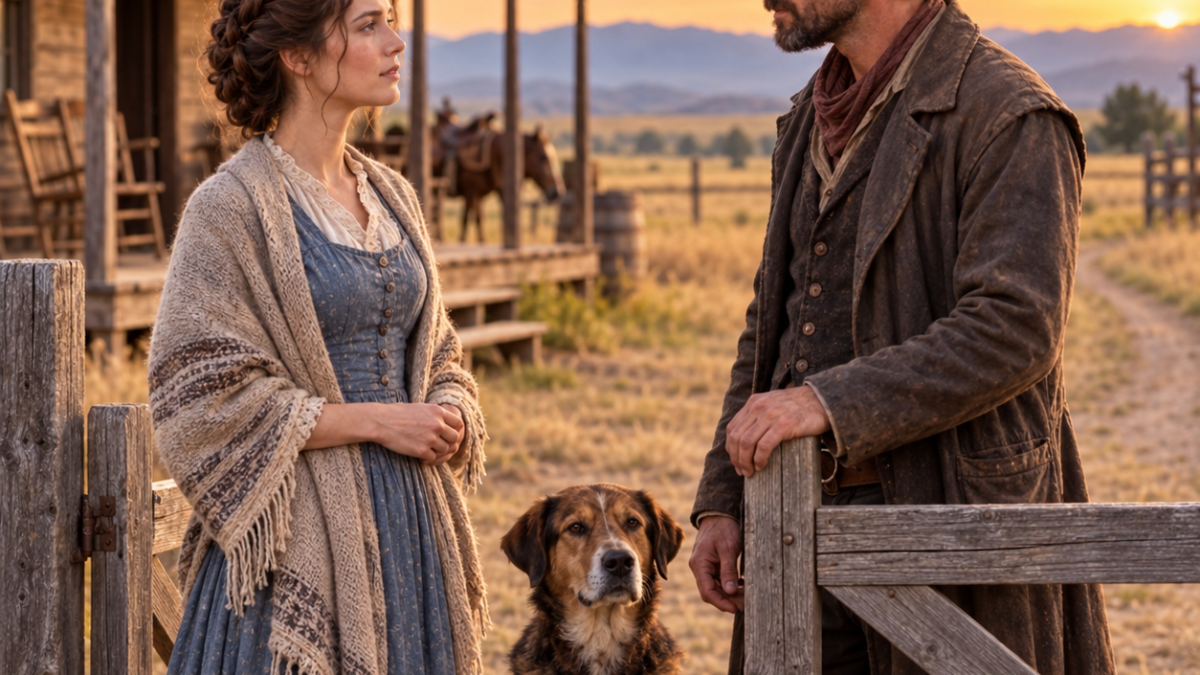
The man came in September, on a Thursday evening.
I was on the porch with Bramble, mending a torn cuff in the last of the light. He sat below the steps, head turned toward the road, ears lifted.
I heard the horse before I saw the rider.
A single horse at the end of the road was unusual enough that I set the shirt aside and stood.
The rider came into view slowly, as though he had been traveling with a question for a long time and was not entirely sure he wanted the answer.
He dismounted at the edge of my property.
Tall. Broad-shouldered. Hat low against the remaining sun. Clothes worn by real weather, not chosen to imitate labor. He held the reins loosely in one hand and looked first at the dog.
“So this is where you come every night,” he said.
Not to me.
To the dog.
Bramble looked at him with calm recognition.
That was the first cut.
Not pain exactly.
A strange little emptiness.
So he did belong to someone.
The man turned to me.
“I’m sorry. I didn’t mean to startle you.”
“You didn’t,” I said.
That was mostly true.
“Is that your dog?”
“Yes.”
The answer should have ended something cleanly.
Instead, it opened a door.
“His name is Rufus,” the man said. “He’s been with my family near ten years.”
Rufus.
The dog’s ears moved slightly at the name.
Of course.
Not Bramble.
Rufus.
A real name. A name worn into him like his collar.
“I’m Caleb Hartwell,” the man continued. “My ranch is about four miles east.”
“Ada Winslow.”
He nodded politely.
“I’ve been trying to figure out where he goes every night for three weeks.”
I looked down at Rufus.
He looked entirely untroubled by this revelation.
“He follows me home,” I said.
“From town?”
“From about a mile out. He walks behind me to the porch. Sits here a while. Then leaves.”
Caleb’s gaze moved from Rufus to the road and back.
Something passed over his face that I could not read.
Grief, maybe.
Or recognition arriving too late to prevent regret.
“I apologize for the intrusion,” he said. “I’ll take him home.”
“It is not an intrusion.”
He paused.
“He chose to come here,” I said. “That is not something you need to apologize for.”
Caleb looked at me then, properly.
His eyes were gray-green, steady in a way that made them difficult to hold.
“No,” he said softly. “I suppose it isn’t.”
He took Rufus home that evening.
I watched them leave with the feeling of someone seeing the end of a thing she had not known she would miss until it turned its back.
The porch looked larger without the dog.
The steps looked foolishly empty.
I went inside.
I did not stand at the window.
Not for long.
Rufus came back the next night.
He was waiting at the mile marker when I closed the shop and started home.
I stopped in the road.
“You are going to make this difficult, aren’t you?”
He wagged his tail once.
The next evening, Caleb came to collect him again.
This time, he stood by the fence instead of riding away immediately.
He had decided, I think, that an explanation was owed.
“My father died last December,” he said.
The words were plain, but his hand tightened slightly around the reins.
“I am sorry.”
He nodded.
“William Hartwell. Seventy-one. Built the ranch from one parcel and more stubbornness than sense.”
I waited.
Caleb looked at Rufus, who lay with his chin on his paws.
“Rufus was his dog.”
There it was.
Not Caleb’s dog, not truly.
His father’s.
“They were inseparable,” Caleb said. “Working dog, yes. Good with cattle when he cared to be. But more than that. He followed my father everywhere. Slept beside his chair. Rode in the wagon. Knew the ranch better than most hired hands.”
He swallowed, and for the first time I saw how tired he was.
“After Father died, Rufus changed. Stopped eating right. Lay in front of Father’s chair for hours. Wouldn’t follow me on work the way he used to follow him. Then three weeks ago, he started disappearing at night. I thought he was hunting. Or running fence.”
Caleb gave a low breath that was almost a laugh and not one at all.
“I did not know he was walking four miles just to walk the final mile behind a stranger.”
I looked at Rufus.
“He never did this for anyone else,” Caleb said. “Not me. Not the hands. My father was the only person Rufus ever chose.”
I held the porch post.
The wood was cool beneath my fingers.
“I never asked him to come.”
“I know.”
“I never made him stay either. I put water out. Food later. But I never called him from you.”
Caleb looked at me then.
“What did you do?”
The question surprised me.
I thought about the first night. The distance. The stopping. The water. The porch. The long quiet.
“Nothing,” I said. “I let him choose.”
Caleb looked at Rufus.
Something settled in his face slowly, as if a truth had been traveling toward him for weeks and had only just arrived.
He took Rufus home again.
And came back the following night.
Not to collect him.
To walk.
It began without being decided.
Caleb rode from his ranch to the mile marker around the time Rufus usually appeared. Then he dismounted, looped the reins loosely around his hand, and walked beside me while his horse followed and Rufus moved between us.
At first, none of us said very much.
That suited me.
It seemed to suit Caleb too.
We walked at Rufus’s pace, which was slower than either of ours would have chosen alone. He kept enough distance from both of us to make the road feel balanced. If I slowed, he slowed. If Caleb slowed, Rufus slowed too.
I began to suspect he was the most accomplished chaperone I had ever met.
During the first week, we talked of practical things.
Weather.
Road conditions.
Thread quality.
Feed costs.
Whether Red Hollow would get a hard winter.
The strange temperament of one of Caleb’s mares, who apparently believed fences were suggestions written for lesser animals.
Then, little by little, the conversations shifted.
Not quickly.
Nothing between Caleb and me happened quickly. I think Rufus would not have allowed it.
Caleb told me about the ranch, not in numbers or acreage, but in character.
The creek that ran clear in spring and thin in late summer.
The west-facing porch his father had built deliberately because he believed a man ought to see something beautiful at the end of every working day.
The old barn door that stuck in damp weather.
The apple tree that refused to bear fruit unless threatened.
The way William Hartwell had known the name of every animal on the property and considered that basic courtesy.
I told Caleb about sewing.
Not simply hems and buttons, but what the work meant. How a garment revealed where a person carried the body differently than a pattern expected. How women apologized for needing alterations, as if fabric’s failure to understand them was a personal flaw. How a torn seam could tell whether a man worked hard, fought hard, or simply took poor care of what he owned.
I told him about the shop I had left in my previous town.
Not everything.
Enough.
The years of work. The customers. The sign I had painted myself. The grief of leaving something I had built because staying near it would have meant staying near the man who had made every room of that town feel unsafe.
Caleb listened.
That was one of the first things I noticed about him.
Not the way women mean when they say a man listened because he did not interrupt for a few minutes. Caleb remembered. He asked about things the next evening. He carried details forward.
If I mentioned a difficult customer, he asked whether the hem had been paid for.
If I said my shoulder hurt from long hours at the machine, he appeared two days later with a small cushion one of his ranch hands swore by for wagon seats.
If I said the road felt shorter lately, he said, “Rufus takes offense to efficiency,” and Rufus wagged as if proud.
One evening, while the mountains stood blue and sharp against a clear September sky, I asked Caleb a question before I knew whether I had the right.
“If the ranch had never belonged to your father, would you still have chosen it?”
He did not answer.
The road stretched ahead of us.
Rufus walked between us, ears relaxed, tail low and easy.
Caleb looked toward the east, where his land lay beyond the rolling fields.
I let the silence remain.
Some questions are not meant to be filled quickly. They are meant to enter a person and find where the walls are.
We were bringing bolts of cloth from the porch of my shop one Tuesday evening when the wind changed suddenly.
Two bolts made it inside.
The third, blue muslin, caught the gust and went sailing across the road like it had remembered a prior ambition to become a flag. It wrapped halfway around a post outside the building opposite mine.
I stood there calculating whether to curse, laugh, or pretend I had meant for it to happen.
Caleb had come into town to collect Rufus, who had spent part of the afternoon asleep in my doorway with the approval of customers and the mild irritation of anyone trying to step over him.
Without being asked, Caleb crossed the road and caught one end of the cloth just as I reached the other.
For a moment, we stood there facing each other, each holding an end of the blue muslin while the wind tried to remain involved.
Rufus sat in the middle of the road and watched.
Then, with calm deliberation, he stood, walked forward, took the trailing edge of the muslin gently in his mouth, and sat back down.
He looked extremely pleased with himself.
“Rufus,” Caleb said.
Rufus held the fabric.
“He does this,” Caleb said.
“With cloth?”
“With things he has decided belong to him.”
“It is my muslin.”
“He is aware.”
“That does not concern him?”
“Not visibly.”
I tugged gently.
Rufus did not release it.
“What did your father do when he decided something belonged to him?”
“Waited.”
“For how long?”
“Once, a full afternoon.”
I looked at Rufus.
Rufus looked back, blue muslin in his mouth, untroubled by human impatience.
I sat on the porch step, still holding my end.
After a second, Caleb sat beside me, holding his.
We remained that way for four minutes while Rufus stared serenely down the road as if performing a public service.
Then he lost interest, dropped the muslin, and lay down in the dirt as though none of it had occurred.
I looked at Caleb.
He had the expression of a man trying not to smile and failing by inches.
Then I laughed.
Not politely.
Not carefully.
The real kind.
It came out before I decided to allow it.
Caleb smiled then too, and something in the late light loosened around us.
The storm came in October.
Colorado storms did not always announce themselves properly. That day had begun clear and ended in violence. I closed the shop early when the wind began driving dust sideways down Main Street. By the time I had walked half the road home, rain was coming hard enough to blur the fence lines.
Rufus was not behind me that evening.
He was ahead.
That frightened me more than his absence would have.
He had turned off the road into the east field and was moving with purpose, head low, ears forward, body cutting through rain like an arrow.
“Rufus!”
He did not stop.
I followed.
Mud grabbed at my boots. My skirt caught on brush. Rain ran down my neck and into my collar. I could barely see ten feet ahead.
Then Rufus barked.
Once.
Sharp.
Commanding.
I found Caleb on the ground near a broken fence section, his horse gone, blood running from a cut at his forehead and rain washing it down his temple.
For a moment, the world narrowed to the sight of him there.
“Caleb!”
His eyes opened.
“Ada?”
“You are bleeding.”
“I noticed.”
“Can you stand?”
“Not as well as I would like.”
His attempt at dry humor might have annoyed me if relief had not struck first.
He was conscious.
Hurt, but conscious.
With difficulty, I got his arm over my shoulders. He was heavier than he looked, and the ground was slick, and it took three attempts before we were both upright. Rufus circled us with the focused energy of an animal supervising incompetence.
My house was closer than the ranch.
So that was where we went.
I do not know how long it took. The storm swallowed time. Caleb leaned heavily on me but tried to pretend he did not. Rufus moved ahead, then back, then ahead again, keeping us on the safest line through the field.
When we reached my porch, my hands were shaking.
Inside, I lit the lamp, got Caleb seated at the kitchen table, and cleaned the cut with what I had. I tore a strip from an old shirt I had been mending and wrapped it around his forehead.
He sat with the patience of a man in pain who had decided not to make it someone else’s problem.
Rufus lay in front of the fireplace as if he had lived there for years.
“Your horse,” I said.
“He’ll find the barn.”
“You are sure?”
“He has more sense than I do.”
I glanced at Rufus.
“I owe that dog an apology,” Caleb said.
“For what?”
“For thinking he was lost.”
The fire cracked softly.
Caleb looked at Rufus with an expression I had begun to recognize: a man putting together pieces he had held separately for too long.
“He was not lost,” Caleb said. “He was doing exactly what he meant to do.”
I added wood to the fire.
Outside, rain battered the windows.
Inside, Rufus sighed like an animal who had completed an important duty.
Then Caleb said, “Maybe he was not following you.”
I turned.
“What do you mean?”
He was looking at the dog.
“Maybe he was trying to bring me here.”
The words entered the room and changed its shape.
I looked at Rufus.
Then at Caleb.
Then at the road beyond the dark window.
All those evenings. The thirty feet. The porch. The return to the ranch. The next night and the next.
Patience as intention.
Not a stray dog choosing a woman.
A grieving dog carrying two lonely people along the same road until they noticed one another.
“Caleb,” I said.
“Yes?”
“Why do you still run the ranch?”
He looked up.
“Because my father built it.”
“Yes,” I said. “But why do you run it?”
He stared at the fire.
For a long while, he did not answer.
Then he said, “Because leaving it feels like leaving him.”
I sat down across from him.
“I know something about that.”
His eyes returned to mine.
“I stayed in my last town two years longer than I should have,” I said. “Because I had built something there. A shop. Customers. A life that proved I could stand on my own. Leaving felt like admitting the building had been wrong.”
The firelight moved across Caleb’s face.
“The building was not wrong,” I said. “The staying was.”
He held the cloth to his forehead.
Outside, the storm began to pass.
“How long does it take,” he asked quietly, “to know the difference?”
I looked at the fire.
“Until you realize you are staying for the thing you built and not for the life you are living.”
He did not speak again for a long time.
But I could see the question I had asked him weeks earlier settling inside him.
Would you still have chosen this ranch if it had never belonged to your father?
Some questions take root before they bloom.
The walks continued through October.
Something had changed after the storm, though neither of us named it.
The same road felt different when you knew it had already led you through danger and back again. Caleb found reasons to come to town during the day now.
A torn strap.
A shirt with a ripped seam.
A jacket that apparently required mending twice in one month, though the second tear looked suspiciously clean.
I accepted the work without comment.
But I was aware, one Wednesday evening while Rufus slept at my feet and I stitched Caleb’s sleeve by lamplight, that I was looking forward to returning the jacket in a way that had nothing to do with the jacket.
I wrote to my sister about it.
Not Caleb directly.
I wrote about the dog, the shop, the October evenings, the walks, the storm, the rancher with quiet eyes, the way Rufus seemed to know things before people did.
My sister wrote back:
You are telling me about the dog, but what you are describing is the man.
I read the sentence twice.
Then I placed the letter in the drawer.
Then I sat by the fire with Rufus and thought, My sister is not wrong.
I also thought, I do not know what to do with that.
Rufus, who had been in my life for two months and seemed to know exactly what to do with everything, placed his head on my foot.
“I should take notes from you,” I told him.
He wagged once.
The letter from Denver arrived in November.
Forwarded from my previous address, delayed long enough to feel less like mail and more like a challenge sent by the life I had once imagined.
I had applied for the position in spring, before the shop in Red Hollow felt like mine, before Rufus, before Caleb, before October evenings with the mountains turning purple ahead of us. I applied because I had promised myself never again to let my future depend on one place, one person, or one fragile hope.
The Denver position was everything a practical woman should want.
Fixed wage.
Large shop.
Reliable customers.
A real opportunity.
The kind of work I had been building toward for a decade.
I read the letter once.
Then again.
Then placed it on the table and stared at it until the words blurred.
Rufus put his head on my foot.
Denver was certainty.
Red Hollow was not.
Denver was income, structure, distance, proof that I had not become trapped again.
Red Hollow was a shop I had built for ten months, a house at the edge of town, evening walks, a dog who followed me with careful patience, and a man who looked at me as though listening was not an effort but a way of honoring what I said.
I thought about the woman I had once been.
The one who stayed too long because she loved what she had built and could not admit the life around it had become unbearable.
I had promised myself I would never do that again.
So I wrote my acceptance.
Then I told Caleb on the next Thursday walk.
Directly.
Without softening.
He listened.
When I finished, he looked at the road ahead.
“Denver,” he said.
“Yes.”
“When?”
“Two weeks.”
Rufus walked between us at his usual pace, requiring us to slow even through heartbreak.
“Say something,” I said.
Caleb held the reins.
“I do not have the right to say what I want to say.”
“What do you want to say?”
“That you should stay.”
My breath caught.
“But not because I am asking you to,” he continued.
I looked at him.
“Because you want to.”
The honesty of it hurt worse than pleading would have.
“I cannot stay for wanting,” I said.
“I know.”
“I have done that before. It cost me everything I had built.”
“I know,” he said again. “That is why I am not asking.”
We walked the rest of the way in silence.
Not the comfortable silence of October.
A different silence.
One with edges.
At my porch, Caleb did not come up the steps.
He took Rufus home.
I stood there until the road went dark.
Then I went inside and did not look out the window.
The next day, I mailed the acceptance letter to Denver.
The two weeks began.
People say waiting makes time slow, but I found the opposite. Those days moved too quickly, each one taking something from me before I had properly said goodbye to it.
I packed my sewing tools.
Sorted accounts.
Finished orders.
Told Ruth, who stared at me for one long minute before saying, “Denver has excellent opportunities and terrible timing.”
“I know.”
“Do you?”
“I think so.”
“Mm.”
“There it is again.”
“It is a versatile sound.”
Caleb came by only when necessary.
Which meant almost not at all.
Rufus still appeared some evenings, but less predictably. When he did, he watched me with those steady brown eyes as if disappointed in the limits of human understanding.
The morning I was to leave, the air was bitter with November cold.
I arrived at the stage station with two cases and a heart I had packed less neatly than my clothes.
Rufus was sitting beside my luggage.
I had not brought him.
He was simply there.
Of course he was.
I looked around.
Caleb was nowhere in sight.
“You need to go home,” I told Rufus.
He did not move.
The stage driver was checking the horses. Other passengers were boarding. Someone complained about the cold. Someone else asked if the road to Denver would be rough after last week’s rain.
I crouched in front of Rufus and placed my hands on either side of his face.
He looked at me.
I thought of the first night.
Thirty feet.
Water at the steps.
Bramble.
Rufus.
The storm.
Caleb at my kitchen table.
Blue muslin in the road.
The Denver letter.
Two weeks of knowing what I was doing and still feeling something tear each time I folded another dress.
“You are the best thing that has happened to me in two years,” I whispered.
To the dog.
Not entirely to the dog.
“And I am getting on this stage.”
Rufus blinked.
The driver called for boarding.
I stood and picked up my cases.
Then I heard a horse on the road.
I turned before he reached the station.
Caleb came faster than he usually moved, but he was not wild with it. Even then, he carried himself like a man trying not to ask for what he had promised not to ask.
He stopped in front of me, breathing hard, holding something in both hands.
Rufus’s collar.
Not on Rufus.
Caleb had opened a folded section of the worn leather I had noticed the first night and forgotten. Inside was a small tarnished metal plate, no bigger than a thumbnail.
He held it out so I could read it.
Three words had been stamped into the metal by hand.
Find your way home.
“My father made it,” Caleb said. “I did not know it was there. Found it last night when I was repairing the strap.”
I stared at the plate.
Find your way home.
The words were plain.
Almost rough.
But they struck me harder than poetry could have.
“I spent the morning trying to decide what it means,” Caleb said.
“What did you decide?”
He looked at Rufus.
“That I spent eleven months thinking he was lost. Now I think he was the only one of us who knew where he was going.”
The driver called again.
“All aboard!”
I looked at my cases.
At Rufus.
At Caleb.
At the collar.
At the stage.
At the road that led toward Denver.
Caleb did not say stay.
He did not touch my arm.
Did not step into my path.
Did not make my leaving harder by dressing his wanting as sacrifice.
He simply stood there with the collar in his hands and let me decide.
So I got on the stage.
I sat by the window.
The horses moved.
Through the glass, I watched Caleb kneel and fasten the collar back around Rufus’s neck. Then he stood and began walking down the road.
Not away from the station.
In the direction the stage had gone.
He was not chasing it.
He was not running.
He was walking.
At the same steady pace he had walked beside me all autumn, Rufus at his side, offering only what was his to offer.
Not demand.
Not persuasion.
Presence.
The stage moved faster.
The distance grew.
I watched until Caleb became smaller, then smaller still.
I thought about Denver.
The wage.
The shop.
A decade of building toward exactly that kind of certainty.
Then I thought about what I had told him by the fire.
You are staying for the thing you built and not for the life you are living.
What kind of life was I living now, seated inside a stage carrying me away from a man who had walked in the direction I was going without asking me to stop?
I thought about Rufus.
Thirty feet behind me.
Always enough space.
Always the same patience.
I thought about home.
Not as a place that traps.
Not as a place someone gives you permission to enter.
But as a direction your heart recognizes only after fear stops speaking first.
The stage rounded the first bend.
Caleb disappeared from view.
I gripped the window frame.
For one breath, I remained the woman who had chosen certainty.
Then I became the woman who chose herself.
“Stop the stage,” I said.
The driver cursed under his breath but stopped.
My two cases came down.
I carried one and dragged the other badly enough that a passenger offered help. I refused because I needed to feel the weight.
I walked back in the cold November morning.
Around the bend, I found Caleb standing in the road.
He had stopped when the stage disappeared because walking after something already gone was different from walking in the direction of someone leaving.
Rufus sat beside him.
When he saw me, his tail began to move.
Not wildly.
Satisfaction has dignity.
Caleb turned.
I set down my case.
“I have a condition,” I said.
His face changed, but he stayed still.
“Tell me.”
“I am not staying because you need me to stay.”
“I know.”
“I have done that before.”
“I know.”
“I am staying because Red Hollow is where I want to be. Because the shop on Main Street has been mine for ten months, and I am not leaving it. Because Ruth will become unbearable if I make her admit she will miss me.”
A small smile moved across his mouth.
“And because,” I said, voice less steady now, “you walked down the road in the direction I was going without asking me to stop.”
Caleb looked at me with his honest, quiet eyes.
“That is the most honest thing anyone has done for me in a very long time.”
He held Rufus’s collar lightly, fingers resting near the metal plate.
“I should tell you something about the ranch.”
“All right.”
“My father did not build it the way I have been running it.”
I waited.
“He built it the way he wanted to live,” Caleb said. “I have been running it the way I thought I owed it to him to run it.”
His eyes moved toward the east.
“Those are not the same thing.”
“No,” I said softly. “They are not.”
Rufus stood.
He walked between us and slightly ahead, toward Red Hollow, at the pace that required us both to slow.
Caleb picked up one of my cases.
This time, I let him.
Before noon, I sat at the table in my shop and wrote another letter to Denver.
It was much shorter than the first.
I thanked them for the opportunity.
I apologized for the change.
I declined the position.
Then I sealed it, posted it, and returned to work.
That afternoon, Ruth came in and stood by the counter.
“You look terrible,” she said.
“I declined Denver.”
“You look wonderful.”
“You just said I looked terrible.”
“Both can be true.”
I smiled.
Ruth glanced toward the doorway, where Rufus slept in a patch of sun.
“And the rancher?”
“What about him?”
“Mm.”
“I dislike that sound.”
“No, you don’t.”
She was right.
Winter taught Caleb and me the meaning of patience in a different language.
Autumn had been walks and questions. Winter was decisions.
He began changing the ranch, though not quickly and not in the theatrical way men sometimes change when they wish to impress a woman. He sold off a section of stock he had been keeping only because his father had favored the breed. He hired a foreman for work that had been grinding him down. He reopened the west room of the main house, which had been kept as William Hartwell left it, and spent three days deciding which things were memory and which were weight.
I kept my shop.
That was never negotiable.
Caleb never treated it as if it should be.
In April, he repaired a small building at the edge of the Hartwell property and asked whether I would like to use it as a sewing room for larger projects.
Asked.
Not announced.
Not arranged and presented as generosity.
Asked.
“You could have started without asking,” I said.
“I could have.”
“You figured I would rather you did not.”
“I did.”
“When did you learn that?”
He thought for a moment.
“November,” he said. “On a road.”
That was when I knew the lesson had taken root.
We married in April, when the first flowers returned and the creek ran fast with snowmelt.
The ceremony was small.
The Reverend from Red Hollow.
Ruth from the dry goods store, looking deeply satisfied and pretending not to.
A few ranch hands.
A few townspeople.
No grand display.
No need.
Rufus attended wearing the old leather collar with the metal plate polished until the words were clear.
Find your way home.
When I saw him standing beside Caleb beneath the spring light, I had to look away for a moment.
Not because I was sad.
Because gratitude can be as overwhelming as grief when it arrives after a long season of expecting little.
That evening, after everyone had gone, Caleb and I sat on the west-facing porch of the main house.
The mountains held the last of the light.
William Hartwell had built the porch facing west because he believed a man should see something beautiful at the end of every working day.
I understood him then.
Rufus slept at our feet.
The lamp burned behind us.
The ranch was Caleb’s.
Mine too, though I did not need the word ownership to feel welcome there.
The shop in Red Hollow remained mine.
The workroom at the ranch waited for morning.
The road between them no longer felt like a line between two separate lives, but a thread stitching them together.
“Caleb,” I said.
“Yes?”
“We should fix the west window in the new workroom.”
He looked at me.
“So the evening light comes in.”
His expression softened.
“Why?”
I looked toward the mountains.
“Because your father was right about seeing something beautiful at the end of every working day.”
Caleb smiled faintly.
“He usually was.”
Rufus sighed in his sleep.
I looked down at him.
A dog named Rufus had walked four miles in the dark every night for weeks just to follow me home.
He had never done that for anyone else.
Not for Caleb.
Not for the ranch hands.
Not after William died.
He did it for me.
I had not asked him to come.
I had not trained him.
I had not rewarded him with anything grand.
I put water out.
Food later.
Then I sat on the porch steps and let him exist near me without requiring anything from him.
And he kept coming.
There is something in that worth keeping.
Sometimes a life does not change because someone storms into it with promises.
Sometimes it changes because something patient begins walking beside you at a careful distance.
Never pulling.
Never trapping.
Never demanding that you become ready faster than you are.
Just close enough to show you that the road home does not have to be walked alone.
I went to Red Hollow to survive.
Nothing more.
I took a shop and a house at the edge of town. I put my head down and worked because work was what I had, and work was what I knew. I was not looking for a dog. I was not looking for a rancher with quiet eyes who fixed things without being asked and listened like every word mattered.
I was not looking for home.
Then Rufus appeared behind me on a Tuesday evening.
Thirty feet back.
Polite as a prayer.
Stubborn as grace.
I told him to go home.
He did not.
I told myself I was alone because alone was safer.
He did not believe me.
I thought he was lost.
He was not.
He was carrying an old message on a hidden plate beneath a fold in his collar, a message his first master had stamped there by hand without knowing how far it would one day travel.
Find your way home.
I think Rufus read it better than either Caleb or I did.
He found the road.
He found me.
He found Caleb.
Then, patiently, night after night, he walked us toward one another until we learned how to follow.
Now, when evening comes and the western light settles over the ranch, Rufus still walks with us sometimes.
Not always.
He is older now and more selective with his efforts.
Some nights, he lies on the porch and lets us walk alone, as if satisfied that we understand the route.
But on clear evenings, when the mountains look close and the road turns gold, he rises slowly, stretches, and takes his place between us.
Not ahead.
Not behind.
Between.
The way he always meant to be.
And every time I look down at that old brown dog, walking at the pace that requires us both to slow, I remember the first night I heard four steady beats in the dust behind me.
I remember turning and seeing him there.
I remember saying, “Go home.”
I remember how calmly he refused.
Thank God he did.
Because I was not lost when he found me.
Not exactly.
I knew where my house was.
I knew where my shop was.
I knew the shape of my days and the cost of my survival.
But I had forgotten that being safe and being alive were not the same thing.
Rufus knew.
Caleb learned.
And eventually, so did I.
Home was never the house at the edge of town.
It was never only the ranch.
It was not even the road between them.
Home was the place where I could keep what I had built without having to lock my heart outside to protect it.
Home was the man who walked in the direction I was going and never once demanded that I stop.
Home was the dog who followed at a careful distance until I was ready to understand that love does not always arrive asking to be let in.
Sometimes it simply walks beside you.
Slowly.
Faithfully.
Quietly.
Until you find your way there yourself.








