A Stray Cat Vanished for Two Weeks—Then She Returned at Midnight Carrying the Only Kitten She Had Managed to Save
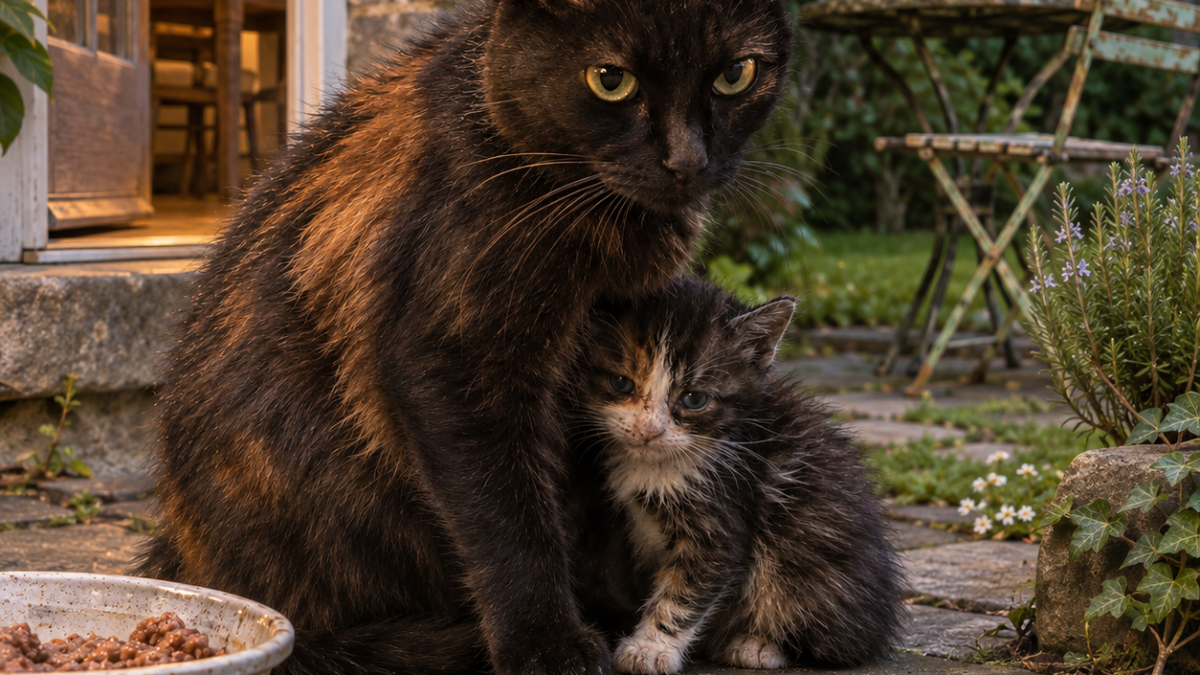
A Stray Cat Vanished for Two Weeks—Then She Returned at Midnight Carrying the Only Kitten She Had Managed to Save
For months, Pepper had trusted Daniel with nothing but the distance between them—until the night she appeared beneath his garden bench carrying a dying kitten in her mouth.
She had lost everything somewhere beyond his fence, and instead of saving herself, she brought the last thing she loved to the one human who had never tried to own her.
Daniel thought he was rescuing a stray cat that night, but before the truth was over, he would learn what Pepper had survived, who had tried to drive her away, and why she had chosen his door when she had nowhere else left to go.
The first time Daniel Mercer noticed the cat, he thought she was a shadow moving beneath the hydrangeas.
It was a cold evening near the end of October, the kind that made the glass in the kitchen windows turn black before dinner and sent damp leaves skittering across the stone path behind his house.
Daniel had just finished washing a coffee mug when the motion light near the garden shed flickered on.
He glanced through the window.
Something small was crouched beside the ceramic dish he kept near the hedge.
For years, Daniel had left shallow bowls of water and occasional scraps of cat-safe food near the bottom of his garden for hedgehogs, birds, and whatever else wandered through after dark. His late wife, Marianne, had started the habit.
“Everybody needs somewhere safe to stop,” she used to say.
Even after she was gone, Daniel kept filling the bowls.
Especially after she was gone.
The habit gave shape to evenings that otherwise felt too quiet.
Daniel leaned closer to the kitchen window.
The animal by the bowl was a cat.
Small.
Black, mostly, though when she shifted beneath the yellow garden light, Daniel could see a rusty-brown streak across the middle of her back, as if someone had brushed a thumb dipped in copper paint along her spine.
She was painfully thin.
Her shoulders formed sharp little points beneath her fur.
One ear had a notch missing from the edge.
She ate quickly, lifting her head every few seconds.
Daniel knew that look.
It was not hunger alone.
It was fear practiced so often it had become instinct.
He stayed still.
The cat ate until the bowl was empty, then licked at the rim.
Daniel smiled despite himself.
“Well,” he murmured. “You were hungry.”
He made the mistake of opening the back door.
The cat vanished.
Not ran.
Vanished.
One second she was beside the bowl.
The next she was gone beneath the hedge, leaves trembling behind her.
Daniel stopped in the doorway.
“All right,” he said softly into the darkness. “Message received.”
He closed the door.
The next evening, he put food out again.
She returned at 9:47.
Daniel knew the exact time because he happened to be checking the clock above the stove when the motion light came on.
This time, he did not open the door.
He stood several feet back from the window and watched.
The cat approached the bowl in stages.
Two steps.
Stop.
Listen.
Three more steps.
Freeze.
Look toward the house.
Then she ate.
PART2:
The following night, she came at 10:12.
The night after that, 9:31.
Within a week, Daniel had developed a ridiculous habit of pretending he was not waiting for her.
He would make tea.
Read the newspaper.
Wash a plate that was already clean.
Rearrange things on the kitchen counter.
Then the garden light would click on, and he would glance through the window as casually as a man checking the weather.
“There you are,” he would say.
The cat never answered, of course.
She also never came close.
Daniel began leaving the food farther from the hedge and nearer to an old wooden bench at the end of the garden.
He moved the bowl by a few inches each night.
The cat noticed.
She did not approve.
The first night he moved it too far, she sat at the edge of the bushes for eleven full minutes, staring at the bowl as if Daniel had clearly designed an elaborate trap.
He watched from the window, amused.
“You know, if I were plotting against you, I’d have come up with something more sophisticated than chicken.”
Eventually she crept forward.
Daniel began talking to her through the closed glass.
Nothing important.
Weather.
News.
Complaints about the neighbor’s leaf blower.
Thoughts he used to say to Marianne.
PART3:
“You’d think Gary would know leaves continue to fall after noon,” he muttered one Saturday morning while the cat sat beneath the bench cleaning one paw. “But apparently he believes the trees are personally insulting him.”
The cat looked up.
Daniel nodded solemnly.
“Exactly.”
He did not realize how lonely he had become until he found himself laughing at a stray cat’s expression.
Daniel was sixty-one.
He had taught high-school history for thirty-two years before retiring.
His students used to say he had the voice of someone who could turn a fire alarm into a lecture about the Cold War.
Marianne had teased him about that.
“You explain everything,” she used to say.
“Someone has to.”
“No, Daniel. Sometimes a toaster is just a toaster.”
She had died three years earlier after a fourteen-month battle with ovarian cancer.
The last months had been brutal.
Hospitals.
Appointments.
Medication schedules.
Phone calls at strange hours.
Hope measured in numbers Daniel hated learning.
After she was gone, people surrounded him for a while.
Then life resumed.
Not cruelly.
Just naturally.
Friends went home.
Former colleagues stopped checking every week.
His daughter, Rebecca, lived two states away with her husband and two little boys and called every Sunday.
Daniel insisted he was fine.
And mostly, he was.
Fine was not the same as happy, but it was survivable.
He cooked.
He walked.
He volunteered twice a week at the community library.
He repaired things around the house that did not need repairing.
Then the cat appeared.
By the second week, Daniel had given her a name.
Pepper.
He chose it because she was dark and sharp-eyed and because naming her “the cat” had begun to feel rude.
“Pepper,” he whispered through the window one evening.
Her ears flicked.
Daniel smiled.
“You heard that.”
She kept eating.
For almost a month, that was the extent of their relationship.
Food.
Distance.
Patience.
Daniel never tried to touch her.
He had seen well-meaning people ruin frightened animals by demanding trust too quickly.
He remembered Marianne saying something years ago when they had fostered an old beagle that had been badly neglected.
“Trust isn’t a door you open,” she had said. “It’s a hallway you build one safe moment at a time.”
Daniel had not forgotten.
So he built Pepper a hallway.
He placed food beneath the bench.
He left a small weatherproof shelter behind the shed, lined with straw.
He never stood between Pepper and the hedge.
He stopped making eye contact when she appeared nervous.
And every evening, he sat just inside the kitchen with the back door closed while she ate.
By December, Pepper no longer fled when he walked past the window.
By January, she sometimes sat beneath the bench after eating.
By February, she began appearing before sunset.
One afternoon, Daniel opened the door to place food outside while Pepper was already in the garden.
They both froze.
Pepper crouched.
Daniel remained standing just inside the doorway.
For one terrible second, he thought she would disappear and not return.
Instead, Pepper backed away three feet.
That was all.
Daniel slowly put the bowl down.
Then he stepped inside.
Pepper approached.
“Progress,” he said.
The word caught unexpectedly in his throat.
It embarrassed him.
A cat standing ten feet away should not have mattered that much.
But it did.
There were things grief changed that no one explained.
A person could miss being needed almost as much as they missed being loved.
Pepper asked nothing of Daniel except consistency.
No promises.
No explanations.
Just food in the same place and no sudden movements.
He could manage that.
Then March came.
The days lengthened.
Daffodils pushed through the soil Marianne had planted years earlier.
Rain replaced frost.
And Pepper disappeared.
At first, Daniel barely noticed.
She had occasionally missed a night.
Once, during a snowstorm, she vanished for two days before returning with mud frozen to her paws and the expression of someone who deeply resented the weather.
On the second night, Daniel placed fresh food beneath the bench.
On the third, he replaced it again.
On the fourth, he walked to the bottom of the garden and looked beneath the hedge.
Nothing.
“Probably found another restaurant,” he told himself.
The joke did not help.
On day five, Daniel checked the little shelter behind the shed.
Empty.
On day six, he began scanning the roadside whenever he drove into town.
That frightened him.
There were things he did not want to find.
On day seven, he posted a photograph of Pepper on the neighborhood community page.
The picture was terrible, taken through glass.
Mostly black cat.
Bright eyes.
Brown patch.
Missing piece of ear.
His post read:
Has anyone seen this little stray around Hawthorne Lane? She has been visiting my garden regularly for several months but hasn’t appeared in a week. Very timid. Please don’t chase her.
Most replies were kind.
Haven’t seen her, but we’ll keep an eye out.
Hope she’s okay.
Try asking around by the old industrial estate.
One comment irritated him.
Probably someone’s outdoor cat. They wander.
Daniel replied politely.
Maybe. Just hoping she’s safe.
Then a woman named Carol Winslow wrote:
There’s been a feral cat problem behind the abandoned nursery lots. County has been contacted before. People really shouldn’t feed them because it encourages breeding.
Daniel stared at the comment.
He typed a response.
Deleted it.
Typed another.
Deleted that too.
Finally, he wrote:
Thanks for the information.
Marianne would have been proud.
She had always said his greatest weakness was believing every argument deserved a response.
By day nine, Daniel drove behind the old nursery lots.
The area sat half a mile from his neighborhood, beyond a row of vacant commercial buildings and a chain-link fence.
The nursery had closed years earlier.
Behind it were overgrown storage sheds, broken greenhouses, and piles of lumber collapsing beneath ivy.
A perfect place for stray cats.
Daniel parked on the roadside.
“Pepper?”
Nothing.
He walked along the fence.
“Pepper?”
A black-and-white cat darted behind a stack of pallets.
Daniel crouched.
“I’m not bothering you.”
He placed a small container of food near the fence.
After twenty minutes, he left.
He returned the next day.
And the next.
No Pepper.
By day twelve, the bowl beneath the garden bench had remained untouched so long that rainwater had collected around the edges.
Daniel carried it inside.
He washed it.
Dried it.
Then stood in the kitchen holding the empty bowl longer than necessary.
He felt foolish.
She was a stray cat.
She had never belonged to him.
He had never touched her.
Never held her.
Never taken her to a veterinarian.
She had no collar.
No microchip that he knew of.
Maybe she had simply moved on.
Perhaps someone else had taken her in.
That was what he should hope.
Instead, the garden looked wrong.
The bench looked wrong.
Even the motion light clicking on for a fox felt like an insult.
Daniel put the bowl in the cupboard.
For two nights, he did not check the window.
On the fourteenth night after Pepper disappeared, Daniel went to bed early.
Rain had started around ten.
Not heavy.
Just cold spring rain tapping softly against the upstairs windows.
Daniel read for a while.
Turned off the lamp.
Then, at 12:17 a.m., the garden light came on.
He saw the glow from the hallway.
Daniel almost ignored it.
Probably a fox.
Or the neighbor’s cat.
Then something made him get up.
He walked downstairs in bare feet.
The kitchen was dark.
He stepped toward the window.
Pepper stood beneath the old wooden bench.
Daniel stopped breathing.
She looked smaller.
That was his first thought.
Then he realized why.
Her fur was soaked flat against her ribs.
Mud covered her legs.
And beside her sat a kitten.
Tiny.
No larger than Daniel’s hand.
The kitten swayed on its feet.
Daniel’s heart slammed once against his chest.
“Oh my God.”
Pepper looked toward the house.
She did not run.
Daniel slowly opened the back door.
Cold air rushed in.
He stepped aside.
“Come on.”
Pepper stared at him.
Daniel crouched several feet from the doorway.
“You’re safe.”
The kitten made a tiny sound.
Not quite a meow.
More like air escaping.
Pepper turned toward it.
She gripped the kitten gently by the scruff.
Then she walked toward Daniel’s house.
One step.
Then another.
Daniel remained perfectly still.
Pepper crossed the threshold.
For the first time in all the months Daniel had known her, the cat entered his home.
She carried the kitten across the kitchen.
Past the table.
Into the dining room.
Then disappeared beneath the large oak table Marianne had insisted they buy twenty years earlier because, according to her, “One day the whole family will need somewhere to fit.”
Pepper set the kitten down.
Daniel closed the back door.
His hands were shaking.
He grabbed an old cardboard box from the pantry and filled it with clean towels.
When he turned around, Pepper was heading back toward the door.
Daniel opened it.
She ran outside.
“Wait.”
Pepper vanished into the rain.
Daniel stared into the darkness.
His mind jumped immediately to the obvious conclusion.
More kittens.
She had a litter somewhere.
This was the first.
He pulled on shoes.
A coat.
Grabbed a flashlight.
Pepper appeared at the edge of the garden.
Daniel followed from a distance.
She moved beneath the hedge.
Through a gap in the fence.
Across the narrow strip of common land behind his property.
Then she stopped.
Daniel approached carefully.
Pepper was sitting beside an old drainpipe beneath a thicket of brambles.
Daniel crouched.
He heard nothing.
He shone the flashlight around.
No kittens.
Pepper turned and ran back toward his house.
Daniel followed.
Inside, Pepper went straight to the dining table.
She curled around the kitten.
That was when Daniel understood.
She had not brought him the first kitten.
She had brought him the last one.
Maybe the only one left.
The thought landed with terrible weight.
Daniel knelt beside the table.
The kitten lay against Pepper’s stomach.
Its fur was gray-brown beneath the dirt.
Its eyes were crusted.
Its breathing came fast and shallow.
Pepper licked the kitten’s head.
Again.
Again.
Again.
Daniel called the emergency veterinary line.
A woman answered on the fourth ring.
“Greenwood Emergency Veterinary Service.”
“I have a kitten,” Daniel said. “A very young one. Maybe four or five weeks. He’s weak. Barely moving.”
“Is he breathing?”
“Yes.”
“Warm?”
Daniel hesitated.
“No.”
“Can you bring him in?”
“Yes.”
“Wrap him in a warm towel. No direct heat against the skin. Don’t force food or water. Bring the mother if you can safely contain her.”
Daniel looked beneath the table.
Pepper stared back.
Contain her.
That would be the difficult part.
He went to the garage and found Marianne’s old pet carrier.
They had not used it since their beagle foster had been adopted.
Daniel opened the carrier and placed it near the table.
Pepper flattened herself.
“No one’s forcing you,” he whispered.
He moved the kitten into the warm towel.
Pepper immediately followed.
Daniel put the towel and kitten inside the carrier.
Pepper stepped in after him.
Daniel almost laughed from disbelief.
He closed the door gently.
Twenty-eight minutes later, Daniel carried the carrier into Greenwood Emergency Veterinary Service.
The waiting room smelled of disinfectant and coffee.
A golden retriever with a bandaged paw sat beside a young couple.
An elderly man held a rabbit wrapped in a blanket.
A veterinary nurse rushed toward Daniel.
“Kitten?”
“Yes.”
She took the carrier.
Pepper hissed.
“Mother’s feral?”
“Terrified,” Daniel said. “Not aggressive unless she thinks you’re hurting him.”
The nurse nodded.
“We’ll keep them together as much as possible.”
A veterinarian named Dr. Lena Ortiz examined the kitten.
Daniel waited beneath fluorescent lights for almost an hour.
At 2:11 a.m., Dr. Ortiz came into the consultation room.
She was in her forties, dark hair tied back, expression tired but kind.
“The kitten is severely dehydrated,” she said. “He has an upper respiratory infection, a high flea burden, and probably intestinal parasites. His body temperature was very low.”
Daniel swallowed.
“Will he make it?”
“I can’t promise that.”
He looked down.
“But,” she continued, “he responded to warming. That’s good. We’ve started fluids and antibiotics. He’s fighting.”
“And Pepper?”
“Pepper?”
“The mother.”
Dr. Ortiz smiled faintly.
“She’s underweight. Several old scars. One fresh wound on her back leg. She appears to have been nursing recently.”
Daniel looked at her.
“Recently?”
“Yes.”
Dr. Ortiz hesitated.
“There’s something else.”
Daniel felt the familiar dread of waiting for medical information.
It was the same feeling hospitals had carved into him.
“What?”
“Based on her mammary development, Pepper almost certainly had more than one kitten.”
Daniel closed his eyes.
“How many?”
“We can’t know.”
“Could they still be alive somewhere?”
“Possibly.”
Daniel looked toward the treatment-room doors.
“Then I need to find them.”
Dr. Ortiz’s expression changed.
Not disbelief.
Respect mixed with concern.
“You may be looking for something difficult to find.”
“I understand.”
“Stray mothers move litters when threatened. There could have been illness, predators, people, weather—”
“I understand.”
She nodded slowly.
“The kitten needs hospitalization tonight. Ideally Pepper stays too, but she’s extremely stressed.”
Daniel looked through the small observation window.
Pepper sat in the rear of a stainless-steel enclosure, body curved around the kitten.
For months, she had fled from Daniel if he came closer than a few yards.
Now she was sitting beneath harsh lights in a strange hospital because she had carried her baby to him.
“I’ll pay for both.”
Dr. Ortiz nodded.
Daniel drove home at three in the morning.
He did not sleep.
At sunrise, he returned to the abandoned nursery lots.
This time he brought food, gloves, a flashlight, and a long-handled pruning tool.
He searched behind sheds.
Under broken pallets.
Inside drainage pipes.
At 8:40, he found the place.
A shallow nest beneath a collapsed section of greenhouse plastic.
Blankets.
Not natural material.
A dirty blue towel.
Newspaper.
Someone had made it.
Daniel crouched.
There were tiny paw prints in the mud.
And something else.
A small tuft of black fur snagged on broken wire.
Pepper’s.
Daniel searched for two more hours.
No kittens.
Then he saw the cardboard box.
It lay behind a dumpster.
Wet.
Crushed on one side.
Inside were two tiny bodies.
Daniel stopped.
He stood there in the morning light, unable to move.
He had seen death before.
His parents.
Marianne.
Former colleagues.
But there was something especially cruel about creatures so small that the world had barely given them time to begin.
Daniel removed his coat.
He wrapped the kittens gently.
Then he noticed the smell.
Chemical.
Sharp.
He looked at the ground.
Near the nest sat a shallow aluminum tray.
Inside it was cloudy liquid mixed with food.
Daniel did not touch it.
He took photographs.
Then called animal control.
An officer named Maya Brooks arrived forty minutes later.
She was younger than Daniel expected, maybe thirty-five, with a serious expression and mud already on her boots.
“You found the cats here?”
“One living kitten. Two dead.”
Maya crouched near the tray.
Her expression tightened.
“Don’t touch that.”
“I didn’t.”
“Good.”
She looked at the broken greenhouse.
“You said the mother had been coming to your property?”
“For months.”
“And disappeared almost two weeks ago?”
“Yes.”
Maya stood.
“There have been complaints about cats here.”
Daniel remembered the neighborhood post.
“What kind of complaints?”
“Feral population. Noise. Trash. People feeding them.”
“People?”
“A few residents nearby.”
“Any removals?”
“Not authorized ones.”
Daniel looked toward the tray.
“What does that mean?”
Maya met his eyes.
“It means if someone was trying to poison animals, that’s not population control. That’s cruelty.”
The word hardened something inside Daniel.
He had spent most of his adult life believing anger was useful only if you taught it discipline.
Standing in that muddy lot, he felt anger anyway.
“Can you test it?”
“We can collect samples.”
“Will you?”
“Yes.”
Maya photographed the area.
She bagged the tray.
She collected the kittens carefully.
Before leaving, she asked Daniel to send her the community-page screenshot.
“Why?”
“Because sometimes people complain publicly before doing something privately.”
Daniel thought immediately of Carol Winslow.
He disliked that thought.
A comment was not evidence.
People said ugly things online every day.
Still, he sent the screenshot.
By noon, Daniel was back at Greenwood.
The kitten had survived the night.
Barely.
Dr. Ortiz led Daniel into a quiet room.
“He’s more stable.”
Pepper was inside a large enclosure with the kitten.
When Daniel approached, she did something extraordinary.
She stood.
Walked toward the front.
And did not retreat.
Daniel crouched.
“Hey.”
Pepper stared at him.
He slowly raised one finger toward the bars.
She sniffed it.
That was all.
But Daniel’s eyes filled anyway.
Dr. Ortiz pretended not to notice.
The kitten remained hospitalized for three days.
Daniel visited twice daily.
On the second day, Dr. Ortiz asked what he planned to call him.
“Call who?”
“The kitten.”
Daniel frowned.
“I wasn’t planning to keep him.”
Dr. Ortiz smiled.
“Of course.”
“I’m serious.”
“Absolutely.”
“Once he’s recovered, I’ll find him a home.”
“Sounds sensible.”
Daniel narrowed his eyes.
“You’re very bad at pretending you believe me.”
“I’m a veterinarian. We hear that sentence daily.”
Daniel looked through the glass.
The kitten was curled against Pepper.
“Bean.”
Dr. Ortiz glanced at him.
“What?”
“His name.”
“You named him?”
“Temporarily.”
“Obviously.”
Bean improved quickly after the first forty-eight hours.
Pepper did not.
Physically, she began recovering.
Emotionally, she remained intensely vigilant.
Any unfamiliar person entering the room caused her to press herself over Bean.
If a metal tray clattered, she flinched.
When one male technician approached too quickly, she lunged at the cage door, not to attack him but to stop him from getting close.
Dr. Ortiz noticed.
“She’s been handled badly.”
Daniel’s jaw tightened.
“How can you tell?”
“Animals remember patterns. Men. Boots. Certain sounds. Reaching hands. We don’t know exactly what happened, but fear that specific usually has history behind it.”
On the third afternoon, Maya Brooks called.
“We got preliminary results from the food tray.”
Daniel gripped the phone.
“And?”
“Rodenticide.”
His stomach dropped.
“Rat poison?”
“Yes. Mixed with canned cat food.”
Daniel sat down at his kitchen table.
He looked toward the garden.
“Someone did it deliberately.”
“That appears likely.”
“Can you prove who?”
“Not yet.”
Daniel closed his eyes.
“What happens now?”
“We investigate.”
Maya paused.
“There’s more.”
Daniel waited.
“We’ve received another report.”
“About what?”
“A resident says she saw someone carrying boxes into the nursery lot around the time the cats disappeared.”
“Who?”
“She didn’t know the name. Older woman. Silver SUV.”
Daniel immediately thought of Carol Winslow’s profile picture.
A smiling woman beside a silver Lexus.
He hated himself for noticing.
Maya continued.
“I’m not saying it’s connected. We’re checking.”
“Carol Winslow drives a silver SUV.”
There was silence.
“Why do you know that?”
“Neighborhood page.”
“Don’t contact her.”
“I wasn’t going to.”
“I mean it, Daniel.”
The use of his first name surprised him.
“This is an investigation now.”
He looked toward the empty garden.
“Understood.”
Pepper and Bean came home the next evening.
Daniel had transformed the spare room.
Litter boxes.
Food.
Water.
Blankets.
Two hiding places.
A scratching post.
A ridiculous collection of toys he claimed were “necessary for behavioral enrichment.”
Rebecca called while he was assembling a cat tree.
“Dad.”
“Yes?”
“Why is there a six-foot cat tower behind you?”
“It was discounted.”
“You don’t have a cat.”
Daniel looked toward Pepper, who was hiding beneath the bed.
“That’s currently under review.”
Rebecca stared at him through the video call.
Then she smiled.
It was the first time in months Daniel had seen her look at him without that subtle worry adult children carry when a parent lives alone.
“Mom would find this hilarious.”
Daniel stopped tightening a screw.
“Yes.”
Rebecca’s smile softened.
“She would.”
That evening, Bean discovered Daniel’s shoelaces.
Pepper remained beneath the bed.
But when Daniel sat on the floor with a book and read aloud, she listened.
He chose The Wind in the Willows because Marianne had once read it to Rebecca.
“‘There is nothing—absolutely nothing—half so much worth doing as simply messing about in boats,’” Daniel read.
Bean attacked his sock.
Pepper blinked slowly.
For the next week, Daniel built another hallway.
Not a literal one.
The kind Marianne had described.
Safe moments.
He entered slowly.
Sat down.
Never reached under furniture.
Never cornered Pepper.
Bean adapted immediately.
Bean had apparently decided survival entitled him to everything.
He climbed Daniel’s pants.
Slept inside a laundry basket.
Knocked over a pencil cup.
Tried to fight his reflection in the oven door.
Pepper watched.
Three weeks after coming home, she began sitting in the doorway while Daniel prepared their food.
Four weeks after that, she stood two feet from his chair.
Then came the morning Daniel reached down without thinking.
Pepper was beside him.
He extended his hand.
She froze.
Daniel froze too.
“Sorry.”
He started to pull back.
Pepper leaned forward.
Her forehead touched one finger.
Daniel did not move.
She rubbed her cheek against his knuckle.
Once.
Then retreated.
He sat alone in the kitchen afterward and cried harder than he had expected.
Not because a cat had allowed him to touch her.
Because for the first time in three years, something broken had trusted him with the chance to be gentle.
The investigation continued quietly.
Then, one Saturday morning, it became public.
Carol Winslow knocked on Daniel’s door.
He almost did not recognize her in person.
Early sixties.
Perfectly styled gray-blond hair.
Cream-colored coat.
Silver Lexus parked at the curb.
She smiled when Daniel opened the door.
“Mr. Mercer?”
“Yes.”
“Carol Winslow. We’ve interacted online.”
“I remember.”
Her smile remained.
“I was hoping we could talk.”
Daniel stepped outside and closed the door behind him.
He did not invite her in.
Carol noticed.
“I understand you’ve been feeding feral cats.”
“One cat.”
“There are dozens.”
“Not in my garden.”
Carol sighed.
“You may not realize it, but people like you make these problems worse.”
“People like me?”
“People who feed animals without taking responsibility for them.”
Daniel folded his arms.
“I took responsibility.”
Carol looked past him toward the house.
“You brought that black cat inside?”
“And her kitten.”
Something flickered across her face.
Gone quickly.
But Daniel saw it.
“She had a kitten?”
“Yes.”
“I thought the litter was—”
Carol stopped.
Daniel became very still.
“You thought the litter was what?”
Carol’s expression changed.
“Nothing.”
“You were saying?”
“I had heard there were kittens.”
“From whom?”
“People talk.”
Daniel said nothing.
Silence did more work than argument.
Carol adjusted the strap of her handbag.
“Look, Mr. Mercer, I came because animal control has been asking ridiculous questions. They’ve contacted residents. They’re implying someone poisoned cats.”
“They found poison.”
Carol’s mouth tightened.
“Rat poison. In an abandoned property full of rats. Shocking.”
“In cat food.”
“That proves nothing.”
Daniel watched her.
“I didn’t say it proved anything.”
For the first time, Carol’s polished expression cracked.
“Those animals were destroying property.”
“Were they?”
“They tore garbage open. They defecated in gardens. They carried disease.”
“So you knew exactly which cats animal control was asking about.”
Carol’s eyes narrowed.
“You are twisting my words.”
“No. I’m listening to them.”
Her face reddened.
“You people always do this. You sentimentalize vermin until someone else has to deal with the consequences.”
“You people?”
“Yes. People who confuse kindness with responsibility.”
Daniel almost smiled.
“Funny.”
“What?”
“I spent thirty-two years teaching teenagers. I know what people sound like when they came prepared to lecture someone and realize halfway through that they said too much.”
Carol stepped closer.
“Do not accuse me of anything.”
“I haven’t.”
“You’re implying it.”
“No.”
Daniel looked toward her Lexus.
“I’m waiting for investigators to do their job.”
Carol’s mouth became a thin line.
Then she said something Daniel would remember for a long time.
“That cat should have stayed gone.”
Daniel’s eyes moved back to hers.
Carol realized it too late.
She turned.
Walked toward her car.
Daniel pulled out his phone.
Not to record her.
He had not thought that far ahead.
He called Maya.
“She came to my house.”
“What?”
“Carol Winslow.”
Maya exhaled sharply.
“What did she say?”
Daniel repeated it.
Every word.
By the end of the week, investigators had security footage from a gas station across from the nursery access road.
The camera angle was poor.
The image grainy.
But the silver Lexus was visible entering the service road three nights during the week Pepper disappeared.
Carol’s attorney called the evidence circumstantial.
He was right.
Then they found the receipt.
Rodenticide.
Eight trays of cheap canned cat food.
Disposable gloves.
Purchased together at a farm-supply store six miles away.
Paid for with Carol’s credit card.
Still, Carol denied it.
She said she had purchased poison for mice in her garage.
She said the food was for a neighbor’s cat.
She claimed someone could have taken the poison from her trash.
Then one of her neighbors came forward.
A widower named Harold Pike.
Harold was seventy-four and had lived across the street from Carol for twelve years.
He told investigators Carol had complained about the cats for months.
Not mildly.
Obsessively.
“She said they were filthy,” Harold told Maya in a recorded statement. “Said property values would fall because people kept feeding them. She asked me if I knew how long poison took to work.”
That changed things.
So did something else.
The blue towel from the kittens’ nest carried a faded embroidered monogram.
C.W.
Carol claimed it meant nothing.
Then Maya found an old social-media photo from Carol’s garden showing the same towel set hanging behind her swimming pool.
The case moved from suspicion to prosecution.
Local news picked it up.
A headline appeared online:
WOMAN CHARGED AFTER POISONED CAT FOOD FOUND AT ABANDONED NURSERY
Daniel hated the attention.
Pepper hated it more.
Reporters came to the street.
Neighbors gathered.
People wanted photographs.
One television producer asked Daniel to bring Pepper outside.
“No.”
“It would help people connect with the story.”
“She’s not a prop.”
“Just thirty seconds.”
“No.”
Daniel closed the door.
That evening, he found Pepper hiding behind the sofa.
Bean sat beside her.
Daniel lowered himself onto the floor.
“It’s all right.”
Pepper’s pupils were wide.
Cars had been stopping outside.
Doors slamming.
Voices.
Daniel sat without touching her.
Bean climbed into his lap.
Five minutes passed.
Pepper’s breathing slowed.
Then she came forward.
She rested one paw on Daniel’s knee.
That was the first time she chose contact without food nearby.
Daniel stared at the small black paw.
Something in his chest broke open.
“Okay,” he whispered. “We’ll get through this.”
The court proceedings began four months later.
Carol was charged with animal cruelty, unlawful poisoning, and illegal dumping of toxic substances.
The case divided the neighborhood.
Some people supported Daniel.
Others defended Carol.
“She was trying to solve a problem.”
“They were feral animals.”
“People care more about cats than humans now.”
Daniel stopped reading comments.
One evening, someone spray-painted RAT FEEDER across his wooden fence.
He stood looking at the words in disbelief.
Rebecca drove down the next morning.
She did not ask permission.
She arrived with her husband, two paint rollers, and Daniel’s grandsons.
The boys were eight and ten.
“What does it say?” the younger one asked.
“Nothing worth remembering,” Daniel said.
They painted over it together.
Bean tried to walk through the paint tray.
Pepper watched from the window.
Rebecca leaned against the fence beside her father.
“You okay?”
“Yes.”
“Dad.”
He looked at her.
She had Marianne’s eyes.
That made lying difficult.
“I don’t understand people sometimes.”
Rebecca nodded.
“Mom did.”
Daniel smiled sadly.
“Your mother understood everybody except telemarketers.”
“She hated telemarketers.”
“She once kept one on the phone for forty minutes asking increasingly specific questions about his dental insurance.”
Rebecca laughed.
Daniel did too.
Then she became serious.
“You know what she’d say about this?”
“I can guess.”
“She’d tell you not to let someone else’s cruelty turn your kindness into embarrassment.”
Daniel looked at the fresh paint.
“She’d say it more elegantly.”
“No. She’d probably swear first.”
He laughed again.
Pepper appeared on the windowsill.
Rebecca glanced toward her.
“Dad.”
“Yes?”
“You know you’re keeping them, right?”
Daniel pretended to consider.
“The adoption situation is still being evaluated.”
“Bean sleeps on your pillow.”
“He’s manipulative.”
“You bought Pepper a heated bed.”
“She gets cold.”
“You have their photos framed.”
“That’s irrelevant.”
Rebecca smiled.
“You’re keeping them.”
Daniel looked toward the window.
Pepper sat in sunlight.
Bean’s gray head appeared beside her.
“Yes,” he said.
The word came out quietly.
But it felt important.
“Yes.”
The criminal case took nearly a year to reach trial.
By then, Pepper had changed almost beyond recognition.
Her coat was glossy.
She had gained healthy weight.
The wound on her hind leg had healed.
She still startled at sudden noises.
Still disliked strangers.
Still vanished whenever someone carried a broom.
Daniel did not know why.
He stopped using one around her.
But she slept on the windowsill every morning.
Allowed Daniel to pet her head.
Sometimes climbed onto the sofa beside him.
Bean became enormous.
Not physically impressive.
Just emotionally enormous.
He entered every room as though he owned the mortgage.
He stole socks.
Opened cabinet doors.
Sat inside Daniel’s grocery bags.
Once, during a video call with Rebecca, Bean walked across the keyboard and ended the call.
Daniel stared at him.
“Unacceptable.”
Bean blinked.
Daniel called Rebecca back.
She was laughing too hard to speak.
Then, six weeks before trial, something happened that changed Daniel’s understanding of Pepper’s story.
A woman named Elise Grant contacted him.
She had seen a newspaper article.
“I think I knew your cat,” she said.
Daniel sat up.
“What?”
“The black one. Pepper.”
“How?”
“I lived near the nursery two years ago.”
Elise sent a photograph.
Daniel stared at it.
Pepper.
Younger.
Thinner.
Sitting beside a small orange cat behind a row of storage units.
“There were two of them,” Elise said over the phone. “Always together. I fed them.”
“What happened?”
“My landlord found out. He told me to stop.”
“Why?”
“He said cats attracted pests.”
Daniel almost laughed at the absurdity.
Elise continued.
“I contacted a rescue. They tried trapping them. The orange one was caught.”
“And Pepper?”
“She disappeared.”
Daniel looked at Pepper asleep across the room.
“Did the orange cat survive?”
“Yes. He was adopted.”
Daniel’s shoulders lowered.
He had not realized he had been holding tension.
Elise hesitated.
“There’s something else.”
“What?”
“Pepper had kittens once before.”
Daniel looked at her.
“When?”
“About two years ago.”
“What happened?”
“I don’t know. One day she was pregnant. Then she wasn’t. I never saw kittens.”
Daniel closed his eyes.
Maybe she had lost them.
Maybe moved them.
Maybe they had died.
Pepper’s story had begun long before his garden.
Hunger.
Litters.
Disappearing shelters.
People chasing her.
One safe person gone.
Another safe place lost.
No wonder trust took months.
The trial began in October.
Exactly one year after Daniel first saw Pepper stealing food beneath the hedge.
Carol arrived at the courthouse in a dark suit.
Her attorney argued that she was being scapegoated because the community had grown emotional over one photogenic animal.
He described the nursery colony as a public-health concern.
He emphasized there was no video of Carol physically placing the poison.
Then Maya Brooks testified.
She explained the toxicology.
The purchase receipt.
Vehicle footage.
Witness statements.
The towels.
The pattern of placement.
Dr. Ortiz testified next.
She described Bean’s condition.
Severe dehydration.
Infection.
Malnutrition.
Flea anemia.
She explained Pepper’s physical state and signs of recent nursing.
Then Daniel was called.
He hated courtrooms.
They reminded him of lecture halls without the possibility of humor.
The prosecutor asked him to describe how he first met Pepper.
Daniel did.
The bowl.
The hedge.
The bench.
The months of distance.
Then he described the night she returned.
“Did she have more than one kitten with her?” the prosecutor asked.
“No.”
“Did you later find others?”
Daniel looked toward the jury.
“Yes.”
“Alive?”
“No.”
The courtroom became very quiet.
Carol did not look at him.
The prosecutor asked, “Why do you believe Pepper brought Bean to you?”
Carol’s attorney stood.
“Objection. Calls for speculation.”
“Sustained.”
The prosecutor nodded.
“Mr. Mercer, what did Pepper do when you opened your door?”
Daniel swallowed.
“She carried Bean inside.”
“Had she ever entered your house before?”
“No.”
“Had you ever touched her?”
“No.”
“Had you ever trapped her?”
“No.”
“Then what did you do during the months she visited?”
“I fed her.”
“Anything else?”
“I left her alone.”
The prosecutor paused.
“Why?”
Daniel looked toward Pepper’s photograph displayed as evidence.
“Because she was afraid.”
“That’s all?”
Daniel nodded.
“That was enough.”
On cross-examination, Carol’s attorney tried to suggest Daniel had interfered with local efforts to control stray animals.
“You fed an unowned cat for months without arranging sterilization, correct?”
“Yes.”
“You agree that unsterilized feral cats reproduce?”
“Yes.”
“You understood this could contribute to a colony?”
“Yes.”
“So your actions were not necessarily responsible.”
Daniel considered the question.
“No.”
The attorney blinked.
“No?”
“No, I wouldn’t say I handled everything perfectly.”
The lawyer seemed surprised.
Daniel continued.
“I should have contacted a rescue earlier. I should have tried to arrange a humane trap and veterinary care. I was afraid moving too quickly would scare her away. In hindsight, I waited too long.”
The courtroom remained silent.
The attorney looked dissatisfied.
“But you did feed her.”
“Yes.”
“And that contributed to her remaining in the area.”
“Possibly.”
“So you share some responsibility for what happened.”
Daniel looked directly at him.
“For feeding her?”
“For attracting animals to a location where residents did not want them.”
Daniel’s jaw tightened.
“I share responsibility for giving a hungry animal food.”
The attorney stepped closer.
“And Ms. Winslow was simply concerned about an uncontrolled colony.”
“Concern is not the same as poison.”
“Mr. Mercer—”
“You asked about responsibility.”
The judge looked over her glasses.
“Answer only the question asked, Mr. Mercer.”
“Yes, Your Honor.”
The attorney tried again.
“Would you agree that residents had legitimate concerns?”
“Yes.”
Carol turned slightly.
Her attorney smiled.
“And those concerns required action.”
“Humane action.”
“That wasn’t my question.”
“Then ask a better one.”
A few people in the gallery shifted.
The judge raised an eyebrow.
“Mr. Mercer.”
“Sorry.”
Even the prosecutor looked like she was suppressing a smile.
The most damaging testimony did not come from Daniel.
It came from Carol herself.
Her attorney had advised her not to testify.
She insisted.
That decision destroyed her.
At first, she appeared composed.
She described herself as a longtime homeowner.
Community volunteer.
Former neighborhood association president.
She spoke about sanitation.
Property standards.
Children playing near stray-animal waste.
She said she had repeatedly asked authorities to “do something.”
Then the prosecutor stood for cross-examination.
“You disliked the cats.”
“I disliked the problem.”
“You called them vermin.”
“I may have used that word.”
“You told Mr. Pike poison was faster than trapping.”
“I don’t recall.”
“You purchased rodenticide.”
“For my garage.”
“And cat food.”
“For a neighbor.”
“Which neighbor?”
Carol paused.
“I don’t remember.”
“You bought eight cans.”
“Yes.”
“Do you regularly buy food for cats you describe as vermin?”
Carol’s face tightened.
“No.”
The prosecutor displayed the receipt.
“Then why that day?”
“I already answered.”
“No, you said it was for a neighbor. Which neighbor?”
Carol looked toward her attorney.
He could not help her.
The prosecutor moved on.
“Did you drive to the nursery property?”
“I may have driven nearby.”
“Three times?”
“I don’t remember.”
“Security footage shows your vehicle entering the service road.”
“That does not prove I placed anything.”
“No. It doesn’t.”
The prosecutor walked to the evidence table.
She lifted the photograph of the blue towel.
“Is this yours?”
“I don’t know.”
“It bears your initials.”
“Those are common initials.”
“Is this your backyard?”
A social-media photograph appeared.
Carol’s face changed.
“Yes.”
“And are those matching towels hanging behind your pool?”
Carol looked at the image.
“Possibly.”
“Ms. Winslow, did you place poison-laced cat food near the nursery colony?”
“No.”
“Did you place the towel?”
“No.”
“Did you move a box containing dead kittens?”
“No.”
The prosecutor stopped.
Daniel saw Carol’s attorney look up sharply.
So did the jury.
The prosecutor spoke softly.
“I didn’t ask about a box containing dead kittens.”
Carol froze.
For several seconds, no one moved.
The prosecutor continued.
“That detail had not been made public before trial.”
Carol’s mouth opened.
Closed.
Her attorney stood.
“Objection—”
But there was no objection that could erase what everyone had heard.
The prosecutor faced Carol.
“How did you know the kittens were in a box?”
Carol’s composure shattered.
“I assumed.”
“You assumed?”
“There were photographs.”
“The photographs entered into evidence yesterday did not show the kittens inside the box.”
Carol began breathing faster.
“You people are twisting everything.”
The prosecutor said nothing.
That silence worked the way Daniel knew silence could.
Carol looked toward the jury.
“You don’t understand what it was like.”
Her attorney whispered urgently.
“Carol.”
But she continued.
“They were everywhere.”
“Carol.”
“They were breeding under sheds. Screaming at night. Tearing open bags. People kept feeding them and feeding them and pretending kindness solved everything.”
The prosecutor stepped back.
Carol’s voice rose.
“I called animal control. I called the county. Nobody did anything.”
Her attorney stood fully.
“Your Honor, I request a brief recess.”
Carol ignored him.
“You know what happens when no one handles a problem? Someone eventually has to.”
Daniel felt cold.
The prosecutor asked one question.
“Were you that someone?”
Carol looked at her.
And for one second, arrogance defeated caution.
“Yes.”
The room went silent.
Carol’s attorney closed his eyes.
Then Carol seemed to hear herself.
“I mean—someone had to address it. Not that I—”
But it was done.
The jury deliberated for less than three hours.
Guilty on multiple counts.
Carol was sentenced to probation, substantial community service under supervision, fines, restitution for veterinary costs, and a court-ordered prohibition on owning or controlling animals during the probation period.
Some people thought the sentence too light.
Others thought any criminal conviction excessive.
Daniel felt neither triumph nor disappointment.
Justice, he had learned, rarely looked like stories made it look.
There was no music.
No sudden transformation.
No villain led away screaming.
Carol stood beside her attorney looking smaller than Daniel had ever seen her.
The judge addressed her directly.
“You were not punished for disliking stray animals. You were punished for choosing suffering when lawful, humane alternatives existed.”
Daniel remembered that sentence.
Carol looked toward him as deputies prepared paperwork.
For the first time, there was no anger in her face.
Only something exhausted.
“You ruined my life,” she said quietly.
Daniel looked at her for a long moment.
Then he answered.
“No.”
Carol’s eyes hardened.
Daniel continued.
“You made a choice. Pepper survived it. Bean survived it. You have to live with yours.”
He walked away.
Outside the courthouse, reporters waited.
Daniel ignored them.
Maya Brooks caught up to him near the steps.
“You handled yourself well.”
“I told a lawyer to ask a better question.”
“He deserved it.”
Daniel laughed.
Maya smiled.
“What happens to the nursery colony now?”
“That’s the better part.”
She explained that the county had partnered with a rescue group to trap, sterilize, vaccinate, and relocate or return healthy cats where appropriate.
Volunteers had already found homes for several socialized cats.
Others would be monitored.
Feeding stations would be controlled.
Shelters provided.
Actual population management.
Not poison.
Daniel nodded.
“Marianne would approve.”
Maya glanced at him.
“Your wife?”
“Yes.”
“You talk about her like she’s still part of the committee.”
Daniel smiled.
“She would insist on chairing it.”
A year later, the abandoned nursery lot looked different.
The collapsed greenhouse had been removed.
The county required the property owner to clear dangerous debris.
A rescue organization installed discreet shelters near a managed feeding station.
A mural appeared on one concrete wall.
Not of Pepper specifically.
Just silhouettes of cats beneath wildflowers.
Daniel did not care much for murals, but he liked that one.
At home, Pepper had stopped sleeping beneath furniture.
That mattered more.
She slept on the windowsill.
Bean slept everywhere.
Bean’s preferred locations included Daniel’s chair, Daniel’s pillow, Daniel’s laundry, Daniel’s newspaper, and any object Daniel needed urgently.
One November morning, Daniel sat at the kitchen table trying to complete a crossword.
Bean was stretched across the page.
“Move.”
Bean did not.
“Seven letters. ‘Unwanted obstruction.’”
Bean blinked.
“Exactly.”
Pepper sat on the windowsill.
Sunlight warmed the rusty patch along her back.
Daniel looked at her.
“You know, technically this is your fault.”
Pepper yawned.
Daniel smiled.
A knock came at the door.
It was Rebecca and the boys.
The younger one ran straight toward Bean.
Bean fled dramatically despite having spent the previous evening sleeping on the child’s coat.
Rebecca entered carrying groceries.
“You forgot we were coming.”
“I did not.”
“You’re wearing two different socks.”
“That proves nothing.”
She glanced toward Pepper.
Pepper did not hide.
That was new too.
Rebecca crouched several feet away.
“Hi, Pepper.”
Pepper watched her.
Then, slowly, walked forward.
Rebecca did not move.
Pepper sniffed her hand.
Then rubbed her cheek once against Rebecca’s fingers.
Rebecca’s eyes widened.
“Dad.”
“I saw.”
“She touched me.”
“She’s selective.”
Rebecca looked close to tears.
Daniel understood.
Some victories were microscopic.
A frightened animal choosing one inch less distance.
A wounded thing deciding the room was safe.
A person discovering grief had not erased every future attachment.
They ate lunch together.
The boys argued over who Bean liked more.
Daniel insisted Bean liked no one and merely exploited them.
Pepper slept nearby.
Later, after Rebecca left, Daniel walked into the garden.
The old wooden bench was still there.
Weathered now.
One arm had begun to crack.
Daniel had considered replacing it.
He never did.
The original ceramic bowl sat beneath it.
Empty.
Clean.
Unused for months.
Daniel kept it there anyway.
Not because Pepper needed it.
Because he did.
It reminded him of the distance they had crossed.
He sat down.
The garden had changed since Marianne died.
Or maybe Daniel had.
Some plants were gone.
Others had grown wild.
He had stopped trying to keep everything exactly as she left it.
That had taken a long time.
For the first year after Marianne died, Daniel had preserved the house almost like evidence.
Her mug in the same cupboard.
Her coat in the hall.
Her gardening gloves by the shed.
He had been afraid changing anything meant losing more.
Pepper taught him something he had not expected.
A safe place did not have to remain frozen.
It could change and still honor what came before.
The bench could weather.
The bowl could sit empty.
A new cat could sleep where Marianne once left gardening magazines.
A kitten could scatter toys beneath the table where Daniel once sat alone.
Love did not always arrive as replacement.
Sometimes it arrived as continuation.
The back door opened behind him.
Daniel turned.
Bean ran into the garden.
Pepper followed more cautiously.
Daniel smiled.
“You’re both supposed to stay inside unless I’m out here.”
Bean ignored him.
Pepper walked toward the bench.
For a moment, she stood exactly where Daniel had first seen her.
Same black fur.
Same copper streak.
Same missing piece from one ear.
But not the same cat.
Her body was strong now.
Her coat clean.
Her eyes calm.
She jumped onto the bench beside Daniel.
That surprised him.
Pepper had never done that before.
Daniel stayed still.
She sat near his hip.
Then leaned against him.
Barely.
Just the weight of one shoulder.
Daniel looked straight ahead because some moments became smaller if you stared at them too directly.
He rested his hand on the bench.
Pepper remained beside him.
“I wondered why you came back,” he said.
Her ears moved.
“For a long time.”
He looked toward the hedge.
“Maybe it was the food.”
Pepper blinked.
“Maybe you remembered the shelter.”
Bean attacked a fallen leaf.
Daniel smiled.
“Maybe you were simply desperate.”
He thought about the night she appeared beneath the rain.
Her ribs visible.
Mud on her legs.
A dying kitten hanging gently from her mouth.
She had traveled whatever distance separated terror from trust.
Not for herself.
For Bean.
Daniel’s voice softened.
“You brought me the one thing you had left.”
Pepper turned her face toward him.
Daniel touched the top of her head.
This time, she did not flinch.
He thought about all the moments before that night.
Every bowl he placed without demanding gratitude.
Every door he did not open.
Every step he did not take toward her.
All those ordinary acts that had seemed insignificant.
Pepper had remembered them.
That was the part Daniel found impossible to forget.
Trust had been forming even when nothing visible seemed to be happening.
In the spaces.
In the absences.
In every moment no harm came.
Daniel had spent years thinking kindness mattered most when it was dramatic.
Saving someone.
Sacrificing something.
Standing against injustice.
Pepper had taught him otherwise.
Sometimes kindness was a bowl left beneath a bench.
A door that stayed open without anyone forcing you through it.
A person who let you retreat.
A place where fear was not punished.
And sometimes a frightened creature carried the most precious thing she had across a threshold because months earlier, someone had decided not to chase her away.
Bean raced past them with a leaf in his mouth.
Pepper watched him.
Daniel laughed.
“He turned out all right.”
Pepper’s tail flicked.
“Mostly.”
The afternoon sun dropped lower.
Somewhere beyond the fence, a car passed.
A dog barked.
Leaves shifted in the hedge.
Ordinary sounds.
Safe sounds.
Daniel sat there until the air grew cool.
Then he stood.
“Inside.”
Bean ignored him.
Daniel sighed.
“Bean.”
The kitten—no longer truly a kitten—looked at him and ran the opposite direction.
Daniel shook his head.
Pepper jumped down from the bench.
She walked toward the house.
Then stopped at the open door.
She looked back.
Daniel stood in the garden.
For one strange second, the image pulled him backward through time.
Midnight.
Rain.
The light clicking on.
Pepper beneath the bench.
The tiny body beside her.
Daniel had once wondered why she chose his house.
He no longer believed the answer was mysterious.
She had chosen the place where nothing had ever been demanded from her.
The place where food appeared without a trap.
The place where no one shouted.
No one chased.
No one grabbed.
No one punished fear.
She had chosen the person who had quietly shown her, night after night, that kindness could exist without a price.
Daniel walked toward the doorway.
Pepper waited.
When he reached her, she went inside.
Bean finally followed.
Daniel closed the door.
Years later, he would still keep the old bowl beneath the wooden bench.
Rain would collect in it sometimes.
Leaves would fall inside.
The ceramic would chip around the rim.
Visitors would ask why he had never thrown it away.
Daniel would simply say it belonged there.
He would not explain that some objects become proof.
Proof that a hungry animal had once stopped in his garden.
Proof that patience could become trust.
Proof that a mother who had been failed by people still found the courage to trust one.
Proof that the smallest kindness, offered without expectation, might someday become the place someone runs to when everything else has been lost.
Pepper never knew anything about courtrooms.
She never understood evidence, convictions, restitution, or the arguments people had made about whether her life mattered.
She knew simpler things.
Hunger.
Fear.
Pain.
Loss.
Warmth.
A familiar garden.
A bowl beneath a bench.
A quiet man behind a window.
And on the worst night of her life, when the world had taken almost everything from her, she remembered where gentleness lived.
So she picked up her last surviving kitten.
And she carried him home.








