A Stray Cat Sat on My Porch Every Night for Weeks—Then One Storm Changed Everything Between Us
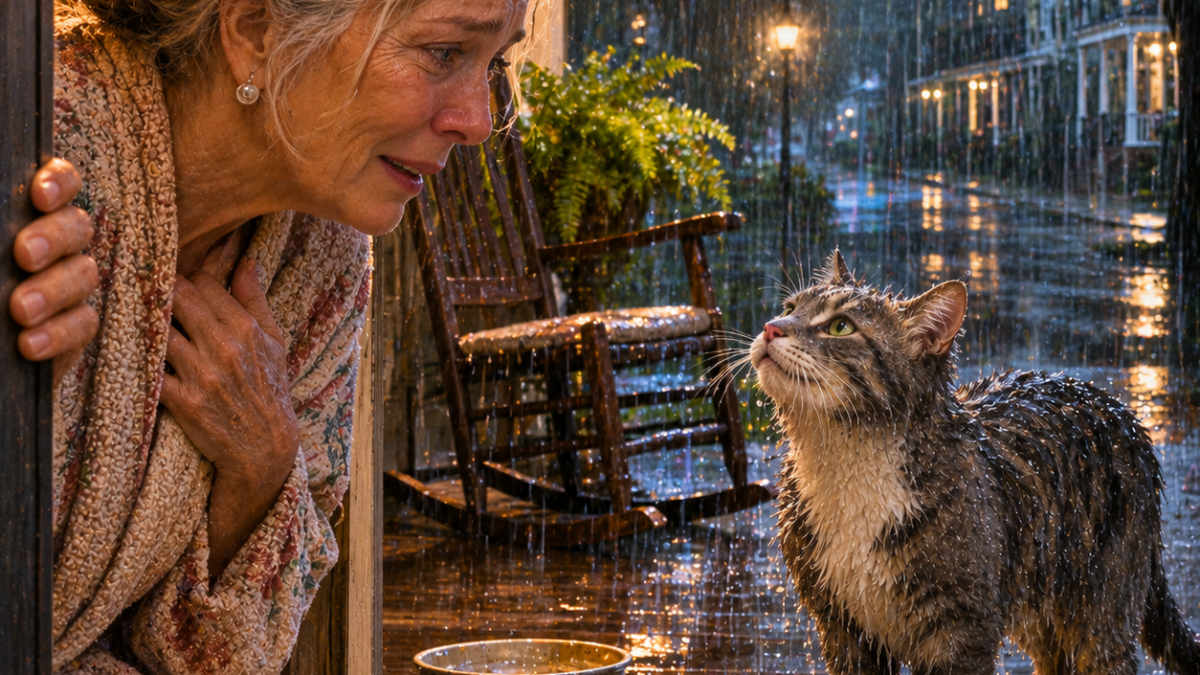
A Stray Cat Sat on My Porch Every Night for Weeks—Then One Storm Changed Everything Between Us
For weeks, the young blue-gray cat sat on the same step of my porch every evening, never begging for food, never scratching at the door, and never asking for anything except the chance to stay near me while I pretended I was perfectly fine being alone.
I kept telling myself not to get attached because at seventy-five I already knew what it cost to love something you could lose, but somehow I still began listening for the soft rustle of leaves that meant he was coming up the path.
Then one cold night the rain came down so hard I couldn’t see beyond my porch light, and when he failed to appear, I finally understood what I had been too afraid to admit about both of us.
My name is Evelyn.
I was seventy-five years old the first time I saw him.
By then, evenings had become the hardest part of my day.
Mornings were manageable.
Morning gave you things to do.
Coffee.
The newspaper.
Sweep the kitchen.
Water the plants.
Make the bed even though only one side had been slept in.
There were errands if I needed them.
The pharmacy.
The grocery store.
The library.
A neighbor might wave while walking a dog.
The mail carrier sometimes stopped long enough to complain about the humidity.
Daylight made the house feel occupied even when it wasn’t.
Evenings were different.
Evenings were when the walls seemed to remember.
That was the hour my husband, Henry, used to come into the kitchen asking what I was making for dinner even when he could clearly see what I was making for dinner.
It was when he turned on the local news too loudly.
When he complained that the ceiling fan clicked even though he was the one who kept promising to fix it.
When he sat in the dining chair beside the window with his tea and watched people walk past our house in Savannah as if the sidewalk were a private theater production put on entirely for him.
Henry had been gone almost four years.
People said time softened grief.
That was true.
What nobody explained was that soft does not mean gone.
Sharp grief is easier to identify.
It cuts.
You know exactly where it hurts.
Older grief changes.
It settles into habits.
You reach automatically for two cups.
You turn toward the other side of the bed because you heard something.
You save a story all afternoon and then remember at five-thirty there is no one coming home to hear it.
By the fourth year, I had become very good at appearing adjusted.
PART2:
My daughter called from Atlanta twice a week.
“How are you doing, Mom?”
“Fine.”
Neighbors asked.
“Fine.”
My doctor asked.
“Fine.”
I said it so often the word stopped meaning anything.
I wasn’t lying exactly.
I could pay my bills.
Drive.
Cook.
Keep appointments.
Remember birthdays.
I wasn’t falling apart.
But there is a large territory between falling apart and being all right.
I lived there quietly.
The evening I first saw the cat, I stepped onto the porch because the house had become too still.
Late summer.
Savannah air thick and warm even after sunset.
Cicadas humming from the live oaks.
PART3:
I had taken my tea outside but forgotten to drink it.
That happened a lot.
I was standing near the railing when I noticed him.
Blue-gray tabby.
White chest.
Young but not a kitten.
Maybe a year old.
Maybe a little more.
He sat on the second porch step with his tail wrapped neatly around his paws.
I don’t know how long he’d been there.
He wasn’t thin enough to look desperate.
His coat was dusty, but not matted.
There were small pale marks along one ear.
Old scratches.
The kind a street cat collects simply by remaining alive.
He looked at me.
That was all.
No meow.
No little chirp.
No rubbing against the post.
No performance.
He just watched.
I lifted one hand.
“Go on.”
Nothing.
“I mean it.”
His tail tapped the wood once.
“Go home.”
Still nothing.
I almost laughed.
“I suppose that’s the problem, isn’t it?”
He blinked.
Slowly.
I immediately regretted talking to him.
Talking made him something other than scenery.
I pointed toward the yard.
“Go on now.”
He didn’t move.
There was something strangely confident about the refusal.
Not arrogant.
He wasn’t challenging me.
It was more like he had heard my suggestion and decided it didn’t require action.
I sat in the rocking chair.
He remained on the step.
For several minutes, we watched each other pretend we weren’t watching each other.
Finally, I went inside.
I closed the door gently.
I expected scratching.
Maybe a cry.
Nothing came.
I stood with my back against the door.
Ridiculous.
A stray cat had sat on my porch.
That happened in Savannah.
Neighborhood cats moved through gardens all the time.
Some belonged to people.
Some probably didn’t.
There was no reason to think about it.
I went to bed.
The next evening, he came back.
Same step.
Same posture.
Tail around his paws.
I opened the door and stared down at him.
“You again.”
His eyes lifted.
“You know, this is trespassing.”
Nothing.
“I’m serious.”
He adjusted one paw.
That was his response.
I went inside.
Third evening.
Same cat.
Fourth evening.
Same.
I started noticing the time.
He usually appeared around dusk.
Not exactly.
He was a cat, not a train.
But close enough that I began expecting him.
At first, I kept telling myself he was using the porch because it was sheltered.
Then I noticed something inconvenient.
He didn’t stay there during the day.
My neighbor, Ruth, came over one afternoon, and I asked casually:
“Have you seen a gray cat around?”
She looked at me.
“What gray cat?”
“Blue-gray. White chest.”
“No.”
“He sits on my porch.”
Ruth smiled immediately.
“Ah.”
“What does that mean?”
“Nothing.”
“It means something.”
“You have a cat.”
“I do not.”
“Sounds like the cat disagrees.”
“He is not mine.”
“Does he know?”
I regretted bringing it up.
I still did not feed him.
That matters.
Not because I was cruel.
Because food would change the arrangement.
Food was an invitation.
Food said:
Come back.
I wasn’t ready to say that.
He came back anyway.
Every evening.
Sometimes he sat on the second step.
Sometimes near the porch column.
Never close enough that I had to step around him.
That was something I noticed early.
He always left space.
If I walked toward the steps, he moved aside.
If I sat in the rocking chair, he stayed several feet away.
If I stood, he watched.
Never crowded.
Never demanded.
He seemed to understand distance better than many people I had known.
One evening, without planning to, I said:
“The house feels too big.”
His ear turned toward me.
I looked at him.
“I wasn’t talking to you.”
He blinked.
I continued anyway.
“It didn’t used to.”
The cat sat there.
No advice.
No pity.
I rocked once.
The chair creaked.
“Henry wanted this porch.”
I don’t know why I told him that.
Maybe because the light was soft.
Maybe because nobody else was listening.
“We almost bought a place on the other side of town. Smaller yard. Newer kitchen.”
The cat lowered his chin slightly.
“But Henry stood right here and said he could see himself getting old on this porch.”
I looked toward the empty chair beside mine.
“He got that part right.”
The words hurt after I said them.
I stopped talking.
The cat didn’t move closer.
That helped.
People are uncomfortable with grief.
Good people.
Kind people.
They don’t mean harm.
They hear sadness and immediately reach for tools.
You’ll get through it.
He’s in a better place.
You have your daughter.
You have your health.
You should travel.
You should volunteer.
Have you thought about dating?
That last suggestion had nearly caused me to throw a muffin at Ruth.
The cat offered nothing.
He just sat.
So the next evening, I talked again.
Little things.
Not confessions.
Not at first.
I told him the azaleas had bloomed too early that year.
I told him Henry hated okra despite living in Georgia for thirty-eight years.
I told him the refrigerator had started making a noise I didn’t trust.
I told him my daughter worried too much.
I told him I sometimes still set out two cups for tea.
That one came out unexpectedly.
I stopped rocking.
The cat looked toward me.
“I know.”
I pressed my lips together.
“Four years.”
He remained still.
“And I still do that.”
My throat tightened.
“I don’t even drink his kind of tea.”
Nothing.
“That seems especially foolish.”
He blinked.
I laughed.
It was small.
But it surprised me.
I realized I hadn’t laughed out loud in the house all day.
Maybe two days.
That frightened me more than I wanted to admit.
So I created a rule.
Do not get attached.
He could sit.
I could talk.
That was all.
No food.
No touching.
No name.
Especially no name.
Names were dangerous.
Names converted random things into specific things.
Specific things could be missed.
I already understood missing.
One evening, I found myself standing at the front window at 6:17.
He usually came by six.
At 6:23, I checked again.
At 6:31, I went outside.
Empty porch.
I felt ridiculous.
“He is a stray cat, Evelyn.”
I said it out loud.
Then, at 6:36, dry leaves rustled near the walkway.
He appeared beneath the hydrangeas.
I felt relief so immediate I got angry.
Not at him.
At myself.
“This needs to stop.”
He climbed the steps.
“What are you doing?”
He sat.
“Don’t look at me like that.”
He looked at me exactly like that.
I went inside.
Ten minutes later, I came back out.
He was still there.
We never discussed my hypocrisy.
Weeks passed.
I began noticing details.
A small notch in his left ear.
A narrow scar over his shoulder where fur grew differently.
White fur beneath his chin.
One front paw had more white than the other.
He groomed himself carefully.
He didn’t seem sick.
He didn’t seem starved.
I started asking around.
Ruth didn’t know him.
Neither did the couple across the street.
I checked neighborhood postings.
No missing cat matching him.
No collar.
I told myself I was only being responsible.
I still didn’t feed him.
Then Ruth caught me leaving a shallow bowl of water near the porch.
She looked down.
Then up.
“Not your cat?”
“It is August.”
“Mhm.”
“Animals need water.”
“Of course.”
“I would do this for any animal.”
“I’m sure.”
“Go home, Ruth.”
She laughed all the way down my walkway.
I left the water.
He drank after I went inside.
The next evening, I sat in my chair while he sat on his step.
I said:
“I had a dog once.”
His ear moved.
“Before Henry.”
Pause.
“That’s not true. Henry was there. But she liked me better.”
The cat looked unimpressed.
“Her name was Daisy.”
I hadn’t thought about Daisy in years.
“Golden retriever. Completely stupid.”
I smiled.
“Wonderful dog.”
Then the old fear rose.
Not Daisy specifically.
What happened at the end.
The vet.
The empty leash.
The silence after.
Then Henry years later.
Hospitals.
Funeral flowers.
People bringing casseroles I couldn’t taste.
Loss seemed to stack.
One thing taught you how to survive the next, but also how expensive loving anything could become.
I looked at the cat.
“This is why you’re staying outside.”
He washed one paw.
“You don’t care.”
He continued washing.
“Probably healthier.”
After that, I became more conscious of what I was doing.
I was enjoying him.
That was the dangerous part.
I liked having someone there when the sun went down.
Someone who required no explanation.
Someone I could talk to without worrying I was boring them with a dead husband.
I began spending longer on the porch.
Sometimes an hour.
Sometimes until mosquitoes drove me inside.
He never tried to enter.
Not once.
That made me trust him more.
He could have rushed the doorway.
He didn’t.
He stayed exactly where he was welcome.
One night I said:
“You’re better behaved than most relatives.”
His tail tapped once.
I chose to interpret that as agreement.
Then came the night I didn’t feel right.
Nothing dramatic.
That is important.
People expect danger to announce itself.
Pain.
Collapse.
Sirens.
Mine was quieter.
I felt heavy.
Not sleepy.
Not exactly sick.
Just wrong.
A pressure behind my ribs.
A tiredness deeper than ordinary tiredness.
I had eaten.
Taken my medication.
Drank water.
I checked my blood pressure with the little machine my daughter bought me.
A little elevated.
Not alarming.
I sat on the edge of the bed.
Looked toward the hallway.
The house felt enormous.
That happens when you’re seventy-five and alone.
Minor discomforts become questions.
Is this nothing?
Is this something?
Should I call my daughter and scare her?
Should I call emergency services and feel foolish?
Should I lie down?
That last question frightened me.
Not because of sleep.
Because some nights, when you’re older and alone, sleep briefly reminds you of mortality in ways it never did when you were thirty.
You close your eyes trusting morning.
Most of us do.
But after enough people disappear from your life, trust gets less automatic.
I left my bedroom door cracked.
Hall light on.
I lay down.
Did not sleep.
Every creak in the house sounded louder.
Around midnight, rain started.
Soft at first.
Then steadier.
I thought of the porch cat.
I wondered where he went at night.
Under a shed?
Someone else’s porch?
An abandoned garage?
Maybe he did belong to someone.
The idea should have comforted me.
Instead I felt strangely rejected by a possibility that hadn’t happened.
I turned over.
“Ridiculous.”
I said it into the dark.
At some point, I caught myself wishing he were outside.
Just knowing he was there.
That was when I understood I’d already broken my rule.
I was attached.
I didn’t like it.
By dawn, I had barely slept.
The rain had stopped.
Gray morning light filled the hall.
I wrapped my robe around myself.
Walked toward the front door.
Fresh air, I thought.
Maybe that would steady me.
I opened it.
He was curled against the doorframe.
I froze.
The cat lifted his head.
His fur was puffed slightly from the cold.
Not soaked.
But damp around the edges.
His eyes looked tired.
He had stayed.
Maybe all night.
I stared.
“Oh, honey.”
The word came out before I could stop it.
Honey.
I hadn’t called anyone that since Henry.
Not seriously.
The cat blinked slowly.
“You stayed?”
He lifted his head a little higher.
Something inside me shifted.
Not because I believed he somehow knew I had felt unwell.
I didn’t turn him into a magical creature.
Maybe the porch was simply dry.
Maybe he liked the step.
Maybe he slept there often after I went inside.
I had no proof otherwise.
But the facts didn’t matter as much as the feeling.
I had spent the night believing nobody was near.
Then opened the door and found one living thing waiting on the other side.
I crouched.
One hand on the frame to steady myself.
“Thank you.”
He watched.
No meow.
No approach.
Just that steady gaze.
I stayed there a long time.
The doorway between us.
Then I thought:
You could let him in.
Immediately, fear answered.
No.
Not because he might scratch furniture.
Not because of litter boxes.
Not because of cost.
Because if I let him inside, he became part of my life.
And life takes things.
That was the truth.
I had spent four years pretending independence was strength when at least part of it was avoidance.
Don’t need too much.
Don’t love too much.
Don’t create another absence.
You cannot lose what you never let in.
That sounds logical when you’re grieving.
It is also a terrible way to live.
I stood.
The cat stayed where he was.
I opened the door wider.
“All right.”
My voice shook.
“Come in if you want.”
He didn’t rush.
Of course he didn’t.
He stood.
Stretched his front legs.
Looked through the doorway.
Then placed one paw inside.
Pause.
Second paw.
He crossed the threshold quietly.
No excitement.
No victory.
Like we had reached an agreement.
He walked into my hallway.
Stopped.
Sniffed.
Then continued toward the kitchen.
I followed.
He moved slowly, investigating.
Chair legs.
Cabinet.
Doorway.
Living room rug.
Something about watching another creature move through the house made the rooms look different.
Occupied.
Not less mine.
More alive.
Then he jumped onto the dining chair by the window.
Henry’s chair.
I stopped.
My hand caught the wall.
Of all the places.
That chair.
Henry sat there every morning.
Coffee in one hand.
Newspaper folded wrong.
He watched the street.
Sometimes he’d say:
“Mrs. Ellis is walking that ridiculous dog again.”
As though Mrs. Ellis had not walked the same dog every day for six years.
The cat sat upright.
Facing the window.
Same quiet posture.
My chest tightened so fast I had to inhale sharply.
“No.”
He turned his head.
I took one step toward him.
I wanted him down.
Not because he’d done anything wrong.
Because it hurt.
Grief is unreasonable about objects.
A chair becomes sacred.
A sweater becomes untouchable.
A chipped mug becomes evidence someone existed.
I had kept Henry’s chair exactly where he left it.
Nobody sat there.
Not Ruth.
Not my daughter.
Not me.
And now this stray had jumped into it within five minutes of entering my house.
I reached toward the chair.
“Come on.”
He looked at me.
Calm.
Not defiant.
My hand stopped.
For one terrible second, Henry’s absence and this cat’s presence occupied the same space.
I wanted one to cancel the other.
That was impossible.
Then something quieter happened.
I realized the chair had been empty for four years.
Empty wasn’t preserving Henry.
It was preserving emptiness.
I lowered my hand.
“All right.”
The cat turned back toward the window.
I stepped away.
My eyes burned.
I went into the hallway until I could breathe normally.
When I returned, the chair was empty.
My heart jumped.
Already.
I hated how quickly I noticed.
Then I found him by the bookcase.
There was a small ottoman in the corner.
Across it lay Henry’s navy sweater.
I had not moved that sweater since the winter after he died.
Every few months, I thought:
Today.
I’ll wash it.
Fold it.
Put it in the cedar chest.
Then I touched the sleeve and stopped.
The cat circled the ottoman once.
Then climbed onto the sweater.
I almost said no again.
Instead, I watched.
He tucked his paws beneath his chest.
Closed his eyes.
The navy wool folded around him.
A little gray body resting on something I had treated like a relic.
I waited for pain.
It came.
But something else came too.
A smile.
Small.
Unexpected.
So strange on my face that I touched my cheek.
I hadn’t smiled at that sweater in years.
Only endured it.
The cat opened one eye.
“You’re trouble.”
He closed it again.
I went to the kitchen.
I had kept a little dry cat food in a cabinet because neighborhood cats sometimes wandered through the yard.
At least that was the excuse.
I filled a small bowl.
Fresh water.
Set both near the ottoman.
He lifted his head.
Looked at me.
Then drank.
Slowly.
No desperation.
No grabbing.
Just trust measured in small amounts.
I sat on the floor a few feet away.
“This doesn’t mean anything.”
He drank.
“You’re still not officially staying.”
He ate several pieces of food.
“I mean it.”
He continued.
I laughed.
Something about caring for him felt familiar.
Not burdensome.
That surprised me.
I had been so afraid attachment would feel like weight.
Instead, filling a bowl gave the evening structure.
Watching him drink gave me somewhere to place my attention besides the silence.
That morning, I called my doctor.
That matters too.
The strange heaviness from the night before turned out not to be an emergency, but she adjusted one medication and reminded me to call if it happened again.
My daughter was furious I hadn’t called her.
“Mom.”
“I was fine.”
“You don’t know that.”
“I called the doctor.”
“After.”
“Yes.”
“You have to tell me these things.”
“I know.”
She paused.
Then:
“What is that sound?”
I looked down.
The cat was drinking again.
“What sound?”
“Are you feeding something?”
“No.”
“Mom.”
“A cat came inside.”
Silence.
Then she laughed so loudly I held the phone away.
“This is not funny.”
“You adopted a cat.”
“I did not.”
“Did you feed him?”
“That proves nothing.”
“Is he inside your house?”
“Temporarily.”
“What’s his name?”
“He doesn’t have one.”
She laughed again.
I almost hung up.
For the next several days, he stayed.
Not constantly inside.
That surprised me.
When I opened the door, sometimes he went out.
He returned later.
I never forced him to remain.
I hadn’t yet taken him to the vet or checked for a microchip.
I told myself that needed to happen before I considered anything permanent.
Very responsible.
Very logical.
Also a convenient way to postpone admitting what I wanted.
I began waking and looking for him.
Sometimes he slept on Henry’s sweater.
Sometimes on the rug.
Never my bed.
He seemed to understand there were boundaries even I had not articulated.
Every morning, he performed a slow tour of the house.
Kitchen.
Living room.
Hallway.
Porch.
Back again.
I talked to him.
More than I should admit.
I told him about Henry.
Not because I thought the cat cared about biography.
Because speaking Henry’s name out loud began to feel possible again.
For years, talking about Henry either made people uncomfortable or made them look at me with that particular softness reserved for widows.
The cat didn’t change expression.
I could say:
“Henry once tried to fix the garbage disposal and flooded the kitchen.”
The cat washed his shoulder.
I could say:
“He hated jazz and pretended to like it because I did.”
The cat blinked.
“He knew I knew.”
Nothing.
“He was a terrible liar.”
Tail flick.
Talking did not feel like opening a wound anymore.
It felt like setting memories on the table one at a time.
Looking at them.
Putting them back differently.
Several days after he first came inside, I took him to a veterinarian.
Borrowed carrier from Ruth.
The cat protested this development.
Strongly.
“That seems more normal.”
I told him as he objected from inside the carrier.
At the clinic, they scanned for a chip.
None.
Young male.
Healthy overall.
Old healed scratches.
No obvious illness.
The vet estimated a year and a half.
Maybe two.
We checked lost-pet listings again.
I posted found notices without revealing every identifying detail.
Weeks passed.
Nobody claimed him.
I still didn’t name him.
Ruth came over.
The cat sat near the window.
She stared at me.
“What?”
“You know what.”
“No.”
“He lives here.”
“He is visiting.”
“For how long?”
“That is none of your business.”
She looked at the bowls.
Then the litter box.
Then the toy mouse my daughter had mailed.
“Visiting.”
“Yes.”
“Does he have luggage?”
“Ruth.”
She sat down laughing.
The cat ignored both of us.
Then came the storm.
Not the first rain since he’d arrived.
Savannah gets rain.
This was different.
The sky turned dark by late afternoon.
Heavy clouds.
Wind moving through the trees.
Weather alert on my phone.
By five, rain fell in hard straight sheets.
The cat had gone outside that morning.
That had become normal.
He usually returned well before dusk.
Five-thirty.
No cat.
Six.
Nothing.
I set food on the porch.
Told myself that was enough.
Six-thirty.
I opened the door.
Rain.
Porch empty.
Seven.
Nothing.
I walked from living-room window to front door and back.
“This is why.”
The words came before I realized I was speaking.
“This is exactly why.”
Why what?
Why I shouldn’t care.
Why I shouldn’t let anything become part of the rhythm of my days.
Because eventually something fails to return.
The thought was unfair.
He was a young cat.
He had survived outside before meeting me.
He probably had shelter.
Maybe he was under someone’s shed.
Maybe dry beneath a porch.
Cats are resourceful.
I knew all of that.
None of it mattered emotionally.
Seven-thirty.
Nothing.
Rain worsened.
I stood under the porch roof calling softly.
“Come on.”
No response.
I still had not named him.
So I had nothing to call.
That suddenly felt unbearable.
“You.”
I felt ridiculous.
“Gray boy.”
Wind.
“Come on, sweetheart.”
Nothing.
I went back inside.
At eight, I called Ruth.
“I haven’t seen him.”
“Since when?”
“This morning.”
“He’s probably dry somewhere.”
“I know.”
“You want me to check my garage?”
“Yes.”
She did.
Nothing.
Two other neighbors checked sheds.
Nothing.
My daughter called.
I tried not to mention it.
She heard my voice.
“What happened?”
“Nothing.”
“Mom.”
“The cat isn’t back.”
Pause.
“The cat you haven’t adopted?”
“Please don’t.”
Her tone softened.
“He’ll probably come back.”
“I know.”
“You don’t sound like you know.”
I sat at the kitchen table.
The food bowl outside was filling with rainwater.
“I made a mistake.”
“What mistake?”
“Letting him stay.”
My daughter was quiet.
Then:
“Because you care?”
“Yes.”
“That doesn’t sound like a mistake.”
“You’re forty-six.”
“Correct.”
“You say things like that because you still think life is long.”
Another silence.
Then she said:
“Mom, loving Dad wasn’t a mistake because he died.”
I closed my eyes.
“Don’t.”
“I’m serious.”
“I know.”
“And letting a cat matter isn’t a mistake because he might disappear.”
“That is not the same.”
“No.”
She paused.
“But I think that’s what you’re really talking about.”
I ended the call soon after.
Not angrily.
I simply couldn’t continue.
Because she was too close.
Nine o’clock.
I closed the porch door.
Opened it again ten minutes later.
Ten.
Nothing.
The house felt different.
He had only been inside for days.
On the porch for weeks.
How could absence return so quickly?
I sat at the dining table.
Henry’s chair across from me.
Empty.
The cat’s food untouched outside.
Suddenly I understood something I had resisted for years.
I did not want to go back.
Not to the version of the house before the cat.
Not because he replaced Henry.
He didn’t.
Nothing could.
But he had changed the shape of the silence.
There is a difference between solitude and emptiness.
For years, I confused them.
I told myself I preferred solitude.
Maybe sometimes I did.
But I had also protected emptiness because emptiness could not surprise me.
It could not die.
Leave.
Fail to return.
The cat had disrupted that arrangement.
And now, sitting there while rain hit the windows, I realized I was grateful.
Even if he never came back.
That thought hurt.
But it was true.
At 10:17, I stood to turn off the porch light.
Then I heard something.
Barely.
Scratch.
I froze.
Another sound.
Soft against wood.
I opened the door.
There he was.
Soaked.
Completely.
Water dripping from his whiskers.
Fur plastered against his body.
Tail wrapped tight.
He stood beneath the porch light trembling.
“Oh.”
My hand went to my mouth.
“Oh, sweetheart.”
He looked up.
Tired.
Not panicked.
Not desperate.
Just tired.
I stepped aside.
“Come in.”
For one second, he remained outside.
Then one wet paw crossed the threshold.
Second.
Then the rest.
Slow.
Intentional.
He was not wandering.
He was coming home.
That was what I felt.
I closed the door against the wind.
He stood on the mat.
Tried to shake himself.
Tiny, restrained movements.
Almost polite.
That broke something open in me.
Even soaked and shivering, he somehow seemed concerned with taking up as little space as possible.
“No.”
I knelt.
“No more of that.”
I grabbed a towel.
Spread it beside him.
He stepped onto it.
Then lowered himself.
I reached toward him.
Stopped.
Until then, I had touched him only briefly.
A stroke across the back.
A fingertip against his cheek.
Always his choice.
That night, when my hand touched his cold fur, he didn’t pull away.
I dried him gently.
Head.
Shoulders.
Back.
Paws.
He leaned into my hand.
Not much.
Enough.
And I cried.
Not dramatically.
Tears just came.
Rain outside.
Wet cat.
Old woman kneeling on hardwood.
Four years of careful distance collapsing over one soaked tabby.
“Stay.”
The word slipped out.
He blinked.
I pressed the towel around him.
“Please.”
My voice shook.
“You can stay.”
For the first time, saying it didn’t feel like asking life to promise me anything.
That was the change.
I wasn’t saying:
Stay forever.
Never get sick.
Never leave.
Never make me grieve.
I had finally learned those promises don’t exist.
I was only saying:
Stay now.
Be here while you are here.
Let me love what is present without demanding protection from the future.
He closed his eyes.
My chest loosened.
That night, I moved Henry’s sweater from the ottoman.
Not to put it away.
I spread it more carefully.
The cat climbed onto it.
Turned three circles.
Lay down.
I sat in Henry’s chair.
First time in four years.
I had avoided it because it felt like sitting in his place.
But that night, I realized chairs do not belong to grief.
I sat.
The cat slept.
Rain softened.
I whispered:
“You know, he would have liked you.”
One ear moved.
“He would pretend not to.”
The cat stayed asleep.
“Then he’d feed you when I wasn’t looking.”
I smiled.
“He did that with Daisy.”
The room felt full.
Not crowded.
Full.
The next morning, I called my daughter.
“He’s back.”
“I figured.”
“How?”
“You answered the phone differently.”
I looked toward the sweater.
“I told him he could stay.”
Silence.
Then:
“Mom.”
“Don’t cry.”
“I’m not.”
“You are.”
“So are you.”
Fair.
She asked:
“Does he have a name now?”
I looked at him.
“No.”
“Still?”
“I’ll get there.”
My daughter laughed.
But I did something more important first.
I called the vet.
Updated his records.
Scheduled vaccines and neutering.
Completed the found-animal hold process properly.
Kept the notices up for the required period.
No one came forward.
Eventually, the paperwork became official.
Mine.
Or, more accurately, I became his.
Ruth insisted I name him.
“You cannot put ‘gray porch cat’ on the vet file forever.”
“Apparently I can.”
“What do you call him?”
“Sweetheart.”
“That is not a cat name.”
“He responds.”
“He responds to the refrigerator.”
True.
The name eventually came quietly.
Henry used to call the porch “the harbor.”
Whenever storms came, he’d say:
“Everything needs a harbor.”
The phrase returned to me one morning while the cat sat in the window watching rain.
So I called him Harbor.
I tried it once.
“Harbor.”
His ears turned.
Again.
“Harbor.”
He looked at me.
That was enough.
The house changed after Harbor.
Not dramatically.
That matters.
There was no cinematic transformation.
I did not suddenly become a social butterfly.
I didn’t start traveling the world.
I didn’t stop missing Henry.
Grief did not vanish because a cat entered the building.
The change was smaller.
Better.
I had someone to say good morning to.
Someone appeared when I opened the refrigerator.
Someone sat by the kitchen while I made tea.
Someone watched birds through Henry’s window.
Someone followed me to the porch each evening.
Sometimes Harbor sat beside my chair.
Sometimes on the same second step where I first saw him.
I continued talking.
About Henry.
My daughter.
Neighbors.
News.
Things that irritated me.
Things I remembered.
The difference was that memories stopped feeling like locked rooms.
I could enter them.
Sit.
Leave.
One morning, Harbor jumped into Henry’s dining chair.
I froze automatically.
Then nothing happened.
No sharp pain.
No need to move him.
He settled.
Sunlight across his white chest.
I walked over.
Ran my hand down his back.
And felt peace.
Not replacement.
That distinction took me a long time to understand.
Harbor did not occupy Henry’s place.
There was no place to occupy.
People are not furniture.
Love is not a chair that can hold only one person at a time.
Henry existed in one part of me.
Harbor existed in another.
They did not compete.
The past and present could sit at the same table.
That realization changed more than the cat.
I began saying yes to small things.
Coffee with Ruth.
Lunch after church.
A weekend visit to my daughter’s house.
I started walking farther in the mornings.
Not because Harbor needed it.
He definitely did not.
He watched me leave from the window and considered exercise a personal failing.
But I had begun paying attention to my own days again.
That scared me at first.
Enjoyment can feel disloyal after loss.
Nobody warns you.
The first time you genuinely laugh after someone dies, part of you thinks:
How dare you?
The first good day feels like betrayal.
Then slowly you learn grief is not measured by how miserable you remain.
I could miss Henry and enjoy Harbor.
I could remember one life while continuing mine.
One afternoon, my daughter visited.
Harbor hid for the first hour.
“He hates me.”
“He doesn’t hate you.”
“He likes you.”
“I fed him.”
“Exactly.”
She sat on the floor.
Eventually, he appeared.
Sniffed her hand.
Walked away.
“Rude.”
“He’s evaluating.”
“He has your personality.”
“I don’t know what that means.”
She smiled.
Later, she found him sleeping on Henry’s sweater.
She stood silently.
“That’s Dad’s.”
“I know.”
“You still had it?”
“I still have it.”
She touched the sleeve.
For years, I had avoided showing her the sweater because I assumed it would hurt her.
She sat down.
“He wore this the day we went to Tybee.”
“I remember.”
“He complained about the wind.”
“He complained about everything.”
We laughed.
Harbor slept through it.
That conversation would not have happened before.
Not because the sweater wasn’t there.
Because I had turned it into something too sacred to touch.
Harbor ignored sacredness.
He made it usable again.
That might have been his greatest gift.
He had no respect for the museum I built out of grief.
Henry’s chair?
Seat.
Henry’s sweater?
Bed.
Quiet hallway?
Running track at three in the morning.
Living room rug?
Excellent place to vomit exactly once after eating too quickly.
Life entered.
Messy.
Ordinary.
That was what I needed.
About six months after Harbor stayed, I had another evening when I felt strange.
Similar heaviness.
This time I called my daughter before she could become furious retroactively.
Then I called my doctor’s office.
Everything was fine.
But after hanging up, I realized I had changed.
Before Harbor, I often treated asking for help as weakness.
If I could still stand, drive, cook, and remember appointments, I believed I had no right to worry anyone.
But caring for another living thing reminded me that help is not only for emergencies.
Harbor depended on me.
Food.
Vet.
Shelter.
And I depended on people too.
My daughter.
Ruth.
Doctors.
Neighbors.
Dependency wasn’t failure.
It was life.
Henry had depended on me.
I had depended on him.
We never called that weakness.
We called it marriage.
Why had widowhood convinced me strength meant needing nobody?
I don’t know.
Maybe because losing the person you rely on makes reliance feel dangerous.
Harbor changed that equation slowly.
I fed him.
He waited on the porch.
I opened the door.
He came home.
Mutual things.
Small.
Reliable.
One year after the storm, Savannah had another terrible downpour.
Harbor was inside before it started.
I checked anyway.
Old habits.
He sat on the windowsill watching rain.
I made tea.
One cup.
Then stopped.
Looked at the cabinet.
For years, accidentally setting out two cups had hurt.
I took down a second one intentionally.
Henry’s old mug.
Blue ceramic.
Chipped handle.
I placed it across from me.
Not because I believed he was there.
Not because I was pretending.
Because I wanted to remember him while I sat with my present life.
Harbor jumped into the chair beside it.
I laughed.
“You’re ruining the symbolism.”
He licked one paw.
I drank my tea.
Rain filled the windows.
And the evening wasn’t heavy.
That was new.
Ruth once asked:
“Do you think he knew you needed him?”
We were sitting on the porch.
Harbor asleep near my feet.
I considered it.
“No.”
She looked disappointed.
“You don’t?”
“I think people like making animals magical.”
“But he kept coming.”
“Yes.”
“Without food.”
“Yes.”
“And stayed outside that night you felt sick.”
“Yes.”
She smiled triumphantly.
“So?”
“So maybe he liked my porch.”
Ruth rolled her eyes.
I continued.
“But I think I knew I needed him before I admitted it.”
That was true.
Harbor didn’t have to understand grief.
He didn’t need to sense my loneliness in some supernatural way.
The miracle, if there was one, was ordinary.
A living thing appeared.
Kept appearing.
I noticed.
Then cared.
That was enough.
We often wait for healing to feel dramatic.
A revelation.
A breakthrough.
A moment where pain suddenly makes sense.
Mine looked like a cat sitting on the same porch step every evening.
Nothing happened.
Then it happened again.
And again.
Routine became expectation.
Expectation became care.
Care became fear.
Fear became choice.
When Harbor disappeared into that storm, I finally saw what my caution had become.
Not protection.
Isolation.
I had been standing in the doorway of my own life telling everything new:
Go on.
Not because I wanted to be alone.
Because I was afraid to have another reason not to be.
That was the difference.
Harbor is older now.
Not old.
Just older.
His blue-gray fur is thicker.
The scars on his ears remain.
He still likes the porch at dusk.
Sometimes he sits exactly where I first saw him.
Second step.
Tail around paws.
I sit in the rocking chair.
We have almost the same arrangement we had at the beginning.
Except now the front door is open behind us.
That matters.
He goes in when he wants.
Comes out when he wants.
I don’t worry every second he leaves the porch anymore.
Well.
I worry some.
I’m still seventy-something and apparently motherhood can be accidentally renewed through cats.
But fear no longer makes every decision.
One evening recently, a woman walking past stopped.
“Beautiful cat.”
“Thank you.”
“Yours?”
I looked at Harbor.
He looked away.
I said:
“Yes.”
The word still gives me a little warmth.
“Where’d you get him?”
“He showed up.”
She smiled.
“They choose us.”
People say that a lot.
Maybe.
I think sometimes they simply arrive, and we’re given a choice whether to notice.
After she left, I looked at Harbor.
“You chose the porch.”
His tail tapped.
“I chose the door.”
That felt more accurate.
Henry once told me every house has two lives.
The one built from wood and walls.
And the one built from whoever is allowed inside.
For four years after he died, I thought protecting our life together meant keeping the second version of the house unchanged.
Same chair.
Same sweater.
Same routines.
Same silence.
But houses are not preserved by becoming empty.
Neither are people.
Now there is cat hair on Henry’s navy sweater.
Scratch marks on one dining-chair leg.
A water bowl in my kitchen.
A small gray mouse under the refrigerator that Harbor refuses to retrieve but becomes distressed if I try to throw away.
There is life here.
Not the same life.
That is the point.
One morning, I found Harbor asleep in Henry’s chair with the early sun across his back.
I stood there for a moment.
Years earlier, seeing him in that chair nearly made me put him outside.
Now I simply rested my hand on him.
He opened one eye.
I said:
“You know, you caused a lot of trouble.”
His eye closed.
“I had things organized.”
Nothing.
“Very quiet.”
Tail flick.
“You ruined all that.”
He started purring.
I laughed.
Then sat in the chair beside him.
I thought about the first evening.
Me on the porch.
Him on the step.
“Go on.”
I had said it twice.
Maybe three times.
He stayed.
Not forever.
Just another minute.
Then another evening.
Then another week.
Long enough for me to realize the person I was actually trying to send away was not him.
It was possibility.
Possibility of attachment.
Possibility of happiness.
Possibility of grief.
You don’t get one without risking the others.
I had spent years trying to negotiate around that fact.
There is no negotiation.
Everything alive changes.
Everything loved can be lost.
The answer is not to stop loving.
I wish I had learned that more easily.
Maybe nobody does.
Sometimes it takes a storm.
Sometimes it takes an empty chair.
Sometimes it takes a soaked cat standing under a porch light after you’ve spent hours convincing yourself you don’t care whether he comes back.
That night, when I knelt on the floor and said, “Stay,” I thought I was offering Harbor a home.
I understand now that I was also offering myself one.
Not a different house.
The same one.
Just open again.
These days, when evening settles over Savannah, the rooms no longer seem to close around me.
I make tea.
Harbor follows me to the porch.
Sometimes I talk.
Sometimes I don’t.
He sits near my feet, tail curled neatly around his paws.
The live oaks move in the warm air.
Neighbors pass.
Lights come on.
And I think about how little he ever asked from me.
He didn’t scratch at the door.
Didn’t cry for food.
Didn’t force his way inside.
He waited.
Maybe that’s why I finally trusted him.
He left the choice with me.
For weeks, I believed he was the one waiting to be let into the house.
I was wrong.
I was the one standing behind the door.
And on that stormy night, when I finally opened it wide enough for both of us, I learned that letting something new into your life doesn’t erase what came before.
It simply means the empty places don’t have to stay empty forever.








