A Stray Cat Gave Birth Under My Truck in 37-Degree Weather—Then I Realized Why She Had Chosen My Parking Space
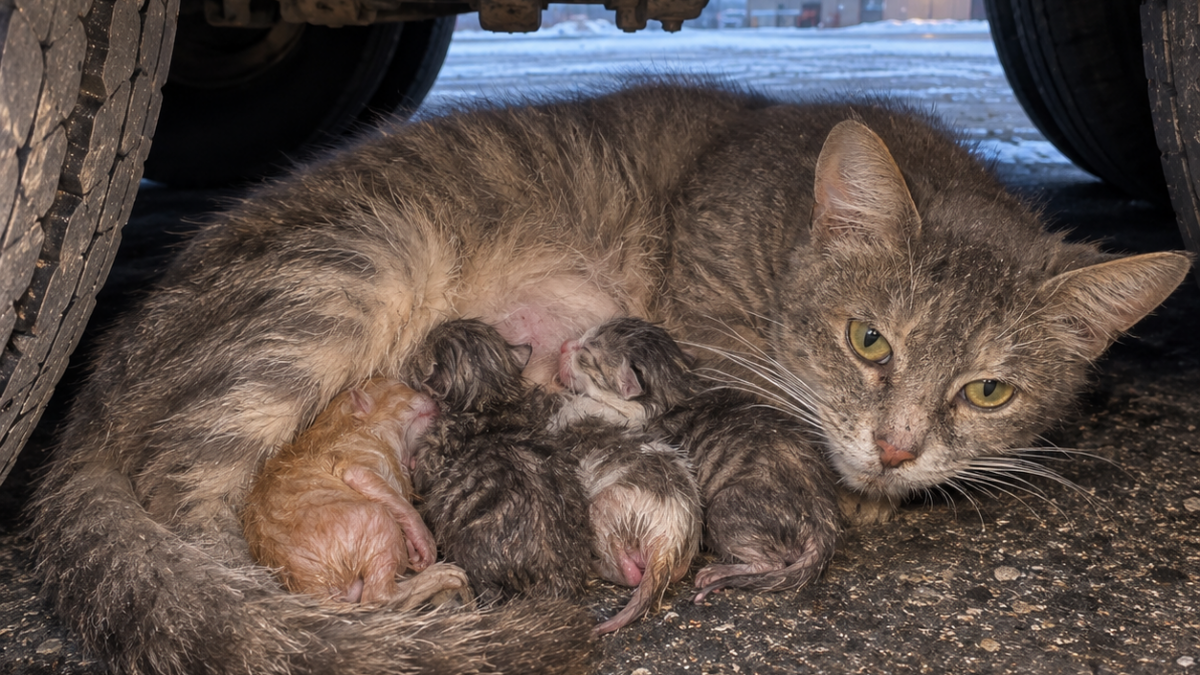
A Stray Cat Gave Birth Under My Truck in 37-Degree Weather—Then I Realized Why She Had Chosen My Parking Space.
At six in the morning, I crawled beneath my truck expecting to find something caught under the chassis—and instead found a skinny gray cat curled around four newborn kittens on freezing pavement, using her own body as the only wall between them and the wind.
The kittens were still wet, some of their umbilical cords were still attached, and the only reason they had survived the night was that their mother had somehow found the one patch of asphalt in the parking lot that still held a little warmth from my truck.
But when we tried to move her somewhere safer, she refused to take a single step until every one of her babies had been carried first, and that was when I understood that being late for work was no longer even remotely important.
I work mornings at a distribution warehouse outside a small town in northern Indiana.
Not glamorous work.
Pallets.
Forklifts.
Inventory.
Loading bays.
Steel shelves tall enough to make you nervous if you stand beneath them and think too hard.
My shift officially starts at six.
I usually arrive around 5:25 because I am one of those people who would rather sit in a parking lot ten minutes early than spend the entire drive wondering whether I am going to be late.
My girlfriend says this is not a personality trait.
It is anxiety with a wristwatch.
She is probably right.
The warehouse sits on the edge of an industrial area where town becomes farmland.
One side is warehouses.
The other is fields.
Behind the building is a gravel-and-asphalt employee lot that holds maybe forty vehicles when the place is busy.
I drive an old Ford F-150.
Nothing special.
Dark blue.
A little rust beginning around one wheel well.
Heater works.
Radio works when it feels like it.
The driver’s-side window makes a noise that sounds expensive, so I try not to use it.
That truck has taken me to work for six years.
It has hauled furniture.
Lumber.
A broken washing machine.
My girlfriend’s ridiculous number of houseplants when she moved apartments.
Once an entire dining set I was absolutely certain would fit and absolutely did not.
It had never been a maternity ward.
That changed last February.
The temperature had dropped overnight.
Not dangerously cold for Indiana, but cold enough.
Around 37 degrees Fahrenheit.
Three Celsius.
Wind coming across the open lots.
The kind of morning where the cold gets inside your sleeves when you walk from the truck to the building.
I had arrived at work in the dark.
5:26.
Parked in my usual space near the back fence.
Turned off the engine.
Sat there for maybe a minute finishing coffee.
Then went inside.
Nothing unusual.
That day was busy.
A shipment came in late.
Two people called off.
One forklift battery refused to charge.
PART2:
By the time my shift ended, I was tired enough that I wanted exactly three things:
My truck.
Food.
My couch.
I walked outside just before two in the afternoon.
The sun was up, but the air still felt cold.
I crossed the lot.
Unlocked my truck.
Then heard something.
At first I thought it was a bird.
A thin, high sound.
Almost mechanical.
I stopped.
Nothing.
I opened the driver’s door.
Then heard it again.
A tiny cry.
Underneath me.
I froze.
The first thought in my head was:
Kitten.
I do not know why.
Maybe because once you hear a kitten cry, the sound is hard to confuse with anything else.
I crouched beside the truck.
“Hello?”
Ridiculous, I know.
But that is what came out.
Another cry.
PART3:
Definitely beneath the truck.
I got down on one knee.
Could not see much.
The underside was shadow.
I turned on my phone flashlight.
Got lower.
Then lay flat on my stomach on cold asphalt.
The first thing I saw was eyes.
Two greenish-yellow reflections under the chassis.
Then gray fur.
A cat.
She was tucked between the rear wheels, closer to the differential than I would ever want an animal to be.
For one terrible second, I thought she was injured.
Then something moved against her stomach.
Tiny.
Pink.
Wet-looking.
I stared.
“No way.”
Another tiny body shifted.
Then another.
Four kittens.
A mother cat had given birth beneath my truck.
I just lay there.
Phone in one hand.
Cheek almost against freezing pavement.
Trying to understand what I was seeing.
The mother was young.
That was obvious even to me.
Small body.
Narrow face.
Gray tabby coat, though dirty enough that some of the striping was hard to see.
She looked thin.
Not skeletal.
But close enough that every line of her shoulders showed.
Her body curved tightly around four newborn kittens.
Not days old.
New.
Hours.
Maybe less.
Their fur still looked damp.
Their eyes were sealed shut.
One was gray like her.
One darker.
One pale tabby.
One almost black.
At least two still had bits of umbilical cord attached.
They were pressed against her belly.
Moving.
Rooting.
Nursing.
The mother looked at me.
She did not hiss.
Did not growl.
Did not try to run.
She simply watched.
I backed away slowly.
Sat up.
Then immediately looked at the truck.
I had almost started it.
That thought hit me so hard my stomach turned.
If I had climbed in, turned the key, and driven away—
I stopped myself.
No.
They were alive.
That was what mattered.
I called my girlfriend.
Her name is Jenna.
She answered after two rings.
“Hey.”
“Are you home?”
“Yeah. Why?”
“I need towels.”
Pause.
“What happened?”
“And a box.”
Another pause.
“Why?”
“There’s a cat under my truck.”
“You found a cat?”
“She had babies.”
Silence.
“What?”
“Four.”
“Under your truck?”
“Yes.”
“Are you serious?”
“Yes.”
“Are they alive?”
“Yes.”
“Are you alive?”
“What?”
“You sound weird.”
“I’m lying in a parking lot looking at newborn kittens.”
“I’m coming.”
That was Jenna.
No further questions.
She lived about fifteen minutes away.
I called my supervisor next.
Not because I needed permission to leave.
My shift was done.
Because I needed to tell him my truck was not moving.
Mike answered.
“You already leave?”
“I’m in the parking lot.”
“Then leave.”
“I can’t.”
“What happened?”
“Cat gave birth under my truck.”
Silence.
Then:
“What?”
That became the word of the day.
What?
No one accepts that sentence immediately.
“I have four newborn kittens between my back wheels.”
Mike was quiet.
Then laughed once because I think he thought I was messing with him.
“I’m serious.”
“Send me a picture.”
I crawled back underneath.
The mother still had not moved.
I took one photograph.
Flash off.
Just phone light.
She stared directly into the camera.
Four babies tucked against her.
The truck frame above.
Cold pavement below.
I sent it.
Thirty seconds later Mike called.
“Jesus.”
“Yeah.”
“You can’t move the truck.”
“Thank you for the technical advice.”
“Shut up.”
He came outside five minutes later.
Then two other coworkers.
Soon there were four grown men standing twenty feet from my truck looking underneath like we were waiting for a bomb technician.
“Don’t crowd her,” I said.
Mike looked at me.
“Since when are you cat expert?”
“Since fifteen minutes ago.”
Fair point.
One coworker, Luis, crouched.
“She picked a bad place.”
That was my first thought too.
Under a vehicle.
Parking lot.
Cold weather.
Exhaust.
Tires.
Danger everywhere.
Then I touched the asphalt beneath the truck.
Not where the kittens were.
A spot closer to the front.
Cold.
I reached farther back.
Closer to where the exhaust had run that morning.
Slightly warmer.
Not warm exactly.
But not as cold.
I stared.
The truck had been parked at 5:30 that morning after a twenty-five-minute drive.
Engine hot.
Exhaust hot.
Drivetrain warm.
The truck would have radiated heat downward for hours.
The pavement beneath it had held some of that warmth.
By night, when temperatures dropped toward three degrees Celsius, it might have been the warmest patch in that entire open lot.
That changed the story.
“She didn’t pick a bad place,” I said.
Mike looked at me.
“What?”
“She picked the warmest place.”
We all went quiet.
That truck was one of the only vehicles left in the lot overnight sometimes because our facility ran staggered shifts.
But that morning I had arrived before most employees.
My engine had been one of the first warm things in a mostly empty parking lot.
Maybe she had found it while the truck was still warm.
Maybe she had been searching for shelter.
Maybe labor had already started.
Maybe she simply followed heat.
Whatever happened, she ended up underneath the rear of my truck.
Protected overhead by the chassis.
Wind blocked partly by tires.
Residual warmth underneath.
Then she gave birth.
No blankets.
No box.
No shed.
No porch.
Just pavement.
And herself.
I looked under again.
Her body formed a tight C around the kittens.
Back curved outward.
Head near her hind legs.
She had positioned herself so the babies were enclosed on three sides.
The chassis above blocked some wind.
Her body blocked the rest.
The ground underneath was warmer than the surrounding lot.
She had built a shelter using geometry.
Truck.
Body.
Heat.
That was it.
Jenna arrived twenty minutes later.
Her car came into the lot too fast.
She parked several spaces away.
Got out holding a cardboard box, towels, and one of our old fleece blankets.
“You weren’t exaggerating.”
“I don’t usually exaggerate newborn cats.”
She crouched.
I showed her.
She whispered, “Oh my God.”
The mother’s eyes followed her.
“She looks exhausted.”
“Yeah.”
“Can we move them?”
“I don’t know.”
That was the problem.
The kittens could not stay there.
Eventually I had to move the truck.
The temperature would drop again at night.
The warm pavement would not last.
And the underside of a pickup is not a safe nursery.
But the mother had just given birth.
Moving her carelessly could make her panic.
Jenna placed the cardboard box on one side of the truck to block the wind.
Then moved her car to the opposite side, not close enough to frighten the cat, but enough to create another barrier against the crosswind.
“Better?”
“A little.”
She folded one towel.
Reached under.
Not toward the cat.
Just near.
Placed it a few inches away.
The mother watched.
Did nothing.
We waited.
Ten minutes.
Fifteen.
The kittens nursed.
One cried.
The mother licked it.
Then, after maybe twenty minutes, she did something I will remember for the rest of my life.
She leaned forward.
Bit the corner of the towel.
Pulled.
The towel moved a few inches.
She let go.
Adjusted.
Bit it again.
Pulled farther.
Jenna grabbed my arm.
“She’s taking it.”
“Don’t move.”
The cat dragged the towel beneath part of her body.
Then shifted.
Carefully.
One kitten rolled slightly.
She immediately nudged it back.
Then pulled the towel again.
Little by little, she managed to get enough of the fabric under the kittens that they were no longer lying directly on the asphalt.
Jenna started crying.
Not loudly.
Just tears.
I understood.
Here was an animal who had given birth in the cold, probably alone, maybe hungry, maybe frightened.
And within minutes of being given one soft thing, she knew exactly what to do with it.
She did not leave the kittens to investigate it.
She did not lie on it alone.
She pulled it underneath them.
Interior decorating in a truck parking lot.
I laughed.
Jenna wiped her face.
“What?”
“Nothing.”
“What?”
“She’s fixing the place.”
Jenna laughed too.
The cat looked at us like we were idiots.
Which was fair.
We called a rescue.
Actually, we called three.
First one went to voicemail.
Second said they were full but gave us another number.
Third answered.
The woman’s name was Carol.
She volunteered with a foster network.
She asked questions.
“How old are kittens?”
“Born today.”
“Eyes open?”
“No.”
“Umbilical cords?”
“Some.”
“Mom nursing?”
“Yes.”
“Responsive?”
“Yes.”
“Can you touch her?”
“Haven’t tried.”
“Don’t yet.”
Good.
“Is she trapped?”
“No.”
“Can she leave?”
“Yes.”
“Is she leaving?”
“No.”
“Okay.”
Carol said she would come.
Forty-five minutes.
We waited.
By then Mike had gone back inside.
Luis brought a bowl of water.
Another coworker brought canned tuna from his lunch.
We placed both several feet from the truck.
The mother smelled them.
Did not move.
That worried me.
“She needs to eat.”
Jenna said, “She won’t leave them.”
That seemed obvious.
We slid the food closer.
Still no movement.
Finally, after nearly an hour, she stretched her neck far enough to lick some water.
Then ate a little tuna without fully leaving the kittens.
Everything she did was calculated around contact.
One paw stays here.
Body stays around them.
Head reaches.
Return.
No unnecessary distance.
Carol arrived around four.
Late afternoon now.
The temperature had not risen much.
She brought a hard-sided carrier lined with thick blankets.
There was a heating pad beneath half the bedding.
Battery-powered warming disc.
Professional setup.
She knelt near the truck.
Looked once.
Then said:
“She’s young.”
“How young?”
“Maybe a year.”
Jenna stared.
“That’s basically a baby.”
Carol nodded.
“Possibly first litter.”
“She knows what she’s doing.”
“Instinct is powerful.”
Carol watched the mother for several minutes.
Then looked at the kittens.
“All four moving.”
“Yes.”
“Good nursing response.”
“Yes.”
“She did well.”
Something about that sentence hit me.
She did well.
Like she had been given an impossible exam.
Cold parking lot.
No shelter.
No help.
First labor.
Four newborn lives.
And somehow the answer had been:
Find residual heat.
Use the truck.
Curve body against wind.
Do not leave.
Keep them alive.
She did well.
Carol did not want to pull the mother out.
Too much stress.
Instead we opened the warmed carrier near the truck.
Placed it on the pavement.
Door facing her.
The mother stared.
No movement.
Carol placed food inside.
Nothing.
“We may have to move kittens first.”
Jenna frowned.
“Will she attack?”
“Maybe.”
Carol looked at the mother.
“But I think she’s more scared of leaving them than of us.”
That turned out to be exactly right.
Carol put on gloves.
Reached slowly under the truck.
The mother’s ears flattened slightly.
But no hiss.
Carol paused.
Then lifted the first kitten.
Tiny.
Wet fur beginning to dry.
It cried.
The mother’s head snapped toward it.
Carol moved immediately to the carrier.
Set the kitten inside.
The mother stood.
For the first time.
She looked shaky.
Exhausted.
She took one step toward the carrier.
Then stopped.
Looked back.
Three babies still beneath the truck.
She returned.
Carol whispered, “See that?”
I did.
Second kitten.
Same.
Mother watched.
Took half a step.
Returned to remaining two.
Third kitten.
Now only one under the truck.
The mother stood over it.
Would not move.
Carol waited.
No rush.
Then carefully picked up number four.
The mother followed the kitten with her eyes all the way to the carrier.
Carol placed it inside.
Four tiny cries.
The mother looked under the truck.
Empty.
Then toward the carrier.
Then back beneath the truck.
She checked again.
That is the part that got me.
She physically looked around the spot where they had been.
One.
Two.
Three.
Four.
Maybe she could not count the way we do.
But she knew the nest was empty.
She smelled.
Looked.
Then walked toward the carrier.
Slow.
Cautious.
She put her head inside.
The kittens cried.
She went in.
Immediately curled around them.
Same C shape.
Same body wall.
Different shelter.
Warm blankets now.
No wind.
Carol closed the carrier.
Jenna made a sound beside me.
Half laugh.
Half sob.
I looked away because I was doing the same thing.
Carol covered the carrier with another blanket.
“She would not move until all four were in.”
“No.”
“That’s normal maternal behavior.”
“Normal?”
She smiled.
“Normal can still be impressive.”
I liked that.
People sometimes think instinct makes something less meaningful.
As if behavior only matters if it is consciously planned.
I do not think that anymore.
Whether the cat understood sacrifice as a concept did not matter.
Her body knew one rule:
Babies first.
The carrier went into Carol’s heated vehicle.
She said the family would go straight to a foster home.
Then veterinary check.
She asked if I wanted updates.
“Yes.”
Too fast.
I laughed.
“Yeah. Definitely.”
She wrote down my number.
Jenna added hers too.
Then Carol looked at my truck.
“You can move it now.”
I stared.
I had almost forgotten.
The truck.
My actual reason for being in the parking lot.
I crawled underneath one more time.
The towel remained.
Dark patch on the pavement where the mother had been.
A little blood from birth.
Nothing else.
Empty.
It felt wrong.
Like a room after furniture is removed.
Jenna touched my shoulder.
“You okay?”
“Yeah.”
I picked up the towel.
Still slightly warm.
We drove home.
That night Carol texted.
MOM AND BABIES STABLE. ALL FOUR NURSING. MOM ATE A FULL MEAL.
Then a photograph.
The mother inside a plastic nesting box.
Clean blankets.
Heating pad beneath one side.
Four kittens lined against her belly.
No asphalt.
No truck frame.
No cold.
I stared at the picture for a long time.
Then sent:
Does she have a name?
Carol replied:
Not yet. Want to pick one?
I had not expected that.
Jenna immediately said, “Ford.”
“No.”
“Why not?”
“Absolutely not.”
“Truck?”
“No.”
“Diesel?”
“She’s a girl.”
“Women can be named Diesel.”
“We are not naming her Diesel.”
We argued for ten minutes.
Finally Jenna said:
“Shelter.”
I looked at her.
“What?”
“She made one.”
That felt too obvious.
Then I thought about the time.
She had chosen the truck because of heat.
The one warm place.
“Haven.”
Jenna smiled.
“Haven.”
We texted Carol.
Haven.
She replied:
Perfect.
The kittens got temporary foster names a day later.
Milo.
Pip.
Bean.
June.
I do not know why one was June in February.
Foster people operate under their own naming laws.
The next morning, I went to work.
Mike saw me come in.
“You’re on time.”
“Disappointed?”
“Little bit.”
He looked at my truck through the window.
“Everything gone?”
“Yeah.”
“Kittens okay?”
“Yeah.”
“Mom?”
“Eating.”
Mike nodded.
“Good.”
Then:
“You know yesterday technically wasn’t an excused absence.”
I stared.
“I wasn’t absent.”
“You spent two extra hours in parking lot after shift.”
“That is my personal time.”
“I’m kidding.”
“Good.”
He laughed.
Then became serious.
“If that happened before work, you’d be late.”
“Obviously.”
“How late?”
“As long as necessary.”
He nodded.
“Correct answer.”
A week later, the story actually happened that way.
Not exactly.
But close.
Carol asked whether Jenna and I could visit Haven at the foster home.
We planned to go before my shift because that was when the foster volunteer was available.
Bad idea.
I should have known.
We arrived at 4:45 a.m.
The kittens were a week older.
Still tiny.
Eyes beginning to open.
Haven looked completely different.
Clean.
Fed.
Fur brighter.
Still thin, but relaxed.
When I entered the room, she looked at me.
I stopped several feet away.
“Think she remembers?”
The foster volunteer, Michelle, said, “She might remember your smell.”
Haven stood.
Walked toward me.
I crouched.
She came close.
Sniffed my hand.
Then rubbed her face against my fingers.
I lost it.
Not dramatically.
No sobbing.
Just eyes filling immediately.
Jenna saw.
Smiled.
“Big tough warehouse guy.”
“Shut up.”
Haven rubbed again.
Michelle said, “She’s incredibly friendly.”
“Stray?”
“Probably abandoned at some point.”
“How can you tell?”
“She seeks people. Uses litter box. Comfortable indoors.”
That hurt in a different way.
Somebody may have owned her.
Then she was outside.
Pregnant.
Cold.
Searching.
We would never know.
Maybe she got lost.
Maybe moved.
Maybe someone stopped feeding her.
Maybe she had always been loosely cared for.
No chip.
No collar.
No missing-cat report matching her.
History gone.
Only the parking lot remained certain.
At 5:20, Jenna said, “You need to go.”
My shift started at six.
Warehouse was thirty-five minutes away.
“I know.”
Haven was nursing.
I watched one kitten push its way beneath another.
“I know.”
5:25.
“Seriously.”
“Yeah.”
5:30.
I finally left.
Hit traffic.
Arrived twelve minutes late.
Mike looked at the clock.
Then at me.
“What?”
I showed him a picture.
Haven with kittens.
He studied it.
Then said:
“Yeah.”
Pause.
“That’s an excellent reason.”
That became the line everyone repeated.
An excellent reason.
There are not many good reasons to be late in warehouse work.
Traffic?
Leave earlier.
Overslept?
Set alarm.
Forgot wallet?
Not management’s problem.
But sometimes four newborn kittens and a mother cat outrank the schedule.
No policy manual needs to explain that.
Haven stayed in foster care for eight weeks.
The kittens grew.
Eyes opened.
Ears unfolded.
They went from little blind potatoes to tiny criminals almost overnight.
Michelle sent videos.
Bean climbing the side of the nesting box.
Pip attacking his own tail.
June falling asleep inside a food dish.
Milo screaming because Haven walked three feet away.
Haven gained weight.
A lot.
Her ribs disappeared.
Her coat became soft.
She stopped looking like a cat who had spent the night in survival mode.
She began playing.
That shocked me more than anything.
The first video of Haven chasing a feather toy made me realize how young she really was.
She had looked ancient under the truck.
Exhaustion will do that.
Motherhood will too, apparently.
In the foster room, she looked almost like a kitten herself.
A one-year-old cat raising four babies.
We visited twice more.
Each time Haven greeted us.
Not dramatically.
But she came.
Jenna became attached.
I pretended I had not.
This lasted about three weeks.
Then Michelle asked:
“Have you thought about adopting her?”
I said:
“No.”
At the exact same time Jenna said:
“Yes.”
We looked at each other.
Michelle laughed.
“Healthy relationship.”
I frowned.
“We have not discussed this.”
“We have,” Jenna said.
“When?”
“I said she was cute.”
“That is not adoption discussion.”
“I said I missed her.”
“That is not paperwork.”
“I showed you cat beds online.”
“I thought that was theoretical.”
Michelle was enjoying this too much.
Haven sat between us.
Then climbed into Jenna’s lap.
Betrayal.
I said, “We rent.”
“Pets allowed,” Jenna replied.
“We both work.”
“She is a cat.”
“She could have medical issues.”
“She’s been checked.”
“We don’t know how she feels about being alone.”
“She lived under a truck.”
“Stop using that.”
“Why?”
“Because it makes every argument sound stupid.”
Jenna smiled.
“Exactly.”
I looked at Haven.
She looked back.
Then began washing one paw.
No interest in negotiations.
“What about the kittens?”
Michelle answered.
“They’ll be adoptable separately at twelve weeks.”
“Will she miss them?”
“Usually mom cats are ready once they’re weaned.”
“Usually?”
“Haven is already taking longer breaks from them.”
Jenna looked at me.
I knew.
I hated that I knew.
“We’re not taking five.”
“No.”
“One.”
“Yes.”
“Haven.”
“Yes.”
I sighed.
“We need a litter box.”
Jenna smiled.
That was the end.
Haven came home three weeks later.
The kittens were fully weaned.
All healthy.
Two adopted together.
The other two went to separate homes.
We received pictures from all of them.
Haven walked into our apartment like she had signed the lease.
No hiding.
No fear.
She inspected the living room.
Kitchen.
Bedroom.
Bathroom.
Then sat on the windowsill.
Jenna said, “That was anticlimactic.”
“What did you expect?”
“Tears.”
“She’s a cat.”
“You cried.”
“I did not.”
“You did under the truck.”
“Wind.”
“It was under the truck.”
“Dust.”
“There was no dust.”
We argued while Haven watched birds.
That first night, she slept on our bed.
At three in the morning, I woke with her pressed against my legs.
I did not move for a while.
I thought about the parking lot.
Same cat.
Weeks earlier:
Three-degree cold.
Wet kittens.
Pavement.
Now:
Blanket.
Heat.
Apartment.
Safe.
That change felt almost too large.
The truck story spread at work.
Luis told everyone.
Then Mike.
Then somebody posted the original photograph in our employee group chat.
The caption:
REASON #47 WHY YOU CHECK UNDER YOUR TRUCK.
It became a joke.
But also not.
Several guys started checking beneath vehicles before driving away.
Especially in winter.
That mattered.
Cats crawl under warm cars constantly.
Not usually to give birth.
But for heat.
Mike put a sign near the employee exit:
COLD WEATHER: CHECK AROUND/UNDER VEHICLE BEFORE STARTING.
No mention of Haven.
But everybody knew.
A month later, one employee found a kitten sitting on top of his tire near the wheel well.
Alive.
He brought it inside in his lunch cooler because that was apparently the only container available.
The kitten went to a rescue.
Luis said, “Haven started a safety program.”
I laughed.
Maybe she had.
Spring came.
Haven loved sunlight.
She would stretch across the floor wherever it appeared.
I wondered if warmth meant something different to her.
Probably not.
Cats love heat.
Biology.
Simple.
But humans attach stories.
We cannot help it.
Every time she found the warmest patch, I thought:
Of course.
She always did.
The kittens’ adopters stayed in contact.
Milo became huge.
Bean remained tiny.
Pip developed a habit of sleeping inside sinks.
June lived with an older woman who knitted.
Every Christmas, Jenna created a group chat titled HAVEN FAMILY.
Everyone sent pictures.
Four cats growing in different homes.
Mother in ours.
All because of one cold morning.
People told me I saved them.
That never felt right.
I found them.
There is a difference.
Haven did the hard part.
She found warmth.
Gave birth.
Kept four newborns alive through a freezing night.
Used her body as insulation.
Stayed.
When we offered a towel, she improved the nest herself.
When we offered a carrier, she moved only after every kitten was inside.
That was not me.
That was her.
I made phone calls.
Jenna brought towels.
Carol brought the carrier.
Michelle fostered.
Everyone added something.
But Haven was first.
I started paying more attention to stray animals after that.
Not in an obsessive way.
Maybe a little.
I kept cat food in the truck.
Water.
A folding bowl.
Jenna added a towel.
Then a small carrier after she found one on sale.
“You realize we are now those people.”
“What people?”
“The ones with emergency cat equipment.”
“Could be worse.”
It could.
Mostly we never used it.
That was fine.
Once I fed a stray at a gas station.
Once we helped move a turtle from the road.
The carrier stayed empty.
Years passed.
Haven became less “the cat from under the truck” and more simply Haven.
That matters.
Rescue stories freeze animals at the moment of crisis.
Injured dog.
Abandoned kitten.
Cold mother cat.
But the good part is when crisis becomes boring.
Haven became boring.
Beautifully boring.
She yelled for breakfast.
Knocked pens off the counter.
Hated closed bathroom doors.
Slept on fresh laundry.
Ignored every expensive toy except one frayed piece of string tied to a plastic stick.
She sat on Jenna’s laptop during meetings.
She vomited on the one rug that was harder to clean than the hardwood around it.
She attacked my shoelaces.
She developed preferences.
Rules.
Habits.
A personality larger than the emergency that introduced us.
That is what rescue should become.
Ordinary life.
About two years after we adopted her, we bought a house.
Small.
Two bedrooms.
Backyard.
Detached garage.
Haven hated the move.
For one afternoon she became the frightened cat from the truck again.
Crouched in carrier.
Wide eyes.
Would not eat.
We set up one room first.
Blankets.
Litter.
Food.
Water.
Her old bed.
Jenna sat on the floor.
I opened the carrier.
Haven stayed inside.
“Take your time.”
She waited twenty minutes.
Then emerged.
Walked around.
Smelled everything.
By evening she was on the windowsill.
By morning she owned the house.
A year later, our daughter was born.
That created a new version of Haven.
Cautious.
Curious.
Extremely suspicious of crying.
The first night home, Haven sat three feet from the bassinet and stared.
Jenna whispered, “She knows.”
“Knows what?”
“Baby.”
“She had four.”
“Exactly.”
I looked at Haven.
Maybe.
Maybe not.
Again, humans love explanations.
But when our daughter cried at two in the morning, Haven often appeared.
Not beside the crib.
Usually at the doorway.
Watching.
Then leaving once someone picked the baby up.
Quality control.
At least that is what I called it.
As our daughter grew, we taught her boundaries.
Gentle hands.
No tail pulling.
If Haven walks away, let her walk away.
Our daughter’s first clear animal word was “cat.”
Not Mama.
Not Dada.
Cat.
I pretended not to be offended.
Jenna absolutely was not sympathetic.
When our daughter turned three, we showed her the photograph from under the truck.
She stared.
“That Haven?”
“Yes.”
“Baby Haven?”
“No. Mama Haven.”
She looked at the kittens.
“Her babies?”
“Yes.”
“Outside?”
“Yes.”
“Cold?”
“Very.”
Her face became worried.
“But you got her?”
“Eventually.”
She touched the photograph with one finger.
“She was protecting them.”
“Yes.”
I had not used that word.
She did.
Children understand simple truths faster than adults sometimes.
Years later, when Haven developed arthritis, she started seeking warm places even more aggressively.
Heating vent.
Sunny window.
Laundry.
Jenna bought her a heated pet bed.
The first time we plugged it in, Haven stepped onto it within thirty seconds.
Curled up.
Refused to leave for three hours.
I laughed.
“What?”
Jenna asked.
“She found the warm spot.”
Jenna looked at her.
Then understood.
“Oh.”
We both went quiet.
Same instinct.
Different life.
Once, warmth meant a patch of asphalt beneath an engine.
Now it was a heated bed in a house.
That might be one of the clearest measurements of rescue I know.
Not the day you pick something up.
The day survival instinct gets to become preference.
Haven was not choosing heat because four newborn kittens would die without it.
She was choosing heat because she was old and liked being comfortable.
That is a privilege.
Comfort.
Animals deserve enough time to become picky.
She lived with us twelve years.
Longer than anyone expected when Carol guessed her age.
By the end, Haven was around thirteen.
Maybe fourteen.
We never knew exactly.
Her face grayed.
She slowed.
Stopped jumping onto counters.
Then stopped jumping onto the bed.
I built steps.
She ignored them.
I built a ramp.
She used it.
Apparently I had become a man who constructed accessibility infrastructure for cats.
Fine.
Kidneys became an issue near the end.
Medication.
Special food.
More veterinary visits.
Our daughter, now old enough to understand, helped fill Haven’s water bowl.
One evening she asked:
“Is she going to die?”
I wanted to lie.
Not because children cannot handle truth.
Because I could not.
“Someday.”
“Soon?”
I looked at Haven.
“Maybe.”
Our daughter sat on the floor beside her.
“That’s not fair.”
No.
It wasn’t.
There is no useful adult answer to that.
The final winter was cold.
Not unlike the winter we found her.
One morning snow covered the yard.
Haven sat in her heated bed near the window.
Outside temperature around three Celsius.
Exactly.
I noticed because my phone showed 37°F.
The number hit me.
I stared at it.
Thirteen years collapsed.
Parking lot.
Truck.
Phone flashlight.
Four wet kittens.
I sat beside her bed.
Haven lifted her head.
I touched her ears.
Warm.
“Better arrangement now, huh?”
She purred.
Our daughter asked, “What?”
“Nothing.”
A week later, Haven stopped eating.
The veterinarian ran tests.
Kidneys failing.
We tried fluids.
Medication.
Appetite stimulant.
For several days she rallied.
Then stopped again.
The veterinarian gave us the conversation every pet owner dreads.
Quality of life.
Good days.
Bad days.
Pain.
Eating.
Drinking.
Mobility.
Interest.
I knew where it was going.
I hated it anyway.
We brought Haven home.
That night she slept in the heated bed.
Jenna on one side.
Me on the floor.
Our daughter curled nearby with a blanket.
The next morning, Haven tried to stand.
Could not.
She looked at us.
Then settled.
That was the answer.
We scheduled a home visit.
I carried her heated bed into the living room where the morning sunlight fell.
Haven lay there.
Warm from beneath.
Sun from above.
No wind.
No asphalt.
No truck.
Our daughter put the original photograph beside her.
I nearly broke.
Jenna whispered, “Don’t.”
“What?”
“You’re doing the thing.”
“What thing?”
“Trying to hold it together.”
She was right.
So I stopped.
I cried.
Adult man.
Same as that parking lot years before.
No shame.
When the veterinarian arrived, Haven was tired but calm.
Our daughter kissed her head.
Then went to my sister’s house because we decided the final moment was ours.
Jenna sat beside me.
I held Haven.
Not tightly.
Her body was small again.
Old age had made her thin.
For a moment, she felt almost like that young mother under the truck.
Different life.
Same weight.
Same gray fur.
I whispered:
“You did good.”
That phrase had stayed with me since Carol first said it.
She did well.
She had.
What else could you say?
You kept them alive.
You moved only after they were safe.
You accepted the towel.
You trusted the carrier.
You came home.
You raised four kittens.
You lived twelve more years.
You slept in warm places because you liked them.
You became ordinary.
You became ours.
The medication worked.
Haven relaxed.
Her head rested against my arm.
Breathing slowed.
Then stopped.
No parking lot cold.
No fear.
No babies depending on her.
Nothing left to protect.
For once, she could simply rest.
We kept her ashes.
Our daughter chose the box.
Gray wood.
Small brass plate.
HAVEN.
Beside it sits the photograph from under the truck.
People visiting our house sometimes ask about it.
They see truck parts.
Dark pavement.
Gray cat.
Tiny kittens.
“What happened?”
I tell them.
Not all at once.
Usually:
“She gave birth under my truck.”
Then comes the familiar response:
“What?”
Still.
After all these years.
What?
I show them the rest.
Cold night.
Residual heat.
Four newborn kittens.
Towel.
Carrier.
Foster.
Adoption.
Years.
Sometimes people say:
“You were lucky you heard them.”
True.
Sometimes:
“They were lucky you didn’t start the truck.”
True.
Sometimes:
“What are the odds?”
I do not know.
I stopped thinking about odds.
There are too many things that almost happen.
Too many lives dependent on timing.
I could drive myself crazy replaying it.
What if I had parked one space over?
What if another employee had arrived first?
What if the truck had cooled sooner?
What if Haven had chosen a different vehicle that left during the night?
What if I wore headphones walking back?
What if she had given birth somewhere exposed?
What if.
What if.
No.
I prefer what did happen.
A young cat searched for warmth.
Found it.
A man heard a cry.
Stopped.
A woman brought towels.
A rescue volunteer brought heat.
A foster opened her home.
Four kittens grew.
A mother cat got twelve more years.
That is enough.
The kittens all lived good lives too.
We stayed in touch with their adopters for years.
Milo died at eleven from cancer.
Bean lived to fourteen.
Pip was still alive the last time we heard.
June reached fifteen.
Four little bodies I first saw wet and blind beneath a truck grew into old cats.
That may be the most astonishing part.
Because that morning, all I could see was how fragile they were.
One palm.
Closed eyes.
Tiny cords.
No insulation except fur and mother.
Then they became years.
That is what rescue protects.
Not just life in the moment.
Possibility.
All the ordinary days that come afterward.
Meals.
Windows.
Beds.
Annoying habits.
Veterinary bills.
Sunlight.
Aging.
Goodbyes.
Sometimes people make rescue stories too clean.
Animal in danger.
Human saves animal.
Happy ending.
Real life is less neat.
Haven saved them before I did.
Cold nearly killed them before any person knew they existed.
We gave her a carrier.
But she did the first impossible work.
That matters.
I was not the hero under my truck.
I was late enough to notice the hero already there.
She was thin.
Young.
Exhausted.
Curled around four newborn kittens on pavement.
Using her body as a wall.
That image changed how I understand strength.
Strength is not always standing.
Sometimes it is making yourself smaller around something weaker.
Taking the wind.
Giving the heat.
Not moving.
Waiting until everyone else is safe before you go anywhere.
That is what Haven did.
The warehouse eventually paved that parking lot properly.
A few years later, they repainted all the spaces.
My old spot disappeared during an expansion.
There is a loading dock there now.
No one working there today would know what happened on that patch of ground.
That feels strange.
Places forget quickly.
People do not.
Before I left the warehouse for another job, I walked to that spot one morning.
Cold.
Not freezing.
Around six.
Same kind of gray light.
Trucks idling.
People arriving.
I stood there.
Nothing marked it.
No plaque.
No sign.
Just asphalt.
That was okay.
Not every important place needs to announce itself.
Sometimes it is enough that somebody remembers.
I remember the sound first.
Tiny cry.
Then eyes reflecting phone light.
Then the curve of Haven’s body.
Then the towel moving because she pulled it herself.
Then four kittens transferred one by one.
Then her checking the empty space.
Then entering only after the fourth.
Babies first.
Always.
I think about that whenever people tell me animals do not understand love the way humans do.
Maybe not.
Maybe “love” is our word.
Maybe Haven operated on instinct.
Hormones.
Maternal behavior.
Biology.
Fine.
Call it instinct.
It still kept four kittens alive.
We do not need to make animals human for their actions to matter.
A mother cat did not need to understand sacrifice philosophically.
She simply did not leave.
That was enough.
It remains enough.
I am older now than I was that morning.
So is Jenna.
Our daughter is old enough to roll her eyes at half my stories.
But she never rolls her eyes at Haven’s.
Every winter, when the temperature drops into the thirties, she reminds me:
“Check the truck.”
I do.
Not because I expect another family.
Because once is enough to change a habit forever.
I tap the hood.
Look underneath.
Check wheel wells.
Then start the engine.
Most days:
Nothing.
Good.
I like nothing.
Nothing means no animal spent the night trying to survive beside hot metal.
Sometimes doing the right thing looks like hoping you are not needed.
There is still a towel behind my truck seat.
Old habit.
Emergency food too.
Jenna laughs because we no longer even own a cat.
Not yet, anyway.
Our daughter is working on that.
Maybe someday.
But I keep the towel.
Because years ago, at six in the morning—or close enough that the sky still felt like night—I learned how much a towel can mean.
To me:
An old piece of fabric.
To Haven:
Floor.
Insulation.
Nest.
Something soft between newborn bodies and winter pavement.
She took the corner in her teeth and pulled it beneath them herself.
No one taught her.
No one had to.
That detail still makes my eyes burn if I think about it too long.
She was exhausted.
Still bleeding from birth.
Cold.
Hungry.
Probably frightened.
And the second the world gave her something better, she used it for her babies.
That was Haven.
I did not know her name yet.
But that was already who she was.
People sometimes ask whether I regret being late that day.
That always makes me laugh.
Late?
For what?
Boxes?
Pallets?
A production number?
A time clock?
Those things matter.
Jobs matter.
Responsibilities matter.
But schedules exist to organize life.
They are not more important than life.
There are mornings when the right thing to do is clock in.
And there are mornings when a living creature has given birth beneath your truck in near-freezing weather and needs someone to lie on the asphalt beside her.
On those mornings, be late.
Call your boss.
Show the picture.
Let the schedule survive without you.
The world will continue.
That is what my supervisor understood when he looked at the photograph and said:
“Yeah. That’s an excellent reason.”
He was right.
I would make the same choice every time.
I would lie on that frozen pavement again.
I would bring the towel.
Wait.
Call the rescue.
Watch four tiny bodies move into warmth.
And if somebody asked why work had to wait, I would show them the picture.
A gray cat.
Four newborn kittens.
Cold asphalt.
Truck frame above.
Her body around them like a wall.
Because sometimes the most important thing on your schedule is the thing that was never on it.
And sometimes being late simply means you stopped long enough to notice that something else needed you first.








