A Starving Little Girl Begged an Elderly Woman for Food Outside a Church—Then Their Broken Half-Moon Pendants Fit Together, Revealing a Family Secret Buried for Years
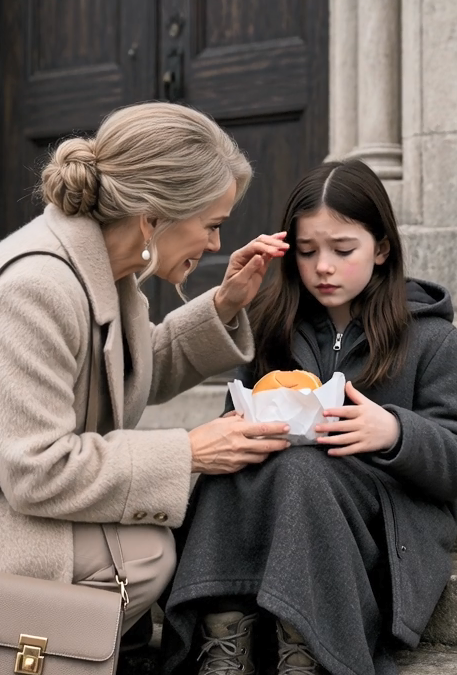
A Starving Little Girl Begged an Elderly Woman for Food Outside a Church—Then Their Broken Half-Moon Pendants Fit Together, Revealing a Family Secret Buried for Years.
The little girl on the church steps was starving, but the pendant around her neck was what made Mara Ellison forget how to breathe.
For nine years, Mara had buried the truth about her dead son, the woman he loved, and the child she claimed never existed.
Now her younger son stood beside her with two coffees in his hands, asking who the girl was, and Mara chose the cruelest answer a grandmother could give.
“Please… I’m so hungry.”
The girl’s voice was so weak it barely carried over the wind.
Mara Ellison stopped on the stone steps outside St. Jude’s Church with one gloved hand on the brass railing and the other clutching the wool collar of her coat against her throat. Snow had started falling again, the small hard kind that did not float so much as sting. It scraped sideways across the church courtyard, gathered in the carved faces of saints above the doors, and settled like ash along the edges of the marble steps.
The child sat beneath the old bulletin board where parish volunteers taped flyers for coat drives, grief groups, food pantry hours, and missing pets. She could not have been more than eight or nine. Thin wrists. Knotted brown hair. Purple fingers curled into the sleeves of a coat too small for her. Her shoes were cracked along the sides, and one lace had been replaced with a piece of dirty yellow string.
Mara had seen poverty before.
She had chaired committees for it.
Raised money for it.
Posed beside cardboard donation boxes wrapped in red ribbon.
She had written checks large enough to make people thank her in newsletters.
But poverty looked different when it sat on the steps in front of you, shivering through a child’s body, asking for bread in a voice that had already learned not to expect kindness.
“Please,” the girl whispered again.
Mara’s first instinct was to step around her.
That would shame her later.
At that moment, it felt like self-preservation.
She was late. The memorial Mass had run long. The December air hurt her lungs. Caleb was waiting with coffee. The driver had already texted twice. There were safe ways to help and unsafe ways, clean ways and complicated ways, and Mara Ellison had spent most of her adult life making sure need reached her through proper channels.
A child on church steps was not a proper channel.
Still, something in the girl’s face stopped her.
Not the hunger.
Not the cold.
The eyes.
Gray-blue.
Wide.
Too familiar.
“Where are your parents?” Mara asked.
The girl swallowed hard. Her lips were dry and cracked at the center.
“My father died.”
Mara’s fingers tightened on the rail.
“Your mother?”
The girl looked down.
“Mom never came back.”
The words entered Mara like cold water.
For a second, the church bells overhead were silent, though she knew they were ringing. The street beyond the courtyard kept moving. Cars hissed through slush. A man laughed somewhere near the corner. A bus groaned to a stop half a block away.
But Mara heard only that sentence.
Mom never came back.
The child shifted, and the collar of her coat slipped open.
A silver half-moon pendant hung from a chain around her neck.
Broken cleanly down the middle.
Mara went still.
Her breath disappeared.
The pendant was old. Not expensive in the obvious way. No diamonds, no large stone, nothing flashy. But she knew the shape of it as intimately as she knew the shape of her own wedding ring. A crescent moon, half of a circle, the broken edge jagged and deliberate. The kind of pendant designed to complete itself only when joined with its match.
Mara’s fingers began to tremble.
No.
That was her first thought.
Not possible.
Not after all this time.
Not here.
Not on these steps.
The girl noticed her staring and lifted one dirty hand to the pendant as if protecting it.
Mara reached into her coat pocket.
She did not know why.
She carried the other half everywhere, though she told herself she did not. Some women carried rosaries. Some carried photographs. Mara carried proof of a wound she had convinced herself was scar tissue.
Her fingers closed around the familiar silver curve.
Old.
Polished smooth by years of touch.
She pulled it out.
The girl stared.
Mara pressed the two pieces together.
They formed one full moon.
Perfect.
Complete.
The world seemed to go silent.
“Who gave you this?” Mara asked.
Her voice barely sounded like her own.
“My dad,” the girl said.
“What was his name?”
“Daniel.”
The courtyard tilted.
Mara gripped the railing.
The child kept talking because children do that when they have finally found someone who might understand.
“He said if anything happened, I should come here. He said Grandma had the other half.”
Mara sat down hard on the stone step beside her.
Pain shot through her hip.
She did not feel it.
PART2:
“No,” she whispered. “No, this is impossible.”
The bells rang again above them.
Noon.
Deep bronze sound rolling across the winter sky.
Mara had listened to those bells for forty years. Her children had been baptized under them. Her husband’s funeral had been held beneath them. Her eldest son had once stood in this very courtyard at seventeen, laughing into the snow, tossing his little brother over one shoulder while Mara scolded him for ruining his suit.
Daniel.
Daniel with his impossible smile.
Daniel who never did what he was told if what he was told felt wrong.
Daniel who had walked away from everything.
Daniel who had died without coming home.
Then footsteps sounded below.
A man in a dark wool coat climbed the steps, holding two coffees in a cardboard tray. He was tall, calm, clean-shaven, with Daniel’s jaw and their father’s serious eyes. Caleb Ellison moved through the world more quietly than his brother had, but lately Mara had been noticing Daniel in him. The tilt of his head. The set of his mouth when he was about to ask a question he already knew mattered.
“Mom?” Caleb said.
Mara snatched the pendant halves apart so quickly the chain bit into the little girl’s neck.
The child winced.
Caleb’s eyes narrowed.
He looked from Mara to the girl.
His face changed.
Slowly.
First concern.
Then confusion.
Then something like recognition, though he could not possibly have known what he was recognizing.
“This little girl looks so familiar,” he said. “Who is she?”
The girl’s eyes moved to Caleb, then back to Mara.
Mara closed her hand around her half of the pendant so tightly it hurt.
“Nobody,” she said. “Let’s go now.”
The child flinched.
Not dramatically.
That would have been easier for Mara to dismiss.
It was small.
A tiny tightening around the mouth.
The look of a child who had been told she was nobody before and had learned to make less space when it happened.
Caleb stared at his mother.
“What did you say?”
Mara stood too quickly.
“We’re late.”
“Mom.”
“She’s cold and hungry,” Mara said, reaching into her purse with shaking hands. “Give her some cash and call parish outreach. They handle these things.”
“These things?”
“Caleb, not here.”
The girl began to stand, unsteady on the icy step.
“I’m sorry,” she whispered. “I didn’t know.”
Caleb set the coffees down on the step and crouched in front of her.
“Hey. You don’t have to apologize.”
Mara grabbed his arm.
“Don’t.”
Caleb looked at her hand, then at her face.
Something passed between them.
A son suddenly seeing his mother as a stranger.
The girl tried to take one step down.
Her knees buckled.
Caleb caught her before she hit the stone.
“Mara,” he said sharply, no longer calling her Mom. “Call 911.”
“I said parish outreach—”
“Now.”
His voice was not loud.
It did not need to be.
Mara had heard Caleb angry before. Cold anger. Lawyer anger. The controlled tone he used with men in expensive suits who mistook politeness for weakness.
She reached for her phone because people were looking now.
The church doors had opened behind them. Mrs. Donnelly from the altar flower committee stood frozen with her purse against her chest. Father Michael had stepped out in his black coat. A young couple with a stroller stopped near the gate.
Mara Ellison, chair of the St. Jude’s Winter Mercy Fund, knelt on the steps with a starving child at her feet and terror in her eyes.
People would remember that.
Mara thought of that before she thought of anything else.
She hated herself for it.
Caleb lifted the girl gently.
She was lighter than she should have been.
“What’s your name?” he asked.
The girl’s head rested against his shoulder.
“Sophie.”
“Sophie what?”
Her eyes fluttered.
“Sophie Reed.”
Mara closed her eyes.
Reed.
Not Ellison.
Thank God, some desperate part of her thought.
Then Sophie opened her eyes again and whispered, “But Dad said my real name was Sophie Ellison. He said Grandma would know.”
Caleb went utterly still.
Mara felt the winter enter her bones.
The ambulance arrived in six minutes.
To Mara, it felt like six years.
Paramedics wrapped Sophie in a foil blanket, checked her blood sugar, asked questions she could barely answer. Caleb stayed beside her, speaking softly, one hand resting near hers but never forcing contact.
Mara stood several feet away, watching the half-moon pendant glint weakly against the blanket.
Father Michael came to stand beside her.
“Mara,” he said quietly, “do you know this child?”
“No.”
The word was too fast.
Father Michael had been a priest for thirty-eight years. He had heard lies confessed in whispers and shouted in rage. He had heard people lie to others, to God, and worst of all, to themselves.
He turned his head toward her.
“You’re sure?”
Mara looked straight ahead.
“I’ve never seen her before.”
The ambulance doors closed.
Caleb climbed inside with Sophie.
Mara reached for him.
“Caleb, you can’t just—”
He looked down from the ambulance doorway.
“She asked for us.”
“She asked for a grandmother.”
“Yes,” Caleb said. “And you had the other half of her necklace.”
The sentence landed between them.
Mara felt every eye in the courtyard.
“That proves nothing.”
Caleb’s face did not change.
“Then why are you shaking?”
The doors shut.
The ambulance pulled away.
Mara stood on the church steps with one half of a moon in her palm and a dozen witnesses pretending not to stare.
Twenty-three minutes later, she was in the back seat of the family car with the heater turned too high, telling herself there were explanations.
Daniel could have given away the pendant.
Someone could have stolen it.
The child could have been coached.
A scam, perhaps.
People knew the Ellison name. They knew money. They knew the foundation. They knew grief. There were people who looked for cracks in wealthy families and pressed their fingers into them.
Mara had spent years learning to defend against that kind of intrusion.
Yet every explanation broke against the same image.
Sophie’s eyes.
Daniel’s eyes.
When Mara reached the house on Beacon Hill, the staff had already lit the front rooms for the afternoon reception. The Ellison home was old Boston money disguised as good taste: white brick, black shutters, antique rugs, portraits of stern men who had mistaken inheritance for virtue. The Christmas garland around the stair banister smelled of pine and clove. Silver trays lined the dining room sideboard.
A reception.
She had forgotten.
The church memorial committee was coming at three to discuss year-end giving. The Ellison Foundation’s winter gala was in six days. Half the city’s charitable class expected her to stand beneath gold lights and speak about forgotten children.
Mara walked into the powder room and locked the door.
Only then did she open her hand.
The silver half-moon lay against her palm.
Her half.
Daniel’s half had been gone for twelve years.
She remembered the day she bought the necklace.
Daniel had been seventeen. Caleb had been eleven. Mara’s husband, Walter, still alive then, still laughing at breakfast and giving too much money to street musicians because, as he said, “If a man can make music outside in February, he’s earned it.”
Daniel had been preparing to leave for college.
Mara had bought the necklace from a little shop in Newport during one of their last summer weekends as an intact family. Two halves of a moon. One for her, one for him.
“So you’ll remember your mother,” she had teased.
Daniel rolled his eyes. “Mom, I’m going to Providence, not war.”
“You have no idea how dramatic I can be.”
“I have seventeen years of evidence.”
She had slapped his arm.
He had laughed and put his half around his neck.
For years, he wore it.
Through college.
Through law school for one semester before dropping out.
Through the fights with Walter.
Through the Christmas when he came home with a woman Mara had not approved of and a look in his eyes that told her approval no longer mattered.
Elena Reed.
That name still had teeth.
She had been beautiful in a way Mara distrusted immediately. Not polished. Not trained. Warm. Direct. A waitress at a diner Daniel frequented near the courthouse where he volunteered after quitting law school. She had dark curls, quick hands, and the unsettling confidence of someone who had survived enough not to be dazzled by money.
Daniel loved her.
That was the unforgivable part.
Not that she was poor.
Not that she was older than he was by three years.
Not that she spoke to Walter like an equal the first night Daniel brought her home.
Those were offenses Mara could have managed.
The real offense was that Daniel looked at Elena the way Walter had looked at Mara before the money, the committees, the house, and the Ellison name hardened them all into roles.
Daniel looked free.
Mara had told herself she was protecting him.
That was how cruelty often entered respectable homes.
Dressed as protection.
Elena would trap him.
Elena would spend his money.
Elena would embarrass the family.
Elena would pull him away from everything he had been given.
When Daniel married her at city hall without inviting them, Walter eventually softened. He always did with the boys. Mara did not.
“You’ll come back when this becomes real,” she told Daniel the last time he stood in the library.
He looked at her for a long time.
“It’s real now.”
“You’re throwing away your future.”
“No,” he said. “I’m choosing one.”
She remembered the silver half-moon against his throat.
He left.
Walter died two years later.
Daniel sent a letter.
Mara returned it unopened.
Or she told herself she did.
The truth was worse.
She opened it.
Read three lines.
Mom, I know you’re angry, but I have a daughter. Her name is Sophie.
Mara stopped there.
Folded the letter.
Locked it away.
Told Caleb Daniel had not written.
Told herself a man who abandoned his family did not get to re-enter it using a child as bait.
She never answered.
That was nine years ago.
Her phone rang.
Caleb.
She did not answer.
It rang again.
Then a text appeared.
St. Anne’s Hospital. Room 412. We need to talk.
Mara stared at the screen until it blurred.
Then another message.
She has pneumonia, dehydration, and frostbite on two toes. She keeps asking if Grandma is mad.
Mara sat down on the closed toilet lid and pressed one hand over her mouth.
For the first time in years, she thought she might be sick.
At St. Anne’s, Sophie slept beneath two warmed blankets with an IV taped to her thin hand.
Her face looked smaller against the pillow.
Caleb stood by the window, arms folded.
He did not turn when Mara entered.
Dr. Elaine Porter, a pediatric emergency physician with tired eyes and the kind of calm that comes from seeing too much, closed the chart.
“She needs rest, antibiotics, fluids, nutrition, and time. We’ve contacted child services since she arrived without a guardian.”
Mara nodded, grateful for procedure.
Procedure made things smaller.
“Has she said anything about her mother?” Caleb asked.
Dr. Porter looked between them.
“Some. She said her mother left three days ago to find help and didn’t return. She and her mother were living at the Greyline Motel under the name Reed. The motel manager says they were evicted this morning after falling behind.”
Caleb’s jaw tightened.
“This morning?”
“Yes. Sophie says she went to St. Jude’s because her father told her to go there if she ever got lost.”
Mara looked at the child.
Lost.
What a mild word for a girl collapsing on church steps.
Caleb finally turned.
“Tell him,” he said.
Mara stiffened.
“Caleb.”
“Tell him who Daniel was.”
Dr. Porter’s expression shifted with professional caution.
Mara lifted her chin.
“This is a family matter.”
“No,” Caleb said. “A child nearly froze outside a church while carrying our family name around her neck. It stopped being private.”
Sophie moved slightly in the bed.
All three adults fell silent.
Her eyes opened halfway.
For a moment, she looked around as if she expected to be told she had done something wrong.
Then she saw Mara.
Her lips parted.
“Grandma?”
Mara felt the word hit a place she had spent years boarding shut.
Caleb watched her.
Dr. Porter watched too.
Sophie tried to sit up.
The IV line pulled.
Caleb moved first.
“Hey, slow down.”
Sophie looked from Caleb to Mara.
“You’re her,” she whispered. “Right?”
Mara could have lied.
She had lied once already on the church steps.
Maybe twice.
Maybe for nine years.
The lie stood ready in her mouth.
No, sweetheart, you’re confused.
No, I don’t know your father.
No, someone must have made a mistake.
Instead, because God had a cruel sense of timing, Sophie reached for the pendant beneath her hospital gown.
“My dad said you had the other half.”
Caleb held out his hand.
“Mom.”
Mara removed the half-moon from her pocket.
Sophie’s face changed.
Hope, when it appears in a starving child’s eyes, is almost unbearable.
“You kept it,” Sophie said.
Mara closed her hand around the pendant.
Caleb’s voice lowered.
“Give it to her.”
“It’s mine.”
The words came out before Mara could stop them.
Dr. Porter’s face hardened.
Sophie flinched.
Caleb stared at his mother as though something inside him had broken clean through.
Mara heard herself.
It’s mine.
Not I’m sorry.
Not your father loved you.
Not I should have come sooner.
It’s mine.
That was the moment Caleb stopped asking and started investigating.
He did not shout in the hospital room.
He did not shame Mara in front of Sophie.
He simply walked to the door and called his assistant.
Caleb Ellison had not followed the family path into foundation boards and private investments. He had become an attorney, first in corporate law because Mara expected it, then in child advocacy because expectations had begun to feel like a too-tight collar around his neck.
He knew how systems hid children.
He knew how families lied with paperwork.
He knew how polite signatures could bury violence better than fists.
Within two hours, he had Sophie’s birth certificate pulled through emergency legal channels.
Mother: Elena Reed.
Father: Daniel Walter Ellison.
His brother.
His dead brother.
Caleb sat in the hospital hallway reading the document on his phone while Mara stood ten feet away pretending not to shake.
Daniel Walter Ellison.
Father.
Caleb had been twenty-six when Daniel disappeared from family life.
Old enough to ask questions.
Too young, or too loyal, to insist on answers.
Mara had told him Daniel chose Elena over them. Then that Daniel wanted no contact. Then that Daniel moved west. Then that Daniel had died of an aneurysm three years ago, and there was no service because Elena “handled things privately.”
Caleb had mourned a brother in fragments.
No grave.
No goodbye.
No truth.
Now truth sat in a hospital bed wearing donated socks.
He looked at Mara.
“How long did you know?”
She stared straight ahead.
“Caleb—”
“How long?”
“It’s complicated.”
“That means long enough.”
Mara’s eyes flashed.
“You don’t know what Daniel put this family through.”
“I know what you told me.”
“He broke your father’s heart.”
“Dad would have wanted to know he had a granddaughter.”
“Your father was sentimental.”
“He was decent.”
Mara recoiled as if slapped.
Caleb stood.
“Did Daniel contact you?”
No answer.
“Did he tell you about Sophie?”
Mara’s mouth trembled once.
Caleb’s voice became very quiet.
“Did you know my brother had a child while he was alive?”
Mara looked down.
That was answer enough.
Caleb walked away because if he stayed, he was afraid of what he might say.
Mara remained outside Room 412, listening to the machines beep around the granddaughter she had erased.
At 7:18 that evening, Caleb found the first letter.
Not in Mara’s house.
He was not foolish enough to start where she controlled the doors.
He called Father Michael.
The priest answered on the second ring.
“Caleb.”
“Did Daniel ever contact St. Jude’s?”
Silence.
“Father.”
“I need you to come to the rectory.”
The rectory smelled of dust, tea, and old wood. Father Michael took a small box from a locked cabinet and set it on the desk between them.
“I should have done more,” he said before Caleb touched it.
Caleb opened the box.
Inside were copies of letters.
Not originals.
Those, Father Michael explained, had been sent to Mara.
“These were for parish records because Daniel asked me to witness that he attempted contact.”
Caleb’s throat tightened.
“You knew?”
“Not everything. Daniel came to me after your father died. He said your mother had refused to meet Elena and Sophie. He wanted help mediating.”
“And you?”
“I called Mara.”
Caleb looked up.
Father Michael’s face aged ten years in one breath.
“She told me Daniel was unstable. That Elena was using the child for money. She said the family attorneys were handling it. She was very persuasive.”
“She always is.”
“I believed the wrong person.”
Caleb unfolded the first letter.
Mom,
I know you’re angry. I know I hurt you by leaving the way I did, but I need you to hear me now. I have a daughter. Her name is Sophie Mara Ellison, because even after everything, I wanted her to carry something of you besides silence.
Caleb had to stop reading.
The room blurred.
Sophie Mara Ellison.
Named for the grandmother who pretended she did not exist.
The next letters were worse.
Daniel asking for a meeting.
Daniel sending photos.
Daniel explaining that Sophie had Walter’s eyes.
Daniel saying Elena was not after money, only family.
Daniel saying he was sick.
That stopped Caleb.
Sick?
He read faster.
Daniel had been diagnosed with cardiomyopathy, not an aneurysm. He had known there was risk. He had begged Mara to let Sophie know her family before it was too late.
The final letter was dated six weeks before Daniel’s death.
Mom,
If you never forgive me, that is your choice. But Sophie is innocent. If anything happens to me, please do not punish her for my decisions. I gave her my half of the moon. I told her you have the other. I told her if the world ever becomes too hard, she can go to St. Jude’s and ask for you.
Please be better to her than you were willing to be to me.
Your son,
Daniel
Caleb sat with the letter in his hands.
For a long time, he said nothing.
Father Michael’s voice broke the silence.
“I kept copies because something in me was uneasy.”
“You never told me.”
“I asked Mara if you knew. She said Daniel had manipulated you before and that involving you would hurt the family.”
Caleb laughed once.
It was a terrible sound.
“The family.”
“I am sorry.”
“I don’t need your sorrow, Father. I need your help.”
“You have it.”
Caleb folded the letters carefully.
“Then we find Elena.”
Finding Elena Reed took eighteen hours.
It should have taken less.
It would have taken less if poverty did not scatter people across systems that barely spoke to one another.
Greyline Motel had evicted Elena and Sophie at eight that morning after three weeks of partial payments and one final promise the manager no longer believed. Elena had left Sophie in the room with a granola bar and their last bottle of water while she went to “ask for help.”
The manager had seen her walk toward the bus stop.
After that, nothing.
Caleb’s office searched shelters.
Hospitals.
Police incident reports.
Church intake logs.
He called in favors he had spent years avoiding because he hated the Ellison name opening doors, but for Sophie he used every key he had.
At 3:40 the next afternoon, a social worker from Boston General returned his call.
Unidentified female, mid-thirties to early forties, admitted under the name Jane Doe after collapsing near South Station. Pneumonia. Severe exhaustion. No ID except an old photograph of a man and child in her coat pocket. She had been conscious for two minutes long enough to say one word repeatedly.
Sophie.
Caleb drove there himself.
Mara followed in a separate car without being invited.
Elena Reed looked smaller than Caleb remembered from the one time Daniel had brought her to the Ellison house all those years ago. Back then, she had stood in Mara’s dining room wearing a blue dress Daniel clearly loved and Mara clearly judged. She had shaken Caleb’s hand warmly and asked what books he liked.
He had liked her.
He remembered that now with a pain that embarrassed him.
He had liked her, then allowed his mother to rewrite her into a threat.
Now Elena lay in a hospital bed with oxygen tubing under her nose, hair dull against the pillow, cheeks hollow from months of surviving too close to the edge.
When Caleb entered, her eyes opened.
For a second, she looked afraid.
Then she saw Mara behind him.
The fear became something older.
Harder.
“No,” Elena whispered.
Mara stopped.
Caleb stepped forward.
“Elena, I’m Caleb. Daniel’s brother.”
Her eyes filled instantly.
“Where’s Sophie?”
“She’s safe. She’s at St. Anne’s. She’s being treated. She found St. Jude’s.”
Elena turned her face away and sobbed once, sharply, like her body did not have strength for more.
“She remembered.”
“Yes.”
“I told her to stay at the motel. I told her I’d come back.”
“You collapsed.”
“I was going to the Ellison house.” Elena’s gaze moved to Mara. “Not for me. For her.”
Mara said nothing.
Elena’s voice shook, but she held Mara’s eyes.
“I went once before. After Daniel died. You remember?”
Caleb looked at his mother.
Mara’s expression froze.
Elena gave a weak laugh.
“Of course you remember. You had security walk me out through the service gate so your guests wouldn’t see us.”
Caleb felt something in him turn cold.
“What?”
Mara’s lips parted.
“Elena was hysterical.”
“I was grieving,” Elena said. “There’s a difference.”
Caleb looked at Elena.
“When was this?”
“Two years ago. Daniel had been dead three weeks. Sophie was six. I had forty dollars, a dead husband, and a child asking why Grandma never came to the funeral.”
Mara closed her eyes.
Elena kept going.
“I went to your mother because Daniel made me promise. He said, ‘If things get bad, try once more.’ So I did. I stood at that gate with Sophie in her red coat, and your mother looked at her through the glass door like she was something left on the porch.”
Caleb turned to Mara.
“Is that true?”
Mara’s voice was barely audible.
“I gave her money.”
Elena laughed again, bitterly.
“She gave me five hundred dollars and a letter from her lawyer saying if I used the Ellison name to solicit support again, she would seek an injunction. She told me Sophie would be better off if I stopped filling her head with fantasies about belonging to people who did not want her.”
The hospital room became very quiet.
Caleb could hear the oxygen machine.
The hallway cart wheels.
His own pulse.
Mara lifted her chin, but her face had gone gray.
“I did what I thought was necessary.”
Elena stared at her.
“No. You did what was clean.”
That sentence hit harder than any scream.
Mara looked away first.
Three days later, Sophie saw her mother.
Caleb had arranged transfer coordination so both could be treated in the same hospital wing. Mara did not come to the reunion. Caleb did not ask her to.
Sophie was sitting up in bed, pale but stronger, eating applesauce with the concentration of a child who did not trust food to remain available if ignored.
When Elena entered in a wheelchair, Sophie froze.
The spoon dropped onto the blanket.
For one second, neither moved.
Then Sophie made a sound that Caleb would remember the rest of his life.
“Mom!”
Elena opened her arms.
Sophie climbed out of bed so fast the nurse nearly dropped the IV pole.
Caleb looked away when they collided because some grief deserved privacy, even when it happened in public.
Elena held her daughter like someone clinging to the last piece of a destroyed world.
“I came back,” she kept saying. “Baby, I tried. I came back.”
“I went to the church,” Sophie sobbed. “I did what Dad said.”
“I know. You were so brave.”
“Grandma was there.”
Elena’s arms tightened.
“I know.”
“She had the moon.”
Elena closed her eyes.
Caleb stood in the doorway with Father Michael beside him.
The old priest wiped his face openly.
“Daniel would have…” Father Michael began, then stopped.
Caleb finished for him.
“He would have been furious.”
Father Michael nodded.
“And proud.”
The Ellison Foundation winter gala took place six days later.
Mara insisted on attending.
Caleb told her it was a mistake.
She told him the foundation needed stability.
He told her stability was not the same as silence.
She wore black silk and pearls. Her hair was perfect. Her makeup hid nearly everything except the hollowness around her eyes.
The ballroom at the Copley glittered with warm light, white flowers, champagne flutes, and the kind of expensive compassion that never spilled sauce on its shoes. Donors in tailored suits discussed child poverty over scallops. A string quartet played near the staircase. Photographers gathered near the foundation backdrop where the words Every Child Belongs curved in gold lettering above the Ellison crest.
Every Child Belongs.
Caleb stood across the room and looked at those words until anger became something clean.
Priyanka? No, not relevant. Need continue.
He had not planned to confront her publicly.
Contrary to what Mara believed, Caleb did not enjoy humiliation.
But Mara had refused all week to step down, refused to release trust documents voluntarily, refused to admit to the board that Sophie existed. She agreed only to “private family reconciliation” and “careful messaging.”
Careful messaging.
As if a child’s hunger were a public relations inconvenience.
Then Mara took the stage.
Caleb felt something in the room shift as she approached the microphone.
His assistant, Naomi, touched his arm.
“You don’t have to do this now.”
“Yes,” Caleb said. “I do.”
Mara began with practiced grace.
“Good evening, friends. For decades, the Ellison Foundation has stood for children who fall through the cracks of society. Children who are unseen, unheard, forgotten…”
Caleb stepped forward.
“Forgotten like Sophie?”
Mara stopped.
The microphone caught her small intake of breath.
Heads turned.
The quartet stumbled into silence.
Mara looked down from the stage.
“Caleb.”
He walked toward her, not quickly.
Naomi followed with a folder.
Behind Caleb, Father Michael entered the ballroom with two members of the foundation board. Elena was not there. Sophie was not there. Caleb had refused to make either of them an exhibit.
But Daniel’s letters were there.
His birth certificate.
Sophie’s birth certificate.
The hospital records.
The attorney letter Mara had sent to Elena.
The trust documents Walter Ellison had signed before his death, specifying that any biological grandchild was a beneficiary of the family education and welfare trust.
A trust Mara had administered for nine years while claiming there were no eligible grandchildren through Daniel.
“Mara,” said Jonathan Price, the board treasurer, stepping forward. “We asked you this afternoon whether there were any undisclosed family beneficiaries tied to foundation-controlled assets.”
The room stirred.
Mara’s expression hardened.
“This is not the place.”
“No,” Caleb said. “The church steps weren’t the place either. The hospital room wasn’t the place. Daniel’s funeral wasn’t the place. Elena’s eviction wasn’t the place. Somehow truth never finds a place convenient enough for you.”
A murmur moved through the crowd.
Mara’s face flushed.
“You are grieving and emotional.”
“I’m Daniel’s brother.”
“You are making a spectacle.”
“No,” Caleb said. “You did that when you stood under a sign saying every child belongs while hiding the child who belonged to us.”
Gasps now.
Phones rising.
Caleb turned sharply.
“Put your phones down.”
The authority in his voice surprised even him.
“This is not entertainment. A child was harmed. You don’t get to turn her into content.”
Several people lowered their phones.
Not all.
Father Michael stepped forward, old and white-haired and suddenly more imposing than anyone in the room expected.
“If anyone records or posts identifying details about that child, St. Jude’s will consider it an act of harm, not advocacy.”
More phones lowered.
Mara stood at the microphone, trapped inside the life she had built.
Caleb opened Daniel’s final letter.
He did not read all of it.
Only one line.
“If anything happens to me, please do not punish her for my decisions.”
The ballroom was silent.
“Mara,” Jonathan Price said, voice shaking with controlled anger, “is this letter authentic?”
Mara’s eyes shone.
For a moment, Caleb thought she might finally surrender.
Instead she lifted her chin.
“You have no idea what I sacrificed for this family.”
The old Mara returned.
Not composed.
Exposed.
“Elena would have taken everything. Daniel was reckless. He threw away his education, his position, his future. Your father was weak about him. Someone had to protect what generations built.”
Caleb stared.
“There it is.”
Mara blinked.
“What?”
“You finally said it. This was never about protecting Daniel. It was about protecting the name.”
Mara looked at the donors, the board, Father Michael, Caleb.
Then, with terrible pride, she said the sentence that ended her public life.
“That child was not raised as an Ellison.”
Caleb’s voice broke.
“No. Because you made sure of it.”
Jonathan Price removed his glasses.
“Mara Ellison, pending legal review, you are suspended immediately from all foundation duties.”
Mara gripped the podium.
“You can’t do that.”
The board secretary stepped forward.
“We just did.”
The criminal investigation took longer.
It always does.
People expect justice to arrive like thunder.
Most of the time, it arrives as paperwork.
Bank records.
Certified letters.
Trust amendments.
Depositions.
Emails recovered from old servers.
The lawyer who had threatened Elena, Martin Briggs, tried to claim he had simply followed client instructions. That lasted until Caleb’s team found billing notes describing “containment strategy regarding potential illegitimate claimant.”
Illegitimate.
Caleb stared at that word for a long time.
Then he printed it and placed it in the file.
Mara avoided indictment for the most serious financial charges only because Walter’s trust documents had been drafted broadly enough that funds remained technically unspent rather than stolen. But she faced civil fraud claims, breach of fiduciary duty, and conspiracy allegations involving Briggs. The foundation settled under court supervision.
Sophie’s trust was restored with interest.
Elena received damages large enough to secure housing, medical care, and stability, though no amount of money could return the years spent believing Daniel’s family simply hated her.
Briggs lost his position at his firm.
Mara lost the foundation.
She lost her seat on three boards.
She lost invitations from people who had once competed for her approval.
But the deepest consequence came quieter.
Caleb stopped calling her Mom.
Not forever, perhaps.
But for a long time.
He called her Mara in court filings, in emails, in the one letter he wrote after the settlement.
You taught me that family reputation mattered more than family truth. I am trying to unlearn that. Until I can look at you without seeing Sophie on those steps, I need distance.
Mara read it alone in the Beacon Hill house, surrounded by portraits of men whose names had protected her until they did not.
She took the half-moon pendant from her pocket and set it on the table.
For the first time in nine years, she let herself remember Daniel as he had been before she turned him into a story that justified her cruelty.
Daniel at five, asleep under the piano after refusing a nap.
Daniel at twelve, sneaking sandwiches to a homeless man behind the parish hall.
Daniel at seventeen, laughing in the snow with silver at his throat.
Daniel standing in the library, saying, “It’s real now.”
She had thought she was punishing him.
But Daniel had been dead for years.
The living had paid.
Sophie recovered slowly.
Children do not become safe the moment adults sign documents.
For months, she hid food in drawers.
Crackers under pillows.
Granola bars in coat pockets.
Half a sandwich wrapped in napkins behind books on Caleb’s office shelf.
Elena would find them and cry in the bathroom where Sophie could not see.
Caleb learned not to say, “You don’t need to hide that.”
Need did not listen to logic.
Instead, he bought a basket and placed it in the kitchen of their new apartment.
“Emergency snacks,” he said casually.
Sophie looked at him suspiciously.
“For who?”
“For anyone. Me, mostly. I get dramatic when hungry.”
Sophie studied him.
“You’re not hungry.”
“I might be later.”
The next day, one granola bar disappeared from the basket.
Not hidden.
Taken.
That was progress.
Elena worked with a trauma counselor.
So did Sophie.
So did Caleb, though he told almost no one at first.
His therapist asked once what hurt most.
He expected to say Daniel.
Or Mara.
Or the letters.
Instead he said, “I believed the version that was easiest for me.”
That was the wound.
He had loved his brother, but not enough to question the silence.
He had trusted his mother, but partly because trusting her let him avoid choosing sides.
Now a child had nearly frozen under the weight of everyone’s convenience.
On Christmas Eve, nearly one year after the church steps, Sophie returned to St. Jude’s.
Not because Mara asked.
Because Sophie did.
Elena came with her.
Caleb too.
Snow fell lightly over the courtyard. The bulletin board had a new flyer for emergency winter shelter, now funded through an independent grant created in Daniel’s name. The stone steps had been salted. Father Michael waited near the door in a thick black coat, breath visible in the cold.
Sophie wore a red coat.
New.
Warm.
Chosen by herself from three options because Caleb had learned choice mattered.
Around her neck hung the full moon pendant.
Both halves joined.
Mara had given up hers through Caleb months before, wrapped in a velvet pouch with a note Sophie had not opened for three weeks.
When she finally did, it said:
I do not ask you to forgive me. I only return what should have been yours. Your father loved you before I was brave enough to know you existed.
Sophie had read it twice.
Then placed the note in a shoebox where she kept complicated things.
Now she stood at the bottom of the church steps, looking up.
“You found me here,” she said.
Caleb nodded.
“You found us,” he said.
“That’s different.”
“Yes.”
She thought about that.
Then took Elena’s hand and climbed.
Inside, the church glowed with candles.
The choir rehearsed softly near the altar.
Sophie lit one candle for Daniel.
Her small face was solemn in the flickering light.
Elena whispered something Caleb did not hear.
Maybe a prayer.
Maybe an apology.
Maybe a promise.
They sat in the back pew because Sophie wanted to see the doors.
Halfway through the service, Caleb noticed someone standing in the side aisle.
Mara.
She looked older.
Not in the way of age alone.
In the way of a person who had finally lost the protection of believing herself right.
She wore a plain dark coat.
No pearls.
No foundation pin.
No entourage of grateful committee members.
She did not approach.
She simply stood near the side aisle and looked at Sophie.
Caleb felt Elena stiffen.
Sophie noticed too.
For a long moment, the girl said nothing.
Then she leaned toward Caleb.
“Is she allowed to be here?”
Caleb answered carefully.
“Yes.”
“Do I have to talk to her?”
“No.”
Sophie looked at Mara again.
The choir began Silent Night.
Mara lowered her eyes.
Sophie touched the pendant at her throat.
Then she stood.
Elena caught her hand.
“You don’t have to.”
“I know.”
Sophie walked slowly to the side aisle.
Caleb stood too, but Elena touched his sleeve.
“Let her choose.”
So he stayed.
Sophie stopped several feet from Mara.
Neither moved closer.
Mara’s face crumpled.
Not dramatically.
Not in a way that asked for pity.
More like the final collapse of something held too rigid for too long.
“Sophie,” she whispered.
Sophie looked up at her.
“My dad said you would know me.”
Mara closed her eyes.
“I should have.”
“You said I was nobody.”
A tear slipped down Mara’s cheek.
“Yes.”
“That was mean.”
“Yes.”
“Why did you say it?”
Mara’s mouth trembled.
Because I was ashamed.
Because I was afraid.
Because I cared more about being obeyed than being good.
Because your father loved someone I could not control.
Because I thought if I did not open the door, the truth could not enter.
All of that was true.
None of it was enough.
“I was cruel,” Mara said. “And wrong.”
Sophie watched her.
Children can hear the difference between excuses and truth.
Mara did not reach for her.
That mattered.
“I don’t forgive you yet,” Sophie said.
Mara nodded, crying silently now.
“You don’t have to.”
Sophie touched her pendant.
“My dad gave me this.”
“I know.”
“He said the moon looks broken sometimes, but it isn’t. You just can’t see the whole thing.”
Mara put one hand over her mouth.
Sophie looked back at Elena and Caleb.
Then at Mara.
“I can’t see the whole thing yet.”
Mara bowed her head.
“That’s fair.”
Sophie returned to the pew.
Caleb sat very still as she climbed beside him.
“You okay?” he whispered.
“No.”
He nodded.
“Okay.”
She leaned against his side.
“But maybe someday.”
Caleb looked toward Mara, standing alone beneath the shadow of St. Jude’s side altar.
“Maybe,” he said.
Years later, people in the city would tell the story incorrectly.
They would say a starving girl appeared on church steps and a necklace revealed she was an heiress.
That version made it sound like a fairy tale.
It was not.
Sophie was not saved by money.
Money helped.
Food helped.
Heat helped.
Doctors helped.
Lawyers helped.
But what saved her was truth.
Ugly truth.
Late truth.
Truth dragged out of locked drawers, legal files, hospital rooms, and the shaking hands of adults who had failed her.
She grew stronger.
Not all at once.
Not perfectly.
At ten, she spoke at the opening of the Daniel Ellison Winter Outreach Center, a small renovated building beside St. Jude’s where families could get emergency food, motel vouchers, legal referrals, and medical transport without proving they were respectable enough to deserve help.
She did not mention Mara.
She did not mention the trust.
She stood on a little platform in a blue dress, the moon pendant shining at her throat, and said, “When someone is cold, don’t ask first if helping them will be complicated.”
Caleb had to look down.
Elena cried openly.
Father Michael pretended to wipe his glasses.
Mara stood in the back, invited by Sophie after much thought, and did not approach until Sophie nodded.
That was the boundary.
That was the beginning.
Not forgiveness.
Not exactly.
Something slower.
More honest.
Mara never again chaired a foundation.
She volunteered twice a week in the outreach center kitchen, not where cameras could see her, not where donors thanked her, but in the back, labeling soup containers and washing ladles. The first time someone tried to praise her, she said, “Don’t. I am paying a debt.”
Elena eventually allowed her to sit at the same table.
Caleb eventually called her Mom once by accident.
They both cried and pretended not to.
Sophie grew into a girl who did not like being called lucky.
“I wasn’t lucky,” she told a teacher once. “I was found.”
That was different.
On the tenth anniversary of Daniel’s death, they gathered at St. Jude’s after evening Mass.
No gala.
No speeches.
Just family, complicated and scarred and still standing.
Sophie was almost nineteen by then, tall like Daniel, with Elena’s curls and Mara’s stubborn chin. She had been accepted to college with plans to study social work and law, because apparently family pain sometimes turns into a profession if you refuse to waste it.
After lighting a candle, she stepped outside alone.
Snow had begun falling.
Caleb found her on the steps where it had all started.
“You okay?”
She smiled a little.
“People ask me that a lot.”
“You scared us early.”
“I was hungry.”
“I know.”
She touched the moon pendant.
The silver had been repaired but the seam remained visible down the middle.
She liked it that way.
A perfect circle with proof of the break.
“I used to think this meant I belonged to the Ellisons,” she said.
Caleb sat beside her.
“And now?”
“Now I think it means broken things can tell the truth.”
Caleb looked out at the snowy street.
“That’s better.”
Sophie leaned her shoulder against his.
“Dad knew she had the other half.”
“Yes.”
“He still sent me.”
Caleb nodded.
“He believed she could be better.”
“Was he wrong?”
Caleb took time with the answer.
“No,” he said finally. “But he was early.”
Sophie smiled.
Below them, the outreach center windows glowed warm across the courtyard. A young mother entered with two children and left ten minutes later with a bag of groceries, a motel voucher, and the phone number of a lawyer who would answer.
No cameras.
No speeches.
Just help arriving before desperation became tragedy.
Mara stood inside near the kitchen window, sleeves rolled, hair pinned back, listening while Elena showed her how to seal containers properly so they would not leak in delivery bags.
It was an ordinary sight.
That was what made it miraculous.
Sophie watched them.
“I don’t think forgiveness is one big thing,” she said.
Caleb looked at her.
“No?”
“I think it’s more like letting someone carry one small box at a time after they burned down the house.”
Caleb laughed softly.
“That is very specific.”
“I’m studying metaphors.”
“You’re frighteningly good at them.”
She smiled, then looked toward the church doors.
“I’m still mad.”
“You can be.”
“I still miss him.”
“You always will.”
“I still don’t understand how she could look at me and say nobody.”
Caleb’s throat tightened.
“Neither do I.”
Sophie held the pendant.
Then she whispered, not to Caleb exactly, maybe to the snow, maybe to the father whose voice had guided her to the church steps, “But I’m somebody.”
Caleb put his arm around her.
“Yes,” he said. “You are.”
The bells began to ring above them.
The same bells that had rung the day Mara tried to hide her.
The same bells that had rung over Daniel’s baptism, Walter’s funeral, countless weddings, confessions, bargains, and prayers.
This time, Sophie did not flinch at the sound.
She lifted her face to the falling snow.
For years, the moon pendant had been broken in two—one half carried by a child searching for family, the other by a woman hiding from the truth.
When the halves came together, they did not erase the break.
They revealed it.
That was the real inheritance.
Not the money.
Not the Ellison name.
Not the house or the foundation or the old portraits staring down from polished walls.
The inheritance was this: a child hungry on church steps could still speak, a mother crushed by poverty could still fight, a son raised inside lies could still choose truth, and even a grandmother who had failed in the worst way could spend the rest of her life proving that shame was not the same as repentance.
Some families are born whole.
Others are broken cleanly down the middle.
But if the truth is finally held up to the light, if the people who were erased are named, if the hungry are fed before questions are asked, then even a broken moon can shine.
And Sophie Ellison Reed, the little girl Mara once called nobody, grew up knowing exactly who she was.
She was Daniel’s daughter.
Elena’s miracle.
Caleb’s niece.
Mara’s unfinished prayer.
And most of all, she was the child who walked through snow with half a moon around her neck and forced an entire family to stop hiding in the dark.








