A Starving K9 Knocked Three Times on a Former Navy SEAL’s Door—Then He Turned Over the Tag and Read, “If Caleb Is Gone, Follow the Dog.”
A Starving K9 Knocked Three Times on a Former Navy SEAL’s Door—Then He Turned Over the Tag and Read, “If Caleb Is Gone, Follow the Dog.”
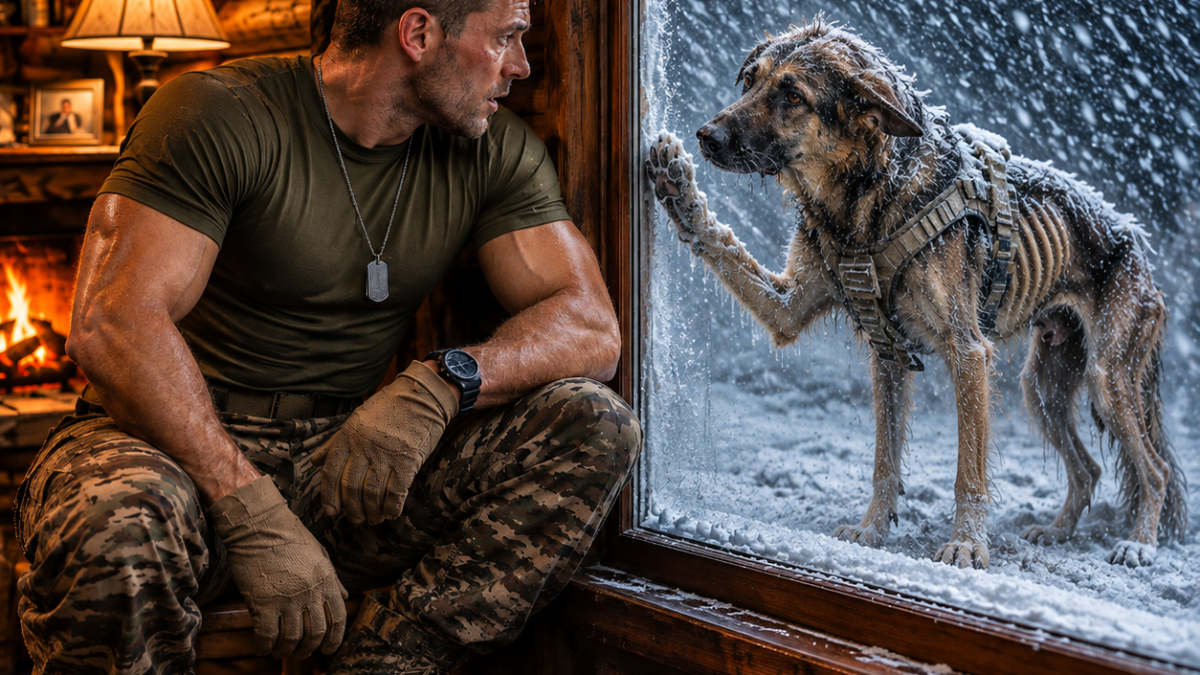
The starving German Shepherd knocked three times on Nathan Ror’s cabin door in the middle of a Washington storm, carrying a rusted K9 tag and enough scars to prove someone had spent years trying to make sure he never came home.
Nathan thought he was saving one dying dog until he turned the tag over and found seven words scratched into the metal: IF CALEB IS GONE, FOLLOW THE DOG.
By sunrise, that message would lead a former Navy SEAL to a trapped mother, a dead deputy’s hidden evidence, the woman who had mourned him for three years, and a waterfront empire built on fraud, explosives, intimidation, and one secret someone had already killed to keep buried.
Rain struck the cedar roof above Lake Crescent hard enough to shake water from the gutters in sheets.
Nathan Ror sat alone at his kitchen table with a generator regulator in pieces beneath his hands and coffee gone cold beside his elbow.
He drank it anyway.
At forty-two, Nathan had lost the ability to care whether coffee tasted good.
Hot had once been enough.
Then warm.
Lately, anything technically liquid qualified.
The cabin stood far enough outside Port Angeles that the city lights were only a dull orange stain beyond the dark shoulders of the Olympic foothills.
Tonight even that disappeared.
Wind came off the Strait of Juan de Fuca and drove rain sideways through the cedars.
The weather radio hissed from the counter.
“Flood warning for low crossings near Little River Road…”
Nathan kept working.
“High winds…”
He turned a tiny brass fitting between his fingers.
“Residents near unstable slopes should avoid unnecessary travel…”
He tightened his jaw.
Thunder never bothered him.
Thunder was honest.
Thunder announced itself, arrived violently, shook the world, and moved on.
Silence was different.
Silence came after explosions.
Silence came after radio traffic suddenly stopped.
Silence came during the three seconds Nathan still counted in his sleep.
One.
Miles visible through dust.
Two.
Nathan holding position because training said there might be a second shooter.
Three.
Miles Turner disappearing behind smoke.
Nathan’s thumb pressed too hard against the generator part.
Metal bent slightly.
He put it down.
PART2:
Around his neck, beneath his faded white T-shirt and blue flannel, hung a military dog tag that didn’t belong to him.
MILES TURNER.
Nathan hadn’t removed it in six years.
People assumed he wore it to remember his friend.
That wasn’t exactly true.
Nathan wore it because punishment worked better when it touched skin.
The weather radio crackled again.
Then the knocking came.
Tap.
Tap.
Tap.
Nathan looked toward the front door.
He waited.
Wind pushed against the cabin.
Branches scratched the siding.
Nothing.
Then again.
Tap.
Tap.
Tap.
Not a branch.
Too even.
Too patient.
Nathan stood.
PART3:
His body became still before his mind caught up.
A hundred doors returned to him.
Concrete compounds.
Metal gates.
Hotel rooms.
Mud-brick houses.
Hands signaling.
Weapons ready.
He looked toward the kitchen drawer where his pistol sat.
He didn’t open it.
This was Washington.
Not Yemen.
Not Somalia.
Not anywhere people whispered coordinates before kicking doors.
Something breathed beneath the threshold.
Nathan approached slowly.
Lightning flashed.
Through the narrow glass beside the door he saw a shape.
Large.
Four-legged.
German Shepherd.
Nathan opened the door.
Wind threw cold rain across his boots.
The dog remained on the porch.
He was enormous by structure but starved down to angles.
Sable coat plastered against ribs.
Broad black saddle shining with water.
Gray beginning around the muzzle.
One ear torn from an old injury.
His right hind leg shook.
Not fear.
Pain.
The dog’s amber eyes studied Nathan.
No whining.
No tail wagging.
No desperate rush toward warmth.
One front paw was still raised against the door.
The paw that had knocked.
Nathan crouched.
“Easy.”
The Shepherd’s eyes moved over him.
Hands.
Face.
Doorway.
Room behind him.
Window.
Kitchen.
Exits.
Nathan knew that scan.
He’d watched working dogs do it before entering unfamiliar structures.
“You can come inside.”
Nothing.
Nathan moved backward.
“I’m not much company.”
He looked around the cabin.
“But the roof works.”
The Shepherd crossed the threshold.
One deliberate step at a time.
Mud spread across Nathan’s floorboards.
The dog moved automatically toward the wall where he could see both the front door and the kitchen window.
Then stopped.
Perimeter.
Nathan felt something shift inside him.
He got a towel.
Moved slowly.
“Let me see you.”
The dog allowed the towel across his shoulders.
Beneath wet fur, Nathan found scars.
Old cuts.
Pressure wounds around the neck.
Raw skin where something had rubbed repeatedly.
A healed ridge along the ribs.
His right hind leg had likely been broken once and never set properly.
Nathan felt anger arrive.
Quiet anger.
The kind that didn’t make his hands shake.
“Somebody kept you tied too long.”
The dog’s ear twitched.
Nathan touched the collar.
Old leather.
Waterlogged.
Stitched more than once.
A rusted metal tag hung from the ring.
He wiped mud away.
ATLAS
RETURN TO EVELYN FORD
Underneath:
CLALLAM COUNTY K-9.
Nathan looked at the dog.
“Atlas.”
The Shepherd’s head rose instantly.
Recognition.
“That’s you.”
Nathan opened the refrigerator.
Boiled chicken from the night before.
He cut it into small pieces.
Filled a bowl with water.
Set both on the floor.
Atlas stared at the chicken.
Every muscle leaned forward.
He was starving.
But he didn’t eat.
He looked at Nathan.
Nathan froze.
Waiting for release.
Training.
Nathan swallowed.
“Okay.”
Atlas ate.
Slowly at first.
Controlled.
As if someone had once punished him for touching food without permission.
Nathan had seen hunger make men desperate.
This dog made hunger look disciplined.
Halfway through, Atlas stopped eating.
His head turned sharply toward the weather radio.
“Flash flooding reported near Little River Road.”
Atlas stood.
“Residents should evacuate low ground.”
The Shepherd limped toward the door.
Nathan frowned.
“No.”
Atlas struck the floor with one paw.
Three times.
Tap.
Tap.
Tap.
Nathan stared.
Atlas looked at him.
Then the door.
Then Nathan.
Another three taps.
Not panic.
Signal.
Nathan picked up the collar tag.
“Evelyn Ford.”
Little River Road.
He knew the area.
Old orchard properties.
Creek bottoms.
A few houses built before anybody worried about flood maps.
Nathan had repaired a pump out there once for an elderly woman who paid him in blackberry jam.
He tried to remember the name.
Atlas tapped again.
“Stop.”
The dog stared.
Nathan looked through the window.
Rain.
Dark roads.
Flood warning.
Every reason not to go.
He had spent six years building a life around reasons not to go.
Don’t get involved.
Don’t volunteer.
Don’t promise.
Don’t let someone else’s emergency decide your night.
Because once you became responsible, failure had a name.
Miles.
Nathan looked at Atlas.
“No.”
The Shepherd didn’t move.
Nathan’s right hand began shaking.
Not badly.
Enough.
Atlas waited.
Nathan grabbed his rain jacket.
Flashlight.
Medical kit.
Truck keys.
Atlas headed for the door.
“You are incredibly annoying.”
Atlas looked back.
Nathan almost smiled.
Almost.
Lightning split the sky as he closed the cabin.
He turned the tag in his hand one more time.
Something on the back caught the porch light.
Scratched letters.
Small.
Uneven.
Done with a knife or nail.
Nathan brought it closer.
IF CALEB IS GONE, FOLLOW THE DOG.
The cold that moved through Nathan had nothing to do with rain.
Little River Road was nearly underwater by the time they reached it.
Atlas sat in the passenger seat wrapped in an old wool blanket.
He didn’t lie down.
Didn’t sleep.
His nose stayed pointed toward the windshield.
At every turn, he shifted before Nathan touched the steering wheel.
The dog knew the road.
“Who was Caleb?”
Atlas stared ahead.
“Excellent conversation.”
Brown water flowed across the pavement.
Nathan slowed.
Atlas watched.
No hesitation.
They continued.
A faded wooden sign appeared through rain.
FORD APPLE FARM.
One hinge had ripped loose from the gate.
Atlas stood before the truck stopped.
“Sit.”
Atlas sat.
Barely.
The look he gave Nathan suggested obedience should not be confused with agreement.
“Don’t start.”
Nathan opened the door.
Atlas jumped down badly.
Pain buckled the hind leg.
He recovered immediately.
Then drove forward.
White farmhouse.
Green shutters.
Orchard trees clawing at fog.
A smokehouse near the creek leaned at a dangerous angle.
Smoke came from the roof.
Nathan’s pulse changed.
“Atlas.”
The Shepherd stopped.
Looked at the smokehouse.
Pawed the ground.
Three times.
Nathan checked the farmhouse first.
Front door open.
“Hello?”
No answer.
“Evelyn Ford?”
Wind moved through the hall.
A photograph lay face down on the floor.
Nathan picked it up.
Young deputy.
Brown Clallam County uniform.
Blond hair.
Easy smile.
Atlas beside him.
Healthy.
Strong.
Young.
Nathan turned the frame.
CALEB & ATLAS — 2019.
Atlas touched his nose to the broken glass.
A sound came from outside.
Human.
Weak.
Nathan ran.
The smokehouse wall had partially collapsed.
A timber pinned the entrance.
Inside, beneath a fallen shelving unit, an older woman lay trapped.
White hair.
Raincoat over a blue house dress.
Blood along one temple.
One leg pinned.
And clutched against her chest—
a deputy’s jacket.
Nathan dropped beside the doorway.
“Mrs. Ford?”
Her eyes opened.
Sharp despite pain.
“I’m Nathan Ror.”
She looked past him.
Atlas came through the mud.
Evelyn’s face changed.
“Oh.”
Her hand lifted.
“Caleb’s boy.”
Atlas shoved his muzzle beneath her palm.
The sound he made was not a bark.
Not a whine.
Something between.
Three years of distance leaving one animal all at once.
Evelyn’s mouth trembled.
“I waited for you.”
Nathan examined the structure.
Wet soil had shifted beneath one corner.
Electrical smell.
Smoke worsening.
“We need to move.”
Evelyn still held Atlas’s face.
Nathan touched the shelf pinning her leg.
“Can you pull when I lift?”
“I buried a husband and a son.”
Nathan looked at her.
“I can move one leg.”
Fair enough.
He wedged his shoulder beneath the shelving.
Lifted.
Pain shot through his back.
Memory shot through harder.
Miles.
Collapsed structure.
Smoke.
Three seconds.
One.
Two.
Nathan heard his own breath become too fast.
Atlas barked.
Sharp.
Nathan snapped back.
Now.
Not then.
“Evelyn.”
“I’m ready.”
“Pull.”
She dragged her leg free.
The roof groaned.
Nathan wrapped one arm around her.
Atlas backed toward the opening.
Nathan pulled Evelyn out as the shelving collapsed behind them in a burst of sparks and wet ash.
He carried her toward the truck.
Atlas followed.
Nathan wrapped her in an emergency blanket.
Called dispatch.
Weak signal.
Then finally:
“Possible fracture. Head injury. Fire risk. Ford Apple Farm, Little River Road.”
As they waited, Atlas stood between Evelyn and the road.
Guarding.
Evelyn stroked his neck.
“They told me he died.”
Nathan looked at her.
“Atlas?”
“In the warehouse explosion.”
“What warehouse?”
Her expression hardened.
“Northstar.”
Nathan recognized the name.
Northstar Harbor Group.
Billboards all over Port Angeles.
Marina redevelopment.
Industrial storage.
Luxury waterfront proposals.
Scholarships.
Hospital donations.
Grant Holloway shaking hands in newspapers.
Evelyn closed her eyes.
“My son was a deputy.”
“Caleb.”
She opened them.
“You saw the picture.”
“Yes.”
“He was investigating Northstar.”
“For what?”
“Everything people told him not to investigate.”
Nathan waited.
“Land pressure. Illegal explosives. Contractors. Old people signing papers they didn’t understand.”
“Northstar?”
“Caleb thought so.”
“What happened?”
Evelyn looked toward the smokehouse.
“Warehouse fire.”
Her voice changed.
“Three years ago.”
“Caleb died?”
“They said he entered alone chasing an unsupported tip.”
Atlas pressed closer.
Evelyn continued.
“The sheriff called him reckless.”
Nathan looked at the old deputy jacket.
“Was he?”
“No.”
No hesitation.
“Caleb could be stubborn.”
A faint smile.
“Annoying.”
Atlas’s ear moved.
“Apparently that runs in his unit.”
Nathan almost smiled.
“But careless?”
She shook her head.
“Never.”
Sirens sounded below.
Evelyn grabbed Nathan’s wrist.
“Listen.”
He did.
“Caleb said if anything happened, Atlas would know the rest.”
“The rest of what?”
“I don’t know.”
“You never asked?”
“He wouldn’t tell me.”
Anger moved through her.
“Thought protecting his mother meant making decisions for her.”
Nathan knew that kind of man.
Because he’d been one.
Evelyn continued.
“After the explosion, Atlas disappeared.”
“For three years?”
“Three years.”
She looked at him.
“I put food out every night for eighteen months.”
Nathan stared at the Shepherd.
“He came back.”
“No.”
Evelyn looked at Nathan.
“He came to you.”
The ambulance arrived.
Medics stabilized her.
Before they loaded her, Evelyn pulled Nathan closer.
“Don’t let them take him again.”
Nathan hated promises.
Promises created graves people carried inside themselves.
Atlas looked up.
Nathan said:
“I won’t.”
Evelyn released him.
Atlas turned toward the smokehouse.
Walked back.
Nathan followed.
The dog found the deputy jacket where Evelyn had dropped it.
He caught the sleeve.
Pulled.
“What?”
Another tug.
Nathan felt inside the lining.
Something stitched beneath the cloth.
He opened a torn seam.
Pulled out a square fabric patch.
Gray.
Burned on one edge.
Blue compass star.
NORTHSTAR HARBOR GROUP.
Atlas tapped the mud.
Three times.
Nathan looked toward the road where Evelyn’s ambulance disappeared.
“Of course.”
The Port Angeles Harbor Animal Clinic occupied an old bait shop near the waterfront.
Atlas refused help climbing from Nathan’s truck.
Nathan offered one hand.
Atlas looked at it.
Then jumped down badly.
Nathan sighed.
“Stubborn.”
The clinic door opened.
A woman stepped out.
Thirty-nine.
Tall.
Dark blond hair tied back.
Green eyes.
Navy scrub top.
She saw Atlas.
Stopped.
Everything in her face disappeared except recognition.
“Atlas.”
The Shepherd limped toward her.
Pressed his muzzle against her wrist.
She closed her eyes.
Nathan watched her fight tears.
“You know him.”
“Everyone who loved Caleb knew Atlas.”
Nathan took out the tag.
Photograph.
Northstar patch.
“Evelyn’s alive.”
The woman inhaled.
“Where?”
“Hospital.”
“How bad?”
“Leg. Head cut. Conscious.”
She looked relieved for half a second.
Then professional again.
“Exam room.”
Her name was Dr. Megan Ellis.
Atlas trusted her.
That told Nathan more than introductions could.
She examined him.
Dehydration.
Severe muscle loss.
Old hind-leg fracture.
Cracked pads.
Collar wounds.
Scars beneath fur.
Then she scanned him.
The machine beeped strangely.
Megan frowned.
Again.
Same.
“What?”
“Chip damaged.”
“Old?”
“No.”
She looked at Nathan.
“Deliberate.”
His jaw tightened.
“How?”
“Heat or electromagnetic damage, maybe both.”
“Why leave it in?”
“Removing it creates obvious surgery.”
She turned to the collar.
“This stitching is new.”
Nathan looked.
“How do you know?”
“Because I was there when Caleb bought this collar.”
Her mouth almost smiled.
“He complained about the price for two weeks.”
Atlas watched her.
“Then bought Atlas a smoked bone longer than his arm because he felt guilty for leaving him with the saddle maker.”
The smile vanished.
Megan used scissors.
Opened the inside seam.
Atlas sat perfectly still.
A small plastic sleeve slid out.
Sealed.
Inside:
Micro SD card.
Tiny folded note.
Megan unfolded it.
Her hand shook.
IF HE MADE IT HOME, THERE IS STILL TIME.
She whispered:
“Caleb.”
Nathan looked at her.
She touched a silver ring hanging from a chain around her neck.
“He was my fiancé.”
Silence.
Nathan didn’t offer condolences.
There were some griefs that became smaller when strangers tried to make them neat.
Atlas leaned against Megan’s leg.
She wiped two tears away angrily.
“We need law enforcement.”
Nathan looked at the window.
A gray SUV sat across the road.
Engine running.
A man behind tinted glass held a phone.
Megan saw him.
“Dale Haskins.”
“Friend?”
“Northstar security.”
“That’s not what I asked.”
“No.”
The man lowered the phone.
Another man entered the clinic.
Cheap raincoat.
Thin beard.
Eyes immediately found Atlas.
“Morning.”
Nobody answered.
“Heard somebody found a Shepherd.”
Megan’s voice went cold.
“Funny how fast news travels.”
“Might be mine.”
Nathan stepped forward.
“He’s not.”
The man looked at him.
“Who are you?”
“Person telling you to leave.”
The man smiled.
Then noticed Nathan wasn’t.
He backed out.
Outside, the SUV pulled away.
Megan locked the door.
“Somebody knows Atlas came back.”
Deputy Mara Jensen arrived without sirens.
Thirty-six.
Sharp.
Methodical.
She photographed everything.
Tag.
Collar.
Hidden sleeve.
Note.
SD card.
“Nobody touches this card without logging it.”
Megan brought an old clinic laptop disconnected from internet.
Mara inspected it.
“Perfect.”
Nathan waited.
First files corrupted.
Second unreadable.
Third opened.
Caleb appeared on screen.
Alive.
Tired.
Deputy jacket over tactical vest.
Work light behind him.
“If this is found…”
Static.
Nathan leaned closer.
“Grant Holloway is moving restricted blasting material through Northstar storage under false construction invoices.”
Megan gripped the chair.
Caleb continued.
“He’s pressuring elderly landowners along the bay and Little River Road.”
Screen flickered.
“The marina project is cover.”
Nathan looked at Mara.
Mara didn’t react.
Professional stillness.
Caleb continued:
“I don’t have enough yet.”
He looked off camera.
“Atlas has the scent trail to the second cache.”
Video jumped.
“Where gulls sleep above cold brick.”
Megan whispered:
“No.”
Nathan looked.
“What?”
“The old fish cold-storage plant.”
Caleb continued.
“Tell Megan I’m sorry.”
Her face broke.
“I kept her outside too much.”
He swallowed.
“Tell Mom I wasn’t chasing ghosts.”
Then another voice.
Off screen.
Smooth.
“The dog is a liability.”
A man crossed behind Caleb.
Silver hair.
Tan coat.
Grant Holloway.
The video died.
Mara exhaled.
“Enough to reopen the case.”
“Enough to arrest him?”
“No.”
Nathan hated the answer.
Mara continued.
“Not yet.”
Atlas stood.
Walked toward the harbor-facing door.
Pawed once.
Twice.
Three times.
Megan whispered:
“Gulls above cold brick.”
Nathan looked out toward the waterfront.
Mara said:
“Daylight.”
Atlas pawed again.
“No.”
The dog looked at her.
Mara looked back.
“I’ve been stared down by judges, drunks, suspects, and my mother.”
She pointed.
“You’re waiting.”
The clinic phone rang.
Megan answered on speaker.
Static.
Then a man’s voice.
Warm.
Calm.
“Dr. Ellis.”
Her face changed.
“Who is this?”
“You’ve always been practical.”
Mara reached for her radio.
“Give us the dog and the card.”
Nathan moved closer.
“And Caleb can remain a hero.”
Megan turned white.
The voice continued.
“Refuse…”
Pause.
“…and every grave in this town gets opened.”
The line went dead.
The old cold-storage plant stood near Ediz Hook.
Three stories of salt-stained brick.
Broken windows.
Gulls nested along the roof.
Mara had requested backup.
Storm damage had stretched county resources thin.
Agent Brooke Landry from the Washington Attorney General’s office was on her way.
Not there yet.
Megan said:
“This is a terrible plan.”
Nathan checked his flashlight.
“Most plans are.”
“That doesn’t help.”
“It wasn’t intended to.”
Atlas found a cut in the fence.
Recent.
They entered.
Cold air.
Rust.
Old fish.
Wet concrete.
Atlas moved directly.
Not searching.
Remembering.
Down a narrow stair.
Basement.
Gull feathers near broken vents.
Newer mortar along one wall.
Atlas flattened near it.
Three taps.
Megan whispered:
“He knows.”
Mara documented.
Nathan removed one loose brick.
Behind it:
Waterproof case.
Inside:
Maps.
Photographs.
Invoices for blasting caps labeled as dock hardware.
Names of elderly landowners.
And another SD card.
At the bottom sat a ring box.
Megan stopped breathing.
She opened it.
Silver engagement ring.
Receipt.
Caleb’s handwriting:
WHEN THIS IS OVER, I STOP HIDING WORK FROM THE WOMAN I LOVE.
Megan sat back.
“I hated him.”
Nathan said nothing.
“For leaving me without an explanation.”
Atlas pressed against her.
“I thought the case mattered more.”
Nathan said:
“Maybe he thought secrecy was protection.”
She looked at him.
“That’s what men say when they don’t want to admit pride.”
Nathan almost smiled.
“You’re not wrong.”
Metal scraped upstairs.
Atlas lowered.
Lip raised.
Mara drew her sidearm.
A man rushed down.
Hooked utility knife.
“Leave it!”
Atlas barked.
One sharp explosion.
The man lunged toward Mara.
Nathan moved.
Caught the wrist.
Turned.
Wall.
Knife dropped.
Mara cuffed him.
“Name?”
“Lawyer.”
“That’s not a name.”
She searched him.
Phone.
Radio.
Envelope.
Inside:
Photograph of Evelyn Ford in the hospital.
Taken through a doorway.
Words written beneath:
OLD PROMISES BURN FIRST.
Nathan’s stomach went cold.
Grant wasn’t only protecting evidence.
He was targeting people.
They moved to a small church near the harbor.
Pastor Peter Alden gave them a warm basement and terrible coffee.
Agent Landry arrived by phone first.
She reviewed chain of custody.
Evidence.
Threat.
Arrest.
“Nobody freelances.”
Nathan looked at Atlas.
Atlas looked innocent.
Landry continued:
“Especially you, Mr. Ror.”
“Why am I singled out?”
Megan answered:
“Pattern recognition.”
Mara’s mouth twitched.
Then a knock came upstairs.
Three taps.
Human.
Mara went first.
No one outside.
Only something metal on the step.
Nathan saw it.
His breath stopped.
Miles Turner’s dog tag.
The one that had been hanging against Nathan’s chest that morning.
He hadn’t noticed it missing.
Fresh words had been scratched into the back.
SOME MEN ARE ALWAYS LEFT BEHIND.
Nathan’s hand closed.
Metal cut his palm.
Blood ran.
Megan saw his face.
“Miles?”
He nodded.
Grant knew his past.
The threat wasn’t random.
Someone had researched him.
Someone wanted the old wound open.
Nathan stood frozen.
Then Atlas pushed against his leg.
Not comfort.
Pressure.
Move.
Nathan breathed.
They returned to Nathan’s cabin only long enough to gather medication and documents.
Smoke hit first.
Back door open.
Drawers overturned.
Tools broken.
Team photograph smashed.
Nathan stopped at the frame.
Miles smiling.
Nathan younger.
Before.
Atlas pressed against him.
Nathan breathed.
Then Atlas dropped flat.
Nathan saw the wire beneath the table.
Timer.
Red numbers.
“OUT!”
Megan moved.
Mara radioed.
Atlas slipped.
Nathan lifted him.
They cleared the house.
Explosion.
Small.
Dirty.
Enough.
Windows blew outward.
Fire took curtains.
Then beams.
Nathan stood in rain while his cabin burned.
Everything he’d used to hide from the world turned orange.
Megan stood beside him.
“I’m sorry.”
“They want me running backward.”
“Are you?”
Nathan looked at Atlas.
“No.”
Mara found a tracker beneath his truck.
Boot prints led toward a logging spur.
Radio static suddenly changed.
A man’s voice.
“Nice fire, Ror.”
Nathan stared into darkness.
“Shame about the old ghosts.”
Atlas pulled toward Freshwater Bay.
At dawn, Agent Landry had enough for a warrant on a Northstar boat shed.
Inside:
Ledgers.
Land transfer drafts.
Property lists.
Notes beside elderly owners.
WIDOW.
NO ATTORNEY.
MEDICAL DEBT.
SON OUT OF STATE.
Evelyn Ford circled twice.
Megan whispered:
“They were choosing people who couldn’t fight.”
Nathan looked at the page.
“No.”
“What?”
“They were choosing people they thought wouldn’t.”
A forged Caleb report sat in another drawer.
Claiming no illegal explosives existed.
Megan knew immediately.
“Not his signature.”
Landry found more.
False panel.
Waterproof tube.
Checks to a former sheriff.
Northstar payroll.
Photographs.
A signed cooperation draft.
Then a boat engine started outside.
Grant Holloway’s voice came over a loudspeaker.
“Nathan Ror.”
Silver-haired man aboard a Northstar utility boat.
“You failed one man in the dark.”
Miles.
Nathan felt the hit.
“Don’t make it two.”
Atlas growled.
Megan stepped beside Nathan.
“Caleb doesn’t belong to him.”
Nathan looked at her.
“And Miles doesn’t either.”
Another Northstar boat blocked the channel.
Landry found a maintenance skiff.
They loaded evidence.
Moved.
Grant’s boat followed.
A shot struck water.
Mara returned a warning shot high.
Second shot.
Then third.
Atlas moved.
He slammed into Nathan.
Glass exploded.
Atlas collapsed.
Blood spread through his shoulder.
“Atlas!”
Megan dropped beside him.
“Shoulder.”
She pressed cloth.
“Not chest.”
Nathan drove the skiff.
Coast Guard lights appeared through fog.
They reached shore.
Nathan carried Atlas.
Blood soaked his sleeve.
He remembered Miles.
Three seconds.
Waiting.
This time he did not wait.
At the clinic, Megan operated.
Nathan stood outside.
Helpless.
Mara arrived.
Landry arrived.
Evidence safe.
Grant escaped.
Then Northstar’s attorney called.
Offer.
Medical bills.
Clinic grant.
Private settlement.
Return the evidence.
Avoid “unnecessary public damage.”
Megan emerged from surgery.
Blood on gown.
“He’s alive.”
Nathan closed his eyes.
Then heard the attorney.
She stepped toward the phone.
“Caleb Ford didn’t die so I could sell his truth while his dog is on my table.”
Silence.
“And Atlas has better character under anesthesia than Grant Holloway has fully awake.”
Mara smiled.
The lawyer disconnected.
Atlas survived.
Barely.
Grant ran.
The warrant hit minutes after he left his house.
But Northstar’s server wipe failed.
Recovered data led investigators to a private airstrip near Sequim.
Nathan shouldn’t have gone.
Megan shouldn’t have brought Atlas.
Atlas definitely shouldn’t have been walking.
Yet when Grant’s name came over the radio, the bandaged Shepherd stood.
Megan looked at him.
Then Nathan.
“If he drops, we turn around.”
Atlas leaned against her.
Nobody argued.
At the hangar, Grant prepared to leave.
Private plane.
Cash-paid pilot.
Folders.
Fuel can.
Lighter.
Landry entered with Mara.
“Grant Holloway.”
Grant smiled.
“Agent.”
“Step away.”
Then he saw Atlas.
His face changed.
“That animal should be dead.”
Atlas growled.
Weak.
Exact.
Grant reached for the fuel.
Gasoline splashed over folders.
Atlas lunged.
Not toward Grant.
Toward the plane.
Nathan followed.
Under landing gear:
Waterproof pouch.
Grant panicked.
That mattered.
Mara moved.
Grant slipped on his own fuel.
Hit the floor.
Cuffed.
Inside the pouch:
Original payment records.
Flash drive.
Handwriting samples.
Drafts of Caleb’s forged report.
And a notarized statement from the former sheriff.
It admitted everything.
Northstar pressure.
False evidence.
Suppression.
Caleb’s reputation destroyed after death.
The documents placed Grant near the warehouse the night Caleb died.
Megan read the statement.
“This clears him.”
Landry nodded.
“It does more.”
Grant laughed from the floor.
“You think people care after three years?”
Megan touched Caleb’s ring.
“They cared enough to remember his dog.”
Atlas leaned against Nathan.
Nathan crouched.
“You did it.”
Atlas looked at him.
Then Megan.
Then the evidence.
One exhausted huff.
Work complete.
But the deepest secret was still waiting.
It appeared three days later when Landry’s forensic team opened the last encrypted file from Caleb’s second card.
Nathan was sitting beside Atlas in recovery.
Megan stood near the monitor.
Evelyn had been discharged and sat wrapped in a blanket.
Caleb appeared on screen.
Different recording.
Later.
Bruised face.
Smoke behind him.
“If you’re seeing this, I ran out of road.”
Evelyn’s hand covered her mouth.
Caleb continued.
“Mom, I’m sorry.”
Megan closed her eyes.
“Atlas knows home.”
Then Caleb looked directly into the camera.
“And if Nathan Ror is with him…”
Nathan froze.
Megan turned.
Caleb knew his name.
Nathan whispered:
“No.”
Caleb continued.
“Miles Turner told me about you.”
The room disappeared.
Nathan’s chest tightened.
Miles.
Caleb said:
“Before Miles deployed, he helped me on a Northstar subcontractor lead involving diverted blasting components.”
Nathan couldn’t breathe.
“He said if anything happened to him, you’d blame yourself.”
Nathan’s hand gripped the chair.
Evelyn looked at him.
Caleb continued:
“He told me something I think you deserve to hear.”
Static.
Then:
“Miles knew about the second shooter.”
Nathan stopped moving.
“He knew why you held.”
Nathan’s eyes filled.
“He told me the last thing he wanted was for you to break cover for him.”
Nathan whispered:
“No.”
Caleb kept talking.
“Miles said if it went bad, your job was to keep the rest alive.”
Nathan’s vision blurred.
“He said you’d probably spend the rest of your life calling that failure.”
Caleb almost smiled.
“His exact words were: ‘Nathan is stubborn enough to turn survival into a punishment.'”
Megan covered her mouth.
Nathan began crying before he knew it.
Caleb’s voice softened.
“Don’t.”
Pause.
“Miles didn’t think you abandoned him.”
Nathan bent forward.
Years collapsed.
Three seconds.
One.
Two.
Three.
Not cowardice.
Not betrayal.
A decision Miles understood.
Caleb continued:
“If Atlas finds you, then maybe both dead men finally got tired of you carrying things that weren’t yours.”
The video ended.
Nathan sat in silence.
Atlas lifted his head from the blanket.
Moved one paw.
Touched Nathan’s boot.
Nathan looked at him.
A laugh broke through tears.
“You carried that too?”
Atlas closed his eyes.
Evelyn whispered:
“Caleb knew.”
Megan looked at Nathan.
“Miles knew.”
Nathan had spent six years treating memory like a courtroom where he was always guilty.
Now two dead men had left testimony.
Not absolution.
Something harder.
Context.
Miles was still dead.
Nathan still wished he had moved sooner.
Nothing erased that.
But guilt had been telling the story alone.
Now it had witnesses.
Grant Holloway was indicted on charges tied to fraud, obstruction, restricted explosives, witness intimidation, arson, conspiracy, and attempted violence.
The former sheriff cooperated.
Northstar Harbor Group collapsed.
Land deals were frozen.
Elderly property owners regained parcels or received restitution.
Caleb Ford’s record was amended.
The official finding changed.
He had not died chasing an unsupported rumor.
He died while gathering evidence in an active investigation that had been corrupted from inside.
At a small harbor ceremony months later, Evelyn wore Caleb’s old deputy jacket.
Megan wore his ring on a chain.
Mara’s shoulder was still healing.
Landry carried a file thick enough to frighten accountants.
And Atlas walked beside Nathan.
Slowly.
Still limping.
But heavier now.
Healthy enough that his ribs no longer looked like fingers beneath the coat.
A new leather harness carried a small plate.
ATLAS FORD
LAST WATCH K9
Evelyn knelt with difficulty.
Atlas pressed his head into her.
“He brought him home.”
Nobody asked who she meant.
Caleb.
Truth.
Nathan.
Maybe all three.
Mara brought a wooden box.
Inside:
Caleb’s restored badge.
Atlas’s original tag.
Cleaned.
Not polished smooth.
Scratches remained.
Some promises deserved scars.
Evelyn looked at Nathan.
“My son trusted Atlas with the truth.”
Nathan swallowed.
“Atlas trusted you with the road back.”
Nathan looked at the dog.
“He mostly argued.”
“Good.”
Evelyn smiled.
“You needed supervision.”
That became the first time Nathan laughed in public without immediately feeling guilty afterward.
Megan used part of the restitution funds and donations to establish a program at her clinic.
LAST WATCH K9 CARE.
Medical support for retired police, military, and search-and-rescue dogs.
Old injuries.
Medication.
Emergency surgery.
End-of-life care.
“No hero should be abandoned because retirement gets expensive,” Megan said.
Nathan disliked the word hero.
Atlas seemed willing to tolerate it.
Then came the adoption paperwork.
Nathan stared.
“He’s Evelyn’s.”
Evelyn shook her head.
“My house has stairs.”
“Megan?”
“Clinic is not a home.”
Nathan looked at Atlas.
The Shepherd was asleep against his boot.
Megan said:
“He knocked on your door.”
Nathan sighed.
“That was poor judgment.”
Atlas opened one eye.
Evelyn laughed.
Nathan signed.
ATLAS FORD ROR.
Megan read it.
“Sounds like a law firm.”
“He has branding issues.”
Atlas sneezed.
Nathan’s old cabin was gone.
Insurance paid enough for a smaller rental above Lake Crescent while he rebuilt.
He chose a place with a porch.
Two bedrooms.
Large table.
At first he hated the extra room.
Then Evelyn visited.
Then Megan.
Then Mara.
Pastor Alden arrived with food and a prayer disguised as bad jokes.
Nathan discovered a second chair was not dangerous.
Neither was a third.
He hung his old team photograph above the mantle.
The glass remained cracked from the fire.
Megan offered to replace it.
“No.”
“Sentimental?”
“Evidence.”
“Of?”
Nathan touched Miles’s face.
“That broken doesn’t always mean ruined.”
Megan looked at him.
“That’s annoyingly healthy.”
“I’ll stop.”
“Please don’t.”
Atlas slept near the bed.
Every night.
At first Nathan woke reaching for a weapon when Atlas moved.
Then he woke and heard breathing.
Dog breathing.
Ordinary.
Warm.
Safe.
Miles’s tag still hung around his neck.
But it stopped feeling like punishment.
One evening Nathan removed it.
Held it in his palm.
Atlas watched.
Nathan placed the tag beside Caleb’s copied note on the mantle.
Megan happened to be there.
She didn’t comment.
That was why he loved having her around.
She knew when silence was work.
Months became years.
Atlas became a familiar figure around Port Angeles.
Children asked to pet him.
Nathan usually said no.
Megan usually explained better.
“He likes people.”
“But?”
“He spent a long time learning strangers could be dangerous.”
A child once asked:
“Will he ever forget?”
Nathan said:
“I hope not.”
Megan looked at him.
Nathan continued:
“Forgetting isn’t the goal.”
The child frowned.
“What is?”
“Learning the bad thing isn’t happening now.”
Nathan realized after saying it that he wasn’t talking only about Atlas.
Atlas eventually stopped checking every window.
Not completely.
But enough.
He learned the sound of Megan’s car.
Evelyn’s cane.
Mara’s knock.
Pastor Alden’s habit of opening the door while still knocking because apparently religion had weakened his respect for hinges.
Atlas knew.
These people belonged inside the perimeter.
Nathan did too.
That took longer.
One winter night, nearly four years after Atlas knocked on the cabin door, another storm came off the Strait.
Rain struck hard.
Wind shook the windows.
Nathan sat at his table repairing a pump.
New cabin now.
Rebuilt.
Stronger.
Atlas lay beside the stove.
Gray muzzle almost white.
His hind leg had worsened.
Megan had warned them.
Arthritis.
Old fracture.
Age.
Atlas slept more.
Worked less.
Nathan didn’t call it retirement.
Neither did Atlas.
Then came three taps at the door.
Nathan froze.
Atlas lifted his head.
Tap.
Tap.
Tap.
Nathan looked at the dog.
Atlas looked at him.
For one impossible second, Nathan felt time fold.
The first storm.
The starving Shepherd.
The tag.
Follow the dog.
Nathan opened the door.
A teenage boy stood outside holding a soaked kitten beneath his jacket.
“Mr. Ror?”
Nathan looked at Atlas.
Atlas’s tail moved once.
The boy said:
“Dr. Ellis told me if I found something hurt and didn’t know what to do, come here.”
Nathan almost laughed.
Megan.
Of course.
He stepped aside.
“Come in.”
The boy entered.
Atlas watched.
No growl.
No alarm.
Nathan fetched towels.
Warm milk.
Called Megan.
When he hung up, he realized something.
He had opened the door without calculating exits.
Without touching the pistol drawer.
Without wondering whether helping would cost too much.
Atlas had trained him.
Years passed.
Evelyn died at seventy-six.
Peacefully.
At home.
Atlas lay beside her bed during her last afternoon.
She touched the damaged ear.
“Tell Caleb you took your time.”
Atlas rested his head on her hand.
Nathan cried.
Megan cried.
Afterward Atlas searched the house once.
Kitchen.
Hallway.
Back porch.
Then stopped.
Nathan knelt.
“She’s not lost.”
Atlas looked at him.
Nathan swallowed.
“She went where we can’t follow yet.”
Atlas leaned into him.
The dog understood enough.
Or Nathan needed him to.
Sometimes love permitted small mysteries.
Atlas lived another eleven months.
His final decline came quietly.
Stopped finishing meals.
Could no longer climb the porch.
Then one morning, he tried to stand and couldn’t.
Nathan lifted him.
Atlas growled.
“You’ve been complaining about help since the day we met.”
Megan came to the house.
No clinic.
No bright room.
Atlas lay beside the front door.
Exactly where he could see outside.
Rain was beginning.
Of course.
Nathan sat beside him.
Megan checked heart.
Breathing.
Eyes.
Then looked at Nathan.
He knew.
“No.”
She didn’t argue.
“Not yet.”
“Okay.”
Two hours.
Chicken.
Water.
Mara came.
Pastor Alden.
Landry sent a message.
Nathan placed Caleb’s original tag beside Atlas.
RETURN TO EVELYN FORD.
Nathan laughed through tears.
“You did.”
Atlas breathed.
“You brought him home.”
Caleb.
“You brought Megan back to him.”
Megan covered her face.
“You brought me back to Miles.”
Nathan’s voice broke.
“And then somehow…”
He put his forehead against Atlas’s.
“…you brought me home too.”
Atlas’s paw moved.
One scrape against the floor.
Then another.
Then a third.
Tap.
Tap.
Tap.
Nathan shut his eyes.
The signal.
Always move.
Always follow.
Not backward.
Forward.
Nathan whispered:
“Okay.”
Megan prepared the medication.
Nathan held Atlas.
No uniform.
No ceremony.
No words about heroes.
Just a man and an old dog.
Nathan said:
“Stand down.”
Atlas’s breathing slowed.
“Last watch complete.”
Megan gave the medication.
Atlas exhaled.
Nathan whispered one final command.
“Home.”
Atlas died against his chest.
For a long time, Nathan didn’t move.
Rain hit the roof.
Thunder came.
Then silence.
Nathan waited for the silence to become the old one.
The cruel silence.
The three-second silence.
It didn’t.
This silence contained Atlas.
Evelyn.
Caleb.
Miles.
Megan’s hand on Nathan’s shoulder.
People who had been lost.
People who had been found.
Grief.
But no punishment.
Months later, Nathan mounted Atlas’s collar beside Miles’s tag and Caleb’s copied message.
Under them he placed a small brass plate.
THREE KNOCKS.
Megan read it.
“That’s all?”
Nathan nodded.
“People won’t understand.”
“They don’t need to.”
The Last Watch K9 Care Fund grew.
Nathan helped.
Not because he became inspirational.
He hated that word.
He fixed ramps.
Transported dogs.
Repaired kennel doors.
Sat beside veterans who weren’t ready to talk.
Sometimes people arrived with working dogs who had stopped eating after retirement.
Or dogs who woke attacking rooms.
Or handlers who believed they had failed because the dog couldn’t become normal.
Nathan would listen.
Then say:
“Normal is overrated.”
One retired deputy once asked:
“How do you know when they’re finally safe?”
Nathan looked toward the empty spot beside his boot.
“You don’t.”
The man frowned.
Nathan continued:
“You just keep showing them the danger is over.”
“And eventually?”
Nathan thought about Atlas sleeping beside doors.
Checking windows.
Learning cars.
Learning people.
“Eventually they believe you more often than they believe the past.”
That was enough.
On the fifth anniversary of Grant Holloway’s conviction, Port Angeles installed a small memorial plaque near the harbor.
Not for Nathan.
He refused.
For Deputy Caleb Ford.
It read:
HE FOLLOWED THE TRUTH WHEN IT WOULD HAVE BEEN EASIER TO TURN AWAY.
Beside Caleb’s name was a smaller line.
ATLAS FOUND THE ROAD HOME.
Nathan stood in the back during the dedication.
Megan beside him.
Caleb’s ring was no longer around her neck.
Nathan noticed.
She caught him looking.
“I put it away.”
“Why?”
She smiled sadly.
“Because loving what came before doesn’t require wearing it forever.”
Nathan looked at Miles’s tag beneath his shirt.
Then smiled.
“I’m slow.”
“I noticed.”
They walked toward the water.
No dog between them.
That emptiness never completely disappeared.
It didn’t need to.
Some absences become rooms.
You don’t demolish them.
You learn how to live beside them.
That night Nathan returned home.
Rain began after midnight.
Soft.
Cedar-scented.
Ordinary.
He sat at the same kind of kitchen table where the story had begun.
Generator parts beneath his hands.
Coffee cooling.
Then he heard something on the porch.
Not knocking.
A branch.
He knew immediately.
Nathan smiled.
Once, every sound after dark had been a threat.
Then a starving K9 arrived from a storm carrying a dead man’s name around his neck.
Nathan thought Atlas needed food.
A dry floor.
A doctor.
He thought saving meant giving.
He learned otherwise.
Atlas carried Caleb’s evidence home.
Carried Evelyn out of waiting.
Carried Megan out of anger.
Carried Miles’s last truth into Nathan’s hands.
And carried Nathan across the invisible line between surviving and living.
The dog had spent three years holding secrets because men had taught him that duty meant finishing the mission.
In the end, Atlas completed every one.
He found Evelyn.
He cleared Caleb’s name.
He exposed Grant Holloway.
He brought a dead man’s message to a man who had spent too long punishing himself.
Then, only after everyone else was home, Atlas finally allowed himself to stop.
Nathan looked at the brass plate above the mantle.
THREE KNOCKS.
People liked dramatic miracles.
Nathan didn’t.
He had seen too many dramatic things go wrong.
The miracle that changed his life had been smaller.
A dark porch.
A freezing night.
A wounded animal too disciplined to bark.
One raised paw.
Tap.
Tap.
Tap.
Nathan had opened the door thinking he was letting a starving dog inside.
He understood now that Atlas had been opening it from the other side.








