A Starving Dog Was Left Behind in an Empty Backyard for Weeks—But After Rescuers Finally Carried Him Out, They Discovered the Cruelest Part of His Story Was Still Ahead
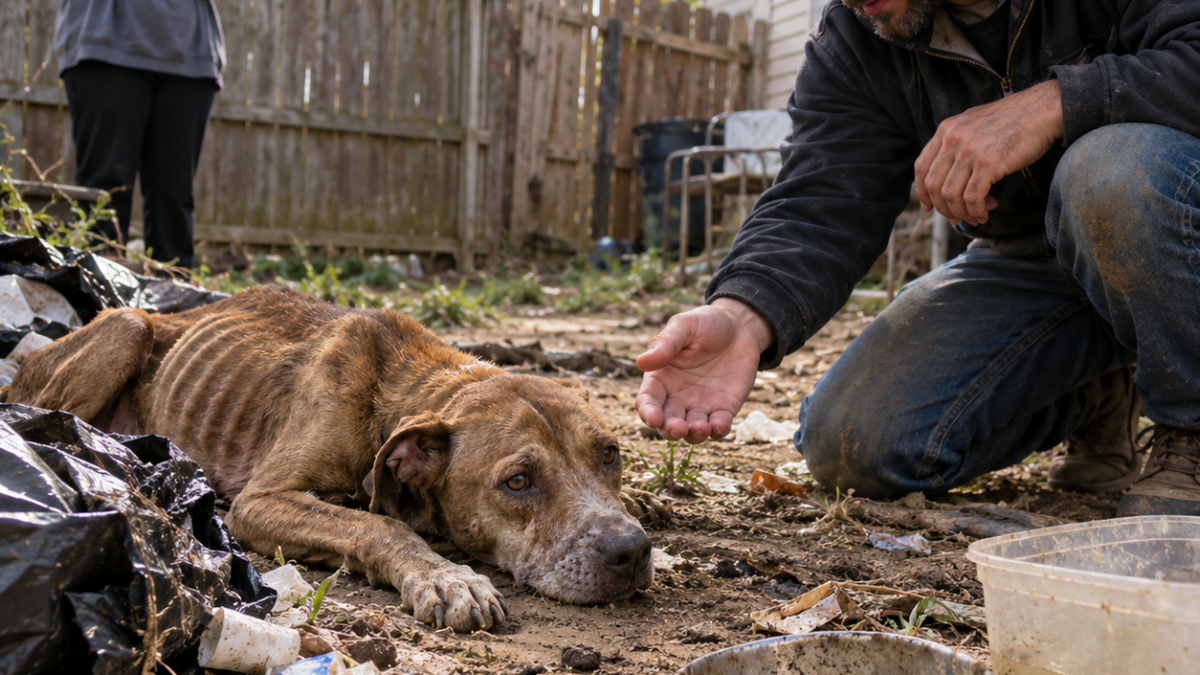
A Starving Dog Was Left Behind in an Empty Backyard for Weeks—But After Rescuers Finally Carried Him Out, They Discovered the Cruelest Part of His Story Was Still Ahead.
The first time I saw Vito, he was lying beside a torn garbage bag in an abandoned backyard, too weak to lift his head.
The people who once called him theirs had packed their belongings, driven away, and left him behind with an empty bowl, a locked fence, and trash to eat when hunger became stronger than fear.
I thought getting him out of that yard would be the rescue, but the real fight began when the clinic told me the damage inside his body might kill him before he ever learned what home was supposed to feel like.
I had received the call earlier that afternoon.
A neighbor said the family next door had moved.
Their dog had not.
At first, I thought there had to be a misunderstanding.
There usually is, or at least you hope there is. In rescue work, hope sometimes becomes a reflex before facts have time to break it. Maybe someone was coming back. Maybe a relative was stopping by. Maybe the neighbor had not seen the person feeding him. Maybe arrangements had been made and nobody had communicated them clearly.
Then the neighbor said quietly, “They’ve been gone for weeks.”
That changed everything.
By the time I pulled up in front of the house, the street looked painfully ordinary. A row of small single-family homes. Patchy lawns. A basketball hoop tipped sideways at the end of one driveway. A faded welcome mat still sitting in front of the empty house as if pretending people lived there.
The neighbor, Mrs. Alvarez, was waiting by the gate with both hands twisted together.
She was older, maybe early seventies, with silver hair pinned back and worry written across her face so plainly I did not need to ask whether she had slept well.
“I should have called sooner,” she said before I even introduced myself.
“We’re here now,” I told her.
That was not forgiveness.
It was direction.
Guilt could wait. The dog could not.
The backyard gate was locked, but the landlord had finally authorized entry after Mrs. Alvarez called again, this time refusing to be brushed off. One of our animal-welfare investigators had already taken photographs of the exterior. The house windows were dark. The curtains were gone. A few dead leaves had gathered along the back steps.
When we entered the property, the backyard was silent.
No barking.
No animal rushing toward us.
No chain rattling.
No sound at all except the gate creaking behind me and distant traffic beyond the fence.
I called softly.
“Hey, buddy?”
Nothing.
Then I saw movement near the rear fence.
At first, I thought it was a piece of plastic shifting in the wind.
Then two dull eyes lifted from the dirt.
Vito was lying beside a torn black garbage bag.
He was painfully thin, but what frightened me more was how little energy he had left to respond. His ribs showed beneath a dirty brown coat. His hips pressed sharply against skin that seemed too loose for the body underneath. His legs were tucked awkwardly, not in rest, but in exhaustion.
There was an old plastic food bowl nearby.
Empty.
A water container held only dirty residue at the bottom.
Around him were ripped bags, food wrappers, shredded plastic, paper scraps, and bits of packaging chewed into pieces.
I crouched several feet away.
“It’s okay.”
His eyes moved toward me.
His body did not.
That was when anger came.
Not loud anger. Not the kind that makes you shout. A quieter, colder kind that settles into the chest when you realize someone had options and chose none of them.
I looked at Mrs. Alvarez.
“He’s been eating this?”
Her eyes filled.
“I saw him tearing into whatever blew over the fence. I started throwing food to him when I realized nobody was coming back.”
“How long?”
PART2:
“I don’t know exactly.” She swallowed. “A few weeks.”
A few weeks.
I looked back at Vito.
This had been his entire world even before they left.
A backyard.
A fence.
Rare meals.
Little comfort.
Then even the people inside the house disappeared.
I moved closer.
Vito flinched when my hand reached toward him, but he did not have enough strength to retreat.
That broke something in me.
“Easy,” I whispered. “I’m not taking anything from you.”
I slid one hand beneath his chest.
His body felt frighteningly light.
When I lifted him, his legs hung with almost no resistance.
Mrs. Alvarez covered her mouth.
“Oh my God.”
I carried him toward the vehicle.
Vito’s head rested against my arm, not because he trusted me, I don’t think. Because he had nothing left with which to resist.
For the first time in weeks, he was leaving that backyard.
I wanted to believe that meant the worst was over.
At the veterinary clinic, that hope lasted less than an hour.
PART3:
The staff moved fast the moment we arrived. Weight. Temperature. Hydration check. Bloodwork. Abdominal exam. IV access. Vito barely reacted to any of it. He lay on the table as if the world had already asked too much from him and he had no opinion left to give.
Dr. Harris, the veterinarian on duty, was one of the most composed people I knew. She had treated hit-by-car dogs, parvo puppies, neglected seniors, and cats so dehydrated their skin barely settled back into place after she lifted it.
When Dr. Harris got quiet, I listened.
She pressed her stethoscope to Vito’s abdomen.
Moved it.
Listened again.
Her face tightened.
“What?” I asked.
“I don’t like what I’m hearing.”
Bloodwork confirmed what his body had been trying to tell us.
Advanced gastroenteritis.
Severe inflammation in his stomach and intestines.
Infection.
Dehydration.
Malnutrition.
His gut had been injured not only by hunger, but by whatever he had swallowed to survive it.
Plastic.
Paper.
Wrappers.
Trash that smelled enough like food to become food in the mind of a starving dog.
“What happens now?” I asked.
“We treat aggressively and monitor closely,” Dr. Harris said. “Fluids. Medication. Gastrointestinal support. Antibiotics where indicated. Nutrition when he can tolerate it.”
“And if the treatment doesn’t work?”
She looked at Vito before answering.
“Then we may lose him.”
I hated how clinical the room suddenly seemed.
The clean floor.
The metal table.
The labeled drawers.
The neatly coiled tubing.
The soft beep of equipment.
Everything was orderly now. Professional. Controlled.
But Vito’s suffering had not begun in an orderly place. It had begun in a yard where bowls were empty, where people drove away, where hunger turned garbage into a decision.
I sat beside his kennel that night while fluids ran through the line taped carefully to his front leg.
Vito barely moved.
Someone had finally opened the gate.
Someone had finally carried him out.
And now, after surviving isolation, hunger, plastic, garbage, and almost four weeks alone, he might die in a clean hospital room before he ever learned what a real home felt like.
I pressed my fingers gently against the blanket beside him.
“You didn’t survive that yard just to stop here.”
His eyes opened.
Barely.
“Stay with me.”
The next morning, there was almost no improvement.
The day after that, very little.
Vito refused most food. The little he accepted sometimes caused discomfort. His body needed nourishment, but his digestive system had been through too much trauma to receive it normally.
Dr. Harris reminded me that starving animals are not repaired by placing a giant bowl in front of them.
I knew that intellectually.
Emotionally, it felt cruel.
The dog who had eaten garbage to survive now turned his face away from food.
That scared me most.
On the third evening, I held a tiny piece of prescribed food near his nose.
“Come on, buddy.”
Vito sniffed.
Turned away.
“Just a little.”
Nothing.
I sat back, exhausted.
A technician named Laura entered the treatment room and leaned against the counter.
“You’ve been here six hours.”
“I know.”
“You need dinner.”
“So does he.”
“He needs you functional too.”
I looked at her.
“You ever hate people?”
“Frequently.”
“Good.”
“Why?”
“I’m checking whether I’ve become unreasonable.”
She glanced at Vito.
“Today is not the day to ask me.”
I almost smiled.
Then Vito shifted.
We both froze.
His nose moved toward the food.
I did not breathe.
“Come on,” I whispered.
He sniffed again.
Then he took the smallest bite.
Laura touched my shoulder.
“Don’t make a big deal.”
“I’m not.”
My voice cracked.
Vito chewed slowly.
Swallowed.
Waited.
Then took another bite.
I looked away because my eyes had filled.
Two bites.
To anyone else, almost nothing.
To us, a door opening.
That night, his food stayed down.
By morning, his temperature had improved slightly.
Not normal.
Better.
Dr. Harris remained cautious.
“We are not celebrating yet.”
“I already did.”
“I know.”
“You saw?”
“Half the clinic saw.”
“I was subtle.”
“You cried over two bites of gastrointestinal food.”
“Very dignified crying.”
She smiled.
“He is still critical.”
“I know.”
“But this is the first movement in the right direction.”
I crouched beside Vito.
“You hear that? You have apparently impressed a doctor.”
His tail did not move.
Not yet.
But he ate again several hours later.
A little more.
Then slept.
Real sleep.
Not the collapsed, barely conscious stillness he had arrived with. His body relaxed into the blanket, and one paw twitched.
Dreaming.
That wrecked me.
What does a dog dream about after years in a backyard?
Food?
Running?
The sound of people who stopped coming?
I hoped he was dreaming about somewhere he had never been.
Somewhere soft.
While Vito fought to stay alive, the investigation began.
The animal-welfare investigator assigned to the case was Maria Santos, and she had the kind of voice that could remain calm even when her words carried fury.
She called me from outside the old house after speaking to the former owners.
“We found them.”
I stepped into the clinic hallway.
“And?”
“They say what happened to him isn’t their responsibility.”
For several seconds, I said nothing.
I thought maybe I had heard her wrong.
“What do you mean it isn’t their responsibility?”
Maria let out a slow breath.
“They’re saying they had already given him away.”
“To who?”
“They haven’t provided a name.”
“When?”
“They’re being vague.”
I looked through the glass wall of the treatment room.
Vito lay beneath a thin blanket. His chest rose. Fell. Rose again.
That was all I cared about in that moment.
“Maria, that dog was still locked inside their yard.”
“I know.”
“There was no food.”
“I know.”
“He was eating garbage bags.”
“I know.”
“And they’re saying he belonged to somebody else?”
“That’s the story right now.”
There is one kind of anger that arrives when someone does something terrible.
There is another when they refuse to acknowledge that anything terrible happened.
The second one was settling into me.
“What do you need?” I asked.
“Documentation.”
“You’ll have everything from the clinic.”
“Good. Photographs from the property?”
“Already taken.”
“The bowls?”
“Documented.”
“Trash?”
“Yes.”
“Neighbor willing to speak?”
“I think so.”
“Then let me work.”
I looked at Vito again.
“You find out what happened.”
“I will.”
“And Maria?”
“Yes?”
“If they really gave him to somebody, find that person too.”
“I intend to.”
I hung up.
A few minutes later, Dr. Harris came into the hallway.
“Everything okay?”
“No.”
“That makes two of us.”
My anger vanished beneath fear.
“What happened?”
“His inflammatory markers are still concerning. He’s not responding as quickly as I’d hoped.”
“Is he worse?”
“Not dramatically. But he isn’t better enough.”
“What do we do?”
“We continue.”
That became our life for days.
Continue.
Fluids.
Medication.
Monitoring.
Tiny meals.
Temperature checks.
Bloodwork.
Wait.
Rescue work is full of uncertainty, but people rarely see that part.
They see the before-and-after photographs later.
The skeletal dog.
Then the healthy dog on a couch.
They rarely see the space between those pictures.
The nights when nobody knows whether there will be an after.
The vomiting.
The bloodwork.
The moment a technician opens a kennel and pauses because the animal has not changed position since the previous round.
Recovery does not happen in inspirational music.
It happens under fluorescent lights at two in the morning.
On the fifth night, Vito scared us again.
He vomited and became lethargic. His abdomen tightened. The next morning, I arrived to find Dr. Harris studying imaging on a screen.
“What happened?”
She pointed.
“We’re concerned about foreign material.”
My stomach dropped.
“Plastic?”
“Possibly.”
The garbage bags.
Everything he had swallowed.
Even if the infection responded, something inside him might still kill him.
“Does he need surgery?”
“We’re deciding.”
“What are the risks?”
“In his condition? Significant.”
“And if you don’t operate?”
“If there is an obstruction that does not pass, also significant.”
There are moments when rescue feels cruel because every option seems dangerous.
Vito had survived neglect only to face the consequences created by hunger.
He had not eaten plastic because he was mischievous.
He had eaten it because his body had been desperate.
That distinction mattered to me.
A dog cannot understand that the thing carrying the smell of old food might become a blockage later.
Hunger lives in the present tense.
Eat now.
Survive now.
Consequences later.
The team monitored him closely. Additional imaging suggested some material was moving. There was no immediate complete obstruction.
We waited.
I hated waiting.
“You need to pass this, buddy,” I told him.
Vito opened his eyes.
“Whatever terrible decision you made in that backyard, I forgive you.”
Laura laughed from behind me.
“He was starving.”
“I know.”
“I’m pretty sure the court will excuse him.”
“Good.”
Twenty-four hours later, part of the material passed.
Plastic.
Actual torn plastic.
Seeing it in a clinical tray made my hands shake.
Not because it was graphic.
Because it made the story physical.
This was not a metaphor.
Vito really had been eating bags.
Trash.
Things that could not nourish him.
Things that might have killed him.
Because the people responsible for filling a bowl did not.
By the end of the first week, Vito finally turned a corner.
It happened quietly.
No dramatic music.
No sudden miracle.
He simply stood.
I walked into the treatment room and found him on all four feet.
His legs trembled.
But he was standing.
I stopped in the doorway.
“Excuse me.”
Vito looked at me.
“You’ve been holding out.”
Laura smiled. “He stood about twenty seconds earlier too.”
“Why was I not notified?”
“Because you are not his legal mother.”
“That feels technical.”
I crouched.
“Come here.”
Vito stared.
Then he took one step.
His back legs were uncertain.
Another step.
Then another.
He reached me.
I touched his chest.
His tail moved.
Once.
Very small.
I looked at Laura.
“No.”
She was smiling.
“Did you see that?”
“Yes.”
“He wagged.”
“Yes.”
“Document it.”
“You want a medical note that says tail wag?”
“Yes.”
She laughed.
I did not care.
Vito leaned his forehead against me.
That was the first time I felt him make a choice about affection.
Until then, most contact happened because we needed to move him, examine him, medicate him, or comfort him.
Now he had crossed the space.
He came to me.
I rested my face against his head.
“You’re staying,” I whispered.
His tail moved again.
“You hear me?”
Another tiny movement.
“You are staying.”
Maria’s investigation tightened around the people who had left him.
The former family had moved to an apartment complex about forty miles away.
No pets without a deposit.
Breed restrictions applied.
They had not paid the deposit.
Their explanation shifted as pressure increased.
First, they had given Vito away.
Then they had expected someone to collect him.
Then they claimed the neighbor had agreed to feed him.
Mrs. Alvarez denied that completely.
Text messages told the story more clearly than any of them did.
Before the move, the apartment complex sent them pet-policy information.
The mother wrote:
We can’t bring Vito.
The father replied:
Then he stays till somebody wants him.
The son asked:
Who?
No answer.
That message hurt more than I expected.
Then he stays.
As if Vito were an old refrigerator placed beside a garage until someone hauled it away.
No plan.
No shelter.
No rescue call.
No veterinary appointment.
No confirmed adopter.
No food arrangement.
No person taking responsibility.
He stays.
Another message came nine days after the move.
The son had texted his father:
You going back for Vito?
The father replied:
No. Somebody will take him.
Then:
He got food?
Reply:
There’s stuff in yard.
Stuff.
Garbage, most likely.
Plastic.
Wrappers.
The things Vito had swallowed because his bowl was empty.
There was another message from the mother.
Neighbor keeps asking about dog.
The father replied:
Tell her mind her business.
They knew.
They knew he was there.
They knew the neighbor was worried.
They knew no one had taken him.
They did nothing.
The family later tried to say they had arranged for a man named Eric to take Vito.
No last name.
No phone number.
No messages.
No address.
No key.
The backyard gate had been padlocked.
They had kept the key.
Their mystery adopter had supposedly been responsible for a dog he could not access.
Maria said carefully, “Anger can point toward evidence. It cannot replace it.”
She was right.
So we gathered evidence.
Photos of the bowls.
Photos of the trash.
The landlord’s records.
The move-out date.
Statements from Mrs. Alvarez.
Veterinary reports.
Text messages.
Vito’s body condition.
The plastic he passed.
The case became less about whether they meant to be cruel and more about whether they knew they had a duty and abandoned it anyway.
Neglect does not always require sadism.
Sometimes it requires selfishness repeated long enough.
A decision not to buy food today.
A decision not to call the vet.
A decision not to rehome.
A decision to move first and solve the dog later.
Then no solution.
Then silence.
Then garbage.
Two weeks after rescue, Vito was medically stable enough to leave the hospital.
He still needed monitoring.
Medication.
A special diet.
Rest.
Careful meals.
But the immediate danger had passed.
We needed a foster home.
Claire volunteered.
Claire had fostered medically fragile dogs before, and she arrived at the clinic with a soft gray blanket, a printed medication chart, feeding instructions highlighted in three colors, and the anxious sincerity of someone who understood exactly how much trust she was being handed.
“What if he won’t get in my car?” she asked.
“We go slowly.”
“What if he won’t eat?”
“Call.”
“What if he eats too fast?”
“Use the feeding instructions.”
“What if he wakes up scared?”
“You sit nearby.”
“What if—”
“Claire.”
She stopped.
“You’re good.”
“I just don’t want to fail him.”
That was exactly why I trusted her.
People who assume they cannot fail an animal worry me more than people who understand the responsibility.
We brought Vito outside.
Sunlight touched his face.
He stopped.
For several seconds, he simply stood there.
Grass.
Air.
Cars in the distance.
No backyard fence enclosing his entire world.
Claire crouched beside the open vehicle door.
“No rush,” she said.
Vito sniffed.
I placed the gray blanket on the back seat.
He looked at me.
“Go ahead.”
One paw up.
Then down.
Again.
Finally, he climbed in.
Claire did not shut the door immediately. She sat beside him. Vito sniffed her hand. She did not touch him until he moved closer.
Then she gently scratched beneath his jaw.
“Hi, Vito.”
His tail moved.
That tiny scene mattered.
For once, someone new entered Vito’s life without demanding anything from him.
At Claire’s house, his world expanded one room at a time.
Day one, he slept near the kitchen instead of on the bed she had bought.
Day two, he discovered the couch but would not climb onto it.
Day three, he ate every meal and began standing near the kitchen ten minutes before feeding time.
Day four, he carried a sock into the living room and looked shocked when nobody punished him.
Day five, he wagged when Claire came back from taking out the trash.
That one made me cry.
She had been gone for less than two minutes.
Vito still celebrated her return.
Think about that.
His original family disappeared for weeks.
Now, when a person walked through a door after ninety seconds, Vito responded as if the sun had come back.
Claire called me that night.
“He follows me everywhere.”
“That’s normal right now.”
“Bathroom too.”
“Especially bathroom.”
“I’m serious.”
“So am I.”
She grew quiet.
“Do you think he thinks I’ll leave?”
“Yes.”
The answer hurt both of us.
“What do I do?”
“Come back.”
“What?”
“Every time you leave, come back.”
“That simple?”
“That repetitive.”
Trust is often repetition.
Breakfast comes.
Water returns.
Door opens.
Person returns.
Nothing hurts.
Again.
Again.
Again.
Eventually, the nervous system learns a new prediction.
Claire did exactly that.
Vito began sleeping more deeply.
At first, he chose corners where he could see exits. Then the hallway. Then beside Claire’s bed.
One morning, she sent a photo at 6:12 a.m.
Vito was asleep on his side with his legs stretched out.
Caption:
He didn’t move when I got up.
That was progress.
A dog who has been abandoned sometimes monitors movement obsessively.
Shoes.
Keys.
Doors.
Bags.
Anything that might mean someone is leaving.
Vito gradually stopped treating every departure as permanent.
His body changed too.
The difference was slow enough that Claire did not always notice.
I noticed every time I visited.
His hip bones softened beneath new weight. Muscle returned along his shoulders. His coat improved. His eyes became brighter. The hollow expression faded.
One afternoon, he ran.
Not far.
Claire tossed a soft toy across the yard. Vito watched it land. Then he trotted. Then, suddenly, accelerated.
Only five or six strides.
But running.
Claire screamed.
I nearly dropped my coffee.
Vito grabbed the toy, turned, and ran back.
I crouched.
He passed directly by me.
“Excuse me?”
Claire laughed.
“He has priorities.”
The dog who had once struggled to move his limbs was now playing keep-away.
I had never been happier to be ignored.
That evening, he slept for three hours on a rug with Claire nearby.
No dirt.
No garbage bags.
No empty bowl.
Soft fabric beneath him.
I stared at him and thought:
This is what they nearly stole.
Not just his life.
His ordinary future.
That is the part of neglect people sometimes fail to understand.
When an animal dies from preventable cruelty, the loss is not only one moment of death.
It is every boring morning that should have followed.
Every nap.
Every walk.
Every silly toy.
Every person he might have loved.
Every gray hair he should have lived long enough to grow.
Vito was reclaiming those things one day at a time.
The legal case moved forward.
The family retained an attorney. Their explanation kept changing.
A private rehoming.
A neighbor supposedly feeding him.
A mystery man named Eric.
A misunderstanding.
A difficult move.
Financial stress.
Apartment rules.
A lot going on.
That phrase came from the father during testimony.
“I had a lot going on.”
I remember hearing it and feeling something inside me go cold.
Vito had almost died because people had a lot going on.
The prosecutor asked one quiet question.
“What did Vito have going on?”
The defense objected.
Sustained.
Legally, maybe improper.
Emotionally, the answer lived in every photograph.
Hunger.
Garbage.
Plastic.
Infection.
Isolation.
The case did not end that day.
Real proceedings stretch.
There were additional filings, negotiations, discussions about restitution, questions about ownership rights.
The family finally stopped seeking Vito’s return.
That had been one of my fears.
Not because I thought they truly wanted him.
Because people sometimes fight to avoid admitting they should not have something.
Vito was formally surrendered.
Permanent.
When Maria called with that news, I was at Claire’s house.
Vito was asleep with his head beneath the coffee table.
“Say that again,” I said.
“They signed the surrender.”
“He’s free?”
“Legally, yes.”
I looked at Claire.
She knew from my face.
Her hand covered her mouth.
I whispered, “He’s not going back.”
Vito opened one eye.
Claire sat on the floor beside him.
“Oh, baby.”
He rolled onto his side.
He had no idea paperwork had just changed his life.
Maybe that was beautiful.
Humans had created the legal problem.
Humans could solve it.
Vito did not need to understand.
The court eventually imposed consequences connected to the neglect.
Restitution for part of his veterinary and care expenses.
Fines.
Probationary requirements.
Restrictions on animal ownership for a defined period.
A formal record of what had happened.
No dramatic movie justice.
No one dragged away while a crowd cheered.
But the consequences mattered.
The family could no longer say:
Not our responsibility.
The court had answered that.
It had been their responsibility.
They failed it.
At first, I wanted more.
I admit that.
During Vito’s worst nights, I imagined the people who left him being forced to sit beside his kennel and watch him struggle. I wanted them to see the IV line, the bloodwork, the plastic, the moment Dr. Harris said, “We may lose him.”
I wanted them to understand exactly what convenience had cost.
That anger was real.
But as Vito healed, the shape of justice changed for me.
I stopped wanting his future attached to their punishment.
They had already occupied enough of his story.
The better revenge was happening in Claire’s living room.
Vito learned toys.
Actual toys.
At first, he treated them like food. A stuffed fox lost one ear almost immediately.
“Vito.”
He froze.
Claire approached.
He lowered his head.
That reaction told us something.
He expected anger.
Claire stopped.
“Hey.”
Vito stared.
She held out a treat.
“Trade.”
He released the torn fox.
Treat.
No shouting.
No hitting.
No chasing.
The next time he grabbed something inappropriate, the trade came faster.
Eventually, he learned the difference between his toys and Claire’s shoes.
Mostly.
One sneaker remained a casualty.
Claire sent me a photograph.
Shoe destroyed.
Vito sitting beside it.
Caption:
Suspect denies involvement.
I replied:
Insufficient evidence.
His personality emerged in layers.
He hated rain.
Loved sunny patches on the floor.
Refused carrots.
Loved apple slices.
Barked at delivery drivers but hid behind Claire if they actually came inside.
He had an unreasonable fascination with bath towels.
He learned the sound of the refrigerator door and could appear from three rooms away before it fully opened.
Most importantly, he became playful.
Not constantly.
Enough.
Vito had never stopped wanting what people failed to give him.
Food.
Safety.
Company.
Gentleness.
Once offered those things consistently, he moved toward them.
He was cautious.
But not closed.
That humbled me.
Humans often describe abused animals as still loving despite everything. I understand the sentiment, but sometimes it sounds as though the animal owes us forgiveness.
Vito owed humans nothing.
If he had spent the rest of his life distant, that would have been understandable.
The remarkable part was not that he forgave humanity.
The remarkable part was that he discovered specific people were safe and responded to them.
Trust was not abstract.
It was Claire.
It was me.
It was Laura.
It was Dr. Harris.
Later, it would become someone else.
Because eventually, Vito was ready for adoption.
I hated that sentence the first time Claire said it.
“He’s ready.”
“No.”
She stared at me.
“Professionally, I mean.”
“So do I.”
“You just said no.”
“Emotionally.”
She smiled.
“You could adopt him.”
I looked at Vito.
He was upside down on her couch, one paw hanging over the edge, completely unaware that humans were making major decisions around him.
“No.”
“Why?”
“Because my work is too unpredictable. He deserves stability.”
“That is annoyingly responsible.”
“I hate it.”
“Good.”
The rescue posted his profile carefully.
Not as tragedy bait.
Not:
Poor abandoned dog needs hero.
Instead:
Vito is recovering from severe neglect and would benefit from a patient home with predictable routines, continued veterinary follow-up, and people willing to let trust develop at his pace.
Applications came quickly.
His story had circulated locally during the case. That created another challenge.
Some people wanted Vito because they wanted to be connected to the rescue story.
That is not always malicious.
Emotion brings people toward animals.
But adoption has to survive after emotion settles.
One applicant wrote:
I want to show the people who hurt him what real love looks like.
Nice sentence.
Not enough.
Where would Vito sleep?
How many hours alone?
Other pets?
Veterinary plan?
Food budget?
Exercise?
Emergency care?
What happens when he vomits on a carpet?
What happens if he steals trash?
What happens when he is no longer a symbol and is simply a dog at 5:40 a.m. asking to go outside?
We rejected several applicants.
One became angry.
“How can you deny me after what he went through?”
That question answered itself.
Vito had already spent too much time around people who believed wanting him gave them rights over him.
This time, his needs came first.
Then came an application from a couple named Ethan and Grace.
They lived about an hour away.
No children.
One older mixed-breed dog named Penny.
Secure yard.
Flexible work schedules.
Excellent veterinary history.
Their previous dog had suffered chronic gastrointestinal disease, so medication and diet management did not frighten them.
Their application did not mention saving Vito once.
It said:
We understand he has already been rescued. We would like to give him a permanent home if he chooses us too.
I read that line three times.
If he chooses us too.
The first meeting happened at Claire’s house.
At first, Ethan and Grace simply sat.
Vito watched from near the hallway.
Grace turned slightly sideways.
No direct approach.
Good.
Ethan tossed a treat several feet away.
Vito ate it.
Another.
Closer.
Then Vito retreated.
Neither followed.
Twenty minutes passed.
Vito approached Grace.
Sniffed her shoe.
Then Ethan’s hand.
Ethan did not touch him.
“Hi, buddy.”
Vito stepped back.
Later, he returned.
This time, he rested his chin briefly on Grace’s knee.
She did not squeal.
Did not grab.
Her eyes watered, but she stayed still.
Claire looked at me.
I looked away.
No.
Too early.
The second visit lasted longer.
Vito brought Ethan a toy.
Ethan tossed it.
Vito chased.
Returned halfway.
Forgot the game.
Went to inspect the kitchen.
Perfect.
The third visit included Penny.
She was twelve and calm, the kind of dog who had seen enough nonsense to decline participation in most of it.
Vito sniffed.
Penny sniffed.
Vito tried to play.
Penny looked offended.
We all laughed.
Eventually, they walked side by side.
No pressure.
Good.
Grace asked more questions than any adopter I had ever met.
“What signs tell you his stomach is bothering him?”
“Any history of guarding food?”
“What does he do when frightened?”
“Does he prefer sleeping near people?”
“How long is he comfortable alone?”
“Has anyone tested him around garbage cans?”
That last one mattered.
Vito had a scavenging history.
They planned locking trash cabinets.
Excellent.
Ethan asked, “What do we do if he eats something he shouldn’t?”
I went through emergency signs.
Veterinary contacts.
When to wait.
When not to wait.
He took notes.
Actually took notes.
I looked at Claire.
She whispered, “Stop looking for problems.”
“I’m being thorough.”
“You’re trying to keep him.”
“Those are related.”
On the fourth visit, Vito fell asleep with his head on Ethan’s shoe.
I knew.
Claire knew.
Grace knew.
Ethan pretended not to notice because moving his foot might wake him.
That told me everything.
The adoption was approved.
I spent the night before at Claire’s house.
Not intentionally.
I stopped by after work.
Then dinner happened.
Then Vito climbed beside me on the couch.
Then leaving felt impossible.
Claire made coffee.
“You know you’re going to cry tomorrow.”
“No.”
“You cried because he ate two bites.”
“That was medically significant.”
“You cried when he wagged.”
“Neurologically significant.”
“You cried when he ran.”
“Musculoskeletal milestone.”
“You are exhausting.”
Vito put his head on my lap.
Claire smiled.
“See?”
“Traitor.”
I looked down at him.
His body had filled out. I could run my hand along his back without feeling every vertebra. His coat was healthy. His eyes were bright.
I remembered lifting him from the dirt.
Legs hanging.
Head weak.
Garbage bags nearby.
“You know where you’re going tomorrow?” I asked.
His tail tapped.
“They have another dog.”
Tap.
“Old lady. She may boss you around.”
Tap.
“They bought you a bed.”
Vito yawned.
“Apparently a very expensive one.”
His eyes closed.
“You probably won’t use it.”
Claire said, “Definitely couch.”
“Absolutely.”
I kept my hand on him.
“Your bowl is going to be full.”
That sentence caught me.
Vito opened his eyes.
I swallowed.
“You are never going to have to eat garbage again.”
Claire turned away.
I knew she was crying.
I was too.
“You’ll have people who notice when you’re sick.”
Vito pushed his nose under my hand.
“People who come back.”
His tail moved.
“People who know you’re there.”
I lowered my head.
“That’s all you needed.”
The next morning, Grace and Ethan arrived with Penny in the back.
They brought Vito’s new harness.
Food.
Medication list.
A folder.
A blanket.
Three toys.
And a stainless-steel bowl engraved with his name.
VITO.
I saw the bowl and lost whatever emotional discipline remained.
Grace noticed.
“We thought he should have his own.”
I ran my thumb over the name.
VITO.
Not property.
Not forgotten dog.
Not evidence.
A name on a bowl.
“That’s perfect,” I said.
Paperwork took thirty minutes.
Goodbye took longer.
Claire crouched first.
Vito licked her face.
“You be good,” she whispered.
He wagged.
“You don’t have to be perfect.”
Another wag.
“Just be happy.”
She hugged him and stepped back.
Then it was my turn.
I knelt.
Vito approached immediately.
I put both hands around his neck.
“You gave us a scare.”
Tail.
“Several.”
Tail.
“You owe me at least four years off my life.”
He licked my nose.
“Disgusting.”
I pressed my forehead to his.
“You don’t owe anybody anything.”
Then I whispered the rest.
“Go live.”
Grace attached the new leash.
Vito walked toward their car.
Penny watched from the rear seat like a disapproving grandmother.
Vito put his front paws inside.
Looked back.
For one second, I saw the dog from the backyard again.
The one who could barely move.
Then he climbed into the car under his own strength.
That image replaced the old one.
The door closed.
They drove away.
Three hours later, Grace sent the first photograph.
Vito lying on a rug beside Penny.
His engraved bowl visible in the kitchen behind them.
Caption:
He ate, checked every room twice, followed Penny everywhere, and finally fell asleep.
I zoomed in on the bowl.
Full water.
Clean.
Ordinary.
Beautiful.
The first week brought updates every day.
Vito discovered the backyard.
At first, he refused to stay outside without one of them. Grace would step through the door. Vito followed. She sat. He explored. If she went inside, he came immediately.
No one forced him to remain.
Eventually, he began wandering farther from the door.
One afternoon, he lay in the grass alone for six minutes while Ethan watched through the window.
Six minutes.
That was progress.
The backyard that had once meant abandonment was becoming something else.
A place to sunbathe.
Run.
Sniff.
Then come inside.
Doors matter differently when you know they will open.
His relationship with Penny became hilarious.
Vito adored her.
Penny tolerated him.
He brought her toys. She ignored them. He followed her into the yard. She acted inconvenienced. If Vito slept too far from her, Penny eventually moved closer while pretending it was accidental.
Within a month, photographs showed them sharing the same bed despite having two.
Grace wrote:
Penny would deny this under oath.
I replied:
Insufficient witness credibility.
Vito gained more weight.
Not too much.
Healthy.
Controlled.
His veterinarian adjusted his diet as his gastrointestinal system stabilized. The infection cleared. Inflammation improved. No further foreign material problems. His bloodwork normalized.
The first completely ordinary veterinary checkup made me more emotional than the emergency ones.
Dr. Harris sent a note through the rescue:
Healthy weight. Bright, alert, responsive. Continue routine care.
Routine care.
Two words I had desperately wanted for him.
Routine meant nobody was fighting death.
Routine meant vaccinations and nails and weight.
Routine meant future.
Almost a year after Vito’s rescue, we held a fundraiser and adoption event.
Vito attended with Grace and Ethan.
He was not there for adoption.
He was there as proof of what recovery could look like.
Healthy.
Muscular.
Bright-eyed.
Blue bandana.
I was speaking with another volunteer when I noticed Grace go still.
“What?”
She looked toward the parking lot.
A man stood near the entrance.
Vito’s former owner.
The father.
My entire body tightened.
“What is he doing here?”
“I don’t know,” Grace said.
“Stay with Vito.”
I walked toward him.
Maria, who happened to be attending, saw the same thing and intercepted him before I reached him.
Good.
I was not certain I would speak carefully.
The man lifted both hands.
“I’m not here for trouble.”
Maria’s expression was flat. “Then why are you here?”
“I heard the dog would be here.”
Vito had not noticed him yet.
I positioned myself so he did not need to.
“What do you want?”
The man looked past me. “To see him.”
“No.”
His face tightened. “I used to own him.”
I felt something cold move through me.
“You lost the right to say that like it means affection.”
“I know what the court said.”
“Good.”
“I just want to know he’s okay.”
I laughed once.
Not because anything was funny.
“You want to know now?”
He looked down.
“I made mistakes.”
“Mistakes?”
Maria touched my arm.
Warning.
I stepped back.
The man swallowed.
“I know what happened was bad.”
“Do you?”
“Yes.”
“You knew he was there while you were living forty miles away.”
His jaw tightened. “I had problems.”
“So did Vito.”
“I’m not trying to argue.”
“Then don’t.”
He looked toward the event again.
Vito was standing beside Ethan, tail wagging while a child gently stroked his shoulder.
The former owner stared.
I watched his face change.
Maybe he expected the skeletal dog from the evidence photos.
Maybe he expected Vito to look permanently damaged.
Instead, Vito looked magnificent.
Healthy.
Loved.
Confident.
The man whispered, “He looks good.”
I could have said a hundred cruel things.
I wanted to.
Then Vito saw him.
Everything stopped.
Vito’s ears shifted.
His mouth closed.
His body became still.
Grace immediately shortened the leash without tightening it. She looked at Vito.
“Want to go?”
That was the right question.
Not:
Go say hello.
Not:
Do you remember him?
Not:
Look who’s here.
Want to go?
Vito looked at Grace.
Then at Ethan.
Then he turned away from the man.
He walked with them toward the other side of the field.
Never approached.
Never wagged.
Never looked back.
The former owner watched him leave.
I saw something in his face then.
Not punishment I could impose.
Something quieter.
Vito had chosen.
A dog who once had no choice about where he lived, whether he ate, or whether anyone returned had just been given one.
He chose the people who stayed.
The man looked at me.
“He remembers.”
“Maybe.”
“He doesn’t want to see me.”
I could have softened it.
I did not.
“He doesn’t owe you that.”
His eyes dropped.
“I know.”
For once, I believed him.
Maria stepped closer.
“You need to leave.”
He nodded.
Before walking away, he looked once more toward Vito.
“I’m sorry.”
I do not know whether he meant it.
I also realized it no longer mattered.
An apology can be sincere and still arrive too late to become access.
Forgiveness does not mean restoration of every lost privilege.
Vito did not need to comfort the person who failed him.
He did not need a reunion.
He had a family.
The man left.
I walked across the field toward Vito.
He saw me and started wagging.
Grace crouched.
“You okay?”
Vito pushed his nose into her hand.
Ethan scratched his chest.
Then Vito saw a tennis ball and forgot the entire human drama within approximately four seconds.
He ran.
I laughed.
Grace watched him.
“Was that who I think?”
“Yes.”
“What did he want?”
“To see Vito.”
Her expression hardened.
“He doesn’t get to.”
“No.”
Vito returned with the ball.
Dropped it.
Ethan threw.
Vito ran again.
I watched him cross the field.
That was the revenge scene I had imagined for months without realizing it.
No screaming.
No humiliation.
No threats.
A healthy dog running away from his past because his future was standing in the other direction.
Vito had once been the one left behind.
This time, he was the one who walked away.
And he did not have to look back.
After that day, the story became quieter.
The best rescue stories eventually do.
No more court.
No more investigators.
No more photographs of garbage.
Life replaced the case.
Vito turned three.
Then four.
Grace sent a picture every birthday.
A dog-safe cake.
A party hat he hated.
Penny looking embarrassed for everyone.
At five, Vito developed a habit of sleeping beneath Ethan’s desk while he worked.
At six, he finally stopped trying to raid trash cans if someone forgot to close a cabinet.
Mostly.
At seven, Penny died.
That loss changed him.
For several days, Vito searched the rooms. He stood beside her bed. Waited near the back door.
Grace called me crying.
“He keeps looking for her.”
“I know.”
“What do I do?”
“The same thing you did when he was afraid you’d leave.”
“Come back?”
“Stay.”
So they stayed.
Grief belonged to Vito too.
He ate less for several days. The veterinarian checked him because his history meant nobody ignored appetite changes.
That mattered.
The old Vito could stop eating and no one noticed.
This Vito missed one meal and had three adults discussing whether he needed medical evaluation.
He was physically fine.
Sad.
Time helped.
Eventually, he slept in Penny’s old bed.
Grace almost moved it.
Then left it.
Months later, they adopted another older dog named June.
Not to replace Penny.
Vito had taught us all that lesson already.
Vito acted inconvenienced.
Then protective.
Life continued.
Years after the backyard, Vito’s muzzle began graying.
The first picture shocked me.
I stared at the white hairs.
Then smiled.
Gray.
Do you know how beautiful gray can look on a dog who almost died young?
Gray means time happened.
Birthdays happened.
Winters.
Summers.
Meals.
Vet appointments.
Naps.
Walks.
People returning home.
A neglected dog growing old is one of the most satisfying forms of justice I know.
When Vito was nine, I visited him.
Grace opened the door.
He appeared behind her.
Older.
Slower.
Still unmistakably Vito.
For half a second, he stared.
Then his tail started.
I crouched.
“Hey, garbage boy.”
Grace laughed.
“That nickname is terrible.”
“He knows I mean it lovingly.”
Vito walked toward me and pressed his head against my chest.
I wrapped my arms around him.
The body I once carried because he could barely move now felt solid.
Warm.
Alive.
I ran my hand along his side.
“You got old.”
Tail wag.
“Good.”
I meant it.
“Very good.”
We sat in the backyard.
Not the old backyard.
This one had grass. A shaded patio. Fresh water. A door Vito could walk through whenever he wanted. June slept nearby. Grace brought coffee. Ethan came home carrying groceries, and Vito stood immediately.
Old age temporarily defeated by the possibility of food.
“Some things never heal,” Ethan said.
“Trauma?”
“Greed.”
I laughed.
Vito followed him into the kitchen.
Grace smiled.
“He still checks every grocery bag.”
“Understandable.”
“He has never gone hungry here. Not one day.”
I looked at her.
“Thank you.”
She shook her head.
“He’s our dog.”
Exactly.
Our dog.
Those two words meant more than any speech.
Not an obligation.
Not a burden.
Not something waiting in a yard.
Family.
Before I left, Grace handed me a photograph.
Printed.
Vito as a younger dog, asleep on the couch, belly exposed, one paw over his eyes.
Behind him sat his engraved bowl.
“You remember this?” she asked.
“Yeah.”
“We took it about six months after adoption.”
“Why give it to me?”
“Because you still have the intake one.”
She knew.
I kept it in a folder.
Not displayed.
But never deleted.
Vito in the dirt.
Thin.
Eyes lowered.
Garbage nearby.
Evidence.
Grace touched the new photograph.
“You should have one that shows the rest.”
She was right.
I placed both photographs beside each other when I got home.
Before.
After.
But even that phrase felt too simple.
The second photograph was not after.
It was during.
During life.
There were years afterward.
That is the point.
Rescue transformations are often presented as two pictures.
Suffering.
Healing.
But between them are thousands of decisions.
Medication given on time.
Meals measured.
Doors opened.
Appointments kept.
Walks taken.
Trash cans secured.
Fears respected.
Mistakes forgiven.
People returning.
Again.
Again.
Again.
The miracle is repetition.
Neglect is repetition.
Care is repetition.
Both accumulate.
One destroys.
One rebuilds.
Vito became living proof.
When he turned eleven, Grace sent a video.
Vito walked slowly into the backyard.
Sunlight.
He sniffed the grass.
Then turned toward the house.
The back door was open.
He walked inside.
That simple motion brought me back to the old property.
The locked yard.
The empty house.
The gate.
The bowl.
The trash.
How different can two doors be?
One family closed a door and did not return.
Another kept theirs open.
That may be Vito’s entire story reduced to one image.
A door that stayed shut.
Then a door that opened.
Eventually, Vito’s health began declining more noticeably.
Nothing dramatic at first.
More stiffness.
Longer sleep.
Less interest in long walks.
His veterinarian monitored him closely. Grace and Ethan adjusted everything.
Ramps.
Non-slip rugs.
Orthopedic bed.
Medication.
Shorter outings.
More frequent checks.
The difference between his first family and his final family could be measured in those details.
One saw care as inconvenience.
The other saw changing needs and changed with him.
When Vito struggled with stairs, Ethan built a ramp.
When he needed medication, Grace set alarms.
When he became picky with food, they worked with the vet.
When he woke confused one night, someone sat beside him until he settled.
Nobody said:
Too much trouble.
Nobody said:
We have a lot going on.
Nobody left.
One evening, Grace called me.
Her voice told me before the words.
“Can you come?”
I drove immediately.
Vito was lying on his bed near the living room window.
He looked tired.
Not distressed.
Just old.
Very old.
I sat on the floor.
His eyes opened.
His tail moved once.
Even then.
I laughed softly.
“Hey.”
He put his head against my hand.
Grace sat opposite me.
Ethan beside her.
June nearby.
The veterinarian had explained that Vito’s quality of life was declining. Pain management was becoming less effective. He had stopped enjoying most of the things that once mattered.
They were facing the decision every good dog owner eventually fears.
Grace cried.
“I promised he’d never suffer alone.”
“You kept it.”
“I don’t want to give up too soon.”
“You’re not.”
“What if he has another good week?”
“What if he has a bad one?”
She covered her face.
There is no painless version of that decision.
But there is a selfish version and a loving one.
The loving one asks what the animal needs, not what our grief wants.
We sat for hours.
Vito slept.
Woke.
Drank.
Rested.
At one point, Ethan carried his food bowl over.
Vito sniffed.
Ate a little chicken.
Of course.
“Still has standards,” I whispered.
Grace laughed through tears.
The appointment was made for the next day at home.
No clinic.
No strange room.
His house.
His bed.
His people.
I stayed.
I did not know whether I should.
Grace asked me to.
“You carried him out of the first backyard.”
That sentence broke me.
“He should have you here.”
The veterinarian arrived in the afternoon.
Vito was surrounded by everyone who loved him.
Grace.
Ethan.
June nearby.
Me.
His head rested on the same gray blanket Claire had brought years earlier.
We had kept it through every move.
I touched his face.
“Remember this?”
He breathed slowly.
“You probably don’t.”
Maybe he did not.
The backyard felt like another lifetime.
Good.
That was the point.
Grace whispered into his ear.
“You’re home.”
Ethan held his paw.
The veterinarian worked gently.
Vito never panicked.
His breathing slowed.
Then stopped.
Quietly.
No garbage.
No empty yard.
No locked gate.
No wondering whether anyone was coming.
He left the world with hands on him.
His bowl had been full that morning.
His name was known.
His people were there.
For a long time, nobody moved.
Then Grace said the sentence that completed his story.
“He never had to be alone again.”
No.
He didn’t.
That night, I drove past the old neighborhood.
I had not planned to.
My car seemed to know where to go.
The house looked different.
New fence.
New owners.
Children’s bicycles near the porch.
I did not stop.
There was nothing there for me.
Vito’s life was not in that backyard anymore.
It was in eleven years of photographs.
In an engraved bowl Grace kept.
In scratches on Ethan’s floor.
In Penny’s old bed.
In June waiting near an empty spot.
In Dr. Harris remembering the dog she thought she might lose.
In Mrs. Alvarez knowing she had seen him grow old.
In me.
The next week, Grace invited everyone who had known Vito to their house.
Claire came.
Maria came.
Laura.
Mrs. Alvarez with her cane.
Dr. Harris, now retired.
We sat in the backyard.
The good backyard.
Grace brought out photographs.
Hundreds.
Vito young.
Vito running.
Vito destroying the fox toy.
Vito beside Penny.
Vito asleep.
Vito under the Christmas tree.
Vito gray.
Vito old.
Vito loved.
Then she placed the intake photograph on the table.
Silence.
We had all seen it.
But after eleven years, it felt almost impossible.
That dog.
This life.
Maria said quietly, “They almost took all of this from him.”
Grace shook her head.
“But they didn’t.”
Exactly.
They did not.
Neglect hurt him.
It almost killed him.
It left scars in behavior and body.
But it did not get everything.
People intervened.
Medicine worked.
Trust returned.
A foster home gave him space.
A permanent family gave him time.
And time multiplied into a life.
Before leaving, Mrs. Alvarez touched the old photograph.
“I’m still sorry I waited.”
Grace took her hand.
“If you hadn’t called, we wouldn’t have any of these.”
She pointed at the pile.
Mrs. Alvarez cried.
So did I.
That is how I choose to remember Vito now.
Not as the dog eating garbage.
That image matters because it explains why we had to act.
But it is not the image I want last.
The last image is Vito lying in sunlight in his family’s backyard at ten years old.
Gray around the muzzle.
Eyes half closed.
A full water bowl nearby.
Back door open.
Grace sitting several feet away reading.
Nothing dramatic happening.
No rescue.
No emergency.
No investigation.
Just an old dog existing safely.
That is the photograph that defeated the backyard where I first found him.
People sometimes say dogs live in the moment.
I do not know exactly how true that is.
But I hope Vito eventually had enough good moments that the old ones became small.
I hope his body forgot hunger before his mind did.
I hope the smell of garbage stopped meaning food.
I hope a closing door stopped meaning abandonment.
I hope a person picking up car keys eventually meant:
They’ll come back.
I know one thing for certain.
He learned what a full stomach felt like.
He learned what soft beds felt like.
He learned what it meant to become sick and have someone notice.
He learned what it felt like for medication to appear because somebody cared whether he hurt.
He learned that people could leave a room and return.
Leave a house and return.
Leave for work and return.
Leave for groceries and return.
Again.
Again.
Again.
Until staying became believable.
Vito’s first family moved on.
For years, that sentence made me angry.
Now I think about the other half.
Vito moved on too.
He moved beyond them.
Beyond the yard.
Beyond the trash.
Beyond illness.
Beyond being evidence in a case.
Beyond being the dog everyone felt sorry for.
He became someone’s annoying kitchen shadow.
Someone’s couch hog.
Penny’s unwanted best friend.
June’s older brother.
Grace’s baby.
Ethan’s walking partner.
My reminder.
A dog who lived long enough to become ordinary.
That is extraordinary.
If there was revenge in his story, it was never violence.
Never humiliation.
Never making another person suffer for entertainment.
It was accountability followed by irrelevance.
The people who abandoned Vito had to answer for what they did.
Then Vito got something even better.
A life in which they no longer mattered.
They were not there when he learned to run again.
Not there when he slept peacefully.
Not there when he discovered apple slices.
Not there when Penny finally allowed him onto her bed.
Not there for birthdays.
Not there when gray appeared around his face.
Not there when his family built a ramp because his hips hurt.
Not there at the end.
They had chosen to leave.
Better people chose to stay.
And staying won.
I still keep the two photographs.
The backyard.
The couch.
Sometimes I show them to new rescue volunteers.
I do not show the first one to shock them.
I show both.
Because the job is not only to witness suffering.
It is to believe in the second photograph before it exists.
When you lift a broken dog from the dirt, you have to imagine the couch.
When he refuses food, imagine the birthday cake.
When he cannot stand, imagine him running.
When he flinches from hands, imagine him sleeping against someone’s leg.
When his former owners say it is not their responsibility, imagine the day a family will say:
He’s ours.
Because sometimes the animal cannot imagine any of that yet.
We have to hold the possibility for him.
That was what we did for Vito.
At the clinic.
Through the medication.
Through the days with almost no improvement.
Through the fear of surgery.
Through the investigation.
Through foster care.
Through adoption.
Until Vito no longer needed us to imagine a better life.
He was living it.
And when the end finally came, it came after years nobody expected him to have.
I still hear my own voice from that first night.
You didn’t survive that yard just to stop here.
He didn’t.
He kept going.
Through infection.
Through weakness.
Through fear.
Through the first full meal.
The first tail wag.
The first run.
The first home.
Then thousands of ordinary days.
Vito was once left behind because someone decided taking responsibility for him was inconvenient.
In the end, he was surrounded by people willing to rearrange their lives so he would never be frightened, hungry, sick, or alone without someone noticing again.
That is the ending his former family never got to choose.








