A Starving Dog Refused Food and Kept Dragging Himself Toward the Clinic Door—Then a Rescuer Returned to the Abandoned Warehouse and Heard Crying Beneath the Darkness
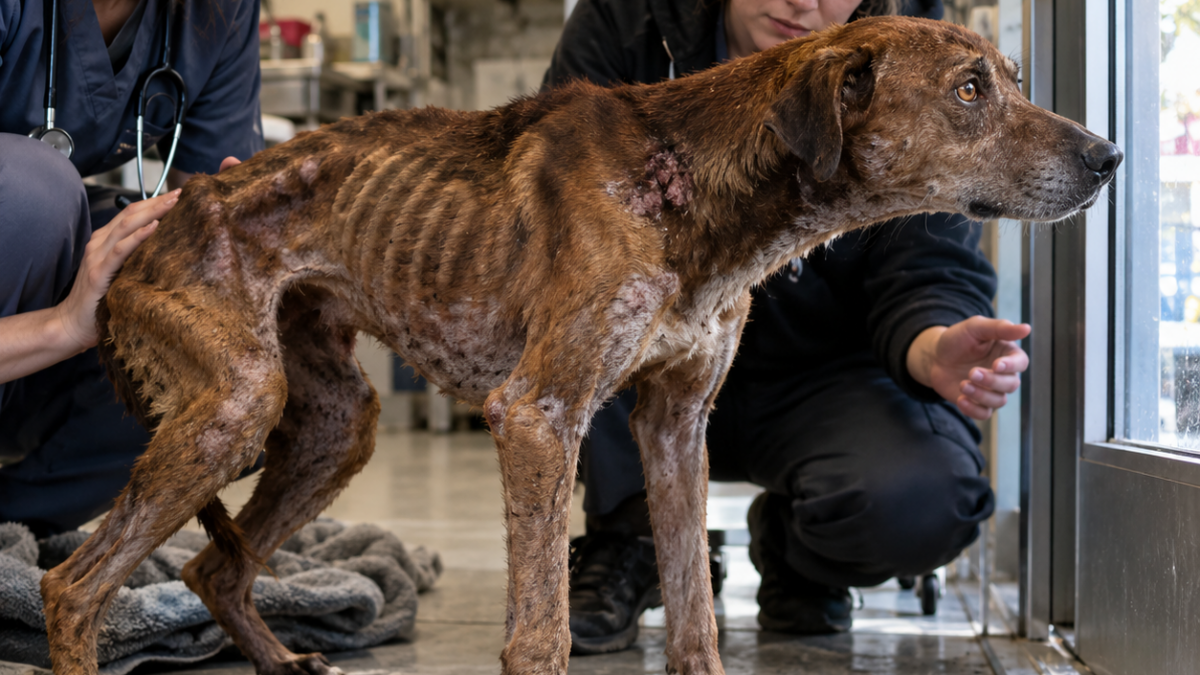
A Starving Dog Refused Food and Kept Dragging Himself Toward the Clinic Door—Then a Rescuer Returned to the Abandoned Warehouse and Heard Crying Beneath the Darkness.
The first thing that frightened me about the starving brown dog in the middle of our clinic was not his ribs, or his shaking legs, or the patches of missing fur along his ruined coat.
It was the fact that no matter how weak he was, he refused to lie down.
And when we finally understood why, every person in that room realized he had not been begging us to save him—he had been begging us to follow him back.
We found him near the old industrial district on the east side of town, where abandoned storage buildings sat between active warehouses, broken loading docks, rusted fences, and weeds tall enough to hide almost anything.
A warehouse worker named Chris called first.
He sounded uncertain, the way people do when they are afraid they may be wasting your time but cannot make themselves walk away.
“There’s a dog out here,” he said. “Brown one. Looks bad.”
“How bad?”
There was a pause.
“Bad enough that I don’t think he should still be standing.”
That sentence got me moving.
I had been with animal rescue for nine years, long enough to hear the difference between a person describing a stray and a person describing suffering. Chris was not being dramatic. His voice had the tightness of someone who had seen something that made the rest of his day impossible to continue normally.
I grabbed a slip lead, towels, a small bowl, bottled water, and a bag of soft food.
Jenna came with me.
She had been volunteering with us for only two years, but she had the kind of courage that made me nervous. She would crawl under porches, climb fences, wade through drainage ditches, and say things like, “I think I can reach him,” five seconds before doing something that made my blood pressure spike.
“Don’t become the second rescue,” I told her as we drove.
She smiled out the passenger window.
“That’s a hurtful lack of faith.”
“That’s experience.”
The sky was pale gray when we reached the industrial lot. Late afternoon light bounced off metal siding and puddles of old oil near the loading docks. The air smelled like rust, wet cardboard, engine exhaust, and something sour from a dumpster behind one of the buildings.
Chris stood near a cracked dock with his hard hat pushed back and both hands in his coat pockets.
He pointed without speaking.
At first, I did not see the dog.
Then the brown shape near the concrete moved.
My stomach sank.
He was standing with his head hanging so low his nose almost touched the ground. Brown coat, or what was left of it. Fur missing in patches along his back and hips. Ribs visible from several feet away. Hip bones sharp beneath skin that looked stretched over nothing. His legs trembled so badly I could see it before I reached him.
“Hey, sweetheart,” I said softly.
PART2:
I crouched and placed the bowl several feet away, then pushed food toward him.
A starving dog usually notices food.
Even frightened dogs notice food.
This dog lowered his nose, sniffed once, and looked behind me.
Not at Jenna.
Not at Chris.
At the buildings.
Then he took three unsteady steps toward them.
On the fourth, his front legs buckled.
I caught him beneath the chest.
“You’re done walking.”
He tried to pull away.
There was no strength behind it. No aggression. No teeth. No growl.
Only desperation.
His body was failing, but something behind those buildings mattered more to him than food, water, or the hands trying to keep him alive.
“We’re helping you,” I whispered.
He stared past me, toward the dark gaps between the storage units, until we closed the van door.
At the clinic, Rachel met us at the treatment entrance.
She had been a veterinary nurse for fifteen years, and very little shook her. She could handle wounds, seizures, frightened animals, angry owners, and the practical cruelty of hard medical choices with a steady calm that made everyone else better.
But when she saw the brown dog, her face changed.
“Oh, baby.”
We lifted him onto a padded mat.
He tried to stand immediately.
Rachel put one hand against his shoulder.
“Easy.”
His legs trembled beneath him.
PART3:
“Severely underweight,” she said, running her fingers carefully along his side. “Dehydrated. Skin infection. Probably anemic.”
I watched his head.
He was not watching us.
He was watching the door.
Rachel noticed too.
“Why won’t he lie down?”
“I don’t know.”
We offered water.
He drank a little.
We offered a tiny amount of food because a dog this malnourished could not be allowed to gorge. Refeeding too quickly can be dangerous, even deadly.
He sniffed the food.
Turned away.
Then dragged himself toward the door again.
Two steps.
Stop.
Look.
Two more.
Stop.
Look.
Rachel sat on the floor beside him.
“What are you waiting for, buddy?”
His ears twitched whenever someone entered the hallway.
Then his eyes returned to the clinic door.
That was when the thought hit me so hard I stood up.
“What if he isn’t waiting?”
Rachel looked up.
“What?”
“What if he’s trying to go back?”
She followed my gaze to the door.
I called Jenna.
She was still at the industrial lot talking to workers, asking if anyone had seen the dog before.
“Walk the route where people saw him.”
“Why?”
“I think he left something behind.”
Jenna went quiet.
Then said, “I’m going.”
Twenty minutes later, she called back.
Her breathing was fast.
“I’m behind the old storage building.”
“What do you see?”
“Tracks. I think dog tracks.”
My hand tightened around the phone.
Then I heard gravel shift.
Something scraped.
“Jenna?”
“Hold on.”
“Don’t crawl under anything alone.”
“I’m not crawling anywhere,” she whispered. “The opening’s too small.”
Behind me, the brown dog lifted his head.
For the first time since we brought him inside, his ears stood fully upright.
His whole body seemed focused on my phone.
Then Jenna gasped.
“There are two of them.”
My mouth went dry.
“Two what?”
“Dogs.”
I closed my eyes.
“How big?”
“Small. Maybe young adults. Or older puppies. I can’t tell.”
“Are they alive?”
“One moved when the light hit him.”
“And the other?”
A pause.
“Yes.”
Relief came first.
Then fear.
“Don’t pull them out if they’re trapped. I’m calling animal control and bringing equipment.”
“I think I can reach one.”
“Jenna.”
“I’m not going under there.”
“Good.”
“I’m just going to keep talking to them.”
I ended the call and looked at Rachel.
“Two dogs.”
She stared at the brown dog.
“That’s what he was going back for.”
Suddenly everything made sense.
The food he ignored.
The door.
The pacing.
The way he fought us when we carried him away.
He was almost too weak to stand, but whatever was beneath that building mattered to him more than his own hunger.
Rachel lowered herself beside him.
“You were trying to get back to them.”
His legs shook again.
She touched his shoulder.
“Okay. We understand now.”
I wish I could say dogs understand promises the way people do.
I do not know whether they do.
But I looked directly into his exhausted eyes anyway.
“We’re bringing them here.”
He kept staring at the door.
“Stay with us.”
Then I drove back to the industrial yard faster than I should have.
Animal control arrived a few minutes after me. Officer Marcus Bell stepped out of his truck with a flashlight, gloves, carriers, bolt cutters, and the expression of a man who had learned to expect the worst while still hoping to be wrong.
The old storage building had been unused for years. Its siding was rusted. Several windows were broken. Behind it were stacks of pallets, discarded metal shelving, torn insulation, and weeds high enough to hide suffering.
Jenna was kneeling beside a gap under the foundation.
“They’re right there.”
Marcus crouched beside her and shined his flashlight inside.
I knelt too.
Two faces reflected the beam.
The first dog was small and black with white paws.
The second was tan, with one ear folded against her head.
They were pressed tightly together in the dirt.
Neither barked.
Neither growled.
The black dog tried to retreat farther under the building, but he did not have enough energy.
“Easy,” Marcus said.
He studied the gap.
“We need to remove some of these boards.”
Chris helped us move the pallets. Behind them, we found a torn feed sack, an empty plastic water jug, and an old blanket stiff with dirt.
Jenna touched one corner of the blanket.
“They’ve been living here.”
“Maybe,” Marcus said.
I saw something tied to one corner.
Blue nylon rope.
Cut.
Marcus photographed everything before touching it.
“What are you thinking?” I asked.
“I’m thinking we don’t assume anything yet.”
I hated that answer.
Later, I would understand why investigators speak that way.
Anger wants a full story immediately.
Evidence gives it to you piece by piece.
What we knew in that moment was simple and terrible.
Three dogs were suffering.
We did not yet know how they got there.
Marcus widened the opening carefully. The tan female came out first, light enough that one rescuer lifted her with a towel. She shook so violently I could feel it through the fabric.
The black dog resisted weakly.
When Marcus reached for him, he flattened himself against the dirt.
“Don’t pull,” I said.
“I’m not.”
Marcus waited.
Then offered the back of his hand.
The dog sniffed.
One minute passed.
Then two.
Finally, Marcus slid a towel beneath him and eased him forward.
When I saw him completely, my chest tightened.
He was thin too.
Not as catastrophic as the brown dog back at the clinic, but badly underweight. His paws were irritated. One had a cut near the pad. The tan female had raw skin around her neck, like something had rubbed there too long.
We loaded them into separate carriers and drove straight back.
Rachel met us at the clinic entrance.
“The brown dog?”
“Still standing.”
“Seriously?”
“Mostly.”
We brought the carriers down the hallway.
The change in him was immediate.
His head snapped up.
His ears lifted.
His tail moved once.
The black dog whimpered inside his carrier.
The brown dog tried to walk.
Rachel supported him with both hands.
“Slow.”
We placed the carriers on the floor.
Opened the black dog’s first.
He remained inside.
The brown dog lowered himself as far as his weak legs allowed.
Then the black dog crawled forward.
Their noses touched.
The brown dog closed his eyes.
The black dog pressed his face beneath the larger dog’s chin.
A few seconds later, the tan dog came out.
She leaned against his side.
And that was the moment the brown dog finally stopped watching the door.
His knees folded.
Rachel caught him.
For one horrible second, I thought he was collapsing.
But he was not.
He curled himself around the two smaller dogs.
Then he sighed.
I still remember that sound.
Not pain.
Relief.
Rachel brought the food again.
This time, the brown dog smelled it.
Then he ate.
Three bites.
Stopped.
Then another.
Rachel smiled through tears.
“There you go.”
I sat beside them on the floor.
“You needed to know they were safe.”
He kept eating.
Only a little.
But enough to make every person in that treatment room feel as if something enormous had happened.
We named him Atlas.
It was Jenna’s idea.
“Because he looks like he’s been carrying the whole world.”
Nobody argued.
The black dog became Milo.
The tan female became June.
We did not know if Atlas was their father, their older companion, or simply the dog who had taken responsibility when no one else did.
There was no way to ask.
What we knew was that all three were bonded.
Atlas watched them constantly.
If Milo moved, Atlas lifted his head.
If June whimpered during an examination, Atlas tried to stand.
Eventually we positioned their kennels so Atlas could see both of them, because separating them made him anxious enough to interfere with treatment.
Their medical findings told us more.
All three were malnourished.
Atlas was by far the worst.
Severe muscle wasting. Dehydration. Anemia. Intestinal parasites. Significant skin infection. Overgrown nails. Several damaged teeth.
June had a circular abrasion around her neck consistent with prolonged pressure from something like a collar or rope.
Milo had scars along one back leg.
None of it proved exactly what had happened.
But it proved this had not been a few difficult days outside.
This had taken time.
Atlas’s recovery would be the hardest.
Dr. Karen Mitchell reviewed his bloodwork late that night.
“His albumin is extremely low.”
“What does that mean?”
“His body hasn’t had enough nutrition for a long time. We need to monitor his liver carefully.”
“Can he survive?”
She looked through the glass.
Atlas had his head resting near Milo’s carrier. June slept against the gate closest to him.
“He’s still standing after everything his body has been through.”
“That isn’t an answer.”
“No,” she said softly. “But I think he has a chance.”
I had learned to love that word.
Chance.
Not certainty.
Chance.
The first forty-eight hours were dangerous because of refeeding syndrome. A severely starved body can react badly when nutrition returns too quickly. So we fed Atlas carefully.
Tiny meals.
Measured amounts.
Electrolytes monitored.
Fluids adjusted.
No well-meaning bowl overflowing with food.
Healing required patience.
Atlas hated patience.
The first evening, he finished his small portion and stared at Rachel.
“That’s it,” she said.
He kept staring.
“I know.”
His eyes dropped to the empty bowl.
“You are not guilt-tripping me.”
He looked back at her.
She laughed.
“Don’t start.”
That was the first hint of the dog hiding beneath the suffering.
Meanwhile, we needed answers.
Chris told animal control he had seen the brown dog twice before.
“Did you feed him?” Marcus asked.
“I threw him part of my sandwich.”
“Did he eat it?”
Chris hesitated.
“No.”
That detail hit me hard.
“Where did he go?”
“Behind the storage building.”
Atlas had been doing the same thing before we found him.
Searching.
Returning.
Searching.
Returning.
Chris mentioned cameras at a packaging plant across the road, and from that point, the investigation became larger than us. That mattered.
Rescuers can preserve observations.
We can document.
We can report.
But we are not police.
And I did not want anger destroying whatever accountability might be possible.
The next morning, Atlas worsened.
His temperature dropped.
He vomited after one of the small meals.
His blood pressure became unstable.
Dr. Mitchell moved him into intensive monitoring.
June cried when staff rolled him out of sight.
Milo paced his kennel.
We moved them closer again.
Atlas lifted his head when he heard them.
That tiny reaction kept me hopeful.
I sat beside his enclosure that night.
“You did your job,” I whispered.
His eyes opened.
“Milo and June are safe.”
One ear moved.
“You don’t have to stand guard anymore.”
He closed his eyes.
“Now you get to be the weak one for a while.”
I do not know why that sentence affected me so much.
Maybe because there are people like that too.
People who have been holding everyone else together for so long they forget they are allowed to fall apart once they reach somewhere safe.
Atlas had survived for them.
Now we had to survive for him.
Day three brought no miracle.
Day four gave us one.
Atlas stood long enough to walk from one side of the treatment area to the other.
Maybe eight feet.
Rachel followed with a support sling.
Milo watched through the gate.
Atlas reached him.
Milo licked his nose.
Rachel whispered, “Okay. That was worth eight feet.”
Day five, Atlas ate every measured meal.
Day six, his bloodwork stabilized slightly.
Day seven, he wagged his tail when Jenna arrived.
Not for food.
For Jenna.
She cried immediately.
“I’m pretending that didn’t happen.”
“Too late,” I said. “We all saw it.”
“You saw nothing.”
“I saw everything.”
Milo improved faster.
June did too.
Within ten days, both had enough strength to bark at the vacuum, which Rachel considered excellent medical progress.
“Noise means strength,” she said.
The clinic became louder every day.
Then Marcus called me to his office.
I assumed they had identified someone.
He did not confirm that.
Instead, he placed several printed photographs on his desk.
Security-camera stills.
The first showed a white utility van entering the industrial area at 11:42 p.m. roughly three weeks before Atlas was found.
The second showed the same van turning behind the abandoned storage building.
The third showed it leaving seventeen minutes later.
“You can’t see the dogs,” I said.
“No.”
“Plate?”
“Partial.”
“Owner?”
“We have a probable match.”
My anger sharpened.
“Who?”
Marcus looked at me carefully.
“Before I give you anything, understand this investigation is ongoing.”
“Marcus.”
“I’m serious.”
“I’m not going to show up at someone’s house.”
He studied me.
“Good.”
The van belonged to a man named Roy Harlan.
I knew the name vaguely. He operated a small scrap and equipment business four miles away.
Marcus had found an old licensing record for a brown male dog matching Atlas’s description, registered to Roy’s business address.
“So Atlas belonged to him.”
“Possibly.”
“Marcus.”
“Possibly.”
He sounded like a broken machine, and I told him so.
“I sound like someone who wants evidence to survive court,” he replied.
That shut me up.
More evidence emerged slowly.
A former employee named Tyler Jennings contacted animal control after hearing investigators were asking questions about Roy. Tyler had worked at the scrap business until two months before the rescue.
He remembered Atlas.
But not as Atlas.
“His name was Duke,” Tyler said.
The name hurt me strangely.
Atlas had belonged somewhere.
He had known another name.
Tyler also recognized Milo.
We had accidentally chosen his real name.
The tan female had been called Pepper.
Three names.
Three histories.
Tyler explained that Roy kept Atlas—then Duke—as a yard dog. Milo arrived later. Pepper came after that.
“Were they fed?”
“At first.”
“What changed?”
“Roy started losing money.”
“Did he stop feeding them?”
Tyler shook his head. “I don’t know exactly what he did when I wasn’t there.”
That distinction mattered.
But Tyler had photographs.
Not because he was documenting neglect, but because he photographed equipment he repaired. In the background of three images was Atlas.
The first, five months earlier, showed a lean but normal brown dog near a forklift.
The second, three months later, showed clear weight loss.
The third, taken shortly before Tyler was fired, showed ribs.
Not as severe as the night we found him.
But unmistakable.
June appeared tethered near a fence.
Blue rope.
I felt physically sick.
Tyler remembered Roy saying that animal control would fine him if someone reported the dogs.
“What exactly did he say?” Marcus asked.
Tyler stared at the floor.
“That he needed the problem gone.”
The problem.
Three living animals had become a problem.
As Atlas grew stronger, that phrase stayed with me.
The problem.
He walked farther every day.
His skin treatment began working.
New fur started appearing.
He no longer needed to see Milo and June constantly, though if either barked in another room, his ears still lifted.
His sense of responsibility had not disappeared.
The sweetest moment came three weeks after rescue.
Atlas was resting on a thick blanket.
Actually resting.
Not pretending to relax while remaining alert.
June walked over, turned in a circle, and lay directly across his front legs.
Atlas opened one eye.
He looked at me as though deeply inconvenienced.
“You wanted them safe,” I said. “This is what safe looks like.”
He sighed.
June fell asleep.
Atlas did too.
Milo went to a foster home first.
He was medically stable enough.
June went to a different foster home because she needed extra skin treatment. We worried separating them from Atlas might cause distress.
Instead, Atlas seemed to understand something had changed.
When Milo left, Atlas watched the carrier, but he ate dinner.
When June left three days later, Atlas waited by the clinic door for ten minutes.
Then he walked back to his bed.
He was learning that departures could end safely.
That not every dog disappearing meant loss.
Atlas remained with us another two weeks.
By then he had gained nearly fourteen pounds.
Still thin.
But no longer skeletal.
His energy returned in strange bursts.
One morning, he stole Rachel’s glove.
She stared at him.
“You were dying three weeks ago.”
Atlas carried it away.
“Give that back.”
He moved faster.
Rachel looked at me.
“I have created a monster.”
“Congratulations.”
His foster family was a retired couple named Robert and Ellen Hayes.
They had a quiet home outside town, a large fenced yard, and no other animals initially. Ellen had nursed two neglected dogs through recovery before.
When Atlas entered their house, he walked room to room.
Kitchen.
Hallway.
Bedroom.
Back door.
Then he returned to the front.
“He’s mapping exits,” Ellen said softly.
I nodded.
Men made Atlas cautious, and Robert understood that immediately.
For four days, he barely approached him. He tossed treats, filled water bowls, sat nearby reading, and let Atlas decide the distance.
On day five, Atlas walked over and sniffed Robert’s shoulder.
Robert did not move.
On day seven, Atlas rested three feet from him.
On day ten, he placed his head on Robert’s knee.
Ellen took a picture.
Robert pretended he was not crying.
The message beneath the photograph read:
HE PICKED ME.
Those three words destroyed me.
Meanwhile, Roy’s attorney denied intentional abandonment.
First, Roy claimed the dogs had escaped.
Security footage made that difficult.
Then he said he had driven them to the industrial area because someone had agreed to take them.
Who?
A man named Carl.
Last name?
He did not know.
Phone number?
Lost it.
Address?
No.
No Carl ever appeared.
Then investigators recovered text messages through lawful process.
Three days before the van appeared on camera, Roy had written to his brother:
Need to get those dogs out before inspection.
His brother replied:
Take them to shelter.
Roy answered:
They’ll ask questions.
Another message:
I’ll handle it.
The morning after the van entered the industrial yard, Roy wrote:
Problem solved.
I stared at those words when Marcus eventually told me.
Problem solved.
Atlas had spent the next weeks starving while protecting Milo and June.
Roy believed the problem was solved.
He was wrong.
Because Atlas kept walking.
That became the central image in my mind.
A dog so thin he could barely stand leaving the only shelter the three had found, wandering through an industrial area looking for food or people, then returning to the two weaker dogs beneath the building.
Again.
And again.
Until somebody noticed.
Roy had abandoned them where he thought nobody would connect them to him.
Atlas unknowingly carried the truth back.
The arrest happened six weeks after the rescue.
Charges related to animal cruelty, neglect, and abandonment were filed according to evidence and local law.
I did not celebrate.
I did not drive past Roy’s business.
I did not post his photograph online.
That surprised some people.
A woman from another rescue asked me, “Don’t you want everyone to know?”
“I want the case to hold.”
“But he deserves to be exposed.”
“He deserves due process.”
She stared at me.
“You’re defending him?”
“No.”
I looked at a photograph on my phone of Atlas asleep beneath Ellen’s kitchen table.
“I’m protecting the outcome.”
Public fury burns hot and fast.
Evidence lasts longer.
Months later, the case reached court.
By then, Atlas was almost unrecognizable.
I was called as a witness about his condition when found and his behavior at the clinic.
Roy’s attorney was careful.
“You are emotionally attached to Atlas.”
“Yes.”
“You are angry with my client.”
“Yes.”
“So you have a personal interest in seeing him punished.”
“I have a personal interest in telling the truth about what I observed.”
He nodded.
“You did not see Mr. Harlan abandon these dogs.”
“No.”
“You did not personally see him withhold food.”
“No.”
“You cannot tell this jury exactly what Atlas ate during the weeks before you found him.”
“No.”
“You cannot even say with absolute certainty that Atlas was the dog previously called Duke.”
“We confirmed his microchip.”
The attorney paused.
That mattered.
Atlas’s old chip had eventually been detected once his physical condition allowed a thorough examination. It connected him directly to records associated with Roy’s business.
The attorney moved on.
“You changed his name.”
“Yes.”
“Why?”
“Because at the time we did not know his original name.”
“So some of the story surrounding this dog was created by rescuers.”
“No,” I said. “His name was created by rescuers. His medical condition was documented by veterinarians.”
He looked at me.
“You called him a protector.”
“Yes.”
“How do you know he was protecting the other dogs?”
“I don’t know what word Atlas would use.”
A few people smiled before the judge asked for quiet.
I continued.
“I know he repeatedly tried to return toward the location where Milo and June were found. I know he refused significant food until they arrived at the clinic. I know he relaxed when he saw them. The interpretation belongs to whoever hears those facts.”
The attorney stopped.
“No further questions.”
Dr. Mitchell testified about the medical evidence. She explained that Atlas’s condition was not produced by missing a few meals. His muscle wasting and laboratory abnormalities indicated prolonged nutritional deprivation and lack of adequate veterinary care.
The defense argued financial hardship.
Roy’s business had struggled.
That was true.
He had missed loan payments. Lost contracts. Owed taxes.
I could understand overwhelmed.
I could understand embarrassment.
I could even understand someone delaying veterinary treatment because money terrified them.
What I could not accept was what followed.
He had options.
Surrender.
Shelter.
Rescue.
Animal control.
Veterinary assistance.
A phone call.
A message.
He chose a van after dark.
The prosecution showed the security footage.
11:42 p.m.
White utility van entering.
Behind the storage building.
11:59 p.m.
White utility van leaving.
Then the gas-station image.
Then the messages.
Need to get those dogs out before inspection.
Take them to shelter.
They’ll ask questions.
I’ll handle it.
And finally:
Problem solved.
The courtroom became very quiet.
Roy testified.
That surprised me.
He said he loved Atlas.
He used the name Duke.
He said financial problems overwhelmed him. He admitted the dogs were thin. He admitted transporting them. But he claimed he believed someone would care for them in the industrial district.
The prosecutor stood.
“Who?”
Roy blinked.
“What?”
“Who did you believe would care for them?”
He looked toward his attorney.
“I thought there were workers around.”
“At midnight?”
“I knew businesses were there.”
“Did you tell any worker you were leaving three dogs?”
“No.”
“Did you leave food?”
“I left some.”
“Water?”
“There was a jug.”
“For three severely underweight dogs?”
Roy shifted.
“I thought someone would see them.”
“Then why place them behind the building rather than at the front entrance?”
Silence.
“You drove past an animal shelter on your way there, correct?”
The map confirmed it.
Less than two miles from the shelter.
“Did you stop?”
“No.”
“Did you call?”
“No.”
“Did you contact a rescue?”
“No.”
“Did you ask Tyler Jennings, who had previously bought food for Atlas, whether he would take him?”
“No.”
“Why not?”
Roy’s jaw tightened.
“I didn’t want trouble.”
There it was.
Not inability.
Avoidance.
He had been more afraid of questions than Atlas had been afraid of hunger.
The jury deliberated until late afternoon.
I sat in the hallway beside Jenna while she bounced one knee until the whole bench shook.
“Stop.”
“I can’t.”
“You’re shaking the bench.”
“I know.”
Marcus stood several feet away speaking quietly to another officer. Dr. Mitchell had already returned to the clinic.
Life continued.
That struck me as strange.
Cars moved outside. People bought coffee. Phones rang. Somewhere, Atlas was probably asleep in Ellen and Robert’s house without any idea that twelve strangers were deciding how society would describe what had happened to him.
Then the bailiff appeared.
We went back inside.
The first verdict was read.
Guilty.
Then another.
Guilty.
Not every allegation survived in its broadest form. Some charges had been narrowed. Real cases rarely end with every possible accusation confirmed.
But Roy was convicted of serious animal neglect and abandonment offenses.
I looked at him.
He did not look at me.
Jenna whispered, “He finally has to answer for it.”
I understood what she meant.
But I did not feel victorious.
Because Atlas still woke sometimes when a van door slammed.
June still disliked anything around her neck.
Milo still gulped food too quickly unless his meals were portioned carefully.
A verdict could identify wrongdoing.
It could not erase memory from their bodies.
At sentencing, the judge imposed penalties permitted by law, including restrictions on animal ownership, supervision requirements, fines, and restitution connected to veterinary care.
Then the judge spoke directly to Roy.
“Financial hardship may explain why obtaining care was difficult. It does not explain why you avoided the people whose job was to help because you feared being questioned.”
I remember that sentence.
Accountability as the danger.
That was exactly what had happened.
When I walked out of the courthouse that afternoon, I realized the strongest revenge Atlas could ever have was already happening somewhere else.
He was alive.
Roy had driven him into darkness assuming that would end the problem.
Atlas had walked back into the world.
He had led us to Milo and June.
His survival became evidence.
His weakness exposed what Roy tried to hide.
And every pound Atlas gained afterward proved that the ending Roy left for him had failed.
Several weeks later, Ellen called me.
“I need you to come over.”
My stomach immediately tightened.
“What happened?”
“Nothing bad.”
“That sentence never makes me relax.”
“Just come.”
When I arrived, Robert was sitting in the backyard.
Atlas stood beside him.
Actually, stood was no longer the right word.
He strutted.
His coat had grown thick and dark brown. His chest had filled out. His hips no longer looked sharp. He wore a red harness.
Robert tossed a tennis ball.
Atlas chased it.
Not quickly enough to win races.
But quickly enough to make me laugh.
He picked it up.
Then ran away from Robert instead of bringing it back.
“You call this fetch?” I asked.
Robert shrugged.
“He understands the first half.”
Ellen handed me a folder.
I opened it.
Adoption paperwork.
I looked at her.
“You’re keeping him.”
Robert called from the yard, “She’s keeping him. I’ve been trying to return him for weeks.”
Atlas walked over and leaned against Robert’s leg.
Robert immediately rubbed his ears.
“Very convincing,” I said.
Ellen laughed.
“We’re serious.”
“You know about the medical follow-ups.”
“Yes.”
“Skin flare-ups.”
“Yes.”
“Food issues.”
“Yes.”
“He may always be anxious in certain situations.”
“We know.”
I looked at Atlas.
He had dropped the tennis ball at Robert’s feet.
Robert picked it up.
Atlas wagged.
“What made you decide?”
Ellen stared at me as if the question was ridiculous.
“He decided.”
“How?”
“The first night he slept through until morning. He woke up, walked into our room, and put his head on the bed.”
She smiled.
“That was it.”
I signed the rescue portion of the paperwork with shaking hands.
Atlas Hayes.
Permanent address.
Home.
That word mattered.
Milo’s foster family adopted him a month later.
Their ten-year-old daughter, Abby, refused to discuss any alternative.
“He’s my brother,” she said.
Her father tried correcting her.
“He’s technically the dog.”
Abby stared at him.
“He’s my brother.”
Negotiations ended.
June took longer.
Her foster mother loved her deeply but already had two older dogs with medical needs. So we searched carefully.
The right family eventually appeared.
A woman named Leah and her adult daughter Sophie lived in a quiet house with a fenced yard and no other animals. They visited June four times before adoption.
The first visit, June stayed behind her foster mother.
The second, she accepted a treat.
The third, she followed Sophie across the yard.
The fourth, she fell asleep with her head against Leah’s foot.
That decided it.
Months after the court case ended, all three were home.
Different houses.
Different families.
Different lives.
But we arranged reunions.
The first happened at a fenced rescue property.
Atlas arrived with Robert and Ellen.
Milo came next.
Atlas saw him from across the yard.
His ears lifted.
Milo froze.
Then both ran.
Milo hit Atlas hard enough to almost knock him over. Atlas barked. Milo spun in circles.
Then June entered.
She stood near Leah for several seconds.
Atlas saw her.
He stopped.
June’s tail began moving.
Slowly at first.
Then faster.
She ran.
The three dogs collided in a ridiculous pile of legs and tails.
I cried immediately.
Jenna cried too.
Marcus had come because I bullied him into taking an afternoon off.
He folded his arms.
“Everyone here is embarrassing.”
“You’re crying,” I said.
“I have allergies.”
“There are no plants near you.”
“Industrial allergies.”
We laughed.
Atlas chased Milo.
June chased Atlas.
Then all three collapsed beneath a tree.
For several minutes, they simply lay together.
No pallets.
No darkness.
No empty feed sack.
No one trying to disappear them.
I thought about the first night Atlas curled around them on the clinic floor.
He had refused to rest until he knew they were safe.
Now he could sleep beside them beneath an open sky.
Years passed.
Atlas discovered camping.
Robert bought an old travel trailer and took him to a state park beside a lake.
Ellen sent me a picture of Atlas sitting twenty feet from the water.
Caption:
HE HATES WATER.
I replied:
SMART DOG.
Next picture:
Robert standing knee-deep in the lake calling Atlas.
Atlas still sitting twenty feet away.
Caption:
HE ALSO HATES ROBERT’S IDEAS.
Another picture:
Atlas asleep in Robert’s camping chair.
Caption:
HE HAS SEIZED MANAGEMENT.
Milo became inseparable from Abby.
He attended soccer practices, waited by the window for the school bus, and slept outside her bedroom. One evening, Abby came home crying after an argument with a friend. Milo brought her his favorite stuffed rabbit, placed it in her lap, and climbed beside her.
The dog Atlas once guarded beneath an abandoned warehouse had become somebody else’s protector.
June became the quietest of the three.
She loved sunbeams. Sophie worked from home and placed a bed beside her desk. June spent hours there.
Eventually, a harness no longer frightened her.
Then one day Leah sent a photograph of June wearing a loose blue collar.
I called immediately.
“She let you put that on?”
“We’ve been practicing for months.”
“How did she react?”
“She looked offended.”
“That’s excellent.”
“She demanded chicken.”
“Even better.”
These were the victories no courtroom could produce.
The law could punish abandonment.
Only patience could teach June that something touching her neck did not always mean restraint.
Only repetition could teach Milo that meals would return tomorrow.
Only months of safety could convince Atlas he no longer needed to watch every exit.
Nearly a year after the rescue, I visited Atlas while carrying groceries for Ellen.
Robert opened the door.
“Don’t say his name.”
“Why?”
“He’s asleep.”
“So?”
“Look.”
Atlas was sprawled in the center of the living room.
On his side.
Legs stretched out.
Belly exposed.
Completely unconscious.
I stopped.
Robert whispered, “He does that now.”
I remembered the clinic.
The trembling legs.
The refusal to lie down.
The constant pull toward the door.
Now I was looking at a dog sleeping so deeply that my arrival had not even made his ears move.
“He feels safe.”
Robert nodded.
“Finally.”
I sat on the floor beside him.
Atlas woke after a minute, blinked, then rolled partly onto his back.
I rubbed his chest.
“You know how much trouble you caused?”
His tail thumped.
“You could’ve just eaten the food.”
Another thump.
“But no. You had to make us search an entire warehouse.”
Atlas yawned.
Robert laughed.
“I don’t think he regrets it.”
Neither did I.
The thing people remembered most about Atlas’s story was his refusal to eat.
They assumed it was because he was too sick.
Partly, it probably was.
But the moment Milo and June arrived and he finally settled changed how all of us understood his behavior.
He had been trying to return.
Whether he believed he was searching for food, searching for help, or simply unable to leave his companions behind, nobody can know with scientific certainty.
I do not need to romanticize him beyond what happened.
The facts are powerful enough.
A severely malnourished dog was repeatedly seen away from a hiding place containing two other malnourished dogs.
He repeatedly returned toward that location.
At the clinic, he remained restless and refused most food.
When the other two dogs arrived, he relaxed and began eating.
Call that loyalty.
Bonding.
Instinct.
Protection.
Whatever word you choose, I know what it looked like.
It looked like a dog whose own body was failing still refusing to forget two others.
That changed me.
About eighteen months after the rescue, I received a letter forwarded through official channels.
Roy had written it.
I almost threw it away unopened.
Then I read it.
The first paragraph was defensive.
He explained the business failure again.
The bills.
The pressure.
His embarrassment.
I nearly stopped there.
Then came a sentence that made me continue.
“I convinced myself that leaving them near businesses meant I wasn’t really abandoning them.”
I sat at my kitchen table.
The letter continued.
“I told myself somebody would take them, and I used that thought so I wouldn’t have to admit I was afraid of what people would say if they saw how bad they had become.”
That was closer to truth.
Not enough to erase anything.
But closer.
Then he wrote about Atlas.
He called him Duke.
He wrote about learning that Atlas had returned repeatedly to Milo and June.
“I left them because I didn’t want responsibility anymore. The dog I thought was weakest took more responsibility for the other two than I did.”
I stopped.
Read that sentence again.
There was nothing I could add.
Roy ended without asking forgiveness.
He said he understood if nobody wanted to hear from him again.
I never responded.
Some apologies matter because they show recognition.
They do not create obligation on the injured side.
Atlas owed him nothing.
Milo owed him nothing.
June owed him nothing.
Neither did I.
I placed the letter in a drawer.
Then I drove to Ellen’s house.
Atlas met me at the gate carrying a tennis ball.
“Your former owner wrote me,” I said.
Atlas dropped the ball.
I threw it.
He chased it.
That was his response.
Probably the correct one.
The past had already taken enough from him.
Two years after the rescue, the old industrial storage building was demolished.
Jenna and I went to watch.
Not because we were sentimental about the place, but because one of the property owners had invited our rescue group before redevelopment began. They wanted to put a small donation box and plaque near the new warehouse office supporting local animal welfare.
The plaque did not tell the whole story.
Just:
IN HONOR OF THREE DOGS FOUND HERE AND THE PEOPLE WHO CHOSE NOT TO WALK PAST.
I liked that.
No graphic photographs.
No sensational language.
Just a reminder.
When the final wall came down, I expected sadness.
Instead, I felt release.
That dark little space had been terrible.
But it had also been the only shelter Atlas managed to find for them.
A place where three abandoned animals survived long enough to be discovered.
Now Milo did not need it.
June did not need it.
Atlas certainly did not.
They had houses now.
Beds.
Families.
Full bowls.
Veterinary records filled with ordinary checkups instead of emergency notes.
One winter, Robert sent me a photograph after a snowstorm.
Atlas stood in the yard wearing a ridiculous insulated coat.
I called.
“He hates that.”
“He loves it.”
“His face says he is considering legal action.”
Robert laughed.
“He refused to come inside.”
“What was he doing?”
“Watching the back gate.”
Something inside me tightened.
“Still?”
“Not the way he used to,” Robert said. “He watches for squirrels now.”
I laughed.
That sounded better.
Atlas had transformed vigilance into curiosity.
The gate was no longer where someone disappeared.
It was where squirrels committed crimes.
Time continued.
Abby grew older.
Milo’s muzzle began to gray.
June became brave enough to accompany Sophie to outdoor cafés.
Atlas slowed slightly but remained healthy considering how badly starvation had damaged his body. His veterinarians monitored his liver and general condition. Some consequences of prolonged neglect can last.
Healing is not magic.
But his life was good.
Really good.
One summer evening, Ellen invited all three families to her house.
It became an unofficial reunion.
Milo arrived first and immediately stole one of Atlas’s toys.
Atlas chased him.
June watched from beside Leah.
Then joined.
Three formerly starving dogs ran around a backyard while seven adults shouted useless instructions.
“Atlas!”
“Milo!”
“June, don’t eat that!”
“Whose hot dog is missing?”
“Robert?”
“Why is this automatically my fault?”
Because dogs understand opportunity better than obedience.
Eventually, everyone settled near a fire pit.
Atlas lay beneath my chair.
Milo beside Abby.
June with Sophie.
I looked around.
“These dogs were once under a warehouse,” I said.
Nobody spoke for a moment.
Abby, now thirteen, stroked Milo’s ears.
“I know,” she said. “I just can’t picture him there.”
That struck me.
Good.
Maybe that was exactly what we wanted.
For the life after rescue to become so large that suffering felt impossible to reconcile with who they had become.
Not forgotten.
Just no longer dominant.
Roy once reduced them to a problem.
Now Atlas belonged to Robert and Ellen’s camping trips.
Milo belonged to Abby’s childhood.
June belonged to Sophie’s workdays and Leah’s morning walks.
They occupied calendars.
Beds.
Family photographs.
Vacation plans.
Veterinary budgets.
Christmas cards.
They mattered.
That became the final answer to abandonment.
You tried to make them disappear.
They became impossible to imagine gone.
The last time all three dogs were together, Atlas was too old to run much.
Milo tried anyway.
June wandered around sniffing the yard.
Atlas lay beneath the same tree where they had once reunited years earlier. Milo eventually came over and dropped beside him. June followed.
The three lay together.
Almost exactly as they had on the clinic floor.
Except everything else was different.
Their bodies were healthy.
Their coats full.
Their tags carried family addresses.
Food waited inside.
People were talking nearby.
Nobody was watching the gate.
I sat a few feet away with Jenna.
Neither of us spoke for a while.
Then she said, “He finally got what he wanted.”
“What?”
She nodded toward Atlas.
“They’re all safe.”
I looked at the three dogs.
Atlas’s eyes were closed.
Milo rested against his back.
June had her head across his paws.
Maybe Jenna was right.
Maybe that was the ending Atlas had been trying to reach from the first moment we found him.
Not justice.
Not punishment.
Not even rescue.
Just this.
Everybody safe enough to sleep.
That night, when Robert called the dogs inside, Milo and June left with their families.
Atlas remained under the tree for a moment.
He watched them go.
Years earlier, seeing them disappear through a door would have made him frantic.
This time, he simply rested his head back on the grass.
He knew.
Milo was going home.
June was going home.
And when Robert opened his own door and said, “Come on, old man,” Atlas slowly stood and went home too.
That is the picture I carry now.
Not the skeletal dog in the clinic.
Not Roy in court.
Not the abandoned warehouse.
Not the blue rope.
An old brown dog walking through the doorway of the house where he belonged.
He did not look back.
He did not need to.
For most of his suffering, Atlas had been looking backward because someone weaker was behind him.
When we first carried him away, he fought us because leaving meant leaving Milo and June.
At the clinic, he refused to rest because he did not know where they were.
Then the carriers arrived.
The doors opened.
Their noses touched.
Atlas ate.
Atlas slept.
And from that moment forward, the responsibility slowly became ours instead of his.
We fed him.
We treated him.
Investigators followed the evidence.
A jury heard what happened.
Roy faced consequences.
Families opened their homes.
Years passed.
The frightened dogs became spoiled dogs.
The spoiled dogs became old dogs.
And life did what good rescue stories rarely show enough of.
It became ordinary.
Breakfast.
Walks.
Vet appointments.
Road trips.
Homework.
Camping chairs.
Christmas photographs.
Stolen food.
Gray muzzles.
Soft beds.
That ordinary life was the victory.
Roy had once called them a problem.
But the problem he believed he had solved never disappeared.
Atlas survived.
Milo survived.
June survived.
And because they survived, the truth survived with them.
The van on camera.
The photographs.
The messages.
The witnesses.
The medical records.
All of it came together because one starving dog refused to vanish where he had been left.
But I still do not think Atlas’s greatest act was helping expose Roy.
His greatest act happened before any of us knew his name.
When his body had almost nothing left.
When every step must have hurt.
When food should have been the only thing in the world that mattered.
He walked away from shelter.
He searched.
And then he went back.
Because two smaller dogs were still underneath that building.
That is why whenever I remember the first question Rachel asked—
“Why won’t he lie down?”
—I know the answer now.
He was not ready.
Not while Milo and June were missing.
Not while he thought they were still waiting.
But once those carriers came through the clinic door, once he touched noses with them and understood somebody else had finally taken over, Atlas did something he had been unable to do since we found him.
He stopped watching the exit.
He ate.
He curled around them.
And he slept.
Years later, he still sleeps that way.
Deeply.
Completely.
Safely.
Because the dog who once believed he had to keep everyone alive finally learned there were people willing to keep him safe too.
And after everything Atlas carried for two smaller dogs beneath that dark building, that was the ending he deserved most.








