A Starving Doberman Fought Everyone Who Tried to Take His Torn Blanket—Then We Saw a Tiny Paw Move Beneath It
# A Starving Doberman Fought Everyone Who Tried to Take His Torn Blanket—Then We Saw a Tiny Paw Move Beneath It
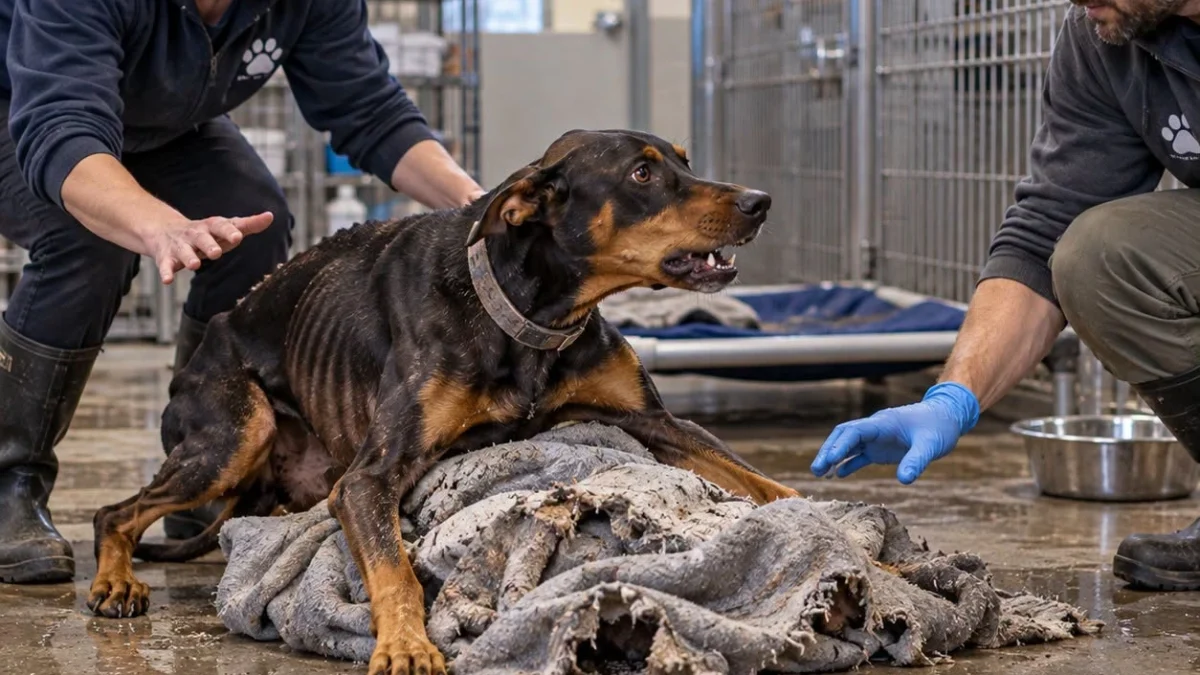
The starving Doberman had almost nothing left—not strength, not warmth, not even enough food in his body to stand without shaking—but he was prepared to fight anyone who tried to take the filthy gray blanket beneath his chest.
For nearly an hour, I thought I was dealing with a frightened abandoned dog guarding the last possession he had left in the world, until the blanket moved in a place his paws had never touched.
Then our veterinarian whispered, “Nobody touch that blanket,” and a pale orange paw smaller than my thumb slipped out from beneath the folds.
I first saw him at 6:18 on a freezing November morning behind a shuttered garden center in south Minneapolis.
The call came from a bakery delivery driver named Thomas Keene.
He had pulled behind the building because the loading lane near the front entrance was blocked by a snowplow.
The garden center had closed for the season almost two weeks earlier.
Its outdoor racks were empty.
The hanging baskets were gone.
The rows of plants that had filled the parking lot all summer had been replaced by shopping carts chained together beneath plastic covers and stacks of wooden pallets darkened by freezing rain.
Thomas noticed the dog because at first he thought someone had left a black trash bag beneath the loading awning.
Then the bag lifted its head.
He called us at 5:51.
“Big dog,” he told dispatch.
“Black. Maybe Doberman.”
“Is he aggressive?”
“I don’t know.”
“Can you approach him?”
“I tried.”
“What happened?”
“He looked at me.”
That was an unusual answer.
“He looked at you?”
“Yeah.”
“Growled?”
“No.”
“Barked?”
“No.”
“Did he move?”
“Barely.”
Thomas paused.
“He’s laying on something.”
“What?”
“Blanket, I think.”
Then:
“I gave him some breakfast sandwich.”
“Did he eat?”
“A little.”
“But he won’t leave the blanket.”
I had worked animal control for eleven years.
Long enough to stop imagining every call would have a clean explanation.
Dogs ended up outside for hundreds of reasons.
Some got loose.
Some were abandoned.
Some were stolen and dumped.
Some escaped bad homes.
Some belonged to good people and got lost during one terrible moment.
Sometimes we found the owner before lunch.
Sometimes we never learned a single thing about where the animal came from.
I arrived with those possibilities in my head.
Then I saw him.
He was under the far edge of the loading awning.
Rainwater dripped through a broken seam in the metal roof.
Freezing sleet ticked against overturned carts.
The pavement around him was dark with moisture.
He had positioned himself where the concrete met the wall, as far beneath the awning as he could go without disappearing behind a stack of pallets.
Black-and-rust Doberman.
Male.
Large frame.
Terribly thin.
His coat was so soaked that it clung to every rib.
His hips looked sharp.
A narrow waist that should have looked athletic instead looked hollow.
One ear folded slightly at the tip.
A thin white scar crossed the bridge of his nose.
Around his neck was a faded red nylon collar.
No tag.
No leash.
No visible identification.
And beneath him was a gray blanket.
Not a nice blanket.
It looked like something pulled from a dumpster.
One edge was torn.
The fabric had gone dark from water.
Mud stained the corners.
Leaves and dirt clung to it.
The Doberman’s front half was lying across the center.
His head rested between his paws.
His eyes tracked my vehicle before I even opened the door.
That was what stopped me.
He was weak.
But alert.
Not wandering.
Not disoriented.
Not looking for escape.
He was holding his ground.
I stepped out carefully.
No slamming doors.
No quick movement.
I turned my body slightly sideways as I approached.
Dogs read direct frontal movement differently.
Especially frightened dogs.
I stopped about twelve feet away.
“Hey, handsome.”
His eyes lifted.
“I’m not here to hurt you.”
No growl.
No teeth.
He watched my hands.
I crouched.
The freezing rain hit the back of my coat.
“You’ve had a bad night, huh?”
Nothing.
I pulled a small tray of warmed wet food from the insulated bag we kept in the truck.
Placed it on the pavement.
Pushed it toward him with a catch pole—not using the loop, only the shaft so I could move the tray without closing distance.
The smell caught him instantly.
His nostrils flared.
He lifted his head.
For one hopeful moment, hunger seemed stronger than fear.
He stretched his neck forward.
Took one mouthful.
Swallowed too fast.
Then immediately pulled himself backward and laid his chest across the gray blanket again.
I frowned.
Most starving dogs will choose food.
Even frightened ones.
Maybe they eat in short bursts.
Maybe they snatch it and retreat.
But this dog was acting as if taking three steps away from that blanket was impossible.
I pushed the food closer.
He ate again.
Then put a trembling foreleg across the fabric.
Not accidentally.
Deliberately.
Like a hand over a locked box.
“Okay.”
I sat back on my heels.
“That matters.”
Thomas was standing thirty feet away near his delivery van.
“Is he hurt?”
“Almost certainly.”
“You think somebody dumped him?”
“Maybe.”
“He didn’t even want my sandwich.”
“He wanted it.”
I watched the dog.
“He just wants that more.”
At 6:31, my partner Marcus arrived.
He brought portable barriers, blankets, a second food tray, and the heated animal-control vehicle.
Marcus had worked with me for six years.
Good with nervous dogs.
Patient.
Quiet.
Exactly the kind of person you want when an animal is deciding whether humans are safe.
He came around the far side of the awning.
The Doberman changed immediately.
One second he was lying down.
The next, he was trying to stand.
His back legs shook violently.
His nails scraped on wet concrete.
For a second I thought he would collapse.
He did not.
He turned sideways.
Placed his entire body between Marcus and the blanket.
Then growled.
Low.
Deep.
Not lunging.
Not bluffing.
A warning.
Marcus stopped.
Hands up.
“Okay, buddy.”
The dog’s head lowered.
His legs kept shaking.
Marcus looked at me.
“Resource guarding?”
“Maybe.”
He studied the blanket.
“Food under it?”
“I don’t know.”
“Bone?”
“Could be.”
But it did not feel like ordinary resource guarding.
I had seen dogs protect toys.
Bowls.
Trash.
Dead animals.
Objects with familiar scents.
A starving dog that has lost everything can attach enormous value to one possession.
But there was something about the Doberman’s posture.
He was not guarding the blanket like he wanted it.
He was guarding it like he was afraid of us.
Not afraid we would take the fabric.
Afraid of what would happen if we did.
We tried food.
Distance.
Gentle pressure from barriers.
No rushing.
No catch pole around the neck.
The temperature was falling.
Ice was forming along the edges of the lot.
We had to get him into warmth.
But forcing a terrified seventy-pound dog that could still bite was not good for him or us.
We moved slowly.
Eventually I shifted one corner of the blanket with the end of a soft barrier panel.
The Doberman snapped his head around.
No bite.
No lunge.
But complete attention.
Then he grabbed the corner of the blanket with his teeth.
That surprised me.
He pulled.
Weakly at first.
Then harder.
The entire soaked bundle dragged several inches.
Marcus looked at me.
“He wants it with him.”
“Then it comes.”
We opened the heated vehicle.
Moved the food inside.
Put one barrier along each side to create a guided path.
The Doberman stared.
He would not move.
I picked up the loose end of the blanket without pulling it away from him.
He grabbed it immediately.
I stepped backward toward the truck.
He dragged the blanket.
One step.
Stop.
Breathe.
Another.
His legs almost gave out.
He still pulled.
I had never seen anything like it.
A starving dog refusing to enter warmth unless the filthy wet thing beneath him entered too.
Eventually he climbed the ramp.
Blanket between his teeth.
He turned once inside.
Dropped the fabric.
Then collapsed over it.
Not beside it.
Over it.
Marcus closed the doors.
Thomas exhaled behind us.
“Think he’s going to make it?”
I looked through the window.
The Doberman was staring at us.
“I hope so.”
I did not yet know there was another life inside that answer.
We reached the shelter shortly after seven.
The veterinary wing was already awake.
Our technician Hannah helped us prepare a warm intake room.
Low traffic.
Soft lights.
Clean water.
Padded bed.
Fresh blankets.
We opened the transport crate.
The Doberman did not come out.
Hannah placed food near the door.
He ate.
Slowly this time.
Then looked down at the gray blanket.
I moved it toward the threshold.
Only then did he follow.
He gripped the corner and pulled the entire bundle into the room himself.
No one touched it.
He carried it to the far corner.
Circled twice.
Lowered himself on top.
Hannah whispered:
“That’s his whole world.”
“Looks like it.”
She reached toward one exposed edge.
His head snapped up.
One bark exploded through the room.
Sharp.
Instant.
Hannah stepped back before I could say anything.
“Sorry.”
The dog did not pursue.
He simply stared.
“Don’t take it,” I said.
“I wasn’t going to.”
“I know.”
I lowered myself onto the floor several feet away.
“We’ll work around it.”
That was when Dr. Elena Shaw entered.
Elena had been our veterinarian for almost seven years.
She had the kind of calm people mistake for emotional distance until something terrible happens and they realize calm is exactly what they need.
I had seen her treat dogs hit by cars.
Cats pulled from fires.
Animals so neglected that technicians cried after leaving the room.
Elena rarely looked shaken.
She came through the doorway holding a clipboard.
Stopped.
Looked at the Doberman.
Then at the blanket.
Her expression changed.
Small.
But enough that I noticed.
“What?”
She did not answer.
She crouched.
The dog watched.
Elena stayed far enough back not to trigger him.
“Look at the center.”
I followed her gaze.
Gray folds.
Wet fabric.
The Doberman’s chest.
Nothing.
“What am I looking at?”
“Wait.”
For several seconds, nothing happened.
Then the blanket moved.
I almost dismissed it.
The dog’s breathing lifted the fabric.
Of course it moved.
Then it happened again.
Different spot.
Deeper inside the bundle.
Not synchronized with his chest.
Not near his paws.
A tiny pulse beneath the folds.
My body went cold.
“Elena.”
“I saw it.”
Hannah stepped closer.
“What?”
Elena raised a hand.
“Nobody touch that blanket yet.”
She looked at Marcus.
“Close the door.”
He did.
“Hannah, dim the overhead lights.”
The room softened.
The Doberman watched every movement.
His eyes were exhausted.
He refused to close them.
Elena slowly sat on the floor.
“Do you think something is alive under there?” I asked.
She watched the dog’s abdomen.
Fast shallow breathing.
His muscles tightened.
Then another tiny movement.
The Doberman saw it too.
His head dropped.
He pressed his muzzle against the exact spot.
And for the first time that morning, he made a sound that was not a warning.
A whimper.
Soft.
Almost inaudible.
Elena whispered:
“Oh, sweetheart.”
Then:
“Hannah, warming board. Thermal blanket.”
Hannah moved carefully.
Marcus stood near the door.
I stayed low.
Nobody crowded.
Elena placed the equipment several feet away.
“We are not pulling anything out from underneath him until we know what we’re dealing with.”
I nodded.
The dog looked at her hand.
Elena moved it an inch closer.
He lifted his head.
She stopped.
“You’re okay.”
No movement.
“We’re going to help.”
His eyes moved from her face to her fingers.
Back again.
This was not trust.
Not yet.
It was calculation.
He had almost no strength left.
He knew it.
We knew it.
If he decided to fight, he might hurt someone.
He might also collapse before the fight ended.
Still, he was prepared.
That broke my heart.
I held out a small piece of chicken.
“Come on, buddy.”
He sniffed.
Did not take it.
“Just a little trust.”
Elena eased the rigid warming board beneath an outer layer of fabric.
Not under the dog.
Under the soaked bundle.
He stiffened.
Growled.
Then something pressed against his belly.
His head dropped instantly.
He began licking the gray fabric.
Elena froze.
The blanket opened maybe an inch.
That was all.
Then I saw it.
A paw.
Pale orange.
Smaller than my thumb.
It trembled once against the Doberman’s chest.
Hannah covered her mouth.
Marcus whispered:
“Oh, God.”
For several seconds, nobody moved.
“A kitten.”
Elena said it first.
My eyes filled immediately.
A kitten.
Beneath a starving Doberman.
On a frozen loading dock.
Wrapped in a blanket he had dragged into our vehicle.
“Is it alive?”
“That paw moved.”
Elena shifted slightly.
“We need to assess her.”
Her.
We did not know that yet.
But somehow all of us were already thinking of the tiny creature as a little girl.
The Doberman lowered his nose.
Sniffed the paw.
Then used his chin to push the fold back over it.
Not aggressive.
Protective.
I had spent the entire morning thinking the blanket was his treasure.
Now I understood.
The blanket did not matter.
What was inside it did.
Elena glanced at me.
“Keep him focused on you.”
I moved closer.
Slow.
The smell hit me.
Wet fur.
Cold pavement.
Salt.
Old fabric.
Then another scent.
Faint.
Milk.
My stomach tightened.
“Elena.”
“I know.”
She lifted another fold.
A tiny orange face appeared.
Eyes closed.
Ears flat.
Fur wet and clumped.
Mouth open.
No sound came out.
That scared me more than a cry would have.
A healthy kitten complains.
This one did not have enough energy.
Elena’s voice changed.
“Warm carrier now.”
Hannah moved.
Elena did not pull the kitten abruptly.
She supported the fabric beneath her body.
Eased her toward the warmed towel.
The Doberman watched every inch.
When the kitten was finally lifted free, he tried to stand.
His legs failed.
He hit the floor on one foreleg.
Made a desperate sound.
I put my hand near his shoulder without restraining him.
“Easy.”
He tried again.
“We’re not taking your baby.”
The words came out before I could stop them.
Your baby.
A male Doberman.
Orange kitten.
Different species.
No biological relationship.
It did not matter.
That was what his body was saying.
Elena placed the kitten on the warmed surface.
Weak breathing.
Dangerously low temperature.
Dehydrated.
No obvious trauma.
Maybe one or two weeks old.
Tiny enough to fit in Elena’s palm.
Hannah whispered:
“Girl?”
Elena checked.
“Looks like it.”
The Doberman forced himself up.
One step.
Then another.
His claws scraped the tile.
I steadied his chest.
This time, he let me.
That was the first moment he accepted a human hand.
Not because he trusted me.
Because the kitten mattered more than his fear.
Elena turned the warmed carrier so he could see.
“Here she is.”
The kitten moved one foreleg.
The Doberman’s entire body changed.
His back loosened.
His head dropped.
He pressed his nose against the clear side of the carrier.
Then lay down beside it.
And closed his eyes.
One second.
Maybe two.
The first time he had allowed himself to stop watching.
That image would stay with me longer than anything else.
Not the bark.
Not the starving ribs.
Not the kitten’s paw.
The moment he saw she was safe enough that he could sleep.
We named him Ranger.
Hannah did it accidentally.
She was filling out the intake sheet.
Temporary designation still blank.
She looked through the glass at him lying beside the carrier.
“He’s guarding that kitten like a ranger guarding a whole forest.”
Marcus said:
“Ranger.”
The Doberman lifted his head.
Could have been coincidence.
We wrote Ranger anyway.
The kitten stayed unnamed for several days.
Elena did not want us emotionally sprinting ahead of medicine.
Her temperature was dangerously low.
We warmed slowly.
Gave fluids carefully.
Followed neonatal feeding protocol.
Monitored continuously.
With severely chilled animals, enthusiasm can kill.
You do not simply pour food into a cold body because it looks hungry.
Everything has an order.
Warm.
Stabilize.
Then feed.
Ranger had his own list of problems.
Severe malnutrition.
Dehydration.
Paw abrasions.
Salt irritation.
Physical stress.
His bloodwork looked bad but not hopeless.
No microchip.
No tag.
No identification.
The red collar had worn the fur thin.
That bothered me.
Somebody had once put it on him.
Somebody had known him.
Somebody had seen that folded ear.
That white scar.
Maybe loved him.
Maybe failed him.
Maybe died.
Maybe lost him.
Maybe abandoned him.
We did not know.
We searched lost-dog reports.
Shelter databases.
Neighborhood pages.
Nothing.
Ranger’s past remained blank.
The kitten was the only clue.
And even that raised more questions.
Had they been abandoned together?
Had Ranger found her?
Was there a mother cat nearby?
Had someone wrapped the kitten in the blanket and dumped her?
Did Ranger steal the bundle from somewhere?
How long had he carried it?
How long had he stayed beneath the awning?
We would never answer those questions completely.
Rescue work teaches you to live with unfinished stories.
You can spend months trying to explain yesterday while the animal in front of you needs dinner tonight.
So we focused on tonight.
Ranger ate small meals.
Wanted more.
Much more.
Every time Hannah approached with food, his ears lifted.
His entire body said:
Finally.
Elena stayed strict.
Small portions.
Measured.
Slow.
His paws were cleaned and wrapped.
He received fluids.
A soft bed.
Fresh water.
Warmth.
He tolerated treatment surprisingly well.
Until we moved him away from the kitten.
Then he panicked.
Paced despite weakness.
Whined.
Searched.
One afternoon he spotted the original gray blanket hanging over a laundry cart.
He pulled toward it so hard I thought he would reopen the cracks in his paw pads.
We had not washed it yet.
Elena wanted a small period of preservation in case anything on it helped identify the animals’ origin.
Dirt.
Garden soil.
Leaves.
No labels.
No hair obvious enough to tell us anything immediately.
Ranger pressed his nose into it.
Marcus said:
“Maybe that’s where he found her.”
“Maybe.”
“Or maybe someone left them together.”
Neither possibility helped.
Elena suggested moving his recovery pen beside the kitten’s heated enclosure.
Not together.
Penny—though she did not have that name yet—was far too fragile to share a space with a large dog.
Ranger could hurt her accidentally just by rolling over.
But proximity was safe under supervision.
We moved his pen.
The effect was immediate.
Ranger walked inside.
Circled once.
Lay down.
Eyes on the carrier.
Whenever the kitten made a sound, his ears lifted.
When she quieted, he relaxed.
Hannah stood beside me.
“Have you ever seen this?”
“Dogs care for kittens.”
“After almost freezing to death?”
“No.”
She watched him.
“He could’ve gone looking for food.”
Maybe.
A healthy adult Doberman could have traveled farther.
Found dumpsters.
Porches.
Garages.
Somewhere drier.
Ranger stayed beneath a leaking awning.
Hungry.
Cold.
With that bundle.
We had to be careful not to turn behavior into fairy tale.
Dogs do not explain motives.
We did not know what he understood.
We did not know whether he thought of the kitten as offspring.
Companion.
Something vulnerable.
Something warm.
Something familiar.
I reminded everyone constantly:
“We know what he did.”
Not why.
That was enough.
What he did was stay.
That first night I tried to leave at six.
At 5:47, I was still standing beside Ranger’s pen with my coat over my arm.
He was asleep.
Clean blanket.
Wrapped paws.
Water.
The kitten in her warmed enclosure nearby.
For a moment everything looked peaceful.
Then she cried.
Tiny.
Thin.
Ranger’s eyes opened instantly.
He stood.
Slowly.
Painfully.
Pressed his nose against the side of his pen.
The kitten cried again.
He looked toward her.
Then me.
I had seen that look before.
Not in animals.
In parents.
Outside emergency rooms.
Watching nurses’ faces.
Waiting for information.
Hannah checked the kitten.
“She’s okay.”
Ranger did not move.
“Hungry.”
She carried out the feeding protocol.
The kitten settled.
Ranger lay down.
Only then.
Hannah touched my shoulder.
“Go home.”
“I know.”
“We’ve got them.”
“I know.”
“You look exhausted.”
“So does he.”
“At least one of you is smart enough to sleep.”
I left.
Drove home through sleet.
Could not stop thinking about him.
If Ranger had nearly frozen because he would not leave that kitten, what kind of life produced that choice?
Had he lost puppies before?
Had he once lived with cats?
Had someone trained him around small animals?
Was he simply responding to distress?
We never knew.
The next morning, I arrived forty minutes early.
Hannah was already there.
“Kitten?”
“Made it.”
Relief.
“Ranger?”
She pointed.
He was awake.
His ears lifted when he heard me.
Then something happened I did not expect.
His tail moved.
Once.
Barely.
I opened the pen.
Crouched.
“Morning, handsome.”
He tried to get up.
“Don’t.”
I moved to him.
He sniffed my sleeve.
Then carefully rested his head against my forearm.
Not heavy.
But the weight felt enormous.
Yesterday I could not get within twelve feet without him tracking my hands.
Now his head was on me.
I scratched beneath the clean collar we had temporarily fitted around his neck.
“You did good.”
His eyes closed.
Then opened.
He turned toward the kitten.
Of course.
The next week became a collection of tiny victories.
The kitten’s temperature stabilized.
Her cry became stronger.
She started taking appropriate feedings.
Gained grams.
Not ounces.
Grams mattered.
Ranger began eating better.
His legs stopped trembling as severely.
The sunken look around his eyes softened.
He walked more.
Then personality appeared.
This is one of my favorite parts of rescue.
When an animal is in survival mode, you do not know who they are.
Fear occupies everything.
Hunger occupies everything.
Pain occupies everything.
Then those things recede.
And the actual animal arrives.
Ranger was stubborn.
Spectacularly.
He hated paw checks.
Believed every meal was late.
Had opinions about bedding.
Would not settle if the kitten’s enclosure moved out of sight.
Once he decided I belonged to his safe group, he greeted me every morning by pressing his forehead against my chest.
Hannah called it his hug.
I objected.
“That isn’t a hug.”
“What is it?”
“Head pressure.”
“That sounds terrible.”
“It’s accurate.”
“Morning hug.”
Ranger sided with her.
Every morning.
Forehead.
Chest.
Hold.
Then he would turn toward the kitten.
On day six, we named her Penny.
Bright orange.
Tiny pale patch beneath the chin.
Hannah said she looked like a copper penny.
Marcus added:
“And Ranger thinks she’s worth guarding with his life.”
Elena looked at him.
“Can everyone please stop assigning human motives to the dog?”
“You called him her bodyguard yesterday.”
“Medically supervised bodyguard.”
Penny squeaked.
Ranger’s ears lifted.
Marcus grinned.
“Case closed.”
Penny opened her eyes a few days later.
Cloudy blue slits.
Wobbly head.
She turned toward the sound of Ranger breathing.
He lay completely still.
She cried.
His ears moved.
Hannah whispered:
“She is going to have a strange idea of what a mother looks like.”
“He’s not exactly maternal.”
Ranger’s head was larger than her whole body.
Penny could have slept inside one food bowl.
Still, she oriented toward him.
We eventually allowed carefully supervised proximity.
Barrier first.
Carrier beside his pen.
Noses separated by clear plastic.
Ranger sniffed.
Penny squeaked.
He exhaled.
Elena smiled.
I caught it.
“Careful.”
“What?”
“You’re anthropomorphizing.”
“No.”
She looked at them.
“I’m just glad they’re alive.”
That was enough.
Not every day was good.
Penny’s weight stalled.
Ranger developed digestive upset.
Some mornings Penny was quieter than we liked.
Those hours brought back the fear of the first day.
When she became unusually still, Ranger behaved differently.
Head up.
Eyes fixed.
Nose against barrier.
Once he stood there until she finally moved.
Then his tail gave one slow wag.
I remember that more clearly than the snow falling outside.
By December, Minneapolis disappeared beneath winter.
Inside, Ranger transformed.
Ribs less visible.
Paws healed.
Coat shining.
New red collar.
Properly fitted.
And toys.
That was another surprise.
He ignored balls.
Rubber rings.
Hard chew toys.
But anything soft?
He loved it.
Stuffed rabbit.
Plush bear.
Fleece duck.
He carried each one around solemnly.
Then arranged them beside his bed.
The first time Hannah saw him do it, she nearly cried.
“He wants soft things.”
I looked at the sealed storage bag containing the salvageable portion of his original blanket.
“Maybe he always did.”
We eventually cleaned one small section.
Most of the blanket was too damaged.
Ranger sniffed the clean piece.
But he no longer obsessed over it.
That mattered.
He had a bed.
Food.
Warmth.
People.
And Penny.
Maybe the blanket had only been necessary when the world could take everything.
Now the world was giving some things back.
Penny became trouble.
That is the medical term.
At least it should be.
Once her coordination improved, she attacked towels.
Climbed shoes.
Bit shoelaces.
Pounced on anything moving.
She walked into Ranger’s space under careful supervision as if he were a piece of furniture.
The first time she approached his paws, Ranger lowered his head.
Sniffed.
Penny tapped his nose.
Ranger blinked.
Looked at me.
I laughed.
“Yeah, buddy.”
Penny tapped him again.
“She runs the place now.”
He sighed.
Penny squeaked.
His tail moved.
Slowly.
Carefully.
By mid-December, we faced the question everyone had been avoiding.
Home.
Ranger and Penny could not stay forever.
A good shelter should not become a permanent residence simply because staff have fallen in love.
Animals need homes.
Real ones.
We discussed separate adoption.
It was reasonable.
Ranger was a large adult Doberman.
Penny was a kitten.
Their needs were different.
A beautiful story is not enough reason to keep two animals together if doing so reduces either one’s chances of thriving.
Elena reminded us constantly.
“We make decisions based on welfare, not sentiment.”
She was right.
I hated it.
Every time someone mentioned separation, I saw the frozen awning.
Ranger’s shaking legs.
The blanket dragged into our vehicle.
The sound he made when Elena lifted Penny.
One afternoon Hannah found me sitting beside his pen.
“You’re thinking about adoption.”
“Unfortunately.”
“We’ll find them good homes.”
“I know.”
“You sound unconvinced.”
I looked at Ranger.
He was asleep.
Front paws crossed.
Stuffed rabbit tucked against his chest.
“He kept her alive when he barely had enough to keep himself alive.”
Hannah sat beside me.
“And now they’re finally safe.”
I continued.
“I hate the idea that safety means losing each other.”
Silence.
Then Hannah said:
“What if we try for both?”
I looked at her.
“Bonded placement?”
“If their behavior keeps supporting it.”
“Harder.”
“Yes.”
“Large dog and kitten.”
“Yes.”
“Specific home.”
“Yes.”
She smiled.
“Still worth trying.”
So we did.
Carefully.
We documented interactions.
Behavior.
Stress.
Prey drive.
Comfort.
Penny’s development.
Ranger’s tolerance.
We did not advertise them as a magical dog-and-cat duo.
That attracts the wrong adopters.
People fall in love with stories.
Then reality arrives.
Ranger needed structure.
Exercise.
Continued training.
Veterinary follow-up.
Patience.
Penny would climb curtains.
Wake people at two in the morning.
Attack shoelaces.
Need vaccinations.
Safe spaces.
Gradual introductions.
And just because Ranger protected one kitten did not mean he would love every cat.
We were brutally honest.
That is how you protect a good ending.
Several applicants came.
Some wanted Penny only.
Some wanted Ranger.
Some said they would take both without asking a single practical question.
Those worried me.
Then Claire and Daniel Bennett arrived.
Friday afternoon.
Claire was a middle-school librarian.
Daniel worked as a mechanical technician.
Small house outside Minneapolis.
Fenced yard.
Quiet neighborhood.
Spare room.
They had owned dogs before.
Fostered cats.
Their elderly shepherd mix, Walter, had died the previous spring.
Claire saw Ranger’s photograph through our shelter page.
Could not stop thinking about him.
I asked why.
She looked through the consultation-room window.
“The way he wouldn’t leave.”
Daniel reached for her hand.
“She read his intake story to me three times.”
Claire laughed.
“Probably four.”
Then she told me about her mother.
Alzheimer’s.
Late stage.
Her mother had carried a small knitted blanket everywhere.
Worn thin.
Family members kept trying to replace it.
New blankets.
Softer.
Cleaner.
Warmer.
Her mother rejected all of them.
“It wasn’t about fabric.”
Claire’s eyes filled.
“It was familiarity.”
She looked toward Ranger.
“She couldn’t explain it anymore.”
Pause.
“But she knew she needed it.”
I thought about Ranger.
The gray folds.
The way we almost misunderstood.
Claire said:
“When I saw him on that blanket, I kept thinking about how easy it is to decide an animal is being difficult when they’re really trying to tell you something.”
That was the first thing she said that made me hopeful.
Daniel leaned forward.
“We know he’s a Doberman.”
“Good.”
“Big dog.”
“Yes.”
“Training.”
“Yes.”
“Exercise.”
“Yes.”
“We aren’t here because it’s cute that he likes a kitten.”
Better.
Claire added:
“If Penny is still available and staff think together is genuinely appropriate, we’d like to meet both.”
“Then we move slowly.”
They agreed.
First meeting.
Ranger stayed close to me.
Claire sat sideways.
Did not reach.
Did not baby-talk.
“Hello, Ranger.”
He watched her.
Approached after several minutes.
Sniffed sleeve.
Retreated.
Returned.
Finally rested his muzzle on her knee.
Claire looked at me.
Tears.
I nodded.
“He does that when he starts trusting.”
Daniel stayed several feet away.
Ranger inspected his shoes.
Accepted one treat.
Then another.
By the end of the visit, Ranger lay near Claire’s feet.
Not at the exit.
That mattered.
Penny’s introduction happened separately.
Claire held her.
Penny climbed her sweater.
Daniel said:
“She seems shy.”
Penny immediately bit his sleeve.
“Extremely.”
Ranger watched from a controlled distance.
Penny squeaked.
His ears lifted.
Claire noticed.
“He always does that?”
“Every time.”
They came back.
Again.
And again.
Asked questions.
Good questions.
Feeding.
Work schedules.
Training.
Veterinary expenses.
Gates.
Separation.
Stress signals.
Cat-safe spaces.
Travel.
Emergency plans.
Not:
How soon can we take them?
But:
How do we make sure they stay home?
That is the question you want.
Daniel installed gates.
Claire bought a crate large enough for Ranger.
They created a separate safe room for Penny.
Scheduled a trainer familiar with large working breeds.
Kitten-proofed.
Nothing impulsive.
Nothing glamorous.
Perfect.
The adoption was approved.
The morning I carried Ranger’s paperwork into his room, he was lying with the rabbit.
“Well.”
He lifted his head.
“You’ve got a family.”
He tilted an ear.
I sat.
“When I found you, I thought you were going to need months before anybody could touch you.”
He pushed his nose into my hand.
“Maybe you would have.”
I rubbed his cheek.
“If we hadn’t listened.”
He sighed.
I looked at the cleaned piece of gray blanket stored nearby.
I thought about how close we came to treating his behavior as a problem.
Guarding.
Aggression.
Obstruction.
If we had rushed, we might have pulled the blanket away.
The kitten might have been injured.
Ranger might have bitten.
Then his file would say:
Aggressive Doberman.
Resource guarding.
Instead, we slowed down.
And found a paw smaller than my thumb.
Claire and Daniel arrived after ten.
New leash.
Blue blanket.
Treats.
Penny carrier.
Ranger recognized them.
His tail moved.
He walked to Claire.
Pressed his forehead against her thigh.
She crouched.
“Hi, sweetheart.”
Daniel smiled.
“He remembered.”
Claire put both hands into Ranger’s neck fur.
“I did too.”
We reviewed everything.
Again.
Medication.
Food.
Safety.
Supervision.
Penny came in.
Older now.
Stronger.
Bright eyes.
Orange fur.
Full of opinions.
She complained inside the carrier.
Ranger turned instantly.
Walked over.
Sniffed.
Looked at me.
I laughed.
“Yes.”
My throat tightened.
“She’s coming.”
He looked back toward Claire.
Then Penny.
Then me.
Checking.
Always checking.
I thought leaving would feel clean.
It did not.
Goodbyes rarely do.
Ranger walked toward the front door beside Claire.
Clean collar.
Healthy paws.
Shining coat.
Stuffed rabbit in his mouth.
Daniel carried Penny.
At the doorway, Ranger stopped.
Turned.
Looked at me.
I crouched.
“Go on.”
He did not move.
Claire waited.
I held out my hand.
Ranger returned.
Pressed his forehead against my chest.
That familiar weight.
I wrapped my arms loosely around him.
“You don’t have to guard the world anymore.”
He stood still.
Then stepped away.
Went back to Claire.
The door opened.
Cold December air rushed in.
Ranger paused.
But this time he was not beneath a leaking awning.
Not wet.
Not starving.
Not dragging a torn blanket.
He was walking toward a warm car.
With people who had chosen him.
Penny was coming too.
Claire sent a photo that night.
Ranger on a thick blue bed.
Rabbit between his paws.
Penny asleep safely nearby.
Spaces still separated while they adjusted.
Message:
“He ate. Explored. Checked on Penny three times. Finally fell asleep.”
I stared at the picture.
Then replied:
“Thank you.”
Updates followed.
Ranger learned the house.
Found a sunny spot beside the sliding door.
Carried the rabbit from room to room.
Developed an intense interest in Daniel cooking chicken.
Penny grew.
Climbed the cat tree.
Stole socks.
Attacked laces.
Became, according to Claire, “a tiny orange criminal.”
Their relationship changed.
Penny no longer needed warmth from Ranger.
She did not need protection from sleet.
But she remained comfortable around him.
Ranger still responded to every unusual sound she made.
Claire and Daniel did not force closeness.
That was important.
No staged cuddling for social media.
No assumption that a beautiful rescue story meant they needed to sleep touching every night.
Safe separation when unsupervised.
Choice when together.
Three months later, Claire invited me over.
Early spring.
Snow still piled dirty beside driveways.
Clear sky.
I rang the bell.
Claws hit hardwood.
One bark.
Claire opened.
Ranger stood behind her.
I almost did not recognize him.
Chest filled out.
Coat glossy.
Strong legs.
Bright eyes.
Healthy weight.
The dog he should have been all along.
“Ranger?”
His ears lifted.
He stared.
Then launched forward.
Tail sweeping.
I dropped to my knees.
He pressed his forehead into my chest hard enough to nearly knock me over.
I laughed.
“Easy!”
He sniffed everything.
Face.
Sleeves.
Hands.
Then ran away.
Came back carrying the rabbit.
Claire laughed.
“That’s the most valuable object in the house.”
“He’s giving it to me?”
“Apparently.”
I accepted the damp stuffed rabbit.
“Thank you.”
Ranger stood proudly.
Then an orange blur rounded the corner.
Penny.
No longer the silent wet handful from the blanket.
Healthy young cat.
Bright eyes.
Tail straight up.
She walked to me.
Meowed.
“Hello, trouble.”
She rubbed against my knee.
Ranger lowered his head.
Penny touched noses with him.
Then walked away like we were all boring.
Claire shook her head.
“She owns the house.”
“I saw this coming.”
We sat in the living room.
Daniel brought coffee.
Ranger stretched on the rug.
Penny climbed her tree.
Sunlight crossed the floor.
A clock ticked.
Nothing happened.
That was the beautiful part.
Nothing.
No emergency.
No medical monitor.
No freezing rain.
No fear.
Ordinary.
I felt tears coming.
Claire noticed.
“You okay?”
“Yeah.”
I looked at Ranger.
“Just remembering.”
“The awning?”
“Yeah.”
He was asleep.
Paws crossed.
Claire rested one hand on his shoulder.
“He hates rain.”
I smiled.
“Really?”
“If it’s raining, he looks out the back door and turns around.”
Daniel laughed.
“Unless he sees a squirrel.”
At the word squirrel, Ranger’s head came up.
All three of us laughed.
Penny stared down from the cat tree like we were idiots.
Before I left, Claire took me to the hallway.
There was a framed photograph.
Ranger at the shelter.
Thin.
Exhausted.
Lying beside Penny’s warmed carrier.
His nose almost touching it.
Beneath the frame, inside a clear protective sleeve, was a small piece of gray fabric.
I stopped.
“The blanket.”
Claire nodded.
“Hannah included it with the adoption records.”
I touched the edge of the frame.
That fabric had once looked worthless.
Wet.
Torn.
Dirty.
Nobody would have bent down to pick it up from a sidewalk.
Yet for one freezing morning, it was the only thing between a newborn kitten and the cold.
And a starving dog had treated it like treasure because of what it held.
Claire asked:
“Do you think he remembers?”
I looked into the living room.
Ranger asleep in sunlight.
Penny curled nearby.
“I don’t know.”
That was the honest answer.
Animals remember in ways we cannot fully measure.
Smell.
Pattern.
Body.
Emotion.
Maybe he remembered every second beneath the awning.
Maybe none.
“But he knows this.”
“What?”
“He’s safe now.”
Claire nodded.
“That’s enough.”
I still drive past the old garden center sometimes.
Different tenant now.
A home-improvement outlet.
The loading awning was repaired.
Shopping carts gone.
Fresh paint.
If you did not know, you would never guess a starving Doberman once nearly froze there protecting a kitten.
That is another thing rescue work teaches you.
Places forget faster than people.
Parking lots become something else.
Buildings change signs.
Snow melts.
But certain mornings stay.
I remember Thomas’s phone call.
His breakfast sandwich.
The gray sky.
Ice.
The way Ranger watched my hands.
That trembling foreleg moving over the blanket.
At first I saw it as resistance.
A problem.
Something keeping us from rescuing him.
Now I think of it as communication.
Ranger could not say:
There is something alive under me.
He could not say:
Please be careful.
He could not explain where Penny came from.
Could not tell us how long he had guarded her.
He had one language.
His body.
Stand between us and blanket.
Drag blanket into truck.
Refuse separation.
Whine when kitten moves.
Watch.
Guard.
Stay.
The question was whether we would listen.
I wish I could tell you the mystery got solved.
It did not.
We never found Ranger’s owner.
No one claimed him.
No microchip.
No matching lost report.
No security footage useful enough.
The garden-center cameras had been shut off for the season.
Nearby businesses showed fragments.
A black dog crossing an alley two days earlier.
Maybe Ranger.
Maybe not.
An orange adult cat had been seen near the loading dock earlier that fall.
Could have been Penny’s mother.
Could have been unrelated.
We never learned whether Ranger found Penny already wrapped in the blanket.
Whether someone abandoned both.
Whether he carried her.
Whether she crawled to him.
The storyteller in me wanted an answer.
The animal-control officer in me had to accept reality.
Some pasts remain closed.
What mattered was what happened after.
Penny lived.
Ranger recovered.
They found a home.
That sounds simple.
It wasn’t.
There were feeding schedules.
Medical checks.
Behavior assessments.
Home visits.
Applications.
Training.
Boundaries.
Time.
Love is often less dramatic than rescue.
It looks like calendars.
Bills.
Gates installed correctly.
Food measured.
Doors closed.
Veterinary appointments remembered.
The decision to keep showing up after the emotional part is over.
Claire and Daniel did that.
A year after adoption, I received a Christmas card.
Yes.
From the animals.
Claire is that kind of person.
Front photograph:
Daniel on the couch.
Claire beside him.
Ranger lying across both their feet.
Penny sitting on the top edge of the couch behind them with one paw on Daniel’s head.
Inside:
“Ranger still hates rain.
Penny still steals socks.
We still can’t believe we got both.”
I put the card on my refrigerator.
A few weeks later, Claire sent another picture.
Ranger asleep.
Stuffed rabbit under one paw.
Penny curled on a blanket nearby.
Not touching him.
Did not need to.
Same room.
Safe.
I saved it beside the shelter photo.
Sometimes I look at both.
The first dog is skeletal.
Eyes open.
Body tight.
Kitten in heated carrier.
The second dog is healthy.
Sleeping.
No need to monitor.
No need to defend.
The difference is not just weight.
Not just warmth.
It is the difference between surviving and belonging.
That is what rescue should aim for.
Not simply keeping an animal alive.
Giving them enough safety that they no longer have to behave like survival is the only job they have.
Ranger taught me that in an unexpected way.
When I first found him, I thought his guarding behavior was an obstacle.
Something to manage.
Now I see it differently.
It was information.
Too often, we label animals by the behavior that inconveniences us.
Aggressive.
Difficult.
Stubborn.
Possessive.
Fearful.
Sometimes those labels are useful shorthand.
Sometimes they hide the question we should ask first.
Why?
Why won’t he leave the blanket?
Why does she growl when someone reaches?
Why does he freeze near doorways?
Why does she destroy things only when alone?
Behavior is not morality.
It is communication.
That does not mean dangerous behavior should be ignored.
It means understanding can change how you respond.
If we had decided Ranger was simply aggressive, we might have forced the issue.
If we had forced the issue, the entire morning could have gone differently.
Instead Elena noticed.
Tiny movement.
We stopped.
Listened.
And found Penny.
Months after adoption, Claire told me about one strange habit.
Every evening Ranger walked through the house before settling.
Kitchen.
Hallway.
Penny’s safe areas.
Back door.
Then living room.
He did not seem anxious.
Just checked.
After that, he slept.
Daniel called it security patrol.
Claire called it Ranger being Ranger.
Maybe it came from his past.
Maybe it was simply routine.
One evening Penny was sleeping in an upstairs room.
Ranger walked to the bottom of the stairs.
Waited.
Claire called:
“She’s up here.”
Ranger looked at her.
Then lay down.
She laughed when telling me.
“He just needed to know.”
That sounds sentimental.
Maybe it is.
But again, I only know what happened.
He checked.
He heard.
He rested.
There was another update I loved.
First thunderstorm of summer.
Ranger panicked at the rain.
Not thunder.
Rain against the windows.
He paced.
Claire did not know why.
Then remembered the loading awning.
She opened the hallway closet.
Took down a clean gray fleece blanket.
Placed it on his bed.
Ranger sniffed it.
Circled.
Lay down.
Penny eventually jumped onto the couch nearby.
The storm passed.
Claire wrote:
“I know it’s probably coincidence, but gray seemed right.”
Maybe coincidence.
Maybe not.
Sometimes care does not require certainty.
If a gray blanket makes a dog feel better, use a gray blanket.
That is enough.
Penny developed no corresponding fear of rain.
Penny feared vacuum cleaners.
Hair dryers.
One decorative ceramic owl.
No idea why.
She was otherwise fearless.
Once Claire sent video of Penny walking directly across Ranger’s back while he slept.
He opened one eye.
Looked at her.
Closed it.
I replied:
“He risked his life for this disrespect.”
Claire wrote:
“Parenthood.”
Fair.
People often asked us whether Ranger thought Penny was his puppy.
We do not know.
Whether Penny thought Ranger was her mother.
We do not know.
Animals form cross-species social bonds.
That is real.
Their exact internal concepts are not ours to narrate confidently.
I don’t need to.
The behavior was enough.
He protected her.
She sought proximity.
They remained comfortable.
They adjusted.
That is beautiful without inventing dialogue inside their heads.
The shelter received a surprising amount of attention after their adoption post.
People sent blankets.
Dog food.
Kitten supplies.
Donations.
One third-grade classroom mailed handwritten notes.
My favorite said:
DEAR RANGER,
THANK YOU FOR KEEPING THE BABY CAT WARM.
YOU ARE A GOOD DOG.
P.S. PENNY LOOKS NAUGHTY.
Accurate on all counts.
Claire framed that one too.
Ranger, of course, cannot read it.
Penny would not care if she could.
But people needed somewhere to put their feelings.
That is what rescue stories do.
They remind us vulnerability is not the same as weakness.
Ranger was dying.
Still protected something smaller.
Penny was helpless.
Still survived.
But I try not to turn them into lessons at the expense of who they actually are.
Ranger does not owe us inspiration.
He is a dog.
He deserves dinner.
Walks.
Veterinary care.
A warm bed.
Penny does not need to symbolize resilience every time she knocks a mug off a counter.
Sometimes she is just a cat being annoying.
That normality is part of the happy ending.
The best rescue outcome is often when the animal stops being a rescue story and becomes somebody’s pet.
A dog that needs nail trims.
A cat that steals socks.
A family that complains about fur.
That is success.
The gray blanket piece still hangs in Claire’s hallway.
People ask why she kept it.
She says:
“Because we almost misunderstood it.”
I love that answer.
Not because the blanket itself was magical.
Because it represents the moment humans slowed down enough to see what the dog was trying to protect.
There are objects people would throw away if they did not know the story.
A faded collar.
A broken toy.
A dirty blanket.
Then context changes value.
The gray fabric was worth nothing.
What it carried was priceless to Ranger.
That morning, it held Penny.
Later, it became evidence of a moment when a dog had almost nothing and still would not surrender something more vulnerable than himself.
I asked Elena once what she remembered most.
I expected her to say the paw.
She did not.
“The growl.”
“Really?”
“Yes.”
“Why?”
“Because he warned us.”
She looked at me.
“And we listened.”
That was the medical version.
Ranger did not attack.
He communicated a boundary.
Elena respected it.
That gave us time to understand.
“Do you think he would’ve bitten?”
“Yes.”
She answered immediately.
“If we had ripped that blanket away, I think he might have.”
“Even that weak?”
“Yes.”
“Then what?”
“We would have called him aggressive.”
That sentence sat between us.
“And he would have been protecting the kitten.”
“Yes.”
There are uncomfortable lessons in that.
Sometimes the same action has completely different meaning depending on context.
Context does not erase risk.
A bite still injures.
But context should shape response.
Ranger deserved that chance.
So did Penny.
The shelter later used the case in staff training.
No names initially.
Scenario:
Emaciated large dog.
Unknown history.
Guarding fabric bundle.
Low warning growl.
What do you do?
New staff offered answers.
Remove item.
Use catch pole.
Distract.
Sedate.
Separate.
Then Elena showed the photograph of the tiny orange paw.
Room changed.
Lesson:
Slow down.
Observe.
Safety first.
But curiosity matters.
Do not assume you already understand what the animal is telling you.
I attended one session.
At the end, a young technician asked:
“What if the blanket hadn’t moved?”
Good question.
Elena answered:
“We still would have respected the warning and evaluated carefully.”
Exactly.
Penny did not make Ranger deserve patience.
He deserved appropriate handling before we knew she existed.
That distinction matters too.
Compassion should not depend on discovering a dramatic reason.
A frightened starving dog is enough.
The kitten made the story extraordinary.
But Ranger was already worthy of help.
Sometimes I think about the delivery driver.
Thomas.
He almost drove away.
He had a schedule.
Stores waiting.
Bread getting late.
He told me months later:
“I figured somebody else would call.”
Then he looked at the dog again.
Something stopped him.
He made the call.
He never met Penny after that morning.
We invited him to an adoption event, but his route changed.
Claire mailed him a photo.
He sent back one sentence:
“Glad I was late that day.”
That is another chain in the story.
He noticed.
Called.
We came.
Elena looked.
Hannah warmed.
Marcus helped.
Claire and Daniel adopted.
No one person saved everybody.
Rescue is a relay.
Each person carries the next piece.
If Thomas had ignored Ranger, maybe another driver would have noticed.
Maybe.
I do not like building happy endings on maybe.
I am glad he stopped.
A year later, I visited Claire again.
Ranger recognized my vehicle before I reached the porch.
One bark.
Then tail.
When I entered, he did the forehead thing.
Still.
Penny watched from a shelf.
She had grown into a beautiful orange cat.
Confident.
Round.
Completely convinced she owned oxygen.
Claire handed me coffee.
Daniel said:
“Want to see something?”
He went to the closet.
Returned with a small clean gray fleece blanket.
Ranger stood immediately.
I felt my chest tighten.
Daniel placed it on the floor.
Ranger sniffed.
Then walked away.
No panic.
No guarding.
Nothing.
He went to his blue bed.
Picked up the stuffed rabbit.
Brought it to me.
Daniel smiled.
“That’s progress, right?”
Maybe.
We cannot know exactly what associations remained.
But it felt like something.
The gray blanket was no longer a crisis.
No life hidden inside.
No freezing loading dock.
No hands reaching.
Just fabric.
Ranger had learned the world was not always taking.
That may be the greatest transformation.
Not trusting every human.
He should not.
Not forgetting the past.
We cannot ask that.
Simply learning that some situations end differently.
That evening Penny jumped onto the couch.
Ranger lay on the rug.
She looked at him.
Then curled up.
He did not check.
Did not stand.
Did not move closer.
He simply slept.
No need.
She was safe.
He knew.
I watched them for a long time.
Claire asked:
“What are you thinking?”
“That this is boring.”
She laughed.
“Excuse me?”
I smiled.
“I mean it as a compliment.”
The room was quiet.
Television low.
Dishwasher running.
Dog sleeping.
Cat sleeping.
People drinking coffee.
No crisis.
Beautifully boring.
“That’s what I wanted for them.”
Claire looked around.
“Me too.”
Sometimes people ask whether Ranger is still protective.
Yes.
But not in the desperate way.
He watches the house.
Barks at deliveries.
Checks unusual noises.
Stands between Claire and unfamiliar visitors until introduced.
Dobermans are attentive dogs.
But the trembling panic disappeared.
He no longer believes every movement means loss.
That difference matters.
Penny no longer fits under his chest.
She is too big.
Too confident.
Too busy causing problems.
But when she makes a certain high-pitched cry from another room, Ranger still lifts his head.
Every time.
Some habits remain.
One night Penny accidentally got shut in a closet.
Claire heard Ranger whining at the door.
He would not leave.
She opened it.
Penny walked out offended.
Ranger sniffed her.
Then went back to bed.
Claire texted me:
“Apparently his shift never ends.”
I replied:
“Give him overtime.”
The old gray blanket was never recovered fully.
Most of it was discarded after examination because the fabric was too contaminated and damaged.
That used to bother me.
Now I think the small preserved piece is enough.
You do not need to keep every object to keep what it meant.
Ranger did not need the whole blanket forever.
The thing he was guarding lived.
That was the point.
Penny lived.
He lived.
The fabric completed its job.
There is something freeing about that.
Humans keep relics because memory scares us.
We think if the object disappears, the moment will too.
Ranger did not care about preservation.
Once Penny was safe, his relationship to the blanket changed.
Maybe there is wisdom there.
Keep what matters.
Release what has finished carrying it.
I still have the first photo on my phone.
Ranger beside the carrier.
Not the most dramatic.
But the one I return to.
His body is skeletal.
Paws wrapped.
Eyes fixed on Penny.
He looks exhausted beyond anything.
Yet peaceful.
That is the contradiction.
He had finally transferred responsibility.
For however long he had protected her, he did not have to do it alone anymore.
That is why he could close his eyes.
When I think about rescue now, I think of that moment.
People imagine rescue is the act of taking danger away.
Sometimes it is.
But sometimes rescue is convincing someone—animal or human—that they no longer have to hold everything alone.
Ranger had been holding Penny.
Literally.
Under his chest.
Against cold concrete.
We took some of that weight.
Then Claire and Daniel took more.
Eventually Ranger could just be Ranger.
That is the ending I care about.
Not that he was heroic forever.
That he did not have to be.
Heroism is exhausting.
Survival is exhausting.
Guarding everything is exhausting.
A good home should make heroism unnecessary.
Penny does not need a bodyguard now.
She needs somebody to stop her from eating houseplants.
Ranger does not need to keep vigil in sleet.
He needs a walk after breakfast.
Ordinary needs.
That is what belonging gives you.
The right to become ordinary.
Last winter, almost exactly two years after I found him, Minneapolis got hit with freezing rain again.
I was working.
Same early shift.
A call came in about a dog behind a warehouse.
For half a second, my stomach dropped.
Different dog.
Different story.
We went.
Helped.
Everything fine.
But driving back, I passed the garden center.
The awning.
I parked.
Just for a minute.
The lot had changed.
New signage.
Fresh carts.
Salt spread across concrete.
I walked to the approximate place Ranger had been.
Nothing there.
Of course.
I stood under the awning.
Freezing rain tapped the metal.
I imagined him.
Thin body.
Gray blanket.
Tiny hidden kitten.
I thought about how easily I could have misunderstood.
Then my phone buzzed.
Claire.
Photo.
No idea where I was.
Ranger on the couch.
Penny sleeping against the back cushion above him.
His stuffed rabbit under his chin.
Message:
“Rainy day. Neither one interested in going outside.”
I laughed alone beneath the awning.
Then cried a little.
Not sadness.
Something else.
Relief, maybe.
The past and present colliding.
There was Ranger.
Warm.
There was Penny.
Alive.
The weather had lost.
I sent back:
“Smart animals.”
Then returned to work.
That night, I looked again at the two photographs.
First.
Starving dog.
Warmed carrier.
Second.
Healthy dog.
Confident cat.
The change between them involved food.
Medicine.
Heat.
Time.
People.
But more than anything, it involved listening.
A delivery driver listened to the feeling that told him not to drive away.
We listened when Ranger warned us.
Elena listened to the blanket.
Claire listened to what Ranger needed instead of what made a beautiful story.
Daniel listened to training advice.
Everybody listened long enough for something to change.
I wish rescue always worked that way.
It doesn’t.
Some animals do not make it.
Some injuries are too severe.
Some behavioral damage is dangerous and cannot be safely overcome.
Some homes fail.
Some stories hurt no matter how much everyone tries.
Knowing that makes Ranger and Penny’s ending feel more precious, not less.
They got the ending we want every animal to get.
Not perfection.
Safety.
The last time I saw Ranger, I knelt in Claire’s living room.
He approached.
Forehead to chest.
Morning hug even though it was afternoon.
I wrapped one hand around his neck.
“You know something?”
He breathed against my coat.
“You really scared me that first day.”
His tail moved.
“I thought you were going to bite Marcus.”
Tail again.
“Probably would have.”
Claire laughed from the kitchen.
I continued:
“I thought that blanket was yours.”
Ranger lifted his head.
Penny jumped down from the cat tree.
She crossed the room.
Walked underneath Ranger’s neck.
Rubbed against one front leg.
Then moved away.
Ranger watched her.
No urgency.
No panic.
Just attention.
I smiled.
“Yeah.”
I scratched behind his ear.
“I know now.”
The blanket had never been the treasure.
It was only the container.
Penny was the thing he would not surrender.
Maybe he understood she would die if he left.
Maybe instinct did the work.
Maybe smell.
Sound.
Warmth.
Maybe we will never know.
We do know this:
A starving Doberman stayed beneath a leaking awning in freezing rain.
He guarded a torn gray blanket.
He dragged it into a rescue vehicle even though his legs could barely hold him.
When humans reached for it, he warned them.
When we slowed down, we saw why.
A tiny orange paw.
A kitten whose body temperature had dropped dangerously low.
A life small enough to fit in one hand.
Ranger watched until that kitten was placed in warmth.
Then, for the first time that morning, he closed his eyes.
That is the part I still return to.
Not because I think animals experience responsibility exactly the way humans do.
Not because I need to make Ranger into something mythical.
I return to it because of what I saw.
An exhausted animal who had spent every remaining ounce of strength protecting something fragile finally realized someone else was helping.
And he rested.
Penny survived.
Ranger recovered.
Claire and Daniel made room for both.
The gray blanket now sits behind glass in a hallway, reduced to one clean piece of torn fabric beside a photograph.
Ranger sleeps in sunlight.
Penny steals socks.
And the dog who once seemed willing to fight the world over a filthy blanket no longer has to guard anything alone.








