A Starving Chihuahua Stood Watching the Car That Dumped Him Drive Away—Hours Later, a Witness Sent Me the License Plate That Could Identify Who Left Him
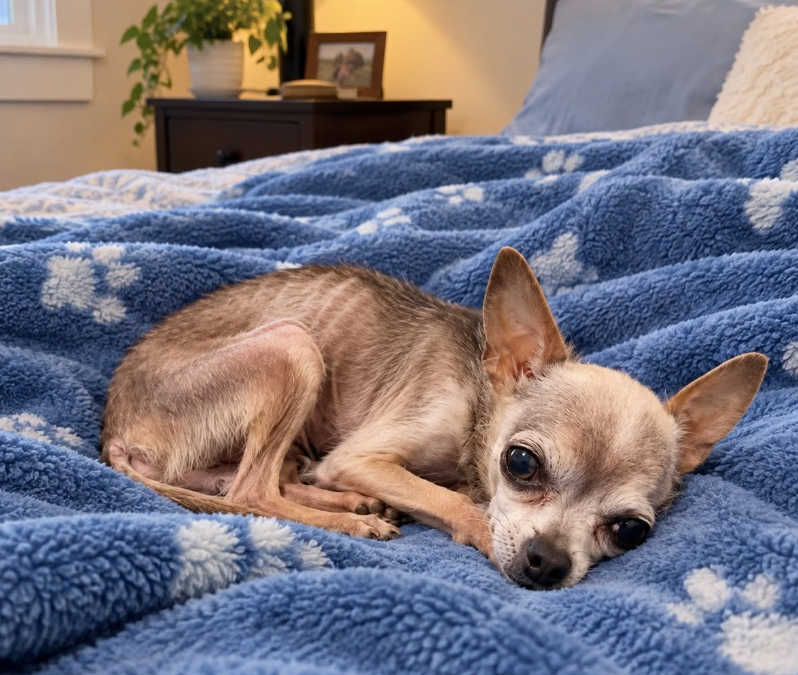
A Starving Chihuahua Stood Watching the Car That Dumped Him Drive Away—Hours Later, a Witness Sent Me the License Plate That Could Identify Who Left Him.
The little dog never chased the car that abandoned him; he only stood in the road and watched it disappear like he still believed love might turn around.
His ribs were showing, his back was scarred, and his eyes carried the quiet heartbreak of an animal who had been betrayed by someone he once trusted completely.
But before that night was over, one blurry photograph, one hidden microchip, and one old red sweater would uncover a truth that no one in town was ready to face.
It happened on the evening of June 9, 2026.
I still remember that date because I had written it at the top of an intake form only ten minutes earlier for a pregnant stray cat someone had found behind the laundromat. I remember the damp heat in the rescue room, the smell of disinfectant and wet towels, the low hum of the old refrigerator where we kept medication, and the way my back ached because I had been bending over kennels since sunrise.
My name is Rachel Morgan, and at thirty-nine years old, I was the director, janitor, overnight bottle-feeder, emergency driver, paperwork person, and occasional plumber for Briar County Small Animal Rescue.
That sounds more official than it was.
Our rescue was three rooms attached to the back of an old grooming salon, funded by bake sales, Facebook fundraisers, overdue favors, and the stubbornness of six women who refused to admit we were always one emergency away from running out of money. We took in the animals people forgot, delayed, denied, dumped, surrendered, ignored, or loved too late.
I had seen things that made me angry.
I had seen things that made me cry.
I had seen things that made me stand in the parking lot after midnight with my hands on my knees, trying not to hate people as a species.
But even after twelve years in rescue, abandonment still did something different to me.
Neglect could be gradual. Cruelty could hide behind excuses. Illness could be misunderstood by careless people who didn’t know what they were looking at.
But abandonment was a choice with a location.
A road.
A field.
A box.
A ditch.
A door opening.
A living thing being told, without words, You are no longer my problem.
That night, I was rinsing food bowls behind the rescue room when my phone rang. I nearly let it go to voicemail because my hands were covered in soap and canned dog food, and I had already missed dinner twice that week.
But I saw the name on the screen.
Denise Carter.
Denise was not a volunteer, not officially, but she was the kind of woman every rescue needs. She lived on the edge of town, carried dog treats in her purse, knew every back road in the county, and had once sat on a porch for three hours convincing a terrified hound to come close enough for a slip lead.
I answered with my shoulder pressed to the phone.
“Denise?”
“Are you still there?” she asked.
Her voice was shaking.
I straightened.
“Technically. Why?”
“There’s a dog on Miller Road. A tiny one. Somebody just dumped him.”
The bowl slipped in my hand and clattered into the sink.
“Are you sure he was dumped?”
“I watched the car stop. The passenger door opened. They put him out. Then they drove away.”
For one second, everything in me went still.
Then rescue mode took over.
“What kind of dog?”
“Small. Really small. Maybe a Chihuahua. He’s just standing there.”
“Is he moving toward traffic?”
“No. That’s what’s strange.”
“What do you mean?”
Denise’s breath caught.
“He’s just watching the car leave.”
I closed my eyes.
“All right. Stay where you are if it’s safe. Don’t chase him. Don’t call to him from across the road. I’m coming.”
I grabbed my keys, a slip lead, a towel, a can of recovery food, and the soft carrier we used for fragile animals. I told the evening volunteer, Marcy, that I would be back as soon as I could.
She took one look at my face.
“Dumped?”
“Yeah.”
Her mouth tightened.
“Go.”
Miller Road ran along the edge of town, where the houses thinned out and fields replaced sidewalks. It was one of those rural roads people used when they wanted to avoid main traffic, or when they wanted no one to notice what they were doing. There were long stretches with no streetlights, only ditches, mailboxes, and the occasional glow of a farmhouse window set far back from the road.
By the time I arrived, daylight was fading.
The sky was bruised purple behind the tree line, and the first summer insects had started their high, electric singing. Denise’s car was pulled onto the shoulder with its hazard lights blinking. She stood beside it, one hand pressed to her mouth.
I saw the dog before I turned off my engine.
He was beside the drainage ditch.
Tiny.
Motionless.
A Chihuahua.
Not barking.
Not wandering around looking for food.
Not sniffing the grass or trying to hide.
He was staring down the road.
PART2:
At first, I thought he might be frozen with fear.
Then I realized he was waiting.
Waiting for the car to come back.
I parked several yards away, shut my door quietly, and crouched down.
“Hey, buddy.”
His ears moved.
That was all.
“I’m not going to hurt you.”
He looked at me then.
Even from that distance, I could see how thin he was.
When I moved closer, my stomach tightened.
His ribs pressed sharply against his skin. His hips protruded. His coat was patchy and dull, with bald areas along his back where healthy fur should have been. Old marks crossed his little body, pale against irritated skin. His nails were too long. His eyes were too large for his face, not because he was young, but because everything else on him had become too small.
Whatever had happened to him had not begun that night.
The abandonment was simply the latest chapter.
I held out my hand.
He hesitated.
Then he took three slow steps toward me.
No growling.
No snapping.
No attempt to run.
He touched his nose to my fingers.
And then, impossibly, his tail moved.
Once.
Twice.
A weak little wag.
“Oh, sweetheart.”
I swallowed hard.
“I know. I know.”
I lifted him carefully.
He weighed almost nothing.
His body felt warm, but there was so little padding between my hands and his bones that I was afraid of squeezing too hard. He curled inward automatically, as if expecting pain, but when none came, he leaned against my chest.
That was when Denise started crying.
“I didn’t know what to do,” she said. “I didn’t want to scare him into the road.”
“You did exactly right.”
“He didn’t chase them.”
I looked down at the little dog.
His eyes were still turned toward the direction the car had gone.
“I know.”
“He just stood there.”
“I know.”
She wiped her face.
“I tried to get a picture of the car. It was dark and I was shaking. I don’t know if it came out.”
“Send me anything you have.”
“I will.”
I wrapped the dog in the towel. He did not fight. He didn’t even shake the way some dumped dogs did after adrenaline wore off. He simply rested his chin against my arm and let me carry him to my vehicle.
Denise followed.
“You’ll tell me if he’s okay?”
“I will.”
“Do you think he’ll make it?”
I hated that question because I had learned not to make promises on roadsides.
Instead, I looked at the little dog in my arms.
“He made it to us,” I said. “That counts for something.”
Back at the rescue room, I set him down gently on a clean towel and placed a small bowl of food in front of him.
The change was immediate.
He rushed toward it.
Not like an excited pet getting dinner.
Like an animal who believed the food might disappear if he didn’t swallow it fast enough.
“Easy,” I whispered. “There’s more.”
He didn’t understand that yet.
He finished the first portion and searched the floor, nose moving frantically over tile that had nothing left to give.
I gave him another small amount, careful not to overwhelm his stomach. Then I put down water.
He drank.
And drank.
And drank.
I finally had to lift the bowl away.
“Slow down, buddy.”
He looked up at me.
Water clung to his chin.
His eyes should have been frightened. After being neglected, scarred, and left beside a road, he had every reason to recoil from human hands.
Instead, he leaned toward mine.
Then he licked my fingers.
That almost broke me.
I sat back on my heels and breathed through my nose the way I did when I refused to cry in front of a dog who needed calm more than emotion.
“You’re something else,” I whispered.
The veterinary office was closed, which meant the questions in my head would have to wait.
How sick was he?
Why had he lost so much hair?
How long had he been hungry?
Were the scars from old injuries, skin disease, or both?
And most importantly—
Who had done this to him?
I made him a bed from two soft blankets and an old fleece pad. He circled it once before collapsing into the middle.
Within minutes, he was asleep.
For the first time that night, I allowed myself to breathe.
Then my phone buzzed.
Denise had sent a message.
I expected another photo of the dog.
Instead, there was a grainy image of a dark sedan, captured from behind as it moved down Miller Road into the fading light.
Below it were seven words.
I think I got the license plate.
I enlarged the photograph until the pixels blurred. The car had been maybe thirty yards away when Denise took the picture, and dusk had already begun to swallow the road.
But she was right.
There was a plate.
Not a perfect one.
Not every character was clear.
But it was something.
I looked down at the sleeping dog.
For the first time since I had found him, his body had completely relaxed. His head rested sideways on the blanket, his narrow chest rising and falling beneath the loose skin stretched over his ribs.
Whatever happened next could wait until morning.
He couldn’t.
That night belonged to him.
I turned off the overhead lights and left one lamp glowing in the corner. Then I pulled a chair beside his bed.
I intended to stay for ten minutes.
I stayed almost two hours.
Every now and then, he woke suddenly. His head would jerk up. His eyes would search the room. The first few times, he looked genuinely confused. Then he would see me.
“You’re okay,” I would say.
And his head would slowly lower again.
Around midnight, I stood to leave.
He woke immediately.
His body stiffened.
I took one step toward the door.
He struggled to his feet.
That stopped me.
“You think I’m leaving you too?”
His tail went down.
I sat again.
He shuffled across the blanket, climbed awkwardly into my lap, and curled himself against my stomach. He was still trembling. I don’t know whether it was cold, exhaustion, fear, or all three.
I wrapped the edge of my sweatshirt around him.
For the next forty minutes, he slept there.
I kept thinking about the car.
About someone opening a door.
About this little animal looking toward a person he trusted.
About that person leaving.
People imagine abandonment as a quick act.
A door opens.
A dog gets out.
A car leaves.
Done.
But it isn’t done for the animal.
They wait.
Sometimes they follow.
Sometimes they panic.
Sometimes they stay in the exact spot where their person disappeared because every experience they’ve ever had tells them that familiar person is their entire world.
This little dog had stayed.
That was the part I couldn’t get out of my head.
He hadn’t run toward houses.
He hadn’t explored the field.
He hadn’t even searched for food.
He had watched the road.
Waiting.
The next morning, I arrived at the veterinary clinic twenty minutes before they opened. I had slept maybe three hours on the rescue couch, and the little dog had spent most of those hours tucked beneath my sweatshirt as if the warmth might vanish if he let go.
He sat inside a carrier on the passenger seat, watching me through the mesh door. He had eaten another carefully measured meal at dawn. This time, he didn’t inhale it quite as violently.
Progress.
Tiny progress.
At the clinic, Dr. Lauren Hayes took one look at him and stopped smiling.
“How long have you had him?”
“Since last night.”
“He came in like this?”
“Yes.”
She crouched and spoke softly before touching him.
The little dog walked toward her.
Again, that tail moved.
Dr. Hayes looked at me.
“He’s social.”
“Very.”
She ran her hands carefully along his spine. He weighed just over five pounds. Dr. Hayes said an adult Chihuahua of his frame should have weighed considerably more.
His nails were overgrown.
His coat was poor.
The bald patches looked consistent with long-term skin disease, malnutrition, parasites, chronic irritation, or some combination of those problems. Some scars were old. A few spots concerned her enough that she wanted photographs for the medical record.
She drew blood.
Checked his teeth.
Listened to his heart.
Examined his ears, eyes, abdomen, joints.
He endured everything with patience.
At one point, the technician held him against her chest while Dr. Hayes examined his rear legs. The little dog turned and licked the technician’s wrist.
She looked away quickly.
“You okay?” I asked.
She nodded.
Then whispered, “No.”
That was the thing about him.
He made you angry and hopeful at the same time.
His body showed you exactly how badly human beings had failed him.
His personality showed you he still wanted to believe they could do better.
Dr. Hayes came back into the room with preliminary results and a plan.
“He’s definitely underweight,” she said. “Severely enough that we need to be careful about how fast we increase food. I want smaller meals throughout the day.”
I nodded.
“Anything life-threatening?”
“Nothing obvious at this moment, and that’s the good news.”
I exhaled.
“But we’re not finished. We’ll treat the skin condition, address parasites if the lab confirms them, support nutrition, and monitor him closely.”
Then she scanned him for a microchip.
The machine beeped.
I looked at her.
“He has one?”
“He does.”
For a second, neither of us spoke.
My mind went immediately to Denise’s photograph of the sedan.
A license plate was one thing.
A microchip was another.
Dr. Hayes printed the chip number and gave it to me.
“You know the drill,” she said.
I did.
A microchip didn’t automatically prove who had abandoned him. Records could be old. Dogs changed hands. People moved. Sometimes previous owners had nothing to do with the condition in which an animal was found.
Facts mattered.
Especially now.
I called the chip company from the parking lot. Because I was working through a rescue and because the dog had been found abandoned, there was a process. The chip had registration information, but the representative couldn’t simply hand me somebody’s personal details over the phone.
They could contact the registered person.
Animal control could follow up through official channels.
So I called Officer Elena Ramirez.
She had worked animal control in our county for nine years and had seen nearly every excuse people could invent. She knew how to listen without reacting too soon. She also knew how to make lying people deeply uncomfortable without raising her voice.
She picked up on the third ring.
“Morgan.”
“I have a dumped Chihuahua from Miller Road. Witness saw the car. We may have a partial plate. Vet found a chip.”
Silence.
Then, “Send me everything.”
“Already starting.”
“Don’t post the license plate publicly.”
“I wasn’t planning to.”
“Good.”
Her voice softened.
“How’s the dog?”
I looked through the windshield.
He was sitting on the passenger seat now, secured by a harness. His front paws rested on the edge of the center console, and he was looking at me as if we had known each other for years.
“He’s wagging his tail.”
Officer Ramirez was quiet.
“Of course he is.”
“What does that mean?”
“It means dogs are better than us sometimes.”
Then she hung up.
For the next several days, the little dog became the center of my schedule.
Breakfast at six.
Medication.
A short trip outside.
Another meal.
Skin treatment.
Rest.
Lunch.
More rest.
Dinner.
More medication.
I named him Paco because the chip company, through the official process, confirmed that was his registered name. When I said it for the first time, his ears lifted.
“Paco?”
His tail moved.
So that was that.
He hated being alone.
That became obvious on the second night. I had decided to foster him at my house instead of leaving him overnight at the rescue. My place wasn’t fancy: two bedrooms, a fenced backyard, a kitchen too small for the table I had forced into it, and an old couch permanently decorated with dog hair.
To Paco, it might as well have been a palace.
He explored slowly.
The carpet fascinated him.
So did the couch.
But what he loved most was a blue dog bed near the kitchen.
He stepped into it.
Turned three circles.
Lay down.
Got up again.
Looked at me.
Lay down again.
It was almost as though he couldn’t believe nobody was going to make him move.
That night, I put the bed beside mine.
At 1:14 a.m., I woke to a faint scratching sound.
Paco was standing against the side of my mattress.
“What?”
He scratched again.
I lifted him onto the bed.
He immediately crawled beneath the edge of the blanket and pressed his entire body against my leg.
I smiled into the darkness.
“So this is how it’s going to be?”
His tail thumped once beneath the blanket.
Apparently, yes.
Three days later, Officer Ramirez called.
“I need you to come in.”
My stomach tightened.
“Did you find the car?”
“I need you to come in.”
That meant yes.
Her office was inside an aging county building between public works and code enforcement. I arrived with a folder containing Paco’s records and the original images Denise had taken.
Denise was already there.
I had only spoken to her by phone after Miller Road. She was in her early sixties, with silver hair tied back and glasses hanging from a chain around her neck. The moment she saw me, she asked, “How is he?”
“Better.”
Her shoulders dropped with relief.
“I keep seeing him standing there.”
“So do I.”
Officer Ramirez came out.
“Come on back.”
Inside her office, she closed the door.
“The vehicle belongs to a man named Brett Lawson.”
The name meant nothing to me.
“He lives about twelve miles from where Paco was found.”
“Is he the registered chip owner?”
“No.”
That surprised me.
“Who is?”
“A woman named Melissa Grant.”
“Different address?”
“Different town.”
Officer Ramirez slid a sheet of paper across the desk, careful not to expose private information unnecessarily.
“The chip company contacted her. She called us.”
“And?”
“She says Paco was her mother’s dog.”
I looked at Denise.
Ramirez continued.
“Her mother died nineteen months ago.”
There it was.
The first twist.
According to Melissa, her mother, Evelyn Grant, had adored the Chihuahua. His original name really was Paco. He had slept in her bed, eaten boiled chicken when his stomach bothered him, and worn a ridiculous red sweater every Christmas.
Melissa had photographs.
Healthy photographs.
Paco at six pounds, then seven.
Paco on a couch.
Paco in a backyard.
Paco sitting beside an elderly woman whose hands rested lovingly around his chest.
“What happened to him?” I asked.
Officer Ramirez’s jaw tightened.
“After Evelyn died, Melissa couldn’t take him. Her apartment didn’t allow dogs. Her brother agreed to keep Paco temporarily.”
“Brett?”
“No.”
Another name.
“Melissa’s brother is Jason Grant.”
I frowned.
“Then where does Brett fit?”
“That’s what we’re figuring out.”
Denise leaned forward.
“I know what I saw.”
“Nobody is disputing that,” Ramirez said. “Your statement is solid.”
She turned back to me.
“Jason claims Paco disappeared about ten months ago.”
“Disappeared?”
“Yes.”
“Did he report him missing?”
“No.”
“Call shelters?”
“He says he looked around the neighborhood.”
I stared at her.
“You believe him?”
“I believe evidence.”
That was why I liked Officer Ramirez.
She never let outrage replace facts.
Not even when outrage was deserved.
She tapped the desk.
“Here’s what we know. Paco belonged to Evelyn Grant. After her death, he was supposed to stay with her son Jason. At some point, Brett Lawson ended up with the dog. And on June ninth, Denise watched a vehicle registered to Brett stop on Miller Road and leave Paco behind.”
“Have you spoken to Brett?”
A pause.
“Yes.”
“And?”
Ramirez leaned back.
“He says he never owned the dog.”
Denise gave a humorless laugh.
“Of course.”
“He claims he was doing someone a favor.”
“For who?”
“He won’t say.”
That was the moment my anger sharpened.
Not exploded.
Sharpened.
Because this wasn’t simply carelessness anymore.
Someone knew Paco.
Someone had been responsible for him.
Someone had watched his body become thinner and thinner. His skin deteriorate. His nails grow. His bones emerge. Then instead of walking into a shelter, calling animal control, contacting a rescue, or asking anyone for help, somebody had chosen a road.
A car door.
And goodbye.
Officer Ramirez must have seen my expression.
“Don’t contact him.”
“I wasn’t going to.”
“Yes, you were.”
I said nothing.
Denise almost smiled.
Ramirez pointed at me.
“This is why I’m telling you. Let us do it properly.”
I folded my arms.
“What happens if he lies?”
“Then evidence becomes very inconvenient.”
That sentence stayed with me.
Evidence becomes very inconvenient.
So I started collecting it.
Not by chasing Brett.
Not by knocking on doors.
By documenting Paco.
Every meal.
Every weight check.
Every veterinary finding.
Every photograph.
Every medication.
Every small improvement.
June 13.
Five pounds, three ounces.
June 16.
Five pounds, eight ounces.
June 20.
Five pounds, thirteen ounces.
His appetite changed first.
The frantic swallowing slowed. One morning, halfway through breakfast, he actually stopped eating.
I froze.
My immediate thought was that something was wrong.
Then Paco walked away from the bowl, came to me, stretched his front legs, and wagged his tail.
He was full.
It sounds ridiculous to call that moment extraordinary.
But I nearly cried.
For the first time since I had met him, Paco believed food would still exist later.
He didn’t have to finish everything.
He didn’t have to protect every crumb from an uncertain tomorrow.
There would be another meal.
Then another.
His body was learning safety before his mind fully understood it.
The skin treatments began working too.
The rawest areas calmed. Fine hair started appearing in patches. His energy increased.
And with energy came personality.
A lot of personality.
Paco discovered that he hated the vacuum cleaner. He loved scrambled eggs. He believed every blanket in my house belonged to him. He would bark exactly once when the mail carrier came, then look at me as if expecting congratulations.
He also had a strange obsession with shoes.
Not chewing them.
Collecting them.
I would wake up and find one sneaker in his bed.
Then a slipper.
Then a sandal.
By the end of his second week with me, he had assembled a small collection beside the blue bed.
“What is this?” I asked one morning.
Paco looked proud.
“You don’t even wear shoes.”
Tail wag.
“You have four feet and no shoes.”
Another wag.
I picked up the sneaker.
Paco grabbed the lace.
“No.”
He pulled.
I pulled back.
For the first time, he growled.
Not an angry growl.
A playful one.
I stared at him.
Then I laughed so hard I had to sit on the kitchen floor.
Paco pounced on the lace.
Two weeks earlier, this dog had barely possessed enough energy to stand beside a road.
Now he was fighting me for a sneaker.
That was the revenge I thought I wanted.
At least at first.
Watching Paco become happy.
Watching every pound he gained erase a little of what had been done to him.
Then Officer Ramirez called again.
“We found Jason.”
“What do you mean found him? You knew who he was.”
“I mean we got a real conversation.”
Her tone was different.
“What happened?”
“He changed his story.”
I stopped washing the bowl in my hand.
“To what?”
“He says he gave Paco to Brett eight months ago.”
There was silence between us.
“So Paco didn’t disappear.”
“No.”
“Jason lied.”
“Yes.”
“Why?”
“He claims he was embarrassed.”
“About what?”
“About giving away his mother’s dog.”
That answer made my hands go cold.
I thought of the photographs Melissa had eventually sent. Evelyn sitting in a recliner with Paco asleep on her chest. Evelyn holding him at Christmas. Paco wearing the absurd red sweater.
Melissa had told me her mother used to call Paco “my little shadow.”
When Evelyn became sick, Paco stayed beside her. When she struggled to sleep, he slept against her stomach. When she came home from the hospital after one treatment, Paco refused to leave her chair for almost a day.
Before Evelyn died, she asked her son to make sure Paco was safe.
Jason had said yes.
Then he gave him away.
I tried to control my voice.
“Why Brett?”
“They knew each other through work.”
“Did Brett want a dog?”
“Apparently not very much.”
“What does that mean?”
Ramirez sighed.
“It means Brett says Jason asked him to keep Paco for a few weeks. Jason says the arrangement was permanent. Each man is trying to place responsibility on the other.”
“And Paco paid for it.”
“Yes.”
“Who starved him?”
“We’re working on that.”
That evening, Melissa called me.
I had given Officer Ramirez permission to share my number if Melissa wanted updates.
Her first words were, “Can I see him?”
She sounded terrified that I would say no.
“Of course.”
She arrived the next afternoon carrying a red sweater.
The moment I saw it, I recognized it from the photograph.
Paco was asleep on the couch.
Melissa stopped in my doorway.
Her hand flew to her mouth.
“Oh my God.”
Paco lifted his head.
For several seconds, he stared at her.
Melissa crouched.
“Paco?”
His ears rose.
She whispered his name again.
“Paco.”
He jumped off the couch.
Not gracefully.
He nearly slipped on the rug.
Then he ran.
Straight to her.
Melissa fell to her knees.
Paco climbed onto her lap and began licking her chin.
She sobbed.
Not delicate crying.
The kind that shakes your whole body.
“I’m sorry. I’m so sorry.”
Paco wagged harder.
She buried her face against his neck.
“I thought you were safe.”
I stepped into the kitchen because the moment didn’t belong to me.
But I could still hear her.
“My mom would kill me.”
She laughed through her tears.
“She would absolutely kill me.”
A few minutes later, I brought water. Melissa was sitting cross-legged on the floor with Paco in her lap. He looked completely content.
She touched the thin fur growing along his back.
“He was beautiful.”
“He’ll be beautiful again.”
“No. I mean…”
She looked at me.
“He was never like this.”
“I know.”
“I should have checked.”
“You believed your brother.”
“That was my mistake.”
I sat across from her.
“What did he tell you?”
“That Paco had gotten out.”
“When?”
“Almost a year ago.”
“And you never knew Brett had him?”
“No.”
She wiped her eyes.
“Jason told me he searched. He said he put flyers up. He said he checked shelters.”
“He didn’t.”
“I know that now.”
Paco shifted in her lap.
Melissa looked down at him.
“My mother trusted us.”
There are moments when anger stops feeling satisfying.
This was one of them.
Melissa wasn’t the person I wanted to blame.
She had made mistakes.
But I could see what they cost her.
“Why couldn’t you take Paco originally?” I asked.
“My landlord. I tried. I even offered more deposit money.”
She looked embarrassed.
“I was taking care of my dad too. He had dementia. I was barely keeping everything together.”
There it was.
Real life.
Messy.
Imperfect.
Not every failure came from cruelty.
Some came from trusting the wrong person while drowning in responsibilities of your own.
But someone had still left Paco on Miller Road.
And that part required an answer.
Before Melissa left, she unfolded the red sweater.
Paco sniffed it.
Then shoved his head into it.
We both laughed.
“You remember that?” I asked.
Melissa smiled for the first time.
“Mom used to put it on him whenever the temperature went below sixty, even inside the house.”
“That sounds excessive.”
“She thought Chihuahuas were basically tropical royalty.”
Paco stood in the living room wearing the sweater. It hung too loose around his stomach now.
But his tail was up.
Melissa took a photograph.
Then she became serious.
“Can I ask you something?”
“Sure.”
“If he needs a home…”
I knew where the sentence was going.
“I’m fostering him right now.”
“I know.”
“And he has medical needs.”
“I know.”
“And trauma.”
“I know.”
“My lease changed last year,” she said quietly. “I moved. Dogs are allowed now.”
I studied her face.
She didn’t ask again.
Instead, she said, “I know I don’t deserve to just walk back in.”
“It isn’t about deserving him.”
“I know.”
“It’s about what’s safest for Paco.”
She nodded quickly.
“Whatever you need.”
That answer mattered.
People who want an animal for themselves say, Give him to me.
People who care about the animal say, Whatever he needs.
I told her we would take it slowly.
Visits first.
No promises.
Paco would decide as much as any of us could let him.
Three days later, Officer Ramirez asked me to bring Paco to the county office.
“Why?”
“We’re interviewing Brett again.”
“With Paco there?”
“Not in the room. I want our veterinarian to see him first, and Melissa may come in afterward.”
Something was happening.
I could hear it in her voice.
When I arrived, a county vehicle was parked outside. Melissa was already there.
So was Jason.
I knew it was him before anyone introduced us. He had Melissa’s eyes. He was standing near the entrance with both hands in his pockets, face pale, hair uncombed, looking like a man who had slept badly for many nights and deserved each one.
When he saw Paco, he went completely still.
Paco stopped.
For one long moment, they looked at each other.
Jason whispered, “Hey, buddy.”
Paco did not run to him.
He didn’t hide either.
He simply stood beside my leg.
Jason swallowed.
“I didn’t know.”
Melissa spun toward him.
“You told me you searched for him.”
“I did.”
“No, you didn’t.”
“I thought Brett still had him.”
“You told me he ran away.”
Jason looked at the ground.
Officer Ramirez stepped through the door.
“Not here.”
Melissa’s hands were shaking.
“You lied to me for ten months.”
“Melissa—”
“You lied about Mom’s dog.”
“I screwed up.”
“No.”
Her voice cracked.
“You made a choice.”
Jason looked at Paco again.
For the first time, I saw shame cross his face.
That didn’t erase anything.
But it was real.
Officer Ramirez led him inside.
Melissa and I waited in another room.
An hour passed.
Then another.
Finally, Ramirez returned.
She closed the door.
“Brett admitted Paco had been living at his property.”
Melissa whispered, “How long?”
“At least seven months.”
My jaw tightened.
“Did he admit dumping him?”
“Not directly.”
“What does that mean?”
“He says he drove Paco to Miller Road but claims the dog jumped out when he opened the door.”
Denise’s photograph flashed in my mind.
“That’s garbage.”
“I know what Denise saw.”
“He opened the door, put him out, and drove off.”
“Yes.”
“So why are we pretending?”
“We aren’t pretending. We’re documenting.”
I paced to the window.
Paco followed me.
Ramirez continued.
“There’s more.”
I turned.
“A neighbor gave us security footage.”
“What footage?”
“Brett’s property. The neighbor’s camera catches part of Brett’s side yard.”
Melissa’s face changed.
“What did it show?”
Ramirez’s expression told us before she spoke.
“A small dog matching Paco appears repeatedly over several months.”
My throat tightened.
“Outside?”
“Yes.”
“How often?”
“We’re reviewing everything.”
“Was he tied?”
“Sometimes.”
Melissa covered her mouth.
Ramirez kept her voice measured.
“There appears to be an outdoor pen. We are determining what shelter, food, and water were available.”
I looked at Paco.
He was sitting near my shoe.
The bald patches.
The overgrown nails.
The hunger.
The thirst.
Pieces were fitting together.
I hated the picture they made.
Then Ramirez said, “The footage from the morning of June ninth is more important.”
My eyes went back to her.
“It shows Brett carrying Paco toward the sedan.”
Carrying him.
That destroyed the jumped-out story.
Melissa closed her eyes.
Ramirez continued.
“Paco didn’t escape.”
Nobody spoke.
There are victories that feel good immediately.
That one didn’t.
It just hurt.
Because proving what happened meant watching pieces of it.
The county wouldn’t show us the entire video while the investigation remained active.
I was grateful.
I didn’t need to see Paco being carried toward the car by the person who would leave him behind.
I had already seen enough in my imagination.
Over the following week, the investigation expanded.
No dramatic police raid.
No television cameras.
No mob outside Brett’s house.
Real accountability is usually less cinematic than people expect.
Paperwork.
Statements.
Veterinary records.
Photographs.
Interviews.
Dates.
Receipts.
Video timestamps.
Microchip records.
Contradictions.
But there is something powerful about facts accumulating quietly.
Brett said he had fed Paco regularly.
The body-condition records argued otherwise.
He said Paco’s hair loss had happened suddenly.
The veterinarian documented signs suggesting a chronic problem.
He said Paco escaped from the vehicle.
The witness and video evidence contradicted him.
He said Jason had promised to take Paco back.
Jason produced messages showing months of avoidance, but those messages also exposed Jason’s own failure to intervene.
Nobody walked away clean.
That mattered to me.
I didn’t want a convenient villain if the truth was uglier.
Jason had placed Paco with someone who didn’t want responsibility. When questions arose, Jason looked away.
Brett had kept Paco in worsening conditions. Then Paco became inconvenient.
Melissa had trusted a brother who lied to her rather than checking for herself.
Three people.
Three different kinds of failure.
One five-pound dog carrying all the consequences.
Paco, meanwhile, had no interest in their excuses.
He had discovered chicken.
That became his primary concern.
Dr. Hayes had approved adding small amounts of lean cooked chicken to his diet. The first time I placed some in his bowl, Paco looked at me.
Then the bowl.
Then me again.
“It’s yours.”
He sniffed it.
Took one piece.
Chewed.
His eyes widened.
I started laughing.
He immediately ate another.
After that, the word chicken became dangerous.
I couldn’t say it casually.
If I told someone on the phone, “I’m making chicken,” Paco would appear from another room.
His hearing became miraculous whenever poultry was involved.
His weight continued climbing.
Six pounds.
Then six pounds, four ounces.
Then six and a half.
The red sweater began fitting differently. His hips became less sharp. Hair returned along his shoulders. Pale scar tissue remained visible in a few places.
Dr. Hayes said some marks might always be there.
I hated that.
But slowly I began seeing them differently.
Not as proof that Brett had won something.
As proof that Paco had survived him.
One Saturday morning, Melissa came for another visit.
She had been coming twice a week. At first, Paco greeted her warmly and then returned to me. Over time, something shifted.
He started waiting near the window around the time she usually arrived.
I hadn’t told him the schedule.
Dogs notice patterns we miss.
That Saturday, her car had barely stopped before Paco began spinning near the front door.
“Seriously?” I said.
He barked once.
His signature announcement.
When Melissa entered, he launched himself at her ankles.
She lifted him.
“There’s my boy.”
My chest tightened.
Not from jealousy.
Something stranger.
The knowledge that love was beginning to pull him toward a life that might not include me.
That is the brutal privilege of fostering.
You repair what someone else broke.
You wake up at two in the morning.
You clean accidents.
You give medicine.
You learn which blanket they prefer.
You become the first safe thing they have known in months.
Then, if everything goes right, you let them go.
I hated that part.
I also believed in it.
Melissa sat on the couch.
“I brought something.”
She handed me a folder.
Inside were documents from her new landlord confirming pets were allowed. A letter from her veterinarian. Receipts showing she had already purchased a crate, bed, food bowls, a secure harness, and a baby gate.
Then she showed me a photograph.
Her living room.
In the corner was a small blue dog bed almost identical to mine.
I looked at her.
“You copied his bed.”
“I didn’t want him to feel like everything changed again.”
That almost did me in.
“He sleeps on my bed now,” I said.
She smiled.
“I figured.”
“Usually under the blanket.”
“My mom used to complain that he kicked her all night.”
“He does.”
We both looked at Paco.
He looked back innocently.
Melissa became serious.
“I know you love him.”
“I do.”
“And if you think staying here is better, I won’t fight you.”
I said nothing.
She continued.
“I want him back because he was family. But I don’t want him back just because I feel guilty.”
That was exactly what I needed to hear.
“I think we should try an overnight.”
Her eyes filled immediately.
“Really?”
“One.”
She nodded.
“One.”
“And I’ll bring him over myself.”
“Okay.”
“And if he’s stressed, I take him home.”
“Absolutely.”
I pointed at her.
“No feeding him an entire rotisserie chicken.”
She laughed.
“No promises.”
“Melissa.”
“Kidding.”
Paco spent his first night with her the following Friday.
I packed enough supplies for a military deployment.
Food.
Medication.
Blanket.
Harness.
Toy.
Emergency numbers.
His sweater, despite it being June.
Melissa looked at the bag.
“He’s staying eighteen hours.”
“I know.”
“This is more luggage than I took on my honeymoon.”
“He has needs.”
Paco stood between us.
I clipped on his leash.
For a moment, my hand wouldn’t let go.
Melissa noticed.
“You can change your mind.”
“No.”
I crouched.
Paco walked into my lap.
“Listen to me, tiny criminal.”
He licked my nose.
“You be good.”
Tail wag.
“No collecting all her shoes.”
Another wag.
“And don’t pretend you’re starving. I know your tricks.”
He sneezed.
Melissa laughed.
Then they left.
My house became unbearably quiet.
I kept hearing phantom sounds.
His nails on the floor.
His tags.
That single ridiculous bark.
I made dinner and dropped a piece of carrot. Automatically, I looked down.
No Paco.
I went to bed early.
At 11:07, Melissa sent a photograph.
Paco was asleep under her chin.
The caption read:
He remembers Mom’s blanket.
The blanket beneath him was faded yellow.
I zoomed in.
Paco’s eyes were closed.
His entire body was loose.
Safe.
The next morning, I received another picture.
A sneaker in his bed.
I laughed out loud.
By noon, Melissa brought him back.
Paco ran into my house like he had been away for a month. He greeted me frantically. Then he ran back to Melissa. Then back to me. His confusion lasted about thirty seconds before he decided the obvious solution was to demand attention from both humans simultaneously.
“How did he do?” I asked.
“Perfect.”
“Eating?”
“Everything.”
“Bathroom?”
“Outside.”
“Sleeping?”
“On my face.”
“Sounds right.”
Then she hesitated.
“Something happened.”
My stomach dropped.
“What?”
“At about three in the morning, I woke up and he wasn’t beside me.”
“Where was he?”
“In the hallway.”
“Doing what?”
“Looking at the front door.”
I frowned.
“Was there a noise outside?”
“I don’t think so.”
She rubbed her hand over her arm.
“I think he was checking.”
“Checking what?”
“That I hadn’t left.”
The room went still.
I looked at Paco.
He was digging through his toy basket.
Abandonment lives in strange places.
Not always in cowering.
Not always in obvious fear.
Sometimes it lives in a dog waking at three in the morning to make sure the door is still closed and the human is still inside.
Melissa crouched beside him.
“He came back to bed when I called.”
I nodded.
“He’ll learn.”
“How long?”
“I don’t know.”
She looked disappointed.
I added, “But he will.”
The case moved forward in July. Officer Ramirez couldn’t discuss every detail, but there was enough documented evidence for authorities to pursue animal neglect and abandonment violations under the applicable local statutes.
Jason was also cited for failures connected to Paco’s care and transfer.
He cooperated.
Brett did not.
At least not initially.
His attorney argued that Paco had been a stray.
The microchip undermined that.
Then Brett claimed he had tried to surrender Paco but couldn’t find anywhere open.
Phone records found no calls to local shelters.
He claimed Paco had refused food.
Veterinary findings did not support a sudden short-term issue explaining his overall condition.
He claimed the dog’s skin had always looked like that.
Melissa provided years of photographs showing otherwise.
Every excuse met another document.
Evidence becomes very inconvenient.
I understood Officer Ramirez’s words now.
Still, Brett had one more move.
He claimed ownership.
I found out on a Tuesday afternoon. I was at work when Ramirez called.
“He says Paco belongs to him.”
I nearly dropped my phone.
“He abandoned him.”
“He’s disputing that.”
“He carried him to the car.”
“I know.”
“Denise watched him put Paco on the road.”
“I know.”
“And he wants him back?”
“His attorney is preserving every argument available.”
My hands shook.
Paco was at home.
Safe.
For the first time since Miller Road, I felt real fear.
Not because I thought Brett should win.
Because legal processes are processes.
They take time.
They require proof.
They can turn something morally obvious into something procedural.
“Can he take Paco?”
“Not right now.”
“Right now?”
“Listen to me. Paco is being held under the rescue’s authority while this is handled. He’s not being handed over today.”
“But?”
“Melissa has records tying him to Evelyn. Jason has now signed a statement about transferring the dog. Brett’s own versions conflict. We’re dealing with it.”
I paced behind the rescue counter.
“Why would he even want Paco?”
“I can’t tell you what he wants.”
I could guess.
Control.
Leverage.
Maybe pride.
Maybe he hated being accused.
Maybe asking for Paco back had nothing to do with loving Paco.
That possibility made me angrier than anything else.
That night, I sat on the floor with Paco.
He crawled into my lap.
“You have no idea how many adults are arguing over you.”
He yawned.
“Probably better that way.”
He rolled onto his back. His stomach was rounder now.
Not fat.
Healthy.
I scratched beneath his front leg.
“You aren’t going anywhere unsafe.”
His eyes closed.
I said it again.
“You hear me?”
One eye opened.
“You are never going back.”
For the next two weeks, I lived with that sentence in my head.
Never going back.
Melissa did too. She began attending every meeting she was allowed to attend. Jason provided messages. Denise repeated her statement. Dr. Hayes prepared a detailed report.
Then the neighbor with the security camera produced something nobody expected.
Audio.
The camera hadn’t only recorded video. It had captured sound from Brett’s yard on several dates. Most of it was useless.
Wind.
Traffic.
Dogs barking.
Lawn equipment.
But one recording mattered.
Brett was outside with another man.
Paco could be seen inside the pen.
The other man apparently asked about him.
The microphone didn’t catch every word.
But it caught enough.
Brett’s voice was clear.
“Jason dumped him on me.”
Then later:
“I’m getting rid of him.”
Not rehoming.
Not calling a shelter.
Not arranging veterinary care.
Getting rid of him.
The recording was weeks before June ninth.
When Officer Ramirez told me, I sat silently for several seconds.
“So he planned it.”
“It supports that conclusion.”
“What happens now?”
“The process continues.”
I hated that phrase.
The process continues.
But it did.
And while it continued, Paco healed.
That became our routine.
Humans argued.
Paco recovered.
Humans filed paperwork.
Paco grew fur.
Humans exchanged accusations.
Paco learned to play.
One evening, he discovered zoomies.
I had seen hints before. But that night, something inside him switched on.
He sprinted through the living room.
Around the coffee table.
Into the hall.
Back through the kitchen.
Across the rug.
His little legs moved so fast they looked absurd.
I shouted, “Paco!”
He ran faster.
He hit the blue bed at full speed, flipped it halfway over, emerged from underneath it, and charged back toward me.
I laughed until my stomach hurt.
He stopped.
Looked at me.
Then launched into another lap.
That was the dog in Evelyn’s photographs.
Not physically.
Not completely.
But spiritually.
He was returning.
By August, his weight had stabilized above seven pounds. His coat was still uneven but dramatically improved. The scars remained.
Dr. Hayes crouched beside him during one appointment.
“You know what my favorite thing is?”
“What?”
She scratched Paco under the chin.
“He’s getting demanding.”
As if to prove the point, Paco pawed her hand when she stopped.
Dr. Hayes smiled.
“A terrified, shut-down animal asks for nothing. A secure dog starts developing opinions.”
“Paco has many.”
“He should.”
Then she gave me the news I had been waiting for and dreading.
“Medically, I don’t see a reason he can’t move into a permanent home.”
The sentence hurt.
I looked at him.
Paco looked at me.
“Are you sure?”
“Yes.”
“Could you maybe find some obscure disease that requires him to stay with me forever?”
“No.”
“You’re not trying very hard.”
She laughed.
“You’ve done your job.”
I hated that sentence too.
Because she was right.
My job wasn’t to keep Paco.
It was to get him here.
Healthy.
Stable.
Safe.
Ready.
But the legal ownership issue had to be resolved first.
That happened eleven days later.
There was no grand courtroom scene. No judge pounding a gavel while Paco sat heroically beneath a table.
Reality was quieter.
Brett withdrew his ownership claim after the accumulating evidence and legal pressure made his position increasingly difficult to maintain. The county case over the treatment and abandonment proceeded separately. Jason formally surrendered any claim he might have possessed. Melissa’s documentation established the family history. And the rescue, following its process, approved Paco for adoption.
Officer Ramirez called me that afternoon.
“It’s done.”
I sat down.
“What does done mean?”
“It means Brett is not getting Paco.”
I closed my eyes.
“Say that again.”
“He is not getting Paco.”
My breath shook on the way out.
“And Melissa?”
“That’s between your rescue and Melissa now.”
I laughed.
For weeks, I had imagined what revenge might feel like. I imagined Brett being forced to look at photographs of the dog he abandoned after Paco became healthy. I imagined him hearing exactly what everyone thought of him. I imagined some dramatic moment when he understood the weight of what he had done.
But sitting there with the phone against my ear, none of that mattered.
Paco wasn’t going back.
That was enough.
The county later resolved its case through the legal process. There were penalties and restrictions related to animal ownership, along with consequences the authorities deemed supportable by the evidence. Jason also faced consequences for his role.
I won’t pretend it felt perfectly satisfying.
No fine could restore the months Paco had spent hungry.
No order could erase the scars.
No document could explain to a five-pound dog why a car door had opened and the person he depended on had driven away.
Justice rarely repairs the past.
What it can do is protect the future.
For Paco, that future was waiting.
Melissa’s adoption application went through the same review we required for anyone else.
Home check.
Veterinary plan.
References.
Housing verification.
Follow-up requirements.
She never complained.
Not once.
When I apologized for how thorough we were being, she shook her head.
“Don’t apologize.”
“Some people get irritated.”
“I want you to be difficult.”
I smiled.
“That’s the nicest thing anyone has said to me this week.”
She leaned toward Paco.
“Nobody should ever trust us just because we’re family.”
That sentence sealed it for me.
Melissa understood.
Love wasn’t paperwork.
Family wasn’t proof.
Promises weren’t enough.
You showed up.
Repeatedly.
Consistently.
That was what Paco needed.
His final trial stay lasted one week.
On the first evening, I cried after dropping him off.
Not in front of Melissa.
Not in front of Paco.
I made it to my car. Then I sat behind the steering wheel and lost it.
There was a dog hair on my shirt.
A tiny pale one.
I picked it off and held it between my fingers like an idiot.
Through the window, I could see Melissa’s living room. Paco was on the couch. She sat beside him. He stood on his hind legs and put his paws against her chest.
Then he disappeared from view.
I started the engine.
“Do your job,” I told myself.
I drove home.
The blue bed was still beside my kitchen.
His stolen sneaker collection had been returned to the closet.
The house smelled cleaner.
I hated it.
The next morning, Melissa sent me a video.
Paco was running through her hallway carrying a slipper.
I watched it twelve times.
Day two.
Paco asleep on her lap.
Day three.
Paco walking beside her through a quiet park.
Day four.
Paco sitting in a patch of sunlight.
Day five.
Paco wrapped in Evelyn’s yellow blanket.
Day six.
A photograph that stopped me.
Melissa had placed an old framed picture on a low shelf. Evelyn sat in her recliner holding a younger, healthier Paco.
In front of the photograph, present-day Paco was sleeping.
Same dog.
Different lifetime.
I called Melissa.
She answered immediately.
“What’s wrong?”
“Nothing.”
“You don’t call unless something is wrong.”
“I saw the picture.”
Silence.
Then she said, “Yeah.”
“I’m glad he’s with you.”
Another silence.
Her voice broke.
“Are you sure?”
“No.”
She laughed through a sob.
I laughed too.
“But I’m sure this is right.”
On day seven, I drove to her house for the final adoption.
Paco heard my car.
Before I reached the door, I heard barking.
Not once this time.
Three times.
Melissa opened the door.
Paco exploded through the gap.
I dropped to my knees.
“There he is!”
He climbed all over me, licking my chin, my nose, my glasses. His tail moved so violently his whole body bent with it.
“You remember me?”
He sneezed directly into my face.
“Okay. Great.”
Melissa laughed.
We sat at the kitchen table. The adoption papers were already arranged.
I went through them anyway.
Medical care.
Microchip update.
Follow-up.
Return policy.
Emergency contacts.
Melissa signed each page carefully.
When we reached the final line, her pen stopped.
“You okay?” I asked.
She looked at Paco.
He was sitting between our chairs.
“My mother would have wanted this.”
“She would.”
“I keep thinking about the last thing she said to Jason about him.”
I waited.
Melissa swallowed.
“She was in hospice. She could barely talk. She told him, ‘Don’t let my little boy be alone.’”
My throat tightened.
“And he promised.”
“Yes.”
Paco put one paw on Melissa’s shoe.
She looked down.
“For a while, everybody failed him.”
I thought of Miller Road.
The fading light.
The drainage ditch.
The tiny dog staring after a disappearing car.
“Not everybody,” I said.
She looked at me.
“Denise didn’t.”
“No.”
“You didn’t.”
“No.”
“Officer Ramirez didn’t. Dr. Hayes didn’t.”
“And you didn’t once you knew the truth.”
She shook her head.
“I should have known sooner.”
“Maybe.”
She looked surprised.
I wasn’t going to lie to comfort her.
“You should have checked. You know that.”
“I do.”
“But what matters to Paco now is what you do next.”
She nodded.
I slid the final paper toward her.
She signed.
Just like that, Paco had a home.
Again.
But this time, I believed it would last.
Before I left, Melissa disappeared into the bedroom. She returned carrying the red sweater.
“You want to put it on him?”
“In August?”
“My mother would.”
“Fair point.”
We put the ridiculous sweater over Paco’s head.
It fit now.
Perfectly.
Not loose.
Not hanging from his sides.
He stood between us looking deeply offended.
I pulled out my phone.
“This photograph is absolutely necessary.”
Paco stared at me.
“It’s evidence.”
Melissa laughed.
I took the picture.
Seven-pound Chihuahua.
Red sweater.
Healthy body.
Bright eyes.
Fur returning across his back.
A few scars visible if you knew where to look.
Tail up.
Very annoyed.
Completely loved.
Then came the moment I had been avoiding.
I had to leave.
I crouched beside him.
Paco stepped into my lap automatically.
I pressed my face against the side of his neck. He smelled like the oatmeal shampoo Melissa had bought.
“You know something?”
His ear turned toward my voice.
“You scared me half to death.”
He licked my cheek.
“You also stole my favorite sneaker.”
Tail wag.
“I want that back someday.”
He licked me again.
“Take care of her, okay?”
Melissa made a sound behind me.
I stood quickly because I was about to cry.
Again.
Paco followed me toward the door.
That hurt.
I stepped outside.
He tried to follow.
Melissa held him gently.
“Paco.”
His ears went forward.
I turned.
He looked at me.
For one awful second, I saw Miller Road again.
A dog watching someone leave.
My chest tightened.
I went back inside.
Melissa looked confused.
I knelt.
“No.”
I touched Paco’s chest.
“This is different.”
He stared at me.
“I am coming back.”
I knew he couldn’t understand the words.
But I needed to say them.
“You are not being left.”
I kissed his forehead.
“You’re home.”
Then I stood.
This time, when I stepped outside, Melissa carried him to the front window.
I waved.
She waved one of his paws at me.
I drove away.
But unlike the car on Miller Road, I came back.
Three days later.
Then the following week.
And many times after that.
The first time I returned, Paco went absolutely insane. He raced around the living room, jumped onto the couch, jumped down, barked, ran to Melissa, ran back to me.
There was no fear in his face.
No uncertainty.
He had learned something.
People could leave and still return.
That may have been his biggest recovery of all.
Months later, Paco barely resembled the dog from June ninth. His coat had filled in enough that strangers rarely noticed the old bald spots. His ribs were hidden beneath healthy weight. His energy was ridiculous.
His collection of stolen shoes had expanded at Melissa’s house.
She sent me photographic evidence frequently.
He had also appointed himself neighborhood security.
Mail truck?
One bark.
Garbage truck?
One bark.
Squirrel?
National emergency.
Melissa told me he sometimes slept beside Evelyn’s old photograph.
I don’t know whether dogs understand photographs. Probably not the way we do. But scent survives in objects. Voice survives in memory. Safety survives in the body.
Maybe something familiar remained.
The red sweater stayed in a drawer beside his bed. Melissa brought it out when the weather cooled.
That December, she sent me a Christmas photograph.
Paco was sitting beneath the tree.
Red sweater.
Tiny wrapped gifts around him.
A new blue bed behind him.
And beside the tree was a framed picture of Evelyn.
Melissa wrote only one sentence.
Mom’s little boy is home.
I stared at that message for a long time.
Then I thought about Brett.
For months, I had wanted revenge.
Not violence.
Not cruelty.
I wanted him to feel something.
Loss.
Shame.
Regret.
Some fraction of what Paco had felt when the sedan disappeared.
But eventually, I realized Paco had already delivered the only answer that mattered.
Brett had treated him like something disposable.
Paco survived.
Someone had let his body waste away.
Paco became healthy.
Someone had left him alone.
Paco built a family.
Someone had taught him that human beings could disappear.
We taught him that some came back.
The punishment belonged to the legal system.
The victory belonged to Paco.
And there was one final moment that made me understand just how complete that victory had become.
Almost a year after I found him, Denise asked if she could visit.
She had never actually spent time with Paco after that night. She wanted to see what he looked like now.
Melissa agreed.
We met at the rescue on a warm Saturday afternoon. Denise arrived carrying a small paper bag.
“I brought treats.”
I smiled.
“You may become his favorite person.”
Paco entered with Melissa.
Denise froze.
“Oh.”
That was all she said.
Paco trotted toward her.
She crouched slowly.
“Do you remember me?”
He probably didn’t.
Not consciously.
But he sniffed her hands.
Then accepted a treat.
Denise’s eyes filled.
“I thought he was going to die out there.”
Melissa stood beside her.
“So did I when I saw the first pictures.”
Denise looked at me.
“He wouldn’t move.”
“I know.”
“He just kept staring after the car.”
Her voice shook.
“I couldn’t understand why he wasn’t running somewhere.”
I knelt beside them.
“He was waiting.”
Denise nodded.
“I know that now.”
Paco finished the treat and searched the bag for another.
Denise laughed.
“Well, apparently you’re over the starvation part.”
“Very much,” I said.
Melissa folded her arms.
“He had breakfast ninety minutes ago.”
Paco ignored the accusation.
Denise handed him another treat.
Then she touched the fur along his back.
“You look good, little man.”
His tail moved.
She looked at me.
“You know what I wish?”
“What?”
“I wish the person who left him could see him now.”
I thought for a moment.
Then I shook my head.
“I don’t.”
She seemed surprised.
“Why not?”
“Because this isn’t his story anymore.”
I looked at Paco.
“He doesn’t get to own another chapter.”
That was the truth.
Abandonment had started this story.
It didn’t get to define the ending.
Neglect had marked Paco’s body.
It didn’t own his future.
Brett Lawson had driven away believing that putting distance between himself and a suffering dog would make the problem disappear.
Instead, Paco was found.
The witness spoke up.
A photograph existed.
A microchip remembered what people forgot.
Veterinary records documented what excuses couldn’t erase.
A security camera held onto the truth.
And a tiny Chihuahua who should have had every reason to fear human hands kept walking toward them.
That was what I remembered most.
Not how thin he was.
Not the scars.
Not the bald patches.
Not even the road.
I remembered holding out my hand.
I remembered Paco taking three small steps.
I remembered his nose touching my fingers.
And I remembered his tail moving.
Once.
Twice.
The first fragile sign that somewhere inside that exhausted body, hope was still alive.
People often tell rescue stories as though humans save animals.
Sometimes that’s true.
But sometimes an animal walks into your life carrying evidence of the worst things people can do and still chooses to trust you.
Then you have to decide what to do with that trust.
Paco gave us his.
We tried to deserve it.
He got his meals.
His medicine.
His warm blankets.
His veterinary care.
His ridiculous sweater.
He got accountability for what happened to him.
He got a family that understood love wasn’t something you promised once.
It was something you proved every day.
Most importantly, Paco stopped waiting for the car.
He stopped watching doors as if someone might vanish forever.
He stopped eating as though every bowl could be his last.
He learned that food came again tomorrow.
He learned that beds belonged to him.
He learned that shoes were apparently collectibles.
He learned that a person could walk out the front door and return later.
He learned that being loved didn’t require him to be perfect, quiet, convenient, or grateful.
He only had to be Paco.
One evening, months after the adoption, I stopped by Melissa’s house. She was making dinner. Paco was sleeping on the couch.
I sat beside him.
He opened one eye.
His tail thumped.
Once.
I scratched his chest.
“Hey, buddy.”
He rolled onto his back.
His stomach was soft and healthy beneath my hand.
No sharp ribs.
No hollow belly.
I could barely reconcile him with the dog I had lifted from beside Miller Road.
Melissa looked over from the kitchen.
“You know he still does one thing.”
“What?”
“Whenever a car door closes outside, sometimes he wakes up.”
My hand stopped.
“Still?”
“Sometimes.”
I looked at him.
Paco’s eyes were already closing again.
“But he doesn’t run to the window anymore,” she said.
“What does he do?”
“Usually nothing.”
I smiled.
That sounded insignificant.
It wasn’t.
Once, the sound of a car leaving had meant everything.
Now it was just a sound.
A door closing somewhere beyond a safe house.
An engine starting.
Tires moving down a street.
Nothing more.
Paco stretched one paw across my leg.
Melissa turned back to the stove.
Outside, a car passed.
Paco didn’t move.
He was warm.
He had eaten.
He was safe.
My name is Rachel Morgan, and I have carried hundreds of animals through the doors of our rescue. I have cleaned wounds, held trembling bodies, signed surrender forms, argued with officials, begged for donations, and watched broken creatures slowly remember how to live.
But Paco taught me something I will never forget.
Sometimes the deepest wound is not hunger.
It is not scars.
It is not bald patches or overgrown nails or a body that has become too thin.
Sometimes the deepest wound is the moment an animal realizes the person they trusted is not coming back.
And sometimes healing begins when someone else proves that the story can end differently.
The little dog never chased the car that abandoned him.
He only stood in the road and watched it disappear.
But the car did not get the final scene.
Paco did.
A tiny Chihuahua in a red sweater.
Sleeping beneath a Christmas tree.
Stealing shoes.
Barking once at the mailman.
Loved by the family that finally understood what Evelyn had meant when she said, Don’t let my little boy be alone.
He wasn’t alone.
Not anymore.
And the road where he waited became only the place where the wrong people left him behind.
Not the place where his story ended.








