A Single Mom Spent Her Last $8 Meant for Her Son’s Breakfast on an Injured Biker—Days Later, She Woke to Dozens of Motorcycles Outside Her Home
PART3:
Not because she knew the men outside.
Not because she understood what they wanted.
But because she remembered the man at pump number three.
His blood on her fingers.
His hand gripping her wrist.
His voice, rough and confused, asking why she would help him.
Because someone should.
That had been her answer.
The kind of answer a person gives when they are too tired, too scared, and too broke to think of something clever.
Now dozens of motorcycles stood outside her apartment building, and it felt as though those four words had found their way back to her with an army behind them.
Two nights before, Marissa had been standing inside a small roadside gas station just off Route 64, counting the last of her money on the counter.
Eight dollars.
That was all she had until Friday.
Friday meant paycheck day at the diner.
If the manager did not cut her hours again.
If the payroll deposit arrived on time.
If no automatic charge she had forgotten about hit first.
Life had become a chain of ifs.
She had planned everything carefully.
A half gallon of milk.
A small box of cereal.
Maybe one banana if the station had any that were not bruised beyond saving.
Enough to make sure Tyler had breakfast before school.
She could go without.
That had become habit.
Hot water tricked the stomach for a while.
So did chewing gum.
So did working through the hunger because a diner shift did not pause for empty bellies.
But Tyler needed food.
Tyler was growing.
Tyler was eight and already too thin in the wrists.
The fluorescent lights buzzed overhead.
The young clerk leaned against the counter, watching a video on his phone with one earbud in. He barely looked at her as she placed two crumpled bills and a handful of coins on the counter.
Marissa stared down at the money.
Eight dollars.
She tried to calculate again.
Milk: four dollars and something.
Cereal: five dollars if she chose the small box.
Too much.
Maybe crackers instead.
Milk and crackers.
No.
Milk and instant oatmeal.
Did they have oatmeal?
She turned toward the aisle.
Then something outside caught her eye.
At pump number three, beyond the smeared glass window, a figure lay motionless on the ground.
At first, Marissa thought it might be someone resting.
A drunk person, maybe.
Someone who had pulled over and decided the concrete was as good a place as any to sleep.
She had seen stranger things working late shifts.
But something about the position felt wrong.
The man was large.
Broad shoulders.
Heavy build.
One arm bent awkwardly near his side.
His head was turned slightly, and even from inside the station she could see a dark mark along his temple.
He was not resting.
He needed help.
Marissa stepped closer to the window.
Her reflection stared back at her for a second.
Thirty-one years old.
Dark hair pulled into a tired knot.
Diner uniform under a faded hoodie.
Eyes that looked older than they should.
Behind her reflection, the man did not move.
She turned.
“Hey,” the clerk called nervously as she headed for the door. “You might want to leave that alone.”
Marissa stopped with her hand on the handle.
“Why?”
He lowered his voice, though no one else was inside.
“That’s one of those biker guys.”
She looked back through the window.
The man wore a black leather vest over a dark shirt. One boot was turned sideways. His motorcycle stood near the pump, upright but angled strangely, as if he had barely managed to stop before falling.
The clerk continued.
“Better not get involved.”
Marissa stared at him.
“He’s bleeding.”
The clerk shifted.
“I can call someone.”
“Have you?”
“I was about to.”
“You were watching your phone.”
His face reddened.
“He might be dangerous.”
The sentence hung there.
Marissa looked outside again.
The man on the concrete did not look dangerous.
He looked alone.
And tired.
Something inside her made the decision before her mind could argue.
She walked back to the counter, pushed the eight dollars forward, and said, “Can I get a bottle of water and something for pain?”
The clerk frowned.
“You sure about that?”
“Yes.”
“That’s your money.”
“I know.”
“Ambulance will bring stuff.”
“When?”
He had no answer.
“Water,” she said. “And pain medicine.”
“Lady, if he wakes up mad—”
She looked at him then.
Really looked.
And whatever he saw in her face made him stop talking.
He grabbed a bottle of water from the small refrigerator, then a travel packet of pain reliever from behind the counter.
“Comes to nine fifty.”
Marissa’s stomach dropped.
“I have eight.”
The clerk looked at the money.
Then at her.
For one second she thought he might refuse.
Then he sighed with the exaggerated irritation of someone doing kindness while trying not to be caught at it.
“Fine.”
He took the eight dollars.
Marissa grabbed the water and medicine and pushed through the door.
The night air was cooler than the station.
She crossed the pavement quickly.
“Sir?”
No answer.
“Sir, can you hear me?”
The man’s eyelids moved.
Marissa knelt beside him.
The concrete was cold through her jeans.
Up close, he seemed even larger. His beard was streaked with gray. His face was weathered and pale beneath the blood near his temple. His right hand was scraped raw across the knuckles, and one side of his vest was dusty as if he had hit the ground hard.
His motorcycle idled unevenly nearby.
Marissa reached toward the key and hesitated.
She knew almost nothing about motorcycles.
She had no idea whether touching it would make something worse.
The man groaned.
That settled the question.
She turned the key.
The engine died.
Silence rushed in.
Behind her, the clerk stood just inside the gas station doorway, watching from safety.
“Call 911!” she shouted.
He lifted his phone.
“I am!”
Marissa unscrewed the water bottle.
The man’s eyes opened halfway.
“Don’t move,” she said. “You hit your head.”
He stared at her without focus.
“Where…”
“Gas station off Route 64.”
He tried to push himself up.
“No. Stay down.”
He groaned again, and his hand moved toward his ribs.
“Bike…”
“It’s right there.”
He blinked.
“Don’t let…”
His words dissolved.
Marissa took the cleanest cloth she had, a small dish towel from her tote bag that she used to wrap Tyler’s lunch when there was lunch to wrap, and pressed it carefully against the cut on his head.
He flinched.
“I know,” she said. “I’m sorry.”
His breathing was uneven.
His eyes rolled shut, then opened again.
She had taken first aid once years earlier when Tyler was a baby and she still believed planning could protect her from disaster. Most of the details were gone now, but she remembered pressure for bleeding, keep someone still, do not give medicine if they are disoriented.
She looked at the pain packet in her hand.
Useless.
Maybe dangerous.
Great.
Eight dollars for water and something she could not even use.
She almost laughed.
Instead, she held the water to his lips.
“Small sip. Just a little.”
He swallowed.
Some of the water ran into his beard.
His eyes found her face.
“Who…”
“My name is Marissa.”
He stared like the name meant nothing.
Of course it did not.
Cars passed on the road beyond the station, headlights briefly washing over them before vanishing into dark again. Nobody stopped.
Marissa kept the cloth pressed to his temple.
The clerk came out halfway.
“Ambulance is coming!”
“How long?”
“They said soon!”
Soon.
Another word that meant everything and nothing.
The man’s left hand moved suddenly and caught Marissa’s wrist.
His grip was strong enough to startle her.
She almost pulled away.
Then she saw his eyes.
Confused.
Pain-filled.
Not threatening.
Searching.
“Why would you help me?” he asked.
His voice was low and strained, scraped raw.
Marissa hesitated only a second.
Because the answer felt obvious.
Because he was on the ground.
Because blood was blood.
Because no one else had stepped outside.
Because if Tyler ever needed help, she prayed someone would not look at him and decide he was not worth the risk.
“Because someone should.”
The man stared at her.
Something changed in his face.
Not a smile.
Something deeper.
Something that looked almost like grief.
Then sirens approached.
The ambulance turned into the station lot, lights flashing red across the pumps. Two paramedics jumped out. They took over quickly, asking questions Marissa answered as best she could.
Name?
She did not know.
What happened?
She had found him down.
How long?
Maybe a few minutes.
Was he conscious?
In and out.
Did he take anything?
Only water.
One paramedic gave her a look of approval when she said she had not given the pain medicine.
As they lifted the man onto a stretcher, his hand reached again, slower this time.
It brushed her sleeve.
“Marissa,” he said.
She froze.
He remembered.
“Yes.”
His lips moved.
“Thank you.”
Then the ambulance doors closed.
The siren pulled away.
And Marissa stood in the gas station lot with blood on her towel, no groceries in her hands, and nothing left in her wallet.
The clerk stepped outside.
“You know him?”
“No.”
He looked at the empty road.
“Hope he’s not trouble.”
Marissa looked down at the towel in her hand.
The blood had already darkened.
“Me too.”
Then she walked home.
It took forty minutes.
Her old car had been sitting dead behind the apartment building for three months because the repair estimate was more than rent. The bus had stopped running that route after ten. She did not have money for a rideshare, and even if she did, she would have spent it on Tyler.
So she walked.
Past closed shops.
Past a laundromat glowing blue and empty.
Past a church sign that read GRACE IS GIVEN, NOT EARNED.
She wanted to laugh at that too.
Not because she disagreed.
Because grace, in her experience, often came with paperwork.
At home, Tyler was asleep on the couch.
Their neighbor Mrs. Henley had watched him during Marissa’s shift and left a note on the counter.
He ate the last soup. Did homework. Asked if you got cereal. I told him maybe tomorrow.
Marissa stood in the kitchen holding the note.
Maybe tomorrow.
She washed the blood from her hands three times.
The towel was ruined.
She rinsed it anyway and hung it over the shower rod because throwing it away felt wasteful, and waste had become its own kind of sin.
Then she sat on the floor beside the couch and cried silently so she would not wake her son.
The next morning, Tyler asked about breakfast.
Marissa gave him toast made from the last two slices of bread.
No butter.
She told him the diner might have extra food after her shift.
He nodded, too quickly.
“Toast is good.”
She hated that sentence.
She worked a double that day.
Seven in the morning until almost ten at night.
The diner sat near a truck route, open long enough to catch breakfast men, lunch women, tired drivers, and teenagers who ordered fries and occupied booths for hours.
Marissa carried plates until her feet hurt.
Refilled coffee.
Smiled when men called her sweetheart in ways that made the word feel dirty.
Apologized for slow eggs she did not cook.
Cleaned ketchup from under tables.
Checked her phone every hour in case Tyler’s school called.
Nothing.
At two, her manager, Rick, pulled her aside.
“You’re late on last week’s rent again?”
Marissa stared at him.
“What?”
“My cousin owns Alder Ridge units.”
Her stomach sank.
Of course he did.
Tulsa was large enough to get lost in and small enough that humiliation traveled.
“He mention that to you?”
Rick leaned against the counter.
“I’m just saying, you need more hours, I need someone reliable.”
“I am reliable.”
“You missed last Thursday.”
“My son had a fever.”
“People always got something.”
She swallowed.
“I can work Friday night.”
He smirked.
“You already are.”
“I mean close.”
“We’ll see.”
We’ll see meant he would keep her hoping.
We’ll see meant she would not know until the last minute whether she had enough hours to cover rent.
We’ll see meant power.
When she got home that night, Mrs. Henley had left a plate covered in foil.
Chicken, rice, peas.
Marissa stood in the doorway with the plate in her hand and felt the dangerous sting of gratitude.
Mrs. Henley was seventy-four and living on social security.
She could not afford to feed them either.
But she did, sometimes.
Just enough to remind Marissa that poverty did not always erase generosity.
Tyler woke when she came in.
“Mom?”
“Go back to sleep, baby.”
“Did you eat?”
The question nearly did it.
“Yes.”
A lie.
He was quiet.
Then he said, “Mrs. Henley said you helped somebody.”
Marissa froze.
“She did?”
“She saw your towel in the bathroom when she checked the sink. She asked if you cut yourself.”
“I helped a man who was hurt.”
“Was he okay?”
“I think so.”
“Did he say thank you?”
She remembered his hand on her sleeve.
“Yeah.”
“Good.”
Tyler rolled over.
After a moment, he added, “We should always help hurt people.”
Marissa pressed a hand to her mouth.
“Yes,” she whispered. “We should.”
The next morning was Tuesday.
The morning the motorcycles came.
Back in the apartment, Tyler stood close to Marissa while the engines settled into silence.
A knock sounded downstairs.
Not at her door.
At the building entrance.
Voices drifted upward.
Neighbors.
Questions.
Fear.
Curiosity.
Marissa moved toward the door.
Tyler grabbed her hand.
“Don’t go.”
“It’s okay.”
“How do you know?”
She did not.
But if the men outside had come to hurt her, hiding behind a thin apartment door would not save them.
She opened the door.
The hallway smelled of old carpet and boiled coffee.
Mrs. Henley stood at the stair landing in her robe, peering downward.
When she saw Marissa, she whispered, “Honey, do you know what this is?”
Marissa said softly, “Maybe.”
Together they descended the stairs.
Tyler stayed glued to her side.
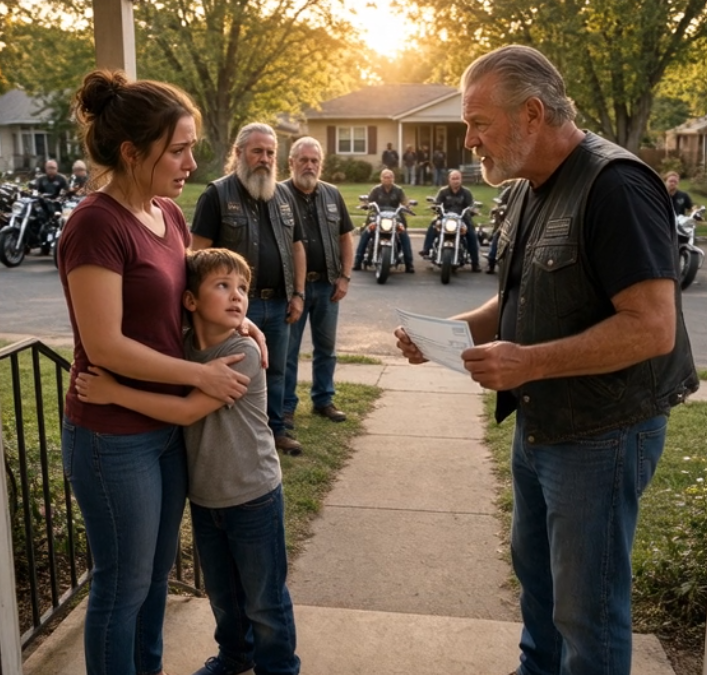
By the time they reached the front entrance, most of the building seemed to have gathered outside.
Mr. Alvarez from 2C held his phone up, filming.
Mrs. Henley muttered, “Put that away, Leonard.”
He lowered it halfway.
Across the courtyard, neighbors from the other buildings had stepped onto porches and balconies.
The riders remained beside their motorcycles.
Quiet.
Still.
Not blocking doors.
Not touching anyone’s property.
Just waiting.
Then one man stepped forward.
He moved with calm confidence, his presence drawing attention without a single raised voice. He was tall, with a weathered face and a beard streaked with gray. His leather vest bore a patch across the front that read HOLLOW ROAD MC.
Marissa’s stomach tightened.
The man stopped several steps away from the building.
“We’re not here to cause trouble,” he said.
His tone was steady enough to calm some people and frighten others.
Someone from the crowd called, “Then why are you all here?”
The man did not look at them.
His eyes stayed on Marissa.
“We came because of her.”
A ripple passed through the courtyard.
Tyler squeezed her hand hard.
The man continued.
“The rider she helped two nights ago—his name is Grant Holloway. Around us, we call him Ridge.”
Marissa blinked.
She had never known his name.
Grant Holloway.
Ridge.
Names made people more real.
“He told us what happened,” the man said. “He said a woman with almost nothing still chose to help him.”
Marissa’s throat tightened.
She became aware of her clothes.
Her old sweatpants.
Her diner T-shirt.
Her bare feet in worn flip-flops.
Her son’s hand in hers.
All the neighbors watching.
All those riders standing in the street.
“I only gave him water,” she said.
The man shook his head.
“No, ma’am.”
That word—ma’am—landed strangely coming from someone who looked like he had frightened more than one room into silence.
“You stayed.”
Marissa did not know what to say.
Two riders stepped forward carrying something large between them.
At first, Marissa could not see clearly.
Then they turned it toward her.
Gasps spread through the courtyard.
It was a check.
Not a normal check folded in an envelope.
A large ceremonial one, white board with black lettering.
Her name printed across it.
MARISSA COLE.
Her eyes moved slowly to the number.
$25,000.
For several seconds, her mind refused to process it.
Twenty-five thousand dollars was not a number in her life.
It was not rent.
Not groceries.
Not a utility bill.
Not a paycheck.
It belonged to hospital invoices, car prices, lottery dreams, and people with savings accounts.
She stared until the numbers blurred.
“No,” she whispered.
The man looked unsurprised.
“No?”
“I can’t take that.”
A few neighbors murmured.
Tyler looked up at her in panic.
The man’s expression softened.
“My name is Walter Briggs. Most call me Preacher, though I’m not one.”
Behind him, someone muttered, “That’s debatable.”
Preacher ignored it.
“Ridge is our road captain. He had a blood sugar crash and went down hard by that pump. Hit his head. He’s diabetic. He’d been riding back from visiting his sister in Muskogee, and he pushed too long without eating. Stubborn fool.”
A few riders nodded grimly.
“He said people saw him. A clerk saw him. Cars passed. You stopped.”
Marissa looked at the check.
“I bought water.”
“With the last money you had for groceries.”
Her head snapped up.
“How do you know that?”
Preacher reached into his vest and pulled out a small plastic bag.
Inside was the pain medicine packet from the gas station.
“The clerk told one of our boys. He said you counted eight dollars, asked about milk, then spent it on Ridge instead.”
Marissa closed her eyes.
Of course.
Even kindness could become public in the wrong hands.
“I didn’t do it for this.”
“We know.”
“That’s why you can’t give it to me.”
“That is exactly why we can.”
The sentence moved through the crowd.
Tyler whispered, “Mom?”
She knelt instinctively.
His eyes were wide.
“That’s a lot of money.”
“Yes.”
“Could we buy cereal?”
A sound went through the riders.
Not laughter.
Not pity.
A wounded kind of exhale.
Marissa pressed her forehead briefly against Tyler’s.
“Yes, baby.”
Then she stood.
“I appreciate it. I do. But this is too much.”
Preacher nodded.
“We expected you to say that.”
That surprised her.
He gestured, and a woman rider stepped forward.
She was in her forties, with dark hair braided over one shoulder and a vest patched with road dust.
“My name’s Jo,” she said. “I handle our foundation paperwork.”
“Foundation?”
“Hollow Road Relief Fund. Started years ago after one of our members lost his house in a tornado. We raise money all year—rides, raffles, repair days. Most of it goes to families after accidents, house fires, medical trouble. Ridge asked us to help you.”
Marissa looked from Jo to the check.
“I’m not one of your families.”
Preacher said, “You became part of our story when you knelt on concrete beside our brother.”
Marissa shook her head again, overwhelmed.
“I have bills, yes. I’m behind, yes. But other people need—”
Jo interrupted gently.
“Marissa, accepting help doesn’t steal it from someone else. We voted last night. This is what the fund is for.”
Neighbors whispered.
Mr. Alvarez lifted his phone again.
Preacher looked at him once.
The phone went down.
Jo continued.
“This check pays to you, but we’d like to structure it carefully if you’ll allow us. Rent arrears directly to the landlord. Utilities current. Car repair estimate paid to the mechanic. Grocery support. Emergency account. Not cash tossed at you in a parking lot unless that’s what you want.”
Marissa stared at her.
That was the first thing anyone had said that made sense.
Not miracle money.
A plan.
A terrifying, beautiful, impossible plan.
“My car doesn’t run,” she said stupidly.
Preacher smiled faintly.
“We heard.”
“How?”
Mrs. Henley raised one hand slowly.
Marissa turned.
The old woman looked guilty and proud at the same time.
“I may have mentioned it when they asked whether you needed anything practical.”
“Mrs. Henley.”
“They were polite.”
“You told strangers my business?”
“Honey, your business has been yelling under that hood for three months.”
Despite everything, someone laughed.
Tyler looked up at Preacher.
“Are you going to fix our car?”
Preacher crouched to Tyler’s level.
The movement reminded Marissa of someone approaching a frightened animal gently.
“We have two mechanics who think they can.”
“Is it expensive?”
“Less expensive when the labor comes with coffee and insults.”
Tyler considered this.
“Can I watch?”
Preacher looked at Marissa first.
She noticed.
He did not answer her son before asking her with his eyes.
That mattered.
“We’ll see,” she said.
Tyler nodded, satisfied enough for the moment.
Then another rider stepped forward holding several grocery bags.
Not dramatic.
Not overflowing for show.
Milk.
Cereal.
Eggs.
Bread.
Apples.
Peanut butter.
Coffee.
Marissa saw the coffee and almost lost her composure completely.
“We weren’t sure what you used,” the rider said awkwardly.
Tyler looked at the cereal.
It was the kind with too much sugar.
The kind Marissa never bought because it cost more than the plain box.
He did not ask for it.
He only looked.
Preacher noticed.
“That one’s for you,” he told him.
Tyler looked at his mother.
Marissa nodded.
He smiled then.
A real child’s smile.
Small, sudden, bright.
And that was what broke her.
Not the check.
Not the motorcycles.
Not the speeches.
The cereal.
Her son smiling because breakfast had become certain for one morning.
Marissa covered her mouth, but the sob escaped anyway.
Jo stepped closer but did not touch her without permission.
“Would you like to sit down?”
Marissa laughed through tears.
“I don’t think my legs work.”
Mrs. Henley came up on her other side.
“Then sit before you prove it.”
They guided her to the low brick wall near the entrance.
Tyler sat beside her with one arm around the cereal box like someone might take it back.
Preacher stood before the crowd.
“Listen up,” he said, not loudly, but everyone listened.
“We did not come here to embarrass Ms. Cole. We did not come here to make a show of her life. If anybody posts her face, her kid’s face, her apartment number, or anything that brings trouble to her door, you’ll answer to me first and your conscience second.”
Nobody spoke.
Marissa looked up at him.
He continued.
“She helped a man when people told her not to. That’s all anyone needs to know.”
For the first time since opening the curtain, Marissa felt safe enough to breathe.
That was when a black pickup turned onto Alder Ridge Drive.
It moved slowly because motorcycles lined both sides of the street.
The driver honked once, impatient.
No one moved.
The truck stopped near the entrance.
Rick stepped out.
Her manager.
Marissa’s stomach twisted.
He wore a polo shirt with the diner logo and sunglasses pushed onto his head. He scanned the motorcycles, the crowd, the check, the grocery bags.
Then his eyes landed on Marissa.
“What the hell is this?”
Tyler pressed closer to her.
Marissa stood automatically.
Years of needing that job pulled her upright before dignity could stop her.
“Rick.”
“You didn’t answer my texts.”
“I didn’t hear—”
“I need you in by nine. Jenny called out.”
Marissa looked at the riders.
Then at her son.
It was not even seven-thirty.
“I’m not scheduled until four.”
“You want hours or not?”
That sentence struck with practiced precision.
Rick seemed to notice the check then.
His expression changed.
“What’s that?”
Preacher’s eyes narrowed.
Jo stepped slightly forward.
Marissa felt heat rise in her face.
“It’s nothing to do with work.”
Rick laughed.
“Looks like it might mean you don’t need work.”
Fear flashed through her.
“No. I do.”
The words came too fast.
Rick heard the fear and smiled.
Men like Rick could smell desperation the way dogs smelled meat.
“Then get dressed. I’ll give you twenty minutes.”
Preacher said, “She just told you she isn’t scheduled.”
Rick looked at him.
“And you are?”
“A man listening.”
“Well, listen somewhere else. This is between me and my employee.”
Marissa wanted the ground to open.
All the money on that check, and still the old fear held her by the throat.
Because help had arrived, but bills did not clear instantly.
Because rent did not forgive embarrassment.
Because a job could still be taken.
Jo stepped in, voice calm.
“Are you threatening to fire her for not coming in outside scheduled hours?”
Rick snorted.
“I don’t have to threaten anything.”
“Good. Then don’t.”
His smile thinned.
“Lady, you don’t know how restaurants work.”
Jo reached into her pocket and pulled out a business card.
“No. But I know how labor complaints work.”
Rick blinked.
Marissa looked at her.
Jo did not look away from him.
“Also,” Jo added, “I know how community boycotts work. I know how local news loves stories about diner managers punishing single mothers because they received charitable assistance. I know how quickly riders can decide where not to eat breakfast.”
Behind her, dozens of men and women in leather remained silent.
Rick’s confidence faltered.
Preacher spoke softly.
“You came to this woman’s home before her scheduled shift to intimidate her in front of her child. I’d choose the next sentence carefully.”
Rick looked at Marissa.
For a second, she saw anger.
Then calculation.
Then retreat disguised as contempt.
“Fine. Four o’clock.”
He turned back toward his truck.
Before he got in, he called, “Don’t be late.”
Preacher’s voice followed him.
“She won’t be there.”
Marissa turned sharply.
“What?”
Rick froze.
Preacher looked at her, not Rick.
“Not if you don’t want to.”
She almost laughed from panic.
“I need my job.”
Jo said gently, “Maybe. Maybe not that one.”
“You don’t understand.”
“I understand more than you think.”
Rick drove away, tires crunching too hard over the pavement.
Marissa sat back down because her legs truly did not work.
“I can’t just quit.”
“No one said today,” Jo said. “But we can help you plan. That matters more.”
Plan.
There was that word again.
A plan felt more dangerous than charity.
Charity could be a moment.
A plan meant imagining tomorrow might be different.
The rest of that morning unfolded in pieces Marissa would remember for years.
Two riders named Cash and Raymond examined her dead car behind the apartment building. Cash had a shaved head, tattooed arms, and a voice so gentle Tyler kept asking him questions. Raymond had a white beard, coveralls, and the air of a man who trusted engines more than humans but was willing to make exceptions.
They discovered the fuel pump had failed and the battery had gone flat from sitting too long.
“Not hopeless,” Raymond declared.
Marissa almost cried again.
Not hopeless.
She wished he could examine her life and say the same.
Jo sat with her at Mrs. Henley’s kitchen table and made a list.
Rent arrears.
Electric bill.
Water bill.
Tyler’s school field trip.
Car repair.
Groceries.
Phone bill.
Medical debt from Tyler’s urgent care visit last winter.
A payday loan Marissa had taken once and regretted every week since.
Jo did not scold.
Did not widen her eyes.
Did not say, “Why would you agree to these terms?”
She simply wrote everything down.
Preacher called Ridge from the sidewalk.
Grant Holloway.
The man from the gas station.
He was still in the hospital under observation for the head injury and diabetic crash. He insisted on speaking to Marissa.
Preacher handed her the phone.
Marissa held it like it might burn her.
“Hello?”
A rough voice came through.
“Marissa?”
“Yes.”
“It’s Ridge.”
“I heard.”
A pause.
“I’m sorry we scared your street.”
She laughed once.
“You kind of did.”
“Preacher enjoys making an entrance.”
“I heard you’re okay.”
“Because of you.”
“I just stayed until the ambulance came.”
“That’s the part.”
She closed her eyes.
He continued.
“I remember asking why you helped me.”
“Yes.”
“I’ve been thinking about what you said.”
Marissa said nothing.
“Because someone should,” he repeated quietly. “That one’s been sitting on my chest since I woke up.”
“I didn’t mean anything big by it.”
“That’s usually when words are true.”
She looked through Mrs. Henley’s window at the motorcycles.
“I can’t take twenty-five thousand dollars from strangers.”
“You didn’t.”
“What?”
“You took eight dollars from your son’s breakfast and spent it on me.”
Her throat closed.
He continued.
“We’re not repaying kindness. You can’t repay that. We’re answering it.”
Marissa pressed the phone tighter.
“I was scared.”
“So was I.”
“I didn’t know if you’d wake up angry.”
“I probably looked like someone’s bad decision.”
“A little.”
He laughed, then winced audibly.
“Don’t make me laugh. Head hurts.”
“Sorry.”
“No. I needed that.”
Silence.
Then his voice changed.
“Take the help, Marissa. Not because you owe us. Because your boy deserves breakfast and you deserve one day where the whole weight isn’t on your back.”
She wiped her face.
“I don’t know how.”
“Then let Jo show you.”
That was the first time Marissa said yes.
Not loudly.
Not dramatically.
Just one small yes into a borrowed phone.
By noon, the motorcycles had left Alder Ridge Drive in small groups.
Preacher had been careful about that too.
No roaring departure.
No parade.
No performance.
Just riders slipping away after making sure the street returned to itself.
But Alder Ridge did not return to what it had been.
Not exactly.
Mrs. Henley came upstairs with Marissa, carrying two grocery bags despite Marissa telling her not to.
Tyler carried the cereal.
He placed it on the counter carefully, then turned to his mother.
“Can I have some now?”
Marissa laughed.
It came out watery.
“Yes.”
“With milk?”
“With milk.”
He hesitated.
“Is milk expensive?”
She knelt in front of him.
“Today, you don’t have to worry about that.”
He studied her face.
“Are we rich?”
“No.”
“Are we okay?”
Marissa looked around the apartment.
Peeling paint near the window.
Couch bed.
Stack of unpaid bills on the counter.
Grocery bags full for the first time in weeks.
“I think,” she said carefully, “we might be getting help becoming okay.”
Tyler nodded.
“That’s good.”
Then he poured cereal into a bowl and used too much milk.
Marissa did not correct him.
She drank real coffee while he ate.
The first sip nearly made her emotional all over again.
At three-thirty, her phone buzzed.
Rick.
Where are you?
She stared at the message.
Her thumb hovered.
Every survival instinct told her to apologize.
To say she was coming.
To beg without sounding like begging.
Then another message arrived.
Don’t make me regret giving you hours.
Marissa’s chest tightened.
Jo had left her card on the counter.
Marissa picked it up and turned it between her fingers.
At four, Rick called.
She did not answer.
At four-ten, he texted:
Don’t come back.
Marissa stared at the screen.
There it was.
The thing she had feared.
The job gone.
The floor dropping.
The punishment delivered.
But instead of panic, she felt something unexpected.
A quiet, hollow space.
Then anger.
Not explosive.
Not loud.
Clean.
She had worked doubles.
Covered shifts.
Smiled through insults.
Skipped meals.
Begged for hours.
And he had still thrown her away the moment she was inconvenient.
Tyler looked up from his homework.
“Mom?”
She turned the phone off.
“I’m okay.”
“Really?”
She thought about lying.
Then stopped.
“I’m scared. But I’m okay.”
That evening, Jo called to check in.
Marissa told her about Rick.
Jo was silent for one beat.
Then said, “Good.”
“Good?”
“Now we can find you something better without him dangling hours over your head.”
“I need income.”
“Yes. And you have restaurant experience, references if we avoid Rick, and transportation soon. Also, Ridge owns a small logistics company.”
Marissa blinked.
“What?”
“He started it after he got out of the Army. Motorcycle parts, custom deliveries, warehouse contracts. Office needs an inventory clerk. Better hours. Health insurance after ninety days. He told me not to mention it unless you lost the diner or wanted out.”
Marissa sat down.
“Why would he offer me a job?”
“He isn’t offering charity. He needs someone reliable. You raised a kid alone, worked diner shifts, managed bills with nothing, and stopped for a bleeding stranger when everyone else looked away. Reliability is not the question.”
Marissa pressed her hand to her eyes.
“I don’t know how to do inventory.”
“You can learn.”
“What if I mess it up?”
“Then someone teaches you.”
That sentence landed harder than it should have.
Someone teaches you.
Not punishes.
Not cuts your hours.
Teaches.
The next morning, Cash and Raymond returned with parts for the car.
Tyler watched from a safe distance wearing borrowed safety glasses that kept sliding down his nose.
Cash explained each step as if Tyler were an apprentice.
“This right here is the fuel pump assembly.”
Tyler nodded seriously.
“Is it expensive?”
Cash glanced at Marissa, then back at Tyler.
“It can be. But sometimes people have spare parts, discounts, and friends who owe them favors.”
Raymond snorted.
“I don’t owe favors. I collect them.”
Cash ignored him.
Tyler asked, “Do motorcycles have fuel pumps?”
“Some do.”
“Do they break?”
“Everything breaks eventually.”
Tyler thought about that.
“Then people fix them?”
Cash smiled.
“If they can.”
“And if they can’t?”
“Then they ask someone who knows.”
Tyler nodded again.
That afternoon, the car started.
The sound was not pretty.
It coughed.
Shook.
Complained.
But it started.
Marissa stood behind it with both hands over her mouth.
A working car did not solve life.
But it changed the size of the cage.
For three months, every grocery trip had depended on distance, bus schedules, weather, and how much Tyler could carry without complaining. Every job opportunity beyond one bus line might as well have been in another state. Every emergency had carried the added terror of transportation.
Now the engine turned.
Raymond leaned out the window.
“She needs tires soon.”
Marissa’s heart sank.
He pointed at her before she could speak.
“Soon does not mean today. Today means she runs.”
Tyler cheered.
Cash laughed.
Marissa cried again, which was starting to become embarrassing.
“You cry a lot,” Raymond observed.
Cash elbowed him.
Marissa wiped her face.
“I’m storing up.”
Raymond considered that, then nodded.
“Fair.”
Three days after the motorcycles came, Marissa visited Ridge in the hospital.
She almost did not go.
The thought of entering that room made her nervous in a way she could not explain. It was easier to help a stranger for ten minutes in the dark than to stand in daylight with the consequences of that help.
But Tyler insisted on making a card.
He drew a motorcycle with wheels that looked like pancakes and wrote:
GET WELL RIDGE
THANK YOU FOR THE CEREAL
Marissa told him maybe not to mention cereal.
Tyler said, “But I am thankful.”
So the cereal stayed.
Ridge was sitting up when she arrived.
Without blood, without concrete, without the half-conscious confusion, he looked different.
Still large.
Still intimidating at first glance.
But tired.
Human.
There was a bandage near his temple and bruising along one cheekbone. His beard was trimmed close, and his left arm had an IV taped in place.
He looked at the card first.
Then at Marissa.
“I was hoping to meet the cereal expert.”
“He’s in school.”
“Good place for him.”
She stood awkwardly near the door.
He nodded toward the chair.
“Please sit.”
She did.
For a moment, neither spoke.
Then Ridge said, “Preacher said we overwhelmed you.”
“A little.”
“He does that.”
“He also scared my manager.”
“Then I forgive him.”
She smiled despite herself.
Ridge turned the card over carefully.
“Your boy draw this?”
“Yes.”
“It’s a good bike.”
“The wheels are questionable.”
“I’ve ridden worse.”
The silence that followed was easier.
Then he said, “I need to say this right.”
Marissa braced.
“I was alone a long time before you walked out.”
She looked at him.
“I don’t know how long exactly. Long enough to hear people drive by. Long enough to understand I couldn’t get up.”
His voice remained steady, but his hand tightened slightly on the blanket.
“I’ve been in worse places. Afghanistan. Roads where stopping could get you killed. But that gas station…” He paused. “That scared me more than I want to admit.”
Marissa whispered, “Why?”
“Because people saw me and decided what I was before they decided whether I was alive.”
She swallowed.
“I almost listened to the clerk.”
“But you didn’t.”
“No.”
“That matters.”
She looked down.
“I was thinking about Tyler.”
“Your son?”
“Yes. I thought if he were ever hurt, I’d want someone to help before deciding if he looked worth helping.”
Ridge nodded slowly.
“That’s about the best moral code I’ve heard.”
“It’s not much.”
“It’s enough.”
He reached toward the bedside table and picked up a small envelope.
“My sister brought this. It’s not money.”
Marissa almost laughed.
“You have to say that now?”
“Yes. Apparently.”
She took it carefully.
Inside was a photograph.
Ridge younger, thinner, standing in desert camouflage beside a military truck. Beside him was another soldier with his arm slung around Ridge’s shoulder. Both men were grinning like idiots.
“My brother,” Ridge said.
“Actual brother?”
“Best friend. Close enough. His name was Marcus.”
Marissa looked at the photo.
“He died?”
“Yeah.”
“I’m sorry.”
“Me too.”
He looked toward the window.
“After he died, his wife and little girl were in bad shape. Hollow Road helped them. Rent, food, school clothes. Back then, I was too proud to accept anything for myself, but I watched what help did for them.”
He nodded at the envelope.
“That fund saved my goddaughter from sleeping in a car. So when Preacher told you what the fund was, he meant it. This is not rich men playing hero.”
“I didn’t think—”
“You did a little.”
She flushed.
He smiled faintly.
“It’s okay. I would have too.”
He leaned back.
“Help can feel like a hook when life teaches you everything has a catch.”
Marissa stared at him.
That sentence knew too much.
Ridge continued.
“This doesn’t. The job offer doesn’t either. If you interview and you don’t want it, you walk away. If you take it and hate it, you leave. If you take it and outgrow it, good.”
She held the photo carefully.
“Why are you doing all this?”
He looked at her like the answer was obvious.
“Because someone should.”
The words returned between them.
Marissa smiled, but tears gathered anyway.
Ridge saw them and looked alarmed.
“I said that wrong?”
“No.”
“Preacher says I’m bad at delicate conversations.”
“You’re fine.”
“Good. Because he also says I’m not allowed to make you cry anymore.”
She laughed.
For the first time in a long time, it did not hurt.
The job interview took place the following Monday.
Marissa wore the best clothes she had: black pants, a clean blouse, and shoes with the soles beginning to separate at the edges. She had glued them the night before and prayed they would hold.
The company was called Holloway Route & Repair.
It operated from a warehouse on the west side of Tulsa, not glamorous but clean, busy, and organized. Motorcycle parts lined shelves in labeled bins. A small office overlooked the loading floor through a window.
Ridge was not there.
He was still recovering.
Jo met her instead.
So did a woman named Denise, who ran the office with the calm authority of someone who could locate a missing invoice from 2018 in under thirty seconds.
Denise did not ask personal questions.
She asked about Marissa’s work history.
Computer comfort.
Scheduling.
Whether she could lift twenty pounds if needed.
How she handled mistakes.
Marissa answered honestly.
“I haven’t worked inventory before. But I learn fast, and I write everything down.”
Denise nodded.
“Good. People who don’t write things down scare me.”
By the end of the interview, Marissa’s hands had stopped sweating.
Denise walked her to the door.
“I’ll be direct. Ridge wants us to give you a chance. I don’t hire people because Ridge gets sentimental.”
Marissa’s stomach tightened.
“But,” Denise continued, “I like that you showed up early, brought references, admitted what you don’t know, and asked three practical questions about the job. I can work with that.”
Marissa could barely breathe.
“So…”
“So training starts Wednesday if you want it.”
Marissa gripped her folder.
“Yes.”
The word came out too quickly.
Denise smiled.
“Good. Don’t be late.”
Then she added, “And don’t come in sick. We’re not a diner. We can survive one person having a fever.”
Marissa walked to her car in a daze.
Her car.
Running.
With half a tank of gas paid for by the relief fund because Jo had said transportation assistance counted as part of stabilization, which sounded official enough that Marissa had stopped arguing.
She sat behind the wheel and called Mrs. Henley first.
“I got it.”
The older woman whooped so loudly Marissa had to pull the phone away.
Then she called Tyler’s school and left a message approving the field trip.
Then she sat there with both hands on the steering wheel and whispered, “Okay.”
Not everything was fixed.
That was the part stories often skipped.
The relief fund paid her rent arrears, but she still had to budget future rent.
The payday loan company did not care that a motorcycle club disliked predatory interest.
Jo helped negotiate a payoff anyway.
The car ran, but Marissa drove carefully, listening for every sound.
Tyler still sometimes asked if expensive things were allowed.
Marissa still woke at night calculating numbers before remembering some of them had changed.
Trauma does not disappear the moment help arrives.
Poverty trains the body to expect collapse.
It takes time to believe the floor will hold.
The first week at Holloway Route & Repair, Marissa came home exhausted in a new way.
Not diner exhausted.
Not feet swollen, back aching, smile muscles dead exhausted.
This was mind tired.
Part numbers.
Shipping codes.
Invoices.
Inventory software.
Denise corrected her without cruelty.
“Wrong column.”
Marissa winced.
“Sorry.”
“Don’t apologize. Fix it.”
That became a strange comfort.
Do not apologize.
Fix it.
By the third week, Marissa could process incoming shipments without asking every five minutes.
By the fifth, she caught a mislabeled box before it went out.
Denise nodded approvingly.
“Good eye.”
Marissa carried those two words home like treasure.
Tyler changed too.
Not all at once.
He stopped saving half his snacks “for later” in strange places around the apartment.
He began asking for things again, cautiously at first.
“Can we maybe get apples?”
“Can I do the field trip?”
“Can I invite Jamal over?”
Each question was a sign of returning childhood.
One Friday evening, Marissa took him grocery shopping in their repaired car.
He sat in the cart even though he was too old for it, legs hanging awkwardly, laughing when she told him he looked ridiculous.
They bought cereal.
Milk.
Chicken.
Rice.
Coffee.
Apples.
A small pack of cookies because Tyler looked at them and then looked away.
“Put them in,” Marissa said.
He blinked.
“Really?”
“Really.”
“Are you sure?”
“Yes.”
He placed them in the cart carefully.
At checkout, Marissa paid with money she had earned from her new job.
Not borrowed.
Not donated.
Earned.
The receipt printed.
She held it for a second longer than necessary.
Tyler noticed.
“Mom?”
“Nothing.”
“You’re crying again.”
“I told you, I stored up.”
He grinned.
Then he hugged her in the checkout lane, and the woman behind them pretended not to watch.
Ridge returned to the warehouse six weeks after the accident.
He came in limping slightly, moving slower than he probably wanted anyone to see. The entire floor pretended not to make a fuss and failed terribly.
Cash clapped him on the shoulder too hard.
Denise told him he looked like roadkill but slightly better organized.
Jo hugged him.
Preacher inspected him silently, then said, “You’re still ugly.”
Ridge replied, “Good to be home.”
When he reached Marissa’s desk, she stood.
“Welcome back.”
He smiled.
“You still here?”
“So far.”
“Denise hasn’t scared you off?”
“Almost.”
“Good. That means she likes you.”
From the office window, Denise shouted, “I can hear you.”
Ridge lowered his voice dramatically.
“She can hear dust settle.”
Marissa smiled.
Then Tyler appeared from behind a shelf.
It was after school, and Marissa had permission to let him sit in the break room until her shift ended.
He held out his hand.
“Hi. I’m Tyler.”
Ridge looked at the hand.
Then shook it seriously.
“Grant Holloway.”
“Are you Ridge?”
“To some people.”
“Can I call you Ridge?”
“Yes.”
Tyler studied him.
“Thank you for helping my mom get a job.”
Ridge glanced at Marissa.
“She got the job herself.”
“But you told them about her.”
“I told them she existed. She handled the rest.”
Tyler seemed to like that answer.
“My cereal drawing was accurate,” he said.
“Very.”
“The wheels were bad.”
“I’ve ridden worse.”
Tyler laughed.
Marissa watched them and felt something careful open in her chest.
Not romance.
Not anything so simple.
Community, maybe.
The terrifying beginning of belonging.
Months passed.
Alder Ridge Drive changed its opinion of the motorcycles.
At first, neighbors whispered when a rider came by.
Then they got used to Cash stopping occasionally to check the car.
Jo dropping off paperwork.
Preacher bringing a used desk for Tyler because he had heard the boy did homework on the coffee table.
Mrs. Henley developed an alarming friendship with Raymond after he fixed her window latch and she fed him banana bread.
“He has manners,” she told Marissa.
“He grunts.”
“With manners.”
Tyler began spending one Saturday a month at the warehouse learning basic mechanics under strict supervision. He wore safety glasses and took the rules seriously. Cash taught him how to identify tools. Raymond taught him that every repair began with listening. Preacher taught him how to sweep properly because “everybody wants to touch the machine, nobody wants to respect the floor.”
One afternoon, Tyler asked Ridge, “Do bikers have to be scary?”
Ridge considered this.
“No.”
“Then why do people think that?”
“Some bikers are scary. Some people are scared before they know anything. Both can be true.”
Tyler thought about that.
“My mom was scared.”
“Smart woman.”
“But she helped you.”
“Brave woman.”
“Can you be both?”
Ridge looked toward Marissa, who was checking inventory nearby.
“Yes,” he said. “Most brave people are.”
Marissa pretended not to hear.
She heard every word.
The large check did not hang on their wall.
Marissa refused.
Instead, Jo helped her keep a small folder labeled STABILITY PLAN.
Rent paid.
Utilities current.
Car repaired.
Emergency savings opened.
Payday loan closed.
Tyler’s school account credited for lunches and field trips.
At first, the folder made Marissa nervous.
Then it became proof.
Not that life could not go wrong.
It could.
It would.
But proof that she had survived one season and entered another.
Rick, her former manager, tried calling twice after word spread that several regular customers had stopped visiting the diner.
Marissa did not answer.
Later, she heard he told people she had “gotten lucky.”
Maybe she had.
But luck had not made her kneel on concrete beside a stranger.
Luck had not made her work through years of exhaustion.
Luck had not taught her son kindness in a home with almost nothing.
Luck was too small a word for all of that.
One year after the gas station, Hollow Road held a charity breakfast ride.
The money went to their relief fund.
Ridge asked Marissa if she would speak.
She said no immediately.
Then Tyler said, “You should.”
“No.”
“You tell me to do scary things when they matter.”
“That is extremely unfair.”
“I learned from you.”
She spoke.
Not long.
Not perfectly.
Standing on a small stage in the warehouse lot, looking out at riders, families, neighbors, and people who had come because stories travel, Marissa held the microphone with both hands.
“I don’t know how to give speeches,” she began.
Preacher called from the crowd, “That’s never stopped me.”
People laughed.
Marissa smiled.
Then she looked at Tyler in the front row.
“A year ago, I had eight dollars. I was tired. I was scared. And I thought helping someone meant losing something my son needed.”
Her voice shook, but she continued.
“I did lose the groceries that night. That part is true. But I learned something after. Kindness is not always a trade where one person loses and another wins. Sometimes kindness is a door. You open it for someone else, and people you never expected come through it carrying tools, groceries, job applications, and cereal.”
Laughter moved through the crowd.
Tyler grinned.
Marissa looked toward Ridge.
“I helped one man for a few minutes. This club helped my son and me for a year. Not by treating us like a sad story. By helping us stand.”
She swallowed.
“So if you give today, don’t think of it as charity. Think of it as answering someone’s ‘because someone should.’”
The applause came gently at first.
Then louder.
Ridge stood in the back, arms folded, eyes bright.
Preacher wiped his face and claimed allergies.
Jo hugged Marissa when she stepped down.
Tyler said, “You did good.”
“Just good?”
“Really good.”
“I’ll take it.”
That year, the charity ride raised more money than any before.
Some of it went to a family after a house fire.
Some to medical bills for a mechanic’s wife.
Some to school supplies for children in Alder Ridge.
Marissa helped process the paperwork.
She liked that part best.
The quiet part.
The part no one photographed.
Three years later, Marissa no longer lived at Alder Ridge.
She and Tyler moved into a small rental house with a patchy yard and a kitchen window over the sink. It was not fancy. The bathroom faucet squeaked. The bedroom doors did not close unless lifted slightly. But Tyler had his own room.
The first night, he stood in the doorway looking at the bed.
A real bed.
Not a couch.
Not folded towels over a spring.
He ran one hand over the blanket.
“Can I sleep here?”
Marissa laughed.
“It’s your room.”
“I know. But tonight?”
“Every night.”
He turned away quickly, embarrassed by his own tears.
Marissa pretended not to see.
Later, after he fell asleep, she stood in the kitchen holding a mug of coffee she had bought without calculating what it meant for milk.
Her phone buzzed.
A message from Ridge.
You settled?
She replied:
Getting there.
He wrote back:
Good. Call if the faucet explodes.
She smiled.
The faucet did not explode until two months later.
Raymond fixed it while complaining about modern plumbing.
Tyler grew.
Children do that no matter how often mothers silently ask them to slow down.
At twelve, he knew more about engines than Marissa ever would.
At thirteen, he began volunteering at Hollow Road charity events, carrying boxes, sweeping floors, and showing younger kids how to wear safety glasses.
At fourteen, he saved his own money to buy Marissa a new coffee mug.
It said:
BECAUSE SOMEONE SHOULD
She cried, obviously.
He rolled his eyes.
“You cry at mugs now?”
“I’m versatile.”
At sixteen, Tyler got his first part-time job at Holloway Route & Repair, filing, sweeping, learning inventory, and spending too much time asking Raymond questions.
Marissa watched him walk across the warehouse floor in steel-toe boots and felt the ache of time.
Ridge came to stand beside her.
“He’s a good kid.”
“Yes.”
“You did that.”
She shook her head.
“We had help.”
“Help doesn’t raise a boy. It gives the person raising him room to breathe.”
She looked at him.
“You always say things like that when I’m trying not to cry.”
“I have bad timing.”
“No,” she said. “You don’t.”
Ridge had become part of their lives in the way steady people do.
Not by dramatic declarations.
By showing up.
School events.
Warehouse cookouts.
One terrifying afternoon when Tyler broke his wrist falling off a borrowed skateboard and Ridge beat Marissa to the emergency room because he had been closer.
He never tried to become Tyler’s father.
That mattered.
Tyler had a father, somewhere, a man who had left when responsibility became heavier than his interest. Marissa did not speak cruelly of him, though she had earned the right. Tyler understood enough as he grew.
Ridge became something else.
Not replacement.
Not charity.
A witness.
A mentor.
A safe adult.
A man who had once lain bleeding at a gas station and later taught Tyler how to change oil, hold boundaries, and never let fear decide whether another person deserved help.
On the tenth anniversary of that Tuesday morning, Hollow Road held the charity ride on Alder Ridge Drive.
Mrs. Henley still lived there, older now, using a walker with purple tennis balls on the legs. She sat in a folding chair like royalty while riders arrived.
The apartment building looked smaller to Marissa than it had in memory.
The stairs she had once climbed exhausted seemed narrow.
The courtyard where the check had appeared was cracked in places.
A new family lived in her old unit.
A little girl pressed her face to the second-floor window, watching motorcycles below.
Marissa stood near the brick wall where she had sat crying years earlier.
Tyler, now eighteen, stood beside her.
Tall.
Broad-shouldered.
Kind-eyed.
He wore a Hollow Road volunteer shirt and kept jingling car keys in his pocket because he had recently earned his license and believed this made him subtle.
Preacher, older but no less imposing, stepped up beside them.
“You remember this spot?”
Marissa smiled.
“I remember thinking my legs stopped working.”
“They did. Mrs. Henley and Jo had to park you there.”
Mrs. Henley shouted from her chair, “And she argued!”
“I did not,” Marissa called back.
“You did with your eyes.”
Tyler laughed.
Ridge arrived last.
Not on the same motorcycle from that night. That one had been repaired and later retired after too many miles. He parked carefully, removed his helmet, and walked toward them.
His beard was grayer now.
A faint scar remained near his temple.
Marissa noticed it every time.
Not with guilt anymore.
With gratitude.
Proof that people survive moments that might have gone another way.
The charity breakfast tables were set up along the street.
Neighbors came.
Riders came.
Children climbed onto parked motorcycles with permission and supervision.
Nobody posted faces without asking.
That rule had endured.
During the event, a young woman approached Marissa.
She held a toddler on one hip and looked exhausted in a way Marissa recognized immediately.
“Are you Marissa Cole?”
“Yes.”
The woman shifted the child.
“I got help from the fund last winter. My apartment flooded. They said…” She looked toward the riders. “They said the fund grew because of your story.”
Marissa shook her head.
“It grew because people gave.”
“But you started something.”
“No,” Marissa said softly. “I answered something.”
The woman frowned slightly.
Marissa looked toward Ridge, who was pretending not to lose an argument with Tyler about carburetors.
“A man was hurt. I helped. Then people helped me. That’s all.”
“That’s not all.”
Marissa smiled.
“No. But it’s enough.”
Later, when the ride began, engines filled Alder Ridge Drive again.
This time, no fear moved through Marissa.
Only memory.
The sound rolled through the street, deep and steady.
Ten years earlier, that sound had made her hands shake.
Now it sounded like arrival.
Like community.
Like a promise made in steel and thunder.
Tyler stood beside her as the first bikes pulled away.
“Mom?”
“Yeah?”
“Did you ever regret spending the eight dollars?”
She looked at him.
He was not asking as a child anymore.
He was old enough now to understand what eight dollars had meant then.
Milk.
Cereal.
Breakfast.
A mother’s failure, if you looked at it harshly.
A stranger’s survival, if you looked at it another way.
“No,” she said.
“Not even that night?”
She thought about the walk home.
The ruined towel.
The empty wallet.
The toast with no butter.
Tyler asking if the man said thank you.
“I was scared that night,” she said. “I wondered if I had made your life harder.”
“You did.”
The honesty startled her.
Then he smiled.
“For like one day.”
She laughed.
He continued.
“Then you made it bigger.”
“What?”
“My life.”
The motorcycles rolled past.
Tyler looked at them, then back at her.
“You always say you just bought water. But you showed me something.”
Marissa’s eyes burned.
He nudged her shoulder gently.
“Don’t cry.”
“You know that never works.”
“I know.”
“What did I show you?”
He thought for a moment.
“That being broke doesn’t mean you have nothing to give.”
Marissa closed her eyes.
For years she had carried guilt about what Tyler had seen.
Empty cabinets.
Late notices.
Her exhaustion.
Her fear.
She had worried poverty had taught him scarcity too deeply.
Maybe it had.
But perhaps it had also taught him something else.
That kindness was not a luxury item.
That dignity could survive an empty wallet.
That people were not measured by what they had left after giving, but by what they chose when giving cost them something.
Ridge’s bike rolled toward them near the end of the line.
He slowed.
Lifted two fingers from the handlebar in greeting.
Marissa lifted her hand.
Tyler did too.
Then Ridge rode on.
The engines faded down the street, just as they had that first morning.
But this time, the silence left behind was not heavy.
It was full.
Mrs. Henley waved Marissa over for coffee from a thermos.
Preacher argued with a folding table.
Jo coordinated volunteers with a clipboard.
Raymond complained about the placement of extension cords.
Cash showed a small boy how to check tire pressure.
Tyler went to help unload supplies.
Marissa stood for a moment alone on the curb.
Alder Ridge looked ordinary again.
Sprinklers.
Brick.
Old stairs.
Morning light.
But she knew better now.
Ordinary places could hold turning points.
A gas station pump.
A second-floor apartment window.
A cracked courtyard.
A street full of motorcycles.
Years later, people still told the story in ways that made it sound simple.
A single mother spent her last eight dollars.
Bikers came back with a check.
Her life changed.
That was true.
But it was not the whole truth.
The whole truth was less shiny and more important.
A woman was tired and poor and scared, and she helped anyway.
A man who looked dangerous was actually vulnerable.
A club people judged from a distance had spent years quietly saving its own and then decided she was one of the people worth saving too.
A child ate cereal and learned generosity did not belong only to people with full cupboards.
A job was lost.
A better one was found.
A car started.
A folder marked STABILITY PLAN slowly filled with crossed-off debts.
A boy grew into a young man who understood engines, boundaries, and mercy.
A mother learned that accepting help did not make her weak.
And a sentence spoken on cold concrete became a kind of family motto.
Because someone should.
Not because it was easy.
Not because it was safe.
Not because anyone was watching.
Because someone was bleeding.
Because someone was hungry.
Because someone was tired.
Because someone had to take the first step through the door.
That had been Marissa’s step.
Eight dollars.
A bottle of water.
A cloth against a stranger’s head.
The world answered louder than she ever expected.
But the answer did not begin with engines.
It began in the quiet space before them, when one woman looked at a man everyone else was willing to leave on the ground and decided that fear would not get the final word.
On the tenth anniversary, after the riders had gone and the tables were cleared, Marissa returned home with Tyler.
Their house smelled faintly of coffee and laundry soap.
On the kitchen shelf sat the mug he had given her.
BECAUSE SOMEONE SHOULD.
She touched it as she passed.
Tyler dropped his keys into the bowl by the door.
“Dinner?”
“You’re eighteen. You can cook.”
“I can heat things.”
“That is not the same.”
“I learned from you.”
“Rude.”
He grinned.
They made grilled cheese and tomato soup, a meal they had eaten often in the hard years because it was cheap. Now they ate it because they liked it.
Halfway through dinner, Tyler said, “I’m thinking about applying to the technical college.”
Marissa looked up.
“For mechanics?”
“And business classes. Maybe both.”
Her heart swelled.
“That sounds like you.”
“I talked to Ridge.”
“Of course you did.”
“He said knowing how to fix machines is good, but knowing how to run the shop keeps the doors open.”
“Smart.”
“He also said I should ask you because you’re the one who knows about surviving impossible budgets.”
Marissa laughed.
“Sadly true.”
Tyler grew serious.
“I want to work with the fund someday. Maybe help people with cars so they don’t lose jobs because they can’t get there.”
Marissa set her spoon down.
There it was again.
Kindness moving forward.
Not repaid.
Continued.
“That would be wonderful.”
“You think so?”
“I know so.”
He nodded, pretending that did not mean much.
It did.
Later that night, after Tyler went to his room, Marissa stood on the porch.
The street outside their little rental was quiet.
No motorcycles.
No crowd.
No giant check.
Just crickets and the low sound of traffic somewhere far away.
She thought of the woman she had been ten years earlier, holding hot water in a chipped mug because coffee was gone.
She wished she could tell that woman something.
Not that everything would become easy.
It would not.
Not that help would erase fear.
It would not.
Not that one act of kindness would magically solve every problem.
It would not.
She would tell her this:
Do it anyway.
Help anyway.
Say yes when good people offer good help.
Let your son see you scared and brave at the same time.
Let the world surprise you.
Let kindness come back louder than it left.
Inside, Tyler laughed at something on his phone.
The sound carried through the open window.
Marissa smiled.
The life she had now was not perfect.
Perfect had never been the promise.
It was steady.
It was honest.
It had food in the kitchen, coffee in the cabinet, and people she could call if the car made a sound she did not trust.
It had a son who asked big questions.
It had work that did not humiliate her.
It had memories that no longer hurt every time they surfaced.
And somewhere across town, in a warehouse full of motorcycle parts and stubborn people, there were men and women who had once filled her street because one of their own had said:
Find her.
Thank her.
Help her stand.
Marissa looked up at the night sky.
“Thank you,” she whispered.
She did not know exactly who she meant.
Ridge.
Jo.
Preacher.
Mrs. Henley.
Tyler.
God.
The broke woman she had been.
Maybe all of them.
Then she went inside, locked the door, and rinsed their soup bowls in a sink that worked.
On the shelf, the mug waited for morning.
Because someone should.
Because someone had.
Because someone always could.








