A Single Mom Hid a Wounded K9 in Her Barn—Before Sunrise, Armed Navy SEALs Surrounded Her Home, and She Realized the Dog Had Been Running From Something Far Worse
PART3:
He stared at her with a focus that made the hair rise along the back of her neck. There was intelligence there. Not the sentimental kind people imagined when they said animals understood everything. This was sharper. Trained. Exhausted. Measuring.
Antonia crouched slowly in the rain.
The pavement soaked through the knees of her jeans.
“Okay,” she said. “I’m a nurse. I don’t know if that means anything to you, but it means something to me.”
The dog’s head lowered an inch.
As she moved closer, the flashlight caught the wound.
High on his left shoulder, dangerously near the base of his neck, blood pulsed through the soaked fur in dark, rhythmic waves.
Antonia’s breath hitched.
Gunshot.
Not buckshot from a hunter.
Not a graze from a panicked farmer.
A clean, high-velocity wound through muscle.
Professional.
Recent.
“Who shot you?” she whispered.
The dog whined low in his chest.
The sound was not weak.
It was controlled pain.
Antonia shrugged out of her jacket, ripped open the emergency medical kit she kept in the back seat, and pressed a stack of sterile gauze against the wound.
The dog’s entire body tensed.
Muscles coiled.
For one terrifying second, she thought he might take her face off.
But he did not attack.
He pressed his teeth together and stared at her with those amber eyes, breathing hard through his nose.
“That’s it,” she murmured. “That’s it. I know. I know it hurts.”
Rain ran down her neck and into her shirt.
Blood soaked through the gauze.
She added more pressure.
The dog trembled.
“Listen to me,” she said, because talking kept her from panicking. “I’m going to help you, but you have to help me too, because you are huge, and I have not been to the gym since my son was born.”
The dog blinked once.
It was ridiculous, but it felt like permission.
Getting him into the Subaru should have been impossible.
Maybe it was.
Maybe adrenaline is just another word for doing impossible things before your body realizes it should refuse.
Antonia lowered the back seats, dragged out the thermal emergency blanket from her trunk, and coaxed the dog inch by inch toward the open hatch.
He tried to stand.
His front legs buckled.
She caught part of his weight and nearly went down with him.
“Easy, easy, easy.”
He leaned against her.
Ninety pounds of wet fur, blood, Kevlar, and fading strength.
She hooked both arms under his chest, ignoring the hot pull in her lower back, and half-lifted, half-dragged him into the back of the car. He collapsed onto the blanket with a sound that made her stomach twist.
“I know,” she whispered. “I’m sorry. I’m sorry.”
She kept one hand pressed to his wound while fumbling for another bandage with the other.
Her phone still had no service.
The nearest emergency vet was almost an hour away in good weather. In this storm, with that wound, he would bleed out before they reached it.
Her farmhouse was four miles away.
Her barn had lights, heat, clean water, medical supplies she had accumulated over years of rural emergencies and bad roads.
She made the decision before she could think herself out of it.
“Home first,” she said.
The dog’s eyes followed her as she climbed back into the driver’s seat.
The drive to her property felt endless.
Every curve seemed sharper. Every fallen branch looked like a roadblock. Rain smashed against the windshield so hard the wipers blurred. In the rearview mirror, she could see the dog lying still except for the rise and fall of his ribs.
“Stay with me,” she kept saying.
Stay with me.
Stay with me.
Stay with me.
The words became prayer, command, and bargaining all at once.
The gravel driveway appeared at last, a narrow cut between trees leading to the farmhouse her grandfather had left her five years earlier.
It was isolated.
Too isolated, some people said.
A white two-story house with a wraparound porch, peeling green shutters, and a detached insulated barn behind it. Dense timber pressed close on three sides. The nearest neighbor lived more than a mile away. Antonia used to love that privacy.
That night, as the Subaru rolled past the dark windows of the house where Leo slept, the isolation felt different.
Heavier.
She drove straight to the barn.
The big sliding door groaned on its track. Fluorescent lights flickered on overhead, harsh and white against the old wooden beams. Tools hung along one wall. Her grandfather’s workbench still stood beneath the east window. A metal utility sink sat near shelves stacked with towels, paint cans, extra blankets, and old jars of screws sorted by a logic only her grandfather had understood.
Antonia backed the Subaru as close as possible and hauled the dog inside on the emergency blanket.
By the time she got him onto a pile of old quilts near the space heater, she was soaked, shaking, and breathing like she had run miles.
But the moment she knelt beside him, the ER took over.
Gloves.
Scissors.
Light.
Pressure.
Assess airway, breathing, circulation.
Check gums.
Pulse.
Pupils.
Wound track.
She unbuckled the Kevlar vest carefully.
It was heavier than she expected and far more advanced than any police K9 gear she had seen. Ballistic plating. Reinforced seams. A wiring system woven into the lining. A crushed transponder module blinked weakly near the collar attachment.
Red.
Red.
Red.
A signal.
Something cold moved through her stomach.
The dog watched her.
Antonia stared at the blinking module.
Every instinct told her that whoever had shot this dog might be looking for that signal.
“Sorry, buddy,” she whispered.
She grabbed a wrench from the bench and smashed the module until the blinking stopped.
The barn seemed to go quieter.
Outside, thunder rolled across the trees.
She turned back to the wound.
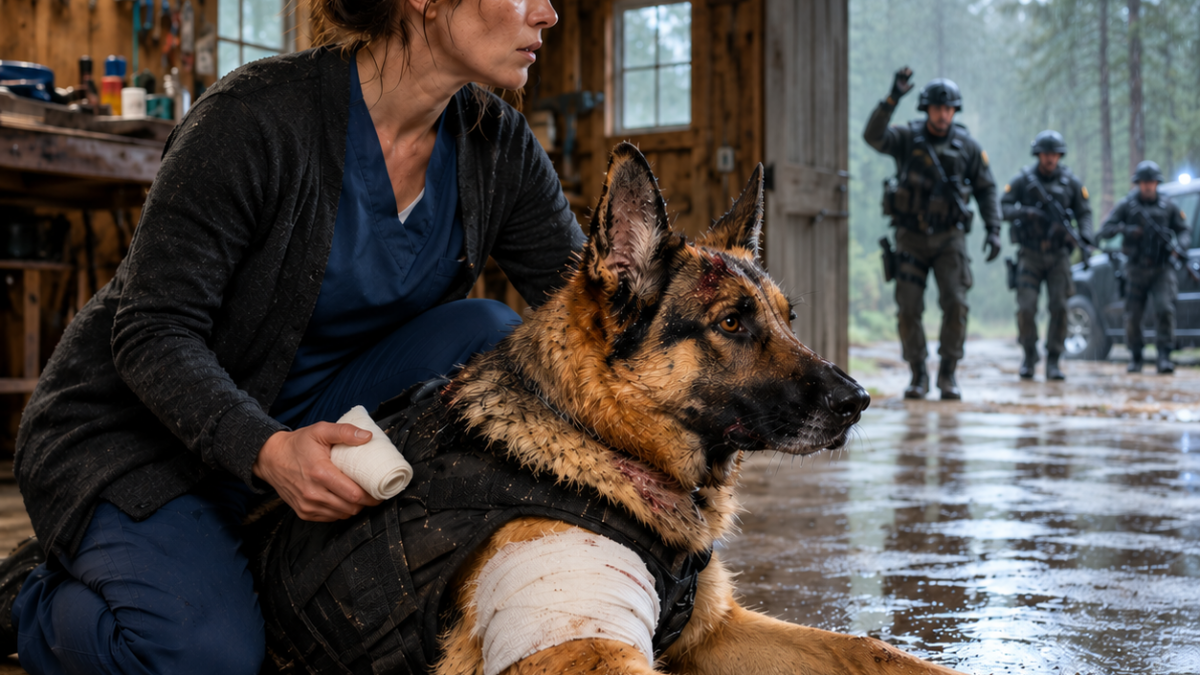
The bullet had gone clean through muscle, missing bone and major vessels by a miracle measured in millimeters. The bleeding was serious but controllable. She irrigated with saline. Trimmed fur around the wound. Injected local anesthetic. Set sterile pads. Sutured what she could. Packed what needed packing. Administered broad-spectrum antibiotics from an emergency supply she probably should not have had at home but did, because rural nurses learn the difference between rules and survival.
Through it all, the dog endured.
He panted.
Trembled.
Once, when she irrigated the deepest part of the wound, his lips lifted and a low growl vibrated through him.
Antonia froze.
His eyes met hers.
The growl died.
He turned his head away as if apologizing.
That nearly broke her.
“No,” she whispered, continuing with gentler hands. “You’re allowed to hurt.”
When she finished the last stitch, she sat back on her heels, dizzy with fatigue.
The dog lowered his massive head onto her knee.
Just like that.
No warning.
No hesitation.
His weight settled against her as if he had been holding himself up only until someone else could take over.
Antonia looked down at him.
Mud streaked his muzzle. Blood stained her jeans. His ears were too large, one nicked at the edge. His amber eyes half closed.
She found the designation stamped faintly inside the vest lining.
EKKO.
Not Echo.
Ekko.
Military spelling, maybe. Or contractor spelling. Or someone’s idea of clever.
“Ekko,” she said softly.
His ear moved.
The dog opened one eye.
“That’s you?”
His tail thumped once.
Barely.
But once.
Antonia let out a shaky laugh.
“Okay, Ekko. Nobody is hurting you tonight.”
She said it before she knew whether she could keep the promise.
By then, the storm had swallowed the world.
She checked on the house from the barn doorway. No lights except the small glow from the living room lamp she had left on for Sarah. Leo’s bedroom window was dark. The storm noise was so thick she could barely hear her own breath.
She texted Sarah from the spot near the barn that sometimes caught service.
Running very late. Bad roads. Stay asleep. I’ll pay extra.
No signal.
She tried again.
Nothing.
Fine.
The house was only thirty yards away.
She would go in soon.
But Ekko shifted behind her and made one low sound.
Not pain.
Warning.
Antonia turned.
He was awake again, head lifted, eyes fixed on the barn door.
“What?”
The dog did not move.
Rain hammered the roof.
Wind shook the trees.
The barn lights hummed overhead.
Then, from somewhere deep in the forest, a branch snapped.
Antonia told herself it was the storm.
Just the storm.
Still, she locked the barn from inside, pulled the old 12-gauge shotgun from the high cabinet where her grandfather had kept it, checked the chamber with hands steadier than they should have been, and sat in the folding chair beside Ekko until dawn.
She did not sleep.
Not really.
She drifted in fragments, jolting awake every time the dog shifted, every time the storm changed pitch, every time the old barn creaked.
At some point, near dawn, exhaustion dragged her under.
When she woke, the shotgun nearly slid from her lap.
Pale gray light seeped through the high windows.
The storm had broken.
Fog pressed thick against the glass, turning the world outside into a blank wall.
Ekko was gone from the quilts.
Panic shot through her.
“Ekko?”
A soft thump answered.
Then another.
Thump.
Thump.
She turned.
He sat at the barn door.
Not lying.
Not wandering.
Sitting.
Straight-backed despite the fresh sutures in his shoulder, head high, ears forward, eyes locked on the crack beneath the door.
A low vibration hummed in his chest.
He was not waiting to go out.
He was guarding.
Antonia stood carefully.
Her neck screamed from sleeping in the chair. Her clothes were stiff with dried rain and blood. Her hands ached.
“What do you hear?”
Ekko did not look at her.
She walked toward him and placed one hand lightly on his back.
His muscles were rigid.
Not random fear.
Focus.
The kind of focus she had seen in combat veterans brought into the ER who scanned every exit before allowing anyone to touch them.
Antonia’s throat tightened.
“You’re still fighting, aren’t you?”
At that, he leaned sideways, pressing his weight briefly against her leg.
It was such a human gesture of trust that she had to swallow hard.
“Water first,” she said.
She changed his bandage, gave him water, and fed him boiled chicken and rice from the emergency food stash she kept for winter power outages. He ate with controlled hunger, never taking his eyes fully off the door.
After securing the barn again, Antonia went to the house.
The world outside was too quiet.
No birds.
No rain.
No wind.
Just fog.
Thick, white-gray fog between the trees and along the driveway, muffling sound so completely that her boots on the gravel seemed too loud.
She paused halfway across the yard.
The back of her neck prickled.
The house looked normal.
Porch light on.
Kitchen curtains still.
Leo’s toy dump truck near the back steps where he had abandoned it two days earlier.
Normal.
She forced herself to move.
Inside, the warmth hit her first.
Then the smell of old popcorn and the lavender detergent Sarah used.
The teenage babysitter was asleep on the couch, one arm flung over her face, television blue-screened in front of her.
Antonia checked the time.
6:02 a.m.
She paid Sarah extra, lied about a bad shift and flooded roads, and sent her home before the girl could notice the blood on Antonia’s jeans.
Upstairs, Leo slept sideways in his bed, superhero pajamas twisted, mouth open, one hand resting on a plastic dinosaur.
Antonia stood in the doorway and watched him breathe.
She had nearly lost count of how many times she had done that since his father left.
Not died.
Left.
There were days Antonia wished Mark Morris had died, because death at least gave people permission to hate the empty space. But Mark had simply decided fatherhood, debt, and a wife working nights were not the life he wanted. He mailed birthday cards sometimes. Late. Without return addresses. He called when guilt made him drunk.
Leo still kept a photo of him in the bottom drawer.
Antonia never touched it.
Children were allowed to love people who failed them.
That was one of the hardest truths she had learned.
She went downstairs, poured black coffee into a mug, and opened her laptop.
If she could identify Ekko, she could figure out who to call.
Military working dog registry.
K9-CH7.
Tactical Kevlar serial numbers.
Pacific Northwest military training operations.
No results.
Nothing useful.
She tried describing the vest.
The wiring.
The transponder.
Still nothing.
Then the internet died.
The router blinked red.
Antonia stared at it.
Storms knocked out internet in the valley often enough that she should not have reacted.
But something about the timing made the skin along her arms tighten.
She checked her phone.
No service.
Not one bar.
She moved to the kitchen window, then the living room, then the upstairs landing where service was strongest.
Nothing.
That was wrong.
In five years at the farmhouse, even during snowstorms, windstorms, and one absurd hailstorm that broke two windows and terrified Leo into wearing a bike helmet indoors, she always had at least a weak signal.
Always.
“Mom?”
Antonia jumped.
Leo stood at the bottom of the stairs rubbing his eyes, hair sticking up in three directions.
She forced a smile so quickly it felt like putting on a mask.
“Hey, baby.”
He squinted at her.
“You look weird.”
“Good morning to you too.”
“Is the storm gone?”
“It is.”
“Do I have school?”
Antonia glanced at the dead router.
The silent phone.
The fog outside.
“Not today.”
His eyes lit up.
“Snow day?”
“Fog day.”
“Is that real?”
“It is when your mom says so.”
“Can we watch movies?”
“As many as you want.”
He gasped like she had offered him a sports car.
She made him toast, set up the DVD player because streaming was dead, and put on one of his dinosaur movies. Then she went to the mudroom, pulled on her heavy coat, and took the shotgun from behind the pantry door.
Leo looked up.
“Are there bears?”
“Maybe raccoons.”
“With a shotgun?”
“Big raccoons.”
He accepted that because seven-year-old boys want the world to remain reasonable when it still can.
Antonia kissed his hair.
“Stay inside, okay? Pajama day rules.”
“Can I have cocoa?”
“Yes.”
“With marshmallows?”
“Don’t negotiate with me before coffee.”
He grinned.
She stepped outside before her smile collapsed.
The fog was worse now.
It pressed close to the house, so thick she could barely see the barn from the porch. The air smelled of wet pine, mud, and something metallic she could not place.
When she opened the barn door, Ekko did not greet her.
He stood in the center of the floor, body rigid, hackles raised from neck to tail. His lips were drawn back enough to show white teeth. The growl in his chest was so deep it seemed to vibrate through the workbench tools.
He faced the back wall.
The wall toward the timberline.
Antonia closed the door behind her slowly.
“What is it?”
Ekko shifted his body between her and the wall.
Not by accident.
Deliberately.
A shield.
Her mouth went dry.
She moved to the workbench and loaded two shells into the shotgun.
Outside, faint through fog and wood, came a sound.
A metallic click.
Small.
Precise.
Like a carabiner striking a metal ring.
Antonia’s stomach dropped.
Hunters did not move like that.
Hunters wore orange.
Hunters made noise.
Hunters cursed at mud and snapped branches and parked trucks on the road.
She crossed to the side window, wiped condensation from the glass, and peered out.
At first, there was nothing.
Trees.
Fog.
The rusted tractor her grandfather never hauled away.
Then a shadow moved.
Not a deer.
Not a neighbor.
A person.
Fully camouflaged, dark gear dampened by mist, moving with terrifying silence between the trees.
A compact suppressed weapon angled down across his chest.
Another figure appeared near the tractor.
Then a third.
They advanced in a coordinated shape, spacing perfect, bodies low, collapsing toward the farmhouse.
Not police.
Not deputies.
Not search and rescue.
Antonia knew enough from trauma rooms, military patients, and late-night documentaries Leo was too young for that she was looking at elite operators.
And they were between her and her child.
The world narrowed.
Fear did not vanish.
It burned down into something hotter and cleaner.
Maternal focus.
Leo was in the house.
Nothing else mattered.
Ekko looked at her.
His amber eyes were sharp and furious.
He knew.
Whatever those men were, he knew.
“We have to get to the house,” Antonia whispered.
The dog lowered his head.
Ready.
She could not go through the main barn door.
They would be watching it.
Her grandfather had built the barn with odd little practicalities only old rural men thought of: drainage trenches, backup latches, a root cellar under the stairs, and a small corrugated metal access hatch at the rear leading into an overgrown ditch that ran along the back of the property.
As a child, Antonia had used it as a secret escape during hide-and-seek.
Now she unlatched it with hands that did not feel like hers.
The rusty hinge squealed faintly.
She froze.
Ekko slipped out first, belly low, using the fog like cover despite the bandage on his shoulder.
Antonia followed, shotgun slung against her chest, boots sinking into mud, blackberry thorns clawing at her coat and hair. The ditch smelled of wet earth and rot. Cold water seeped into her socks.
They crawled.
Fifty yards to the kitchen door.
It felt like five miles.
Halfway there, Ekko stopped so abruptly Antonia nearly ran into him.
He did not growl.
Did not bark.
He became stone.
His eyes fixed left.
A figure emerged from the fog less than twenty feet away.
Black tactical gear.
Night-vision rig pushed up on his helmet.
Suppressed rifle sweeping slowly.
He had not seen them yet.
But his gaze was moving toward the ditch.
Antonia raised the shotgun.
If she fired, every operator on the property would know exactly where she was.
If she did not, the man would find them.
Before she could choose, Ekko moved.
Not wildly.
Not like an angry dog.
Like a trained missile.
He crossed the distance in a blur of muscle, mud, and controlled violence. The operator turned too late. Ekko hit him in the chest and drove him backward, jaws locking onto the reinforced fabric of his forearm, forcing the rifle muzzle down into the dirt.
The man grunted, tried to shake him off, reached for a blade.
Antonia ran forward.
“Ekko!”
The blade lifted.
Antonia swung the shotgun stock with both hands.
The impact against the side of the man’s helmet sent shock up her arms.
He dropped.
Hard.
Ekko released instantly and stepped back, breathing heavily, then sat beside the unconscious operator as if awaiting orders.
Antonia stared at him.
Then at the man.
Then at the radio clipped to the operator’s vest.
Her hands moved before her mind caught up.
She grabbed the radio and turned the volume low.
Static cracked.
A voice came through.
“Viper Two, report. Do you have eyes on the target package?”
Target package.
Antonia’s blood chilled.
They were not here for a lost dog.
“Viper Two, respond.”
A pause.
“We are breaching primary structure in sixty seconds. Data drive must be secured.”
Primary structure.
The house.
Leo.
Antonia ran.
Stealth no longer mattered.
She sprinted across the open yard with Ekko at her side, pain forgotten in the dog’s stride. Gravel slid under her boots. Her lungs burned. The fog swallowed the world at the edges.
She hit the back porch, fumbled the key, shoved the kitchen door open, and locked it behind them.
“Leo!”
Her voice cracked through the house.
He was sitting on the rug in the living room, confused, the television frozen mid-dinosaur.
“Mom? The movie stopped.”
“I know, baby.”
Her voice changed.
Not softer.
Not louder.
Different.
The voice from the ER when a child was bleeding and the parents needed calm more than truth.
“The power is acting weird. We’re going to play a hiding game downstairs.”
Leo frowned.
“Now?”
“Yes.”
“Can Ekko play?”
Antonia froze.
“You saw him?”
“He’s huge.”
Ekko stood between Leo and the front window, head low, scanning the glass.
“He’s going to help me fix the power.”
Leo’s eyes widened.
“He’s a power dog?”
“Yes. Very specialized.”
Children believe absurd things when terror has not yet taught them not to.
Antonia carried him toward the basement stairs.
He was heavier than he used to be. All knees and elbows and pajama fabric. She could feel his heart beating against her chest.
The root cellar beneath the basement stairs had been reinforced by her grandfather for storms. Concrete walls. Heavy wooden door. Inside were blankets, bottled water, canned food, and a camping lantern.
She set Leo down inside.
His face had changed now.
He knew something was wrong.
“Mom?”
She crouched in front of him and took both his hands.
“Listen to me. This is very important. You stay here until I open this door and tell you the game is over. You do not come out for any reason.”
His lower lip trembled.
“Are bad guys here?”
Antonia’s chest tore open.
She wanted to lie.
Could not.
“I think some bad people are outside. But I am going to keep you safe.”
“Like at the hospital?”
“Yes.”
“Are you scared?”
She kissed his forehead.
“Yes. But I know what to do while scared.”
That seemed to matter to him.
He nodded once.
She gave him her dead phone with downloaded games and put headphones over his ears.
“Blanket fort,” she said.
He crawled under the blankets.
She closed the door and locked it from outside.
For one second, her hand stayed against the wood.
Then the radio hissed.
“Breach. Breach. Breach.”
The front door exploded inward.
The crash shook the house.
Antonia killed the kitchen lights and dropped behind the granite island, shotgun across her knees. Ekko flattened beside her, silent as shadow.
Three operators moved into the house.
Boots on hardwood.
Red laser dots swept walls, furniture, cabinet edges.
They cleared rooms with terrifying efficiency.
Antonia’s mouth went dry.
She was not a soldier.
She was not police.
She was a nurse with a shotgun, a wounded dog, and a child hiding below the stairs.
A voice barked from the hallway.
“Clear downstairs. Find the asset.”
A laser dot crawled along the kitchen cabinet.
Closer.
Closer.
Antonia took one breath.
Then she racked the shotgun deliberately.
The metallic sound cracked through the house.
All movement stopped.
“I have a twelve gauge aimed at the kitchen entrance,” she called.
Her voice sounded steadier than she felt.
“The first man who steps into this room does not leave it standing. Get out of my house.”
Silence.
Then a figure appeared partially at the hallway edge, shielded behind the frame.
He removed his face covering.
Late forties.
Scarred cheek.
Cold eyes.
The kind of face Antonia had seen on men who mistook control for morality.
“Mrs. Morris,” he said smoothly. “My name is Commander Carter Reed.”
Antonia’s finger tightened on the trigger.
“I don’t care.”
“We are a specialized private contracting unit operating under a classified government mandate. You are currently harboring stolen military property.”
“A dog is not property.”
“The K9 is irrelevant,” Reed said.
Ekko growled.
The sound was low and poisonous.
Reed’s eyes flicked to him.
“Wounded and obsolete. What matters is the encrypted biometric drive sewn into his tactical harness.”
Antonia’s mind flashed to the vest in the barn.
The advanced wiring.
The crushed tracker.
The strange weight in the lining.
“I don’t know what you’re talking about.”
“I think you do. You removed his gear. Where is it?”
“Your men shot him.”
Reed sighed.
“The dog panicked after an incident with his handler.”
Ekko’s growl deepened.
The floorboards seemed to vibrate.
Antonia looked at him.
He knew Reed.
Not by scent alone.
By hatred.
That told her enough.
“What happened to his handler?” she asked.
Reed’s expression hardened.
“Lower the weapon.”
“No.”
“My men can drop flashbangs into that kitchen and drag you out before you fire twice.”
“My son is in this house.”
Reed stared at her.
For the first time, something like irritation slipped through his calm.
“Then do not make this worse for him.”
Antonia understood then.
He did not care that Leo was there.
Not really.
A man who cared did not cut communications and storm a home before dawn.
A man who cared did not threaten a mother behind a kitchen island.
“The vest is in the barn,” she lied.
Reed smiled faintly.
“Viper Two already swept the barn.”
Antonia’s blood went cold.
“They didn’t find it.”
That meant one of two things.
Either they were lying.
Or someone else had taken it.
Reed’s face changed as he realized what her reaction revealed.
“Take her,” he ordered.
Two operators shifted.
Before anyone moved, the world outside changed.
A deep, rhythmic thwack-thwack-thwack rolled through the fog.
Windows rattled.
The walls trembled.
Helicopters.
Multiple.
Reed’s head snapped toward the front of the house.
“Status,” he barked into his radio. “Who is inbound?”
Static screamed.
Then a panicked voice answered.
“Multiple birds. Black Hawks on perimeter. We have federal markers.”
Searchlights blasted through the fog, white and blinding.
A megaphone boomed over the rotor wash.
“This is the Federal Bureau of Investigation and Naval Criminal Investigative Service. Drop your weapons and exit the structure with your hands visible. You are surrounded.”
Reed’s face twisted.
Not fear.
Rage.
He lifted his rifle toward the kitchen island.
Antonia saw the movement too late.
Ekko did not.
Despite the wound in his shoulder, the German Shepherd launched over the island in a blur of muscle and fury. He hit Reed square in the chest as the rifle fired into the ceiling, showering drywall across the kitchen.
Reed crashed backward.
Ekko pinned him, jaws snapping inches from his throat.
The remaining operators froze, caught between a furious mother with a shotgun, a war dog on their commander, and federal agents flooding through the shattered front door.
“Drop them!” Antonia screamed.
This time, the authority in her voice surprised even her.
The weapons hit the floor.
Agents poured into the house wearing FBI and NCIS markings, shouting commands, securing Reed and his men, clearing rooms. Someone yelled for medical. Someone else called, “Child in cellar!” and Antonia nearly swung the shotgun toward him before he raised both hands and said, “Ma’am, we’re friendlies.”
A tall man in a navy windbreaker stepped into the kitchen.
His badge caught the searchlight.
He lowered his weapon when he saw Ekko sitting beside Antonia, panting hard, blood seeping through his shoulder bandage.
“Easy, Ekko,” the man said softly. “Stand down, buddy.”
Ekko’s ears perked.
A small whine escaped him.
Recognition.
Antonia lowered the shotgun.
Her arms shook so violently she almost dropped it.
“Mrs. Morris,” the agent said. “I’m Special Agent John Marshall. You and your son are safe.”
The words reached her, but her body did not believe them.
“Leo,” she said.
Marshall nodded to another agent.
“We’ve got him. He’s okay.”
Only then did Antonia’s legs give out.
She sank to the kitchen floor and wrapped both arms around Ekko’s neck.
The dog leaned into her, still watching the room.
Still guarding.
Still bleeding.
Paramedics treated Antonia in the driveway while the property transformed into a scene from a military operation.
Federal vehicles lined the gravel drive.
Agents moved between house, barn, and tree line.
A helicopter circled once, then lifted away into the gray morning.
Leo sat in the back of a squad car wrapped in a blanket, holding a powdered donut some agent had clearly given him without asking permission.
He waved at her with sugar on his face.
Antonia started crying then.
Not during the breach.
Not when Reed aimed at her.
Not when she knocked a man unconscious in the fog.
But at the sight of her son eating a donut, alive.
Ekko rested his head on her knee while a veterinary medic checked his sutures.
Agent Marshall crouched in front of her.
“Carter Reed and his unit are rogue private contractors,” he said. “They’ve been under investigation for using classified logistics corridors to move illegal weapons. Ekko’s handler, Sergeant Adam Miller, discovered evidence and loaded it onto an encrypted drive embedded in Ekko’s harness.”
Antonia looked toward the barn.
“Reed killed him?”
Marshall’s jaw tightened.
“That’s what we believe.”
Ekko’s ears lowered.
Antonia placed one hand on his head.
“He escaped.”
“He was trained to protect sensitive material and return to friendly command. Reed’s men shot him before he could reach extraction. He made it to the road instead.”
“To me.”
Marshall nodded.
“You smashed the tracker.”
“I thought whoever shot him might follow it.”
“You were right. That probably bought you time.”
“Where’s the drive now?”
Marshall glanced toward the barn.
“Our team recovered the vest from a secondary search. Reed’s men missed the lining compartment.”
Antonia almost laughed.
After everything, the evidence had been sitting inside her barn under fluorescent lights while armed men hunted through fog.
Marshall studied her carefully.
“You saved his life.”
Antonia looked down at Ekko.
“No,” she said softly. “He saved ours too.”
Ekko thumped his tail once.
Later, when the arrests were done and Leo had been checked twice and Antonia had signed statements until her hand cramped, Agent Marshall returned with a paper cup of coffee.
It was terrible coffee.
She drank it anyway.
“What happens to him?” she asked.
Ekko lay beside her on the ambulance bumper, chin on her boot, eyes tracking every movement around them.
Marshall followed her gaze.
“Normally, a K9 who loses a handler and sustains a combat injury is evaluated for retirement. Given what happened, he won’t go back to work.”
“Good.”
“He’ll need a specialized home. Quiet environment. Land helps. Someone who understands trauma. Someone calm under pressure.” Marshall raised one eyebrow. “Someone who can handle a ninety-pound dog with federal evidence sewn into his vest and enough training to clear a hallway.”
Antonia stared at him.
“No.”
Ekko lifted his head.
Marshall said nothing.
“I’m a single mom. I work nights. My house just got raided by rogue contractors. My son thinks he’s a power dog.”
Marshall’s mouth twitched.
“A what?”
“Never mind.”
Ekko rested his chin on her knee again.
Leo shouted from the squad car, “Mom! Can Ekko live with us?”
Antonia closed her eyes.
Marshall smiled.
“Seems the household has opened debate.”
“He is enormous.”
“Yes.”
“He is injured.”
“Yes.”
“He probably has trauma.”
“Definitely.”
“I have no idea how to care for a dog like this.”
“We can help.”
That made her open her eyes.
“We?”
“NCIS K9 transition program. Federal working dog retirement network. Veterinary support. Handler mentorship. If you’re willing, you won’t be doing it alone.”
Antonia looked down at Ekko.
He watched her with the same intelligent amber eyes that had met hers on the rain-slick road.
In less than twenty-four hours, this dog had trusted her hands, guarded her barn, protected her son, faced armed men, and placed his bleeding body between her family and danger.
She thought of Sergeant Miller, whoever he had been, dying because he tried to expose treason.
She thought of Ekko running wounded through storm and forest with the last thing his handler had entrusted to him.
She thought of Leo under the blankets in the root cellar, trying to be brave.
She thought of her own life, already too full, too tired, too hard.
Then Ekko’s tail thumped once against the gravel.
A single, hopeful sound.
Antonia laughed through tears.
“Yeah,” she said softly. “I think I know someone.”
Ekko came home officially three weeks later.
The first weeks were a different kind of battle.
Not with guns.
With doors.
Sounds.
Trust.
Routine.
He refused to sleep unless he could see the exits. He woke from nightmares with his teeth bared at enemies that existed only in memory. He limped on cold mornings. He followed Antonia from room to room, even when she only went to brush her teeth.
Leo adored him with the solemnity of a child who believed he had been assigned a guardian from a secret agency.
“Ekko is retired,” Antonia told him often. “He is not a toy. He is not a superhero.”
Leo nodded seriously.
Then whispered to Ekko, “You’re kind of a superhero.”
Ekko tolerated this with dignity.
A retired military working dog trainer named Mason Hale came twice a week. He taught Antonia how to read Ekko’s posture, how to build decompression routines, how to create safe zones, how to avoid turning fear into obedience problems.
“He doesn’t need dominance,” Mason said. “He needs predictability.”
Antonia laughed.
“Same.”
Mason looked around the farmhouse—the broken front door replaced, the kitchen ceiling patched, Leo’s toys everywhere, Antonia’s hospital shoes by the mudroom, Ekko’s bed positioned where he could see both entrances.
“Then this might work.”
It did.
Not perfectly.
Nothing important works perfectly.
Ekko had setbacks.
Fireworks sent him into a shaking crouch under the dining table until Antonia lay on the floor beside him and Leo built a blanket wall to “block the boom.” The first time a delivery driver knocked too hard, Ekko hit the door like a freight train and scared the man so badly he left the package in the flower bed. Once, Antonia dropped a metal pan, and Ekko shoved Leo behind the couch so fast the child thought it was a game until he saw Antonia crying.
But there were good days too.
More and more.
Ekko learned the sound of Leo’s school bus.
At 3:34 every afternoon, he moved to the front window.
Not 3:30.
Not 3:40.
3:34.
He waited until the bus stopped, until Leo jumped down the steps, until the boy ran up the driveway yelling, “Ekko! I got a sticker!”
Then the huge German Shepherd would wag his tail with restrained but undeniable joy.
He learned Antonia’s post-shift routine.
Boots off.
Hands washed.
Coffee reheated.
Five minutes sitting on the kitchen floor with him before she became Mom again.
Sometimes, after terrible shifts, she buried both hands in his thick fur and whispered things she could not say to people.
“I lost a patient today.”
“I’m so tired.”
“I don’t know if I’m doing enough.”
“I’m scared Leo misses having a dad more than he says.”
Ekko never answered.
He leaned against her until her breathing changed.
That was enough.
Months later, Agent Marshall visited with final paperwork.
Carter Reed had taken a plea deal after the evidence on the drive exposed enough names to shake three agencies and bury his contracting firm forever. Several more arrests followed. Sergeant Adam Miller received posthumous honors. His family asked to meet Ekko one day, if Antonia was willing.
She was.
That meeting took place on a clear autumn morning.
Sergeant Miller’s parents came first.
Then his younger sister.
They stood at the edge of Antonia’s yard with grief written in every line of their bodies.
Ekko knew them by scent before introductions.
He approached slowly.
Not with the alertness he gave strangers.
With something quieter.
Recognition by association.
The mother began to cry before he reached her.
“Adam loved you,” she whispered.
Ekko lowered his head into her hands.
Antonia watched from the porch, one arm around Leo’s shoulders, and understood that keeping Ekko did not mean keeping him from everyone else who had loved what he had lost.
Love was not ownership.
It was stewardship.
That became the word she held onto.
She was not Ekko’s replacement handler.
Not exactly.
She was not Sergeant Miller.
She was not military.
She was not part of the world that had trained him.
She was the woman who found him bleeding in the rain and promised nobody would hurt him that night.
Then she kept making that promise in smaller ways.
Food.
Medicine.
Quiet.
Work with no gunfire.
A boy to guard.
A porch to nap on.
A life after service.
A year after the storm, Antonia woke before dawn to silence.
For a moment, panic seized her.
Then she heard it.
Soft breathing.
Leo asleep upstairs.
Ekko asleep across the bedroom doorway.
Rain tapping gently on the roof.
Not the violent storm from that night.
Just rain.
Ordinary rain.
She got up and walked to the kitchen. Ekko lifted his head instantly.
“Go back to sleep,” she whispered.
He considered this order and ignored it, following her down the hall.
She opened the back door and stepped onto the porch.
The yard was dark and wet. The barn stood quiet beyond the grass. The tree line was only trees again.
Ekko came to stand beside her.
His shoulder brushed her leg.
The scar beneath his fur had healed into a hard ridge. His limp still appeared in cold weather. His dreams still sometimes chased him.
But he was here.
Alive.
Safe.
Antonia rested one hand on his head.
“You found the right road,” she told him.
Ekko leaned into her.
Behind them, Leo’s sleepy voice came from the hallway.
“Mom?”
She turned.
He stood in dinosaur pajamas, taller now, hair wild.
“Is Ekko okay?”
“He’s okay.”
“Are you okay?”
Antonia looked at her son.
Then at the dog.
Then at the rain.
For years, she had thought okay meant nothing terrible was happening.
Now she knew better.
Okay could mean terrible things had happened, and you were still standing.
Still loving.
Still opening the door to morning.
“Yeah,” she said softly. “We’re okay.”
Leo came out and wrapped both arms around Ekko’s neck.
Ekko stood very still, accepting the hug with the patience of a retired soldier who had survived secret wars, betrayal, blood loss, and one small boy’s complete lack of personal space.
Antonia laughed.
The sound startled her.
Not because it was rare anymore.
Because it was real.
That was how life continued.
Not as the story people told later.
Not as a headline.
Single Mom Saves Wounded K9.
Navy Operators Surround Farmhouse.
Hero Dog Exposes Treason.
Those were pieces.
True pieces, maybe.
But not the whole.
The whole story was quieter.
A woman driving home exhausted in the rain.
A dog bleeding on a road, carrying the last mission his handler gave him.
A boy hiding under blankets, learning that his mother could be scared and brave at the same time.
A farmhouse once too isolated becoming, somehow, exactly the place a wounded K9 needed.
A mother who had spent years believing survival meant doing everything alone slowly learning that help could arrive in helicopters, federal badges, trainer visits, school-bus greetings, and the warm weight of a German Shepherd’s head on her knee.
Ekko lived many years after that.
Long enough for Leo to stop wearing superhero pajamas and start pretending he was too old to kiss a dog on the nose, though he still did it when he thought nobody saw.
Long enough for Antonia to move from night shifts to trauma education.
Long enough for Sergeant Miller’s family to visit every October.
Long enough for the barn, once a battlefield, to become a workshop again.
Long enough for the front door to stop feeling like a point of entry and start feeling like a door.
When people asked Antonia why she kept Ekko, she never gave the dramatic answer first.
She did not talk about Reed.
Or the gunshot.
Or the fog.
Or the helicopters.
She usually said, “Because he came to my house wounded, and then he stayed to help us heal too.”
If they stayed long enough, she told them the rest.
She told them about the rain.
The Kevlar vest.
The amber eyes.
The transponder she smashed with a wrench.
The men in the fog.
The root cellar.
The way Ekko stood between her son and the windows without anyone teaching him Leo mattered.
The federal agents.
The truth about Sergeant Miller.
The day Ekko finally slept through a thunderstorm.
And the lesson she wished more people understood:
Some heroes do not arrive clean.
Some do not arrive easy.
Some come bleeding out of the woods with secrets sewn into their gear and trauma locked in their bones.
Some scare you before they save you.
Some need stitches, patience, boundaries, and a place where they are no longer treated like tools.
But if you are brave enough to look past the blood, the scars, and the fear, you may find something extraordinary.
Not a weapon.
Not property.
Not a problem.
A life still trying to complete its last loyal act.
Ekko had run through a storm carrying the truth.
Antonia had stopped her car.
Everything that happened after came from those two choices.
His loyalty.
Her mercy.
And before dawn, when armed men surrounded her house, both were tested.
Both held.
That was why, years later, when rain hit the farmhouse roof and Ekko slept across the hallway outside Leo’s room, Antonia still sometimes whispered the promise she made in the barn the first night.
“Nobody is going to hurt you anymore.”
And in the dark, if he was awake, Ekko’s tail would thump once against the floor.
Just once.
As if to answer:
I know.
I’m home.








