A Silent Kitten Waited Under the Same Bridge for Days—Then I Came Back With a Carrier and He Finally Took One Step Toward Me
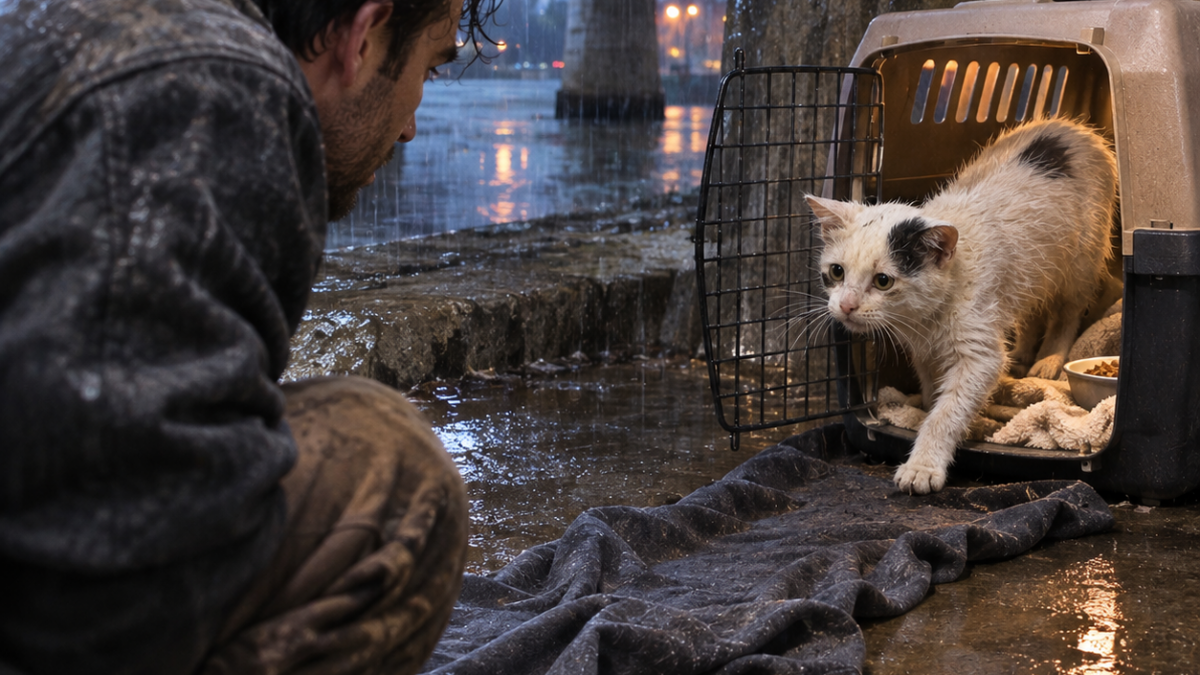
A Silent Kitten Waited Under the Same Bridge for Days—Then I Came Back With a Carrier and He Finally Took One Step Toward Me.
For nearly a week, a tiny white kitten sat beneath the same Richmond bridge without crying, wandering, or asking anyone for help, while hundreds of people passed close enough to see him and kept walking—including me.
By the time I finally turned around, bought him food, and came back, I realized the most frightening thing was not that he was hungry or cold; it was that something had taught a three-month-old kitten to stay frozen in one patch of concrete as if moving toward anything better was more dangerous than remaining alone.
Then, on a freezing November night, I laid my old sweatshirt between him and an open carrier and watched one little white paw cross the line he had refused to cross for days—and I had no idea that before the week was over, I would be the one learning how difficult it can be to believe someone is actually coming back.
He never cried for help.
That is the detail I remember most.
Not the cold.
Not the bridge.
Not the black spot beside his left ear.
Not even the way his little body looked almost colorless against all that damp gray concrete.
The silence.
My name is Daniel Mercer.
I was thirty-five years old that November, living alone in a second-floor apartment in Richmond, Virginia, and working in an office downtown for a civil engineering company that designed drainage systems, retaining walls, and transportation projects.
Not exciting work to most people.
I liked it.
Numbers behaved.
Load calculations behaved.
Water moved downhill whether anybody had a complicated childhood or not.
I had spent much of my adult life appreciating systems that followed rules.
At 7:32 every weekday morning, I left my apartment.
At 7:44, I passed the gas station on Dock Street.
At roughly 7:51, I walked beneath the old railroad bridge near the James River.
At 8:03, I bought coffee from the same place.
At 8:17, I reached my desk.
Routine suited me.
That year, routine suited me more than usual.
My father had died fourteen months earlier.
Heart attack.
Sudden.
He was sixty-three.
My mother had moved to North Carolina to stay near my sister after that, and the house where I grew up had been sold by spring.
I had also ended a relationship that summer.
Not because anyone cheated.
No dramatic betrayal.
Emily simply told me one night that she could not keep waiting for me to decide whether I actually wanted a shared life or just liked having someone nearby.
She was right.
That did not make losing her easier.
By November, my life had become very efficient.
Work.
Apartment.
Gym occasionally.
Groceries on Saturday.
Call my mother Sunday evening.
Repeat.
I told myself I liked the quiet.
Most of the time, I believed it.
Then I met a kitten who was even better at staying still than I was.
Late November feels colder beneath that bridge than it does almost anywhere else in Richmond.
The river holds damp air.
The concrete keeps the chill.
Wind comes off the water and finds gaps in clothing you did not know existed.
Train wheels scream overhead.
Traffic echoes strangely.
PART2:
Everything is amplified and muffled at the same time.
That Monday morning, I noticed something white beside a storm drain near one of the concrete supports.
At first I thought it was trash.
Plastic bag.
Paper.
Then it moved.
Kitten.
Small.
Mostly white.
Two black markings.
One close to his left ear.
Another across his back near the spine.
He was sitting upright.
Not crouched.
Not eating.
Not grooming.
Just looking ahead.
I slowed.
He did not run.
That was unusual enough that I should have stopped.
I did not.
I looked at him for maybe two seconds.
Three.
Then checked the time.
I was already cutting it close.
The explanation came automatically.
He belongs to somebody nearby.
PART3:
There are houses beyond the river road.
Maybe he slipped out.
Someone probably feeds cats here.
He looks clean enough.
He’ll move when traffic picks up.
All those thoughts happened without effort.
Humans are incredibly talented at building explanations that allow us to continue walking.
I continued walking.
By the time I reached the office, I had forgotten him.
Mostly.
Tuesday morning, he was there again.
Same spot.
Same posture.
Same black mark near his ear.
I slowed more this time.
“Hey.”
He looked toward me.
Barely.
No meow.
No movement.
I considered approaching.
Then a cyclist came through behind me, bell ringing.
I stepped aside.
When I looked back, the kitten had lowered himself slightly but had not moved away.
I told myself:
Someone must be caring for him.
Then I went to work.
Wednesday morning, I felt something unpleasant before I even saw him.
A small tightening in my stomach.
Anticipation.
Maybe guilt.
There he was.
Same exact patch of concrete.
That was when repetition stopped feeling accidental.
I stood across the walkway.
He looked smaller than I remembered.
Maybe because I was finally looking properly.
I could see that his fur was dirty around the paws.
One side of his white coat had a faint gray stain from the concrete.
He was thin.
Not skeletal.
But too narrow.
His face had the round unfinished shape of a young kitten.
Three months old, maybe.
Four at most.
He watched people pass.
Did not approach them.
Did not retreat.
That bothered me more than fear would have.
Fear makes sense.
A scared kitten runs.
Hides.
Hisses.
This one seemed to have reached some other state.
Wait.
That was all he did.
I noticed the cardboard then.
Wet.
Pressed almost flat against the ground several feet away.
Beside it was an empty plastic food container.
Cheap takeout type.
Someone had fed him.
Or tried to.
That should have comforted me.
Instead, I felt ashamed.
Because I understood immediately what had probably happened.
Someone else had seen him.
Left food.
Then moved on.
Exactly what I had been preparing to congratulate myself for doing.
I stood there.
The kitten looked toward the storm drain.
Then back ahead.
I walked past.
I made it almost one block.
Stopped.
There is a particular kind of argument you have with yourself when you know the correct answer but are still searching for permission to choose the easier one.
I had work.
A meeting at nine.
I knew nothing about cats.
My lease required a pet deposit.
I was not an animal rescuer.
There were shelters.
There were people better equipped.
Maybe he would leave once he ate.
Maybe somebody already had a plan.
All technically reasonable.
None of them changed the fact that I knew I would think about him all day.
I turned around.
The gas station near the bridge sold almost everything except the thing I needed.
I stood near a shelf searching labels.
The cashier finally asked:
“You looking for something?”
“Cat food.”
He pointed.
“Bottom shelf by the detergent.”
Of course.
There were two options.
I chose a small pouch of chicken-flavored wet food because the picture showed a happy cat and apparently that was the full extent of my decision-making process.
I bought bottled water too.
When I returned, the kitten was still there.
I crouched several feet away.
His body tightened slightly.
“Okay.”
I tore open the pouch.
The smell was awful.
“If this doesn’t convince you, nothing will.”
His ears moved.
First sign I had seen that he was listening to me.
I placed food near the wall.
Poured water into the bottle cap.
Backed away.
The kitten did nothing.
I waited.
He stared.
I checked my phone.
8:01.
“Great.”
No response.
“You’re making me late.”
Nothing.
“I realize that is not your concern.”
One ear moved again.
I waited another minute.
Then left.
At work, my manager asked why I was ten minutes late.
“Traffic.”
Technically there had been traffic.
Human foot traffic.
He accepted it.
I did not.
All day I wondered whether the kitten ate.
At 5:20, instead of heading directly home, I walked back under the bridge.
Food gone.
Water mostly gone.
Kitten still there.
I stopped.
Same spot.
Not ten feet away.
Not under another support.
Not tucked somewhere warmer.
Same little rectangle of concrete.
He looked at me.
This time I sat on the low retaining edge across from him.
“You ate.”
Silence.
“Good.”
He blinked once.
I had no idea what to do next.
So I did nothing.
Five minutes.
Maybe ten.
Train overhead.
Cars.
Footsteps.
The kitten remained still.
Eventually I left.
That night I barely slept.
I told myself I was being ridiculous.
One kitten.
One bridge.
Richmond contained thousands of animals, people, problems, tragedies.
Why this one?
I think it was the stillness.
Something about him made me think of my father’s final year.
Not because my father had behaved like a kitten.
That would be absurd.
But after retiring, my father became quieter.
My mother worried about him.
I told her he deserved rest.
Then after he died, she admitted he had been depressed.
She had tried to get him to travel.
Volunteer.
See friends.
He always said later.
Another week.
Another month.
He had not been in immediate danger as far as anybody knew.
He simply became smaller inside his own life.
I remember thinking after the funeral:
Why didn’t I see it?
Now this kitten was sitting beneath a bridge refusing to move from one patch of concrete.
And I had already walked past him three times.
Thursday morning, I left home forty-five minutes early.
Still dark.
That was deliberate.
I wanted to know whether he stayed under the bridge at night.
Maybe he wandered after sunset.
Maybe someone collected him and returned him.
Maybe that spot was only his morning location.
I reached the bridge before seven.
No joggers.
No cyclists.
Only river noise and distant traffic.
He was there.
Curled tighter.
Head up when I approached.
I stopped.
Something dropped inside me.
“You stayed.”
He looked terrible in the weak light.
Not injured.
Just exhausted.
There is a difference between sleeping and collapsing into rest because maintaining awareness has become work.
I walked around the area more carefully.
No nest.
No blanket.
No dry box.
No protected recess.
The storm drain opening was too narrow for him to use safely.
Nothing made that precise location special.
That was when I understood:
The spot was not safe.
He believed it was safe.
Those are not always the same thing.
I called the nearest veterinary clinic when they opened.
The receptionist listened.
“Three months, maybe?”
“I think.”
“Eating?”
“Yes.”
“Drinking?”
“A little.”
“Walking?”
“I’ve barely seen him move.”
“How long?”
“Several days.”
She paused.
“Sir, if he’s that young and staying in one place that long, somebody needs to get him checked.”
I looked at the kitten.
“He won’t let me touch him.”
“Do you have a carrier?”
“No.”
“Can you get one?”
“Probably.”
“Don’t chase him into traffic.”
“That was not my plan.”
“You’d be surprised.”
She gave me the number for a local rescue too.
I called.
Voicemail.
Another.
Full intake.
Third organization said they could lend me a humane trap the following day, but they were overloaded.
The woman apologized.
“Can you keep feeding him until then?”
“I think so.”
“Can you bring him somewhere safe if you catch him?”
That was the first moment I hesitated.
“My apartment.”
“Pets allowed?”
“With deposit.”
“Other animals?”
“No.”
“Then maybe.”
Maybe.
That word followed me into work.
That afternoon, I bought a carrier.
Not a trap.
Plastic.
Gray.
Small enough for a kitten.
A cheap fleece blanket.
And because I had no idea how frightened animals processed new environments, I brought one of my old work sweatshirts.
It smelled like laundry detergent, my apartment, maybe coffee.
Something familiar from me.
I returned to the bridge after work.
The kitten watched me set everything down.
I did not place the carrier directly in front of him.
I put it at an angle several feet away.
Blanket inside.
Food near the entrance.
Sweatshirt beside it.
Then I crouched.
I had heard people use baby voices with animals.
I could not do it.
It felt fake.
So I talked normally.
“Long day.”
The kitten’s ear moved.
“Client changed an entire drainage design after we finished calculations.”
Ear again.
“You have no idea what that means.”
He watched.
“It means somebody deserves to be fired.”
Nothing.
I kept talking.
Weather.
Traffic.
The fact that Richmond by the river in November felt unnecessarily hostile.
How I did not own a cat.
How I was beginning to suspect that detail was irrelevant to him.
Then something happened.
He stood.
For the first time in front of me.
His legs looked thin.
His back slightly arched from tension.
But he stood.
One paw forward.
Then another.
I stopped talking.
He moved toward the carrier.
My heartbeat became ridiculous.
One more step.
Then a train crossed overhead.
Metal screamed against metal.
The underside of the bridge vibrated.
The kitten flinched.
Instantly he retreated.
Not anywhere.
Back to the exact patch beside the concrete support.
He folded himself into the same position.
That was the moment I understood his problem was bigger than hunger.
He wanted the food.
He was curious about me.
He had proven he could move.
But that spot had become something in his nervous system.
A rule.
Do not leave.
Maybe someone had placed him there.
Maybe something frightened him and he froze.
Maybe he had wandered there and survived one terrifying night, then another, until survival itself became attached to that square of concrete.
I did not know.
But every step away from it seemed to cost him something.
I packed up eventually.
Not disappointed.
Strangely, I felt closer to understanding him.
“Tomorrow.”
I said it before leaving.
The kitten watched me.
“I’ll come back.”
That sentence struck me after I said it.
Come back.
I had promised something to an animal who could not possibly understand the words.
But maybe promises are partly about the person making them.
I came back.
Friday evening, rain began.
Not a storm.
Worse in some ways.
Thin November rain.
Persistent.
Cold.
The kind that makes everything wet without ever looking dramatic.
I left work early.
My manager asked why.
“Personal situation.”
He looked surprised.
I was not known for having those.
I drove instead of walking.
Carrier in the back.
Blanket.
Food.
Sweatshirt.
When I reached the bridge, the kitten was curled into himself.
His dry area had shrunk.
Water had crept across the concrete.
His ears were low.
He was trembling.
That ended the debate.
I was not leaving him there again.
I set the carrier closer.
Opened it.
Blanket inside.
Then I took off my sweatshirt.
Cold air hit immediately.
I laid it from near his spot toward the carrier entrance.
Not touching him.
A path.
Ridiculous idea.
Maybe.
I stepped away.
The kitten watched.
Rain tapped beyond the bridge.
River moved below.
Cars hissed across wet pavement.
Nothing happened.
One minute.
Three.
Five.
I stood there in shirtsleeves, cold and increasingly convinced this plan had been designed by an idiot.
Then the kitten moved.
One paw onto the sweatshirt sleeve.
He stopped.
Looked at me.
I did not breathe properly.
Another paw.
Then his body.
He walked slowly along the fabric.
At the carrier entrance, he froze.
Half a foot away from dry warmth.
Could not cross.
I knew that feeling in a way I wish I did not.
There had been months after my father died when my sister asked me to come visit.
I always had a reason not to.
Emily asked me to move in.
I asked for more time.
Friends invited me places.
Work.
Tired.
Another day.
Sometimes the line between a bad place you understand and a better place you do not trust feels enormous.
I crouched.
“You don’t have to be brave.”
His eyes found mine.
The words came without planning.
“You just have to not stay here.”
The kitten looked at the carrier.
Then toward his concrete patch.
Back.
One white paw touched the carrier lip.
Stayed.
Another second.
Then he leaned forward.
Head inside.
Black mark beside his ear.
One paw.
Other paw.
Half his body.
He turned and looked backward.
I swear I could see the argument in him.
Return.
Stay.
Return.
Stay.
Then his back paws crossed.
He entered.
All the way.
I moved carefully.
Closed the door.
Click.
The kitten pressed into the rear corner.
No scream.
No thrashing.
No meow.
Just those huge eyes.
I covered part of the carrier with the remaining blanket.
“Okay.”
My hands were shaking.
“We’re going.”
The clinic was about to close.
I called from the car.
“They said I could bring him.”
“Bring him.”
I drove in wet clothes with the heat blasting.
The kitten did not make one sound.
At the clinic, the receptionist looked into the carrier.
“Oh.”
That one syllable told me she understood.
Dr. Olivia Hart examined him.
Young veterinarian.
Maybe early forties.
Calm.
No unnecessary movement.
No microchip.
No matching recent lost-animal reports.
Male.
Approximately twelve to fourteen weeks.
Underweight.
Dehydrated.
Fleas.
Mild upper respiratory irritation.
Small abrasions on two paw pads.
No fractures.
No obvious neurological issues.
No severe infection.
“He’s lucky.”
I looked at him.
“I don’t know if lucky is the word.”
Olivia nodded.
“Fair.”
She listened to his chest.
“He’s scared.”
“Yes.”
“But physically, I’m not seeing anything catastrophic.”
“What does he need?”
“Warmth.”
“Food.”
“Quiet.”
“Time.”
She looked at me.
“And predictability.”
That word landed hardest.
Predictability.
Nothing surprises him.
Nothing corners him.
Nothing disappears suddenly if you can help it.
I said:
“I don’t own a cat.”
Olivia smiled.
“You do tonight.”
“I mean I don’t know what I’m doing.”
“You got him here.”
“That’s a start.”
They treated fleas.
Gave fluids.
Sent me home with food instructions and follow-up appointment.
The receptionist handed me paperwork.
Under NAME:
Blank.
“What do I put?”
“Whatever you’re calling him.”
“I’m not calling him anything.”
She looked at me.
I looked at the kitten.
“Temporary.”
She smiled.
“That’s a terrible cat name.”
I left it blank.
My apartment bathroom became the safest room I could build on short notice.
Litter box.
Water.
Food.
Cardboard box with blanket.
Carrier on floor.
No loud fan.
No clutter.
I opened the carrier.
Expected him to bolt.
Or refuse.
Instead he came to the doorway.
Sat.
Looked at the bathroom.
Then beyond it into the hall.
Same posture from the bridge.
The threshold had changed.
The problem had not.
I sat outside the bathroom.
“Take your time.”
He watched.
Twenty minutes.
Nothing.
I eventually went to bed.
At 2:13 a.m., I woke to a sound.
Tiny.
Rough.
Almost not a meow.
I sat upright.
Again.
I walked into the hallway.
The kitten stood at the bathroom threshold.
Not hiding.
Not in the carrier.
Standing.
I lowered myself to the floor several feet away.
No reaching.
No calling.
He looked at me.
Then placed one paw across the threshold.
I almost laughed.
Same process.
Another paw.
His body followed.
He walked past me.
Slow.
The entire apartment was maybe seven hundred square feet, but to him it must have looked enormous.
He found the food bowl I had placed near the kitchen wall.
Ate a little.
Then moved to the window.
Looked at dark glass.
Circled.
Then found my wet sweatshirt where I had dropped it beside the laundry basket.
He lay down on it.
Of course.
I watched his breathing slow.
His body uncurled.
For the first time since I saw him beneath the bridge, he slept without looking like he was waiting to run.
That did something to me.
I sat on the floor.
It was almost three in the morning.
I had work in five hours.
Did not care.
I thought I had rescued him from the bridge.
But sitting there, I realized removal is not the same as safety.
I had changed his location.
He still had to learn that the next place would not hurt him.
My phone lit up.
Message from my landlord.
MRS. HENLEY:
Need access to your bathroom tomorrow morning around 8:00 to check reported pipe pressure in units 2A/2B. Please confirm.
I stared at the message.
Then at the kitten.
My lease allowed pets with approval and a deposit.
I had neither.
My immediate instinct was exactly what it had been at the bridge.
Make it smaller.
Temporary rescue.
Only overnight.
Looking for a shelter.
Not mine.
Not responsibility.
A workaround.
I hated myself for recognizing the pattern.
Saturday morning, Mrs. Henley knocked at 7:52.
She was sixty-something and ran the building with the suspicious competence of someone who knew exactly which tenant left trash outside the bins.
I opened the door.
I had a speech ready.
“Mrs. Henley, I should explain—”
The kitten walked out of the hall.
I stopped.
He did not run.
He did not hide.
He came toward me.
Slow.
Stopped beside my ankle.
Mrs. Henley looked down.
Then at me.
“Daniel.”
“Yes.”
“That’s a cat.”
“I’m aware.”
“Since when do you have a cat?”
“I don’t.”
She raised one eyebrow.
The kitten touched my shoe with one white paw.
Traitor.
Mrs. Henley looked at him.
“What happened?”
I told her.
Not the shortened version.
Bridge.
Days.
Food.
Rain.
Carrier.
Vet.
Everything.
She listened.
Then crouched slightly.
The kitten moved closer to my leg.
Did not approach her.
Mrs. Henley said:
“If you do the paperwork properly, he can stay.”
I blinked.
“What?”
“Pet deposit.”
“Vaccination records.”
“Addendum.”
“That’s it?”
“What did you expect?”
“Eviction.”
She laughed.
“For a kitten?”
“You once threatened to charge me seventy-five dollars for leaving a bicycle in the stairwell.”
“That was a fire hazard.”
“Fair.”
She pointed toward the bathroom.
“Pipes.”
I moved.
As she walked past, she looked at the kitten again.
“You naming him?”
“Not yet.”
“You should.”
“I’m not sure he’s staying.”
She gave me a look.
The kitten remained beside my leg.
Mrs. Henley said nothing.
She did not need to.
Two weeks later, I paid the deposit.
Bought a proper bed.
Scratching post.
Toys.
Cat carrier that did not look like something stolen from a storage room.
And I named him Bridge.
I know.
Not subtle.
But the name was never supposed to memorialize the place where he suffered.
It reminded me of what happened there.
He crossed.
One small step.
Then another.
Bridge.
The first few weeks were quiet.
He hid under my bed during the day.
Came out after dark.
Ate.
Used the litter box perfectly, which felt like a personal miracle.
He did not play.
Did not purr.
Did not climb onto me.
That was fine.
I had no expectations.
At least I pretended I did not.
I bought toys anyway.
Feather wand.
Balls.
Mouse.
Bridge regarded them as evidence in an investigation.
One Sunday afternoon, I rolled a small ball across the floor.
He watched it pass.
Nothing.
I rolled again.
One paw moved.
Barely.
Third time, he touched it.
I smiled.
“Got you.”
He retreated beneath the chair.
Progress.
A week later, he chased the ball.
Three feet.
Stopped.
Looked almost embarrassed.
“You’re allowed.”
He chased it again.
The first time he purred happened by accident.
I was sitting on the floor with my laptop.
Bridge approached from behind.
I did not move.
He sniffed my sleeve.
Then my hand.
His cheek touched one knuckle.
I thought it was accidental.
Then he did it again.
I scratched beneath his chin once.
He froze.
I stopped.
He leaned forward.
I scratched again.
Tiny vibration.
I stared.
“Are you purring?”
The sound stopped.
“You are.”
Bridge walked away.
Apparently he did not appreciate being exposed.
Our routine changed.
Morning food.
Work.
Home.
Evening.
Bridge began waiting near the apartment door when I returned.
Not directly in front.
Across the room.
At first I thought it was about food.
Then one day I came home after already filling his automatic feeder.
He was still there.
That was when I realized he was waiting for me.
It was a strange feeling.
For years, I had avoided being needed.
Not consciously.
I told myself independence was responsible.
I did not want children.
Did not want a dog because of the commitment.
Did not want to live with Emily because we were “fine as we were.”
Then my father died.
Emily left.
My mother moved.
And suddenly I had exactly what I had been protecting.
Nobody depending on me.
It was much lonelier than I expected.
Bridge changed that without asking permission.
If I was late, he noticed.
If I closed a door, he waited outside.
If I sat on the couch, eventually he appeared.
Not always beside me.
Somewhere nearby.
I began coming home earlier.
That annoyed my coworkers.
My friend Marcus asked:
“You’ve become one of those cat guys?”
“I have one cat.”
“That’s how it starts.”
“It is not.”
“Do you have photos?”
“No.”
I had forty-seven.
I showed him three.
Bridge became healthier.
Weight increased.
White fur became clean.
The black mark by his ear sharpened in contrast.
The second black patch stretched over his back like someone had painted him with one careless brushstroke.
His eyes were yellow-green.
Too serious for his face.
Olivia at the clinic declared him healthy after several follow-ups.
At one visit she asked:
“Any vocalization?”
“A little.”
“Good.”
“He mostly makes one sound when I’m late with breakfast.”
“That is standard.”
“Any social behavior?”
“He waits near the door.”
She smiled.
“That’s yours.”
“What?”
“The cat.”
“I know.”
“No, I mean emotionally.”
I looked at Bridge.
He sat inside the carrier glaring at both of us.
“Don’t tell him.”
Olivia laughed.
Winter deepened.
Then came the first snow.
Bridge stood at the window.
He stared.
Body low.
I wondered what he remembered.
Had he experienced snow before?
He was young enough that maybe not.
Still, cold air came through the glass.
Bridge backed away.
I closed the curtain.
He sat near my feet.
That night he slept on the couch instead of under my bed.
The bridge faded slowly from our daily life.
For me, not completely.
I still walked beneath it to work.
The first few weeks, every time I crossed the spot where I had found him, I looked down.
The wet cardboard disappeared.
Trash container gone.
Concrete remained.
Nobody passing knew anything had happened there.
That unsettled me.
Places do not remember for us.
One morning I stopped.
The spot was empty.
Just gray.
A runner passed.
Then a cyclist.
I suddenly understood how easy it had been for everybody, including me, to keep moving.
A kitten was small enough to become scenery.
I stood there until someone nearly walked into me.
Then went to work.
Bridge continued learning.
He discovered cabinets.
He discovered curtains.
He discovered that toilet paper apparently existed for his personal destruction.
I came home one night to find white paper across the bathroom floor.
Bridge sat in the middle.
“Really?”
He blinked.
“Do you understand how expensive everything is now?”
No remorse.
The silence beneath the bridge had been misleading.
Bridge had opinions.
Especially about doors.
If I closed the bedroom door, he scratched.
If I shut the bathroom door, he sat outside.
If I entered the laundry room, he followed.
Thresholds fascinated him.
For months, I could not understand why.
Then I noticed something.
He did not like being the last one through a closing door.
If I walked into a room and began pulling the door behind me, Bridge rushed through.
Even if he had shown no interest in entering.
He needed to know he had not been left on the other side.
That realization hurt.
I stopped closing doors unnecessarily.
One afternoon, six months after I found him, I had to travel overnight for work.
First trip since adoption.
Marcus agreed to feed Bridge and stay for a while.
Everything arranged.
Still, when I pulled out my suitcase, Bridge changed.
He sat beneath the table.
Watched.
When I put on my jacket, he approached.
Touched my boot.
One paw.
The same gesture he had used the morning Mrs. Henley discovered him.
I crouched.
“I’m coming back tomorrow.”
Bridge stared.
“I know.”
“You’ve heard promises before.”
I was projecting.
Probably.
Still.
I said it again.
“I’ll come back.”
The trip went fine.
I returned the next evening.
Bridge was not waiting at the door.
My stomach dropped.
“Bridge?”
Nothing.
Marcus had texted that everything was normal.
I walked into the bedroom.
Bridge was under the bed.
He looked at me.
Did not move.
For ten minutes, he ignored me.
Then he emerged.
Walked past.
Went into the living room.
I followed.
He jumped onto the couch.
Sat with his back toward me.
“Are you mad?”
Silence.
“I was gone twenty-eight hours.”
Nothing.
“I came back.”
His ear moved.
I sat.
Five minutes later, Bridge moved closer.
Then placed one paw against my leg.
I almost cried.
That became our ritual.
Whenever I put on a jacket to leave, Bridge touched my boot.
At first I thought he wanted me to stay.
Later I began interpreting it differently.
A check.
Are you leaving?
Yes.
Are you coming back?
Yes.
I always did.
Until one day I almost did not.
It happened the following summer.
I was crossing an intersection downtown when a pickup ran a red light.
I remember tires.
Horn.
Then pavement.
I woke in the emergency department with a fractured wrist, broken collarbone, concussion, and enough road rash that nurses kept using the phrase “very lucky.”
There was that word again.
Marcus came to the hospital.
First thing I asked:
“Bridge.”
“He’s fine.”
“You need to feed him.”
“I already did.”
“Stay with him.”
“I will.”
“He gets weird if—”
“Daniel.”
“What?”
“I know.”
I spent two nights in the hospital.
Bridge had never been without me that long.
Marcus sent photos.
First night, Bridge sat by the door.
Second morning, same place.
Third photo:
Bridge lying on my shoes.
I stared at it until my vision blurred.
Not because of pain medication.
Probably not only.
When I finally returned wearing a sling, Bridge did not run to me.
He stood across the room.
Frozen.
My heart broke.
“Hey.”
He stared.
Maybe the sling changed my outline.
Maybe hospital smell.
Maybe I moved differently.
I sat on the floor.
Waited.
Bridge approached.
Slow.
Sniffed my shoe.
Then my injured hand.
He touched the boot.
One paw.
I whispered:
“I came back.”
Bridge climbed into my lap for the first time.
Actually climbed.
Carefully.
Curled against my stomach.
I sat there with a broken collarbone and an increasingly numb leg, too afraid to move.
He purred.
Loud.
That was when I understood the promise had never been one-directional.
I thought I had spent a year teaching Bridge that people return.
Bridge had also taught me there was somewhere worth returning to.
Recovery kept me home for several weeks.
Bridge loved this arrangement.
My employer allowed remote work.
I worked from the couch.
Bridge occupied the laptop whenever possible.
He became more social.
More vocal.
He slept beside me.
The accident changed me too.
Not dramatically overnight.
But enough.
I began calling my mother more.
Visited my sister.
Accepted invitations.
I even emailed Emily.
Not to restart anything.
To apologize.
I told her she had been right that I treated closeness like an obligation waiting to trap me.
She replied kindly.
She was engaged.
I was surprised by how happy I felt for her.
We exchanged three emails.
Then let each other go properly.
Bridge slept beside my keyboard through all of it.
Another year passed.
Then I received a message from a woman named Claire Donnelly.
She had seen a photo of Bridge that Marcus posted online.
Mostly white kitten.
Two black patches.
Found near James River bridge.
She wrote:
I think I might know where he came from.
My chest tightened.
We met at a coffee shop.
Claire was twenty-eight.
She showed me photographs.
A white female cat.
Three kittens.
One looked almost identical to Bridge.
Same black ear mark.
Same patch across the back.
“That’s him?”
“I think so.”
The photos were taken behind a warehouse less than a mile from where I found him.
Claire volunteered with a small trap-neuter-return group.
They had been monitoring the mother.
“One day the kittens disappeared.”
“All of them?”
“Two were eventually found.”
“One adopted.”
“One went to foster.”
“The white-and-black male was missing.”
“When?”
“About a week before you found Bridge.”
“What happened?”
“We don’t know.”
“Could someone have moved him?”
“Possible.”
She hesitated.
“There were workers clearing debris.”
“We worried the kittens scattered.”
I looked at the photo.
Bridge at maybe eight weeks.
Standing beside his mother.
Not abandoned by a person necessarily.
Not dumped under the bridge.
Just separated.
Lost.
That changed the story I had built.
I had assumed somebody placed him there.
Maybe nobody had.
Maybe the bridge was simply the first place he stopped after becoming frightened enough to freeze.
Claire asked:
“Do you want to see his mother?”
“She’s alive?”
“Yes.”
“Community cat.”
“Spayed now.”
“Feeder looks after her.”
I said yes.
We went one evening.
The mother cat appeared behind the warehouse.
White.
Black tail.
Cautious.
She stayed twenty feet away.
I did not bring Bridge.
That would have been more about me than him.
I simply watched.
Claire said:
“She did okay.”
“Still outdoor?”
“She won’t tolerate confinement.”
“Healthy.”
“Fed.”
“Sheltered.”
I felt something strange.
Relief.
Bridge had not necessarily been deliberately left under the bridge.
His mother had not simply disappeared.
Life had separated them.
Accident.
Fear.
Bad luck.
The truth was less dramatic.
Better.
I returned home.
Bridge met me at the door.
I crouched.
“I found your mom.”
He sniffed my jacket.
“Completely unimpressed?”
He touched my boot.
“Yeah.”
“That tracks.”
The discovery did not change our bond.
It changed something in me.
For years, I had filled missing information with the saddest explanation.
Someone abandoned him.
Someone taught him people leave.
Maybe.
Maybe not.
Animals can become traumatized without human betrayal.
Separation itself is enough.
Fear is enough.
Cold is enough.
A loud bridge, strange city, missing mother—enough.
I became more careful about turning Bridge into a symbol for my own wounds.
He was not my father.
Not Emily.
Not me.
He was Bridge.
A cat.
His story belonged to him first.
That realization actually made me love him more.
He did not need to represent anything to deserve being saved.
He was small.
Cold.
Stuck.
That was sufficient.
Three years after rescue, Bridge became sick for the first time.
Stopped eating.
Vomited twice.
I panicked.
Olivia examined him.
Foreign body.
Possibly string.
X-rays uncertain.
Ultrasound.
Turned out to be a long piece of ribbon from a gift bag.
Surgery.
I stood at the clinic feeling like the entire world had narrowed to one operating room.
Olivia came out afterward.
“He’s fine.”
I sat down so quickly she laughed.
“Breathe.”
“I was breathing.”
“Not convincingly.”
Bridge recovered.
I removed every ribbon from the apartment.
Christmas gifts became aggressively boring.
He returned to normal.
Then gained weight.
Olivia told me he was getting chunky.
I objected.
She showed me a body-condition chart.
I stopped objecting.
Bridge went on a diet.
He considered this betrayal.
At five, he became confident enough to greet selected visitors.
Marcus was accepted.
My sister was accepted.
My mother required three visits.
Children were observed from a distance.
Mrs. Henley remained suspicious but tolerated.
She would stop in the hallway and say:
“You know I’m the reason you live here.”
Bridge walked away.
At six, he became obsessed with the balcony.
I installed secure screening.
He sat outside in the sun.
Watched birds.
No desire to jump.
No fear.
Sometimes I stood behind him and thought of the river.
Concrete.
Rain.
A tiny body unable to move six feet.
Now he crossed the apartment without hesitation.
Every doorway.
Every room.
Every piece of furniture.
His world had expanded because he learned the next step could be safe.
Mine had too.
I left the engineering firm at thirty-nine.
Started working for a smaller company.
Less pay.
Better life.
I volunteered twice a month with the rescue that had originally offered me the trap.
Mostly transport.
Sometimes foster coordination.
I never became the person with twelve cats.
Marcus lost that bet.
But I learned enough to help other frightened animals.
One evening, a volunteer called about a kitten hiding beneath a loading dock.
“Won’t come out.”
“How long?”
“Two days.”
“Eating?”
“A little.”
“Don’t chase.”
“I know.”
“Set food.”
“Give cover.”
“Make the safe option smaller than the scary one.”
She laughed.
“You sound like a motivational speaker.”
“I hate that.”
“Good.”
They caught the kitten.
Eventually adopted.
I did not tell everyone Bridge’s story every time.
He was not a template.
But he changed the way I understood hesitation.
Sometimes fear does not look like running.
Sometimes it looks like staying.
That applies to animals.
Also people.
At seven, Bridge began sleeping beside the front door.
That scared me at first.
It looked too much like the bridge.
Then I realized the afternoon sun reached that spot.
He was warm.
Stretched out.
Completely relaxed.
Context changes everything.
One Sunday, my mother visited.
She sat on the couch.
Bridge lay near her.
She said:
“Your father would have liked him.”
I smiled.
“Dad hated cats.”
“No.”
“He pretended to.”
“He fed the neighbor’s cat for six years.”
“What?”
“Every morning.”
“You never told me.”
“You never asked.”
That made me laugh.
Then cry.
My mother looked alarmed.
“I didn’t mean to—”
“It’s fine.”
Bridge raised his head.
I scratched his cheek.
There are things you learn about people only after they are gone.
Small kindnesses.
Hidden routines.
I wished I had asked my father more.
That became another thing Bridge changed.
I started asking.
My mother about her childhood.
My sister about her work.
Friends about what they actually felt instead of what they were doing.
Questions are bridges too.
Sometimes people do not cross unless somebody builds one.
Bridge turned ten.
His face remained kittenish.
His body did not.
Slower jumps.
More sleep.
Olivia found early arthritis.
Medication.
Steps beside the bed.
He refused the steps for a month, then used them only when he thought I was not looking.
At eleven, early kidney changes.
Not severe.
Diet.
Monitoring.
More water bowls.
Bridge developed a talent for finding the one cup of water intended for me and drinking from it.
At twelve, his hearing declined.
He startled if I approached from behind.
So I tapped the floor.
Created vibrations.
He learned.
At thirteen, I moved apartments.
The building was being renovated.
For the first time since adopting him, I had to pack everything into boxes.
Bridge panicked.
He stopped eating the first evening.
Sat near the door.
Watched boxes move.
I remembered the promise.
“If I move, you come.”
I had said it to him years earlier when neighbors moved.
Now it mattered.
I kept one room unpacked until the final day.
Bridge’s bed.
Blanket.
Food.
My sweatshirt.
Yes.
The old sweatshirt.
I had kept it.
Not because I was sentimental.
That is what I told myself.
It was worn almost transparent.
Still, I placed it in his carrier.
On moving morning, Bridge entered without protest.
At the new apartment, I opened the carrier in one quiet room.
He sat at the edge.
That old posture.
I felt my chest tighten.
“Take your time.”
He looked at me.
Then stepped out.
One paw.
Another.
Within twenty minutes, he was exploring.
By evening, asleep on my bed.
I sat beside him.
“You’ve gotten good at this.”
He purred.
The new apartment had larger windows.
More light.
Bridge approved.
I was forty-seven then.
It amazed me that twelve years had passed since the bridge.
I was no longer the man walking to work with every minute arranged.
My life had become messier.
Friends.
Volunteer work.
Mother aging.
Sister’s children.
Travel.
Bridge.
I even dated again.
Nothing permanent for a while.
Then I met Leah.
She was forty-four.
High-school librarian.
Divorced.
Owned no pets because her previous apartment prohibited them.
Bridge disliked her immediately.
Not aggression.
Suspicion.
She understood.
Never forced interaction.
Third visit, Bridge sat in the same room.
Fifth, accepted a treat.
Eighth, allowed one cheek scratch.
Leah looked at me.
“That feels like passing a background check.”
“You have no idea.”
A year later, Leah moved in.
I watched Bridge carefully.
Change was hard for him.
But she brought books, plants, and one very soft blanket.
Bridge claimed the blanket.
Relationship approved.
When Leah and I married two years later, Bridge stayed home with Marcus rather than being included in some ridiculous cat-ring-bearer plan my sister proposed.
I had limits.
Bridge was fifteen by then.
Very old.
Kidney disease progressing.
Arthritis.
Thyroid medication.
Still waiting near the door when I came home.
Still touching my boot.
One paw.
The ritual never stopped.
Even when his vision dimmed.
Even when he moved slower.
Jacket.
Boot.
Paw.
I’m leaving.
I’m coming back.
Promise.
One autumn, I took him to Olivia because he had lost more weight.
She had aged too.
Gray in her hair.
Same calm voice.
Tests.
Kidneys worse.
Blood pressure.
Anemia.
We adjusted treatment.
“How long?”
I asked.
She hated the question.
“I don’t know.”
“Months?”
“Could be.”
“A year?”
“Possible.”
“Good quality?”
“That’s what we watch.”
Bridge remained comfortable for nearly eight months.
Then one rainy November morning, he did not get up when I put on my jacket.
That frightened me instantly.
“Bridge.”
He lifted his head.
No paw.
I sat.
He tried to stand.
Legs shook.
Leah crouched beside me.
I called Olivia.
We brought him in.
Bloodwork was terrible.
Kidney failure.
Dehydration despite treatment.
Weakness.
Olivia said hospitalization might buy time.
Possibly days.
Maybe weeks.
But Bridge hated hospitalization.
At fifteen, frightened, partially deaf, tired.
I looked at him.
He pressed his head against my hand.
I knew.
I took him home.
Not yet euthanasia.
One last night.
Maybe that was selfish.
Olivia said he was comfortable enough with medication.
We made the apartment quiet.
Bridge slept on my old sweatshirt.
The same one from the bridge.
I had not planned that.
Leah found it in his storage box.
She spread it on his bed.
Bridge laid his head on the sleeve.
I sat beside him.
Rain hit the windows.
November rain.
Of course.
I thought about the first night.
Cold concrete.
Carrier.
“You don’t have to be brave.”
My voice broke.
“You just have to not stay here.”
Fifteen years later, the sentence meant something else.
Bridge was tired.
I wanted him to stay.
That was the truth.
I wanted another week.
Month.
Year.
Anything.
But love eventually asks the opposite of rescue.
Sometimes saving means taking someone out of danger.
Sometimes it means not forcing them to remain because you are afraid of the empty space afterward.
At midnight, Bridge woke.
Walked slowly toward the front door.
Leah and I followed.
He sat beside my boots.
I knelt.
Put on my jacket without thinking.
Bridge raised one paw.
Touched the boot.
I lost control completely.
Crying.
Not polite tears.
Full grief.
He left the paw there.
Leah put one hand on my back.
I whispered:
“I’m not leaving.”
Bridge looked at me.
“I’m staying.”
He lowered his paw.
Lay down.
That was our final version of the ritual.
No promise that I would return.
A promise that I would not leave first.
Olivia came the next morning.
Home euthanasia.
Bridge lay on the sweatshirt.
I sat on the floor.
Exactly as I had the first night in my apartment.
Olivia gave the sedative.
His body relaxed.
I scratched beneath his chin.
He purred once.
Faint.
Leah cried beside me.
I told him:
“You did it.”
His eyes were half closed.
“You left the bridge.”
“You crossed every door after that.”
My hand shook.
“You never had to wait there again.”
The final medication went in.
Bridge breathed out.
Then stopped.
My hand remained on him.
For a long time.
After Olivia left with him, I sat beside the front door.
His paw print was still faintly visible in dust near one boot.
Ridiculous detail.
Everything becomes important when there will be no new version of it tomorrow.
Leah sat beside me.
Neither of us spoke.
Eventually she said:
“You always came back.”
I looked at the boots.
“Yes.”
Then:
“So did he.”
I did not understand at first.
She explained.
“Every time something scared him.”
“Every move.”
“Every vet visit.”
“Every change.”
“He came back to you.”
That was true.
I had spent fifteen years thinking Bridge’s deepest lesson was learning that I would return.
But trust was mutual.
He had returned too.
From under the bed.
From fear.
From illness.
From every threshold.
Again and again.
Weeks after he died, I walked beneath the old bridge.
I had not used that route regularly in years.
The city had changed.
New development.
Bike lanes.
Different graffiti.
The concrete support remained.
So did the storm drain.
I found the approximate spot.
No marker.
No sign.
Nothing.
A couple walked past.
A cyclist.
Someone jogging with headphones.
Same flow of people.
I stood there.
I could almost see him.
Tiny white kitten.
Two black spots.
Silent.
Waiting.
For years I had told the story as though I came back and rescued him.
Standing there at forty-nine, I understood how incomplete that was.
I had walked past.
More than once.
Someone else left food first.
A vet answered the phone.
A rescue gave advice.
My landlord said yes.
Friends helped.
Olivia cared for him for fifteen years.
Leah loved him when he was old.
Bridge’s life changed because many people made small decisions not to make him somebody else’s problem.
Including, eventually, me.
That is less heroic than saying I saved him.
It is also more useful.
Most lives are not changed by heroes.
They are changed by ordinary people turning around.
I reached into my jacket pocket.
There was one small thing inside.
Bridge’s first collar.
Blue.
Worn.
Tag scratched.
I had considered leaving it there.
A memorial.
Then I imagined it washed away.
Or picked up.
Or mistaken for trash.
No.
Bridge had spent enough time belonging to that bridge.
I put the collar back in my pocket.
Took it home.
The bridge was where he waited.
Home was everywhere after.
That distinction mattered.
Today, his collar hangs beside our apartment door.
Not as a shrine.
Just there.
Leah says one day we should adopt another cat.
We will.
Not yet.
Soon.
I volunteer more now.
Sometimes people call about frightened kittens.
One question always comes up.
“What if he won’t come?”
I tell them:
“Give him a safe next step.”
Not a whole future.
Not a promise he cannot understand.
Just the next step.
Food closer.
Carrier open.
Blanket.
Quiet.
Distance.
Time.
Fear rarely disappears all at once.
It loosens one decision at a time.
Bridge taught me that beneath a Richmond bridge when I was thirty-five and convinced that responsibility was something you accepted only when life had made room for it.
I had that backward.
Life almost never makes room first.
You make room.
Then life becomes different.
Bridge did not cry for help.
That is still what stays with me.
He was too quiet.
Too still.
Too easy to walk past.
And for several mornings, I did.
Then one day I turned around.
That did not make me extraordinary.
It simply meant I finally stopped pretending that seeing something and being responsible for what I saw were completely separate things.
The kitten under the bridge did the harder part.
He stood.
He crossed the sweatshirt.
He put one white paw onto the carrier.
Then another.
Years later, whenever I reached for my jacket, that same white paw would touch my boot.
A question.
A memory.
A ritual.
I always answered the same way.
“I’m coming back.”
For fifteen years, I did.
And on the one morning when Bridge finally had to leave before me, I stayed beside him until he no longer needed to wonder.








