A Shelter Worker Said the Retired K9 Was “Too Broken to Adopt”—Then the Night Janitor Dropped His Mop and Gave One Hand Signal
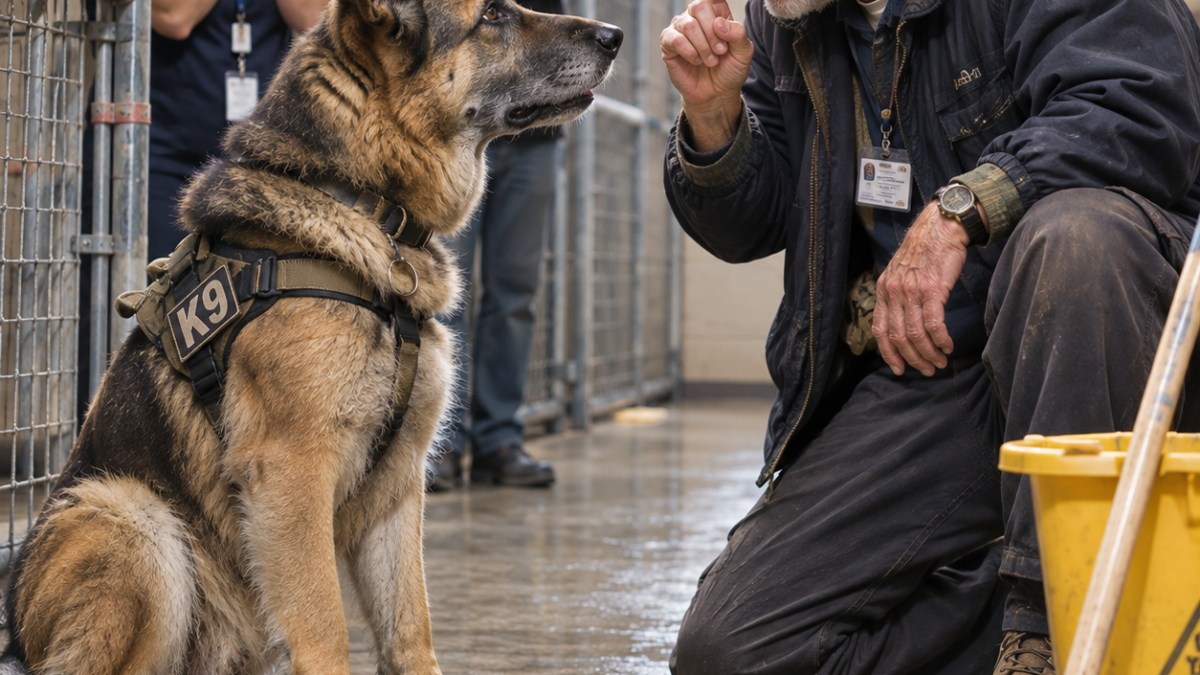
A Shelter Worker Said the Retired K9 Was “Too Broken to Adopt”—Then the Night Janitor Dropped His Mop and Gave One Hand Signal.
For five months, the retired military K9 at the far end of the shelter had ignored everyone who came for him—families, trainers, veterans, toys, steak, tennis balls, even the handlers who still knew the commands from his service file.
The staff had quietly begun using the phrase “too broken to adopt” after Major stopped responding to almost everything human, but one rainy night a seventy-year-old janitor dropped his mop, raised a single hand through the kennel bars, and watched the old German Shepherd stand for the first time in three days.
Then Major crossed the kennel, sat perfectly at the man’s left leg, and looked up with the unmistakable obedience of a dog who had just recognized a command from a world everyone else believed was gone.
The first person to call Major broken was not cruel.
That mattered later.
Her name was Lauren Beckett, and she had spent twelve years working at Blue Ridge Animal Recovery Center outside Roanoke, Virginia.
She had bottle-fed abandoned puppies at two in the morning.
Driven through ice storms for injured dogs.
Sat on concrete floors with animals that bit because pain had made them suspicious of everything.
She had fostered a pit bull with three legs.
A deaf cattle dog.
Two blind senior beagles.
And one cat that hated her so intensely she respected him for it.
Lauren did not give up easily.
But by November, Major had exhausted every idea she had.
He arrived at Blue Ridge in June.
Twelve-year-old German Shepherd.
Large.
Dark sable coat.
Black saddle.
Gray muzzle.
Deep amber eyes.
One torn ear.
Old scar running from his left shoulder toward his chest.
Rear hips stiff from arthritis.
PART2:
Military tattoo number faded inside his right ear.
Microchip records confirmed what the paperwork already said.
MAJOR.
Military Working Dog.
Retired.
Explosive detection.
Multiple deployments.
Transferred after retirement to a former handler in North Carolina.
That handler had died.
Afterward, Major passed through three temporary homes.
The first lasted nine days.
The second lasted less than a week.
The third family returned him in forty-eight hours.
Nobody said Major was aggressive.
That almost made things harder.
He did not lunge.
Did not bark.
Did not destroy furniture.
Did not bite.
He simply stopped participating.
PART3:
The family could place a steak six inches from his nose.
Nothing.
Call his name.
Nothing.
Offer a leash.
Nothing.
Touch his shoulder.
He tolerated it, but his eyes went somewhere else.
He would eat only after people left.
Sleep only when a room was empty.
Refuse to enter vehicles unless physically guided.
Once inside, he froze.
One foster described him as:
“An animal waiting for the next order from someone who isn’t coming.”
Lauren read that sentence several times.
At Blue Ridge, Major was given kennel seventeen.
Large run.
Outdoor access.
Raised bed.
Orthopedic mat.
Water bowl.
Two toys.
A rubber Kong.
A faded green tennis ball.
The first morning, Lauren entered carrying boiled chicken.
Major stood in the back corner.
She crouched.
“Hey, old man.”
His ears moved.
Not toward her.
Toward the hallway.
She placed chicken on the floor.
Backed out.
Closed the gate.
Major didn’t eat until the building became quiet.
The second day, she tried cheese.
Third day, hot dogs.
Fourth day, roast beef.
Major ate everything eventually.
Never in front of her.
A trainer named Dominic Wells came from Richmond.
Former Army canine handler.
He studied Major’s paperwork first.
Then stood outside the kennel.
“Major.”
Nothing.
“Foos.”
The German heel command.
Nothing.
“Platz.”
Down.
Nothing.
“Hier.”
Come.
Nothing.
Dominic tried hand signals.
Still nothing.
He sat outside the kennel for two hours.
Major never approached.
Dominic eventually told Lauren:
“He knows I’m here.”
“You think he understands?”
“Absolutely.”
“So why isn’t he responding?”
Dominic looked through the bars.
“Because understanding isn’t the problem.”
“What is?”
“I don’t know yet.”
That answer became five months.
Visitors came.
Families.
Veterans.
Police officers.
A retired Marine who owned twelve acres.
A widower who wanted a quiet companion.
A couple who had previously adopted an elderly police dog.
Major ignored all of them.
The widower sat outside his kennel for nearly an hour.
Read the newspaper aloud.
Major stared at the wall.
The retired Marine brought a military blanket.
Major sniffed it once.
Then walked away.
A child with permission tossed him a tennis ball.
Major watched it roll past.
Never moved.
That bothered Lauren more than anything.
According to his records, Major had once been obsessed with tennis balls.
His old handler notes included:
PRIMARY REWARD: BALL.
HIGH DRIVE.
WILL WORK THROUGH DISTRACTION FOR BALL.
Now he did not even look.
By August, people stopped asking about him.
By September, Blue Ridge needed kennel space.
The adoptable dogs remained near the front where visitors walked.
Major was moved down the back hallway.
Not punishment.
Practicality.
Kennel thirty-two.
The forgotten end.
That was what volunteers called it privately.
Old dogs.
Medical holds.
Behavior cases.
Animals that needed time.
Major belonged there now.
Lauren hated that.
Every morning she walked to the back before checking emails.
“Morning, Major.”
No response.
Every evening before leaving:
“Good night, old man.”
Nothing.
Sometimes she wondered if he was losing hearing.
Veterinary testing said no.
Vision?
Reduced slightly.
Cognitive decline?
Possible, but inconsistent.
Pain?
Managed.
Neurological issues?
Nothing obvious.
One veterinarian used the term shutdown.
Another said trauma response.
A third said learned helplessness.
Lauren wrote every phrase into Major’s file.
Then one Friday, after a family spent fifteen minutes trying to coax him forward with chicken and left disappointed, Lauren closed the folder and said the sentence she would later regret.
“He’s too broken to adopt.”
The volunteer beside her, a college student named Mia, looked upset.
Lauren immediately corrected herself.
“That came out wrong.”
“But is it true?”
Lauren stared toward kennel thirty-two.
“I don’t know.”
Major lay with his back to them.
She lowered her voice.
“I don’t know if he wants a home.”
That night, the cleaning crew arrived at ten.
Blue Ridge used a skeleton overnight staff.
One veterinary technician on call.
One overnight attendant.
And a janitor named Calvin Reed.
Calvin was seventy.
White hair kept cut close.
Brown skin weathered by sun.
Thin frame.
Left knee stiff.
He worked slowly but thoroughly.
Nobody knew much about him.
He had started at Blue Ridge eighteen months earlier.
Worked four nights a week.
Never complained.
Never volunteered personal stories.
Never wore headphones.
Never listened to podcasts.
He cleaned.
Mopped.
Emptied trash.
Fixed small things without being asked.
If a kennel latch squeaked, Calvin oiled it.
If a drain clogged, he cleared it.
If a frightened dog barked at the mop, he waited until the animal moved before entering.
He was the kind of person buildings quietly depend on.
Lauren liked him.
They did not know each other well.
Calvin arrived after she left most nights.
Sometimes they crossed paths.
“Evening, Mr. Reed.”
“Evening, Miss Beckett.”
She told him repeatedly to call her Lauren.
He never did.
Major had seen Calvin hundreds of times.
At least, everyone assumed he had.
Calvin mopped the back hallway almost every night.
Major never reacted.
What nobody knew was that Calvin had never looked directly at Major before.
Not really.
He knew there was an old shepherd in thirty-two.
Knew the dog did not like people.
Staff had mentioned:
“Give Major space.”
Calvin respected that.
He cleaned around the kennel.
Never tried to make friends.
Never clicked his tongue.
Never offered treats.
Never said:
“Who’s a good boy?”
That last part probably helped.
Then, on November 14, a storm moved through Roanoke.
Hard rain.
Wind.
Branches against the roof.
Power flickered twice.
The overnight attendant called in sick with the flu.
Lauren stayed late.
By eleven-thirty, only she and Calvin remained.
Mia had gone home.
The veterinary rooms were quiet.
The shelter lights had been dimmed.
Rain drummed against the metal awning.
Lauren was in the office completing medication notes when she heard something from the back.
Metal.
Then the mop bucket rolling.
She stood.
“Calvin?”
No answer.
She walked down the hallway.
At kennel thirty-two, Calvin stood motionless.
His mop lay on the floor.
Water slowly spread toward a drain.
Major was standing.
Lauren stopped.
That alone was unusual.
Major had barely risen for dinner.
Now his body was rigid.
Ears forward.
Eyes fixed on Calvin.
Calvin looked as though someone had struck him.
“Mr. Reed?”
He did not answer.
Major took one step toward the gate.
Lauren whispered:
“Major?”
The dog ignored her.
Calvin lifted his right hand.
Not high.
Chest level.
Palm facing inward.
Two fingers together.
The movement was precise.
Small.
Major froze.
Then he walked forward.
Not wandering.
Not cautious.
Straight.
He reached the bars.
Calvin changed the hand position.
Fingers down.
Major sat.
Perfectly square.
Lauren’s mouth opened.
Calvin’s breathing changed.
He moved his hand again.
A slight downward sweep beside his left thigh.
Major stood.
Then shifted his body until he was aligned beside Calvin on the other side of the gate.
Heel position.
Exact.
Lauren stared.
“Where did you learn that?”
Calvin didn’t answer.
Major began whining.
Low.
Almost inaudible.
Calvin’s eyes filled.
He placed one hand against the bars.
Major pressed his forehead against it.
“Jesus.”
Lauren stepped closer.
Calvin whispered:
“Major.”
The dog’s tail moved.
One beat.
Then another.
For five months, Lauren had never seen it wag.
Calvin closed his eyes.
“Good boy.”
Major made a sound.
Not bark.
Not whine.
Something between.
Lauren’s skin prickled.
“Mr. Reed.”
Calvin opened his eyes.
She asked again:
“How do you know those signals?”
His hand remained against Major’s head.
“Because I taught them to the man who trained him.”
Silence.
Even the rain seemed farther away.
Lauren looked at Major.
Then Calvin.
“What?”
Calvin swallowed.
“Open the kennel.”
Lauren did not move.
“Please.”
“Do you know this dog?”
“I know where he came from.”
“That isn’t what I asked.”
Calvin looked directly at her.
“I don’t know if he remembers me.”
Major answered by pushing harder against the bars.
Calvin’s face folded.
“Open it.”
Lauren hesitated.
Protocol.
Major was not considered aggressive.
But an elderly employee entering a kennel with an emotionally shut-down retired military dog required caution.
She said:
“Let me get a leash.”
Calvin shook his head.
“No leash yet.”
“Mr. Reed—”
“Miss Beckett.”
His voice changed.
Not louder.
Commanding.
For the first time, she heard something beneath the janitor.
Something practiced.
“If he thinks he’s being moved before he knows who I am, you’ll lose him again.”
Lauren stared.
Then unlocked the gate.
She opened it six inches.
Major did not rush.
Calvin stepped inside.
The old German Shepherd stood.
Calvin raised one hand.
Major came to heel.
Calvin whispered:
“Center.”
Major moved between his legs.
Sat.
Lauren covered her mouth.
Calvin touched both sides of the dog’s face.
“Look at you.”
Major stared up.
His whole body trembled.
Calvin dropped to one knee despite the bad joint.
Major pushed against his chest.
Hard.
Calvin nearly fell backward.
Then the dog climbed half into his lap.
Twelve years old.
Seventy pounds.
Military discipline gone.
Just a dog.
Calvin held him.
Major buried his muzzle against the man’s shoulder.
Lauren had seen dogs reunite with owners.
This was different.
Recognition was there.
But so was searching.
Major kept sniffing Calvin’s jacket.
Neck.
Hands.
Chest.
Then pulling back.
Looking behind him.
Toward the hallway.
Then Calvin.
Then hallway again.
Calvin understood before Lauren did.
His face changed.
“He isn’t looking for me.”
Major whined.
Calvin stroked his neck.
“No, buddy.”
The dog turned toward the hallway.
Calvin whispered:
“He’s looking for Sam.”
Lauren said:
“Who is Sam?”
Calvin looked at her.
“Sergeant Samuel Mercer.”
Major’s original trainer.
The name existed in the file.
Lauren had seen it.
MWD TRAINER / INITIAL HANDLER:
SSG SAMUEL MERCER.
Years earlier.
Then another name replaced it.
Operational handlers.
Deployment records.
Transfers.
Mercer disappeared from Major’s paperwork after training.
Lauren asked:
“You knew him?”
Calvin sat on the kennel floor.
Major pressed against his leg.
“Knew him?”
His voice broke.
“He was my son.”
Lauren stopped breathing.
Calvin Reed had a different last name.
Major’s trainer was Samuel Mercer.
She said:
“Your son?”
“My stepson.”
That explained the name.
Calvin’s first wife had died when Sam was young.
He raised the boy from age nine.
Never formally changed Sam’s last name.
Calvin had served twenty-two years in the Army.
Canine program.
First as handler.
Later instructor.
Then civilian contractor after retirement.
Sam grew up around working dogs.
At nineteen, he enlisted.
At twenty-four, he entered the military working dog program.
Calvin trained instructors.
Sam trained dogs.
For a time, they worked at the same facility.
Major was one of Sam’s first dogs.
Lauren sat on the concrete outside the kennel.
“You never told anyone you were military.”
Calvin shrugged.
“Nobody asked.”
“You clean an animal shelter.”
“Now.”
“Why?”
He looked at Major.
“That takes longer.”
Major’s head remained on his thigh.
Lauren asked the question she was afraid of.
“What happened to Sam?”
Calvin stopped petting the dog.
“He died.”
Major’s ears moved.
Calvin looked down.
“Eight years ago.”
Not during Major’s service.
After.
Lauren waited.
Calvin took his time.
Sam had trained Major from young-dog evaluation through certification.
Major was difficult.
High drive.
Overfocused.
Too much energy.
Several trainers thought he lacked emotional stability for deployment.
Sam disagreed.
He saw a dog that needed clarity.
Not domination.
Major responded best to hand signals because Sam trained him during early mornings near loud aircraft where voice commands were often lost.
The signals became their private language.
Sit.
Down.
Heel.
Center.
Look.
Wait.
Release.
Calvin had taught Sam some of them.
Old working-dog methods adapted over years.
That was why Major recognized the gestures.
Not because Calvin had trained him extensively.
Because Calvin’s hands moved like Sam’s.
Lauren looked at Major.
“So he didn’t recognize you.”
“Maybe scent.”
Calvin shook his head.
“Mostly the signal.”
Major lifted his head.
Calvin made the heel gesture again.
Immediate response.
Lauren whispered:
“He’s been waiting for that.”
Calvin didn’t answer.
She asked:
“What happened after Sam trained him?”
“Major deployed.”
With another handler eventually.
Sam was reassigned.
But he followed Major’s career.
Every promotion.
Every deployment.
Every injury.
Calvin remembered Sam showing him a picture after Major’s first mission.
Mud-covered dog.
Tongue hanging out.
Sam wrote on the back:
TOLD YOU HE’D MAKE IT.
Major later served with Sergeant Eric Dalton.
Then Staff Sergeant Cole Ramirez.
He became excellent.
Reliable.
The kind of K9 soldiers requested by name.
Sam remained proud.
Years passed.
Then Sam left active service.
Married.
Had a daughter.
Struggled.
Calvin paused.
“Struggled with what?”
Lauren asked.
“Everything he thought he’d left overseas.”
PTSD.
Insomnia.
Alcohol.
Anger.
Shame about needing help.
Calvin knew the pattern.
Had seen it in soldiers for decades.
Seeing it in his own son was different.
Sam tried treatment.
Stopped.
Tried again.
Major was still working then.
Sam occasionally asked for updates.
“When he was having a bad week, he’d say, ‘At least Major knows what he’s supposed to do.’”
Calvin smiled painfully.
“He envied the dog.”
Lauren understood.
Clear commands.
Clear purpose.
Human life rarely offers either.
Sam died eight years ago.
Not in combat.
Calvin would not give details at first.
Later he did.
Single-vehicle crash.
Alcohol involved.
No one else hurt.
Sam was thirty-five.
Calvin had never forgiven himself.
Not rationally.
But grief does not require rationality.
He had trained soldiers to recognize stress.
Taught handlers to read dogs.
Spent a career identifying danger.
Yet his own son still died.
Afterward, Calvin left canine work.
Stopped attending reunions.
Stopped answering calls.
Sold most of his military belongings.
Moved twice.
Eventually took the night janitor job because the shelter needed someone and he preferred animals that did not ask questions.
Lauren asked:
“Did you know Major was here?”
“No.”
“How is that possible?”
“I don’t read intake files.”
“But you mop this hallway.”
“I don’t look into every kennel.”
“You never heard his name?”
Calvin shook his head.
“Staff called him old man sometimes.”
That was true.
Lauren often did.
Calvin had kept distance because Major appeared stressed.
Until that night.
Until the dog looked directly at him.
Then Calvin saw the ear.
The scar.
The eyes.
Maybe not certainty.
Memory.
He gave the signal almost without thinking.
Major answered.
Lauren sat there for nearly an hour.
Major never left Calvin.
When Calvin stood, the dog stood.
When Calvin stepped, Major heeled.
When Calvin stopped, Major sat.
Lauren felt both relief and anger.
Five months.
Trainers.
Visitors.
Behavior plans.
Medication trials.
All while the key had been pushing a mop down the hallway.
But that was not fair.
No one could have known.
The next morning, Lauren called Dr. Melissa Greene, Major’s veterinarian.
Then Dominic Wells.
The trainer drove from Richmond that afternoon.
Calvin nearly refused to come in.
Lauren asked.
“Please.”
He arrived wearing the same work shirt.
Dominic watched from outside the kennel.
Calvin entered.
One hand signal.
Major stood.
Another.
Heel.
Dominic’s expression became almost reverent.
“What signal system is that?”
Calvin demonstrated.
Dominic nodded slowly.
“Old hybrid MWD cues.”
“Modified.”
“Who taught him?”
“Samuel Mercer.”
Dominic looked toward Major.
Recognition.
“I know that name.”
Calvin said nothing.
Dominic continued:
“He trained dogs at Lackland before transferring.”
“Yes.”
“You’re Calvin Reed.”
That surprised Lauren.
Dominic looked at him.
“You taught Mercer.”
Calvin’s face closed.
“Long time ago.”
Dominic had heard stories.
Not legendary nonsense.
Professional stories.
Calvin Reed had been one of the instructors who pushed for reading stress signals rather than treating every hesitation as disobedience.
He taught:
A dog refusing a command may be confused, injured, overloaded, or remembering something.
Figure out which before you call him stubborn.
Lauren felt that sentence go through her.
Too broken to adopt.
She regretted it again.
Dominic crouched outside Major’s kennel.
“Can we test something?”
Calvin nodded.
They began carefully.
Dominic gave a standard verbal command.
Nothing.
Calvin repeated the equivalent hand signal.
Major obeyed.
Verbal.
Nothing.
Hand.
Immediate.
Then Dominic tried combining both.
Major hesitated.
Then obeyed.
They repeated.
Slowly.
No pressure.
Major began reconnecting words with motion.
Not forgetting.
Rebuilding.
Dominic said:
“He hasn’t lost training.”
Lauren asked:
“Then what happened?”
“Generalization collapse.”
She waited.
Dominic explained.
Dogs learn signals in context.
Handlers.
Body posture.
Tone.
Environment.
Stress can narrow what they recognize.
Major had lost too many anchors.
Retirement.
Handler death.
Multiple homes.
New commands.
New voices.
New rooms.
He may have stopped trusting any cue as meaningful.
Then Calvin gave him something from the earliest layer of memory.
A movement connected to Sam.
It opened the file.
Not literally.
But close.
Lauren looked at Major.
“So he was never broken.”
Dominic shook his head.
“No.”
Pause.
“He was disconnected.”
That became the phrase they used.
Not broken.
Disconnected.
The next question was harder.
Could Calvin adopt him?
Everyone thought it.
Calvin refused before anyone asked.
“No.”
Lauren stared.
“What?”
“No.”
Major sat beside his chair.
Calvin looked straight ahead.
“I can’t.”
“You’re the first person he’s responded to.”
“That’s not the same as being a home.”
“You could be.”
“No.”
Lauren felt anger.
“Why?”
Calvin stood.
Major immediately rose.
Heel.
Calvin looked down and hated that.
“That.”
“What?”
“He sees Sam.”
Lauren softened.
“You don’t know that.”
“I do.”
“He sees you.”
“No. He sees hands he remembers.”
Major pressed his shoulder against Calvin’s leg.
Calvin’s jaw tightened.
“I spent eight years trying not to be my son’s father anymore.”
Lauren understood then.
Major wasn’t simply a dog.
He was evidence.
Sam existed.
Sam trained him.
Sam loved him.
Sam died.
Bringing Major home meant bringing the entire son back into the room.
Calvin could mop beside that memory.
He could not yet sleep beside it.
Lauren did not push.
Major’s progress continued anyway.
Calvin agreed to spend thirty minutes with him after each shift.
Structured.
No promises.
Hand signals.
Then verbal pairings.
Dominic created a plan.
Sit signal plus “sit.”
Heel signal plus “heel.”
Wait.
Release.
Ball.
That last one took weeks.
Lauren placed the faded tennis ball near Major.
Nothing.
Calvin picked it up.
Major’s eyes followed.
First time in months.
Calvin rolled it two feet.
Major looked.
Did not move.
Next night, same.
Third night, Major took one step.
Fourth night, nose touched ball.
Fifth night, he picked it up.
Lauren cried.
Calvin pretended not to notice.
On the seventh night, Major brought it back.
Placed it at Calvin’s boot.
Calvin picked it up.
“Again?”
Major’s tail moved.
Lauren had to leave the hallway because she was crying too hard.
Word spread among staff.
Not online.
Lauren forbade that.
No videos.
No viral posting.
No turning Major into content.
He needed recovery, not spectators.
Volunteers noticed.
The dog at the forgotten end was standing now.
Watching.
Accepting treats from Lauren’s hand.
One morning, Mia walked past.
Major approached the gate.
She stopped.
“Hi.”
His ears lifted.
She crouched.
He sniffed her fingers.
That was all.
Mia cried anyway.
Two weeks later, a veteran named Thomas Keller visited.
He had asked about Major months earlier.
Lauren called him back.
“Something changed.”
Thomas came.
Retired Army mechanic.
Sixty-two.
Widower.
Quiet house.
No children.
Large fenced yard.
He sat outside the kennel.
Major watched him.
Thomas did not call.
Did not offer treats.
After ten minutes, Calvin entered the hallway.
Major looked toward him.
Calvin gave the smallest hand signal.
Look.
Major turned toward Thomas.
Calvin signaled forward.
Major approached the bars.
Thomas held still.
Major sniffed him.
Then sat.
Lauren felt hope.
Calvin did not.
He said:
“Again next week.”
Thomas came again.
And again.
Major gradually accepted a leash from him.
Walked beside him.
Ate chicken from his palm.
Then rode in Thomas’s truck for five minutes.
Calvin sat in the passenger seat.
Second ride, Calvin sat in back.
Third ride, he stayed behind.
Major stopped at the truck door.
Looked back toward Calvin.
Calvin gave the forward signal.
Major entered.
The truck drove away.
Calvin watched until it disappeared.
Lauren stood beside him.
“You okay?”
“No.”
“Good answer.”
Major returned forty minutes later.
Calm.
Lauren began thinking adoption.
Calvin still resisted.
Not Thomas.
Himself.
He said Major needed someone who wanted a dog, not a ghost.
Thomas seemed perfect.
Then something complicated happened.
Major started waiting for Calvin.
At nine-thirty every evening, he stood near the kennel door.
Calvin’s shift began at ten.
Nine-forty.
Still standing.
Nine-fifty.
Ears up.
Ten-oh-two.
Mop cart wheels in hallway.
Major’s tail moved.
Every night.
Lauren watched.
Calvin saw it too.
“This isn’t helping.”
“What isn’t?”
“He’s attaching.”
“That’s what dogs do.”
“He’s supposed to attach to Keller.”
“Maybe he can attach to both.”
Calvin looked irritated.
“Everything doesn’t have to be solved by everyone staying.”
Lauren replied:
“Everything doesn’t have to be solved by everyone leaving either.”
That landed.
He walked away.
Two nights later, he called in sick.
First time in eighteen months.
Major waited.
Ten.
Eleven.
Midnight.
No Calvin.
He did not eat.
Next night, Calvin still absent.
Major paced.
Lauren called.
No answer.
Third day, she drove to the address in his employee file.
Small apartment.
Second floor.
No response.
She called the emergency contact.
None listed.
Finally she contacted police for a welfare check.
Calvin was found on the kitchen floor.
Stroke.
Minor, doctors later said.
Treatable.
But he had lain there nearly twenty hours.
Lauren visited the hospital.
Calvin hated hospitals.
Not because of trauma.
Because he hated being helpless.
His left hand was weak.
Speech slightly slurred.
He looked furious.
“You called police.”
“You didn’t answer.”
“I was busy.”
“On the floor?”
He glared.
“How’s Major?”
There.
First question.
Lauren sat.
“Waiting.”
Calvin looked away.
“He should be with Keller.”
“He hasn’t eaten normally.”
“Then Keller should spend more time.”
“He does.”
Silence.
Lauren said:
“He waits for you.”
Calvin’s eyes closed.
“I know.”
“Maybe stop pretending that means nothing.”
“I never said it means nothing.”
“Then what does it mean?”
Calvin stared at his weak left hand.
“It means I’m seventy.”
“So?”
“It means I’ve already left one dog behind.”
Lauren frowned.
He explained.
Sam had another dog after Major.
Personal dog.
Malinois named Pike.
After Sam died, Calvin could not take him.
Too painful.
Pike went to another family.
Calvin never visited.
He had spent years ashamed of that too.
“I don’t do goodbyes.”
Lauren said:
“Nobody does.”
“I do them worse.”
“That’s not a reason to avoid hello.”
He laughed once.
Slurred.
“You rehearse that?”
“No.”
“Sounded rehearsed.”
“It wasn’t.”
Two weeks later, Calvin returned to Blue Ridge.
Cane.
Doctor’s restrictions.
No mopping yet.
Lauren told him he could sit at the desk.
He ignored her.
Walked slowly down the back hallway.
Major heard the cane before seeing him.
The dog stood.
Calvin appeared.
Major froze.
Then rushed the gate.
Not military.
Not controlled.
Front paws against bars.
Whining.
Tail striking metal.
Calvin dropped the cane.
Lauren moved.
He raised his good hand.
Wait.
Major stopped.
Barely.
Calvin opened the gate.
Lauren helped.
Major came forward.
Calvin sat in a chair.
The old German Shepherd pushed his head into Calvin’s chest.
Calvin wrapped his right arm around him.
His left still weak.
He whispered:
“You’re making this difficult.”
Major licked his chin.
Calvin laughed.
First time Lauren had heard it.
Then he cried.
No hiding.
No turning away.
Lauren stood in the hallway.
Thomas Keller arrived thirty minutes later for Major’s scheduled visit.
He saw them.
Understood immediately.
Thomas asked:
“You want him?”
Calvin looked up.
No answer.
Thomas smiled sadly.
“That’s the problem, isn’t it?”
Calvin said:
“You’d give him a better home.”
“Maybe.”
“Yard.”
“Yeah.”
“House.”
“Yeah.”
“No stairs.”
“Yeah.”
Thomas sat across from him.
“But he isn’t waiting for my truck at ten every night.”
Calvin looked down.
Major’s head rested on his knee.
Thomas continued:
“I wanted a dog.”
“You deserve one.”
“I’ll get one.”
Calvin shook his head.
“This isn’t fair.”
Thomas laughed.
“Dogs aren’t distributed by fairness.”
Then he stood.
He scratched Major behind one ear.
“Good luck, old soldier.”
Major leaned into it.
Thomas left.
Calvin stared after him.
Lauren said:
“I have paperwork.”
“Don’t.”
“You want me to wait?”
“Yes.”
“How long?”
Calvin looked at Major.
“Tonight.”
He took Major home the following evening.
Not adopted yet.
Foster trial.
Calvin insisted on the term.
Lauren knew better.
His apartment was small.
Second floor.
Major’s hips hated stairs.
That problem lasted one day.
Calvin moved.
Not immediately.
But within three weeks, he found a ground-floor unit in the same complex.
Lauren helped.
Mia helped.
Thomas brought a truck.
Major supervised.
Mostly from the doorway.
The first night in the new apartment, Calvin set an orthopedic bed beside his own.
Major ignored it.
Slept against Calvin’s bedroom door.
Second night, closer.
Third night, beside the bed.
Fourth night, Calvin woke from a dream about Sam.
He had not dreamed of his son clearly in years.
In the dream, Sam was twenty-six.
Uniform.
Laughing.
Major young at his side.
Calvin woke crying.
Major’s head rested on the mattress.
Calvin touched him.
“Was that what you were waiting for?”
The dog breathed.
Calvin sat on the floor.
He finally opened a box he had kept sealed for eight years.
Sam’s things.
Photos.
Training notes.
Patch.
Dog tags.
A photograph of Major at two years old.
Ears too large.
Tongue out.
Sam kneeling beside him.
On the back:
MAJOR PASSED CERT.
DAD OWES ME $20.
Calvin laughed so hard it became crying.
He put the photograph on the kitchen wall.
That was the beginning.
Not closure.
Calvin hated that word.
Nothing closed.
Sam remained dead.
Major remained old.
Calvin remained angry at himself.
But memory moved from sealed box to wall.
That mattered.
He formally adopted Major one month later.
Lauren watched him sign.
CALVIN REED.
Owner.
He stared at the word.
“I don’t like that.”
“Guardian?”
“Worse.”
“Dad?”
Calvin glared.
Lauren smiled.
“Owner is fine.”
Major lay beneath the table.
Tennis ball between his paws.
The shelter held no ceremony.
Calvin requested none.
No cameras.
No balloons.
Lauren respected that.
He walked out through the same side door he used every night as a janitor.
Major heeled beside him.
Not because of a command.
Because he chose to.
After Major’s adoption, something strange happened at Blue Ridge.
Staff stopped saying “broken.”
Not officially.
No memo.
No training session.
The word simply felt wrong now.
Lauren caught a volunteer describing a frightened dog as broken and interrupted gently.
“Disconnected.”
The volunteer looked confused.
Lauren explained.
Sometimes an animal is not refusing life.
Sometimes the connection between what he knows and what the world is asking has been lost.
Find the bridge.
Dominic began using Major’s case in training seminars.
Anonymous at first.
Later with Calvin’s permission.
The lesson was not:
Use military hand signals.
Too simple.
The lesson was:
Behavior is history.
A dog can know a command and still be unable to access it.
A dog can remember a person through posture.
Movement.
Scent.
A rhythm of hands.
What looks like stubbornness can be grief.
What looks like emptiness can be waiting.
Calvin returned to work after rehabilitation.
Reduced schedule.
Three nights.
Then two.
He no longer mopped the entire building.
He trained a younger custodian.
Major sometimes came with him after closing, approved by Lauren.
The first time he returned, he walked past kennel thirty-two.
Stopped.
Sniffed the bars.
Then kept going.
Lauren watched.
She wondered if he remembered the five months there.
Probably.
Dogs remember places differently than people.
Calvin sat in the hallway.
Major beside him.
A new shepherd mix occupied thirty-two.
Young.
Terrified.
Would not approach staff.
Calvin looked through the bars.
Then at Major.
“Not our business.”
Major lay down.
Calvin sighed.
“Fine.”
He sat outside the kennel for twenty minutes.
Said nothing.
The dog eventually moved closer.
Lauren saw from a distance.
The pattern continued.
Calvin became something unofficial.
Not trainer.
Not behaviorist.
He refused titles.
But if a dog shut down, staff sometimes asked:
“Can Mr. Reed sit with him?”
Calvin usually complained.
Then did it.
He never forced eye contact.
Never reached immediately.
Never treated a frightened animal like a puzzle he needed credit for solving.
He waited.
That was his gift.
Major aged.
Thirteen.
Then fourteen.
His hips worsened.
Hearing declined.
He stopped retrieving the ball.
Then stopped carrying it.
Calvin kept it on the kitchen table.
Major’s days became simple.
Breakfast.
Short walk.
Nap.
Window.
Calvin’s shift.
Dinner.
Sleep.
He loved lying near the front door while Calvin read.
He hated rain.
Liked scrambled eggs.
Disliked vacuum cleaners.
Growled at one particular delivery driver for reasons nobody understood.
Calvin’s daughter from his second marriage, Renee, began visiting more often.
She had been distant after Sam’s death.
Not from anger.
Everyone had grieved separately until separation became habit.
Major changed that too.
Renee asked about Sam.
Calvin answered.
At first small stories.
Then difficult ones.
One afternoon, Renee found the certification photo.
“Why have I never seen this?”
Calvin said:
“Because I was an idiot.”
She accepted that.
They made copies.
One went to Renee.
One to Lauren.
One stayed.
On Major’s fifteenth birthday—estimated, because working-dog records gave year but not exact day—Blue Ridge sent him a package.
New orthopedic mat.
Soft treats.
Tennis ball.
Card signed by staff.
Lauren wrote:
NOT BROKEN.
CALVIN read it.
Did not comment.
Placed the card in the box with Sam’s photo.
Major’s final winter was cold.
His mobility declined quickly.
Calvin built a ramp.
Thomas Keller came by once a month.
He had adopted another senior dog from Blue Ridge.
A black Labrador named Roscoe.
Major tolerated Roscoe.
Barely.
Thomas said:
“He’s jealous.”
Calvin replied:
“He’s judgmental.”
Major’s last good day came in March.
Warm.
Sun.
Calvin took him to a quiet park.
No crowd.
Major walked slowly beside him.
At one point Calvin stopped.
Raised the old hand signal.
Heel.
Major looked.
Then moved into position.
Not perfectly.
Rear legs too weak.
Body crooked.
But beside him.
Calvin’s eyes filled.
“Good enough.”
Major looked up.
That evening he refused dinner.
Next morning, he could not stand.
Lauren came.
So did Dr. Greene.
They entered Calvin’s apartment quietly.
Major lay on his bed.
Calvin sat beside him.
The tennis ball rested near one paw.
Lauren crouched.
“Hey, old man.”
Major’s ear moved.
Recognition.
Lauren smiled through tears.
For five months she had said that every morning without getting an answer.
Now one ear was enough.
Dr. Greene examined him.
Pain.
End-stage arthritis.
Possible internal problem.
At fifteen, more testing would not change the decision.
Calvin knew.
He asked everyone to leave for five minutes.
They did.
He sat alone with Major.
He had rehearsed words.
None came.
Finally:
“I thought you recognized me because I was his father.”
Major breathed.
Calvin touched the scar on his shoulder.
“Maybe you did.”
Pause.
“But you stayed because you knew me.”
That was what Calvin needed to believe.
Not that Major had confused him for Sam.
That the dog had begun with memory and ended with choice.
Calvin raised one hand.
The same signal from the shelter.
Major’s eyes followed.
Heel.
The dog tried to move.
Calvin stopped him.
“No.”
His voice broke.
“No more work.”
He lowered his hand.
Then gave a different signal.
One Lauren had never seen.
Release.
Major relaxed.
Calvin whispered:
“That’s it.”
He stroked the gray fur.
“You’ve done enough.”
Lauren returned.
Dr. Greene prepared the medication.
Calvin kept one hand on Major’s chest.
One on his head.
He said:
“Sam would’ve been proud of you.”
Then, after a long silence:
“He was.”
Major’s breathing slowed.
Calvin closed his eyes.
The dog died under his hand.
Nobody spoke for several minutes.
Calvin eventually picked up the tennis ball.
Held it.
Then gave it to Lauren.
She shook her head.
“You keep it.”
“I’ve got enough things.”
“You sure?”
He looked at Major.
“No.”
Then put it back in his pocket.
He kept it.
Major’s ashes were divided.
Most stayed with Calvin.
A small amount went to the military working dog memorial near the training center where Sam had first certified him.
Calvin traveled there with Renee.
First time in almost a decade he returned.
The facility looked different.
New kennels.
New buildings.
Same heat rising from pavement.
A young handler approached.
“Mr. Reed?”
Calvin nodded.
“We’ve heard about Major.”
Calvin looked annoyed.
“From who?”
“Dominic Wells.”
“Talks too much.”
The handler smiled.
He asked Calvin if he wanted to see the training yard.
Calvin almost said no.
Then:
“Sure.”
Young dogs worked.
Handlers used hand signals.
Different now.
Updated.
But some movements survived.
Calvin watched.
One instructor raised two fingers.
A shepherd sat.
Calvin’s breath caught.
Sam.
Major.
Time folding.
Renee touched his arm.
“You okay?”
Calvin answered honestly.
“No.”
Then:
“But stay.”
They stayed.
Blue Ridge eventually placed a small plaque near kennel thirty-two.
Not memorial.
Lauren hated memorializing suffering.
The plaque said:
BEHAVIOR IS HISTORY.
LOOK AGAIN.
Underneath, smaller:
In honor of Major and Calvin Reed.
Calvin complained when he saw it.
Lauren said:
“You can remove it after I retire.”
“When’s that?”
“Never.”
He left it.
Years later, new staff heard the story.
The retired military K9 who ignored everyone.
The night janitor.
The dropped mop.
One hand signal.
Some retellings made Calvin Major’s original handler.
Lauren corrected them.
No.
That mattered.
Calvin had not been Major’s handler.
He had not rescued him from combat.
He had not known him intimately before the shelter.
The connection was more interesting.
Calvin had trained the man who trained Major.
A movement passed from one generation of handler to another.
Calvin to Sam.
Sam to Major.
Then years later, Major saw that movement again and something inside him reopened.
A language survived the people who created it.
That was the miracle, if anyone insisted on using the word.
Not that a dog obeyed.
Major had always known how to obey.
The miracle was that after loss, transfers, unfamiliar homes, and five months of silence, there was still something inside him waiting to recognize meaning.
And there was still something inside Calvin waiting too.
The shelter thought Major needed someone to teach him how to trust humans again.
Maybe he did.
Calvin thought he had left his life with working dogs because there was nothing left there for him except Sam.
He was wrong too.
Major did not replace Sam.
Nothing could.
That was never the point.
He gave Calvin somewhere to put the love that grief had trapped.
And Calvin gave Major a signal old enough to tell him:
You still know this.
You still belong somewhere.
You are not finished.
The night it began, Lauren had been standing in the hallway thinking she was looking at a dog everyone had failed.
Calvin Reed dropped his mop.
Raised one hand.
Major stood.
He crossed the kennel.
Sat at the old man’s left side.
And for the first time in five months, his tail moved.
Not because someone had finally fixed him.
Because he had never been broken.
He had only been waiting for something familiar enough to lead him back.








