A Shelter Cat Ignored Every Name We Gave Him—Then I Read the Faded Name Scratched Into His Old Collar
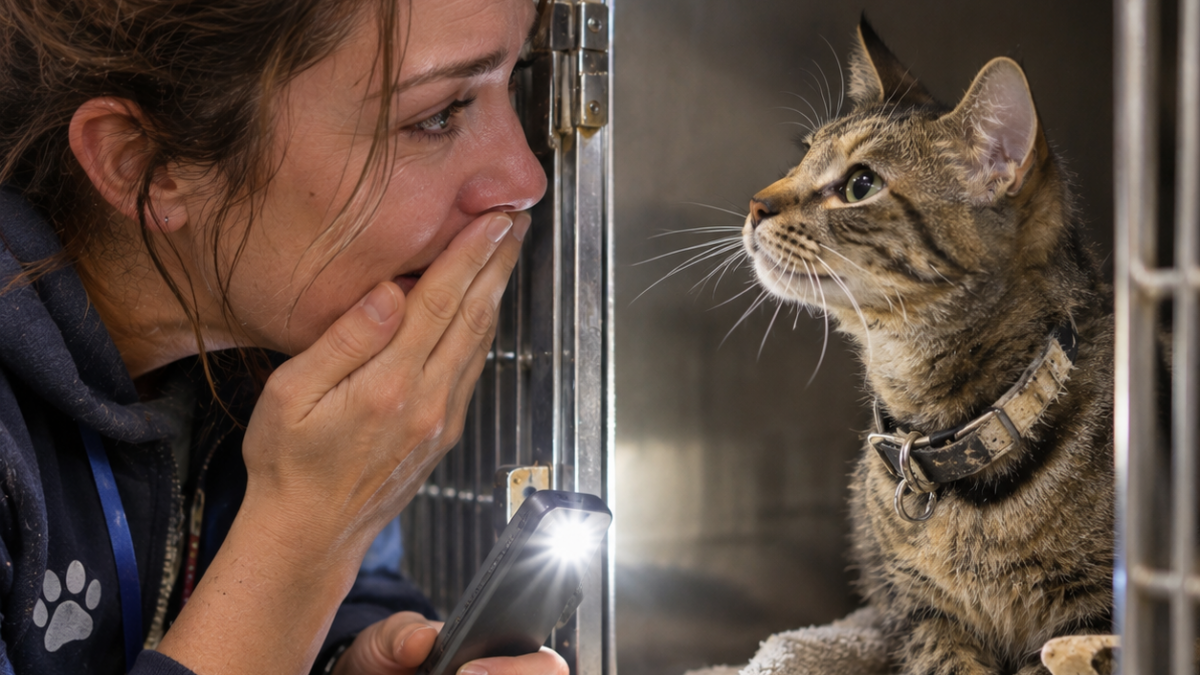
A Shelter Cat Ignored Every Name We Gave Him—Then I Read the Faded Name Scratched Into His Old Collar.
For two days, the young tabby ignored every name we gave him and watched families pass his kennel as if he had already learned that being quiet enough was another way to disappear.
Then I found one nearly erased word scratched into the metal tag beneath his shelter collar, whispered “Arden,” and watched a cat who had refused to acknowledge any of us stand up and take his first step toward the door.
Four months later, that name would lead me to a mother who had spent every night believing she had abandoned him, a boy hundreds of miles away who still kept Arden’s empty bed beside his own, and a quiet stranger who would teach me that sometimes rescuing an animal does not mean giving him a new life—it means refusing to erase the one he already had.
He heard everything except the name we gave him.
That was the first thing I noticed.
I was twenty-nine then, working evening intake at a city shelter in Boise.
I had been there a little over four years, long enough to become good at the parts of shelter work nobody posts on social media.
Paperwork.
Vaccination schedules.
Cleaning.
Medication charts.
Microchip scanners.
Calling people who had listed disconnected phone numbers.
Explaining why a stray hold had not expired yet.
Explaining why it had.
Knowing which kennel latch stuck when the weather changed.
Knowing which dog could be walked past which other dog without turning the hallway into chaos.
Knowing that a frightened cat who looked “mean” at five in the afternoon might be rubbing against your wrist by eight if you stopped staring at him long enough.
I was good at practical things.
Practical things have answers.
A cat has fleas.
Treat the fleas.
A dog is dehydrated.
Fluids.
A kennel is dirty.
Clean it.
A vaccination is due.
Give it.
What I was never very good at was the other kind of problem.
The kind where nothing looked obviously wrong, but something still felt off.
He arrived near the end of my shift on a Wednesday.
Outside, the light had begun turning that washed-out gray-blue Boise gets before evening settles over the foothills.
Animal control brought him in a plastic carrier with a cracked handle.
Young brown tabby.
Male.
Not fully grown.
Maybe nine or ten months old, though later our veterinarian thought he could have been closer to a year.
Thin.
Not starving.
Just the wiry kind of thin that makes a street cat look built out of springs.
PART2:
He had been found behind a row of small service businesses near the back delivery doors.
The officer who brought him in said employees had been seeing him for at least a week.
“He keeps coming back to one door.”
“Which door?”
“Printing shop. Unit four.”
“Anybody feeding him?”
“Someone put out turkey.”
“Did he eat it?”
“Eventually.”
“Friendly?”
The officer shrugged.
“Not unfriendly.”
That usually meant nobody had been bitten yet.
“He let you pick him up?”
“No.”
“How’d you get him?”
“Carrier and food.”
“Any collar?”
“Yeah. Old one.”
“Tag?”
“Sort of.”
I looked.
The cat wore a faded blue nylon collar beneath the temporary slip lead the officer had used.
There was a small metal plate against it, so scratched and dull that I could not read anything at a glance.
I made a note to check it later.
PART3:
At intake, priorities come in order.
Scan first.
No chip.
Quick physical assessment.
No obvious injury.
Some flea dirt.
A minor scab near one shoulder.
Hydration acceptable.
Weight a little low.
Eyes clear.
Ears dirty but not alarming.
He did not fight.
That surprised me.
Stray cats usually gave you something.
Hissing.
Flattening.
Trying to escape.
Or, at the opposite end, desperate affection from an animal relieved to be indoors.
This cat did neither.
He watched.
Every hand.
Every sound.
Every step.
When I moved the scanner down his back, his eyes followed my wrist.
When a kennel door slammed two rooms away, one ear rotated.
When a dog barked, both ears went forward.
When somebody opened a can of food in the prep area, his head turned toward the sound immediately.
He heard perfectly.
He was present.
He just acted as though none of us belonged to him.
The shelter software required a name.
A temporary one was fine.
Most strays arrived without any identification.
Some got silly names.
Some seasonal.
Some based on appearance.
The week before, three orange kittens had been entered as Cheddar, Gouda, and Brie.
I looked at the brown stripes on his forehead and typed:
Milo.
There were probably twelve Milos in our database already.
He looked like a Milo.
I printed the kennel card.
“Milo.”
Nothing.
I opened the carrier.
“Milo, come on.”
He looked past me.
I tapped the side gently.
“Milo.”
Nothing.
A metal scoop fell in the hallway.
His head snapped up.
So I knew.
He heard me.
He just did not care about Milo.
That was not unusual by itself.
Cats do not generally arrive understanding shelter names.
But most animals react to a voice.
An ear twitch.
A glance.
A flinch.
Something that says:
I heard a human noise directed at me.
He gave me none of that when I used the name.
It was almost as if Milo belonged to another animal in another room.
I moved him into a kennel.
Folded towel.
Food.
Water.
Litter.
Cardboard hide box.
He went straight to the back.
Not into the box.
Behind it.
He sat low with his tail tucked close.
I crouched several feet away.
“Okay, Milo.”
His gaze traveled over my shoulder.
“Not a Milo?”
Nothing.
“Kevin?”
One ear shifted toward a barking dog.
“Mr. President?”
Nothing.
I smiled despite myself.
“Fine.”
I left him alone.
The next morning he had eaten.
That was good.
Used the litter box.
Also good.
No vomiting.
No obvious diarrhea.
He had groomed enough to smooth the fur along one shoulder.
Physically, he looked like a straightforward stray hold.
Behaviorally, something about him bothered me.
Not fear exactly.
He did not recoil when I changed the food bowl.
He did not hiss.
He did not swat.
He watched my hand come in, then watched it leave.
No trust.
No panic.
Assessment.
That was the word.
He seemed to be assessing every person who came near him and finding none of us relevant.
When I said “Milo,” nothing.
At lunch, one coworker tried:
“Tiger.”
Nothing.
“Buddy.”
Nothing.
“Baby.”
Nothing.
She looked at me.
“He’s a cat.”
“I know.”
“He doesn’t have to answer.”
“I know.”
“What are you expecting?”
“I don’t know.”
That was the problem.
The stray hold expired without an owner appearing.
No microchip.
No lost report matching him.
Nothing attached to the collar that we could immediately read.
So by the next afternoon, after standard processing and veterinary clearance, he moved to the adoption side.
That was when what I had worried about started happening.
Families noticed him.
He was young.
Healthy-looking.
Good face.
Plain brown tabby, yes, but beautiful in that classic way tabbies are beautiful when you actually stop looking for unusual colors.
Strong dark lines around his eyes.
Narrow black stripe down the nose.
Dark tail tip.
White nowhere.
People slowed.
Then they waited for him to do something.
A woman crouched.
“Hi, Milo.”
Nothing.
She clicked her tongue.
Nothing.
Her daughter tapped the glass.
Nothing.
The cat watched the tapping finger.
No approach.
No retreat.
Twenty seconds later, they moved two kennels down to a six-month-old tuxedo who immediately rolled onto his back.
A man in a Carhartt jacket stood there later.
“He’s kind of shut off, huh?”
“He’s adjusting.”
“He friendly?”
“He hasn’t shown aggression.”
“That isn’t the same.”
“No.”
The man waited.
Our tabby sat at the back.
The man moved on.
A teenage boy came with his mother that evening.
He looked through the glass.
“That one doesn’t even respond.”
“He’s been through a transition,” I said.
The mother nodded politely.
They adopted a kitten three kennels away.
That is how invisibility starts in shelters.
Not because nobody sees the animal.
They see him.
Then they decide he is not giving them enough back.
People want connection.
That is reasonable.
They walk into a loud room full of animals and are trying to imagine one of those animals in their house.
A paw through the bars helps.
A purr helps.
A cat rubbing against the door helps.
A kitten making eye contact helps.
This one gave people no easy preview.
He made them do all the work.
Most did not.
By the end of the second adoption day, my manager, Susan, stood beside me.
“If he stays like this, we may move him to Quiet Row.”
I nodded.
Quiet Row was not punishment.
It was better for some stressed cats.
Less foot traffic.
Fewer children.
Lower noise.
More decompression.
But adoption traffic there was also lower.
A cat could become calmer and less visible at the same time.
“How long?”
“Couple days.”
“Maybe he needs longer here.”
“Maybe.”
Susan was not cruel.
That almost made the conversation harder.
She had worked sheltering for nineteen years.
She knew space.
Stress.
Disease control.
Turnover.
She knew you could not build policy around one employee’s feeling that a particular cat was “holding on to something.”
I knew that too.
I nodded.
“Okay.”
After closing, I should have gone home.
Instead I finished laundry.
Then cleaned water bowls that did not need cleaning.
Then checked medication logs twice.
Eventually I admitted I was waiting for the building to get quiet.
The bright adoption-room lights went down.
The dogs settled.
The phones stopped.
A shelter after closing becomes a different place.
During public hours, everything is motion.
Questions.
Children.
Barking.
Doors.
Announcements.
Afterward, you hear the small sounds.
Litter shifting.
A cat drinking.
Blankets moving.
Purring from somewhere you cannot see.
I went back to the tabby’s kennel.
He was sitting in the same place.
Watching.
“It’s just me.”
Nothing.
I opened the door slowly to replace a damp section of bedding.
He shifted forward.
Not toward me.
Just enough to make room.
That was more movement than I had seen him make voluntarily near a person.
The old blue collar became visible.
I had forgotten it.
The shelter tag had been clipped over it.
I reached—not toward him, but toward the dangling metal plate.
He tightened.
I stopped.
“Okay.”
I used my phone flashlight instead.
The metal looked blank at first.
Scratches everywhere.
Weather.
Wear.
But when he turned his head, the light caught shallow engraving.
One letter.
Maybe A.
I crouched lower.
Another.
R.
Then what looked like D.
I adjusted the angle.
The word emerged slowly.
ARDEN
I said it without thinking.
“Arden.”
His head came up.
So fast I stopped breathing.
Not a casual orientation.
Not the small ear twitch he’d given every random shelter sound.
He looked directly at me.
Both ears forward.
Eyes fixed.
I did not move.
“Arden?”
He stood.
For the first time since arriving, he stood because of something I said.
Then he took one small step toward the kennel door.
That was it.
No running.
No meow.
No purr.
But my entire understanding of him changed in about three seconds.
I whispered:
“That’s your name.”
He watched.
“Arden.”
Another step.
Then he stopped.
I sat on the floor.
For maybe five minutes, we looked at each other.
He did not come farther.
I did not reach.
But he also did not turn away.
The shelter had called him Milo.
He had ignored us because Milo had nothing to do with him.
That realization felt obvious after the fact.
Of course animals have histories before intake.
Of course a shelter name is convenience.
But something about seeing him answer to his real one made the gap between our paperwork and his life feel enormous.
He was not a blank cat.
He had belonged somewhere.
Maybe to someone.
The collar might be old.
The name might not even be his.
But his reaction was too specific for me to dismiss.
The next morning, I started looking.
Lost-pet databases first.
Nothing current.
Local Facebook groups.
Neighborhood apps.
Craigslist lost and found.
Humane society reports.
Older posts.
There were dozens of tabbies.
Hundreds if I widened the area.
Brown cats are difficult to identify from bad photographs.
One dark tail tip looks like another.
One forehead M resembles fifty others.
I searched “Arden cat Boise.”
Nothing useful.
“Lost cat Arden Idaho.”
A landscaping company.
A realtor.
A baby-name forum.
I searched the cross streets near the service businesses where he had been found.
Nothing.
During my break, I drove there.
The printing shop employee recognized him from a photo.
“That’s the one.”
“How long was he coming here?”
“Maybe ten days.”
“Why this door?”
She shrugged.
“We wondered that.”
“Did anybody know him?”
“No.”
“Did he try getting inside?”
“Sometimes.”
That caught me.
“What do you mean?”
“At closing. He’d sit right there.”
She pointed beside the back delivery entrance.
“If somebody opened it, he’d stand up.”
“Go inside?”
“No.”
“Why?”
“I don’t know.”
“Did he seem like he was waiting?”
She gave me a strange look.
“Yeah.”
I walked around the block.
Apartments.
Old houses converted into offices.
A laundromat.
A small auto shop.
Nothing.
Back at the shelter, Arden still responded.
I tested carefully.
No food cue.
No can opening.
I stood near his kennel.
“Arden.”
Head up.
Every time.
Not always coming forward.
But orientation.
Recognition.
The shelter name?
Nothing.
Susan watched once.
“Well.”
“Exactly.”
“That collar should’ve been checked more carefully at intake.”
“I know.”
I felt embarrassed.
That was my job.
But worn collars are common.
We scan microchips because collars come off, tags transfer, names change.
Still, we had missed it.
Susan said:
“Search another day. If nothing turns up, we can’t hold him indefinitely from adoption.”
“I know.”
“We can note that his name appears to be Arden.”
“I already changed the kennel card.”
She looked at me.
“You did?”
“Yes.”
A pause.
Then:
“Okay.”
Small victory.
His card now read:
ARDEN
The difference was immediate.
Not for adopters.
For him.
When I said it during feeding, he came forward.
Not all the way.
But enough.
Day after day, that name became the only reliable bridge.
I kept searching.
Late one night, after scrolling through posts old enough that most people would have stopped, I found a photograph from about four months earlier.
Bad picture.
A brown tabby sitting inside a window.
Side view.
The forehead pattern looked close.
The tail tip dark.
Caption:
Lost during our move. Please keep an eye out near Fairview / Orchard area. He may be scared.
No name in the post.
I nearly moved on.
Then I opened comments.
Someone had written:
I hope Arden comes home. Thinking of you and Noah.
I stared at the screen.
There it was.
Outside the shelter.
Outside the collar.
Arden.
I sat up so quickly my chair rolled backward.
The account belonged to a woman named Claire Morgan.
The post was four months old.
I called the phone number.
Straight to voicemail.
I left a message.
“Hi, my name is— I work at the Boise city shelter. I’m calling about a lost tabby named Arden. Please call me.”
Nothing.
Ten minutes later, I called again.
No answer.
I messaged the account.
Then I spent the next several hours checking my phone.
Nothing.
One coworker, Jamie, saw me.
“You’re getting attached.”
“To the cat?”
“To the mystery.”
“Maybe.”
“Careful.”
“Why?”
“Because sometimes people disappear for a reason.”
I looked at her.
“Meaning?”
“Maybe they dumped him.”
“That post doesn’t look like dumping.”
“You don’t know.”
She was right.
“Maybe the number is disconnected.”
“Maybe.”
“Maybe she doesn’t want him.”
“Maybe.”
That possibility bothered me more than I wanted to admit.
Arden did not need the person who used to own him to want him back for his history to matter.
But emotionally, I had already imagined reunion.
That was dangerous.
Shelter work teaches you not to build endings before you have facts.
I was doing it anyway.
That afternoon, a man named Eli Mercer walked into the adoption room.
I noticed him because he did not behave like most visitors.
He was around forty.
Paint on one sleeve.
Work boots.
Dark hair with gray beginning near the temples.
He looked tired, but not unhappy.
He walked the entire cat room once.
No tapping.
No calling every cat “buddy.”
No sticking fingers through kennel bars.
Then he came back to Arden.
And stayed.
Five minutes.
That is a long time in front of one quiet shelter cat.
I approached.
“Looking for anything specific?”
“No.”
“First cat?”
“No.”
“Current pets?”
“None.”
That got my attention.
“Last cat?”
“Died about a year ago.”
“I’m sorry.”
“Thanks.”
He looked back at Arden.
“What’s his deal?”
The question could have sounded rude.
It didn’t.
“Stray.”
“He looks like he’s thinking.”
“He does a lot of that.”
“Friendly?”
“Unknown enough that I don’t promise.”
Eli smiled.
“Good answer.”
I gave him the standard description.
Young.
Quiet.
Observant.
Not aggressive.
Slow to engage.
I warned him that Arden had not done well in meet-and-greets.
Eli said:
“Okay.”
Then crouched off to one side.
Not directly in front.
He did nothing.
Arden remained in the back.
One minute.
Two.
Then his head lifted.
Eli did not move.
Arden turned his body enough to face forward.
I felt my pulse change.
It was more response than most adopters had gotten.
I said quietly:
“Arden.”
His ears moved immediately.
Eli looked at me.
“That’s his name?”
“We think.”
“What do you mean?”
I should have kept it simple.
Instead, maybe because Eli had not asked the cat to perform anything, I told him.
The collar.
The engraving.
The reaction.
The old post.
The unreturned calls.
Everything.
When I finished, Eli leaned against the wall.
“What do you do?”
“Keep trying.”
“No, I mean if you find them.”
“Depends.”
“Do they get him back?”
“If ownership can be verified and the legal hold situation supports it, potentially.”
“And if they can’t take him?”
“I don’t know yet.”
Eli nodded.
He looked at Arden.
Then said:
“I restore old hand-painted signs.”
I waited.
He continued.
“Storefronts mostly. Old barns. Sometimes theaters.”
“Okay.”
“Half the job is stripping paint somebody put over what was there before.”
I looked at him.
“You can find old names underneath.”
“Sometimes.”
He smiled.
“They’re not always perfect.”
Then:
“But the dumbest thing you can do is paint over it again before you even look.”
He stood.
“I’m not applying today.”
I felt strangely disappointed.
“Okay.”
“If his people don’t come through, call me.”
“You’re still interested?”
“Yes.”
“Even with all this?”
“Especially because of all this.”
He left his number.
After closing, I sat near Arden.
“You met someone.”
He watched.
“Not exactly charming.”
Arden blinked.
“Neither are you.”
He looked away.
“Fair.”
At 8:46 that night, my phone rang.
Unknown number.
I nearly let it go to voicemail.
Then I saw the area code matched the old lost-cat listing.
“Hello?”
A woman said:
“You left a message about Arden?”
Her voice trembled on his name.
“Yes.”
Silence.
Not disconnected silence.
Breathing.
Trying not to hope.
“My name is Claire.”
“Hi, Claire. I work at the shelter.”
“Do you have him?”
“I have a cat who may be him.”
She did not say:
I’m coming.
She started asking questions.
That told me more than excitement would have.
“Is the tip of his tail darker than the rest?”
“Yes.”
“On his forehead, do the stripes come together narrow between his eyes?”
“Yes.”
“Is there a thin dark line down the nose?”
“Yes.”
“Left back paw—does one toe sit a little sideways?”
I had not noticed.
I checked the intake photos.
“Maybe.”
“When men approach him, does he run immediately?”
“No.”
“What does he do?”
“Watches first.”
Claire exhaled shakily.
“That’s Arden.”
I sent two photographs.
Her reply arrived almost immediately.
THAT’S HIM.
Then a second:
I’m sorry. I need a minute.
I sat at my desk.
Five minutes later, she called again.
She told me the story.
Divorce.
Fast.
Ugly in the quiet way some divorces are ugly.
No police.
No dramatic affair.
Just money, custody, resentment, and a house that had to be emptied quickly.
Claire and her son Noah had been staying in the rental home.
Her ex-husband, Matt, moved out first.
Then the lease ended sooner than expected.
Claire packed alone while working full-time.
Friends came.
Doors stayed open.
Boxes moved.
Arden had always been an indoor cat.
On moving day, he slipped out.
Nobody noticed for almost two hours.
When Claire realized, she stopped everything.
Searched.
Neighbors searched.
No Arden.
They left food.
His litter box.
Blankets.
Flyers.
She returned every night.
For weeks.
Then the landlord changed locks.
She kept searching from outside.
“What happened to the house?”
“New tenant.”
“What about you?”
“Temporary apartment.”
“Pet-friendly?”
“No.”
That explained part of the silence.
“Why did you move somewhere that didn’t allow him?”
The question came out harsher than I intended.
Claire did not become defensive.
“Because it was the only place I could afford that would take me immediately.”
I closed my eyes.
“I’m sorry.”
“No. It’s fair.”
“No, it wasn’t.”
She continued.
Her son Noah had gone to stay temporarily with his father in Oregon.
“Why Oregon?”
“Matt moved there for work.”
“How old is Noah?”
“Eleven.”
“He knows Arden is missing?”
“Yes.”
Her voice broke.
“He blamed himself.”
“Why?”
“He left the back door open while carrying a box.”
I felt sick.
“He was ten.”
“I know.”
“That’s not his fault.”
“I know.”
“Does he?”
A long pause.
“No.”
Claire told me Noah still kept Arden’s cat bed beside his bed in Oregon.
Empty.
He had asked about Arden every few days at first.
Then every week.
Then stopped asking.
“He started saying things like, ‘He probably has another family now.’”
“That could be true.”
“I know.”
“He could have survived because somebody fed him.”
“I know.”
“But he didn’t forget his name.”
Claire cried.
I waited.
She asked:
“Can I come tomorrow?”
“Yes.”
“Should I bring anything?”
“Photos. Vet records if you have them. Anything supporting ownership.”
“Okay.”
Then:
“I need to tell you something.”
“What?”
“I can’t take him home tomorrow.”
My heart dropped.
“Why?”
“My housing still doesn’t allow pets.”
“Still?”
“I’m on a waiting list for another apartment.”
“How long?”
“Could be months.”
I did not know what to say.
She continued quickly:
“I don’t want you to hold him indefinitely.”
“Claire—”
“I don’t.”
“He recognized his name.”
“I know.”
“I need to think.”
“No.”
Her voice became firm.
“Please don’t make decisions because you feel sorry for me.”
That stopped me.
“I want to see him.”
“Okay.”
“I want to know he’s alive.”
“Okay.”
“And then we figure out what is actually best for him.”
That sounded like someone who loved the cat.
Not someone trying to own the ending.
Claire arrived the following afternoon.
She carried a large manila envelope.
Her hair was pulled back too tightly.
No makeup.
Hands shaking slightly.
She looked like someone who had spent the entire drive practicing not to cry.
We checked documents first.
Vaccination records.
Old veterinary invoices.
Photographs.
Microchip paperwork?
None.
They had never chipped him.
That was a mistake Claire regretted openly.
“He was indoor-only.”
“So are most lost indoor cats.”
“I know that now.”
One photo showed kitten Arden asleep against a little boy.
Noah.
Another showed Arden sitting inside a cardboard castle.
Another at Christmas.
Another stretched across Claire’s keyboard.
Same forehead.
Same tail.
Same eyes.
There was no realistic doubt.
I brought Arden into a quiet meet-and-greet room.
Claire sat on the floor.
Hands in her lap.
She did not call immediately.
Arden entered low.
Cautious.
He looked around.
Then saw her.
Stopped.
Claire whispered:
“Arden.”
Everything in him went still.
Not fear.
Focus.
He stared.
Then stepped forward.
One step.
Another.
Another.
He stopped beyond arm’s reach.
Claire’s face collapsed.
“Hi.”
Arden watched.
She did not reach.
“You got big.”
That was the wrong sentence somehow.
She laughed and cried at once.
Arden took another step.
Sniffed the air.
His nose moved.
Then he sat.
Claire covered her mouth.
I stood near the wall pretending I was not crying too.
Movies would have made him run.
Jump into her arms.
Purr.
Knead.
Instant reunion.
Reality was quieter.
Four months is long in a young cat’s life.
He knew something.
Voice.
Scent.
Movement.
Name.
But recognition does not erase what happened between.
Claire whispered:
“I’m sorry.”
Arden blinked.
“I looked for you.”
He looked toward the door.
“I came back every day.”
Nothing.
“I’m sorry.”
I wanted to tell her:
He does not know you failed him.
Maybe she needed that.
But I did not know what Arden understood.
So I stayed quiet.
After twenty minutes, he moved closer.
Close enough to sniff her hand.
Claire did not touch him until he rubbed one side of his face against her fingers.
One second.
Then away.
She cried harder.
“I kept thinking if I found him, I’d just take him home.”
I sat across from her.
“You might be able to arrange something.”
“No.”
“Foster?”
“No.”
“Temporary placement?”
She shook her head.
“I have moved four times in five months.”
She looked at Arden.
“Noah is still in Oregon.”
“Is he coming back?”
“Eventually. We don’t know exactly when.”
“Your apartment?”
“Month-to-month. No pets. I could lose it.”
I nodded.
Claire wiped her face.
“If I take Arden now, what does ‘home’ even mean?”
No answer.
“Another temporary room?”
She looked at me.
“Another move?”
Silence.
“He already had enough of that.”
Then she asked:
“Has he liked anyone?”
I thought of Eli.
“There is someone.”
Her face tightened.
“An adopter?”
“Potential.”
“Good person?”
“I think so.”
“Think?”
“I’ve met him once.”
Claire laughed weakly.
“That’s not reassuring.”
“He sat with Arden for five minutes and didn’t touch the glass.”
“That’s better.”
“He knows the history.”
“All of it?”
“What I knew.”
“And he didn’t leave?”
“No.”
Claire looked at Arden.
Then at me.
“If that happens…”
She stopped.
I waited.
“If he goes with someone else, don’t rename him.”
“I won’t.”
“Please.”
“I promise.”
She swallowed.
“I know names don’t mean the same thing to cats that they do to us.”
“Maybe not.”
“But it’s his.”
“Yes.”
“I don’t want somebody acting like his life started when they adopted him.”
That sentence stayed with me.
Because shelters do that accidentally all the time.
Not maliciously.
Animal arrives.
New name.
New card.
New photos.
New bio.
Happy ending.
We simplify before and after because it is easier to tell.
But animals do not begin when we meet them.
They arrive carrying habits we do not understand.
Fears.
Preferences.
Routines.
Names.
People.
Sometimes loss.
Claire left without Arden.
That was one of the hardest things I have watched someone do.
At the door, she turned once.
Arden was behind the glass, watching.
She whispered his name.
His ears moved.
Then she walked out.
I called Eli before I could talk myself out of it.
“Hi.”
“You found them.”
I had not even said why I called.
“How do you know?”
“Your voice.”
I told him everything.
Claire.
Noah.
Housing.
Recognition.
Her decision.
The request about the name.
When I finished, I waited for the polite escape.
Too complicated.
Too emotional.
Potential ownership dispute.
Former family involved.
Maybe future contact.
People generally want adoption to feel clean.
A handoff from nobody to somebody.
Arden did not come that way.
Eli said:
“I can come tonight.”
“You’re still interested?”
“Yes.”
“You understand Claire may want updates.”
“Okay.”
“She may want Noah to know where he is.”
“Okay.”
“She doesn’t want his name changed.”
“Good.”
“Good?”
“I wasn’t going to change it.”
I smiled.
“Why?”
“Because it’s his name.”
He arrived before closing.
Same paint-stained sleeve.
Different shirt.
Arden went into the same meeting room.
Eli entered after.
His voice came from the hall first.
“Hey.”
Arden’s head lifted before the door opened.
I noticed.
Eli came in.
Sat down off to the side.
No reaching.
Arden stayed near a chair leg.
Eli said:
“I don’t need him to be new.”
I looked at him.
He continued:
“I just don’t want him to have to give anything up to stay.”
Then he said:
“Arden.”
The cat walked across the room.
Not running.
Not dramatic.
Steady.
Careful.
All the way to Eli’s knee.
Eli put his hand flat on the floor.
Arden leaned forward.
Sniffed.
Then rubbed once against his knuckle.
That was the moment I knew.
Not fate.
Not magic.
Not that Eli was more deserving than Claire.
Just fit.
A cat needing patience.
A man apparently built out of patience.
We finished the paperwork.
Eli rented a small house with a fenced backyard, though Arden would remain indoors.
No current pets.
His previous cat, Scout, had died of kidney disease at sixteen.
Veterinary records excellent.
Landlord approval.
Stable job.
No small children.
He worked restoring old signs and architectural lettering from a workshop behind his house.
He could bring Arden into the workshop later if the environment was safe.
At first, Arden would have his own room.
Everything checked.
When the carrier door closed, Arden did not panic.
He looked at me.
I said:
“Go home.”
Then corrected myself.
“Go to the next one.”
Eli heard.
He nodded.
A week later, Claire messaged.
“Did he go?”
“Yes.”
“Is he okay?”
“Yes.”
I sent a photo Eli had given permission to share.
Arden stretched across an old wooden worktable.
Paint cans around him.
Brushes.
One paw dangling over a faded sign reading:
MILLER & SONS HARDWARE
He looked more relaxed than he ever had at the shelter.
Claire replied:
I showed Noah.
Then:
He cried.
Then:
But good crying, I think.
I asked whether Noah wanted to talk to Eli.
Claire said:
“Not yet.”
Two weeks later, he did.
That call changed everyone.
Eli told me afterward.
Noah was eleven.
Quiet.
He did not ask:
Does Arden miss me?
He asked:
“Does he still sleep with his front legs crossed?”
Yes.
“Does he chirp at birds instead of meow?”
Yes.
“Does he hate the vacuum?”
Absolutely.
“Does he steal bread?”
Eli paused.
“He stole half a hamburger bun yesterday.”
Noah laughed.
Then went silent.
Finally:
“Can you tell him I’m sorry?”
Eli said:
“You don’t have to be sorry.”
“Yes, I do.”
“Why?”
“I left the door open.”
Eli told me he could hear Claire in the background say:
“Noah.”
The boy continued:
“If I closed it, he wouldn’t have gotten out.”
Eli did something I would not have thought to do.
He did not tell Noah:
It wasn’t your fault.
Not immediately.
Instead he asked:
“How old were you?”
“Ten.”
“Were you helping move?”
“Yes.”
“Were adults moving boxes too?”
“Yes.”
“Were doors opening all day?”
“Yes.”
“Then Arden got out during a chaotic move.”
Noah said:
“Because of me.”
Eli replied:
“You were one part of a whole day.”
Silence.
Then:
“He’s safe now.”
Noah cried.
Eli let him.
Eventually he said:
“You want to see something?”
He turned on video.
Arden was asleep beside a stack of old signboards.
Eli said his name.
One ear moved.
Noah laughed through tears.
“He still does that.”
“That’s what I’m told.”
That became the beginning of something none of us had planned.
Not co-ownership.
Not a confusing split arrangement.
Continuity.
Every month or so, Eli sent Claire and Noah a photo.
Sometimes video.
No obligation.
No demand.
Arden watching snow.
Arden sleeping in the workshop.
Arden knocking over a cup of brushes.
Arden refusing a new bed and sleeping in the box it arrived in.
Noah sent an old photo in return.
Arden as a kitten wearing a paper bow tie.
Eli printed it and put it in the workshop.
Months passed.
Claire eventually moved into stable housing.
Pet-friendly.
That created another emotional problem.
She called me.
“I can have cats now.”
I knew what she was asking without asking.
“What are you thinking?”
“I don’t know.”
She cried.
“I thought once I got somewhere permanent, I would know.”
“Know what?”
“Whether I should ask for him back.”
I sat in the shelter office.
Arden had been with Eli six months by then.
He was thriving.
Legally adopted.
Claire had voluntarily agreed not to reclaim him when she could not provide stable housing.
Noah had adjusted.
Eli loved him.
Nothing about this was simple.
“What do you want?”
Claire laughed bitterly.
“I want the last year not to have happened.”
“That option isn’t available.”
“I know.”
“Do you want Arden back?”
“Yes.”
Then:
“No.”
Then:
“I don’t know.”
That was honest.
She said:
“When I picture him with me, I feel relieved.”
I waited.
“When I picture taking him away from Eli…”
Her voice broke.
“I feel like I’m doing to him what happened before.”
That was the real conflict.
Not ownership.
Disruption.
I suggested she talk directly with Eli.
She hesitated.
“What if he thinks I’m trying to take Arden?”
“Then tell him you’re not.”
“What am I doing?”
“Trying to understand what you feel.”
They met at a coffee shop without Arden.
That was Eli’s suggestion.
No pressure on the cat.
No emotional staging.
Claire told him everything.
The divorce.
Noah.
The guilt.
The new apartment.
Her fear that accepting Arden’s new home meant admitting she had stopped being his family.
Eli listened.
Then said something Claire later repeated to me.
“You didn’t stop being part of his life because I became part of it.”
That helped.
Not completely.
Nothing completely fixes grief.
But enough.
Claire did not ask for Arden back.
Instead, a month later, she and Noah visited Eli.
Noah had returned from Oregon by then.
He was twelve.
Eli spent almost an hour preparing him for what might happen.
Arden might hide.
Might not respond immediately.
Might smell different.
Might behave differently in his territory.
Recognition did not guarantee a movie scene.
Noah said:
“I know.”
He did not know.
Children rarely do until the moment arrives.
When they entered the workshop, Arden was sleeping on a folded moving blanket.
Claire stopped near the door.
Noah whispered:
“Arden.”
The cat’s head rose.
He stared.
Then stood.
Noah froze.
Arden walked toward him.
Slowly.
Same as Claire.
Same as Eli.
Not running.
Not throwing himself into anyone’s arms.
He stopped two feet away.
Noah sat on the floor.
“Hi.”
Arden sniffed his shoe.
Then his knee.
Then rubbed his face against Noah’s wrist.
The boy started crying.
Not loudly.
Arden climbed halfway into his lap.
Then, because cats are excellent at ruining cinematic perfection, he noticed a loose string on Noah’s hoodie and attacked it.
Noah laughed so hard he cried harder.
Claire took one photograph.
Then put her phone away.
That mattered.
The visit lasted two hours.
Arden moved between them and Eli.
No confusion.
No apparent crisis.
He was simply a cat in a room with people who knew him from different parts of his life.
That image became the whole story to me.
Not reunion.
Not adoption.
Continuity.
Nobody had to disappear for someone else to matter.
Months later, Claire adopted another cat.
An older gray female named Lottie.
She called me before doing it.
“Does this mean I’m replacing Arden?”
“No.”
“That was too fast.”
“I’ve had practice.”
She laughed.
Noah chose Lottie because she ignored everyone else and sat beside him.
Apparently he had developed a type.
Eli kept restoring signs.
Arden became a fixture in the workshop.
Customers sometimes asked:
“What’s the cat’s name?”
“Arden.”
“Funny name.”
“It’s his.”
That was always his answer.
Then one day, nearly two years after Arden’s intake, Eli brought an old sign to the shelter.
Not for adoption.
For me.
It was a small piece of wood, maybe eighteen inches wide.
Weathered edges.
Cream background.
Hand-painted brown letters.
ARDEN
I stared.
“What is this?”
“Practice piece.”
“You made this?”
“Yeah.”
“Why?”
He shrugged.
“You were the first person who read it.”
I had to look away.
“That’s manipulative.”
“I restore signs. It’s all I’ve got.”
We hung it in the staff office.
Not in the adoption lobby.
I did not want his story turning into a slogan that flattened other animals.
But new staff eventually asked about it.
Why Arden?
Then I told them.
The collar.
The name.
Claire.
Noah.
Eli.
And I always emphasized the lesson that embarrassed me most.
We almost missed it.
We had scanned the cat for a chip and felt responsible because we followed procedure.
We had given him a new name because software required one.
We had interpreted silence as shutdown.
We had almost moved him somewhere quieter where fewer people would see him.
None of those decisions were malicious.
Most were reasonable.
That is exactly why they mattered.
Systems can erase history without anyone intending cruelty.
A worn tag looks unreadable.
A scared animal receives a new label.
The old one gets discarded.
A new photograph gets posted.
A new biography begins:
“Meet Milo!”
Meanwhile, Arden had been Arden the whole time.
He had slept beside Noah.
Stolen bread from Claire’s kitchen.
Sat in a window.
Been lost during a divorce.
Spent weeks outside.
Waited behind a business door.
Been trapped.
Processed.
Tagged.
Renamed.
He had not forgotten simply because we did not know.
After Arden, our intake procedure changed slightly.
Nothing dramatic.
We already checked collars.
But we became more careful with damaged tags.
Photograph before removal.
Use angled light.
Check engraving.
Search phone numbers even if incomplete.
Record any apparent name before assigning a shelter one.
If an animal consistently responds to a discovered name, note it prominently.
Small changes.
No policy named after him.
No plaque.
Just better attention.
That felt right.
A few years later, Susan retired.
At her farewell dinner she told me:
“You know Arden almost got moved to Quiet Row.”
“I remember.”
“I think about that.”
“So do I.”
“Would’ve still been adopted eventually.”
“Probably.”
“You don’t know that.”
“No.”
She smiled.
“You’re still annoying.”
“Consistent.”
I had become shelter manager by then.
That surprised me more than anyone.
At twenty-nine, I thought I was good at systems and bad at emotional ambiguity.
By thirty-four, I understood the two were connected.
Good systems leave room for things that do not fit cleanly.
The old cat.
The missing history.
The adopter whose grief looks like indecision.
The owner who loves an animal but cannot safely take him back.
The child who blames himself.
The new person who does not need to erase the old person.
There is no software field for most of that.
You still have to notice.
Arden lived with Eli for eleven more years.
He became an old man.
Heavy.
Confident.
Extremely interested in sandwich bread.
The guarded stillness vanished gradually.
Not completely.
He remained cautious with strangers.
If three people entered the workshop, he watched from a high shelf.
He did not become a universal lap cat.
He did not need to.
He trusted Eli.
He trusted Claire and Noah when they visited.
He tolerated me.
I like to believe that was affection.
Eli said it was probably professional courtesy.
Noah grew up.
College.
Architecture.
He eventually moved back to Idaho after school.
At nineteen, he had a small tattoo placed on his forearm.
Not Arden’s face.
Just the word:
ARDEN
Claire cried when she saw it.
Eli sent me a picture.
I replied:
DON’T ENCOURAGE HIM.
Noah called.
“You started this.”
“I found a collar.”
“Same thing.”
“No.”
He laughed.
The guilt over the open door took years to soften.
That is the part people underestimate about children.
Adults tell them:
It wasn’t your fault.
Children hear:
You are saying that because you love me.
They need evidence.
Arden alive.
Arden safe.
Arden old.
Arden with a life after one open door.
That became evidence.
One mistake—or one moment inside a chaotic day—had not destroyed him.
That helped Noah forgive the ten-year-old he had been.
When Arden turned somewhere around twelve, his kidneys began failing.
Slowly.
Eli managed it.
Diet.
Fluids eventually.
Medication.
Regular labs.
He called me after the first diagnosis.
“I hate this.”
“I know.”
“Scout died of kidneys.”
“I remember.”
“I’m doing it again.”
“No.”
“What do you mean?”
“You’re caring for another old cat.”
“That sounds similar.”
“It is similar.”
“Helpful.”
“But Arden isn’t Scout.”
Silence.
“You told me that.”
“When?”
“The first week.”
I didn’t remember.
“Apparently I was wise once.”
“Briefly.”
Treatment gave Arden several more good years.
No miracles.
No cure.
Just management.
Noah visited more often as Arden slowed.
Claire too.
The three of them developed an unspoken arrangement.
Eli was Arden’s home.
Claire was part of his history.
Noah was something in between.
Family without ownership.
That would have sounded strange to me when Arden first arrived.
Later it felt obvious.
On Arden’s final day, Eli called all of us.
I had not seen the cat in months.
I drove to his house.
Claire and Noah were already there.
Noah was twenty-three.
Tall.
Beard.
Still looked ten when he cried.
Arden lay on a blanket near the workshop window.
Very thin.
Dark tail tip still visible.
Forehead stripes faded with gray.
The blue collar had been replaced years earlier, but Eli kept the original hanging from a nail above the workbench.
That worn metal plate.
ARDEN.
I stood near the door.
He lifted his head when he heard my voice.
I said:
“Arden.”
One ear moved.
Even then.
Even after all those years.
Claire laughed through tears.
“He still knows.”
Of course he did.
Noah sat beside him.
Eli on the other side.
The veterinarian gave sedation at home.
Arden relaxed.
Claire touched his back.
Noah held one paw.
Eli rested his hand near Arden’s head.
Nobody competed for the last moment.
Nobody needed to prove who loved him most.
That may have been the most beautiful part.
The cat who had once been caught between old life and new life died with both present.
Afterward, Eli removed the original collar from the nail.
He handed it to Noah.
Noah shook his head.
“No.”
“You should have it.”
“You kept him.”
“You had him first.”
Claire started crying harder.
I almost laughed.
“Stop.”
Both men looked at me.
“You are doing exactly the thing Arden spent his entire life disproving.”
“What?”
“That one person has to win.”
Silence.
I pointed at the collar.
“Make a copy of the tag.”
Eli smiled.
“Metal doesn’t work that way.”
“You restore signs. Figure it out.”
He did.
The original tag stayed with Eli.
A replica went to Noah.
Claire kept the kitten photographs.
I kept nothing.
At least physically.
The sign in the shelter office was enough.
Years after Arden died, a new employee asked me:
“Why is that sign here?”
I told the short version.
A cat ignored his shelter name.
We found his old one.
Tracked his family.
His former owner couldn’t take him.
A patient adopter could.
The employee said:
“Sad.”
I looked at her.
“What part?”
“That he couldn’t go back.”
I thought about Claire.
Noah.
Eli.
The workshop.
Eleven years.
The visits.
The final day.
“I don’t think that’s the sad part.”
“What is?”
“That we almost assumed going forward required forgetting backward.”
She frowned.
I explained.
Shelters are built around beginnings.
Intake date.
Adoption date.
New home.
New photographs.
We celebrate clean transitions.
But most animals come with unfinished lives.
Some had people who loved them.
Some had people who failed them.
Some had both.
Some were lost rather than abandoned.
Some were surrendered because someone was dying, evicted, hospitalized, deployed, arrested, escaping abuse, or choosing between rent and veterinary care.
That does not mean every former owner deserves an animal back.
Safety matters.
Legal ownership matters.
Current welfare matters.
But history matters too.
Arden taught me those truths can exist together.
Claire loved him.
Claire could not responsibly house him.
Eli loved him.
Eli did not have to pretend Claire never existed.
Noah loved him.
His childhood mistake did not need to become a lifelong punishment.
And Arden?
Arden did what cats do.
He lived.
He adjusted.
He carried familiar patterns forward.
He learned new ones.
He slept on a different table.
He stole bread from another kitchen.
He responded to the same name.
That last part became the symbol because humans like symbols.
Maybe Arden himself cared less about the concept of identity than we did.
Maybe the sound simply predicted familiar attention.
Maybe Claire and Noah had reinforced it enough that the phonetic pattern stayed associated with safety.
I do not need the answer to be mystical.
The reaction was real.
That was enough.
He heard everything except the name we gave him.
Not because he was broken.
Not because he had stopped caring.
We were simply calling for someone who did not exist.
“Milo.”
Nothing.
“Buddy.”
Nothing.
“Tiger.”
Nothing.
Then:
“Arden.”
Head up.
Life returned to his face.
That moment changed the direction of his story because it changed the question I was asking.
Before:
How do we get this cat to engage enough to be adopted?
After:
Who was this cat before we met him?
That question led to Claire.
Claire led to Noah.
Their circumstances led back to Eli.
And Eli did something I still think about more than any dramatic reunion.
He did not ask Arden to become his.
He made room for Arden to remain himself.
That sounds small.
It wasn’t.
People often confuse adoption with reinvention.
New house.
New collar.
New name.
New family.
Fresh start.
Sometimes fresh starts are wonderful.
Sometimes names need changing because they carry trauma or because nobody knows the old one.
But there is a difference between offering something new and declaring everything before you irrelevant.
Eli understood that instinctively.
Perhaps because of the signs.
He once showed me a theater marquee he restored.
Layers of cheap paint had covered original lettering from the 1940s.
He could have sanded everything down to raw wood and made it look new.
Instead, he preserved sections.
Cracks.
Old brush marks.
Faded gold leaf.
“Why leave the imperfections?” I asked.
“Because they tell you it’s actually old.”
“That sounds like an excuse for sloppy work.”
He laughed.
Then:
“If you make everything perfect, you erase the proof that it survived.”
Arden was sitting on the workbench then.
Old by that point.
Gray around the muzzle.
He looked at me when Eli said his name.
I thought:
There it is again.
Proof it survived.
Not unchanged.
Not untouched.
Survived.
There is a difference.
The hardest lesson Arden gave me had nothing to do with animal behavior.
It was about love.
I used to think love had a natural direction.
If you love someone, you keep them.
If you lose them, you try to get them back.
If someone else gets them, something has gone wrong.
Claire destroyed that simple logic.
She found Arden.
She had proof.
He recognized her.
She wanted him.
And still she chose not to take him because taking him would have served her pain more than his stability.
That is a brutal kind of love.
No applause.
No possession.
She did not get the photograph people want.
Former owner reunited forever.
Instead, she got a photo on her phone from a stranger’s workshop.
Arden sleeping on old wood.
Safe.
Still called Arden.
She told me years later:
“That picture hurt more than the day he disappeared.”
I asked:
“Why?”
“Because I knew he didn’t need me to rescue him anymore.”
She cried.
Then smiled.
“And that was good.”
Human hearts are badly designed for that kind of truth.
We want being needed to prove being loved.
Animals do not cooperate with our symbolism.
They move on because they have to.
Sometimes that feels like rejection.
It isn’t.
Arden being safe with Eli did not invalidate Claire’s years with him.
Arden recognizing Claire did not invalidate Eli’s home.
Nothing had to cancel anything else.
That is why I never call Eli Arden’s “real owner.”
Claire was real.
Eli was real.
Noah was real.
The shelter was real.
Different chapters.
Same animal.
The day Arden died, Noah posted one photograph.
Not a long tribute.
No dramatic caption.
It showed the old blue collar beside a newer brown one Eli had used for years.
Beneath it, Noah wrote:
He never forgot his name. We never forgot who he was before us.
I thought that was perfect.
I did not comment.
Some stories do not need another person explaining them.
But the next morning, when I opened the shelter office, I looked at the painted ARDEN sign.
I remembered a young tabby sitting low on a folded towel, ignoring me.
I remembered saying Milo.
Nothing.
I remembered metal catching phone light.
A few surviving letters.
A name rubbed nearly invisible but not gone.
And one quiet word spoken into a kennel.
“Arden.”
Head up.
Ears forward.
One step.
That was all it took to remind me that a life can be hidden without being erased.
Sometimes animals come to us with no history we can recover.
Sometimes the past is dangerous and the safest thing is distance.
Sometimes the old name is unknown.
Sometimes the old person should never regain access.
Every case is different.
Arden’s lesson was never “always return a lost animal.”
It was simpler.
Look before you overwrite.
Ask before you assume.
Do not mistake silence for emptiness.
And when you discover that somebody existed before you arrived, do not be so eager to become the hero that you erase them.
For a few days, Arden had been Milo because our computer needed a box filled in.
For the next eleven years, he remained Arden because we finally listened closely enough to realize he had been telling us, in the only way he could, that he already knew who he was.
Sometimes helping an animal means giving him something new.
A home.
A person.
A second chance.
And sometimes helping means protecting the one thing he carried through everything that came before.
For Arden, it was five worn letters on a scratched piece of metal.
A name almost rubbed away.
Almost.
But not quite.
And when I finally said it out loud, he looked at me as if he had been waiting for somebody—anybody—to remember.








