A SEAL’s K9 Wouldn’t Let Anyone Near for 6 Months—Then His Fallen Handler’s Grandfather Spoke One Word
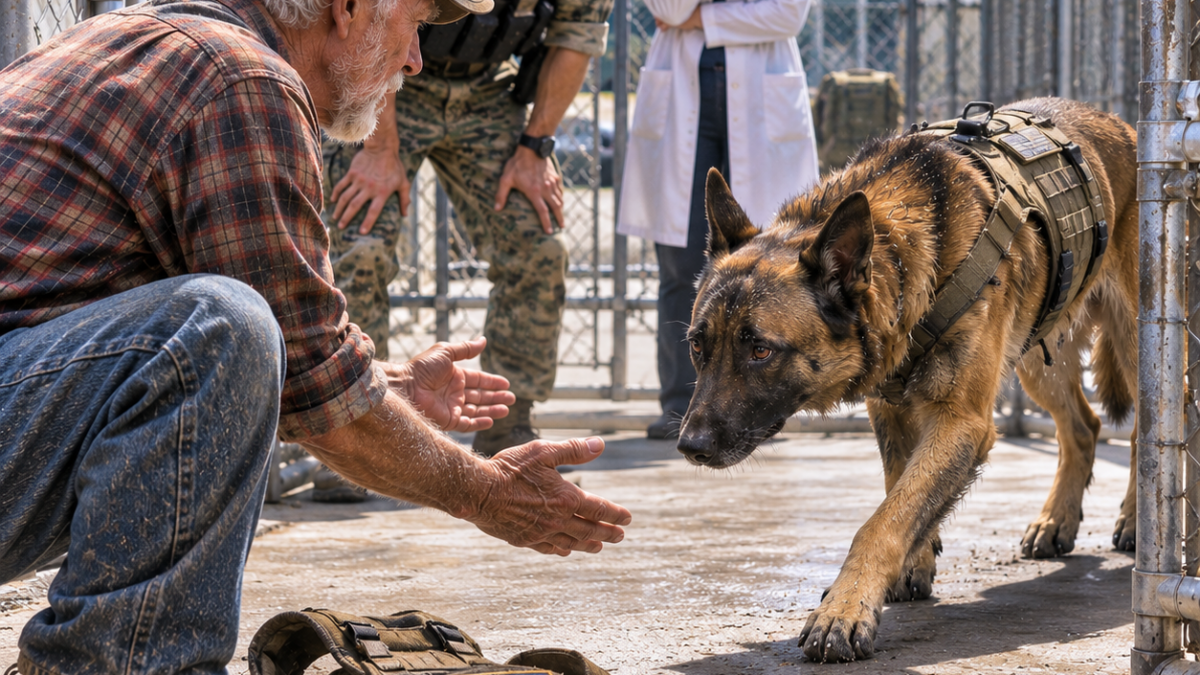
A SEAL’s K9 Wouldn’t Let Anyone Near for 6 Months—Then His Fallen Handler’s Grandfather Spoke One Word.
For six months after Navy SEAL Liam Olsen came home beneath a flag, his Belgian Malinois Phalanx would not let a single trainer, veterinarian, or former teammate come within ten feet of him without showing teeth.
The Navy’s reintegration team had tried desensitization, medication, behavioral conditioning, and every protocol they had—yet the dog still paced his concrete enclosure like his war had never ended, and the final recommendation on Dr. Reed’s desk was running out of alternatives.
Then an old Montana farmer stepped through the kennel gate, knelt in front of the raging K9, and spoke one field command Phalanx had not heard since the day his handler died.
“That’s a lot of fence for one dog.”
The voice came from behind Dr. Reed.
Quiet.
Dry.
Raspy in the way voices become after decades of wind, dust, and long stretches when a man finds no reason to speak.
Dr. Reed turned.
The visitor did not look like the kind of person normally admitted into the special canine compound at Naval Base Coronado.
He looked like someone who had taken a wrong turn on the way to a feed store.
Faded flannel shirt.
Blue jeans washed almost colorless at the knees.
Old work boots.
A sun-bleached cap.
Hands thick with calluses.
His face carried deep lines cut by weather rather than age alone.
The man could have been seventy.
Maybe older.
But there was something strange about the way he stood.
Balanced.
Neither stiff nor relaxed.
Feet positioned naturally beneath him.
Hands loose.
Nothing wasted.
Nothing uncertain.
His name was Jacob Brandt.
He had come from Montana.
And somewhere behind the concrete wall in front of them, a Belgian Malinois was trying to tear the world apart.
Phalanx paced the enclosure.
Back.
Turn.
Forward.
Turn.
Back again.
The same route.
Over and over.
Burnt-sable coat.
Powerful shoulders.
Lean military conditioning still visible despite six months of poor appetite.
His nails clicked against concrete in a hard, repetitive rhythm.
A low growl followed every pass.
Not barking.
Not yet.
Just the constant warning of a dog who had decided the entire world belonged outside his perimeter.
Dr. Reed looked at Jacob.
“He’s not just one dog.”
Jacob kept watching.
“That’s Phalanx.”
No reaction.
“He served with SEAL Team Three.”
Still nothing.
“His handler was Petty Officer First Class Liam Olsen.”
Dr. Reed used the past tense automatically.
PART2:
She had said the sentence dozens of times.
To commanders.
Veterinarians.
Behaviorists.
Review panels.
But this time, it changed the air.
Jacob’s eyes remained fixed on Phalanx.
“I know.”
Dr. Reed stopped.
Jacob said:
“Liam was my grandson.”
For the first time, her clinical expression softened.
“I’m sorry.”
Jacob gave the smallest nod.
Nothing more.
There are men whose grief spills from them.
And men whose grief hardens into structure.
Jacob belonged to the second kind.
PART3:
Dr. Reed had spoken with him by phone when he requested permission to visit.
She had agreed reluctantly.
Family contact was sometimes useful in canine reintegration cases.
A familiar scent.
A familiar voice.
An object associated with the handler.
But Phalanx had rejected all of it.
Men Liam had served beside had come.
Phalanx tried to attack the fence.
His former veterinary technician came.
Same response.
A handler who had worked with Liam during certification exercises spent three days trying to approach.
Phalanx never gave him more than teeth and rage.
Six months.
One hundred eighty-two days.
The dog ate only when food was placed through an extended delivery system.
Petty Officer Davis handled that.
“Handled” was generous.
He slid food in using a long pole and stepped away before Phalanx approached.
No one touched the dog.
No one leashed him.
No one entered the run.
No one had even performed a normal physical examination without sedation since Liam died.
The official description was severe trauma-associated aggression.
Hyperarousal.
Grief response.
Handler-loss destabilization.
Potential canine PTSD.
Those words were accurate.
They were also failing.
Dr. Reed folded her arms.
“We have tried everything we can safely justify.”
Jacob glanced at her.
“Everything?”
“Everything supported by the program.”
“Ah.”
That one syllable irritated her immediately.
“What does that mean?”
Jacob looked back at Phalanx.
“Means there’s always a difference between everything and everything you were taught.”
Dr. Reed’s jaw tightened.
She was not inexperienced.
Clinical psychologist.
Lead on the canine reintegration program.
Years studying the effects of operational trauma on handlers and military working dogs.
She had fought to get behavioral medicine included in cases that once would have been dismissed as simple aggression.
She had argued before senior officers that a traumatized working dog was not defective equipment.
Yet this old farmer had been standing beside her less than two minutes and somehow managed to make her feel accused of exactly that.
“Mr. Brandt, Phalanx is suffering from a severe and persistent behavioral crisis.”
Jacob listened.
“He remains in a near-constant state of hypervigilance.”
Jacob nodded once.
“He has shown handler-directed aggression.”
Another nod.
“We’ve attempted counter-conditioning.”
Nothing.
“Desensitization.”
Nothing.
“Environmental modification.”
Nothing.
“Pharmacological intervention.”
Jacob finally looked at her.
“And?”
“And nothing has produced a stable response.”
Jacob returned his attention to Phalanx.
“No.”
Dr. Reed frowned.
“No what?”
“He’s stable.”
She almost laughed.
The dog slammed his front paws against the chain-link fence.
The entire enclosure shook.
Phalanx erupted into barking.
Deep.
Explosive.
Violent enough that a civilian visitor standing nearby visibly flinched.
Jacob did not.
Dr. Reed pointed.
“That is not stability.”
Jacob watched the dog return to his pacing route.
“It is if you understand what he’s doing.”
Petty Officer Davis had been standing several feet away.
Young.
Careful.
Still enough to suggest he had learned not to introduce unnecessary motion around the kennel.
He looked at Jacob more closely.
“What’s he doing?”
Jacob answered without hesitation.
“Guarding.”
Dr. Reed exhaled.
“He attacks anyone who approaches.”
“That’s what guards do when they think the threat never ended.”
“He is not guarding anything.”
Jacob looked toward the concrete run.
Then toward her.
“That’s where you’re wrong, Doctor.”
Silence.
“He’s guarding his last position.”
Davis’s expression changed.
Jacob continued.
“He thinks his boy is still in the fight.”
Dr. Reed started to respond.
Jacob raised one hand slightly.
Not to silence her.
To finish.
“You keep trying to teach him the mission ended.”
He nodded toward Phalanx.
“But as far as he knows, it didn’t.”
Dr. Reed stared at him.
“You’re interpreting behavior through grief.”
“Yes.”
“That isn’t a diagnostic method.”
“No.”
“Then what makes you so certain?”
Jacob watched the Malinois complete another circuit.
Same turn.
Same brief scan toward the gate.
Same check toward the far concrete wall.
Then another pass.
“He’s holding a perimeter.”
Davis looked sharply at the dog.
Once the old man said it, the pattern became obvious.
Phalanx was not pacing randomly.
He was checking.
Gate.
Fence corner.
Rear wall.
Roof line.
Then gate again.
Over and over.
A loop.
A patrol.
Davis felt something cold move through him.
Jacob said:
“He isn’t waiting for you to cure him.”
He looked at Phalanx.
“He’s waiting for Liam to come back and relieve him.”
No one spoke.
The Malinois barked once.
Jacob’s face tightened.
Only for an instant.
Then the farmer started toward the gate.
Dr. Reed stepped in front of him.
“No.”
Jacob stopped.
“I didn’t come from Montana to talk to him through wire.”
“You are not entering that enclosure.”
“He can’t hear what he needs from out here.”
“He can hear perfectly.”
Jacob looked at her.
“You know what I mean.”
Dr. Reed’s voice hardened.
“Mr. Brandt, Phalanx put a master-at-arms in the infirmary for three days because the man came too close during a feeding attempt.”
Jacob nodded.
“He has bitten through protective sleeves.”
Another nod.
“He has charged trained handlers.”
Jacob waited.
“He is a military working dog conditioned for violence when he believes violence is necessary.”
“I know.”
“You do not know what that means.”
That was when Jacob finally turned his full attention toward her.
The pale blue eyes did not become angry.
That almost made it worse.
“I know exactly what that means.”
Something in the sentence made Davis straighten.
Not the words.
The tone.
It was not an old farmer guessing.
It was familiarity.
Dr. Reed did not notice immediately.
She was too focused on liability.
“My responsibility is to keep personnel safe.”
“And mine is to keep you from killing that dog because nobody figured out what he’s waiting for.”
She went still.
The word had never been used aloud around Phalanx’s enclosure.
Euthanasia.
Not in front of visitors.
Not in casual conversation.
But the recommendation was sitting unfinished on her desk.
Operationally unstable.
Severe aggression.
No safe placement identified.
Quality-of-life concerns.
If nothing changed, there were very few paths left.
Jacob knew.
Maybe Liam’s former teammates had told him.
Maybe somebody else had.
It did not matter.
He looked at her.
“You’ve got about a week.”
Dr. Reed said nothing.
“Some captain signs a piece of paper.”
Still nothing.
“And then everybody gets to call it necessary.”
His voice remained soft.
“You all go home telling yourselves you gave him every chance.”
That landed.
Hard.
Dr. Reed stared toward the kennel.
Phalanx was watching them now.
Growling.
Jacob continued:
“Your way hasn’t reached him.”
He nodded toward the gate.
“Let me try mine.”
Protocol said no.
Every professional instinct Dr. Reed had said no.
Risk matrix said no.
Liability said absolutely not.
Then she looked at the report waiting for her signature.
Six months of failure.
And she looked at Jacob.
He was not emotional.
Not reckless.
He was grieving.
Certainly.
But grief did not explain the way he had analyzed the dog.
Or the gate.
Or the enclosure.
Davis saw it too.
Jacob had checked the latch without seeming to.
Position of the sun.
Distances.
Escape points.
Where the tranquilizer pistol sat on Davis’s belt.
Where Dr. Reed stood relative to the gate.
The old man’s eyes had catalogued everything.
Davis had seen that kind of scanning before.
Operational people did it without realizing they were doing it.
He said quietly:
“Ma’am.”
Dr. Reed looked at him.
Davis did not tell her to approve it.
He simply said:
“I think he knows what he’s asking.”
Jacob looked at Davis.
Small nod.
Recognition.
Dr. Reed closed her eyes for one second.
Then:
“Davis.”
“Yes, ma’am.”
“Open the gate.”
Davis’s pulse jumped.
Dr. Reed immediately added:
“You stay there.”
“Yes.”
“Tranq ready.”
“Yes.”
“If Phalanx commits—”
“I understand.”
Jacob said:
“Don’t fire because he makes noise.”
Dr. Reed turned.
“You are not directing my safety protocol.”
“If you shoot him because he bluffs, you prove to him he was right about everybody here.”
Davis almost smiled despite the tension.
Dr. Reed did not.
“The moment I believe you are in immediate danger, Petty Officer Davis acts.”
Jacob nodded.
“Fair.”
Davis unlocked the heavy padlock.
Metal scraped.
The gate opened inward.
Phalanx stopped pacing.
Instantly.
The growl deepened.
His head lowered.
Ears flattened.
Lips pulled away from his teeth.
The transformation was terrifying.
The pacing dog vanished.
A weapon took his place.
Jacob stepped through.
One step.
Then another.
The gate remained open behind him.
Davis held position.
Dr. Reed’s heartbeat hammered against her ribs.
Jacob stopped approximately fifteen feet from Phalanx.
No hand extended.
No soothing noises.
No crouching.
No direct frontal posture.
His arms stayed loose at his sides.
Phalanx barked.
Once.
The sound struck the concrete walls like a gunshot.
Jacob did not move.
Another bark.
Then another.
The dog’s body compressed.
Rear legs loaded.
Davis’s hand went to the tranquilizer pistol.
Jacob’s eyes stayed on Phalanx’s eyes.
Not teeth.
Not paws.
Eyes.
He saw rage.
Yes.
But rage was the outer layer.
Underneath was something else.
Confusion.
Exhaustion.
Loss.
A dog performing the last duty he understood because stopping meant admitting the person he waited for would never return.
Jacob said:
“Easy, son.”
Soft.
Almost conversational.
Phalanx launched forward.
Dr. Reed gasped.
Davis drew the tranq halfway.
The dog covered most of the distance in an explosive rush.
Then stopped.
Five feet from Jacob.
Barking.
Saliva flying.
Chest heaving.
Jacob remained still.
Not frozen.
Davis saw that.
The farmer’s body had changed slightly.
One foot offset.
Weight balanced.
Shoulders angled.
Ready.
Not panic.
Preparedness.
This was not the posture of an elderly civilian who had wandered into danger because love had made him foolish.
This man understood violence.
He expected it.
He simply did not fear it.
For nearly a minute, Phalanx tried to drive him backward.
Bark.
Growl.
Advance half a step.
Retreat.
Bark again.
Jacob gave him nothing.
No challenge.
No fear response.
No punishment.
The dog’s fury began changing.
The barking became less confident.
More frantic.
Why are you still here?
Why are you not attacking?
Why are you not leaving?
Jacob finally spoke.
“That’s enough.”
The dog barked.
Jacob stepped forward.
Dr. Reed whispered:
“Oh my God.”
Davis did not move.
Phalanx barked again.
Less committed.
Jacob advanced another half step.
“You’re done scaring everybody in white coats.”
The Malinois growled.
“I’m not them.”
Another step.
Then Jacob stopped.
Only a few feet separated them.
“I know who you’re waiting for.”
Phalanx became very still.
Jacob’s voice changed.
Grief entered it for the first time.
“I know you miss him.”
The dog’s mouth closed.
Jacob swallowed.
“I miss him too.”
Phalanx blinked.
“He was my boy before he was yours.”
The dog’s breathing changed.
Dr. Reed saw it.
Davis saw it.
The frantic panting slowed by a fraction.
Jacob lowered himself.
One knee.
Slow.
Controlled.
Nothing about the movement looked fragile.
He deliberately placed himself below the dog’s eye line.
Vulnerable.
But not helpless.
“Liam’s not coming back, Phalanx.”
The dog growled again.
But weaker.
Jacob’s voice almost broke.
“He’s gone home.”
Silence.
“And he’s waiting on us now.”
Phalanx trembled.
Not aggression.
Something else.
Jacob kept his eyes on him.
“But our job isn’t done.”
The Malinois took one step backward.
Jacob called without turning:
“Doctor Reed.”
She startled.
“Yes?”
“Do you have Liam’s vest?”
“What?”
“Something he wore operationally.”
Dr. Reed looked at Davis.
Davis immediately understood.
“The plate carrier.”
Jacob nodded.
“If you still have it.”
They did.
Liam’s final personal effects had been processed separately from the dog.
Some had been released to family.
Operational equipment remained in storage pending administrative review.
Dr. Reed ran.
She returned carrying the plate carrier.
Dust remained in seams.
Faded fabric.
Wear marks around buckles.
A dark stain on one shoulder.
Davis took it.
He entered just far enough to lay it on the concrete near Jacob.
Then retreated.
Phalanx’s head snapped toward it.
The reaction was immediate.
His nose worked.
Once.
Twice.
His entire body went rigid.
Jacob reached sideways.
Hooked one finger into the webbing.
Dragged the vest closer.
The smell reached the dog fully.
Phalanx made a sound no one at the compound had heard in six months.
A whine.
High.
Thin.
Painful.
Dr. Reed covered her mouth.
The dog stepped backward.
Another whine.
He looked at the vest.
Then toward the gate.
Then back.
As if Liam should appear behind it.
Jacob put his palm on the dusty armor.
“He told me about you.”
Phalanx stared.
“Said you were the best dog he ever saw.”
The old man’s voice trembled.
“Said you could find a needle in a sandstorm.”
Phalanx’s ears moved forward.
“And he said you had the heart of a lion.”
Jacob stroked the vest.
“He called you family.”
The dog stopped growling completely.
Dr. Reed felt tears sting her eyes.
This was not a behavioral exercise anymore.
It was grief.
Pure and unmistakable.
Jacob leaned closer.
“His watch is over.”
The Malinois stared.
“He stood his post.”
Jacob tapped the vest once.
“Now you stand yours.”
Phalanx’s body trembled.
Then Jacob spoke one word.
Short.
Guttural.
Not English.
Davis’s head snapped up.
The word had the rhythm of an operational command.
Phalanx reacted as if electricity passed through him.
His head jerked.
Ears forward.
The tension drained so suddenly his legs almost seemed to soften beneath him.
For one second, the dog looked completely bewildered.
He stared at Jacob.
The old farmer repeated it.
Softer.
Then in English:
“At ease, soldier.”
Phalanx whimpered.
Long.
Broken.
The sound came from somewhere deeper than barking.
One step forward.
Jacob stayed still.
Another.
The dog approached until his nose hovered inches from Jacob’s hand.
Sniff.
Old cotton.
Hay.
Metal.
Machine oil.
Weather.
And perhaps something else.
Something that belonged to another part of the world.
A part of his world.
Phalanx touched Jacob’s hand with his nose.
Jacob did not grab him.
The dog nudged again.
Harder.
Jacob slowly raised his hand.
Placed it against the side of Phalanx’s head.
The dog closed his eyes.
Davis forgot to breathe.
Jacob’s fingers moved over the dog.
Ears.
Jaw.
Neck.
Shoulders.
Chest.
Not petting.
Assessment.
Checking.
The exact sequence Davis had been taught for inspecting a working dog after field exposure.
Hands practiced enough that age could not erase the pattern.
Phalanx leaned into him.
Then collapsed.
Not unconscious.
Not weak.
He folded onto the concrete beside Jacob and laid his head across the old man’s knee.
A mournful sound escaped him.
Jacob placed one hand along the Malinois’s neck.
Steady.
Slow.
The dog closed his eyes.
For the first time in one hundred eighty-two days, Phalanx stopped standing guard.
Dr. Reed began crying.
Quietly.
She did not realize it until Davis glanced toward her.
Jacob continued checking the dog’s body.
His fingers moved over the flank.
Stopped.
He parted the thick fur.
Worked at a small matted spot.
Something came loose.
Tiny.
Brown.
Dried.
A burr.
Jacob held it between thumb and finger.
Davis recognized the shape only because he had deployed before.
Desert vegetation.
Something Phalanx had carried home in his coat.
Six months.
A physical fragment of the place where his old life ended.
Jacob looked at it.
Then flicked it away.
Dr. Reed whispered:
“How?”
Jacob looked toward her.
Her professional certainty had collapsed.
Not her science.
Something more personal.
The belief that expertise meant she had already asked every meaningful question.
“What was that word?”
Jacob glanced at Davis.
Then answered:
“Something Liam mentioned in a letter.”
Davis knew immediately that was not the whole truth.
He had heard field commands.
He had seen men under pressure.
He had watched the old farmer meet a charging military dog without wasting one ounce of movement.
Jacob had just performed a working-dog field assessment as naturally as another man might check a tractor tire.
Davis said:
“Sir.”
Jacob looked at him.
“With respect—that wasn’t something you learned from one of Liam’s letters.”
Jacob waited.
“The stance.”
Silence.
“The breath control.”
Still silence.
“The way you checked Phalanx.”
Davis lowered his voice.
“Where did you serve?”
Dr. Reed looked sharply at Jacob.
The old farmer’s expression changed.
Almost a smile.
Almost sadness.
“A long time ago.”
“Where?”
“In a place that doesn’t exist anymore.”
He stood.
Phalanx rose with him.
Immediately.
No command.
The Malinois moved to Jacob’s side.
Left leg.
Close heel.
Davis stared.
Jacob gave the dog a firm rub behind the ear.
“He’ll be all right.”
Dr. Reed stepped toward the gate.
“You can’t know that.”
“No.”
Jacob nodded.
“But now he can start.”
“What changed?”
Jacob looked down at Phalanx.
“He got new orders.”
Then he walked toward the gate.
Phalanx followed.
Dr. Reed opened it wider.
The same dog who had threatened every human being within ten feet now crossed beside Jacob with a loose body and attentive eyes.
No muzzle.
No restraint pole.
No sedation.
Just the old farmer.
Davis watched them disappear toward the far training field.
Then turned toward Dr. Reed.
“What just happened?”
She shook her head.
“I don’t know.”
Davis said:
“I think I do.”
That afternoon he requested a meeting with Captain Wallace.
The base commander sat behind his desk reading Dr. Reed’s preliminary report.
He barely looked up.
“At ease, Petty Officer.”
Davis moved from attention.
Wallace scanned the memo.
“Dr. Reed says the Olsen dog has shown an abrupt reduction in aggression following contact with the handler’s grandfather.”
“Yes, sir.”
“She recommends supervised transfer planning.”
“Yes, sir.”
The captain looked up.
“This report tells me almost nothing.”
Davis hesitated.
Wallace put the paper down.
“What happened?”
Davis described everything.
Jacob entering the enclosure.
Phalanx’s charge.
The vest.
The command.
The transformation.
The way Jacob had handled the dog afterward.
Wallace’s expression changed slightly when Davis repeated the word.
“What did you say?”
Davis repeated it.
“I checked what I could, sir.”
He explained that the term appeared to come from Pashto, connected to rest or easing down depending on dialect and context.
But the pronunciation was not standard classroom language.
It sounded old.
Regional.
Learned through use.
Wallace leaned back.
“Brandt?”
“Yes, sir.”
“Jacob Brandt?”
“From Montana.”
The captain stared past Davis.
For several seconds, the room was silent.
Then Wallace asked:
“How much do you know about the history of Naval Special Warfare canine work?”
“The basics.”
“Post-9/11 expansion.”
“Yes.”
“Modern assault and detection teams.”
“Yes.”
Wallace shook his head.
“Earlier.”
Davis waited.
“Long before the current programs were standardized, men were experimenting with dogs in places where doctrine hadn’t caught up yet.”
He turned toward his computer.
“Vietnam.”
Davis felt his pulse increase.
“MACV-SOG?”
Wallace glanced at him.
“Among others.”
He typed.
Logged through several layers.
Then stopped.
A file appeared.
Much of it redacted.
Black bars.
Dates.
Operational codes.
One line was readable.
BRANDT, JACOB T.
CPO, USN — RETIRED.
Davis stared.
Wallace scrolled.
Late 1960s.
1970s.
Into the early 1980s.
Most details inaccessible.
Then an award citation.
The captain stopped.
Navy Cross.
Extraordinary heroism.
Lead scout.
K9 handler.
Clandestine cross-border operation.
The summary described Brandt and his dog holding a position against a numerically superior force long enough for a reconnaissance element to extract.
Davis read it twice.
“Sir.”
Wallace nodded.
“Your farmer isn’t a farmer who somehow knows military dogs.”
He turned the screen slightly.
“He’s one of the men who helped build the culture you work inside today.”
Davis looked at the blacked-out sections.
Wallace continued.
“After retirement, he requested privacy.”
“Moved to Montana.”
“Bought land.”
“Disappeared.”
The captain leaned back.
“As far as most people were concerned, Chief Brandt became a civilian.”
“Why would Liam never mention it?”
“Maybe he did.”
“Not to us.”
“Would you?”
Davis understood.
A grandson trying to build his own reputation inside Naval Special Warfare would not necessarily advertise that his grandfather was a legend.
Wallace looked back at the file.
“Liam was probably one of the few reasons anybody in the current command community still knew Brandt was alive.”
Davis thought about Jacob kneeling inside the run.
The balance.
The command.
The old eyes that never looked at Phalanx’s teeth.
“He wasn’t guessing.”
“No.”
“He knew exactly what the dog was doing.”
Wallace closed the file.
“He’s spent a lifetime watching partners who couldn’t speak.”
The next morning, Dr. Reed found Jacob on a grassy training field far from the main kennel.
Phalanx was with him.
The change seemed impossible.
The Malinois moved in a loose circle.
Sniffing.
Tail neutral.
Mouth open.
Normal pant.
Jacob held a short length of rope.
He tossed it.
Phalanx bounded after it.
Not aggressively.
Playfully.
The sight stopped Dr. Reed.
For six months, the dog had not played.
He had barely eaten.
Now he grabbed the rope.
Turned.
Ran back.
Dropped it at Jacob’s boots.
Jacob said:
“Good.”
Nothing more.
Phalanx wagged.
Dr. Reed approached slowly.
“Mr. Brandt.”
Jacob looked up.
“Doctor.”
She stopped several yards away.
“I owe you an apology.”
Jacob tossed the rope again.
“For what?”
“I was arrogant.”
“Probably.”
She almost laughed.
Then realized he was serious.
“I saw a case.”
Jacob watched Phalanx retrieve.
“A diagnosis.”
The dog returned.
“A dangerous animal.”
Jacob bent to take the rope.
Dr. Reed continued:
“You saw something else.”
Jacob looked at her.
“I saw a soldier.”
“That’s what I missed.”
“You didn’t miss everything.”
She frowned.
“The medication mattered.”
He held up one finger.
“The veterinary work mattered.”
Another.
“The safe enclosure mattered.”
Another.
“The months your team kept feeding him even when he wanted nothing to do with you mattered.”
Dr. Reed looked surprised.
Jacob continued.
“Science matters.”
“Medicine matters.”
“Behavior work matters.”
“Then why did none of it work?”
“It did.”
She shook her head.
“Not enough.”
“Because you treated half the wound.”
Phalanx dropped the rope.
Jacob picked it up.
Dr. Reed waited.
“The dog lost his handler.”
“Yes.”
“You treated the dog.”
She understood.
“But not the bond.”
Jacob nodded.
“That was the injury.”
He looked toward Phalanx.
“Liam wasn’t just the man holding his leash.”
“He was direction.”
“Routine.”
“Safety.”
“Purpose.”
“Pack.”
“When Liam disappeared, everything Phalanx trusted vanished at once.”
Dr. Reed folded her arms.
“So he guarded.”
“It was the last job he knew.”
“The enclosure.”
“His last position.”
“The gate.”
“Yes.”
She looked toward Phalanx.
“He was waiting for Liam to return.”
Jacob’s voice softened.
“He was waiting to be relieved.”
Dr. Reed asked:
“And that word?”
Jacob smiled slightly.
She repeated it as best she could.
“It wasn’t magic.”
“No.”
“Not simply a calming cue.”
“No.”
“What was it?”
Jacob looked down at the rope.
“A key.”
“To what?”
“His old world.”
The doctor waited.
“It meant stand down.”
“At ease.”
“Battle’s over.”
Jacob looked toward the dog.
“More important than that—it came from somebody who sounded like they belonged to the world Liam came from.”
Dr. Reed said:
“He recognized authority.”
“Maybe.”
“Memory?”
“Definitely.”
“Training?”
“Yes.”
“Your scent?”
Jacob smiled.
“Probably smelled like hay.”
She did not smile.
Davis had already told her what he suspected.
Jacob noticed.
“What?”
“Petty Officer Davis knows who you are.”
Jacob’s smile disappeared.
“Does he?”
“Captain Wallace apparently knows too.”
Jacob stared toward the field.
“I came here for my grandson’s dog.”
“I know.”
“I didn’t come to become a history lesson.”
“I understand.”
“Do you?”
“I’m trying to.”
That answer seemed to satisfy him more than confidence would have.
Dr. Reed stepped closer.
“The Navy approved Phalanx’s transfer.”
Jacob nodded.
“To you.”
“I know.”
“You knew?”
“Wallace called me.”
“You’re taking him back to Montana?”
Jacob looked toward Phalanx.
The dog stood twenty yards away with the rope in his mouth.
Waiting.
“I’m taking him home.”
Dr. Reed felt unexpectedly emotional.
“That’s probably best.”
Jacob said nothing.
Then:
“But his work isn’t finished.”
She looked at him.
“Phalanx?”
“Him.”
Pause.
“Me.”
Dr. Reed waited.
Jacob walked toward the dog.
“This will happen again.”
“What will?”
“Some young man goes out with a dog.”
He took the rope from Phalanx.
“Or some young woman.”
“They work together every day.”
“They sleep ten feet apart.”
“They eat near each other.”
“They learn each other’s breathing.”
“They trust each other when everything else goes wrong.”
He looked at Dr. Reed.
“Then one of them comes home alone.”
She said nothing.
“You have programs for the human.”
“Yes.”
“You have protocols for the dog.”
“Yes.”
“Where’s the program for what existed between them?”
Dr. Reed stared.
Jacob continued.
“That is what breaks.”
“The bond?”
“Yes.”
“And you think we can treat that?”
“You’d better learn.”
His voice was no longer conversational.
It carried command.
“We’re going to keep sending these dogs into places most people will never see.”
“They’re going to lose handlers.”
“Handlers are going to lose dogs.”
“If you only treat aggression, appetite, sleep, and arousal, you’ll miss what the animal thinks his duty still is.”
Dr. Reed thought about six months of Phalanx circling the same perimeter.
Waiting.
“You want a different reintegration program.”
“I want you to understand the warrior before you try to fix the animal.”
She looked at Jacob.
A farmer.
A grandfather.
A retired chief whose history was buried behind redacted pages.
A man who had walked calmly into an enclosure everyone else feared.
“What would it look like?”
Jacob shrugged.
“You’re the doctor.”
She almost smiled.
“I’m asking you.”
“Start with history.”
“What history?”
“The actual partnership.”
“Not just medical history.”
“Handler routines.”
“Field commands.”
“Home commands.”
“Operational cues.”
“What did the dog do after missions?”
“What did the handler do when the dog was scared?”
“How did they sleep?”
“What objects mattered?”
“What sounds belonged to work?”
“What sounds meant work was finished?”
Dr. Reed’s mind was already moving.
Jacob continued.
“Stop acting like the dog starts over when the handler dies.”
“He doesn’t.”
“No.”
“He’s carrying the old mission into the new room.”
“Yes.”
“And we need to show him the transition.”
Jacob nodded.
“Now you’re listening.”
Dr. Reed took a breath.
“Teach me.”
Jacob looked at her.
Not surprised.
Not impressed.
Simply evaluating.
“Help me build it.”
He studied her face.
Yesterday, he had seen certainty.
Today, he saw humility.
Not humiliation.
Those are different things.
Humility still has strength.
It simply leaves room for new information.
Jacob said:
“Get a notebook.”
Dr. Reed smiled.
“Seriously?”
“Very.”
She turned toward the building.
Jacob called after her.
“Doctor.”
She looked back.
“First lesson.”
“Yes?”
Jacob glanced at Phalanx.
“It isn’t about the command.”
“What is it about?”
“Trust.”
He clipped a leash onto the Malinois.
Phalanx immediately moved beside him.
Loose leash.
Head up.
Calm.
Jacob said:
“Everything starts there.”
Over the following weeks, Dr. Reed began rewriting pieces of the reintegration approach.
Not replacing veterinary medicine.
Not abandoning behavioral science.
Not turning the program over to folklore.
Jacob would not have allowed that anyway.
He disliked anyone who treated instinct as an excuse for carelessness almost as much as he disliked people who treated theory as a substitute for observation.
He demanded records.
He asked for timelines.
He read every note about Phalanx.
Then criticized half of them.
“‘Aggressive at 1400 hours.’”
He tapped one report.
“What happened at 1355?”
Dr. Reed looked.
“Nothing recorded.”
“Exactly.”
Another:
“‘Refused food.’”
Jacob asked:
“Who delivered it?”
“Davis.”
“What did Davis smell like?”
She stared.
“That matters?”
“Maybe he had been working another dog.”
Another report:
“‘Heightened agitation following equipment transfer.’”
Jacob asked:
“What equipment?”
“Liam’s crate.”
“What was inside?”
Nobody knew.
Jacob hated that.
“Details.”
He repeated the word constantly.
“Trauma lives in details.”
He taught staff to map routines associated with the missing handler.
Which commands had been personal.
Which tones meant work.
Which objects carried strong scent associations.
Which environments triggered guarding rather than fear.
He insisted they distinguish between a dog trying to drive someone away and one desperately trying to protect a vanished mission.
Some staff resisted.
That was expected.
One senior trainer said:
“You’re anthropomorphizing.”
Jacob answered:
“You’re under-observing.”
The trainer crossed his arms.
“Dogs don’t understand death the way humans do.”
Jacob nodded.
“Probably not.”
“Then why talk about grief?”
“Because he noticed someone stopped coming back.”
Silence.
“That’s enough.”
Jacob never claimed Phalanx understood funerals.
Flags.
Casualty reports.
Loss-of-life notifications.
But the dog understood absence.
And routine.
And scent.
And promises repeated through thousands of working hours.
That was enough to break something when Liam disappeared.
Phalanx improved.
Not overnight.
The first dramatic release inside the enclosure was not a cure.
Some mornings he still woke scanning.
Certain equipment sounds sent him instantly alert.
Men wearing gear similar to Liam’s could make him freeze.
A helicopter passing low over the base caused him to search the sky and whine for nearly twenty minutes.
Jacob never punished it.
He gave Phalanx another task.
Walk.
Search.
Carry.
Track.
Then stand down.
Mission.
Completion.
Rest.
Again.
The dog began sleeping.
Then eating properly.
Then allowing Davis near him.
That milestone came quietly.
Davis sat on the grass one morning while Jacob worked Phalanx on a long lead.
Jacob handed the leash to Davis.
Phalanx stopped.
Looked at Jacob.
Then Davis.
Jacob said nothing.
Davis kept the leash loose.
Phalanx sniffed him.
Walked once around him.
Then stood at his left leg.
Davis’s eyes filled.
Jacob noticed.
“Don’t make it weird.”
“Yes, Chief.”
Jacob looked sharply at him.
Davis immediately corrected:
“Sorry.”
Jacob sighed.
“Too late now, I suppose.”
Davis smiled.
“Captain Wallace told me.”
“I figured.”
“Sir—”
“Don’t.”
“I just wanted to say—”
“No.”
“Navy Cross—”
Jacob pointed toward Phalanx.
“Dog does not care.”
Davis stopped.
Jacob added:
“Good lesson.”
Davis nodded.
Phalanx looked between them.
Jacob clicked softly.
The dog relaxed.
The old man looked at Davis.
“You want to honor old handlers?”
“Yes.”
“Be good to the dog in front of you.”
That ended the conversation.
Months later, Dr. Reed presented the first formal proposal for an expanded handler-loss canine reintegration protocol.
Jacob refused to let his name appear in the title.
She tried.
He crossed it out.
She tried using Liam’s.
Jacob sat with that longer.
Then shook his head.
“This isn’t just his story.”
“What about Phalanx?”
“No.”
“Why?”
“Program should be bigger than the case that taught it to you.”
She respected that.
The new framework focused on partnership history, transition cues, scent-associated objects, prior field language, controlled reintroduction to purpose, and gradual reassignment of trust when appropriate.
It also required something deceptively simple.
Whenever a working dog lost a handler, someone had to interview the people who had actually seen them together.
Not just supervisors.
Teammates.
Kennel staff.
Family when relevant.
Anyone who understood the pair’s routines.
Because sometimes one word mattered.
Sometimes one whistle.
Sometimes a vest.
Sometimes the way a handler tapped the side of his leg twice before ending a work session.
Tiny things no medical chart contained.
Jacob returned to Montana with Phalanx.
The dog rode in the truck.
At first in a secured crate.
Later, after enough progress, in the back with proper restraint.
Calder? No—Brandt’s ranch sat far from the base.
Open grass.
Cold mornings.
Fence lines.
Cattle.
Machinery.
No concrete kennel walls.
Phalanx adapted slowly.
The first week, he patrolled the farmhouse every night.
Front door.
Back door.
Windows.
Barn.
Again.
Again.
Jacob did not stop him.
He simply walked the route once with him.
Then at the end said the old stand-down command.
Phalanx eventually lay beside the stove.
Second week, he slept four hours straight.
Third week, six.
The dog learned farm sounds.
Tractor.
Gate chain.
Cattle.
Wind against metal roofing.
Coyotes at night.
Jacob gave him work.
Not combat work.
Purpose.
Find a missing calf.
Carry a rope.
Search a section of pasture.
Walk fence lines.
Locate Jacob when called from behind the hay shed.
Simple tasks.
Finish.
Praise.
Stand down.
The old dog-soldier began understanding that duty had changed shape.
Liam remained gone.
Nothing fixed that.
Jacob never tried.
He kept one photograph near the kitchen.
Liam in uniform.
Phalanx beside him.
Young man smiling.
Dog staring seriously toward the camera.
Sometimes Phalanx looked at it.
Sometimes he did not.
Jacob talked to Liam occasionally.
Not because he expected an answer.
Because grief, like working dogs, responds badly to pretending nothing happened.
One winter evening, Phalanx walked to the photograph.
Sniffed the frame.
Then returned to Jacob’s chair.
Laid down.
Head on the old man’s boot.
Jacob rested a hand over the dog’s neck.
“Yeah.”
That was all.
Months after the original visit, Dr. Reed flew to Montana.
Officially, she was evaluating long-term outcomes.
Unofficially, she wanted to see the dog.
She found Jacob repairing a fence.
Phalanx stood fifty feet away watching cattle.
No leash.
The Malinois looked toward her vehicle.
Alert.
Then toward Jacob.
Jacob gave a tiny nod.
Phalanx returned to watching the pasture.
Dr. Reed smiled.
“That’s new.”
Jacob hammered a staple.
“What?”
“He checked with you.”
“He checks everything.”
“But he let it go.”
“That’s the point.”
She walked closer.
Phalanx eventually approached.
He sniffed her hand.
She did not touch him immediately.
Waited.
The dog leaned forward.
Permission.
She scratched his neck.
Six months earlier, she could not stand within ten feet of the enclosure.
Now he allowed her beside him in open pasture.
She looked at Jacob.
“You knew this would happen?”
“No.”
“You acted like you did.”
“Confidence and certainty aren’t the same thing.”
She laughed.
“I’m writing that down.”
“You doctors write down everything.”
“Yes.”
Jacob looked toward Phalanx.
“Good.”
They sat on the porch later.
Dr. Reed showed him the latest protocol draft.
Jacob read slowly.
Made corrections in the margins.
Crossed out three paragraphs of terminology.
She protested.
“That language is clinically precise.”
“It’s unreadable.”
“It’s for clinicians.”
“Clinicians are human.”
“Debatable.”
He smiled.
She pointed toward Phalanx.
“He changed my career.”
Jacob shook his head.
“He changed your question.”
“What was my old question?”
“How do I stop the behavior?”
She nodded.
“And the new one?”
“What is the behavior trying to protect?”
Jacob looked pleased.
“Better.”
Dr. Reed closed the folder.
“Do you ever think about what would’ve happened if you hadn’t come?”
Jacob looked across the pasture.
“No.”
“Never?”
“No use.”
“You saved his life.”
Jacob’s expression hardened.
“Liam saved mine first.”
She waited.
Jacob rarely spoke about his grandson’s death.
He did now.
“Kid called me before deployment.”
“Liam?”
“Yes.”
“Said if something happened to him, Phalanx came to me.”
Dr. Reed stared.
“You knew?”
“I knew what he wanted.”
“Why didn’t the paperwork say that?”
“Operational custody isn’t decided by a grandson telling his grandfather something over the phone.”
“Still.”
Jacob nodded.
“He knew the dog.”
“What did he say?”
Jacob looked toward Phalanx.
“‘Granddad, he won’t understand if I don’t come back.’”
Dr. Reed felt her chest tighten.
“And?”
“I told him not to talk like that.”
“Of course.”
“He laughed.”
Jacob swallowed.
“Said, ‘You understood Major when nobody else did. You’ll understand him.’”
Dr. Reed knew Major from the classified file.
Jacob’s old K9.
The one in the Navy Cross citation.
“So when you entered that kennel—”
“I was keeping a promise.”
That was all he would say.
Phalanx walked onto the porch.
Sat beside Jacob.
The old man rested his hand on the Malinois’s head.
Dr. Reed looked at the two of them.
Not handler and replacement dog.
Not grandfather and grandson’s asset.
Something created from the pieces left after two different wars.
An old operator who had lost his partner decades ago.
A military dog who had just lost his.
Each understood the shape of the other’s silence.
That was why the first contact worked.
Not magic.
Not a secret word alone.
The command opened the door.
Everything else came from recognition.
Years later, personnel at the reintegration program still talked about the day Phalanx stopped guarding the concrete run.
Stories grew.
They always do.
Some said the old farmer walked into the kennel and whispered once and the dog immediately became gentle.
That was not true.
Phalanx lunged.
Barked.
Threatened.
Fought the process with everything he had.
Others said Jacob somehow hypnotized him.
Nonsense.
Some said the Pashto command was a secret military technique.
Also wrong.
The word mattered because it belonged to Phalanx’s world.
Another dog might have heard it and done nothing.
The real change began when someone finally understood what the dog believed his duty was.
He was not attacking because he had forgotten his training.
He was holding the line because he remembered it too well.
For six months, every person who approached asked him to abandon his post.
Jacob was the first one to tell him the watch had ended.
There is a difference.
Dr. Reed eventually put that sentence into her training lectures.
She never used Jacob’s name unless necessary.
He had asked for privacy.
But she told new clinicians:
“Never assume stopping behavior is the same as healing the animal.”
She would show them a photograph of a military working dog inside a concrete run.
No identifying details.
Then another photograph months later.
Same dog.
Open pasture.
Relaxed posture.
Watching an old man repair fence.
“Your patient may be obeying a mission nobody else remembers assigning.”
That became one of the central lessons of her career.
Petty Officer Davis kept another lesson.
Be good to the dog in front of you.
He later became a senior handler.
Young trainers asked him about command presence.
He taught structure.
Timing.
Safety.
Evidence-based methods.
Then he added something no manual had taught him well enough.
“When a dog stops trusting you, don’t immediately ask how to gain control.”
“Ask what you did that made control necessary.”
Some instructors thought the line sounded too philosophical.
Davis did not care.
He had watched a seventy-something farmer stand motionless while a SEAL dog charged him.
He had watched that same dog collapse with his head on the man’s knee.
He knew what trust looked like when it returned.
Jacob never accepted payment from the program beyond travel costs when they occasionally asked him to consult.
He hated the word consultant.
“Means somebody gets paid to tell you what you already know.”
Dr. Reed would answer:
“Then what should we call you?”
“Jacob.”
That usually ended it.
As the years passed, Phalanx slowed.
The Malinois that once crossed a concrete enclosure like contained lightning eventually developed gray around his muzzle.
His shoulders remained strong.
His eyes stayed bright.
But farm life aged him differently.
He learned to sleep in sunlight.
He learned that tractors did not require tactical assessment.
He learned that calves were irritating but generally not hostile.
He learned that mail carriers were permitted to leave alive.
Mostly.
He never lost his instinct to scan a room.
Never stopped checking exits.
Never stopped noticing changes before everyone else.
Jacob did not want him to.
Healing did not mean erasing what made Phalanx himself.
One autumn morning, Jacob found the dog sitting at the edge of the north pasture.
Facing east.
Still.
Jacob stood beside him.
The dog did not move.
The sun came over the ridge.
Jacob thought of Liam.
Then Major.
Then every man and dog he had known whose names existed only in old files, faded photographs, or memory.
Phalanx leaned against his leg.
Jacob said the old command.
Softly.
Not because the dog was agitated.
Because sometimes words change meaning when enough time passes.
Once, it had meant:
Stand down.
The danger is over.
Now it meant something simpler.
Rest.
You’ve done enough.
Phalanx looked up at him.
Tail touched the grass once.
Jacob smiled.
“Good boy.”
The dog lay down.
For six months after Liam died, everyone had thought Phalanx refused to let anyone near him because grief had destroyed his training.
Jacob understood the opposite.
The training was exactly why he could not let go.
His handler had vanished.
No one relieved him.
No one gave him a new mission.
So he guarded the last world Liam had left him.
Until an old farmer from Montana walked through the gate.
Until Liam’s vest returned to the concrete.
Until a voice from the same warrior language finally said the one thing Phalanx had been waiting one hundred eighty-two days to hear.
Your watch is over.
Stand down.
And for the first time since his SEAL came home beneath a flag, the old war dog finally allowed himself to grieve.








