A Scarred Shelter Cat Waited 214 Days With No One Wanting Him—Then a Tiny Kitten Needed His Rare Blood Type, and the Matching Shaved Patches Told the Whole Story
PART3:
Denise had scratched under Moss’s chin. “Yep. Under all that attitude, he’s rare.”
Moss, of course, had no idea that a line on a medical chart made him valuable in a way no adopter had yet noticed.
For months, the donor list sat quietly in a file drawer.
Then Juniper arrived.
She came in after dark on a rainy Tuesday night in April.
The person who found her was a college student named Naomi Perez, who had been driving home from her night class when she saw a small shape tumble near the shoulder of County Road 8. At first she thought it was trash blown from a truck. Then the shape moved.
Naomi pulled over so fast her tires slid on the wet gravel.
Later she would remember the headlights reflecting off rain, the sound of her own breathing, and the awful sight of a tiny kitten dragging herself toward a culvert as if instinct alone were telling her to hide.
Juniper had been so small Naomi first mistook her for eight weeks old.
She was actually closer to ten or eleven weeks, but trauma had reduced her to almost nothing. She weighed just under two pounds. Her breathing was fast and shallow. There was blood on her mouth and chest. One hind leg trembled violently when Naomi tried to lift her, and the kitten gave a thin broken cry that Naomi said she heard in her sleep for days afterward.
Naomi wrapped her in a sweatshirt, called the emergency line taped to the shelter’s door, and drove straight to Crestview Veterinary Emergency Clinic, the shelter’s after-hours partner.
By the time Juniper arrived, she was in shock.
Dr. Sanjay Patel was on duty that night. He had been an emergency vet for fifteen years, and he had developed the grave kind of calm that could terrify pet owners because it meant he was taking things very seriously.
He examined the kitten, ordered x-rays, and told Naomi as gently as possible that the next few hours would decide everything.
Internal bleeding.
Blunt-force trauma.
Severe anemia.
Hypothermia.
Possible pelvic injury.
The kitten was alive, but only just.
Naomi stood at the treatment-room window crying into both hands while technicians placed a warming pad under Juniper and started oxygen support.
“Can you save her?” she asked.
Dr. Patel did not believe in lying for comfort.
“We’re going to try.”
Then came the lab results.
The kitten’s hematocrit was catastrophically low. She had lost too much blood.
Without a transfusion, she almost certainly would not survive the night.
The clinic typed her blood.
B.
Dr. Patel turned immediately to the technician beside him. “Call Green Hollow. Ask if that donor cat is still medically cleared.”
That donor cat was Moss.
At 10:13 p.m., Denise’s phone buzzed on her nightstand. She sat upright before she was fully awake because shelter staff learned to fear late-night calls.
She answered to hear Dr. Patel’s voice clipped with urgency.
“How fast can you get Moss here?”
Denise was out of bed in seconds.
Green Hollow was dark when she let herself in through the back entrance. The security lights cast long narrow shadows across the cat room. Most of the animals stirred when they heard the doors, then settled again.
Moss lifted his head the moment Denise approached with a carrier.
“Hey, old man,” she whispered. “I know. I know. I’m sorry.”
He hated carriers with the total conviction of an animal who believed nothing good had ever begun with one. On any normal day, getting him inside involved strategy, patience, and bribery.
That night, perhaps because she moved quickly but gently, perhaps because he trusted her more than he let on, perhaps because fate was in a hurry, Moss only complained twice before stepping in.
During the drive, Denise kept glancing through the carrier bars at the broad gray body inside. Moss sat completely still, staring forward, silent except for the occasional slow blink.
“It’s for a baby,” she told him, feeling foolish and emotional and too tired to care. “A little kitten. She’s in bad shape.”
Moss did not answer, obviously, but his steady silence felt like permission to keep talking.
“I know you don’t know what any of this means. I just thought I should tell you.”
At the clinic, the staff moved with efficient speed.
Moss was examined, confirmed healthy enough to donate, and lightly sedated. The hair on the side of his neck was shaved in a neat small rectangle for the jugular draw. Denise stayed beside him, one hand resting against his shoulder while blood flowed into the collection bag that would give a stranger’s baby one more chance at life.
In the next room, Juniper lay beneath warming blankets, tiny and motionless except for the rise and fall of her chest.
When the transfusion started, Denise found herself standing between two treatment tables and suddenly feeling as if she were watching something sacred.
On one side, an old tom nobody wanted.
On the other, a kitten who had barely entered the world.
Between them, a red line carrying life.
The first transfusion saved her.
That was the sentence Dr. Patel used the next morning, and it became a kind of shelter legend later. The first transfusion saved her. Not “fixed everything.” Not “guaranteed a future.” Just saved her long enough for more fighting.
Juniper remained hospitalized for several days. Her internal bleeding stabilized. Her temperature normalized. She accepted syringe feeding, then a little food on her own. Her hind leg had soft tissue trauma but no fracture requiring surgery. She was bruised from chest to belly and exhausted down to the marrow, but she was alive.
Naomi came to visit every day until Green Hollow formally took over her case. She sat with the kitten and told her, “You don’t get to quit on me, okay? I stopped in the rain for a reason.”
It was Rebecca who named her Juniper a few days later after seeing the first weak but determined way the kitten tried to stand. “She bends,” Rebecca said, “but she doesn’t break.”
Everyone loved the name.
For eleven days, it seemed Juniper was climbing slowly toward safety.
Then she crashed again.
It happened in the early morning, when overnight quiet makes bad news feel even more brutal. Her gums went pale. Her heart rate climbed. Follow-up bloodwork showed her red cell count had fallen dangerously once more. Complications from her injuries had left her unstable, and despite all supportive care, she needed another transfusion.
Dr. Patel called Green Hollow again.
There was only one compatible donor immediately available.
Moss.
Denise closed her eyes when she got the update.
“You’re kidding.”
“I wish I were,” Dr. Patel said. “I know it’s asking a lot. But if we don’t do this now, we lose her.”
The staff all hesitated for the same reason. Two donations in such a short period pushed the edge of what they felt comfortable asking from a shelter cat, even one monitored carefully. Moss’s welfare mattered too. Nobody wanted to turn him into a resource instead of a living creature.
Karen, the shelter director, made the final call after speaking directly with the veterinarian.
“Only if he’s medically cleared again,” she said. “And only if the doctor says he can tolerate it.”
He could.
So once more, late at night, Denise carried Moss to the clinic.
“Buddy,” she whispered as she loaded him into the carrier, “if you ever need me to personally fight an adopter for not choosing you, I will.”
This time Moss protested all the way to the parking lot, then settled once the car moved.
At the clinic, Dr. Patel himself helped restrain him gently before sedation.
“Good man,” he murmured. “Good old man.”
The second shaved rectangle on Moss’s neck ended up almost exactly over the first as the fur had only begun growing back. The collection took less time than Denise feared. Juniper received the blood. Everyone waited.
There are moments in rescue when hope feels offensive because you are afraid of what disappointment will cost.
That was one of them.
Juniper made it through the second transfusion.
Then she made it through the next twelve hours.
Then twenty-four.
Then seventy-two.
By the following week, she was eating on her own, hissing weakly at thermometers, and batting at tubing when technicians changed her bedding.
“She’s got opinions now,” Dr. Patel said with tired satisfaction. “That’s always a good sign.”
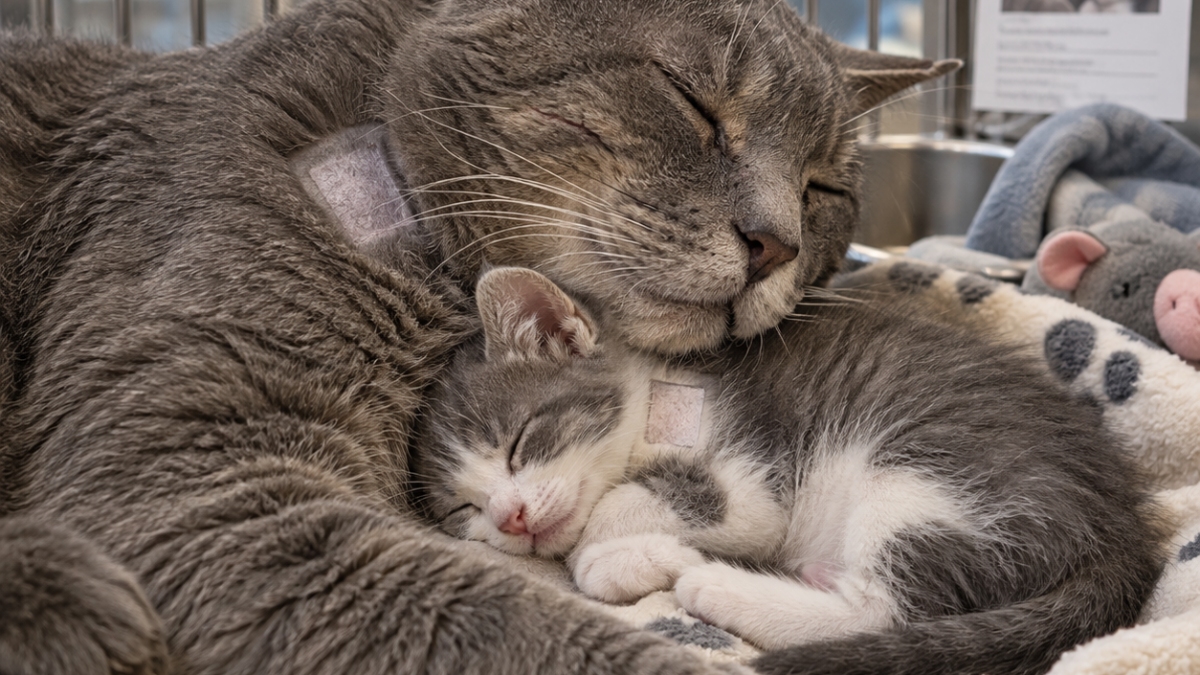
When Juniper finally returned to Green Hollow, she was placed in the recovery wing for observation. She was still fragile, still too thin, still clearly recovering. Her shaved patch matched Moss’s almost exactly where the clinic had accessed her vein. Rebecca saw it and felt the story click partially into place.
But it did not fully land until a few days later, when she stopped Karen in the hallway with her phone held out and asked, “Okay, seriously, why do Moss and the kitten have matching neck patches?”
Karen smiled in that slow way people do when they are about to tell a story they know matters.
“You don’t know?”
“No.”
Karen looked through the glass at kennel twelve, where Juniper was now awake and climbing sleepily over Moss’s side while he endured it with stoic resignation.
“Moss gave blood to save her.”
Rebecca lowered the phone slowly. “What?”
“Twice.”
For a moment Rebecca could only stare.
“Twice?” she repeated.
Karen nodded. “Juniper needed an emergency transfusion after she was hit by a car. Type B. We only had one compatible donor on our list.”
She pointed toward the gray tom.
“Him.”
Rebecca looked at Moss again with entirely new eyes.
The scarred face.
The torn ear.
The broad rough body curled protectively around the tiny kitten.
“How did I not know this?”
Karen’s smile faded into something more tender. “Because we’ve been busy trying to keep them alive.”
Rebecca laughed shakily, then wiped her eyes before the tears could fall. “And they put them together?”
“After Juniper stabilized. The foster room was full, and she seemed calmer near other cats. We introduced them carefully. He surprised everyone.”
“How?”
Karen folded her arms. “She climbed into his bed the first night and fell asleep against him. He looked offended for about ten seconds. Then he licked her head.”
Rebecca made a sound somewhere between a laugh and a sob.
“You’re kidding.”
“I wish I were.”
From then on, Juniper seemed to adopt Moss with total confidence, as if she understood on some animal level that this old cat belonged in the category of safe things.
She followed him from litter box to food bowl to sleeping shelf.
She tucked herself against him when unfamiliar people came into the room.
She batted at his whiskers, pounced on his tail, and once tried to nurse on his shoulder until Denise nearly cried laughing.
Moss tolerated everything.
Not patiently in the human sense, but in the only way that mattered: he never once shoved her away with claws or anger. He would sigh. He would stand up and relocate. He would pin her with a look that plainly said you are outrageous. Then he would lie back down and allow her to curl beside him all over again.
It was Claire, the adoption coordinator, who taped the now-famous photo to the bulletin board near the front desk after Rebecca printed it.
Two cats asleep, shaved patches visible.
No caption.
Just the image.
Everyone who saw it asked the same question.
“What’s the story?”
Once they heard it, people reacted in predictably human ways. Some cried. Some gasped. Some smiled and said, “Well, I’m taking this one home,” only to point at the kitten and ignore Moss entirely.
Juniper’s future became almost embarrassingly easy.
She was tiny. She was beautiful in that scrappy survivor way. She had a dramatic rescue story that people found irresistible. Applications began arriving before she was even officially cleared for adoption.
Moss remained Moss.
Admired.
Praised.
Passed over.
Claire hated that part.
“There should be a law,” she muttered one afternoon after another couple cooed over Juniper for twenty minutes and walked past Moss with nothing more than, “Aw, he looks rough.”
Rebecca was updating kennel cards beside her. “There is no law against people having terrible taste.”
Claire snorted. “If there were, half this county would be in jail.”
Still, something subtle had changed.
Moss was no longer just the cat who had been there forever. His story had begun circulating among volunteers, then on the shelter’s social media page, then through shares by people who had never set foot in the building. “The gray tom who donated blood twice to save a kitten” was suddenly more interesting than “older adult cat, needs patient home.”
The post Rebecca wrote was simple because she did not trust herself not to become sentimental.
Meet Moss and Juniper.
Their matching shaved patches tell a story.
When baby Juniper was hit by a car and needed emergency blood transfusions—not once, but twice—our longtime resident Moss was the only compatible donor available.
He saved her life.
Now they’re sharing a kennel while Juniper heals, and we can’t stop crying.
The comments exploded.
People called Moss a hero.
A gentleman.
An angel in a cat body.
A grizzled old medic.
A cranky grandpa with a heart of gold.
People donated toward medical care. They sent toys, blankets, and blood-donor stickers meant for pets. A local artist even mailed a watercolor portrait of the pair sleeping together.
For a week, Green Hollow felt buoyed by the kind of attention shelters rarely received unless something tragic had happened.
Juniper continued getting stronger.
Moss continued being overlooked in person despite being beloved on screens.
Then one Saturday afternoon, a foster family came in to finalize Juniper’s adoption paperwork.
The family was everything Claire could have hoped for: warm, experienced, respectful. A couple in their thirties, Rachel and Emily Brennan, with no young children, two grown indoor cats at home, and enough financial stability to handle follow-up care. They had been fostering Juniper during the last stretch of her recovery, and the official adoption was merely the happy ending everyone expected.
Juniper recognized them immediately. She trotted to the kennel door, tiny tail raised, and chirped in that rusty little voice she had developed.
Rachel scooped her up carefully. “There’s our girl.”
Emily signed forms at the front counter while Juniper kneaded Rachel’s cardigan like she was trying to prove her homecoming was overdue.
Then Emily’s eyes drifted to the framed photograph Claire had set beside the register—the one of Juniper and Moss asleep with their shaved necks visible.
She pointed.
“That’s her, right?”
Claire smiled. “That’s Juniper.”
Emily studied the image longer. “And the big gray cat?”
“Moss.”
“Is he still here?”
Claire’s face changed so slightly that most people might not have noticed. Emily did.
“Was,” Claire corrected, and the word came with a smile she could no longer contain. “He was here.”
Rachel looked up fast. “You mean he got adopted?”
Claire actually laughed out loud then, partly from relief, partly from the joy of finally saying the words.
“Yesterday.”
Rebecca, who was sorting mail nearby, turned immediately. “Wait—what?”
Claire clapped both hands over her mouth, grinning.
“You didn’t hear yet? The Millers came back.”
“Which Millers?”
“The retired couple from Pine Ridge. The ones who met him last month but said they needed to talk it over because of his age?”
Rebecca dropped the envelope she was holding. “They adopted Moss?”
Claire nodded so hard her ponytail bounced. “This morning. Papers signed. He’s gone home.”
Rachel and Emily were smiling now too, though they had never met Moss.
“What made them decide?” Emily asked.
Claire looked toward the photograph. “They saw the story online again. Then Mr. Miller said anyone willing to save a baby twice deserved a couch for the rest of his life.”
Rebecca actually sat down because her knees suddenly felt strange.
The Millers were Charles and Anne, both in their seventies, both recent widowers who had found companionship in late-life friendship and eventual marriage after meeting in a grief support group. They lived in a quiet ranch house with a sunroom, bird feeders outside every window, and a habit of speaking to animals as though politeness mattered.
They had met Moss a month earlier and liked him immediately, but they had hesitated.
“He’s older,” Anne had whispered in the visitation room while Moss rubbed against Charles’s pant leg with suspiciously strategic charm.
Charles had stroked the gray tom’s back. “So are we.”
Anne smiled sadly. “That’s exactly my point.”
They had left with a promise to think about it. Claire had assumed, based on long experience, that “think about it” usually meant no.
But then the story spread.
Anne saw the photo again on Facebook late one evening and called Charles into the room.
“There he is,” she said.
“The old fellow?”
“The hero.”
Charles stood behind her, reading the story in silence.
When he finished, he said, “Well.”
Anne turned to look at him. “Well what?”
He kept his eyes on the screen. “I think we’ve just been told something.”
Anne knew exactly what he meant because grief had taught her the strange language of timing. Sometimes a thing kept returning to you because it was meant to.
“He’s waited a long time,” she said softly.
“Two hundred and fourteen days.”
Charles had always remembered numbers that mattered.
Anne reached over and touched the screen where Moss’s scarred face showed in profile. “He doesn’t look easy.”
Charles smiled. “Neither were you when I met you.”
She swatted his arm. Then she began to cry.
By the next afternoon they were back at Green Hollow.
Moss did not perform for them. He never performed for anyone. He walked into the meeting room, sniffed Charles’s shoe, stared at Anne for a solid ten seconds as if weighing her soul, then jumped onto the bench between them and sat down with a grunt.
Anne laughed through tears. “Well. That seems clear.”
Charles nodded solemnly. “He has chosen.”
There were practical questions. His age. His medical history. His donor status. Whether he got along with other animals. What food he preferred. Whether he was a lap cat.
Claire answered everything honestly.
“He likes routine. He tolerates brushing when he trusts you. He’s not clingy, but he does like company. And he has this habit of pretending he doesn’t want affection right before leaning into it.”
Charles scratched Moss’s shoulder. “He sounds dignified.”
“Mostly,” Claire said. “Unless there’s tuna.”
That broke the last of the tension.
By the time the adoption papers were complete, Anne had already asked if the shelter would mind updates and Charles had promised Moss an orthopedic pet bed “fitted for a gentleman of experience.”
When they carried him out in his carrier, several staff members stood in the hallway pretending not to be emotional and failing badly.
Denise bent beside the crate before they left. “You be nice,” she told him. “You already used up your bad-boy years.”
Moss blinked slowly.
Rebecca touched the carrier door. “You finally got your turn.”
As soon as the car pulled away, Claire cried in the supply closet for four full minutes.
So when Juniper’s family asked, and Claire answered, and Rebecca realized Moss had finally gone home, the entire shelter seemed to brighten all over again.
Rachel pressed one hand to her heart. “Oh, thank God.”
Emily looked back at the photograph and smiled. “Good. I hated the idea of them being separated if he was still waiting.”
Rebecca thought about that sentence later.
People assumed Juniper had been the life that Moss changed. They rarely considered that Juniper might have changed Moss’s life too—not only by sleeping against him in recovery, not only by drawing attention to him, but by giving human beings a reason to look twice.
Sometimes love did not rescue in one direction.
Sometimes it looped back.
The first update from the Millers arrived three days later.
Subject line: Moss Report.
Inside were four photographs.
In the first, Moss sat in the middle of a braided rug in the sunroom looking as if he had personally designed the space. In the second, he was asleep on a blue plaid blanket beside Charles’s slippers. In the third, he had discovered a low window perch and was glaring at a squirrel with theatrical intensity. In the fourth, Anne had somehow captured the exact moment he climbed onto Charles’s lap and then looked offended by his own decision.
The message beneath the photos read:
Dear Green Hollow friends,
Moss has spent the last 48 hours inspecting every inch of the house and informing us of his standards. He enjoys poached chicken, warm laundry, birdwatching, and sleeping precisely where someone intended to sit. He has also decided Charles wakes too late and should be corrected by 5:30 a.m.
We adore him already.
Also—please tell Juniper, if that can be done in an official capacity, that her old friend is safe.
Love,
Anne and Charles Miller
Rebecca printed the email and taped it to the staff refrigerator.
Juniper’s family sent updates too.
She was gaining weight. Her limp had faded to almost nothing. She chased feather wands like she had something to prove. She adored the family’s older black cat and irritated the calico by stealing her bed. The shaved patch on her neck was slowly disappearing under new fur.
One afternoon, a few weeks after both adoptions were finalized, Rachel brought Juniper back for a scheduled follow-up at Crestview and then stopped by the shelter to show everyone how well she was doing. Juniper rode in on Rachel’s shoulder like a pirate’s sidekick and instantly behaved as though she still owned the place.
Rebecca kissed the top of her head.
“You’re supposed to remember us fondly, not move back in.”
Juniper chirped.
Claire came out from the office smiling. “You need to see this.”
She led Rachel and Emily to the front desk where the framed photo of Juniper and Moss still stood because nobody could bear to take it down.
Beside it, Claire had placed a second photograph from the Millers: Moss asleep belly-up on Charles’s recliner, one paw hanging off the side, utterly and gloriously unguarded.
Emily laughed. “That cat looks reborn.”
Claire nodded. “I think maybe he is.”
Rachel studied the two photographs together—the one with the shaved marks, the one with the contented old cat finally home—and wiped her eye.
“I keep thinking about how nobody knew what he was carrying.”
Rebecca glanced at her. “You mean the blood?”
Rachel shook her head slowly. “Not just that. Everything. Gentleness. Loyalty. Whatever made him give twice and then accept a baby climbing all over him like he’d been waiting his whole life to matter to someone.”
Claire looked at the pictures too.
“He always mattered,” she said quietly.
Rachel smiled. “I know. I just mean… now other people know.”
That became, in its own way, the heart of the story.
People liked the miracle of the transfusions, and they should have. It was extraordinary. A little kitten survived because an old shelter tom happened to carry the rare blood she needed and happened to be healthy enough and calm enough to share it. Then he did it again. If you wrote that in a novel, some readers might call it too sentimental to believe.
But the deeper truth sat under all of that.
For 214 days, visitors had walked past Moss and seen an aging stray with scars and a torn ear.
They did not see that inside him was exactly what someone else might someday need to live.
They did not see that his rough face hid patience.
That his caution hid tenderness.
That his silence hid steadiness.
That his very body held rescue.
Juniper, for her part, grew into a sleek adolescent cat with the kind of reckless joy only survivors seem to possess. She jumped too high, ran too fast, and loved too hard. At six months old, she was still smaller than average, and Rachel liked to say she had made up for it by growing a personality too big for her frame.
At Christmas, the Brennans sent a card to the shelter.
On the front was Juniper tangled in ribbon under a tree.
Inside they wrote:
Thank you for saying yes to one tiny life.
She reminds us every day that survival can become joy.
A week later, the Millers sent their own card.
Moss was pictured on a red fleece blanket in the center of the sofa, wearing an expression of deep disapproval beneath a pair of reindeer antlers Anne admitted lasted only three seconds.
Inside, Charles had written:
Moss has appointed himself household supervisor. He monitors all bird feeder activity, insists on dinner at 4:47 p.m., and sleeps between us every night.
We are grateful beyond words.
Please tell anyone who doubts an older cat can change a home that ours is proof.
Rebecca kept both cards in her locker.
Sometimes, on difficult days, she reread them.
Because difficult days still came.
Animals still arrived broken.
Not every donor story ended happily.
Not every kitten lived.
Not every old cat got his family.
Shelter work remained what it had always been: a long education in hope without guarantees.
But when the work felt too heavy, Moss and Juniper offered something solid to hold onto.
A reminder that unnoticed did not mean unimportant.
That time waiting did not erase worth.
That the ones people overlooked might be carrying the exact thing that could save another life.
And that sometimes, if people were willing to ask the right question—Why do they have the same shaved mark? Why is that old cat still here? What am I not seeing?—the answer could open an entire door to compassion that had been standing there all along.
Months later, Green Hollow hosted an adoption fundraiser in the community park. Booths lined the walking path. Dogs in bandanas trotted past folding tables. Volunteers sold cookies shaped like paws. A local pet supply store donated raffle baskets. Someone painted children’s faces under a canopy tent.
Rebecca was helping at the photo display when she heard a familiar low voice behind her say, “Well, there’s our celebrity.”
She turned to see Anne and Charles Miller approaching with Moss in a large mesh stroller because, as Anne explained cheerfully, “He despises harnesses but enjoys supervising public events.”
Moss sat upright in the stroller like a retired admiral reviewing troops.
Rebecca laughed with pure delight. “Look at you!”
Moss narrowed his eyes, then allowed one brief scratch under the chin.
A few minutes later, Rachel and Emily arrived too, carrying Juniper in a secure soft carrier because she was too curious to be left out but too impulsive to trust loose around dogs.
For one impossible, lovely moment, both adopters stood beside the display table while the shelter staff gathered around, and there they were again:
Moss.
Juniper.
The old donor and the kitten he had saved.
Separated now by different homes, different futures, different daily lives—but linked forever by something deeper than most people would ever fully understand.
Rachel unzipped Juniper’s carrier enough for her to peek out. Juniper saw Moss and gave a soft questioning chirp.
Moss leaned forward in the stroller.
They looked at each other.
No cinematic rush.
No dramatic reunion.
Just recognition, maybe. Or maybe familiarity. Or maybe simply the calm acknowledgment of two creatures whose lives had once intertwined at the narrowest edge of survival.
Juniper reached one paw toward the mesh.
Moss blinked at her once, slowly.
Anne put a hand to her mouth. “Oh, my heart.”
Rebecca felt tears prickle at the back of her eyes again.
So many months had passed, and still this pair could undo her.
Charles looked at the display photos clipped to the board—Moss’s intake picture, Juniper’s first medical photo, the famous sleeping image, the adoption updates.
“You know,” he said quietly, “people always talk about giving a part of yourself metaphorically. He did it literally.”
Rachel nodded. “Twice.”
Charles glanced down at Moss. “And he never acted like he wanted credit.”
Denise, who had just walked up carrying lemonade, laughed. “No, he acts like we all owe him rent.”
Everyone laughed, including Anne, who wiped her eyes while doing it.
The afternoon went on. Families came by. Children asked questions. Donors dropped bills into jars. People took selfies with adoptable puppies.
But at least three times, Rebecca noticed strangers pause in front of the photo display and ask the same question she once had.
“Why do both cats have the same shaved patch?”
And every time, someone nearby told the story.
By the end, the strangers always looked at Moss differently.
Not as the battered old tom he had once been to them.
But as a creature of quiet astonishing worth.
Years from now, Rebecca knew, Green Hollow staff would still tell new volunteers about Moss and Juniper. The details might soften around the edges, as stories do. Someone might get the exact date wrong. Someone might say the road was busier or the weather worse or Juniper smaller than she had been. But the heart of it would remain.
An overlooked gray tom named Moss waited 214 days in a shelter.
A tiny kitten named Juniper was brought in dying after being hit by a car.
They shared the same rare blood type.
He gave blood to save her.
Then he gave again.
She lived.
They healed together.
And eventually, because one person stopped and asked the right question about two matching shaved marks, the world finally saw what had been true all along.
That heroes are not always beautiful.
They are not always young.
They are not always easy.
Sometimes they are scarred and older and tired.
Sometimes they have spent months being ignored in a cage.
Sometimes they cannot tell their own story, so someone else must notice.
And sometimes the greatest hearts in the room belong to the ones nobody thought to choose until they had already changed a life.
Moss never knew his photograph made people cry.
He never knew that social media strangers called him noble or brave or miraculous.
He never knew that his story traveled far beyond the walls where he had once waited.
What he knew, in the end, was far simpler and probably far more important.
He knew the feeling of safety.
The weight of a kitten sleeping against him without fear.
The quiet of a home where no one passed his cage and kept walking.
The steady hand of Charles on his back.
The soft voice of Anne saying goodnight.
The sun on the rug.
The birds at the feeder.
The dignity of being wanted at last.
And Juniper, who had nearly left the world before she had properly entered it, grew up in the warm ordinary abundance that all rescued animals deserve—a full bowl, familiar voices, toys under the sofa, soft blankets, routine, laughter, and the kind of love that does not ask what you looked like on your worst day before deciding whether you are worthy of staying.
Maybe that was the most beautiful part.
Not merely that one saved the other.
But that both of them, after pain and waiting and long brushes with loss, ended up exactly where all living creatures hope to land.
Safe.
Seen.
Loved.
And forever marked—not by the small shaved patches that first made people curious, but by the proof those patches carried.
That sometimes the life no one notices is the very life that changes everything.
That sometimes the ones who look the least extraordinary are carrying miracles quietly in their blood.
And that sometimes all it takes to uncover one is for somebody, finally, to stop in front of a photograph and ask the right question.








