A Scarred Nurse Was Ordered Out of a Military Memorial—Then 7 K9s Broke Formation and Ran Straight to Her
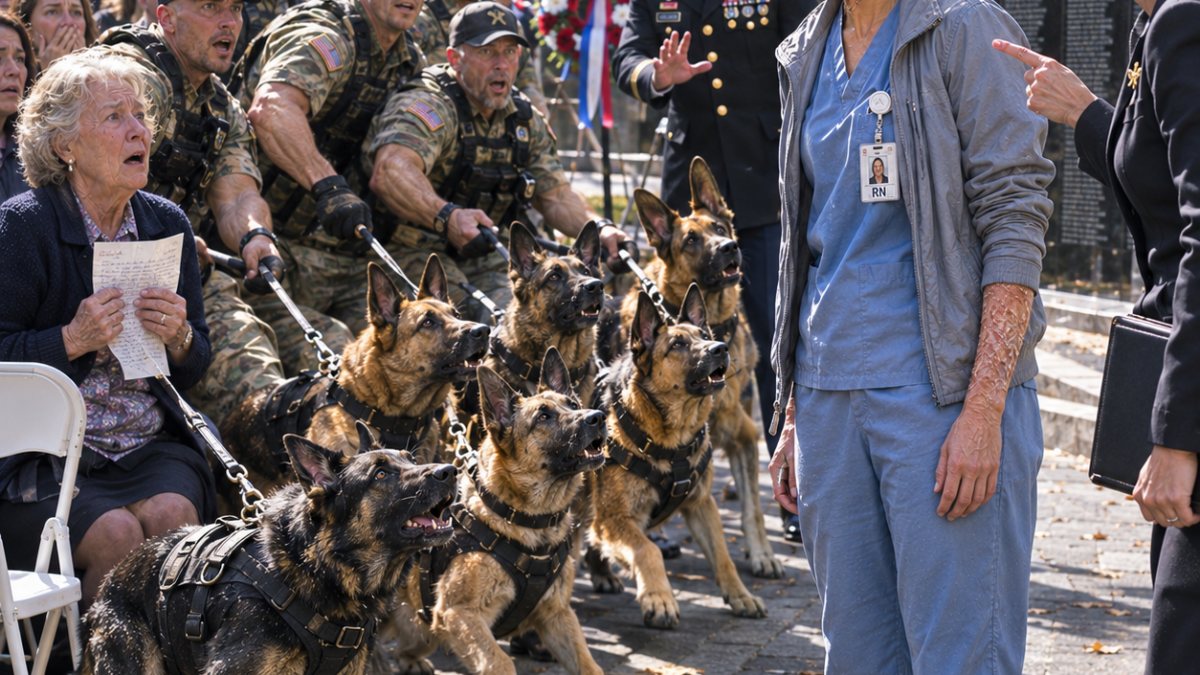
A Scarred Nurse Was Ordered Out of a Military Memorial—Then 7 K9s Broke Formation and Ran Straight to Her.
Commander Adrian Locke looked at the burn scars climbing my neck, told security I did not belong at the memorial, and ordered me escorted away while families of the men I had once treated watched in silence.
I was almost beyond the flags when seven military working dogs suddenly turned away from their handlers, broke a formation they had held through years of training, and ran straight across the memorial grounds toward me.
Everyone thought the dogs were disobeying a command, but when one of them pressed his head against my scarred arm and I whispered the same five words I had used eight years earlier inside a burning ambulance, the man who erased my name from the official record stopped looking angry and started looking afraid.
My name is Eliana Cross.
For eight years, I avoided military memorials.
Not because I disliked them.
Because I remembered too much.
The invitation to Fort Ashford sat unopened on my kitchen table for three days.
Heavy cream paper.
Embossed seal.
My name handwritten across the front.
MS. ELIANA CROSS.
Not Lieutenant.
Not Captain.
Not Nurse Cross.
Just Eliana.
That should have made it easier.
It didn’t.
Every morning before work, I passed the envelope.
Every night, I came home and saw it again.
By Thursday, I slid it beneath a stack of bills.
By Thursday evening, I put it in a drawer.
Friday afternoon, Mara Ellison walked into the veterans medical clinic carrying the same envelope.
I was standing beside an examination table with one hand near the shoulder of an old Belgian Malinois named Rook.
Rook’s hips were failing.
His right eye had gone cloudy.
His handler had died six months earlier.
Since then, he watched every clinic door as though grief might eventually walk back through one.
I never forced him to lie down.
I simply stood beside him until his muscles loosened enough for him to choose it.
Mara stopped in the doorway.
“You didn’t answer.”
I kept my eyes on Rook.
“I received it.”
“That isn’t what I said.”
Mara was seventy-two.
PART2:
Her son, Lieutenant Caleb Ellison, had been dead eight years.
His photograph hung in our clinic hallway with the other fallen handlers.
Young man.
Big grin.
German Shepherd trying to steal his cap.
I walked past that photograph every day.
I almost never looked directly at it.
Mara held the invitation toward me.
“The memorial is tomorrow.”
“I know.”
“Caleb’s name is being added to the new wall.”
“I know.”
“You should be there.”
I reached toward the supply cabinet.
“No.”
She did not move.
“You haven’t even opened it.”
“I don’t attend memorials.”
“You attend funerals.”
“That’s different.”
“When someone asks.”
I finally turned.
“I’m asking.”
PART3:
My sleeve pulled back when I reached for gauze.
The burn scar along my left forearm showed.
It started above my wrist.
Disappeared beneath the sleeve.
Continued over my shoulder.
A second scar followed my neck and jaw.
Most people noticed.
Kind people pretended not to.
Mara never pretended.
“My son mentioned you in his last letter.”
I looked away.
“He mentioned many people.”
“He wrote that you stayed.”
I stopped moving.
Rook lifted his head.
“Mara.”
“He wrote that everyone else was moving toward the helicopters and you were moving back toward the fire.”
“Please.”
She stepped closer.
“If his name is spoken tomorrow, yours should not be missing.”
I could have told her the memorial belonged to military families.
That I was a civilian trauma nurse.
That I had never worn rank.
That my role in the Ashen Ridge evacuation had been reduced to half a page in the final report.
That the last time I stood beneath military flags, a senior officer suggested I stop contradicting the official record if I wanted to keep working military contracts.
Instead, I asked:
“Why now?”
Mara’s expression softened.
“Because I’m tired of letting other people decide which parts of my son’s life I’m allowed to remember.”
I stared at the envelope.
“You think me being there changes anything?”
“No.”
I almost smiled at the honesty.
Then she added:
“But absence is how they erased you the first time.”
That night, I opened the invitation.
FORT ASHFORD MEMORIAL GROUNDS.
11:00 A.M.
Dress uniform requested.
Civilian formal attire acceptable.
I owned neither.
My closet held scrubs.
Jeans.
Winter coats.
One black dress I had worn to three funerals.
I took it out.
Held it against myself.
The neckline showed the scar climbing my neck.
I imagined polished officers trying not to stare.
Whispers.
Recognition.
Questions.
I put the dress back.
The next morning, I went to work.
That was mistake number one.
Not because I shouldn’t have worked.
Because work gave me somewhere to hide.
Fifteen minutes before my shift ended, Russ Calder arrived with his retired German Shepherd.
Russ had fallen trying to lift the dog into his truck.
The dog was fine.
Russ’s shoulder was not.
I stayed.
Imaging.
Sling.
Pain management.
Instructions.
Then I waited until someone could drive him home.
By the time I finished the paperwork, Dr. Naomi Vail appeared at the nurse’s station.
“You’re still here.”
“I’m leaving.”
“You said that an hour ago.”
“Russ didn’t have a ride.”
Naomi noticed the cream envelope sticking out of my bag.
“You’re actually going?”
“Yes.”
She looked at my scrubs.
“Like that?”
I looked down.
Light blue.
Clean.
Mostly.
“They’re clean.”
“They have dog hair.”
“So does everything I own.”
She smiled.
Then became serious.
“You don’t have to go.”
“I know.”
“Want me to come?”
“No.”
“Want me to tell you not to?”
I thought about that.
“No.”
Naomi nodded.
“Then get out of here before you find somebody else with a sprained shoulder.”
I arrived at Fort Ashford twenty-seven minutes late.
Flags lined the memorial grounds.
American flags snapping in mountain wind.
White chairs filled the lawn.
Families sat facing a granite wall covered with dark fabric.
Dress-uniform officers stood near the platform.
Seven military working dogs waited in formation.
German Shepherds.
Belgian Malinois.
Black memorial harnesses.
Polished tags.
Each dog stood beneath the plaque of a fallen handler.
I stopped at the edge of the grounds.
Everything was beautiful.
Organized.
Controlled.
That was almost worse.
The last time I saw some of those names, nothing had been controlled.
Smoke.
Metal.
Blood.
Burning fuel.
A damaged ambulance tilted against a mountain road.
I almost turned around.
Then Mara saw me.
She stood from the first row.
Lifted one hand.
I took a step.
A security officer moved in front of me.
“Ma’am, this section is restricted.”
“I have an invitation.”
He looked at my scrubs.
“Medical staff are stationed near the south tent.”
“I’m not working.”
“Then I’ll need your credential.”
I reached into my bag.
Before I found the invitation, a voice behind him said:
“That won’t be necessary.”
I knew the voice before I turned.
Commander Adrian Locke.
Eight years had improved him.
Silver at the temples.
Perfect dress uniform.
Rows of decorations.
He still stood the same way.
Shoulders back.
Chin slightly lowered when he wanted someone to feel he was speaking privately even in public.
His eyes went to my face.
Then my neck.
Recognition.
Then something else.
Fear.
“Eliana Cross.”
“Commander Locke.”
The security officer looked between us.
“You know her, sir?”
Locke never took his eyes off me.
“Yes.”
No warmth.
He stepped closer.
Lowered his voice.
“You shouldn’t be here.”
“Mara invited me.”
“This is not the place.”
“For what?”
“For reopening disputed events.”
“I haven’t said anything.”
“Your presence says enough.”
I looked past him.
Caleb’s name was somewhere beneath the cloth.
“So that’s the problem.”
“This day belongs to their families.”
“I didn’t come to take anything from them.”
“Then leave quietly.”
I watched him.
Eight years earlier, I had thought time might eventually make him easier to understand.
It hadn’t.
“I came because Caleb’s mother asked me.”
“She does not understand the operational history.”
“She understands her son.”
Locke’s jaw tightened.
The ceremony had already started.
I could hear the band.
Families held folded flags.
Children sat beneath photographs of fathers and mothers they barely remembered.
I would not turn their memorial into a public fight.
I pulled the invitation out.
Held it toward Mara.
“I’m sorry.”
She stood.
“No.”
Locke turned toward security.
“Escort her outside the memorial boundary.”
People nearby began noticing.
Whispers.
“Who is she?”
“A nurse.”
“Why is she wearing scrubs?”
“Maybe she works here.”
“Look at her neck.”
I heard every word.
The officer gestured toward the path.
“Ma’am.”
I started walking.
I kept my eyes forward.
That was a skill I learned after the burns.
If you look down when people stare, they think you are ashamed.
If you stare back, they think you are angry.
So you learn to look through the middle.
I had almost reached the outer walkway when Mara called:
“Eliana.”
The security officer stopped.
Locke said:
“Continue.”
Mara stepped into the aisle.
“You asked her to leave without asking why I brought her.”
Locke turned.
“Mrs. Ellison, today should not become confrontational.”
“You made it confrontational.”
She held up a folded letter.
“My son wrote her name.”
Locke’s face changed.
“This ceremony is based on the official record.”
“My son was there.”
“So was I.”
My voice came out quieter than I expected.
But the grounds were silent enough now that people heard it.
Several K9 handlers turned.
Locke looked at me.
“You were a civilian medical contractor operating outside command authority.”
I stared at him.
“I was the trauma nurse inside the ambulance your report said was empty.”
Silence.
Not ordinary silence.
The kind that moves through a crowd.
Mara stepped farther into the aisle.
Locke lowered his voice.
“This is exactly why your attendance was not appropriate.”
Mara said:
“I invited her.”
“You do not understand the operational context.”
“My son died understanding it.”
That landed.
Locke looked toward the officers.
Calculation.
I remembered that look too.
He had worn it eight years earlier while deciding how long a damaged convoy could remain under threat.
The master of ceremonies approached.
“Sir, the tribute recording is ready.”
Locke nodded.
Then:
“Remove her.”
I lifted one hand.
“It’s all right.”
Mara shook her head.
“No.”
“I came because you asked.”
“You came because Caleb asked first.”
For one second, my composure shifted.
Just enough.
The security officer guided me away without touching me.
He didn’t need to.
Public humiliation works fine without hands.
I passed women holding flags.
A teenage boy staring at his father’s photograph.
Decorated officers.
A woman whispered:
“She should’ve known better.”
A man beside her said:
“Some people use any tragedy for attention.”
I kept walking.
Then the master of ceremonies spoke.
“Lieutenant Caleb Ellison served with courage, loyalty, and unwavering devotion to his unit.”
My feet stopped.
Caleb’s photograph appeared on the screen.
Young.
Alive.
Smiling.
The speaker continued.
“His final recorded transmission became a symbol of sacrifice during the Ashen Ridge evacuation.”
A recording played.
Static.
Wind.
Distant gunfire.
Then Caleb’s voice.
“Hold the line. I’m coming back.”
I closed my eyes.
The memorial disappeared.
I smelled burning insulation.
Diesel.
Blood.
Melted plastic.
I heard injured dogs whining in the back of the ambulance.
Caleb’s voice near the rear hatch.
He had said those words repeatedly.
Every time he left.
Every time he brought someone back.
Hold the line.
I’m coming back.
Without realizing it, I whispered:
“You said that every time you left the tent.”
One dog lifted his head.
Black-and-tan German Shepherd.
Bishop.
He stood beneath Caleb’s plaque.
His ears turned toward me.
Chief Warrant Officer Jonah Cade looked down.
“Bishop.”
The dog didn’t move.
Then another dog raised her head.
Nix.
Then Ranger.
Echo.
Flint.
Vesper.
Atlas.
Seven dogs.
Every one of them turned away from the platform.
Every one looked toward me.
Handlers shortened leashes.
Jonah frowned.
“Hold.”
Bishop took one step.
“Bishop, stay.”
Another step.
Then the leash slipped.
Bishop ran.
Someone shouted:
“Dog loose!”
A gasp crossed the crowd.
The security officer stepped in front of me.
I moved around him.
“Don’t.”
Bishop crossed the grass at full speed.
His handler shouted.
The dog ignored him.
Then two more leashes pulled free.
Nix.
Echo.
Then Ranger.
Flint.
Vesper.
Atlas.
Seven military working dogs broke formation.
Dogs trained to obey through gunfire.
Aircraft.
Crowds.
Explosions.
This time, none stopped.
I stood still.
Bishop reached me first.
Stopped so abruptly his paws dug into the grass.
Then he pressed his head against my left forearm.
The scarred one.
Nix circled behind me.
Sat.
Echo lowered herself across my feet.
Ranger leaned against my leg.
Flint lifted his nose toward my jaw.
Vesper whined.
Atlas sat directly in front of me.
No barking.
No aggression.
No chaos.
They simply settled.
Around me.
I couldn’t breathe normally.
Jonah reached us.
His face was pale.
“What did you do?”
I lowered myself carefully.
My knees shook.
I placed one hand near Bishop’s shoulder.
“Easy.”
His breathing slowed.
I whispered:
“Hold the line.”
Every dog went still.
Jonah stared.
“How do they know that?”
I looked at the memorial harnesses.
Small sealed compartments.
Scent articles.
Gloves.
Cloth.
Personal effects from handlers.
“They don’t know me.”
“Then why are they here?”
I looked at Bishop.
“He remembers Caleb’s scent.”
Then at the others.
“And maybe they remember the way their handlers responded to those words.”
Commander Locke approached.
His face had lost color.
“Get the dogs back into formation.”
No handler moved immediately.
Jonah looked at him.
“Sir, I’ve never seen them do this.”
“Then regain control.”
Mara walked past Locke.
Stopped beside me.
Opened Caleb’s letter.
“My son wrote about a nurse.”
The crowd became silent.
Her hands shook.
Her voice did not.
“Mom, if this reaches you, I need you to remember the woman in the ambulance. Her name is Eliana Cross.”
My eyes closed.
Mara kept reading.
“Command told us to withdraw. She stayed with the wounded. She held the dogs when the handlers couldn’t.”
Bishop made a small sound.
“If I don’t come home, don’t let them say we were abandoned by everyone.”
Mara looked at me.
“She stayed.”
No one was staring at my scrubs anymore.
No one whispered about my scars.
Every face turned toward Locke.
Mara said:
“They remember the woman you erased.”
Locke recovered enough to speak.
“This ceremony cannot be hijacked by an unverified personal letter.”
Jonah stared at him.
“Seven dogs just broke ceremonial formation.”
“That is not evidence.”
Mara answered:
“No.”
She folded the letter.
“It’s memory.”
I stood slowly.
The dogs rose with me.
All seven stayed close.
Jonah looked at my neck.
Then at the plaques.
“Who are you?”
I looked toward the memorial wall.
The polished officers.
The flags.
The version of history that had managed to exist for eight years without me.
“I was the nurse inside the ambulance.”
For almost a minute, nobody moved.
Then Jonah tried Bishop again.
“Bishop.”
The dog looked toward him.
“Heel.”
Nothing.
I touched Bishop lightly.
“You can go.”
He stayed.
Jonah’s expression changed.
A small, incredulous smile.
“He isn’t refusing me.”
“What?”
“He thinks he’s guarding you.”
I shook my head.
“No.”
“What then?”
“He thinks he’s guarding a promise.”
Mara raised the letter.
“There’s more.”
Locke took one step.
“Mrs. Ellison—”
She ignored him.
“Caleb wrote this three days before the convoy.”
She read:
“Mom, there’s a civilian trauma nurse attached to us named Eliana Cross. Nobody outranks her medically because she doesn’t carry rank. She carries responsibility.”
Several veterans looked at one another.
“When everyone else panics, she doesn’t.”
My throat tightened.
“The dogs settle when they hear her voice. She keeps telling them the same thing whenever handlers leave to pull someone from danger.”
Mara looked up.
“The words she whispered today.”
I already knew what came next.
“Hold the line. I’m coming back.”
Jonah knelt beside Bishop.
“That’s why.”
I shook my head.
“The dogs didn’t memorize me.”
“What did they memorize?”
“Hope.”
One younger handler spoke.
“My dog’s predecessor belonged to Lieutenant Brooks.”
He pointed toward Echo.
“Brooks wrote that phrase in his field journal.”
Another handler said:
“So did mine.”
Then another.
“And mine.”
The phrase had spread through the unit.
Not because it belonged to me.
Because people needed it.
Locke interrupted.
“Memory is emotional. It isn’t evidence.”
Mara turned.
“My son’s letter is evidence.”
“A personal letter cannot overturn an official investigation.”
Jonah said quietly:
“No.”
He looked toward me.
“But it can tell us where to start looking.”
The ceremony stopped.
Nobody announced it formally.
People simply stopped behaving as though the program could continue.
Jonah guided me toward a shaded area near the memorial garden.
The dogs came too.
Handlers walked beside them.
No one forced formation.
Mara sat on my left.
Jonah removed his campaign hat.
“I’ve read the Ashen Ridge report.”
I looked toward the mountains.
“It said your ambulance became disabled after the convoy withdrew.”
“Yes.”
“It said command did not know survivors remained because communications repeatedly failed.”
I almost laughed.
Not because it was funny.
“The report wasn’t entirely false.”
“What does that mean?”
“It was carefully incomplete.”
Jonah waited.
I had not told this story in full for years.
Not to Mara.
Not to the clinic.
Not to anyone who could do anything about it.
“It was late afternoon.”
I looked down at my hands.
“We were moving wounded handlers and three injured military working dogs.”
The air around me seemed to cool.
“The first blast disabled the lead vehicle.”
I could see it.
“The second hit ours.”
My mouth went dry.
“The windshield disappeared.”
Metal folded.
“Medical equipment caught fire.”
A dog screamed.
“The driver died immediately.”
Someone beside me inhaled sharply.
“The rear axle collapsed.”
Jonah said nothing.
“Commander Locke radioed another strike was expected.”
“You were ordered to withdraw?”
“Yes.”
“You refused?”
“No.”
That mattered.
“I requested six minutes.”
“For what?”
“To stabilize the patients enough that moving them wouldn’t kill them.”
“Was it granted?”
“No.”
“What did Locke say?”
“That anyone left behind would become unrecoverable if the convoy stayed.”
Jonah looked toward Locke across the grounds.
“And then?”
“He left.”
The words had no heat left in them.
That surprised me.
I had carried them so long they had become heavy rather than sharp.
“The helicopters moved with the convoy.”
I continued.
“I had two medics.”
“Four wounded handlers.”
“Three injured dogs.”
“No evacuation.”
Mara touched the letter.
“My Caleb?”
I smiled.
“He wouldn’t leave.”
Of course he wouldn’t.
“What did he say?”
“I told him he was bleeding too heavily to keep moving.”
Mara smiled through tears.
“He argued?”
“He said commanders were supposed to argue with medics.”
She laughed softly.
“That sounds exactly like him.”
I looked at my arm.
“The ambulance ceiling collapsed.”
My fingers touched the scar beneath my sleeve.
“I pulled one handler through the rear hatch.”
“Then another.”
“The dogs wouldn’t leave them.”
I stopped.
The memory came in pieces.
Fire climbing the inside wall.
Someone shouting.
Caleb pulling a stretcher.
Heat at my neck.
“I crawled back inside.”
Jonah looked at my scars.
“That’s where you were burned.”
I nodded.
“The fuel ignited.”
No one spoke.
“I remember Caleb yelling my name.”
“Then somebody threw blankets over me.”
“After that…”
I breathed.
“I woke in a field hospital three days later.”
Jonah looked toward the memorial.
“The report said delayed evacuation worsened the casualty count.”
“Yes.”
“It blamed you.”
“Not directly.”
I smiled without humor.
“It said my delay contributed.”
Mara stared.
“It never said why you delayed.”
“No.”
“It never said you were carrying my son.”
“No.”
Across the lawn, Locke stood speaking with two senior officers.
Every few seconds, he looked at us.
At the dogs.
At the families gathering closer.
Jonah stood.
“I want to see the file.”
I laughed once.
“I have seen the file.”
“The complete one?”
“There is no complete one.”
He looked at me.
“I submitted forty-two pages.”
That stopped him.
“What?”
“Medical timeline.”
“Patient triage.”
“Radio logs.”
“Treatment notes.”
“Everything.”
“How much is in the official file?”
“One page.”
Jonah put his hat back on.
“Then let’s start there.”
Fort Ashford’s historical archive building sat above the memorial grounds.
Climate-controlled.
Quiet.
Rows of military records.
An elderly archivist met us.
Jonah showed credentials.
“I need the complete Ashen Ridge evacuation file.”
She hesitated.
“Restricted collection.”
“Request authorization.”
Her expression suggested she disliked being told what to do in her own archive.
Good.
Ten minutes later, the supervisor arrived.
Three binders came out of secure storage.
Operational timeline.
Casualties.
Witness statements.
Locke’s statement was complete.
Detailed.
Recommendation attached.
Vehicle records.
Flight paths.
Communications summaries.
Then we reached:
CIVILIAN MEDICAL PERSONNEL.
CROSS, ELIANA.
Status:
Civilian contractor.
Additional statement:
Unavailable.
I stared.
Jonah frowned.
“Unavailable?”
“I submitted forty-two pages.”
The archivist looked up.
“Forty-two?”
“Yes.”
“Medical timeline?”
“Yes.”
“Attachments?”
“Yes.”
She checked the index.
Her expression changed.
“There should be appendices.”
“How many?”
“A through H.”
“Where are they?”
She searched again.
“They aren’t here.”
Mara stepped closer.
“So somebody removed them.”
The archivist shook her head slowly.
“I’ve worked here nineteen years.”
She turned another page.
“I have never seen primary witness attachments missing like this.”
Jonah continued searching.
A folded inventory sheet slipped free.
He opened it.
Transfer authorization.
Eight years earlier.
Removal of supplemental evidence.
Approved by:
COMMANDER ADRIAN LOCKE.
Mara stared at the signature.
“He erased her.”
The room disappeared for a second.
For eight years, I believed my report had been ignored.
Buried.
Discounted because I was civilian.
Now I knew something worse.
Somebody had physically removed it.
Jonah put the document into a protective sleeve.
“If one set disappeared, we need to determine whether anything else did.”
The archivist opened another database.
Jonah asked:
“Where were personal effects from that operation stored?”
“Some were transferred through the military working dog division before family return.”
Jonah looked at me.
“The harnesses.”
We returned outside.
The seven dogs had settled beneath the trees.
Families gathered around.
No ceremony.
Just people talking.
About handlers.
Promises.
Things the official program had not included.
Jonah approached Bishop.
The dog greeted him.
Then returned to my side.
“I owe you an apology,” Jonah said.
“For what?”
“I almost treated you like you didn’t belong.”
“You treated me exactly the way the paperwork described me.”
He looked uncomfortable.
That wasn’t an accusation.
Just fact.
He removed Bishop’s memorial harness.
Each one contained a sealed compartment with an approved scent article.
Glove.
Scarf.
Field cap.
Something carrying the fallen handler’s scent.
Bishop’s pouch felt heavier.
Jonah opened it carefully.
Caleb’s identification tags.
Beneath them:
A waterproof memory card wrapped in medical tape.
Mara covered her mouth.
Jonah looked at me.
“What is this?”
I knew immediately.
“Caleb.”
“What?”
“He never trusted a single copy.”
Military investigators took control of the card.
Within an hour, they recovered the contents.
GPS timestamps.
Medical status files.
Radio traffic.
Continuous communication logs.
Then the seven transmissions.
My voice.
Eight years younger.
Calm because panic never helped anyone.
“Command, I require six additional minutes.”
Locke’s response.
“Negative.”
Another transmission.
“Living casualties remain in the vehicle.”
Acknowledgment.
Another.
“We have trapped personnel.”
Acknowledgment.
Again.
Again.
Again.
Seven times.
Communications had not failed.
Locke heard me.
Every time.
He understood people remained alive.
He withdrew support anyway.
Jonah leaned back.
“The dogs didn’t find evidence.”
“No.”
“They reminded us where to look.”
Word moved through Fort Ashford faster than any official announcement could control.
Locke tried to restart the ceremony.
“We owe it to the fallen to complete today’s program.”
Mara stood.
“No.”
Everyone looked at her.
“We owe the fallen the truth first.”
One family stood beside her.
Then another.
The father of a military veterinarian.
Widow of a handler.
Brother of a medic.
Jonah removed his campaign hat.
“I recommend suspension of the ceremony.”
Locke stared.
“On what authority?”
Jonah looked toward the seven dogs.
“On my responsibility to the handlers they represent.”
The dogs remained around me.
Someone behind us whispered:
“They’re standing with the person who stayed.”
That sentence almost broke me.
Investigators reviewed the recovered audio.
Locke’s voice.
Clear.
“No additional delay authorized.”
Then mine.
“I still have living casualties. I require six minutes.”
Then him.
“Convoy continues.”
No ambiguity.
An older veteran removed his cap.
He looked at me.
“I defended that report for eight years.”
I didn’t know him.
He looked ashamed.
“I was wrong.”
I answered:
“You defended the information you were given.”
Three weeks later, Fort Ashford convened a formal command review.
I almost didn’t go.
Mara came to the clinic.
Again.
Apparently this was our pattern.
“They already heard his version.”
I looked at her.
“It’s finally your turn.”
The hearing room was quiet.
No crowd.
No cameras.
Investigators.
Officers.
Witnesses.
Locke entered in full dress.
Medals under fluorescent lights.
He looked smaller indoors.
The review officer asked:
“Did you believe additional enemy strikes were imminent?”
“Yes.”
“Did Nurse Cross request six minutes?”
“Yes.”
“Did you know multiple wounded personnel remained alive?”
“Yes.”
“Did you know evacuation aircraft were being redirected?”
“Yes.”
“Did you know military working dogs remained with casualties?”
“Yes.”
The investigator opened the radio log.
“Then why did your official report state communications failures prevented command from knowing survivors remained?”
Locke paused.
“It reflected the situation as I understood it later.”
A second document slid across the table.
The archive transfer authorization.
“Did you order removal of Nurse Cross’s supplemental testimony?”
Locke looked at his own signature.
“Yes.”
“Why?”
Silence.
“Commander Locke.”
Nothing.
“Why?”
Finally:
“Contradictory accounts would have delayed closure for the families.”
I looked at him.
All those years.
That was the justification.
Closure.
I said:
“No.”
Every face turned toward me.
“They would have delayed your promotion.”
Locke looked at me.
For once, he had nothing ready.
The review ultimately recommended correction of the official after-action record.
Missing witness statements restored.
Awards and recommendations tied to the incomplete account reviewed.
Administrative action regarding Locke referred through proper channels.
Reporters later asked if I felt vindicated.
I hated that word.
Vindicated sounds like winning.
Caleb was still dead.
So were others.
Nothing about truth changed that.
I told them:
“This was never about winning.”
A reporter asked:
“Then what was it about?”
“Making sure the people who never came home are remembered honestly.”
Six months later, Fort Ashford invited the families back.
Clear autumn sky.
Same mountains.
Same granite wall.
But something had changed.
The fallen handlers’ names remained where they belonged.
No one removed them.
No one diminished them.
Beneath the memorial, a new inscription had been carved:
FOR THOSE WHO REMAINED BESIDE THE WOUNDED WHEN DUTY DEMANDED COURAGE BEYOND RECOGNITION.
Below that were several names omitted from the original dedication.
Mine among them.
ELIANA CROSS
TRAUMA NURSE
No rank.
No medal.
No grand title.
Just the truth.
I came directly from the veterans clinic.
Light blue scrubs.
RN badge.
Dog hair.
Jonah approached with the seven handlers.
“There won’t be a rigid formation today.”
“I noticed.”
Families stood naturally.
Dogs beside them.
No performance.
When I stepped onto the memorial walkway, Bishop rose first.
He didn’t run.
Walked.
Nix followed.
Ranger.
Echo.
Flint.
Vesper.
Atlas.
Seven dogs surrounded me again.
This time, nobody shouted.
Nobody reached for leashes.
Jonah smiled.
“I think they’ve made their decision.”
Mara stepped toward me.
Caleb’s letter in her hands.
“I’ve read this enough.”
She placed it in mine.
“It belongs to you now.”
I unfolded the pages.
The paper had softened along the folds.
Near the bottom was a sentence Mara had never read aloud.
Maybe she saved it.
Maybe she hadn’t noticed it before.
I read:
If I don’t make it home, tell Eliana she kept her promise. She held the line until we came back.
The words blurred.
For eight years, I had carried one question heavier than my scars.
Did staying matter?
Six minutes.
That was what I requested.
Six minutes.
I knew they had not saved everyone.
I knew some people died anyway.
I knew courage does not guarantee outcomes.
But those six minutes had saved enough.
Enough people lived to remember.
Enough records survived to contradict a lie.
Enough history remained for seven old promises to come running across a memorial lawn eight years later.
A young military nurse approached after the ceremony.
Maybe twenty-four.
Twenty-five.
Nervous.
“Ms. Cross?”
“Yes?”
“I start trauma training next month.”
“Congratulations.”
She looked toward my scars.
Then immediately looked embarrassed.
“I’ve heard what happened.”
I waited.
“I hope…”
She hesitated.
“If I’m ever in something like that, I hope I have your courage.”
I looked toward the wall.
Then back at her.
“Courage isn’t refusing to be afraid.”
She listened.
“It’s refusing to leave someone behind because you are.”
She nodded.
I watched her walk away.
Bishop sat beside my leg.
Mara stood on my other side.
The flags moved overhead.
Years earlier, those seven dogs and others like them had waited beside wounded handlers while people made impossible choices on a burning mountain road.
They could not bring their handlers home.
Neither could I.
That failure had followed me for years.
I thought surviving when other people didn’t was something I needed to apologize for.
I thought scars were proof that I had stayed too long.
I thought the official report must have been right because official things feel permanent when you are one civilian name against an institution.
But records can be wrong.
Commanders can protect themselves.
Witnesses can disappear from files.
Truth can be delayed without being destroyed.
Sometimes all it needs is one mother who keeps a letter.
One archivist who notices missing appendices.
One handler who asks why seven trained dogs suddenly refuse formation.
One memory card wrapped in old medical tape.
And sometimes it needs seven dogs who don’t understand politics, promotions, official narratives, or memorial protocol.
They know voices.
Scent.
Handlers.
Promises.
They know who stayed.
When the grounds began emptying, Bishop remained beside me.
Jonah called:
“Bishop.”
The dog looked at him.
Then at me.
I smiled.
“You can go.”
He stood.
Took two steps.
Stopped.
Looked back.
Then returned to his handler.
This time willingly.
Mara watched.
“He finally listened.”
I shook my head.
“He always listened.”
“To what?”
I looked toward Caleb’s name.
“The right thing.”
For years, I thought the scars on my arm were what people saw first.
At that first memorial, they were.
Whispers followed me across the grass.
Who is she?
Why is she here?
Look at her scars.
Six months later, the scars were still there.
Nothing about my face changed.
The difference was context.
People finally knew what they were looking at.
That matters more than I understood.
A scar without a story can look like damage.
A scar with the truth can become evidence.
I returned to the clinic the next morning.
Same examination rooms.
Same old dogs.
Same frightened handlers.
Rook, the Belgian Malinois whose appointment Mara had interrupted months earlier, came in again.
His hips were worse.
His cloudy eye had gone almost completely blind.
His new caretaker apologized because Rook refused to lie down.
I crouched nearby.
Did not touch him.
Waited.
Eventually, he lowered himself.
The caretaker said:
“You’re good with them.”
I smiled.
“No.”
“What do you mean?”
“I’m patient.”
Rook rested his head on the floor.
“Sometimes that looks the same.”
The memorial plaque never changed my work.
That was important to me.
People occasionally recognized my name after the review.
Veterans especially.
One came in and stared at my badge.
“Are you the Ashen Ridge nurse?”
I said:
“I’m your nurse today.”
That usually ended it.
I didn’t want to become a symbol.
Symbols stop being people.
They get polished.
Simplified.
Turned into stories with easy heroes and villains.
Ashen Ridge was not easy.
Locke made decisions under threat.
That was true.
I disagreed with him.
That was also true.
He lied afterward.
Removed evidence.
That was the part that could not be excused by battlefield pressure.
The review mattered because it separated those things.
A difficult decision is not the same as falsifying what happened.
Fear is not the same as deception.
We can understand why someone was afraid without accepting what they did afterward to protect themselves.
That became my answer whenever people asked whether I hated Locke.
No.
Hate requires maintenance.
I spent enough years maintaining guilt.
I had no interest in replacing it with something else heavy.
Mara came to the clinic often.
Sometimes because one of the retired dogs needed care.
Sometimes because she wanted coffee.
Usually terrible clinic coffee.
She kept Caleb’s original photograph in her purse.
One day she showed me another.
Caleb sitting beside Bishop’s predecessor.
Young dog.
Both muddy.
“You were there that day?”
I looked.
“I took that picture.”
Mara stared.
“You did?”
“He complained I cut off his boots.”
The photograph ended just below his knees.
She laughed.
“That sounds like him.”
I smiled.
“That’s what you always say.”
“Because apparently everything sounds like him.”
We sat quietly.
Then she asked:
“Do you regret coming to the memorial?”
I thought about Locke.
Security.
Whispers.
Seven dogs running.
The archive.
The hearing.
Caleb’s letter.
“No.”
“Even the first part?”
“Yes.”
She looked surprised.
“I needed to know what they would do if I showed up.”
“And?”
“They showed me.”
“Then the dogs showed everyone else.”
I smiled.
“Something like that.”
Years later, Fort Ashford added a small archive exhibit about the corrected Ashen Ridge record.
No dramatic display.
Documents.
Timeline.
Redacted radio transcripts.
Medical evacuation maps.
A section on military working dogs.
My forty-two-page report was finally there.
All of it.
I visited once.
Not at the opening.
Months later.
Quiet weekday.
A young man was reading one of the panels.
He had no idea who I was.
That was perfect.
He read the section describing the six-minute request.
Then looked at his friend.
“She asked for six minutes.”
His friend nodded.
“Doesn’t sound like much.”
The young man said:
“Guess it depends what you do with them.”
I walked away before they noticed me.
That sentence stayed.
Six minutes.
Sometimes six minutes is nothing.
Sometimes it is the difference between someone bleeding out and reaching a helicopter.
Sometimes it is enough time to pull one handler through a hatch.
Then another.
Sometimes it is enough time for a wounded officer named Caleb to make one more trip through smoke.
Sometimes it is enough time for history to survive.
I do not remember everything from Ashen Ridge.
Trauma does that.
People assume terrible events remain perfectly sharp.
Some parts do.
Others disappear.
I remember the heat.
Caleb shouting.
A dog trying to crawl back toward its handler.
A medic wrapping my arm.
I remember saying:
“Hold the line.”
Again.
Again.
Again.
I do not remember deciding it would become a phrase.
It was practical.
I needed wounded men to stay where they were.
I needed dogs to stop fighting restraint.
I needed everyone to believe I was returning.
So I promised.
“Hold the line. I’m coming back.”
Maybe I said it for myself too.
Maybe promises work that way.
Years later, when Bishop crossed the memorial grounds, I first thought he recognized me.
That made a better story.
But it wasn’t exactly true.
Bishop had not been there eight years earlier.
Some of the dogs had lineage or training connections to dogs and handlers from that unit.
Some carried their handlers’ preserved scent articles.
Some reacted because other dogs reacted.
Dog behavior is complicated.
Memory is complicated.
I never wanted people turning that moment into magic.
The dogs did not testify.
They did not prove Locke lied.
Documents did that.
Recordings did that.
The radio log did that.
Caleb’s memory card did that.
But the dogs did something evidence could not.
They stopped everyone long enough to ask why.
That was enough.
Without that interruption, maybe I would have left.
The ceremony would have continued.
Mara might have read Caleb’s letter privately.
The archive file might have stayed closed.
The memory card might have remained inside a memorial harness for another year.
Maybe forever.
Seven dogs changed the direction of one morning.
People did the rest.
I like that version better than a miracle.
It gives responsibility back to us.
Animals can point.
Humans still have to look.
On the fifth anniversary of the corrected memorial, I went back to Fort Ashford.
No ceremony.
Just me.
Mara had died the previous winter.
Peacefully.
Her daughter called me afterward.
Among Mara’s things was a note.
Very short.
For Eliana.
It said:
Thank you for letting me remember all of him.
I carried that note with me to the wall.
Caleb’s name remained.
So did mine beneath the inscription.
I stood there for a long time.
One of the current K9 units was training on another field.
I could hear barking in the distance.
A handler called a command.
Dog responded.
Ordinary work.
I liked that.
Memorials are for the dead.
Training fields are for what continues.
I placed Mara’s note beneath my hand.
Then touched Caleb’s name.
“You were right.”
Wind moved through the flags.
No dogs broke formation.
No dramatic sign.
Nothing answered.
Good.
I didn’t need one.
I had spent years needing proof that staying mattered.
Eventually, I understood something else.
You cannot judge the value of an act only by whether it saves everyone.
Sometimes courage saves one person.
Sometimes it saves four.
Sometimes it only preserves a truth that someone else will need later.
You do the right thing because it is right in the moment.
Not because history promises to reward you.
I returned to the clinic on Monday.
Put on blue scrubs.
Checked appointments.
First patient:
Retired German Shepherd.
Second:
Former handler with chronic pain.
Third:
Old Malinois refusing food after his partner died.
Normal day.
At noon, a new nurse asked about my scar.
Then immediately apologized.
“I’m sorry. I shouldn’t have asked.”
“It’s okay.”
She hesitated.
“Does it hurt?”
“Sometimes.”
“How did it happen?”
I looked toward the hallway where Caleb’s photograph still hung.
“Long story.”
She smiled.
“Maybe someday.”
“Maybe.”
Then a dog barked from exam three.
I stood.
“Right now somebody is more interested in biting the thermometer.”
She laughed.
We went back to work.
That is where the story really ends for me.
Not under flags.
Not in front of a corrected memorial.
Not with a commander exposed.
Not even with seven dogs surrounding me.
It ends in a clinic.
With old animals.
Old soldiers.
Medicine.
Ordinary care.
Because that was the part of me the official report never understood.
I had not stayed at Ashen Ridge because I wanted recognition.
I stayed because there were still living patients in front of me.
Handlers.
Medics.
Dogs.
People who could not move fast enough to save themselves.
Eight years later, I nearly walked away from Fort Ashford because I thought being erased meant I no longer belonged in their story.
Then seven military dogs ran across a memorial lawn and reminded everyone to stop.
Mara read a letter.
Jonah opened a file.
An archivist noticed missing pages.
Investigators listened to old transmissions.
The truth did not come back because one dramatic thing happened.
It came back because enough people finally refused to look away.
And whenever someone asks me what I remember most about that day, they expect me to say the dogs running toward me.
I don’t.
I remember what happened after.
Bishop pressing his head against my burned arm.
Seven animals going quiet.
A crowd waiting.
And my own voice saying words I had not spoken in eight years.
“Hold the line.”
For most of my life, I thought those words were something I said to other people.
Only much later did I understand they had carried me too.








