A Scarred Nurse Was Escorted Out of a Military Memorial—Then 7 K9s Broke Formation, Raced Across the Grounds, and Surrounded Her in Front of Everyone
PART3:
For a moment, neither woman spoke. The clinic hummed around them: a printer spitting forms at the front desk, someone laughing down the hall, a leash clip tapping against a metal chair, the muffled bark of a dog who disliked being weighed.
Mara reached into her purse and removed a folded letter. The paper was soft at the creases, handled too many times with hands that needed proof the past had happened.
“My son wrote your name,” she said.
Eliana’s face did not change.
“He wrote many names.”
“He wrote yours differently.”
Eliana looked away.
Mara unfolded the letter with care, though Eliana knew she did not need to read it. Some words had been memorized through repetition, through grief, through the desperate human need to keep hearing the dead speak.
“My son wrote, ‘If anything happens to me, remember the nurse in the ambulance. Her name is Eliana Cross. She stayed.’”
Ghost’s ears twitched.
Eliana’s hand tightened on the counter.
Mara continued, her voice low but steady. “He wrote, ‘Everyone else was moving toward the helicopters, and she was moving back toward the fire.’”
“Please stop.”
“No.”
The word was not cruel.
It was tired.
Mara stepped closer.
“For eight years, I let them tell me which parts of my son’s last day were appropriate to say out loud. I let Commander Locke stand in front of flags and polished boots and tell us there was nothing more anyone could have done. I let them bury Caleb under language that sounded honorable and felt empty. I accepted a folded flag. I accepted a report. I accepted silence because everyone told me silence was dignity.”
Eliana looked at her then.
Mara’s eyes were wet, but her voice did not break.
“I am done being dignified for people who lied to me.”
Eliana swallowed.
There were a hundred answers she could have given.
That the ceremony was for families.
That she had no uniform to wear.
That she had never belonged to Fort Ashford, not officially.
That the Army had made that very clear when her statement disappeared from the after-action report, when her testimony was “misfiled,” when a senior officer placed a hand on her shoulder outside a hospital room and told her that reopening disputed events would only hurt the families.
That she had spent eight years waking up from the smell of diesel and burning plastic in her dreams.
That the last time she had stood beneath a row of military flags, a man with kind eyes had quietly asked her not to contradict Commander Locke’s version of events.
But instead, she asked, “Why now?”
Mara folded the letter.
“Because absence is how they erased you the first time.”
That night, Eliana finally opened the invitation.
The paper was stiff under her fingers. The ceremony would begin at eleven in the morning at Fort Ashford Memorial Grounds. The new wall would honor fallen handlers and military working dogs lost during the Ashen Ridge evacuation eight years earlier.
Dress uniform requested.
Civilian formal attire acceptable.
Eliana laughed once at that.
It came out dry and strange in her empty kitchen.
She owned no dress uniform. She had never been issued one. She had been a civilian trauma nurse attached to a medical evacuation unit because the Army was short on people with her exact field experience and too proud to admit how often it relied on contractors when official structures failed.
Civilian formal attire.
Her closet held blue scrubs, gray scrubs, two pairs of jeans, a winter coat, three old sweaters, and one black dress she had worn to funerals until she stopped attending them.
She took the black dress out and held it against herself in the mirror.
For a moment, she saw what others would see.
A woman in her early forties who looked older when she was tired. Dark hair pinned low. Brown eyes that had learned to stay still. A scar tracing the edge of her jaw like pale lightning. Burn tissue climbing from collarbone to neck. The left side of her body permanently marked by a fire that was supposed to have killed her before anyone needed to explain her.
She imagined walking across Fort Ashford in that dress while polished officers looked at her scars and tried to decide whether they remembered her.
She imagined Commander Adrian Locke turning toward her, his face tightening for half a second before he recovered.
She imagined the whispers.
She put the dress away.
The next morning, the clinic was busier than usual.
It was always that way before a memorial. Grief made old injuries louder. Men who could ignore shoulder pain for weeks suddenly needed it checked. Widows brought dogs in for nail trims they could have done themselves because it was easier to say, “His paws are clicking on the floor,” than, “I cannot bear tomorrow.”
At ten-fifteen, Eliana told herself she would leave in five minutes.
At ten-twenty, Russ Calder came in with blood on his sleeve and panic in his eyes because his retired German Shepherd, Major, had slipped while trying to climb into the back of his truck. Major was fine. Russ was not. He had fallen hard, twisted his shoulder, and tried to pretend the pain was nothing because Major was staring at him like the old dog blamed himself.
Eliana stayed.
Of course she stayed.
She checked Russ’s shoulder, called for imaging, calmed Major, cleaned the scrape along Russ’s forearm, and argued with him gently until he agreed to let a neighbor drive him home.
By the time she finished the paperwork, the memorial had already begun.
Dr. Naomi Vail found her at the sink, washing her hands for the third time.
“You’re still here,” Naomi said.
“I’m leaving.”
“You said that forty-five minutes ago.”
“He didn’t have anyone to drive him.”
“Of course he didn’t.”
Eliana dried her hands.
Naomi leaned against the doorframe. She was younger than Eliana by a decade, sharp-eyed, kind, and one of the few people at the clinic who knew better than to ask questions twice.
“You’re going dressed like that?”
Eliana looked down.
Blue scrubs. RN badge. Light jacket. Dog hair on one thigh.
“They’re clean.”
“They have Malinois drool on the pocket.”
“So does everything I own.”
Naomi smiled, but it faded quickly.
“You don’t have to go.”
“I know.”
“Do you want me to come?”
“No.”
“Do you want me to tell you not to?”
Eliana considered that longer than expected.
“No.”
Naomi nodded.
“Then go before you find someone else to save from a sprained shoulder.”
Eliana almost smiled.
Almost.
She drove to Fort Ashford with both hands tight on the steering wheel.
The base sat against the mountains, all stone gates, clipped lawns, old brick buildings, and flags snapping in the wind. Eliana had not been there in eight years. Not since the inquiry. Not since the room where her statement was taken by two officers who never looked surprised, even when she described the voices on the radio.
She arrived twenty-seven minutes late.
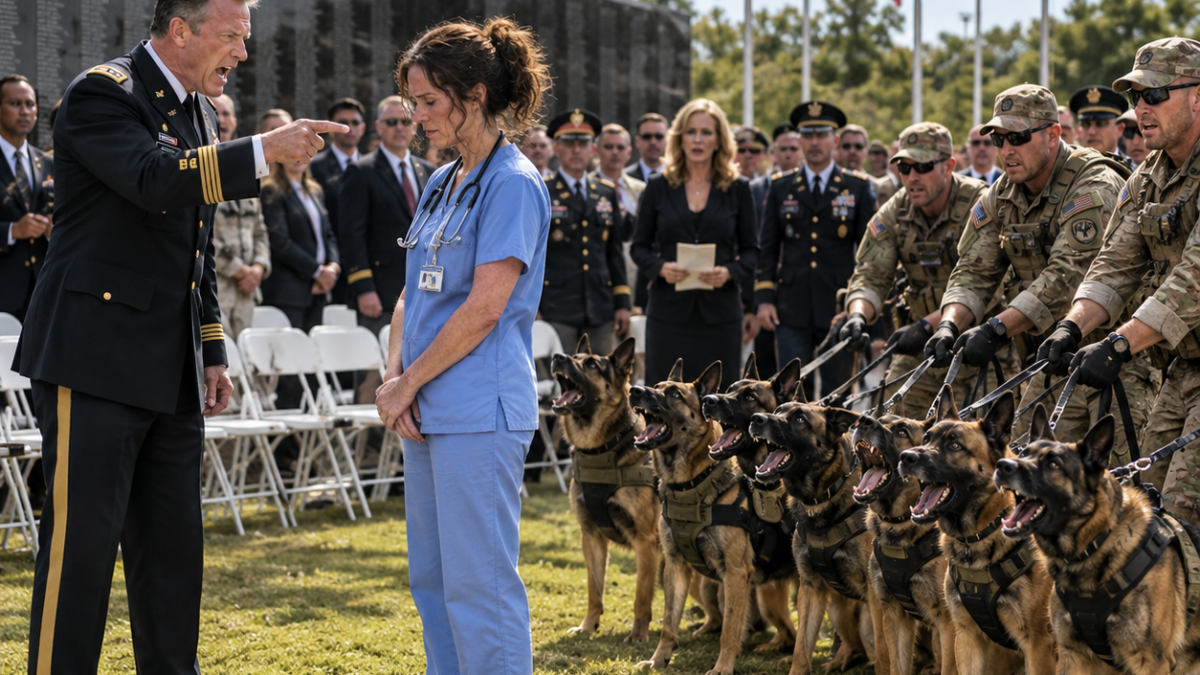
Rows of white folding chairs filled the memorial grounds. Families sat facing a polished granite wall draped in dark cloth. American flags lined the walkway. Dress uniform officers stood near the platform, their shoes bright, their faces composed into public sorrow.
Seven military working dogs waited in perfect formation beside their handlers.
German Shepherds.
Belgian Malinois.
Black tactical harnesses.
Polished memorial tags.
Each dog stood beneath a plaque bearing the name of a fallen handler.
Eliana stopped at the edge of the grounds.
The scene was beautiful.
Orderly.
Controlled.
Nothing like the mountain road.
Nothing like the ambulance tilted half into a ditch, its rear door jammed, the air thick with smoke and screaming. Nothing like Caleb Ellison pressing one hand against his bleeding side while using the other to hold Bishop’s collar. Nothing like Commander Locke’s voice cutting through the radio, telling everyone to withdraw while Eliana counted the living by sound because she could no longer see.
She nearly turned around.
Then Mara saw her.
From the front row, the older woman rose and lifted one hand.
Eliana took a step forward.
A security officer moved into her path.
“Ma’am,” he said, “this area is restricted.”
“I have an invitation.”
His eyes dropped to her scrubs.
“Medical staff are stationed near the south tent.”
“I’m not working.”
“Then I’ll need to see your credential.”
She opened her bag.
Before she found the envelope, a voice came from behind him.
“That won’t be necessary.”
Eliana went still.
Commander Adrian Locke walked toward them across the grass.
Time had treated him generously, as it often treated men who survived the worst parts of their decisions without being burned by them. His dark dress uniform fit perfectly. Rows of decorations crossed his chest. Silver had appeared at his temples, giving dignity to a face Eliana remembered lit by flames.
He looked older.
Not weaker.
Never weaker.
His expression remained professionally calm until his eyes reached the scar along her neck.
Recognition flickered.
Then fear.
Only for a heartbeat.
But she saw it.
“Eliana Cross,” he said quietly.
“Commander Locke.”
The security officer looked between them.
“You know her, sir?”
“Yes,” Locke said.
There was no warmth in it.
He stepped closer, lowering his voice so the nearby families would not hear.
“You should not be here.”
“Mara invited me.”
“This is not the place.”
“For what?”
“For reopening disputed events.”
“I haven’t said anything.”
“Your presence says enough.”
Eliana looked past him toward the memorial wall.
“Caleb’s name is being honored.”
“So are the others.”
“I know.”
“This day belongs to their families.”
“I didn’t come to take anything from them.”
“Then leave quietly.”
The words struck with the precision of a hand across the face.
Eliana stared at him for several seconds. She could have raised her voice. She could have told the security officer to ask Mara. She could have asked Locke, right there in front of the flags and the grieving mothers, why a man confident in his official report was still afraid of a nurse in dirty scrubs.
But the ceremony had already begun.
Mothers sat with photographs in their laps.
Children stared at plaques bearing names they barely remembered.
Old fathers held folded programs like they were holding their sons’ hands.
Eliana would not turn their grief into a battlefield.
She took the invitation from her bag and held it toward Mara as if returning something that had never truly belonged to her.
“I’m sorry,” she said.
Mara stood.
“No.”
Locke did not look at her.
“Escort her beyond the memorial boundary,” he told the security officer.
Several guests turned.
Then more.
Whispers began like insects in the grass.
“Who is she?”
“A nurse, I think.”
“Why is she dressed like that?”
“Maybe she wandered over from the clinic.”
“Look at her scars.”
Eliana heard every word.
Combat had taught her that hearing everything did not mean reacting to everything.
She kept her eyes forward.
The security officer gestured toward the path.
“Ma’am.”
She began walking.
Behind her, the military band faded. The master of ceremonies stepped toward the microphone. The seven dogs remained still beneath the flags, trained bodies holding perfect silence.
Eliana had almost reached the outer walkway when Mara called her name.
“Eliana.”
The security officer paused.
Locke’s jaw tightened.
“Continue,” he said.
Mara stepped into the aisle.
“You ordered her to leave without asking why I invited her.”
Locke turned with a practiced expression of sympathy.
“Mrs. Ellison, today should not become confrontational.”
“You already made it confrontational.”
The crowd shifted.
Mara held up Caleb’s letter.
“My son wrote her name.”
Locke’s face tightened.
“This ceremony is based on the official record.”
“My son was there.”
Locke lowered his voice again, but this time others were close enough to hear.
“Your son was critically wounded. Personal recollections written under combat stress are not always reliable.”
Mara’s face changed.
It was not anger at first.
It was disbelief, as if she had just watched a man step on her child’s grave and call it procedure.
Eliana stopped walking.
“Mara,” she said softly.
But Mara did not sit down.
“My son wrote what he saw.”
“Your son was a hero,” Locke said. “Do not let unresolved grief turn his sacrifice into accusation.”
That was when Eliana turned around.
The words had not been aimed at her, but she felt them enter her body like glass.
Unresolved grief.
As if Mara’s love were an illness.
As if Caleb’s final letter were a symptom.
As if mothers became unreliable when their children died.
Eliana’s voice was quiet, but it carried.
“I was there.”
The memorial grounds went still.
Locke’s eyes sharpened.
“You were a civilian medical contractor operating outside command authority.”
“I was the trauma nurse inside the ambulance your report said was empty.”
Someone gasped.
The security officer’s hand dropped from his radio.
Mara closed her fingers around the letter.
Locke took two steps toward Eliana.
His voice became cold.
“This is exactly why you were not authorized to attend.”
Eliana looked at him.
“I was invited by a grieving mother.”
“A grieving mother who does not understand operational context.”
Mara flinched.
Eliana saw it.
So did others.
A low murmur moved through the chairs.
The master of ceremonies leaned toward Locke, uncertain.
“Sir, the recorded tribute is ready.”
Locke nodded once, then looked at the security officer.
“Remove her.”
Eliana raised one hand.
“It’s all right.”
Mara shook her head.
“No.”
“I came because you asked.”
“You came because Caleb asked before he died.”
The sentence broke something small and carefully protected inside Eliana.
Not enough for tears.
Not yet.
But enough for Locke to see he had not won.
The security officer began guiding her away.
No one touched her.
They did not have to.
The humiliation was already public.
She passed families holding folded flags. Officers wearing ribbons. Guests who saw only a scarred nurse in blue scrubs interrupting an honorable ceremony. A woman in the second row whispered, “She should have known better.”
A man beside her muttered, “Some people use any tragedy for attention.”
Eliana continued walking.
Her scars felt suddenly exposed beneath the mountain sun.
At the platform, the master of ceremonies began.
“Lieutenant Caleb Ellison served with courage, loyalty, and unwavering devotion to the members of his unit.”
Caleb’s photograph appeared on a large screen beside the wall.
Young.
Smiling.
Alive.
He was laughing in the picture, one hand lifted as Bishop, then a young German Shepherd with oversized paws, tried to steal his cap.
Eliana stopped.
The speaker continued.
“His final recorded transmission has become a symbol of the sacrifice made during the Ashen Ridge evacuation.”
Locke turned toward the screen.
The dogs remained in formation.
The recording played through the loudspeakers.
Static.
Wind.
Distant gunfire.
Then Caleb’s voice, strained but unmistakable.
“Hold the line. I’m coming back.”
The world vanished.
Eliana closed her eyes.
Suddenly she was no longer standing on green grass beneath clean flags.
She was back inside the ambulance.
Smoke filled her lungs. Metal screamed as heat warped the frame. A wounded handler begged for water. A dog howled from the rear compartment. Caleb stood at the back hatch with blood soaking the side of his vest, refusing to leave even after she told him he was bleeding too heavily to stand.
“Hold the line,” he had shouted.
Not for cameras.
Not for history.
For the living.
“I’m coming back.”
He had said it each time he left the ambulance to guide another rescue team through smoke and rock and gunfire.
He had said it to the dogs when they panicked.
He had said it to Eliana when her left sleeve caught fire.
He had said it until his voice failed.
Eliana whispered without meaning to.
“You said that every time you left the tent.”
The nearest K9 lifted his head.
Bishop.
Older now. Larger. A black-and-tan German Shepherd standing beneath Caleb’s plaque, his muzzle graying around the edges, his memorial harness polished, his body trained to stillness.
His ears turned toward Eliana.
Chief Warrant Officer Jonah Cade looked down sharply.
“Bishop.”
The dog did not move.
Then the second dog raised her head.
Nix, a lean Belgian Malinois with intelligent amber eyes.
Then Ranger.
Echo.
Flint.
Vesper.
Atlas.
All seven dogs turned away from the memorial platform.
Every pair of eyes fixed on Eliana.
The handlers tightened their leashes.
Jonah frowned.
“Hold.”
Eliana opened her eyes.
Bishop took one step.
Jonah corrected him.
“Bishop, stay.”
The German Shepherd ignored him.
The first leash slipped from a handler’s grip.
Bishop ran.
A sharp gasp passed through the crowd.
“Dog loose!”
The security officer beside Eliana moved instinctively in front of her.
She stepped around him.
“Don’t.”
Bishop crossed the grass at full speed.
His handler shouted after him.
The dog never slowed.
Before he reached Eliana, two more leashes pulled free.
Nix and Echo bolted from formation.
Then Ranger.
Flint.
Vesper.
Atlas.
Seven military K9s raced across the memorial grounds.
Chairs scraped.
Families stood.
Security officers reached for radios.
Handlers shouted commands those dogs had obeyed through gunfire, aircraft noise, tactical exercises, fireworks, crowds, and chaos.
This time, not one responded.
Eliana remained still.
The dogs reached her in a wave of fur, harnesses, tags, and desperate sound.
Bishop stopped first.
He did not jump.
He did not bark.
He pressed his head against her scarred left forearm and let out a sound so low and broken that every person nearby felt it in their bones.
Nix circled behind Eliana and sat, close enough to block anyone approaching from the rear.
Echo lay across her feet.
Ranger leaned against her hip.
Flint lifted his nose toward the scar along her jaw and breathed in old antiseptic, cloth, smoke-memory, and skin.
Vesper whined.
Atlas, a huge sable shepherd with a scarred ear, sat directly in front of her and stared up as if waiting for the next command from a war that had never ended.
The entire formation settled around the scarred nurse.
No aggression.
No barking.
Only recognition.
Grief.
Memory.
Jonah Cade reached them seconds later, pale with disbelief.
“What did you do?” he asked.
Eliana lowered herself carefully among the dogs. Her knees trembled. Her voice did not.
“Easy.”
Bishop’s breathing slowed.
She rested one hand near his shoulder.
“Hold the line.”
Every dog became still.
The words moved through them like a command older than their current training.
Jonah stared.
“How do they know that phrase?”
Eliana looked toward the memorial harnesses. Small fabric pouches had been secured beside the name tags. Scent articles. Pieces of clothing. Old gloves. Field caps. Handler belongings preserved for the ceremony.
“They don’t know me,” she said softly. “Not all of them.”
“Then why did they come?”
She looked at Bishop.
“He remembers Caleb’s scent.”
Her eyes moved to the others.
“And they remember what their handlers felt when those words were spoken.”
Commander Locke approached from across the grass, his face drained of color.
“Get the dogs back into formation.”
No handler moved.
Jonah looked toward him.
“Sir, they have never broken like this.”
“Then regain control.”
Mara walked past Locke. She stopped beside Eliana and unfolded Caleb’s letter. Her hands shook. Her voice did not.
“My son wrote about a nurse.”
The crowd became silent again.
Mara began reading.
“Mom, if this reaches you, I need you to remember the woman in the ambulance. Her name is Eliana Cross. Command told us to withdraw. She stayed with the wounded. She held the dogs when the handlers could not. If I do not come home, do not let them say we were abandoned by everyone. She stayed.”
Eliana closed her eyes.
A sound escaped Bishop.
Mara continued.
“She keeps saying, ‘Hold the line. I’m coming back.’ I think some of us are still alive because we believe her.”
The letter lowered.
No one looked at Eliana’s scrubs anymore.
No one whispered about her scars.
Every face turned toward Commander Locke.
Mara looked directly at him.
“They remember the woman you erased.”
Locke’s jaw tightened.
“This ceremony cannot be hijacked by an unverified personal letter.”
Jonah stared at him.
“Seven military working dogs just broke formation for her.”
“That is not evidence.”
“No,” Mara said. “It is memory.”
Eliana slowly stood.
The dogs rose with her.
All seven remained close.
Jonah looked at the scar along her neck, then toward the memorial plaques.
“Who are you?”
Eliana glanced across the flags, polished shoes, decorated officers, grieving families, and the granite wall built on a version of events that had never included her.
Then she answered simply.
“I was the nurse inside the ambulance.”
The wind lifted the flags above them.
Commander Locke looked toward the exits.
For the first time that morning, the decorated officer appeared less like the man in command of the memorial and more like a man realizing that seven loyal witnesses had just brought the past running back across the grass.
For nearly a full minute, nobody moved.
The memorial had split open, and everyone present seemed afraid that if they breathed too loudly, the truth might disappear again.
Jonah Cade removed his cap slowly. He had trained military working dogs for almost twenty years. He had seen them ignore explosions, helicopters, screaming crowds, live-fire exercises, and handlers falling in mud. He had seen frightened young dogs become steady under pressure and steady old dogs refuse retirement because loyalty was the only language they understood.
But he had never seen anything like this.
Seven dogs had abandoned ceremonial formation not in panic, not in aggression, but in purpose.
They had not run from something.
They had run to someone.
“Bishop,” Jonah said again, softer this time.
The German Shepherd looked at him. His ears flicked. His body remained beside Eliana.
“Bishop, heel.”
Nothing.
Eliana looked down at the dog.
“You can go.”
Bishop did not move.
A small, stunned smile crossed Jonah’s face despite the tension around him.
“He’s not disobeying me,” Jonah said. “He believes he’s guarding you.”
Eliana shook her head.
“No. He thinks he’s guarding a promise.”
“What promise?”
Before she could answer, Mara unfolded another page of Caleb’s letter.
“There’s more.”
Locke stepped forward.
“Mrs. Ellison, this has gone far enough.”
She ignored him.
“My son wrote this three days before the convoy.”
“Mara,” Eliana whispered.
But Mara had spent eight years being managed, comforted, redirected, thanked for her sacrifice, and quietly told which questions were appropriate.
She was finished.
She began reading.
“Mom, there’s a civilian trauma nurse attached to us named Eliana Cross. Nobody outranks her medically because she doesn’t carry rank. She carries responsibility.”
Several veterans exchanged glances.
Mara continued.
“When everyone else panics, she doesn’t. The dogs settle when they hear her voice. She keeps telling them the same thing whenever handlers leave to pull someone from danger.”
Mara looked up.
“The words she whispered today.”
Eliana lowered her eyes.
Mara finished the sentence.
“Hold the line. I’m coming back.”
The crowd grew impossibly quiet.
A younger handler near Echo swallowed hard.
“My partner’s predecessor belonged to Lieutenant Brooks,” he said, pointing toward Echo. “Brooks wrote that phrase in his field journal.”
Another handler looked up.
“So did Staff Sergeant Ruiz.”
“And mine,” someone else whispered.
Jonah stared toward the memorial wall.
“The phrase spread through the unit.”
Eliana nodded.
“It wasn’t mine. It belonged to all of them.”
Locke cut in sharply.
“Memory is emotional. It is not evidence.”
Mara turned toward him.
“No. My son’s letter is.”
“A personal letter written under combat stress cannot overturn an official investigation.”
“No,” Jonah said quietly. “But it can tell us where to start looking.”
That was when Locke’s face changed.
Not much.
He was too practiced for collapse.
But Eliana saw the calculation return to his eyes. The same calculation she had seen eight years earlier when he stood outside a burning ambulance deciding what could be saved, what could be abandoned, and what the report would later say.
The memorial did not resume.
No one wanted music.
No one wanted prepared remarks.
Families remained seated, programs folded in their laps, eyes fixed on Eliana and the seven dogs around her. Some were crying. Some looked confused. Some looked angry in the slow, stunned way people look when they realize grief has been used to keep them obedient.
Jonah guided Eliana toward a shaded seating area beside the memorial garden.
The seven dogs followed calmly.
Their handlers walked beside them without attempting to force another formation.
For the first time in eight years, Eliana sat across from someone who seemed to want to hear what had happened, not manage the damage caused by hearing it.
Jonah sat in the chair opposite her, hat in his hands.
“I’ve read the official report,” he said. “It said your ambulance became disabled after the convoy withdrew. It said repeated radio failures prevented command from knowing survivors remained inside.”
Eliana looked toward the mountains beyond Fort Ashford.
“The report was not entirely false,” she said. “Only incomplete.”
Jonah waited.
“It was late afternoon. We had already crossed two mountain passes. We were transporting wounded handlers and three injured dogs from a forward staging area after the first strike. Caleb was in the rear vehicle. Locke was commanding the withdrawal.”
“Then the convoy was hit again?”
Eliana nodded.
“The lead vehicle took the first blast. Ours took the second. The windshield disappeared. Medical equipment caught fire. The driver died instantly. The rear axle collapsed into the ditch. One of the dogs was trapped beneath a bench seat. One handler had an arterial bleed. Another had shrapnel in his chest. Caleb was wounded, but mobile.”
Mara sat beside her, both hands gripping Caleb’s letter.
Eliana’s voice stayed even.
That was how she had survived telling it in pieces to herself for years.
“Commander Locke radioed that another strike was expected. He ordered immediate withdrawal to the extraction zone.”
Jonah’s jaw tightened.
“You disagreed.”
“I requested six minutes.”
“For what?”
“To stabilize the patients enough to survive movement.”
“And he refused.”
“He said anyone left behind would become unrecoverable.”
Eliana did not look at Locke, but she felt him standing somewhere behind the circle of listeners.
Mara’s voice broke softly.
“My Caleb wouldn’t leave.”
Eliana’s mouth trembled at the edge.
“He argued with me.”
“About what?”
“I told him he was bleeding too heavily to move. He told me commanders were supposed to argue with medics.”
Mara laughed through tears.
“That sounds like him.”
Eliana looked down at her hands.
“He kept going back. He guided two rescue teams through the smoke. He carried Bishop out once, and Bishop went right back inside because another handler was still trapped. The dogs were terrified, but they wouldn’t leave their people. None of them would.”
Her fingers unconsciously touched the scar along her jaw.
“The ambulance ceiling collapsed. I crawled back in. The fuel ignited. I remember Caleb shouting my name. I remember someone throwing blankets over the flames. I remember dragging Ruiz by his vest and thinking his boots were too heavy. Then I woke up three days later in a field hospital.”
Jonah’s eyes moved to her scars.
“The burns.”
She nodded.
“The report blamed delayed evacuation.”
“It never mentioned why you stayed.”
“It said I delayed movement.”
Mara closed Caleb’s letter.
“It never said you were carrying my son.”
Eliana’s composure wavered.
Only for a second.
But Jonah saw it.
So did Mara.
So did Bishop, who pressed his head into her thigh until she placed a hand on him.
Across the memorial grounds, Commander Locke stood near the platform speaking quietly with two senior officers. Every few moments, he glanced toward Eliana, toward the dogs, toward the families gathering around the shaded area.
His confidence had begun to fracture.
Not because he felt guilt.
Guilt had had eight years to find him.
It had not.
No, Locke feared exposure.
There was a difference.
Jonah stood.
“If the report was incomplete, we find the record.”
Locke turned sharply.
“Chief Warrant Officer Cade, you are not authorized to open a closed operational review in the middle of a memorial ceremony.”
Jonah faced him.
“Then authorize me.”
Locke’s eyes narrowed.
“That is not how command structure works.”
“No,” Jonah said. “This is how conscience works.”
A murmur moved through the families.
Locke stepped closer, lowering his voice.
“You are emotional because of the dogs.”
Jonah looked at Bishop, then at the other six K9s, still settled calmly around Eliana.
“No, sir. I’m attentive because of them.”
Within thirty minutes, Jonah led Eliana, Mara, two senior officers, and the Fort Ashford historical archivist toward the records building overlooking the memorial grounds. Locke followed because not following would have looked worse.
The archive was cool and silent, filled with sealed boxes, binders, digital terminals, and the faint smell of dust and old paper.
An elderly archivist named Mrs. Hanley greeted them from behind a desk.
“Chief Cade?”
“I need the complete Ashen Ridge evacuation file.”
Her expression tightened.
“That collection is restricted.”
“Request authorization.”
Locke stepped forward.
“No authorization is being granted today.”
A senior officer beside him cleared his throat. Colonel Mason was older than Locke, broad-shouldered, with a face weathered by years of field command.
“Commander Locke, given what occurred at the memorial, I am granting temporary review access.”
Locke’s mouth tightened.
“That is highly irregular.”
“So is seven K9s breaking formation for a witness not named in the report.”
Mrs. Hanley hesitated only a moment before unlocking a secure cabinet.
Three thick binders emerged.
Operational timeline.
Casualty list.
Witness statements.
Jonah opened the first binder.
Commander Adrian Locke’s statement was complete. Detailed. Cleanly typed. Commendation attached.
The second contained vehicle damage assessments, flight paths, medical evacuation summaries, and communications logs.
The third held witness statements.
Jonah turned pages slowly.
Handlers.
Pilots.
Medics.
Security personnel.
Then he reached the civilian medical section.
One page.
Half empty.
Name: Cross, Eliana.
Status: Civilian contractor.
Additional statement: unavailable.
Jonah frowned.
“Unavailable?”
Eliana looked over his shoulder.
“I submitted forty-two pages.”
Mrs. Hanley blinked.
“Forty-two?”
“My full medical timeline. Triage notes. Treatment records. Radio times. Patient movement. Casualty status. The names of everyone alive when Locke withdrew support.”
Mara covered her mouth.
Mrs. Hanley moved to the digital terminal. Her fingers flew over the keyboard. She searched the archive index once. Then again.
“There should be attachments,” she said. “Appendices A through H.”
Jonah leaned over the binder.
“They’re referenced?”
“Yes.” She turned the page, her face paling. “But they’re not here.”
Mara whispered, “Someone removed them.”
Mrs. Hanley looked genuinely disturbed.
“I’ve worked in military records for nineteen years. I have never seen a casualty file missing primary evidence without notation.”
Eliana stood very still.
For eight years, she had believed her testimony had been ignored.
Now she understood something worse.
It had been removed.
Not because it was irrelevant.
Because someone had decided it was dangerous.
Jonah turned another page, and a folded inventory sheet slipped out from between documents.
He picked it up carefully.
Not a report.
A transfer authorization.
Eight years old.
Supplemental evidence removed from archive for command review.
Authorized by: Commander Adrian Locke.
The room went silent.
Mara looked at Locke.
“You took her statement.”
Locke’s face remained controlled, but color had drained from his skin.
“I was tasked with consolidating contradictory materials.”
“Contradictory,” Eliana repeated.
He looked at her.
“You were badly injured. Your recollection—”
“My handwriting was steady enough to record eight vital signs while the ambulance burned.”
No one spoke.
Eliana took one step toward him.
“Do not insult me by calling my memory weak when what you feared was my accuracy.”
Colonel Mason lifted the authorization sheet.
“Commander Locke, where are the appendices?”
“I don’t recall.”
Mara laughed once, sharp and bitter.
“For eight years, every detail of my son’s death was clear enough for speeches. Now you don’t recall?”
Locke’s jaw flexed.
“This is becoming inappropriate.”
“No,” Eliana said. “This is becoming documented.”
Jonah turned to Mrs. Hanley.
“Where would physical evidence from the operation have been stored?”
She checked the database.
“Personal effects were transferred to the Military Working Dog Division before being returned to families. Some items were retained for memorial use.”
Jonah’s eyes narrowed.
“The harnesses.”
Outside, under the memorial trees, the seven K9s waited beside their handlers. Families had gathered in clusters, no longer pretending this was an ordinary ceremony delayed by logistics. The truth had weight now. Everyone could feel it, even without knowing its shape.
Jonah approached Bishop first.
The German Shepherd stood and greeted him, then immediately returned to Eliana’s side.
“I’m sorry,” Jonah said quietly.
Eliana looked at him.
“For what?”
“For almost treating you like someone who didn’t belong here.”
Eliana’s smile was sad.
“You treated me the way the paperwork described me.”
He removed Bishop’s ceremonial harness.
Each memorial harness contained a sealed compartment holding an approved scent article from the fallen handler it represented. Most held a glove, a cloth patch, a field cap, a scarf, something that carried enough memory for the dogs to honor the person behind the plaque.
When Jonah reached Bishop’s compartment, he paused.
“This is heavier than it should be.”
Mara’s hand tightened around Eliana’s arm.
Jonah opened it carefully.
Inside lay Caleb Ellison’s identification tags.
Beneath them was a waterproof memory card wrapped in medical tape.
For a moment, no one understood what they were seeing.
Then Eliana closed her eyes.
“Caleb,” she whispered.
Mara’s breath caught.
“What is it?”
Eliana opened her eyes.
“Your son never trusted one copy of anything.”
Jonah looked at her.
“He carried backups?”
“Always. Radio logs. helmet camera fragments when he could get them. Medical transfer notes. If a report mattered, Caleb believed it should survive more than one filing cabinet.”
Locke stepped forward.
“That is private property and potentially classified operational material.”
Jonah closed his hand around the card.
“Then we will secure it properly.”
“You do not have authority to—”
Colonel Mason cut him off.
“I do.”
The memory card was placed into an evidence sleeve. Within an hour, military investigators arrived from the base legal office. The memorial remained suspended. Families waited beneath the trees, refusing to leave, as if departure itself might allow the truth to be buried again.
Eliana sat on a bench with Bishop’s head in her lap.
Mara sat beside her, silent now, both hands folded around Caleb’s letter.
“You knew him better than I realized,” Mara said.
“No,” Eliana said softly. “I knew who he was under pressure. That isn’t the same as knowing a son.”
Mara looked at her.
“It might be more than some mothers get.”
Eliana had no answer to that.
At 2:47 p.m., Jonah returned.
His face told them before his mouth did.
Mara stood.
“What did they find?”
Jonah removed his cap.
“Radio transmissions. GPS timestamps. Medical status reports. Helmet audio. Not all of it survived, but enough did.”
Eliana’s hand froze on Bishop’s head.
Jonah looked toward the memorial platform, where Locke stood apart from everyone.
“The recovered communication log proves Commander Locke received your requests for additional evacuation time. Seven transmissions. He acknowledged each one.”
Mara swayed.
Eliana rose quickly, catching her elbow.
Mara looked at Locke.
“He knew?”
Jonah’s voice lowered.
“He knew living wounded remained inside the ambulance.”
Mara’s eyes filled with tears that looked nothing like weakness.
“And he still left.”
Eliana said nothing.
Because the truth was not new to her.
Only proven.
That difference mattered to everyone else.
To her, it felt like an old wound being photographed and called evidence.
Investigators played the recovered audio first for Colonel Mason and legal personnel, then privately for the immediate families who requested to hear it.
Mara asked.
Eliana warned her.
“It is not easy.”
“My son did not die easily,” Mara said. “I will not remember him comfortably because others prefer it.”
So they sat in a small conference room off the memorial hall while Jonah placed headphones gently over Mara’s ears.
Eliana sat beside her.
The audio began with static.
Then Caleb’s voice.
“Bishop, stay low. Stay with me.”
Gunfire cracked in the background.
Eliana heard her own voice next.
Calm.
Younger.
Tight with smoke.
“I have four living casualties. Handler Ruiz has a femoral bleed controlled by tourniquet. Brooks is conscious. Ellison is mobile but bleeding. Three dogs injured. I need six minutes before movement.”
Locke’s voice came through.
“Negative. No additional delay authorized. Withdraw immediately.”
Eliana again.
“I still have living casualties.”
Locke.
“Convoy continues.”
Then Caleb, faint but clear.
“Sir, she’s got them breathing. Give us the six.”
Locke’s reply.
“Denied. Move to extraction or be left.”
Mara covered her mouth.
The recording continued.
Eliana’s voice again.
“Command, be advised, I am remaining with wounded personnel.”
Locke answered.
“Civilian contractor is outside command authority. Convoy continues.”
Mara pulled the headphones off.
She bent forward, one hand pressed to her chest, but she did not sob.
Not yet.
She looked at Eliana.
“He called for six minutes.”
“Yes.”
“You asked for six minutes.”
“Yes.”
“And the report said communications failed.”
“Yes.”
Mara closed her eyes.
“All these years, I thanked that man.”
Eliana sat beside her, saying nothing.
There are moments when comfort becomes disrespectful because pain deserves the whole room.
Outside, the ceremony space had changed.
Guests no longer sat neatly in rows. Families gathered around one another. Handlers knelt beside dogs. Veterans spoke in low voices, comparing memories, fragments, old journal entries, things they had dismissed because the official report had felt too final to challenge.
Commander Locke attempted to restart the program.
He walked to the microphone, face composed again, uniform immaculate.
“We owe it to the fallen to complete today’s ceremony.”
Mara walked out of the conference room holding Caleb’s letter.
“No.”
Every head turned.
She moved down the aisle slowly, not because she was weak, but because she wanted every person to see her coming.
“We owe the fallen the truth first.”
One by one, others stood beside her.
The widow of Staff Sergeant Ruiz.
The father of Lieutenant Brooks.
The younger brother of a medic killed during the convoy.
A former handler whose dog had survived Ashen Ridge but had never stopped sleeping beside the front door afterward.
No one returned to their seats.
Jonah removed his cap.
“I recommend suspending today’s ceremony pending formal review.”
Locke stared at him.
“On what authority?”
“On my responsibility to the handlers these dogs represent.”
The seven K9s remained around Eliana.
None returned to the platform.
None needed commands.
The symbolism was impossible to miss.
An elderly veteran near the front said quietly, “They’re standing with the person who stayed.”
The phrase moved through the crowd.
The person who stayed.
Not the contractor.
Not the scarred woman.
Not the interruption.
The person who stayed.
Three weeks later, Fort Ashford convened a formal command review.
This time, the room was not polished for public grief. It was plain, windowless, and bright enough to make lies uncomfortable. There were no speeches, no flags arranged for photographs, no band, no ceremonial music.
Only investigators.
Witnesses.
Documents.
Recordings.
And a row of families who had waited eight years for someone to stop calling their questions inappropriate.
Eliana almost declined to testify.
Mara came to her apartment the night before with two cups of coffee and no patience.
“They already heard his version,” Mara said. “It’s finally your turn.”
Eliana stood by the window overlooking the empty street.
“What if it doesn’t change anything?”
Mara set the coffee down.
“Eliana, look at me.”
She did.
“My son is dead. Nothing changes that. The others are dead. Nothing changes that either. But truth changes how the living carry them.”
Eliana looked toward the mantel, where she had placed the invitation after the memorial. She had not meant to keep it. She had tried twice to throw it away.
She couldn’t.
The next morning, she wore the black dress.
Not because the Army requested formal attire.
Because she was tired of hiding from rooms.
Her scars were visible.
Let them be visible.
Commander Locke entered the hearing in full dress uniform. His medals reflected the overhead lights. His face looked calm, but Eliana saw the tightness around his mouth, the sleepless shadows beneath his eyes.
Men like Locke spent their lives believing presentation could outrun truth.
Sometimes it did.
For a while.
When questioned, he defended his decision.
“I believed additional strikes were imminent,” he said. “My duty was to preserve remaining personnel.”
A review officer nodded.
“When Nurse Cross requested six additional minutes, you denied her.”
“I judged further delay unacceptable.”
“You acknowledged her reports that multiple wounded personnel remained alive.”
“Yes, but under the circumstances—”
“You understood rescue aircraft were redirecting.”
“Yes.”
“You understood at least three military working dogs remained with those casualties.”
“Yes.”
The room remained silent.
The investigator looked down at the transcript.
“So your official report stating communications had failed was inaccurate.”
Locke hesitated.
“It reflected the situation as I understood it later.”
The investigator slid a document across the table.
“The archive transfer authorization. Did you order the removal of Nurse Cross’s supplemental testimony?”
Locke looked at the signature.
His own hand.
Eight years younger.
Just as arrogant.
“Yes.”
“Why?”
He remained silent.
The investigator asked again.
“Why?”
Finally, Locke answered.
“Because contradictory accounts would have delayed closure for the families.”
The words landed badly.
Even before Eliana spoke, everyone knew it.
She looked at him steadily.
“No,” she said. “They would have delayed your promotion.”
For the first time that day, Locke had no response.
The review continued for hours.
Eliana testified last.
She did not dramatize. She did not accuse beyond what she could prove. She gave times, injuries, names, interventions. She described the wounded not as symbols, but as people.
Ruiz asked about his daughter while she packed the wound in his thigh.
Brooks kept apologizing because his dog was trapped and he could not reach her.
Caleb made jokes until he no longer had enough breath to finish them.
The dogs would not abandon their handlers.
The smoke grew black.
The radio stayed active.
She requested six minutes.
She stayed.
When the investigator asked why, Eliana looked down at her hands.
“Because they were alive.”
No one interrupted.
“Because if a person is alive, they are not a statistic yet. They are not a sacrifice yet. They are not a sentence in a report. They are a patient. And if they are my patient, I do not leave them because leaving is easier to explain.”
Mara began crying silently.
So did the widow of Staff Sergeant Ruiz.
Eliana looked at Locke only once.
“You called it operational context. I called it four men breathing in front of me.”
The review concluded with unanimous recommendations.
The Ashen Ridge after-action report would be corrected.
Eliana Cross’s full testimony would be restored.
Commander Locke’s commendation related to the evacuation would be withdrawn pending administrative action.
A secondary investigation would examine suppression of evidence, false statements, and retaliation against civilian medical personnel.
The memorial dedication would be postponed until the record could be amended.
Reporters waited outside.
Eliana avoided most of them.
One caught her near the side exit.
“Miss Cross, do you feel vindicated?”
She stopped.
The question was not cruel, only small.
“Vindicated?” she repeated.
The reporter nodded.
Eliana thought of Caleb’s voice in the recording. Bishop running across the grass. Mara folding and unfolding the same letter until grief turned paper soft. Seven dogs surrounding her because memory had succeeded where command had failed.
“No,” she said. “This was never about winning.”
“Then what was it about?”
Eliana looked toward the mountains.
“Remembering honestly.”
Six months later, Fort Ashford invited the families back beneath clear autumn skies.
This time, the invitation addressed her differently.
Eliana Cross, Trauma Nurse.
She stared at that line for a long time.
It was not a rank.
It was not a medal.
It was enough.
The memorial wall looked different now.
The names of the fallen handlers remained exactly where they belonged. No honor had been removed from them by adding truth around them. That was something Eliana wished more people understood. Truth did not diminish sacrifice. It protected it from being used.
Beneath the names, a new inscription had been carved into polished granite.
For those who remained beside the wounded when duty demanded courage beyond recognition.
Below it appeared several names omitted from the original dedication.
Medics.
Drivers.
A rescue pilot.
And one civilian trauma nurse.
Eliana Cross.
No grand title.
No decoration.
No speech beneath her name.
Just the truth, carved deeply enough that weather would have to work hard to erase it.
She almost did not go.
Not because she was afraid this time.
Because she was tired.
Healing was exhausting. Public attention had worn her down. Strangers sent letters. Some called her a hero. Some called her a liar. Some wanted interviews. Some wanted to turn her scars into inspiration clean enough for morning television.
She ignored most of it.
She kept working at the clinic.
Dogs still needed hips checked. Veterans still needed medication refills. Russ Calder still lied about his shoulder pain until Major ratted him out by refusing to get in the truck. Ghost still waited for a dead handler at every door.
Life did not become simple because truth arrived.
But it became lighter in places.
Mara arrived at Eliana’s apartment the morning of the ceremony carrying a garment bag.
“No,” Eliana said before she opened it.
“You haven’t seen it.”
“I know what garment bags mean.”
“It isn’t a dress uniform.”
“I don’t wear uniforms.”
“It isn’t that either.”
Eliana sighed and unzipped the bag.
Inside was a deep navy jacket, simple, beautifully tailored, with no medals, no ribbons, no decoration except a small embroidered line inside the collar.
Hold the line.
Eliana touched it.
Mara looked away quickly, pretending to inspect the kitchen cabinets.
“Caleb’s sister had it made.”
Eliana swallowed.
“I can’t accept this.”
“You can.”
“Mara.”
“Eliana.”
The older woman’s voice softened.
“My son spent his last letter making sure I knew your name. Let us give you something with yours still on it.”
Eliana wore the jacket.
At Fort Ashford, nobody stopped her at the boundary.
The same security officer from the first memorial stood near the path. When he saw her, his face reddened.
“Miss Cross,” he said.
She paused.
“I owe you an apology.”
She looked at him for a moment.
He seemed younger now. Or maybe shame had stripped away the false certainty.
“You were following orders,” she said.
“I still owe you one.”
She accepted that with a nod.
People turned as she walked across the grass.
Not with whispers this time.
With recognition.
That felt almost harder.
Mara waited in the front row.
Jonah stood near the memorial walkway with the seven handlers.
And the dogs.
Bishop saw her first.
His ears lifted.
Jonah looked down and smiled.
“There won’t be a rigid formation today,” he said when she reached him.
Eliana glanced at the dogs.
“I noticed.”
Instead of standing in perfect alignment, the handlers gathered naturally with the families. The dogs waited calmly, harnesses polished but leashes loose.
When Eliana stepped onto the memorial walkway, Bishop rose.
Not running this time.
Walking.
Nix followed.
Then Ranger.
Echo.
Flint.
Vesper.
Atlas.
The seven dogs surrounded her once more.
Not because commands failed.
Because no commands were given.
A soft sound moved through the crowd. Not shock this time. Something gentler. Something like recognition returning without needing proof.
Jonah looked toward the families.
“I think they’ve made their decision.”
Mara stepped forward carrying Caleb’s final letter.
“I’ve read this enough times,” she said.
Eliana shook her head.
“Mara, no.”
“Yes.”
She placed the folded pages into Eliana’s hands.
“I think it belongs to you now.”
Eliana held the letter carefully.
The paper was worn from grief, softened at the creases, marked in places by fingers that had returned to certain lines again and again.
She unfolded it.
Near the bottom, beneath the paragraph Mara had read at the first memorial, was a sentence Eliana had never heard.
If I don’t make it home, tell Eliana she kept her promise. She held the line until we came back.
The words blurred.
For years, Eliana had carried guilt heavier than the scars along her neck and arm.
She had wondered whether staying had mattered enough. Whether six minutes had changed anything. Whether the living she pulled from the fire outweighed the dead she could not save. Whether surviving made her responsible for every name carved into stone.
She looked around the memorial.
At Mara.
At the families.
At Jonah and the handlers.
At the corrected wall.
At the seven dogs sitting peacefully beside her like the past had finally stopped running.
Those six minutes had not saved everyone.
But they had saved enough for the truth to survive.
The ceremony began quietly.
No one tried to make grief behave this time.
Colonel Mason spoke first, not with the polished rhythm of prepared military theater, but with the careful humility of a man standing in a room with people he knew had been failed.
“Today we honor not only the courage of the fallen, but the truth of their final moments. Honor cannot exist without truth. Memory cannot heal when built on omission. And no institution, no matter how proud, is made weaker by admitting where it failed. It is made weaker only when it refuses.”
Mara read Caleb’s name.
Her voice broke, but she did not stop.
Other families came forward.
Some brought photographs.
One brought a leash.
Another brought a child too young to remember his father but old enough to press his hand against the granite and ask if Daddy could see him.
Eliana stood near the wall, silent.
Bishop leaned against her leg.
When her name was called, she did not move at first.
“Eliana,” Mara whispered.
She stepped forward.
The crowd rose.
She wished they hadn’t.
The standing made it feel too much like praise, and praise had always made her uneasy. Praise simplified things. It rounded sharp edges. It turned blood into symbolism.
But then she saw Russ Calder standing near the back with Major beside him. Naomi from the clinic. Mrs. Hanley from the archive. The young security officer. Officer families. Veterans. Widows. Children.
They were not standing for a legend.
They were standing because, for once, the right person had not been left outside the boundary.
Eliana reached the microphone.
For several seconds, she said nothing.
The wind moved gently through the flags.
Seven dogs sat at her feet.
She looked at the wall, not the crowd.
“I used to think memorials were for the dead,” she began.
Her voice was soft, but the microphone carried it.
“I avoided them because I thought I had no right to stand in places where families carried losses I could not repair. I thought my job was to save who I could, bury what I couldn’t, and keep working.”
She touched Caleb’s letter.
“But I was wrong. Memorials are also for the living. They tell us what kind of truth we are willing to carry forward.”
Mara lowered her head.
Eliana continued.
“The people whose names are carved here were not perfect symbols. They were human beings. They were tired. Afraid. Brave. Stubborn. Funny at inappropriate times. Loyal beyond reason. Some were handlers who refused to leave their dogs. Some were dogs who refused to leave their handlers. Some were wounded and still trying to help someone else breathe.”
Her voice trembled then, but did not break.
“They deserved more than clean language. They deserved the truth.”
She looked toward the younger soldiers standing along the edge of the crowd.
“If you serve, in any uniform, remember this. Courage is not the absence of fear. It is not obedience without thought. It is not a medal or a speech or a report written after smoke clears. Courage is knowing someone still needs you and refusing to let fear make the decision for you.”
She looked down at Bishop.
His eyes were on her.
“Sometimes holding the line means fighting. Sometimes it means staying with the wounded. Sometimes it means telling the truth after everyone has begged you to stay quiet.”
She stepped back from the microphone.
The applause did not come immediately.
For a moment, there was only silence.
Then Mara began clapping.
One pair of hands.
Then Jonah.
Then the handlers.
Then the families.
Then everyone.
Eliana closed her eyes.
Bishop pressed his head against her hand.
After the ceremony, a young military nurse approached hesitantly. She could not have been more than twenty-four, with her hair pinned too tightly and fear hidden beneath ambition.
“Miss Cross?”
Eliana turned.
“Yes.”
“I start trauma training next month,” the young woman said. “I’ve heard about what happened. I just wanted to say…” She hesitated, embarrassed by her own emotion. “I hope if I’m ever in that kind of situation, I’ll have your courage.”
Eliana studied her.
She saw the young woman’s polished shoes, her nervous hands, her bright eyes, her whole life still full of ideas about what bravery might look like when called upon.
“Courage isn’t refusing to be afraid,” Eliana said.
The young nurse listened.
“It’s refusing to leave someone behind because you are.”
The young woman’s eyes filled.
She nodded once, as if accepting an order.
As the crowd slowly dispersed, Mara remained beside the wall. She pressed her fingers against Caleb’s name.
Eliana stood a few feet away, giving her privacy.
After a while, Mara said, “For eight years, I thought his last words were only about the mission.”
“Hold the line?”
Mara nodded.
Eliana looked toward the mountains.
“I think they were about coming home.”
Mara turned to her.
“He didn’t come home.”
Eliana stepped closer.
“No. But his truth did.”
Mara covered her mouth.
This time, when she cried, Eliana held her.
Not like a nurse comforting a family member.
Like two women who had both been carrying different pieces of the same unbearable day and had finally set them down in the same place.
The seven dogs remained beside them until the last family departed.
No handler called them away.
No one rushed them.
Years earlier, those dogs and the dogs before them had been unable to bring their handlers home. Today, in their own quiet way, they had brought back something else.
The truth.
And with it, the name of the scarred nurse who had held the line long after everyone believed her story had been forgotten.
At sunset, Eliana stood alone before the granite wall.
The crowd was gone. The chairs had been folded. The flags still moved in the soft mountain wind. The air smelled of cut grass, stone, and distant rain.
Bishop sat beside her.
He was old now. His muzzle was almost fully gray. His hips were stiff. His working years were behind him. But when Eliana looked down, she saw Caleb’s partner still guarding a promise made in smoke.
“You can rest,” she whispered.
Bishop leaned into her leg.
Maybe he understood.
Maybe he didn’t.
Maybe dogs understood the parts of grief humans kept making too complicated.
Jonah approached quietly.
“He’s retiring after today,” he said.
Eliana looked at Bishop.
“Good.”
“He needs a placement.”
She glanced at Jonah.
His expression was too innocent.
“No.”
“I didn’t ask anything.”
“You were about to.”
“He already chose you once.”
“I run a clinic. I work long hours. My apartment is too small.”
Bishop placed one paw on her shoe.
Jonah looked down.
Eliana sighed.
“That is manipulation.”
“That is a military working dog making an informed decision.”
She looked at Bishop, then at the wall, then at the fading sky.
For eight years, she had tried to live as if the past could be contained. Locked away. Managed. Reduced to scars and nightmares and careful avoidance.
But maybe healing did not mean leaving the past behind.
Maybe healing meant letting the right parts follow you home.
Two weeks later, Bishop slept on a blue rug beside Eliana’s kitchen table, snoring loud enough to rattle the heater.
The Fort Ashford invitation, the first one, remained in a drawer.
Caleb’s letter sat in a frame on the wall, not because Eliana wanted visitors to read it, but because some promises deserved light.
Her life did not become easy.
Some nights, she still woke smelling smoke.
Some mornings, her scars pulled tight before rain.
Some days, a sudden sound sent her back to the ambulance, and she had to grip the edge of a counter until the present returned.
But now, when she came home from the clinic, Bishop was there.
When she sat at the kitchen table, he rested his head on her knee.
When she passed the framed letter, she no longer looked away.
Months later, the corrected Ashen Ridge report became required reading in a training course on battlefield medical ethics and command accountability. Eliana hated that phrase when she first heard it. Command accountability sounded too clean for what had happened.
But then Naomi printed the course introduction and brought it to the clinic.
At the bottom was a quote from Eliana’s testimony.
If a person is alive, they are not a statistic yet.
She stared at the line for a long time.
Then she folded the paper and placed it in the drawer beside the invitation.
Not every truth needed to be displayed.
Some simply needed to exist where no one could erase it.
On the anniversary of the corrected memorial, Mara came to Eliana’s apartment for dinner. She brought cornbread, flowers, and a small toy for Bishop, who accepted it with the solemn dignity of a retired veteran receiving official equipment.
They ate soup at the kitchen table.
For the first time in years, Eliana did not stand over the sink.
Mara looked around the apartment.
“It feels different in here.”
Eliana raised an eyebrow.
“Cleaner?”
“No.” Mara smiled. “Less like a waiting room.”
Eliana looked at Bishop asleep by the heater.
“I suppose I stopped waiting to disappear.”
Mara reached across the table and took her hand.
The scars on Eliana’s fingers were pale now beneath the kitchen light.
“You never disappeared,” Mara said. “They just stopped looking.”
Eliana squeezed her hand gently.
Outside, rain began tapping against the window.
Inside, the old dog slept.
The letter held its place on the wall.
And Eliana Cross, scarred nurse, civilian contractor, trauma witness, quiet hero, finally understood that she had not spent eight years trapped in the moment everyone left.
She had spent eight years holding the line.
And at last, the truth had come back.








