A Rookie Nurse Stepped Between a Gun and a Snarling Police K9—Then She Whispered the Command He Hadn’t Heard Since His Handler Died
PART3:
On the stretcher lay a police officer.
Dark uniform cut partly open.
Chest soaked.
Abdomen darker.
Face white.
One gloved paramedic pressed hard against a wound below the ballistic vest.
The portable monitor screamed numbers that were becoming worse by the second.
“Officer David O’Connor, thirty-seven,” John shouted. “Two penetrating wounds. One lower thorax, one abdomen. Possible femoral involvement. Lost consciousness twice en route. Couldn’t get a second line.”
Dr. Aerys stepped toward the gurney.
“Why the hell not?”
John’s answer was not verbal.
His eyes moved.
So did ours.
To the dog.
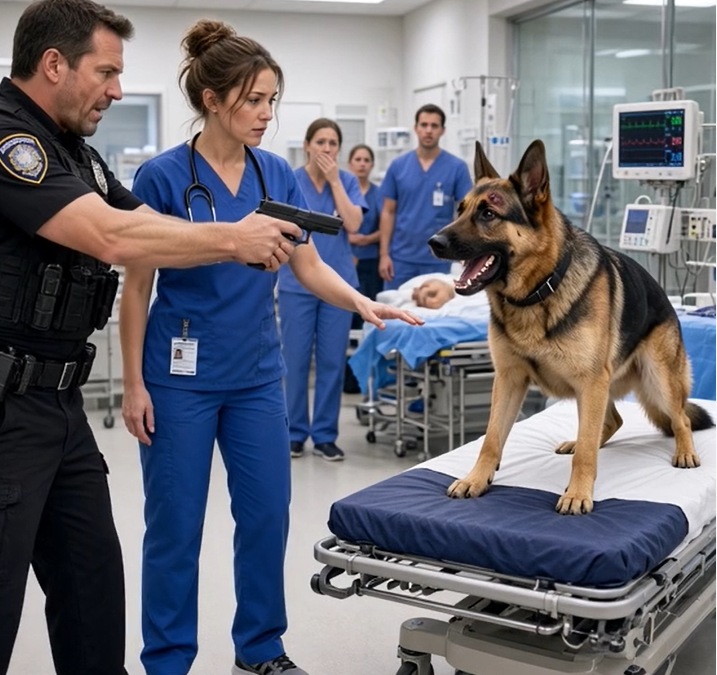
A sable German Shepherd crouched across Officer O’Connor’s lower body.
Massive.
Maybe eighty pounds.
Blood darkened the fur along his front legs and chest.
His claws dug into the stretcher pad.
His ears were pinned flat.
His lips curled away from white teeth.
And from somewhere beneath those ribs came a growl so deep I could feel it through the soles of my shoes.
Nobody moved for half a second.
Half a second is a long time when somebody is bleeding to death.
John said:
“We couldn’t separate them.”
Dr. Aerys stared.
“You brought the dog into my trauma bay?”
“He wouldn’t leave.”
“You should’ve called K9 backup.”
“We did.”
“And?”
“Officer’s partner is twenty minutes out.”
“He doesn’t have twenty minutes.”
O’Connor’s body jerked with a shallow breath.
The monitor displayed 142.
Blood pressure barely obtainable.
Dr. Aerys lifted one hand.
“Everybody stay calm.”
He moved slowly toward the gurney.
The dog’s head snapped around.
“Easy.”
Aerys took another step.
The dog lunged.
Jaws closed around the surgeon’s sleeve.
Fabric ripped.
Aerys pulled back so violently he hit the instrument cart.
Metal crashed.
Sarah shouted:
“Nobody approach!”
The dog released instantly.
No pursuit.
No second bite.
He returned to his place over O’Connor.
That should have told us something.
He was not hunting.
He was guarding.
But at that moment nobody cared about behavioral distinctions.
A man was dying.
A working dog was preventing treatment.
Dr. Aerys looked at the torn sleeve.
No broken skin.
“Get security.”
Sarah was already calling.
John remained near the door.
“He let us move O’Connor.”
“Why?”
“He followed when we loaded him.”
Miller added:
“Every time we touched the officer, the dog reacted.”
“What’s his name?”
“Bruno.”
The name hit somewhere inside me.
Not hard enough yet.
Just enough to make me look again.
Bruno.
Common police-dog name.
Could be coincidence.
Chicago had dozens of K9s.
Hundreds over the years.
Then the dog lifted his head toward the ambulance-bay doors.
The overhead trauma light struck the right side of his muzzle.
I saw the scar.
Jagged.
Pale.
Running diagonally from beside the nose toward the cheek.
The room disappeared.
I was no longer in Chicago Memorial.
I was twenty-two.
Standing in our apartment kitchen.
My brother Matthew leaning against the counter in uniform.
A younger German Shepherd sitting beside him with a fresh row of stitches across his muzzle.
I had screamed:
“What happened?”
Matthew had laughed.
“You should see the fence.”
“Matthew!”
“Suspect ran through a vacant lot.”
“And Bruno?”
“Forgot barbed wire exists.”
The dog had sneezed.
Matthew scratched behind his ear.
“Still caught the guy.”
I stared at Trauma Bay One.
Same scar.
Same amber eyes.
Older now.
Harder.
Blood across the fur.
“Bruno.”
I whispered.
No one heard.
Two years earlier I had not been a nurse.
I had a marketing degree.
A collection of blazers I hated.
Applications to companies that sold things I did not care about.
And an older brother who had spent most of my life filling every role our parents had left empty.
Our mother died when I was thirteen.
Cancer.
Dad followed three years later.
Heart attack.
Matthew was nine years older than me.
He could have left.
Nobody would have blamed him.
Instead he moved home.
Finished his police academy classes while learning how to sign school forms, grocery shop for a teenage girl, and pretend he knew the correct response to prom drama.
He was terrible at some of it.
He ruined white shirts in the wash.
Believed frozen pizza counted as a balanced meal if he added peppers.
Drank orange juice directly from the carton.
Once threatened to run a background check on a boy who asked me to homecoming.
I knew he was joking.
Mostly.
He raised me anyway.
By the time I graduated college, he had been with Chicago PD for more than a decade.
K9 officer.
Decorated.
Respected.
Annoying.
Alive.
Bruno came into our lives when I was nineteen.
German Shepherd.
Two years old.
Imported working line.
Serious.
Suspicious.
Obsessed with Matthew within days.
At first Bruno tolerated me because Matthew told him to.
Then I learned his routines.
Breakfast release.
Door signal.
The sound Matthew made when somebody approaching the apartment was safe.
Unofficial cues.
Words that never appeared in police training manuals.
Matthew called them house rules.
“Dogs need to know when the job ends.”
He told me once.
“What do you mean?”
“Bruno spends twelve hours believing every dark doorway could hide something.”
Matthew scratched the dog’s chest.
“He needs a word that means he can stop.”
“What word?”
Matthew smiled.
“Code Four.”
I knew enough police language to understand.
Code Four.
Situation under control.
No additional assistance needed.
At home, Matthew used it differently.
“Code Four, buddy.”
Then Bruno could leave the window.
Stop pacing.
Eat.
Sleep.
Be a dog instead of an officer.
I thought it was cute.
I never imagined it would matter.
Then Matthew died.
A November warehouse raid.
Narcotics team.
Bad intelligence.
Suspects better armed than expected.
Dark building.
Confused lines of fire.
Matthew took a round high in the thigh.
Femoral artery.
The scene remained unsecured too long for medics to enter.
Bruno stayed beside him.
A round grazed the dog’s ribs.
He stayed anyway.
By the time backup reached Matthew, he had lost too much blood.
Captain James Donovan told me that part later.
Hospital family room.
His police hat in both hands.
I remember almost nothing else he said.
Your brother served with honor.
Your brother saved lives.
Your brother died doing his duty.
Duty.
Such a small word.
Matthew had packed my lunches when I was sixteen.
He had sat through my college graduation in dress uniform because he came directly from a ceremony downtown.
He had left sticky notes on the refrigerator saying:
BUY MILK OR WE BECOME A WATER HOUSE.
Duty did not contain any of that.
Bruno survived.
They had to physically remove him from Matthew’s body.
For months he underwent veterinary treatment and behavioral rehabilitation.
I visited twice.
The second time destroyed me.
Bruno searched behind me when I entered the kennel room.
Looking for Matthew.
He went to the door.
Waited.
Whined.
Then looked at me as though I had forgotten to bring the person who mattered.
I stopped visiting.
Cowardice can wear very respectable clothing.
I told myself I was letting the department handle him properly.
Really, I could not stand being the person who smelled like Matthew’s home but arrived without Matthew.
Bruno eventually returned to duty with a new handler.
Officer David O’Connor.
I never met him.
I refused every invitation.
Captain Donovan called when the partnership became official.
I let it go to voicemail.
A department newsletter arrived with Bruno’s picture on the cover.
I threw it away without opening it.
I told myself I was happy he had a future.
Then avoided all evidence of that future.
Meanwhile, I changed mine.
One morning six months after Matthew died, I sat on my bathroom floor holding his old CPD sweatshirt against my face.
I had an interview that afternoon at a marketing company downtown.
Could not stand up.
Could not imagine spending the rest of my life making presentations while one fact screamed inside my head:
Matthew died because blood left his body faster than anybody could stop it.
By evening, I canceled the interview.
Three weeks later, I applied to an accelerated nursing program.
People called it brave.
Meaningful.
A tribute.
It was none of those things at first.
It was panic with tuition.
I could not save Matthew.
So I decided maybe I could become the kind of person who saved somebody else’s brother.
Now I stood in Trauma Bay One.
And Bruno was guarding another dying police officer.
Another warehouse.
Another shooting.
Another handler covered in blood.
History had not repeated.
It had cornered us.
Security arrived.
Greg Sullivan came first.
Night shift supervisor.
Big.
Reliable.
Former corrections officer.
Behind him, two guards.
Greg took one look at Bruno.
“Oh, hell.”
Dr. Aerys said:
“We need that dog moved immediately.”
Greg pulled a tranquilizer launcher from the locked emergency equipment case security kept for animal incidents.
Sarah said:
“How fast?”
“Depends.”
“I need a number.”
“Five minutes.”
Aerys snapped:
“He may not have two.”
Greg looked at O’Connor’s monitor.
Heart rate 150.
Then the dog.
“Adrenaline could delay sedation.”
“What if you increase dose?”
“Risk respiratory arrest.”
Sarah said:
“And if he misses?”
Greg did not answer.
We all saw the problem.
A dart near a dying man.
The dog shifted.
O’Connor made a weak sound.
Bruno immediately looked down at him.
Nosed his chest.
Then resumed guarding.
That gesture did it.
The dog was terrified.
Not rabid.
Not out of control.
Terrified.
Greg lowered the dart gun.
Then unsnapped his duty weapon.
The click sounded louder than everything.
“No.”
Sarah turned.
“Khloe?”
I stepped forward.
Greg said:
“Stay back.”
“You can’t shoot him.”
“If he prevents medical intervention, Officer O’Connor dies.”
“He’s protecting him.”
“I understand.”
Greg’s face was sick with what he was preparing to do.
“But that doesn’t change the outcome.”
He drew.
Raised the weapon.
Bruno saw.
The dog’s body lowered.
He bared his teeth.
Ready.
Ready to die where he stood.
Something inside me tore open.
“No!”
I dropped my clipboard.
Moved.
Sarah shouted:
“Henderson!”
I went between the muzzle and Bruno.
Greg immediately angled the weapon upward.
“What the hell are you doing?”
“Put it down.”
“Move.”
“Greg.”
“Khloe, move.”
“That’s Bruno.”
Nobody understood.
Sarah did first.
Her face changed.
“Matthew’s?”
I nodded.
My hands shook so badly I pressed them against my thighs.
Greg stared.
“That doesn’t mean he knows you.”
“I know.”
“He could kill you.”
“I know.”
“Henderson.”
Dr. Aerys’s voice sharpened.
“We do not have time for this.”
“I need thirty seconds.”
“You have ten.”
I took one step.
Bruno lunged.
Teeth snapped inches from my face.
Every person behind me recoiled.
I didn’t.
Not because I was fearless.
I was so afraid my body had become strangely calm.
Grief had done that before.
At funerals.
At the morgue.
During nursing school when we practiced hemorrhage control and I had to leave class afterward to vomit.
Sometimes fear becomes too large for motion.
“Hey.”
Bruno growled.
“It’s me.”
Meaningless.
Of course.
I had not seen him in two years.
Different uniform.
Hospital smell.
Blood.
Masks.
Noise.
His handler dying.
I slowly lowered myself.
Knees to tile.
Smaller.
Less threatening.
Bruno’s eyes followed.
“Everybody stop talking.”
I said.
No one argued.
The room became impossibly quiet.
Monitor.
Rain.
O’Connor’s strained breathing.
Bruno.
I reached beneath my scrub collar.
Silver chain.
Matthew’s badge.
4429.
I had worn it every shift since starting at Chicago Memorial.
Against policy technically.
Sarah knew.
Never mentioned it.
I pulled it free.
Held it in my palm.
Extended my hand.
Bruno snapped once.
Then stopped.
His nose moved.
Scent.
Metal.
Skin.
Maybe there was no mystical recognition.
Dogs live through smell in ways humans barely understand.
Matthew and I had shared laundry detergent.
Apartment.
Soap.
Food.
Furniture.
Years.
Maybe enough of him remained on the badge.
Maybe enough of home remained on me.
Bruno’s growl changed.
Less certain.
One ear rose slightly.
“Bruno.”
His eyes locked on mine.
I remembered him lying outside my bedroom after bad dates.
Waiting by the kitchen whenever Matthew cooked bacon.
Sneezing every time I sprayed perfume.
I remembered kneeling beside him before Matthew’s funeral.
Whispering:
“Where is he?”
As though Bruno might answer.
Now the dog looked at me with two years of fear inside his eyes.
I whispered the words Matthew had used a thousand ordinary nights.
“Code Four, Bruno.”
The dog froze.
I continued.
“Matthew says your watch is over.”
My voice broke.
“I’ve got him now.”
Nobody moved.
“Stand down, buddy.”
Bruno stared.
Badge.
Face.
Badge again.
Then something happened.
The aggression did not disappear like obedience.
It collapsed like exhaustion.
His front legs folded.
He dropped.
A sound came from him I had never heard before.
High.
Broken.
Almost human.
He crawled from the gurney.
Belly low.
Toward me.
Then shoved his head into my lap so hard I nearly fell backward.
I wrapped both arms around him.
“Go!”
I screamed.
That released the room.
Doctors and nurses surged around us.
Trauma shears.
IVs.
Pressure.
Blood.
Aerys climbed onto the side of the gurney.
“Femoral injury!”
Sarah shouted:
“Pressure forty-eight!”
“Start rapid transfuser!”
“OR now!”
Bruno jerked at every movement.
I tightened my arms.
“Stay.”
He trembled.
“Let them.”
O’Connor disappeared beneath bodies working to save him.
Blood units emptied.
Lines multiplied.
A chest tube went in.
Someone called vascular.
Someone called surgery again.
Within minutes the gurney moved.
Bruno lifted his head.
Whined.
“I’ve got him.”
I whispered.
“Code Four.”
The doors closed behind O’Connor.
And just like that, the chaos stopped.
I remained sitting on the bloody floor.
Bruno pressed against me.
My scrubs soaked.
Matthew’s badge still in one hand.
Then I cried.
Not pretty crying.
Not movie crying.
I sobbed.
Two years of trying to become competent enough to outrun helplessness broke apart in one room.
Bruno licked my face.
I buried myself against his neck.
“You remember.”
I whispered.
“You remember him.”
Footsteps entered.
Administrator Richard Wallace.
Tie.
Angry face.
The word liability practically radiating from his forehead.
“What happened?”
Nobody answered fast enough.
Wallace saw Bruno.
“That animal needs to be removed immediately.”
Bruno’s ears moved.
“Lower your voice.”
I said.
Wallace stared at me.
“Nurse Henderson, that dog attacked an attending physician.”
“He grabbed fabric.”
“He is dangerous.”
Captain James Donovan entered behind him.
Older than I remembered.
Gray at the temples.
Same hard eyes.
“He’s a police officer.”
Wallace turned.
“He’s a dog.”
“He is a certified CPD K9.”
“He cannot remain in my hospital.”
Donovan stepped forward.
“Then give us a safe room until kennel personnel arrive.”
Wallace pointed toward me.
“And she needs to return to duty.”
“No.”
Sarah appeared.
Everyone looked at her.
“She’s off the floor.”
Wallace laughed.
“You don’t make administrative—”
“Critical incident.”
Sarah interrupted.
“I’m charge.”
“I’m relieving her.”
“You can argue tomorrow.”
Wallace opened his mouth.
Sarah’s expression ended the conversation.
He left muttering.
Donovan looked down.
His eyes landed on Matthew’s badge.
“You still wear it.”
“Yes.”
Then Bruno.
“He remembered.”
I shook my head.
“He remembered Matthew.”
Donovan’s jaw tightened.
Maybe both.
I could not accept that yet.
I asked:
“What happened?”
Donovan looked toward surgery.
“Railyard pursuit.”
“Armed suspect.”
“O’Connor and Bruno tracked him into one of the old freight warehouses.”
My stomach tightened.
Donovan continued.
“Suspect ambushed them.”
“David took multiple rounds.”
“Bruno dragged him behind a concrete support.”
I closed my eyes.
“Dragged him?”
“By the vest.”
Donovan nodded toward Bruno.
“He held position until backup arrived.”
Another warehouse.
Another handler.
Bruno had been forced to live the nightmare again.
For four hours I sat with him in a family consultation room.
Sarah brought towels.
Water.
Food Bruno ignored.
I cleaned blood from his fur.
Front paws.
Chest.
Snout.
The scar.
He let me.
When I reached his collar, my fingers found a small tag.
BRUNO.
CPD K9.
DAVID O’CONNOR.
That hurt.
Not because David’s name had replaced Matthew.
Because I realized I still thought love worked by replacement.
As though Bruno could only belong to one person.
As though caring for David meant Matthew had disappeared.
My phone buzzed.
OR update.
1:15 A.M.
Still operating.
Spleen injury.
Femoral repair.
Bruno watched me.
Another update.
2:30.
Massive transfusion.
Pressure unstable.
I remembered waiting for Matthew.
Same plastic chairs.
Different hospital.
People bringing coffee nobody drank.
Captain Donovan saying:
“We’re doing everything.”
Then the doctor walking in.
Everything had not been enough.
At 3:45:
Still fighting.
I pressed my hand into Bruno’s neck.
“Hold on.”
I whispered.
Bruno breathed.
“We hold on.”
At 5:12 the door opened.
Dr. Aerys entered.
Exhausted.
Surgical scrubs stained.
For one second his face became the face of the doctor who told me Matthew was dead.
I stopped breathing.
Aerys smiled faintly.
“He’s stable.”
I stared.
“He’s alive.”
“Yes.”
My knees failed.
I crouched beside Bruno.
The dog’s tail moved once.
Then again.
Aerys pointed at me.
“If you hadn’t moved that dog, O’Connor dies downstairs.”
I looked up.
“You saved him.”
“No.”
“Yes.”
I almost argued.
Then didn’t.
That was new.
Three days later, David O’Connor woke fully.
I stood outside ICU with Bruno.
The hospital had rules.
Many.
Animals in intensive care violated several.
Somehow nobody noticed.
Sarah took an unusually long coffee break.
Dr. Aerys stared at a chart.
Donovan stood beside the nurses’ station looking prepared to commit administrative violence.
I opened the glass door.
David turned.
Pale.
Bruised.
Lines everywhere.
“David?”
His eyes found Bruno.
Everything changed.
“Brun.”
Barely a whisper.
Bruno surged forward.
I released the leash.
At the bed, he slowed.
Careful.
Placed his front paws on the mattress edge away from tubing.
Pressed his head against David’s neck.
The sound that came from the dog was almost a cry.
David wrapped one arm around him.
Wept.
I stepped back.
Some moments become smaller if watched too closely.
After several minutes David looked at me.
“You.”
I smiled.
“Apparently.”
“Donovan told me.”
“That man needs hobbies.”
“He said you stepped in front of Greg’s gun.”
“Bruno was scared.”
David stroked the dog.
“He told me something else.”
His eyes moved to Matthew’s badge.
I touched it instinctively.
“You’re Henderson’s sister.”
I went still.
“You knew Matthew?”
David gave a weak laugh.
“Knew him?”
“He trained me.”
My chest tightened.
“When I came out of academy.”
David continued.
“He was my training officer.”
I could not speak.
“He taught me how not to become the kind of cop who needed everybody to know he was a cop.”
That sounded exactly like Matthew.
David smiled.
“He made me buy coffee for a homeless guy I’d almost arrested for sleeping in a doorway.”
“Also sounds like him.”
“After Matthew died…”
David’s voice changed.
“I applied to K9.”
I stared.
“Why?”
He looked at Bruno.
“Because nobody knew what would happen to him.”
“Department considered retiring him.”
“Some handlers didn’t want a dog carrying that much grief.”
“I did.”
Bruno rested against David.
“I started visiting his kennel every day.”
“He hated me.”
A weak smile.
“Wouldn’t even face me.”
“So I sat outside.”
“Hours.”
“Sometimes after shift.”
“Read reports.”
“Drank coffee.”
“Never touched him.”
“One day he came over.”
“Lay beside the gate.”
David looked at me.
“I asked for him that afternoon.”
The room blurred.
For two years, I had imagined Bruno being reassigned like property.
A new handler erasing Matthew.
Instead David had chosen Bruno because Matthew mattered to him too.
“You didn’t take him.”
I whispered.
David frowned.
“What?”
“Nothing.”
I stepped closer.
He continued.
“Your brother saved me more than once.”
“Most of it had nothing to do with bullets.”
“He kept me from becoming a worse man.”
David’s eyes filled.
“And Bruno…”
His hand tightened in the fur.
“I promised him I wouldn’t pretend Matthew never existed.”
I cried again.
Quietly this time.
David said:
“Your brother saved my life.”
“And now you did.”
I shook my head.
He continued:
“How does somebody repay that family?”
I put my hand over his.
“You already did.”
“How?”
“You stayed with Bruno.”
My voice cracked.
“When I couldn’t.”
David understood.
No judgment.
He just nodded.
“Then now you can.”
That became the beginning of something I had not expected.
I started visiting Bruno.
At first at the hospital.
Then the K9 unit.
Then David’s home after discharge.
David’s recovery was brutal.
Movies make healing look like montages.
Real recovery smells like antiseptic and frustration.
It is catheter bags.
Staple removal.
Pain medication schedules.
Three steps down a hallway celebrated like a marathon.
Fevers that terrify everybody.
Scar tissue.
Physical therapy.
Embarrassment at needing help to stand.
David hated the cane.
Sarah threatened to decorate it with glitter.
He believed her.
Bruno hated physical therapy more.
The first session, David walked four assisted steps.
Bruno whined.
David glared.
“Don’t start.”
The dog tilted his head.
“I dragged you out of mud once.”
Bruno sneezed.
Even the therapist laughed.
Laughter changes hospitals.
It reminds everybody the patient is still a person.
I watched David and Bruno rebuild each other.
Bruno had trauma too.
Loud metallic crashes triggered him.
Warehouses became impossible.
Gunfire during qualification caused shaking afterward.
The department veterinarian recommended retirement.
David resisted.
“I need him.”
Captain Donovan corrected:
“You love him.”
“Different.”
David looked angry.
Donovan continued.
“If you need him to keep risking himself so you feel like a cop, that isn’t love.”
David went silent.
Bruno retired two months later.
Officially.
David adopted him.
The ceremony took place in the hospital courtyard because somebody—probably Sarah—decided that was where the story needed to finish.
Bruno wore a clean black collar.
No working harness.
No badge.
David used his cane.
Captain Donovan stood near him.
Greg came off shift.
Dr. Aerys pretended he was passing through.
Sarah brought coffee.
David knelt carefully.
“You’re retired.”
Bruno stared.
“No suspects.”
Nothing.
“No warehouses.”
Ear twitch.
“No biting surgeons.”
Aerys said:
“Especially that.”
People laughed.
David looked at me.
“Your turn.”
I knew.
My hand moved toward Matthew’s badge.
For two years I had carried that metal like grief needed identification.
I knelt.
Bruno approached.
Gray beginning around his muzzle.
Scar across his snout.
Amber eyes calmer.
“Code Four.”
I whispered.
“Your watch is over.”
Bruno pressed his forehead against mine.
And this time I cried for a different reason.
Not because Matthew was gone.
Because some part of me finally understood he had existed beyond the moment he died.
In David’s choices.
In Donovan’s memory.
In Bruno.
In me.
Loss had convinced me that absence meant erasure.
It didn’t.
A year passed.
I stopped being the rookie nurse everybody watched.
Sarah eventually told me:
“You’re becoming annoyingly competent.”
From Sarah, this was essentially a medal.
The trauma phone still tightened my stomach.
But it no longer transported me immediately back to Matthew.
Sometimes another patient survived.
Sometimes they didn’t.
That was harder to accept.
Nursing did not give me power over death.
It gave me work to do beside it.
Difference.
Important.
Greg carried his own memory of that night.
Months later, David and Bruno visited.
Greg stood by security.
David recognized him.
“You the guy who almost shot my dog?”
Greg went white.
Then David smiled.
“Relax.”
Greg swallowed.
“I’m sorry.”
David nodded.
“I know.”
Greg crouched.
Stopped.
“Can I?”
Bruno looked at him.
Then at me.
I whispered:
“Code Four.”
The dog stepped forward.
Allowed Greg’s hand against his neck.
Greg’s eyes filled.
“I had the sight on him.”
“I know.”
“I see it sometimes.”
Everyone carries a version of the night where their hand almost became something they could not forgive.
“But you didn’t fire.”
Greg looked at me.
“Because you moved.”
“Because you stopped when somebody asked you to.”
That mattered.
Bravery is rarely one person.
One person may step first.
Other people still have to decide whether to follow.
That night:
Greg lowered the gun.
Sarah protected me.
Aerys trusted ten seconds he did not have.
The team moved.
Bruno listened.
Everybody contributed to the survival story afterward.
Even Wallace changed.
Slightly.
Which may have been the greater miracle.
He eventually approved a formal hospital policy for emergency handling of police working dogs arriving with injured officers.
Dedicated contact numbers.
Safer separation protocol.
Designated quiet room.
No improvising with weapons unless an immediate life threat left no alternative.
He never admitted the policy originated from Trauma Bay One.
Sarah framed the first page anyway.
Wrote:
BRUNO’S LAW.
Wallace hated it.
It stayed behind the nurses’ station for six months.
David returned to limited duty.
Then administrative K9 training.
Could not run like before.
Could not work the street.
At first that devastated him.
I understood too well.
Identity after injury is a strange grief.
You survive.
Everybody calls you lucky.
Then you discover the life you survived for does not exist in the same form.
David struggled.
Bruno helped.
Retired dog.
Retired street cop.
They took long morning walks.
Sat together on the porch.
David started helping new handlers.
He taught them something Matthew had taught him.
“The dog does not exist for your ego.”
One recruit asked:
“What does that mean?”
David answered:
“If you need the dog to look tough, you have the wrong job.”
I laughed when he told me.
“Matthew said that?”
“Almost exactly.”
“He would.”
I started asking about my brother.
Really asking.
Not only how he died.
That had been my mistake.
Death had consumed Matthew’s biography.
I asked Donovan about academy days.
David about patrol.
Older officers about embarrassing stories.
There were many.
Matthew once chased a burglary suspect through an alley and ripped his uniform pants climbing a fence.
He conducted the rest of the arrest with a jacket tied around his waist.
Another time Bruno stole half a hot dog from a child during a street fair and Matthew bought the family dinner because he was so embarrassed.
At a Christmas party Matthew sang one karaoke song and was apparently terrible enough that Donovan threatened disciplinary action.
I had never known these stories.
Grief had reduced him to:
Officer killed in line of duty.
That was not fair.
Matthew had lived thirty-three years before dying.
I had allowed one night to swallow them.
So I reclaimed him.
Slowly.
The brother who snored.
The man who overcooked steak.
The police officer who trained David.
The handler who taught Bruno how to stop working.
The idiot who once put dish soap in a dishwasher and flooded our kitchen.
Matthew became a person again.
Not only a wound.
That was healing.
Not forgetting.
Expansion.
Two years after Trauma Bay One, David invited me to his backyard for Bruno’s retirement anniversary.
I found the dog beneath a maple tree.
Older.
Muzzle gray.
Hips stiff.
He lifted his head when I approached.
Tail thumped.
Did not stand.
David laughed.
“He has executive privileges.”
“He’s lazy.”
“He’s earned lazy.”
I sat beside Bruno.
His head rested on my leg.
The scar felt smooth beneath my thumb.
David brought lemonade.
We sat without talking.
Eventually he said:
“I used to be jealous of Matthew.”
I looked up.
“What?”
“With Bruno.”
David smiled sadly.
“First year.”
“I knew that dog loved me.”
“But sometimes he looked at doors.”
“Like somebody else was coming.”
My throat tightened.
David continued.
“I wanted to be enough.”
“Then I realized that was stupid.”
“Why?”
“Because loving me didn’t require forgetting him.”
I stared toward the yard.
That sentence was not only about Bruno.
David knew it.
He did not say so.
I touched Matthew’s badge beneath my shirt.
For years, moving forward had felt disloyal.
Smiling.
Dating.
Planning.
Being happy after Matthew died.
As though grief were proof of love and peace were betrayal.
Bruno had loved two handlers.
Not by dividing loyalty.
By enlarging it.
Maybe people could do the same.
Several months later, I finally removed Matthew’s badge from my everyday chain.
That frightened me.
I placed it in a shadow box.
Photograph.
Badge 4429.
A small picture of Bruno as a young dog.
Below it I put one sentence.
CODE FOUR.
I still wore the chain sometimes.
Just not every day.
Nothing terrible happened.
Matthew did not vanish because metal left my skin.
Memory remained.
Love remained.
I remained.
Bruno aged faster after that.
Degenerative arthritis.
Kidney problems.
Shorter walks.
David called one September afternoon.
“Can you come?”
I knew from his voice.
I drove to his house after shift.
Bruno lay in the backyard under the same maple tree.
Sun across his sable coat.
Mostly gray around the face.
Breathing slow.
David sat beside him.
Veterinarian was coming in an hour.
My chest closed.
“No.”
David nodded.
“He stopped eating yesterday.”
I sat.
Bruno opened one amber eye.
Tail moved once.
“Hey, buddy.”
His nose touched my hand.
Weak.
I leaned against him.
For a long time, none of us spoke.
Then David said:
“You should tell him.”
I shook my head.
“I can’t.”
“You can.”
“That command means work is over.”
David’s voice broke.
“I know.”
I cried before the veterinarian arrived.
When it was time, David held Bruno’s head.
I kept one hand against his shoulder.
The dog looked between us.
Two people connected to two handlers.
Two different lives.
One long history.
I whispered:
“Code Four, Bruno.”
His ear moved.
“Your watch is over.”
My voice shook.
“You found Matthew.”
“Then David found you.”
“And somehow you found me again too.”
David cried silently.
I continued.
“You don’t have to guard anybody anymore.”
Bruno exhaled.
“Go rest.”
The veterinarian gave the medication.
Bruno’s eyes softened.
His head grew heavy against David.
I bent close.
“Matthew’s got you.”
I whispered.
“And we’ve got David.”
The final breath left him quietly.
No warehouse.
No blood.
No gun.
No shouting.
Sunlight.
Grass.
Hands that loved him.
Code Four.
I thought I would break the way I had after Matthew.
I didn’t.
I hurt.
Deeply.
But hurt no longer meant destruction.
That was Bruno’s last gift.
We buried his ashes partly with David.
Partly with me.
And one small portion beneath Matthew’s grave marker.
Captain Donovan came.
Sarah too.
Greg stood behind us.
Dr. Aerys sent flowers with a card that said:
HE STILL OWES ME A SCRUB TOP.
David laughed until he cried.
We placed Bruno’s old collar beside Matthew’s photograph for a moment.
Then David took it home.
It belonged there.
A few years later, Chicago Memorial formally created a partnership with CPD for trauma-response training involving working dogs.
I taught part of it.
First class:
Twenty nurses.
Security staff.
Paramedics.
Police handlers.
I showed no dramatic footage.
No picture of myself between gun and dog.
I put one sentence on the screen.
BEHAVIOR IS INFORMATION.
Then a photograph of Bruno.
Not snarling.
Sleeping in David’s backyard.
I told them:
“The night he came into our ER, people called him vicious.”
“He wasn’t.”
“He was terrified.”
“A terrified trained dog can absolutely kill you.”
“Understanding that does not mean being careless.”
“It means identifying what the behavior is trying to accomplish.”
One resident asked:
“So what should we do if it happens again?”
I answered honestly.
“Do not do what I did.”
People laughed.
“I mean it.”
“I stepped in front of a firearm and approached an agitated police dog.”
“That could have ended very differently.”
“We build protocols so the next nurse does not need a miracle or a family connection.”
That mattered to me.
I refused to turn the story into:
Young nurse fearlessly saves K9.
I had not been fearless.
I had been terrified.
I simply possessed information nobody else had.
The private command.
The badge.
The history.
Hero stories can become dangerous if they teach people to imitate luck.
The lesson was not:
Walk toward snarling dogs.
The lesson was:
Pause long enough to understand what you are seeing when circumstances allow.
Know who can help.
Prepare before crisis.
Respect working animals.
Respect fear.
Years passed.
I became charge nurse.
Sarah retired and pretended not to cry during her party.
Before leaving she gave me the trauma phone.
Not literally.
Administration would have objected.
She pointed at it.
“Your problem now.”
I said:
“I hate you.”
She hugged me.
“You’re ready.”
I believed her.
Eventually.
On my first night as charge, the red phone rang.
For half a second:
Matthew.
Bruno.
Blood.
Then present.
I answered.
“Trauma.”
Work.
Not memory.
Progress can be that small.
David became a close friend.
Not replacement brother.
Nobody needed to replace anyone.
He married eventually.
A physical therapist named Rachel.
I stood on his side at the wedding.
Captain Donovan whispered:
“Matthew would’ve approved.”
I answered:
“He’d complain about the DJ.”
“Absolutely.”
David and Rachel later adopted a retired K9 named Atlas.
First time I met Atlas, he sniffed me and stole a napkin.
I looked at David.
“This one lacks Bruno’s professionalism.”
David smiled.
“Retirement standards dropped.”
The empty places in our lives stopped feeling like holes that needed to be filled.
They became spaces around which new things could grow.
That distinction took me a decade to learn.
People still occasionally recognized my name because somebody had written an article about Trauma Bay One.
The headline always annoyed me.
ROOKIE NURSE WHISPERS SECRET COMMAND TO ATTACK DOG.
Secret command.
Like magic.
Like Bruno was a machine waiting for the correct password.
He wasn’t.
The phrase worked because it belonged to a relationship.
History.
Safety.
Home.
The words alone meant nothing without everything behind them.
That is what people misunderstand about trauma too.
You cannot always talk someone out of fear with the correct sentence.
But sometimes a voice connected to safety can reach farther than force.
Bruno did not drop because I controlled him.
He dropped because recognition finally penetrated panic.
Matthew.
Apartment.
Food bowl.
Sleep.
Off duty.
Safe.
The watch is over.
For years afterward, I realized I had needed the same command.
I had kept watch over Matthew’s death.
Every day.
Reliving.
Reconstructing.
Punishing.
Training myself into a profession partly so I could stand guard over a night that had already ended.
Bruno had collapsed when I told him he could stop.
I kept standing.
Eventually I understood.
Code Four was for me too.
One evening after shift, years later, I drove to the cemetery.
Matthew’s grave.
Cool autumn air.
Leaves across grass.
I sat.
No badge around my neck.
No uniform memory pressing into me.
Just his sister.
“I’m okay.”
I said.
The sentence felt disloyal for perhaps one second.
Then peaceful.
“I miss you.”
Wind.
“I still get mad.”
Nothing.
“Sometimes I still think if I had been a nurse sooner…”
I stopped.
That old sentence.
The one that built half my life.
“If.”
I shook my head.
“No.”
Matthew had died because an armed man shot him in a warehouse.
Not because his little sister had chosen marketing.
Not because I lacked medical training.
Not because I had failed him.
I knew that medically for years.
Knowing emotionally took longer.
“I couldn’t save you.”
I said.
Tears came.
“But that wasn’t my job.”
Another hard truth.
“You were my big brother.”
“I was your little sister.”
“That was enough.”
I touched the grass.
“And Bruno knew.”
I laughed softly.
“He always knew more than me.”
When I stood to leave, I looked at Matthew’s name one last time.
“Code Four.”
I whispered.
Not goodbye.
Permission.
I drove home.
Years after that, when younger nurses asked why I became an ER nurse, I stopped telling the polished version.
“My brother died.”
I said.
“That pushed me here.”
Then:
“But grief can get you through a door.”
“It can’t decide whether you stay.”
“What made you stay?”
They would ask.
I always thought about Trauma Bay One.
Aerys fighting for David.
Sarah protecting her staff.
Greg lowering the gun.
Donovan remembering Matthew.
David waking.
Bruno pressing his head into my lap.
“I learned I loved the work.”
That was the truth.
Not because I could save everyone.
I could not.
Not because every story ended like David’s.
They did not.
I stayed because emergency medicine was full of moments when frightened people handed strangers the worst minutes of their lives and said, without words:
Help me hold this.
Sometimes we could.
Sometimes we could only stand beside them while it happened.
Both mattered.
That was something Matthew had understood about police work.
Something Bruno understood instinctively.
Something I had to learn.
On the twentieth anniversary of Matthew’s death, David and I met at the cemetery.
His hair had gray in it.
Mine too, though I objected to the comparison.
He brought no flowers.
Instead he carried a photograph.
Bruno.
Young.
Standing beside Matthew’s cruiser.
Matthew kneeling beside him.
Both looking toward the camera.
I had never seen it.
“Where did you get this?”
“Donovan’s files.”
I stared.
Matthew looked alive.
Not symbolically.
Actually.
Annoyed expression.
One hand on Bruno’s back.
Uniform slightly wrinkled.
Human.
David said:
“I thought you should have it.”
I touched the photograph.
“Thank you.”
We sat.
After a while David asked:
“Do you ever think about that night?”
“Which?”
“Hospital.”
“Yes.”
“Do you think you saved me?”
I smiled.
“You’ve been waiting twenty years to ask?”
“Maybe.”
I considered.
“No.”
He raised an eyebrow.
“You’re terrible at accepting compliments.”
“I helped.”
“Bruno helped.”
“Greg helped by stopping.”
“Paramedics got you there.”
“Aerys and the team saved your life surgically.”
“Blood donors you never met kept enough oxygen in your body.”
“Physical therapists rebuilt you.”
“You survived.”
I looked at him.
“No one person gets the whole story.”
David smiled.
“Matthew would like that answer.”
“He would say it was too long.”
“True.”
We both laughed.
Then he looked at the grave.
“He would be proud of you.”
For years that sentence had made me cry.
This time it made me smile.
“I think so.”
No guilt.
No argument.
Just:
“I think so.”
That evening I put the new photograph beside Matthew’s badge.
Underneath, I added another.
David in his hospital bed.
Bruno’s head against his chest.
Not because David had replaced Matthew.
Because the story continued.
That is what I had not understood at twenty-two.
Death ends a life.
It does not end every relationship that life created.
Matthew trained David.
Matthew trained Bruno.
Matthew raised me.
Then Matthew died.
David carried pieces of what he learned forward.
Bruno carried memory.
I carried love and grief into nursing.
Years later all three paths collided under fluorescent lights.
And this time:
The handler lived.
The dog lived.
I lived differently afterward.
Nothing undid Matthew’s death.
I stopped needing it to.
That was peace.
The story people remember is simpler.
A police officer comes into an ER bleeding to death.
His K9 guards him.
Security prepares to shoot.
Rookie nurse recognizes dog.
Whispers secret command.
Dog collapses.
Officer survives.
Good story.
But incomplete.
The real story began two years earlier when a dog lay beside one dead handler and could not understand why the man did not stand up.
It continued when another officer spent months sitting outside a kennel until Bruno trusted him.
It continued when I changed careers because helplessness terrified me.
When David chose Matthew’s dog because Matthew had once chosen him.
When Bruno dragged David behind cover.
When Greg opened his holster because he believed he had no better option.
When a trauma team waited ten impossible seconds.
When one old home command reached a terrified animal.
When surgeons kept working until dawn.
When David opened his eyes.
When Bruno retired.
When I finally learned grief was not the same thing as loyalty.
That was the story.
The last memory I have of Bruno alive remains my favorite.
Not Trauma Bay One.
Not the ICU reunion.
Not retirement.
David’s backyard.
September sun.
Bruno old and gray beneath the tree.
I sat beside him.
He did not bother standing.
His tail hit the grass once.
I rested my hand against his shoulder.
“Hey, buddy.”
One amber eye opened.
“Code Four.”
Tail again.
Nothing dramatic.
No collapse.
No whine.
No blood.
The words meant something gentler now.
Safe.
Home.
Done.
Loved.
Bruno closed his eye.
Sighed.
And slept in the sun.
For two years after Matthew died, I thought the command belonged to my brother and his dog.
Then I believed it belonged to the night David survived.
Eventually I understood it belonged to anyone who had spent too long standing guard over something already gone.
Sometimes courage is not holding the line.
Sometimes courage is believing someone when they tell you the danger has passed.
Sometimes loyalty is not staying trapped beside the worst moment of your life.
Sometimes love sounds like permission to stop fighting.
That night in Trauma Bay One, everyone thought I whispered a command that made a dangerous police dog surrender.
They were wrong.
Bruno did not surrender.
He remembered.
He remembered the apartment.
Matthew.
Safety.
The difference between work and home.
He remembered there had once been a world where somebody he trusted could tell him he did not have to protect everyone by himself.
And when he dropped his scarred head into my lap, he was not the only one hearing those words.
Some part of me was still sitting outside that warehouse from two years earlier.
Still waiting for Matthew.
Still thinking that if I stayed vigilant enough, useful enough, competent enough, I could somehow change an ending that had already happened.
Bruno showed me the truth before I had words for it.
The watch could end without love ending.
The person could be gone without everything they gave us being gone too.
And maybe that is why, decades later, when the trauma phone rang and some frightened new nurse looked at me with the same panic I once carried, I always gave the same first instruction.
“Look at me.”
They would.
“Breathe.”
They did.
Then:
“We’ve got this.”
Not because I could promise the patient would live.
I had learned better than that.
It meant:
You do not have to hold this alone.
The same thing Matthew gave me when I was thirteen.
The same thing David gave Bruno by sitting outside a kennel.
The same thing Bruno gave me in Trauma Bay One.
The same thing I whispered into his fur while another officer disappeared through operating-room doors.
Code Four.
I’ve got him.
Your watch is over.
You can stand down now.
You’re safe.








