A Roofer Found a Stray Cat Curled Around 3 Orphaned Birds After a Storm—Then He Realized She Was Using Her Own Body to Shield Them From the Wind
PART3:
“My mom has four cats.”
“That explains a lot about you.”
He ignored me.
Margaret shaded her eyes.
“She’s been there all morning.”
“Do you know her?”
“No.”
“Neighbor’s cat?”
“I asked the people on both sides. Nobody recognizes her.”
“Has she moved?”
“A little.”
“Any crying? Limping?”
“No.”
I walked around the house.
The wind had removed perhaps eight or ten shingles from one slope. Nothing dramatic. The roof itself looked structurally sound from below.
Then I spotted something else beside the chimney.
A few twigs.
Dry grass.
Bits of leaves.
A nest.
My stomach tightened slightly.
I put my ladder against the gutter.
Luis steadied it.
“You want me up there?”
“Give me a minute first.”
I climbed.
Most roofers will tell you the first thing you do when your head reaches gutter level is stop and look.
You don’t just throw yourself onto the roof.
You check footing.
You look for loose debris.
You make sure there isn’t a branch lying where you’re about to put your hand.
That morning—or afternoon by then—I did exactly what I had done thousands of times.
My head rose above the gutter.
And I froze.
The cat was maybe twenty feet away.
She was small.
Smaller than she had looked from the ground.
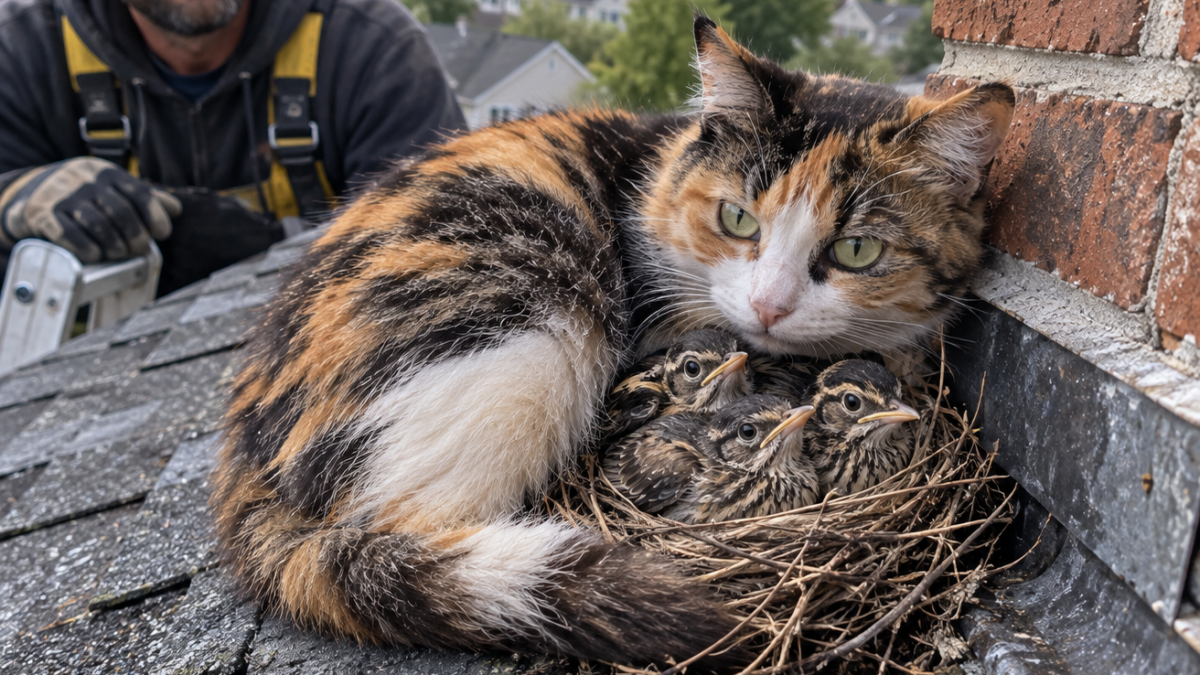
A young adult calico, maybe six or seven pounds, with white legs, black patches along her back, and orange markings around one ear and cheek.
Her fur was still damp in places.
She wasn’t trapped.
She wasn’t panicking.
She wasn’t even standing.
She was lying beside the chimney.
Curled around a bird’s nest.
I stayed motionless.
The cat raised her head.
Yellow-green eyes locked on mine.
Her ears didn’t flatten.
She didn’t hiss.
She simply watched.
Then I heard chirping.
Tiny.
Soft.
Three small heads moved inside the nest.
For a moment my brain refused to put the pieces together.
Cat.
Birds.
Nest.
That usually ends one way.
But the birds weren’t struggling.
There were no feathers scattered around.
No blood.
No sign the cat had attacked anything.
Instead, her body was wrapped around the nest in a rough semicircle.
Not on top of it.
Around it.
The chimney formed the fourth wall.
I climbed onto the roof slowly.
The cat followed every movement.
“Easy,” I said.
She blinked.
“You’re not supposed to be doing this.”
More blinking.
I stayed low and moved a few feet closer.
The wind hit me hard enough to tug at my jacket.
That was when I noticed the direction.
The chimney was on the north side of the nest.
The cat lay along the west and southwest side.
That was exactly where the wind was coming from.
Her fur rippled with every gust.
The birds barely moved.
I took another step.
The cat lifted her head higher.
“Okay.”
I stopped.
“You win.”
She looked down at the nest.
Then back at me.
It sounds ridiculous, but the expression on her face seemed less afraid than irritated.
Not angry.
Just busy.
As if I had walked into an office and interrupted a meeting.
I heard Luis from below.
“What is it?”
I turned carefully.
“There are birds.”
“What?”
“Three babies.”
“And the cat?”
“Right beside them.”
A pause.
“Are they alive?”
“Very.”
“Did she kill the mother?”
That thought had already crossed my mind.
“I don’t know.”
I looked around.
The nest sat wedged against the chimney on a small flattened area of shingles and roofing debris.
No adult bird.
No feathers.
No remains.
No obvious sign of a struggle.
I checked the gutter line.
Nothing.
The tree nearest the roof had several damaged branches.
It was possible the nest had originally been elsewhere and had blown onto the roof.
But the structure looked surprisingly intact.
Maybe it had always been built there.
Birds make terrible real-estate decisions.
I moved another foot closer.
The baby birds opened their mouths briefly when my shadow crossed them.
They were old enough to have most of their feathers but still had the soft, unfinished look of nestlings.
One stretched its neck.
The calico immediately lowered her head toward it.
My muscles tensed.
Here it comes, I thought.
Instead, she touched her nose gently against the bird’s head.
The chick settled.
I stared.
“What are you doing?”
The cat licked her lips once.
My roofer brain had no category for this.
I had found raccoons in attics.
Squirrels inside soffits.
Once, in July, I lifted a loose sheet of metal roofing and discovered a snake beneath it. I nearly broke an Olympic long-jump record getting off that section.
I had removed dead birds from gutters.
I had chased a turkey off a garage.
I had once spent forty minutes waiting for a family of ducks to cross a flat commercial roof because nobody could figure out how they had gotten up there.
But I had never seen a cat protect birds.
I backed away.
The calico lowered her head again.
I climbed down.
Margaret was waiting beside the ladder.
“Well?”
I took off my gloves.
“You were right.”
“She’s stuck?”
“No.”
“Then what is she doing?”
I looked up.
“Guarding a nest.”
Margaret stared at me.
“Guarding?”
“Three baby birds.”
Luis laughed once because he assumed I was joking.
I didn’t.
His expression changed.
“You’re serious?”
“Yep.”
Margaret stepped closer.
“But cats eat birds.”
“Usually.”
“Oh, dear.”
“What?”
“What if she’s waiting?”
“Waiting for what?”
“For them to get bigger.”
I almost laughed.
Then I realized she was serious.
“I don’t think so.”
“You don’t know.”
“That’s true.”
None of us knew.
I asked Margaret again whether she had ever seen the cat.
“Maybe once or twice.”
“Where?”
“Across the street. Near Mrs. Dorsey’s shed.”
“Anybody feeding her?”
“Not that I know.”
Luis pointed toward the roof.
“Could she have kittens somewhere?”
Possible.
But I hadn’t seen signs of nursing from where I stood.
We checked the neighborhood.
Mrs. Dorsey knew of “a little patchy cat” that wandered through her backyard sometimes.
Another neighbor had seen her behind the grocery store two blocks away.
A teenager said he had thrown her pieces of turkey once.
Nobody owned her.
Nobody knew where she slept.
Nobody had given her a name.
She was just one of those animals people noticed at the edges of ordinary life.
There one day.
Gone the next.
Surviving somehow.
I called our local wildlife rehabilitation center.
A woman named Dr. Hannah Cole answered.
I explained the situation.
There was a long silence.
“Let me make sure I understand.”
“Okay.”
“You have three nestling birds.”
“Yes.”
“On a roof.”
“Yes.”
“The parent is absent.”
“As far as I can tell.”
“And a cat is lying around the nest.”
“Correct.”
“Has the cat injured them?”
“No.”
“Touched them?”
“Only with her nose.”
“Any punctures? Blood?”
“Nothing I can see.”
Another silence.
“What species?”
“That question is well above my roofing license.”
She laughed.
“Can you send a picture?”
I had not taken one yet.
“I can.”
“Get one from a distance. Don’t stress them.”
I climbed back up with my phone.
The cat was still in the exact position.
This time she barely bothered lifting her head.
“Back again,” I whispered.
I took several photos using the zoom.
Three birds.
Cat wrapped around them.
Chimney behind.
Wind pushing her fur sideways.
When I sent the photos, Hannah called almost immediately.
“They look like young robins.”
“Almost ready to fly?”
“Probably within days, depending on age.”
“What do we do?”
“I need to see this myself.”
She arrived forty-five minutes later in a dusty SUV with wildlife center decals on the side.
Hannah was perhaps forty-five, wearing cargo pants, hiking shoes, and the expression of someone who had already seen enough strange things in nature that she had learned not to dismiss anything.
We climbed together.
She stopped at the gutter exactly where I had.
“Oh.”
That was all she said.
The cat raised her head.
Hannah crouched.
The babies chirped.
For nearly ten minutes, she simply watched.
Finally she whispered, “I have been doing wildlife rehabilitation for twenty years.”
“And?”
“I don’t know what I’m looking at.”
That made me feel better.
“So I’m not crazy?”
“Oh, you may still be crazy. But the cat is definitely protecting them.”
“You’re sure?”
“Watch the wind.”
A gust swept over the ridge.
The calico lowered herself.
Not randomly.
She shifted her front legs and broadened the curve of her body.
The wind struck her back.
The nest sat in a pocket of still air behind her.
Hannah’s expression changed.
“Wow.”
“What?”
“She’s adjusting.”
“You saw that too?”
“Yes.”
We waited.
Another gust.
Same thing.
Hannah moved closer.
The cat watched but did not retreat.
Hannah inspected the birds visually.
“They’re well fed.”
“So their mother was here recently?”
“Likely.”
“Could she still be around?”
“Could be. Storm may have displaced her temporarily.”
“But we’ve been here hours.”
“I know.”
“Could she be dead?”
“Yes.”
Hannah said it without drama.
Nature did not owe anyone a happy explanation.
“Should we take the birds?”
She hesitated.
“Normally, if they’re healthy and this close to fledging, I’d rather leave them in place in case the parent returns.”
I pointed at the cat.
“And her?”
“That is the part I don’t have a manual for.”
I laughed.
The calico yawned.
Hannah watched her for almost an hour.
Not once did the cat stalk.
Not once did she show hunting posture.
She didn’t bite.
Didn’t paw.
Didn’t become excited when the birds moved.
If anything, she behaved like an exhausted animal who had decided her body belonged exactly where it was.
Finally Hannah said, “We leave them.”
“With the cat?”
“For now.”
“You’re serious?”
“If she had wanted to kill these birds, she could have done it long before we arrived.”
Fair point.
“We’ll monitor.”
I glanced at the damaged shingles on the opposite slope.
“I need to repair the roof.”
“Can you work away from them?”
“Yeah.”
“Then do that.”
For the next ninety minutes, Luis and I replaced shingles while Hannah remained nearby.
Every tool noise made the cat’s ears turn.
Hammer.
Nail gun.
Boots scraping granules.
She watched us.
But she never abandoned the nest.
At one point I moved a little too close while carrying a bundle.
She stood.
I immediately stopped.
Her body positioned itself between me and the birds.
Tail low.
No hiss.
No arched back.
Just a line.
Me.
Her.
Them.
I took two steps away.
She lay back down.
Luis saw it.
“Man.”
“What?”
“She really is guarding them.”
“Looks that way.”
“From us too.”
“Especially us.”
Around four in the afternoon, the weather began shifting again.
Clouds gathered beyond the western hills.
Hannah checked the radar on her phone.
“There’s another band coming.”
“How bad?”
“Not like last night. But gusts could hit thirty-five.”
I looked toward the nest.
“That roof is going to get cold.”
“Yeah.”
“Should we move them now?”
She frowned.
“If we disturb the nest unnecessarily and the parent returns…”
“What if the parent doesn’t return?”
“That’s the gamble.”
I hated that answer.
Roofing is easier.
You find the damaged section.
You replace it.
There is no philosophy involved.
Animals turn everything into uncertainty.
Margaret brought coffee outside.
“Any change?”
“No mother bird,” Hannah said.
“And the cat?”
“Still there.”
Margaret looked genuinely troubled.
“I put some tuna on a plate below.”
“Did she come down?”
“No.”
That caught Hannah’s attention.
“How long has food been there?”
“About an hour.”
The cat had not moved for tuna.
Now I knew something was wrong with the universe.
By five, the temperature dropped.
Luis had gone home because the repair itself was complete.
I stayed.
I told Sarah I would be late.
She asked why.
I sent her the photo.
My phone rang ten seconds later.
“What am I looking at?”
“That’s the problem.”
“Is that cat cuddling baby birds?”
“Pretty much.”
There was silence.
“Bring her home.”
“What?”
“The cat.”
“We have two dogs.”
“They like cats.”
“No, they tolerate the neighbor’s cat through a window.”
“Fine. Then find someone who can take her.”
“Honey, we don’t even know if she wants to be taken.”
Sarah exhaled.
“Just don’t leave them there in another storm.”
That was exactly what I had been thinking.
The first drops arrived at 5:37.
Cold rain.
Scattered.
Then more.
Hannah and I went back up.
The cat was awake now.
Wind pulled at her fur.
The babies were huddled deeper into the nest.
“Okay,” I said. “This changes things.”
Hannah nodded.
“If we get sustained rain, they can become hypothermic.”
I pointed to the calico.
“And she can’t stop rain.”
“No.”
The cat stood as we approached.
“Easy.”
Hannah carried a small transport box.
She had made the decision.
“We’re moving the birds.”
The calico stepped in front of the nest.
Hannah stopped.
“Well.”
“You want me to grab her?”
“No.”
The cat looked from Hannah to me.
Rain dotted her head.
The wind increased.
Then something happened that I still think about.
One of the chicks gave a loud hungry call.
The cat turned.
She looked down at it.
Then at Hannah.
Then she moved aside.
Not far.
Maybe eighteen inches.
But enough.
Hannah whispered, “You have got to be kidding me.”
She reached into the nest.
The cat watched.
Hannah lifted the first bird.
No reaction.
Second.
The cat stepped closer but did nothing.
Third.
The nest was empty.
The calico sniffed it.
Then looked into the transport box where the birds were chirping.
I had no idea whether she understood what was happening.
I still don’t.
But she followed us to the gutter.
Hannah went down first with the birds.
I expected the cat to remain.
Instead she stood on the roof edge watching the box descend.
“Come on,” I said.
She looked at me.
Rain ran down my face.
“You did your job.”
She stayed.
I climbed down.
From the yard, we looked up.
There she was.
Alone beside the chimney.
For the first time all day, there was no nest beneath her body.
Margaret looked close to tears.
“What about her?”
Hannah set the birds safely in her vehicle.
“We need to see if she’ll come down.”
Margaret brought the tuna closer to the house.
We waited.
Ten minutes.
Twenty.
The rain intensified.
The cat disappeared from the roofline.
For one awful moment I thought she had slipped.
Then she reappeared near the gutter above my ladder.
She looked down.
I put my hands on the ladder rails.
“Okay.”
She stepped onto the top rung.
Margaret gasped.
“Don’t scare her.”
“I’m not doing anything.”
The calico descended like she had used ladders her entire life.
Three rungs.
Pause.
Two more.
Then she jumped the last six feet into the flower bed.
Immediately she walked past all of us.
Past Margaret.
Past me.
Past the tuna.
Straight to Hannah’s SUV.
The baby birds were inside.
The cat sat beside the rear wheel.
Nobody spoke.
Finally Hannah said, “Daniel?”
“Yeah?”
“I’m officially out of explanations.”
The birds spent the night at the wildlife center.
Their condition was remarkably good.
No dehydration.
No injuries.
No evidence the cat had harmed them.
One was slightly underweight but not dangerously so.
Hannah planned to return them to an outdoor pre-release enclosure until they were ready to fledge.
The calico created a different problem.
She had no collar.
No chip.
No known owner.
Animal control scanned her.
Nothing.
She was thin but not starving.
Her paws showed the wear of an outdoor cat.
She had a few healed scratches.
No sign she was nursing.
No major health problems.
When Hannah placed the bird transport box inside the wildlife intake room, the calico sat outside the door and cried.
First sound I had heard from her all day.
A short, rough meow.
Then another.
Hannah looked at me.
“You hear that?”
“Hard not to.”
“We can’t let her loose with wildlife patients.”
“Obviously.”
“We also can’t leave a stray outside.”
“What now?”
Hannah rubbed her forehead.
“Animal shelter.”
I hated the idea immediately.
So did Margaret.
When I called to update her, she said, “After what she did?”
“What else do we do?”
“Find her a home.”
“By tonight?”
“Yes.”
I laughed.
She did not.
“I’m serious, Daniel.”
“So am I.”
“Put her picture online.”
I did.
That photo—the one I had taken from the ladder earlier—was never meant to go anywhere.
I posted it in our neighborhood Facebook group with a simple caption:
Does anyone know this cat? Found on Maple Ridge Lane after last night’s storm. No collar, no chip. She spent most of today curled around a nest of three orphaned baby birds, protecting them from the wind. We’re trying to locate an owner or safe foster.
Then I put my phone away.
An hour later there were more than two hundred comments.
By bedtime, the post had been shared over a thousand times.
Some people didn’t believe it.
Several insisted the cat was “saving the birds for later.”
One man confidently explained that cats were incapable of protective behavior toward prey species and that I had misunderstood the scene.
I replied with exactly three words.
You weren’t there.
Other people wanted the cat.
Dozens.
Too many.
That presented a new problem.
People fall in love with stories faster than they fall in love with animals.
The distinction matters.
A good story can make someone want the symbol of an animal.
Living with the actual animal is different.
Actual animals scratch furniture.
Wake you at 4:00 a.m.
Need medical care.
Get scared.
Hide.
Refuse to perform the magical behavior that made them famous online.
Hannah knew that better than I did.
“We’re not handing her to the first person who says she’s an angel,” she told me the next morning.
“So what happens?”
“The county shelter will hold her through the stray period. If nobody claims her, they’ll evaluate applications.”
“Can she stay there safely?”
“They have space right now.”
“What about the birds?”
“Doing well.”
“Does she know where they are?”
Hannah gave me a look.
“I’m a wildlife rehabilitator, not a cat psychic.”
Fair.
I stopped by the shelter that evening anyway.
I told myself I wanted to make sure the cat was okay.
The truth was more embarrassing.
I missed her.
They had named her Roo.
Short for Roofer.
I objected immediately.
“That is terrible.”
The shelter technician smiled.
“Then you should have named her before dropping her off.”
“She needs something dignified.”
“Like what?”
I looked through the kennel door.
The calico was asleep in a folded blanket.
“Storm?”
“That’s worse.”
“Fine. Roo.”
She opened one eye when she heard my voice.
Then stood.
That surprised me.
She walked to the front of the kennel.
I held out two fingers.
She rubbed her face against them.
“Hey, trouble.”
She purred.
One of the shelter staff said, “She doesn’t do that for everybody.”
I tried not to look pleased.
“How’s she doing?”
“Healthy. Very calm. Eats well. Uses the litter box. Loves heated beds.”
“Any aggression?”
“None.”
“With birds?”
The woman laughed.
“We don’t test cats with birds.”
“Good policy.”
I visited again two days later.
Then the day after that.
Sarah noticed.
“You’re visiting the roof cat again?”
“Her name is Roo.”
“Oh, now she has a name.”
“The shelter named her.”
“Uh-huh.”
“I’m just checking.”
“Uh-huh.”
“We can’t adopt a cat.”
“I didn’t say we could.”
“We have Scout.”
Our Labrador, Scout, had the emotional subtlety of a wrecking ball.
Sarah said, “Scout grew up with my sister’s cat.”
“That was four years ago.”
“He still remembers.”
“Our beagle chases leaves.”
“Cooper is afraid of the vacuum cleaner.”
“That proves nothing.”
Sarah smiled.
“Daniel.”
“No.”
“You’re attached.”
“I found her on a roof. That’s all.”
“You have shown her picture to every customer you’ve met this week.”
“That is professional networking.”
She laughed so hard she spilled coffee.
The birds remained at the wildlife center for six days.
Hannah sent updates.
They ate.
They grew.
They flapped.
They hopped from branch to branch inside a protected flight enclosure.
On the fifth day, she called.
“They’re ready.”
“To go?”
“Tomorrow morning.”
I asked if I could be there.
She was quiet for half a second.
“I assumed you would.”
At 8:00 the next morning, I met her at a field behind the wildlife center.
The three young robins sat in a soft-release enclosure near a line of trees.
They looked nothing like the fragile creatures I had seen in the nest.
Feathers filled out.
Eyes bright.
Restless.
Hannah opened the first panel.
For several seconds, nothing happened.
Then one bird hopped to the edge.
Looked around.
Launched.
Its flight was ugly.
Unsteady.
Perfect.
It reached a low branch.
The second followed.
Then the third.
I laughed.
I hadn’t meant to.
It just came out.
Hannah smiled.
“Pretty good feeling, isn’t it?”
“Yeah.”
The three birds moved higher.
Within minutes, they were shapes among leaves.
Gone.
I looked at the empty enclosure.
“Think they would’ve survived without Roo?”
Hannah didn’t answer quickly.
“We can’t know.”
“But?”
“But after that storm, without an adult bird present, exposed on that roof in cold wind…”
She glanced at me.
“She improved their odds.”
That was enough.
I went straight from the wildlife center to the shelter.
Roo was stretched across the front of her kennel.
I crouched.
“They made it.”
Her ear twitched.
“All three.”
She yawned.
“You could at least pretend you care.”
The shelter director, Monica, approached behind me.
“Daniel?”
I stood.
“Yeah?”
“Can we talk?”
That sentence rarely brings good news.
“What happened?”
“Nothing bad.”
She held a clipboard.
“Her stray hold ends tomorrow.”
“Okay.”
“We have thirty-seven adoption inquiries.”
I stared.
“Thirty-seven?”
“Actually forty-two, but five are clearly not appropriate.”
“Why?”
“One person wanted her for a petting zoo. Another asked whether she could be trained to protect parakeets.”
I closed my eyes.
“People are idiots.”
“Some.”
She smiled.
“But several applications are excellent.”
“That’s good.”
“It is.”
Why did it not feel good?
Monica watched me.
“You’re allowed to apply too.”
I laughed immediately.
“No.”
“Okay.”
“I have dogs.”
“Lots of homes have cats and dogs.”
“My dogs are idiots.”
“So are lots of dogs.”
“My wife would kill me.”
“Has your wife met Roo?”
“No.”
Monica said nothing.
I stared at her.
“Don’t.”
“I didn’t say anything.”
I went home.
Sarah was in the backyard throwing a tennis ball for Scout.
I stood on the patio.
She looked at my face.
“What?”
“Her hold ends tomorrow.”
“Roo?”
“Yes.”
“That’s good.”
“Forty-two people applied.”
“Wow.”
“Several are good homes.”
Sarah threw the ball again.
Scout crashed into a shrub.
“Sounds like she’ll be okay.”
“Yeah.”
She glanced at me.
“You don’t sound happy.”
“I’m happy.”
“You look like somebody cancelled Christmas.”
“She’s a cat.”
“Correct.”
“She needs a home.”
“Correct again.”
“We have dogs.”
“You mentioned that.”
I crossed my arms.
Sarah smiled.
“You want her.”
“I don’t.”
“Daniel.”
“I just don’t want her going to somebody who wants her because of a Facebook post.”
“Then apply.”
“No.”
“Why?”
“Because that is exactly how people end up with animals they didn’t plan for.”
Sarah looked toward Scout, who had returned without the ball.
“We got him because you found him behind a job site.”
“That was different.”
“How?”
“He was a puppy.”
“You brought Cooper home because a customer was going into assisted living.”
“That was temporary.”
“He has been temporarily living here for six years.”
I pointed at her.
“You participated in that decision.”
“I did.”
She dropped the ball thrower.
“Bring the cat over.”
“What?”
“Ask the shelter if we can do a supervised dog introduction.”
“You’re serious?”
“Very.”
The next afternoon, Sarah met Roo.
Roo immediately ignored her.
Sarah sat in the shelter meeting room.
Roo sniffed her shoe.
Walked past.
Jumped onto the windowsill.
Sarah whispered, “I like her.”
“She’s done nothing.”
“Exactly.”
“What?”
“She’s not trying to win me over.”
We introduced Scout first, controlled carefully on leash with shelter staff.
Roo went rigid.
Scout whined.
I prepared for disaster.
Then Roo walked onto a chair.
Scout sniffed the floor where she had been.
Roo watched.
No lunge.
No panic.
After ten minutes, Scout lay down.
Roo remained on the chair.
Cooper was even easier because Cooper treated most unfamiliar experiences as potential tax audits.
He glanced at Roo.
Roo glanced at him.
Both apparently decided avoidance was best.
Sarah looked at me.
“You’re out of excuses.”
“I can find more.”
She smiled.
We filled out the application.
I felt ridiculous.
Thirty-seven—or forty-two—people wanted Roo.
Some had quieter houses.
No dogs.
More experience with cats.
Why should we be chosen?
I told Monica exactly that.
She leaned forward across her desk.
“Because she already trusts you.”
“That can’t be the only reason.”
“It isn’t.”
“And because she knows my ladder?”
Monica laughed.
“We’ll evaluate all the applications.”
Three days later she called.
“You still want the roof cat?”
I was standing on a commercial building holding a tape measure.
“Yes.”
The answer came out before I had time to pretend otherwise.
“Then come get your cat.”
I sat down on the roof.
Luis looked over.
“You okay?”
“They approved us.”
“For what?”
“Roo.”
He stared.
“The bird cat?”
“Yeah.”
He grinned.
“I knew it.”
“Knew what?”
“You looked at that cat the way my wife looked at our daughter the first time.”
“Shut up.”
“I’m serious.”
“Go measure the west slope.”
When Roo came home, the first thing she did was disappear behind the washing machine.
For two hours.
So much for magical connection.
Scout sat outside the laundry room wagging his tail.
Cooper slept through most of the event.
Sarah placed food near Roo’s hiding spot.
We left her alone.
Around midnight, I woke to a noise.
I walked into the kitchen.
Roo sat on the counter.
We stared at each other.
“You’re not allowed up there.”
She blinked.
I picked her up.
She did not scratch.
I put her on the floor.
She jumped back onto the counter.
We repeated the process.
Three times.
By the fourth, I gave up.
“That roof thing made you arrogant.”
She began washing a paw.
Over the following weeks, Roo established ownership of the house.
She slept in the living-room window.
She discovered the upstairs landing.
She learned Scout was harmless but useful as a source of warmth.
She ignored Cooper until one cold morning when Sarah found both of them asleep on the same dog bed.
She became obsessed with one old green blanket.
And every time strong wind hit the windows, she moved to the nearest one and watched outside.
The first major storm after we adopted her came two months later.
Rain hammered the roof.
Branches bent.
The weather radio warned of gusts over forty miles per hour.
Around 11:00 p.m., Sarah noticed Roo was missing.
We searched.
Kitchen.
Bedroom.
Laundry room.
Basement.
Nothing.
Then I saw movement beside the upstairs bathroom window.
Roo was sitting on the sill.
Watching the storm.
I sat beside her.
“You miss the roof?”
Her tail flicked.
A gust rattled the glass.
She didn’t move.
I thought of the nest.
The three birds.
Her body curved around them.
“You’re inside tonight.”
She leaned slightly against my arm.
That became her habit.
Storm arrives?
Roo finds a window.
Not frightened.
Watching.
Maybe looking for movement.
Maybe listening.
Maybe none of the things I imagined.
I stopped trying to explain her.
That was the lesson, really.
People desperately want animal behavior to become a human story.
We want motives.
Names.
Reasons.
We say brave.
Kind.
Maternal.
Selfless.
We create language around things animals may experience completely differently.
Hannah reminded me of that every time I got too sentimental.
“You know she may have been drawn to their warmth,” she once said.
“Okay.”
“She may have simply found a sheltered spot.”
“Okay.”
“She might have had a suppressed prey drive for some reason.”
“Okay.”
“She may not have understood them as prey.”
“Okay.”
“You’re not arguing.”
“I was there.”
Hannah sighed.
“That is annoyingly difficult to respond to.”
I smiled.
“I don’t need Roo to understand the moral meaning of what happened.”
That was true.
I didn’t need to believe she climbed the roof intending to become a hero.
I didn’t need to pretend she had formed a human plan.
I knew only what I saw.
Three vulnerable birds.
No adult parent.
Cold wind.
A stray cat lying around the nest.
Her body placed on the exposed side.
Her position changing with the gusts.
Hours passing.
Food offered below.
She stayed.
People came near.
She moved between them and the nest.
Then, when the weather worsened and Hannah reached for the birds, Roo eventually moved aside and let us take them.
Afterward, she followed the box.
Those things happened.
Whatever words belonged around them were less important.
The original photo continued circulating online for months.
Every now and then a customer recognized me.
“You’re the roof guy!”
Unfortunately, that became my accidental identity.
One woman asked me to sign a printed copy of the photo.
I refused.
“What would I even write?”
She laughed.
“Something inspirational.”
“I replace shingles.”
Another customer offered us extra money because she had seen the story.
I deducted it from the bill.
Roo was the interesting one.
Not me.
Margaret became part of her life too.
She visited every few weeks.
The first time she came to our house, Roo walked directly to her.
Margaret nearly cried.
“She remembers.”
“Maybe.”
“Let me have this, Daniel.”
“Fine. She remembers.”
Margaret brought treats every visit.
After that, Roo definitely remembered.
In spring, nearly seven months after the storm, something happened that completed the story in a way I would never have believed if someone else had told me.
I was back at Margaret’s house.
Different problem.
Nothing dramatic.
A piece of flashing had come loose near the chimney.
I climbed onto the same roof.
Same ladder position.
Same slope.
The nest was long gone.
Weather had scattered most of it.
Only a few dry stems remained near the brick.
I stood there longer than necessary.
You can revisit a place where something strange happened and feel disappointed by how ordinary it looks afterward.
Just shingles.
Brick.
Sky.
Then I heard a bird.
A robin landed on the ridge.
Adult.
Bright orange chest.
It hopped twice.
Watched me.
Another robin appeared near the tree.
Then a third.
Probably coincidence.
Robins are common.
I knew that.
Still, I took a photograph.
I sent it to Hannah.
Three birds on the roof.
Her reply came thirty seconds later.
Don’t start.
I laughed so hard Margaret heard me from the yard.
“What happened?”
“Nothing.”
“Are those the babies?”
“We have absolutely no way of knowing.”
She cupped her hands around her mouth.
“Those are the babies!”
“Margaret!”
“I know what I believe!”
There was no arguing with her.
I sent the photograph to Sarah.
She replied:
Show Roo.
So I did.
That evening I held the phone in front of our cat.
“Recognize anybody?”
Roo sniffed the screen.
Then walked away.
Sarah laughed.
“She’s humble.”
“She doesn’t care.”
“Same thing.”
Roo is still with us.
She has gained almost two pounds.
Her coat is thicker.
The nervous little hollows around her hips disappeared months ago.
She still prefers high places.
Top of the couch.
Window ledge.
Bookcase.
Once I found her sitting on top of the refrigerator and decided some battles were not worth fighting.
She likes Scout.
She tolerates Cooper.
She sleeps between Sarah and me when temperatures drop.
And every time I carry my extension ladder past the kitchen window, she comes running.
Sarah says she thinks Roo misses roofing.
I say we are absolutely not testing that theory.
The photograph hangs in my office now.
Not because it went viral.
Not because customers recognize it.
Not because it makes me feel sentimental about one particular workday.
I keep it because it reminds me how often we decide what something is before we actually stop to look.
Cat.
Predator.
Bird.
Prey.
Stray.
Unwanted.
Storm.
Damage.
Simple categories.
Useful most of the time.
Not always true enough.
I nearly looked at that roof and saw nothing more than eight missing shingles and a section of damaged flashing.
Had I climbed from the opposite side, maybe I would have started working before noticing her.
Had I approached too quickly, maybe she would have run.
Had Hannah assumed predator and prey could never safely share space, maybe the birds would have been removed hours earlier.
Had Margaret simply called animal control that morning, the entire scene might have ended differently.
Instead, for one strange day after a violent storm, all of us were forced to watch something we could not neatly explain.
A stray cat had found three young birds alone on a roof.
Their mother never returned while we were there.
The wind blew.
The temperature fell.
And the cat stayed.
People still ask me why.
I tell them the truth.
I don’t know.
Maybe there is an explanation an animal behavior specialist could give me.
Maybe there are ten explanations.
Maybe she had encountered birds before.
Maybe something in their calls triggered a response other than hunting.
Maybe the warmth of the nest attracted her.
Maybe the protected area beside the chimney simply happened to be where she wanted to lie.
But those explanations do not change the part I witnessed.
Whenever the wind shifted harder toward the nest, she lowered herself between it and the birds.
When I approached, she put her body between me and them.
When food waited below, she remained.
When rain came, she remained.
And when Hannah finally took the birds away, Roo followed them down.
Fifteen years in roofing teaches you that storms reveal weak places.
A loose shingle you never noticed.
A rotten board hidden beneath felt.
Flashing that looked fine until water found the smallest opening.
But that storm showed me something else.
Sometimes pressure reveals strength too.
Not the kind anyone planned.
Not something you can see on a calm day.
Something hidden until the wind comes.
Before that afternoon, Roo was just a stray cat moving through a neighborhood where almost nobody knew her.
No collar.
No chip.
No home.
No name.
Three birds were just three vulnerable babies in a nest after a storm.
Then, for reasons none of us will ever fully understand, their lives crossed on a roof.
She had every reason to behave exactly as we expected a cat to behave.
She didn’t.
And I had every reason to finish my repair, climb down, collect my check, and move to the next damaged house.
Instead, I spent most of a day sitting on shingles watching a six-pound animal confuse every assumption I had.
Sometimes I still look at the photograph and notice something different.
The chimney.
The scattered storm debris.
The loose feather beside the nest.
The way the birds are tucked deep in the center.
But mostly I notice Roo’s eyes.
She is looking directly at me.
Wind blowing through her fur.
Body wrapped around creatures she should not have cared about.
And I remember exactly what I thought in that moment.
She looks busy.
That still feels like the best explanation I ever found.
She had found something vulnerable.
The storm had already taken enough.
For that one day, she seemed to have decided it wasn’t taking these three too.
So she stayed.
Not their mother.
Not even their species.
Just a stray cat on a damaged roof, standing between the wind and three tiny lives until somebody else arrived to help.
I repair roofs for a living.
I know what walls are supposed to look like.
Brick.
Wood.
Metal.
Shingles.
But on that afternoon, twenty feet above the ground after one of the worst storms of the season, the strongest wall on that house weighed less than seven pounds, had four paws, and answered to no name at all.
And somehow, against every instinct I thought I understood, she chose to become shelter for someone smaller than herself.








