A Retired Police K9 Refused to Enter His Late Handler’s House—Then He Led the Family to a Shed Locked for 9 Years
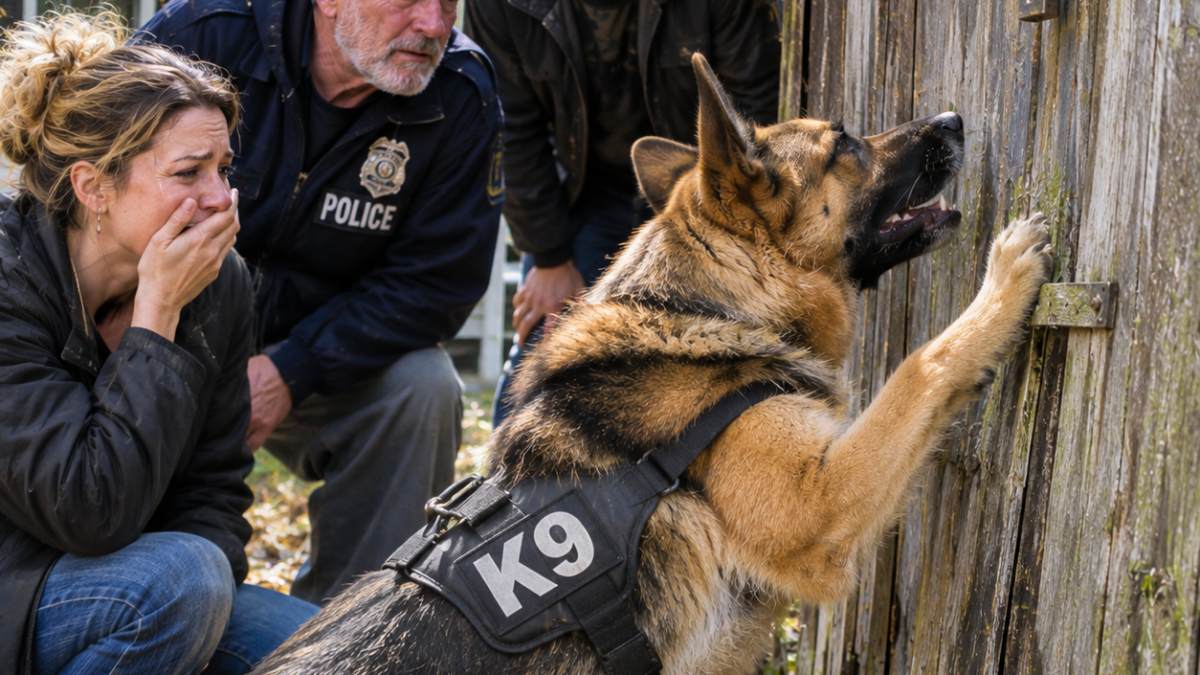
A Retired Police K9 Refused to Enter His Late Handler’s House—Then He Led the Family to a Shed Locked for 9 Years.
Everyone expected retired police K9 Bruno to run through the front door when he was finally brought back to the Kentucky home where he had once lived with his handler, Detective Jack Mercer.
Instead, the old German Shepherd stopped halfway up the driveway, turned away from Jack’s family, and began clawing at the door of an overgrown shed nobody had opened since Jack died nine years earlier.
When they finally broke the rusted lock and opened the sealed equipment trunk inside, they found Jack’s old K9 gear, a stack of case photographs nobody knew he had kept, and one envelope explaining why Bruno had been trying to bring them back to that shed before time erased the last person who could still finish what Jack had started.
Bruno did not recognize the house.
At least that was what everyone believed during the first thirty seconds.
The truck stopped at the end of a long gravel driveway outside Shelbyville, Kentucky, and the old German Shepherd lifted his head from the blanket in the back seat.
His ears rose.
His nose worked.
Then he went completely still.
Rachel Mercer saw it through the open passenger door.
“Bruno?”
The dog did not look at her.
He stared through the windshield.
Ahead stood the white farmhouse where Rachel had grown up.
Two stories.
Green shutters.
Brick chimney.
Large maple tree beside the porch.
The porch swing her father had built when Rachel was twelve still hung from two chains beneath the roof.
Nine years had changed small things.
New shingles.
Different mailbox.
Her mother had replaced the front steps.
But the house itself remained almost exactly as Detective Jack Mercer had left it.
Rachel had imagined this moment for weeks.
She had pictured Bruno jumping from the truck.
Running toward the porch.
Sniffing the door.
Maybe crying.
Maybe barking.
Maybe looking for Jack.
Everyone else had imagined the same thing.
Her mother, Helen, stood on the porch gripping the railing.
Rachel’s older brother, David, waited near the front steps.
Their teenage sons and daughters had been told to stay back and let Bruno decide how much interaction he wanted.
Even Dr. Claire Bennett, the veterinarian from the retired working-dog program who had driven Bruno there, expected the front door to matter.
Bruno had lived in that house for nearly five years.
He had slept beside Jack’s bed.
Waited near the kitchen table every morning.
Patrolled the backyard fence.
Sat on the passenger floorboard of Jack’s cruiser whenever he was off duty but still too restless to leave the dog at home.
If memory lived anywhere in him, surely it would be there.
Claire opened the rear door.
“Easy, Bruno.”
The thirteen-year-old dog stood slowly.
His back legs were stiff.
His muzzle had gone almost completely gray.
PART2:
One ear leaned slightly outward after an old bite injury.
A thin scar crossed the bridge of his nose.
He stepped down using the portable ramp.
Rachel crouched several feet away.
“Hey, buddy.”
Bruno sniffed.
One step.
Then another.
He reached the middle of the driveway.
Stopped.
Helen whispered from the porch:
“Oh, sweetheart.”
Bruno looked toward her.
For a moment Rachel thought he recognized her mother.
Then he turned his head sharply to the right.
Away from the house.
Toward the back pasture.
Claire followed his gaze.
“What’s over there?”
Rachel looked.
“Barn.”
“Old garden.”
Then she saw the roof through the weeds.
“And Dad’s shed.”
PART3:
The shed sat about eighty yards behind the house.
Small.
Weathered.
Originally painted red, though most of the paint had faded to brown.
Honeysuckle had climbed one wall.
Tall weeds surrounded the path.
Nobody had opened it in nine years.
Not since Jack died.
Bruno began walking toward it.
Rachel stood.
“Bruno?”
The dog continued.
Claire picked up the leash but did not pull.
“Let him.”
Helen came down from the porch.
“What’s he doing?”
“I don’t know.”
Bruno crossed the yard.
Passed the maple.
Ignored the back porch.
Ignored Jack’s old outdoor kennel, still attached to the side of the garage.
That surprised Rachel.
He had spent hours in that kennel.
Yet he barely sniffed it.
Straight toward the shed.
David followed.
“You sure he used to go out there?”
Rachel frowned.
“I think so.”
“With Dad?”
“Maybe.”
She had been twenty-three when Jack died.
Living in Cincinnati.
Building her own life.
The shed had always been her father’s territory.
Tools.
Fishing equipment.
K9 supplies.
Boxes.
Old police gear he was supposed to have returned years earlier but somehow always had legitimate reasons for keeping.
Jack did not forbid the family from entering.
He simply made the place so disorganized that nobody wanted to.
Except one thing.
A trunk.
Rachel remembered that.
Bruno reached the shed.
The door was secured with an old brass padlock.
He sniffed along the threshold.
Then scratched.
Once.
Twice.
Hard enough that his nails scraped weathered wood.
Claire said:
“Bruno.”
He scratched again.
David stepped closer.
“He wants inside.”
Rachel stared.
Bruno stopped scratching.
Sat in front of the door.
Then looked back at them.
Helen made a sound in her throat.
“That’s exactly what he used to do.”
Rachel turned.
“What?”
“When Jack told him to show.”
“Show what?”
Helen looked at the dog.
Then at the locked shed.
“If Bruno found something during training, Jack would say ‘show me.’”
“He’d sit and look back.”
Claire crouched.
“You remember that after nine years?”
Helen nodded.
“I watched them do it a thousand times.”
Bruno looked at the door again.
Rachel felt something cold move through her.
“Where’s the key?”
Helen’s face changed.
“I don’t know.”
“You never opened this?”
“Not since your father died.”
“Why?”
Helen looked embarrassed.
Then tired.
“Because he told me not to throw anything away.”
“That’s not the same as never opening it.”
“No.”
“He said there was something important in the equipment trunk.”
“What?”
“He never told me.”
David frowned.
“When?”
“The week before he died.”
Rachel looked at her mother.
“You never mentioned this.”
“I forgot.”
“How do you forget something like that?”
Helen’s eyes sharpened.
“Your father died in a hospital after being shot twice.”
“I forgot a lot of things that month.”
Rachel immediately regretted the question.
“I’m sorry.”
Helen looked toward the shed.
“So am I.”
Nine years earlier, Detective Jack Mercer had been fifty-one.
Twenty-seven years in law enforcement.
Eleven as a K9 handler.
Bruno was his third dog and the one everyone said suited him best.
Both stubborn.
Both suspicious of strangers.
Both preferred work to parties.
Bruno joined him at eighteen months.
German Shepherd.
Imported working line.
High drive.
Difficult.
The first trainer told Jack:
“He doesn’t like anybody.”
Jack answered:
“Neither do I.”
That was apparently the beginning of the partnership.
They worked narcotics at first.
Then tracking.
Evidence recovery.
Building searches.
Missing persons.
Bruno once found a seven-year-old boy hiding beneath an abandoned farm trailer after the child wandered almost three miles from home.
He once tracked an armed robbery suspect through freezing rain.
He located a handgun thrown into a drainage ditch.
He found an elderly dementia patient before temperatures fell below freezing.
The local paper photographed them more than once.
Jack hated photographs.
Bruno looked offended in all of them.
Then came the Hale County corruption case.
Nobody in the family knew much about it.
Jack stopped discussing active investigations at home years earlier.
But during his final months, Rachel noticed changes.
He became careful about where he parked.
Checked mirrors.
Stopped leaving case notes on the dining-room table.
Once, during Thanksgiving dinner, David asked why Jack’s service pistol was on his belt inside the house.
Jack answered:
“Habit.”
Helen knew better.
Then one December evening, Jack responded to what dispatch described as a suspicious vehicle near an abandoned feed warehouse.
Bruno was not with him.
That was unusual.
His partner later said Jack had been following up on an informant and expected a conversation, not an arrest.
Someone shot him in the parking lot.
Two rounds.
One through the abdomen.
One high in the chest.
Jack survived the initial surgery.
For twelve days, the family thought he might come home.
He died from complications on the thirteenth.
The man arrested for the shooting was a low-level trafficker named Aaron Pike.
Pike pleaded guilty.
Twenty-eight years.
Case closed.
Or everyone thought it was.
Bruno attended the funeral.
Then lived with Helen for three months.
It did not work.
Not because he was aggressive.
Because he was searching.
Every night.
Room to room.
Garage.
Driveway.
Jack’s truck.
He stopped eating.
Stopped sleeping properly.
When a deputy arrived in uniform, Bruno raced toward the cruiser and looked inside.
Helen eventually made the hardest choice of her life.
The department arranged for Bruno to live with retired K9 trainer Ray Donnelly.
Ray had land.
Experience.
Other retired working dogs.
Bruno improved.
Rachel visited twice during the first year.
Then life accelerated.
Marriage.
Children.
Job.
Ray moved farther east.
Contact became Christmas cards.
Then phone calls.
Then occasional updates.
Bruno became an old dog somewhere else.
Until Ray died.
That was how Claire Bennett became involved.
Ray suffered a heart attack at seventy-four.
His family could not keep three retired working dogs.
Blue Ridge Working K9 Foundation took them.
Claire volunteered there as consulting veterinarian.
During intake she scanned Bruno’s chip.
Old department number.
Handler:
JACK MERCER.
DECEASED.
Emergency family record:
HELEN MERCER.
Phone disconnected.
Claire searched.
Found Rachel through an obituary.
Called.
Rachel almost hung up because she assumed it was a scam.
Then Claire sent a photograph.
Bruno.
Gray.
Old.
But unmistakable.
Rachel cried for twenty minutes.
That had led them back to the farmhouse.
Now Bruno sat outside Jack’s shed as if nine years had disappeared.
David walked to the door.
Tugged the lock.
Rust flaked away.
“I can cut it.”
Helen hesitated.
Rachel touched her arm.
“Mom.”
“He wanted us to keep the trunk.”
“Then we’ll keep it.”
“We’re opening the shed, not throwing anything away.”
Helen nodded.
David returned with bolt cutters.
One squeeze.
Second.
The old lock snapped.
Bruno stood before the door opened.
Claire held the leash.
David pulled.
The swollen wood resisted.
Then gave with a long groan.
Dust rolled out.
Bruno leaned forward.
The shed smelled like oil, dry wood, old leather, mouse nests, rust, and everything else that collects when a building remains sealed for nearly a decade.
Rachel coughed.
David switched on his phone light.
Shelves.
Fishing rods.
Power tools.
A cracked K9 training sleeve.
Old traffic cones.
Tackle boxes.
Two folding chairs.
And against the back wall:
A black equipment trunk.
Military-style polymer case.
Large.
Two latches.
One small padlock.
Rachel recognized it immediately.
“That’s the one.”
Helen stood in the doorway.
“Yes.”
Bruno pulled.
Claire loosened the leash.
He walked around the shelves.
Straight to the trunk.
Sniffed the seams.
Then lay down beside it.
Not scratching anymore.
Not pacing.
Just waiting.
David looked at Rachel.
“Well.”
Claire said:
“I think that’s what he wanted.”
Helen whispered:
“Jack told me never to throw that away.”
Rachel crouched beside the trunk.
“Did he say never open it?”
Helen thought.
“No.”
“What exactly?”
“He was tired.”
“He’d just come home.”
“He said, ‘Helen, whatever happens, don’t let anyone throw out the black K9 trunk in the shed.’”
“Then he said…”
She closed her eyes.
“What?”
Rachel asked.
“‘Bruno knows.’”
Nobody moved.
Rachel felt goosebumps rise along her arms.
“You never told us that part.”
“I forgot until now.”
Claire looked at Bruno.
“What did he mean?”
Helen shook her head.
“I thought he was talking about training equipment.”
David examined the padlock.
“Need cutters again.”
He cut it.
Rachel lifted the latches.
The lid resisted.
Weather seal.
She pulled harder.
Air hissed faintly.
Inside:
Bruno’s old working harness.
Tracking line.
Leather collar.
Department patches.
Jack’s K9 gloves.
A retired badge holder.
Several training reward toys.
A blue rubber ball.
Bruno lifted his head when Rachel touched it.
She rolled it once in her palm.
He stood.
Tail moved.
One slow sweep.
Helen laughed through tears.
“He loved that thing.”
Under the gear:
Uniform shirts.
Jack’s.
Folded neatly.
That alone was strange.
Jack never folded anything neatly.
Then a large sealed evidence envelope.
No police markings.
Just Jack’s handwriting.
RACHEL + DAVID
IF I’M NOT HERE.
Rachel’s hands began shaking.
David sat on an overturned bucket.
“Open it.”
She looked at Helen.
Her mother nodded.
Inside was a letter.
Three pages.
And a small USB drive.
Rachel read aloud.
Kids,
If you are reading this because I died, first understand I am sorry.
I should have trusted other people sooner.
I should have brought this to internal affairs the first day I knew what I was looking at.
I did not because I did not know how far it went.
If I am wrong, then I have left you a box of embarrassing paranoia.
If I am right, then the safest witness I have is a dog who cannot be pressured, bought, promoted, or talked into forgetting what he smelled.
Rachel stopped.
Looked at Bruno.
The dog stood beside the trunk.
Jack continued.
The Hale County narcotics seizures are being skimmed before evidence intake.
Not every case.
Enough.
Cash.
Small quantities of drugs.
Occasionally recovered firearms that later reappear with altered serials.
I started documenting after Bruno alerted twice on departmental vehicles that should never have contained narcotics after evidence transfer.
I thought contamination.
Then I found patterns.
The letter named no grand conspiracy.
Jack was careful.
Two officers.
One evidence technician.
A towing contractor.
Possibly someone higher.
He had copied logs.
Photographs.
Case numbers.
Vehicle assignments.
The USB drive contained the records.
But the trunk held something else too.
Rachel continued.
There is a false bottom.
Lift the K9 platform.
David stared.
“False bottom?”
They removed the remaining gear.
The trunk’s interior floor looked solid.
Then Claire found two recessed tabs.
Lift.
A shallow compartment appeared.
Inside:
Photographs.
Dozens.
Old-style printed photographs.
Evidence lockers.
Vehicle trunks.
Cash bundles.
License plates.
Two sheriff’s-department SUVs.
One man Rachel recognized.
Lieutenant Dennis Crowley.
Jack’s former supervisor.
Now retired.
Another:
Aaron Pike.
The man convicted of shooting Jack.
Talking beside a tow-yard office with Crowley.
Date stamp:
Three weeks before Jack was shot.
David whispered:
“Oh my God.”
Another envelope contained photocopies of evidence receipts.
Amounts altered.
Weights changed.
Chain-of-custody entries.
Jack had circled discrepancies.
Then a notebook.
No dramatic coded secrets.
Dates.
Times.
License plates.
Short observations.
Bruno alert—Unit 214 rear cargo, 11:40 p.m.
No authorized narcotics transport.
Crowley drove vehicle home.
Bruno alert—tow yard locker.
Pike present.
Evidence tech S. Nolan signed 8:12 a.m. but camera shows arrival 9:03.
Rachel looked up.
“Dad knew.”
Helen sat on the shed threshold.
“He knew something.”
“He never told me what.”
Claire asked:
“Why put it here?”
Rachel returned to the letter.
Jack answered.
I have duplicate digital records outside the house.
This trunk stays here because Bruno has been trained to return to it on the command “home cache.”
I used the shed during off-duty evidence exercises because it was the one place nobody cared about.
If something happens to me and Bruno is still with us, say “show home” and he will take you there.
If nobody remembers the command, I’m betting Bruno remembers the place.
David looked toward the dog.
Nine years.
Bruno had remembered.
Then the last paragraph.
Do not confront anyone named here.
Take everything to state investigators, not my department.
If I die in an accident, do not assume it was an accident until someone outside the county checks this.
I hope I am being ridiculous.
Love you both.
Dad.
Nobody spoke for almost a minute.
Then Helen whispered:
“He wasn’t.”
Rachel folded the letter.
“No.”
Jack had been shot three weeks after the photograph of Aaron Pike meeting Crowley.
Pike had confessed to the shooting.
But maybe the reason had never been what prosecutors thought.
Official motive:
Jack interrupted a drug transaction.
Maybe.
Or maybe Pike knew Jack was getting close.
The family did not call the local sheriff.
They called Kentucky State Police.
Then Rachel called the state attorney general’s public corruption unit.
Claire stayed.
Not because she was family.
Because none of them wanted Bruno left alone while the house filled with investigators again.
By evening, the shed was taped off.
The trunk remained inside.
State investigators photographed everything before removal.
Digital forensics took the USB.
Some files were corrupted.
Most opened.
Scans.
Photographs.
Audio.
One recording contained Jack speaking with an unidentified man.
Voice shaky.
“I can’t keep doing this.”
Jack:
“Then stop.”
“They’ll know.”
“They already know you’re scared.”
Another voice:
“Crowley has Pike doing pickups.”
Rachel listened only once.
Investigators told her not to obsess over incomplete fragments.
Context mattered.
Verification mattered.
Jack had known that too.
That was why he documented.
Over the next several weeks, old records were pulled.
Some people named in Jack’s notes were dead.
Others retired.
One still worked in law enforcement elsewhere.
The towing company had changed names twice.
Records were incomplete.
But patterns remained.
Evidence discrepancies.
Missing cash.
Unexplained destroyed evidence.
Vehicles.
Phone contacts between Pike and Crowley.
Then investigators found something that changed the shooting case.
Aaron Pike had received money.
$38,000.
Deposited in several smaller cash transactions during the month before and after Jack was shot.
Pike had no legitimate income explaining it.
The original prosecution noticed the deposits.
His attorney claimed drug proceeds.
Nobody connected them to police corruption because the investigation focused on proving Pike pulled the trigger.
Now the context looked different.
State investigators reopened parts of the case.
Not because a dog found a magic box.
Because Jack’s records gave them specific facts to verify.
That distinction mattered to Rachel.
She hated the way local rumors grew.
BRUNO SOLVES HANDLER’S MURDER AFTER NINE YEARS.
No.
Bruno found the trunk.
Jack had done the investigating.
The state did the proving.
Bruno simply refused to let the evidence disappear.
Several weeks later, Claire visited the Mercer house.
Bruno had stayed with Helen.
Temporarily.
At least that was the plan.
He had settled almost immediately.
Not in Jack’s bedroom.
Not in the old kennel.
He slept outside the shed door.
Every night.
Rachel tried bringing his orthopedic bed inside.
He returned to the shed.
Finally, David moved the bed into the mudroom with the door facing the backyard.
That satisfied him.
The shed was empty now.
Evidence removed.
Trunk gone to investigators.
Yet Bruno still checked it every morning.
Helen would open the door.
He walked inside.
Sniffed.
Then came back.
Claire watched one morning.
“Maybe he thinks he’s still guarding it.”
Rachel shook her head.
“I think he’s checking whether the job is finished.”
“How would he know?”
“He wouldn’t.”
Rachel smiled.
“But Bruno has never cared much about what humans think dogs know.”
The public-corruption case moved slowly.
Months.
Subpoenas.
Grand jury.
Interviews.
Forensics.
No one wanted another rushed conclusion.
Dennis Crowley denied everything.
Said Jack had become paranoid after years of stressful police work.
Said the photographs were ordinary contacts taken out of context.
Said Pike was an informant.
Sometimes.
Said cash discrepancies happened in narcotics work.
Rachel hated hearing her father described as paranoid.
State investigator Michael Tran told her:
“Let documents win.”
“What does that mean?”
“It means we don’t prove your father right by getting angry.”
“We prove each fact.”
Jack would have liked him.
Eventually, the state proved enough.
Not everything Jack suspected.
Enough.
Evidence technician Scott Nolan had falsified chain-of-custody records.
He pleaded guilty to theft and tampering-related charges.
The towing contractor had helped move seized property outside authorized procedures.
Financial records tied payments to Crowley-controlled accounts.
Crowley was charged with conspiracy, evidence tampering, theft, and public-corruption offenses supported by the investigation.
Then came the question everyone cared about.
Jack’s shooting.
Did Crowley order it?
Prosecutors were cautious.
They had evidence of contact.
Money.
Motive.
Pike’s involvement.
But proving an order nine years later required more.
Then Pike asked to speak.
He was still in prison.
Older.
Sick.
His attorney arranged the interview.
Pike admitted Jack had not stumbled onto him by accident.
He had been told to bring Jack to the warehouse.
Who told him?
Crowley.
Why?
“Scare him.”
That was Pike’s first answer.
Investigators kept asking.
Pike eventually admitted he carried a gun because Crowley said Jack was “becoming a problem.”
Did Crowley explicitly say kill him?
Pike claimed no.
Did Crowley pay him?
Pike said yes.
For what?
Silence.
The state did not pretend ambiguity did not exist.
Pike had already admitted shooting Jack.
New charges depended on corroboration.
Some allegations could be proven.
Others remained inference.
Rachel struggled with that.
She wanted one clean answer.
Jack deserved one.
Claire reminded her:
“Real cases don’t always give families that.”
Rachel knew.
Still hated it.
Crowley ultimately faced trial on the provable corruption scheme and conspiracy connected to efforts to obstruct Jack’s investigation.
Pike’s testimony became part of it.
Prosecutors argued Jack was targeted because of what he had discovered.
The jury convicted Crowley on several counts.
Not every count.
No cinematic life sentence.
No courtroom applause.
Just accountability where the evidence reached.
Afterward, a reporter asked Rachel:
“Do you believe your father can finally rest?”
She hated the question.
“My father has been dead nine years.”
“The people who needed peace were the ones still living.”
The reporter lowered the microphone.
“Bruno?”
Rachel looked toward the farmhouse.
“Yes.”
“Especially Bruno.”
The old dog changed after the trial.
Subtle.
He stopped sleeping facing the shed.
He began sleeping near Helen’s recliner.
He started walking through the front door without hesitation.
That was the part Rachel remembered most.
The first day they brought him back, he refused to enter the house.
Months later, after the evidence had been recovered, the investigation reopened, and the state had taken possession of Jack’s records, Bruno walked up the porch steps.
Stopped at the blue welcome mat.
Sniffed.
Then entered.
No coaxing.
Helen covered her mouth.
Rachel whispered:
“He’s done.”
Claire, standing behind them, said:
“Maybe.”
Bruno walked through the living room.
Kitchen.
Hallway.
Then into Jack’s old bedroom.
The room had changed.
New paint.
Different bedding.
Jack’s dresser remained.
A framed photograph sat on top.
Jack and Bruno beside a police cruiser.
Bruno approached.
Sniffed the frame.
Then lay down beside the bed.
Helen sat on the floor with him.
“I’m sorry we sent you away.”
Rachel looked toward her.
“Mom.”
Helen kept talking to Bruno.
“I thought you were hurting here.”
“Maybe you were trying to tell me something.”
Bruno placed his head on her knee.
There are apologies dogs do not need explained.
They accept the body before the words.
Bruno stayed with Helen permanently.
The foundation offered to complete adoption transfer.
Nobody objected.
Claire inspected the house.
Fenced yard.
Medication plan.
Ramps.
Orthopedic bedding.
Helen was seventy-six.
Rachel lived twenty minutes away.
David fifteen.
They built a schedule.
Bruno was family again.
He became strangely attached to Helen’s morning routine.
6:30 coffee.
7:00 porch.
7:15 newspaper.
He sat beside her every day.
If she slept late, he nudged the bedroom door.
Helen said:
“Your father never managed to get me up early.”
“Of course the dog does.”
Bruno also developed one ridiculous habit.
Every afternoon he walked to the shed.
The lock was gone now.
Rachel replaced the rotten door.
Inside, they left Jack’s workbench.
Nothing else.
Bruno entered.
Circled once.
Then returned.
One day, Rachel followed.
“What are you checking, old man?”
He looked at the empty corner where the trunk once sat.
Then at her.
Rachel smiled.
“Still gone.”
He walked out.
The family eventually turned part of the shed into a small memorial workspace.
Not a shrine.
Jack would have hated that.
His fishing rods.
Old hand tools.
One K9 leash returned by investigators after the case ended.
A copy of the letter.
The original remained preserved with case materials before later being returned.
Rachel framed one sentence:
If nobody remembers the command, I’m betting Bruno remembers the place.
Underneath, she placed no explanation.
Anyone who knew the story understood.
Anyone who did not could ask.
Bruno turned fourteen.
His hips worsened.
Kidneys too.
He remained mentally sharp.
Thunderstorms frightened him more.
Helen sat beside him in the hallway during storms.
She had learned from Jack.
No fuss.
Hand on shoulder.
Calm voice.
Once she whispered:
“You spent your whole life protecting everybody.”
“Terrified of weather.”
Bruno looked offended.
Rachel laughed.
He became popular with the grandchildren.
Not playful.
Supervisory.
When the youngest, Emma, ran toward the road, Bruno stepped into her path.
He had not been asked.
She tried going around.
He moved again.
Emma put both hands on his back.
“You’re annoying.”
Bruno stood there.
Rachel said:
“He gets that from Grandpa.”
The children slowly learned Jack through Bruno.
Stories adults had stopped telling because grief made them painful became easier when attached to the dog.
Grandpa dropped an entire Thanksgiving turkey because Bruno stole the kitchen towel.
Grandpa slept on the floor after Bruno’s surgery.
Grandpa once spent three hours looking for his patrol keys before finding Bruno lying on them.
Grandpa refused to admit he cried when Bruno was injured.
Grandpa called him “Professor” whenever the dog made him look stupid.
The corruption case had threatened to reduce Jack to a dead detective and a stack of evidence.
Bruno restored the person.
That was another thing nobody expected.
One afternoon, State Investigator Tran returned the black equipment trunk.
Case completed.
Evidence released.
He carried it into the shed himself.
Rachel touched the scarred lid.
“Feels smaller.”
Tran smiled.
“That happens.”
“What?”
“Objects become huge while they’re evidence.”
“Then they go back to being boxes.”
Bruno was sleeping near the doorway.
Tran crouched.
“Hey, partner.”
Bruno opened one eye.
Tran laughed.
“I’ve interviewed suspects who looked happier to see me.”
Rachel asked:
“What should we do with it?”
“Whatever your dad wanted.”
“He said don’t throw it away.”
“Then I guess you’ve got your instructions.”
They put the trunk back in the same corner.
Empty except for Jack’s old K9 harness and blue ball.
Bruno stood.
Walked over.
Sniffed.
Then did something he had not done in months.
He picked up the blue ball.
Carried it outside.
Helen gasped.
Bruno dropped it at Rachel’s feet.
She stared.
“You want me to throw this?”
Tail moved.
Rachel threw.
Not far.
Bruno trotted after it.
His back legs awkward.
Picked it up.
Returned.
For five minutes, the thirteen-year-old retired police dog became young.
Not physically.
But enough.
Helen cried.
Rachel did too.
David filmed ten seconds, then put the phone away.
Some memories deserve to happen without becoming content.
Bruno’s final winter was quiet.
Snow.
Fireplace.
Short walks.
Long naps.
His appetite weakened.
Claire monitored bloodwork.
One February morning he refused cheese.
That scared everyone.
He had never refused cheese.
Ultrasound found a large splenic mass.
Likely cancer.
At fourteen, with kidney disease and bad hips, surgery offered uncertain benefit.
Rachel asked:
“How long?”
Claire hated the question.
“Could be days.”
“Maybe weeks.”
“Could rupture suddenly.”
Helen looked at Bruno.
“No hospital.”
Claire nodded.
“Comfort.”
They chose home euthanasia before crisis made the choice for them.
Two days later.
Sunny morning.
Cold.
Bruno woke earlier than usual.
Ate half an egg.
Walked outside.
Past the porch.
Across the yard.
Toward the shed.
Rachel followed.
So did Helen.
Bruno entered.
Went to the black trunk.
Sat.
Rachel opened it.
Blue ball.
Harness.
Jack’s collar.
She placed the harness beside Bruno.
He sniffed.
Then lay down.
Helen whispered:
“Here?”
Rachel understood.
“Yes.”
They brought his bed into the shed.
Claire arrived at noon.
David.
Grandchildren.
No crowd beyond family.
Rachel sat beside Bruno.
Held the blue ball.
Helen held his head.
Before Claire administered the final medication, Rachel said:
“Bruno.”
His eyes opened.
“Show home.”
The old command.
The one Jack had written.
Bruno did not stand.
Did not need to.
He was already there.
Rachel started crying.
“You did.”
“You showed us.”
Helen leaned down.
“Tell Jack we finally listened.”
Claire gave the medication.
Bruno relaxed.
Rachel kept one hand on his shoulder.
His breathing slowed.
Then stopped.
The shed was silent.
Nobody moved for a long time.
Eventually David said:
“He waited nine years to finish Dad’s case.”
Rachel shook her head.
“No.”
Everyone looked at her.
“He waited nine years for us to open the door.”
That was different.
And truer.
Bruno was cremated.
Part of his ashes stayed with Helen.
Part were buried beside Jack’s grave.
At the cemetery, the police department offered full ceremonial honors.
Rachel declined anything elaborate.
Jack’s funeral had already been enormous.
Bagpipes.
Honor guard.
News cameras.
This time she wanted family.
A few officers came anyway.
Including two young K9 handlers who had never met Jack.
One brought his dog.
The living K9 sat near Bruno’s small urn.
Helen smiled.
“Jack would complain this is sentimental.”
Rachel said:
“He’d be crying harder than anyone.”
“Also true.”
They placed Bruno’s old blue ball beside Jack’s headstone for the afternoon.
Then Rachel took it home.
Too many dogs would steal it.
The farmhouse became quieter.
Helen sometimes woke at 7:15 expecting the newspaper patrol.
No Bruno.
The shed door remained unlocked.
That mattered.
Rachel refused to put another padlock on it.
The black trunk stayed inside.
One summer afternoon, Emma asked:
“Why don’t you lock Grandpa’s shed?”
Rachel answered:
“Because the person who needed us to open it already did.”
Emma frowned.
“Bruno opened it?”
“Not exactly.”
“He got us to.”
“That counts.”
The story spread beyond the family after the corruption case became public.
News stations wanted interviews.
Documentary producers called.
A true-crime podcast offered money.
Rachel refused most.
One reporter persuaded her because he agreed to focus on Jack’s documentation rather than turning Bruno into a supernatural detective.
He asked:
“Did Bruno know there was evidence in the trunk?”
Rachel thought carefully.
“I don’t know.”
“Do you think he remembered your father training him there?”
“Yes.”
“Do you think he understood Jack had died?”
“I think he understood Jack stopped coming home.”
“Why did he refuse to enter the house?”
Rachel looked toward the shed.
“My guess?”
“Yes.”
“The house was where Bruno expected Dad.”
“The shed was where Dad gave him work.”
“Maybe when Dad wasn’t in the house, Bruno went to the last unfinished job.”
The reporter asked:
“So he was still working?”
Rachel smiled sadly.
“Bruno never really understood retirement.”
That line became the headline.
She hated that too.
But less.
The retired K9 program changed its intake procedures after Bruno.
Claire added detailed questions.
Former handler locations.
Known training sites.
Unique commands.
Objects.
Family contacts.
Any verbal wishes documented before handler death.
Not because every retired K9 carried a hidden case.
Most did not.
Because Bruno showed how much history disappeared when a working dog became only a chip number and medical file.
Claire gave a lecture to police departments.
She showed a photograph of Bruno outside the locked shed.
Then said:
“When a retired working dog repeatedly fixates on a place, don’t immediately assume confusion.”
“Ask whether the dog has history there.”
One officer asked:
“Are you saying dogs remember locations nine years later?”
Claire answered carefully.
“Dogs can retain strong learned associations for long periods.”
“But I’m not claiming every behavior has a hidden explanation.”
“I’m saying curiosity is cheap.”
“That sentence stayed.
Curiosity is cheap.
The Mercer family had paid nine years for the lack of it.
Not because anyone did something cruel.
Helen was grieving.
Rachel and David had lives.
The shed seemed irrelevant.
The trunk seemed like old equipment.
Jack’s one strange warning disappeared beneath a thousand louder memories surrounding his death.
Then Bruno returned.
He did not bark at the front door.
Did not run through Jack’s bedroom.
Did not search the cruiser.
He walked to the one place where Jack had hidden something meant to survive him.
The family could not explain exactly what Bruno remembered.
They stopped trying.
They knew what happened.
That was enough.
Years later, Helen died peacefully at eighty-three.
Rachel inherited the farmhouse.
She considered selling.
David wanted to keep it in the family.
They compromised.
Rachel moved back.
Renovated the kitchen.
Repainted the bedrooms.
Repaired the porch.
The shed stayed.
Fresh roof.
New paint.
Same workbench.
Same black trunk.
One afternoon, Rachel found Jack’s original handwritten K9 training notes in an old desk drawer.
Among dozens of commands:
TRACK.
SEARCH.
OUT.
HEEL.
SHOW.
HOME CACHE.
Definition:
Return to designated secure gear location and indicate.
Below:
BRUNO — SHED.
Rachel sat down.
There it was.
Not a mystery.
Training.
Repetition.
Memory.
Jack had taught Bruno exactly what the shed meant.
Secure gear location.
Home cache.
Years later, with no one giving the command, Bruno chose it himself.
Rachel laughed alone.
“Of course.”
She scanned the page.
Added it to the trunk.
People would probably find that explanation less dramatic.
Rachel liked it more.
The truth did not make Bruno less extraordinary.
It made Jack more present.
He had built the association through training.
Dog and handler.
Thousands of repetitions nobody else saw.
That was why Bruno knew where to go after nine years.
Not magic.
Work.
Trust.
Memory.
The final discovery came almost accidentally.
Rachel was sorting the remaining pages when she found one note near the bottom.
Different ink.
Written later.
If Bruno ever returns to the shed without me, trust him before you trust your assumptions.
Rachel read it twice.
Then laughed and cried at the same time.
Jack Mercer had known his dog.
Maybe better than he knew people.
Rachel framed that sentence inside the shed.
Not in the house.
Visitors who saw it often asked:
“Did your father know he was going to die?”
“No.”
“Then why write that?”
“Because he was a cop.”
“He planned for things.”
“Or because Bruno had already proven him wrong enough times that Dad learned to listen.”
That answer felt right.
Jack’s grave and Bruno’s marker sat beneath the same maple at the cemetery.
Not side by side exactly.
Bruno’s small plaque rested near the foot of Jack’s stone.
It read:
BRUNO
K9 PARTNER
HE REMEMBERED THE WAY.
Rachel visited every year on the anniversary of Jack’s death.
She used to hate that day.
Now she sometimes came on Bruno’s birthday instead.
Better reason.
One October morning, she stood there with David.
He asked:
“Do you think Dad knew the case would ever get reopened?”
“No.”
“Do you think he expected Bruno to find the trunk?”
Rachel looked at the dog’s marker.
“I think Dad hoped people would find it.”
“Bruno was insurance.”
David smiled.
“The strangest insurance policy ever.”
“Worked.”
They stood quietly.
Then David said:
“Imagine if Bruno had run inside the house that day.”
Rachel had thought about that often.
Everyone would have cried.
Taken photographs.
Fed him.
Let him sleep beside Jack’s old bed.
The shed might have stayed locked another nine years.
The trunk might have rotted.
The USB could have failed completely.
Witnesses could have died.
Records disappeared.
Crowley might never have faced anything.
Bruno’s refusal was the important part.
Everyone expected one thing.
The dog did another.
Instead of treating him as confused, Claire let him lead.
That choice opened the case.
Rachel said:
“I’m glad he was stubborn.”
David laughed.
“Dad trained him.”
“He never had a chance.”
The farmhouse remains in the Mercer family.
The porch swing still hangs.
The shed still stands behind the house.
It is not overgrown anymore.
Rachel keeps the path clear.
Inside, the black trunk sits beneath the workbench.
Jack’s old K9 harness.
Training notes.
Blue ball.
Copies of the case material allowed for family records.
Nothing sensational.
No bloodstained evidence.
No crime-scene trophies.
Just history.
The original trunk has scratches on one corner where Bruno pawed it during training.
Rachel never repairs them.
Once a year, a group of new K9 officers from the county training academy visits.
Rachel tells the story.
Not because she wants Jack remembered as a hero.
He would hate that word.
She tells it because young handlers often believe the most important things they teach their dogs happen during formal training.
Search.
Tracking.
Apprehension.
Detection.
Rachel points toward the trunk.
Then says:
“My father also taught Bruno where home equipment belonged.”
“That simple lesson outlived him.”
One young officer once asked:
“What do you think Bruno thought when he saw the house again?”
Rachel answered:
“I can’t know.”
“But if I had to guess…”
She looked toward the farmhouse.
“He knew Dad wasn’t there.”
The officer nodded.
“And the shed?”
“That was where Dad had left him something to do.”
The officer looked at the black trunk.
“Finish the job.”
“Yes.”
That became the way Rachel understood Bruno’s final years.
He had not spent nine years solving a murder.
He had lived.
Ate.
Slept.
Aged.
Played less.
Lost his handler.
Adjusted.
Then one day, someone finally brought him home.
And the moment his paws touched the old driveway, he ignored every place humans thought should matter.
The porch.
The bedroom.
The kennel.
The kitchen.
He turned toward a weathered shed.
Walked through weeds.
Scratched at the locked door.
And waited.
Inside was a trunk everyone had obeyed Jack about without understanding why.
Don’t throw it away.
Bruno knows.
Three words Helen had forgotten.
Bruno had not.
When the lock broke, the old dog walked straight to that trunk.
Inside were the pieces of a case Jack had been afraid would die with him.
The evidence did not magically answer every question.
It did something more useful.
It gave honest investigators somewhere to start.
Records were checked.
Money traced.
Witnesses questioned.
Old assumptions challenged.
Some allegations proved.
Others did not.
That is what real truth looks like.
Incomplete at first.
Slow.
Dependent on people willing to verify one piece after another.
Bruno had spent his career searching rooms so humans could safely enter afterward.
In the end, he did the same thing one last time.
He found the door.
He indicated.
And he waited for the people behind him to do their part.
Nine years late, they finally did.
That is why Rachel never tells people Bruno solved her father’s final case.
Jack built the case.
The investigators proved it.
But Bruno?
Bruno remembered where Jack had left the truth.








