A Retired Navy SEAL Found His First Love Dragging a Mattress Through a Blizzard—Then He Looked Into the 4-Year-Old Girl’s Eyes and Learned She Was His Daughter
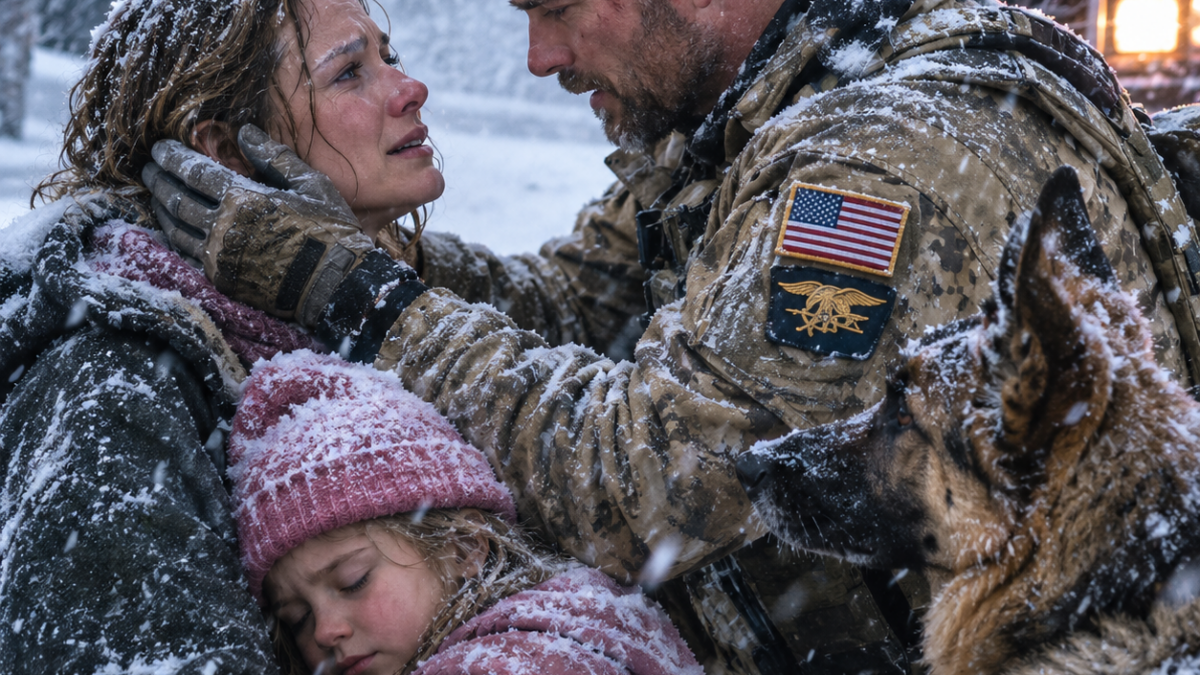
A Retired Navy SEAL Found His First Love Dragging a Mattress Through a Blizzard—Then He Looked Into the 4-Year-Old Girl’s Eyes and Learned She Was His Daughter.
Retired Navy SEAL Owen Mercer was driving through a whiteout outside McCall, Idaho, when his K9 suddenly barked three times and led his eyes to a woman dragging a soaked mattress through the storm with a little girl stumbling beside her.
The woman was Megan Hartley, the first girl Owen had ever loved and the one he had spent twenty-one years pretending he could forget, but it was the four-year-old child’s gray-blue eyes that made him realize the past he had abandoned might have grown up without him.
What Owen did not yet know was that Megan had not returned to his life looking for rescue at all—she had spent four years surviving a lie that destroyed her name, and buried beneath her collapsing cabin was evidence that could finally expose the family who had ruined her.
The storm over McCall had teeth.
It came down from the dark shoulders of the Idaho mountains in hard white sheets, swallowing the pines and smoothing the edges of the road until the yellow center line looked less like paint and more like something Owen Mercer had imagined because he badly wanted it to be there.
His old black pickup moved slowly.
Both hands on the wheel.
Wipers fighting a battle they were losing.
Heater roaring against the windshield.
Outside temperature:
Eight degrees.
Falling.
Beside him sat Bishop.
Seven-year-old German Shepherd.
Sable coat.
Black saddle.
Golden-brown chest.
One ear intact.
The other permanently nicked near the top by a piece of metal from a place Owen had stopped naming after retirement.
Bishop had left military service the same week Owen did.
Neither of them had adapted particularly well.
People liked to say retired working dogs deserved rest.
Bishop disagreed.
He considered retirement an administrative error.
Even now, with snow melting along his coat and the cab heater blasting, his body remained upright and alert.
Watching.
Smelling.
Listening.
Owen noticed the change before he noticed anything outside.
Bishop’s shoulders tightened.
Tail stilled.
Head lifted.
Then:
Three short barks.
Not excitement.
Not fear.
A report.
Owen took his foot off the gas.
“Easy.”
Bishop barked again.
PART2:
Slapped one paw against the dashboard.
Owen leaned forward.
At first there was nothing.
Snow.
Trees.
White road.
Then something moved on the shoulder.
A shape bent forward beneath something large.
Owen slowed.
Thirty yards.
Twenty.
Ten.
A woman.
Dragging a mattress.
Not carrying it.
Dragging it.
The mattress was wrapped in a blue tarp torn at one corner and tied with rope across her shoulders.
It had absorbed enough snowmelt to become nearly impossible to move.
Every few feet it caught in the roadside ruts.
The woman stopped.
Pulled.
PART3:
Dragged it free.
Kept walking.
Her coat was thin.
Green wool.
Wrong for Idaho winter.
Her boots were worse.
Ordinary rubber soles.
Cracked near the sides.
And then Owen saw the child.
Small.
Four, maybe five.
Pink knit cap.
Pale hair escaping underneath.
Blue mittens.
One mitten had a little white star stitched crookedly on the back.
She carried grocery bags in both hands.
One bag dragged through the snow whenever she stumbled.
She did not cry.
That bothered Owen more than crying would have.
Children who cried still expected somebody to answer.
Children who went quiet had already learned to ration need.
Bishop whined.
Owen reached toward the hazard lights.
Then the woman lifted her head.
The snow thinned for half a second.
He saw her face.
Twenty-one years disappeared.
“Megan.”
He said it without meaning to.
Megan Hartley.
Brown-gold hair now darker beneath the storm.
Same line of the mouth.
Same stubborn chin.
Same way she squinted into bad weather instead of turning away from it.
His first love.
His first almost-everything.
The girl who used to meet him beside Payette Lake with sandwiches wrapped in wax paper because neither of them had money for the restaurants tourists used.
The girl who told him at seventeen:
“If the Navy is the thing burning a hole through you, go.”
The girl he promised he would come back for.
He had meant it.
That was the problem with promises made by young men.
They often meant them completely at the moment they said them.
Then life arrived.
Training.
Deployments.
Deaths.
Promotions.
Classified assignments.
Numbers changed.
Addresses changed.
People changed.
Owen had come back to McCall once.
Four years earlier.
His uncle Ray had died.
Owen returned for the funeral.
He saw Megan in a roadside café after midnight.
Both older.
Both carrying things they did not explain.
They talked until the waitress turned chairs upside down on half the tables.
They laughed.
Then stopped laughing.
Megan touched the scar near Owen’s jaw.
He kissed her.
She kissed him back.
Grief and history did the rest.
Before dawn, Owen left.
Orders were waiting.
That was what he told himself.
He did not leave a working number.
Did not ask the right questions.
Did not return.
Now she was walking through a blizzard dragging a mattress while a child carried groceries beside her.
Bishop turned his head.
Looked directly at Owen.
Not accusing.
Expecting.
“I see her.”
His voice sounded unfamiliar.
“I see them.”
He drove past slowly so he wouldn’t throw slush.
Pulled onto a turnout.
Stopped.
He watched in the mirror.
Megan never looked toward the truck.
The little girl did.
Flat curiosity.
Too tired to be frightened.
Bishop fogged the passenger window.
Owen put his hand on the door handle.
Then stopped.
He remembered Megan at nineteen.
Flour on her cheek in her mother’s kitchen.
Laughing.
“I don’t need rescuing, Owen Mercer. I need people to stop deciding what kind of help I should want.”
He had loved that sentence.
Twenty-one years later it made helping much harder.
A man could not disappear for years, return during a snowstorm, and expect a woman to receive his hand as though he were some answer sent from God.
That wasn’t help.
That was guilt wearing a useful coat.
So Owen did something that felt cowardly.
He followed.
Far enough back not to crowd them.
Close enough that if either fell, he could reach them.
The road narrowed.
County plowing ended.
Megan and the girl turned down a lane barely visible beneath snow-heavy branches.
Owen waited.
Then followed.
At the end stood a cabin.
Calling it a cabin felt generous.
The roof sagged under snow.
One porch corner had collapsed.
Plastic covered a window.
A stove pipe leaned crookedly, held in place by wire.
No vehicle outside.
No fresh tire tracks.
Megan dropped the rope from her shoulders.
The mattress landed in the snow.
The child dropped one grocery bag.
Her mittened fingers struggled to pick it up.
Megan immediately knelt.
Took the little hands in hers.
Breathed warmth into them.
That small gesture nearly undid Owen.
He had seen bravery in louder forms.
Men running into fire.
Men holding doorways.
Men staying with wounded teammates after every rational calculation said run.
But there was something about Megan, exhausted and freezing, warming a child’s hands before dealing with her own pain, that felt like courage stripped of performance.
They disappeared inside.
The door closed.
Owen remained in the truck.
Bishop did not relax.
Instead the dog stared toward the north side of the cabin.
Made a low sound.
“What?”
Owen shut off the engine.
Got out.
Cold struck him immediately.
Bishop jumped down.
Pulled toward the cabin.
“Bishop. Heel.”
The dog obeyed three steps.
Then stopped beside the foundation.
Sat.
Owen knew that sit.
Not refusal.
Information.
Snow had drifted against the wall.
Beneath it, dark moisture stained old wood.
Owen crouched.
Smelled it.
Mold.
Rot.
Wet insulation.
The cabin was sick.
Then he heard a child cough inside.
One cough.
Then another.
Bishop’s ears went flat.
Owen closed his eyes.
“Not tonight.”
He didn’t know whether he was speaking to the dog or himself.
The instinct to start fixing everything was almost unbearable.
Roof.
Window.
Heat.
Food.
The mattress.
The child.
Megan.
But she had not asked.
He backed away.
Returned to the truck.
At the end of the lane, he looked back.
One small yellow square of light showed through the storm.
Then it flickered.
Twice.
Went dark.
Owen slept less than an hour.
By 5:30 he was awake in the one-room cabin his uncle Ray had left him.
Wood stove clicking.
Coffee strong enough to strip paint.
Bishop sitting by the door.
The dog looked toward the north.
Toward Megan.
Owen looked at him.
“We’re going.”
One tail thump.
By seven, Owen was at Miller’s General.
June Miller had been running the store since somewhere around the invention of weather.
Small woman.
Silver hair.
Red cardigan.
Reading glasses on a chain.
The bell jingled as Owen entered with Bishop.
June pointed immediately.
“Dogs aren’t allowed in produce.”
Bishop sat.
She narrowed her eyes.
“Unless they behave better than customers.”
“He does.”
“Most days.”
Bishop looked offended.
June looked at Owen.
Then harder.
“Ray Mercer’s nephew.”
“Yes, ma’am.”
She came around the counter.
Took both his hands.
“Well.”
She looked up at him.
“Ray talked about you whenever television showed anything Navy related. Claimed you were doing classified heroic nonsense he wasn’t allowed to ask about.”
“He asked anyway.”
“Repeatedly.”
Her eyes moved toward Bishop.
“And your uncle gave jerky to every dog who came through here.”
Bishop’s ears rose.
“Don’t encourage him.”
June smiled.
Then her expression changed.
“You came to ask about Megan.”
Owen stared.
“How—”
“Black pickup with out-of-state plates trailing a woman through yesterday’s storm like a man following his own funeral.”
He said nothing.
June pointed toward the coffee booth.
“Sit.”
“I don’t—”
“Sit.”
Owen had obeyed admirals with less authority.
He sat.
June brought coffee.
Bishop settled under the table.
“Megan Hartley,” June said.
Owen’s fingers tightened around the cup.
“I saw her yesterday.”
“Dragging that mattress?”
“Yes.”
June closed her eyes.
“Of course she was.”
“What does that mean?”
“It means I offered Pete and his plow truck.”
“She refused.”
“Said Pete’s knee is bad and she wouldn’t have him falling because of her.”
June shook her head.
“That woman could be bleeding from both ears and still ask whether the ambulance driver had eaten lunch.”
Owen looked toward the window.
“Where is she living?”
“You followed far enough to know.”
“I did.”
June watched him.
“I didn’t want to scare her.”
“But you smelled the mold.”
Owen glanced at Bishop.
“He did.”
June’s face hardened.
“The cabin belongs to some cousin-of-a-cousin arrangement. Man takes cash rent on a structure he should be ashamed to let a raccoon sleep in.”
“Why is she there?”
June studied him.
“Because this town ate her name.”
Owen went still.
“Explain.”
“Four years ago Megan kept books for Dawson Timber Lodge.”
He knew the Dawsons.
Everybody who spent time in McCall did.
Timber money.
Rental cabins.
Lodge.
Guiding operations.
County committees.
Frank Dawson had the kind of local power that never needed to announce itself because half the room already knew who owed him favors.
“Mason Dawson was running operations,” June continued.
“Money disappeared from the winter-maintenance account.”
“How much?”
“Enough to matter.”
“They blamed Megan?”
“Mason did.”
“Proof?”
“Noise.”
June’s mouth hardened.
“Sometimes noise is enough.”
“Police?”
“They threatened charges, then never formally pushed.”
Owen frowned.
“Why not?”
“No trial means Megan never gets to clear herself.”
That was smarter.
Crueler too.
June continued.
“She demanded an audit.”
“Did she get one?”
“No.”
“Then?”
“Jobs dried up.”
“People stopped hiring the thief.”
“She wasn’t convicted.”
“Small towns don’t require paperwork when gossip already has shoes on.”
Owen looked down.
“The child?”
June didn’t answer immediately.
“Lily.”
The name hit him.
“How old?”
“Four.”
The room changed.
Owen did the arithmetic.
Four years.
Funeral.
Café.
One night.
Dawn.
June watched realization move across his face.
“You know.”
“I know enough to be afraid.”
“That’s better than pretending.”
Owen’s throat tightened.
“Did Megan try to contact me?”
June sighed.
“Twice from my phone before Lily was born.”
His eyes closed.
“First number dead.”
He had changed it.
“Second went to an office in Virginia Beach. Some woman told Megan there was no Owen Mercer available.”
Classified assignment.
Temporary administrative front.
Perfectly reasonable.
Completely useless to the pregnant woman trying to find him.
“She didn’t leave a message?”
“No.”
“Why?”
June imitated Megan’s tone.
“If a man wants to be found, he leaves a trail.”
Owen almost smiled.
Then couldn’t.
“I made not knowing easy.”
June did not rescue him from that truth.
Good.
“What do I do?”
“Nothing dramatic.”
“I saw the house.”
“Exactly why I said nothing dramatic.”
“That child is coughing.”
“And if you arrive with money, lumber, and a hero complex?”
“Megan throws me down the mountain.”
“Correct.”
June drank coffee.
“Start with respect.”
“How?”
“Be where people can see you.”
“Stay.”
“Don’t promise.”
“Do.”
“Offer honest work if you have honest work.”
Owen thought about his plan for Ray’s old property.
A winter search-and-rescue training center.
K9 tracking.
Avalanche response.
Survival training.
County teams.
Guide companies.
It would need payroll.
Books.
Grant administration.
“Bookkeeper.”
June pointed her spoon.
“There.”
“Would she accept?”
“Not if she thinks you invented the job for her.”
“It’s real.”
“Then make it real before you offer.”
Owen nodded.
June leaned forward.
“And if Lily is yours?”
His stomach tightened.
“She doesn’t need a SEAL for a week.”
June’s voice became quiet.
“She needs someone boring for forty years.”
“Doctor appointments.”
“School plays.”
“Grocery lists.”
“Bad dreams.”
“Broken faucets.”
“Birthdays you don’t get medals for attending.”
“Can you do boring?”
Owen thought about the life he had lived.
Everything scheduled around urgency.
Everything measured in objectives.
He had been exceptionally good at arriving when things were breaking.
Staying after the emergency?
Less evidence.
“I don’t know.”
June nodded.
“Good answer.”
Then:
“Learn quietly.”
Owen left with a folder for the training center and grocery bags he had no permission to deliver.
June confiscated a pair of child-sized wool socks he had bought.
“These are for your truck emergency kit.”
“They have stars.”
“Coincidence.”
“June.”
“Do not sneak charity through me.”
“I wasn’t.”
“You were planning.”
Bishop accepted jerky from her while Owen was lectured.
Traitor.
By noon, Owen was walking toward Megan’s cabin.
No groceries.
No socks.
Only Bishop and a clean folder showing that the rescue center actually existed.
Lily saw the dog first.
The door opened six inches.
She stepped out wrapped in a blanket.
“Is he a wolf?”
Owen crouched several yards away.
“He believes so.”
Bishop sat taller.
Lily studied the torn ear.
“He’s broken.”
“Just the ear.”
“Does it hurt?”
“Not anymore.”
“Can I pet him?”
“If your mother says yes.”
The cabin door opened.
Megan stepped onto the porch.
Dish towel in one hand.
She recognized Owen slowly.
Confusion.
Disbelief.
Pain.
Anger.
“Owen.”
No greeting could have carried more history.
“Megan.”
“What are you doing here?”
“I saw you yesterday.”
A hard laugh.
“Yes. Everybody probably did.”
“I should have stopped.”
“Why didn’t you?”
He could have lied.
Could have said the road was dangerous.
Could have said he didn’t recognize her.
Instead:
“I remembered you hate people deciding what help you should accept.”
That landed.
Not forgiveness.
Recognition.
“You remembered that?”
“I remember more than I deserve to.”
Her eyes hardened.
“Did you remember coming back?”
There it was.
He did not defend himself.
Not with deployments.
Not with classified operations.
Not with dead teammates.
“No explanation makes twenty-one years smaller.”
“Twenty-one.”
“You can count.”
“Yes.”
“How impressive.”
Bishop sneezed.
Lily giggled behind the door.
Megan’s face flickered.
Then:
“Why are you here?”
“I’m opening a search-and-rescue training operation.”
She waited.
“It needs bookkeeping.”
Silence.
“June said you were good.”
“June needs a hobby.”
“I think I’m her hobby now.”
Almost a smile.
Gone immediately.
“You want to hire me?”
“I want to offer you legitimate work.”
“Because you saw where I live.”
“No.”
“Because you feel guilty.”
“Also no.”
“You don’t?”
“I feel enough guilt to heat Idaho.”
That surprised her.
“But the job exists whether you take it or not.”
“Paid?”
“Yes.”
“Documented?”
“Yes.”
“I’d see the books?”
“That would be the job.”
A shadow crossed her face.
“The town thief managing a Navy SEAL’s money.”
“I don’t believe you stole anything.”
Megan looked away.
The words hurt.
Too late.
“Belief is cheap when you weren’t here.”
“Yes.”
Again she looked at him.
“You’re agreeing a lot.”
“You’re right a lot.”
“That must be painful.”
“Extremely.”
The door opened again.
Lily stepped out in blue mittens.
Bishop immediately flopped onto his back in the snow.
Lily gasped.
“He wants a snow angel!”
“He wants attention.”
The dog’s tail swept the snow.
Megan almost smiled.
Then Lily moved closer.
Turned.
And Owen saw her eyes.
Gray blue.
Stormlight.
His mother’s eyes.
Evelyn Mercer.
The woman who had once told him from a hospital bed that there were different kinds of courage.
“One day,” she had said, “you might try the kind that stays.”
Owen stopped breathing.
Megan saw him see.
She pulled Lily gently back.
“Inside, baby.”
“But Bishop—”
“Inside.”
Lily obeyed.
The door closed.
Owen’s voice came too quickly.
“How old is she?”
Megan’s face went pale.
“Don’t.”
“Megan—”
“Do not stand in my yard doing math.”
“I’m sorry.”
“You should be.”
He swallowed.
“Is she mine?”
Megan flinched.
Owen hated himself immediately.
“That wasn’t fair.”
“Fair.”
She almost laughed.
“You want to talk about fair?”
Then the years came.
Letters returned.
Calls unanswered.
Pregnancy.
Dawson accusation.
Job loss.
Morning sickness.
Threats.
Rent.
Formula.
Propane.
“Tell me exactly when I was supposed to chase a man who had already demonstrated he was very good at disappearing.”
Owen did not move.
“I didn’t know.”
“Because you made not knowing easy.”
True.
“Go home.”
“Megan—”
“Please.”
That word stopped him.
Not anger.
Please.
“I cannot have you walk into Lily’s life because you suddenly discovered the past has consequences.”
She folded her arms.
“She is my daughter.”
“She is safe because I made her safe.”
“Even when safe meant a leaking roof.”
Owen said the wrong thing.
“She shouldn’t have to live like this.”
Megan’s face closed instantly.
“There.”
“I meant the house.”
“You don’t get to separate the house from the woman yet.”
He took that.
“You’re right.”
“I know.”
“I’ll go.”
She looked surprised.
“But I’m not disappearing.”
“Your promises expired.”
“Then don’t trust the promise.”
He looked toward the door.
“I’ll stay in town.”
“You can watch.”
“Work offer stays open.”
“No charity.”
“No charity.”
“No gifts through June.”
“Understood.”
He turned.
Bishop did not.
The dog walked toward the porch.
Pawed snow from a warped board near the foundation.
Underneath was an old carving.
Two letters.
O + M.
Inside a crooked heart.
Owen remembered the summer.
Megan had refused to carve a tree because “the pine did nothing to deserve teenage romance.”
So they carved a piece of scrap wood behind Ray’s shed.
Megan covered the initials with her boot.
“Go.”
Her voice had changed.
He went.
That evening, Owen sat at Ray’s table.
Bishop under it.
Ray’s old photograph on the shelf.
The note his uncle left him still in Owen’s seabag:
Come home when running gets boring.
Owen had not understood it four years ago.
Maybe Ray had.
Owen went to the church warming room that night because June called and told him to “loom productively.”
He hauled wood.
Stacked blankets.
Stayed away from Megan until she saw him.
She was seated beside a radiator.
Lily curled against her beneath a quilt.
Bishop’s tail moved.
Lily sat up.
“Mama. The wolf came to church.”
A few people laughed.
Megan did not leave.
That was something.
Owen sat only after asking.
Lily wanted Bishop closer.
Megan allowed him near enough to be pet but not near enough to steal dinner.
Bishop looked personally persecuted.
Then Lily coughed.
Wet.
Megan’s hand immediately went to her back.
Owen kept his face neutral.
It cost him.
“She gets worse when the cabin is damp,” Megan said.
“Bishop smelled mold.”
“Of course he did.”
“He’s trained for scent changes.”
“Blood.”
“Stress.”
“Recovery work.”
“Explosives.”
“Mold if it’s bad enough.”
“That is a cheerful résumé.”
“He is terrible at taxes.”
Megan’s mouth twitched.
“Then we all have limits.”
The old rhythm surfaced.
Dangerous.
Gentle.
Owen apologized for asking about Lily in the yard.
Megan accepted the apology without forgiving anything else.
Then he asked again.
This time quietly.
“Is she my daughter?”
Megan closed her eyes.
“Yes.”
One syllable.
Everything changed.
Owen put his trembling hands beneath the table.
Megan noticed.
“Don’t make a scene.”
“I’m trying.”
“She doesn’t know.”
He nodded.
“I’ll follow your lead.”
“All of it?”
“All of it.”
“When she learns.”
“Yes.”
“What she calls you.”
“Yes.”
“How fast.”
“Yes.”
“You do not buy your way into her life.”
“Yes.”
Megan’s eyes searched him.
“Words are weather, Owen.”
“They change.”
“Then watch what stays.”
He nodded.
That became the rule.
Not believe what I say.
Watch what stays.
The work offer remained.
Caleb Price, Owen’s former JAG friend, drafted the contract.
Real hourly rate.
Independent access to accounting.
No romantic language.
No hidden conditions.
Megan read every page.
Did not accept immediately.
Owen said:
“Take your time.”
She kept waiting for pressure.
None came.
Then Mason Dawson arrived at the church.
Charcoal coat.
Polished smile.
The kind of man who could insult you without changing his volume.
“I heard Megan was here.”
Bishop positioned himself at the bottom of the stairs.
Silent.
Mason looked at him.
Then at Owen.
“Owen Mercer.”
“Mason Dawson.”
“Ray’s nephew.”
“Yes.”
“Navy man.”
“Retired.”
Mason smiled toward Megan.
“I heard the Hartley cabin lost power.”
“We’re fine,” Megan said.
“We have a maintenance room at the lodge.”
“No charge.”
“No.”
“Think about Lily.”
Megan’s face changed.
“Do not use my daughter.”
Mason’s smile cooled.
“I’m trying to help.”
“You don’t know how.”
He looked at Owen.
“Be careful who you let around your child.”
That was deliberate.
Owen felt anger rise.
Megan answered before he could.
“Do not talk about my child.”
The room went quiet.
Mason’s smile returned.
“You’ve always been protective.”
“No.”
Megan looked at him.
“You resent that I am.”
For one second the polished man vanished.
Irritation.
Entitlement.
Fear.
Then the smile came back.
“Winter is hard on people who don’t plan.”
He left.
June waited until the door closed.
“May his socks always be damp.”
Lily looked up.
“Is that bad?”
“Terrible.”
Even Megan laughed.
But afterward she gave Owen boundaries about the Dawsons.
No confrontation.
No Dawson property.
No using Lily as justification.
If Megan said stop, he stopped.
He wrote the rules down and pinned them beside Ray’s photograph.
Caleb searched public records only.
Dawson entities.
Liens.
Old filings.
Mason had formed an LLC shortly before the missing money surfaced.
The company had bought equipment.
Then struggled with debt.
Not proof.
But enough to make Caleb curious.
Megan revealed she had once kept backup records.
Partial payroll summaries.
Vendor sheets.
Handwritten corrections.
She had hidden them in a tin box beneath the north side of the old cabin.
The same side Bishop had identified.
They searched the next morning.
Owen did not reach into the crawl space.
He waited.
Megan retrieved the box herself.
Inside:
Plastic-wrapped papers.
Fuel transfers.
Corrections in Mason’s handwriting.
Different figures from the versions Megan had approved.
Not proof of everything.
But proof that the story had cracks.
Caleb brought in forensic accountant Priya Shah from Boise.
Priya had the comforting personality of a bank vault.
Megan liked her immediately.
Then the second storm came.
Bigger.
Worse.
Roads closing.
Megan had taken Lily back to the cabin because she wanted her daughter sleeping in her own bed.
Owen knew better than to order her out.
He parked at the end of the public lane with emergency gear in his truck.
Texted:
Storm worsening. I’m nearby with supplies if you ask.
No response.
Forty minutes.
Bishop paced.
The cabin light flickered.
Then came a cracking sound through the storm.
Timber.
Owen drove.
The truck stuck three-quarters of the way in.
He and Bishop continued on foot.
The roof over Lily’s room had begun to fail.
Water poured inside.
Front door jammed.
Owen used a hatchet and his bad shoulder to break through the rear entrance.
Megan did not argue this time.
That frightened him more than resistance would have.
Lily stood under a blanket.
Silent.
Bishop pressed against her.
Owen helped get her coat on while Megan packed medicine and the inhaler.
Then the ceiling cracked.
They got outside.
Ten steps later, part of the roof collapsed.
Megan screamed.
Lily cried.
Owen carried Lily through the snow.
She tucked her face against his neck.
“Mr. Owen?”
“Yes?”
“Is our house falling down?”
He looked at Megan.
“Part of it got tired.”
“Where are we going?”
“Somewhere warm.”
“Bishop too?”
Bishop plowed ahead.
“Apparently he insists.”
The truck was buried.
Owen shoveled.
Megan joined him.
“Get inside.”
“I’m not decorative.”
“I didn’t say—”
“Then dig.”
They dug together.
Traction boards.
Branches.
Snow refilling every space they cleared.
Third attempt.
The truck broke free.
At the church, Lily was wrapped in blankets.
A nurse checked her lungs.
Stable.
Owen decided stable was the greatest word in English.
Megan sat opposite him.
Snow melting from her hair.
Hands shaking.
“Thank you.”
“You don’t owe me thanks for getting my daughter out.”
He froze.
Megan did too.
She had said it.
My daughter.
Their daughter.
“Our daughter?” he asked softly.
Megan’s eyes filled.
“Yes.”
This time the word sounded different.
Not admission.
Beginning.
The next morning, Bishop found a second metal box buried beneath the damaged cabin foundation.
This one wasn’t Megan’s.
Dawson Timber maintenance label.
Owen did not touch it.
Deputy Anita Brooks was called.
She documented its location.
Bagged it.
Chain of custody.
Inside were internal vendor summaries.
Fuel receipts.
A damaged hard drive.
Mason’s handwriting.
Megan’s original totals.
Altered copies.
Priya recovered data from the drive.
Three transfers from the winter-maintenance account fed through companies tied to Mason.
The amounts had been divided.
The dates lined up with the period Megan had been accused.
Deleted security footage showed Mason entering the accounting office after midnight with his own key card.
He had publicly claimed Megan was the only person with after-hours access.
“He lied.”
Megan stared at the screen.
“Yes,” Caleb said.
“All of them believed him.”
June stood in the doorway.
“Not all.”
Megan looked at her.
June’s eyes filled.
“I didn’t believe it.”
“June—”
“I said so quietly.”
Her voice broke.
“To safe people.”
“Where it cost me nothing.”
“I should have said it loudly.”
“I’m sorry.”
Megan stood.
Hugged her.
June immediately complained about flour getting on her sweater.
Owen looked away.
Some apologies deserved privacy.
The cabin was condemned.
Owen arranged temporary housing for Lily through Caleb.
Not a secret gift.
Not a romantic rescue.
A documented parental support arrangement.
Megan read every line.
Signed.
Then moved with Lily into a furnished rental cabin near the church.
The first night Lily took a long hot shower and sang nonsense at full volume.
June cried while chopping onions that did not require chopping.
Later Megan stood on the porch alone.
Owen found her as he was leaving.
“I can go.”
“No.”
The word surprised both.
Snow fell gently.
“I don’t know how to accept this.”
“Don’t accept all of it.”
She looked at him.
“Accept tonight.”
“Heat.”
“Safe roof.”
“Lily asleep.”
“Tomorrow can argue tomorrow.”
Megan laughed weakly.
“You’re using my survival rules.”
“They’re good.”
“They were lonely.”
Owen said nothing for several seconds.
“I’m sorry you had to make them alone.”
This time she did not turn away.
“So am I.”
Mason responded to the reopened investigation by smiling more.
Dawson Timber released statements.
Malicious rumors.
Stolen records.
Outside agitators.
Frank Dawson spoke publicly about loyalty.
Community.
Family.
Words men like Frank used whenever accountability came dressed as betrayal.
Rumors started again.
Megan had found a rich veteran to fight her battles.
Owen was unstable from war.
Bishop was dangerous.
Megan was manipulating him.
Owen wanted to answer.
Megan didn’t.
“Paper,” Caleb reminded him.
“Beats outrage.”
Usually.
Then Rachel Dawson arrived.
Mason’s sister.
Thirty-seven.
Terrified.
She came through the back door of Miller’s General carrying a manila envelope.
June locked the store.
Megan was in the back with Caleb and Owen.
Lily coloring stars around a print of Bishop’s paw.
Rachel saw Megan.
Almost turned around.
“I shouldn’t have come.”
June blocked the exit.
“Too late.”
Rachel’s eyes filled.
“I knew.”
Megan went still.
“Some of it.”
Rachel’s voice shook.
“I knew Mason was moving money.”
“I saw transfers.”
“I saw him changing reports after you signed.”
“I told myself there had to be an explanation.”
“He was my brother.”
“My father said families survive by not handing knives to outsiders.”
Megan’s face went white.
Rachel placed the envelope down.
“I saved copies.”
“Why?”
“At first because I thought Mason might blame me someday.”
Then quieter:
“Later because I was ashamed.”
She had ledger pages.
A cashier’s check tied to a private gambling debt.
A handwritten instruction from Mason:
Move winter maintenance variance to Hartley review file.
Megan stared.
“He wrote my name.”
She touched the words.
“All these years I wondered if maybe I made some mistake.”
“If I missed something.”
“He wrote my name.”
Rachel cried.
“I watched people destroy you.”
“I watched you come to the lodge once with Lily in a sling asking for your final paycheck.”
“I hid.”
“Why?”
“Because if you saw me, you might ask me to be brave.”
Megan sat down.
“Would you have been?”
“No.”
Rachel answered immediately.
“No.”
Bishop stood.
Walked to Rachel.
Sat at her feet.
Lily looked up.
“He does that when people are sad or lying.”
Rachel blinked.
Lily considered.
“Maybe you’re sad.”
Bishop leaned against Rachel.
A broken laugh came out.
“Yes.”
“I’m very sad.”
“Then he’s helping.”
Lily returned to coloring.
To her, case closed.
Rachel agreed to testify.
Then came the mistake.
Bishop disappeared near Dawson property.
Owen had been inspecting public-access terrain for the rescue center when the dog caught a scent and vanished beyond the visible line.
Owen called Anita.
Gave his location.
Waited.
Not long enough.
He heard Bishop whine inside an old storage barn.
Door open.
Owen crossed.
Found Bishop trapped in a cable snare inside a utility cage.
The wire had tightened around one front leg.
Not cutting.
But swelling.
Owen freed him.
Bishop immediately limped toward the back of the barn.
Of course he did.
Behind carpet rolls:
Lifted floorboard.
Black waterproof bag.
Owen did not touch it.
Photographed it.
Stepped away.
Sirens approached.
Anita arrived with deputies.
Megan arrived in June’s car despite everybody telling her not to.
She ran into the barn.
Dropped beside Bishop.
“You idiot dog.”
Bishop put his head against her shoulder.
Then Megan looked at Owen.
“You crossed onto Dawson property.”
“Yes.”
“I told you not to.”
“Yes.”
“Do not ‘yes’ me.”
Caleb’s voice came over Anita’s phone.
“For the record, I am also scowling.”
Owen nodded.
“I called Anita first.”
“You still went in.”
“I heard Bishop.”
“You could have been arrested.”
“Yes.”
“Hurt.”
“Yes.”
“Stop agreeing like it fixes things.”
“It doesn’t.”
Her anger shook.
Then underneath it came fear.
“I need you alive, Owen.”
She stopped.
“Lily needs you.”
Another pause.
“I might too.”
Owen did not touch the sentence.
Did not ask what she meant.
“I’ll do better.”
“Actually better.”
“Not poetically better.”
“Yes.”
The waterproof bag contained:
Keycard encoder.
Printed access logs.
Two thumb drives.
Cash still wrapped in a Dawson Timber deposit band from four years earlier.
The logs showed Mason entering the accounting office repeatedly after hours.
One drive contained accounting exports with changes made after Megan’s final login.
The second held clearer security footage.
Mason carrying a bank envelope out of the accounting room the night before the missing money was reported.
Priya studied everything.
“This is useful.”
For Priya, that was celebration.
Mason’s attorney claimed Owen planted the evidence.
That argument struggled against Anita’s photographs, the snare, the physical Dawson property, old dust beneath the floorboards, Rachel’s identification of the keycard equipment, and records dating back years.
Frank called Owen an unstable veteran.
Owen read the article while Bishop got his leg wrapped at the veterinary clinic.
Megan sat beside him.
“That hurt you.”
“I’ve been called worse.”
“That isn’t what I said.”
Owen looked at her.
The exam room smelled of disinfectant and wet dog.
“It hurts because some of it used to be true.”
She waited.
“Sam died on my last deployment.”
The name surprised him by existing aloud.
“My teammate.”
“We got home.”
“I didn’t come home right.”
“Bishop knew.”
“Probably before I did.”
Megan did not tell him he was fine.
Did not say the past was over.
She rested one hand near his on the bench.
Not touching.
Near.
That was enough.
The prosecutor reopened the Dawson matter.
Mason offered settlement.
Money.
Confidentiality.
Megan sat with Caleb at the rental cabin.
Owen was there only because she asked.
Caleb explained the offer.
Enough money to rebuild.
Enough to give Lily stability.
In exchange:
Confidential release.
No public admission.
No continued demand for formal correction.
Megan looked toward Lily’s bedroom.
Then toward the window.
“I spent four years being a lesson.”
“What kind?” Owen asked.
“Don’t become Megan.”
Her voice stayed steady.
“Don’t trust the wrong people.”
“Don’t reach above your place.”
“Don’t touch money if powerful people can accuse you of taking it.”
She shook her head.
“If I take his money and silence, Lily gets a better roof.”
“But the same shadow stays over my name.”
Caleb waited.
“What do you want?”
“Truth.”
“Public.”
“Not revenge.”
“Truth.”
Caleb nodded.
“Then we proceed.”
Across town, Rachel finally stopped waiting for permission to be brave.
Her testimony strengthened the case.
Frank Dawson tried to intimidate her.
Then tried Caleb.
Frank entered Caleb’s temporary office with an elk-antler cane and old-money certainty.
“You are helping a bitter woman destroy a family that built this town.”
Caleb leaned back.
“If you intend to intimidate witnesses, Mr. Dawson, I recommend doing it in front of fewer witnesses.”
Frank looked at Owen.
“You think Megan loves you?”
“She loves what you can do for her.”
Owen saw it then.
Not power.
Fear disguised as power.
“Maybe you’ve mistaken love for leverage so long you can’t recognize the difference.”
Frank’s face reddened.
“You don’t belong here.”
Owen thought of Lily asking him to tie a boot.
Megan’s ruined cabin.
Ray’s note.
Bishop by the church radiator.
Maybe belonging was not decided by the oldest man with money.
“Court can sort that out.”
The hearing came in March.
Snow outside the courthouse.
Megan stood on the steps.
Bishop pressed his nose into her hand.
“You ready?” Owen asked.
“No.”
Caleb approached.
“Good.”
Megan frowned.
“Ready people are often underinformed.”
June hugged Megan.
“Tell the truth.”
“Let lawyers wrestle with furniture.”
Caleb sighed.
“That is not legal advice.”
“It should be.”
Lily stayed with June.
Before Megan entered, Lily gave Owen a folded paper.
“For Mama if she gets scared.”
He opened one corner.
A star.
Bishop.
Three stick people.
A house with a roof containing no holes.
His throat tightened.
“I’ll keep it safe.”
Lily touched his cheek.
“Bishop says you can do hard things.”
Owen looked at the dog.
“He told you?”
“With his eyebrows.”
“Professional secrecy.”
Inside, Frank sat in the front row.
Mason beside his attorney.
Rachel separate from them.
Priya testified first.
Transfers.
Altered timestamps.
LLC.
Gambling debts.
Changed ledgers.
Mason’s attorney tried to make the accounting sound impossibly complicated.
Priya adjusted her glasses.
“Complexity is not ambiguity.”
June whispered:
“Put that on a pillow.”
The judge looked at her until June discovered urgent business inside her purse.
Deputy Anita testified about the hidden boxes.
Chain of custody.
The barn.
The cable snare.
The waterproof bag.
Mason’s attorney suggested Owen planted evidence.
Anita said:
“I photographed Mr. Mercer outside before reentry under supervision.”
“The bag was beneath old floorboards covered in dust and rodent waste.”
She paused.
“Unless Mr. Mercer trained rodents to participate in financial fraud, I consider planting unlikely.”
The courtroom made a sound.
The judge silenced it.
Rachel testified.
Her hands shook.
Then her voice found itself.
Mason’s gambling problems.
Night office access.
Changed reports.
The sentence that finally cracked something inside Megan:
“Mason said Megan was the cleanest place to put the dirt because she had access but no power.”
Owen felt rage enter his body.
He put both feet flat.
Breathed.
Did nothing.
Rachel described Frank’s response when she questioned the story.
Keep family matters inside the family.
Let the girl defend herself.
Mason’s lawyer attacked.
Rachel was emotional.
Angry.
Unstable.
Influenced by Owen.
Rachel went pale.
But remained seated.
“I am ashamed.”
Her voice shook.
“That is not the same as unstable.”
“I am afraid of my father.”
“That is not the same as lying.”
“And nobody influenced me to remember what I spent four years trying not to remember.”
Frank stared at his daughter.
Rachel never looked back.
Megan testified last.
No theatrics.
She admitted fear.
Admitted hiding partial records.
Admitted being too proud sometimes to ask for help.
Then said:
“But I did not steal.”
Her voice reached the back wall.
“I did not take money from Dawson Timber.”
“I did not take money from anyone.”
“I lost my name because a powerful man needed somewhere to put his son’s crime.”
Mason lowered his eyes.
The judge recessed.
Outside, townspeople approached Megan awkwardly.
“I always wondered.”
“I never believed all of it.”
“Rumors get out of hand.”
Megan offered manners.
Not absolution.
Rachel stood beside her.
“Whatever happens, I’m sorry.”
“It was late,” Megan said.
Rachel’s face folded.
“Yes.”
Then Megan added:
“But late truth has to start somewhere.”
The judge returned.
Evidence sufficient for charges against Mason Dawson.
Fraud.
Evidence concealment.
False accusation.
Megan’s public record corrected.
Civil damages claim allowed to move forward.
Mason’s lawyer objected.
Overruled.
Frank stood.
Bailiff moved.
Frank sat.
Megan did not react.
Then her knees weakened.
Owen touched her elbow.
Only enough to steady.
“It’s over.”
Caleb, incapable of allowing emotion to destroy accuracy, said:
“This part is over.”
“Criminal case starts now.”
“But your name is corrected today.”
Megan stared.
“My name?”
Owen’s voice broke.
“Your name.”
Outside, June brought Lily.
Lily ran up the courthouse steps.
“Mama!”
Megan knelt.
Lily crashed into her.
“Did the judge fix the roof?”
Megan laughed and cried at the same time.
“No, baby.”
“What did she fix?”
Megan looked at the courthouse.
At Owen.
Rachel.
Caleb.
June.
The town beyond.
“Something people broke.”
Lily accepted that.
Then called Bishop.
The dog charged forward with all remaining dignity abandoned.
Licked her face.
She screamed laughing.
A newspaper photographer caught that moment.
Not Mason.
Not the judge.
Not the documents.
A little girl laughing in snow with a bandaged German Shepherd while her mother stood behind her with her name returned.
Frank Dawson suffered a medical collapse two days later.
Hospital in Boise.
Megan surprised Owen by asking him to drive her.
“Why?”
“I don’t want Lily learning that justice requires hatred afterward.”
“He doesn’t deserve your forgiveness.”
“I didn’t say forgiveness.”
June sent muffins.
Owen looked at the bag.
“He definitely doesn’t deserve muffins.”
“No.”
Megan looked out the windshield.
“But I deserve to walk into that room without him controlling me.”
Frank looked diminished in the hospital.
Machines.
Thin blanket.
Rachel in the corner.
He saw Megan.
“Come to gloat?”
“No.”
“Then why?”
“To tell you I know.”
Her voice trembled.
“The court knows.”
“The town will know.”
“I will not pretend your family didn’t destroy part of my life.”
“And I will not protect Mason from consequences.”
She set the muffins down.
“But I’m leaving your hatred here.”
Frank closed his eyes.
Megan turned.
Walked out.
On the drive home she rested her head against the window.
“I thought justice would feel bigger.”
Owen kept his eyes on the road.
“Maybe it’s built small enough to carry.”
Megan glanced at him.
“When did you start talking like that?”
“June.”
“She says it better.”
“Almost always.”
At the rental cabin, Lily met them with drawings.
Bishop had stolen one of Caleb’s socks.
Ordinary chaos.
Owen realized he had once thought the hearing was the summit.
It wasn’t.
It was a clearing.
The mountain remained.
Megan still needed to tell Lily the truth.
Owen still had to become something more difficult than a rescuer.
Reliable.
Spring arrived slowly.
Megan told Lily on a Sunday afternoon.
Soup on the stove.
Bishop asleep near the door.
Owen sat across the room because Megan wanted him close but not crowding.
Lily was drawing stars.
Megan took her hands.
“Baby, I need to tell you something about Owen.”
Lily’s eyes widened.
“Is he sick?”
“No.”
Megan breathed.
“He’s your father.”
Lily blinked.
Looked at Owen.
Then Bishop.
Then Megan.
“Like in books?”
“Yes.”
“But real.”
Lily frowned.
“Did he get lost?”
Owen’s chest broke open.
Megan looked at him.
He moved to the rug.
Slowly.
Stopped several feet away.
“Yes.”
Lily watched.
“I got lost for a long time.”
“Your mama found the road without me.”
“I am sorry I wasn’t there when you were born.”
“Or when you were little.”
Lily frowned.
“I am little.”
Owen almost laughed and cried simultaneously.
“You are?”
“Yes.”
He swallowed.
“Can I be here for the rest of little?”
Lily leaned toward Bishop.
Whispered into his ear.
The dog stared at Owen.
Tail thump.
Lily nodded.
“Bishop says yes.”
A pause.
“But you share pancakes.”
Megan laughed.
Owen covered his face.
He had survived combat.
Interrogations.
Funerals.
A four-year-old negotiating pancake access destroyed him completely.
At first Lily called him Mr. Owen.
Then Owen.
Then Daddy Owen.
One morning she was eating toast and struggling with a jam jar.
“Dad, open this.”
Owen opened it.
Set it down.
Walked calmly outside.
Megan found him on the porch three minutes later.
“You okay?”
“A jam jar changed my life.”
“Powerful objects.”
“I didn’t want to cry into strawberry preserves.”
“Good judgment.”
She smiled.
Trust grew in ordinary places.
Owen turned down a high-paying security position in Virginia Beach.
He told Megan before answering.
Not because he needed permission.
Because secrecy had already cost them enough.
“It’s good work,” she said.
“Yes.”
“You’d be good at it.”
“Yes.”
“You want it?”
Owen looked around.
Lily’s drawings on the refrigerator.
Bishop’s blue star charm hanging by the door.
Megan’s textbooks.
“No.”
“Don’t say no for me.”
“I’m not.”
“For Lily?”
“Not exactly.”
“Then why?”
“Because I know what leaving costs now.”
Megan folded the offer letter.
“Here?”
“Here.”
She looked at him.
“I’m trying to believe you.”
“I know.”
“Some days I do.”
“That’s enough for today.”
The Mercer-Hartley K9 Search and Rescue Training Center opened in May.
Two sheds.
Obstacle course.
Small classroom.
Hand-painted sign June said looked “earnest and visually unfortunate.”
Megan handled the books.
Grant applications.
Payroll.
Compliance.
She eventually enrolled in online business courses to finish the degree she had abandoned.
Caleb said Owen had finally been rescued from his greatest operational threat:
Arithmetic.
Bishop stole a pancake from the mayor on opening day.
June declared the pancake compromised before theft.
Rachel Dawson attended.
She had moved out of her father’s house.
Began volunteering at the church warming room.
Her relationship with Megan remained cautious.
Not instant friendship.
Truth did not erase betrayal.
Rachel gave Megan a framed copy of one original ledger page.
“I thought you might hate this.”
Megan studied it.
“No.”
“What will you do with it?”
“Office wall.”
Rachel looked shocked.
“As a reminder.”
June appeared with coffee.
“Records matter.”
“And cowards can become witnesses if they stop practicing.”
Rachel winced.
Megan touched her arm.
“She means that affectionately.”
“I absolutely do not.”
Then June hugged Rachel anyway.
Summer came.
Then fall.
Then winter again.
Owen learned Lily’s life.
Which socks bothered her toes.
Which cough meant inhaler.
Which bedtime story required voices.
Which school lunch she would not eat.
He attended a preschool Christmas performance in which Lily forgot her line while dressed as a star.
Bishop sneezed from the back row.
Everyone laughed.
Lily remembered.
She pointed at the ceiling.
“I SHINE!”
Owen applauded like she had won Olympic gold.
Megan laughed beside him.
They argued too.
Megan waited too long to ask for help.
Owen went silent under stress.
He hated that she assumed independence was always strength.
She hated that he occasionally treated planning like permission.
They learned to stop.
Name it.
Try again.
One night Owen woke from a nightmare.
Went outside barefoot in snow.
Megan found him.
Brought boots.
Blanket.
Sat beside him.
“Want to talk?”
“No.”
“Want me to go?”
He hesitated.
“No.”
She stayed.
No interrogation.
No fixing.
That mattered more than a speech.
Another time paperwork from Lily’s medical provider mistakenly identified Megan as a dependent beneficiary instead of co-authorizing parent.
Megan froze.
Paper had been used as a weapon against her before.
Owen did not tell her she was overreacting.
He called.
Corrected it.
Got a clean copy.
Apologized.
Trust grew because someone could be corrected without leaving.
Nearly one year after the first storm, snow returned.
Soft this time.
Owen prepared dinner on the porch of Megan’s new farmhouse.
She had bought it using part of the civil settlement.
Not huge.
Sound roof.
Mudroom.
Safe furnace.
Fenced yard.
Near the rescue center.
June cooked half the dinner, denied involvement, and disappeared poorly.
Caleb took Lily to choir practice.
Rachel left flowers.
Bishop wore a small pouch attached to his collar.
Megan stepped outside.
Cream sweater.
Hair loose.
Saw the candles.
Stopped.
“Owen.”
“That tone worries me.”
“What are you doing?”
“I had a speech.”
“Had?”
“Bishop ate the corner.”
Bishop looked away.
Megan laughed.
Owen took a breath.
“I loved you when I was eighteen.”
“Badly.”
“Because I was young and thought wanting someone was the same as knowing how to care for them.”
Megan’s eyes filled.
“I loved you four years ago.”
“And I ran because grief and fear were easier to call duty.”
Snow drifted beyond the porch.
“This year taught me something.”
“What?”
“Love can be ordinary and still terrify a man.”
She smiled through tears.
“It’s medicine schedules.”
“Court dates.”
“Budget meetings.”
“Pancake theft.”
“School forms.”
“Nightmares.”
“Roof inspections.”
“And staying in the room after pride gets loud.”
He took the pouch from Bishop.
“I can’t fix the past.”
“I don’t want to.”
Megan’s voice was soft.
“I want to build the rest.”
“Slowly.”
“Honestly.”
“And with June interfering more than either of us wants.”
From inside came June’s voice.
“I HEARD THAT.”
Megan laughed.
Owen opened the ring box.
“Megan Hartley.”
“Will you marry me?”
She looked at the ring.
Then Bishop.
Then Owen.
“Yes.”
His breath left him.
Then Megan raised one finger.
“If Bishop carries the rings at the wedding, we secure them properly.”
“Operational requirement.”
“Three knots.”
“At least.”
They married in December.
Churchyard.
Snow.
Warm lights.
Lily wore a white dress with blue star mittens and snow boots because Megan refused to give a child cold feet for photographs.
Bishop carried the rings in a pouch secured by three knots inspected by Caleb as if transporting classified intelligence.
June cried.
Denied it.
Rachel stood with Megan.
Not because blood erased anything.
Because people can sometimes walk out of inherited darkness.
When Owen kissed Megan, Lily shouted:
“NOW WE’RE ALL FOUND!”
Everyone laughed.
Even Caleb.
Years passed.
People in McCall told the story in different ways.
Some said Owen rescued Megan in a blizzard.
Megan hated that version.
“I got myself through plenty before he showed up.”
Owen agreed.
Some said Bishop solved a fraud case.
June preferred that version because Bishop was more entertaining than lawyers.
Caleb objected on procedural grounds.
Others called it a love story.
It was.
But not because a man found a woman in snow.
That was only the beginning.
The love story was the boring part afterward.
Showing up.
Keeping appointments.
Letting Megan sign her own documents.
Waiting outside doors until invited.
Telling Lily the truth.
Driving to preschool.
Learning multiplication homework.
Replacing furnace filters before winter.
Sitting beside Megan in silence when an old rumor resurfaced.
Letting her be angry.
Letting himself be afraid.
Staying.
Megan’s name became respected again.
Not because the town magically became noble.
Some apologized sincerely.
Some rewrote their own history.
“I never really believed it.”
“I always had doubts.”
Megan learned not every apology required acceptance on demand.
She could be polite.
She could forgive.
She could also remember.
Those things were allowed to exist together.
Mason eventually accepted a plea agreement involving financial fraud, evidence concealment, and restitution.
The lodge changed ownership after Frank’s health declined.
Rachel declined family money tied to the business.
Started over smaller.
Frank never became an easy man.
Real life did not require him to transform for Megan to heal.
That was another lesson.
You do not need the person who hurt you to become good before you are allowed to move forward.
The training center grew.
Sheriff departments sent teams.
Mountain guides came for avalanche-response courses.
Owen trained dogs.
Megan became operations director.
Eventually people stopped introducing her as “the woman Dawson accused.”
That mattered.
One day someone introduced Owen as:
“Megan Hartley’s husband.”
He liked that better than most of his old titles.
Bishop aged.
Slowly at first.
Gray around the muzzle.
Stiffer mornings.
Shorter training sessions.
Longer naps in Megan’s office.
He remained convinced pancakes were a constitutional right.
Lily grew up thinking it was perfectly normal for a military dog to attend family meetings.
When she was nine, a teacher asked students to draw their families.
Lily drew Megan.
Owen.
Herself.
Bishop.
June.
Then added Caleb at the edge with a cane because “he comes to dinner a lot.”
She drew the old collapsed cabin in the corner.
Owen asked why.
“So we remember.”
“Remember what?”
Lily shrugged.
“Where Mom got us from.”
Megan laughed.
“That is not exactly what happened.”
Lily looked at her.
“Close enough.”
One winter morning, snow came hard again.
Not as violent as the first storm.
Enough to erase the mountains.
Owen stood by the rescue-center window.
Watched white swallow the field.
For a moment, he saw the road again.
Green coat.
Blue tarp.
Little girl with grocery bags.
He heard Bishop’s three barks.
The moment that split his life into before and after.
Megan came behind him.
“What?”
“Nothing.”
“You have the face.”
“What face?”
“The one where you’re living twenty years ago and pretending you’re looking at weather.”
He smiled.
She slipped one hand into his.
Bishop, now old enough to resent getting up unnecessarily, pushed himself from the rug.
Walked over.
Leaned his body against both their legs.
Megan looked down.
“He’s heavier.”
“He’s always been heavy.”
“He’s dramatic.”
“Also always.”
Bishop sighed.
Lily called from the other room.
“DAD! MOM! BISHOP STOLE MY PANCAKE!”
Owen closed his eyes.
Megan laughed.
“You trained him.”
“Not for this.”
“Clearly.”
They walked toward the kitchen.
That was the life June had warned him about.
Broken sinks.
Medicine.
Breakfast.
School.
Ordinary things.
He had once admitted he didn’t know whether he could do ordinary.
Now he knew.
Ordinary was harder than heroism in some ways.
Heroism often arrived with adrenaline.
A clear task.
A beginning.
An end.
Ordinary required repeating the choice after nobody applauded.
Sometimes Owen failed.
Sometimes Megan did.
Sometimes they hurt each other accidentally.
Sometimes Lily slammed her bedroom door.
Sometimes Bishop threw up on the rug.
Sometimes money got tight during off-season months at the rescue center.
Sometimes Owen’s nightmares returned.
Sometimes Megan heard a stranger mention Dawson Timber and spent the rest of the afternoon inside an old humiliation she thought she had finished processing.
But nobody disappeared.
That was the rule.
You could need space.
Take a walk.
Close a door.
Cry.
Be angry.
Sleep badly.
But you came back to the table.
Years after the case, Rachel asked Megan a question.
They were cleaning up after the rescue center’s annual fundraiser.
“Do you forgive me?”
Megan stopped stacking cups.
Rachel immediately looked embarrassed.
“I shouldn’t have asked.”
“No.”
“It’s fair.”
Megan thought.
“I don’t know if forgiveness is one event.”
Rachel listened.
“I trusted you enough to let you watch Lily last month.”
“Yes.”
“I call you when I’m angry.”
“Yes.”
“I invited you to Christmas.”
Rachel smiled faintly.
“You made me peel potatoes.”
“You were terrible.”
“I know.”
Megan looked at her.
“Maybe forgiveness looks like that.”
“Potatoes?”
“Apparently.”
Rachel cried.
Megan hugged her.
Then told her the potatoes were still unacceptable.
Owen watched from across the room.
Did not intervene.
He had finally learned some things repaired better when he kept his hands off them.
When Bishop was fourteen, his back legs began failing.
Lily was ten.
Old enough to understand.
Not old enough to like it.
The veterinarian explained.
Pain.
Arthritis.
Neurological decline.
Medication bought time.
Not forever.
Lily slept beside Bishop on the floor his final week.
The dog who had once found explosives, tracked people through mountain snow, and discovered evidence hidden beneath houses now mostly slept.
But whenever Lily cried, his tail still moved.
One evening Owen sat beside him.
Bishop lifted his head.
Pressed it weakly against Owen’s hand.
“You did enough.”
Owen whispered.
The dog looked toward Megan.
Then Lily.
Then back at him.
“I know.”
He smiled through tears.
“You found us.”
Bishop sighed.
On his final morning, they brought him outside.
Snow had fallen overnight.
Thin.
Clean.
Bishop had always loved snow.
Megan spread a blanket.
Lily lay beside him.
Owen held his head.
The veterinarian came to the house.
No clinic.
No steel table.
No fluorescent lights.
Just family.
Bishop died with Lily’s hand on his shoulder.
Megan’s hand in Owen’s.
And one blue mitten with a white star tucked beside him.
The original mitten.
Megan had saved it all those years.
Owen buried Bishop near the rescue center beneath a pine overlooking the training field.
The stone read:
BISHOP
GOOD DOG
GOOD SOLDIER
BETTER FRIEND
June objected.
“Too modest.”
“He would have wanted more about pancakes.”
So Lily added a tiny pancake etched into one corner.
That was better.
The first winter after Bishop’s death was difficult.
Snow felt different.
Too quiet.
Owen still turned toward the passenger seat while driving.
Still waited for three barks when something moved near the road.
One evening he drove through a storm with Lily beside him.
She was eleven.
Almost twelve.
Old enough to use sarcasm professionally.
A dark shape appeared near the shoulder.
Owen slowed.
Lily looked.
A man whose truck had slid into a ditch.
Owen pulled over.
Lily smiled.
“What?”
“You didn’t drive past.”
“No.”
She looked out the windshield.
“Bishop trained you.”
Owen laughed.
“Probably.”
They helped the man.
No drama.
Tow strap.
Gloves.
Ten minutes.
Then continued home.
Lily stared out the window.
“Dad?”
“Yeah?”
“Did Mom really drag a mattress through a blizzard?”
“Unfortunately.”
“She says the story gets more ridiculous every year.”
“It was ridiculous when it happened.”
“Were you scared?”
“When I saw her?”
“Yes.”
He thought.
“Yes.”
“Because of the storm?”
“No.”
Lily looked at him.
“Because I knew I loved her.”
“Still?”
“Immediately.”
“And me?”
His throat tightened.
“When I saw your eyes, I knew something had changed.”
“But you didn’t know yet.”
“No.”
“What did you think?”
He smiled.
“I thought I was in trouble.”
She laughed.
“You were.”
“I know.”
They drove on.
At home Megan stood on the porch waiting.
Not because she was afraid Owen would disappear.
Not anymore.
Because dinner was getting cold.
That difference was everything.
Years later, Lily would hear people tell the simplified version.
Retired Navy SEAL finds first love in blizzard.
Discovers secret daughter.
Exposes corrupt businessman.
Marries lost love.
People liked stories shaped that way.
Clean.
Destined.
Romantic.
Lily knew better.
Her father had once told her:
“Destiny is what people call a story after all the difficult choices have already been made.”
The truth was messier.
Owen could have seen Megan on the road and kept driving.
He could have rushed in too quickly and driven her away.
Megan could have rejected every offer forever because pride had once been the only wall protecting her dignity.
June could have stayed quiet.
Rachel could have burned the last pages.
Anita could have treated the evidence carelessly.
Caleb could have promised certainty where none existed.
Priya could have mistaken complexity for ambiguity.
Megan could have taken settlement money and kept the truth private.
Owen could have accepted Virginia Beach.
He could have mistaken one dramatic rescue for proof that he had earned fatherhood.
He could have left after the crisis.
None of those things happened.
Not because they were destined not to happen.
Because people made choices.
Again.
And again.
That was the part worth remembering.
Megan eventually framed Lily’s courthouse drawing.
Three stick figures.
A dog.
One star.
A roof with no holes.
It hung beside the restored Dawson ledger page in the rescue-center office.
Visitors sometimes asked about the strange combination.
A child’s drawing beside financial evidence.
Megan would smile.
“One shows what happened.”
“The other shows why it mattered.”
Owen never corrected her.
On winter mornings, when snow erased the mountains and the world outside disappeared into white, he sometimes stood there longer than necessary.
The first storm had taken almost everything from Megan.
The roof.
Her final illusion of independence.
The place she had forced into becoming shelter.
But the storm also exposed things.
Mold.
Old evidence.
A hidden box.
A truth nobody powerful had wanted examined.
And it exposed Owen too.
Not as a hero.
As a man who had spent much of his life becoming excellent at leaving.
Leaving home.
Leaving Megan.
Leaving after funerals.
Leaving before difficult mornings.
He had known how to run into danger.
He had not known how to remain after danger ended.
Megan taught him that.
Lily made him practice.
Bishop kept score.
And in the end, that was why Owen stopped telling people he found Megan in a blizzard.
The sentence felt wrong.
He had not found Megan.
Megan had been there the whole time.
Raising Lily.
Working.
Surviving.
Defending her name.
Dragging mattresses when she had to.
Keeping a stove alive in a cabin determined to freeze.
Making rules that protected her daughter.
Holding onto evidence everyone else found inconvenient.
She had never been lost.
Owen was.
The storm simply put him back on the road where she could finally see whether he was willing to stop running.
And this time, he stayed.








