A Retired Navy SEAL Found a Dying Puppy on an Oregon Beach at 5 A.M.—Months Later, the Dog Led Him Back Toward the Family and Life He Had Shut Out
PART3:
“Stay,” I said.
The word hit something in me.
Stay.
Laurie had said that to me once, years earlier, during a period after a deployment when I came home physically intact and otherwise debatable.
I had spent three weeks moving through our house like a man waiting for incoming fire. Checking locks. Watching windows. Flinching at dropped pans. Sleeping in the guest room because I told her my schedule was off.
That was not why.
One night she found me sitting on the back steps at two in the morning.
She sat beside me in her robe and said, “You need to stop waiting for me to leave.”
I had not answered.
She put her hand over mine.
“I’m not going anywhere, Slade.”
I had wanted to believe her.
I had also spent enough of my life knowing that wanting a thing did not make it permanent.
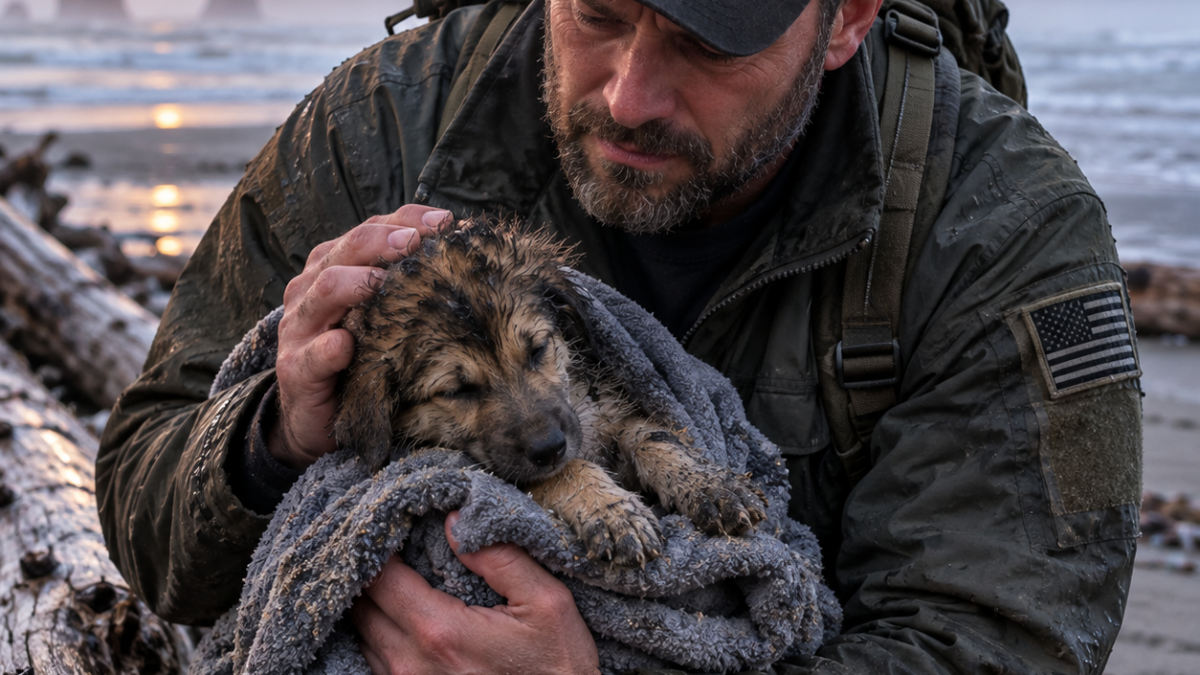
Dr. Ingram met me at the clinic door.
She was in her fifties, sharp-eyed, gray hair pulled back, the sort of woman who did not waste motion. I liked her immediately because she did not ask me ten questions while the dog was still dying.
She took him from my arms.
“Hypothermic,” she said.
I followed her inside.
“Severe dehydration. Malnourished. Probably exposure. How long was he out there?”
“Don’t know.”
“Found where?”
“Beach. Against driftwood.”
“Dumped?”
I looked at the towel.
“Probably.”
Her mouth tightened.
That was all.
No speech about human cruelty.
People who deal with cruelty every day often do not perform outrage. They save their energy for the living.
She worked on him for two hours.
Warm fluids.
Heat.
Small measures.
Needles.
Monitoring.
I stood in the corner of the exam room because leaving felt wrong and helping felt impossible.
That is a bad combination for a man trained to act.
Finally Dr. Ingram looked up.
“He’s not out of danger, but he’s trying.”
I nodded.
“You have experience with dogs?”
“No.”
“Cats?”
“No.”
“Any animals?”
“No.”
She looked at me.
I looked back.
“I found him.”
“Yes,” she said. “You did.”
She glanced at the puppy.
“He’ll need careful monitoring for at least a week. Feeding every few hours. Warmth. Watch for vomiting, tremors, lethargy, labored breathing. Follow this schedule.”
She handed me a printed sheet.
“He should not be alone much.”
“I’m home.”
That word used to mean something different.
Home had once been wherever Laurie was.
Virginia Beach.
Military housing.
A rental with bad plumbing.
The old house with creaky stairs where Petra learned to ride a bike in the driveway.
After Laurie died, home became a structure containing my mail.
Now this woman was asking if I could keep a dying puppy alive inside it.
“I’m home,” I repeated.
The puppy opened one eye.
Dark.
Unfocused.
Still here.
The drive back was quiet.
He sat in the passenger seat wrapped in the clinic blanket, which he seemed to regard as his due. He did not look out the window. He watched me.
“Stop that,” I said.
He watched.
“I’m not a dog person.”
He blinked.
“I’m not.”
He looked unconvinced.
I had spent twenty-two years as a Navy SEAL.
I had been trained to identify threats, calculate risk, control breathing, remain functional in impossible circumstances, and keep going when softer parts of the body and mind wanted to stop.
None of that prepared me for a puppy wrapped in a blanket judging me from a passenger seat.
I named him Anchor that evening.
I did not plan to.
I was sitting on the kitchen floor with the feeding chart beside me, trying to coax him through one teaspoon of warmed food, when the name came out.
“Come on, Anchor.”
I froze.
He licked the edge of the spoon.
That was it.
The name stayed.
I had spent my whole adult life around water in one form or another. Oceans, rivers, rain, sweat, blood. I knew what an anchor was for.
It holds you.
It keeps you from drifting when current and wind do not care where you meant to go.
Laurie had been my anchor.
Not in the sentimental way people say things at anniversaries.
In the literal sense.
She had been the fixed point around which the rest of my life organized itself.
Deployments.
Returns.
Silence.
Bad nights.
Good mornings.
Petra’s childhood.
Bills.
Holidays.
The particular loneliness of service that no one who has not lived it can fully understand.
Laurie had held the line.
Then the stroke took her at fifty-eight.
Everyone kept saying that was young.
As if youth made death more tragic in a way that helped.
It did not make it smaller.
It made the rest of my life feel too long.
After the funeral, I retired the following spring, sold the Virginia Beach house, and drove north until the landscape matched the inside of my chest.
Gray.
Cold.
Indifferent.
The Oregon coast did not ask me to explain myself.
It did not care if I spoke.
It did not mind if I disappeared.
I bought the cedar house forty minutes outside Astoria, three miles from the nearest neighbor, and settled into the project of becoming a man who did not need people.
I was doing well.
Then Anchor happened.
The first week was harder than I expected.
Not because of the schedule.
Schedules I understood.
Small meals every four hours.
Warmth.
Medication.
Watch the gums.
Check breathing.
Log intake.
I kept records because I am the kind of man who, when emotionally compromised, makes charts.
The hard part was the silence changing.
For fourteen months, the house had been quiet in one way.
Empty quiet.
Dead quiet.
The kind of quiet that collected in corners.
Anchor did not make much noise at first. He was too weak for chaos. But his presence bent the silence around him.
When he slept on the couch, the room was quiet around a sleeping thing.
When he followed me into the kitchen, the kitchen was quiet with company.
When he watched me from the blanket by the stove, the house no longer felt abandoned.
It felt like something had paused.
That was worse in some ways.
And better.
I started talking.
Not to myself exactly.
That is what it would have looked like from outside.
But it was not the same.
I narrated things.
Coffee.
Weather.
The mood of the ocean.
“Flat and gray today.”
Anchor watched.
“Rain by noon.”
He blinked.
“You don’t care.”
He tilted his head.
“You have no idea what I’m saying.”
His expression became so specifically skeptical that I laughed.
Actually laughed.
Out loud.
Alone in my kitchen at seven in the morning.
The sound startled me so badly I stopped moving.
I had not heard myself laugh in so long that it sounded like a word from a language I used to speak.
Anchor thumped his tail once.
Like he had meant to do that.
Petra called three weeks after the beach.
My daughter lived in Portland and worked in data logistics, a phrase I repeated when asked though I still did not fully understand what she did. She called every Sunday at noon with the disciplined consistency of someone who had made peace with loving a man who was bad at being loved.
She had been close to Laurie.
Not just mother and daughter.
Friends.
Once Petra was grown, she and Laurie developed a whole private world of afternoon calls, book recommendations, recipes I pretended not to notice required my kitchen tools, and jokes that excluded me in the gentlest possible way.
When Laurie died, Petra went quiet.
Not broken exactly.
Lowered.
Like someone had turned down the volume on her and she could not find the knob.
I worried about her the way I worried about everything then.
Early, sharply, uselessly.
That Sunday, she asked, “How’s the coast?”
“Wet.”
“How’s the house?”
“Still standing.”
“Are you eating actual food?”
“Define actual.”
“Dad.”
“Yes.”
There was a pause.
Then she said, “Are you actually okay?”
I should have said what I always said.
Fine.
Managing.
Doing all right.
Instead I looked at Anchor, who was asleep with his head on one of my boots.
“I found a dog.”
Silence.
“What?”
“On the beach.”
“What do you mean you found a dog?”
“Hypothermic. Dehydrated. Dying, mostly.”
“Dad.”
“I brought him home.”
Another silence.
“You brought a dog home.”
“He was dying.”
“Right, but you always said—”
“I know what I said.”
She went quiet again.
I could hear her rearranging her understanding of me.
“What’s his name?”
“Anchor.”
This silence was different.
Soft.
“Oh,” she said.
I waited.
“That’s a good name.”
“I know.”
By late November, Anchor had become a puppy again.
The hypothermia left no obvious damage. Dr. Ingram used the word resilient with the tone of someone who respected biology when it cooperated.
He grew fast.
Too fast, it seemed to me.
One week he was a fragile thing under a blanket, and the next he was all paws, ears at mismatched angles, and a tail that swung his whole back end behind him when he trotted.
We went to the beach every morning.
He loved the driftwood log.
Of course he did.
Dogs have no sense of dramatic irony.
He would sniff around the place where I found him, dig once or twice as if checking whether his previous life was still buried there, then look back at me.
I started sitting on that log again.
Some mornings, the grief came hard.
Not because of anything obvious.
A gull cry.
A certain shade of light.
The smell of rain on my jacket.
The memory of Laurie standing in a Virginia kitchen holding a chipped mug and telling me the coffee was perfect even though we both knew she made it too strong.
For twenty-two years, I had been trained to hold still inside myself.
Controlled breathing.
Compartmentalization.
The discipline of not feeling what I was feeling until it was safe.
That had served me in places where feeling everything at once could get men killed.
It served me badly after Laurie died.
The mechanism did not know the difference between a firefight and a bedroom with one side empty.
So it shut everything down.
Efficient.
Quietly destructive.
Anchor had no respect for compartmentalization.
If I sat on the log and went somewhere inside myself, he gave me about forty-five seconds.
Then he would put his front paws on my knee and stare at me.
“I’m fine.”
He stared.
“I said I’m fine.”
He made a small sound.
Not a bark.
More like a short sentence in a language I had not learned yet.
“I don’t need commentary.”
More staring.
Eventually I would put a hand on his head.
He accepted this as progress.
My nearest neighbor, Gene Pullman, showed up in December.
Gene lived three miles north, retired schoolteacher, seventies, thin as a fence rail, with a truck that sounded like it was losing an argument with itself. He came carrying a jar of honey from his bees and a piece of my fence that the last windstorm had apparently redistributed into his yard.
I opened the door.
Gene looked past me at Anchor sitting in the middle of the living room floor with professional interest.
“You got a dog.”
“He got me.”
Gene considered that.
“That how it works with dogs?”
“Apparently.”
He came in.
I did not invite him exactly.
Gene moved like a man who considered neighbors a fact of geography, not an optional social arrangement.
He sat at my kitchen table, drank two cups of coffee, and told a story about a border collie he had owned in the nineties who learned to open the refrigerator and ate an entire Thanksgiving turkey Gene’s wife had spent three days preparing.
The story had no point.
That was the point.
It was just a man talking because talking was part of being alive.
I sat across from him and listened.
Anchor lay under the table with his chin on Gene’s boot.
Halfway through the second cup, I realized this was the longest conversation I had had with another human being in four months.
Gene looked down at Anchor.
“Smart dog.”
“He’s nosy.”
“They always know.”
After Gene left, I stood in the kitchen for a while.
I was not sure what I felt.
Something between grief and its opposite.
Something more complicated and therefore probably more real.
I looked at Anchor.
“You did that.”
Anchor looked unsurprised.
December brought a storm that knocked out the power for four days.
That part was fine.
I knew how to prepare.
Generator.
Wood.
Water.
Food.
Batteries.
Exits.
Contingencies.
I was good at logistics.
I was less good, I was starting to understand, at the kind of readiness that could not be trained.
The kind that involved letting other people matter.
The outage should have made the house feel more isolated.
Instead, with the generator humming, the fire lit, rain hitting the windows, and Anchor pressed against my side on the couch, it felt almost like company.
Almost like shelter.
I sat in the dark and thought about Laurie.
Not only the loss.
That was what I usually thought about.
The absence.
The missing voice.
The room where she should have been.
That night, I thought about the shape of her life with me.
The way she read mystery novels backward because she hated suspense and refused to participate in it.
The way she made lists on envelopes.
The way she sang badly when she cooked and somehow made that everyone else’s problem.
The way she once told me, “I’m not going anywhere,” and I believed her less than I should have because permanent had never felt like a real thing to me.
Anchor shifted and put his head in my lap.
“She would have loved you,” I said.
The fire cracked.
Rain struck the windows.
Anchor sighed like he already knew.
And maybe he did.
Laurie had always been faster than me at knowing what was worth loving.
Petra came for Christmas.
She drove down from Portland in her practical car with two bags, a bottle of wine, and the careful composure of someone who had rehearsed this visit and hoped not to need the rehearsal.
She stood in my doorway with the ocean behind her and looked around at the house I had chosen for disappearing.
I watched her face do the work of not showing what she thought.
Then Anchor came around the corner, saw her, sat down directly in front of her, and made a sound that was approximately a full paragraph.
Petra stared.
Then looked at me.
“He’s been talking since I let him in,” I said.
“That’s a howl?”
“No.”
“What is it?”
“Commentary.”
Anchor made another sound.
Shorter.
Pointed.
Petra’s mouth twitched.
“What did he say?”
“That the house is too cold, the couch is better than it looks, and the beach is best before seven.”
She looked at Anchor again.
Then at me.
Something softened around her eyes.
“You seem…”
“Don’t.”
“I was going to say okay.”
I thought about that.
“I’m getting there.”
It was the most honest thing I had said to another person in longer than I could measure.
Petra nodded.
“Can I pet him?”
“He’ll answer you whether you do or not.”
She crouched and held out a hand.
Anchor stepped forward and pressed his face into her palm with the complete trust of a creature who had decided the world was basically safe and acted accordingly.
Petra closed her fingers gently around his ears.
Her shoulders dropped two inches.
We stayed like that for a moment.
My daughter.
My dog.
Me in the doorway of a house that had been too quiet for too long.
Something inside me loosened.
Not fixed.
Not healed in the cheap way people use the word.
Just loosened.
Like a knot giving up one strand.
Christmas Eve, we sat by the fire.
Anchor was upside down on the rug, paws in the air, entirely lacking the dignity one might expect from a dog named for a naval object.
Petra told me something I had not known.
After Laurie died, she had started driving to the Oregon coast on days off.
Not to see me.
Not exactly.
Just to be near the water.
She would pull off Highway 101 at random turnouts, sit in her car, and stare at the ocean.
“Why didn’t you tell me?”
She looked into the fire.
“I didn’t want you to think I was checking on you.”
“I would have survived being checked on.”
“That’s not what I mean.”
“What then?”
She swallowed.
“I didn’t want you to know I needed something.”
That went through me.
Fifty-eight years of compartmentalization sat in my chest like equipment I had carried so long I forgot its weight.
“You’re allowed to need things,” I said.
She looked at me.
“So are you.”
Anchor made a sound from the rug.
Editorial.
Petra laughed.
Then I laughed.
The fire snapped.
Rain hit the windows.
The ocean was somewhere out there in the dark doing what it always did, completely indifferent and somehow, that night, less threatening.
“What did he say?” Petra asked.
“Probably that we took too long to figure that out.”
In January, I drove to Portland.
No mission.
No appointment.
No emergency.
I woke up, looked at Anchor, and said, “You want to see the city?”
He gave a sound I had come to interpret as yes, obviously, why are we still here?
So we went.
I had avoided cities since Laurie died. Cities required surface-level engagement. Eye contact. Parking. Menus. The possibility of seeing families moving through the world as if that were still an ordinary thing.
But I drove along the Columbia into Portland with Anchor in the back seat like this was something normal people did.
We walked near the river.
Portland in January looked damp and low-ceilinged, the kind of city that seemed to be slowly rejoining the ground. Anchor trotted beside me with the easy confidence of a dog who believed wherever I was must be the correct place.
I found a café with outdoor seating and a sign that said DOGS WELCOME.
Anchor read neither words nor social boundaries and accepted the welcome fully.
I ordered coffee.
Sat.
Watched two women pushing strollers, a man losing an argument into his phone, and a kid on a bike nearly hit a puddle and somehow avoid it.
Then I called Petra.
“I’m in your city.”
Pause.
“You’re in Portland?”
“Yes.”
“Why?”
“I wanted to see your neighborhood.”
Another pause.
“Where are you?”
I told her.
“Give me forty-five minutes.”
“I’m not going anywhere.”
She arrived in thirty-five.
She sat across from me at the wet metal table and looked at me, then Anchor, then me again.
“You drove up.”
“Yes.”
“For no reason.”
“I just gave you a reason.”
Under the table, Anchor found her foot and fell asleep on it with decisive authority.
Petra looked down.
“That’s your dog.”
“I know.”
“He’s on my foot.”
“He does that.”
She looked at me across the small table.
For a moment, everything hard between us sat there too.
Laurie’s death.
My disappearing.
Her grief.
My silence.
All of it named without being discussed.
Still present.
Maybe a little smaller.
“I’m glad you came,” she said.
“I know.”
She smiled.
That became a new thing.
I drove to Portland sometimes.
Petra came to the coast sometimes.
Gene dropped by more often.
Dr. Ingram began greeting Anchor before she greeted me, which seemed correct.
The house changed.
Not dramatically.
No miracle montage.
Just small alterations.
A leash by the door.
Dog hair in places no dog had access to, which I still do not understand.
A bowl by the sink.
A chewed corner of the rug.
A tennis ball under the couch.
Boot prints beside paw prints on the porch.
Noise.
Routine.
Interruption.
Life.
By spring, Anchor was six months old and enormous in the way young large dogs are enormous.
All feet.
All opinions.
Those opinions had range.
Short factual statements.
Low complaints.
Lengthy arguments about the moral urgency of morning walks.
A particular grumble he reserved for Gene’s truck.
An entire category of sounds related to the neighbor’s cat, who appeared occasionally along the fence line and clearly represented a complex philosophical problem.
But the subject Anchor studied most was me.
He watched me with an attention I had never experienced.
I had been watched before.
Commanders assessing readiness.
Teammates measuring trust.
Enemies calculating weakness.
I knew surveillance.
Anchor’s attention was different.
He was not evaluating me against a standard.
He had no preferred version of Slade Mercer.
No investment in whether I became stronger, softer, healed, useful, normal, or easier to talk to.
He simply noticed me.
Sustained.
Uncomplicated.
Present.
It was the thing I had been starving for and did not know how to name.
In April, Dr. Ingram did his six-month checkup.
She came out, saw him, and stopped.
“That,” she said, “is not the dog I treated in October.”
“Same dog.”
She crouched, ran her hands along his sides, checked his ears, teeth, heart, legs.
Anchor submitted with lordly patience.
“Healthy,” she said. “Really healthy.”
Then she looked at me.
“You’ve taken good care of him.”
I said nothing.
Praise had always made me uncomfortable.
She stood.
“Sometimes,” she said, “the ones who almost don’t make it become the most necessary.”
She said it the way she said most things.
Matter-of-fact.
Without sentiment.
It did not need any.
I found the photograph in May.
It was in a box I had avoided since the move, one marked MISCELLANEOUS in someone else’s handwriting.
Boxes marked miscellaneous are dangerous.
They contain things no one knew how to categorize and therefore postponed.
Inside were old extension cords, a cracked picture frame, Laurie’s gardening gloves, a folded flag from some event I could no longer place, and a photograph from 2003.
Not classified.
Nothing important.
Just a camp somewhere overseas, sun harsh, men squinting, dust everywhere.
And there, among us, a dog.
Young shepherd mix.
Alert posture.
Mismatched ears.
I sat down on the kitchen floor.
I had forgotten him.
His name, or what we called him, was Sergeant.
He belonged to no one and everyone.
He made rounds every morning with the air of someone with official responsibility. Slept near the gate. Ate whatever he could charm from whichever man was weakest that day.
I remembered one night after a bad patrol, I sat outside unable to go into the tent, and Sergeant leaned against my leg.
Not begging.
Just leaning.
Like Anchor had done in the car without knowing any of this.
Twenty years had covered Sergeant over.
War does that.
Life does too.
I stared at the photograph.
Anchor came and sat beside me.
“Different dog,” I said.
He looked at the photo.
“Long time ago.”
He looked at me.
Made a lower sound than usual.
Quiet.
Almost a question.
“I know,” I said.
I did not know what exactly I meant.
I meant some things are gone and not gone.
I meant something had started in a dusty place in 2003 and somehow arrived on an Oregon beach twenty years later, which was not logical and also felt true.
I meant I was not the man who put that box in storage and told himself he was fine alone.
I meant I was not alone.
I put the photograph on the shelf above the fireplace.
It stayed there.
In June, Petra came down for a weekend.
The three of us walked the beach in the evening, when the sun finally did something specific and the water was almost blue.
Anchor ran ahead, came back, ran ahead again, the perpetual motion of a happy dog in a place he knows well.
Petra walked beside me quietly.
Then she said, “You’re different.”
I did not answer right away.
We walked.
“I’m trying,” I said.
“No. That’s not what I mean.”
I looked at her.
“I don’t mean you’re working on it. I mean you’re different. Something changed.”
I looked at Anchor, who was investigating something at the waterline with full scientific commitment.
“October,” I said.
Petra nodded.
She understood.
The morning.
The dog against the log.
The carrying him home.
The accidental decision that turned out to be the only one that mattered.
“Mom would have said it wasn’t accidental,” Petra said.
I thought about Laurie reading endings first because she hated suspense.
Laurie burning toast and blaming the toaster.
Laurie telling me she was not going anywhere.
“I know she would have.”
We walked on.
The Pacific made its enormous indifferent sound beside us.
The sky above the fog was the blue it only sometimes got, and evening came in long and slow, the way it does in June on the Oregon coast, as if light itself had decided to stay a while.
Anchor looped back to us, fell into step between us, and made a sound.
“What did he say?” Petra asked.
I listened.
I had gotten fairly good at this.
“He says if we turn around now, we’ll get back before dark, and there’s a good log fifty yards up where a person could sit if a person wanted to.”
Petra looked at me.
“And,” I added, “he’s glad we’re all here.”
I knew that last part was me.
Or maybe not.
That is the thing about paying attention to a creature who cannot lie.
Eventually, you stop lying to yourself.
The log was where Anchor said it would be.
We sat.
The three of us.
Petra on one side.
Anchor between us.
Me on the other.
The beach stretched out gray and gold.
For a long time, nobody said anything.
Some things do not need to be said to become completely real.
I thought about the morning I found him.
The cold.
The fog.
The heartbeat barely there beneath my fingers.
I thought about how close I had come to walking past.
Not because I was cruel.
Because I had trained myself not to see anything that might ask me to stay.
That was what grief had done.
It had not made me weak.
It had made me efficient at disappearing.
Anchor interrupted that.
A half-dead puppy with sand in his fur and no breath to spare had somehow demanded a future from me when I had stopped making plans beyond coffee, weather, and getting through the day.
He needed warmth.
Food.
Medication.
A schedule.
Walks.
A name.
A life.
And in giving him those things, I had accidentally built one around myself again.
Petra leaned her shoulder against mine.
Not dramatically.
Not like a child.
Like a grown daughter who had lost her mother and was slowly finding her father under the wreckage.
Anchor put his head on my boot.
“You know,” Petra said, “I used to be mad at you.”
I nodded.
“I figured.”
“For moving out here.”
“I know.”
“For disappearing.”
“I know.”
“For making me feel like I had to call at exactly noon every Sunday or you might vanish completely.”
That one hurt.
“I’m sorry.”
She looked at the water.
“I know.”
We sat in the wind.
“I wasn’t trying to leave you,” I said.
“I know.”
“I was trying not to need anything.”
Petra gave a sad little laugh.
“How’d that work out?”
I looked at Anchor.
“Poorly.”
She smiled.
Then wiped under one eye.
“I miss her.”
“I do too.”
“All the time.”
“Yes.”
Anchor made a soft sound.
Petra looked down.
“What was that?”
“That,” I said, “was agreement.”
She leaned forward and pressed her hand into Anchor’s neck.
He closed his eyes.
The ocean kept moving.
The light kept thinning.
And for the first time since Laurie died, I did not feel like the world was moving on without permission.
It was moving.
That was all.
And somehow, sitting there with my daughter and the dog I had found not breathing on a beach, I understood that moving did not mean leaving Laurie behind.
It meant carrying her differently.
Not as an absence that hollowed every room.
As a voice.
A shape.
A fixed point still inside me, even if I could no longer reach across the bed and touch her.
Anchor lifted his head suddenly and looked toward the dunes.
“What now?” I asked.
He gave one short bark.
Petra laughed.
“He’s ready.”
“He’s always ready.”
“For what?”
I stood slowly.
Anchor sprang up, tail swinging.
“For whatever comes next.”
That became the answer more often than not.
When Gene invited me over for dinner with his daughter Alice, I went.
When Petra asked if I wanted to spend a weekend in Portland, I went.
When Dr. Ingram mentioned the shelter needed volunteers to help walk recovering dogs, I said absolutely not.
Then went the following Tuesday.
Anchor came with me, of course.
He considered himself supervisory staff.
The first dog I walked was a timid brown mutt recovering from surgery.
He shook when I clipped the leash.
I crouched.
Anchor sat beside me, calm and steady.
“It’s all right,” I told the dog.
He did not believe me.
That was fair.
But he believed Anchor enough to take one step.
Then another.
That was sometimes how trust worked.
Borrowed from something already standing.
Months later, on the anniversary of Laurie’s death, I woke at three like before.
For a moment, I thought nothing had changed.
Then I felt Anchor’s weight against the side of the bed.
Not on the bed.
He had gotten too big for pretending he was a small blanket, though he still tried during thunderstorms.
He slept on the rug beside me, one paw touching the bed frame.
I lay still.
The room was dark.
The empty side of the bed remained empty.
That truth had not changed.
But the room was not hollow.
That truth had changed.
I got up, made coffee, and took Laurie’s mug from the cabinet.
I had not used it since she died.
Blue ceramic.
Small crack near the handle.
She said it was her favorite because it held the right amount of coffee, by which she meant too much.
I poured coffee into it.
Then into mine.
Set hers on the table across from me.
Anchor watched from the doorway.
“Don’t start,” I told him.
He sat.
I looked at the mug.
“Morning, Laurie,” I said.
My voice broke on her name.
Anchor came over and put his head in my lap.
I cried then.
Not like the first weeks.
Not the kind that tears the body open.
Quieter.
Deeper.
Less desperate.
The kind that knows it will not be finished today and is no longer demanding to be.
After a while, I called Petra.
It was early.
She answered anyway.
“Dad?”
“I used your mother’s mug.”
Silence.
Then she said, “Good.”
That was all.
One word.
Enough.
In October, one year after the beach, Petra drove down again.
Gene came too, carrying honey because apparently every emotional gathering required honey if Gene was involved.
Dr. Ingram stopped by for fifteen minutes and stayed two hours.
Alice came from San Francisco.
Even Marcy from the shelter came after hearing the story from Dr. Ingram, though Anchor had never technically been a shelter dog. She brought a bag of treats and said, “Close enough.”
We did not call it a party.
I would not have allowed that.
But people came to the house.
My house.
The one I had bought to disappear inside.
There was coffee.
Soup.
Firewood stacked by the door.
Wet coats hanging in the hall.
Voices in the kitchen.
Anchor moved from person to person, accepting admiration as his due.
At sunset, Petra and I took him down to the beach.
Just us.
The fog held off that evening.
The log remained where it had always been, silver and worn.
Anchor ran to it.
Sniffed.
Dug once.
Then sat.
Petra stood beside me.
“This is the place?”
“Yes.”
“He was right there?”
I pointed.
“Against the base.”
She was quiet.
Then she crouched and touched the sand.
“I’m glad you saw him.”
I looked at Anchor.
“So am I.”
“No,” she said, standing. “I mean I’m glad you were the one who saw him.”
The wind moved off the water.
I did not trust my voice immediately.
“He saved me,” I said finally.
Petra nodded.
“I know.”
Anchor barked once.
Petra smiled.
“What did he say?”
I looked at him.
Big now.
Healthy.
Alive.
His mismatched ears caught in the wind, eyes bright, tail moving like the world had never once been cruel to him.
“He says that is inaccurate.”
Petra laughed.
“What’s accurate?”
I watched Anchor trot toward us, paws kicking sand.
“He says we saved each other.”
Anchor pressed himself between us like punctuation.
Maybe that was sentimental.
Maybe I had become sentimental.
I used to distrust sentiment because it seemed undisciplined.
Now I think maybe sentiment is just truth after it has survived long enough to soften.
I was a retired Navy SEAL.
A widower.
A father who had gone quiet when his daughter needed him to stay reachable.
A man who bought a house by the ocean because the ocean did not ask questions.
And one morning, in a fog so thick the world looked unfinished, I found a dying puppy against a driftwood log.
I carried him home because he had a heartbeat.
That was all.
That should have been the whole story.
But love rarely stops where you think the action ends.
The heartbeat I found that morning was not only his.
It became the sound of the house changing.
The sound of my own voice returning.
The sound of my daughter laughing by the fire.
The sound of Gene’s truck in the driveway.
The sound of paws on old cedar floors.
The sound of rain against windows that no longer felt like walls.
I thought I was carrying Anchor away from death.
Maybe I was.
But he was carrying me too.
Away from the life I had mistaken for survival.
Away from the silence I had confused with strength.
Away from the belief that needing nothing was the same as being safe.
A man like me does not admit that easily.
So I will say it plainly.
I needed him.
Not because he replaced Laurie.
Nothing could.
Not because he fixed grief.
Nothing does.
I needed him because he made the world ask something of me again, and in answering, I remembered I was still here.
That is what happened next.
Not a miracle in the dramatic sense.
No music.
No single moment where all the broken pieces flew back together.
Just a dying puppy becoming a living dog.
A silent house becoming a home.
A daughter and father finding words again.
A widower learning that the heart can remain broken and still keep beating.
And an old driftwood log on the Oregon coast becoming the place where one life nearly ended and two lives began again.
Anchor is asleep beside me as I write this.
He is larger than he has any right to be.
He takes up too much of the floor.
He snores.
He comments on weather, visitors, delivery trucks, the neighbor’s cat, my cooking, and occasionally the state of my soul.
His paws twitch when he dreams.
Sometimes I wonder what he remembers from the beach.
Cold.
Fog.
Hunger.
The sound of waves.
Maybe nothing.
Maybe dogs are kinder to themselves than we are and let the worst things fade when life becomes good.
But every morning, when we walk past that log, he stops.
Just for a second.
He looks at it.
Then he looks at me.
And every morning, I understand him perfectly.
We’re still here.
We’re still here.
We’re still here.








