A Retired Military K9 Refused to Leave a Pregnant Nurse’s Side—Then Her 5-Year-Old Son Went Missing
A Retired Military K9 Refused to Leave a Pregnant Nurse’s Side—Then Her 5-Year-Old Son Went Missing
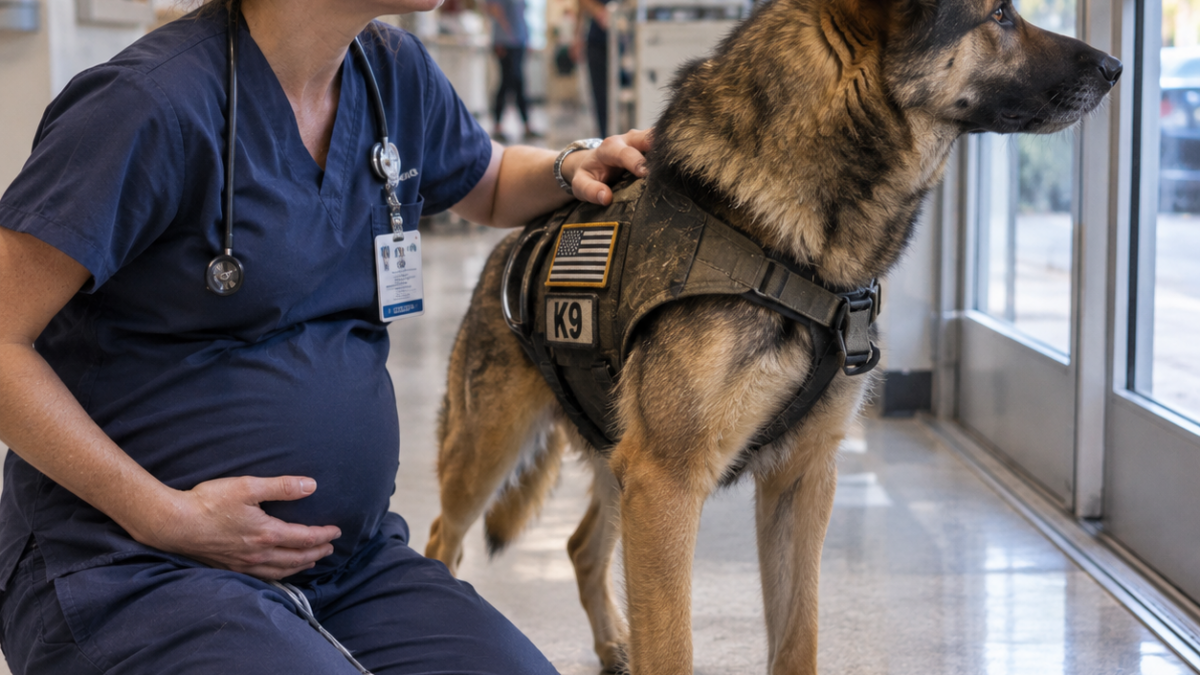
Atlas had inexplicably followed Nurse Claire Bennett through the veterans’ hospital all morning, ignoring every handler who tried to call the retired military K9 away from her.
Hours later, Claire received the call every parent fears: her five-year-old son had vanished from a nearby playground while she was finishing her shift.
When Claire whispered her son’s name through shaking lips, Atlas rose from the hospital floor, stared toward the exit, and began walking as if he already knew exactly what he was being asked to find.
Claire Bennett first noticed the dog at 7:18 that morning.
She remembered the exact time because she had been looking at the clock above the nurses’ station while trying to decide whether the tightening across her lower back was normal pregnancy discomfort or something she should mention to Dr. Reeves.
Thirty-two weeks.
That was what every decision seemed to orbit now.
Thirty-two weeks pregnant.
Eight weeks left, give or take.
Too early for labor.
Far enough along that bending over had become a strategic exercise.
Far enough along that sleeping required six pillows and negotiations with gravity.
Far enough along that her five-year-old son, Owen, had begun asking every morning whether the baby was “coming today.”
“No,” Claire always told him.
“How do you know?”
“Because she’s not ready yet.”
“Maybe she is.”
“She isn’t.”
“Did you ask her?”
That was Owen.
Five years old.
Serious brown eyes.
Messy blond hair.
A mind that treated every adult statement as an opening position in a debate.
Claire loved him with the particular exhaustion of a single mother who had spent five years trying to be two parents without allowing the child to notice the arithmetic.
Owen’s father, Daniel, had died two years earlier.
Not in combat.
Not in some dramatic accident.
Cancer.
Thirty-six years old.
Sixteen months from diagnosis to funeral.
There had been no enemy Claire could hate.
No person responsible.
Just scans.
Chemotherapy.
Hospitals.
Hope.
More scans.
Then less hope.
By the time Daniel died, Owen was three.
Young enough that Claire feared he would forget.
PART2:
Old enough that he remembered enough to ask questions.
“Daddy liked pancakes, right?”
“Yes.”
“Daddy carried me on his shoulders?”
“Yes.”
“Daddy knew Atlas?”
That question had come only once.
Claire had not known how to answer.
Because Atlas had not been Daniel’s dog.
Not exactly.
But Daniel had known him.
Everyone in the rehabilitation wing had.
Atlas was a retired military working dog, a large sable German shepherd with a dark face, scarred muzzle, and the controlled stillness of an animal who had spent most of his life being expected to understand situations before humans finished explaining them.
He had served overseas.
Claire knew that much.
Explosives detection.
Patrol.
Three deployments.
One handler wounded.
One final injury to Atlas’s left shoulder that ended his service career.
After retirement, a nonprofit partnered with St. Vincent Veterans Medical Center to place several former military dogs in a specialized therapeutic program.
Atlas was not technically a therapy dog.
Everyone made that distinction.
He did not wear a pastel vest.
PART3:
He did not wander room to room greeting patients.
He did not perform tricks.
Atlas lived with retired Army staff sergeant Mason Hale, who worked part-time with the hospital’s veteran transition program.
Mason brought Atlas in several days a week.
The dog mostly stayed near him.
Sometimes Atlas lay beside patients with PTSD during difficult appointments.
Sometimes he sat silently with amputees during physical rehabilitation.
Sometimes he did nothing at all.
That was Atlas’s specialty.
Presence without pressure.
Daniel had met him during his final months.
Not because Daniel was a veteran.
Because Claire worked there.
On days when Daniel’s treatment left him exhausted and Owen’s daycare closed early, Claire occasionally brought both of them through the hospital while arranging rides and schedules.
One afternoon, Daniel had sat in the courtyard while Claire finished paperwork.
Atlas had walked over.
Daniel had rested one hand on the dog’s head.
For nearly forty minutes, neither had moved.
Later Daniel said, “That dog understands bad news.”
Claire had laughed.
“Dogs don’t understand oncology.”
“I didn’t say oncology.”
That was Daniel.
And that was one of the memories Claire tried not to touch too often because some memories still had sharp edges even years later.
On that Thursday morning, Atlas was sitting at the far end of the rehabilitation hallway when Claire first noticed him.
Mason stood beside him talking with a physical therapist.
Claire carried a medication tray past.
Atlas’s head lifted.
Nothing unusual.
She kept walking.
Then heard nails against the floor behind her.
Click.
Click.
Click.
She turned.
Atlas was following.
Mason noticed too.
“Atlas.”
The dog stopped.
Looked back.
Mason pointed to his side.
“Here.”
Atlas returned.
Claire smiled.
“Losing your touch?”
“Never.”
“Looks like it.”
Mason crouched and rubbed the dog’s shoulder.
“He’s distracted today.”
Atlas stared past him.
At Claire.
She raised an eyebrow.
“Do I smell like bacon?”
“Do you?”
“At seven in the morning? I wish.”
Mason smiled.
Claire continued toward Room 214.
Ten minutes later Atlas appeared outside the doorway.
She nearly walked into him.
“Seriously?”
Atlas stood.
Mason was nowhere nearby.
Claire stepped around him.
Atlas moved with her.
She stopped.
Atlas stopped.
She went left.
He went left.
“Okay.”
Claire looked down at her stomach.
“You’re making this weird.”
Atlas sniffed once near her scrub pocket.
Then lifted his head.
A patient inside the room laughed.
“Looks like you got yourself a bodyguard, Nurse Bennett.”
Mr. Wallace was seventy-four, recovering from a knee replacement, and had spent six years in the Marines during Vietnam.
Claire checked his IV.
“I can barely afford daycare. I’m not hiring security.”
Atlas sat outside the room.
Mr. Wallace looked toward him.
“That ain’t a therapy dog.”
“I know.”
“That’s Hale’s shepherd.”
“Yes.”
“Then I’d pay attention.”
Claire glanced up.
“To what?”
Mr. Wallace shrugged.
“Dogs like that don’t waste attention.”
She smiled politely.
Veterans had opinions about military dogs the way fishermen had opinions about weather.
Everyone believed their experience contained secret knowledge.
Claire continued her rounds.
Atlas continued following.
By eight, it had become noticeable.
By eight-thirty, funny.
By nine, Mason stopped laughing.
“He has never done this.”
Claire stood at the nurses’ station charting.
Atlas lay beneath the counter near her feet.
She looked down.
“He likes pregnant women.”
“No.”
“You know every preference he has?”
“Pretty much.”
“Maybe I dropped food.”
“You didn’t.”
“How would you know?”
“Because he would have eaten it and left.”
Fair.
Mason gave a short command.
“Atlas. Heel.”
Atlas stood.
Went to Mason.
Stayed for perhaps twenty seconds.
Then Claire moved toward the elevator.
Atlas followed her again.
Mason’s expression tightened.
“Atlas.”
The dog ignored him.
That was when Claire stopped smiling.
“Does he ever ignore you?”
“Not like that.”
“Should I be worried?”
“No.”
Too fast.
Claire noticed.
“Mason.”
He looked at Atlas.
Then at her.
“Military dogs are trained to notice changes.”
“What kind of changes?”
“Environment. Behavior. Scent.”
Claire put one hand on her stomach.
“You think he smells the baby?”
“He’s been around pregnant staff before.”
“Maybe I smell different.”
“Maybe.”
That answer did not reassure her.
“Do I need to call obstetrics?”
Mason immediately shook his head.
“Don’t let me turn a dog being weird into a medical diagnosis.”
“Too late.”
Claire had spent enough years in healthcare to know that once concern entered the mind, it rarely left politely.
At 9:12 she called Dr. Julian Reeves, the obstetrician who happened to have clinic privileges in the adjoining medical building.
She described mild back tightening.
No bleeding.
No fluid.
Baby moving normally.
No regular contractions.
He told her what she expected.
Hydrate.
Sit down.
Monitor.
Come in if symptoms changed.
“And a German shepherd won’t leave me alone.”
Silence.
Then Dr. Reeves asked:
“Is that medically relevant?”
“I was hoping you’d know.”
“Claire.”
“I’m serious.”
“I’m an obstetrician, not Cesar Millan.”
She laughed despite herself.
“Fine.”
“Drink water.”
“Yes.”
“Eat something.”
“Yes.”
“And stop diagnosing yourself based on animal behavior.”
“Yes, doctor.”
Atlas remained under her chair.
At ten, Claire took her break.
Usually she called Owen.
That day he was with her mother, Ruth, who had taken him to a small playground two blocks from the hospital.
Claire had arranged it because summer preschool had ended the week before and Ruth had volunteered to keep him during Claire’s Thursday shift.
The plan was simple.
Playground.
Lunch.
Library.
Then Ruth would bring Owen to the hospital around three, and they would all go home.
Claire video-called.
Owen answered by holding the phone so close to his face that she saw only one eye.
“Mom!”
“Hi, monster.”
“I’m not a monster.”
“Debatable.”
“Grandma says we’re getting ice cream.”
Ruth’s voice came from somewhere off screen.
“I said maybe.”
Owen yelled:
“She said yes!”
“I said maybe!”
Claire laughed.
Atlas raised his head from beside her.
Owen noticed.
“Is that Atlas?”
Claire angled the phone.
Atlas looked toward the screen.
“Yep.”
“Hi, Atlas!”
His tail moved once.
Owen gasped.
“He knows me.”
“His tail moved.”
“He knows me.”
Claire smiled.
“Probably.”
“Can he come to the park?”
“No.”
“Why?”
“Because he has a job.”
“He’s retired.”
Claire looked at Mason across the room.
Mason shrugged.
The kid had a point.
“He still has things to do.”
Owen considered that.
“Like follow you?”
Claire stared.
“How did you know?”
“Because he’s right there.”
“Good observation.”
Owen grinned.
Then the camera swung wildly toward playground equipment.
“Look!”
Claire saw blue slides.
Mulch.
A red climbing wall.
Children moving.
Ruth sitting on a bench.
Normal.
Completely normal.
“Stay where Grandma can see you.”
“I know.”
“Owen.”
“I know.”
“Say it.”
He sighed dramatically.
“Stay where Grandma can see me.”
“Thank you.”
“Can I show you the tunnel?”
“Later. I have to work.”
His face fell slightly.
Claire felt the familiar guilt.
Work.
Always work.
Daniel had once told her guilt was the tax parents paid for loving someone they could never give enough to.
At the time she had told him that was depressing.
Now she understood.
“I’ll see you this afternoon.”
“Promise?”
The word hit differently after Daniel.
Claire never used it casually.
“I promise.”
“Love you.”
“Love you more.”
“No, I love you more.”
“Impossible.”
“Bye!”
The screen went dark.
Atlas was standing.
Not looking at Claire.
Looking at the phone.
Then at the hallway.
Mason saw it.
“What?”
Claire asked.
“Nothing.”
“You’re doing the face.”
“What face?”
“The dog trainer face.”
“I don’t have a dog trainer face.”
“You absolutely do.”
Mason watched Atlas.
The dog sniffed the air.
Then returned to Claire and pressed his shoulder lightly against her leg.
Claire steadied herself.
“Okay, that’s new.”
Mason crouched.
“Atlas.”
The shepherd looked at him.
Mason gave a hand signal.
Atlas sat.
Another signal.
Stay.
Mason walked ten feet away.
Atlas stayed.
Claire shifted.
Atlas immediately stood and followed her.
Mason exhaled.
“Something about you is overriding him.”
“Comforting.”
“Could be your pregnancy.”
“You said that wasn’t likely.”
“I said I didn’t know.”
“I liked your earlier answer better.”
At eleven-thirty, Claire finally stopped fighting it.
If Atlas wanted to lie beneath the nurses’ station, fine.
Patients liked seeing him.
Staff joked.
One nurse said the baby must be “sending dog signals.”
Another said Atlas knew Claire needed to sit down.
Claire threatened to throw a clipboard.
Then at 12:07, Ruth called.
Claire almost ignored it.
She was helping reposition a patient.
The phone stopped.
Then immediately rang again.
Something in her body reacted before her mind did.
Parents know the difference between one call and two.
She pulled off one glove.
Looked at the screen.
MOM.
“Claire?” her coworker Nora asked.
“I need to take this.”
She stepped into the hallway.
Atlas stood instantly.
Claire answered.
“Mom?”
For one second, she heard only breathing.
Then Ruth said:
“I can’t find Owen.”
Everything inside Claire stopped.
Not slowed.
Stopped.
“What?”
“I can’t find him.”
“What do you mean you can’t find him?”
“He was at the playground.”
“Mom.”
“I looked away for maybe a minute.”
Claire’s free hand went to the wall.
“Where is he?”
“I don’t know.”
“What do you mean?”
“I was getting his water bottle from the bag. He was by the slide. Then he wasn’t.”
Claire closed her eyes.
The hallway narrowed.
“Call 911.”
“I did.”
“Where are you?”
“At the park.”
“Stay there.”
“The police are coming.”
“Stay there.”
“Claire—”
“I’m coming.”
Her voice did not sound like hers.
She hung up.
Nora had stepped into the hall.
“What happened?”
Claire tried to speak.
Nothing.
Atlas stood in front of her.
The shepherd’s eyes locked onto her face.
Mason came around the corner.
“Claire?”
She swallowed.
“My son.”
Nora moved closer.
“What about Owen?”
“He’s gone.”
The words made it real.
“What do you mean gone?”
“My mom lost him at the park.”
Nora grabbed Claire’s arm.
“Okay. Sit down.”
“No.”
“Claire—”
“No.”
She moved toward the elevator.
Atlas came with her.
Mason caught up.
“I’m driving you.”
“I can drive.”
“No.”
“I can—”
“You’re shaking.”
She looked at her hands.
He was right.
Atlas stayed beside her.
Claire whispered:
“Owen.”
The dog froze.
Not dramatically.
No bark.
No sudden movement.
His ears came forward.
Claire looked down.
“Owen.”
Atlas looked toward the hospital exit.
Then walked.
Straight down the hallway.
Mason stopped.
“Atlas.”
The dog continued.
Mason’s face changed.
Claire followed.
“What is he doing?”
“Atlas.”
This time Mason used command voice.
The dog stopped at the automatic doors.
Turned.
Looked at Claire.
Then back outside.
Mason stared.
Claire felt hope enter her body so violently it almost hurt.
“He knows him.”
“He’s met Owen.”
“On video.”
“Once in person too.”
Claire remembered.
Six months earlier.
Owen had come to the hospital Christmas event.
Atlas had been there.
Owen fed him half a dog biscuit.
Maybe two.
Maybe three.
“Can he track him?”
Mason hesitated.
“He wasn’t a tracking dog.”
Claire’s hope faltered.
“He did explosives detection.”
“So no?”
“Not exactly.”
“What does that mean?”
“It means scent work is scent work.”
Mason looked at Atlas.
“He knows how to search.”
Claire grabbed his arm.
“Then let him.”
“Claire.”
“Please.”
Mason looked toward the exit.
Then back at her.
“How long has Owen been missing?”
“Maybe ten minutes. Fifteen.”
“Police?”
“Coming.”
Mason made the decision.
“Get in my truck.”
The park was less than five minutes away.
It took four.
Claire sat in the passenger seat.
Atlas behind her.
Mason drove.
Nora had wanted to come.
Claire refused.
Too many people.
Too much noise.
She called Ruth.
Police had arrived.
Two officers.
Park being searched.
Playground bathrooms checked.
Maintenance shed checked.
Parents being questioned.
Claire heard sirens through the phone.
“Did anyone see him leave?”
“No.”
“What was he wearing?”
“Blue dinosaur shirt. Gray shorts. Red sneakers.”
Claire knew that.
Of course she knew.
She had dressed him that morning.
The dinosaur shirt had a stegosaurus on it.
He insisted stegosaurus was better than T. rex because “it has defense and offense.”
She had tied his left shoe twice because it kept coming loose.
Normal details became weapons.
“Any vehicles?”
“I don’t know.”
“Mom.”
“I don’t know!”
Ruth broke.
Claire heard sobbing.
For half a second anger surged.
How could you look away?
How could you lose him?
Then Claire crushed it.
Later.
If there was a later.
Now they needed Owen.
Mason pulled beside the park.
Police tape had not gone up yet.
Too early.
Too uncertain.
An officer approached.
Claire was out before the truck fully stopped.
“My son.”
“Ma’am?”
“Owen Bennett. I’m his mother.”
The officer’s expression changed.
“Okay. We have units checking—”
“My dog can search.”
Mason stepped out.
“Retired military K9.”
The officer looked at Atlas.
Then Mason.
“What discipline?”
“Explosives detection and patrol.”
“Tracking?”
“Not formally.”
The officer hesitated.
“We have county K9 en route.”
“How long?”
“Fifteen to twenty.”
Claire said, “That’s too long.”
“Ma’am—”
“Please.”
Mason intervened.
“We’re not asking you to rely on him. Let him work while you continue your search.”
The officer looked at Atlas again.
Then at Claire.
“Fine. Stay out of active police areas.”
Ruth ran toward Claire.
Claire caught her mother before she could speak.
“Where was he last?”
Ruth pointed.
“Slide.”
They moved.
Atlas’s entire posture changed the moment they entered the playground.
No longer the quiet hospital dog.
Head lower.
Nose active.
Body controlled.
Mason held the leash loosely.
“Claire, do you have something Owen wore?”
“No.”
“Anything he touched?”
Ruth gasped.
“His sweatshirt.”
She opened the backpack.
Small gray hoodie.
Owen had worn it that morning before the day warmed.
Mason took it.
Held it near Atlas.
The dog sniffed.
Once.
Twice.
Mason gave a command Claire had never heard.
“Find.”
Atlas moved.
Not fast.
Focused.
Across the mulch.
Past the slide.
He circled once.
Then moved toward the fence.
Claire’s heart slammed.
“He went that way.”
Mason raised one hand.
“Don’t read too much yet.”
Atlas reached the fence.
There was an opening near a maintenance gate.
He sniffed.
Turned.
Moved along the edge.
Then abruptly pulled toward a row of trees behind the playground.
Claire followed.
The police officer called something behind them.
Mason answered.
Claire did not hear.
She saw only Atlas.
Dog.
Leash.
Ground.
Trees.
Owen.
“Owen!”
Mason turned.
“Don’t call yet.”
“Why?”
“We want Atlas on the scent.”
Claire covered her mouth.
Every instinct screamed to shout her son’s name.
Instead she followed.
Atlas crossed a narrow patch of grass.
Reached the sidewalk.
Stopped.
Traffic moved beyond.
Claire’s stomach dropped.
The sidewalk led toward a busy two-lane road.
Atlas sniffed right.
Then left.
Moved left.
Away from the road.
Claire nearly collapsed from relief.
They passed a pharmacy.
A closed dental office.
Then an alley between buildings.
Atlas slowed.
Mason watched him.
“What?”
Claire asked.
“Working.”
“What does that mean?”
“He lost something.”
Her chest tightened.
“Lost the scent?”
“Maybe.”
Atlas circled.
Returned ten feet.
Sniffed a metal pole.
Then pulled sharply toward the alley.
Mason went with him.
Claire struggled to keep pace.
Pregnancy suddenly felt like weight tied around her hips.
She put one hand beneath her belly.
Keep moving.
Atlas passed behind the pharmacy.
Dumpsters.
Delivery entrance.
Then stopped at a patch of gravel.
Sniffed.
Moved.
Stopped again.
Mason crouched.
“Tire marks.”
Claire stared.
There were dozens.
“From what?”
“Could be anything.”
She heard what he did not say.
A car.
Someone had taken Owen.
No.
She refused the thought.
Atlas moved again.
Out of the alley.
Across another sidewalk.
Toward a residential street.
A police cruiser pulled alongside.
The officer rolled down the window.
“County dog is five minutes out.”
Mason said, “We have possible track eastbound.”
The officer radioed.
Claire barely listened.
Then her phone rang.
Unknown number.
She stopped breathing.
Answered.
“Hello?”
A woman said, “Is this Claire Bennett?”
“Yes.”
“My name is Rebecca Mills. Police gave me your number.”
Claire nearly dropped the phone.
“Do you have my son?”
“No, but I think I saw him.”
“Where?”
“At the park.”
“When?”
“Maybe twenty-five minutes ago.”
“What did you see?”
“There was a little boy near the fence.”
“Yes.”
“He was talking to someone.”
Claire’s legs weakened.
“Who?”
“I don’t know.”
“Man? Woman?”
“I couldn’t see well.”
“Did he leave with them?”
“I saw him go toward the side path.”
“Was he scared?”
“I don’t think so.”
“What did the person look like?”
“I’m sorry. I was loading my stroller.”
Claire closed her eyes.
“Please think.”
“I think it was another child.”
Claire froze.
“What?”
“A bigger kid. Maybe ten? Twelve?”
The entire picture shifted.
Not adult abduction.
Maybe not.
“Boy or girl?”
“Boy, I think.”
“Which direction?”
“Toward the pharmacy.”
Exactly where Atlas had gone.
Claire looked at Mason.
“Someone saw Owen with an older boy.”
Mason nodded.
That fit the track.
Police were informed.
Description vague.
Older child.
Possibly hoodie.
Maybe bike.
Atlas continued.
The residential street ended near a drainage path.
A narrow paved trail followed a shallow creek behind several neighborhoods.
Claire knew it.
Owen did too.
Daniel had taken him there when he was little.
They called it Duck Road because geese gathered near the water.
Claire’s mouth went dry.
“Atlas.”
The dog pulled harder.
Mason looked at her.
“What?”
“Owen knows this path.”
“Good or bad?”
“I don’t know.”
Atlas led them onto the trail.
Now he moved faster.
The county K9 team arrived behind them.
A deputy with a black Labrador.
They briefly coordinated.
The deputy used Owen’s sweatshirt.
His dog picked up scent too.
Both dogs chose the same direction.
Claire’s fear changed.
Still enormous.
But focused now.
Owen had been here.
He had walked this way.
Maybe willingly.
Why?
They moved nearly half a mile.
Claire’s back tightened.
She ignored it.
Mason noticed.
“You okay?”
“Yes.”
“That wasn’t convincing.”
“My son is missing.”
“I know.”
“So stop asking.”
He did.
Atlas suddenly stopped.
Not at the trail.
At the creek bank.
Claire’s heart dropped.
“No.”
Atlas pulled toward the water.
“No.”
Claire ran.
Mason caught her arm.
“Wait.”
“Owen!”
“Claire!”
She ripped away.
The creek was shallow in summer.
Maybe two feet in most places.
Deeper after rain.
It had rained two nights earlier.
Atlas descended the bank.
Sniffed mud.
There were shoe prints.
Small.
Red tread pattern visible in one.
Owen’s sneakers.
Claire knew because she had scrubbed mud from those soles the week before.
“He was here.”
Mason nodded.
The county deputy radioed.
They began searching both directions.
Claire looked at water.
Brown.
Moving.
Not fast.
Still enough to terrify her.
“Owen!”
This time nobody stopped her.
“Owen!”
Nothing.
“Owen!”
Her voice cracked.
Atlas stood.
Head lifted.
Then turned away from the water.
He moved along the bank.
Fifty feet.
One hundred.
Then up toward a cluster of trees.
Mason followed.
Claire stumbled.
A hand caught her elbow.
The police officer.
“Slow down.”
“I can’t.”
“You can if you fall.”
She hated him for being right.
Atlas disappeared behind brush.
Then barked.
One sharp bark.
Mason shouted:
“Atlas!”
Second bark.
Claire ran.
Branches scraped her arms.
She pushed through.
And found a bicycle.
Small.
Blue.
Lying on its side.
Not Owen’s.
Too large.
Beside it:
A backpack.
Claire stared.
“Older boy.”
Mason opened the backpack only after the officer nodded.
Inside:
Water bottle.
Comic book.
A red hoodie.
Phone.
The officer checked the lock screen.
Dozens of missed calls.
“Missing kid too.”
Claire looked at him.
“What?”
The officer radioed the description.
Within a minute dispatch confirmed.
A twelve-year-old named Liam Parker had been reported missing by his father approximately thirty minutes earlier.
Claire stared.
Two boys.
Not one.
“Why would they leave together?”
No one knew.
Atlas sniffed the bicycle.
Then moved deeper into the trees.
Claire followed.
Now the possibilities multiplied.
Had Liam taken Owen?
Had they wandered?
Were both hurt?
The brush thickened near an old storm drainage culvert.
Concrete pipe.
Six feet wide.
Mostly dry except after storms.
Atlas approached.
Stopped.
His ears lifted.
Claire heard something.
Faint.
A child crying.
Her entire body went cold.
“Owen?”
Silence.
Then:
“Mom?”
Claire collapsed to her knees.
“Owen!”
“Mom!”
She pushed toward the culvert.
The officer stopped her.
“Wait.”
“My son is in there!”
“Let us check stability.”
Mason sent Atlas forward.
The dog entered the pipe.
Darkness swallowed him.
Claire could hear crying.
More than one child.
Then Owen’s voice:
“Atlas!”
Of all things.
The child recognized the dog before he saw his mother.
Claire laughed and sobbed at the same time.
The officer entered with a flashlight.
Mason behind him.
Claire waited exactly four seconds before ignoring instructions and going too.
The culvert opened into a wider concrete chamber twenty yards in.
Owen was there.
Mud on his dinosaur shirt.
One knee scraped.
Face wet with tears.
Alive.
Claire reached him.
Dropped down.
Pulled him against her.
“Owen.”
“Mom.”
She could not say anything else.
His arms wrapped around her neck.
Her belly pressed awkwardly between them.
She did not care.
She smelled his hair.
Sweat.
Dirt.
Her child.
Alive.
Then she saw Liam.
The older boy sat against the wall.
Pale.
One ankle bent badly.
Not grotesquely.
But swollen.
He was crying silently.
“What happened?”
The officer asked.
Liam looked terrified.
“I fell.”
Owen said:
“He was helping the cat.”
Claire blinked.
“What cat?”
A sound came from behind a concrete ledge.
Tiny.
Mew.
Mason moved his flashlight.
There, wedged on a narrow shelf above the drainage channel, was a black kitten.
Soaked.
Shivering.
Claire stared.
The entire disaster rearranged itself again.
Liam had seen the kitten near the playground.
Owen saw Liam trying to catch it.
The kitten ran.
They followed.
Across the path.
Behind the pharmacy.
Down the creek trail.
Into the drainage area.
Liam climbed down.
Slipped.
Injured his ankle.
Owen stayed.
Why had he not gone for help?
Because Liam told him not to leave.
Why?
“He said the water might come.”
Owen explained.
The culvert had frightened him.
He did not want Liam alone.
The irony hit Claire so hard she almost laughed.
Her five-year-old had stayed with someone because he was scared to leave them.
Exactly the thing Claire had spent two years doing since Daniel died.
Stay.
Do not leave.
Even when leaving to get help might be smarter.
A child’s logic.
Loyal.
Terrible.
Beautiful.
Police extracted both boys.
Liam was carried.
Owen walked.
Atlas stayed beside him.
The kitten came too, wrapped in the officer’s jacket.
At the trailhead, Ruth was waiting with police.
When Owen appeared, she broke.
She ran.
Then stopped as if afraid Claire would not let her near him.
Claire saw it.
The guilt.
The terror.
For one second, the anger returned.
Then Owen yelled:
“Grandma!”
And ran to her.
Ruth dropped to her knees.
Held him.
Claire watched.
That answered everything she needed in that moment.
Later there would be discussions.
Safety.
Supervision.
Boundaries.
Consequences.
But not now.
Now Owen was alive.
Liam was alive.
Even the ridiculous kitten was alive.
Mason stood several feet away with Atlas.
Claire walked toward the dog.
Atlas looked at her.
Then at Owen.
His body relaxed.
For the first time all day, he lay down.
Claire stared.
“You knew.”
Mason said nothing.
“I know you’re going to tell me he didn’t.”
“I was going to tell you we can’t know.”
“He followed me all morning.”
“Yes.”
“Then when I said Owen’s name—”
“He associated the name with your emotional state. Maybe with the video call.”
“Then he found him.”
“With scent work and training.”
Claire crouched as much as pregnancy allowed.
Atlas lifted his head.
She put both hands around his face.
“You found him.”
Mason said quietly:
“He helped.”
“No.”
Claire looked at Atlas.
“You found him.”
Atlas licked her wrist once.
That was all.
At the hospital, Owen was examined.
Scraped knee.
Mild dehydration.
Nothing else.
Liam had a badly sprained ankle, not broken.
The kitten had mild hypothermia and no chip.
A local rescue took her.
Owen insisted her name should be Drainpipe.
Claire vetoed that immediately.
Liam suggested Hope.
Claire did not love sentimental names.
But nobody argued.
Hope went to foster care.
Liam’s father came to the hospital.
He was furious.
Then relieved.
Then furious again.
Claire understood.
Parents contain contradictory emotions easily when fear is involved.
Liam apologized.
Not for helping the kitten.
For taking Owen.
“I didn’t take him.”
Owen objected.
“I went.”
Claire looked at her son.
“We’re going to discuss that.”
He looked down.
“I was helping.”
“I know.”
“He got hurt.”
“I know.”
“I couldn’t leave.”
There it was again.
Claire sat beside him.
“Owen.”
He looked up.
“Helping doesn’t always mean staying by yourself.”
He frowned.
“If someone’s hurt, you get an adult.”
“But then he’d be alone.”
“For a few minutes.”
“He was scared.”
“I know.”
Claire touched his cheek.
“You can love someone and still leave long enough to bring help.”
The sentence caught in her own throat.
Because she was not talking only to Owen.
For two years after Daniel’s death, Claire had treated every form of leaving as betrayal.
She avoided dating.
Avoided changing apartments.
Kept Daniel’s coat in the hallway closet long after she stopped touching it.
Kept his coffee mug above the sink.
Kept his phone number active for six months because disconnecting it felt like participating in his disappearance.
Stay.
Hold.
Do not leave.
Then pregnancy.
The baby had not been planned.
Neither had the relationship with Dr. Julian Reeves.
That had surprised everyone, especially Claire.
Julian was patient.
Too patient sometimes.
He never asked her to remove Daniel.
Never competed with a dead man.
He simply kept showing up.
Coffee.
Dinner.
School pickup when Claire’s shift ran late.
Then one year later:
A pregnancy test.
Two lines.
Joy.
Panic.
Guilt.
Owen had been thrilled.
Claire had cried in the bathroom because part of her believed a second child was proof life had continued without Daniel’s permission.
Julian found her there.
He did not say:
Move on.
He said:
“Love is not a room with limited chairs.”
She had not forgotten.
Now she looked at Owen.
“You don’t have to stay alone to prove you care.”
He nodded without fully understanding.
That was okay.
Some lessons arrive years before their meaning.
The next day Claire returned to the hospital.
She was not scheduled.
She brought Owen.
Ruth came too.
Claire wanted him to thank everyone.
Police officer.
Mason.
Atlas.
Especially Atlas.
Owen carried a paper bag of treats.
Mason inspected them.
“Dog-safe?”
“My mom checked.”
Claire said, “Twice.”
Atlas sat.
Owen approached.
For the first time since the search, Claire noticed how large the dog looked beside her son.
Atlas’s head almost reached Owen’s chest.
Owen held out one treat.
“Thank you.”
Atlas took it gently.
Owen hugged him.
Mason immediately said:
“Let him choose.”
Claire started to pull Owen back.
But Atlas leaned into the boy.
Not trapped.
Not uncomfortable.
He stayed.
Owen whispered something into his fur.
Claire could not hear.
Later she asked.
“What did you tell him?”
Owen said:
“Secret.”
She let it be.
Atlas returned to normal after that.
That might have been the strangest part.
He stopped following Claire.
Completely.
The next week, she saw him in rehabilitation.
He looked at her.
Tail moved once.
Then he stayed beside Mason.
“Seriously?”
Mason laughed.
“You’re offended?”
“A little.”
“You wanted him to stop.”
“I did.”
“He stopped.”
“I contain multitudes.”
Mason smiled.
Then Claire became serious.
“Why that day?”
“I don’t know.”
“He followed me before Owen disappeared.”
“Yes.”
“Before the call.”
“Yes.”
“So what was he reacting to?”
Mason leaned against the wall.
“That’s the part I’ve been thinking about.”
“And?”
“Maybe nothing connected to Owen.”
Claire frowned.
“He could have been reacting to you.”
“Pregnancy?”
“Stress. Hormones. Blood pressure. Back pain. Scent change.”
“But then why lead me outside?”
“You were panicking. You said Owen’s name. The dog associated your distress with a known person and the exit.”
“That sounds suspiciously convenient.”
“It’s also plausible.”
“So no miracle?”
Mason shook his head.
“I didn’t say that.”
Claire waited.
“People think miracles have to break the laws of nature.”
He looked at Atlas.
“Sometimes a miracle is an animal doing exactly what years of training taught him to do at exactly the moment someone needs it.”
Claire looked at the dog.
She liked that answer.
Not magic.
Not destiny.
Training.
Attention.
Timing.
All the ordinary things that sometimes line up and become extraordinary.
At thirty-four weeks, Claire’s back pain worsened.
This time Dr. Reeves examined her personally.
“No labor.”
“Atlas knew.”
Julian gave her a look.
“Please do not replace obstetric medicine with German shepherd diagnostics.”
“He has an excellent record.”
“He has one case.”
“One for one.”
“Claire.”
She smiled.
Julian put gel on the ultrasound probe.
Baby’s heartbeat filled the room.
Fast.
Steady.
Claire’s face softened.
Owen sat beside her.
He had been quieter since the disappearance.
Not traumatized exactly.
But changed.
He asked permission more.
Checked where adults were.
Did not wander.
At night he sometimes asked:
“You knew I’d come back, right?”
Claire always answered:
“I knew we would find you.”
Technically not true.
During those forty-seven minutes, Claire had believed every terrible possibility.
Parents do not tell children every truth.
Some are too heavy.
The baby arrived at thirty-nine weeks.
A girl.
Seven pounds, four ounces.
They named her Emma.
Owen had suggested Atlas.
Even after being told the baby was a girl.
Claire explained Atlas was already taken.
He suggested Atlas Two.
Rejected.
Emma won.
Mason visited the maternity floor the second day.
Without Atlas.
Dogs were not permitted there.
Owen complained.
Claire did not.
A newborn and a retired military K9 could meet later.
Two weeks later, they did.
In the hospital courtyard.
Claire sat on a bench with Emma in her arms.
Owen beside her.
Julian standing nearby.
Mason approached with Atlas.
The dog slowed.
Looked at Claire.
Then the baby.
He came closer.
Sniffed once.
Sat.
That was all.
Owen whispered:
“He knows.”
Claire smiled.
“Maybe.”
“He does.”
Claire looked at Atlas.
Maybe he did.
Maybe dogs understand family through scent and pattern rather than names and relationships.
Maybe all he knew was:
Claire.
Owen.
New small human.
Same group.
Enough.
Months passed.
The story of Atlas finding Owen spread farther than Claire expected.
Hospital staff told it.
Then local news.
Then veterans’ organizations.
A headline called Atlas a “Retired War Hero Who Saved Missing Child.”
Mason hated it.
“He did not parachute into Afghanistan and carry Owen out in his teeth.”
Claire laughed.
“He helped find him.”
“Yes.”
“That is saving.”
“Words matter.”
“So does humility?”
“For the dog, apparently more than reporters.”
Atlas did not care about publicity.
He cared about food.
Shade.
Mason.
Occasionally Owen.
Owen visited whenever Claire allowed.
The two developed a strange friendship.
Owen read to him.
Atlas did not need reading practice.
Owen did.
He would sit in the courtyard sounding out words while Atlas lay beside him.
When Owen stumbled, Atlas waited.
When Owen grew frustrated, Atlas rested his head on the boy’s shoe.
Claire watched from the window sometimes.
The sight undid her.
Daniel would have loved this.
That thought no longer hurt only.
It still hurt.
But grief had changed shape.
It was no longer a locked room.
More like a scar.
Present.
Part of the body.
Not bleeding every day.
On what would have been Daniel’s thirty-ninth birthday, Claire took Owen to the cemetery.
Emma came too.
Julian stayed home.
Not because he was excluded.
Because some moments belonged to Claire and Owen.
Owen placed a small toy dinosaur beside Daniel’s stone.
“Dad would think stegosaurus is best, right?”
Claire smiled.
“He was a triceratops guy.”
Owen looked offended.
“He was wrong.”
“Deeply.”
They sat.
After a while Owen asked:
“Did Dad know Atlas?”
“A little.”
“Did Atlas find him?”
Claire’s throat tightened.
“No.”
“Why?”
“Daddy wasn’t lost.”
Owen thought.
“He died.”
“Yes.”
“Could Atlas have found him before?”
Claire understood what he meant.
Before death.
Before illness won.
Children approach impossible questions sideways.
“No, sweetheart.”
“Why not?”
“Because some things can’t be found that way.”
Owen became quiet.
Then:
“But he found me.”
“Yes.”
Claire put an arm around him.
“He did.”
That was enough for now.
Atlas aged.
Retired military dogs often carried invisible histories in their joints.
His shoulder worsened first.
Then hips.
Mason reduced hospital visits.
Atlas slept more.
Still alert.
Still himself.
But slower.
Owen noticed before Claire said anything.
“He’s old.”
“Yes.”
“Is he going to die?”
Claire hated that parenting continually required answering the same brutal question in new forms.
“Someday.”
“When?”
“I don’t know.”
“Soon?”
“Maybe not very soon.”
That answer bought time.
For a while.
Atlas turned eleven.
Then twelve.
His face whitened.
He stopped accompanying Mason every hospital day.
When he did come, staff made a quiet fuss.
Treats appeared.
Patients remembered him.
One veteran named Charles Mercer always saluted.
Mason told him to stop.
Charles refused.
“Rank doesn’t matter.”
“He’s a dog.”
“He outranks you morally.”
Mason could not argue.
At thirteen, Atlas developed degenerative myelopathy.
Slow loss of hind-leg control.
No pain initially.
Just weakness.
Mason knew what was coming.
So did Claire.
Owen was nine by then.
Emma four.
Claire had married Julian.
Small ceremony.
Owen carried the rings.
Emma dropped flower petals mostly in one pile.
Atlas was supposed to attend.
He did.
Mason brought him.
Atlas lay near the back during the ceremony.
When Claire walked past, he lifted his head.
For one second she remembered that morning years earlier.
The dog refusing to leave her.
The phone call.
The exit.
Owen missing.
The trail.
The culvert.
A life can pivot on such small things.
A dog standing up.
A mother answering a phone.
A child following a kitten.
A stranger seeing a boy near a fence.
Nobody at the wedding knew what Claire thought.
She simply touched Atlas’s head on the way past.
“Still here.”
His tail moved once.
Six months later, Mason called.
Claire knew before he spoke.
“Atlas?”
“Yeah.”
“How bad?”
“Bad enough.”
Claire closed her eyes.
“Does Owen know?”
“No.”
“You want me to tell him?”
“I think he should come.”
Claire found Owen in his room.
Homework.
Headphones.
Child becoming teenager too quickly.
She sat.
He looked up.
“What?”
“It’s Atlas.”
His face changed.
“No.”
One word.
Exactly the word Claire had used when Atlas tracked toward the creek years earlier.
“No.”
She reached for him.
Owen moved away.
“No.”
“He’s very sick.”
“He can get medicine.”
“They tried.”
“He can get surgery.”
“It won’t fix this.”
Owen stood.
“He found me.”
“I know.”
“He can’t just die.”
Claire’s eyes filled.
“I know.”
“You always say that.”
“Because I do.”
“No, you don’t.”
He was crying now.
“You don’t know.”
Claire let him be angry.
At her.
At biology.
At time.
At every impossible limit.
Then Owen whispered:
“He found me.”
Claire stood.
Put her arms around him.
This time he let her.
“Yes.”
That afternoon they went to Mason’s house.
Atlas lay on a blanket near the back door.
He could still lift his head.
His body had become thin.
Gray around muzzle.
Eyes the same.
Owen knelt.
Atlas’s tail moved.
Once.
Owen broke.
He pressed his forehead against the dog’s neck.
Mason looked away.
Claire did too.
Emma sat beside Atlas quietly.
She had known him her entire life.
To her he was not military.
Not heroic.
Not retired.
Just Atlas.
Family adjacent.
Owen pulled something from his pocket.
A small red toy car.
Claire recognized it.
He had carried it the day he went missing.
One wheel missing now.
“I had this in the tunnel.”
Claire had not known.
Owen placed it near Atlas’s paw.
“You can keep it.”
Mason’s jaw tightened.
Atlas sniffed the car.
Then Owen.
Rested his head on the boy’s leg.
They stayed like that for nearly an hour.
No speeches.
No need.
The veterinarian came to Mason’s house at sunset.
Claire offered to take the children home.
Owen refused.
“I stayed with Liam.”
Claire looked at him.
He remembered.
Of course he did.
“I’m staying with Atlas.”
This time Claire did not tell him leaving to get help was the right thing.
There was no help left to get.
Sometimes staying was exactly the right thing.
So he stayed.
Mason held Atlas’s collar.
Owen kept one hand against the dog’s shoulder.
Claire held Emma.
The medication went in.
Atlas relaxed.
His breathing slowed.
Mason whispered a command Claire had never heard before.
Not military.
Not formal.
“Stand down, buddy.”
His voice broke.
Atlas exhaled.
Then was still.
Owen cried silently.
Claire did not tell him everything was okay.
It was not.
Some moments should not be repaired with false language.
She simply sat beside him.
Hours later, back home, Owen asked:
“Do you think he knew he found me?”
Claire considered.
“I think he knew you were important.”
“Is that the same?”
“Maybe to a dog.”
Owen nodded.
He held the red toy car’s missing-wheel twin in his hand.
“He followed you first.”
“Yes.”
“Why?”
Claire smiled sadly.
“We never figured that out.”
“Maybe he knew I was going to need him.”
“That would be impossible.”
Owen looked at her.
“So?”
Claire laughed through tears.
Fair.
Years later, the hospital put up a small photograph of Atlas in the veterans’ wing.
Mason objected to anything dramatic.
No “hero.”
No “warrior.”
No story about Owen.
Just:
ATLAS
MILITARY WORKING DOG, RETIRED
2009–2022
HE SERVED. THEN HE STAYED.
Claire loved that last line.
He stayed.
Because in the end, that was what Atlas had done best.
He had stayed beside soldiers.
Patients.
Mason.
Claire.
Owen.
He had been trained for explosives and patrol, but the thing people remembered most was his presence.
Not attack.
Not force.
Attention.
He noticed.
The pregnant nurse whose body smelled different.
The fear in her voice when she said her child’s name.
The sweatshirt carrying Owen’s scent.
The path leaving the playground.
The creek.
The culvert.
Then, years later, a boy sitting beside an old dog who no longer had anywhere else to go.
Owen grew up.
Of course he did.
Children always do, no matter how badly adults want certain versions of them to stay.
At fifteen, he volunteered with search-and-rescue training through a youth emergency-services program.
Claire did not encourage it.
She did not discourage it either.
He learned first aid.
Navigation.
Radio use.
Then dog handling.
The first time he worked with a search dog, he came home quiet.
“How was it?”
“Hard.”
“What part?”
“Trusting the dog.”
Claire smiled.
“You’ve done that before.”
“Atlas was different.”
“All dogs are.”
Owen nodded.
Then:
“I want to do this.”
Claire knew.
Years later, after college, Owen became a firefighter-paramedic.
Not K9 search and rescue.
That surprised people who knew his story.
But he volunteered with a regional missing-person team.
Sometimes he worked alongside dogs.
Sometimes not.
He never called himself heroic.
Mason had cured him of that language early.
“Useful,” Owen preferred.
That word Claire liked.
Useful.
At twenty-six, Owen came back to St. Vincent’s for a veterans’ charity event.
Claire was still there.
Older.
No longer bedside full-time.
Nursing supervisor.
Emma in college.
Julian grayer at the temples.
Mason retired completely.
In the hospital corridor, Owen stopped beside Atlas’s photograph.
Claire found him there.
“He looks younger than I remember.”
“You were five.”
“So was he, basically.”
“Older.”
“Everyone was older when I was five.”
Claire stood beside him.
After a while Owen said:
“I don’t remember the playground.”
“What?”
“Not really.”
“The search?”
“Bits.”
“What bits?”
“Tunnel.”
Claire waited.
“Atlas coming in.”
His voice softened.
“I remember seeing his face in the dark.”
Claire’s eyes filled.
“That’s what you remember?”
“Yeah.”
“Not me?”
He smiled.
“You came after.”
“Rude.”
“He was first.”
Technically true.
Atlas had entered the culvert before Claire.
Owen looked at the plaque.
“Funny.”
“What?”
“For years everyone told me he found me.”
“He did.”
“I think what I remember is that he made me realize someone was looking.”
Claire stopped breathing for a second.
Owen continued.
“I was scared in there. Liam was hurt. I thought maybe nobody knew where we were.”
He looked at her.
“Then Atlas showed up.”
That was different.
Not rescue as location.
Rescue as proof.
Someone is coming.
Someone is searching.
You are not forgotten.
Claire reached for his hand.
He allowed it, even as an adult.
For a moment she saw five-year-old fingers again.
Small.
Sticky.
Holding dinosaur toys.
Then the man returned.
Owen said:
“Do you still think him following you that morning was coincidence?”
Claire smiled.
“I think Mason was right.”
“Which answer?”
“Training. Timing. Attention.”
“That’s boring.”
“It’s better than magic.”
“Why?”
“Because if it was magic, nobody can learn from it.”
Owen looked at her.
“And if it was attention?”
“Then we can.”
He considered that.
Claire looked at Atlas’s photograph.
A dog whose entire life had been built around paying attention.
Scent.
Movement.
Threat.
Fear.
Command.
Change.
Maybe that was enough explanation.
Atlas had not predicted the future.
He had noticed the present more carefully than anyone else.
Claire’s physical discomfort.
Her altered scent.
Her anxiety.
Then the instant that anxiety became terror, he responded with everything years of training had given him.
He did not understand playgrounds.
Motherhood.
Pregnancy.
Grief.
He did not need to.
He knew:
Something changed.
Someone mattered.
Find.
Sometimes people want miracles to be mysterious.
Claire no longer did.
She had spent too many years in hospitals.
She knew most lives were saved by ordinary things performed well.
A nurse washing her hands.
A doctor checking one more result.
A stranger making a phone call.
A grandmother dialing 911 quickly.
A witness remembering a child by a fence.
A retired dog lowering his nose to a sweatshirt.
Attention.
Again and again.
Attention.
Owen touched the photograph once.
“Thanks, buddy.”
Then they walked away together.
The picture remained.
Hospital staff changed.
Patients changed.
Mason’s old office eventually became storage.
The courtyard was remodeled.
The playground where Owen disappeared got new equipment.
The drainage culvert was fenced.
Hope, the kitten whose rescue had started everything, lived seventeen years with Liam Parker’s family.
That was perhaps the most ridiculous footnote of all.
Liam insisted on adopting her after his ankle healed.
His father initially said no.
Then Hope slept on his chest during a foster visit.
Argument over.
Liam and Owen stayed friends.
Not best friends.
Life moved them in different directions.
But every June, one of them texted the other:
Don’t follow cats into drains.
The reply was always:
Good advice.
Ruth never forgave herself completely for losing sight of Owen.
Claire never asked her to.
Some guilt cannot be ordered away.
But Claire never used it as a weapon.
That mattered.
Ruth babysat Emma too.
At first nervously.
Claire had to tell her:
“Mom, one terrible minute does not erase thirty years of loving people well.”
Ruth cried.
Then kept showing up.
That became another lesson Atlas’s story left behind.
One terrible moment does not have to own everything that follows.
Not Ruth losing sight of Owen.
Not Claire’s panic.
Not Liam’s mistake.
Not even Atlas’s death.
The story always became larger.
Years.
People.
Choices afterward.
Claire sometimes thought back to that first morning at 7:18.
Atlas lifting his head.
Following her.
Click.
Click.
Click.
She had joked about bacon.
Complained.
Asked Mason to control his dog.
If she could go back, would she behave differently?
Probably not.
Because she did not know what was coming.
That was the point.
Most important moments do not announce themselves.
They look irritating.
Odd.
Minor.
A dog refusing to stay.
A phone ringing twice.
A child missing from a slide.
A witness remembering an older boy.
A dog turning left.
We understand significance afterward.
Life is mostly afterward.
The morning Atlas died, years later, Claire had told him:
“You found him.”
Mason corrected her gently:
“He helped.”
Claire had disagreed then.
Now she understood both.
Atlas found Owen.
Police found Owen.
Mason found Owen.
The witness helped.
Ruth called.
Claire searched.
The county team came.
A chain.
No single hero.
Atlas happened to be the link with four paws and the best nose.
But he was also the link Owen remembered most clearly.
A face in darkness.
Proof someone was coming.
Claire decided that was enough.
More than enough.
Because sometimes the greatest thing anyone can give a frightened person is not the solution itself.
It is the moment they realize they have not been abandoned inside the problem.
Atlas gave Owen that moment.
And before he ever did, on a Thursday morning in a veterans’ hospital, the old military dog had simply stood up and followed a pregnant nurse down a hallway.
Nobody understood why.
Maybe nobody ever would.
But when Claire whispered one terrified name hours later, Atlas stood again.
This time there was no hesitation.
No joke.
No command needed.
He walked toward the exit.
And Claire followed.








