A Retired Military K9 Refused to Eat for 23 Days After Losing His Handler—Then an Old Farmer Sat Outside His Kennel and Made One Silent Gesture No One Else Recognized. Văn bản đã dán (1)
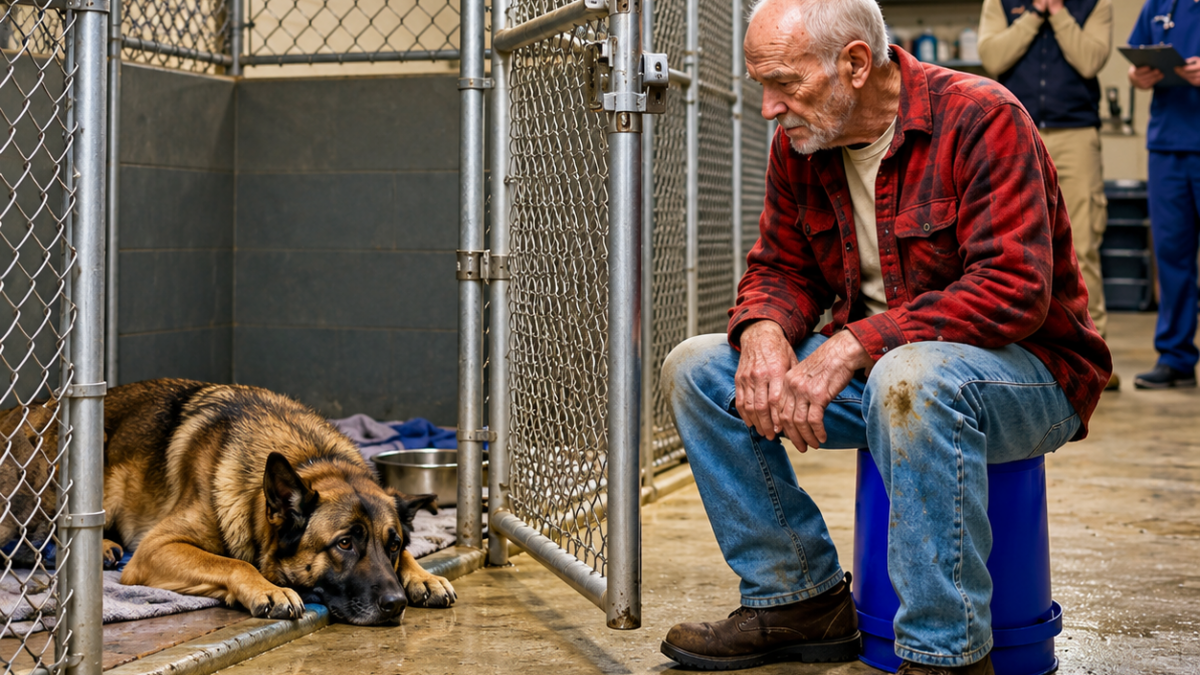
A Retired Military K9 Refused to Eat for 23 Days After Losing His Handler—Then an Old Farmer Sat Outside His Kennel and Made One Silent Gesture No One Else Recognized.
The retired K9 had refused food for twenty-three days.
Doctors called it shutdown, grief response, canine PTSD, and total behavioral collapse—but the old farmer called it something else.
“He’s holding vigil,” Jedediah Stone said, and then he sat down outside the kennel as if he were joining the dog on watch.
My name is Ben Carter, and I was the one who called the old farmer.
At the time, everyone at the shelter thought I was desperate.
They were right.
Ragnar had been with us nearly a month by then, and he was dying one quiet day at a time.
He was a Belgian Malinois, ninety pounds of muscle, discipline, and restrained power.
Even lying still, he looked like a weapon someone had placed gently on the floor and forgotten how to pick up.
His coat had once been glossy, deep fawn and black, but grief had dulled it.
His ribs were starting to show.
His eyes, when he opened them, were the color of dark honey, fixed on a point no one else could see.
He had belonged to Sergeant Michael Evans.
That was the part everybody said softly.
Sergeant Evans had been Ragnar’s handler for six years.
Patrols.
Deployments.
Training fields.
Airfields.
Barracks.
Sand.
Rain.
Night.
Noise.
Fear.
Command.
Trust.
Then Evans was killed.
Ragnar came back without him.
After that, the dog simply stopped participating in the world.
He did not bark.
He did not pace anymore.
He did not lunge.
He did not fight us.
In the first few days, he had paced the back of the kennel until faint scuff marks appeared near the wall.
Then even that stopped.
He lay with his head on his paws, body aligned toward the kennel door, eyes half-open like he was still waiting for one specific pair of boots to appear at the end of the corridor.
Every morning, we brought food.
Every evening, we removed it untouched.
High-value treats.
Chicken.
Steak.
Liver.
Warm broth.
Hand feeding.
Puzzle bowls.
Other dogs nearby.
Recordings.
Medication.
Scent therapy.
Nothing worked.
The worst idea had been the recording of Sergeant Evans’s voice.
Some administrator found an old training clip and thought hearing Evans give a familiar command might comfort the dog.
It did not.
PART2:
The second Ragnar heard his handler’s voice, his whole body began to tremble. Not excitement. Not recognition in any joyful sense. Pain. Deep, physical, breaking pain. He pressed himself against the back wall of the kennel and shook until Dr. Finch ordered the recording shut off.
After that, Ragnar retreated further.
That was when people stopped saying “he needs time” and started saying “quality of life.”
I hated that phrase.
Not because it was cruel.
Because sometimes it was true.
And I did not want it to be true for him.
I was a volunteer at the shelter then. Former Marine. Former corporal. Former a lot of things I was still trying to understand how to be without a uniform.
I cleaned kennels, walked dogs, stocked food, carried crates, fixed broken gates, and did whatever else needed doing. Most days, the work kept my hands busy enough that my head stayed quiet.
But Ragnar was different.
Some dogs come in scared.
Some angry.
Some confused.
Ragnar came in faithful to a man who would never return.
That kind of loyalty is beautiful until you see what happens when it has nowhere to go.
Dr. Alister Finch was the lead veterinary behaviorist assigned to Ragnar’s case.
He was brilliant.
That mattered.
I do not say that sarcastically.
Finch had two doctorates, published papers, developed shelter protocols, and could explain animal cognition in ways that made you feel like he had built a map of the invisible.
He was also the kind of man who trusted charts because charts had rarely betrayed him.
Ragnar betrayed every chart.
By the time I called Jedediah Stone, Dr. Finch had already consulted three certified veterinary behaviorists, a university specialist in canine PTSD, and administrators from the military working dog program at Lackland. They all agreed on one word, though they used different professional language to dress it up.
Grim.
Ragnar was shutting down.
The grief response was total.
He was not eating because some part of him had decided not to live.
I heard about Jedediah from an old Vietnam vet named Earl at the VFW.
Earl was missing two fingers, hated decaf with a religious passion, and had a habit of answering serious questions sideways.
I asked him once if he knew anyone who had worked with military dogs.
He looked at me for a long time over his coffee and said, “You don’t need a trainer. You need Stone.”
“Stone?”
“Jedediah Stone.”
“What is he?”
Earl stirred his coffee.
“Farmer now.”
“That doesn’t answer the question.”
“It does if you listen right.”
Then he told me stories.
Not clear ones.
Not complete ones.
Just fragments.
An old man outside town who had a way with difficult dogs.
Especially the ones that came back from service with ghosts in their eyes.
“He doesn’t fix dogs,” Earl said. “He reminds them who they are.”
That sounded like superstition.
It sounded like a folk remedy brought into a surgical ward.
It sounded ridiculous.
So I called him.
When Jedediah Stone arrived at the shelter, Dr. Finch looked at him the way a surgeon might look at a man offering herbs in a paper bag.
Jedediah was somewhere in his seventies, maybe older. Hard to tell. Some people age in years. Farmers age in weather.
He wore faded denim, a flannel shirt softened by a thousand washings, and work boots clean enough to show respect but old enough to prove they had earned it. His hands looked like gnarled roots. Thick knuckles. Scarred skin. Nails trimmed short. Fingers blunt and strong.
But it was not his clothes or hands that made me stand straighter.
It was the way he carried himself.
He did not have the ramrod posture of a drill instructor. He did not strut. He did not fill the hallway by force. He simply occupied space with quiet purpose.
Shoulders relaxed but square.
Head at a natural angle.
Breathing slow.
No wasted motion.
I had seen that kind of stillness once before on a master gunnery sergeant teaching long-range marksmanship.
Stillness that did not mean absence.
Stillness that meant control.
Dr. Finch stood in front of him with a tablet in one hand and a kind expression that still managed to sound final.
“Sir, I appreciate you making the drive. I really do. But we need to be realistic.”
Jedediah said nothing.
Finch adjusted his glasses.
“Ragnar has been evaluated extensively. Certified behaviorists. Canine PTSD specialist. Military working dog consultants. The consensus is grim. He is shutting down. His grief response is total. He is refusing food because he has decided not to live.”
The doctor’s voice was not unkind.
That almost made it worse.
He sounded like a man who had exhausted hope and now considered honesty a form of mercy.
Jedediah’s eyes were not on Finch.
They were fixed down the kennel block.
At the far end, Ragnar’s enclosure sat in silence.
Other dogs barked, whined, paced, scratched, slept, cried, begged.
Ragnar’s kennel was a black hole of sound.
Jedediah looked at him for a long moment.
Then he said, “Appreciate the summary, Doctor.”
His voice was low and gravelly, like stones rolling in a slow creek.
“Mind if I just sit with him for a spell?”
Dr. Finch blinked.
“Sit with him?”
“Yes.”
“Mr. Stone, the dog is non-responsive. He won’t make eye contact. He won’t take treats. He shows no interest in toys, people, other dogs, or familiar stimuli. We have him on camera twenty-four seven. His heart rate barely elevates when someone enters the block. He is locked in.”
Jedediah nodded as if Finch had told him the weather.
“He’s holding vigil,” the old man said.
Finch frowned.
“I’m sorry?”
“He’s on watch,” Jedediah said. “Waiting for his man to come back through the door. Everything else is just noise.”
He turned his head slightly, and for the first time his pale blue eyes met Dr. Finch’s.
There was no challenge in them.
No arrogance.
Just certainty.
“You’re all just noise.”
I felt that sentence land in my ribs.
Finch opened his mouth, probably to correct him, but Jedediah turned to me.
“Son, is there an old stool or bucket I could sit on?”
“Yes, sir.”
The “sir” slipped out before I could stop it.
I hurried to the supply closet, grabbed a sturdy plastic bucket, wiped it down with a rag, and brought it back.
Jedediah took it with a quiet nod.
Then he walked down the concrete aisle.
He did not walk like a farmer moving through mud.
He walked smoothly, balanced, almost silent. Work boots touching concrete without wasted sound.
He stopped about ten feet from Ragnar’s kennel.
Not close.
Not threatening.
Just outside the space where pressure begins.
He placed the bucket upside down on the floor.
Sat.
And did not look at the dog.
That surprised me.
He faced the opposite kennel, where a terrier mix had been yapping for most of the morning.
He rested his hands on his knees, palms down.
Then he became still.
Not waiting in the impatient human way.
Not performing calm.
Still.
Finch stood beside me near the entrance, arms crossed.
“This is absurd,” he muttered. “Presence alone is not a stimulus.”
I did not answer.
I was watching Jedediah’s hands.
No fidgeting.
No tremor.
No checking a watch.
No phone.
No folded arms.
No anxious shifting.
His hands simply rested on his knees like they had been placed there for a purpose.
“I don’t know, Doc,” I said. “The man who told me about him said Mr. Stone doesn’t fix dogs.”
Finch glanced at me.
“What does that mean?”
“He said he reminds them who they are.”
Finch sighed.
The sound was small, but it carried every ounce of professional irritation he was trying to hide.
An hour passed.
Shelter life continued around us.
Volunteers came and went.
Water bowls were changed.
Kennels were cleaned.
Dogs barked at nothing and everything.
A feeding cart rattled down the aisle.
The terrier across from Jedediah yapped until it wore itself out and fell asleep.
Through it all, the old farmer sat on the bucket.
No reading.
No speaking.
No coaxing.
No treat held through the bars.
He was just there.
Dr. Finch checked the camera feed on his tablet.
“No change,” he said.
I did not respond.
On the screen, Ragnar looked like a statue of sorrow. Head on paws. Body stretched along the floor. Eyes fixed toward the door.
Heart rate: 54.
Respiration steady.
The low resting rate of a depressed but superbly conditioned athlete.
Finch went back to his office.
I stayed near the leash rack, pretending to organize things that were already organized.
Every fifteen minutes, I caught Finch checking the camera feed from his office through the window.
Every fifteen minutes, Jedediah was still there.
Sometime after the first hour, I saw it.
Ragnar’s ear moved.
Not much.
A fraction.
The ear on the side away from Jedediah swiveled back, just enough to aim toward the old man’s general direction.
I held my breath.
The ear moved forward again.
Ragnar stayed still.
It would have been easy to dismiss.
A twitch.
A reflex.
A meaningless adjustment.
But it was the first voluntary movement I had seen him make in a week.
My heart started beating harder.
Another hour passed.
Then Chloe came down the aisle.
Chloe was a young volunteer with a bright voice and more compassion than caution. She carried a leash and stopped at the terrier’s kennel.
“Time for potty break, Mr. Grumbles.”
She opened the kennel door, clipped the leash, and dropped the metal clasp.
It hit the concrete with a sharp clank.
Ragnar’s entire body went rigid.
He did not lift his head, but the muscles across his back and shoulders bunched.
A low growl moved through his chest, so quiet it was almost more vibration than sound.
I froze.
In Finch’s office, I saw him look down sharply at the tablet.
Later, he told me Ragnar’s heart rate spiked to 120.
Jedediah moved for the first time in two hours.
He did not stand.
He did not turn.
He did not speak.
He simply lifted his right hand from his knee, palm open and facing down, then slowly lowered it back.
A simple calming gesture.
Slow.
Deliberate.
I had worked with MWD teams overseas. I had seen handlers communicate with almost nothing. A hand tilt. A finger curl. A shift in posture.
I did not recognize the exact signal.
But I recognized the grammar.
As you were.
Stand down.
Easy.
Inside the kennel, the growling stopped.
The tension drained out of Ragnar’s body.
Just like that.
He remained on the floor, still grieving, still weak, still lost.
But the warrior had answered.
Dr. Finch came out fast, tablet in hand.
“What happened?”
I told him.
Dropped clasp.
Growl.
Hand signal.
Immediate de-escalation.
“He calmed him down,” I said. “Without a word. Without even looking at him.”
Finch stared at Jedediah.
“It could be coincidence.”
His voice lacked conviction.
The data did not look like coincidence.
The spike had dropped too sharply.
Not gradual recovery.
More like a switch flipped off.
For the first time, Finch stayed to watch.
The scientist and the soldier stood side by side in the shelter aisle while an old farmer sat across from a grieving dog.
Another hour passed.
The afternoon sun slanted through the high grimy windows, striping the concrete in pale gold.
Then Jedediah shifted slightly on the bucket.
He reached into his flannel shirt pocket and pulled out a small crumpled brown paper bag.
From it, he took a strip of dried meat.
Jerky.
Not gas station jerky.
Not processed meat packed in chemicals.
This looked homemade, dark and tough. Something cured over smoke, salt, time, and patience.
He did not offer it to Ragnar.
He did not wave it.
Did not click his tongue.
Did not say the dog’s name.
He put the piece in his own mouth and began to chew.
Slowly.
Rhythmically.
The scent drifted through the kennel block.
Smoke.
Salt.
Meat.
Earth.
It cut through the bleach and stress of the shelter.
In Ragnar’s kennel, his nose twitched.
Just once.
A minute later, it twitched again.
Dr. Finch’s breath caught.
The dog lifted his head an inch from his paws.
He did not look at Jedediah.
He tested the air.
His nostrils flared.
He was processing scent.
Not food in a bowl.
Not a treat pushed at him by hopeful hands.
The smell of something real.
Field food.
Campfire.
Leather.
Outdoor work.
Life beyond concrete walls.
Jedediah ate one piece.
Then another.
Then a third.
He still did not offer anything to Ragnar.
He was not feeding the dog.
He was sharing a meal in the same space.
After the third piece, Jedediah took out a fourth.
This time, he did not eat it.
He placed it on the clean concrete floor about five feet in front of him, far from the kennel door.
Then he put his hands back on his knees and became still again.
Ragnar watched the meat.
His head was up now.
Neck muscles taut.
Eyes sharper.
But he did not move.
Minutes stretched.
He was torn between two instincts.
Live.
Wait.
Eat.
Hold the post.
Jedediah did not push.
No coaxing.
No command.
No “good boy.”
No pressure.
He gave Ragnar the one thing no one else had given him.
Choice.
I felt respect settle over me so heavily I almost had to sit down.
You cannot order a soldier out of grief.
You cannot trick him out of it.
You cannot shame him, distract him, or lecture him back into wanting tomorrow.
Sometimes all you can do is sit in the trench beside him, share your rations, and wait until he remembers the world has not ended just because the person he loved is gone.
Finally, Ragnar lowered his head back onto his paws.
Dr. Finch let out a small disappointed breath.
I felt it too.
Then I saw Jedediah.
He had not changed expression.
Not even a flicker.
As if this too was part of the work.
Ten more minutes passed.
Then Ragnar began to move.
Not stand.
Move.
He pushed himself forward on his belly, inch by painful inch, like a soldier low crawling under wire.
His eyes never left Jedediah.
He moved from the back wall toward the front of the kennel.
Not toward the jerky.
Toward the old man.
Dr. Finch’s mouth opened slightly.
All his protocols had been designed to make Ragnar feel safe enough to approach.
This old farmer had achieved it by doing almost nothing.
Ragnar reached the chain-link door and stopped.
His nose was inches from the metal.
For the first time since arriving, he made direct, sustained eye contact.
Not a challenge.
A question.
Who are you?
Jedediah finally turned his head.
He met the dog’s gaze.
He did not smile.
He did not speak.
He just looked back with a quiet understanding that made the kennel block feel suddenly smaller, more sacred somehow.
Then he gave one slow blink.
I knew enough about dogs to understand.
No threat.
No challenge.
I am not here to harm you.
Ragnar watched him.
Then exhaled.
A long, shuddering sigh.
It seemed to carry weeks of tension out of his body.
He rested his chin on the concrete, eyes still on Jedediah, and closed them.
He had not abandoned his post.
But he had accepted someone else on the watchtower.
Jedediah stayed another half hour.
Ragnar dozed.
Not deeply.
Not freely.
But he slept near the front of the kennel.
That alone felt impossible.
Eventually, Jedediah stood. His joints creaked softly. He picked up the piece of jerky from the floor, dusted it off on his jeans, walked to the kennel door, and slid it under.
About a foot inside.
Then he turned and walked back to us.
“He’ll need time,” he said.
His voice was low.
“Don’t push him. Others need to leave him be. One person brings water and food. Quietly. No talk. Put it down and walk away.”
He handed me the bucket.
“I’ll be back tomorrow. Same time.”
Dr. Finch finally found his voice.
“What did you do?”
Jedediah looked at him.
“You were all trying to pull him out of the hole,” he said. “You have to go into the hole with him. Sit with him in the dark for a while. Let him know he’s not alone in it. Then he decides if he’s ready to climb out.”
Finch said nothing.
Jedediah looked from him to me.
“That dog’s not broken. He’s mourning. There’s a difference. You can’t fix mourning. You can only share the burden of it.”
Then he walked out, boots soft against the concrete.
After he left, Dr. Finch and I approached Ragnar’s kennel.
The dog was still dozing near the front.
The piece of jerky was gone.
Finch stared at the empty spot.
Then at the sleeping dog.
For the first time since I had met him, Alister Finch looked less like a man with answers and more like a man willing to learn.
“He approached Ragnar as a fellow being,” Finch said quietly.
I looked at him.
“What?”
“I approached him as a problem to solve.”
He kept looking through the chain link.
“There’s a difference.”
“Yes, sir,” I said.
He did not correct the sir.
The next day, Jedediah returned with the same bucket and another brown paper bag.
This time, he sat directly in front of Ragnar’s kennel.
Ragnar was already there.
Waiting.
When the old man sat down, Ragnar’s tail gave one tentative thump against the concrete.
One.
To anyone else, it might have looked like nothing.
To us, it was thunder.
For two hours, Jedediah sat.
He ate jerky.
Placed a piece inside the kennel.
Ragnar ate it.
No ceremony.
No triumph.
Just food taken quietly, as if both of them understood the dignity of not making a spectacle out of survival.
Occasionally, Jedediah murmured to him.
Too soft for us to hear.
Not baby talk.
Not command voice.
Conversation.
Respectful.
Like he was speaking to a peer.
On the third day, Jedediah arrived and looked at Dr. Finch.
“I’d like to go in with him today.”
Finch stiffened.
“Inside the kennel?”
“Yes.”
“Mr. Stone, that is highly inadvisable. Ragnar has no bite history, but he is a ninety-pound Malinois with advanced combat training. He has been through extreme trauma. His triggers are unknown.”
Jedediah listened.
Then said, “The boy and I have an understanding. It’s time.”
He said it so quietly that arguing would have felt foolish.
Finch looked at me.
I said nothing.
Against every liability protocol in the building, he retrieved the key.
We walked down the aisle together.
Ragnar stood as we approached.
Not tense.
Not aggressive.
Alert.
Focused.
Waiting.
Jedediah took the key.
He did not approach the lock straight on. He stood beside it, body angled slightly away, and inserted the key. He unlocked the door but did not open it immediately.
He rested one hand on the frame.
Let Ragnar absorb his presence.
His scent.
His intent.
Then he slowly swung the heavy door inward and stepped inside.
He did not focus on Ragnar.
Instead, he walked to the back of the kennel and checked the water dispenser. Ran one finger along the nozzle. Kicked lightly at the bedding to fluff it. Looked at the corners. The walls. The floor.
He moved like someone inspecting quarters.
Not visiting.
Not intruding.
Taking responsibility for the space.
Ragnar watched every movement, head slightly cocked.
Then Jedediah turned and sat on the concrete floor with his back against the wall, leaving the entire path to the open door clear.
He patted the floor beside him.
A simple invitation.
Ragnar hesitated.
Then walked over with solemn dignity.
He did not sit beside Jedediah.
He lay down with his back pressed firmly against the old man’s leg, head resting on Jedediah’s knee.
Facing the door.
Still a sentinel.
Still on watch.
But leaning on someone.
Sharing the post.
Jedediah raised one hand slowly.
Not over the dog’s head.
Not a dominance gesture.
From underneath, he gently scratched the thick muscle beneath Ragnar’s jaw.
The dog let out a deep, guttural groan.
Not pain.
Relief.
Pure, unguarded relief.
His eyes closed.
I felt my throat tighten.
Dr. Finch stood beside me, tablet forgotten in his hand.
Jedediah stayed like that for a long time.
Then he began to speak.
His voice was low enough that we caught only pieces.
“No, that’s a heavy load, son. Heavy load.”
A pause.
“You carried it well.”
Another pause.
“You did your duty.”
Ragnar’s breathing shifted.
“No one can ask more than that.”
Jedediah’s hand moved along the dog’s neck.
“He wouldn’t ask more than that.”
I knew who he meant.
Sergeant Evans.
The man Ragnar was still waiting for.
The man who would never come through the door.
Jedediah was not telling Ragnar to forget him.
He was giving him permission to stop dying at his post.
Then the old man’s left hand moved.
Quick.
Precise.
A flash of fingers and a tap near his own shoulder.
A compact, nearly invisible signal.
Ragnar changed instantly.
His head lifted from Jedediah’s knee.
Ears sharp.
Eyes focused.
Back straight.
The grief did not vanish, but the dog was suddenly present in his own body again.
Operator.
On duty.
Dr. Finch whispered, “What was that?”
I stared.
“That’s not standard MWD.”
The old farmer spoke one word.
Sharp.
Guttural.
Not English.
“Vrij.”
Free.
At least, that was what I learned later.
Ragnar broke posture.
He shook his entire body from head to tail as if shedding a weight he had carried too long.
Then he licked Jedediah’s rough hand.
The spell was broken.
Not the grief.
Grief does not break like that.
But the prison around it opened.
Jedediah spent another hour inside.
He brushed Ragnar’s coat with a stiff grooming brush he had brought in his back pocket. He worked through tangles with careful efficiency, speaking in that low calm murmur the whole time.
Finally, he stood.
Ragnar stood with him.
Jedediah walked to the door and stepped out.
Ragnar did not panic.
He sat.
Waiting for the next instruction.
Jedediah locked the door and handed the key back to Dr. Finch.
“He’ll eat now.”
The doctor looked almost startled by the certainty.
“Mix his kibble with warm water and a little beef broth,” Jedediah said. “Not too much. Stomach needs to remember its job.”
Then he looked at me.
“Walk him. Short leash. Heel position. Let him know structure is back. He’s been missing structure.”
Dr. Finch cleared his throat.
“Mr. Stone. Jedediah. I have to ask. Where did you learn that? The hand signal. The word. That isn’t standard military working dog training. I’ve studied the manuals. I’ve spoken to trainers.”
Jedediah looked down at his hands.
For a long moment, I thought he would not answer.
Then he said, “There are all kinds of service, Doctor. Not all of them have manuals you can read.”
I felt the hair rise along my arms.
Earl’s stories from the VFW came back.
The old man’s stillness.
The hand signals.
The non-standard language.
The way Ragnar recognized him.
Some dogs and some men work in places the rest of us only hear about in fragments.
Places without plaques.
Without public medals.
Without standard training manuals.
Jedediah seemed to notice the understanding in my face.
He gave me the smallest nod.
Not confirmation exactly.
Permission not to ask.
Then he turned back to Finch.
“The dog will be fine. He just needed someone who spoke his language.”
“The language of commands?” Finch asked.
Jedediah shook his head.
“The language of duty.”
He started down the aisle, then paused.
“Doctor.”
Finch looked at him.
“Your charts and your science are good for understanding the what. Sometimes with men and dogs like him, you need the why.”
He glanced toward Ragnar.
“His why was his handler. When that was gone, he lost his purpose. All I did was give him a new one for a little while. Wait for me. Now his purpose is to get strong again. One day at a time.”
Then he walked out of the shelter.
His boots made almost no sound.
An hour later, I prepared Ragnar’s food exactly as Jedediah instructed.
Kibble.
Warm water.
A little beef broth.
Not too much.
I carried the bowl to the kennel without speaking.
No excitement.
No begging.
No “come on, boy.”
I opened the slot and placed the bowl inside.
Then I stepped back.
Ragnar stood.
For twenty-three days, he had refused to eat.
Twenty-three days of untouched bowls.
Twenty-three days of charts, consultations, treatment plans, and fading hope.
Now the great Malinois walked calmly to the bowl.
He lowered his head.
And with solemn dignity, began to eat.
I turned away before anyone saw my face.
Dr. Finch did not.
He stood beside me, eyes wet behind wire-rimmed glasses, watching the dog take one mouthful after another.
“He was never refusing food,” Finch whispered.
I looked at him.
“He was refusing to leave his post.”
Finch nodded slowly.
“Yes.”
Ragnar did not recover all at once.
Real healing rarely gives people the dramatic timeline they want.
He ate small portions at first.
Then more.
He walked on a short leash beside me, not bouncing back into life, but participating in it again.
He stayed quiet.
Still watched doors.
Still lifted his head whenever boots sounded in the corridor.
Still seemed to listen for a voice no one could bring back.
But he no longer lay against the far wall waiting to die.
Jedediah came every day for two weeks.
Sometimes he sat outside the kennel.
Sometimes inside.
Sometimes he brushed Ragnar.
Sometimes he walked him slowly in the yard.
He never treated him like a pet.
He treated him like a soldier on convalescent leave.
Respect.
Routine.
Food.
Quiet.
Purpose.
One afternoon, I asked him directly.
“Did you know dogs like him before?”
Jedediah looked across the yard, where Ragnar was standing in weak sunlight, nose lifted to the cold air.
“I knew men like him,” he said.
“That doesn’t answer the question.”
“It answers enough.”
I nodded.
After a while, he added, “Some come home and everyone wants them to be grateful. Happy. Normal. But part of them is still watching a door. Still waiting for the person who didn’t make it back.”
He looked at me then.
“You know anything about that, son?”
I did not answer.
He had not asked because he needed the information.
He asked because he already knew.
Former Marines carry certain silences in familiar places.
Ragnar eventually left the shelter for a specialized retired working dog sanctuary on Jedediah’s farm.
That was the decision Dr. Finch made after swallowing enough pride to admit the obvious.
The old farmer could offer what the shelter could not.
Quiet land.
Routine.
Structure without pressure.
Space.
A man who understood that grief and discipline often sleep in the same room.
The morning Ragnar left, the kennel block felt different.
Volunteers gathered at a distance. Nobody crowded him. Nobody cheered. Nobody made it a spectacle.
Jedediah stood near his old truck, tailgate down, a thick blanket spread in the back beside a crate that looked more like a secure den than confinement.
Ragnar walked at heel beside him.
Slow, still thin, but steady.
At the truck, he stopped and looked back toward the kennel block.
For one breath, I wondered if he was searching for Sergeant Evans again.
Maybe he was.
Maybe he always would.
Jedediah rested a hand lightly against his shoulder.
Not pushing.
Just contact.
“Vrij,” he said softly.
Ragnar turned back to him.
Then climbed into the truck.
Jedediah closed the crate door.
Before he got into the driver’s seat, he walked over to me.
“You did right calling.”
“I almost didn’t.”
“Most important things almost don’t happen.”
I tried to smile.
“Will he be okay?”
Jedediah looked toward the truck.
“He’ll mourn. He’ll eat. He’ll work in small ways. He’ll sleep. One day he’ll hear a door open and not expect the dead to walk through it.”
His eyes returned to me.
“That’s about as okay as any of us get.”
I nodded.
My throat was too tight for more.
Dr. Finch came out last.
He looked different than he had that first day.
Less armored.
He extended one hand to Jedediah.
“I was wrong,” he said.
Jedediah shook his hand.
“No shame in being wrong, Doctor. Shame is in staying there after truth knocks.”
Finch gave a small, tired laugh.
“I may put that in a paper.”
“Don’t.”
That made me laugh.
Ragnar’s truck rolled out of the shelter driveway under a pale morning sky.
He did not bark.
Did not panic.
Did not look wild with fear.
He lay inside the crate, head up, watching the road ahead.
Still on duty, maybe.
But no longer alone on watch.
Months later, I drove out to Jedediah’s farm.
I told myself I was delivering donated blankets and a few bags of feed.
That was partly true.
The farm sat beyond town, past fields gone golden in late autumn. Weathered barns leaned into the wind. Fences ran along pasture edges. An old windmill turned slowly near a pond.
Ragnar met me at the gate.
Not with a bark.
With a stare.
Same dark honey eyes.
Same controlled posture.
But there was weight on him again.
Healthy weight.
His coat had regained its shine.
His ears were sharp.
His body no longer looked like a monument to loss.
Jedediah came from the barn carrying a bucket.
Ragnar glanced at him first.
Then back at me.
Permission granted.
He walked toward me and pressed his shoulder lightly against my leg.
I put one hand on his neck.
“Hey, boy.”
His tail moved once.
That was enough.
Jedediah watched from the barn door.
“He works mornings now,” he said.
“Works?”
“Checks fences with me. Keeps coyotes honest. Walks the old orchard. Watches the gate.”
I looked down at Ragnar.
“Still on duty.”
Jedediah nodded.
“Just a different post.”
Near the barn, I saw a photograph nailed inside a small wooden frame.
Sergeant Michael Evans.
Smiling in uniform.
One hand on Ragnar’s head.
Below the photo, someone had carved a simple line into the wood.
GOOD WATCH. REST EASY.
I looked at Jedediah.
He shrugged.
“Dog needed to know we remembered his man.”
I had to look away for a second.
Ragnar leaned harder against my leg.
That was when I understood something I had not understood at the shelter.
Jedediah had never replaced Sergeant Evans.
He had never tried.
He had simply shown Ragnar that honoring the dead did not require joining them.
That is a hard lesson for dogs.
Harder for men.
Before I left, Jedediah handed me a small brown paper bag.
Inside were strips of homemade jerky.
“For the shelter,” he said.
I raised an eyebrow.
“You want me to use your method?”
“No.”
“Then what?”
He looked toward Ragnar.
“Eat with them sometimes.”
I frowned.
“The dogs?”
“The volunteers. The scared ones. The angry ones. The ones pretending they’re fine.”
His pale eyes settled on me.
“People come into shelters carrying cages too, Ben.”
I did not have an answer.
He did not need one.
When I returned to the shelter, Dr. Finch was waiting near Ragnar’s old kennel.
It had been cleaned.
New bedding.
New water bowl.
A different dog would use it soon.
That was the work.
Space opens.
Pain arrives.
You do your best.
Finch looked at the paper bag in my hand.
“From Stone?”
“Yes.”
“Please tell me it isn’t another lesson.”
“It is absolutely another lesson.”
He sighed.
But he smiled.
That was new.
Over time, Finch changed his approach with the most traumatized dogs.
Not abandoning science.
Never that.
He still believed in data, medication when needed, behavior plans, controlled exposure, environmental management, measurable progress.
But he also began adding something no chart had taught him.
Witness.
He trained volunteers to sit without demanding.
To enter kennel blocks calmly.
To let animals choose distance when possible.
To stop treating every refusal as resistance.
He wrote new notes into case files.
Possible grief response.
Do not force engagement.
Single consistent handler recommended.
Quiet presence may precede feeding.
Choice-based approach.
One day, I saw a sentence in his report that made me stop.
Animal is not noncompliant. Animal appears to be waiting.
I read it twice.
Then looked at Finch through the office window.
He was examining a scared hound with the gentleness of a man who had finally learned the difference between behavior and story.
Ragnar had taught him that.
Or maybe Jedediah had.
Or maybe grief had.
It is hard to separate teachers when the lesson is true.
I kept volunteering.
Some days were good.
Some were heavy.
Dogs came in shaking, biting, hiding, starving, grieving, confused. Some left with families. Some needed longer. Some broke your heart.
But after Ragnar, I stopped measuring success only by tail wags and adoption photos.
Sometimes success was a dog eating one bite.
Sometimes it was an ear turning toward you.
Sometimes it was a growl stopping before panic took over.
Sometimes it was a wounded creature deciding, just for a moment, not to be alone.
I learned to sit more.
Say less.
Move slower.
And when I found myself wanting to fix everything quickly, I remembered Jedediah on that bucket.
Silent.
Unmoved.
Patient enough to let life choose itself.
A year after Ragnar came to us, the shelter held a small fundraiser.
Dr. Finch gave a talk about trauma-informed animal care. He used careful language, but anyone who knew the story understood where the change began.
Jedediah did not attend.
He said crowds made him itchy.
But he sent a note.
Finch read it aloud near the end.
It said:
Some wounds don’t close because we tell them to. They close when the body finally believes the danger has passed. Give them safety. Give them time. Don’t mistake silence for emptiness. Sometimes silence is a creature holding on with everything it has.
The room was quiet afterward.
Even the dogs in the adoption wing seemed quieter, though that may be memory improving the scene.
Two weeks later, I visited the farm again.
Ragnar was lying beside Jedediah near the barn, both of them watching a storm come over the fields.
The old man sat on an overturned bucket.
Of course he did.
Ragnar’s head rested near his boot.
Not on his knee this time.
He did not need to lean constantly anymore.
That was progress too.
He could be near without clinging.
Alert without starving.
Loyal without dying.
When I stepped closer, Ragnar lifted his head.
Jedediah did not look at me.
“Evening, Ben.”
“How’d you know it was me?”
“Truck needs a belt.”
I looked back at my truck.
“It does not.”
“It will.”
Ragnar rose and walked over.
This time, he placed his head against my chest.
I held him.
He allowed it for exactly four seconds.
Then returned to Jedediah.
Fair enough.
I sat on the grass beside them.
For a while, none of us spoke.
The sky darkened.
Wind moved through the pasture.
Somewhere in the barn, a loose hinge complained.
Finally, I asked, “Did you ever tell Dr. Finch what ‘vrij’ means?”
Jedediah’s mouth twitched.
“He looked it up.”
“Free.”
“Close enough.”
“What did it mean to Ragnar?”
He watched the storm.
“Dismissed from post.”
My throat tightened.
“Sergeant Evans would have wanted that?”
Jedediah’s eyes stayed on the fields.
“Any good handler would.”
Thunder rolled far off.
Ragnar did not flinch.
He simply looked toward the sound, then back at Jedediah.
The old man rested one hand lightly on the dog’s shoulder.
Not restraining.
Not commanding.
Just reminding.
You are here.
You are not alone.
The storm passed north of us.
Rain never fell.
The light returned in a thin gold line along the horizon.
That evening, driving back to the shelter, I thought about the day Ragnar first ate.
People wanted to tell the story like a miracle.
The old farmer came.
The dog ate.
Everyone cried.
Easy.
Clean.
But that was not the truth.
The truth was quieter.
Jedediah did not save Ragnar by overpowering grief.
He honored it.
He sat beside it.
He shared space with it until the dog no longer had to guard the dead alone.
That was harder than a miracle.
It required patience.
Humility.
Respect.
And a kind of love that does not demand immediate proof it is working.
I think about that often now.
Especially when people come through the shelter doors carrying their own invisible kennels.
Former soldiers.
Lonely widows.
Teenagers with angry eyes.
Volunteers who say they are fine too quickly.
People who think they are there to help animals and discover the animals have been reading them all along.
I used to think healing meant getting someone to move.
Eat.
Stand.
Respond.
Obey.
Improve.
Now I know sometimes healing begins before any of that.
Sometimes it begins when someone sits down nearby and says without words:
I see the hole.
I am not afraid to sit beside it.
You do not have to climb out today.
But when you are ready, I will still be here.
Ragnar taught me that.
Jedediah taught me how to see it.
Dr. Finch taught me that even brilliant people can change when truth becomes undeniable.
And Sergeant Evans, though I never met him, taught me something through the dog he left behind.
Real loyalty does not end with death.
But if it is loved well, it can become life again.
The last time I saw Ragnar before winter, he was running.
Not fast like a young dog without history.
Not wild.
Not careless.
But running.
Across the pasture behind Jedediah’s barn, legs strong, coat shining, body low and fluid. He chased no toy, answered no command, proved nothing to anyone.
He simply ran because he could.
Jedediah stood beside me, hands in his coat pockets.
“He looks good,” I said.
“He is good.”
“Still misses him?”
“Every day.”
I nodded.
Ragnar slowed near the fence, turned, and looked back at us.
Jedediah lifted one hand.
Not the sharp signal from the kennel.
Not the command that freed him.
Just a small wave.
Ragnar trotted back.
He stopped in front of the old farmer and sat.
Straight.
Proud.
Ready.
Jedediah looked down at him.
“Good watch,” he said.
Ragnar’s tail moved once.
Then he leaned, just slightly, against the old man’s leg.
That was enough.
Some stories do not end with grief disappearing.
They end with grief learning where to rest.
Ragnar had not forgotten Sergeant Evans.
He never would.
But he had eaten.
He had slept.
He had walked into sunlight again.
And all of it began because one old farmer understood what everyone else had missed.
The dog was not broken.
He was mourning.
And nobody could force him back to life.
Someone had to sit beside him long enough for him to remember he was still allowed to live.








