A Retired Military K9 Carried the Same Boot to His Kennel Door Every Night—Then a Nurse Looked Inside It
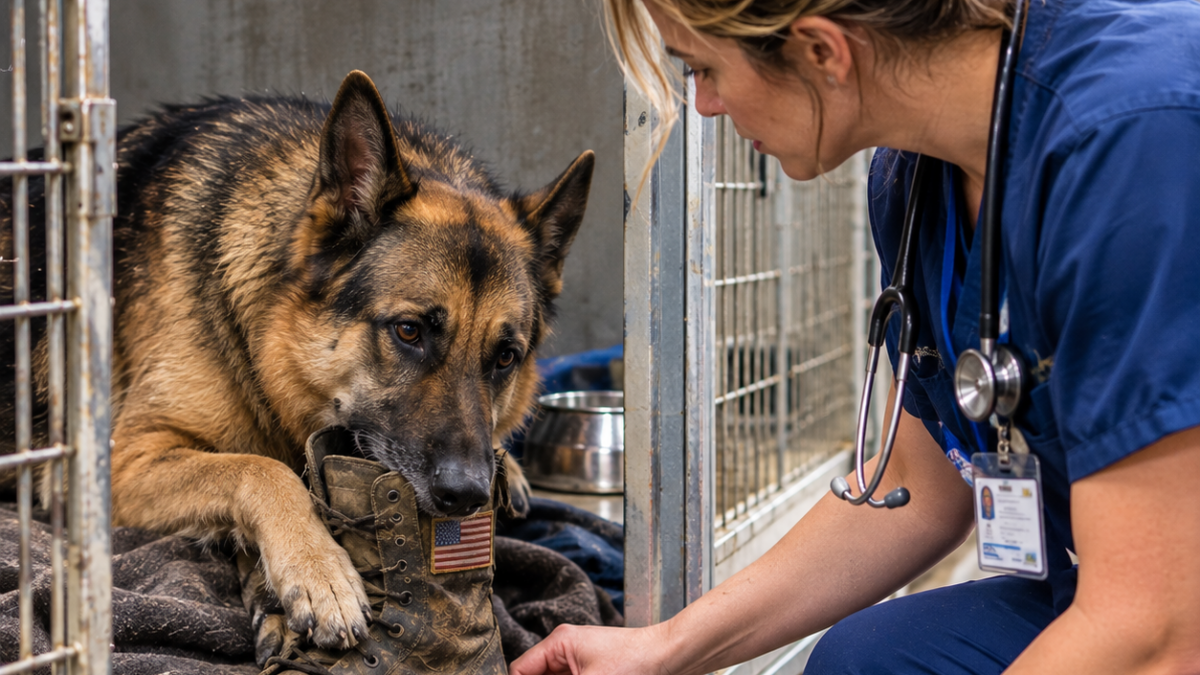
A Retired Military K9 Carried the Same Boot to His Kennel Door Every Night—Then a Nurse Looked Inside It
Every night for six years, the retired military K9 carried the same battered combat boot to wherever he slept, placed it beside the door, and refused to let anyone take it away.
The shelter staff assumed Shadow was guarding the last object that still smelled like his dead handler—until a nurse noticed the torn insole had been stitched back by hand and heard something small slide inside the sole when she lifted it.
Hidden beneath the leather was a sealed piece of cloth, a photograph of a little girl, and a note written before the handler’s final deployment that changed the meaning of everything: Shadow had never been protecting a dead man’s boot.
He had been guarding the scent of the child he had been trained to find if his handler never came home.
Shadow arrived at Cedar Ridge Animal Rescue on a rainy Monday morning in February.
Nobody heard him bark.
That was the first thing people remembered.
The second was the boot.
The old German Shepherd stepped down from the county transport van stiffly, favoring his right hip, gray around the muzzle and shoulders, with the kind of broad skull and deep chest that made people instinctively recognize a working dog even before they saw the faded military tattoo inside his ear.
He was thirteen.
Maybe slightly older.
His records were unusually complete.
RETIRED MILITARY WORKING DOG.
NAME: SHADOW.
BREED: GERMAN SHEPHERD.
PRIMARY FUNCTION: EXPLOSIVE DETECTION / PATROL SUPPORT.
TWO DEPLOYMENTS.
MEDICALLY RETIRED.
FORMER HANDLER: STAFF SERGEANT EVAN COLE.
STATUS OF HANDLER: DECEASED.
There was more.
Arthritis.
Partial hearing loss in the left ear.
Old scar tissue along the ribs.
One surgically repaired hind leg.
Mild cataracts.
No bite history after retirement.
No known aggression toward civilians.
House trained.
Vehicle trained.
PART2:
Responds to verbal and hand commands.
That last line quickly proved inaccurate.
When shelter director Mark Delaney said:
“Shadow.”
The dog looked past him.
“Come.”
Nothing.
A trainer tried:
“Heel.”
Nothing.
They used the old military commands listed in his file.
Nothing.
They used hand signals.
Nothing.
Shadow simply stood beside the transport worker.
Watching.
Waiting.
Then the worker went back to the van.
Returned carrying one object.
A single right combat boot.
Old.
Tan leather gone almost gray.
Toe scraped black.
Laces frayed.
PART3:
One side split where it had been repaired with heavy thread.
The heel was worn unevenly.
The boot looked as if it had crossed deserts, mud, blood, rain, and years.
The worker placed it on the floor.
Shadow immediately walked to it.
Picked it up by the ankle.
Carried it toward the kennel hallway.
Mark frowned.
“That comes with him?”
The worker checked the paperwork.
“Apparently.”
“Why?”
“Previous owner said never separate them.”
“Owner?”
“Handler’s mother.”
That explained part of the history.
Staff Sergeant Evan Cole had been killed overseas six years earlier.
After Shadow’s medical retirement, the dog had gone to Evan’s mother, Judith Cole, outside Knoxville, Tennessee.
Judith kept him until her death from a stroke.
She had no surviving spouse.
Her only other child lived overseas and could not take an elderly military dog.
Shadow went temporarily to county animal control, then to Cedar Ridge because the rescue had experience placing retired police and military dogs.
The combat boot came with him.
Taped to the side of his transport crate was a handwritten note.
PLEASE DO NOT THROW AWAY THE BOOT.
HE SLEEPS WITH IT.
Mark had seen stranger things.
He allowed it.
The first night, kennel staff placed Shadow in a large run at the quiet end of the building.
Orthopedic bed.
Water.
Blanket.
Food.
The boot went beside the bed.
At 11:40 p.m., overnight attendant Carla Simmons walked past.
Shadow was awake.
The boot was not beside the bed.
He had carried it to the kennel door.
Placed it directly against the bars.
Then lay behind it.
Head on his paws.
Eyes facing the hallway.
The next morning, Carla mentioned it.
Mark shrugged.
“Comfort object.”
That was the explanation everyone accepted.
For a while.
Shadow had lost his handler.
Then lived six years with the handler’s mother.
Now she was gone too.
A dog associating one object with family made sense.
The boot probably smelled like Evan once.
Maybe some trace remained.
Mark told staff:
“Leave it.”
They did.
But Shadow did something strange.
Every evening, regardless of where the boot had been moved during cleaning, he carried it to the kennel entrance.
Never to the back.
Never onto his bed.
Always the door.
Toe facing outward.
Opening facing inward.
Like an object positioned for departure.
Staff joked about it.
“He’s packing.”
“He thinks someone is coming.”
“Old soldier waiting for inspection.”
But after a month, the joke stopped feeling funny.
Shadow was not miserable.
He ate.
Walked.
Accepted gentle touch.
Allowed veterinary exams.
He sometimes followed staff into the yard.
But he never fully relaxed.
Every sound near the entrance made his head rise.
Every time boots crossed the hallway, Shadow stood.
Every time a woman with long brown hair entered, his ears moved.
Every young girl who passed the kennel made him stare.
That last behavior became noticeable enough for Mark to add a note.
RESPONDS STRONGLY TO FEMALE CHILDREN, APPROX. AGES 8–15.
Not aggressive.
Just alert.
Once, a volunteer brought her twelve-year-old daughter to the shelter after school.
The girl walked past Shadow’s kennel.
Shadow stood.
Picked up the boot.
Brought it to the bars.
Set it down.
Then looked at the girl.
She stopped.
“Mom?”
Shadow whined.
Low.
Soft.
The girl’s mother moved her along.
Shadow watched until she disappeared.
Then carried the boot back inside.
Nobody knew what to make of it.
Several families applied to adopt him.
The first was a retired Marine and his wife.
Good home.
Fenced yard.
No young children.
Experience with German Shepherds.
Shadow met them politely.
Accepted treats.
Did not engage.
When the couple stood to leave, Shadow retrieved the boot and placed it at the gate.
The wife smiled sadly.
“I think he’s waiting for someone else.”
The second applicant was a former police K9 handler.
Excellent candidate.
Shadow responded to two commands.
Then shut down.
Third applicant lived on ten acres.
Fourth had fostered working dogs.
Fifth had lost a senior shepherd and wanted another.
Nothing.
Shadow was not aggressive.
That made rejecting homes harder.
He seemed capable of living somewhere.
He simply acted as if every placement would be temporary.
Mark eventually stopped advertising him aggressively.
“Give him time.”
Three months passed.
Then Nurse Leah Mercer began volunteering at Cedar Ridge.
Leah was forty-one.
Emergency-room nurse at a hospital in Knoxville.
She volunteered because her night shifts had begun following her home.
After fourteen years in emergency medicine, she had learned that the body leaves work before the mind does.
Some nights she could still hear monitors while lying in bed.
Sometimes a particular smell brought back patients she had not thought about in years.
A hospital counselor suggested she find somewhere quiet that had nothing to do with people dying.
Leah chose an animal shelter.
Her first job was laundry.
She liked it.
Blankets had simple problems.
Dirty.
Clean.
Wet.
Dry.
No family member asking whether the person they loved would survive.
Eventually she began helping with senior dogs.
That was how she met Shadow.
She first noticed him because he watched her shoes.
Leah wore soft gray sneakers.
Every other dog looked at her hands.
Food.
Treats.
Touch.
Shadow looked at her feet.
Then at the hallway.
She crouched outside the kennel.
“Hi.”
His eyes moved to hers.
Then away.
Leah did not take it personally.
She knew dissociation when she saw it.
Human or animal, the body sometimes remained while attention disappeared somewhere safer.
She sat outside the kennel for ten minutes.
No commands.
No baby voice.
No reaching through bars.
Shadow eventually lay down.
That was enough.
The next week she came back.
Same thing.
The third week, she brought a book.
Read beside him.
He ignored her.
Mostly.
Then she turned a page too quickly.
Shadow’s ear moved.
Leah smiled.
“Caught you.”
He looked away.
By week five, Shadow allowed her to walk him.
He did not heel.
Did not pull.
He walked half a body length ahead.
Always scanning.
At the shelter door, he paused every time.
Looked toward the parking lot.
Leah began noticing the boot ritual.
One evening she arrived near closing.
Shadow was in the outdoor run.
The boot remained inside near his bed.
When Mark opened the interior door, Shadow entered.
Walked directly to the boot.
Picked it up.
Carried it to the kennel gate.
Leah watched.
“Every night?”
“Every night.”
“How long?”
“According to the previous owner, six years.”
Leah turned.
“Six?”
“Since his handler died.”
She looked at the boot.
“Same one?”
“Same one.”
“Was it the handler’s?”
“We assume.”
“Assume?”
Mark shrugged.
“The mother said it was Evan’s. Nobody had reason to question it.”
Shadow lowered himself behind it.
Leah studied the position.
“That doesn’t look like sleeping with it.”
“What does it look like?”
“Guarding an exit.”
Mark considered.
“Military dog.”
“Exactly.”
The next time Leah helped clean the kennel, she lifted the boot.
Shadow stood instantly.
Not threatening.
But every muscle tightened.
Leah froze.
“Okay.”
She placed it back down.
Shadow relaxed.
That reaction interested her.
She tried later with Mark present.
Not taking the boot.
Just touching it.
Shadow moved between her and the object.
No growl.
No teeth.
Barrier behavior.
Leah backed away.
“He doesn’t want it removed.”
“We know.”
“No.”
She looked at Mark.
“He doesn’t want anyone inspecting it.”
Mark laughed lightly.
“It’s a boot.”
Leah looked down.
“Maybe.”
The leather was old.
But one thing stood out.
The insole.
Most military boots worn long enough to look that damaged would have interiors destroyed.
This one had a newer-looking insole.
Still old.
But different age from the outer leather.
Leah asked:
“Has anyone ever replaced this?”
“No idea.”
“Can I look?”
“Only if Shadow lets you.”
He didn’t.
Not that day.
Leah did not force it.
She waited.
Trust mattered more than curiosity.
Two weeks later, Shadow developed an irritated paw pad.
Leah volunteered to help the veterinary technician while Mark held him.
Shadow lay on his side.
Calm.
The combat boot sat near the examination table.
After the paw was treated, Shadow remained groggy from mild sedation.
Leah picked up the boot.
No reaction.
She looked inside.
The insole was torn near the heel.
Not naturally.
A clean slit.
Then stitched.
Hand stitches.
Heavy dark thread.
Leah turned the boot.
Something clicked.
Tiny.
Metallic.
She shook it gently.
Click.
Mark heard.
“What was that?”
Leah looked at him.
“You tell me.”
She pressed the insole.
Something hard underneath.
Not part of the sole.
Mark frowned.
“Maybe shank support.”
“No.”
Leah had spent enough years around shoes in emergency rooms, military surplus gear, and trauma patients to know the difference.
The object moved.
She showed Mark.
The boot was technically Shadow’s property, but the shelter had custody.
They photographed everything before touching it further.
Then Leah carefully loosened the old stitching.
The insole lifted.
Beneath it was a narrow cavity carved into the foam.
Inside sat a plastic pouch sealed with old medical tape.
Mark stopped breathing.
“What the hell?”
Leah removed it.
Shadow stirred.
Opened his eyes.
Saw the pouch.
His entire body came awake.
He tried to rise.
Leah immediately placed one hand against his shoulder.
“Easy.”
Shadow whined.
Not at her.
At the pouch.
Mark said:
“Put it where he can see it.”
Leah did.
Shadow settled.
Eyes fixed.
Inside the pouch were three things.
A small square of faded pink cloth.
A photograph.
And a folded piece of paper protected in plastic.
Mark unfolded the photograph first.
A young Army staff sergeant.
Evan Cole.
Recognizable from Shadow’s file.
He was sitting on the floor in uniform.
Shadow was beside him, much younger.
Between them sat a little girl.
Maybe four.
Brown hair.
Green dress.
Both hands wrapped around Shadow’s neck.
On the back:
AVA — AGE 4.
SHADOW KNOWS HOME.
Leah looked at Mark.
“Who is Ava?”
Mark had no idea.
The pink cloth was soft.
Patterned with tiny white stars.
A piece of a child’s blanket.
The paper was handwritten.
Not a formal military document.
A personal note.
Mark read the first line aloud.
“If you’re finding this because I didn’t make it home…”
He stopped.
Leah took over.
The note had been written by Evan.
Short.
Direct.
If you’re finding this because I didn’t make it home, the cloth is from Ava’s baby blanket.
Shadow was scent-conditioned on it before deployment.
Not for work.
For me.
I wanted him to know one smell that meant home no matter where we were.
If anything happens to me and he comes back, take him to Ava.
Don’t give him away until he sees her.
He’ll know.
Underneath was a name.
AVA COLE.
Then a date of birth.
Then an address that was six years old.
At the bottom:
Mom knows.
If she can’t do it, find my sister.
Please don’t let him spend his retirement waiting for orders that are never coming.
Leah read the last line twice.
Then looked at Shadow.
The old dog had pushed himself upright.
He stared at the pink cloth.
Not the boot.
The cloth.
Leah brought it closer.
Shadow’s nostrils moved.
He made a sound no one at Cedar Ridge had heard before.
A soft high whine.
Then he put his nose against the sealed plastic.
His tail struck the table once.
Mark sat down.
“Oh my God.”
The boot had never been only Evan’s scent.
It was a scent container.
A memory vault.
A route home.
For six years, Shadow had carried the boot to the door because hidden inside it was the smell of the child Evan had taught him to associate with home.
Mark pulled Shadow’s file.
They began searching.
Judith Cole’s records.
Emergency contacts.
Old veterinary paperwork.
Military transition documents.
The name Ava appeared once.
Relationship:
DAUGHTER OF FORMER HANDLER.
No current contact.
Then another name.
Megan Cole.
Evan’s younger sister.
Leah searched public databases through appropriate shelter channels.
Found a possible current number.
Mark called.
Voicemail.
He left a message.
“This is Mark Delaney from Cedar Ridge Animal Rescue. We’re caring for a retired military working dog named Shadow who belonged to Staff Sergeant Evan Cole. We found something in an item that came with him. Please call us.”
He did not explain more.
They waited.
Shadow refused dinner that night.
Instead, he carried the boot to the kennel entrance.
But now the pouch had been carefully resealed and returned beneath the insole.
Leah watched him lie behind it.
The behavior looked different now.
Not grief.
Duty.
At 8:12 the next morning, Mark’s phone rang.
Woman’s voice.
Tense.
“This is Megan Cole.”
Mark stood.
Leah was nearby.
He put the call on speaker with permission.
Megan asked:
“You said Shadow?”
“Yes.”
Silence.
Then:
“He’s alive?”
Mark looked toward the kennel.
“Yes.”
Megan began crying.
Not loudly.
Just sudden breathlessness.
“I thought he died.”
“No.”
“My mother said…”
She stopped.
Mark waited.
Megan explained.
After Evan’s death, Shadow had gone to Judith.
That part matched.
Ava had not.
Evan and Ava’s mother, Caroline, had separated before his final deployment.
Their relationship was difficult.
After Evan’s death, Caroline moved with Ava to Oregon.
Judith tried to stay in contact.
For a while, she did.
Then disagreements.
Phone numbers changed.
Caroline remarried.
Contact gradually disappeared.
Judith kept Shadow.
She always said:
“Evan wanted him with Ava.”
But nobody knew there was written proof.
Nobody knew about the hidden cloth.
Megan asked:
“Where did you find it?”
“In his boot.”
Another silence.
“His right boot?”
“Yes.”
Megan made a sound.
“I know that boot.”
Leah leaned closer.
“How?”
Megan explained.
Before Evan’s last deployment, he had visited their mother’s house wearing new combat boots.
He joked that one had a “family emergency kit.”
Judith thought he meant money.
Megan thought he meant spare identification.
Nobody asked.
After Evan’s remains and personal effects were processed, one boot came back with Shadow.
Not both.
That itself had seemed strange.
Military paperwork listed it simply as personal equipment transferred with retired K9.
Nobody cut it open.
Judith somehow knew not to throw it away.
Maybe Evan had told her part of the plan.
But after her stroke years later, she could no longer explain clearly.
Mark asked:
“Where is Ava now?”
Megan hesitated.
“I don’t know exactly.”
“You aren’t in contact?”
“Some.”
She had reconnected briefly three years earlier.
Ava was a teenager by then.
Living in Oregon.
She remembered Shadow.
Very clearly.
Megan said:
“Evan used to video call her from training. She’d ask for Shadow before she’d ask for her dad.”
Leah looked at the old shepherd.
He lay beside the boot.
Eyes open.
Megan agreed to contact Caroline.
Not simple.
Old family wounds.
Protective mother.
A daughter who had spent six years grieving a father.
An old military dog suddenly appearing could reopen everything.
Leah respected that.
This wasn’t a reunion video waiting to happen.
It was a family decision.
Three days passed.
Then Megan called.
“Ava wants to come.”
Mark looked at Leah.
“How old is she?”
“Sixteen.”
That surprised everyone.
The photograph beneath the insole had frozen her at four.
Shadow had carried the scent of a four-year-old for six years.
Ava was almost grown now.
Would he recognize her?
Nobody knew.
Scent changes with age.
Hormones.
Environment.
Diet.
But some baseline odor remains.
Dogs can recognize family scents across remarkable periods.
No guarantees.
They planned carefully.
No crowd.
No social media.
No press.
Ava would visit with her mother and Megan.
Shadow would remain loose in a controlled adoption room.
Leah suggested something else.
“Let Ava hold the blanket cloth first.”
Mark looked at her.
“Why?”
“If Evan trained Shadow to associate that scent with her, maybe we shouldn’t make him solve six years of changes all at once.”
Megan agreed.
Ava arrived the following Saturday.
She was tall.
Brown hair pulled into a loose ponytail.
Gray sweatshirt.
Jeans.
No makeup.
A face that looked both young and tired.
Caroline walked beside her.
Protective.
Megan followed.
The moment Ava entered the rescue, she stopped.
She heard barking.
Dozens of dogs.
Her face tightened.
Leah approached first.
“I’m Leah.”
Ava nodded.
“Is he okay?”
“He’s old.”
“That’s not what I asked.”
Leah liked her immediately.
“Yes.”
Pause.
“He’s okay.”
Ava exhaled.
“Does he remember me?”
“We don’t know.”
That honesty mattered.
Ava looked relieved and frightened at once.
Leah took them into a quiet consultation room.
She placed the photograph on the table.
Ava stared.
Four-year-old version of herself.
Evan.
Shadow.
Her hand covered her mouth.
“I haven’t seen this.”
Caroline sat.
Neither had she.
Then Leah showed the note.
Ava read it silently.
At the line:
SHADOW KNOWS HOME.
Her eyes filled.
Then:
DON’T GIVE HIM AWAY UNTIL HE SEES HER.
Ava cried.
Caroline did too.
Megan turned toward the wall.
Ava whispered:
“He wrote this before he died?”
“Yes.”
“Why didn’t anyone find it?”
Leah said:
“Because Shadow wouldn’t let anyone take the boot apart.”
Ava laughed through tears.
“Sounds like him.”
“Your dad?”
“Shadow.”
That was the first good sign.
Leah brought out the sealed square of pink cloth.
Ava stared.
“My blanket.”
“You recognize it?”
“It had stars.”
Caroline nodded.
“You carried it until kindergarten.”
Ava touched the plastic.
“Can I hold it?”
“Yes.”
They opened the outer protective pouch but kept the original cloth in a clean breathable mesh sleeve.
Ava held it against her chest.
Then they waited.
Leah brought Shadow in.
No leash initially.
Mark followed several feet behind.
Shadow entered slowly.
Old hips.
Gray face.
He saw Megan first.
No reaction.
Caroline.
No reaction.
Then Ava.
He stopped.
Everyone stopped.
Shadow’s ears lifted.
Not fully.
Age had softened one.
His nose moved.
Ava did not call him.
That had been Leah’s recommendation.
Let him choose.
Shadow took one step.
Then another.
Stopped.
Ava knelt.
The cloth remained in her hands.
Shadow sniffed the air.
His head tilted.
Then something changed.
Not dramatic.
His entire body seemed to become younger for half a second.
He took three faster steps.
Ava whispered:
“Shadow?”
The dog froze.
That voice.
Maybe he remembered the pitch.
Maybe only the name.
Then Ava said the thing she remembered from childhood.
“Where’s Daddy?”
Shadow began whining.
Ava broke.
She covered her mouth.
Shadow crossed the remaining distance.
He sniffed the cloth.
Then her hands.
Her sleeve.
Her hair.
Her face.
He circled behind her.
Returned.
Sniffed again.
Then pressed his head into her chest.
Ava wrapped both arms around him.
Shadow’s legs folded.
He sat against her.
Then lay down.
Still pressed into her knees.
Ava sobbed into his neck.
Caroline turned away.
Megan cried openly.
Leah felt tears running down her own face.
Mark whispered:
“He knows.”
Leah shook her head.
“We can’t know exactly what he knows.”
But then Shadow did something nobody expected.
He stood.
Walked toward the door.
Looked back at Ava.
Returned.
Touched the pink cloth.
Went back to the door.
Ava stared.
“What?”
Leah’s skin prickled.
The boot.
Every night.
At the kennel door.
Evan’s note.
Take him to Ava.
Shadow had not been carrying the boot to sleep.
He had been carrying it to an exit.
Waiting for someone to complete the final instruction.
Ava stood.
Shadow moved toward the door again.
She whispered:
“You want to go?”
His tail moved.
Once.
Then faster.
Mark’s eyes filled.
For six years, Shadow had waited at doors.
At Judith’s house.
At county intake.
At Cedar Ridge.
Always with the boot.
Always facing outward.
It was not only comfort.
It was unfinished work.
Evan had turned his daughter into Shadow’s definition of home.
And Shadow had been waiting for someone to take him there.
Caroline understood before anyone asked.
She looked at Ava.
Then at Shadow.
Then at the note.
“No.”
Ava’s face fell.
Caroline held up one hand.
“No, not today.”
Everyone waited.
Caroline continued:
“We are not putting a thirteen-year-old dog on a plane without figuring out his medical care.”
Ava laughed through tears.
Caroline looked at Mark.
“What would adoption require?”
Ava froze.
“Mom?”
Caroline didn’t look at her.
“Does he tolerate cats?”
Mark smiled.
“We can test.”
“Stairs?”
“Hard on his hips.”
“Our house has three.”
“Then you’d need gates or ramps.”
“Medication?”
“Arthritis meds twice daily.”
Caroline nodded.
Ava whispered:
“Mom.”
Caroline finally looked at her daughter.
“Your father wrote that he was supposed to go to you.”
Ava started crying again.
Caroline added:
“That doesn’t mean we ignore reality.”
Leah understood.
Love needed logistics.
Shadow did not leave that day.
Ava hated that.
But she accepted it.
They spent six hours together.
Shadow slept with his head on her shoe.
The boot rested beside him.
For the first time since arriving at Cedar Ridge, he did not carry it to the door at closing.
He left it beside Ava.
That detail destroyed Mark.
He went into his office and cried where nobody could see.
Over the next two weeks, Cedar Ridge evaluated everything.
Shadow met a calm shelter cat.
He ignored it.
Good.
A veterinary specialist reviewed his hips.
Travel was possible.
Caroline sent videos of their Oregon house.
Three steps at the front entrance.
Manageable with a ramp.
Bedroom on the first floor.
Fenced yard.
Ava slept downstairs anyway.
School schedule.
Vet nearby with military-working-dog experience.
Megan offered financial help for travel.
A retired K9 nonprofit covered transport.
Still, Caroline asked the hardest question.
“How long?”
The veterinarian answered:
“No one knows.”
“Months?”
“Possible.”
“Years?”
“Possible.”
Ava sat beside Shadow.
He had gained three pounds at Cedar Ridge.
Still old.
Still carrying time in his hips.
She said:
“I don’t care.”
Caroline did.
Not because she wanted to refuse.
Because she knew what her daughter had already lost.
“Sweetheart, he may die soon.”
Ava looked at her.
“He already lost Dad.”
Pause.
“Grandma died.”
She touched Shadow’s ear.
“He’s been waiting six years.”
Then:
“If I only get six months, he still gets to stop waiting.”
Caroline had no answer.
Shadow’s adoption was approved.
The night before departure, Leah stayed late.
She walked to Shadow’s kennel.
He was awake.
The boot sat near the door.
Same place.
Leah crouched.
“You did a good job.”
Shadow looked at her.
She pointed toward the boot.
“Six years is a little dramatic.”
His tail tapped once.
Leah laughed.
“You could have just let someone look inside.”
Shadow closed his eyes.
The next morning, Ava arrived before sunrise.
No crowd.
Only Mark.
Leah.
Megan.
Caroline.
One shelter technician.
Ava carried a new orthopedic travel mat.
Shadow wore a harness.
The boot remained in his mouth.
Ava opened the vehicle door.
Shadow hesitated.
Then climbed in.
No one had commanded him.
He turned around.
Looked toward the shelter.
Mark swallowed.
“Go home, old man.”
Shadow lay down.
The boot between his paws.
Ava sat beside him.
They drove west.
The trip took two days with stops.
Shadow struggled at the hotel first night.
Unfamiliar room.
Ava placed the combat boot beside the door.
He slept.
In Oregon, he entered the house slowly.
Sniffed every room.
Kitchen.
Hall.
Living room.
Ava’s bedroom.
At the far end of her room stood a framed photograph of Evan in uniform.
Shadow stopped.
Ava watched.
The dog approached.
Sniffed the frame.
Then looked at her.
She sat on the floor.
“This is home.”
Shadow walked over.
Lay beside her.
The boot remained near the bedroom doorway.
For three nights.
Then something changed.
On the fourth evening, Ava found it beside Shadow’s bed.
Not at the door.
She texted Leah a photograph.
No explanation.
Just the boot.
Beside the bed.
Leah understood.
She cried in the hospital break room before beginning her shift.
A week later, the boot moved again.
Closer to Ava’s bed.
Then beneath her desk.
Eventually Shadow stopped carrying it altogether.
It stayed in one place.
He no longer needed to position it for departure.
Ava lived her life around him.
School.
Homework.
Friends.
Vet appointments.
Walks.
Medication.
Shadow waited near the front window every afternoon.
At 3:42, school bus.
At 3:48, Ava at the door.
Some days he stood.
Some days he only lifted his head.
She always greeted him the same way.
“I’m home.”
Shadow’s tail moved.
That sentence became theirs.
Ava learned more about her father through the dog than through any military citation.
Megan visited.
Brought photographs.
Videos.
Stories.
Evan teaching Shadow to crawl under obstacles.
Evan falling into a mud pit.
Shadow stealing half a sandwich.
Caroline told stories too.
Good ones and hard ones.
For years, grief had simplified Evan into a dead father.
Hero.
Uniform.
Photograph.
Now he became human again.
Late to dinner.
Bad at folding laundry.
Terrible singing voice.
Could cook exactly one meal.
Loved hot sauce.
Hated olives.
Once drove twenty minutes back to a restaurant because Ava forgot a plastic dinosaur.
Ava needed those details.
Shadow became the bridge.
One evening she found something attached inside the boot lining.
Not hidden.
Just overlooked.
A tiny faded marker line.
Three letters.
A.C.
Ava Cole.
Her father had marked the boot himself.
She held it.
Then laughed.
“All this time it was yours too.”
Shadow slept.
He had no interest in explanations.
Eight months after adoption, Shadow’s health declined.
Kidneys first.
Then mobility.
Ava became frightened every time he skipped food.
Caroline reminded her:
“We knew.”
Ava snapped:
“Knowing doesn’t help.”
Caroline nodded.
“No.”
That honesty mattered.
The final month was slow.
Shadow slept more.
Walked less.
Still woke when Ava came home.
One afternoon he couldn’t stand.
Ava found him trying.
Back legs slipping.
She dropped her backpack.
“Shadow.”
He looked embarrassed.
Dogs can look embarrassed.
She helped him up using the harness.
He made it outside.
Then back.
That night he slept beside the combat boot again.
Not the door.
The bed.
Ava lay on the floor next to him.
Her hand rested on his chest.
“Did Dad tell you to wait for me?”
Shadow breathed.
“I wish he told me about you.”
She cried.
“You would’ve made everything easier.”
Maybe.
Maybe not.
Dogs don’t fix grief.
They give it somewhere warm to sit.
The veterinarian came two days later.
At home.
No clinic.
Shadow hated slick floors.
Ava wanted his last room to smell familiar.
Caroline.
Megan on video.
Leah joined by phone.
Mark too.
Shadow lay on his bed.
The boot beside his nose.
Ava sat cross-legged.
The pink cloth had been removed from beneath the insole and placed in a small frame.
She held it.
The veterinarian explained.
Ava nodded.
Then asked for one minute.
Everyone waited.
She leaned close.
“Dad told you to find me.”
Shadow opened his eyes.
“You did.”
Tail moved once.
“You waited six years.”
Another small movement.
Ava pressed her forehead against his.
“You don’t have to wait anymore.”
Her voice broke.
“I’m home.”
Shadow exhaled.
Long.
Slow.
The veterinarian gave the medication.
Ava kept one hand on his shoulder.
One on the old combat boot.
Shadow’s breathing slowed.
Then stopped.
The room became quiet.
Ava did not move for a long time.
Caroline sat beside her.
Eventually Ava whispered:
“What do we do with the boot?”
Megan answered from the phone.
“Whatever you want.”
Ava looked at the worn leather.
For six years, the boot had carried:
Evan’s scent.
Her blanket.
A photograph.
A note.
A command.
A promise.
Then Shadow carried it through every home.
Every kennel.
Every loss.
Until it reached her.
Ava did not bury it.
She kept it.
Not beside the door.
On a shelf.
The photograph went next to it.
Evan.
Four-year-old Ava.
Young Shadow.
Underneath, she placed the note.
SHADOW KNOWS HOME.
Cedar Ridge received a letter two months later.
Handwritten.
From Ava.
Mark read it aloud during a staff meeting.
She wrote that Shadow had lived with them for nine months.
Nine months of sleeping beside her bed.
Nine months of waiting for the school bus.
Nine months of slow walks.
Nine months of learning her father had been more than the day he died.
She wrote:
You probably think you rescued him.
Maybe you did.
But he spent six years carrying me around in a boot.
I think he was rescuing me before he even knew where I was.
Leah kept a copy.
The shelter changed one procedure afterward.
Every personal item arriving with a transferred animal was photographed and documented carefully.
Not dismantled automatically.
Not treated as junk.
A blanket could be scent memory.
A collar could carry information.
A toy could be the only stable object left from a former home.
A boot might contain an entire unfinished promise.
Mark added one sentence to Shadow’s old case file before archiving it.
OBJECT PREVIOUSLY CLASSIFIED AS COMFORT ITEM.
ACTUAL FUNCTION: HOME.
Leah laughed when she saw it.
Then cried.
Years later, people at Cedar Ridge still told Shadow’s story.
Some versions became exaggerated.
They said he refused food for six years.
Not true.
They said he had carried the boot through combat.
Probably not.
They said he immediately recognized Ava from across the room.
Not exactly.
The real version was better.
An old military dog had spent years protecting one object because inside it were the last instructions his handler had given him.
Not an attack command.
Not search.
Not explosives.
Home.
Find the girl.
Stay until she is found.
Shadow had not understood death the way humans did.
He did not understand custody disputes.
Addresses.
States.
Phone numbers.
Or why a four-year-old girl’s scent disappeared from his life.
He only knew the object still smelled like the task.
So every night he carried it to the door.
And waited.
Judith saw it for years.
County workers saw it.
Shelter staff saw it.
Everybody thought grief.
They were not entirely wrong.
But grief was only half.
The other half was duty.
Then Nurse Leah Mercer heard a tiny object move beneath a torn insole.
She looked.
Found a piece of pink cloth.
A photograph.
A dead soldier’s handwriting.
And finally understood why the old German Shepherd never slept with the boot tucked safely behind him.
He always placed it at the exit.
Because Shadow was never asking to keep the past.
He was waiting for someone to help him finish carrying it home.








