A Retired Military K9 Broke Formation at a Veterans Day Ceremony and Walked Straight to a Homeless Man—Then the Base Commander Saw the Name on His Old Jacket
PART3:
Leave it meant whatever had caught his attention might as well cease to exist.
That was why, when Ranger stopped moving at 10:17 a.m., Price first assumed the dog’s hip had hurt.
“Easy, old man.”
The formation continued around them.
Ranger did not limp.
He stared toward the barricade.
Price followed his gaze.
Dozens of people.
Veterans.
Families.
A woman holding a toddler.
Three teenagers.
A man in a Vietnam Veteran cap.
An elderly homeless man standing slightly behind everyone else.
Price didn’t notice him at first.
Most people probably didn’t.
The stranger stood apart from the crowd as though he had learned that standing too close invited questions.
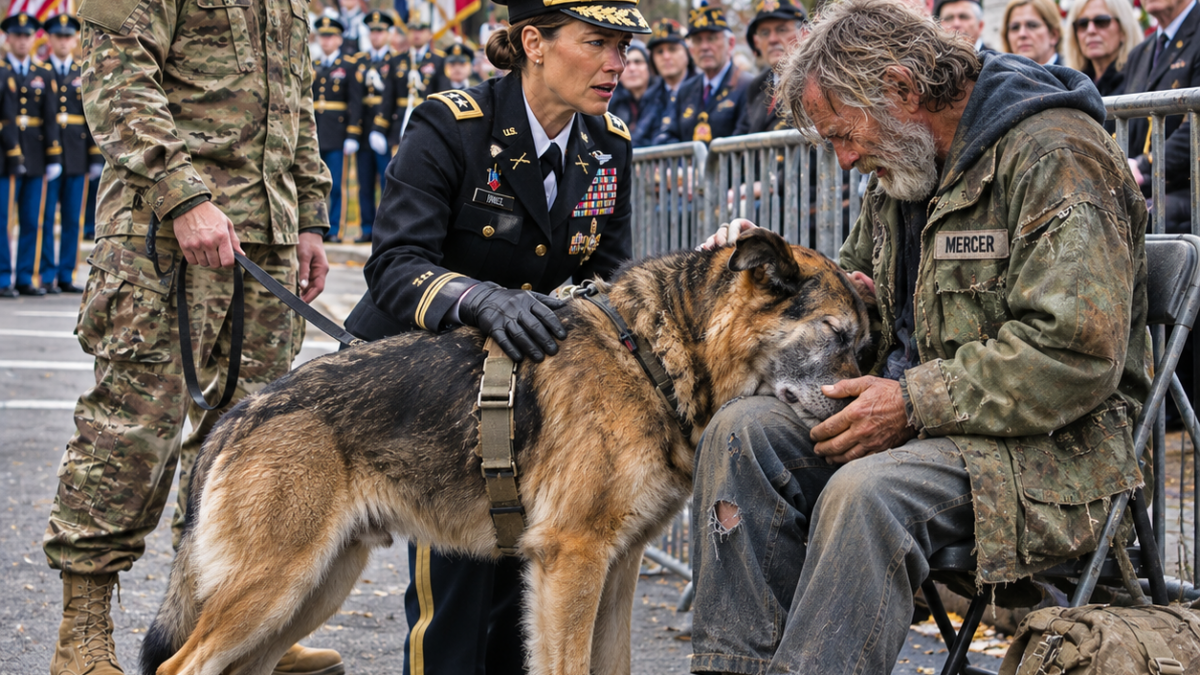
He wore two jackets.
A faded olive field jacket over a gray sweatshirt.
Brown work pants.
Old boots with mismatched laces.
His beard was nearly white.
Hair long enough to touch his collar.
A canvas backpack rested against one leg.
He looked somewhere between sixty-five and seventy.
Maybe older.
Hard years distort age.
Ranger’s ears rose.
His entire body became alert.
Not aggressive.
Not detection posture.
Something else.
“Ranger.”
No response.
Price tightened the leash slightly.
“Heel.”
Ranger remained motionless.
Price glanced toward the formation.
They were falling behind.
“Ranger. Heel.”
The dog’s head turned toward him for half a second.
Then back toward the man.
Price felt people watching.
He gave the command again, sharper.
“Heel.”
Ranger stepped.
Not forward with the formation.
Sideways.
Toward the barricade.
“Ranger.”
The German Shepherd pulled.
Not violently.
Deliberately.
Price planted one foot.
“What are you doing?”
Ranger made a sound Price had never heard from him.
A low, breathy whine.
The homeless man heard it.
His head lifted.
He saw the dog.
Everything about him changed.
His shoulders straightened.
His mouth opened slightly.
One hand rose and stopped halfway.
Ranger whined again.
The old man whispered something.
Price was too far away to hear.
Then Ranger moved.
Price could have held him.
The dog was old.
Strong, but not stronger than a prepared handler.
Instead, something about the animal’s expression made Price loosen his grip.
Ranger crossed the open pavement.
People turned.
The ceremonial formation kept moving another several yards before officers began signaling for a pause.
Ranger reached the barricade.
The homeless man did not reach for him.
He stood completely still.
Ranger pressed his nose against the man’s coat.
Sniffed once.
Shoulder.
Sleeve.
Hand.
Then he moved closer.
The man started shaking.
“No.”
The word was barely audible.
Ranger pressed his head against the man’s knee.
The man closed his eyes.
“No, no.”
His right hand hovered above Ranger’s head.
Price approached cautiously.
“Sir?”
The man did not look at him.
Ranger leaned harder against him.
Then the stranger’s hand came down.
Touched the gray fur between Ranger’s ears.
The dog exhaled.
Long.
Deep.
Almost a sigh.
People near the barricade went silent.
Someone lifted a phone.
A veteran in a wheelchair whispered:
“That dog knows him.”
Colonel Hale stepped down from the reviewing platform.
At first, she assumed the stranger was a former handler.
Possible.
Retired working dogs sometimes recognized people years later.
Scent memory could be astonishing.
But Ranger’s documented handlers were known.
Hale had reviewed the ceremonial profiles that morning.
Ranger’s first operational handler had died.
Second lived in Colorado.
Third had retired in Georgia.
None resembled the man at the barricade.
Hale walked closer.
Price saw her.
“Ma’am.”
“What happened?”
“I don’t know.”
“Did he call the dog?”
“No, ma’am.”
The homeless man finally opened his eyes.
They were pale blue.
Hale noticed something else.
Recognition.
Not general affection.
Not surprise.
He was looking at Ranger the way a person looks at someone returning from the dead.
The stranger touched the dog’s right ear.
Specifically the bent tip.
“You kept that.”
Ranger licked his wrist.
Price stared.
“Sir, do you know this dog?”
The man’s expression closed instantly.
“No.”
Hale heard the lie.
Ranger did too, apparently.
He sat on the stranger’s boot.
The old man looked down.
“Traitor.”
The dog wagged his tail once.
Hale crouched slightly.
“Sir, I’m Colonel Rebecca Hale. I’m the installation commander.”
That got his attention.
His posture changed.
Subtle.
But unmistakable.
Military reflex.
Shoulders back.
Chin level.
Then he seemed to realize what he had done and slouched again.
Hale saw it.
So did Price.
“What is your name?”
The stranger looked toward the road.
“Doesn’t matter.”
“It matters to him.”
She nodded toward Ranger.
The man’s jaw tightened.
Hale noticed his coat then.
Old woodland-pattern Army field jacket.
Probably early 2000s.
Faded nearly gray at the seams.
One shoulder torn and repaired.
No visible insignia.
But the front had partially folded open.
Inside, near the lining, someone had stitched a rectangular cloth label.
The letters were old.
Some thread missing.
Hale leaned just enough to read.
MERCER, D.
Her stomach tightened.
Not because Mercer was a rare name.
Because she had seen it before.
That morning.
On the memorial wall.
She stood.
“Sir.”
He knew.
She could see that he knew.
“Where did you get that jacket?”
The man’s hand immediately closed the front.
“Mine.”
“What did you say your name was?”
“I didn’t.”
Hale looked toward Lieutenant Colonel Ames, standing twenty feet away.
“Call Major Sanderson.”
Ames hesitated.
“The ceremony?”
“Now.”
The homeless man’s face hardened.
“I don’t want trouble.”
“Neither do I.”
“I didn’t come onto the base.”
“You’re standing outside the perimeter. You haven’t done anything wrong.”
“Then leave me alone.”
Ranger refused to move.
The man looked down.
“Come on.”
Ranger’s tail tapped the pavement.
“You’ve got a job.”
Nothing.
Price almost smiled.
“Technically he’s retired.”
The stranger looked at him.
“Since when?”
Price answered before considering the question.
“Two years.”
The man looked back at Ranger.
“Lazy.”
Ranger leaned against him harder.
Colonel Hale’s pulse increased.
“Sir.”
He ignored her.
“Were you ever assigned to the 17th Engineer Battalion?”
The man’s fingers stopped moving in Ranger’s fur.
Hale did not need another answer.
“Sergeant Daniel Mercer?”
Several veterans near them heard the name.
One gasped.
The man slowly raised his head.
Hale knew she had him.
“I don’t use that name.”
Her throat went dry.
Behind her, the Veterans Day ceremony had stopped completely.
The brass ensemble stood motionless.
Families watched.
Nobody knew what was happening.
Hale did.
At least part of it.
Daniel Mercer.
Sergeant First Class Daniel Mercer.
Combat engineer.
Missing during a convoy attack fourteen years earlier.
Presumed killed.
Remains unrecovered.
His name was engraved on Fort Redstone’s memorial wall.
Hale had touched that name less than an hour earlier while walking past the wreath placement.
“You’re Daniel Mercer.”
The man looked around at the crowd.
Fear replaced defensiveness.
“Don’t.”
“Don’t what?”
“Make this something.”
Hale stared.
“Sir, you have been officially dead for fourteen years.”
The stranger gave a tired half-smile.
“That’s been convenient.”
Then he turned to leave.
Ranger stood immediately.
Followed.
Price’s mouth opened.
Hale said:
“Mr. Mercer.”
The man kept walking.
Ranger walked with him.
Price looked at Hale.
“Ma’am?”
Ranger’s leash had gone slack.
Price could pull him back.
He didn’t.
Hale stepped forward.
“Daniel.”
That stopped him.
He turned.
The face she saw did not look like a man celebrating resurrection.
It looked like a man whose hiding place had just been removed.
“Please.”
That single word changed the situation.
Hale lowered her voice.
“Okay.”
She looked around.
Phones.
Crowd.
Stopped ceremony.
Too many eyes.
She turned to Ames.
“Resume the program.”
“Ma’am?”
“Resume it.”
Then to security:
“No detaining him. No photographs. No crowd.”
She addressed those nearest the barricade.
“Please give us room.”
It took several minutes.
People were curious.
Of course they were.
But veterans understand certain forms of silence.
An older man wearing an Army cap said loudly:
“Everybody heard the colonel.”
That helped.
The ceremony resumed without Ranger.
Hale led Daniel away from the crowd.
Not onto the installation.
To a small visitor-services building beside the gate.
He resisted until Ranger walked in first.
“That’s manipulative,” Daniel muttered.
Price heard.
“He’s good at it.”
Inside, Daniel chose the chair nearest the door.
Ranger lay directly across his boots.
Colonel Hale sat opposite.
Price remained nearby.
A medic was offered.
Daniel refused.
Water.
Accepted.
Coffee.
Accepted after smelling it.
“Still terrible?” he asked.
Hale almost laughed.
“Army coffee?”
“Yeah.”
“Tradition survives.”
He took a sip.
Made a face.
“Apparently.”
For several minutes nobody asked anything.
That was deliberate.
Major Sanderson arrived.
He was the installation’s senior legal officer.
Behind him came Command Sergeant Major Lewis, sixty-one, broad and quiet.
Lewis froze at the doorway.
He stared at Daniel.
Daniel looked back.
“Lewis.”
The sergeant major’s face lost color.
“No.”
Daniel looked tired.
“Yeah.”
Lewis crossed the room.
Stopped three feet away.
“You died.”
“Apparently not.”
“I went to your memorial.”
Daniel looked down.
Ranger’s head rested on his boot.
Lewis sat.
Not gracefully.
“Jesus Christ.”
Hale realized then that Lewis knew him personally.
“You served together?”
Lewis nodded.
“Same battalion.”
Daniel said nothing.
Lewis stared at him.
“We searched for you.”
“I know.”
“How?”
Daniel’s eyes hardened.
“I know.”
Lewis swallowed.
“You had a wife.”
Daniel closed his eyes.
That was the first subject that broke him.
Not Ranger.
Not the memorial.
His wife.
Hale leaned back.
No interrogation.
Not yet.
Lewis asked:
“Did you know Melissa died?”
Daniel’s face answered before his mouth did.
“Yes.”
“When?”
“Six years ago.”
“You knew?”
Daniel nodded.
Lewis stood abruptly.
“Then why the hell didn’t you—”
Hale raised one hand.
“Sergeant Major.”
Lewis stopped.
His anger remained.
Daniel accepted it.
Maybe expected it.
Ranger lifted his head between them.
Lewis sat again.
Hale said:
“We need to understand what happened.”
Daniel stared at the coffee.
“You don’t.”
“You are legally presumed dead.”
“Fix the paperwork.”
“It’s not only paperwork.”
“I don’t want benefits.”
“This isn’t about money.”
“Then what?”
Hale answered:
“Fourteen years.”
That reached him.
He looked toward the window.
Outside, the ceremony continued.
A bugle began playing.
Daniel’s face changed.
He recognized the melody.
“Taps.”
“Yes.”
“For who?”
“Veterans who didn’t come home.”
Daniel looked down at Ranger.
“Bad choice of timing.”
No one smiled.
Hale asked:
“Can you tell us what happened?”
Daniel rubbed both hands over his face.
His fingers were scarred.
One knuckle misshapen.
Old burn marks crossed his left wrist.
“I was captured.”
Lewis looked at him.
Nobody spoke.
Daniel continued because silence gave him no place to hide.
The convoy attack had happened in eastern Afghanistan.
Fourteen years earlier.
Daniel had been serving with a route-clearance platoon attached to an engineering unit.
Their vehicles were struck near a narrow valley road.
First blast disabled the lead truck.
Small-arms fire followed.
Confusion.
Dust.
Second explosion.
Daniel remembered being thrown from the vehicle.
He woke somewhere else.
That was the last thing official reports knew.
Three soldiers died.
Two were critically wounded.
Daniel disappeared.
Search teams found blood.
Equipment.
Part of his body armor.
No remains.
Intelligence initially classified him missing.
Months later, after intercepted communications suggested captives from that region had been executed, his status changed.
Presumed dead.
Then legally declared dead.
“What happened after capture?” Hale asked.
Daniel’s eyes went distant.
“Not today.”
Nobody pushed.
Lewis’s anger was gone.
Something heavier replaced it.
“How did you get out?”
“Walked.”
“From Afghanistan?”
Daniel gave him a look.
“No.”
Even after fourteen years, soldier sarcasm survived.
He explained in pieces.
Not cleanly.
He had been held for almost eleven months.
Moved repeatedly.
Not always by the same people.
Sometimes locked inside buildings.
Sometimes underground.
He learned enough local language to understand when guards argued.
During a transfer after a raid disrupted the group holding him, Daniel escaped with another captive.
The second man died two days later.
Daniel reached villagers.
Then people connected to aid workers.
Then someone who promised to contact American authorities.
Lewis leaned forward.
“And?”
Daniel’s mouth tightened.
“I ran.”
Hale frowned.
“Why?”
Daniel looked at Ranger.
“Because by then I didn’t know what I was.”
That sentence took longer to understand.
Daniel had been tortured.
Starved.
Beaten.
Kept in darkness.
Forced to record statements.
He said little about those months.
But he admitted something else.
After reaching relative safety, he experienced severe paranoia.
He believed people were following him.
Believed anyone claiming to represent the government might be connected to his captors.
He had untreated head injuries.
Nightmares.
Gaps in memory.
He drank heavily.
He attacked an aid worker who tried to restrain him during a panic episode.
Then disappeared.
For years.
“How did you get back to the United States?” Sanderson asked carefully.
Daniel laughed once without humor.
“Not legally.”
The route took time.
False papers.
Cargo vessels.
Cash work.
Mexico.
Arizona.
Eventually Ohio.
Then Kentucky.
No stable address.
Day labor.
Shelters.
Camps.
Church basements.
He avoided hospitals.
Police.
Veterans groups.
Anything requiring identification.
“You never contacted family?” Hale asked.
Daniel shook his head.
“Not at first.”
“And later?”
He looked at Lewis.
“Later became harder.”
That was the part people misunderstood.
The first year could be explained by trauma.
Second by instability.
Third by shame.
Then every additional year became evidence against returning.
What do you say?
Sorry I let you bury an empty coffin.
Sorry my wife learned to live without me.
Sorry my mother died believing her son died overseas.
Sorry the Army carved my name into stone.
Sorry I watched from a library computer while people posted memorial messages.
Sorry I kept breathing and did nothing.
Daniel had eventually learned Melissa remarried.
He did not contact her.
Then she became ill.
Cancer.
He watched from a distance.
Six years ago, she died.
That was when he almost came forward.
Instead he drank for three weeks and disappeared again.
Lewis’s eyes were wet.
“You had a daughter.”
Daniel’s face collapsed.
Hale had not known.
Daniel nodded.
“Emily.”
“How old now?”
“Twenty-two.”
“You know where she is?”
“Yes.”
“Does she know?”
“No.”
Lewis looked physically ill.
Daniel whispered:
“She was eight when I disappeared.”
Ranger moved.
Placed one paw across Daniel’s boot.
He stared at the dog.
Hale asked:
“How do you know Ranger?”
Daniel didn’t answer.
Price looked confused.
“Ranger entered the program ten years ago. He couldn’t have served with you before your disappearance.”
Daniel touched the bent ear.
“He didn’t.”
Price waited.
Daniel said:
“I found him.”
That changed everything.
Years after Daniel returned secretly to the United States, he spent time in New Mexico doing day labor near a private training contractor that worked with military and law-enforcement dogs.
One evening, a transport vehicle overturned outside town.
Two dogs escaped.
One was quickly recovered.
The second disappeared into desert scrub.
Daniel found him hours later.
Young German Shepherd.
About two years old.
Bleeding from the ear.
Terrified.
Daniel spent most of the night sitting twenty feet away.
No leash.
No food at first.
Just talking.
The dog eventually approached.
Daniel returned him the following morning.
The contractor employee who collected him barely asked Daniel’s name.
“He was Ranger?” Price asked.
“Not yet.”
“What was he called?”
“R-17.”
Price stared at the dog.
Daniel continued.
Months later, he was working near another installation when he saw the same dog again.
Transferred into military training.
The bent ear gave him away.
Daniel watched from outside the fence.
Never approached.
Years later, another chance encounter.
Veterans charity event.
Ranger had become a decorated military working dog.
Daniel stood far away.
The dog never saw him.
Until today.
Price looked down at Ranger.
“You remembered him from one night?”
Daniel shook his head.
“Two.”
“What was the second?”
Daniel rubbed Ranger’s ear.
“The night after I returned him, he escaped again.”
Price almost laughed.
“Seriously?”
“Seriously.”
“And found you?”
Daniel nodded.
“I was sleeping behind a machine shop.”
Ranger had tracked him.
Curled up beside him.
The contractor eventually recovered the dog again.
Daniel left town the following morning.
He believed he would never see him again.
Ranger had remembered.
Fourteen years after Daniel disappeared from military life.
Nearly a decade after two brief encounters.
He remembered.
Hale sat back.
The absurdity and beauty of it struck her at once.
Thousands of people had searched for Daniel Mercer.
Investigators.
Soldiers.
Analysts.
Family.
Police.
Veterans organizations.
None found him.
A retired German Shepherd did.
Not because of records.
Not DNA.
Not facial recognition.
Scent.
Memory.
A man who thought he had erased himself had been recognized by an animal that had known him for perhaps two nights.
There were practical matters.
Many.
Identification.
Fingerprints.
DNA.
Legal status.
Medical evaluation.
Immigration violations related to his irregular return.
Military records.
Pay.
Benefits.
Possible disciplinary questions.
Notification of family.
Investigative debrief regarding captivity.
Nobody solved any of that in one afternoon.
Colonel Hale refused to let anyone pretend they could.
Daniel agreed to fingerprinting.
Results returned quickly.
Match.
Sergeant First Class Daniel Edward Mercer.
No doubt.
The man engraved on the memorial wall was sitting in a clinic room eating crackers because the medic said he appeared dehydrated.
Hale had the ceremony photographer delete images showing Daniel clearly.
Not because the truth would remain secret.
It couldn’t.
But she wanted his daughter notified before the internet did it for them.
Emily Mercer was twenty-two.
Graduate student at Ohio State.
She had grown up with a dead father.
A heroic dead father.
A photograph in dress uniform.
A folded flag.
Medals in a shadow box.
Stories from men like Lewis.
A grave marker without remains.
Every Veterans Day her mother had lit a candle.
Every birthday, Emily had posted something online:
Wish you were here.
Daniel had seen some of them.
That admission made Colonel Hale angrier than anything else.
“You watched her?”
He nodded.
“And said nothing.”
“Yes.”
“Why?”
Daniel looked at her.
There was no defense.
“Because cowardice gets easier when you practice it.”
Hale sat with that.
It was not the answer she expected.
Maybe because people prefer trauma to erase responsibility completely.
Daniel didn’t.
He knew trauma explained much of his disappearance.
Not all of it.
Eventually there had been moments he could have reached out.
He hadn’t.
He owned that.
That made the situation harder.
More human.
Hale contacted Emily through proper channels.
Not personally at first.
A casualty-assistance officer and counselor coordinated.
Emily initially believed it was a scam.
Then a video call was arranged.
Daniel refused twice.
Third time, Ranger solved it again.
The dog sat beside him.
Hale said:
“You’re not doing this alone.”
Daniel replied:
“That’s not the problem.”
“What is?”
“She has the right to hate me.”
“Yes.”
He looked at Hale sharply.
She continued:
“And you don’t get to protect yourself from that by disappearing again.”
Daniel stared at her.
That sentence landed.
The video call happened at 7:40 that evening.
Emily appeared on screen.
Brown hair.
Her mother’s eyes.
Daniel stopped breathing.
She stared.
No one spoke.
Then Emily said:
“You’re old.”
Daniel laughed.
It came out as a sob.
“Yeah.”
“You’re alive.”
“Yes.”
“Mom died.”
“I know.”
That changed her face.
“You knew?”
Daniel closed his eyes.
“Yes.”
Emily stood so quickly her chair rolled backward.
“You knew?”
“Yes.”
“And you didn’t come?”
“No.”
“Why?”
No answer could survive that question.
Daniel tried.
Failed.
Finally:
“I was sick for a long time.”
Emily said:
“So was Mom.”
He nodded.
“I know.”
“You don’t get to say that.”
“Okay.”
“Don’t say okay.”
“Okay.”
She made a sound halfway between crying and laughing.
“You’re unbelievable.”
“I know.”
“Stop saying you know.”
Daniel shut up.
That was probably the wisest thing he did all day.
Emily walked out of frame.
The call remained connected.
Daniel looked toward Hale.
“She left.”
“Wait.”
Two minutes later, Emily returned.
Holding something.
A photograph.
Eight-year-old Emily sitting on Daniel’s shoulders at a county fair.
She held it up.
“Do you remember this?”
“Yes.”
“What did I eat?”
Daniel blinked.
“What?”
“At the fair.”
“Cotton candy.”
“What color?”
“Blue.”
She stared.
“What ride did Mom refuse to go on?”
“The Cyclone.”
“Why?”
“She said the bolts looked temporary.”
Emily’s mouth trembled.
“What did you win me?”
“Purple bear.”
“What was his name?”
“Sergeant Fuzz.”
She began crying.
Daniel did too.
The questions continued.
Not because she doubted DNA.
Because she needed to know whether this man contained her father.
He did.
That was the beginning.
Not forgiveness.
Beginning.
Emily drove to Fort Redstone the next morning.
She almost turned around twice.
Ranger was with Daniel near the visitor center.
When Emily walked in, Daniel stood.
She stopped ten feet away.
He did not approach.
Good.
She studied him.
The beard.
Coat.
Bent posture.
Hands.
Then:
“You look nothing like the pictures.”
“I know.”
She glared.
“Sorry.”
“Better.”
Silence.
Ranger walked toward Emily.
Sniffed.
Then returned to Daniel.
Emily looked at him.
“Is that the dog?”
“Yes.”
“The one who found you?”
“Yes.”
She laughed once through tears.
“Of course a dog had to do it.”
Daniel nearly smiled.
Emily didn’t hug him.
Not that day.
She sat.
Asked questions for three hours.
Some cruel.
Some necessary.
Did you love Mom?
Yes.
Then why leave her?
I thought I was protecting everyone at first. Later I was ashamed.
Did you ever come near us?
Once.
Emily’s eyes sharpened.
“When?”
Her high school graduation.
Daniel had stood across the road behind a crowd.
She became furious.
“You were there?”
“Yes.”
“You watched me graduate?”
“Yes.”
“And you walked away?”
“Yes.”
Emily slapped him.
Nobody intervened.
Daniel didn’t move.
Ranger stood.
Emily immediately looked at the dog.
“I’m not hurting him.”
Daniel said quietly:
“He knows.”
Then Emily cried.
Not delicately.
Fourteen years.
Mother’s grief.
Funeral ceremonies.
Father’s Day.
Questions.
All of it.
Daniel sat three feet away.
He did not touch her.
Eventually Emily reached toward him.
Not for a hug.
She grabbed the sleeve of his old field jacket.
Held it.
That was enough.
The Army investigation took months.
Some things were classified.
Some unresolved.
Officials confirmed Daniel’s captivity history through archived intelligence, debriefings, and details only he could know.
His legal death declaration was reversed.
His status corrected.
There were questions around his prolonged absence after escape.
Medical experts documented severe PTSD, traumatic brain injury, dissociative episodes, and long periods of untreated mental illness.
There were also periods, Daniel admitted, when he had enough capacity to seek help and chose not to.
No public narrative simplified it.
That was important.
He was neither fraud nor flawless hero.
He was a captured soldier who survived something devastating, came home broken, hid too long, and hurt people who loved him because shame became easier than return.
Fort Redstone removed his name from the fallen memorial.
Not immediately.
Colonel Hale delayed the ceremony.
She wanted Emily there.
Daniel did not.
“I don’t deserve a ceremony.”
Hale said:
“It’s not for you.”
That irritated him enough to attend.
Three months after Veterans Day, a small group gathered at the memorial wall.
Lewis.
Price.
Emily.
Hale.
A few members of Daniel’s former battalion.
No press.
Ranger.
A stoneworker carefully removed the plaque bearing:
SFC DANIEL E. MERCER
The space remained temporarily blank.
Daniel watched from the back.
Emily stood beside him.
She still hadn’t fully forgiven him.
Some weeks they spoke daily.
Some weeks not at all.
Once she told him:
“I love you and I am still furious with you.”
Daniel answered:
“Both make sense.”
That was progress.
After the plaque came down, Lewis brought Daniel something.
A folded flag.
The one given to Melissa fourteen years earlier.
Emily had kept it.
Daniel refused to take it.
“It belongs to you.”
Emily said:
“I’m not giving it back.”
“Then why bring it?”
She looked toward the empty space on the wall.
“Because I wanted you to see what Mom carried home.”
Daniel couldn’t answer.
Emily touched the case.
“She never stopped loving you.”
His eyes closed.
“That makes it worse.”
“Yes.”
No comforting lie.
Ranger sat against Daniel’s leg.
The same way he had on Veterans Day.
Price watched.
“You know, he doesn’t do that with anyone.”
Daniel looked down.
“He has bad judgment.”
Ranger’s tail moved.
The retired K9 became part of Daniel’s recovery almost by accident.
Technically Ranger already had an approved retirement home.
Price’s family.
Daniel never tried to interfere.
But Ranger began refusing to leave Daniel after visits.
The first time, Price called him.
“You want to explain why my dog is sitting beside your truck?”
Daniel looked out.
Ranger sat by the passenger door.
“I don’t own a truck.”
“Exactly.”
Price brought him back.
Two days later, during a rehabilitation appointment, Ranger saw Daniel again.
Same result.
Eventually Price joked:
“We may need shared custody.”
Daniel said:
“Don’t start.”
Emily overheard.
“You need somewhere stable first.”
Daniel looked at her.
She had been helping him navigate housing assistance.
Not because all was forgiven.
Because she had decided rebuilding required practical things.
Identification card.
Medical care.
Phone.
Bank account.
A room.
Medication.
Counseling.
Routine.
The things survival looks like after everyone stops clapping.
Daniel entered a transitional housing program for veterans.
He hated the word veteran applied to himself.
The counselor challenged that.
“You served.”
“I disappeared.”
“You also served.”
“Doesn’t cancel the rest.”
“Correct.”
Daniel respected that answer.
He began treatment for PTSD.
Consistently this time.
He attended neurological appointments.
Stopped drinking.
Again.
The first ninety days were ugly.
Nightmares.
Panic.
Insomnia.
Anger.
One night he left the housing facility at 2:00 a.m. and walked six miles.
Emily found him sitting outside a closed hardware store.
“How did you find me?”
“Colonel Hale told me where you used to sleep.”
Daniel looked embarrassed.
Emily sat beside him.
After ten minutes she said:
“You’re doing it again.”
“What?”
“Leaving before anyone can leave you.”
He stared at the parking lot.
She had his mother’s talent for unpleasant accuracy.
“I don’t know how to do this.”
“Neither do I.”
That helped more than reassurance.
The next spring, Price’s circumstances changed.
He received orders overseas.
His wife was pregnant.
Ranger, old and arthritic, needed a quieter home.
Price asked Daniel the question everyone else had seen coming.
“Take him.”
Daniel refused.
“No.”
“He chose you.”
“He has a home.”
“He needs one.”
“I don’t deserve him.”
Price sighed.
“Dogs don’t care about your moral accounting.”
Daniel looked at Ranger.
The dog looked back.
Price continued:
“He sleeps better after seeing you.”
Daniel said:
“So do I.”
“Great. We’ve solved it.”
Emily signed the adoption support paperwork before Daniel could change his mind.
Ranger moved into a small apartment with Daniel.
The apartment belonged to a veterans housing complex outside Louisville.
One bedroom.
Old cabinets.
Cheap carpet.
Window facing a parking lot.
Daniel thought it was beautiful.
Ranger claimed the rug beside the bed.
First night, Daniel woke from a nightmare.
Dark room.
Heart racing.
For three seconds he was underground again.
Then Ranger’s head pressed against his hand.
Daniel whispered:
“Right.”
Apartment.
Kentucky.
Door unlocked.
Ranger.
Home.
He began keeping a notebook beside the bed.
His therapist suggested it.
Every morning he wrote three things.
Where I am.
What year it is.
Who knows I’m alive.
The third list grew.
Emily.
Lewis.
Hale.
Price.
Ranger.
Eventually others.
That was how a dead man became alive again.
Not through paperwork.
Repeated recognition.
Emily introduced Daniel to people slowly.
Her boyfriend first.
Then friends.
Daniel expected them to know his story.
Some did.
He hated that.
One evening Emily caught him preparing to leave dinner early.
“Where are you going?”
“Home.”
“Why?”
“Your friends are uncomfortable.”
“They’re not.”
“They keep looking.”
Emily crossed her arms.
“Maybe because Dad was dead until last November.”
Daniel almost smiled.
“Fair.”
“Sit down.”
He did.
That became another skill.
Staying.
The story eventually reached the news.
Impossible to prevent forever.
Retired K9 identifies soldier presumed dead for fourteen years.
Headlines exaggerated.
Some claimed Ranger recognized Daniel from military service.
Not true.
Others said Daniel had lived homeless outside Fort Redstone for fourteen years.
Also false.
The Army released a limited statement confirming his identity and saying circumstances surrounding his disappearance and recovery remained under review.
Daniel refused interviews.
Emily did too.
Colonel Hale gave one short statement:
“A military working dog demonstrated remarkable recognition. The more important work now belongs to the family and professionals supporting Sergeant Mercer’s recovery.”
That was all.
Internet detectives tried to find him.
Veterans groups sent offers.
Money.
Jobs.
Motorcycles.
Daniel declined almost everything.
One envelope contained twenty dollars and a handwritten note from a Vietnam veteran:
I hid for eight years after I came home.
Different kind of missing.
Glad somebody found you.
Daniel kept that one.
He wrote back.
Months passed.
Ranger aged quickly.
His hips worsened.
Hearing faded.
Cataracts clouded both eyes.
Daniel adapted the apartment.
Rugs so Ranger wouldn’t slip.
Ramp beside the bed.
Raised bowls.
Medication twice a day.
Emily watched him one afternoon cutting pills into exact halves.
“You’re good at this.”
Daniel shrugged.
“He’s old.”
“So are you.”
“Get out.”
She smiled.
It was the first joke that felt like father and daughter rather than two survivors negotiating a treaty.
On the first anniversary of the Veterans Day ceremony, Fort Redstone invited Daniel back.
He almost refused.
Emily said:
“We’re going.”
“You’re twenty-three. You don’t order me.”
“I’ve met Colonel Hale. Apparently I do.”
Ranger rode in the back seat.
Older.
Gray.
Slower.
When they reached the parade route, Daniel stopped.
Same barricade.
Same pavement.
He remembered standing there one year earlier with everything he owned in one backpack.
Emily stood beside him.
“You okay?”
“No.”
“Do we leave?”
Daniel looked at her.
That question mattered.
Not:
Can you handle it?
Not:
Be brave.
Do we leave?
He looked toward Ranger.
Then the base.
“No.”
They stayed.
This time, Daniel stood inside the barricade.
Not hidden behind it.
Colonel Hale introduced him privately to several veterans before the ceremony.
No public speech.
His choice.
Lewis wore dress uniform.
Price had returned on leave and came directly from the airport.
When Ranger saw him, the old dog brightened.
Price knelt.
“Hey, partner.”
Ranger licked his face.
Daniel watched.
For once, he did not feel replaced.
Love had room.
During the ceremony, a new group of military working dogs passed.
Young.
Strong.
Alert.
Ranger watched from beside Daniel.
When the formation passed, Ranger tried to stand.
His hips failed.
Daniel helped him.
“Easy.”
Ranger took one step.
Then another.
Price smiled.
“He thinks he’s working.”
Daniel rubbed his ear.
“He always does.”
Afterward, Colonel Hale approached.
“We’re adding something to the memorial garden.”
Daniel stiffened.
“No statue.”
She laughed.
“Definitely not.”
A small plaque near the K9 section.
Not Daniel’s name.
Ranger’s.
It read:
RANGER
MILITARY WORKING DOG
SERVICE CONTINUES IN WAYS NO RECORD CAN PREDICT
Daniel hated the wording.
Emily loved it.
Ranger did not care.
The old dog died eight months later.
At home.
Not in a clinic.
Daniel knew the day was coming.
Ranger stopped eating breakfast.
Then couldn’t stand without help.
The veterinarian came to the apartment.
Emily sat on the floor.
Price drove three hours.
Lewis arrived last.
Ranger lay on his rug.
Daniel sat beside him.
One hand on the bent ear.
The veterinarian explained.
Daniel nodded.
He had said goodbye badly too many times in his life.
This one he wanted to do differently.
Price touched Ranger’s paw.
“You were a pain.”
Ranger breathed.
Emily rubbed his shoulder.
“You found him.”
Daniel looked at her.
She wasn’t crying yet.
He was.
Ranger opened his cloudy eyes.
Daniel leaned close.
“Listen to me.”
His voice shook.
“You don’t have to look anymore.”
The dog’s ear moved.
“You found me.”
Daniel pressed his forehead to Ranger’s.
“Took you long enough.”
Price laughed through tears.
Daniel continued.
“You brought me back.”
That wasn’t entirely true.
Ranger found him.
Others brought him back.
Emily.
Hale.
Lewis.
Price.
Counselors.
Doctors.
People who stayed after the dramatic part ended.
Daniel knew that now.
He whispered:
“Good boy.”
The veterinarian gave the medication.
Ranger’s breathing slowed.
Daniel kept his hand on him.
Until it stopped.
Nobody spoke for a long time.
Later Emily asked what Daniel wanted done with the ashes.
He thought.
Then:
“Two places.”
Half went with Price.
Half Daniel kept.
A small portion was placed beneath Ranger’s plaque at Fort Redstone.
The following Veterans Day, Daniel attended without the dog.
That was harder.
He stood near the same intersection.
Not behind the barricade.
Emily beside him.
Children waved flags.
Veterans gathered.
Another retired K9 passed in formation.
Daniel felt the old urge.
Leave.
Before people recognized him.
Before questions.
Before memories.
Emily touched his sleeve.
Not holding him.
Just there.
“You staying?”
Daniel looked toward the memorial garden.
Then the road.
Then his daughter.
“Yeah.”
The parade continued.
Years later, people still told the story incorrectly.
They said a military K9 found his missing handler.
He hadn’t.
Ranger had never served under Daniel Mercer.
They said Daniel had secretly returned from captivity and lived fourteen years directly outside his base.
He hadn’t.
They said the dog somehow smelled military brotherhood.
Nobody knew what Ranger smelled.
The real story was stranger and quieter.
A broken soldier, already legally dead, had once spent two nights helping a frightened young German Shepherd years after disappearing from his own life.
The dog remembered.
The man tried not to.
And on a cold Veterans Day morning, one of them finally refused to keep walking.
That was all Ranger did at first.
Stopped.
Turned.
Crossed the pavement.
Placed his head against Daniel’s knee.
A simple act.
But it broke fourteen years of hiding.
Daniel never called Ranger a hero.
He didn’t like that word used too easily.
“He was a dog,” he would say.
“A very stubborn dog.”
Emily always corrected him.
“Who found you.”
Daniel would look at her.
“Yeah.”
Then one Veterans Day, almost six years after Ranger’s death, Daniel returned to Fort Redstone with Emily and her four-year-old son.
His grandson.
The boy’s name was Aaron.
Not after Daniel.
After Emily’s maternal grandfather.
Daniel was glad.
Some names should belong where they were earned.
Aaron carried a toy German Shepherd.
They walked toward Ranger’s plaque.
The boy asked:
“Is this the dog?”
“Yes.”
“The one who found Grandpa?”
Daniel looked at Emily.
She smiled.
“Yes.”
Aaron thought about that.
“Were you lost?”
The question was so simple Daniel nearly laughed.
He crouched despite his knees protesting.
“Yeah.”
“Did you know?”
“No.”
“How can you be lost and not know?”
Daniel looked toward the parade route.
Veterans stood beyond the trees.
Flags moved.
A dog barked somewhere near the kennels.
He answered carefully.
“Sometimes you get used to being lost.”
Aaron looked down at the toy.
“Then Ranger found you.”
“He started it.”
“Who finished?”
Daniel looked at Emily.
She heard the question.
Her eyes filled slightly.
Daniel answered:
“Your mom helped.”
Emily looked away.
Aaron accepted this without understanding how enormous it was.
Children can do that.
He put the toy dog beside Ranger’s plaque.
Daniel almost told him not to.
Then stopped.
The boy stepped back.
“Can he keep it?”
Daniel looked at the toy.
Then the name.
Then the place where an old German Shepherd once ignored an order, crossed an empty strip of pavement, and chose a man the entire country had already accepted as dead.
“Yeah.”
Daniel stood.
“He was good at keeping things.”
They walked back toward the ceremony.
Daniel no longer wore the old field jacket every day.
It was framed now.
Emily’s idea.
Inside the frame was the faded name strip:
MERCER, D.
Beside it hung Ranger’s retirement tag.
Daniel had objected to framing either.
Emily did it anyway.
Some objects, she told him, were evidence.
Evidence of what?
He asked.
“That you were here.”
He hadn’t known how to answer.
For fourteen years, Daniel Mercer believed disappearing was something that had happened to him.
Capture.
Trauma.
Fear.
Shame.
Then, slowly, he understood that disappearance had also become something he kept choosing.
Coming home required choices too.
Answering the phone.
Attending therapy.
Sitting through dinner.
Letting his daughter be angry.
Showing up the next day anyway.
Taking medication.
Sleeping indoors.
Admitting when he wanted to run.
Staying.
Again.
Again.
Again.
No ceremony could do that work for him.
No medal.
No corrected personnel file.
Not even Ranger.
The dog had only opened the door.
Daniel had to walk through it.
The Veterans Day ceremony ended with the bugler near the memorial wall.
Taps carried across the grounds.
Daniel still struggled with that melody.
Always would.
Aaron reached for his grandfather’s hand.
Daniel took it.
He felt the child’s fingers.
Warm.
Small.
Real.
Emily stood on his other side.
The final note faded.
Nobody moved immediately.
Then Aaron looked up.
“Grandpa?”
“Yeah?”
“If Ranger didn’t find you, would you still be lost?”
Daniel looked toward the plaque.
He could have answered with something comforting.
Something neat.
Instead:
“Maybe.”
Aaron frowned.
Daniel squeezed his hand.
“But he did.”
The boy smiled.
That was enough.
They walked toward the parking lot.
Behind them, Ranger’s plaque caught the November light.
People passing it knew only the official part.
Military working dog.
Years of service.
Retired with honor.
They did not know everything.
They did not need to.
Records are useful.
Names matter.
Dates matter.
Service histories matter.
But none of them could explain why, in a crowd of hundreds, an old German Shepherd had suddenly stopped.
Why he ignored three commands.
Why he crossed the pavement.
Why he placed his head against the knee of a man nobody recognized.
Maybe Ranger remembered two nights in the desert.
Maybe he remembered a voice.
A hand.
A scent.
Maybe animals carry certain truths without needing to understand them.
Daniel never solved that part.
He stopped trying.
He only knew that on the morning the Army was honoring people who had served and returned, a retired K9 walked away from formation to find one man who had technically done neither.
And when the base commander saw the faded name stitched inside his jacket, the world finally learned something Ranger had decided within seconds.
Daniel Mercer was not dead.
He was not gone.
He was standing right there.
He had simply forgotten how to come home.
So Ranger came and found him.








