A Retired Military K9 Broke Formation and Ran to a Homeless Veteran—Then the General Saw the Tattoo Hidden Beneath His Sleeve
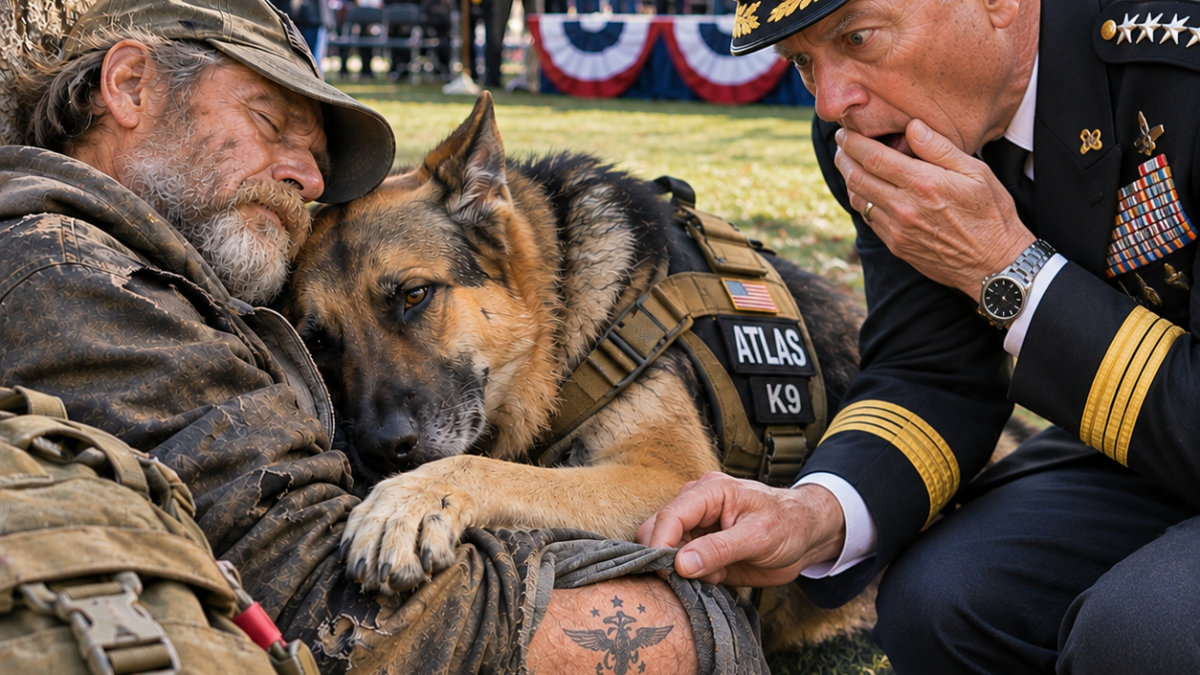
A Retired Military K9 Broke Formation and Ran to a Homeless Veteran—Then the General Saw the Tattoo Hidden Beneath His Sleeve.
Nobody at the Veterans Day ceremony understood why Atlas ignored the command he had obeyed for twelve years, broke formation in front of hundreds of people, and ran straight toward a homeless man security had already been ordered to remove.
The stranger looked like someone the city had forgotten years ago, but the old German Shepherd lowered himself at his battered boots, pressed his gray muzzle against the man’s knee, and began making a sound his former handler had heard only once before—on the worst night of their deployment.
Then the man’s torn sleeve slipped back, exposing a faded military tattoo that made the commanding general stop breathing, because buried inside those worn lines was a secret powerful men had spent fourteen years making sure nobody ever asked about.
The first thing Sergeant First Class Daniel Mercer noticed that morning was the smell of coffee.
Not the flags.
Not the brass band warming up beneath the white pavilion.
Not the rows of folding chairs arranged across Carter Field.
Coffee.
Burned, bitter, cheap coffee drifting from a veterans’ charity tent near the eastern fence.
For three nights Daniel had slept beneath the overhang of an abandoned pharmacy six blocks away, using his backpack as a pillow and a donated Army surplus coat as a blanket. The temperature had dropped into the low thirties before dawn, and although November in North Carolina was hardly Afghanistan, cold had a way of finding the places in his body that had never healed correctly.
His left knee.
Two ribs.
The long scar beneath his shoulder blade.
The fingertips on his right hand that sometimes went numb without warning.
He had awakened before sunrise because a sanitation truck had rattled through the alley.
Then he had walked.
Daniel always walked when the nightmares were bad.
Walking gave his mind something simple to do.
Left foot.
Right foot.
Breathe.
Count.
Keep moving.
That was how he reached Carter Field without knowing there was going to be a ceremony there.
Red, white, and blue banners hung from every lamppost.
A temporary arch over the entrance read:
HONORING THOSE WHO SERVED.
Daniel stared at those words for nearly a full minute.
Then he laughed once.
There was no humor in it.
A young volunteer in a red jacket noticed him near the fence.
“Sir?”
Daniel turned.
PART2:
She was maybe nineteen, with a ponytail, clear skin, and the uncomfortable kindness of someone who had been taught never to stare at homeless people but had not yet learned how to speak to them.
“There’s coffee over there,” she said. “And breakfast sandwiches. Free for veterans.”
Daniel looked down at himself.
His beard had gone mostly gray.
His coat was stained.
One boot was held together with black electrical tape because the sole had started separating three weeks earlier.
He carried everything he owned in a faded canvas backpack.
“I’m good,” he said.
“You don’t have to show ID.”
“I said I’m good.”
She nodded too quickly.
“Okay.”
Then she walked away.
Daniel immediately regretted his tone.
The girl had only been trying to help.
He watched volunteers setting out trays of biscuits and paper cups.
His stomach tightened.
He had eaten half a can of peaches the previous afternoon.
Pride was a stupid thing to feed when your stomach was empty.
He started toward the coffee tent.
That was when he heard a dog bark.
PART3:
Daniel stopped so suddenly that a man walking behind him nearly bumped into his backpack.
The bark came again.
Deep.
Sharp.
Disciplined.
Not a pet.
Daniel turned toward the center of the field.
A procession of military working dogs was assembling near the western side of the reviewing stand.
Most were younger dogs with glossy coats, powerful bodies, and handlers in dress uniforms.
But one dog stood apart.
Old.
Black and tan.
Gray around the muzzle.
A slight stiffness in his back legs.
He wore a dark ceremonial working-dog vest with a gold-edged patch across the side.
ATLAS.
Daniel forgot how to breathe.
Around him, people moved.
Children waved small flags.
Veterans found their seats.
A brass section tested a patriotic march.
Somewhere a microphone squealed.
Daniel heard none of it.
He stared at the German Shepherd.
The dog was facing away from him.
Daniel could see only the familiar slope of his shoulders and one ear that leaned slightly farther left than the other.
Impossible.
He whispered the word without making sound.
Atlas had been young then.
Barely three years old.
Fourteen years ago.
A different country.
A different lifetime.
Daniel backed away.
His heel caught the edge of a plastic barricade.
A security guard looked over.
“You all right, sir?”
Daniel nodded.
He pulled his coat tighter.
Atlas turned his head.
The dog’s ears rose.
Daniel froze.
Atlas stared across nearly seventy yards of crowded parade field.
His handler, Master Sergeant Luke Serrano, gave a quiet correction.
“Atlas.”
The dog did not look away.
Luke followed his gaze.
All he saw were civilians near the eastern fence.
“Leave it.”
Atlas’s body changed.
Anyone who had worked with military dogs long enough would have recognized it.
His posture went rigid.
His nostrils flared.
His tail lowered.
Then it began moving once.
Twice.
Slowly.
Luke frowned.
“Atlas. Heel.”
Atlas took one step forward.
“Atlas.”
Another step.
Around them, the other handlers were lining up.
The ceremony coordinator motioned urgently.
They were thirty seconds from moving.
Luke touched Atlas lightly near the shoulder.
“Hey. With me.”
The dog made a sound deep in his throat.
Not aggression.
Not fear.
Something else.
Luke had heard it only one time.
September 18, 2012.
Kunar Province.
The night Daniel Mercer disappeared.
Luke’s blood went cold.
Atlas pulled forward.
“Atlas, no.”
The command was firm.
Atlas had obeyed that voice under gunfire.
He had obeyed it with helicopters screaming overhead.
He had obeyed it while wounded.
He had obeyed it through smoke, explosions, screaming men, and burning vehicles.
He did not obey now.
The old German Shepherd lunged.
The leash ripped through Luke’s hand before he could lock his fingers.
“Atlas!”
The dog ran.
People gasped.
The military procession broke formation.
A photographer spun around.
Children shouted.
Two security officers stepped onto the field, thinking the dog had somehow escaped control.
Atlas ignored everyone.
He crossed the grass at a speed his aging hips should not have allowed.
Daniel saw him coming.
His first instinct was to run.
His second was stronger.
He dropped his backpack.
Atlas hit him just below the waist.
Daniel staggered backward.
The dog pressed against him so hard they nearly fell together.
“Easy,” Daniel whispered.
Atlas whimpered.
Daniel shut his eyes.
That sound shattered fourteen years in a single breath.
He sank slowly to one knee.
Atlas shoved his head beneath Daniel’s arm.
The old dog trembled violently.
Daniel’s hand hovered above his back.
He was afraid to touch him.
Afraid the moment would disappear.
Afraid he had finally lost his mind completely.
Then Atlas licked the scar across Daniel’s wrist.
Daniel’s face collapsed.
“Hey, boy.”
His voice broke.
Atlas whined louder.
“Hey.”
Daniel buried both hands in the dog’s fur.
“Oh, God.”
People were gathering.
Luke reached them first.
He stopped six feet away.
His face had gone completely white.
Daniel looked up.
Luke Serrano had been twenty-eight when Daniel last saw him.
Lean.
Sharp jaw.
Quick smile.
Now there was gray at his temples and deep lines around his eyes.
But Daniel knew him instantly.
Luke did not.
Not at first.
He stared at Daniel’s beard.
His hollow cheeks.
The scar along his neck.
Then Daniel said one word.
“Rook.”
Luke staggered backward.
Nobody had called him that in fourteen years.
It had been his radio nickname during deployment.
A stupid joke from his first week with the unit after he had walked directly into the wrong briefing tent.
Daniel had started it.
The name stuck.
Luke’s lips parted.
“Mercer?”
Daniel looked down.
Luke whispered it again.
“Dan?”
Security arrived.
One officer pointed toward Daniel.
“Sir, step away from the dog.”
Atlas immediately turned.
The sound from his chest changed.
Luke lifted a hand.
“Don’t.”
The officer hesitated.
Luke crouched beside Atlas.
The dog pressed himself even closer to Daniel.
Luke stared at Daniel’s face.
“What happened to you?”
Daniel’s eyes hardened.
“Not here.”
“Dan, we buried you.”
Daniel flinched.
Luke looked as if he had been struck.
“We buried an empty casket.”
Daniel stood slowly.
Atlas remained against his leg.
“I didn’t ask you to.”
Luke’s eyes filled.
“You were dead.”
Daniel gave him a tired, almost bitter smile.
“Apparently.”
The ceremony around them had stopped.
Hundreds of people were watching.
Phones were raised.
The brass band had fallen silent.
On the reviewing stand, Major General Thomas Caldwell was speaking to an aide when he noticed the commotion.
“What is that?”
The aide leaned closer.
“Retired K9 got loose, sir.”
“Is anyone hurt?”
“No, sir. Looks like he ran to a civilian.”
Caldwell stepped down from the platform.
At sixty-one, General Caldwell still carried himself with the rigid posture of a man who had spent most of his adult life wearing a uniform.
He had commanded units in Iraq and Afghanistan.
He had delivered casualty notifications.
He had attended more memorial services than he could count.
He had learned over decades that sometimes the worst moments began with small irregularities.
A late radio call.
A soldier failing to report.
A helicopter landing two minutes early.
A dog refusing a command.
As he approached the group, he saw Luke Serrano standing motionless.
He saw Atlas pressed against the homeless man.
He saw the man’s trembling hand resting on the dog’s neck.
Then the stranger adjusted his sleeve.
The fabric slipped.
A tattoo appeared on his inner wrist.
Caldwell stopped.
It was old.
Faded.
Partly distorted by scar tissue.
A spearhead.
Three stars.
A black line shaped like a mountain ridge.
Beneath it, four numbers.
Caldwell knew that tattoo.
Only eleven men had received it.
Members of Task Force Shepherd.
A joint reconnaissance element whose existence had once been classified so deeply that even many officers inside the command structure had never known its full mission.
Nine had come home.
One had been confirmed killed.
One had been listed missing, presumed dead.
Daniel Mercer.
Caldwell stared at the man.
“No.”
Daniel heard him.
Their eyes met.
For the first time that morning, Daniel looked afraid.
Not emotional.
Not surprised.
Afraid.
He pulled his sleeve down.
Too late.
Caldwell moved closer.
“Sergeant Mercer?”
Daniel’s jaw tightened.
“Don’t.”
The general stopped.
Luke looked between them.
“You know him?”
Caldwell did not answer.
Daniel picked up his backpack.
“Atlas.”
The dog looked at him instantly.
Daniel almost smiled despite himself.
“Stay.”
Atlas sat.
The crowd murmured.
Even retired, the dog obeyed him.
Daniel turned toward the eastern gate.
Luke grabbed his arm.
Daniel spun so fast that Luke immediately released him.
“Don’t touch me.”
“Dan.”
“I need to leave.”
“You vanished for fourteen years.”
“I know.”
“We were told you died.”
“I know.”
“Your mother died thinking you were dead.”
Daniel’s entire body went still.
Luke regretted the words immediately.
Daniel looked at him.
“My mother?”
Luke’s face changed.
Daniel had not known.
“No.”
Luke swallowed.
“Dan…”
“When?”
“Seven years ago.”
Daniel stepped backward.
The field tilted beneath him.
His mother had been fifty-eight the last time he saw her.
She had stood at Fort Bragg holding two paper cups of coffee and complaining that military ceremonies always made parents wait around longer than soldiers.
Before Daniel deployed, she had hugged him and whispered the same sentence she had said before every deployment.
Come back with all your pieces.
He had promised.
Daniel looked toward the flags.
He could not feel his hands.
“She thought…”
Luke lowered his voice.
“She never stopped hoping.”
Daniel pressed his lips together.
Caldwell saw him losing control.
“Clear this area,” the general ordered.
An aide blinked.
“Sir?”
“Now.”
Security moved the crowd back.
The ceremony announcer awkwardly requested everyone return to their seats.
Music started again.
But dozens of phones had already recorded the moment.
The story was already leaving the field.
Caldwell guided the men toward a small administrative building behind the reviewing stand.
Daniel refused to enter.
“No rooms.”
Caldwell studied him.
Daniel’s eyes flicked automatically to the windows.
The doorway.
The roofline.
The alley beside the building.
“Fine,” Caldwell said.
They stopped beneath an open-sided equipment shelter.
Atlas remained beside Daniel.
Luke had not spoken for nearly a minute.
Finally he said, “Where have you been?”
Daniel stared toward the field.
“Everywhere.”
“That’s not an answer.”
“It’s the only one you’re getting.”
Caldwell stepped closer.
“Sergeant Mercer, fourteen years ago your team reported you missing after an operation near the Korengal corridor.”
Daniel laughed bitterly.
“That’s the official version?”
Caldwell’s brow tightened.
“What does that mean?”
Daniel looked at him.
“You really don’t know.”
Caldwell felt something unpleasant settle in his stomach.
“Know what?”
Daniel said nothing.
Luke spoke quietly.
“Dan, after the extraction point collapsed, we searched for you for six days.”
“Who ordered you out?”
Luke hesitated.
“Colonel Vance.”
Daniel’s eyes closed.
There it was.
A name he had spent fourteen years trying not to hear.
Caldwell noticed.
“Elliot Vance?”
Daniel opened his eyes.
“You know him?”
“He retired a lieutenant general.”
Daniel smiled without humor.
“Of course he did.”
Luke stepped closer.
“What happened?”
Daniel looked at Atlas.
The dog’s head rested against his thigh.
For a long moment Daniel said nothing.
Then he whispered, “We found something we weren’t supposed to find.”
Caldwell waited.
Daniel shook his head.
“I’m leaving.”
“You can’t say that and walk away.”
“Watch me.”
“You may have information concerning a classified operation.”
Daniel turned sharply.
“I had information fourteen years ago.”
His voice rose for the first time.
“And nobody wanted it then.”
Luke stared at him.
Daniel lowered his voice.
“I sent three reports.”
Caldwell frowned.
“To whom?”
“Command.”
“I never saw them.”
“I know.”
“How?”
“Because if you had, I wouldn’t have spent six years trying to prove I existed.”
Luke’s mouth fell open.
Caldwell said, “Six years?”
Daniel looked toward the field.
“After I got out.”
“Got out of where?”
Daniel did not answer.
Atlas whined.
Daniel rubbed behind his ear.
Luke crouched.
“Dan.”
Daniel looked down.
Luke’s eyes were wet.
“I carried your helmet home.”
Daniel’s face softened.
Luke continued.
“I gave your mother your tags.”
Daniel’s breath caught.
“I sat in her kitchen while she asked me whether you were scared at the end.”
“Stop.”
“I told her you weren’t.”
“Luke.”
“I lied because I didn’t know.”
Daniel turned away.
Luke stood.
“Tell me what happened.”
Daniel covered his face with one hand.
When he spoke, his voice was almost inaudible.
“I wasn’t captured in combat.”
Caldwell felt the world narrow.
“What?”
Daniel lowered his hand.
“We completed the mission.”
Luke stared.
“That’s impossible.”
“We found the target compound.”
“The intelligence said it was empty.”
“It wasn’t.”
Daniel paused.
“There were Americans there.”
Caldwell’s expression changed.
“Military?”
“No.”
“Contractors?”
Daniel nodded once.
“Private security. Logistics people. Afghan intermediaries. They were moving weapons.”
Luke frowned.
“Whose weapons?”
“Ours.”
Silence.
Daniel continued.
“Rifles. Optics. Communications equipment. Medical kits. Some of it had disappeared from supply channels months earlier.”
Caldwell spoke carefully.
“You’re saying American military equipment was being diverted?”
“I’m saying we walked into a warehouse full of equipment that was supposed to be supporting units in the region, and it was being sold.”
“To insurgents?”
“To anyone who paid.”
Luke looked sick.
“Who was running it?”
Daniel’s eyes returned to him.
“You already said his name.”
Caldwell went pale.
“Vance?”
Daniel did not answer directly.
“The operation changed thirty minutes after we reported what we found.”
Luke shook his head.
“No. We were ordered to move because enemy fighters were converging.”
“Who gave the intelligence?”
“Command.”
“Vance.”
Luke stopped.
Daniel nodded.
“You remember the drone feed going down?”
“Yes.”
“You remember our backup extraction getting canceled?”
“Yes.”
“You remember being told I was separated during contact?”
Luke stared at him.
Daniel’s voice became colder.
“I wasn’t separated.”
He pointed toward Atlas.
“He was with me.”
Luke looked down at the dog.
Atlas’s ears lifted.
Daniel crouched beside him.
“Atlas found the secondary room beneath the compound.”
Luke whispered, “What was in it?”
“Records.”
“What records?”
“Payments. Shipping manifests. names.”
Caldwell said, “Did you take them?”
Daniel looked at him.
“Some.”
“Where are they?”
“Gone.”
Caldwell exhaled.
“Then how did—”
Daniel cut him off.
“I transmitted photos.”
“To whom?”
“Our intelligence relay.”
Caldwell shook his head.
“There was nothing in the after-action archive.”
“Exactly.”
Luke stepped away.
He looked physically ill.
Daniel continued.
“We moved toward extraction. Halfway there, Vance came on the radio himself.”
Luke remembered.
The memory arrived so suddenly his face changed.
“He rerouted us.”
Daniel nodded.
“You and the others went east.”
“You were covering the rear.”
“I was ordered west.”
Luke stared.
“I never heard that order.”
“Private channel.”
Caldwell’s voice hardened.
“What happened west?”
Daniel was silent for several seconds.
“Two Americans were waiting.”
Luke whispered, “For you?”
“They knew my name.”
Atlas shifted closer.
“They shot the interpreter first.”
Daniel’s gaze went far away.
“Then they tried to kill me.”
Luke swore softly.
Daniel looked at Atlas.
“He stopped them.”
The dog’s left ear twitched.
“He took a round through the shoulder.”
Luke glanced at the old scar beneath Atlas’s fur.
“We thought that happened during the firefight.”
Daniel gave him a tired look.
“That’s what the report said.”
“What happened after?”
“I ran.”
“For six days?”
Daniel shook his head.
“For eleven months.”
Caldwell’s mouth tightened.
“That’s impossible.”
Daniel looked at him.
“You keep using that word.”
“An American soldier missing in theater for eleven months would have triggered—”
“What?”
Daniel stepped toward him.
“A search?”
His voice was bitter now.
“An investigation?”
“A rescue?”
He tapped his chest.
“I was declared dead in twelve days.”
Caldwell had no answer.
Daniel continued.
“I moved north with villagers who hid me. My shoulder was infected. Two fingers were broken. I had no radio. No tags. No weapon after the first week.”
“What happened to Atlas?” Luke asked.
Daniel swallowed.
“I ordered him away.”
Luke stared.
“You what?”
“He was bleeding badly. I knew he wouldn’t survive with me. There was a patrol route twelve kilometers east.”
Daniel looked down at the dog.
“I wrapped a strip of my uniform around his harness. Wrote coordinates and my call sign inside it.”
Luke’s brow furrowed.
“We found Atlas wandering near an Afghan checkpoint.”
“With the cloth?”
Luke shook his head slowly.
“No.”
Daniel’s eyes hardened.
“Exactly.”
Caldwell felt another chill.
Someone had removed it.
Luke touched Atlas’s shoulder.
“You saved him.”
Daniel shook his head.
“He saved me first.”
“What happened after eleven months?”
“I reached a coalition aid station.”
Caldwell leaned forward.
“Then there should be records.”
“There were.”
Daniel’s smile was almost cruel.
“For about forty-eight hours.”
“What do you mean?”
“They took my fingerprints. Photographed me. Treated me. Called Kabul.”
“And?”
“A team arrived.”
“Military?”
“They said they were.”
Daniel’s hands started shaking.
He shoved them into his coat pockets.
“They told me I was being taken home.”
Luke whispered, “But you weren’t.”
Daniel stared at the ground.
“No.”
Nobody spoke.
Finally Caldwell asked, “Where did they take you?”
Daniel’s jaw clenched.
“I don’t know exactly.”
“Afghanistan?”
“At first.”
“At first?”
Daniel breathed slowly.
“When you spend enough time blindfolded, you learn not to guess geography.”
Luke’s face went white.
Caldwell lowered his voice.
“Were you detained?”
Daniel looked at him.
“That’s the polite word.”
“For how long?”
Daniel did not answer.
“How long, Sergeant?”
“Four years.”
Luke sat down hard on a storage crate.
Caldwell looked as if someone had punched him.
“Four years?”
Daniel nodded.
“No charges. No lawyer. No contact.”
“Who held you?”
“People working under contracts that changed names every few months.”
“That cannot happen to an American serviceman.”
Daniel’s eyes flashed.
“It did.”
Caldwell stepped back.
Atlas leaned harder into Daniel.
Luke stared at his former teammate.
“What did they want?”
“The records.”
“You said they were gone.”
“They didn’t believe me.”
“What did they do?”
Daniel’s face emptied.
Luke immediately regretted asking.
Daniel looked away.
“You don’t want that answer.”
“Yes, I do.”
“No, you don’t.”
“Dan—”
“Luke.”
Something in Daniel’s tone ended it.
Caldwell studied the scars visible above Daniel’s collar.
He suddenly understood there were probably many more beneath the clothes.
“How did you get out?”
Daniel was quiet.
“Someone made a mistake.”
“What mistake?”
“They transferred me.”
“Where?”
“Europe.”
“Which country?”
“I’m not giving you everything.”
“Why?”
Daniel looked directly at the general.
“Because I still don’t know who you are in this story.”
That landed harder than anything else.
Caldwell drew himself upright.
“I was not involved.”
“You were command.”
“I never received your reports.”
“That doesn’t mean you weren’t involved.”
Luke said softly, “Dan, Caldwell fought to extend the search.”
Daniel looked at him.
Luke continued.
“He almost ended his career over it.”
Caldwell’s jaw tightened.
“That’s irrelevant.”
“No,” Luke said. “It isn’t.”
Daniel studied Caldwell.
The general removed his cap.
“When Vance recommended ending recovery operations, I objected.”
Daniel’s face changed.
“I was told intelligence confirmed you had been killed by a local militant cell.”
“Whose intelligence?”
Caldwell did not answer.
They both knew.
Vance.
Daniel laughed quietly.
He sat beside Atlas.
The adrenaline was fading.
His body suddenly seemed older.
Tired.
Luke sat a few feet away.
For a moment they were not soldiers, handler, general, or mystery.
They were three aging men standing beside an old dog while fourteen stolen years sat between them.
Luke broke the silence.
“What happened after Europe?”
Daniel scratched Atlas beneath the chin.
“I escaped during a vehicle transfer.”
“How?”
“Driver stopped at a service station. One guard went inside. The other got careless.”
“You fought him?”
Daniel shrugged.
“He lived.”
Luke almost smiled.
That sounded like the man he remembered.
“Then what?”
“I went to an American consulate.”
“And told them who you were?”
“Yes.”
“They didn’t believe you?”
“Not at first.”
“But fingerprints—”
“They eventually confirmed them.”
Daniel’s face darkened.
“Then two men from Washington showed up.”
Caldwell asked, “Which agency?”
“They never said.”
“What did they do?”
“They told me there had been a mistake.”
Luke laughed once in disbelief.
“A mistake?”
Daniel nodded.
“They offered medical treatment, money, new documents.”
“In exchange for?”
“Silence.”
Caldwell stared.
“You accepted?”
Daniel looked offended.
“No.”
“What happened?”
“They sent me to a hospital.”
“And then?”
“Three days later, my room was empty.”
Luke frowned.
“You left?”
Daniel’s expression made the answer clear.
“No.”
The silence returned.
Caldwell’s voice lowered.
“They took you again.”
“For eight months.”
Luke stood abruptly and walked several steps away, fighting tears and rage.
Daniel continued.
“Second place was different.”
“How?”
“They were Americans.”
Caldwell’s face tightened.
“Government?”
“I don’t know.”
“Did they interrogate you?”
“They kept telling me I was confused.”
Daniel’s mouth twisted.
“They showed me reports saying I’d died.”
Luke turned.
“They tried to convince you you were someone else?”
“They tried to convince me nobody would believe me.”
Atlas raised his head.
Daniel’s voice became flat.
“They were right.”
For the next several years, Daniel said, he existed in fragments.
A shelter in Baltimore.
A VA office in Richmond where his identification number triggered an error because the system listed him as deceased.
A county hospital in Kentucky.
Seasonal construction work under borrowed paperwork.
A warehouse job.
A church basement.
A veterans’ outreach center where a caseworker spent six months helping him submit documents, only for federal records to reject the claim.
Again.
Again.
Again.
Eventually Daniel stopped trying.
“The hardest thing about being declared dead,” he said, “isn’t proving you’re alive.”
Luke looked at him.
“It’s proving the dead man is you.”
Caldwell sat on another crate.
The ceremony continued in the distance.
A speaker was talking about sacrifice.
Daniel could hear applause.
The irony almost made him laugh.
His stomach growled loudly.
Luke looked at him.
“When did you eat?”
Daniel shook his head.
“Don’t.”
“When?”
“Yesterday.”
Luke stood.
“Stay here.”
Daniel’s body stiffened.
Luke noticed.
“I’m getting food.”
“I can get my own.”
“I know.”
Luke walked toward the charity tent.
Caldwell remained.
For a while neither man spoke.
Then Caldwell said, “Your mother wrote me.”
Daniel turned.
“What?”
“After the search ended.”
Caldwell looked toward the flags.
“She wrote everyone.”
Daniel swallowed.
“What did she say?”
“She didn’t believe you were dead.”
Daniel looked down.
“She said you had made a promise.”
His eyes filled immediately.
Come back with all your pieces.
Daniel closed them.
Caldwell continued.
“For years, every Veterans Day, she sent me the same letter.”
Daniel whispered, “Why?”
“She believed someone knew more.”
Daniel wiped his face roughly.
“She was right.”
“Yes.”
Caldwell’s voice was quiet.
“She was.”
Daniel stared at him.
The general looked older now.
Not like the commanding figure on the reviewing stand.
Like a man realizing an institution he had devoted his life to might have helped destroy one of its own.
Luke returned carrying coffee, sandwiches, fruit, and a bottle of water.
Daniel hesitated.
Then hunger won.
He ate slowly at first.
Then faster.
Luke pretended not to notice.
Atlas received half a strip of bacon despite Luke’s objection.
“You’re not supposed to have that.”
Daniel looked at him.
“He’s retired.”
Atlas swallowed the bacon.
Daniel almost smiled.
Luke stared at that smile.
For one second, he saw the thirty-two-year-old team leader he remembered.
Then Daniel’s expression closed again.
Caldwell’s phone buzzed.
He checked the screen.
His face tightened.
“What?” Luke asked.
“The video is online.”
Daniel stopped eating.
“What video?”
“Atlas running to you.”
“How many?”
Caldwell looked again.
“Too many.”
Daniel stood immediately.
“I have to go.”
Luke stepped in front of him.
“Go where?”
“Away.”
“You’re already visible.”
“That’s why I have to move.”
Caldwell said, “Running now may put you in more danger.”
Daniel laughed.
“General, standing still has never worked out well for me.”
Luke said, “Come home with me.”
Daniel stared at him.
“I mean it.”
“No.”
“I’ve got a spare room.”
“No.”
“You don’t have to—”
“I said no.”
Luke went quiet.
Daniel looked ashamed of his anger.
He rubbed his forehead.
“I can’t sleep indoors.”
Luke nodded slowly.
“Okay.”
“I can’t have doors closed.”
“Okay.”
“I wake up swinging sometimes.”
“Then we don’t put anyone near you.”
Daniel looked at him.
Luke shrugged.
“I’ve got a screened porch.”
For the first time Daniel almost laughed.
“You always were stubborn.”
“Learned from you.”
Daniel glanced at Atlas.
The old dog sat between them.
Luke’s voice softened.
“He stays with me.”
Daniel looked away.
“I figured.”
“You could come see him.”
Daniel’s jaw tightened.
“Don’t use the dog.”
Luke recoiled.
Daniel immediately regretted it.
“I’m sorry.”
“No.”
Luke’s voice cracked.
“You’re right.”
He looked at Atlas.
“I would use anything if I thought it kept you from disappearing again.”
Daniel stared at him.
Luke wiped his eyes.
“We lost you once.”
Daniel whispered, “You didn’t lose me.”
Luke looked up.
“They threw me away.”
That afternoon, the ceremony ended without Daniel attending any of it.
Caldwell arranged for them to leave through a maintenance gate.
Daniel reluctantly agreed to ride in Luke’s truck after Atlas jumped into the back seat and refused to get out.
Luke lived twenty minutes outside Fayetteville on a quiet five-acre property bordered by pine trees.
The house was modest.
A flag hung from the porch.
A faded pickup sat beside a workshop.
Daniel stopped at the driveway.
Luke parked.
“You okay?”
Daniel stared at the house.
“No.”
“Want to leave?”
“Yes.”
Luke waited.
Daniel looked at Atlas.
The dog had fallen asleep with his head on Daniel’s backpack.
Daniel sighed.
“No.”
Luke did not smile.
“Screened porch is around back.”
Daniel slept there that night.
Or tried to.
Luke gave him blankets and left the porch door unlocked.
Daniel arranged a chair against one wall, then moved it because it blocked his view of the yard.
He checked every window latch.
Twice.
Atlas settled beside him.
Around midnight, Luke woke to barking.
He ran downstairs.
Daniel was on the porch floor with his back against the wall, gasping.
Atlas had placed his body across Daniel’s legs.
“Dan?”
“Don’t come closer.”
Luke stopped.
Daniel’s eyes were open but unfocused.
“Where am I?”
“My house.”
“What country?”
Luke’s chest tightened.
“United States.”
“What state?”
“North Carolina.”
Daniel looked around.
Slowly, he returned.
Atlas licked his hand.
Daniel whispered, “Good boy.”
Luke sat on the other side of the screen door.
Neither man spoke for twenty minutes.
Finally Luke said, “You used to hate sleeping with the lights on.”
Daniel looked toward him.
“I used to sleep.”
By morning the video had been viewed more than four million times.
News outlets wanted interviews.
Veterans’ groups called.
Reporters parked near Carter Field.
Someone identified Luke from old military photographs.
Another person found a memorial page for Daniel Mercer.
The internet did what it always did.
It dug.
Within hours, strangers were posting side-by-side photographs.
Daniel at age thirty-two in uniform.
Daniel now, kneeling beside Atlas.
The resemblance was undeniable.
The headline spread:
DOG RECOGNIZES SOLDIER DECLARED DEAD 14 YEARS AGO.
Daniel watched none of it.
Luke turned off the television.
Caldwell arrived before noon.
He brought a woman.
She wore jeans, boots, and a dark blazer.
Early forties.
No visible weapon.
Daniel noticed the outline anyway.
“No.”
Caldwell stopped.
“Her name is Rachel Monroe.”
Daniel backed away.
“Who does she work for?”
Rachel answered.
“Inspector General’s office.”
“Which one?”
“Department of Defense.”
Daniel laughed.
“Absolutely not.”
Rachel held up both hands.
“I’m not asking you to trust me.”
“Good.”
“I’m asking you to verify me.”
Daniel stared.
She placed her badge and identification on the porch railing, then stepped backward.
“Call the number yourself.”
Daniel did not touch them.
Luke picked up the credentials.
Caldwell said, “I contacted her last night.”
Daniel turned on him.
“You contacted Washington?”
“I contacted someone I trust.”
“You don’t know who’s involved.”
“No.”
Caldwell’s voice hardened.
“But neither do you.”
Daniel looked toward the road.
Two cars had passed in ten minutes.
Both normal.
Probably.
Rachel said, “General Caldwell told me only that you may have information concerning misconduct during a military operation fourteen years ago.”
Daniel looked at her.
“That all?”
“Yes.”
“You know my name.”
“It’s on every news network.”
Daniel’s mouth tightened.
Rachel did not push.
“I searched official records before coming here.”
Daniel went still.
“And?”
She hesitated.
“That’s why I came personally.”
Caldwell asked, “What did you find?”
Rachel looked at Daniel.
“According to the official record, Sergeant First Class Daniel Aaron Mercer died September 18, 2012.”
Daniel showed no reaction.
Rachel continued.
“Except no remains were recovered.”
Luke said, “We know that.”
“That’s not the strange part.”
Rachel opened a folder.
“His military personnel file was modified seven times after his declared death.”
Caldwell frowned.
“Modified how?”
“Access restrictions. Medical references removed. Intelligence attachments deleted.”
Daniel looked at her sharply.
Rachel continued.
“The most recent change was eighteen months ago.”
Luke stared.
“Someone was editing a dead man’s file last year?”
“Yes.”
Daniel’s face went pale.
Rachel opened another page.
“There’s more.”
She looked at him.
“Your Social Security number has triggered seventeen federal database alerts since 2014.”
“I know.”
“No.”
Rachel shook her head.
“You know the VA rejected you.”
Daniel frowned.
“That’s not what I mean.”
“What do you mean?”
“Every time you attempted to prove your identity, someone received a notification.”
Silence.
Daniel’s hands slowly closed into fists.
“Who?”
Rachel looked at Caldwell.
“I don’t know yet.”
Daniel whispered, “They were tracking me.”
Rachel did not answer.
She did not need to.
For years Daniel had blamed himself for moving constantly.
For never staying employed.
For abandoning shelters whenever someone asked too many questions.
For leaving VA offices before paperwork was completed.
He had thought paranoia had broken something inside him.
Now a government investigator was telling him that somewhere, someone had been alerted each time he tried to become alive again.
Luke saw the understanding cross his face.
“Dan.”
Daniel stepped off the porch.
Atlas followed.
“I need air.”
Luke let him go.
Daniel walked to the tree line.
Atlas stayed beside him.
After several minutes Rachel approached but remained fifteen feet away.
“I had a brother,” she said.
Daniel did not turn.
“He served in Iraq.”
Daniel remained silent.
“He came home.”
She paused.
“But part of him didn’t.”
Daniel looked back.
Rachel said, “He spent years convinced people thought his worst symptoms were exaggerations.”
“What happened?”
“He died in 2019.”
Daniel’s face softened slightly.
“I’m sorry.”
“Thank you.”
She looked toward Atlas.
“I learned something from him.”
“What?”
“When a veteran tells you something happened, you don’t begin by asking whether it sounds believable.”
Daniel studied her.
“You begin by asking what evidence survived.”
Rachel nodded.
“Yes.”
Daniel looked away.
“There isn’t much.”
“There might be more than you think.”
She opened the folder.
“One of the supply companies named in records from your operation still exists.”
Daniel turned.
“Which one?”
“Black Ridge Logistics.”
His face changed.
Rachel noticed.
“You know it?”
Daniel said nothing.
“Daniel?”
He pointed toward Atlas.
“Take off his vest.”
Luke had joined them.
“What?”
“His vest.”
Luke knelt and unfastened the ceremonial covering.
Beneath it Atlas wore a simple leather collar.
Daniel stared.
“Not that.”
Luke frowned.
“The old harness.”
“What old harness?”
“The one he was recovered in.”
Luke looked at him.
“It’s in storage.”
Daniel stepped closer.
“You kept it?”
“Of course I kept it.”
They went to Luke’s workshop.
A metal footlocker sat beneath a workbench.
Luke opened it.
Inside were Atlas’s old training equipment, patches, photographs, a cracked water bowl, and a worn tactical harness sealed in a plastic bag.
Daniel’s hands shook as Luke removed it.
He turned the harness over.
Near one seam, he pressed his thumb into the fabric.
Nothing.
Then another seam.
Nothing.
His face fell.
Luke asked, “What are you looking for?”
Daniel kept searching.
Finally he found a tiny line of stitching near the inner chest pad.
Different thread.
Darker.
Daniel whispered, “There.”
Luke saw nothing unusual.
Daniel reached for a knife.
He carefully cut three stitches.
From inside the padding, he pulled a tiny flattened strip of plastic.
Everyone stared.
Rachel stepped forward.
“What is that?”
Daniel opened the plastic.
Inside was a microSD card.
Luke whispered, “You hid that on Atlas?”
Daniel nodded.
“I forgot.”
“How do you forget that?”
Daniel looked at him.
“I forgot a lot.”
Rachel stared at the card.
“What’s on it?”
Daniel’s voice trembled.
“The reason they wanted me dead.”
The card contained twenty-three photographs.
They viewed them on an old laptop disconnected from the internet.
Shipping manifests.
Serial numbers.
Payment ledgers.
Photographs of American weapons stacked inside a warehouse.
Two images showed men in civilian clothes meeting local intermediaries.
One of those men was Colonel Elliot Vance.
The final image showed a document.
At the top was a logo.
BLACK RIDGE LOGISTICS.
Rachel leaned closer.
Caldwell whispered a curse.
Daniel watched their faces.
For fourteen years, the truth had existed inside an old dog’s harness.
Not in a vault.
Not in a government archive.
Not hidden beneath a floorboard.
With Atlas.
The one teammate nobody had thought to interrogate.
Rachel copied nothing.
She photographed the physical card in place, documented chain of custody, and contacted two investigators from a secure line.
Daniel immediately objected.
“No.”
“We need a formal evidence process.”
“No copies leave this house.”
Rachel looked at him.
“If this stays here, it can disappear.”
Daniel laughed bitterly.
“If it goes with you, it can disappear professionally.”
She accepted that.
“Then we bring the process here.”
By evening, three federal investigators and a military attorney were at Luke’s property.
Daniel remained outside.
Atlas beside him.
Rachel spent hours verifying metadata.
The photographs had been taken the night Daniel vanished.
Coordinates matched the mission area.
Serial numbers corresponded to military inventory later listed as lost or destroyed.
Financial documents linked Black Ridge subsidiaries to officers and contractors across three countries.
And buried in an email chain was one sentence that changed everything.
MERCER HAS COPIES. RESOLVE BEFORE EXTRACTION.
Luke read it twice.
Then he walked outside and vomited.
Daniel stood behind the house staring into darkness.
Luke wiped his mouth.
“You knew?”
“I suspected.”
“No.”
Luke turned.
“You knew they were trying to kill you.”
“Yes.”
“And you never hated us?”
Daniel looked at him.
“For what?”
“For leaving.”
“You followed orders.”
“I should’ve known.”
“You were twenty-eight.”
“I should have known.”
Daniel stepped closer.
“You had four wounded men and a dog bleeding from the shoulder.”
Luke’s eyes filled.
“You ordered me to take them east.”
Daniel nodded.
“I did.”
“Why?”
Daniel looked toward Atlas.
“Because I knew what was happening.”
Luke’s breath stopped.
“I sent you away.”
“You saved us.”
“I hoped.”
Luke covered his face.
Daniel pulled him into a hug.
It was awkward.
Brief.
Painful.
The first hug Daniel had willingly given another person in years.
Atlas pressed between them.
Luke laughed through tears.
“Still hates being left out.”
Daniel looked down.
“Always did.”
The investigation exploded quietly before it exploded publicly.
Rachel learned that Elliot Vance had not simply retired.
He served on the board of two defense companies and advised a private security consortium.
Black Ridge Logistics had changed ownership three times.
Several former executives were dead.
Two lived overseas.
One, Mark Hensley, lived in Virginia.
Hensley had been finance director in 2012.
Rachel interviewed him.
He initially denied everything.
Then she showed him one photograph.
His lawyer ended the interview.
Two days later, Hensley asked for immunity.
The first crack appeared.
Daniel hated every moment.
Reporters camped near Luke’s road.
A photograph of Daniel sleeping on the screened porch appeared online.
Someone offered fifty thousand dollars for an exclusive interview.
Daniel refused.
A television host questioned whether he was really Mercer.
Another suggested the story might be fabricated by activists.
A retired intelligence officer appeared on cable news and said Daniel displayed “classic signs of memory distortion associated with trauma.”
Daniel recognized the officer.
He had visited one of the facilities where Daniel had been held.
Daniel threw a coffee mug through Luke’s television.
Then stared at the shattered screen.
“Sorry.”
Luke looked at the hole.
“I hated that TV.”
Daniel laughed.
It surprised both of them.
Three days later, a black SUV appeared near the property.
Daniel noticed it before anyone else.
Of course he did.
He disappeared into the woods.
Luke found him twenty minutes later with Atlas.
“You saw the SUV?”
“Yes.”
“Federal protection team.”
“Rachel didn’t tell me.”
“She told me.”
Daniel turned.
“Why?”
“Because she knew you’d leave.”
Daniel’s face hardened.
Luke raised his hands.
“I told her she was wrong.”
“Were you lying?”
“Yes.”
Daniel almost smiled.
Then the smile vanished.
“I can’t do this.”
“Do what?”
“Be watched.”
“You’re not alone anymore.”
“That makes it worse.”
Luke sat on a fallen log.
Daniel remained standing.
Luke said, “Your mother spent seven years trying to prove you were alive.”
Daniel closed his eyes.
“Don’t.”
“She kept everything.”
Daniel looked at him.
“What?”
“Letters. Records. Names.”
Luke swallowed.
“After she died, her attorney contacted me.”
Daniel stared.
“She left a box for you.”
“You have it?”
Luke nodded.
“Why didn’t you tell me?”
“I didn’t know how.”
Daniel’s voice rose.
“Get it.”
The box was stored in Luke’s attic.
Brown cardboard.
Daniel’s name written across the lid in his mother’s handwriting.
He sat on the porch floor for twenty minutes before opening it.
Inside were letters.
Hundreds.
Copies of emails.
Freedom of Information requests.
Newspaper clippings.
Military paperwork.
Photographs.
At the bottom was a small blue notebook.
Daniel opened it.
His mother had documented every phone call.
Every official.
Every contradiction.
Every time someone told her to move on.
October 3, 2012.
Colonel Vance called. Says Daniel likely died instantly. Would not explain evidence.
October 11.
Asked why no body.
No answer.
November 4.
Thomas Caldwell returned my call. He sounded angry. Says he asked same questions.
December 19.
Anonymous caller told me to stop asking.
Daniel stopped reading.
Luke sat quietly across from him.
Daniel turned another page.
May 8, 2014.
Someone used Daniel’s Social Security number at a clinic in Baltimore.
Military says impossible.
But mothers know when their sons are still in this world.
Daniel’s tears hit the page.
He wiped them quickly.
Another entry.
January 14, 2016.
Received another warning today.
I am not afraid.
If Daniel is alive, I will keep looking.
If he is gone, I will still keep looking, because somebody is lying about how my son disappeared.
Daniel pressed the notebook against his chest.
Atlas laid his head in Daniel’s lap.
Luke looked away to give him privacy.
Daniel cried silently.
Not the restrained tears of the parade field.
Not the brief collapse when he learned his mother had died.
This was fourteen years.
Every night she had waited.
Every birthday.
Every unknown number.
Every knock at the door.
Every official letter.
Every time someone told her to accept his death.
And Daniel had been alive.
Locked behind concrete walls.
Walking foreign roads.
Standing in government offices begging strangers to believe his own name.
“She knew,” he whispered.
Luke nodded.
“She knew.”
Daniel looked at the notebook.
“She never stopped.”
“No.”
Daniel held Atlas tighter.
For the first time since the ceremony, he made a decision that did not come from fear.
“I’ll testify.”
Luke looked at him.
Daniel wiped his face.
“But I want everything recorded.”
“It will be.”
“No sealed room where they bury it.”
Rachel, standing in the doorway, answered.
“We can fight for that.”
Daniel turned.
“I want my mother’s letters entered into the record.”
Rachel nodded.
“Every one.”
“And the names of everyone who told her she was crazy.”
Rachel’s expression hardened.
“Every one we can prove.”
Daniel stood.
“Then let’s prove them.”
The formal inquiry began six weeks later.
By then winter had settled over Washington.
Daniel wore a suit borrowed from Luke.
He hated the tie.
Atlas could not enter the hearing room because of building rules.
Daniel nearly refused to go inside without him.
Rachel solved the problem by having Atlas registered as a support animal through a veterans’ nonprofit that had begun assisting Daniel.
The old dog slept beneath Daniel’s chair.
Across the room sat former Lieutenant General Elliot Vance.
Seventy-three.
Silver hair.
Expensive suit.
Calm expression.
Daniel had imagined this moment for fourteen years.
He expected rage.
Instead he felt tired.
Vance looked at him as though they had met at a business conference.
“Sergeant Mercer.”
Daniel stared.
Vance smiled slightly.
“It’s remarkable to see you alive.”
Daniel’s hand tightened around Atlas’s collar.
Rachel whispered, “Don’t.”
Daniel said nothing.
The hearing lasted eleven hours.
Daniel described the warehouse.
The diverted weapons.
The order sending him west.
The attempted killing.
His months moving through Afghanistan.
His detention.
His reappearance.
The identity alerts.
The second detention.
Every word was recorded.
Vance’s attorney attacked his memory.
“Mr. Mercer, you’ve admitted to severe post-traumatic symptoms.”
“Yes.”
“Nightmares?”
“Yes.”
“Dissociation?”
“Yes.”
“Periods of memory loss?”
“Yes.”
“So your memory is unreliable.”
Daniel looked at him.
“Parts of it.”
The attorney smiled.
“Then how can this committee trust your claims?”
Daniel leaned toward the microphone.
“Because I forgot birthdays.”
The room became silent.
“I forgot names.”
He continued.
“I forgot the sound of my mother’s voice for almost two years.”
His eyes moved toward Vance.
“But I never forgot the face of the man who ordered my team split after I photographed stolen American weapons.”
Vance’s smile disappeared.
The attorney tried again.
“You cannot prove General Vance gave such an order.”
Daniel nodded toward the evidence monitor.
“Play recording seven.”
Rachel looked at him.
Recording?
Daniel reached into his jacket.
He removed a small digital voice recorder.
Luke stared.
“Where did that come from?”
Daniel looked at him.
“My mother’s box.”
She had recorded Vance.
In 2013.
One year after Daniel disappeared.
The audio was poor.
But unmistakable.
Daniel’s mother asked:
“If my son died in combat, Colonel, why did someone call me and tell me to stop asking about Black Ridge?”
Vance paused.
Then answered:
“Mrs. Mercer, there are things connected to your son’s final operation that you do not understand.”
She said:
“Then explain them.”
Vance replied:
“You would be wise to accept the casualty finding.”
Her voice hardened.
“Is that a threat?”
A long pause.
Then Vance said:
“It is advice from someone trying to protect you.”
The recording ended.
Nobody moved.
Daniel looked at Vance.
For the first time, the old general appeared afraid.
That was only the beginning.
Mark Hensley testified the following morning.
He had invoices.
Emails.
Bank transfers.
Names.
Vance had authorized routing military equipment through Black Ridge, selling excess inventory through intermediaries while falsifying losses as battlefield destruction.
When Daniel’s team discovered the warehouse, Vance panicked.
He ordered the communications outage.
He redirected the extraction.
He paid contractors to intercept Daniel.
But Hensley revealed something even Daniel had not known.
The order had not been to capture him.
It had been to kill him.
Daniel sat perfectly still while the document appeared on the screen.
MERCER CANNOT RETURN WITH MATERIAL.
Atlas sensed the change in him.
The dog rose and pressed his head against Daniel’s leg.
Daniel placed a hand on him.
Hensley continued.
After Atlas reappeared at the Afghan checkpoint, Vance learned the dog had been with Daniel.
He ordered the harness inspected.
Someone found the cloth containing Daniel’s coordinates.
They destroyed it.
But they missed the microSD card.
Fourteen years.
All that time.
The evidence had been inches beneath their hands.
Inside the harness of a wounded dog.
Rachel later called it the mistake that saved the truth.
Daniel called it Atlas being Atlas.
The public fallout was enormous.
Vance was arrested three months later on charges connected to conspiracy, obstruction, unlawful detention, fraud, and trafficking military property.
Others followed.
Two former contractors.
A retired intelligence official.
A government liaison who had managed Daniel’s database alerts.
Three executives.
The investigation expanded overseas.
Some cases collapsed because witnesses were dead.
Some evidence had disappeared.
Some crimes were beyond practical prosecution.
Justice, Daniel learned, was not a perfect machine.
It limped.
It arrived late.
It lost pieces.
It made compromises that felt unbearable.
But it moved.
And for the first time, it moved in his direction.
The Department of Defense formally corrected Daniel’s status.
Not deceased.
Not missing.
Recovered.
The word made him laugh.
Recovered.
As if he had been a lost rifle found behind a warehouse shelf.
His back pay and benefits were restored.
A legal settlement created financial security he had never expected.
The VA assigned a trauma specialist.
The first therapist Daniel met made the mistake of shutting the office door.
Daniel left.
The second kept it open.
He stayed twelve minutes.
Next appointment, twenty.
Then thirty-five.
Progress came in strange measurements.
He bought new boots.
He slept indoors once.
Then again.
He started eating breakfast every morning.
For weeks he still hid food in his coat pockets.
Nobody mentioned it.
Luke installed a lock on the screened porch that Daniel could control from inside.
Daniel eventually stopped checking it ten times a night.
Then five.
Then twice.
Atlas remained with him more often than with Luke.
Luke pretended to complain.
“I trained him for twelve years, and you show up smelling like a bus station and steal him.”
Daniel scratched the dog’s head.
“Better leadership.”
“You gave him bacon.”
“Leadership.”
One spring morning, six months after the ceremony, Daniel drove with Luke to a cemetery outside Raleigh.
He had avoided it.
He had made excuses.
Rain.
Court dates.
Therapy.
Atlas’s arthritis.
Traffic.
Anything.
But that morning he was ready.
His mother’s grave lay beneath an oak tree.
Eleanor Mercer.
Beloved Mother.
Teacher.
She Never Stopped Believing.
Daniel stood twenty feet away.
Could not move.
Luke stayed near the truck.
Atlas walked forward alone.
He stopped beside the grave.
Turned.
Waited.
Daniel laughed softly through tears.
“Traitor.”
Atlas sat.
Daniel finally walked toward him.
He placed flowers beside the headstone.
Then he sat in the grass.
For a long time he said nothing.
Finally:
“Hey, Mom.”
His voice broke.
“I’m late.”
Wind moved through the oak leaves.
Daniel looked at the engraved name.
“I tried.”
He wiped his face.
“I tried to come home.”
Atlas placed his paw across Daniel’s boot.
Daniel smiled.
“She’d yell at me for letting you get gray.”
The dog sighed.
“She’d probably feed you steak.”
Daniel looked at the headstone.
“I’m sorry you had to fight for me.”
His eyes filled.
“You shouldn’t have had to.”
He pulled the blue notebook from his coat.
“I read everything.”
A tear rolled down his cheek.
“You were right.”
He laughed softly.
“You were always impossible when you knew you were right.”
Behind him, Luke turned away.
Daniel rested one hand on the cold stone.
“I came back with most of my pieces.”
He closed his eyes.
“Still working on the rest.”
He stayed until sunset.
In the following months, Daniel began speaking privately to groups of veterans whose records had been lost, mishandled, or disputed.
He refused television interviews.
He refused book deals.
He refused documentary crews.
But he sat with veterans in church basements.
VA waiting rooms.
County offices.
Shelters.
He showed them how to document calls.
How to request records.
How to keep copies.
How to find people who could help.
One afternoon, a twenty-six-year-old Marine named Tyler told Daniel, “Nobody believes me.”
Daniel knew that sentence.
He sat across from him.
Atlas slept between them.
Daniel said, “I believe that something happened to you.”
Tyler began crying.
Daniel waited.
The young man whispered, “You don’t even know me.”
Daniel nodded.
“Doesn’t matter.”
“How can you believe me?”
Daniel looked toward Atlas.
“Because sometimes the first thing a person needs isn’t someone who understands the whole story.”
He looked back at Tyler.
“They need one person willing to stay long enough to hear it.”
One year after the Veterans Day ceremony, Carter Field held another event.
Daniel had refused the invitation three times.
Luke accepted for him on the fourth.
“You’re going.”
“No.”
“Yes.”
“I hate crowds.”
“I know.”
“I hate speeches.”
“I know.”
“I hate dress clothes.”
Luke smiled.
“I definitely know.”
Daniel crossed his arms.
“Then why?”
Luke looked toward Atlas sleeping near the fireplace.
“Because this may be his last one.”
Daniel stopped.
Atlas was sixteen.
His hips were failing.
His hearing had faded.
Some mornings he needed help standing.
Daniel knew.
He just hated hearing it said aloud.
So they went.
This time Daniel did not stand outside the fence.
He entered through the main gate.
No borrowed suit.
No medals.
No dress uniform.
Jeans.
Boots.
Dark jacket.
Atlas walked beside him wearing a simple service harness.
When people recognized Daniel, they applauded.
He froze.
Luke leaned closer.
“Breathe.”
Daniel did.
He looked at the crowd.
Veterans.
Families.
Children.
Soldiers.
Some held photographs of people who had not come home.
Daniel suddenly understood the applause was not really for him.
It was for survival.
For the missing who were still searched for.
For families who kept asking questions.
For every person who had ever been told to stop digging.
Daniel crouched beside Atlas.
“You caused all this.”
The dog looked at him.
“You know that?”
Atlas sneezed.
Daniel laughed.
The commanding general at the ceremony was now Caldwell’s successor.
Thomas Caldwell had retired three months earlier.
He sat in the front row wearing a civilian suit.
When Daniel passed, Caldwell stood.
No salute.
No formal greeting.
Just a handshake.
“I’m glad you came.”
Daniel nodded.
“So am I.”
That surprised him.
It was true.
Near the reviewing stand stood the same young volunteer who had offered him coffee one year earlier.
She recognized him.
Her eyes widened.
Daniel walked over.
“You were here last year.”
She smiled nervously.
“Yes, sir.”
“You offered me breakfast.”
“You told me you were good.”
“I lied.”
She laughed.
Daniel handed her two coffees.
“I figured I owed you one.”
Her eyes filled.
“You don’t owe me anything.”
Daniel looked around the field.
“Maybe not.”
Then he smiled.
“But take it anyway.”
The ceremony began.
This time Atlas did not stand in formation.
He lay at Daniel’s feet.
When the anthem played, Daniel stood.
His back straightened automatically.
For years he had believed his uniform had been stolen from him.
His identity.
His rank.
His history.
His country.
But standing there, Daniel understood something he had not understood when he was younger.
Service was not the paperwork.
It was not the file.
It was not whether an institution remembered your name correctly.
It was the people you carried.
The people who carried you.
Luke stood on his right.
Caldwell several rows ahead.
His mother existed in a notebook held safely at home.
And Atlas rested against his left boot.
When the anthem ended, Daniel looked down.
Atlas had not moved.
“Hey.”
The dog blinked.
Daniel crouched.
Atlas’s breathing was shallow.
Luke saw Daniel’s face.
“What?”
Daniel placed both hands around the dog’s head.
“Buddy.”
Atlas looked at him.
His tail tapped the grass once.
Daniel smiled through sudden tears.
“Still with me?”
Another tap.
Luke knelt beside them.
Atlas looked toward him.
His tail moved again.
The two men laughed.
People nearby quietly stepped away, giving them space.
Daniel pressed his forehead against Atlas’s.
Fourteen years earlier, on a mountain thousands of miles away, Daniel had sent a wounded dog toward safety because he believed one of them should survive.
He never imagined that same dog would eventually come running back across a parade field and return his name to him.
“Good boy,” Daniel whispered.
Atlas closed his eyes.
Daniel held him.
For the rest of the ceremony, he never let go.
Atlas lived another seven months.
He died on Luke’s screened porch on a warm June evening.
Daniel lay beside him.
Luke sat nearby.
No hospital.
No uniforms.
No reporters.
Just three old teammates.
Before Atlas’s breathing stopped, Daniel placed the retired harness beside him.
The same harness that had carried the evidence for fourteen years.
“You kept the mission,” Daniel whispered.
Atlas’s ears barely moved.
“You kept all of us.”
Daniel pressed his face into the dog’s fur.
“You can stand down now.”
Atlas exhaled.
And was still.
Daniel cried until sunrise.
Months later, a small memorial plaque was placed at Carter Field.
It did not mention the scandal.
It did not mention Vance.
Daniel refused to let that man’s name share the space.
The plaque contained only a few lines.
ATLAS
MILITARY WORKING DOG
HE REMEMBERED WHEN OTHERS FORGOT.
Beneath it was another sentence chosen by Daniel.
LOYALTY IS SOMETIMES THE LAST WITNESS LEFT STANDING.
Years passed.
Daniel eventually rented a small house near Luke.
Then he bought it.
He planted tomatoes badly.
Built a fence crookedly.
Adopted an elderly German Shepherd nobody wanted because she had arthritis and only one eye.
Luke accused him of becoming sentimental.
Daniel denied everything.
He still had nightmares.
Some scars never vanished.
Certain rooms were difficult.
Unexpected footsteps behind him could still make his heart race.
Government envelopes still sat unopened on his kitchen table longer than they should.
Healing did not make him the man he had been before.
Daniel eventually stopped wanting that man back.
The younger Daniel had believed strength meant never breaking.
The older Daniel understood strength could mean waking up broken and choosing to remain.
One November morning, years after Atlas died, Daniel returned alone to Carter Field.
The ceremony had not begun yet.
Volunteers were setting up chairs.
A few veterans drank coffee near the eastern fence.
Daniel carried two cups.
He walked toward Atlas’s plaque.
Someone was already standing there.
A thin man in a worn coat.
Backpack at his feet.
Gray beard.
Watching the field but staying outside the crowd.
Daniel recognized the posture immediately.
Ready to leave.
Ready to disappear.
Daniel approached slowly.
The stranger noticed him.
His shoulders tightened.
Daniel stopped several feet away.
Held out one cup.
“Coffee?”
The man looked at it.
Then at Daniel.
“I’m good.”
Daniel smiled.
He remembered saying those exact words.
“No, you’re not.”
The stranger almost laughed.
Daniel placed the cup on the bench between them.
“No pressure.”
He turned toward the plaque.
The man read it.
“Your dog?”
Daniel nodded.
“Best soldier I ever knew.”
The stranger stared at Atlas’s name.
After a while he asked, “You serve?”
Daniel looked across Carter Field.
The exact path Atlas had run was invisible now.
Children played across it.
Flags moved gently in the cold morning air.
Daniel smiled.
“Yeah.”
The stranger nodded.
“Me too.”
Daniel waited.
Two words.
Nothing more.
But sometimes two words were the beginning.
The stranger picked up the coffee.
They stood together without speaking.
And as the first notes of the morning’s ceremony drifted across the field, Daniel understood what Atlas had given him was larger than justice, larger than vindication, larger even than the truth.
The old dog had not simply recognized a man everyone else believed was dead.
He had reminded Daniel that being forgotten was not the same as being gone.
Records could be changed.
Names could be erased.
Powerful people could bury evidence, threaten families, rewrite reports, and convince institutions to look away.
But somewhere, if a person was very lucky, there might still be one living witness who remembered the truth.
For Daniel Mercer, that witness had four paws, a gray muzzle, one crooked ear, and a heart that refused an order when obedience would have meant walking past the man he had never stopped waiting for.








