A Retired K9 Walked Past 200 Decorated Veterans and Sat Beside a Dishwasher—Then One Soldier Recognized the Man’s Hands
A Retired K9 Walked Past 200 Decorated Veterans and Sat Beside a Dishwasher—Then One Soldier Recognized the Man’s Hands
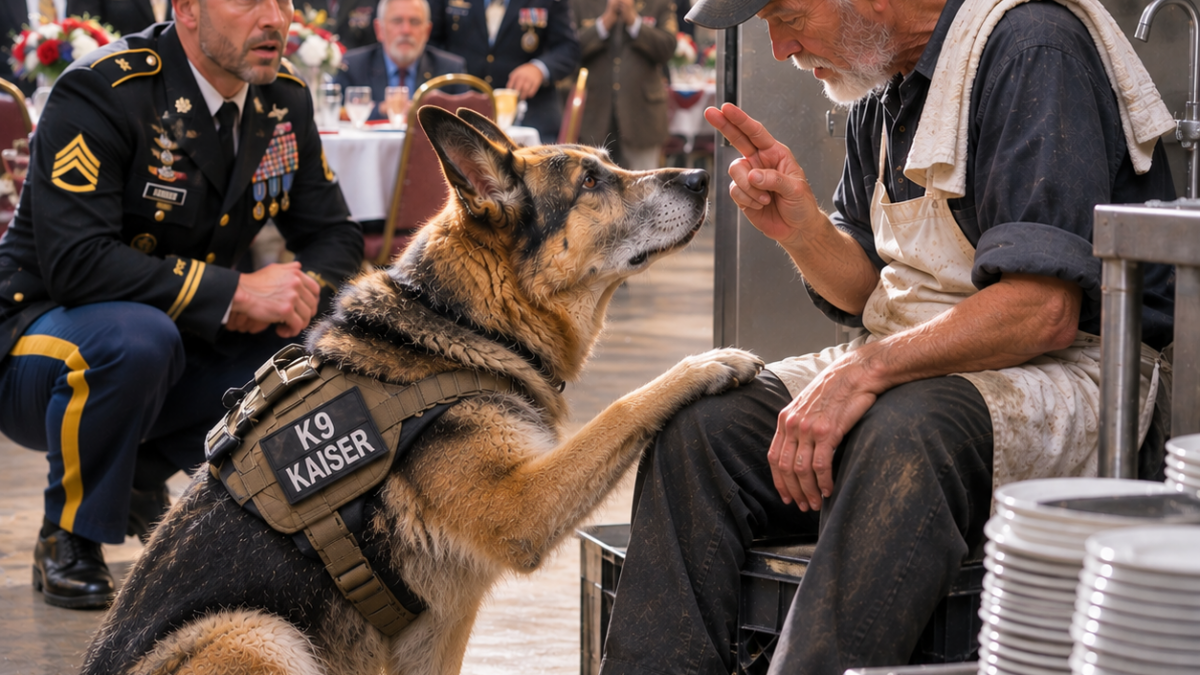
Two hundred decorated veterans called Kaiser’s name across the banquet hall, but the retired military K9 ignored every medal, every uniform, and every outstretched hand before disappearing into the kitchen and sitting at the boots of an elderly dishwasher nobody had invited to the ceremony.
When former K9 handler Mason Hale followed him inside, he watched the old man unconsciously curl two fingers against his palm and give a silent battlefield signal so specific that Mason had not seen it since Afghanistan—and Kaiser instantly dropped into the same protective position he had used under enemy fire.
Then the banquet’s honored guest, a celebrated retired colonel, stepped into the kitchen, saw the dishwasher’s hands, and ordered security to remove him before anyone could ask why a man washing plates for minimum wage knew commands that had supposedly died with one of the most controversial K9 handlers in the unit’s history.
The first thing Kaiser ignored was a Medal of Honor recipient.
That bothered nobody.
Kaiser ignored almost everyone.
At twelve years old, the retired German Shepherd had reached the stage of life where strangers existed mostly as obstacles between him and places he had already decided to go.
He had spent eight years in military service.
Two deployments to Afghanistan.
One to Iraq.
Three handlers.
Hundreds of training searches.
Dozens of operational sweeps.
One shattered canine tooth.
A scar over his left ribs.
And enough commendations to fill a shadow box he could not possibly understand.
He had earned the right to be rude.
That Saturday evening, the Hawthorne Veterans Foundation had made Kaiser one of the ceremonial guests at its annual Valor Banquet outside Richmond, Virginia.
The ballroom was packed.
Two hundred veterans.
Army.
Navy.
Marines.
Air Force.
Men and women who had flown helicopters through dust storms, kicked doors in Fallujah, pulled wounded friends out of burning vehicles, run field hospitals under mortar fire, and then somehow learned to argue about lawn fertilizer and youth baseball like ordinary Americans.
Rows of American flags stood behind the stage.
A jazz trio played softly near the bar.
Servers moved between tables carrying prime rib and roasted potatoes.
At the center table sat retired Colonel Victor Harland.
The man of the evening.
Sixty-six.
Silver hair.
Tailored tuxedo.
Perfect posture.
Three rows of military decorations mounted beneath his lapel.
Harland had commanded Task Force Sentinel in Afghanistan and later built a second career speaking about leadership, sacrifice, and accountability.
The foundation was honoring him with its first Lifetime Valor Award.
He had already shaken nearly a hundred hands.
Kaiser wanted none of them.
PART2:
Staff Sergeant Mason Hale—retired now, though he still hated the word—held the dog’s leash loosely.
“Try to act impressed.”
Kaiser sniffed a tablecloth.
“That’s General Whitmore.”
No reaction.
“Three stars.”
Kaiser looked toward the kitchen.
Mason sighed.
“You have no respect for rank.”
Kaiser started walking.
“Where are we going?”
The shepherd moved through the crowd with surprising determination for an animal whose back legs sometimes needed help getting into Mason’s truck.
A Marine lieutenant colonel bent down.
“Kaiser!”
The dog passed him.
A former combat medic offered a piece of roast beef.
Kaiser hesitated.
Mason almost laughed.
“Now we’ve found his principles.”
But even the roast beef failed.
Kaiser kept going.
He crossed the ballroom.
Passed the stage.
Passed the side entrance.
PART3:
Stopped at the swinging kitchen doors.
Mason shortened the leash.
“No.”
Kaiser pulled.
“Absolutely not.”
Another pull.
“Kaiser.”
The dog looked back at him.
Mason knew that expression.
He had seen it in Afghanistan seconds before Kaiser located a pressure plate hidden under a pile of feed sacks.
It meant:
You can come with me or be wrong by yourself.
Mason sighed.
“Fine.”
They entered the kitchen.
Steam.
Metal counters.
Dish racks.
Shouting cooks.
The smell of onions, detergent, gravy, and coffee.
Kaiser did not hesitate.
He moved around two servers, past a rolling rack of glasses, then through a narrower doorway into the dish room.
The noise doubled.
Industrial sprayer.
Clattering porcelain.
Metal trays striking stainless steel.
At the far sink stood an elderly man.
At least late sixties.
Thin.
Slightly stooped.
White hair cut short.
Gray work shirt.
Black apron.
Cheap nonslip shoes.
He was alone, scraping food from plates before feeding them into the dishwasher.
Kaiser stopped.
Mason nearly bumped into him.
The dog stared at the man.
The dishwasher had not noticed them.
He stacked another plate.
Rinsed.
Stacked.
His hands moved quickly despite his age.
Scarred hands.
Large knuckles.
Two fingers on the left hand slightly crooked.
Mason noticed because handlers noticed hands.
Hands gave commands.
Hands held leads.
Hands reached toward dogs that could break bones if approached incorrectly.
Then the man turned.
Kaiser’s ears rose.
The dishwasher froze.
A white plate slipped from his fingers.
It struck the rubber mat without breaking.
For several seconds, neither moved.
Mason said, “Sorry. He dragged me back here.”
The old man did not answer.
His eyes were on Kaiser.
The shepherd took one step.
The man’s right hand moved.
Barely.
Two fingers curled toward his palm.
Thumb folded inward.
Wrist rotated left.
Mason stopped breathing.
Kaiser immediately lowered his body.
Rear legs tucked.
Chest forward.
Head angled toward the doorway.
A tactical cover posture.
Not sit.
Not down.
Cover.
Mason had not used that signal in nine years.
Nobody used it anymore.
The dishwasher stared at his own hand as if he had not realized what he had done.
Kaiser whined.
The man’s face changed.
“Might be better if you take him out.”
His voice was rough.
Quiet.
American.
Mason did not move.
“Where did you learn that?”
The man picked up the dropped plate.
“Learn what?”
“That hand signal.”
“No idea what you mean.”
“You just gave Kaiser a silent cover command.”
The old man placed the plate in the rack.
“He sat down.”
“He didn’t sit.”
Mason stepped closer.
“He covered your right side.”
The dishwasher continued working.
Mason watched his hands.
The index finger on his left hand bent inward at the second joint.
An old injury.
There was a pale burn scar running from the wrist across the thumb.
Mason felt something stir in his memory.
Not a face.
A photograph.
A photocopied training manual.
Hands demonstrating field signals.
He looked at Kaiser.
The dog had not taken his eyes off the man.
“What’s your name?”
The dishwasher reached for another tray.
“Henry Ward.”
“Were you military?”
“No.”
Too fast.
Mason said, “That signal was used by Joint K9 Detachment Raven.”
The man stopped.
Only for half a second.
Mason saw it.
“We were taught it before my second deployment.”
No answer.
“A handler designed that system after radios kept giving away dog-team positions.”
The man resumed spraying plates.
Mason continued.
“Palm inward meant hold. Two fingers meant cover. Wrist direction told the dog which side.”
The old man shut off the water.
The sudden silence felt enormous.
He looked at Mason for the first time.
“Then you already know more than you need.”
Kaiser stood.
The old man’s eyes dropped to him.
Something passed across his face.
Pain.
Recognition.
Fear.
Then the kitchen door opened.
Colonel Victor Harland entered.
“Mason?”
Mason turned.
Harland smiled at first.
“You disappeared. They want Kaiser for the presentation in—”
He saw the dishwasher.
The smile vanished.
Harland stopped.
The old man became completely still.
Mason looked between them.
“You two know each other.”
Harland recovered.
“No.”
The dishwasher looked down.
Harland’s eyes moved to Kaiser.
Then to the old man’s scarred hands.
His jaw tightened.
“What is he doing in here?”
Mason frowned.
“He works here.”
“I meant the dog.”
“Kaiser walked in.”
Harland looked toward the kitchen manager.
A heavyset man named Brian Lopez had followed him.
“Brian.”
“Yes, Colonel?”
“Remove this employee from the banquet area.”
Brian looked confused.
“He’s assigned dish tonight.”
“Then assign someone else.”
The dishwasher untied his apron.
“I’ll go.”
Mason stepped between him and the door.
“Wait.”
Harland’s voice hardened.
“Mason.”
“What?”
“This is neither the time nor place.”
“For what?”
Harland looked at the old man.
The dishwasher folded his apron carefully.
Mason asked him, “Who are you?”
The old man said nothing.
Harland answered for him.
“Nobody relevant to this evening.”
Kaiser growled.
Low.
Every person in the doorway became still.
Mason looked down.
Kaiser was staring at Harland.
Harland took one step back.
The dishwasher’s hand moved automatically.
Palm down.
Two fingers.
Slow.
Kaiser stopped growling.
Instantly.
Mason’s pulse hammered.
Harland saw that Mason had seen it.
“Take the dog out.”
Mason ignored him.
He looked at the dishwasher.
“Do it again.”
The man’s face tightened.
“Mason.”
“Do the signal again.”
Harland snapped, “That’s enough.”
Mason turned.
“No, sir.”
He had not called Harland sir in fifteen years.
The old habit came out anyway.
Harland noticed.
So did Mason.
Harland lowered his voice.
“This man has no place at a veterans’ event.”
The dishwasher looked up.
That hurt him.
Mason saw it.
He asked, “Why?”
Harland’s mouth flattened.
“Because some people forfeited the right to stand among men who did their duty.”
The dishwasher flinched.
There it was.
Recognition.
Not suspicion.
Not coincidence.
History.
Mason stared at Harland.
“What did he do?”
The old man spoke quietly.
“Nothing that matters anymore.”
He started toward the employee exit.
Kaiser rose.
The dog followed him.
Mason held the leash.
Kaiser pulled.
The old man stopped.
“Don’t.”
Kaiser whined.
The dishwasher closed his eyes.
Then said something so quietly Mason nearly missed it.
“Still stubborn, aren’t you?”
Mason felt cold.
“You know this dog.”
“No.”
“You just—”
“I knew dogs like him.”
Harland stepped forward.
“He needs to leave.”
Mason looked at him.
“Why are you scared?”
Harland laughed once.
“Scared?”
“You walked into a kitchen and saw a dishwasher, and the first thing you did was try to throw him out.”
“That is not what happened.”
“He gave a classified K9 hand signal.”
“Old field signals are hardly classified.”
“He knew Kaiser.”
“You’re imagining a mystery because you spent too many years thinking like a handler.”
The old man opened the employee door.
Kaiser barked.
One sharp bark.
The man stopped.
Without turning, he raised his left hand behind him.
Three fingers.
Close.
Wait.
Kaiser sat.
Mason’s throat tightened.
He knew that one too.
Not from the manual.
From old handlers.
A personal variation.
A signal that belonged to one man.
A man Mason had never met.
A man whose name had been spoken in his K9 school like a warning.
Mason whispered, “Rourke.”
The dishwasher closed his eyes.
Harland went pale.
Mason stepped closer.
“Master Sergeant Samuel Rourke.”
No one moved.
The old man slowly turned.
His face had changed with age.
With scars.
With weight loss.
With time.
But now Mason could see it.
A photograph from an old unit wall.
A broad-faced soldier kneeling beside a young German Shepherd.
The left index finger crooked from an old bite injury.
Burn across the right hand.
Samuel Rourke.
The handler who had supposedly broken under fire.
The handler blamed for the worst K9-unit failure in Task Force Sentinel’s history.
The handler who disappeared before the final investigation.
Mason stared at him.
“You’re dead.”
Rourke gave a tired smile.
“People have been telling me that for fourteen years.”
Harland spoke first.
“Brian, call security.”
Mason turned.
“What?”
Harland’s expression had become cold.
“He has no authorization to be in the guest area.”
“He’s standing in the room where you hired him to wash plates.”
“You know exactly what I mean.”
“No, Colonel.”
Mason stepped toward him.
“I don’t.”
Harland’s voice lowered.
“This man abandoned his team during Operation Red Valley.”
Rourke looked down.
“He disobeyed a direct order under combat conditions.”
Kaiser shifted closer to Rourke.
Harland pointed at him.
“His actions compromised a clearance operation and cost American lives.”
Rourke finally looked up.
“Say their names.”
Harland stopped.
Rourke’s voice remained quiet.
“If you’re going to use dead men to make yourself taller, say their names.”
The kitchen went silent.
Harland’s face reddened.
“Don’t you dare.”
“Sergeant Ben Carter.”
Rourke took one step toward him.
“Specialist Aaron Bell.”
Another.
“Staff Sergeant Lewis Grant.”
Harland stared.
Rourke’s eyes hardened.
“I carried Grant half a mile after your evacuation bird refused to land.”
Harland said, “You were ordered to enter that compound.”
“Yes.”
“You refused.”
“Yes.”
Mason looked between them.
Harland spread his hands.
“There. He admits it.”
Rourke looked at Mason.
“There were wires in the dust.”
“What?”
“Pressure lines.”
Harland snapped, “That claim was investigated.”
Rourke continued as if he had not spoken.
“The dogs smelled explosive compound before we reached the south wall.”
Mason felt his stomach tighten.
“What type?”
“Homemade nitrate mix. Lots of it.”
“Kaiser?”
Rourke looked down at the old shepherd.
For the first time, his expression softened completely.
“He was twenty months old.”
Mason stared.
Kaiser had been there.
Rourke continued.
“He gave me two behavior changes before the gate.”
Harland said, “There was no confirmed device at the gate.”
Rourke looked at him.
“Because I didn’t walk him onto it.”
Harland stepped forward.
“The objective contained a high-value target.”
“And children.”
The word stopped everybody.
Mason looked at Harland.
“What children?”
Harland said nothing.
Rourke did.
“Twelve civilians in the compound.”
“That wasn’t in the report.”
“No.”
“Why?”
Rourke stared at Harland.
“Ask him.”
Security arrived.
Two uniformed officers from the private event company.
They looked confused.
Harland said, “Escort this man out.”
Mason stepped beside Rourke.
“No.”
Harland stared at him.
“This isn’t your decision.”
Mason handed Kaiser’s leash to the old handler.
Rourke looked down at it.
Then at Mason.
Mason said, “Maybe it’s his.”
Kaiser immediately moved against Rourke’s left leg.
Perfect heel.
Rourke’s hand trembled around the leather.
For the first time, the elderly dishwasher looked less like an old man washing plates.
He looked like a soldier holding his dog.
Harland’s face twisted.
“This is absurd.”
Mason turned toward the security officers.
“You touch him, you’ll do it in front of two hundred veterans after I tell them exactly who he is.”
Harland froze.
Mason continued.
“And I’ll ask all two hundred why the man this foundation is honoring tonight seems terrified of a dishwasher’s hands.”
Harland’s eyes hardened.
“You have no idea what you’re doing.”
“Then explain it.”
Silence.
A voice came from behind them.
“I’d like to hear that explanation too.”
Retired Sergeant First Class Ben Carter stood in the doorway.
Mason knew him from the banquet.
Sixty now.
Silver beard.
Walking cane.
Two Purple Hearts.
Carter looked at Rourke.
Then dropped his cane.
It hit the tile.
He whispered, “Sarge?”
Rourke’s face broke.
Carter stepped forward.
“No.”
His eyes filled.
“No, no, no.”
Rourke said, “Ben.”
Carter covered his mouth.
“You’re alive.”
Rourke nodded.
Carter crossed the room and grabbed him.
Not a handshake.
Not military restraint.
He wrapped both arms around him.
Rourke held on.
Carter sobbed against his shoulder.
“You son of a bitch.”
Rourke shut his eyes.
“I know.”
“They told us you ran.”
“I know.”
“They said you left us.”
“I know.”
Carter pulled back and hit him once in the chest.
Not hard.
“You came back for Grant.”
Rourke nodded.
Carter looked around at everyone.
“He came back.”
Harland said, “Ben.”
Carter turned.
His expression changed instantly.
“You.”
Harland stiffened.
Carter pointed at Rourke.
“You told us he abandoned the route.”
“The after-action findings—”
“You told Grant’s mother he abandoned us.”
“Ben, you were concussed.”
Carter stepped toward him.
“I remember him carrying me.”
Harland’s jaw tightened.
“You remember fragments.”
“I remember the signal.”
Carter lifted his hand.
Two fingers curled.
Wrist left.
Kaiser dropped into cover.
The room went silent.
Carter looked at Mason.
“That one.”
His voice shook.
“Rourke used it because radio traffic was drawing fire.”
He looked at Kaiser.
“Dog was a pup.”
Rourke touched Kaiser’s neck.
Carter continued.
“We were ordered through the south gate.”
Harland said, “Stop.”
Carter looked at him.
“You don’t command me anymore.”
Harland’s face changed.
For the first time that night, the retired colonel looked old.
Carter spoke clearly.
“Rourke refused because Kaiser alerted.”
Mason asked, “What happened?”
Carter stared at the floor.
“We went east.”
“Who ordered it?”
“Harland.”
Rourke closed his eyes.
Carter continued.
“Second team entered the southern approach after we diverted.”
Mason understood before Carter finished.
“Explosion?”
Carter nodded.
“Wall came down.”
The dish room had become completely silent.
Even the machine had stopped.
Carter looked at Harland.
“You blamed Rourke because he’d argued with you over the radio.”
Harland said, “That is a grotesque oversimplification.”
“Then simplify it for me.”
Harland looked toward the banquet doors.
People were gathering now.
Servers.
Veterans.
Staff.
News of something happening in the kitchen had spread.
Carter raised his voice.
“You told the investigation Rourke froze.”
Rourke whispered, “Ben.”
“No.”
Carter turned.
“No, Sarge. You shut up for fourteen years.”
Rourke’s eyes filled.
Carter faced Harland again.
“He didn’t freeze.”
Harland said, “He failed to execute.”
“He saved us.”
“Three soldiers still died.”
“Because you sent the second team through the gate he told you was wired.”
The words traveled through the doorway.
People outside went silent.
Harland looked around.
His humiliation was becoming public.
And suddenly his tone changed.
Smooth.
Controlled.
The decorated officer returned.
“Ladies and gentlemen, this concerns a classified operation and a deeply traumatized former soldier whose recollection has been disputed for many years.”
Rourke flinched.
Mason noticed.
Harland continued.
“Master Sergeant Rourke suffered severe blast injury, post-traumatic stress, and documented cognitive impairment.”
Carter shouted, “Don’t do that.”
“Do what?”
“Make his injury a lie detector.”
Harland looked at the crowd.
“I am stating facts.”
Rourke quietly handed Kaiser’s leash back to Mason.
Then removed his apron.
Folded it.
Placed it on the counter.
“I should go.”
Mason stared at him.
“No.”
“I came here to wash plates.”
“You were a master sergeant.”
“Not anymore.”
“You trained Kaiser.”
Rourke looked at the dog.
“A long time ago.”
Carter said, “Sarge.”
Rourke turned.
“I’m tired, Ben.”
That shut Carter down.
Not anger.
Exhaustion.
Fourteen years of it.
Rourke walked toward the employee exit.
Kaiser followed.
Rourke stopped.
“Stay.”
Kaiser ignored him.
Mason almost smiled.
Rourke tried the hand signal.
Stay.
Kaiser ignored that too.
Carter laughed through tears.
“Guess he outranks you now.”
A tiny smile touched Rourke’s face.
Then Harland said something that erased it.
“Some men spend their whole lives trying to rewrite the moment they failed.”
Rourke turned.
Mason expected anger.
Instead the old soldier looked almost sad.
“You still think I’m the one rewriting it.”
Then he left.
Kaiser went with him.
Mason followed.
They found Rourke behind the banquet hall sitting on an overturned milk crate near the dumpsters.
Kaiser sat beside him.
The old man had one hand buried in the dog’s fur.
Mason stayed several feet away.
“You really trained him.”
Rourke nodded.
“How long?”
“Fourteen months.”
“You were his first operational handler?”
“Yes.”
“Why isn’t your name in his current file?”
Rourke laughed softly.
“You’ll have to ask people with better uniforms.”
Mason sat on a second crate.
For a while, neither spoke.
Music from the banquet drifted through the brick wall.
Kaiser leaned against Rourke.
Mason asked, “Why are you washing dishes?”
Rourke looked toward him.
“Dishwashers are necessary.”
“That wasn’t what I meant.”
“I know.”
“Where have you been?”
“Lots of places.”
“Your unit thought you were dead.”
“Some did.”
“Others?”
Rourke looked toward the building.
“Found it useful if they did.”
Mason felt anger rise.
“Harland.”
Rourke said nothing.
“What happened after Red Valley?”
“I was injured three weeks later.”
“Combat?”
“Truck rollover.”
“Report said you disappeared before the investigation was completed.”
“That report said many things.”
“Did you?”
“I was transferred to Germany for treatment.”
“Then?”
“Fort Sam.”
“Then?”
“Medical evaluation.”
“What did they diagnose?”
Rourke smiled without humor.
“The list was impressive.”
“TBI?”
“Yes.”
“PTSD?”
“Yes.”
“Memory impairment?”
“Some.”
“Were you discharged?”
“Eventually.”
“What characterization?”
Rourke looked at his hands.
“Other than honorable.”
Mason stared.
“For disobeying the order?”
“Officially, conduct unbecoming, dereliction, insubordination, unauthorized removal of military property.”
“What property?”
Rourke touched Kaiser.
“A dog.”
Mason blinked.
“What?”
“After the blast, Harland ordered Kaiser turned over to another team for immediate use.”
“You refused.”
“He had blood in his urine and couldn’t put weight on one leg.”
Mason’s jaw tightened.
“You took him to veterinary?”
“I put him in a truck and drove him myself.”
“They charged you for that?”
“Among other things.”
Mason looked at Kaiser.
The old shepherd rested his head on Rourke’s knee.
“What happened to the investigation?”
Rourke shrugged.
“I signed what they put in front of me.”
“Why?”
“My wife was leaving.”
Mason said nothing.
“My son was twelve.”
Rourke continued.
“I couldn’t sleep. Couldn’t drive some days. Forgot words. Lost my temper.”
He looked embarrassed.
“They told me if I fought it, I could spend years tied up in military court.”
“Did you have counsel?”
“Yes.”
“Good counsel?”
Rourke looked at him.
“I had tired counsel.”
Mason understood.
“Why didn’t Carter know?”
“I was ordered not to contact unit witnesses while the inquiry was open.”
“And afterward?”
Rourke looked toward the night sky.
“I was ashamed.”
“That wasn’t your shame.”
“Easy to say fourteen years later.”
“Your family?”
Rourke’s jaw tightened.
“My wife remarried.”
“Your son?”
“Doesn’t speak to me.”
“Because he thinks you abandoned them?”
Rourke did not answer.
That was answer enough.
Mason looked back toward the banquet hall.
“You knew Harland was receiving an award tonight?”
“No.”
“You work here and didn’t know?”
“I work in the kitchen.”
Rourke gave a faint smile.
“People giving each other medals usually don’t ask the dishwasher for input.”
Mason looked at him.
“You could have walked into that ballroom.”
“For what?”
“To tell the truth.”
“To two hundred veterans eating steak?”
Rourke shook his head.
“Truth isn’t louder because there are more chairs.”
Kaiser shifted closer.
Rourke scratched his chest.
Mason asked, “What happened at Red Valley?”
The old man remained silent for almost a minute.
Then he began.
Their team had entered a farming district in Kandahar Province before sunrise.
Intelligence indicated an insurgent facilitator was operating from a walled compound.
Rourke and Kaiser were attached to the lead element.
Two other dog teams followed.
The mission was supposed to be simple.
Clear the approach.
Search the compound.
Detain the target.
But the moment they approached the southern gate, Kaiser changed.
Mouth closed.
Tail stiff.
Nose low.
Rourke recognized explosive odor behavior.
He signaled halt.
Harland ordered them forward.
Rourke refused.
A second handler confirmed a weak alert near the wall.
Harland argued the dogs were picking up fertilizer from nearby fields.
Rourke said no.
Nitrate fertilizer smelled different when combined with fuel and contamination from bomb-making materials.
Harland ordered the gate cleared anyway.
Rourke gave silent signals directing his team east.
The second element remained south.
Minutes later, the gate exploded.
Not one device.
Three.
Daisy-chained charges built into the wall.
Specialist Aaron Bell died instantly.
Staff Sergeant Lewis Grant survived long enough to reach the surgical hospital.
Another soldier died two days later.
Ben Carter suffered a brain injury and lost part of his hearing.
Kaiser was wounded by fragmentation.
Rourke went back into the blast area twice.
First for Carter.
Then for Grant.
Harland’s report later claimed Rourke’s unauthorized diversion had fragmented the formation and contributed to confusion.
Mason listened without interrupting.
“The compound?”
Rourke looked at him.
“Empty of insurgents.”
“What?”
“Twelve civilians.”
“You said that earlier.”
“Four women. Seven children. One old man.”
“And the target?”
“Gone.”
“Intel bad?”
“Not exactly.”
“What does that mean?”
Rourke’s mouth tightened.
“Intel had been updated before we moved.”
“Updated how?”
“Source reliability collapsed.”
“Harland knew?”
Rourke stared at the pavement.
“Yes.”
Mason felt cold.
“Why proceed?”
“He wanted the capture.”
“Why?”
“Promotion cycle.”
Mason shook his head.
“That’s not enough.”
“No.”
Rourke looked toward the banquet hall.
“There was also a civilian contractor delegation visiting brigade headquarters that week. Harland had been promising results.”
Mason understood the shape of it.
“Career.”
“Reputation.”
“Command.”
Rourke nodded.
“He wanted a clean win.”
“And got three men killed.”
“Yes.”
“Did you have proof the intel warning changed?”
Rourke looked at him.
“I did.”
Mason sat forward.
“What kind?”
“Printed update.”
“Where?”
“Gone.”
“Radio traffic?”
“Some.”
“After-action?”
“Rewritten.”
“Witnesses?”
“Carter was concussed. Another handler transferred. Grant died.”
“What about you?”
Rourke raised his scarred hands.
“I became the unstable one.”
Mason hated how easily he understood the mechanism.
A decorated colonel.
A wounded noncommissioned officer.
Conflicting recollections.
One still rising.
One broken.
Institutions often said they followed evidence.
But prestige had a way of arriving dressed like evidence.
The employee door opened.
Ben Carter stepped outside.
He held Rourke’s folded apron.
“You forgot your uniform.”
Rourke smiled.
“Very funny.”
Carter sat on the curb.
For a moment, the two men simply looked at each other.
Fourteen years.
Then Carter said, “I went to your funeral.”
Rourke frowned.
“My what?”
“Unit memorial.”
“I wasn’t dead.”
“No kidding.”
“They held a memorial?”
“Not official casualty. They said you’d died stateside after complications.”
Rourke stared.
“Who told you?”
Carter looked toward the banquet hall.
“Harland.”
Mason felt his stomach drop.
Rourke’s face emptied.
“He told you I died?”
“Yes.”
“When?”
“About a year after I got back.”
Rourke looked down at his hands.
Carter’s voice broke.
“I called your old number for months.”
Rourke swallowed.
“I didn’t know.”
“I sent letters.”
“I never got them.”
“You could’ve called me.”
“I thought you hated me.”
Carter stared.
“For saving my life?”
“For what the report said.”
“I knew the report was bullshit.”
“Did you?”
“Yes.”
“Then why didn’t you fight it?”
Carter flinched.
Rourke immediately regretted the words.
“Ben.”
Carter looked away.
“Because I was twenty-eight, missing half the hearing in my left ear, having seizures, and Harland told me if I contradicted the report I could lose my disability determination because my memory was unreliable.”
Rourke closed his eyes.
Mason saw it then.
The cruelty had not depended on one perfect conspiracy.
It depended on separate frightened people.
Each isolated.
Each made to believe everyone else had accepted the official story.
Rourke thought Carter blamed him.
Carter thought Rourke was dead.
The dead men’s families received a sanitized report.
The unit moved on.
Harland got promoted.
Carter looked at Kaiser.
“He kept going after you.”
Rourke touched the dog.
“Good.”
“Mason handled him later.”
Rourke nodded.
“I know.”
Mason looked at him.
“How?”
“I followed the unit when I could.”
“You knew me?”
“Your name.”
That affected Mason more than he expected.
Rourke said, “Kaiser had good years with you.”
Mason looked away.
“Yeah.”
“He was safe?”
“As safe as a working dog ever is.”
“Good.”
Carter asked, “Why didn’t you come get him when he retired?”
Rourke smiled sadly.
“Other-than-honorable discharge doesn’t put you high on the adoption list.”
Mason’s jaw tightened.
“He should’ve been yours.”
Rourke shook his head.
“He was never property to me.”
Carter snorted.
“Tell the Army.”
Kaiser yawned.
Rourke scratched his head.
The banquet doors opened again.
This time three veterans came out.
Then five.
Then more.
Someone had told the ballroom.
Word spread faster among veterans than official announcements ever did.
An old Marine approached.
“Are you Rourke?”
The dishwasher stiffened.
“Yes.”
The Marine held out his hand.
“Carter told us what happened.”
Rourke stared at the hand.
Then shook it.
A woman behind him said, “I served with Grant’s sister.”
Another veteran said, “My unit heard about Red Valley.”
A third:
“We were told the handler panicked.”
Rourke looked down.
Carter said loudly, “He didn’t.”
The crowd grew.
Rourke’s breathing changed.
Mason noticed.
Too many people.
Too many eyes.
He stepped between Rourke and the group.
“Give him space.”
A few backed away.
Then Harland appeared in the doorway.
Behind him stood foundation board members.
His award presentation had been delayed.
His expression remained controlled.
“I think everyone should return inside.”
Nobody moved.
Harland looked at Mason.
“You have turned a private personnel matter into a public spectacle.”
Mason answered, “You did that when you tried to throw him out.”
Harland said, “Master Sergeant Rourke’s case was adjudicated.”
Carter laughed.
“By who?”
“Proper military authority.”
“Then why tell us he died?”
The question landed hard.
Harland looked at him.
“I was given information about his medical condition.”
“You told me he died.”
“I may have repeated an inaccurate report.”
Carter stared.
“You sent flowers.”
Harland’s face tightened.
“You’re emotional.”
Carter stepped forward.
“That line worked better when I was twenty-eight.”
Murmurs from the crowd.
Harland looked at Rourke.
“You understand what this is becoming.”
Rourke said nothing.
“Old allegations. Fragmented memories. People trying to reshape painful events into something easier to live with.”
Rourke finally met his eyes.
“Is that what you did?”
Harland’s jaw clenched.
Rourke continued.
“I washed plates tonight because I needed the paycheck.”
His voice was quiet.
Not dramatic.
That made everyone listen harder.
“I did not come here for your award.”
Harland said nothing.
“I did not know you’d be here.”
Rourke looked toward the ballroom.
“I have spent fourteen years trying not to become the man your report said I was.”
His hand rested on Kaiser’s head.
“Then this dog walked into my kitchen.”
Kaiser leaned against him.
Rourke’s voice broke slightly.
“And he remembered me before I remembered how to defend myself.”
Nobody spoke.
Harland looked around.
The room was slipping away from him.
He said, “Memories are not evidence.”
Mason nodded.
“For once, we agree.”
Harland stared.
Mason continued.
“So let’s find evidence.”
The foundation board postponed Harland’s award.
Officially, because of “unexpected circumstances.”
Unofficially, nobody wanted photographs of him holding a trophy while a sixty-eight-year-old former master sergeant washed dishes twenty yards away.
Mason took Rourke home that night.
Not because Rourke asked.
Because Kaiser refused to get into Mason’s truck unless Rourke came too.
Rourke lived in a one-bedroom apartment above a closed hardware store.
No photographs on the walls.
No medals.
No military memorabilia.
One folding table.
One recliner.
Books stacked beside the bed.
A coffee maker older than Mason’s marriage.
Kaiser walked through the rooms.
Stopped beside an empty corner.
Rourke said, “Used to have a dog bed there.”
Mason looked at him.
“Dog?”
“Shelter mutt. Daisy.”
“What happened?”
“Cancer.”
“When?”
“Two years ago.”
“Sorry.”
Rourke shrugged.
“Dogs don’t make promises about forever.”
Kaiser lay down in the empty corner.
Rourke stared at him.
Then turned away.
Mason opened his phone.
“What was Operation Red Valley’s date?”
Rourke looked over.
“No.”
“No what?”
“Don’t do this.”
“I’m looking up records.”
“You have a life.”
“So did you.”
“Mason.”
“You trained my dog.”
“I trained hundreds.”
“You saved Carter.”
Rourke’s expression hardened.
“I am not asking you to rescue me.”
“Good.”
Mason sat at the table.
“I’m terrible at following orders from people who don’t outrank me.”
Rourke almost smiled.
“Still a handler.”
“Unfortunately.”
Mason began with publicly available casualty records.
The official report was thin.
Three American deaths linked to “complex enemy attack during compound-clearing operation.”
No mention of disputed intelligence.
No mention of Rourke.
A military newspaper article praised then-Lieutenant Colonel Victor Harland for “decisive leadership under fire.”
Mason stared at the phrase.
Rourke saw it from across the table.
“Don’t.”
“Decisive leadership.”
“Mason.”
“They gave him a Bronze Star.”
“I know.”
“For the mission.”
“Yes.”
Mason’s anger sharpened.
Rourke said, “Anger feels useful until you have to sleep with it.”
“Did you teach that too?”
“No.”
Rourke looked toward Kaiser.
“He did.”
The next morning, Mason called the one person who might understand old K9 records.
Retired Chief Warrant Officer Nora Callahan.
She had run the military working dog school’s historical program for eleven years.
Mason gave her Rourke’s name.
Silence.
Then:
“Where did you hear that?”
“I found him.”
Another silence.
“Alive?”
“Yes.”
“My God.”
“You knew him?”
“No. Knew his case.”
“What case?”
“His training doctrine survived him.”
“The hand signals.”
“Among other things.”
“Why is his name missing from everything?”
Nora hesitated.
“Because his separation generated a restricted administrative flag.”
“Can you access it?”
“Not anymore.”
“Can anyone?”
“Yes.”
“Who?”
“Army Review Boards Agency.”
Mason looked at Rourke.
“What would it take to reopen his discharge?”
“Rourke would have to request correction.”
“He won’t.”
“Then you have a problem.”
“Any archived training reports?”
“Possibly.”
“I need Red Valley.”
“Operational records won’t be in the dog school archive.”
“What about Kaiser’s veterinary history?”
Nora went quiet.
“That might.”
Mason sat straighter.
“Why?”
“Dogs don’t care about command politics. Veterinarians document injuries.”
Two days later, Mason received a lawful copy of Kaiser’s old veterinary transfer summary through his own adoption records.
Rourke sat beside him.
They read it together.
Date.
Red Valley.
Injuries:
Superficial fragmentation to thorax.
Paw laceration.
Acute stress response.
Then one line.
Mason pointed.
“K9 alerted repeatedly to explosive odor at South Access Point prior to blast.”
Rourke stared.
Mason read it again.
There it was.
Written by a veterinarian who had no reason to protect a colonel.
Kaiser had alerted before the explosion.
Rourke closed his eyes.
“For fourteen years…”
Mason looked at him.
“You told them.”
“Yes.”
“And they said the dog didn’t have a confirmed alert.”
“Yes.”
“This says he did.”
Rourke’s hand started shaking.
Mason printed three copies.
Rourke grabbed his wrist.
“Don’t.”
“Why?”
“Because one line doesn’t clear everything.”
“It clears the reason you stopped.”
“It proves the dog alerted.”
“Which proves you weren’t freezing.”
Rourke looked away.
“Not enough.”
Mason saw fear.
Not of losing.
Of hoping.
Hope was more dangerous to Rourke than despair because despair had become familiar.
Mason contacted Ben Carter.
Carter had kept something too.
An old field notebook.
Water damaged.
Bloodstained.
Inside, next to the mission date, were four handwritten words.
Kaiser alert — south gate.
Below:
Rourke called HOLD. H overruled.
Mason photographed the page.
Carter stared at it.
“I wrote that in Germany.”
“Why?”
“Doctors told me to write what I remembered before the concussion scrambled it.”
“Did investigators see this?”
“I offered.”
“What happened?”
“They said my notes were medically unreliable.”
Mason felt rage.
Carter laughed bitterly.
“Funny thing about brain injuries.”
“What?”
“People use them to ignore you until they need proof you were hurt.”
The third piece came from Lewis Grant’s widow.
Mason hesitated to call her.
Rourke refused to.
“I’m not dragging her through this.”
Carter disagreed.
“She deserves the truth.”
“She lost her husband.”
“Exactly.”
Rourke left the room.
Mason called.
Her name was Rachel Grant.
She lived in Tennessee.
When Mason explained, she became silent.
Then she said, “I’ve been waiting fourteen years.”
Mason stared.
“For what?”
“For someone to ask.”
Lewis had called her from the field hospital before surgery.
Three minutes.
His final conversation.
Rachel had saved the voicemail he left when she missed the first call.
She emailed it.
Mason, Carter, and Rourke listened together.
Static.
Hospital noise.
Lewis Grant’s weakened voice.
“Rach, it’s me.”
Rourke bowed his head.
“I’m okay for now.”
A pause.
“If they tell you Sergeant Rourke messed up, don’t believe it.”
Rourke covered his face.
Grant continued.
“Kaiser found it.”
Another breath.
“Colonel pushed us anyway.”
Rourke stood abruptly.
Mason paused the recording.
“Do you want me to stop?”
Rourke could not answer.
Carter was crying openly.
Rourke finally whispered, “Play it.”
Mason continued.
“Rourke came back for us.”
Grant coughed.
“He came back twice.”
A nurse spoke in the background.
Grant hurried.
“Tell Mom I’m sorry.”
Pause.
“Love you.”
The recording ended.
Nobody moved.
Rourke stared at the floor.
“I never knew he called.”
Carter wiped his face.
“He told the truth.”
Rourke began to cry.
Not loudly.
His shoulders folded.
Fourteen years of surviving accusations did not break him.
A dying soldier defending him did.
Kaiser stood.
Walked to him.
Pressed his body against Rourke’s legs.
The old man lowered himself to the floor and wrapped both arms around the dog.
“I’m sorry.”
Mason heard him whisper it again.
“I’m sorry.”
Carter knelt beside him.
“For what?”
“I couldn’t get him out.”
“You carried him.”
“He died.”
“You carried him.”
Rourke shook his head.
Carter grabbed the back of his neck.
“You listen to me.”
Rourke looked up.
“I am alive because you came back.”
Carter pointed at Kaiser.
“He is alive because you refused an order.”
Then toward the phone.
“Grant’s last message says the same thing.”
Carter’s voice broke.
“You don’t get to make yourself guilty just because Harland did it first.”
That night, Rourke agreed to reopen his case.
Mason helped him file with the Army Board for Correction of Military Records.
The process could take months.
Maybe longer.
But something else moved faster.
The Hawthorne Veterans Foundation had started its own review.
Three board members resigned after learning Harland had never disclosed that the man he publicly called a coward had been central to the mission for which Harland received one of his highest awards.
Harland went on television.
He remained calm.
He said memories of combat were complicated.
He expressed sympathy for Rourke.
He denied falsifying any report.
He said he welcomed a fair review.
Then he made his mistake.
A reporter asked whether Kaiser had alerted before the blast.
Harland answered:
“No confirmed canine alert was reported prior to the decision to proceed.”
Mason watched from Rourke’s apartment.
He paused the television.
“Confirmed.”
Rourke looked at him.
“What?”
“He changed the language.”
“So?”
“Old report said no alert.”
Mason held up Kaiser’s veterinary record.
“Now he says no confirmed alert.”
Rourke sat forward.
Mason continued.
“He knows this record exists.”
“How?”
“Foundation lawyers probably found it.”
Rourke stared at the screen.
Harland continued speaking.
Mason muted him.
“He’s retreating.”
Rourke looked almost afraid to believe it.
Three days later, a former intelligence officer contacted Ben Carter.
Captain Elena Cross.
She had been the junior intelligence officer attached to Task Force Sentinel.
Now a high school history teacher in Maryland.
She had watched Harland’s interview.
She still possessed an email printout.
Not classified operational detail.
An administrative routing message.
Sent eight hours before Red Valley.
SUBJECT: SOURCE RELIABILITY DOWNGRADE — OBJECTIVE R-17.
Mason read it.
The key line:
Primary human source now assessed LOW CONFIDENCE following contradictory reporting. Recommend postponement pending secondary verification.
Distribution list included Victor Harland.
Rourke.
Operations staff.
Mason looked up.
“You were right.”
Rourke said nothing.
Elena looked at him.
“I sent it.”
Rourke remembered her.
“You were Lieutenant Cross.”
“Yes.”
“Why didn’t this appear in the inquiry?”
“I was told the mission had already launched before the downgrade was received.”
“That’s a lie.”
“I know now.”
“Did you testify?”
“I gave a statement.”
“What happened?”
“They summarized it.”
“Did Harland know before the operation?”
Elena looked ashamed.
“I personally watched him open the email.”
Rourke stared.
“Why didn’t you say that?”
“I did.”
“To who?”
“The investigating officer.”
“And?”
“He asked if I could prove what Harland read.”
Mason laughed bitterly.
Elena continued.
“I was twenty-four.”
She looked at Rourke.
“I thought if the Army wanted the truth, it would know how to find it.”
Rourke nodded slowly.
“So did I.”
Elena’s eyes filled.
“I’m sorry.”
Rourke did not tell her it was fine.
Because it was not.
Instead he said, “You’re here now.”
Elena nodded.
“Yes.”
“Then be here now.”
That became the sentence people repeated later.
Not because it was dramatic.
Because it was the opposite of absolution.
You cannot repair yesterday by pretending it did not happen.
You can only decide what you do when the truth reaches you today.
The formal military review expanded.
The Department of the Army opened a separate inspector general inquiry into the historical after-action process.
Harland’s attorneys attacked Rourke’s credibility.
They cited his traumatic brain injury.
PTSD.
Other-than-honorable discharge.
Periods of homelessness.
A public intoxication citation from eleven years earlier.
A failed marriage.
Bankruptcy.
They took the worst years of a wounded man’s life and arranged them like proof that he had always been unreliable.
Mason became furious.
Rourke did not.
“That’s what I expected.”
“It’s disgusting.”
“It’s litigation.”
“They’re calling you unstable.”
“I was unstable.”
“That doesn’t make you wrong.”
“No.”
Rourke looked at him.
“That’s the part I needed fourteen years to understand.”
The story went national after a photograph circulated online.
It had been taken at the banquet kitchen.
Nobody knew who took it.
Rourke stood in his dishwasher apron.
Kaiser sat against his leg.
Rourke’s scarred hand rested on the dog’s head.
Harland stood several feet away in his tuxedo, medals shining.
The caption spread faster than any legal filing:
THE DOG REMEMBERED THE MAN THE ARMY FORGOT.
Rourke hated it.
“I wasn’t forgotten.”
Mason looked up.
“No?”
“I was inconvenient.”
That was worse.
Reporters waited outside his apartment.
One offered money.
Another asked him to reenact Kaiser’s hand signals.
Rourke closed the blinds.
“I liked dishes.”
Mason laughed.
“Dishes don’t ask questions.”
“Exactly.”
The banquet hall fired him.
Officially, because press attention was disrupting events.
Mason nearly lost his mind.
Rourke shrugged.
“I’ll find another job.”
“No.”
“What?”
“They cannot fire you because a colonel got embarrassed.”
“They can fire me because I’m hourly and Virginia—”
“Don’t start quoting employment law at me.”
Rourke actually smiled.
“You sound like my ex-wife.”
The backlash was immediate once the firing became public.
Veterans canceled events.
Donors withdrew.
The foundation board intervened.
The catering contractor offered Rourke his job back with back pay.
He declined.
“Why?”
The manager asked him personally.
Rourke looked around the dish room.
“Because I don’t want to spend the rest of my life proving I deserved to stand outside the kitchen.”
Instead, Ben Carter found him work at a veterans’ dog-training nonprofit.
Nothing glamorous.
Three mornings a week.
He cleaned kennels.
Helped veterans learn leash handling.
Corrected young trainers when they pulled too hard.
And slowly, without anyone announcing it, he began teaching again.
Kaiser started going with him.
Mason pretended this was temporary.
It was not.
The old shepherd had made his choice.
Every morning, Kaiser waited by Mason’s truck.
The moment they reached the training center, he limped straight to Rourke.
“You know I adopted you,” Mason told him once.
Kaiser ignored him.
Rourke said, “He has standards.”
“You washed plates six weeks ago.”
“Honest work.”
“Traitor. Both of you.”
Rourke laughed.
The sound became more common.
Then his son called.
Rourke nearly did not answer.
The number was from Texas.
Mason was beside him when the phone rang.
Rourke stared at the screen.
“Who is it?”
“My boy.”
Mason stopped.
Rourke’s son, Jacob, was twenty-six now.
They had not spoken in nine years.
“Answer.”
Rourke shook his head.
“Answer.”
“What do I say?”
“The truth would be a fashionable change.”
Rourke glared.
Then picked up.
“Hello?”
A man’s voice.
Older than the boy Rourke remembered.
“Dad?”
Rourke closed his eyes.
“Yeah.”
Silence.
Then Jacob said, “I saw the news.”
Rourke did not know how to respond.
Jacob continued.
“Mom told me you abandoned us because you cared more about your Army case than your family.”
Rourke swallowed.
“She wasn’t completely wrong.”
“Did you try to call me?”
“Yes.”
“When?”
“Every birthday for three years.”
“I never got anything.”
Rourke looked confused.
“I left messages.”
“My number changed.”
“I sent letters.”
Silence.
“I never got letters.”
Rourke rubbed his forehead.
“I stopped eventually.”
Jacob’s voice hardened.
“Why?”
“Because rejection gets easier when you stop testing it.”
“That’s a terrible answer.”
“I know.”
“You should’ve kept trying.”
“I know.”
“I spent years thinking you didn’t want me.”
Rourke began crying.
“I know.”
Jacob went quiet.
Rourke whispered, “I wanted you every day.”
Neither spoke for several seconds.
Then Jacob asked, “Is Kaiser really the same dog?”
Rourke laughed through tears.
“Yes.”
“The one from that picture you used to keep?”
“Yes.”
“Does he remember you?”
Rourke looked across the training yard.
Kaiser was sleeping in the sun.
“Better than most people.”
Jacob exhaled.
“Can I come see you?”
Rourke covered his mouth.
“Yes.”
His voice failed.
He tried again.
“Yes.”
Jacob arrived two weeks later with Rourke’s nine-year-old granddaughter, Sophie.
Rourke had never met her.
She walked into the training center holding her father’s hand.
Rourke stood near the fence.
He looked terrified.
More terrified than he had looked facing Harland.
Jacob stopped five feet away.
Rourke said, “You got tall.”
Jacob laughed nervously.
“You got old.”
“Fair.”
Sophie peeked around her father.
Rourke looked at her.
“Hi.”
She looked at Kaiser.
“Is that the famous dog?”
Rourke sighed.
“Unfortunately.”
Mason laughed from across the yard.
Sophie approached Kaiser.
“Can I pet him?”
Rourke crouched slowly.
“Kaiser’s old. Let him smell you first.”
She held out her hand.
The shepherd sniffed.
Then licked her fingers.
Sophie giggled.
Rourke looked at Jacob.
Something in his face broke.
Jacob crossed the distance.
They hugged.
Awkwardly at first.
Then harder.
Rourke whispered, “I’m sorry.”
Jacob answered, “I know.”
“No.”
Rourke pulled back.
“I need to say it right.”
He looked his son in the eyes.
“I was hurt.”
“I was ashamed.”
“I believed you were better without me.”
“I used that belief as an excuse to stop trying when trying hurt.”
Jacob’s eyes filled.
Rourke continued.
“That was wrong.”
No justification.
No demand for forgiveness.
Jacob nodded.
“Okay.”
Rourke looked down.
“Okay?”
“That doesn’t fix it.”
“I know.”
“But it’s a place to start.”
Rourke nodded.
“A place to start.”
Kaiser barked.
Sophie jumped.
Then laughed.
The military review took nine months.
Long enough for the news cycle to move on.
Long enough for Harland to believe public interest had faded.
Long enough for Rourke to stop checking the mailbox every day.
Then a thick envelope arrived.
Department of the Army.
Rourke placed it unopened on his kitchen table.
Mason stared at him.
“You’re kidding.”
“I’m thinking.”
“You’ve been thinking for three hours.”
“Long document.”
“It is still inside the envelope.”
Rourke looked at Kaiser.
“You open it.”
Mason frowned.
“Me?”
“I might throw up.”
Mason sat.
Opened it.
Read.
Then stopped.
Rourke watched his face.
“Well?”
Mason looked up.
“Your discharge is being corrected.”
Rourke did not move.
“What?”
“Other than honorable removed.”
He read.
“Honorable characterization.”
Rourke’s mouth opened.
No sound.
Mason continued.
“Finding states disciplinary action relied materially on incomplete and misleading operational records.”
Rourke sat down.
Mason’s voice shook.
“Dereliction finding vacated.”
Rourke covered his face.
“Kaiser’s alert is specifically cited.”
The old dog lifted his head at his name.
Mason kept reading.
“Board finds substantial evidence that Master Sergeant Samuel Rourke’s decision to halt entry through the southern approach was consistent with military working dog indications and likely prevented additional casualties.”
Rourke began crying.
Mason stopped reading.
The old man lowered his hands.
“Keep going.”
“Samuel—”
“Keep going.”
Mason did.
The board did not declare Rourke perfect.
It found he had violated some procedural orders in the chaotic aftermath.
It found his later conduct had been influenced by documented traumatic brain injury.
It criticized the original inquiry.
It recommended restoration of rank for retirement-credit purposes and referral for review of combat awards.
Then the final paragraph.
“The record should reflect that Master Sergeant Rourke did not abandon his team.”
Mason could not continue.
Rourke took the page.
Read the sentence himself.
Once.
Twice.
Then again.
He stood.
Walked to the window.
Kaiser followed.
Rourke whispered, “Fourteen years.”
Mason said nothing.
“I knew it.”
His voice broke.
“I knew what happened.”
“I know.”
“But after enough people tell you…”
He stared through the glass.
“You start wondering if maybe your own memory is the lie.”
Kaiser pressed his head against Rourke’s hip.
The old man looked down.
“You didn’t wonder.”
Kaiser’s tail moved.
“No.”
Rourke smiled through tears.
“You never did.”
Harland’s consequences came later.
The Army review concluded he had received the downgraded intelligence before Red Valley and failed to ensure it was incorporated into the mission decision.
Investigators also found that portions of the after-action report had been altered during command review in ways that minimized the warning provided by Rourke and Kaiser.
No evidence proved Harland personally typed every alteration.
Evidence did prove he approved the final version.
His award from the mission was placed under review.
The Hawthorne Veterans Foundation removed him from its board.
Several organizations canceled his speaking engagements.
More damaging than any of that, Ben Carter testified publicly about Harland’s threats concerning his disability status.
Elena Cross testified about the intelligence email.
Rachel Grant released her husband’s voicemail.
Harland’s image as the unquestioned hero of Red Valley collapsed under the voices of the people who had actually been there.
He denied deliberate wrongdoing.
He insisted decisions had been made under combat pressure.
Some veterans defended him.
Others argued commanders should not be judged with hindsight.
Rourke never demanded that everyone hate Harland.
That surprised Mason.
One afternoon, a reporter asked him whether Harland was a coward.
Rourke shook his head.
“No.”
“Do you believe he lied?”
“Yes.”
“Why not call him a coward?”
Rourke looked toward the training yard.
“Because courage and integrity are different things.”
The reporter waited.
Rourke continued.
“A man can be brave under gunfire and still be too afraid to admit he was wrong.”
That quote traveled farther than the photograph.
The formal award review concluded six months later.
Harland’s Red Valley commendation was revoked.
Rourke received no giant parade.
He wanted none.
The Army offered a small correction ceremony at Fort Belvoir.
He almost refused.
Jacob convinced him.
“You spent fourteen years being publicly wrong.”
Rourke looked at his son.
“You can survive one afternoon of being publicly right.”
So they went.
Mason.
Ben Carter.
Elena Cross.
Rachel Grant.
Jacob.
Sophie.
And Kaiser.
The old shepherd wore no costume.
No ridiculous ceremonial vest.
Just his old leather collar.
The room was modest.
Maybe sixty people.
An Army major general read the correction.
Rourke’s honorable service restored.
Rank recognized.
Record amended.
Then a posthumous reference to Lewis Grant and the men lost at Red Valley.
Rourke stood rigid.
The general presented him with a newly approved Soldier’s Medal for actions connected to the rescue of wounded personnel after the blast.
Rourke looked at it.
Then at Rachel Grant.
He walked away from the podium.
Everyone became confused.
He crossed the room to her.
Held out the medal.
“This belongs with Lewis.”
Rachel shook her head.
“No.”
“I carried him.”
“And he told me you saved him.”
“He died.”
“He lived long enough to call me.”
Rourke’s eyes filled.
Rachel closed his fingers around the medal.
“He wanted me to know you came back.”
She looked at him.
“So stop turning his death into proof that you failed.”
Rourke lowered his head.
Rachel hugged him.
People stood.
Not because the program told them to.
Because they wanted to.
Kaiser rose too.
Slowly.
His hips were worse now.
Mason helped him.
Rourke returned to the front.
The general smiled.
“Master Sergeant.”
Rourke looked at Kaiser.
Then raised his hand.
Two fingers.
Palm inward.
Wrist left.
The old shepherd moved.
Slowly.
Carefully.
Into cover position beside him.
The room went silent.
Many people there did not understand the signal.
Mason did.
Carter did.
Rourke did.
Kaiser did.
That was enough.
After the ceremony, Harland was waiting outside.
No cameras.
No attorneys.
Just an older man in a dark coat.
Mason stiffened.
Carter swore.
Rourke raised a hand.
“I’ll talk to him.”
“No,” Mason said.
“Yes.”
“You don’t owe him anything.”
“I know.”
Rourke walked toward Harland.
Kaiser followed.
Harland looked at the dog.
Then at Rourke.
“I heard about the correction.”
Rourke said nothing.
“I’m not here to fight.”
“Good.”
Harland exhaled.
“I made decisions that day based on what I believed the mission required.”
Rourke looked at him.
“That’s still your defense?”
Harland’s face tightened.
“I am trying to explain.”
“You’ve been explaining for fourteen years.”
Harland looked away.
Then said, “I should have stopped the second team.”
Rourke’s expression changed.
It was the first time Harland had said it.
“I knew Kaiser might be right.”
Rourke’s throat tightened.
Harland continued.
“I thought we were losing the target.”
“So you gambled.”
“Yes.”
“With them.”
Harland closed his eyes.
“Yes.”
Rourke looked at the ground.
“What happened afterward?”
Harland hesitated.
Then the truth arrived slowly.
“I was afraid.”
“Of prison?”
“My career.”
Rourke laughed once.
Not because it was funny.
Harland’s eyes filled.
“I told myself the operation had been chaotic.”
“It was.”
“I told myself no one person caused the blast.”
“The enemy caused the blast.”
“Yes.”
Harland nodded desperately, as though Rourke had offered him rescue.
Then Rourke finished.
“But you caused the order.”
Harland’s face fell.
Rourke continued.
“And afterward, you made me carry it.”
Harland looked at him.
“I’m sorry.”
Rourke waited.
Fourteen years earlier, those words might have changed something.
Now they simply existed.
“You told Ben I died.”
“Yes.”
“Why?”
“He kept asking questions.”
Rourke’s jaw tightened.
“You let my men mourn me.”
“I know.”
“You let my son grow up thinking I was a disgrace.”
“I didn’t know about your son.”
“You knew enough.”
Harland nodded.
“Yes.”
Rourke looked down at Kaiser.
Then back at Harland.
“I’m not going to tell you I forgive you.”
“I understand.”
“I’m not going to tell you I never will.”
Harland swallowed.
“Okay.”
“But if you spend what’s left of your life telling people you were the real victim of a difficult decision…”
Rourke stepped closer.
“Then you still haven’t learned anything.”
Harland nodded slowly.
Rourke turned away.
Harland called after him.
“Samuel.”
Rourke stopped.
“I was wrong.”
Rourke closed his eyes.
Then kept walking.
No handshake.
No dramatic reconciliation.
Some things did not need one.
Kaiser retired again.
That became Mason’s joke.
“He has now retired from the military, from me, and from retirement.”
The dog spent most weekdays at the training nonprofit with Rourke.
His favorite place was beneath Rourke’s desk.
Sophie visited during school breaks.
She learned the silent signals.
Not combat ones.
Simple ones.
Sit.
Stay.
Come.
One afternoon, Rourke caught her experimenting with the old cover signal.
Kaiser slowly moved into position.
Rourke stared.
Sophie grinned.
“He listened.”
“Unfortunately.”
“Did you make that signal?”
“Yes.”
“Why?”
“Because sometimes talking was dangerous.”
She thought about that.
“Does he remember all of them?”
Rourke looked at Kaiser.
“Probably more than I do.”
Sophie sat beside the shepherd.
“Dogs are smarter than people.”
“Careful.”
Rourke smiled.
“That opinion gets easier to defend as you get older.”
Mason visited nearly every day.
He eventually brought Kaiser’s military shadow box to Rourke.
The old man stared at it.
“What am I supposed to do with this?”
“Keep it.”
“It’s yours.”
“No.”
Mason pointed to an old photograph he had added.
Young Kaiser.
Twenty months old.
Beside Master Sergeant Samuel Rourke.
The image had come from the military archive after the record correction.
Rourke touched the glass.
“I haven’t seen this in years.”
“You looked terrible.”
“I was forty pounds heavier.”
“You had hair.”
“Go home, Mason.”
Mason laughed.
Rourke kept the shadow box.
Not on the wall.
At first.
Three months later, Mason visited and found it hanging above the desk.
He said nothing.
Rourke noticed.
“Don’t.”
“I didn’t say anything.”
“Your face did.”
“My face is naturally judgmental.”
Kaiser barked once.
Rourke nodded.
“Dog agrees.”
Kaiser’s health declined the following winter.
Kidneys.
Arthritis.
A mass near his spleen.
The veterinarian explained options.
Rourke listened.
Mason listened.
Kaiser slept.
Surgery might buy months.
It might also take the last good weeks he had.
Mason looked at Rourke.
“You know him better.”
Rourke shook his head.
“You’ve had him longer.”
“He found you.”
“That doesn’t erase you.”
Mason looked at Kaiser.
The dog had belonged to many people.
Or maybe none of them.
Perhaps people simply got turns.
They chose comfort care.
Kaiser kept coming to the training center until he could not.
Then Rourke started spending evenings at Mason’s house.
One snowy night, Kaiser could not stand.
Mason called Rourke.
He arrived twenty minutes later.
No coat.
Still wearing house slippers.
“You drove in those?”
“Shut up.”
They carried Kaiser to the rug by the fireplace.
Rourke sat on one side.
Mason on the other.
For a while, nobody spoke.
Kaiser’s breathing was slow.
Rourke rubbed the scar along his ribs.
“Red Valley.”
Mason looked at him.
“The scar?”
Rourke nodded.
“Piece of wall.”
Kaiser opened his eyes.
Rourke smiled.
“You were young.”
The dog’s tail moved weakly.
“You thought you were indestructible.”
Mason said, “He still does.”
Rourke looked at him.
“You gave him a good life.”
Mason shook his head.
“He gave me one.”
Rourke nodded.
“Yeah.”
Kaiser shifted his paw.
Rourke put his hand beneath it.
The old dog’s toes rested across his scarred fingers.
Mason watched.
The hands.
That was where it had started.
Two hundred veterans.
A ballroom.
A dishwasher.
One unconscious signal.
Hands everyone else saw as old.
Hands Kaiser recognized as home.
Rourke whispered, “You found me.”
Kaiser breathed.
Rourke’s eyes filled.
“I wasn’t looking.”
Mason looked away.
“You still found me.”
Kaiser’s gaze stayed on him.
Rourke raised his right hand.
Slowly.
Two fingers folded.
Thumb inward.
Wrist left.
Cover.
Kaiser’s ear moved.
His body tried to respond.
Could not.
Rourke immediately lowered his hand.
“No.”
His voice broke.
“No more work.”
He stroked the dog’s face.
“You’re done.”
Mason put one hand on Kaiser’s shoulder.
Rourke whispered, “Good boy.”
Kaiser exhaled.
His body softened.
And with both of his handlers sitting beside him—one from the beginning, one from the years that came after—Kaiser died.
Rourke stayed on the floor long after.
At sunrise, Mason asked where they should bury him.
Rourke thought.
Then smiled faintly.
“Somewhere he can ignore people.”
They buried Kaiser on the hill behind the veterans’ dog-training center.
No giant monument.
Just a stone.
KAISER
MILITARY WORKING DOG
HE REMEMBERED WHO STOOD BESIDE HIM.
The following year, the Hawthorne Veterans Foundation held its annual banquet again.
Rourke received an invitation.
He threw it away.
Jacob found it in the trash.
“You’re going.”
“No.”
“Why?”
“I hate banquets.”
“You washed dishes at one.”
“That paid.”
“They want to honor you.”
“I’ve had enough honoring.”
Sophie looked up from the kitchen table.
“Will there be cake?”
Rourke stared at her.
“That’s your argument?”
“Yes.”
He went.
Not in uniform.
Not in a tuxedo.
Dark suit.
Old shoes.
No medals.
Mason sat beside him.
Carter sat on the other side.
Rachel Grant attended.
Elena Cross.
Jacob.
Sophie.
The foundation had created a new annual award.
Not named after Rourke.
He refused that.
It recognized moral courage in veteran advocacy.
The first recipient was Patrice Collins, a former VA nurse who had spent years exposing unsafe medication practices in a separate case.
Rourke liked that.
“About time they gave awards to people who actually annoy institutions.”
Mason laughed.
During dinner, a young server dropped a tray.
Plates crashed.
Everyone turned.
Rourke did not.
He looked through the swinging kitchen doors.
At the dish room.
For a moment, he saw himself there again.
Apron.
Gray shirt.
Head down.
Trying to stay invisible.
Mason noticed.
“You okay?”
Rourke nodded.
“Yeah.”
Sophie asked, “Grandpa?”
“What?”
“Show me the signal again.”
“What signal?”
“The one Kaiser knew.”
Rourke looked around.
“Not here.”
“Why?”
“Because there’s no dog.”
Sophie lifted both hands.
“I’m the dog.”
Carter nearly choked on his water.
Rourke sighed.
“Fine.”
He raised his hand.
Two fingers.
Thumb inward.
Wrist left.
Sophie immediately crouched beside his chair.
Mason laughed.
“You trained another one.”
Rourke shook his head.
“Stand up.”
She did.
Then hugged him.
Rourke froze.
Only a second.
Then wrapped his arms around his granddaughter.
Across the room, two hundred veterans talked and laughed.
Some wore medals.
Some did not.
Some had records that told their stories accurately.
Some carried things paperwork would never capture.
Rourke no longer needed every person in the room to believe him.
That had been another lesson Kaiser taught him.
Truth did not become true when a crowd applauded.
It did not become false when a colonel denied it.
Fourteen years earlier, a young German Shepherd had smelled explosives near a gate.
His handler believed him.
That decision saved lives.
Everything afterward had tried to turn that moment upside down.
Reports.
Rank.
Fear.
Shame.
Silence.
Time.
But memory survived in strange places.
A veterinarian’s note.
A wounded soldier’s notebook.
A dying man’s voicemail.
An intelligence officer’s forgotten email.
A son willing to call his father again.
And an old dog walking past two hundred celebrated veterans because none of their uniforms mattered to him.
Kaiser had entered a noisy kitchen and stopped beside a man everybody else saw as a dishwasher.
He had looked past the gray hair.
Past the apron.
Past the damaged face.
Past the ruined career.
Past fourteen years of accusations.
He recognized the hands.
And long before the Army corrected a record, long before the foundation withdrew an award, long before reporters learned Samuel Rourke’s name, Kaiser had already given the only verdict that mattered to the old handler.
He sat beside him.








