A Retired K9 Slept Outside a Stranger’s Apartment for Days—Then the Veteran Opened the Door Wearing His Fallen Brother’s Dog Tags
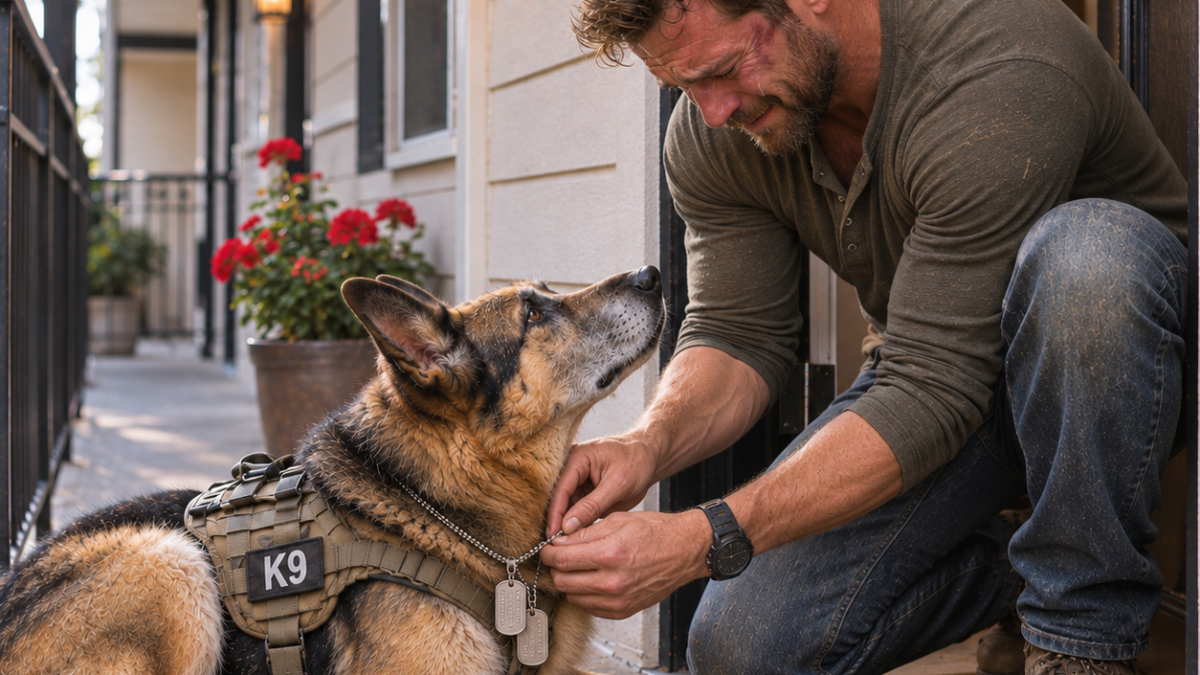
A Retired K9 Slept Outside a Stranger’s Apartment for Days—Then the Veteran Opened the Door Wearing His Fallen Brother’s Dog Tags
For nineteen straight nights, a retired military K9 named Ghost escaped his foster home, crossed nearly three miles of Richmond streets, and slept outside Apartment 3B even though the quiet veteran living behind the door insisted he had never seen the dog before.
Animal control called it attachment behavior until the tenant finally stepped into the hallway wearing a pair of old Army dog tags, and Ghost rose so quickly his arthritic legs nearly collapsed before he pressed his nose against the metal engraved with the name Staff Sergeant Andrew Callahan.
But when the veteran admitted the tags belonged to a brother who had supposedly died thirteen years earlier—and the apartment manager remembered the unfamiliar man who had been asking about Ghost just days before the dog first appeared—the question stopped being why an old K9 had chosen that door and became what Andrew Callahan had left behind for his brother to find.
The first time Daniel Callahan saw the dog, he almost stepped on him.
It was 5:36 on a cold Monday morning in Richmond, Virginia, and Daniel had opened his apartment door with one boot unlaced, a travel mug in his left hand, and exactly seven minutes to reach the bus stop.
The German Shepherd was curled against the wall beside Apartment 3B.
Large.
Old.
Black-and-tan coat gone almost completely silver around the muzzle.
A faded military-style collar.
No leash.
Daniel froze.
The dog opened one eye.
“Jesus.”
The shepherd lifted his head.
Daniel backed up half a step.
He liked dogs.
That was not the problem.
The problem was waking before sunrise to find eighty pounds of unfamiliar German Shepherd blocking the only route to work.
“Hey, buddy.”
The dog watched him.
Daniel looked up and down the empty third-floor hallway.
“Who do you belong to?”
No answer.
“Helpful.”
The dog slowly stood.
His hips were stiff.
Older than Daniel first thought.
He sniffed Daniel’s jeans.
Then his boots.
Then stared up at him.
Daniel reached cautiously for the collar.
The dog stepped backward.
“Okay.”
He raised both hands.
“No touching.”
The shepherd sat.
Daniel pulled out his phone.
No tag visible beyond a worn metal plate stamped:
GHOST
MWD RETIRED
Daniel stared.
“Military dog?”
Ghost’s ears moved.
That complicated things.
PART2:
He called the apartment office.
No answer yet.
He called Richmond Animal Care and Control.
The dispatcher said somebody would come.
Daniel looked at the clock.
5:41.
He had spent the last two years rebuilding a life in which being late mattered.
Being predictable mattered.
Showing up mattered.
He worked maintenance at a printing plant.
Nothing glamorous.
No uniform.
No rank.
No people depending on him to make decisions while rounds came through walls.
He liked it that way.
His supervisor knew Daniel had served in the Army.
Most coworkers did not.
He intended to keep it that way.
Daniel crouched.
“Look, Ghost.”
The dog’s ears lifted at his name.
“I have to go.”
Ghost stood.
PART3:
Daniel moved toward the stairwell.
The dog followed.
“No.”
Ghost followed again.
Daniel stopped.
The shepherd stopped.
“Stay.”
Ghost sat instantly.
Daniel stared.
“Of course you know stay.”
He walked away.
At the stairwell, he looked back.
Ghost remained beside Apartment 3B.
Watching him.
Animal control picked the dog up at 6:17.
Daniel learned this from apartment manager Linda Morales that evening.
Linda intercepted him in the lobby.
Fifty-eight.
Red glasses.
No tolerance for nonsense.
“You have a dog?”
“No.”
“A giant shepherd slept outside your apartment.”
“I noticed.”
“You feed him?”
“No.”
“You know him?”
“No.”
“He knows you.”
“He does not.”
Linda raised an eyebrow.
“Dogs don’t commute across Richmond to sleep outside random doors.”
Daniel stopped.
“Across Richmond?”
“Chip traced to some veterans’ sanctuary.”
“Where?”
“North side.”
Daniel looked toward the elevators.
“Then they’ll keep him there.”
Linda crossed her arms.
“I hope so.”
The next morning Ghost was back.
Same place.
Same position.
Daniel opened his door at 5:34.
The shepherd looked up.
Daniel stared.
“No.”
Ghost’s tail moved once.
“You were literally taken away yesterday.”
Ghost yawned.
“How?”
Daniel called animal control again.
This time he stayed until the officer arrived.
A young woman named Alexis scanned Ghost’s microchip.
“Yeah, same dog.”
“I figured.”
“He belongs to Haven Ridge Veterans Sanctuary.”
“Is their fence decorative?”
Alexis laughed.
“Apparently not. Their director says he’s in foster placement nearby.”
“How nearby?”
“Three miles.”
Daniel stared.
“He walked three miles?”
“Seems like.”
“Twice?”
Alexis clipped on a lead.
Ghost resisted.
Not aggressive.
He simply leaned toward Daniel’s door.
Alexis looked at him.
“Do you know anyone named Michael Ross?”
Daniel shook his head.
“That’s his foster.”
“No.”
“Any military dog handlers?”
“No.”
“You serve?”
Daniel’s face closed.
“A long time ago.”
Alexis noticed.
“Army?”
Daniel nodded.
“Could he know you from service?”
“No.”
“How sure?”
“Completely.”
“What did you do?”
Daniel looked at Ghost.
“Infantry.”
“Where?”
“Afghanistan.”
The word still tasted like dust.
Alexis asked gently, “What years?”
Daniel looked at her.
“That relevant to the dog?”
“Maybe.”
“2009 to 2012.”
She checked Ghost’s chip record on her tablet.
“This dog entered military service around 2011.”
Daniel shook his head.
“Never saw him.”
Alexis took Ghost away.
Third morning.
Back.
Fourth.
Back.
By the sixth, Linda Morales had stopped being amused.
“This cannot continue.”
“I agree.”
“He scratched the paint beside your door.”
Daniel looked down.
Three small marks near the baseboard.
“I’ll pay for it.”
“That is not the point.”
“What do you want me to do?”
“Tell me why he’s here.”
“I don’t know.”
Linda lowered her voice.
“Daniel, I saw how he looks at you.”
“He looks at everybody.”
“No.”
She shook her head.
“I had shepherds twenty years.”
“That dog isn’t waiting for you to feed him.”
“Then what?”
“He’s waiting for something.”
Daniel laughed without humor.
“You’re getting philosophical.”
“I manage thirty-eight apartments. That is where philosophy goes to die.”
He smiled despite himself.
Then stopped because Ghost had rested his head directly against Daniel’s door.
Linda saw Daniel’s expression.
“You sure you don’t know him?”
“Yes.”
“What about whoever lived here before you?”
“I’ve been here three years.”
“Before that?”
“I don’t know.”
“I can check.”
Daniel sighed.
“Linda.”
“What?”
“Don’t turn this into a mystery.”
She looked at the dog.
“I think the dog already did.”
Haven Ridge sent someone personally on the seventh morning.
Mara Collins arrived at 6:10 in an old Ford Explorer.
Daniel knew immediately she was military or former military.
Not because of her clothes.
Jeans.
Boots.
Heavy green jacket.
Because she entered the hallway and scanned exits before looking at Ghost.
Habits.
Daniel recognized them.
Mara crouched ten feet away.
“Ghost.”
The shepherd’s ears moved.
He did not leave Daniel’s door.
Mara frowned.
“You have got to be kidding me.”
Daniel folded his arms.
“You know him?”
“Too well.”
“Then please take him home.”
“That’s been the plan six times.”
She clipped the leash.
Ghost stood.
Then looked at Daniel.
Mara noticed.
“Can I ask you something?”
“Everybody does.”
“Were you a handler?”
“No.”
“Military?”
“Yes.”
“Name?”
“Daniel Callahan.”
Mara froze.
Very slightly.
But Daniel saw it.
“What?”
“Nothing.”
“That wasn’t nothing.”
Mara recovered.
“Do you have family who served?”
Daniel’s entire body tightened.
“Why?”
“Because Ghost has incomplete service records.”
“So?”
“So some working dogs remember people connected to former handlers.”
“Through scent?”
“Sometimes.”
Daniel shook his head.
“My father served Vietnam. He’s dead.”
“Anyone else?”
“No.”
The answer came too quickly.
Mara looked at him.
Daniel stared back.
She did not push.
“Okay.”
Ghost pressed his nose against Daniel’s boot.
Daniel stepped away.
“Take him.”
Mara nodded.
“We’re changing the foster placement. He’ll stay at Haven Ridge.”
“Good.”
“I’m sorry.”
“Not your fault.”
She led Ghost down the hallway.
At the stairwell, the dog stopped.
Turned.
Stared at Daniel.
Daniel shut his apartment door.
He stood behind it for almost a minute.
Then reached beneath his shirt.
His fingers closed around two pieces of cold metal.
Dog tags.
Not his.
He had worn them for thirteen years.
He usually kept them hidden.
Staff Sergeant Andrew J. Callahan.
His older brother.
Dead at twenty-nine.
Killed in Afghanistan.
Daniel pressed the tags against his chest.
“Don’t.”
He did not know whether he was talking to himself, Andrew, or the dog already disappearing down the stairs.
Ghost stayed gone for three days.
Daniel almost relaxed.
Then Sunday morning at 4:49, somebody knocked.
Not barked.
Not scratched.
Knocked.
Three heavy impacts against the bottom of the door.
Daniel woke on the couch.
He had fallen asleep watching television.
He reached automatically toward the side table where, years earlier, a pistol would have been.
There was no pistol now.
He had made that choice deliberately.
The knock came again.
Daniel checked the peephole.
Ghost.
Wet.
Mud covering his paws.
Panting.
Daniel opened the door.
“What the hell?”
Ghost entered.
Daniel stepped back.
“No. No, no, no.”
The dog walked into the living room as if he had paid rent.
Stopped.
Sniffed.
Then turned toward Daniel.
Daniel reached for the collar.
Ghost’s nose moved to Daniel’s chest.
Exactly where the dog tags rested beneath his T-shirt.
Daniel froze.
Ghost sniffed harder.
His body stiffened.
Then he whined.
Not the ordinary impatient sound Daniel had heard in the hallway.
This was high.
Broken.
Urgent.
Daniel slowly pulled the tags out from under his shirt.
Ghost stopped breathing.
At least it looked like it.
The old shepherd stared at the metal.
Daniel’s hand began to shake.
“No.”
Ghost stepped closer.
He pushed his nose against the tags.
Then sat.
Perfectly.
Back straight.
Eyes fixed on Daniel.
Daniel whispered, “Andrew.”
Ghost’s tail struck the floor.
Once.
Daniel’s knees weakened.
He sat on the edge of the couch.
Ghost moved forward.
Pressed his head against Daniel’s chest.
Against the dog tags.
Daniel could not breathe.
“No.”
The dog whined.
Daniel gripped the tags.
“You didn’t know him.”
Ghost pushed harder.
“You couldn’t have.”
Daniel looked at the dog’s gray face.
“How old are you?”
Ghost stared.
Daniel grabbed his phone.
Called Mara.
She answered on the fourth ring.
“Please tell me Ghost is not at your apartment.”
“He’s inside.”
She swore.
“I’m coming.”
“Wait.”
“What?”
Daniel looked at the dog.
“Who was his first handler?”
Silence.
“Mara.”
“I don’t know.”
“You hesitated yesterday when I told you my name.”
Another silence.
“Why?”
“Because I found something after we left.”
“What?”
“An archived transfer page.”
Daniel’s heartbeat increased.
“Handler name?”
“I need to verify it.”
“What name?”
Mara exhaled.
“Callahan.”
Daniel stood.
“First name.”
“I don’t have it clearly. The scan’s damaged.”
“Andrew?”
Ghost’s ears rose.
Mara heard the change in Daniel’s voice.
“Daniel?”
“Was it Andrew Callahan?”
“I don’t know.”
“Mara.”
“I said I don’t know.”
Daniel pressed a hand to his forehead.
“He just recognized my brother’s tags.”
Silence.
“What?”
“I took them out.”
“Why do you have your brother’s tags?”
“Because they sent them home with his body.”
Ghost whined again.
Mara’s voice changed.
“Do not let the dog leave.”
Daniel laughed bitterly.
“That’s been surprisingly difficult.”
“I’m serious.”
“So am I.”
“Daniel, I’ll be there in twenty minutes.”
She arrived in seventeen.
Linda Morales arrived in five because she heard voices.
By the time Mara entered Apartment 3B, Ghost lay on the rug with his head across Daniel’s boots.
The dog tags hung outside Daniel’s shirt now.
Mara crouched.
“Can I see those?”
Daniel removed them.
Handed them over.
She read.
CALLAHAN, ANDREW J.
US ARMY
Mara looked at Ghost.
“Say his name.”
Daniel swallowed.
“Andrew.”
Ghost immediately stood.
Walked to Daniel.
Then performed something Daniel had never seen him do.
He moved around Daniel’s left side.
Sat behind his leg.
Then looked toward the apartment entrance.
Protective rear position.
Mara went pale.
“What?”
Daniel asked.
“That’s not standard obedience.”
“What is it?”
“Handler cover.”
“Meaning?”
“Dog protects the handler’s blind side.”
Daniel stared at Ghost.
“Andrew taught him?”
“Maybe.”
Linda stood near the kitchen.
“You people are finally admitting this is weird?”
Nobody answered her.
Mara called Haven Ridge.
Asked her records coordinator to search every archived reference to Ghost’s microchip, alternate tattoo numbers, and canine service numbers.
Three hours later, they had a partial answer.
Ghost had served under another name.
Military Working Dog Nero.
Name changed during a program transfer eleven years earlier.
Original handler:
Staff Sergeant Andrew Callahan.
Daniel sat at his kitchen table.
Stared at the printed page on Mara’s laptop.
“No.”
Mara stayed silent.
“My brother never handled a dog.”
“You’re sure?”
“He was infantry.”
“Officially?”
Daniel looked at her.
“What does that mean?”
“Some soldiers temporarily worked attached to specialized teams.”
“No.”
“He would have told me.”
Mara closed the laptop slightly.
“When did you last speak to Andrew?”
Daniel did not answer.
Linda quietly left the room.
Mara waited.
Daniel looked at the tags.
“Thirteen years ago.”
“Before he died?”
“Yes.”
“How long before?”
Daniel’s jaw tightened.
“Five months.”
“Why?”
“Doesn’t matter.”
“Ghost thinks it does.”
Daniel looked at her sharply.
“Don’t.”
“I’m sorry.”
“No, you’re not.”
“You’re right.”
Mara sat back.
“I’m trying to understand why a dog has escaped sanctuary property seven times to find the brother of a handler who disappeared from his records.”
Daniel stared through the window.
Finally:
“Andrew and I fought.”
“About?”
“He wanted me out of the Army.”
“You served together?”
“Same deployment area. Different units.”
“Why did he want you out?”
“He said something was wrong.”
“With you?”
“With the mission.”
Daniel’s eyes remained on the window.
“He kept telling me people were lying about what his team was doing.”
“What team?”
“He wouldn’t say.”
Mara leaned forward.
“Did he mention a dog?”
“No.”
“Ghost? Nero?”
“No.”
“He said he was working with an interpreter and a security team.”
“What happened between you?”
Daniel laughed without humor.
“I told him he was paranoid.”
Mara said nothing.
“I was twenty-six.”
He rubbed his face.
“Andrew had always been the responsible one.”
“Good grades.”
“Sergeant before I made specialist.”
“Dad loved telling everybody Andrew was the smart brother.”
Mara waited.
“Andrew called me one night.”
“He sounded scared.”
“I’d never heard him scared.”
“He said he had evidence that a detainee-transfer program was being used for something illegal.”
“What kind?”
“He wouldn’t explain on the phone.”
“He told me to meet him.”
“Did you?”
Daniel’s voice became quieter.
“No.”
“Why?”
“I had convoy duty.”
“He begged me.”
Daniel swallowed.
“I told him if it was real, report it.”
Mara knew what came next before he said it.
“He said he already had.”
Daniel nodded.
“Five months later he died.”
“How?”
“Attack on a remote compound.”
“Ghost?”
“I didn’t know Ghost existed.”
Daniel looked down at the dog.
“Apparently I didn’t know my brother either.”
Mara asked, “Did you attend the funeral?”
“Yes.”
“Closed casket?”
Daniel looked at her.
“No.”
That mattered.
Andrew’s body had been returned.
Daniel had seen him.
Severe injuries.
But unquestionably Andrew.
No fake death.
No secret survival.
Whatever Ghost wanted, it was not a reunion with a living handler.
Mara asked about Andrew’s belongings.
“Most went to Mom.”
“Where is she?”
“Dead.”
“I’m sorry.”
“Five years ago.”
“Anything left?”
“Storage unit.”
Daniel looked at her.
“I kept what she couldn’t go through.”
“Military papers?”
“Probably.”
“Can we look?”
“No.”
“Daniel.”
“No.”
Mara stared.
Daniel’s voice hardened.
“I spent thirteen years not digging into my brother’s death.”
“I’m not starting because a dog slept outside my apartment.”
Ghost stood.
Walked to Daniel.
Pressed his nose into the dog tags again.
Daniel closed his eyes.
“Stop.”
Ghost sat.
Mara said quietly, “Maybe Andrew already did the digging.”
Daniel looked at her.
“And maybe Ghost is all that’s left of where he put it.”
Animal behavior specialists examined Ghost’s pattern.
The dog did not simply like Daniel.
When the tags were removed, he became restless.
When they were placed near Daniel, he settled.
When Mara hid them among three sealed bags containing different metal objects, Ghost identified Andrew’s tags immediately.
Scent.
Old human scent preserved around chain links and crevices.
Daniel found that impossible.
A veterinary behaviorist did not.
“Thirteen years is extraordinary.”
“But not impossible?”
“Dogs don’t experience scent the way we do.”
Ghost had lived with Andrew.
That much became certain when deeper Army archives arrived.
Andrew Callahan had indeed begun deployment as infantry.
Six months later, he was temporarily attached to a joint tactical exploitation unit.
The unit used working dogs for explosive detection, patrol security, and tracking.
Andrew was not technically Ghost’s primary certified handler.
But Ghost’s assigned handler, Staff Sergeant Michael Reeves, was injured.
Andrew took over the dog operationally for nearly eight months.
Field records listed:
TEMPORARY HANDLER — CALLAHAN, A.
Then the records vanished.
Ghost’s next official history began eighteen months later under a different canine identifier.
Daniel stared.
“Why change the dog’s name?”
Mara shook her head.
“Could happen with program transfer. Rare.”
“Why erase Andrew?”
“More concerning.”
“Who ordered it?”
“No answer yet.”
Three days later, Daniel agreed to visit the storage unit.
Ghost came.
Mara came.
So did Special Agent Rachel Moreno from Army CID after the archived records raised enough questions for formal review.
The unit smelled like dust, cardboard, and Daniel’s mother’s old perfume.
Boxes stacked to the ceiling.
Christmas decorations.
Kitchen dishes.
Andrew’s high-school football jacket.
Their father’s tools.
Daniel stood in the doorway.
“I haven’t opened half this since she died.”
Ghost entered.
His entire demeanor changed.
Nose working rapidly.
He moved past boxes.
Stopped at a green Army footlocker.
Andrew Callahan stenciled across the lid.
Daniel stared.
“That hasn’t been opened since Mom packed it.”
Moreno photographed it before Daniel touched anything.
The lock had no key.
Daniel used bolt cutters.
Inside:
Uniforms.
Letters.
Photographs.
A Bible.
One pair of boots.
A field notebook.
And an old black nylon dog leash.
Ghost saw it.
Whined.
He shoved his nose into the trunk.
Daniel picked up the leash.
Ghost immediately grasped the middle.
Daniel froze.
Mara looked away.
For a second, the years between brothers disappeared.
Andrew had held one end.
Ghost the other.
Now Daniel stood where his brother once stood.
He released the leash.
Ghost did not.
He pulled it out.
Carried it to the storage-unit floor.
Placed it in front of Daniel.
Then returned to the trunk.
Pawed at the left interior wall.
Moreno noticed.
“What’s there?”
Daniel looked.
“Nothing.”
Ghost pawed again.
The wall flexed.
False panel.
Moreno stopped everybody.
Gloves.
Photographs.
Documentation.
The panel came out.
Behind it were two sealed plastic envelopes.
A microcassette recorder.
And a photograph.
Daniel reached toward it.
Moreno stopped him.
“I’ll show you.”
She lifted it.
Andrew.
Much younger.
Kneeling beside Ghost.
The dog still had a black muzzle.
Andrew had one arm around his neck.
Beside them stood a boy.
Afghan.
Maybe twelve.
Daniel stared.
“Who’s the kid?”
Nobody knew.
On the back, Andrew had written:
YUSUF — GHOST FOUND HIM BEFORE THEY DID.
Beneath that:
IF THEY CALL HIM A DETAINEE, ASK WHY HE WAS HANDCUFFED BEFORE THE RAID STARTED.
Moreno’s expression changed.
“What does that mean?”
Daniel sat down.
“My brother called me about detainees.”
The first envelope contained copies of handwritten transfer logs.
Detainee identification numbers.
Dates.
Locations.
Vehicle numbers.
Some entries crossed out.
Others had no destination.
One number appeared repeatedly:
Site 14.
The second envelope contained a letter.
Addressed:
DAN.
Daniel stared at his own name.
His hands began shaking.
Moreno asked, “Want me to read it?”
“No.”
He opened it.
The first line broke him.
Little brother,
If you’re reading this because Ghost found you, then I was right about him and wrong about you.
Daniel laughed once through sudden tears.
“Asshole.”
Ghost sat against him.
Daniel continued.
I hope I’m wrong about the rest.
I need you to understand why I stopped telling you things.
The unit has been moving detainees who never enter the official system.
Some are legitimate hostile actors.
Some are informants.
Some are people somebody wants questioned without paperwork.
At first I thought it was intelligence compartmentalization.
Then Ghost found Yusuf.
Daniel stopped.
Mara waited.
He continued reading.
We entered a farmhouse after being told a bomb maker was inside.
Ghost tracked from the road to an irrigation shed.
Yusuf was there already restrained.
Our team had not detained him.
Nobody admitted who had.
He was twelve.
They called him a courier.
He said his father worked for the local police and had refused to give information to a contractor group.
I started checking.
There are transfers under military vehicle numbers that do not belong to our task force.
Private contractors are using Army movements to hide prisoners.
Daniel looked at Moreno.
“Contractors?”
She gestured for him to continue.
Andrew had listed a company.
Sentinel Strategic Solutions.
A defense contractor that no longer existed.
Its regional operations director:
Colonel-turned-contractor Marcus Vane.
Daniel felt his stomach tighten.
The name was familiar.
Vane had later become a retired brigadier general.
Television appearances.
Veterans charities.
Leadership foundation.
Andrew continued:
I reported through Major Douglas Shaw.
He told me the transfers were authorized.
I asked for the authority.
He told me to stop asking.
Michael Reeves asked too.
Three days later he was sent home after an injury that did not happen the way the report says.
Ghost was reassigned to me.
I think that was supposed to shut me up.
It did the opposite.
Daniel looked at Ghost.
“So Andrew wasn’t really your handler by accident.”
Mara said, “Maybe Ghost was left with him because Reeves became inconvenient.”
The letter continued.
I have copied what I can.
I’m not sure this is only about illegal detention.
Some detainees are being exchanged for information, money, and access.
One disappeared after his family paid a contractor intermediary.
If that is what it looks like, this is extortion hiding inside a war.
Daniel stopped again.
His stomach turned.
Andrew had called him.
Scared.
And Daniel had called him paranoid.
He forced himself onward.
If anything happens to me, Ghost knows two things.
My tags.
And home.
You’ll think home means Mom’s house.
It doesn’t.
He knows where I took Yusuf after I got him away from the contractors.
Find Yusuf.
Daniel stared at the page.
“That’s it?”
He flipped it over.
One more line.
And Dan—
I was angry when you didn’t come meet me.
I’m still your brother.
Don’t spend the rest of your life making one bad night bigger than everything before it.
Daniel folded forward.
Elbows on knees.
The letter dropped into his lap.
For thirteen years he had imagined Andrew dying angry.
That had become the central fact of his grief.
Not Afghanistan.
Not the funeral.
Not the closed conversations with their mother.
One missed meeting.
One brother asking for help.
The other saying no.
Daniel had built his entire memory of Andrew around it.
And Andrew, before dying, had already forgiven him.
Ghost pressed against Daniel’s leg.
Daniel grabbed the dog’s collar.
“I’m sorry.”
No one told him not to say it.
No one said Andrew would understand.
No one offered the cheap comforts people reached for when grief became inconvenient.
They let him cry.
Moreno took custody of the documents.
The microcassette contained Andrew’s voice.
Several recordings.
The first confirmed much of the letter.
The second was more disturbing.
Andrew speaking with Staff Sergeant Michael Reeves.
Reeves sounded injured.
“He knows you copied the transfer sheet.”
Andrew:
“Who?”
“Shaw.”
“Vane?”
“Probably.”
“What happened to you?”
Long silence.
Then Reeves:
“They told everyone I fell during the raid.”
“You didn’t.”
“No.”
“What happened?”
“They beat me.”
Daniel looked up.
Moreno stopped the recording.
“Who is ‘they’?”
“Keep going.”
Reeves continued.
“Sentinel security.”
“Why?”
“I threatened to call CID.”
Andrew:
“Names?”
“Paul Denning. Curtis Bell. Maybe others.”
“Did Army personnel see?”
“Shaw did.”
“And?”
“He walked away.”
The third recording was Andrew alone.
“If Reeves disappears, do not accept an accident report.”
The next records showed Reeves had been medically retired six months later.
Publicly alive for another four years.
Then died by suicide.
Moreno located his widow.
Sarah Reeves.
She agreed to speak only after hearing Ghost was alive.
“Ghost?”
Her voice broke.
“That dog was Michael’s.”
Daniel sat beside Moreno during the call.
Sarah continued.
“Michael thought he died.”
Mara frowned.
“Who told him?”
“Major Shaw.”
After Michael’s injury, the military informed him Ghost had been killed in a compound attack.
Another lie.
Michael lost the dog.
His career.
His confidence in his own memory.
Sarah said he spent years insisting his official injury report was false.
Doctors attributed some of his fixation to traumatic brain injury and PTSD.
She believed parts of him.
Not all.
“I got tired.”
Her voice cracked.
“I wanted him to stop living in Afghanistan.”
Daniel understood the sentence.
Families often begged wounded people to let go without knowing whether what they were holding was memory or evidence.
Sarah had one box of Michael’s papers.
In it, investigators found a map.
One location circled.
A village outside Ghazni.
Beside it:
YUSUF SAFEHOUSE / CALLAHAN.
Yusuf.
Finding him thirteen years later was not simple.
The Afghan government had changed.
War had changed.
Borders.
Records.
People.
Moreno worked with federal agencies and refugee organizations.
Three weeks produced nothing.
Six weeks.
Then a name match in Germany.
Yusuf Rahimi.
Twenty-five.
Afghan refugee.
Arrived Europe years earlier.
Worked as an auto mechanic near Frankfurt.
He had a scar above one eyebrow matching the boy in Andrew’s photograph.
Moreno arranged a video interview.
Daniel watched from a federal office.
Ghost was not allowed inside.
He waited with Mara in the hallway.
Yusuf appeared on screen.
Adult face.
Same eyes.
Moreno held up Andrew’s photograph.
“Do you recognize this man?”
Yusuf stared.
Then covered his mouth.
“Andy.”
Daniel stopped breathing.
Yusuf began crying.
“You know him?”
“He saved me.”
Daniel leaned toward the screen.
Yusuf looked at him.
“You look like him.”
“My brother.”
Yusuf whispered something in Dari.
Then English.
“I am sorry.”
Daniel shook his head.
“Tell me what happened.”
Yusuf had been twelve.
His father served in a district police unit.
A contractor group working with American personnel wanted names of suspected insurgent facilitators.
Yusuf’s father refused because he believed several names were personal enemies, not insurgents.
One night, armed men took Yusuf.
Not Taliban.
Afghan security contractors accompanied by Americans.
They held him in a farmhouse.
Threatened his father through intermediaries.
Money.
Information.
Cooperation.
The raid Andrew’s team conducted was based on intelligence that a bomb maker occupied the property.
Instead, Ghost found Yusuf hidden in the irrigation shed.
Already handcuffed.
Andrew realized something was wrong.
“Did Andrew release you?”
Yusuf nodded.
“He fought with another American.”
“Who?”
Yusuf did not know the name.
He remembered a man with a scar on his chin.
Moreno showed photographs.
Paul Denning.
Yusuf pointed.
“Him.”
Denning had been Sentinel security.
Andrew refused to return Yusuf to him.
Instead, he transported the boy to an Afghan police contact through an interpreter he trusted.
Yusuf’s family eventually escaped the district.
His father was killed two years later.
Yusuf went to relatives.
Then Europe.
“Why didn’t you tell anyone about Andrew?”
Yusuf looked confused.
“I did.”
“What happened?”
“An American investigator came.”
“When?”
“Maybe one year later.”
“Name?”
Yusuf could not remember.
“He told me Andrew died and the case was closed.”
“Did you give a statement?”
“Yes.”
“Where is it?”
No one knew.
CID had no record.
Another vanished document.
Yusuf asked, “Ghost alive?”
Daniel swallowed.
“Yes.”
The young man smiled.
“He found me.”
“What?”
“Ghost found shed.”
He touched his chest.
“Andy said dog would always find home.”
Daniel closed his eyes.
Home.
Andrew’s letter.
Ghost knew home.
Not Mom’s house.
Yusuf.
The command was connected to the boy.
Mara began testing Ghost’s old behaviors using nonverbal cues recovered from training notes.
Most did nothing.
Then Yusuf agreed to send an old scarf his mother had kept from Afghanistan.
Something Yusuf had worn as a child.
The package arrived.
Ghost sniffed it.
His whole body changed.
He walked to the sanctuary’s exterior gate.
Sat.
Facing east.
Mara called Daniel.
“He remembers Yusuf.”
“That’s impossible.”
“Stop using that word around this dog.”
But memory alone did not expose the system.
Documents did.
The transfer sheets Andrew hid matched vehicle records.
Some supposed detainees never appeared in official military databases.
Money transfers linked families to Sentinel intermediaries.
Contractors received cash through regional security arrangements.
Some detainees were legitimate intelligence sources kept off formal books for security.
Others appeared to have been held to pressure relatives.
The truth was messy.
Not every secret transfer was criminal.
Not everyone involved knew what Sentinel was doing.
But enough cases showed a pattern of coercion.
Then investigators found a payment ledger.
Obtained from an archived Sentinel civil lawsuit unrelated to Afghanistan.
One line:
RAHIMI FAMILY RESOLUTION — $18,500.
Another:
LOCAL POLICE COOPERATION — RESOLVED.
Another:
CALLAHAN PROBLEM — D.S.
Daniel stared.
“D.S.?”
Moreno did not answer.
Major Douglas Shaw.
Andrew’s superior.
Now retired Colonel Douglas Shaw.
Living in Virginia.
Board member of multiple defense organizations.
Moreno reopened Andrew’s death investigation.
Official account:
Staff Sergeant Andrew Callahan killed during an insurgent attack on an isolated compound while supporting a sensitive intelligence operation.
Body recovered after structure fire.
Four other casualties.
The report was vague.
Original evidence limited.
But there was one detail Daniel had never known.
Andrew was not supposed to be at the compound.
His movement order changed six hours earlier.
Authorized by Douglas Shaw.
Daniel felt physically cold.
“Here we go again.”
Moreno stayed cautious.
“Changing orders doesn’t prove murder.”
“Everybody says that right before the next page proves something worse.”
She did not smile.
The compound Andrew entered was believed to contain a weapons facilitator.
But intelligence traffic recovered later showed source confidence had fallen sharply.
An analyst recommended delay.
Shaw approved continuation.
Andrew went without Ghost.
Why?
Ghost had been reassigned three days earlier.
Official reason:
Behavioral instability.
Mara laughed when she saw it.
“Ghost?”
The dog was asleep upside down beneath her desk.
“You’re telling me this dog became behaviorally unstable three days before his handler died?”
The report cited aggression toward contractor personnel.
Names?
Paul Denning.
Ghost had growled at the Sentinel security man Yusuf later identified.
“Maybe the dog had good judgment,” Mara said.
Moreno agreed privately.
The person who had ordered Ghost removed from Andrew’s team:
Douglas Shaw.
The same pattern.
Separate handler from dog.
Change mission.
Handler dies.
But patterns were not proof.
Then Daniel remembered something.
His mother.
After Andrew’s death, she received a phone call.
A senior officer.
He had been in the kitchen when she answered.
Daniel had forgotten the name.
He called Linda because she had helped him move boxes from his mother’s house years earlier.
“Do you remember the funeral papers?”
Linda paused.
“The military folder?”
“Yes.”
“Storage box marked green.”
They searched.
Inside was Andrew’s funeral program.
Condolence letters.
A handwritten note from Daniel’s mother.
Call Colonel Shaw — asked about Andy’s missing dog.
Daniel stared.
Shaw knew she was asking about Ghost.
What had he told her?
Daniel found one of his mother’s journals.
Entry three weeks after funeral:
Col. Shaw called. Says Nero was killed after Andy. Says Daniel should stop asking questions too. Strange wording. Daniel angry.
Daniel’s hands shook.
“Stop asking questions too.”
At the time Daniel had asked about Andrew’s final mission.
Shaw personally told the family Ghost was dead.
Thirteen years later Ghost slept outside Daniel’s apartment.
Shaw had lied.
Why?
Moreno interviewed him.
Shaw denied remembering specifics.
He admitted classified operations sometimes required sanitized answers.
He denied involvement in illegal detention or extortion.
He denied ordering Andrew killed.
He admitted reassigning Ghost.
Reason?
“The dog had become overly protective of Callahan and aggressive toward contracted partners.”
“Paul Denning?”
“Yes.”
“Was Denning involved in detainee operations?”
“Not to my knowledge.”
That denial failed two weeks later.
A Sentinel roster listed Denning as regional detainee-security coordinator.
Shaw’s credibility cracked.
Then came Apartment 3B.
Linda Morales called Daniel one afternoon.
“You remember I told you somebody was asking about the dog?”
Daniel froze.
“What?”
“Before Ghost first showed up.”
He had forgotten.
The mystery had become so large that the small beginning disappeared.
“What person?”
“Older guy.”
“Name?”
“He said he was looking for a former tenant.”
“When?”
“About four days before Ghost appeared.”
“Description?”
“Sixties. White. Military haircut. Walked with a cane.”
Daniel’s skin prickled.
“What did he ask?”
“Whether a Daniel Callahan lived here.”
“You told him?”
“No.”
She looked offended.
“I don’t confirm residents to strangers.”
“What else?”
“He asked if you had a dog.”
Daniel felt cold.
“Why didn’t you tell me?”
“I did.”
“No, you said someone was asking about Ghost.”
“I said unfamiliar man.”
“Did he identify himself?”
Linda thought.
“Frank.”
“Last name?”
“Maybe Reeves?”
Daniel looked at Mara.
Michael Reeves was dead.
But Michael had a brother.
The records mentioned him.
Frank Reeves.
Former Army signals specialist.
Current whereabouts unknown.
Moreno located him.
Frank Reeves was sixty-seven and living thirty miles away.
He had indeed visited Daniel’s apartment.
And he had done something else.
He was the reason Ghost found it.
Frank had volunteered twice at Haven Ridge under a shortened version of his name.
Mara went pale.
She checked visitor records.
Frank R.
He had spent time with Ghost.
Three weeks before the first escape.
Moreno interviewed him.
Frank did not deny it.
“I gave the dog the tags.”
Daniel stared.
“What tags?”
“Michael’s old spare set.”
Frank had possessed his brother’s duplicate military tags.
Michael Reeves and Andrew Callahan had served together.
Ghost knew Michael’s scent too.
Frank went to Haven Ridge.
Let Ghost smell Michael’s tags.
Then gave an old command he remembered from Michael’s notes.
“Find Callahan.”
Mara’s face hardened.
“You intentionally sent an elderly dog walking across Richmond?”
“I didn’t think he’d leave the property.”
“You did it six times?”
“No.”
“Then how did he keep finding Daniel?”
Frank looked at Ghost.
“Because the dog understood better than I did.”
“How did you know where Daniel lived?”
“Andrew sent Michael a letter before he died.”
Daniel stared.
“What letter?”
Frank had kept it thirteen years.
His brother hid it among papers Frank received after Michael’s death.
The letter said:
Mike,
If I don’t get out of this and you do, find Daniel.
Don’t give him the files first.
Give Ghost something with my scent and tell him to find home.
If Ghost still remembers Dan, you’ll know nobody rewrote everything.
Daniel felt anger rise.
“You had this for thirteen years?”
Frank looked ashamed.
“I found it after Michael died.”
“That was nine years ago.”
“Yes.”
“You waited nine years?”
“Yes.”
“Why?”
Frank’s eyes filled.
“Because my brother died believing the Army had destroyed his life.”
“That doesn’t answer me.”
“I was scared.”
The oldest answer in every story.
Frank continued.
“Michael told me powerful people were involved.”
“I had a wife.”
“Grandchildren.”
“I told myself the files were old.”
“I told myself everyone responsible had retired.”
“Then I saw Vane on television getting an award for veteran leadership.”
Daniel’s jaw tightened.
Frank had started digging.
He found Ghost through old K9 reunion forums.
Learned the dog was alive at Haven Ridge.
Then found Daniel through public records.
He went to the apartment but lost his nerve.
So he visited Ghost.
The dog remembered Michael’s tags.
Then remembered “Callahan.”
Frank had not expected Ghost to escape.
But once the dog reached Daniel, Frank understood Andrew’s contingency had worked.
Ghost had verified the link.
Scent to scent.
Handler to brother.
Memory against erased paperwork.
Daniel wanted to hate Frank.
He could not fully.
He understood cowardice too well.
“What files?”
Frank opened an old metal case.
Inside was a flash drive Michael Reeves had hidden before his death.
Encrypted.
Andrew’s records.
Copies of detainee transfers.
Sentinel payment ledgers.
Emails.
And one audio file recorded two days before Andrew died.
Douglas Shaw.
Marcus Vane.
Andrew.
The argument began calmly.
Andrew:
“You’re using military air and vehicles to move people Sentinel is holding off-book.”
Shaw:
“You are outside your lane.”
Andrew:
“There are children.”
Vane:
“There are intelligence assets.”
“Yusuf was twelve.”
“He was connected to a hostile network.”
“His father was police.”
“His father was compromised.”
Andrew:
“Then put him in the system.”
Silence.
Andrew continued:
“You’re taking money from families.”
Shaw:
“Watch your accusation.”
“I have the ledger.”
Long silence.
Vane:
“Give it to me.”
“No.”
“Staff Sergeant.”
“No.”
Shaw:
“You have a brother in-country.”
Daniel stopped breathing.
On the recording Andrew’s voice changed.
“What did you say?”
Shaw:
“Nothing threatening.”
“You just mentioned Daniel.”
“I said you have family here. That should remind you why operational security matters.”
Andrew:
“If you touch him—”
Vane:
“Enough.”
The recording ended.
Daniel stood so quickly his chair hit the wall.
“They threatened me.”
Moreno said, “Implicitly.”
“They used me.”
“Yes.”
Daniel walked out.
Ghost followed.
In the hallway, Daniel leaned against the wall.
The dog pressed against his leg.
For thirteen years Daniel had thought he failed Andrew because he did not meet him.
Now he understood another piece.
Andrew had been protecting him too.
Not perfectly.
Not wisely.
But intentionally.
Daniel slid down the wall.
Ghost sat beside him.
“I called him paranoid.”
The dog looked up.
“I told him he wanted drama.”
Ghost rested his chin on Daniel’s knee.
“He was trying to keep me alive.”
No one answered.
The investigation became federal.
Sentinel Strategic Solutions had dissolved years earlier after acquisition.
Its archived financial records survived.
Payments linked contractor intermediaries to families of detainees.
Some were ransom-like.
Others described as “security resolution fees.”
Emails showed Marcus Vane knew certain detainees were being held outside authorized channels.
Douglas Shaw managed logistics.
Paul Denning managed physical custody.
Andrew and Michael discovered it.
Shaw suppressed their complaints.
Vane tried to contain the scandal.
Whether Vane knew about Andrew’s death planning remained unclear.
Then Paul Denning was found.
Arizona.
Private ranch.
Retired.
His attorney denied everything until prosecutors showed him Yusuf’s identification.
Then Andrew’s audio.
Then financial records.
Then one email.
From Shaw to Denning.
Date: day before Andrew died.
CALLAHAN MOVING TOMORROW. DOG REMOVED. HANDLE BEFORE HE REACHES CID.
Daniel read the sentence in a federal conference room.
“What does handle mean?”
Moreno looked at him.
“That’s the question.”
Denning answered it after plea negotiations.
It meant scare Andrew.
Confiscate his evidence.
Detain him temporarily through contractor channels if necessary.
Shaw, Denning claimed, did not explicitly say kill him.
The operation went wrong.
Andrew’s team reached a compound where Sentinel personnel were searching for copied records.
A firefight began.
Who fired first remained disputed.
Andrew was shot during the chaos.
Then a fire.
Three others died.
Shaw had engineered the circumstances.
Whether he legally ordered murder would become a courtroom question.
Denning admitted he knew Andrew was likely to encounter armed resistance.
He admitted the official mission intelligence had been manipulated to place Andrew at that location.
He admitted Ghost was deliberately removed because the dog had previously become aggressive toward him and because Andrew used the dog as an independent detection and tracking tool.
“Independent witness,” Mara said.
Moreno corrected her.
“Dogs aren’t witnesses.”
“Andrew thought he was.”
“Andrew thought the dog couldn’t be pressured.”
“That sounds like a witness.”
The federal indictment charged Shaw, Denning, and two former contractor officials with kidnapping-related conspiracy, fraud, obstruction, unlawful detention schemes, extortion, evidence tampering, and offenses connected to Andrew’s death.
Vane faced obstruction and conspiracy charges but not murder.
Daniel initially hated that.
Then he read the evidence.
Vane had covered illegal detention.
Protected contractors.
Approved misleading reports.
Threatened Andrew’s career.
But no proof he knew Shaw would engineer the fatal operation.
Reality refused to provide one villain large enough to absorb everyone else’s guilt.
The Army reopened Andrew Callahan’s official casualty review.
His record had originally implied he violated orders and entered the compound prematurely, contributing to the chaos.
Daniel had never known that.
The wording had been softened in the family notification.
Publicly hero.
Internally questionable.
That dual record enraged him more than anything.
Ghost’s original operational notes became important.
One report from the day before Andrew died stated:
MWD NERO displays marked avoidance and defensive aggression toward Sentinel contractor P. Denning. Handler believes behavior linked to prior physical altercation witnessed at detention site.
Another:
Handler requests canine remain assigned during follow-up due security concerns.
Request denied.
Signed:
MAJ D. SHAW.
Ghost had been removed despite Andrew specifically requesting him.
The Army eventually corrected the record.
Andrew had not acted recklessly.
His mission orders had been manipulated.
His reports had been suppressed.
His concerns about contractor misconduct were substantially verified.
Daniel received the letter alone.
He sat at his kitchen table.
Ghost slept beside Apartment 3B’s door.
Not outside anymore.
Inside.
Mara had approved a temporary placement while the federal case continued.
Ghost had chosen Daniel long before Daniel agreed.
The corrected finding contained one line:
Staff Sergeant Andrew J. Callahan’s actions were consistent with a service member attempting to preserve evidence of serious misconduct and protect vulnerable civilians.
Daniel read it four times.
Then walked to the hallway.
Ghost opened his eyes.
Daniel sat beside him.
“They believe you now.”
Ghost yawned.
“Yeah.”
Daniel laughed.
“About twelve years late.”
The trial began the following spring.
Yusuf came from Germany to testify.
He met Daniel first.
They stood outside the courthouse.
Yusuf looked at the dog tags around Daniel’s neck.
Then hugged him.
No introduction.
Daniel held on.
Yusuf whispered:
“Your brother told me he had a little brother who never listened.”
Daniel laughed through tears.
“That sounds right.”
“Was he right?”
“Usually.”
Yusuf smiled.
Ghost waited at Haven Ridge that day because federal court was no place for an old dog.
But that evening Daniel brought Yusuf to see him.
Yusuf entered the sanctuary yard.
Ghost was asleep.
Daniel said:
“Ghost.”
The dog woke.
Saw Yusuf.
Stood.
For a moment nothing happened.
Then Yusuf spoke one word in Dari.
A name.
“Nero.”
Ghost ran.
Slow for the first two steps.
Then faster.
Yusuf dropped to his knees.
The dog reached him.
Sniffed his hands.
Face.
Jacket.
Then whined.
Yusuf began crying.
“You found me again.”
Ghost licked his face.
Daniel looked away.
Andrew had told him:
Find Yusuf.
Thirteen years later, Ghost had.
The trial lasted five months.
Shaw’s defense argued he believed Sentinel’s detention practices were authorized through classified channels.
The prosecution showed emails proving he knew some detainees were omitted from official lists.
Denning testified.
Michael Reeves’s recordings played.
Andrew’s letters entered evidence.
Yusuf described being twelve and held to pressure his father.
The defense tried to characterize him as an unreliable child witness reconstructing memories after thirteen years.
Yusuf answered:
“I do not remember everything.”
The attorney asked:
“Then how can this jury trust your recollection?”
Yusuf looked at him.
“I remember being tied.”
“I remember being afraid.”
“I remember the dog.”
“And I remember Andrew cutting my hands free.”
Nothing dramatic.
Enough.
Daniel testified too.
The defense asked why he had waited thirteen years to raise concerns.
He answered truthfully.
“Because I didn’t believe my brother.”
The attorney paused.
“So even you thought his allegations lacked credibility.”
“Yes.”
“Why?”
“Because people with more rank said he was wrong.”
“Did you have independent evidence?”
“No.”
“Then your disbelief was reasonable.”
Daniel looked toward the jury.
“No.”
The attorney frowned.
Daniel continued.
“It was understandable.”
“That’s not the same thing.”
The courtroom went quiet.
The prosecutor later asked:
“What changed?”
Daniel touched Andrew’s tags.
“A dog slept outside my apartment.”
A few people smiled.
Daniel did not.
“And then?”
“I finally looked.”
Shaw was convicted on most counts.
Denning had already pleaded.
Two contractor executives received substantial sentences.
Vane pleaded guilty to obstruction, false statements, and conspiracy relating to suppression of the illegal transfer program.
He issued a public apology.
Daniel watched once.
Vane said:
“I made decisions intended to protect sensitive operations and national security.”
Daniel turned off the television.
Mara asked, “Don’t want to hear the rest?”
“No.”
“Why?”
“Because I spent thirteen years listening to explanations instead of Andrew.”
That was enough.
The Army posthumously restored and expanded Andrew’s commendation.
Daniel declined a large public ceremony.
He accepted a small one.
Yusuf attended remotely.
Sarah Reeves came for Michael.
Frank Reeves sat in the back.
Linda Morales came because she said somebody had to represent Apartment 3B.
Mara brought Ghost.
The old shepherd wore Andrew’s original leash recovered from the footlocker.
During the ceremony, an Army general read the correction.
Andrew’s reports were valid.
His warning about unauthorized detainee transfers had been improperly suppressed.
His actions in removing Yusuf from contractor custody were recognized as protecting a civilian minor from unlawful coercion.
Daniel stood beside Ghost.
When Andrew’s name was spoken, the dog’s ears lifted.
Then the general presented Daniel with a restored medal on Andrew’s behalf.
Daniel looked down at it.
Then at Ghost.
“He should have this.”
Mara whispered, “Ghost?”
“Yeah.”
“You’re attaching a medal to a dog?”
“Temporarily.”
The general smiled.
“Works for me.”
Daniel clipped the ribbon to Ghost’s ceremonial harness.
Ghost immediately tried to scratch it off.
Linda laughed.
“Andrew’s dog, definitely.”
Afterward, Frank Reeves approached Daniel.
“I’m sorry.”
Daniel looked at him.
“For what?”
“Waiting.”
Daniel considered the answer.
“You should be.”
Frank nodded.
Daniel continued.
“So should I.”
Frank looked up.
“We both got scared.”
“Yeah.”
Daniel touched Andrew’s tags.
“Doesn’t make the years disappear.”
“No.”
“But you brought Ghost to me.”
Frank shook his head.
“I pointed him in your direction.”
He looked at the shepherd.
“Ghost did the rest.”
Daniel almost smiled.
“Sounds familiar.”
Ghost officially retired to Daniel’s apartment.
The lease had a pet-weight limit.
Linda Morales ignored it.
When Daniel brought up the issue, she stared at him over her red glasses.
“I have managed this building eighteen years.”
“Okay.”
“Do not teach me which rules can suddenly become flexible.”
“Yes, ma’am.”
Ghost claimed the rug beside the door.
Every night.
Daniel bought a large orthopedic dog bed.
Ghost ignored it.
Daniel moved it beside the door.
Ghost slept next to it.
“You’re doing this deliberately.”
The dog sighed.
Eventually Daniel removed the bed.
They developed routines.
5:30 morning walk.
Breakfast.
Daniel to work.
Linda checked Ghost at noon.
Evening walk.
Television.
Ghost hated game shows.
Loved baseball, or at least slept through it more peacefully.
Daniel began speaking about Andrew.
At first only to the dog.
“You know he broke my nose when I was eleven?”
Ghost stared.
“He did.”
Tail moved.
“He told Mom I fell off my bike.”
Another tail movement.
“You’re taking his side.”
Over time, Daniel spoke to people too.
Counseling.
Veterans group.
Mara.
Yusuf on video calls.
He learned grief could harden into biography if you repeated the same version long enough.
For thirteen years, Daniel’s biography had been:
My brother asked for help. I refused. He died.
Now it became larger.
Andrew teased him.
Protected him.
Got angry.
Forgave him.
Saved Yusuf.
Loved a dog called Nero who became Ghost.
Made mistakes.
Took risks.
Got scared.
Kept going.
Died because other people chose reputation, money, secrecy, and self-preservation over accountability.
One missed meeting remained part of the story.
It was no longer the entire story.
Yusuf visited America the following year with his wife and young son.
His son was seven.
He immediately loved Ghost.
“Can I ride him?”
Everyone answered no simultaneously.
Ghost looked relieved.
Yusuf and Daniel sat on the apartment steps one night.
The dog between them.
Yusuf said:
“Andrew talked about you.”
“What did he say?”
“You were stubborn.”
“Accurate.”
“He said you thought he was too serious.”
“Also accurate.”
“He said he worried you would become like him.”
Daniel frowned.
“What does that mean?”
“He said he joined the Army because he wanted purpose.”
“Then the Army became all of his purpose.”
Yusuf looked at Daniel.
“He didn’t want that for you.”
Daniel stared at the parking lot.
“I spent thirteen years trying not to talk about him.”
“Maybe that was your way.”
“Of what?”
“Not becoming him.”
Daniel smiled sadly.
“Maybe.”
Yusuf touched Ghost’s collar.
“He gave me my life.”
Daniel looked at Yusuf’s son chasing fireflies near the sidewalk.
“No.”
Yusuf followed his gaze.
“Maybe not all of it.”
Daniel said quietly.
“He gave you the chance to make the rest.”
Yusuf nodded.
“That is enough.”
Ghost slowed dramatically the next winter.
First stairs.
Then long walks.
Daniel began carrying him down three flights each morning.
Eighty pounds.
His back complained.
Linda watched once.
“You’re going to hurt yourself.”
“He has to pee.”
“There’s an elevator.”
“He hates the elevator.”
“So you carry eighty pounds down three flights?”
Daniel looked at Ghost.
“He carried Andrew’s memory thirteen years.”
Linda stared.
“That was disgustingly sentimental.”
“Yeah.”
“I’m calling the elevator.”
Ghost tolerated it eventually.
Kidney disease came next.
Then degenerative myelopathy.
Mara helped Daniel understand the timeline.
Months.
Maybe a year.
“Is he suffering?”
“Not yet.”
“Tell me when.”
“I will.”
Daniel changed jobs.
The printing plant offered maintenance supervisor.
He accepted.
The man who had built his life around invisibility was suddenly responsible for people.
He almost refused.
Mara asked why.
“I don’t want anybody depending on me.”
“Why?”
He knew.
Andrew.
Afghanistan.
Failure.
Mara said:
“You know being responsible for someone doesn’t mean you can guarantee nothing bad happens.”
Daniel looked at her.
“Easy for you to say.”
“I run a sanctuary full of animals whose previous humans mostly got hurt or died.”
He laughed.
“Fair.”
He took the promotion.
Ghost came to the plant once during a veterans’ event.
Daniel’s coworkers discovered he had served.
Nobody treated him dramatically.
One asked:
“So that’s the dog that kept sleeping outside your door?”
Daniel nodded.
“Creepy.”
“Very.”
Ghost stole half the man’s sandwich.
“Also criminal.”
Daniel laughed.
Andrew would have liked that.
Frank Reeves died two years after the trial.
Cancer.
Before dying, he gave Daniel Michael’s remaining papers.
Among them was one photograph Daniel had never seen.
Andrew.
Michael.
Ghost.
Standing beside a helicopter.
On the back Michael wrote:
CALLAHAN SAYS HIS BROTHER IS THE PAIN IN THE ASS. I THINK THEY’RE BOTH COMPETING.
Daniel framed it.
Put it beside the door.
Ghost often slept beneath it.
One evening, Daniel realized the dog was staring at Andrew’s photograph.
Not really.
Probably just facing that direction.
Still.
Daniel sat beside him.
“You found me.”
Ghost’s ear moved.
“I spent thirteen years not wanting to be found.”
The dog rested his head across Daniel’s leg.
“That must’ve been annoying.”
Tail.
“Yeah.”
Daniel smiled.
“Andrew sent the right guy.”
Ghost reached fifteen.
Mara held a birthday gathering at Haven Ridge.
No giant party.
Ghost disliked crowds now.
Daniel.
Mara.
Linda.
Yusuf on video.
Sarah Reeves.
A few sanctuary staff.
One plain dog-safe cake.
Linda brought a small sign:
APARTMENT 3B SECURITY DEPARTMENT
Daniel rolled his eyes.
Ghost ate the cake.
The following spring, Daniel woke at 4:22 a.m.
Ghost was standing beside the apartment door.
That had become rare.
His rear legs shook.
Daniel sat up.
“What is it?”
Ghost looked at him.
Then the door.
Daniel opened it.
The dog stepped into the hallway.
Slowly.
Walked three feet.
Turned.
Lay down.
Exactly where Daniel had first found him.
Daniel stopped.
“No.”
Ghost rested his head against the wall.
Daniel sat beside him.
The hallway was quiet.
Same beige carpet.
Same cheap lights.
Same marks near the baseboard from years before.
Linda had never painted them.
When Daniel once asked why, she said she liked evidence.
He understood now.
Ghost breathed slowly.
Daniel touched his side.
“You want to sleep out here?”
The dog looked at him.
Daniel returned inside.
Came back with a blanket.
Andrew’s tags hung from his neck.
He took them off.
Held them.
Ghost lifted his nose.
Daniel placed the tags beside his paw.
The dog sniffed.
His tail moved once.
Daniel began crying.
“Is this where you were waiting for him?”
Ghost breathed.
“Or me?”
No answer.
“Probably both.”
Daniel rested against the wall.
At 5:03 Linda opened her apartment door at the far end.
Saw them.
Stopped.
She did not ask.
She went downstairs.
Returned with coffee.
One cup for Daniel.
Water bowl for Ghost.
“Thank you.”
She sat opposite them.
“He came here nineteen nights.”
Daniel looked at her.
“Nineteen?”
“You stopped counting at seven.”
“I didn’t know there were nineteen.”
“He’d sometimes come after you left for work.”
Daniel stared at Ghost.
Linda continued.
“He always slept right there.”
“Why didn’t you tell me?”
“You weren’t ready to hear anything.”
Daniel smiled through tears.
“Apparently everybody knew that except me.”
Linda touched Ghost’s paw.
“He’s tired.”
“I know.”
Mara arrived at seven.
One look.
She knew.
The veterinarian came to the apartment.
No emergency clinic.
No sterile table.
No last ride Ghost hated.
Kidney failure had accelerated.
Neurological decline.
He was not in severe pain yet.
But he was fading.
Daniel asked the question anyway.
“Can we wait?”
The veterinarian answered gently.
“You can.”
“Should we?”
She looked at Ghost.
“I think he came here to tell you he’s done waiting.”
Daniel closed his eyes.
Mara sat beside him.
No one rushed.
Yusuf called from Germany.
Daniel put the phone near Ghost.
“Hey, old man.”
Yusuf’s voice crackled.
Ghost’s ear moved.
“You found me first.”
Pause.
“Then you found Daniel.”
Yusuf began crying.
“Good work.”
Daniel covered his face.
Sarah Reeves called.
“Tell him Michael loved him.”
Linda whispered:
“He probably knows.”
Mara called Haven Ridge staff.
Nobody came unless Daniel invited them.
He invited only Tyler, an old trainer Ghost liked.
The hallway became the final room.
Not Apartment 3B.
Outside it.
Where the story started.
Daniel sat with Ghost’s head across his leg.
Andrew’s tags in one hand.
Michael’s duplicate tag, given by Frank, in the other.
Two men the dog had known.
Both gone.
Daniel still here.
Ghost’s breathing slowed in the afternoon.
Daniel spoke quietly.
“Andrew told you to find home.”
The dog’s eyes opened.
Daniel smiled.
“You did.”
He rubbed the silver fur between Ghost’s ears.
“You found Yusuf.”
“You found me.”
“You even found Linda, unfortunately.”
Linda sniffed.
“Rude.”
Daniel laughed through tears.
Then his voice broke.
“I spent years thinking home was the place Andrew couldn’t come back to.”
He looked at Ghost.
“Turns out it’s whoever still opens the door.”
Mara lowered her head.
Daniel placed Andrew’s tags against Ghost’s collar.
“Nothing left to find.”
Ghost exhaled.
“You hear me?”
His ear moved.
“No more searching.”
Daniel bent forward.
Forehead against the dog’s.
“You’re home.”
Ghost’s body softened.
One breath.
Another.
Then the old German Shepherd who had crossed Richmond again and again searching for the scent connected to a handler dead thirteen years finally stopped moving.
Daniel stayed in the hallway for a long time.
Nobody asked him to move.
Linda placed a handwritten sign downstairs.
PLEASE USE OTHER STAIRWELL.
When Daniel later saw it, he laughed and cried simultaneously.
Ghost’s ashes went to three places.
One portion with Andrew in Arlington.
One sent to Yusuf in Germany, who buried them beneath an apple tree in his yard.
One stayed with Daniel.
He kept them inside a plain wooden box.
No military emblem.
No dramatic inscription.
Just:
GHOST
FORMERLY MWD NERO
HE FOUND HOME.
Daniel remained in Apartment 3B another four years.
The scratch marks stayed beside the door.
Linda refused to repair them even after ownership changed.
When she retired, she gave Daniel one of the old hallway number plates.
3B.
“For your next place.”
Daniel smiled.
“I’m moving into a house.”
“Hang it on the garage.”
“That makes no sense.”
“Neither did a military dog walking across Richmond nineteen times.”
“Fair.”
Daniel bought a small house outside the city.
Two bedrooms.
Fenced yard.
He told everyone he was not getting another dog.
Six months later, Haven Ridge called.
Retired Labrador.
Nine.
Overweight.
Terrified of thunderstorms.
Needed quiet home.
Daniel said no.
Mara brought the dog over anyway.
Linda, now retired and apparently bored, came too.
The Labrador walked into Daniel’s living room.
Lay beside the couch.
Daniel stared.
“This is manipulation.”
Mara nodded.
“Yes.”
He adopted him two weeks later.
His name was Walter.
Walter never found hidden evidence.
Never exposed corruption.
Never crossed three miles of city streets.
He mostly snored.
Daniel loved him anyway.
Years later, when people asked Daniel about Ghost, they usually began with the strangest part.
“How did the dog know where you lived?”
Daniel would explain.
Scent.
Old tags.
Frank Reeves.
An old contingency Andrew had built because he no longer knew which institutions he could trust.
The explanation disappointed people sometimes.
They wanted something supernatural.
Daniel thought the truth was better.
Ghost had not magically known Daniel was Andrew’s brother.
He had been given fragments.
Michael’s scent.
Andrew’s old command.
A family name.
Then the dog did what working dogs were trained to do.
He searched.
Again.
And again.
Until the fragments led him to one apartment door.
The truly remarkable part came afterward.
Humans had spent thirteen years allowing paperwork to decide what Andrew Callahan’s life meant.
Troubled soldier.
Complicated mission.
Classified operation.
Unverified allegations.
A brother who had not believed him.
A dog removed from his record.
A rescued boy whose statement disappeared.
Every inconvenient piece had been separated from every other one until none looked important by itself.
Then Ghost put them back together.
Not through testimony.
Not because he understood corruption.
Because he remembered people.
Andrew.
Michael.
Yusuf.
Daniel.
Scent by scent.
Door by door.
And long before any court corrected Andrew Callahan’s record, long before contractors were convicted, long before Daniel read the letter forgiving him for the worst night of his life, an old German Shepherd had already reached the conclusion everyone else needed thirteen years to find.
The brother behind Apartment 3B was not a stranger.
Ghost had simply arrived before the truth did.








