A Retired K9 Sat Outside the Same VA Hospital Room for 11 Nights—Then a Nurse Learned Who Had Been Sleeping Inside
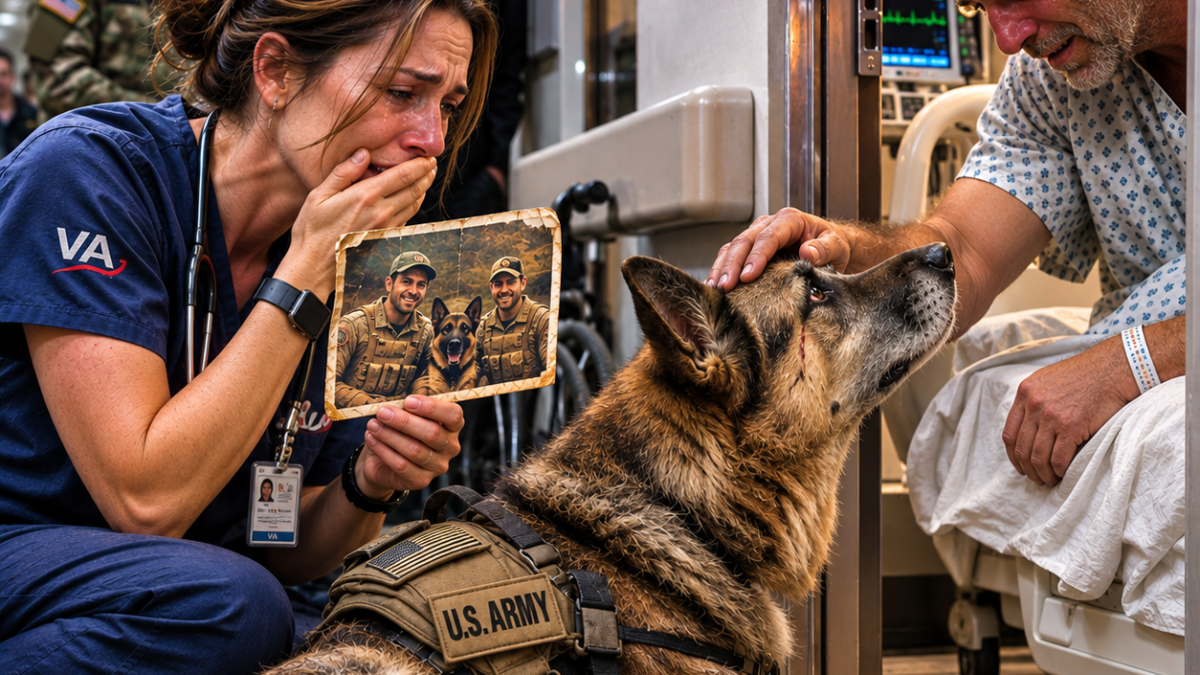
A Retired K9 Sat Outside the Same VA Hospital Room for 11 Nights—Then a Nurse Learned Who Had Been Sleeping Inside.
Every night at exactly 9:40, Ranger slipped away from the veterans’ therapy wing and lay outside Room 214.
The patient inside insisted he had never seen the retired German Shepherd before, and hospital staff assumed the old K9 was simply confused.
Then Nurse Claire Bennett found a deployment photograph showing Ranger, his dead handler, and the wounded medic now lying behind that door.
The first night, nobody thought much of it.
Retired military dogs did strange things when they came to the VA.
Some refused elevators.
Some froze when carts rattled over tile.
Some slept beneath wheelchairs belonging to veterans they had never met.
Others became intensely attached to one hallway, one doorway, one smell.
Ranger had been at the North Missouri Veterans Medical Center for four months as part of a pilot therapy program for former service dogs.
He was eleven years old.
A large sable German Shepherd with a graying muzzle, a scar beneath his right eye, and a stiff left rear leg that dragged slightly when he was tired.
His military records identified him as:
RANGER MWD 4117.
United States Army Military Working Dog.
Explosives detection.
Afghanistan.
Three deployments.
Retired after a spinal injury and loss of his handler.
The handler’s name was Staff Sergeant Caleb Morris.
Killed in Afghanistan eight years earlier.
That was almost everything the hospital knew.
The therapy wing staff knew a few other things.
Ranger hated balloons.
Loved scrambled eggs.
Refused to walk across shiny black floor tiles.
Would carry a tennis ball all day without letting anyone throw it.
And whenever somebody used the phrase “good boy” in a baby voice, he looked personally insulted.
He belonged legally to a veterans’ service organization that had taken custody after his civilian adoptive owner died.
Rather than place him with another private family at his age, they partnered with the VA hospital.
Ranger spent his days visiting veterans in rehabilitation.
He lay beside amputees learning balance.
Sat near men who had not spoken during group therapy.
PART2:
Rested his head on the knees of veterans who woke from nightmares in the middle of afternoon naps.
He never forced himself on anyone.
That was what Nurse Claire Bennett liked most about him.
He waited.
Claire had worked at the VA for thirteen years.
Forty-one years old.
Dark brown hair usually tied beneath a practical clip.
Green eyes.
Comfortable shoes.
Coffee strong enough to remove paint.
She worked evening shift on the rehabilitation and medical step-down floor.
Veterans liked Claire because she did not treat them like inspirational posters.
If someone was angry, she allowed anger.
If they refused to discuss combat, she did not ask again.
If they joked badly, she usually joked worse.
And if a retired German Shepherd decided he wanted to sleep beside the nurses’ station, Claire let him.
On Ranger’s first week, she brought him half a strip of bacon.
Dr. Patel caught her.
“Hospital policy.”
Claire tore the bacon into smaller pieces.
“Now it’s medication.”
“That is not how policy works.”
“Then stop watching.”
PART3:
Ranger liked her after that.
Not enough to follow her everywhere.
But enough that he sometimes leaned his shoulder against her knee when she completed charts.
So when Claire saw him leave the therapy lounge at 9:38 one Monday night, she noticed.
“Ranger?”
The dog did not turn.
He walked down the east corridor.
Past Room 208.
Past 210.
Past the linen closet.
Then stopped outside Room 214.
Claire followed.
“Buddy?”
Ranger circled once.
Lay down.
Placed his head on his paws.
Room 214 belonged to a new patient.
Michael Grant.
Fifty-two.
Former Army combat medic.
Afghanistan and Iraq.
Admitted after surgery related to an old pelvic injury that had deteriorated badly over the years.
Claire had met him earlier that afternoon.
Quiet man.
Gray hair.
Broad shoulders gone thinner with illness.
Old burn scars along his left forearm.
A surgical incision from hip to lower abdomen.
He walked with assistance.
Spoke politely.
Did not invite conversation.
His chart noted chronic pain, multiple previous operations, neuropathy, and a history of insomnia.
Claire knocked.
“Mr. Grant?”
“Yeah?”
She opened the door slightly.
Michael was awake.
Television muted.
Book open but unread on his chest.
“Sorry to bother you.”
“You’re the nurse.”
“Unfortunately.”
He almost smiled.
Claire pointed toward the hall.
“Do you know Ranger?”
Michael’s face changed so slightly most people would have missed it.
Claire did not.
His eyes shifted toward the door.
Then back.
“No.”
“The therapy dog.”
“I know who he is.”
“So you’ve met?”
“No.”
“He’s lying outside your room.”
Michael picked up the book.
“Dogs lie places.”
“That is scientifically accurate.”
He looked at her.
Claire waited.
Nothing.
“All right.”
She closed the door.
Ranger stayed until 11:06.
Then stood.
Walked back to the therapy wing.
No one thought about it again until Tuesday.
9:40 p.m.
Same thing.
Ranger left.
Room 214.
Lay down.
Claire was giving medication in 217 when nursing assistant Tasha Brooks found her.
“Your boyfriend’s back.”
Claire looked at the medication cart.
“Which emotionally unavailable veteran are we discussing?”
“The hairy one.”
“Dr. Patel?”
Tasha laughed.
“Ranger.”
Claire glanced at the clock.
9:43.
She finished medications.
Walked toward 214.
Ranger lay in exactly the same place.
Not against the door.
Three feet away.
Head oriented toward it.
Claire crouched.
“What’s in there?”
Ranger’s ears moved.
Claire tapped the floor.
“Come.”
Nothing.
“Ranger.”
He looked at her.
Then toward the door.
Claire opened it.
Michael was sitting upright this time.
“You again.”
“You’re becoming my favorite patient.”
“Low standards.”
“Your dog is back.”
“Not my dog.”
“Right.”
Michael stared at the doorway.
Claire watched him.
“Do you want him moved?”
“No.”
The answer came quickly.
Then Michael added:
“Doesn’t matter.”
Claire folded her arms.
“He bothers you?”
“No.”
“You’re allergic?”
“No.”
“You dislike dogs?”
“No.”
“Then we’ve exhausted the useful questions.”
Michael’s jaw tightened.
“I told you.”
“I’ve never met him.”
Claire nodded.
“All right.”
She turned to leave.
Michael spoke.
“Does he do this with other rooms?”
“Not that I’ve seen.”
Silence.
Then:
“He’ll stop.”
Claire looked back.
Michael was staring at his hands.
“He probably will,” she said.
Ranger did not.
Wednesday.
9:40.
Thursday.
9:40.
Friday.
9:40.
By the fifth night, everybody on the floor noticed.
Tasha made a chart on the staff whiteboard.
RANGER — ROOM 214.
9:40 Monday.
9:40 Tuesday.
9:39 Wednesday.
9:41 Thursday.
9:40 Friday.
Dr. Patel walked past it.
“This is not clinical documentation.”
Tasha added:
DR. PATEL HAS NO JOY.
He erased both.
Ranger returned anyway.
The strange part was not simply that he chose Michael’s room.
It was the timing.
9:40.
Almost exact.
Every night.
Ranger could be asleep.
Eating.
Sitting with another veteran.
Playing with his tennis ball.
At 9:38 or 9:39, his head would rise.
Then he walked.
Always the same route.
Always Room 214.
Always lay down.
Sometimes until midnight.
Once until 2:17 in the morning.
Michael never invited him inside.
But he never asked anyone to move him.
On the sixth night, Claire tried.
Not because Ranger caused trouble.
Because his stiff hip looked uncomfortable on the tile.
She brought his padded therapy mat.
Placed it beside him.
Ranger stood.
Moved six inches.
Lay on the tile again.
Claire stared.
“Fine.”
She pushed the mat under his front half.
Ranger tolerated that compromise.
Room 214 opened.
Michael stood with his walker.
He looked down.
Ranger immediately lifted his head.
For perhaps three seconds, man and dog stared at each other.
Ranger did not wag.
Did not stand.
Did not whine.
Michael’s hands tightened around the walker grips.
Claire watched.
“You sure you’ve never met?”
Michael looked at her sharply.
“No.”
Ranger slowly placed his head back on his paws.
Michael returned to his room.
Claire stood there.
Something was wrong.
Not medically.
Not exactly.
Recognition had passed between them.
She was sure of it.
The following morning Claire asked the therapy coordinator.
“Any reason Ranger would know Michael Grant?”
Linda Cho opened Ranger’s records.
“Grant?”
“Room 214.”
“Former Army?”
“Medic.”
Linda scrolled.
“Ranger’s handler was Caleb Morris.”
“I know.”
“His deployment records are incomplete.”
“How incomplete?”
“Military dog files are not exactly biographies.”
“Units?”
“Some redacted.”
“Afghanistan?”
“Yes.”
“Years?”
Linda gave her the dates.
Claire wrote them down.
Then compared them with Michael’s service history.
There was overlap.
Two years.
Same region.
That meant almost nothing.
Thousands of service members passed through Afghanistan during those years.
Still.
Claire carried the thought all day.
That evening she asked Michael directly.
He was standing beside the window doing physical therapy exercises alone.
“Were you in Kandahar in 2013?”
Michael stopped.
His expression closed.
“Why?”
“Ranger was.”
“No idea.”
“You were.”
Michael returned to the exercise.
“Lots of people were.”
“Caleb Morris?”
His hand slipped from the rail.
Just once.
Claire saw.
Michael did not look at her.
“You know that name.”
“No.”
“That reaction says yes.”
“I said no.”
Claire lowered her voice.
“I’m not trying to corner you.”
“Then don’t.”
She backed off.
“Okay.”
Michael finished the exercise.
Claire started toward the door.
Then he said:
“Why does it matter?”
She turned.
“Because that dog walks here every night like he has an appointment.”
Michael looked toward the hallway.
“And?”
“And dogs remember.”
His face hardened.
“People like saying that.”
“What?”
“That dogs remember everything.”
“Sometimes they do.”
“Sometimes people just want animals to make their stories cleaner.”
Claire studied him.
“What story are you trying to keep messy?”
Michael’s eyes moved to hers.
“Good night, Nurse Bennett.”
Conversation over.
Night seven.
9:40.
Ranger returned.
Michael kept his door closed.
Ranger stayed outside.
At 10:12, Claire was charting when she heard something.
Not barking.
Whining.
Soft.
One sound.
She walked toward the room.
Ranger sat now.
Ears forward.
Looking at the door.
Inside, something hit the floor.
Claire opened it without knocking.
Michael was on one knee beside the bed.
Walker overturned.
Face pale.
“Don’t.”
Claire moved toward him.
“Sit down.”
“I’m fine.”
“Everybody says that from the floor.”
Ranger stood at the threshold.
Claire helped Michael onto the bed.
His surgical hip had given out.
No new injury.
Pain spike.
She checked vitals.
Medication.
Incision.
Everything stable.
Ranger remained outside.
Michael noticed.
“Why won’t he come in?”
Claire looked toward the dog.
“You’ve never invited him.”
Michael stared.
“Dogs don’t need invitations.”
“Ranger does.”
Michael said nothing.
Claire finished.
Then she walked to the door.
“Ranger.”
The dog looked up.
Claire stepped aside.
“You want to come in?”
Ranger did not move.
Michael watched.
Claire whispered:
“Told you.”
Michael looked at Ranger for a long time.
Then said:
“You can come in.”
Ranger stood.
One step.
Stopped.
His nose lifted.
Then another.
He entered slowly.
Not like a therapy dog greeting a patient.
Like a soldier entering a place he remembered being dangerous.
He walked directly to the side of Michael’s bed.
Stopped.
Michael’s face had gone white.
Ranger smelled his left hand.
Then the scarred forearm.
Then the man’s right hip.
Michael sucked in a breath.
The dog moved around him.
Sniffed again.
Then sat.
Exactly beside Michael’s left knee.
Michael looked down.
His lower lip trembled.
Claire knew then.
“Michael.”
“Leave.”
“No.”
“Please.”
That changed it.
Claire stepped back.
“I’ll be outside.”
She closed the door halfway.
Not fully.
Through the opening, she saw Michael lower one hand.
Ranger did not lean into it.
Did not lick.
He simply let the hand rest between his ears.
Michael whispered something Claire could not hear.
Ranger closed his eyes.
Ten minutes later, Claire returned.
Ranger was back outside.
Michael’s room dark.
The next morning he denied everything.
“I was medicated.”
“You invited him.”
“I don’t remember.”
“Michael.”
“I don’t remember.”
“You touched him.”
No answer.
Claire did not push.
But she stopped believing he had never met Ranger.
On night eight, Ranger did not wait for 9:40.
He became restless at 9:32.
Paced.
Stopped.
Paced again.
At 9:39, he went.
Claire followed from a distance.
Room 214.
Same place.
Michael’s door opened before Ranger lay down.
That surprised Claire.
Michael looked toward the nurses’ station.
Saw her.
Then down at the dog.
“You hungry?”
Ranger stared.
Michael held a small piece of plain chicken from dinner.
Hospital policy probably had opinions.
Claire turned around.
Pretended to inspect a supply cart.
Ranger entered.
Stayed fourteen minutes.
At 10:00, he came back out.
Michael watched him leave.
Claire walked over.
“You know him.”
Michael looked tired.
“Go away, Bennett.”
“Not until you stop lying badly.”
Michael leaned against the doorway.
“Why do you care?”
“Because one of you is waiting outside the other’s room every night, and neither of you will explain why.”
Michael stared toward Ranger disappearing around the corner.
Then closed the door.
Night nine.
Night ten.
Same pattern.
But the wall between them had begun changing.
Michael allowed Ranger inside.
Never more than fifteen minutes.
Never touched him when staff were present.
But Claire noticed his sleep improved.
He used less breakthrough pain medication.
Physical therapy documented better participation.
Once, when another patient asked Michael if the dog was his, he answered:
“No.”
Then after a pause:
“Not anymore.”
That sentence bothered Claire.
Not anymore.
She went to the hospital archive.
Veterans sometimes donated deployment photographs for hallway displays and therapy histories.
There were boxes.
Digital scans.
Unit reunion images.
Memorial ceremony photographs.
The hospital had recently begun organizing them.
Claire searched Caleb Morris.
Nothing.
Ranger.
Nothing.
Military working dogs.
Dozens.
Then she searched Michael Grant’s full name.
A folder appeared.
Uploaded eighteen months earlier by a veterans’ peer-support group.
Claire opened it.
Photographs.
Iraq.
Afghanistan.
Field hospitals.
Medics.
Helicopters.
Dust.
Young men with faces impossible to connect immediately to the gray-haired patients now sleeping upstairs.
She scrolled.
Michael at twenty-nine.
Michael beside a helicopter.
Michael kneeling next to an Afghan child.
Michael carrying medical packs.
Then:
Photograph 47.
Claire stopped.
Three figures.
A German Shepherd.
A soldier.
A medic.
The dog sat center.
Younger.
Dark muzzle.
Same scar not yet present.
A yellow ball near one paw.
Above the dog’s harness:
RANGER.
Beside him stood a tall soldier.
Staff Sergeant Caleb Morris.
Claire recognized him from Ranger’s memorial file.
Arm resting across Ranger’s shoulders.
On the other side:
Michael Grant.
Much younger.
Face lean.
Dust-coated.
Left arm bandaged.
One hand resting on Ranger’s back.
Claire zoomed.
Michael’s hip was wrapped with a field dressing.
Behind the three men stood the damaged shell of a vehicle.
The photo caption:
SSG CALEB MORRIS, MWD RANGER, SGT MICHAEL GRANT — FOB HAWTHORNE, AFGHANISTAN — TWO DAYS AFTER ROUTE 6 IED INCIDENT.
Claire’s pulse changed.
She opened another image.
Same three.
Then another.
Caleb asleep against sandbags.
Ranger curled at his feet.
Michael nearby.
Another caption:
“Doc Grant checking Ranger after blast.”
Claire kept searching.
Then found a scanned handwritten note attached to the folder.
Uploaded by Michael himself.
Claire felt as though she had stepped somewhere private.
She almost closed it.
Then read only enough to understand.
Caleb Morris saved Michael Grant’s life.
Ranger had found the secondary explosive before it detonated.
But not soon enough to prevent the first blast.
Michael had been thrown against a vehicle.
Pelvis fractured.
Caleb dragged him behind cover.
Ranger stayed pressed against Michael’s body while Caleb treated an arterial bleed.
Then came the second attack.
Gunfire.
Mortars.
Chaos.
Caleb was hit.
Michael—already badly injured—crawled to him.
Could not save him.
Ranger remained between the two men.
The evacuation helicopter took Michael first because he was unstable.
Caleb died before the second aircraft arrived.
Ranger survived.
Michael never saw the dog again.
Claire stared at the screen.
Then at one final line from Michael’s note:
“I left with Ranger barking behind me. For eight years I have heard that sound every time I close my eyes.”
Claire sat very still.
9:40.
Why 9:40?
She searched the incident report.
Attack began:
21:31 local.
Evacuation aircraft lifted with Michael:
21:40.
Claire closed her eyes.
Every night at exactly 9:40.
Ranger walked to Michael’s door.
The minute Michael had been taken away.
The minute the dog had watched him leave.
Claire printed nothing.
Copied nothing.
She did not want the photograph becoming hallway gossip.
Instead she asked Linda Cho to come to the archive.
Linda looked at the image.
“Oh my God.”
Claire pointed.
“That’s Ranger.”
“And Michael.”
“Yes.”
Linda read the incident note.
Her eyes filled.
“He knows.”
“He’s been lying.”
“Why?”
Claire already suspected.
“Because he thinks Ranger remembers Caleb.”
“Of course he does.”
“No.”
Claire looked at her.
“I think Michael believes Ranger blames him.”
Night eleven.
9:36.
Claire stood outside Room 214 before Ranger arrived.
Michael noticed.
“Something wrong?”
“I found the photograph.”
Every muscle in his face tightened.
“What photograph?”
“Afghanistan.”
Silence.
“You.”
“Caleb.”
“Ranger.”
Michael looked away.
Claire continued softly.
“Two days after the IED.”
His voice became flat.
“You went through my records?”
“Archive photographs.”
“You had no right.”
“You’re right.”
That stopped him.
Claire did not defend herself.
“I’m sorry.”
Michael looked toward the window.
“Then leave.”
“I also found the incident time.”
Nothing.
“9:40.”
Michael’s eyes closed.
There it was.
Claire whispered:
“That’s when the helicopter left.”
“Yeah.”
“And Ranger was there.”
“Yeah.”
“Michael.”
“Don’t.”
“You think he comes here because of that.”
Michael’s jaw shook.
“I said don’t.”
Claire waited.
Then Ranger’s nails clicked against the hallway floor.
9:40.
The dog appeared around the corner.
Stopped when he saw Claire.
Then Michael.
Michael stared.
Ranger walked forward.
Slow.
Same as every night.
Michael stepped into the hallway.
For the first time.
Not waiting behind the door.
Ranger stopped six feet away.
Michael’s eyes were wet.
“You stupid old dog.”
Ranger’s ears lifted.
Michael’s voice broke.
“You think I don’t know what time it is?”
The dog remained still.
Claire moved backward.
Gave them space.
Michael lowered himself carefully onto a hallway chair.
His injured hip made the movement slow.
Ranger came closer.
Michael looked at him.
“I left him.”
Ranger sat.
“I left Caleb there.”
The dog tilted his head.
“They put me on the bird.”
Michael swallowed hard.
“I told them to take him first.”
His voice rose.
“They wouldn’t.”
Ranger stood.
Michael’s hands began trembling.
“He was alive when they carried me out.”
“I heard you.”
“God, I heard you.”
Ranger stepped between Michael’s knees.
Michael froze.
The dog pressed his head against Michael’s chest.
No hesitation.
Michael made a sound Claire would remember for years.
Not crying exactly.
Something deeper.
The sound of a man finally losing a battle he had fought alone for too long.
His arms went around Ranger.
The dog leaned harder.
Michael buried his face against the gray fur.
“I’m sorry.”
Ranger stood.
“I’m sorry.”
Again.
“I’m sorry.”
Claire watched from halfway down the corridor.
Tasha appeared beside her.
“What happened?”
Claire shook her head.
“Not ours.”
They backed away.
Michael stayed on the floor with Ranger.
After several minutes he whispered:
“I couldn’t save him.”
Ranger licked his chin.
Michael laughed once through tears.
“You always hated crying.”
Ranger licked again.
“All right.”
Michael pressed his forehead against the dog’s.
Then he said something Claire heard only because the hallway had gone silent.
“I thought you were waiting for him.”
Ranger breathed against his chest.
Michael closed his eyes.
“Were you waiting for me?”
The dog’s tail moved.
Once.
Hit the floor.
Michael cried harder.
That was the eleventh night.
Ranger never again lay outside Room 214 at 9:40.
The next evening, at 9:38, Claire watched him carefully.
Ranger woke from the therapy lounge.
Stood.
Walked down the hallway.
But this time Michael’s door was already open.
A blanket had been folded beside the bed.
Water bowl beneath the chair.
Ranger walked directly inside.
At 9:40, Michael scratched behind his ear.
No hallway vigil.
No closed door.
No waiting.
Claire stood at the nurses’ station.
Tasha whispered:
“Guess he finally got invited.”
Claire smiled.
“Looks that way.”
Michael remained in the hospital another three weeks.
During that time, Ranger became unofficially assigned to Room 214.
Michael attended physical therapy with him.
The first session went badly.
Michael’s hip refused to cooperate.
Pain shot down his leg.
He shoved the walker away.
“I’m done.”
Physical therapist Aaron Ruiz said:
“No, you’re angry.”
“I know the difference.”
“Then be angry standing up.”
“Go to hell.”
Aaron nodded toward Ranger.
“Your dog agrees with me.”
“Not my dog.”
Ranger barked once.
Aaron smiled.
“Compelling argument.”
Michael stood again.
Ranger walked beside him.
Three steps.
Five.
Eight.
Rest.
Again.
Over the next two weeks, Michael talked.
Not much.
Enough.
He told Claire what happened in Afghanistan.
Caleb had been twenty-seven.
Funny.
Terrible singer.
Obsessed with cinnamon gum.
Could sleep anywhere except inside aircraft.
He talked to Ranger like the dog understood every word.
Maybe he did.
Michael had been the team medic attached to Caleb’s unit for several missions.
Ranger found explosives.
Caleb trusted the dog more than most people.
Michael once treated Ranger’s paw after broken glass cut the pad.
Ranger tried to bite him.
Caleb laughed for ten minutes.
The Route 6 blast happened near dusk.
Ranger alerted.
They halted.
Then a hidden secondary device detonated from another direction.
Michael remembered airborne dust.
Pain.
Caleb shouting.
Ranger barking.
His pelvis fractured.
Artery damaged.
Caleb stopped the bleeding.
Then the position took fire.
Michael crawled toward Caleb after he was hit.
Tried everything.
Pressure.
Airway.
Medication.
Prayer.
Nothing.
When evacuation came, Michael refused transport.
They overruled him.
Two soldiers lifted him.
Ranger tried following.
Caleb’s body still lay behind cover.
The dog barked.
Michael screamed at the flight crew.
“Take him.”
Nobody knew whether he meant Caleb or Ranger.
The helicopter lifted at 9:40.
Michael never saw either again.
Until Room 214.
After returning home years later, Michael avoided searching Ranger’s fate.
That shocked Claire.
“Why?”
“Because if he died, I didn’t want to know.”
“And if he lived?”
Michael looked at the dog sleeping beside his bed.
“That was worse.”
Claire frowned.
“How?”
“What if he remembered?”
“He did.”
“You know what I mean.”
Claire did.
“What if he remembered you leaving?”
Michael nodded.
“That’s exactly what he remembered.”
Michael stared.
Claire continued:
“He remembered you.”
“Not your guilt.”
“Not your version.”
“You.”
Michael looked toward Ranger.
The dog opened one eye.
Claire said:
“You keep assuming memory is a courtroom.”
Michael gave her a tired look.
“Where’d you get that?”
“Just invented it.”
“It’s annoying.”
“I’m a nurse.”
“It’s required.”
Before discharge, the hospital social worker started asking the obvious question.
Where would Ranger go?
The therapy program had a permanent kennel facility nearby.
Michael had an apartment.
No fenced yard.
Limited mobility.
Ongoing rehabilitation.
Ranger had age-related needs.
Medication.
Joint injections.
A specialized diet.
Nobody wanted sentiment making the decision.
Michael surprised everyone.
“I’m not asking to adopt him.”
Claire blinked.
“You’re not?”
“He’s eleven.”
“So?”
“I’m healing.”
“So?”
“He deserves stability.”
Claire folded her arms.
“You have a point coming eventually?”
Michael ignored her.
“I don’t want to drag him into my life because I feel guilty.”
That answer made Claire respect him.
Linda proposed a trial.
Ranger would remain legally with the veterans’ organization.
Michael could become his primary foster.
Hospital therapy visits continued two days a week.
Support group staff helped with transportation.
Veterinary care remained covered.
Apartment management approved the dog.
Michael agreed.
Then asked Ranger.
He sat on the edge of his hospital bed.
“Want to come home?”
Ranger stared.
Michael held up the tennis ball.
The dog took it.
“Guess that’s contractual.”
Discharge day was cold.
November rain.
Claire walked Michael to the front lobby.
Ranger beside him.
Walker in front.
Tasha carried medications.
Aaron carried nothing because Michael refused help with his bag.
At the doors, Michael stopped.
Looked back.
“What?”
Claire asked.
“Room 214.”
“Going to miss it?”
“Absolutely not.”
Ranger looked toward the elevators.
Michael’s expression changed.
“I spent eleven nights thinking he was waiting for a dead man.”
Claire said:
“He was.”
Michael looked at her.
“And you.”
Both could be true.
Michael nodded.
Outside, a volunteer van waited.
Ranger stepped toward it.
Then stopped.
Looked back at Michael.
Michael limped forward.
“I’m coming.”
Only then did Ranger get in.
The first weeks were not easy.
Michael’s apartment had polished black tiles in the lobby.
Ranger refused them.
Michael stood there fifteen minutes the first day.
“Seriously?”
Ranger sat.
Michael asked the desk clerk:
“Got cardboard?”
They created a path.
The building manager complained.
Then saw Michael struggling with the walker and Ranger refusing to abandon him.
Cardboard stayed three weeks.
Ranger hated the elevator at first.
Michael hated stairs.
Compromise required practice.
Food schedule.
Medication.
Slow walks.
Physical therapy for both.
Michael joked that they were two broken military retirees supervised by nobody competent.
Claire visited once with hospital paperwork.
She found Michael sitting on the floor beside Ranger’s bed.
“Can’t get up?”
“I can.”
“Then why are you down there?”
“Dog wanted company.”
Ranger was asleep.
“He looks devastated by loneliness.”
“Leave.”
Michael began attending a veterans’ peer group again.
He had avoided it for years.
Ranger came.
The first meeting Michael sat nearest the door.
Said nothing.
Second meeting:
Nothing.
Third:
“My name’s Mike.”
Progress.
A Vietnam veteran named Earl looked at Ranger.
“Dog got a name?”
Michael replied:
“Ranger.”
Earl nodded.
“Looks smarter than you.”
“Almost everybody is.”
That helped.
Eventually Michael told the group about Caleb.
Not all at once.
Pieces.
One week:
The blast.
Another:
The helicopter.
Another:
9:40.
When he finally said:
“I thought surviving meant I had abandoned him,”
Earl answered:
“Surviving and abandoning ain’t synonyms.”
Michael stared at him.
Earl shrugged.
“Dictionary’s free.”
Ranger slept through the entire exchange.
Six months later, Michael returned to the VA for a follow-up.
Walking with a cane.
No walker.
Ranger beside him.
Claire was charting.
She looked up.
“Well.”
Michael spread his arms.
“Try not to cry.”
“I’m assessing how much weight the dog gained.”
“You’re terrible.”
Ranger walked behind the desk.
Put his head against Claire’s knee.
“See?”
Claire scratched his ears.
“He remembers who actually helped him.”
Michael sat.
At 9:37, Claire noticed the clock.
She looked at Michael.
He had noticed too.
Neither said anything.
9:38.
Ranger slept.
9:39.
Still sleeping.
Then:
9:40.
Ranger opened his eyes.
Michael stopped breathing.
The dog stood.
Claire watched.
Ranger walked toward the east hallway.
Michael’s face changed.
Claire followed.
They passed 208.
Ranger stopped outside 214.
The room was empty.
Michael stood behind him.
Cane trembling slightly.
Ranger looked at the closed door.
Then back at Michael.
Michael whispered:
“Hey.”
Ranger approached.
Michael crouched as far as his hip allowed.
“It’s okay.”
Ranger pressed his head beneath Michael’s hand.
Michael swallowed.
“We both made it.”
The dog’s tail moved once.
Then he turned away from Room 214.
Walked back toward the lobby.
Michael remained kneeling for several seconds.
Claire stayed beside him.
Finally Michael said:
“Think that was goodbye?”
Claire looked toward Ranger.
“No.”
“What then?”
“I think he was checking.”
“For what?”
“That nobody was still waiting.”
Michael laughed softly.
“Annoying nurse answer.”
“Still good.”
They went home.
Ranger lived another two years.
Not long enough.
Never long enough.
His hind legs weakened gradually.
He stopped climbing into Michael’s truck without a ramp.
Stopped carrying the tennis ball all day.
Started sleeping more.
Michael’s hip improved while Ranger’s failed.
There was something unfair about that exchange.
Michael became the one waiting.
Vet appointments.
Joint injections.
Medication changes.
Good days.
Bad days.
On Ranger’s final morning, he refused breakfast.
Michael knew.
The veterinarian came to the apartment.
No clinic.
No stainless table.
Ranger lay on his favorite blanket near the balcony door.
Morning sunlight across his paws.
Michael sat on the floor.
The veteran who once believed the dog came back to judge him now held the old Shepherd’s head in his lap.
“You found me twice.”
Ranger breathed slowly.
“Once out there.”
“Once in 214.”
Michael rubbed the scar beneath Ranger’s eye.
“I don’t know what you were waiting for.”
His voice broke.
“But I’m glad you waited.”
The vet gave the first medication.
Ranger relaxed.
Michael leaned close.
“Go find Caleb.”
He paused.
Then corrected himself.
“No.”
His eyes filled.
“You don’t have to find anybody.”
“You did enough.”
Ranger’s breathing slowed.
Stopped.
Michael remained there a long time.
At 9:40 that evening, he sat alone.
No dog walking down a hospital corridor.
No nails clicking against tile.
No body outside a closed door.
Michael placed Ranger’s old tennis ball beside the deployment photograph.
The photograph Claire had found.
Three figures.
Caleb.
Ranger.
Michael.
For years, Michael looked at that image and saw only the person who did not come home.
Now he saw something different.
Three lives touching at one moment.
One ended in Afghanistan.
One returned through a VA hallway eight years later.
One had spent too long believing survival was a crime.
Michael finally understood what Ranger had been doing outside Room 214.
The dog had not been standing guard over a stranger.
He had not been confused.
He had not mistaken Michael for Caleb.
He was doing what military working dogs are trained to do when somebody from their team is wounded.
Stay.
Watch.
Wait.
For eleven nights, Michael had kept the door closed because he believed Ranger had come looking for the man he failed to save.
Ranger kept returning because the man he remembered was already inside.
Years later, Claire still kept a copy of the deployment photograph in a private staff album dedicated to veterans and service animals who changed the hospital.
Below it she wrote only the facts:
Staff Sergeant Caleb Morris.
Sergeant Michael Grant.
MWD Ranger 4117.
Afghanistan.
And beneath those names:
9:40 p.m.
Eleven nights.
Nobody unfamiliar with the story understood why the time mattered.
Claire preferred it that way.
Some memories did not need to become public lessons.
Sometimes they simply needed a door left open.
Because Ranger had spent eight years carrying a memory that Michael misunderstood.
And when they finally met again, the old German Shepherd did not demand an explanation.
He did not ask why Michael had left.
He did not care who survived, who failed, who should have done more, or which man deserved to come home.
He walked to Room 214.
Lay outside.
And waited.
Night after night.
Until the wounded medic behind that door finally understood that he had never been abandoned by the dog.
And, more importantly, that surviving had never meant he abandoned anyone either.








