A Retired K9 Rejected Every Adoption Family for 8 Months—Then a 9-Year-Old Girl Raised a Silent Hand Signal No Civilian Should Have Known
A Retired K9 Rejected Every Adoption Family for 8 Months—Then a 9-Year-Old Girl Raised a Silent Hand Signal No Civilian Should Have Known
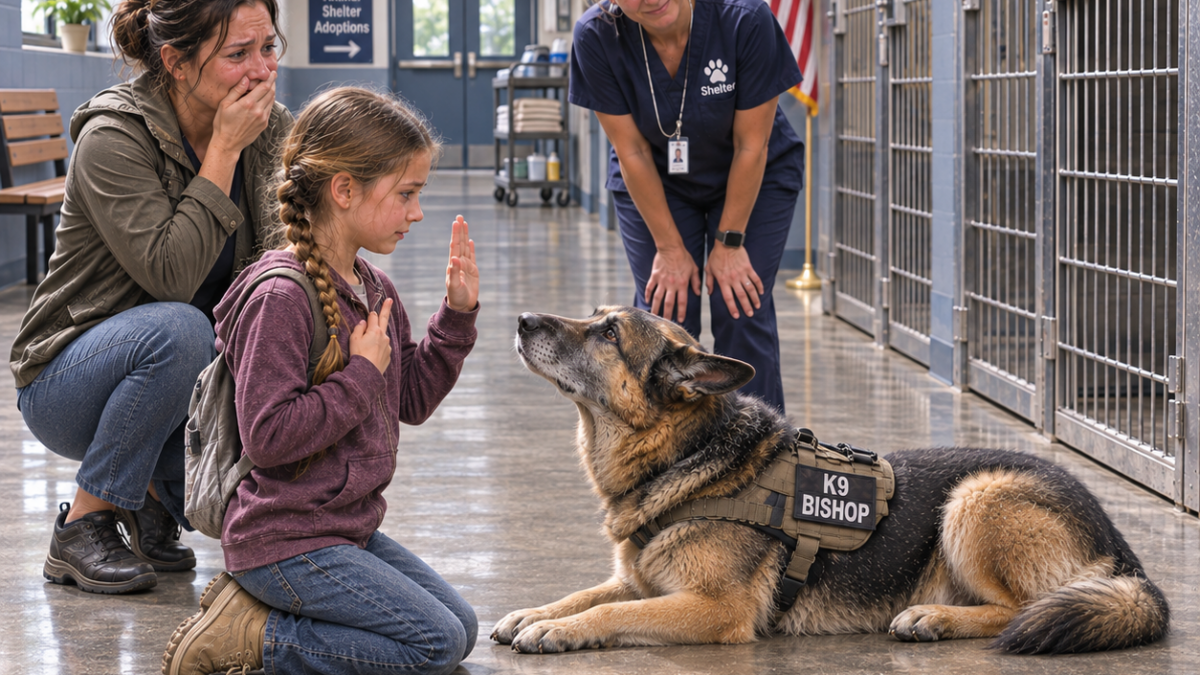
For eight months, Bishop walked away from every veteran, police officer, trainer, and family who entered his adoption room, but when nine-year-old Emma Lawson silently raised her palm and curled two fingers toward her chest, the retired military K9 crossed the floor and pressed his entire body against her leg.
Emma’s mother went pale when the kennel master asked who had taught a civilian child a hand signal that had never appeared in Bishop’s current training file, because the answer was Staff Sergeant Caleb Lawson—a convicted former handler whose name had been erased from the dog’s official history.
Then the retired general who chaired the sanctuary board saw Emma’s hand, ordered the family removed immediately, and called her father a disgrace in front of the entire adoption room—without realizing Bishop had just recognized the one person who could reopen a story the Army had buried for nearly five years.
Bishop rejected Family Thirty-Seven at 10:16 on a Saturday morning.
He did it politely.
That was what made the situation almost funny.
The retired Belgian Malinois did not bark.
He did not growl.
He did not flatten his ears or show his teeth.
He simply looked at the Patterson family—father, mother, fifteen-year-old son, twelve-year-old daughter—stood up from the gray rug in the center of the adoption room, and walked to the opposite wall.
Then he sat with his back toward them.
Mason Hale closed his eyes.
Mrs. Patterson lowered the tennis ball she had been holding.
“Did we do something wrong?”
“No, ma’am.”
Mason tried to sound reassuring.
“He does this.”
Mr. Patterson laughed nervously.
“To everybody?”
“Pretty much.”
Their son crouched.
“Bishop.”
The dog looked over one shoulder.
The teenager patted his thigh.
“Come on, buddy.”
Bishop looked away again.
Mason rubbed the bridge of his nose.
Eight months.
Thirty-seven families.
Three retired police officers.
Five combat veterans.
Two active-duty dog handlers.
One veterinarian.
One state trooper.
Several families with large fenced properties.
PART2:
One ranch owner who owned twenty-seven acres and had once handled patrol dogs.
Bishop wanted none of them.
At first, Mason had considered it funny.
Then challenging.
Then concerning.
Now it had become personal.
Second Watch Military Working Dog Sanctuary sat on forty-two wooded acres outside Fredericksburg, Virginia.
The nonprofit specialized in retired military and law-enforcement dogs who needed more time than ordinary adoption programs could provide.
Some had medical issues.
Some had behavioral scars.
Some had simply spent so long working that nobody had ever taught them how to be pets.
Bishop was supposed to be easy.
Ten years old.
Good physical condition.
Mild arthritis.
No bite incidents outside approved training.
House-trained.
Vehicle-trained.
Neutral around other dogs.
Patient with children under supervision.
Excellent obedience.
PART3;
He had retired eight months earlier after a long military career and been transferred to Second Watch because no former handler had claimed him.
That alone had bothered Mason.
Working dogs usually had histories.
People.
Names.
Bishop’s paperwork looked like somebody had taken scissors to a life.
His official file began six years earlier.
Handler: Staff Sergeant Owen Pike.
Before that:
PRIOR ASSIGNMENT — RECORDS NOT AVAILABLE.
Mason had requested the earlier history twice.
Both requests returned the same answer.
Archived operational records unavailable.
Bishop himself seemed healthy.
He ate.
Played occasionally.
Loved riding in trucks.
Hated vacuum cleaners.
Slept upside down with all four paws against the wall.
He allowed Mason to trim his nails, which made him more cooperative than half the humans Mason knew.
But adoption meetings changed him.
Families entered.
Bishop became distant.
He would sniff them.
Sometimes accept a treat.
Then turn away.
Never fear.
Never hostility.
Rejection.
As if he were waiting for someone specific and every new face merely confirmed that person had not arrived.
Mason walked the Pattersons to the lobby.
“Don’t take it personally.”
Mrs. Patterson smiled sadly.
“He’s beautiful.”
“He knows.”
Her daughter looked back through the glass.
Bishop remained in the far corner.
“Will somebody adopt him?”
Mason followed her gaze.
“That’s the plan.”
The girl frowned.
“Does he know that?”
Mason almost laughed.
“I’m starting to wonder.”
The Pattersons left.
Mason returned to the meeting room.
Bishop looked up.
“You are destroying my success rate.”
The Malinois yawned.
Mason sat in the chair opposite him.
“You know what happens if you keep this up?”
Bishop placed his chin on his paws.
“Nothing terrible.”
Mason pointed at him.
“Don’t make that face.”
Bishop closed his eyes.
“You get to stay here, eat my expensive food, steal my office chair, and make me explain to donors why our most adoptable dog refuses adoption.”
One ear moved.
Mason sighed.
“Maybe that’s your plan.”
The sanctuary’s adoption coordinator, Nora Callahan, appeared at the doorway.
“Your eleven o’clock is early.”
Mason groaned.
“Who?”
Nora looked at her clipboard.
“Mara Lawson. One child. Nine years old.”
“Veteran household?”
“No.”
“Police?”
“No.”
“Dog experience?”
“Family had a German Shepherd years ago.”
“Yard?”
“Fenced.”
“Why Bishop?”
Nora hesitated.
“They didn’t request Bishop.”
Mason looked up.
“What?”
“They applied for Walter.”
Walter was a retired Labrador whose greatest operational challenge now involved locating unattended sandwiches.
“Then why are they meeting Bishop?”
“They aren’t.”
Nora nodded toward the hallway.
“The daughter saw him through the glass.”
Mason stood.
Through the interior viewing window, a little girl stood in the corridor.
Thin.
Dark-blonde hair pulled into a loose ponytail.
Blue jeans.
Gray sweatshirt with a faded school logo.
Beside her stood a woman in her mid-thirties wearing a tan coat and holding an adoption folder against her chest.
The mother was speaking with a volunteer.
The girl was not listening.
She was staring at Bishop.
Bishop was staring back.
Mason frowned.
That alone was unusual.
Most children immediately talked to dogs.
Tapped glass.
Waved.
Smiled.
This girl simply watched.
Then she did something strange.
She lifted her right hand.
Palm facing Bishop.
Held it steady.
Then slowly curled her middle and ring fingers toward her chest.
Mason stopped breathing.
Bishop stood.
Not slowly.
Not arthritically.
Instantly.
His ears snapped forward.
His mouth closed.
The girl repeated the gesture.
Palm.
Two fingers folding inward.
Bishop crossed the room.
Straight to the glass.
He sat.
Perfect heel position on the other side of where the girl stood.
Mason felt his pulse jump.
“No.”
Nora looked at him.
“What?”
“That signal.”
“What about it?”
Mason opened the meeting-room door.
Bishop moved toward the girl before Mason could attach a leash.
“Bishop.”
The dog ignored him.
The little girl stood still.
Her mother turned.
“Emma?”
Bishop walked directly to her.
Mara Lawson stepped between them instinctively.
“Wait.”
Mason raised both hands.
“He’s safe.”
But Bishop did not approach the mother.
He went around her.
Stopped beside Emma.
Then pressed his shoulder against the child’s left leg.
Hard.
Emma’s hand dropped onto his neck.
Bishop closed his eyes.
The entire hallway became quiet.
Nora whispered, “He’s never done that.”
Mason knew.
Bishop had not leaned against any adoption candidate.
Had barely allowed most to touch him.
Emma slowly scratched beneath his collar.
“Hi, Bish.”
Mason looked at her sharply.
“What did you call him?”
Emma looked up.
“Bish.”
Her mother’s face changed.
“Emma.”
“What?”
Mason crouched.
“Have you met this dog before?”
Emma shook her head.
“No.”
“Then how do you know that nickname?”
The girl looked confused.
“My dad called him that.”
Mara Lawson closed her eyes.
Mason stood.
“Your dad knew Bishop?”
Mara stepped forward.
“We should go.”
Emma looked up.
“But Mom—”
“Now.”
Bishop’s eyes opened.
He pressed closer to Emma.
Mason said, “Mrs. Lawson.”
“Mara.”
“Who taught her that hand signal?”
Mara gripped the folder more tightly.
“It doesn’t matter.”
“It matters to me.”
“Why?”
“Because I handled military dogs for twelve years.”
Mara went still.
“That signal isn’t part of Bishop’s current command sheet.”
She said nothing.
“It’s not standard obedience.”
No response.
“It’s a handler-specific silent recall.”
Mara looked at Bishop.
Mason continued.
“And this dog recognized it instantly.”
Emma said quietly, “Dad called it home.”
Mara turned.
“Emma.”
“He did.”
“I know.”
“Then why—”
Mara put a hand on her daughter’s shoulder.
“Not here.”
Mason asked, “What’s your husband’s name?”
Mara’s jaw tightened.
“Caleb Lawson.”
Mason knew the name.
Not immediately.
It hit him a second later.
A court-martial.
Military newspaper.
Explosives theft.
Staff Sergeant Caleb Lawson.
Former military working dog handler.
Sentenced to seven years at Fort Leavenworth.
Dishonorable discharge.
Convicted of stealing controlled explosive components, obstructing an investigation, and disobeying orders during an overseas deployment.
Mason stared.
“No.”
Mara’s face hardened because she recognized his expression.
“There it is.”
“What?”
“That look.”
“I didn’t—”
“Yes, you did.”
Emma looked between them.
Mara took her daughter’s hand.
“We came for the Labrador.”
“Wait.”
“No.”
“Mrs. Lawson—”
“I said we’re leaving.”
Bishop stood.
Emma moved one step.
Bishop moved with her.
Mason caught his collar gently.
“Bishop.”
The dog resisted.
Emma turned.
Her face crumpled.
“Mom.”
“We’re going.”
“But he knows Dad.”
The sentence stopped Mara.
Not Mason.
Not Nora.
Mara.
She looked at her daughter.
Emma had tears in her eyes.
“He knows him.”
Mara’s face softened for one second.
Then hardened again because sometimes anger was the only thing keeping grief upright.
“We don’t know that.”
Emma raised her hand.
Gave the same signal.
Bishop immediately disengaged from Mason.
Crossed to her.
Sat against her leg.
Emma looked at her mother.
“He knows.”
Mara’s eyes filled.
Before she could answer, another voice came from the lobby.
“What is she doing?”
Every adult in the hallway froze.
Retired Brigadier General Everett Shaw stood near the entrance.
Sixty-four.
Tall.
Silver-haired.
Expensive navy suit.
American flag pin.
The kind of military bearing some men never removed even after retirement.
Shaw chaired Second Watch’s advisory board.
He was also the sanctuary’s largest individual donor.
Mason respected him.
Or had.
Shaw had commanded logistics and security elements overseas.
He spoke nationally about veterans’ leadership.
He had personally helped the sanctuary secure two federal grants.
Now he was staring at Emma’s hand.
Not curiously.
Fearfully.
Mara saw him.
Her face drained.
Shaw saw her.
His expression changed.
“Mrs. Lawson.”
Mason looked between them.
“You know each other.”
Mara said nothing.
Shaw walked closer.
“What are you doing here?”
Mara’s posture stiffened.
“Adopting a dog.”
“No.”
One word.
Flat.
Mason frowned.
“General?”
Shaw ignored him.
His eyes went to Bishop.
Then Emma.
“Where did the girl learn that signal?”
Emma moved closer to her mother.
Mara answered.
“Her father.”
Shaw’s jaw tightened.
“That command should never have been taught outside the program.”
Mason stared.
“So you recognize it.”
Shaw looked at him.
“Of course.”
“From where?”
“It was used by a former handler.”
Mason’s voice sharpened.
“Caleb Lawson.”
Shaw said nothing.
Mara laughed bitterly.
“There.”
She looked at Mason.
“Now you know.”
Mason looked at Bishop’s file room down the hall.
“Caleb isn’t listed anywhere in Bishop’s records.”
“No.”
Mara’s voice hardened.
“He isn’t.”
Shaw turned toward Nora.
“End this meeting.”
Nora blinked.
“What?”
“This family is not suitable for Bishop.”
Mason stepped forward.
“We haven’t evaluated that.”
“I just did.”
“You don’t run adoptions.”
“I chair the board.”
“You still don’t run adoptions.”
Shaw’s expression cooled.
“Mason.”
“No.”
Mason looked at Bishop.
“He’s rejected thirty-seven families.”
Then at Emma.
“He chose her in thirty seconds.”
Shaw’s face hardened.
“Dogs do not choose legal custodians.”
“Good thing I didn’t say they did.”
Mara said, “We’re leaving.”
Shaw turned toward her.
“That would be best.”
Emma looked up.
“Why?”
Nobody answered.
“Why can’t we have him?”
Mara closed her eyes.
“Emma.”
The child looked at Shaw.
“Did you know my dad?”
Shaw’s expression remained still.
“Yes.”
“Was Bishop his dog?”
Mara whispered, “Baby.”
Shaw answered.
“For a period.”
Mason felt anger begin to rise.
“How long?”
Shaw ignored him.
Emma asked, “Did Dad hurt him?”
Shaw’s face shifted.
“No.”
“Then why did you take him away?”
Mara took Emma by the shoulders.
“That’s enough.”
But Shaw answered anyway.
“Your father made serious mistakes.”
Mara looked up.
“Don’t.”
“He violated orders.”
“Not in front of her.”
“He stole controlled military material.”
Mason stepped between them.
“General.”
Shaw’s voice grew louder.
“His actions endangered soldiers.”
People in the lobby began looking over.
Other adoption families.
Volunteers.
Veterans.
Mara’s face burned red.
“You have said enough.”
Shaw pointed toward Bishop.
“That dog should never be placed with the family of the man who compromised his unit.”
Bishop growled.
Deep.
Every conversation stopped.
Shaw took one step back.
Emma immediately raised her palm.
Two fingers inward.
Bishop stopped.
He moved beside her.
Sat.
Then shifted his body between Emma and Shaw.
Protective.
Not attack posture.
Shielding.
Mason felt the entire world narrow to that dog.
Shaw saw it too.
For the first time, the retired general looked genuinely shaken.
Emma placed her hand on Bishop’s shoulder.
“He doesn’t think Dad was bad.”
Nobody laughed.
Nobody moved.
Mara’s eyes filled.
She took Emma’s hand.
“We’re going home.”
Mason let them leave.
But he watched Bishop.
The dog remained at the lobby door long after Mara’s car disappeared.
Then he turned.
Walked back into the adoption room.
And for the first time in eight months, refused dinner.
That evening Mason pulled Bishop’s file.
Again.
Every page.
Veterinary.
Training.
Transfer.
Deployment summaries.
Handler assignment.
Staff Sergeant Owen Pike.
Then Sergeant Marcus Bell.
Then retirement.
Nothing before Pike.
No Caleb Lawson.
Mason searched archived kennel records through databases he still had legitimate access to from his former service.
Caleb appeared.
Military occupational specialty.
Working dog handler.
Deployments.
Awards.
Court-martial.
But Bishop did not.
Mason searched Bishop’s microchip number.
Nothing before the year Pike took him.
That was impossible.
Military working dogs did not suddenly appear at age four with no prior medical history.
Nora entered his office around nine.
“You’re digging.”
“Yes.”
“Shaw called.”
Mason did not look up.
“What did he want?”
“He said the Lawsons are permanently disqualified from all sanctuary adoptions.”
Mason stopped typing.
“He said what?”
“He also wants Bishop’s file transferred to board counsel.”
“Why?”
“Risk review.”
Mason leaned back.
“He got scared by a nine-year-old girl’s hand.”
Nora shut the door.
“I noticed.”
Mason turned the monitor toward her.
“Bishop’s microchip history starts six years ago.”
“That’s weird.”
“It’s impossible.”
“Records get lost.”
“Not every vaccine.”
Nora sat.
“You think Caleb Lawson was his first handler.”
“I know he was.”
“How?”
“Bishop told us.”
She gave him a look.
“You know what I mean.”
“I do.”
Mason tapped the screen.
“Why erase a handler?”
“Court-martial?”
“Even convicted handlers remain in working-dog history.”
Nora folded her arms.
“Unless somebody didn’t want people looking backward.”
Mason looked at her.
“Exactly.”
He called Owen Pike the next morning.
Retired Staff Sergeant Owen Pike lived in Wyoming and trained ranch dogs.
The phone rang four times.
“Pike.”
“Staff Sergeant Mason Hale, retired. Second Watch MWD Sanctuary.”
“Okay.”
“You handled Bishop.”
Silence.
Mason knew immediately.
“Mr. Pike?”
“Where did you get that dog?”
“Transferred to us after retirement.”
“Is he alive?”
“Yes.”
Pike breathed out.
“Damn.”
Mason frowned.
“You thought he died?”
“No.”
Pause.
“I stopped asking.”
“Why?”
“Who gave you my number?”
“Personnel directory.”
Another silence.
Mason went directly.
“Did Caleb Lawson handle Bishop before you?”
Nothing.
“Owen.”
Pike’s voice lowered.
“You need to leave that alone.”
“That’s the second time someone told me that in twenty-four hours.”
“Who was first?”
“Everett Shaw.”
Pike swore.
Mason sat straighter.
“So now we’re talking.”
“No.”
“Bishop recognized Lawson’s daughter yesterday.”
Silence.
“What?”
“Nine years old. Gave him a silent recall.”
Pike breathed heavily.
“Palm out?”
“Two fingers inward.”
“Jesus.”
“You know it.”
“Caleb made it.”
“What did it mean?”
“Come home.”
Mason closed his eyes.
Emma had used the exact name.
“How long did Caleb handle Bishop?”
“Almost three years.”
“Why is he gone from the file?”
“I don’t know.”
“Bullshit.”
Pike was quiet.
Mason waited.
Eventually Pike said, “When Bishop was reassigned to me, I received two packets.”
“Two?”
“First had full handler history.”
“Caleb?”
“Yes.”
“Second?”
“Arrived three days later.”
“Caleb removed.”
“Yes.”
“Who ordered that?”
“Command.”
“Name.”
“No.”
“Name.”
Pike sighed.
“Colonel Everett Shaw.”
Mason’s jaw tightened.
“What reason?”
“Operational compartmentalization.”
“Did you believe it?”
“I was twenty-nine and wanted my next promotion.”
Mason said nothing.
Pike continued.
“I believed whatever kept my name off a problem.”
“Did Bishop have behavior issues?”
“For six months.”
“What kind?”
“Wouldn’t bond.”
Mason looked through the office window.
Bishop lay facing the entrance.
“Sound familiar.”
Pike gave a bitter laugh.
“He waited beside the vehicle gate every afternoon.”
“For Caleb.”
“Yes.”
“Did you know what happened to him?”
“Court-martial.”
“Did you testify?”
“No.”
“Were you asked?”
“No.”
“Why not?”
“I inherited the dog two weeks before Caleb was arrested.”
Mason frowned.
“Before?”
“Yes.”
“Why remove Bishop before arrest?”
Pike went quiet.
“Owen.”
“They said veterinary reassignment.”
“For what?”
“Bishop had alerted on a contractor cargo truck.”
Mason felt something cold settle in his stomach.
“What kind of alert?”
“Explosive odor.”
“Was there supposed to be explosive material?”
“No.”
“What happened?”
“Caleb reported it.”
“To?”
“Shaw.”
“And then Bishop was removed.”
“Forty-eight hours later.”
Mason stood.
“What was in the truck?”
“I never found out.”
“What happened to Caleb?”
“You know the official version.”
“I want yours.”
Pike sighed.
“Caleb started saying inventory was disappearing.”
“Explosives.”
“Yes.”
“He claimed training material marked expended was turning up in contractor shipments.”
“Did you believe him?”
“I thought he was obsessed.”
“Why?”
“Because that’s what everyone said.”
The sentence hung there.
Mason hated it.
“What did Caleb say?”
“That somebody was using training losses to hide diversion.”
“Who?”
“He never told me.”
“Did he ever mention Shaw?”
Pike’s silence answered.
Mason said, “Did he?”
“Yes.”
Mason walked slowly across the office.
“Any records?”
Pike hesitated.
“I kept one thing.”
“What?”
“Original training log.”
Mason stopped.
“Why?”
“Because I was told to destroy it.”
“Then why didn’t you?”
Pike laughed without humor.
“Cowardice has limits.”
He emailed scanned pages an hour later.
Bishop’s original name.
Military Working Dog Bishop.
Handler:
SSG Caleb Lawson.
The pages covered nearly three years.
Explosive detection scores.
Patrol drills.
Deployment notes.
Medical visits.
And handwritten training additions.
One entry:
NONVERBAL RECALL — “HOME” — PALM OUT, FOLD MIDDLE/RING FINGERS INWARD.
Nora stared.
“Emma did it exactly.”
Mason nodded.
Another entry:
Used for long-distance silent recovery in high-noise environments.
Under handler notes:
Bishop responds to Lawson family members after controlled familiarization.
Nora looked at Mason.
“Family members?”
Mason read further.
Training note dated four years earlier:
Dependent familiarization demonstration conducted during family day. Child present.
Emma.
She would have been five.
Mason called Mara.
She did not answer.
He called again.
Nothing.
He left one voicemail.
“Mrs. Lawson, I owe you an apology. Bishop’s original records list Caleb as his handler. I need to show you something.”
She called back eleven minutes later.
“Do not involve Emma.”
“I won’t.”
“Whatever you found, you talk to me.”
“Agreed.”
She arrived alone that afternoon.
No coat despite freezing rain.
She sat across from Mason.
He put the training log in front of her.
She did not touch it.
“Where did you get this?”
“Bishop’s next handler.”
Mara stared at Caleb’s name.
Her face changed.
“I haven’t seen this in years.”
“You knew.”
“Of course I knew.”
“I meant about the signal.”
She nodded.
“Caleb taught Emma.”
“Why?”
“Because Emma wanted to help.”
Mara smiled faintly despite herself.
“She was four and thought Bishop was her dog.”
“Did Bishop live with you?”
“Sometimes. Approved home integration weekends.”
“That’s why he knew her.”
Mara shook her head.
“She was tiny.”
“Dogs remember.”
“I know that now.”
Mason hesitated.
“Do you visit Caleb?”
Her smile vanished.
“Twice a month.”
“Leavenworth?”
“Yes.”
“How long has he been there?”
“Four years, three months.”
“Sentence seven?”
“Yes.”
“You believe he did it?”
Mara looked at him.
“That’s a cruel question.”
“I’m sorry.”
“No.”
She leaned back.
“You’re allowed to ask.”
Then:
“I don’t know.”
Mason had expected certainty.
Her answer surprised him.
Mara looked toward the kennel window.
“For the first year, I believed him completely.”
“What changed?”
“He stopped explaining.”
“Why?”
“He said explaining put us in danger.”
“Did you believe that?”
“At first.”
“And later?”
She laughed bitterly.
“You try raising a daughter alone while your husband is in military prison telling you he can’t tell you why he supposedly stole explosives.”
Mason said nothing.
“I lost our house.”
Her voice hardened.
“Friends stopped calling.”
“Parents at Emma’s school Googled Caleb’s name.”
“One mother asked whether I thought it was safe for Emma to attend a birthday party because Caleb had ‘terrorist materials.’”
Mason’s jaw tightened.
“The newspaper called him a disgraced soldier.”
“He pleaded guilty.”
“Yes.”
“To what exactly?”
“Theft of controlled explosive components. Unauthorized retention of classified logistics data. Obstruction.”
“Why plead?”
“His attorney said he faced up to twenty-two years if convicted at trial.”
“And Caleb?”
“He told me seven years was better than risking twenty.”
“Did he admit to you he stole anything?”
“No.”
“Did he tell you someone framed him?”
“Yes.”
“Who?”
Mara looked down.
“Everett Shaw.”
There it was.
Mason asked, “What did Caleb say happened?”
Mara was silent for a long time.
Then:
“He said Bishop alerted on a contractor truck.”
Mason nodded.
She looked up.
“You know that.”
“Yes.”
“Then maybe Owen finally grew a spine.”
Mason did not defend Pike.
Mara continued.
“Caleb inspected the cargo after the alert.”
“Authorized?”
“He said he had probable safety grounds.”
“What did he find?”
“Two sealed cases marked as spent training equipment.”
“And?”
“They smelled wrong.”
“Bishop?”
“Yes.”
“Caleb opened them?”
“One.”
“What was inside?”
“Detonators. Cord. Explosive blocks.”
“Live?”
“He said so.”
“Manifest?”
“None.”
“What happened?”
“He photographed serials.”
“Reported them.”
“Yes.”
“To Shaw.”
“What did Shaw say?”
“That it was part of a classified redistribution program.”
“Was it?”
“Caleb checked with EOD.”
“And?”
“No.”
Mason leaned forward.
“Then what?”
“Bishop was reassigned.”
“Then?”
“Caleb started collecting records.”
“How?”
“Inventory logs. Training expenditures. Vehicle movements.”
“Did he bring anything home?”
Mara hesitated.
“One envelope.”
“What happened to it?”
“I never opened it.”
“Why?”
“He told me not to.”
“Where is it?”
“Gone.”
“How?”
“CID searched the house after his arrest.”
“Did they list it?”
“No.”
Mason felt his pulse rise.
“Anything else?”
Mara looked exhausted.
“Three weeks later, they found military explosives in Caleb’s truck.”
“Same type?”
“Yes.”
“Serials?”
“They said some matched missing inventory.”
“Caleb’s explanation?”
“He said someone planted them.”
“Evidence?”
“None.”
“What about Bishop’s alert?”
“Not mentioned in court.”
“Why?”
“Caleb’s attorney said the dog’s records didn’t support it.”
Mason slid the original training log toward her.
Mara stared.
Her eyes filled.
“They erased him.”
“Yes.”
She covered her mouth.
For several seconds, she said nothing.
Then:
“Caleb told me.”
Mason waited.
“He said they were changing the records.”
Her voice broke.
“I thought prison was making him paranoid.”
“That doesn’t make you a bad wife.”
“Don’t.”
Mason stopped.
She wiped her face.
“I stopped bringing Emma to visits for six months.”
“Why?”
“Because Caleb would tell her things like, ‘Remember Bishop knows how to come home.’”
She laughed through tears.
“I thought he was filling her head with hope about a dog we were told had been transferred overseas and died.”
Mason’s stomach tightened.
“Who told you Bishop died?”
Mara looked at him.
“Everett Shaw.”
That evening Mason formally contacted Army CID.
He did not mention theories.
He submitted documents.
Original training logs.
Current scrubbed file.
Mara’s statement.
Pike’s statement.
The discrepancy around Bishop’s reassignment.
Special Agent Dana Brooks arrived two days later.
Mason recognized the expression immediately.
Not excitement.
Caution.
People imagined investigators loved breakthroughs.
Good investigators distrusted them.
Brooks read everything.
Then asked Mara one question.
“Do you want your husband’s conviction reopened?”
Mara looked at Emma, who sat across the sanctuary lobby doing homework with Bishop’s head resting on her shoe.
“I want the truth reopened.”
Brooks nodded.
“Better answer.”
Emma had been allowed back only because Mason overruled Shaw’s temporary ban.
The board meeting was ugly.
Shaw demanded Mason be suspended.
Mason responded by placing Bishop’s original training log on the table.
“You knew Caleb Lawson was his handler.”
Shaw stared.
“That record was restricted.”
“That isn’t an answer.”
“It became operationally sensitive.”
“Why?”
“Because Lawson’s criminal case involved controlled material.”
“Then why remove three years of dog history?”
“To prevent improper disclosure.”
“Of a hand signal?”
Shaw’s jaw tightened.
Board member Dr. Elaine Porter spoke.
“General, did you personally authorize alteration of Bishop’s file?”
“Administrative changes were made through military channels.”
“Yes or no?”
Shaw looked at her.
“I approved sanitization.”
Mason almost laughed.
“Sanitization.”
Shaw turned.
“Do not make this theatrical.”
“You erased a handler.”
“I protected an investigation.”
“Five years after conviction?”
Silence.
Mason continued.
“And you told Caleb’s wife Bishop was dead.”
The board members looked toward Shaw.
That one he had not expected.
“I conveyed information given to me.”
“By who?”
“I don’t recall.”
“You seem to remember a nine-year-old hand signal perfectly.”
Shaw stood.
“This meeting is over.”
Dr. Porter said, “Sit down.”
He looked at her.
For the first time, the old general seemed shocked somebody had spoken to him like that.
Porter continued.
“You chair this board. You do not own it.”
Shaw sat.
Mason said, “Until CID finishes review, you have no involvement in Bishop’s placement.”
Shaw’s expression became dangerous.
“You are making a serious mistake.”
Bishop barked from the corridor.
One sharp bark.
Mason looked through the glass.
Emma had raised her hand again.
Bishop came to her.
Home.
The sanctuary approved a temporary foster trial.
Not adoption.
Mason argued that Bishop’s repeated rejection of other homes and immediate attachment to Emma justified controlled family placement while the investigation proceeded.
Mara resisted.
“He belonged to Caleb.”
“Maybe he still does.”
“That’s exactly why I’m afraid.”
“Of what?”
She looked through the glass.
“What happens if Caleb comes home?”
Mason stared.
“You just said if.”
Mara’s eyes filled.
“I stopped letting myself say when.”
Bishop went home with them on a rainy Friday.
Emma sat in the back seat beside him.
Mara drove.
Mason followed in another vehicle for the home inspection.
The Lawsons lived in a modest rental house outside Stafford.
Small fenced yard.
Two bedrooms.
Clean.
Nothing fancy.
Bishop entered.
Stopped in the living room.
His nose lifted.
He sniffed.
Moved toward a hallway.
Mara watched.
“Caleb hasn’t lived here.”
“You moved?”
“After sentencing.”
Bishop entered Emma’s room.
Photographs covered one wall.
School pictures.
A baseball team.
A faded family photo.
Caleb in civilian clothes.
Mara.
Emma age four.
And Bishop.
Young.
Dark muzzle.
Caleb kneeling beside him.
Emma sitting on Bishop’s back despite clearly being told not to.
Bishop walked to the photograph.
Stared.
Emma smiled.
“That’s you.”
The dog sniffed the frame.
Then sat.
Mason looked at Mara.
She turned away.
Emma opened a desk drawer.
“I have something.”
She pulled out a small braided black cord.
“What is that?” Mason asked.
“Dad made it.”
Mara looked surprised.
“I thought we lost that.”
Emma shook her head.
“I hid it.”
“Why?”
“Because you were mad at Dad.”
Mara closed her eyes.
The truth children delivered was rarely convenient.
Emma held the cord toward Bishop.
The dog sniffed.
Then licked it.
“What’s it made from?” Mason asked.
Emma answered.
“His old leash.”
Mara nodded.
“Caleb cut a damaged training lead into bracelets.”
“One for Emma.”
“One for himself.”
Emma looked at Bishop.
“Dad said when Bishop got scared, I could hold it so he knew we were his people.”
Mason felt something tighten in his throat.
“Was Bishop scared often?”
Emma shrugged.
“Thunder.”
Mara laughed softly despite herself.
“Military K9 terrified of thunderstorms.”
Mason smiled.
“More common than people think.”
That night Bishop slept outside Emma’s bedroom.
Not on the expensive orthopedic bed Mara had put in the living room.
Outside the door.
At 2:10 a.m., Mara woke and found him there.
She sat on the floor beside him.
“You really are his.”
Bishop lifted his head.
Mara touched his collar.
“I hated you for a while.”
The dog blinked.
“Not you.”
She shook her head.
“What you meant.”
Bishop rested his head on her knee.
“I thought if Caleb hadn’t loved that job so much…”
She stopped.
Dogs were terrible at helping people lie.
“He would’ve been home.”
Her eyes filled.
“And then I hated myself because that wasn’t fair.”
Bishop breathed.
Mara whispered, “I don’t know how to be married to someone I don’t know whether to believe.”
The dog stayed.
“That’s all you’ve got?”
Bishop’s tail moved once.
Mara laughed through tears.
“Very helpful.”
Three days into the foster, Bishop did something unexpected.
Mara opened a storage closet.
Inside were three plastic bins she had not unpacked since moving.
Caleb’s belongings.
Bishop immediately stood.
He pushed past her.
“Hey.”
He sniffed the bins.
Focused on the bottom one.
Pawed once.
Mara froze.
“No.”
Bishop pawed again.
Emma came running.
“What?”
“Nothing.”
Bishop began scratching.
Mara remembered the sanctuary stories about working dogs indicating hidden scents.
She called Mason before opening anything.
He arrived with Brooks.
The bin contained Caleb’s old clothes.
Books.
A broken watch.
Photographs.
A military baseball cap.
Nothing illegal.
Bishop sniffed.
Then pushed his nose beneath a folded field jacket.
Mara lifted it.
A brown mailing envelope lay underneath.
She stared.
“That wasn’t there.”
Brooks looked at her.
“You sure?”
“I packed this bin myself.”
“Who had access?”
“Moving company. My sister. Emma.”
Emma raised both hands.
“Not me.”
Mara picked up the envelope but Brooks stopped her.
“Gloves.”
The envelope was addressed to Mara.
Caleb’s handwriting.
No stamp.
No date.
Mara whispered, “How…”
Emma looked up.
“Dad hid things.”
Mara stared at her.
“What do you mean?”
“Before he left.”
“Left where?”
“The last time.”
Mara sat.
Emma continued.
“He told me if people came to the house, I should leave his stuff alone.”
Mara looked stricken.
“You never told me.”
“You told me Dad lied.”
The room became silent.
Mara covered her face.
Brooks opened the envelope after documenting it.
Inside was one sheet.
Mara,
If this reaches you after I’m gone, I need you to know I did not bring those explosives into my truck.
Bishop alerted on the contractor load before anyone accused me of theft.
The serial numbers I photographed match items already marked destroyed.
If they remove Bishop from my records, find Owen Pike.
If they remove Owen too, find Sergeant Daniel Mercer from EOD.
He saw the original crate.
Do not trust anything signed only by Shaw.
I am sorry I brought this into our home.
Caleb
Mara stopped breathing.
Mason looked at Brooks.
“Daniel Mercer.”
Brooks was already writing.
They found him in Colorado.
Retired Army EOD technician.
Forty-seven.
Disabled after a later deployment.
When Brooks called, he initially refused to speak.
Then she mentioned Emma.
Not Bishop.
Emma.
Mercer went silent.
“She’s how old?”
“Nine.”
“Caleb’s little girl?”
“Yes.”
Another silence.
Then:
“I should’ve said something five years ago.”
Brooks flew to Colorado.
Mercer gave a statement.
Caleb had called him after Bishop alerted on the contractor truck.
Mercer inspected one crate unofficially.
He saw military detonators and explosive material with serials corresponding to training inventory recorded as destroyed.
He told Caleb to report immediately.
Caleb did.
Within days, Mercer’s commander ordered him to stay out of the matter.
Who issued the instruction?
Colonel Everett Shaw.
Mercer objected.
His security clearance review suddenly reopened.
His upcoming promotion was delayed.
His wife was pregnant.
He backed down.
Mason listened to the interview recording with disgust.
Mercer’s voice cracked.
“I told myself Caleb had counsel.”
He paused.
“I told myself the system would work.”
Brooks asked, “Did it?”
“No.”
“What happened to the crate?”
“Gone.”
“Did you keep anything?”
Mercer was silent.
Then:
“One photograph.”
The photo showed an inventory tag.
Batch numbers.
Serial numbers.
Date.
Mason compared them with Caleb’s court-martial evidence.
The explosives found in Caleb’s truck came from the same batch.
That alone did not exonerate him.
Then Brooks checked destruction records.
The entire batch had supposedly been destroyed six months before Caleb’s arrest.
Certification signed by a contractor representative.
And Colonel Everett Shaw.
Mason stared at the record.
“So either Caleb stole explosives from ashes…”
Brooks finished.
“Or the destruction certification was false.”
The contractor was Atlas Strategic Logistics.
A private company that handled training-range disposal and military transport.
Its regional director at the time was Paul Denning.
The same man who later testified at Caleb’s court-martial that Caleb had been seen near restricted inventory.
Brooks pulled the trial transcript.
Denning’s testimony had been devastating.
He claimed Caleb approached him twice asking how destroyed explosives were tracked.
He claimed Caleb had unauthorized access to a storage area.
He claimed Caleb was financially stressed.
All true enough to sound incriminating.
Mara sat in Brooks’s office reading.
“He made it sound like Caleb was planning theft.”
Mason asked, “Was he financially stressed?”
“We had hospital bills from Emma’s birth.”
Mara looked ashamed.
“Who doesn’t?”
Brooks shook her head.
“Financial stress is not proof of theft.”
“What happened to Denning?”
“Left Atlas two years ago.”
“Where now?”
“We’re finding him.”
Meanwhile, Shaw learned the investigation had expanded.
He called Mason.
“You need to stop allowing that family to use the sanctuary as a platform.”
“They’re not.”
“You’re feeding a narrative.”
“I’m housing a dog.”
“You know what I mean.”
Mason leaned back.
“Why did you sign a destruction certificate for explosives that later appeared in Lawson’s truck?”
Silence.
Then Shaw’s voice became cold.
“You are way outside your competence.”
“Probably.”
“Mason.”
“Did you?”
“Those documents involve classified disposal processes.”
“That means yes.”
“Be very careful.”
“You keep saying that.”
“Because you keep confusing loyalty with judgment.”
Mason looked through the window.
Bishop lay at Emma’s feet while she did homework.
“No.”
He said quietly.
“I think that’s what you did.”
Shaw hung up.
Two days later, Second Watch lost a major donor.
Then another.
Both had business connections to Shaw.
The board panicked.
Dr. Porter called Mason.
“If we lose the federal match, we cut twenty percent.”
Mason looked around the kennel.
Twenty percent meant staff.
Veterinary care.
Dogs.
“Are you asking me to stop?”
Porter sighed.
“I’m telling you the cost.”
Mason thought about Mara.
Emma.
Bishop.
Caleb in Leavenworth.
Then thirty-seven families Bishop had rejected while everybody assumed the dog was stubborn.
“What would you do?”
Porter answered.
“If I knew, I’d be running the kennel.”
“Helpful.”
She laughed weakly.
“Mason.”
“Yeah?”
“Don’t lie to yourself that doing the right thing is free.”
He nodded.
“I know.”
The next morning, he cut his own salary temporarily.
Nora did too without being asked.
Two trainers volunteered fewer paid hours.
Local veterans heard why the sanctuary was under pressure.
Small donations began arriving.
Twenty dollars.
Fifty.
Ten.
One envelope contained five dollars and a note:
FOR BISHOP. FROM A RETIRED MARINE WHO HATES BULLIES.
Mason taped it above his desk.
The investigation uncovered the financial trail slowly.
Atlas Strategic Logistics billed the military for destruction of training explosives.
Material was marked destroyed.
Some was not.
Small amounts were diverted to unauthorized private demolition buyers overseas through subcontractors.
Not terrorism.
Not a dramatic secret army.
Greed.
Controlled materials bought cheaply through theft and resold for enormous profit.
Shaw had discovered irregularities early.
Instead of exposing them, he accepted Atlas’s explanation that accounting mistakes were responsible.
Later, evidence suggested he received consulting payments after retirement from an affiliated company.
That transformed negligence into something darker.
Caleb discovered the mismatch while still on active duty.
Bishop’s alert gave him the physical link.
Shaw knew Caleb had photographs.
So Bishop was reassigned.
Records sanitized.
When Caleb continued digging, explosives from the diverted stock were planted in his truck.
Brooks still needed proof of who planted them.
Paul Denning became essential.
They found him in Florida.
Living under another name?
No.
His own.
Working as marina manager.
People involved in wrongdoing did not always live dramatic hidden lives.
Sometimes they sold fishing fuel.
Denning denied everything.
Then investigators showed him bank records.
Payments from Atlas subsidiaries after Caleb’s conviction.
He requested counsel.
Weeks passed.
Mara continued visiting Caleb.
This time, she told him about Bishop.
They sat across thick glass at Leavenworth.
Caleb looked older than his thirty-eight years.
Short hair.
Gray beginning at the temples.
Mara picked up the phone.
He did too.
She said nothing for several seconds.
Then:
“Bishop is alive.”
Caleb froze.
“What?”
“He’s alive.”
His face changed.
Mara had spent four years imagining this man guilty.
Innocent.
Guilty.
Scared.
Selfish.
Brave.
Paranoid.
She had forgotten what joy looked like on him.
Now she saw it.
Raw.
Childlike.
“Where?”
“With us.”
Caleb closed his eyes.
His forehead touched the glass.
Mara began crying.
“He recognized Emma.”
Caleb laughed through tears.
“Of course he did.”
“She used home.”
His face collapsed.
“She remembers?”
“Yes.”
Caleb covered his mouth.
Mara waited.
Finally he whispered, “Is he gray?”
“Very.”
“Still scared of storms?”
“Yes.”
“Still steals towels?”
“First night.”
Caleb laughed.
Mara did too.
Then her expression changed.
“We found your letter.”
Caleb went still.
“What letter?”
“The one in the storage bin.”
He looked confused.
“I didn’t put a letter in a bin.”
Mara’s stomach dropped.
“What?”
“I wrote that letter.”
“Then—”
“I gave it to Ben Carter.”
“Who?”
“Supply sergeant.”
Mara stared.
“He said if I was arrested he’d get it to you.”
“Why didn’t he?”
Caleb looked away.
“I don’t know.”
“Caleb.”
“I thought maybe they got to him.”
Mara’s voice sharpened.
“You thought a lot of things and told me none of them.”
He looked at her.
“I was trying to protect you.”
She laughed bitterly.
“Do you know how much I hate that sentence?”
“Yes.”
“No.”
Mara leaned closer to the glass.
“You do not get to turn me into a child and call it protection.”
Caleb swallowed.
“I know.”
“You let me think you might be guilty.”
“I know.”
“You let Emma grow up hearing people call you a thief.”
His eyes filled.
“I know.”
“You pleaded guilty.”
“I know.”
“Stop saying that.”
Caleb’s voice broke.
“What do you want me to say?”
“The truth.”
He stared at her.
She continued.
“All of it.”
For the first time, Caleb did.
He had not planned to steal anything.
He had discovered diversion.
He copied serials.
Reported through chain.
Shaw told him it was classified redistribution.
Caleb checked independently.
That made Shaw angry.
He began quietly gathering records.
Then Bishop was taken.
Caleb panicked.
He believed Bishop was removed because the dog’s alert supported him.
He contacted EOD Sergeant Daniel Mercer.
Mercer backed him.
Then Mercer withdrew under pressure.
Caleb found explosives in his truck during a security inspection he believed was staged.
He was arrested.
His defense attorney requested Bishop’s records.
The records arrived showing no assignment to Caleb.
The prosecution argued Caleb was inventing the dog alert.
His lawyer told him the jury would see him as desperate.
Then prosecutors found a classified inventory file on his home computer.
Caleb had copied it illegally.
That part was true.
He had broken regulations to preserve evidence.
The government threatened charges carrying decades.
He accepted seven years.
“Why not fight?”
Mara asked.
Caleb stared through the glass.
“Because they mentioned you.”
“What?”
“They said investigators were reviewing whether you knew about the files.”
Mara’s face went cold.
“They were going to charge me?”
“They never said that directly.”
“Caleb.”
“My lawyer said if we went to trial, everything in the house became fair game.”
“You sacrificed yourself.”
“No.”
He shook his head.
“I got scared.”
Mara stared.
“Don’t make it noble.”
“I’m not.”
Caleb’s eyes filled.
“I was scared of losing you and Emma, so I took the deal that guaranteed I’d lose you and Emma for seven years.”
The honesty hurt more than heroism would have.
Mara sat back.
Caleb continued.
“I thought the truth would surface later.”
“You thought wrong.”
“Yes.”
“Why stop explaining to me?”
“Because every time I explained, you looked at me like you were trying to decide which version of me was real.”
Mara started crying.
“I was.”
“I know.”
“And I still am.”
Caleb nodded.
“You should.”
That mattered.
He did not demand belief.
He did not demand loyalty.
He simply told her what happened and accepted that four years of silence had consequences.
Before the visit ended, Mara asked:
“Do you want to see Bishop?”
Caleb’s face changed.
“Can I?”
“I don’t know yet.”
He looked down.
“Tell Emma…”
He stopped.
“What?”
“Nothing.”
“No. Say it.”
Caleb smiled faintly.
“Tell her home still means home.”
Mara cried the entire drive back.
Ben Carter was found in North Carolina.
Former supply sergeant.
Now warehouse supervisor.
He had not disappeared.
He had been ashamed.
When Brooks asked about Caleb’s letter, Carter admitted everything.
He had received it.
After Caleb’s arrest, two military investigators came to his office.
One was legitimate.
The other worked for Atlas as a security liaison.
They asked whether Caleb had given him materials.
Carter lied.
Said no.
He hid the envelope in his garage.
Then got scared and moved it to a storage unit.
Years later, when his mother died, he cleaned out the unit and mailed the envelope anonymously to an address he found for Mara.
It reached the rental house before the family moved in.
The property manager stored previous mail with the household belongings during move-in.
Mara must have packed it unknowingly.
Bishop smelled Caleb on it.
That explained the bin.
Carter also had something more important.
A copy of an inventory receipt.
Why keep it?
Because Caleb had made him sign the original.
The receipt showed the supposedly destroyed explosive batch being moved to Atlas custody three months after its official destruction date.
Signature authorizing transfer:
Colonel Everett Shaw.
Carter had asked Shaw about it.
Shaw ordered him to correct the date.
Carter did.
Then kept the original.
Brooks stared at him.
“Why?”
Carter answered:
“Because when a colonel tells you to change a date that makes no sense, either you forget it or you keep proof you didn’t imagine it.”
That receipt broke the case open.
Denning’s attorney contacted prosecutors.
He wanted a deal.
His testimony was ugly because truth from guilty people often was.
Denning admitted Atlas diverted material.
He admitted Caleb found it.
He admitted Shaw knew.
He admitted he personally placed two sealed explosive packages in Caleb’s truck.
Mara had to leave the room when she heard that part.
Brooks asked Denning who ordered it.
Denning answered:
“Shaw.”
There was no dramatic hesitation.
No villain speech.
One name.
Everett Shaw.
Why frame Caleb?
Because Caleb had copied serial numbers and contacted EOD independently.
Shaw feared exposure would end his career, trigger criminal investigation, and reveal years of false destruction certifications.
Denning also admitted Shaw ordered Bishop removed because the dog’s alert created an inconvenient contemporaneous record.
“What about the court-martial file?” Brooks asked.
Denning shook his head.
“Not me.”
“Who altered the dog records?”
“Shaw had someone in the working-dog program sanitize them.”
“Name?”
Denning gave it.
Retired Lieutenant Colonel Aaron Whitmore.
Whitmore denied wrongdoing at first.
Then original database backups proved the changes.
He cooperated.
The circle closed.
Caleb’s legal team filed for extraordinary relief.
The military appellate process moved faster than anyone expected because prosecutors themselves joined the request to vacate the conviction.
Four years and five months after Caleb entered confinement, a military judge ordered his release pending final disposition.
Mara learned first.
She was at work in an elementary school cafeteria.
Her phone rang.
Brooks.
“Mara.”
Something in the agent’s voice made her sit down.
“What?”
“They’re releasing him.”
Mara said nothing.
“Mara?”
“When?”
“Tomorrow.”
She covered her mouth.
The cafeteria continued around her.
Children laughing.
Trays moving.
Milk cartons opening.
Ordinary life refusing to pause for the biggest sentence she had heard in years.
“Is he cleared?”
“Conviction is being vacated. Final administrative findings will take longer.”
“So he’s innocent?”
Brooks chose her words carefully.
“The government has concluded material evidence used against him was fabricated and exculpatory evidence was withheld.”
Mara started crying.
A cafeteria worker named Denise came over.
“What happened?”
Mara shook her head.
“He’s coming home.”
Emma screamed when she heard.
Then immediately ran to Bishop.
“Dad’s coming!”
Bishop stood.
Emma raised her hand.
Home.
The dog crossed to her.
Pressed against her leg.
Mara watched.
For the first time, the signal did not hurt.
The reunion was arranged privately.
No media.
No sanctuary donors.
No uniforms beyond necessary personnel.
Mason drove Bishop to a quiet fenced training field near Fort Leavenworth.
Mara and Emma waited inside.
Emma bounced on her toes.
“Stop moving.”
“I can’t.”
“I noticed.”
Bishop paced.
He had been restless since they arrived.
Mason held the leash loosely.
A government vehicle stopped outside the gate.
Caleb stepped out.
Civilian clothes.
Gray sweatshirt.
Jeans.
Carrying one small duffel.
Four years of life in one bag.
Emma ran.
“Dad!”
Caleb dropped the duffel.
Caught her.
Nearly fell.
He held his daughter so tightly Mason looked away.
Mara did not move.
Not yet.
Caleb kissed Emma’s hair.
“You got tall.”
“You got gray.”
Mason almost laughed.
Caleb did.
“Fair.”
Then Bishop saw him.
The dog stopped pacing.
Everything stopped.
Caleb looked over Emma’s shoulder.
His face emptied.
“Bish.”
The Malinois stood rigid.
Mason unclipped the leash.
Bishop did not move.
Caleb’s eyes filled.
“Hey.”
Nothing.
For one terrible second Mason wondered whether five years had been too long.
Caleb swallowed.
Then raised his hand.
Palm outward.
Two fingers curled toward his chest.
Home.
Bishop ran.
Not elegantly.
Not like a young working dog.
His back legs slipped once in the grass.
Then recovered.
He crossed forty yards and hit Caleb so hard Emma jumped aside.
Caleb went to both knees.
Bishop climbed into him.
Whining.
Licking his face.
Pawing at his shoulders.
Caleb wrapped both arms around the dog.
“Okay.”
His voice broke.
“Okay, buddy.”
Bishop whined louder.
“I know.”
Caleb buried his face in the dog’s neck.
“I know.”
Emma knelt beside them.
“Dad, he remembered me too.”
Caleb laughed through tears.
“Of course he did.”
“I used home.”
“I heard.”
“You taught me right.”
Caleb looked at his daughter.
“No.”
He shook his head.
“You remembered right.”
Mara stood twenty feet away.
Caleb looked up.
Joy changed to uncertainty.
He stood slowly.
Bishop remained pressed against his leg.
Mara crossed half the distance.
Stopped.
Caleb said, “Hi.”
She laughed through tears.
“Four years and that’s what you’ve got?”
“I had better speeches in prison.”
“I bet.”
Silence.
Emma looked between them.
Bishop looked at nobody.
Caleb said, “I’m sorry.”
Mara nodded.
“I know.”
“I don’t expect—”
“Don’t.”
He stopped.
She continued.
“We’re not fixing four years in a parking lot.”
“It’s a field.”
Mara stared.
Caleb almost smiled.
“Sorry.”
She shook her head.
“There you are.”
That broke something.
They both laughed.
Then cried.
Mara stepped closer.
She did not kiss him.
She hugged him.
Long.
Careful.
Complicated.
Enough.
Bishop pushed between them.
Emma protested.
“Bishop!”
Mason laughed from the fence.
“Dog’s got boundary issues.”
Caleb looked over.
“You Hale?”
Mason nodded.
“Yeah.”
Caleb extended his hand.
Mason ignored it and hugged him.
Caleb stiffened.
Then laughed.
“Okay.”
Mason stepped back.
“You trained a dog to ruin my adoption statistics.”
Caleb smiled.
“He always had standards.”
“Thirty-seven families.”
Caleb looked down at Bishop.
“You held out?”
Bishop panted.
Caleb scratched his ears.
“Good boy.”
The Army formally vacated Caleb’s convictions two months later.
His dishonorable discharge was removed.
His rank and service record restored pending administrative retirement.
Back pay became a separate legal battle.
Benefits were reinstated.
Nothing about it was simple.
Exoneration did not deposit four lost years back into his life.
Emma had grown from five to nine.
Mara had learned to sleep alone.
Caleb had learned how prison doors sounded at 5:00 every morning.
He startled when people stood behind him.
He hated locked rooms.
Sometimes he woke at night convinced somebody was searching the house.
Sometimes Mara woke furious that she had to understand any of it.
They started counseling.
Together.
Separately.
Caleb moved into the spare room.
Emma complained.
Mara did not negotiate.
“Your father coming home does not mean everything becomes what it was.”
Emma looked at Caleb.
He nodded.
“Mom’s right.”
“But you love each other.”
Mara sat beside her.
“Yes.”
Emma frowned.
“Then what’s the problem?”
Caleb almost laughed.
Mara answered.
“Love is not the same as repair.”
Emma looked at Bishop.
“Dogs are easier.”
“Much,” Caleb said.
Bishop agreed by falling asleep.
Everett Shaw’s case took longer.
He resigned from the Second Watch board before he could be removed.
His lawyer issued statements denying criminal intent.
Shaw claimed he believed Atlas’s diversion program involved authorized classified transfers.
He denied ordering evidence planted.
Denning testified otherwise.
Emails supported Denning.
One message from Shaw three days before Caleb’s arrest read:
LAWSON CONTINUES TO PUSH. REMOVE CANINE CONNECTION FROM ACCESSIBLE MATERIAL UNTIL THIS IS CONTAINED.
Another:
VEHICLE ISSUE MUST RESOLVE HIS CREDIBILITY BEFORE FORMAL REVIEW.
Shaw’s defense argued “vehicle issue” could mean anything.
The jury heard Denning explain what it meant.
They also heard Owen Pike.
Pike flew from Wyoming.
Took the stand.
Admitted he had remained silent for five years.
The prosecutor asked:
“Why?”
Pike looked toward Caleb.
“Because I wanted my career.”
“Did Staff Sergeant Lawson deserve your silence?”
“No.”
“Did Bishop?”
Pike’s voice cracked.
“No.”
Daniel Mercer testified too.
He admitted backing away after his clearance was threatened.
Ben Carter testified about the altered receipt.
Aaron Whitmore testified about being ordered to sanitize Bishop’s records.
Mara testified about the effects on the family.
Then Caleb testified.
Shaw’s attorney attacked him aggressively.
“You illegally copied controlled logistics records, correct?”
“Yes.”
“You disobeyed instructions to stop conducting an unauthorized inquiry?”
“Yes.”
“You removed information from military systems?”
“Yes.”
“So you did violate regulations.”
“Yes.”
The attorney seemed surprised.
“You admit that?”
Caleb nodded.
“I broke rules.”
“Yet you want this jury to believe you were framed.”
“No.”
Caleb looked at the jury.
“I want them to look at the evidence.”
The courtroom became quiet.
The attorney said, “You considered yourself above the chain of command.”
“No.”
“Then why didn’t you obey?”
“Because the chain of command was the thing I was reporting.”
That answer stayed with people.
The attorney tried another direction.
“You trained Bishop to respond to your family, correct?”
“Yes.”
“You created unofficial signals.”
“Yes.”
“Against standardization guidance.”
“Sometimes.”
“So even in canine work, you disregarded rules when you believed you knew better.”
Caleb looked at him.
“Would you like to know why I taught home?”
The attorney hesitated.
Caleb continued anyway.
“In Afghanistan, radios failed.”
“We worked around engines, helicopters, gunfire.”
“Sometimes Bishop could see me but couldn’t hear me.”
Caleb raised his palm.
Two fingers curled inward.
“Home meant stop looking at the noise and come back to the person you trust.”
The courtroom was silent.
Caleb lowered his hand.
“I didn’t teach it because I thought I knew better than everybody.”
“I taught it because sometimes following the right signal is how you survive when everything else gets loud.”
The prosecutor did not need to repeat it.
Shaw was convicted on conspiracy, obstruction, evidence tampering, theft-related offenses, and witness intimidation.
He was also convicted of making false statements connected to the investigation.
Not every charge.
Enough.
At sentencing, Shaw spoke.
He described decades of military service.
Good decisions.
Lives saved.
Sacrifices.
He said the government had reduced an entire career to a series of mistakes.
Caleb listened.
Later, outside court, a reporter asked him:
“Do you think General Shaw was an evil man?”
Caleb shook his head.
“No.”
The reporter looked surprised.
“What do you think he was?”
“A man who made one compromise to protect his career.”
Caleb looked toward the courthouse.
“Then another compromise to protect the first one.”
“Then another.”
He paused.
“Eventually he had to hurt people to protect the story he’d built.”
The reporter asked, “Do you forgive him?”
Caleb considered.
“That’s not a courtroom question.”
“What is?”
“Whether he did it.”
“And?”
“The jury answered.”
Second Watch invited Shaw’s former donors back.
Some returned.
Some did not.
The sanctuary survived.
A new board chair was elected.
Dr. Elaine Porter.
Her first official action was irritating Mason by increasing documentation requirements.
He complained.
She replied:
“You just lived through a scandal involving altered records.”
Mason sighed.
“Fine.”
Her second action was easier.
Bishop’s adoption.
The file had been waiting for months.
Name:
Bishop.
Adopter:
Caleb and Mara Lawson.
Mason put the form in front of them.
Mara looked at Caleb.
“We’re both signing?”
Caleb hesitated.
“You want me to?”
She looked offended.
“He’s your dog.”
Caleb shook his head.
“No.”
Bishop lay beneath the table.
“He was.”
Caleb looked at Emma.
“Then he chose her.”
Emma grinned.
Mara said, “He chose the family.”
Caleb looked at her.
The words meant more than dog ownership.
They both knew it.
He signed.
Mara signed.
Emma asked where she signed.
Mason pointed at a blank corner.
“Right there.”
“She’s nine,” Mara said.
“Symbolic.”
Emma wrote her name in huge letters.
Then drew a paw print.
Mason stared.
“That is not legally useful.”
Emma smiled.
“It’s better.”
Bishop’s first weeks with Caleb home were strange.
He followed Caleb everywhere.
Bathroom.
Garage.
Kitchen.
Backyard.
If Caleb closed a door, Bishop waited outside.
At night he slept between Caleb’s spare room and Emma’s room, as if unwilling to choose.
One morning Mara found him lying halfway across both doorways in the hall.
“You’re ridiculous.”
Bishop sighed.
Caleb began rebuilding a life.
The Army offered an administrative position.
He declined.
A private security company offered more money.
He laughed.
“No.”
He did not know what he wanted.
For the first time since nineteen, nobody told him where to be at 0600.
That freedom felt less like freedom than people imagined.
He eventually started volunteering at Second Watch.
Mason gave him the worst jobs first.
Kennel cleaning.
Laundry.
Food inventory.
Caleb looked at him.
“I was a staff sergeant.”
“Past tense.”
“You know my record was restored.”
“Congratulations.”
Mason handed him a mop.
“Drain’s clogged.”
Caleb laughed.
It helped.
Then families began asking him questions.
How do you bond with a retired working dog?
Should I use old commands?
What if he paces?
What if he will not sleep indoors?
What if she guards doors?
What if he ignores toys?
Caleb discovered he had answers.
Not perfect ones.
Useful ones.
He began helping adoption candidates understand that retired working dogs were not military souvenirs.
They were animals with routines, injuries, preferences, and histories.
One afternoon Family Forty-Three met a retired shepherd named Atlas.
Atlas hid behind Caleb.
The father looked disappointed.
“He doesn’t like us.”
Caleb shook his head.
“You’ve been here six minutes.”
“What should we do?”
“Stop asking him to decide his entire life in six minutes.”
Mason heard that from the hall.
Later he said, “You should put that on a shirt.”
Caleb replied, “You should pay me.”
“Volunteer program.”
“Convenient.”
Emma became a regular at the sanctuary.
Homework in Mason’s office.
Treat distribution.
Reading aloud beside anxious dogs.
She was not allowed inside high-risk kennels and complained about it weekly.
“No.”
“But Dad—”
“No.”
“I know signals.”
“So do I.”
“Bishop listens to me.”
“Bishop has questionable judgment.”
Emma looked at Bishop.
“Did you hear that?”
Bishop ignored Mason.
Emma smiled.
“See?”
Mara watched her daughter become lighter.
The bullying at school did not disappear overnight.
Children had heard Caleb was in prison.
Then heard he was released.
Some did not understand exoneration.
One boy said:
“My dad says your dad got off on a technicality.”
Emma punched him.
Mara got called to school.
Caleb sat beside Emma in the principal’s office.
“Did you hit him?”
“Yes.”
“Why?”
“He lied.”
“People lying does not give you permission to hit them.”
“He said you were a terrorist.”
Caleb closed his eyes.
The principal shifted uncomfortably.
Emma continued.
“He said Bishop was trained to kill people.”
Caleb looked at her.
“Was punching him the right choice?”
“No.”
“Good.”
“Did he deserve it?”
Caleb struggled.
Mara stared at him.
He cleared his throat.
“That is a separate question.”
“Caleb.”
“What?”
Mara almost smiled.
Emma got detention.
The boy apologized.
So did Emma.
Healing was humiliatingly ordinary sometimes.
Forms.
School meetings.
Counseling.
Bills.
Arguments over dishes.
Caleb and Mara fought about money.
Then laughed because after stolen explosives, military prison, and federal court, they were somehow shouting about a phone bill.
Three months after Caleb came home, Mara moved his clothes from the spare room closet into the bedroom.
She did not make a speech.
Caleb came home.
Saw shirts hanging beside hers.
Stood there.
Mara walked past.
“Don’t make this dramatic.”
“I wasn’t.”
“You’re crying.”
“Allergies.”
“In January?”
“Very aggressive dust.”
She kissed him.
Bishop watched from the hallway.
Emma shouted from her room:
“FINALLY.”
Mara pulled away.
“Were you listening?”
“Yes!”
Caleb laughed so hard he had to sit down.
The Army formally restored his honorable service record the following spring.
His confinement was declared the result of a wrongful conviction.
Compensation came later.
It did not match what had been taken.
Nothing could.
Caleb used part of it to buy a modest house with a larger yard.
Mara objected to anything expensive.
Caleb agreed.
Emma demanded a bedroom facing the backyard so Bishop could see her window.
Bishop demanded nothing.
He took possession of the porch.
The family placed one framed photograph in the living room.
Caleb in uniform.
Young Bishop beside him.
Emma age four holding up the home signal incorrectly.
Her fingers all curled the wrong direction.
Mara laughing in the background.
They did not frame the courtroom newspaper.
No headlines.
No Shaw.
The house was not a museum to what had been done to them.
It was a place to live afterward.
Owen Pike visited once.
He stood on the porch holding a six-pack of root beer because he had stopped drinking years earlier.
Caleb opened the door.
Neither spoke.
Bishop appeared.
Recognized Pike.
Tail moved.
Pike knelt.
“Hey, old man.”
Bishop sniffed him.
Then returned to Caleb.
Pike stood.
“I owe you an apology.”
Caleb nodded.
“Yes.”
Pike seemed surprised.
“I thought you’d say I didn’t.”
“No.”
Caleb stepped aside.
“Come in.”
They sat at the kitchen table.
Pike described everything he had been afraid of.
Career.
Retaliation.
Clearance.
Mortgage.
New baby.
Caleb listened.
Pike finally said:
“I told myself I had no evidence.”
“You had the dog.”
Pike looked down.
“I know.”
“You had my name in the original file.”
“I know.”
“You watched them remove it.”
“Yes.”
Caleb was angry.
Not theatrically.
Not loudly.
That made it harder.
Pike asked, “Can you forgive me?”
Caleb looked toward Bishop.
“I don’t know.”
Pike nodded.
“Fair.”
“But I believe you’re sorry.”
“Does that matter?”
“Yes.”
“Enough?”
“No.”
Pike accepted it.
They drank root beer.
Sometimes accountability was not a hug.
Sometimes it was sitting at a table long enough to hear exactly what your silence cost.
Daniel Mercer visited too.
He brought Emma an EOD challenge coin.
Mara immediately said:
“She cannot take that to school.”
Emma protested.
“It’s not a weapon.”
“I know my child.”
Mercer laughed.
He apologized to Caleb.
Caleb answered differently this time.
“You got scared.”
Mercer nodded.
“Yes.”
“So did I.”
Mercer looked surprised.
Caleb continued.
“I pleaded guilty.”
“You were cornered.”
“I still made the choice.”
Mercer stared at him.
Caleb shrugged.
“I spent years needing everybody to be either brave or cowardly.”
“It’s easier that way.”
“Yeah.”
He looked at Bishop.
“Dogs are easier too.”
Mercer smiled.
“Much.”
Bishop aged.
That was the part nobody could investigate or appeal.
His muzzle whitened.
His hips stiffened.
He stopped jumping into Caleb’s truck.
Then stopped trying.
Caleb built a ramp.
Emma painted BISHOP ONLY on the side.
Mara made her repaint it because the letters looked terrible.
Emma refused.
The terrible letters stayed.
At twelve, Bishop still attended sanctuary events.
Families loved him now.
Mason joked:
“Where were these social skills eight months ago?”
Caleb replied:
“He had already picked.”
Mason looked at Emma.
“Apparently.”
Bishop never lost the home signal.
Emma could stand fifty yards away in the yard.
Raise her palm.
Curl two fingers.
The old Malinois would turn and come.
Slowly.
But always.
Caleb eventually asked her:
“Do you know why I called it home?”
She rolled her eyes.
“Because it means come back.”
“That’s what it does.”
“Same thing.”
“No.”
He sat on the porch.
Bishop lay between them.
“When a dog is working, there are commands for everything.”
“Sit.”
“Yes.”
“Down.”
“Yes.”
“Seek.”
“Yes.”
“Track.”
“Yes.”
“Bite.”
Mara shouted through the screen door:
“Do not teach her bite.”
Caleb laughed.
Emma whispered:
“Bite.”
Bishop did nothing.
“See?” Caleb said. “Retired.”
Then his expression softened.
“Home was different.”
“How?”
“It meant I’m here.”
Emma looked at him.
“Not just come.”
“No.”
Caleb touched Bishop’s gray head.
“It meant whatever you’re looking at, whatever’s loud, whatever has you scared or distracted…”
He raised his hand.
“Find me.”
Emma copied the signal.
Bishop’s ears lifted.
Caleb smiled.
“And come back.”
Emma looked at her father for a long moment.
“Did you think about it in prison?”
He knew what she meant.
“Every day.”
“Did you think we’d still be here?”
Caleb looked toward the house.
Mara stood behind the screen door pretending not to listen.
“I hoped.”
“That’s not what I asked.”
He smiled sadly.
“No.”
“I didn’t know.”
Emma leaned against him.
“You should’ve.”
“I know.”
Bishop put his head across both their feet.
Two years after Caleb’s release, Second Watch held an adoption open house.
Bishop attended as the ceremonial retired ambassador.
Mason called the title ridiculous.
Nora had printed it on a sign anyway.
A family approached with a nervous retired Dutch Shepherd named Rook.
The dog had rejected two homes.
The father looked embarrassed.
“He keeps walking away.”
Caleb smiled.
“I knew one like that.”
Emma, eleven now, stood beside Bishop.
The family’s little boy asked:
“How did you make Bishop choose you?”
Emma looked at her father.
Then at the child.
“I didn’t.”
“What did you do?”
She raised her hand.
Palm out.
Two fingers inward.
Bishop stood.
Walked to her.
Sat against her leg.
The boy’s eyes widened.
“Magic?”
Emma shook her head.
“No.”
“He already knew it.”
The child frowned.
“Then why did it work?”
Emma scratched Bishop’s neck.
“Because somebody taught him what it meant before I got there.”
Caleb looked away because the sentence hit harder than she intended.
That evening, Bishop struggled getting up.
Caleb noticed.
So did Emma.
They took him to the veterinarian.
Arthritis.
Kidney values worsening.
A mass on the spleen.
Probably benign.
Maybe not.
Surgery risky at his age.
They chose comfort.
Months, the vet said.
Maybe longer.
Emma refused to cry in the clinic.
She made it to the truck.
Then collapsed against Bishop.
“No.”
The dog licked her cheek.
“You’re not allowed.”
Caleb sat beside her.
“Em.”
“No.”
“He’s old.”
“So?”
“So we make the time good.”
She looked at him angrily.
“That’s what people say when they can’t fix something.”
Caleb nodded.
“Yes.”
Emma blinked.
He continued.
“And sometimes it’s still true.”
She cried against Bishop’s neck.
The dog endured it patiently.
Bishop’s final months were good.
Slow walks.
Eggs.
Porch naps.
Sanctuary visits when he felt strong.
He attended one school veteran event with Caleb.
A teacher introduced Caleb as “a wrongly convicted soldier whose case changed military evidence procedures.”
Caleb hated that.
Afterward he told Emma:
“I used to be a dog handler.”
“You still are.”
“Exactly.”
He preferred that.
In October, Bishop stopped eating breakfast.
The veterinarian adjusted medication.
He rallied.
In November, he fell twice on the porch.
In December, Caleb carried him outside to see the first snow.
Bishop sniffed it.
Sneezed.
Emma laughed.
“Still hates winter.”
Mara wrapped a blanket around him.
On Christmas morning, Emma gave Bishop a new collar.
He did not need one.
His old military collar still worked.
The new one had a small brass plate.
BISHOP LAWSON
Caleb stared.
“You gave him our last name.”
Emma looked offended.
“He’s family.”
Mara looked at Caleb.
“You okay?”
He nodded.
Could not speak.
They put it on him.
The following February, Bishop stopped being able to stand without help.
The veterinarian came to the house.
Not yet, she said.
Maybe soon.
Bishop still drank.
Still watched the door.
Still wanted to be near people.
Caleb slept on the living-room floor beside him.
At 3:18 one morning, he woke to find Bishop staring at him.
“Hey.”
The dog breathed slowly.
Caleb touched his head.
“Need outside?”
No movement.
“Water?”
Nothing.
Bishop’s eyes shifted toward the hallway.
Emma stood there.
Pajamas.
Hair tangled.
“Dad?”
Caleb knew.
Mara came behind her.
Nobody said the word.
They carried Bishop to the porch because that was where he liked morning.
The sun had not risen.
Cold blue light over the yard.
Emma sat on one side.
Caleb on the other.
Mara behind them with a blanket.
Bishop rested his head on Emma’s lap.
She cried quietly.
“Do the signal,” Caleb whispered.
She shook her head.
“Why?”
“Because he knows it.”
“He’s already here.”
Caleb’s eyes filled.
“Exactly.”
Emma looked at her father.
Then raised her hand.
Palm outward.
Two fingers curled toward her chest.
Home.
Bishop’s ears moved.
His eyes shifted to her hand.
His tail touched the porch once.
Emma lowered her hand.
“You don’t have to come.”
Her voice broke.
“You’re already home.”
Caleb covered his mouth.
Mara cried behind them.
Bishop exhaled.
Slow.
His body relaxed.
Caleb put one hand on the old dog’s chest.
He could feel the heartbeat.
Weak.
Steady.
Then slower.
Emma whispered:
“Good boy.”
Caleb added:
“Best boy.”
Mara touched his shoulder.
And just after sunrise, with Emma’s hand resting on his neck and Caleb holding the collar that finally carried their family name, Bishop died.
They buried his ashes beneath the maple tree behind the house.
Emma wanted a military monument.
Caleb said no.
She wanted a giant statue.
Mara said absolutely not.
They compromised on a simple stone.
BISHOP LAWSON
MILITARY WORKING DOG
HE KNEW THE WAY HOME.
Second Watch kept a copy of Bishop’s original training log.
Not hidden.
Not sanitized.
Framed in the hallway.
Caleb insisted one page be visible.
The page describing the silent recall.
HOME — PALM OUT, MIDDLE/RING FINGERS INWARD.
Below it, Mason added one sentence:
RECORDS MATTER BECAUSE MEMORY SHOULD NOT HAVE TO FIGHT ALONE.
Years later, people still told Bishop’s story as though the remarkable thing was that he recognized a hand signal.
That part was easy.
Dogs remembered training.
They remembered smells.
Voices.
Movement.
The shape of people they loved.
The remarkable part was what everyone else had forgotten.
For eight months, Bishop rejected thirty-seven families.
People called him stubborn.
Unbonded.
Too attached to his past.
Some wondered whether retirement had confused him.
He was not confused.
The people reading his file were.
They had a history with three missing years and assumed the blank space meant nothing.
Bishop knew better.
Then a nine-year-old girl stepped into the hallway.
She did not call his name.
Did not shake treats.
Did not kneel and beg him to like her.
She simply raised the hand her father had taught her to raise when words could not be heard.
Palm out.
Two fingers inward.
Home.
And Bishop crossed the room.
Not because Emma was a stranger he suddenly decided to trust.
Because she wasn’t a stranger at all.
She was part of a family someone had tried to erase from his history.
A child who carried her father’s signal in her hand.
A dog who carried her father’s truth in his memory.
And for one quiet moment, before investigators, judges, witnesses, convictions, apologies, and corrected records, Bishop did what working dogs had always done better than people gave them credit for.
He ignored the paperwork.
And went home.








