A Retired K9 Refused to Eat for 19 Days After His Handler Died—Then the Man’s 8-Year-Old Son Set Down a Blue Lunchbox
A Retired K9 Refused to Eat for 19 Days After His Handler Died—Then the Man’s 8-Year-Old Son Set Down a Blue Lunchbox
For nineteen days, Ranger refused every bowl of food the military kennel staff placed in front of him, spending each morning staring at the same gate where his handler had once appeared before sunrise.
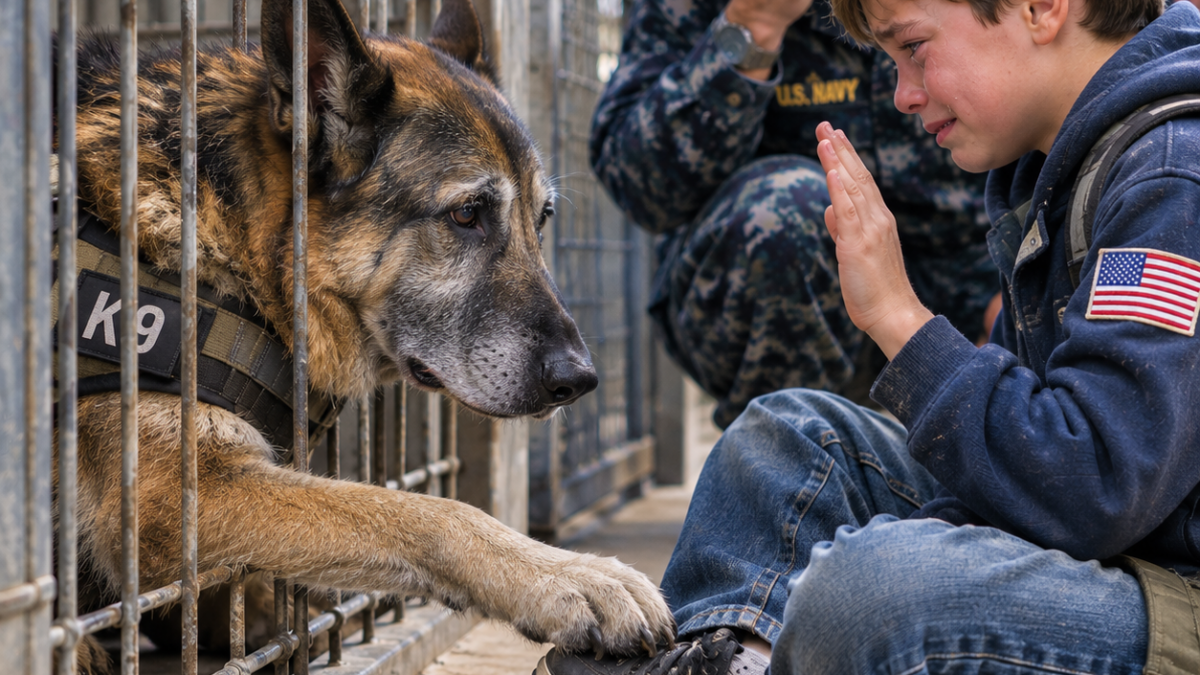
Then eight-year-old Noah Bennett arrived carrying the battered blue lunchbox his father used to take on duty, sat silently outside Ranger’s kennel, and did something none of the adults had been willing to try—he stopped asking the grieving dog to move on.
But when Ranger finally crawled forward, rested one paw on the boy’s shoe, and obeyed a hand signal nobody at the base knew Noah had learned, the people watching realized Sergeant Ethan Bennett had left something behind for his son and his dog that none of them yet understood.
At 5:42 every morning, Ranger stood up.
Not 5:40.
Not 5:45.
Exactly 5:42.
Master Sergeant Luke Serrano had checked the security footage three times because he thought the kennel technicians were exaggerating.
They were not.
Every morning, the old Belgian Malinois rose from the rubber mat in the back corner of Kennel Twelve, walked stiffly to the chain-link door, and stared down the concrete aisle toward the eastern gate.
Then he waited.
Sometimes for twenty minutes.
Sometimes for nearly an hour.
His ears stayed raised.
His body stayed still.
His eyes remained fixed on the gate.
That was where Sergeant First Class Ethan Bennett used to appear.
For seven years, Ethan had arrived at almost exactly the same time.
5:42.
Coffee in his left hand.
Blue insulated lunchbox in his right.
Ranger would hear the gate latch before anyone else did.
His entire body would change.
Tail moving.
Ears forward.
Front paws bouncing once against the kennel floor despite years of training that had supposedly taught him better discipline.
Ethan would walk toward him and say the same thing every morning.
“Morning, trouble.”
And Ranger would sneeze.
Nobody knew why.
Ethan had always insisted it was the dog’s way of answering.
Now Ethan was dead.
And Ranger was still waiting.
On the nineteenth morning, Luke Serrano stood outside Kennel Twelve with a bowl of warm chicken and rice.
He had tried kibble.
Ground beef.
Canned food.
Turkey.
Cheese.
Broth.
Eggs.
Peanut butter.
Even pieces of steak from his own refrigerator.
Ranger ignored all of it.
PART2:
The veterinarian had started subcutaneous fluids three days earlier.
If the dog continued refusing food, they would have to sedate him and place a feeding tube.
Luke hated the idea.
Ranger hated sedation.
Ethan had hated it too.
“Come on, buddy.”
Ranger did not turn.
Luke set the bowl down.
“Just a little.”
Nothing.
“You’re being an ass.”
One ear flicked.
Luke almost smiled.
“There you are.”
Ranger still did not look at him.
Luke crouched outside the kennel.
At forty-four, Luke had spent more than half his life in the Army.
He had seen men grieve.
PART3:
He had seen soldiers stare at empty bunks for weeks after losing friends.
He had seen handlers sleep beside kennel runs after their dogs died.
He had seen dogs become restless after handlers transferred away.
But this was different.
Ranger was not confused about Ethan’s absence.
He knew.
Luke was convinced of that.
The dog had been there when Ethan died.
Three weeks earlier, Ranger and Ethan had been conducting a training demonstration for a new group of military police when Ethan collapsed.
One second he was standing beside Ranger.
The next he was on the ground.
No explosion.
No gunfire.
No dramatic final mission.
A ruptured cerebral aneurysm.
Thirty-seven years old.
Healthy enough to run five miles before breakfast.
Dead before the ambulance reached the hospital.
Ranger had ridden beside the stretcher to the gate.
He was not allowed inside the ambulance.
The dog had lunged against his leash as the doors closed.
He barked until the ambulance disappeared.
Then he sat.
And waited.
Ethan never came back.
For two days Ranger searched every familiar place.
Training yard.
Equipment room.
Vehicle bay.
Kennel office.
He sniffed Ethan’s locker.
He lay beneath Ethan’s chair.
On the third day, he stopped searching.
On the fourth, he stopped eating.
Luke sat outside the kennel now.
“Ethan would be mad at both of us.”
Ranger’s ears moved.
Luke swallowed.
“I know.”
He rubbed his eyes.
“I know.”
Footsteps sounded behind him.
Captain Mara Collins, the base veterinarian, approached carrying a clipboard.
“How much?”
Luke shook his head.
“Nothing.”
Mara looked at the bowl.
“Water?”
“A little.”
She exhaled.
“We can’t keep doing this.”
“I know.”
“His labs are getting worse.”
“I know.”
“Luke.”
He looked at her.
“If he hasn’t eaten by tonight, I’m placing the tube.”
Luke’s jaw tightened.
“He’ll fight it.”
“He’ll be sedated.”
“That’s what I’m afraid of.”
Mara crouched beside him.
“His kidneys don’t care what we’re afraid of.”
Luke stared at Ranger.
The dog had lost nearly eleven pounds.
His hips looked sharper.
His ribs had begun to show.
“This isn’t medical,” Luke whispered.
Mara nodded.
“I know.”
“He’s waiting.”
“I know.”
“How do you treat that?”
Mara had no answer.
At 10:18 that morning, a black SUV stopped outside the kennel facility.
Luke saw it from the office.
His stomach dropped.
He recognized the woman who stepped out.
Claire Bennett.
Ethan’s wife.
Widow, he corrected himself.
The word still felt obscene.
Claire was thirty-five.
Brown hair tied behind her neck.
No makeup.
Dark circles beneath her eyes.
She wore jeans and one of Ethan’s gray Army hoodies, sleeves pulled over her hands.
A small boy climbed out of the passenger side.
Noah.
Eight years old.
Luke had met him dozens of times.
Ethan brought him to family days.
Christmas gatherings.
Barbecues.
Noah had inherited his father’s narrow face, dark eyes, and habit of looking directly at adults instead of glancing toward the floor.
But something was different now.
The boy looked smaller.
He carried a blue lunchbox.
Luke’s chest tightened.
He knew that lunchbox.
Everyone did.
It was ugly.
Hard plastic.
Faded navy blue.
One corner repaired with silver duct tape.
A cartoon astronaut sticker Noah had put on it when he was five.
Ethan had carried it every day.
Luke opened the door.
“Claire.”
She gave him a tired smile.
“Hey.”
Luke looked at Noah.
“Hey, bud.”
“Hi, Sergeant Luke.”
“You don’t have to call me Sergeant.”
Noah shrugged.
“Dad did.”
Luke almost lost it right there.
Claire noticed.
She touched his arm.
“How is he?”
Luke glanced toward the kennel corridor.
“No change.”
“He still won’t eat?”
“No.”
Noah looked toward the building.
“Can I see him?”
Claire immediately said, “Honey—”
Luke asked, “You sure?”
Noah nodded.
“He’s waiting for Dad.”
Luke felt Claire stiffen.
Noah continued.
“I know Dad isn’t coming.”
Claire turned away.
The simplicity of the sentence was worse than crying.
Luke crouched so he was at Noah’s level.
“Ranger might act different.”
“He won’t hurt me.”
“I know.”
“He likes me.”
“He does.”
Noah tightened his grip on the lunchbox.
Luke noticed.
“Why’d you bring that?”
The boy looked down.
“Because Ranger knows it.”
Claire pressed her lips together.
Luke stepped aside.
“Okay.”
The kennel aisle smelled of disinfectant, wet concrete, dog food, and the faint metallic scent common to working-dog facilities.
Several dogs barked as they passed.
Noah flinched at the noise but kept walking.
When they reached Kennel Twelve, Ranger was still facing the gate.
Noah stopped.
For several seconds nobody spoke.
Claire covered her mouth.
She had not seen the dog since Ethan’s death.
Ranger looked old.
Older than three weeks should have made him.
“Ranger,” she whispered.
The dog’s ears moved.
He did not turn.
Claire’s eyes filled.
Luke said softly, “He does that.”
Noah stepped closer.
“Mom?”
“Yes?”
“Can I sit down?”
Claire hesitated.
“Outside the kennel.”
“I know.”
Noah lowered himself onto the concrete.
He placed the blue lunchbox beside his knee.
Ranger’s head turned.
Everybody froze.
It was the first immediate reaction Luke had seen from him in days.
Ranger stared at the lunchbox.
His nostrils moved.
Noah did not call him.
Did not reach through the fence.
Did not tap the door.
He simply pulled the lunchbox into his lap.
The latch clicked.
Ranger stood.
Luke’s breath caught.
Noah opened the lid.
Inside was a turkey sandwich cut diagonally.
Apple slices.
A small bag of pretzels.
Chocolate pudding.
And a folded napkin.
Claire stared.
“You packed that?”
Noah nodded.
“When?”
“This morning.”
“That’s your dad’s lunch.”
Noah looked confused.
“It’s what he always had.”
Claire closed her eyes.
Ethan had eaten almost exactly the same lunch for years.
Turkey.
Apples.
Pretzels.
Pudding if Noah packed it.
Noah removed half the sandwich.
Ranger took one step forward.
Luke whispered, “Jesus.”
Noah held the sandwich but did not offer it through the fence.
Instead, he took a bite.
Chewed.
Swallowed.
Then he placed another small piece on his napkin.
Ranger approached the gate.
Slowly.
His paws dragged slightly.
He reached the chain link.
Noah looked at him.
“Hi, Ranger.”
The dog’s nose touched the fence.
Noah’s lower lip trembled.
“You miss him too?”
Ranger made a soft sound.
Not a whine exactly.
Something deeper.
Claire turned her face away and started crying silently.
Noah put the food down.
He still did not reach toward Ranger.
“I miss him all the time.”
The dog lowered himself onto his stomach.
Then, slowly, Ranger slid one paw beneath the gap at the bottom of the kennel door.
It touched Noah’s shoe.
The boy stopped breathing.
Luke felt every hair rise on his arms.
Noah looked down.
Then back at Ranger.
And with his right hand, he made a small movement.
Two fingers extended.
Palm angled inward.
A quick downward turn.
Ranger’s head lifted.
Luke frowned.
He knew every standard command Ethan used with that dog.
That was not one of them.
Noah repeated it.
Ranger immediately rolled from his chest into a precise down position, head resting flat between his paws.
Luke stared.
“What was that?”
Noah looked over.
“A quiet command.”
Luke’s face changed.
“A what?”
“The quiet one.”
“Who taught you that?”
“Dad.”
Claire looked at her son.
“When?”
Noah shrugged.
“When we practiced.”
“You practiced with Ranger?”
“Not really.”
Noah looked through the fence.
“Dad practiced with me.”
Luke slowly crouched.
“What else did he teach you?”
Noah’s hand moved again.
A closed fist.
Then open palm.
Ranger lifted his head.
Another small gesture.
Ranger touched his nose to the fence.
Luke stood frozen.
Those were not standard kennel commands.
They were private signals.
Ethan’s.
Claire whispered, “Why would Ethan teach those to Noah?”
Luke did not know.
But Ranger knew them.
And suddenly the dog’s grief seemed to have found a language.
Noah picked up a piece of turkey.
He put it on the concrete outside the fence.
Then he slid it beneath.
Ranger sniffed it.
Everybody watched.
The dog looked at Noah.
Noah made one more gesture.
Thumb against his chest.
Two fingers forward.
Luke knew that one.
Not from formal training.
From Ethan.
It meant trust me.
Ranger ate the turkey.
Claire sobbed.
Mara, standing silently at the far end of the corridor, covered her mouth.
Luke felt his knees weaken.
Nineteen days.
Hundreds of attempts.
Veterinary diets.
Hand feeding.
Bribes.
Commands.
Nothing.
An eight-year-old boy had sat down with a battered lunchbox and asked for nothing.
Ranger ate another piece.
Then another.
Noah smiled for the first time since entering the building.
“You’re hungry.”
Ranger sneezed.
Noah laughed.
It sounded so much like Ethan’s laugh that Luke had to turn away.
The story should have ended there.
A grieving boy.
A grieving dog.
A lunchbox.
A small miracle.
But three minutes later Noah said something that changed everything.
“Dad said Ranger was supposed to come home with us.”
Claire froze.
Luke turned back.
“What?”
Noah looked surprised.
“Dad told me.”
Claire crouched beside him.
“When?”
“Before he died.”
“How long before?”
Noah thought.
“The night before.”
Claire stared at him.
Luke felt something tighten in his chest.
“What exactly did your dad say?”
Noah looked at Ranger.
“He said Ranger was done working soon.”
Luke nodded slowly.
The dog had been scheduled to retire in four months.
That part was true.
“And?”
“He said when Ranger came home, I had to remember the signals.”
Claire asked, “Why didn’t you tell me?”
Noah’s forehead wrinkled.
“I thought you knew.”
Claire sat back on her heels.
No.
She had not known.
She knew Ethan wanted Ranger after retirement.
They had discussed it.
Argued about the cost of fencing the backyard.
Joked about Ranger stealing the couch.
But Ethan had never told her the retirement process had been finalized.
Luke looked uncomfortable.
“Claire.”
She turned.
“What?”
“There’s something you need to know.”
Her expression hardened immediately.
“What?”
“Ranger’s retirement placement hasn’t been approved.”
“What do you mean?”
“Ethan submitted the request.”
“And?”
“It was still pending when he died.”
Claire looked at the dog.
“Then approve it.”
Luke said nothing.
Her eyes narrowed.
“Luke.”
“It’s not entirely my decision.”
“He was Ethan’s dog.”
“Legally, he belongs to the government until disposition.”
Claire’s grief changed shape.
For the first time since she arrived, anger appeared.
“So what happens?”
Luke hated the answer.
“He may be evaluated for reassignment.”
Claire stared.
“You’re kidding.”
“He’s still technically serviceable.”
“He hasn’t eaten in nineteen days.”
“I know.”
“My husband died in front of him.”
“I know.”
“He’s almost nine years old.”
“I know.”
“And somebody thinks he should go work for another handler?”
Luke looked away.
Claire stood.
“No.”
“Claire—”
“No.”
Noah looked between them.
“Mom?”
She immediately softened.
“It’s okay, honey.”
She turned back to Luke.
“He comes home with us.”
“I want that too.”
“Then make it happen.”
“I’ll try.”
Claire stepped closer.
“You don’t understand.”
“I do.”
“No.”
Her voice broke.
“You got to say goodbye.”
Luke’s expression changed.
She continued.
“You were at the hospital. You saw Ethan.”
“I know.”
“Noah and I saw a flag-covered casket.”
Luke swallowed.
“Claire—”
“Ranger was the last living thing with my husband when he was still conscious.”
She pointed toward the kennel.
“And now you’re telling me some paperwork might take him away too?”
Luke’s eyes filled.
“I won’t let that happen.”
Claire stared.
“Don’t promise my son something you can’t control.”
That hurt because it was true.
The paperwork moved faster after Ranger began eating.
But not in the direction Claire expected.
Three days later, Colonel Marcus Wade called Luke into his office.
Wade was deputy commander of the base security unit.
Fifty-two.
Career officer.
Formal.
Intelligent.
Not cruel.
But profoundly loyal to process.
He had also never been a dog handler.
Luke sat across from him.
Wade closed a folder.
“I reviewed Ranger’s record.”
“And?”
“Exceptional health before the Bennett incident.”
Luke’s jaw tightened at the phrase.
Incident.
As though Ethan had been a scheduling problem.
“His weight is stabilizing.”
“Barely.”
“He responded appropriately during yesterday’s evaluation.”
“He responded to Noah.”
“He responded to commands.”
“From an eight-year-old kid.”
Wade leaned back.
“That’s actually part of the concern.”
Luke frowned.
“What concern?”
“Attachment.”
Luke stared.
Wade continued.
“If the dog is overly bonded to the Bennett family, placement may complicate future service.”
Luke almost laughed.
“Future service?”
“He’s under retirement age for his classification.”
“By four months.”
“Four months is four months.”
“He’s grieving.”
“Dogs recover.”
Luke’s face hardened.
“Do they?”
Wade noticed the tone.
“Master Sergeant.”
“Sir.”
“We have a shortage of experienced detection dogs.”
“And?”
“Ranger is worth more than seventy thousand dollars in training investment.”
Luke felt his anger rise.
“He’s not a truck.”
“I didn’t say he was.”
“You gave me his price.”
“I gave you the institutional reality.”
Luke leaned forward.
“Here’s another reality. Ethan Bennett worked that dog for seven years. Ranger watched him die. He stopped eating. The only person he has responded to naturally is Ethan’s son.”
Wade nodded.
“I understand the emotional argument.”
“No, sir.”
Luke’s voice was quiet.
“You understand the paperwork around the emotional argument.”
Wade’s face changed.
Silence.
Luke realized he had gone too far.
He did not care.
Wade reopened the folder.
“There’s another issue.”
“What?”
“Captain Harlan submitted an interest request.”
Luke stared.
“For Ranger?”
“Yes.”
Luke leaned back.
Staff Sergeant Derek Harlan was a highly rated handler from another unit.
Good soldier.
Technically skilled.
Ambitious.
He had been asking about Ranger for years.
Ethan disliked him.
Not because Harlan abused dogs.
He did not.
But because he treated them as equipment.
Performance first.
Bond second.
Maybe third.
Luke asked, “Who gave him permission?”
“He doesn’t need permission to request assignment.”
“Ethan would never have wanted that.”
“Ethan is not here.”
The sentence hung between them.
Wade regretted it immediately.
Luke stood.
“Permission to leave, sir.”
“Luke.”
“Sir?”
Wade rubbed his forehead.
“I knew Ethan too.”
“Then act like it.”
Luke walked out.
That afternoon Noah returned.
This time he brought the lunchbox and a notebook.
He sat outside Ranger’s kennel doing math homework while the dog ate from his own bowl.
Luke watched from the office.
Noah never begged Ranger to come closer.
Never tried to turn him into a pet.
He simply existed near him.
Ranger ate.
Then lay beside the fence with his head as close to Noah as the chain link allowed.
Claire arrived later.
She looked exhausted.
“School okay?”
Luke asked.
She nodded.
“He punched a kid yesterday.”
Luke looked toward Noah.
“What happened?”
“The boy said Ethan died because soldiers die.”
Luke winced.
“What did Noah say?”
“He said his dad wasn’t killed in war.”
“And?”
Claire smiled without humor.
“The boy said then he wasn’t a hero.”
Luke looked down.
“What did Noah do?”
“You know.”
“Yeah.”
Claire crossed her arms.
“He’s never hit anyone before.”
“Kids can be brutal.”
“So can adults.”
Luke looked at her.
She took a folded letter from her purse.
The military had denied immediate family placement.
Not permanently.
Temporarily.
Pending a sixty-day operational reassessment.
Luke read it.
His face darkened.
“Sixty days?”
Claire nodded.
“They want to see whether Ranger can return to duty.”
“I’ll appeal.”
“I already did.”
He looked at her.
“How?”
“Ethan taught me paperwork.”
That almost made Luke smile.
Claire continued.
“I also called our congresswoman’s office.”
Luke blinked.
“You what?”
“And three veteran organizations.”
“Claire.”
“What?”
He smiled despite himself.
“Nothing.”
She looked through the glass toward Noah.
“He learned stubbornness from his father.”
“So did you.”
“I married it.”
Over the next two weeks, Ranger improved.
Physically.
Emotionally was harder to measure.
He ate when Noah visited.
He sometimes ate when Luke fed him afterward.
He began walking the training yard again.
But every morning at 5:42, he still stood at the gate.
Waiting.
Noah asked Luke about it one Saturday.
“Why does he still do that?”
Luke crouched.
“Routine.”
“He knows Dad died.”
“Yes.”
“Then why wait?”
Luke thought about the question.
“Maybe knowing something and accepting it are different.”
Noah stared at Ranger.
“Mom does that.”
Luke looked at him.
“What do you mean?”
“She still puts Dad’s coffee cup out sometimes.”
Luke swallowed.
Noah kicked lightly at the concrete.
“I still listen for his garage door.”
Luke sat beside him.
For a while neither spoke.
Then Noah said, “Do you?”
Luke nodded.
“Sometimes I reach for my phone to text him.”
“What do you text?”
“Usually something stupid.”
Noah smiled.
“Dad liked stupid things.”
“He was excellent at them.”
Noah laughed softly.
Ranger turned at the sound.
His tail moved.
Luke noticed.
Noah did too.
The boy lifted his hand.
One of Ethan’s private signals.
Ranger came forward.
Luke asked, “How many signals did your dad teach you?”
Noah thought.
“Maybe twelve.”
“Twelve?”
“He said dogs understand your body before your mouth.”
Luke stared.
That sounded exactly like Ethan.
“When did he teach you?”
“In the backyard.”
“With Ranger?”
“No. Ranger couldn’t come home yet.”
Noah demonstrated.
“Dad pretended to be Ranger.”
Luke burst out laughing.
Noah grinned.
“He was bad at it.”
“I bet.”
“He crawled around.”
“That I would’ve paid to see.”
Noah’s smile faded.
Then he opened the notebook.
“Dad wrote some down.”
Luke’s laughter stopped.
“What?”
Noah pulled out a folded piece of paper tucked inside the back cover.
The handwriting was Ethan’s.
Luke recognized it instantly.
Simple sketches.
Hand positions.
Brief notes.
COME.
DOWN.
WAIT.
CHECK.
QUIET.
HOME.
Luke stopped.
“Home?”
Noah pointed to a gesture.
Two fingers to the chest.
Open hand toward the ground.
“That one.”
“What does it mean?”
Noah looked at him like the answer was obvious.
“Home.”
Luke’s chest tightened.
“Show me.”
Noah stood outside the kennel.
He made the signal.
Ranger rose instantly.
Then walked to the kennel gate.
Not the aisle gate.
The exterior service door beyond it.
He sat facing outside.
Luke felt cold.
“Do it again.”
Noah repeated the gesture.
Ranger touched the exterior door with his paw.
Noah smiled.
“See?”
Luke took the paper.
At the bottom, in Ethan’s handwriting, were six words.
FOR NOAH, WHEN RANGER COMES HOME.
Luke stared at them for a long time.
That was more than sentiment.
It was intent.
He photographed the note and sent it to Claire.
Her reply came thirty seconds later.
Find me the original.
Noah already had it.
The appeal changed after that.
Ethan’s handwritten instruction became evidence that he intended Ranger to live with his family after retirement.
Still, Colonel Wade refused to bypass the evaluation process.
He had regulations to follow.
Harlan arrived two days later.
He was thirty-three.
Athletic.
Sharp uniform.
Confident without being overtly arrogant.
He walked toward Kennel Twelve carrying a tug toy and treats.
Ranger watched him.
Harlan crouched.
“Hey, old man.”
No reaction.
Luke stood nearby.
“Take it slow.”
“I know dogs.”
Luke’s jaw tightened.
“That’s not what I said.”
Harlan ignored the comment.
He opened the kennel.
Ranger did not resist.
Harlan clipped on a leash.
“Ranger. Heel.”
The dog stood.
He followed.
Technically perfect.
Luke hated that.
If Ranger performed well, command would have an argument for reassignment.
They moved to the training yard.
Harlan ran basic obedience.
Sit.
Down.
Stay.
Heel.
Ranger obeyed.
Then scent work.
Ranger found the training target.
Fast.
Clean.
Professional.
Colonel Wade watched from the observation deck.
So did Claire.
Noah stood beside her holding the blue lunchbox.
Harlan finished.
“He’s still got it.”
Luke said nothing.
Wade looked impressed.
“Excellent response.”
Claire stared at Ranger.
The dog stood beside Harlan.
Obedient.
But his eyes were on Noah.
Harlan noticed.
He repositioned Ranger.
The dog looked back.
“Ranger.”
The dog turned forward.
Noah whispered, “He doesn’t like him.”
Claire squeezed his shoulder.
“We don’t know that.”
“I know.”
Harlan unclipped the leash for a recall demonstration.
“Ranger, stay.”
He walked thirty yards.
Turned.
“Ranger, come.”
Ranger moved.
Halfway across the field, Noah dropped the lunchbox.
It hit the metal bench.
Clack.
Ranger stopped.
His head snapped around.
Harlan called again.
“Ranger!”
The dog looked toward Noah.
Then ran.
Not to Harlan.
To Noah.
He reached the fence and stopped directly below him.
Noah lowered his hand.
The home signal.
Ranger sat.
The entire field went silent.
Harlan’s face tightened.
“That kid interfered.”
Noah flinched.
Luke stepped between them.
“He dropped a lunchbox.”
“He gave the dog an unauthorized command.”
“He’s eight.”
“He compromised an evaluation.”
Claire stood.
“Don’t speak about my son like he’s a problem.”
Harlan looked at her.
“Ma’am, I’m talking about the dog.”
“No. You’re talking about my family.”
Wade stepped in.
“That’s enough.”
Harlan turned.
“Sir, this proves my point. The animal’s distracted by the family.”
Luke stared at him.
“Or bonded to them.”
“He’s a working dog.”
“He’s a grieving dog.”
“He’s government property.”
Noah’s face changed.
Claire moved toward him.
Luke stepped closer to Harlan.
“Don’t say that again in front of the kid.”
Harlan shrugged.
“It’s legally accurate.”
Luke’s voice dropped.
“So is the fact that Ethan Bennett died serving this unit. Accuracy isn’t the same thing as decency.”
Wade ended the evaluation.
The decision remained pending.
That evening Noah asked a question Claire had been dreading.
“Is Ranger Dad’s?”
She sat beside him on his bed.
“No.”
“Is he ours?”
“Not yet.”
“Then whose is he?”
Claire hated the answer.
“The Army’s.”
Noah stared at the wall.
“Can the Army miss him?”
Claire blinked.
“What?”
“If Ranger belongs to the Army, does the Army miss him when he’s sad?”
Claire’s eyes filled.
“Oh, honey.”
“Because if he belongs to us, we miss him.”
She pulled him into her arms.
Noah cried.
Quietly.
Angrily.
“I don’t want them to make him forget Dad.”
Claire held him tighter.
“They can’t.”
“What if he likes the other man?”
“That doesn’t mean he forgets Dad.”
“What if he stops waiting at the gate?”
Claire’s heart broke.
She understood then.
Noah did not want Ranger to heal.
Not completely.
Because Ranger’s waiting proved Ethan still mattered.
And somewhere inside Noah’s eight-year-old mind, healing had become betrayal.
She leaned back and looked at him.
“Listen to me.”
Noah wiped his face.
“Ranger eating does not mean he loves Dad less.”
Noah looked down.
“You going back to school doesn’t mean you love Dad less.”
Silence.
“And one day, when you laugh and don’t feel bad afterward, that won’t mean you love Dad less either.”
Noah’s lips trembled.
“Do you laugh?”
“Sometimes.”
“Does it feel bad?”
“Yes.”
“Why?”
Claire thought for a moment.
“Because grief is greedy.”
Noah looked up.
“What does that mean?”
“It tries to convince you that being sad is how you prove you loved someone.”
“Isn’t it?”
“No.”
She touched his cheek.
“Missing Dad is part of loving him.”
She smiled through tears.
“But so is remembering how funny he was.”
Noah smiled slightly.
“He snored.”
“Like a chainsaw.”
“And he burned pancakes.”
“Every Sunday.”
Noah laughed.
Claire did too.
Then they both cried again.
A week later, Ranger stopped waiting at the gate.
Luke noticed first.
5:42 came.
Ranger remained asleep.
5:45.
Still asleep.
Luke should have been relieved.
Instead he felt something like grief.
At 5:51, Ranger woke, stretched, walked to his food bowl, and ate.
Luke called Claire.
She was silent for a moment.
Then asked, “Is that good?”
“I think so.”
“What does Noah think?”
“I haven’t told him.”
“Don’t.”
Luke understood.
Claire wanted to tell him herself.
That afternoon Noah came.
He noticed immediately.
Ranger was not at the gate.
“Where was he this morning?”
Luke hesitated.
“Sleeping.”
Noah looked at the dog.
“He didn’t wait?”
“No.”
The boy went very still.
Luke braced himself.
Then Noah nodded.
“Okay.”
That was all.
He sat down.
Opened the lunchbox.
Ranger came over.
Noah gave the home signal.
This time the dog did something new.
He did not look toward the exterior door.
He lay beside Noah.
Luke felt a lump in his throat.
Home had changed meaning.
Three days before the final reassignment board, Claire received a call.
Not from the Army.
From an attorney.
Ethan’s attorney.
She almost hung up because she assumed it was spam.
Then the man said, “Mrs. Bennett, I’m calling regarding a document your husband filed approximately six weeks before his death.”
Claire sat down.
“What document?”
“A conditional transfer request concerning military working dog Ranger.”
Her heart started pounding.
“We know about the retirement request.”
“This is different.”
“What do you mean?”
“Your husband asked me to prepare a family assumption agreement.”
Claire stood.
“What?”
“He anticipated the dog’s retirement.”
“Why didn’t I know?”
“He specifically requested that it remain unsigned until the military disposition was approved.”
“Why?”
There was a pause.
“He wanted it to be a surprise.”
Claire covered her mouth.
Of course he did.
Ethan loved surprises.
Usually terrible ones.
Birthday breakfasts he ruined.
Weekend trips he accidentally revealed.
Christmas gifts hidden in places Noah found immediately.
“Did Ethan sign anything?”
“Yes.”
Claire stopped breathing.
The attorney continued.
“He executed a letter of intent and veterinary financial assumption.”
“Meaning?”
“He committed to personally covering Ranger’s post-retirement care.”
Claire’s eyes filled.
“But Ethan is dead.”
“Yes.”
“Then the document is useless.”
“Not necessarily.”
“Why?”
“Because he named a secondary responsible party.”
Claire stared at the wall.
“Who?”
“You.”
The packet arrived electronically fifteen minutes later.
Claire read it three times.
Ethan’s signature.
Her name.
Noah’s name listed as household family.
A home assessment request.
Veterinary plan.
Even a fenced-yard estimate.
And one handwritten note attached to the attorney’s copy.
If anything happens to me before Ranger retires, please help Claire finish this. He’s family. She’ll pretend to argue about the couch. Ignore her.
Claire laughed so hard she started sobbing.
That evening she drove to the kennel with the documents.
Luke read them.
Then read them again.
“You’ve got to be kidding me.”
Claire wiped her face.
“He planned everything.”
Luke smiled.
“Ethan planned nothing.”
“He planned this.”
“He once forgot his own anniversary.”
“Twice.”
“Three times.”
Claire stared.
“Three?”
Luke realized his mistake.
“Forget I said that.”
Despite herself, Claire laughed.
The reassignment board convened Friday morning.
Colonel Wade chaired it.
Veterinary staff attended.
Legal counsel.
Working-dog program representatives.
Harlan.
Luke.
Claire.
Noah was not allowed in the room.
He waited outside with Ranger.
The discussion lasted ninety minutes.
Harlan argued that Ranger remained operationally capable.
His performance scores supported continued service.
The program representative agreed there was legitimate value in reassignment.
Luke countered with behavioral records.
Nineteen days without food.
Attachment distress.
Age.
Retirement already scheduled.
Mara provided veterinary evidence.
Ranger could continue limited duty.
But physically, retirement was reasonable.
Then Claire presented Ethan’s documents.
The room changed.
The legal officer read the letter of intent.
Wade leaned back.
Harlan looked irritated.
“This still doesn’t override mission needs.”
Claire looked at him.
“No.”
She folded her hands.
“But maybe it should remind everyone what the mission is supposed to serve.”
Harlan frowned.
“What’s that supposed to mean?”
“My husband gave this organization fifteen years.”
Her voice stayed calm.
“He deployed four times.”
She looked around the table.
“He missed birthdays.”
“Christmas.”
“Noah’s first day of kindergarten.”
“He came home with scars he refused to explain.”
She paused.
“And every morning, that dog went to work with him.”
Her eyes moved toward the door.
“When Ethan died, Ranger didn’t understand personnel shortages.”
“He didn’t understand operational readiness.”
“He understood that his person left and never came back.”
Harlan looked away.
Claire continued.
“My son understands exactly the same thing.”
Silence.
“I’m not asking you to give us expensive government property because we’re sad.”
She hated the phrase but used it deliberately.
“I’m asking you to recognize that Ethan had already prepared for Ranger’s retirement, accepted the responsibility, documented his intent, and taught his son how to communicate with the dog because he believed Ranger would become part of our family.”
She placed the handwritten signal sheet on the table.
“He prepared Noah for Ranger.”
Her voice cracked.
“He just didn’t know Noah would need Ranger without him.”
Nobody spoke.
Wade closed the folder.
The decision did not come immediately.
They recessed.
Outside, Noah sat on the floor beside Ranger.
The blue lunchbox rested between them.
Ranger’s head was in his lap.
Harlan walked past.
Noah looked up.
“Are you taking him?”
Harlan stopped.
For once, the confident handler had no quick answer.
“I don’t know.”
Noah rubbed Ranger’s ear.
“He’s good at working.”
“Yes.”
“My dad said he was the best.”
“He is.”
Noah looked at him.
“But he’s tired.”
Harlan stared at Ranger.
The dog’s muzzle had started turning gray.
Noah asked, “Do dogs know when they’re retired?”
Harlan almost smiled.
“Probably not like we do.”
“Then how does he know he can stop working?”
Harlan looked at the boy.
“I guess someone has to show him.”
Noah nodded.
Then did something nobody expected.
He reached into the lunchbox.
Pulled out half a turkey sandwich.
Held it toward Harlan.
“Do you want some?”
Harlan blinked.
“Why?”
“I packed too much.”
The man looked toward Claire.
She said nothing.
Harlan accepted it.
“Thanks.”
Noah nodded.
They sat in awkward silence.
Eventually Harlan said, “Your dad was a good handler.”
Noah looked at him.
“You knew him?”
“A little.”
“Did you like him?”
Harlan smiled faintly.
“Not always.”
Noah frowned.
“Why?”
“Because he thought he was right a lot.”
Noah nodded seriously.
“He did.”
Harlan almost laughed.
“He also cared about Ranger more than most handlers care about anything.”
Noah stroked the dog’s head.
“Dad said Ranger saved him.”
Harlan looked at the boy.
“When?”
“In Afghanistan.”
Harlan had heard the story.
An IED buried near a culvert.
Ranger alerted seconds before Ethan stepped into the kill zone.
The blast came anyway.
Farther away.
It wounded Ethan but did not kill him.
Ranger had dragged him several feet by his vest before the rest of the team reached them.
“Yeah,” Harlan said quietly.
“He did.”
Noah looked at Ranger.
“Then Dad was supposed to save him after work.”
Harlan stared at the sandwich in his hand.
Something inside him shifted.
When the board reconvened, Harlan withdrew his request.
Wade looked surprised.
“Staff Sergeant?”
Harlan stood.
“I no longer believe reassignment serves the dog.”
Luke watched him carefully.
“What changed?”
Harlan glanced toward the door.
“Additional observation.”
Wade knew that was not the whole answer.
He did not ask.
The board voted.
Four to one.
Retirement approved.
Family placement approved.
Effective immediately.
Claire closed her eyes.
Luke exhaled so hard it sounded like laughter.
Mara cried openly.
Wade looked at Claire.
“Mrs. Bennett.”
She opened her eyes.
“Ranger is yours.”
Claire shook her head.
“No.”
Wade frowned.
She smiled through tears.
“He’s Noah’s.”
Outside, Noah sat exactly where they had left him.
Ranger beside him.
Claire walked toward them.
Noah stood immediately.
“What happened?”
She crouched.
“Remember what Dad said?”
“What?”
“That Ranger would come home?”
Noah stared.
Claire smiled.
“He was right.”
The boy’s face crumpled.
“Today?”
“Today.”
Noah threw himself into her arms.
Ranger stood.
His tail started moving.
Luke opened the kennel facility’s outer gate.
The same gate Ranger had stared at every morning for nineteen days.
Noah turned toward him.
“Can I do it?”
Luke nodded.
Noah wiped his face.
He stepped in front of Ranger.
Then raised his hand.
Two fingers to his chest.
Open palm toward the parking lot.
Home.
Ranger looked at him.
For one second, the old dog did not move.
Everyone watched.
Then he walked.
Past Luke.
Past Harlan.
Past Colonel Wade.
Through the gate.
He stopped beside Noah.
Noah placed one hand on Ranger’s neck.
“Good boy.”
Ranger sneezed.
Luke laughed through tears.
“Your dad was right.”
Noah looked at him.
“About what?”
“He really does answer.”
The first night at the Bennett house was difficult.
Ranger searched every room.
He sniffed Ethan’s boots by the mudroom.
His jacket.
His chair.
His side of the bed.
Claire watched from the hallway.
Ranger entered the bedroom.
Walked to Ethan’s side.
Sniffed the blanket.
Then lay down.
Claire sat on the floor.
“Yeah.”
Her voice broke.
“I know.”
Ranger looked at her.
Claire cried quietly.
“I keep expecting him too.”
The dog rested his head on the carpet.
She moved closer.
Not touching.
Just sitting.
Eventually Ranger shifted until his side pressed against her leg.
It was the first time he had sought her out.
Claire placed her hand on him.
“He loved you.”
Ranger’s ears moved.
“He loved us too.”
She leaned against the bed.
“I’m trying not to be angry about that.”
The dog sighed.
Claire laughed.
“You’re not much of a conversationalist.”
From the doorway, Noah said, “He listens.”
Claire looked up.
Noah carried the blue lunchbox.
“Why do you still have that?”
“I put Ranger’s treats in it.”
Claire smiled.
“Of course you did.”
Noah sat beside them.
For months, Ranger slept on the floor between Ethan’s side of the bed and the doorway.
Always facing the hall.
Always watching.
Eventually he moved to Noah’s room.
Not every night.
Only sometimes.
Then most nights.
Noah’s nightmares became less frequent.
So did Ranger’s pacing.
They developed routines.
At 6:30, Noah fed him.
After school, they walked two blocks.
Ranger’s hips prevented long distances.
Noah adjusted.
When the dog slowed, the boy slowed.
Noah never pulled.
Never rushed.
On hard days, they sat beneath the oak tree in the backyard.
Noah told Ranger about school.
About math.
About a girl named Emma who said his drawing looked like a potato.
About how he hated being called “the kid whose dad died.”
Ranger listened.
Sometimes that was enough.
Claire kept going too.
Grief did not disappear when Ranger moved in.
It changed shape.
There were still mornings she reached across the bed.
Still evenings she opened her phone to text Ethan.
Still moments when another father’s laugh at a school event made her chest ache.
But the house no longer felt completely abandoned.
Ranger carried traces of Ethan everywhere.
Not magically.
Not like a ghost.
In habits.
He waited beside the kitchen when coffee brewed.
Ethan had always given him one ice cube after pouring a cup.
Ranger stood near the garage door around 5:30 in the evening.
The time Ethan used to come home.
He slept beside Ethan’s boots during thunderstorms.
Claire could not explain that one.
Maybe Ethan had done the same overseas.
One afternoon she found Noah in the garage.
He was sitting beside a cardboard box.
Ethan’s uniforms.
Claire had not opened it since the funeral.
Ranger lay nearby.
Noah held one of Ethan’s shirts.
“Mom?”
“Yeah?”
“Can Ranger smell Dad on this?”
Claire’s throat tightened.
“Probably.”
Noah held it toward the dog.
Ranger sniffed.
Then pushed his nose deeper into the fabric.
His tail moved once.
Noah looked at Claire.
“He remembers.”
She nodded.
“Yes.”
“How long?”
She sat beside him.
“I don’t know.”
Noah hugged the shirt.
“I’m scared I’ll forget Dad’s voice.”
Claire’s eyes filled.
“You won’t forget all of it.”
“What if I do?”
“We have videos.”
“That’s not the same.”
“No.”
She nodded.
“It isn’t.”
Noah looked at Ranger.
“Does he forget voices?”
“Maybe.”
He frowned.
Claire touched his hand.
“But remembering someone isn’t only hearing their voice.”
“What is it?”
She thought.
“It’s the things they changed in you.”
Noah looked confused.
“Dad taught you those hand signals.”
“Yeah.”
“So every time you use one, part of something he taught you is still moving through the world.”
Noah looked at his hands.
Then at Ranger.
He made the home signal.
Ranger immediately came closer.
Noah smiled.
A year passed.
On the anniversary of Ethan’s death, Claire did not want a memorial ceremony.
She wanted pancakes.
Burned slightly.
Because Ethan always burned them.
Noah insisted.
Luke came over.
Mara came too.
Even Harlan showed up carrying a bag of dog treats.
Luke stared at him.
“You’re becoming soft.”
“Shut up.”
Ranger moved between everyone.
Older now.
Slower.
But happy.
After breakfast, Noah took the blue lunchbox outside.
He placed it beneath the oak tree.
Luke joined him.
“What’s in it?”
Noah opened the lid.
Turkey sandwich.
Apples.
Pretzels.
Pudding.
Luke smiled.
“You still do that?”
“Every year.”
“Why?”
Noah shrugged.
“It’s Dad’s lunch.”
Ranger lay beside him.
Noah broke off a small piece of turkey.
“Vet said he can have this.”
Luke nodded.
Ranger ate it.
Then placed one paw on Noah’s shoe.
Exactly as he had the first day.
Noah stared down.
Luke saw it too.
For a moment neither spoke.
Noah smiled.
“He still does that.”
Luke nodded.
“Yeah.”
“You think he remembers the kennel?”
“Probably.”
“You think he remembers waiting for Dad?”
Luke looked toward the house.
Claire stood at the kitchen window watching them.
“I think Ranger remembers a lot.”
Noah was nine now.
Still small.
But not the same little boy who had entered Kennel Twelve.
He looked at Luke.
“Do you think he was waiting because he thought Dad would come back?”
Luke took a long breath.
“At first.”
“And then?”
Luke watched Ranger.
The dog’s eyes were half closed in the sunlight.
“Then maybe he was waiting because he didn’t know where else to put his love.”
Noah looked at him.
Luke immediately felt embarrassed.
“That sounded stupid.”
“No.”
Noah rubbed Ranger’s neck.
“It sounds right.”
Years later, Noah would barely remember the funeral.
He would remember pieces.
A folded flag.
His mother’s hand crushing his.
People whispering.
Shoes.
So many polished black shoes.
He would remember adults telling him his father was brave.
He would remember hating the word brave because nobody could explain why brave people still died.
But he remembered Ranger.
Every detail.
The smell of the kennel.
The cold floor beneath his legs.
The click of the blue lunchbox.
Ranger’s ribs beneath his fur.
The paw sliding beneath the gate.
And the first time that old dog responded to the private signal his father had taught him in their backyard.
Home.
When Noah was twelve, Ranger developed cancer.
Claire saw the change first.
He stopped finishing breakfast.
Not refusing food like after Ethan died.
Different.
Slower.
Tired.
The veterinarian found a mass.
Aggressive.
Noah sat in the examination room listening to words he hated.
Treatment.
Months.
Comfort.
Quality of life.
He was old enough now to understand.
Young enough to hate everyone for making him understand.
In the parking lot, he kicked the tire of Claire’s car.
“Why?”
She stood beside him.
“I don’t know.”
“It’s not fair.”
“No.”
“Dad died.”
“I know.”
“And now Ranger?”
Claire cried.
“I know.”
Noah looked at her.
“Why does everything leave?”
She had no answer.
So she told the truth.
“I don’t know.”
Noah turned away.
Ranger stood beside the car.
Weak.
Waiting.
Noah looked at him.
Then crouched.
The dog came slowly.
Noah made the home signal.
Ranger leaned into him.
For six months, they managed his pain.
No aggressive procedures.
No endless hospital visits.
No fear.
They gave him chicken.
Short walks.
Sunlight.
The blue lunchbox remained beside his bed.
Luke visited often.
So did Harlan.
Ranger’s last day arrived in October.
The trees were turning red.
He could no longer stand without help.
Claire called Mara.
The same veterinarian who had threatened to place a feeding tube years earlier came to the house.
She sat on the floor and cried before she even opened her medical bag.
Noah was fourteen.
Almost as tall as Ethan had been.
He wore his father’s old hoodie.
Ranger lay beneath the oak tree.
The family could have stayed inside.
Noah wanted outside.
“That’s where Dad would sit.”
So they carried Ranger there on a blanket.
Luke arrived.
He did not say much.
There was nothing to say.
Claire sat on Ranger’s left.
Noah on his right.
Luke behind them.
Mara explained what would happen.
Noah nodded.
He understood.
He hated it.
But he understood.
Before Mara gave the medication, Noah said, “Wait.”
He ran inside.
Returned carrying the blue lunchbox.
The duct tape was peeling now.
The astronaut sticker almost completely faded.
He placed it beside Ranger.
Opened it.
Inside was a turkey sandwich.
Apple slices.
Pretzels.
Chocolate pudding.
Luke covered his face.
Claire started crying.
Noah broke a tiny piece of turkey.
Ranger sniffed it.
Could not eat.
“That’s okay.”
Noah placed the food down.
He stroked Ranger’s forehead.
“You don’t have to.”
Ranger’s breathing was slow.
Noah wiped his face.
“You waited for Dad.”
His voice trembled.
“Then you waited for me.”
Claire sobbed quietly.
Noah placed his shoe beside Ranger’s paw.
The dog could barely move.
Still, after a few seconds, one paw shifted.
It touched Noah’s shoe.
Noah broke completely.
He bent over Ranger.
“I love you.”
The dog breathed.
“I’m gonna be okay.”
Another breath.
“You can stop working.”
Luke’s shoulders shook.
Noah sat upright.
Then raised his right hand.
Two fingers to his chest.
Open palm forward.
The signal.
Home.
Ranger’s eyes followed the movement.
His ears barely lifted.
Noah whispered, “Home.”
Mara administered the medication.
Claire kissed Ranger’s head.
Luke put his hand on the dog’s shoulder.
Noah kept his hand raised.
Ranger exhaled.
Slowly.
Softly.
And did not breathe again.
For several minutes nobody moved.
The blue lunchbox sat open beside him.
Wind moved through the oak branches.
Somewhere down the street, children were playing.
A lawn mower started.
The world continued.
Noah hated it for continuing.
Then he looked at Ranger.
And remembered what his mother had told him years earlier.
Grief is greedy.
It tries to convince you sadness is how you prove you loved someone.
Noah lowered his hand.
Closed the lunchbox.
And whispered:
“Good boy.”
Ranger was cremated.
Half his ashes were placed beside Ethan at the national cemetery.
The other half stayed with Noah.
Luke arranged a small memorial at the working-dog facility.
No speeches from generals.
No cameras.
Just handlers.
Dogs.
Claire.
Noah.
Harlan.
Mara.
On Kennel Twelve, Luke installed a small brass plaque.
RANGER
MILITARY WORKING DOG
PARTNER OF SFC ETHAN BENNETT
FRIEND OF NOAH BENNETT
Below it, Noah asked them to engrave one more sentence.
HE WAITED UNTIL WE WERE READY TO GO HOME.
Years passed.
Noah grew.
The lunchbox remained in his room.
He never repainted it.
Never replaced the duct tape.
Never tried to make it look new.
At eighteen, Noah left for college.
Claire found him the night before departure sitting on the bedroom floor.
Ranger’s collar in one hand.
The lunchbox in the other.
“You okay?”
Noah nodded.
Then shook his head.
Then laughed.
“Maybe.”
Claire sat beside him.
“You know your dad would be unbearable right now.”
“Why?”
“He’d have mapped your entire drive.”
“He would’ve called every gas station.”
“And inspected your tires four times.”
Noah smiled.
“And Ranger would hate my dorm.”
“Ranger hated almost every room that wasn’t ours.”
Noah looked at the lunchbox.
“Mom?”
“Yeah?”
“I think I want to work with dogs.”
Claire smiled.
“I know.”
“How?”
“You’ve wanted to since you were eight.”
“I never said that.”
“You never had to.”
Noah eventually studied animal behavior.
Then veterinary rehabilitation.
Not military service.
Not because he rejected his father.
Because he wanted a different way to honor him.
He spent his career working with retired service dogs.
Police dogs.
Military dogs.
Search-and-rescue dogs.
Animals that had spent their lives working until suddenly someone expected them to understand retirement.
Some paced.
Some refused food.
Some waited by doors.
Some struggled when handlers died.
Whenever families asked Noah what to do, he never began with commands.
He began with patience.
“Don’t force them to forget,” he would say.
“Give them somewhere safe to remember.”
In his office sat a photograph.
Eight-year-old Noah outside Kennel Twelve.
Blue lunchbox open.
Ranger’s paw resting on his shoe.
People often asked about it.
Noah usually gave them the short version.
“My dad’s dog.”
Sometimes they asked why the lunchbox mattered.
Then he would smile.
“My dad carried it to work.”
That was enough.
But on certain days, when the person asking had recently lost someone, Noah told them more.
He told them about a military dog who stopped eating because his handler never came back.
About adults who tried every medical solution they could think of.
About a child who did not have a solution.
Only lunch.
Only grief.
Only time.
He told them that Ranger did not need someone to replace Ethan.
He needed someone willing to sit beside the empty place Ethan had left.
And eventually, when Noah was ready to say it, he told them what he came to understand as he grew older.
His father had not truly left him a dog.
And Ranger had not simply been given a new family.
Ethan had unknowingly left two grieving creatures to find each other.
One was a decorated military working dog trained to detect danger, follow commands, and protect a soldier.
The other was an eight-year-old boy who had no training at all for the hardest mission of his life.
Ranger taught Noah that grief could sit quietly beside you without needing to be fixed.
Noah taught Ranger that loving someone who was gone did not mean refusing everyone who remained.
And the small hand signal Ethan had once taught his son became something larger than a command.
Two fingers to the chest.
Open palm forward.
Home.
At eight years old, Noah believed it meant a house.
At fourteen, he believed it meant letting Ranger rest.
As an adult, he finally understood what his father had been trying to teach him.
Home was not the place where nobody ever left.
Home was the place where love was allowed to survive after they did.








